Delivering a Predictable Pipeline:
A B2B Revenue Ops Success Framework and Maturity Model
Matt Heinz | President, Heinz Marketing Inc | @heinzmarketing
HOUSEKEEPING
① Copy of this deck and research
② Freebies!
① Full Funnel Marketing (the book)
② Sales Velocity Calculator
③ KPI Metrics Architecture
④ Matt’s bacon recipe
③ Send me an email (matt@heinzmarketing.com)
or bring me a business card with what you
want!
Why is selling so hard today?
Is it how we sell? …. how they buy?
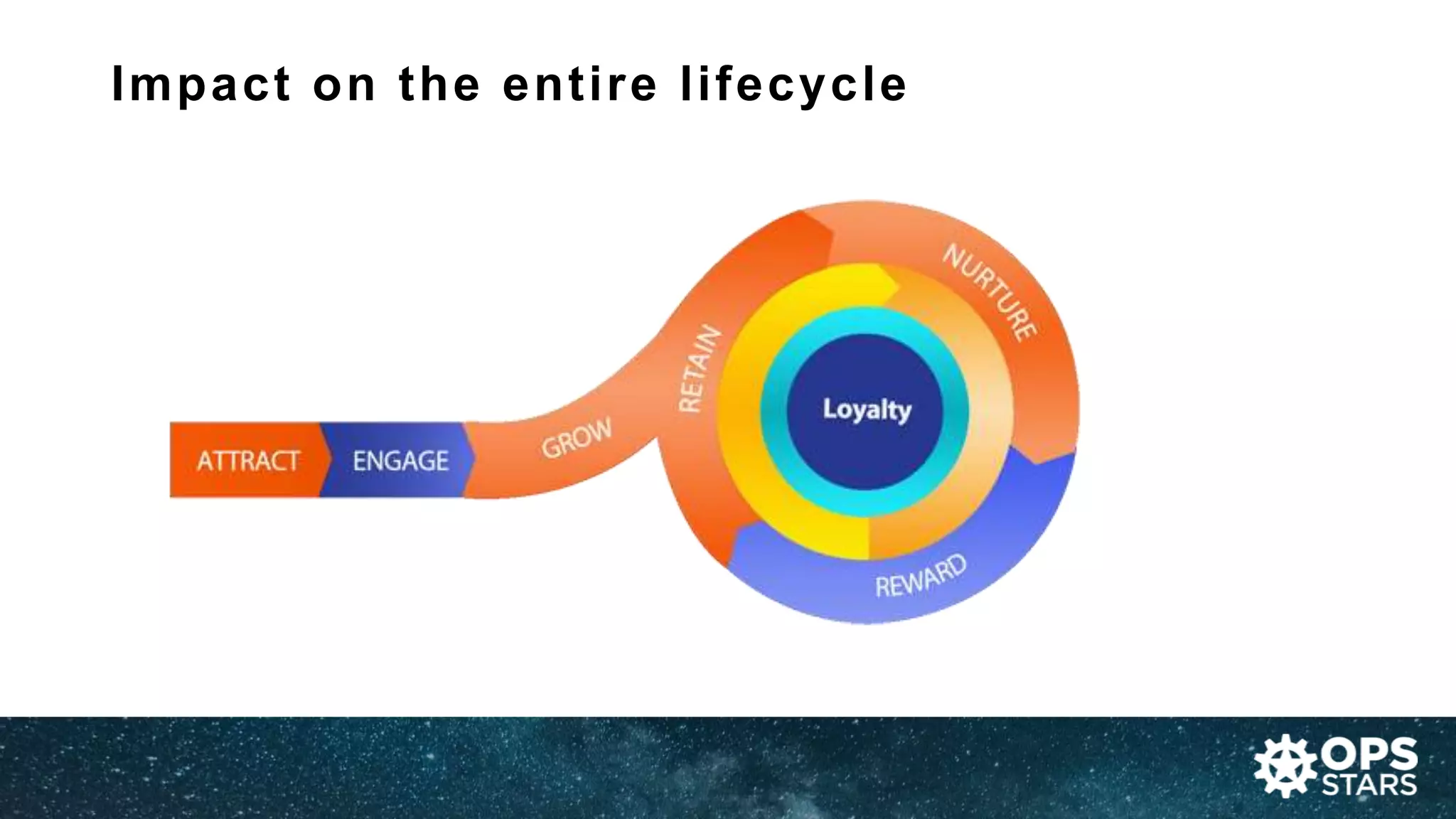
Impact on the entire lifecycle
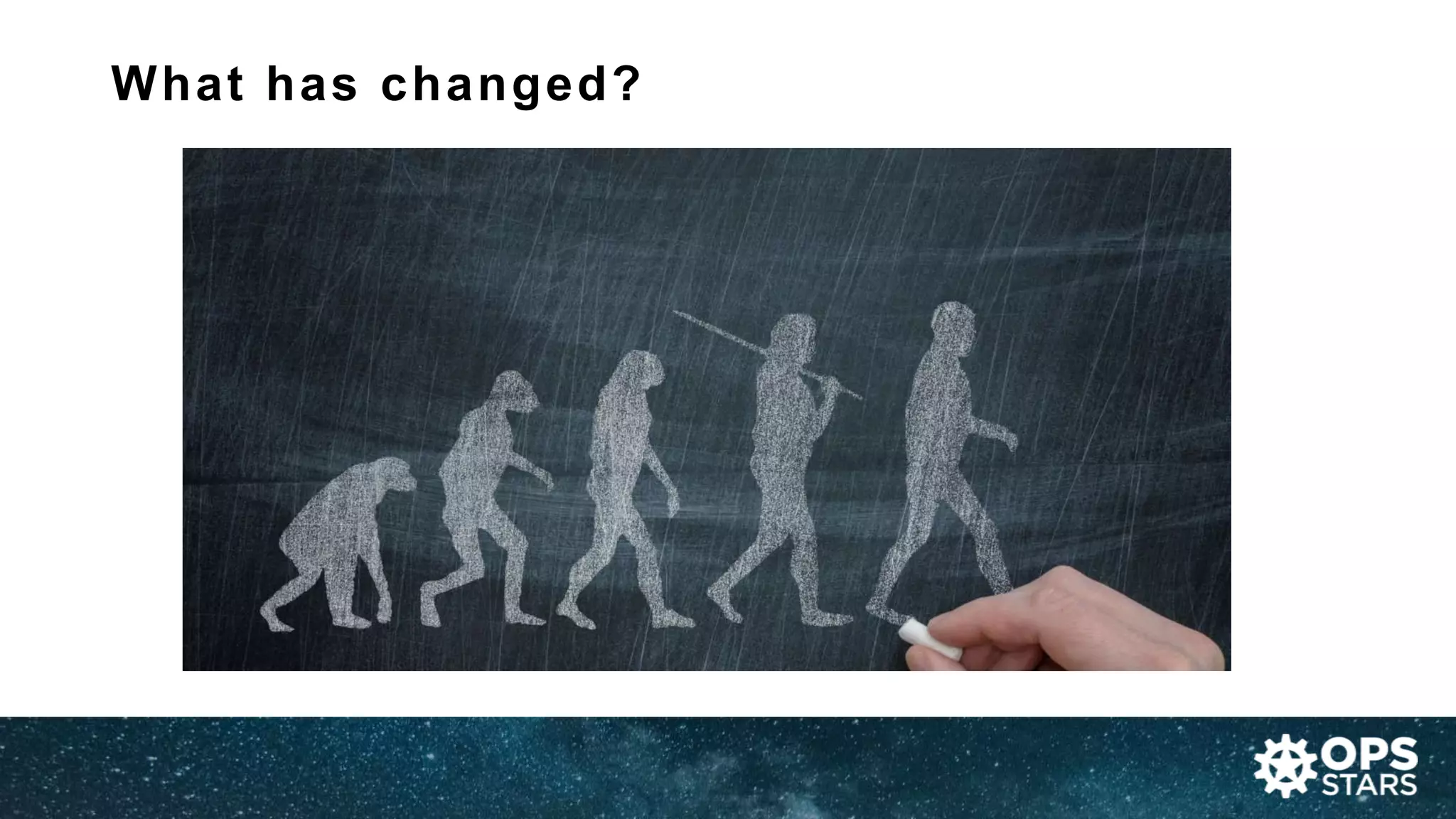
What has changed?
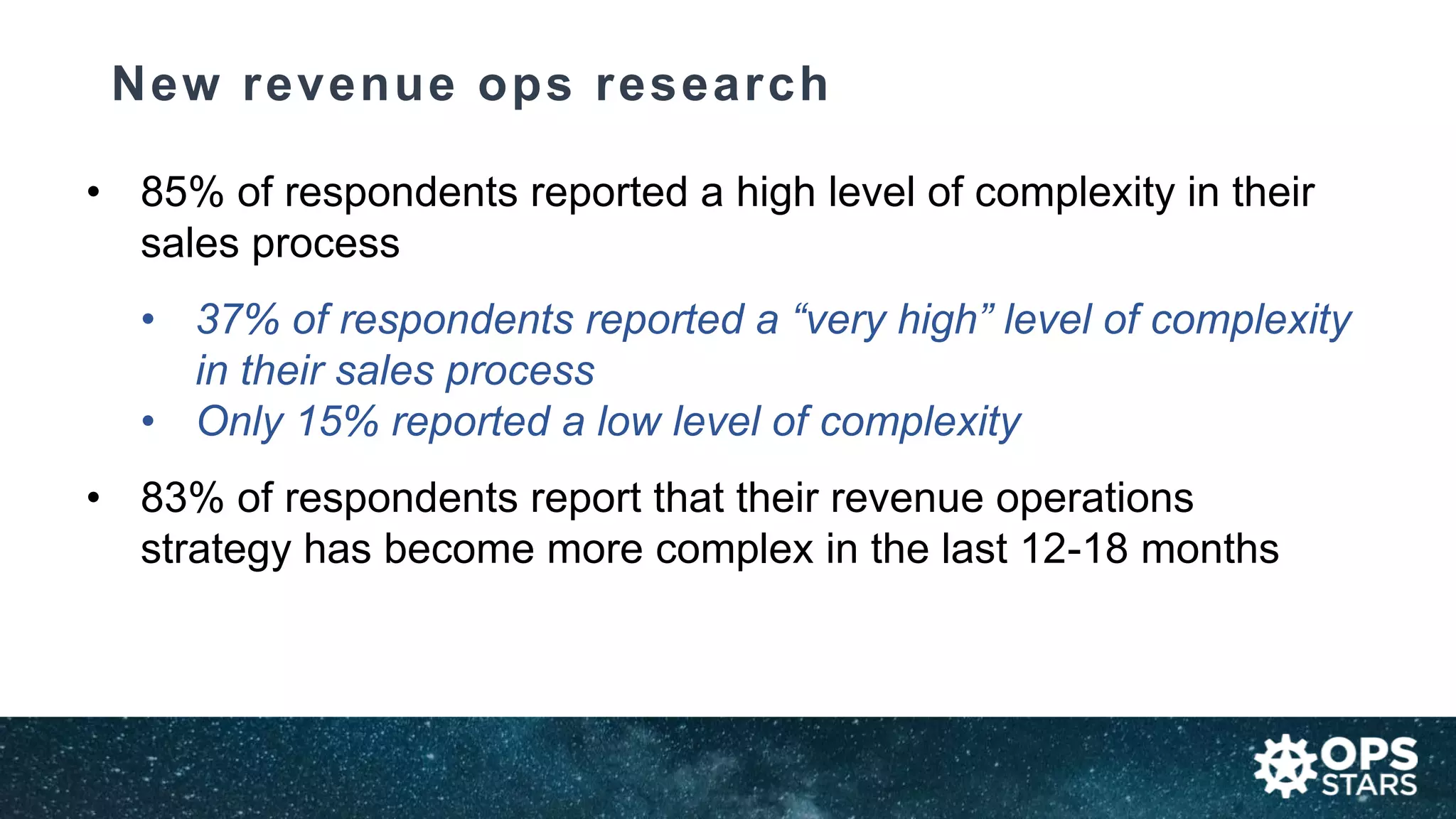
New revenue ops research
• 85% of respondents reported a high level of complexity in their
sales process
• 37% of respondents reported a “very high” level of complexity
in their sales process
• Only 15% reported a low level of complexity
• 83% of respondents report that their revenue operations
strategy has become more complex in the last 12-18 months
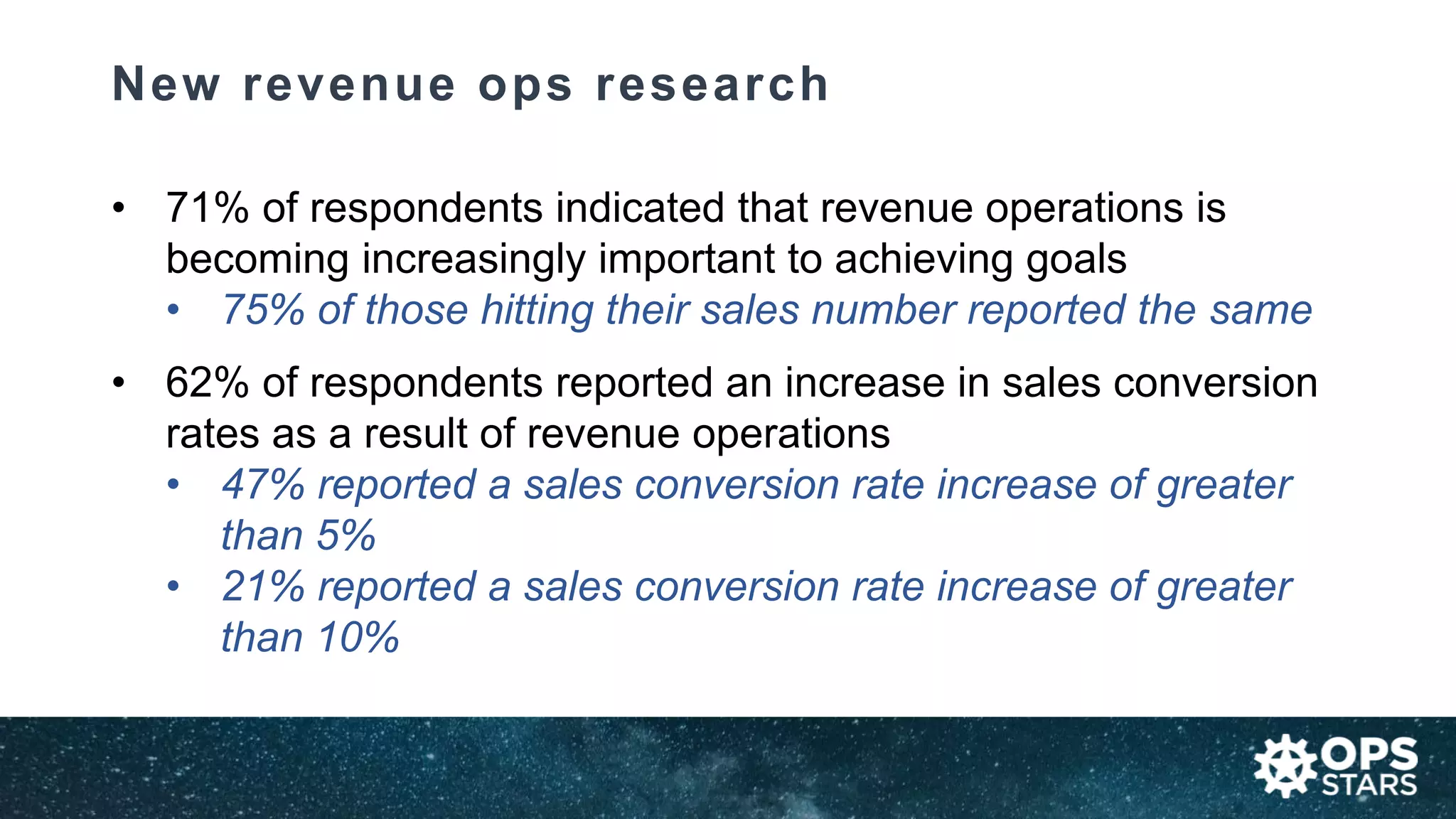
New revenue ops research
• 71% of respondents indicated that revenue operations is
becoming increasingly important to achieving goals
• 75% of those hitting their sales number reported the same
• 62% of respondents reported an increase in sales conversion
rates as a result of revenue operations
• 47% reported a sales conversion rate increase of greater
than 5%
• 21% reported a sales conversion rate increase of greater
than 10%
New revenue ops research
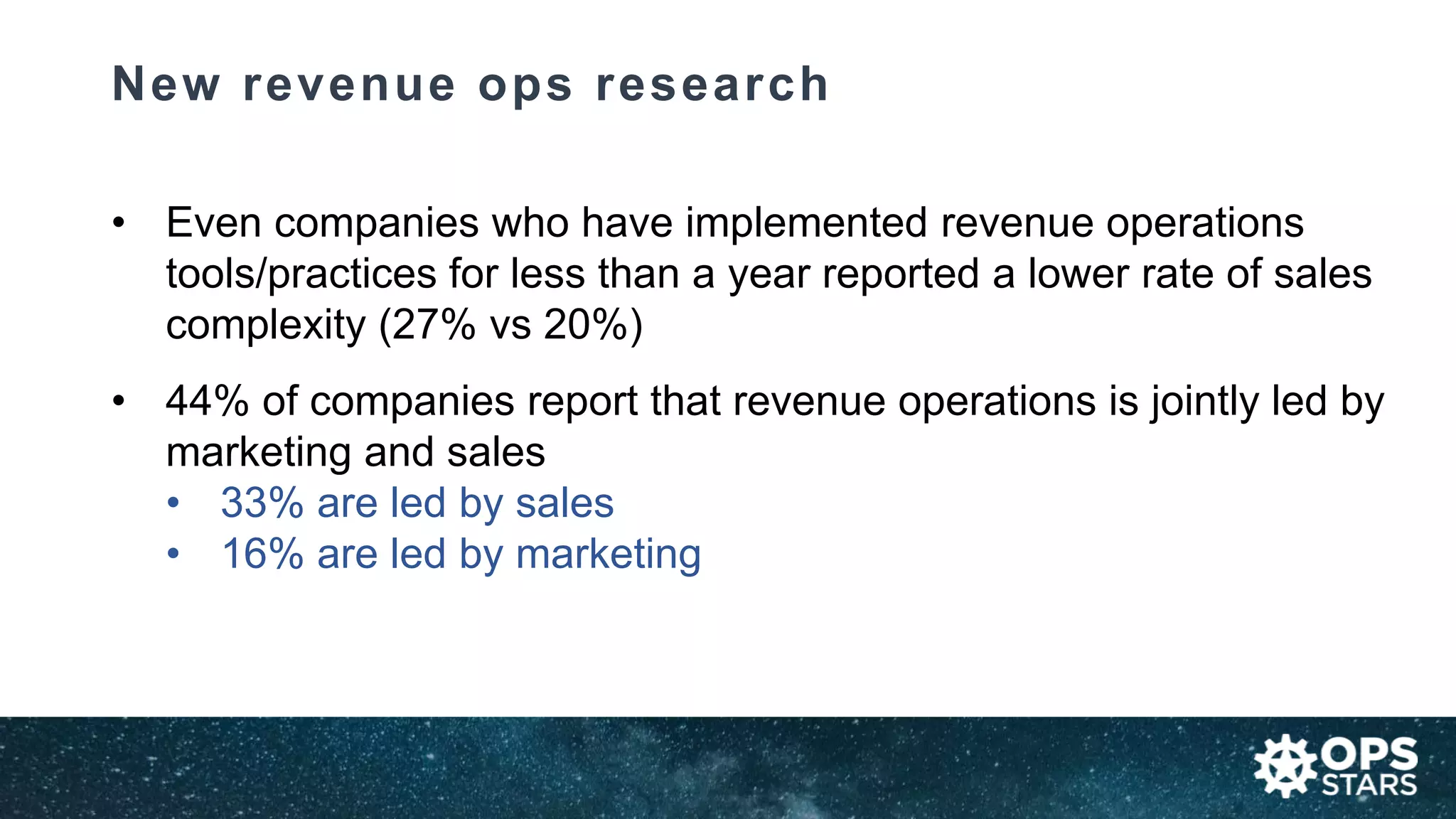
• Even companies who have implemented revenue operations
tools/practices for less than a year reported a lower rate of sales
complexity (27% vs 20%)
• 44% of companies report that revenue operations is jointly led by
marketing and sales
• 33% are led by sales
• 16% are led by marketing
New revenue ops research
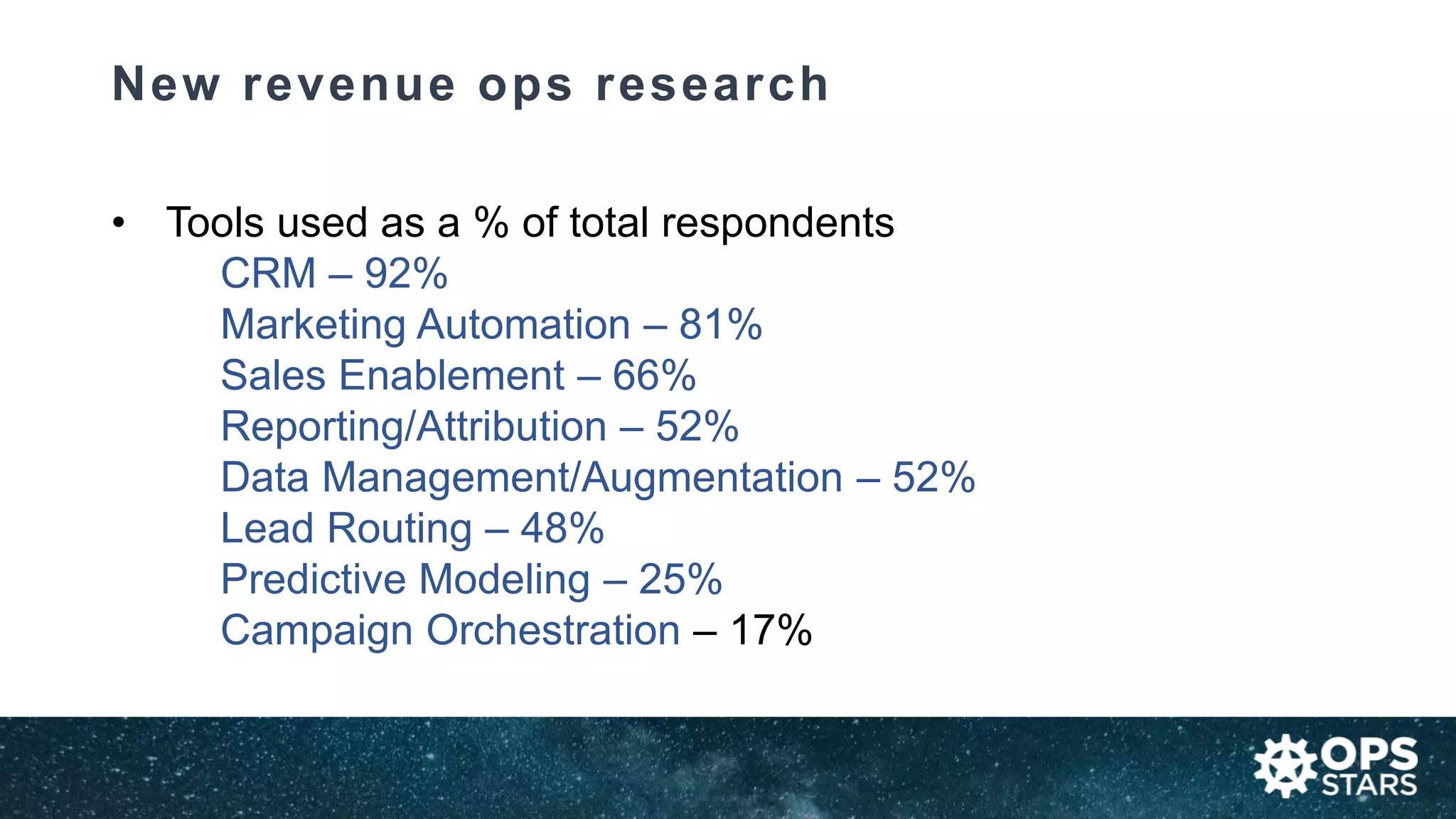
• Tools used as a % of total respondents
CRM – 92%
Marketing Automation – 81%
Sales Enablement – 66%
Reporting/Attribution – 52%
Data Management/Augmentation – 52%
Lead Routing – 48%
Predictive Modeling – 25%
Campaign Orchestration – 17%
New revenue ops research
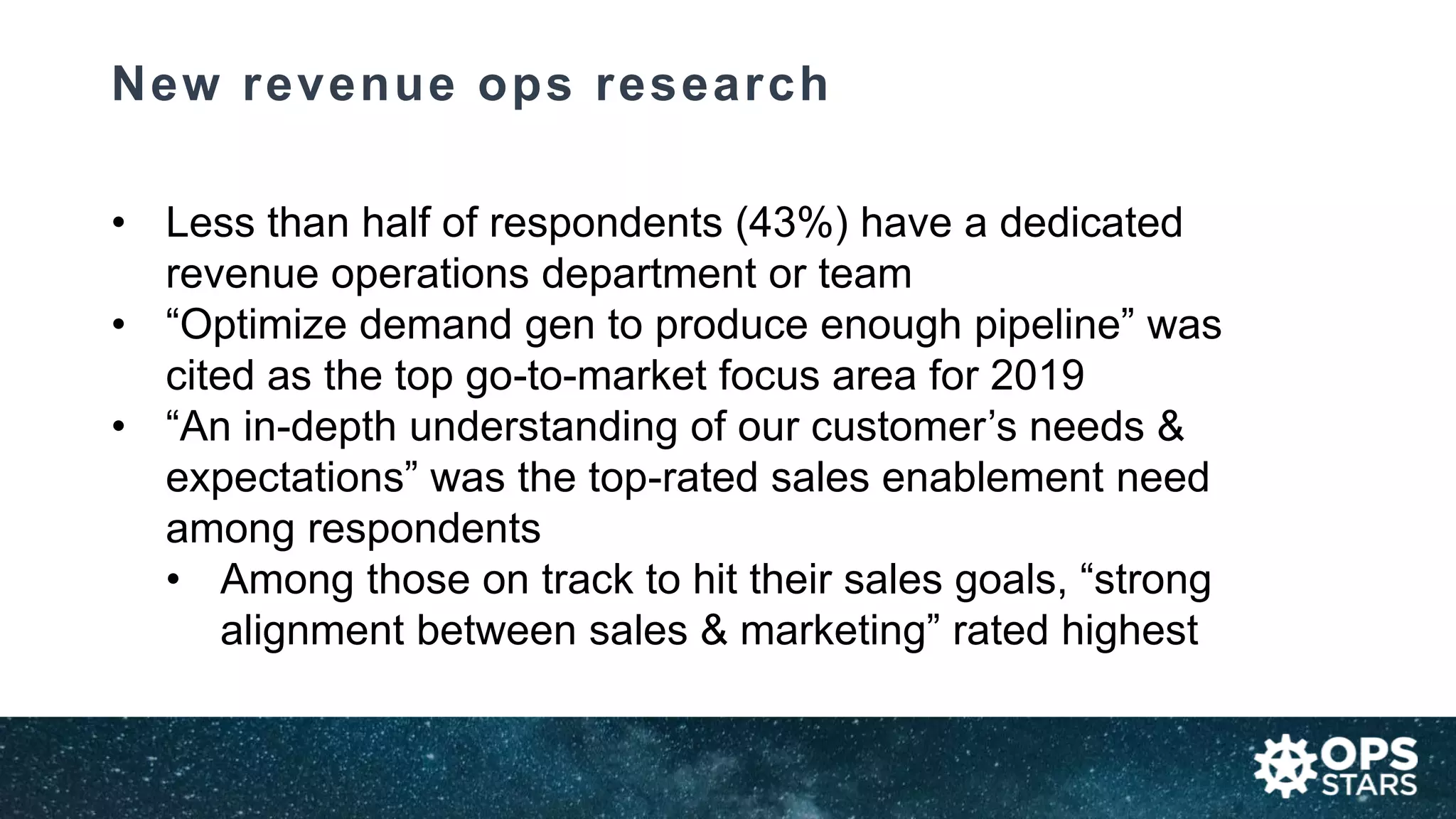
• Less than half of respondents (43%) have a dedicated
revenue operations department or team
• “Optimize demand gen to produce enough pipeline” was
cited as the top go-to-market focus area for 2019
• “An in-depth understanding of our customer’s needs &
expectations” was the top-rated sales enablement need
among respondents
• Among those on track to hit their sales goals, “strong
alignment between sales & marketing” rated highest
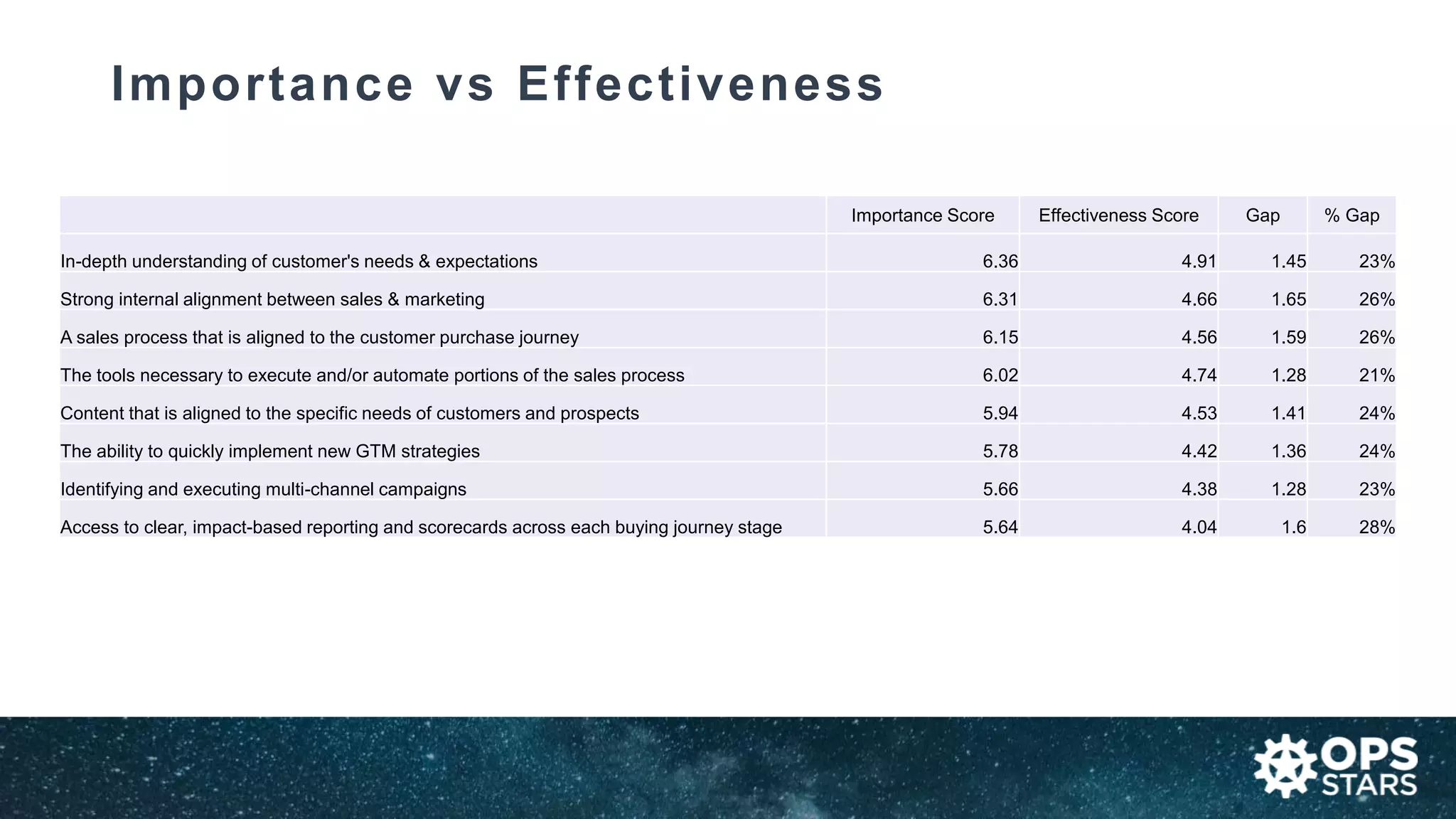
Importance vs Effectiveness
Importance Score Effectiveness Score Gap % Gap
In-depth understanding of customer's needs & expectations 6.36 4.91 1.45 23%
Strong internal alignment between sales & marketing 6.31 4.66 1.65 26%
A sales process that is aligned to the customer purchase journey 6.15 4.56 1.59 26%
The tools necessary to execute and/or automate portions of the sales process 6.02 4.74 1.28 21%
Content that is aligned to the specific needs of customers and prospects 5.94 4.53 1.41 24%
The ability to quickly implement new GTM strategies 5.78 4.42 1.36 24%
Identifying and executing multi-channel campaigns 5.66 4.38 1.28 23%
Access to clear, impact-based reporting and scorecards across each buying journey stage 5.64 4.04 1.6 28%
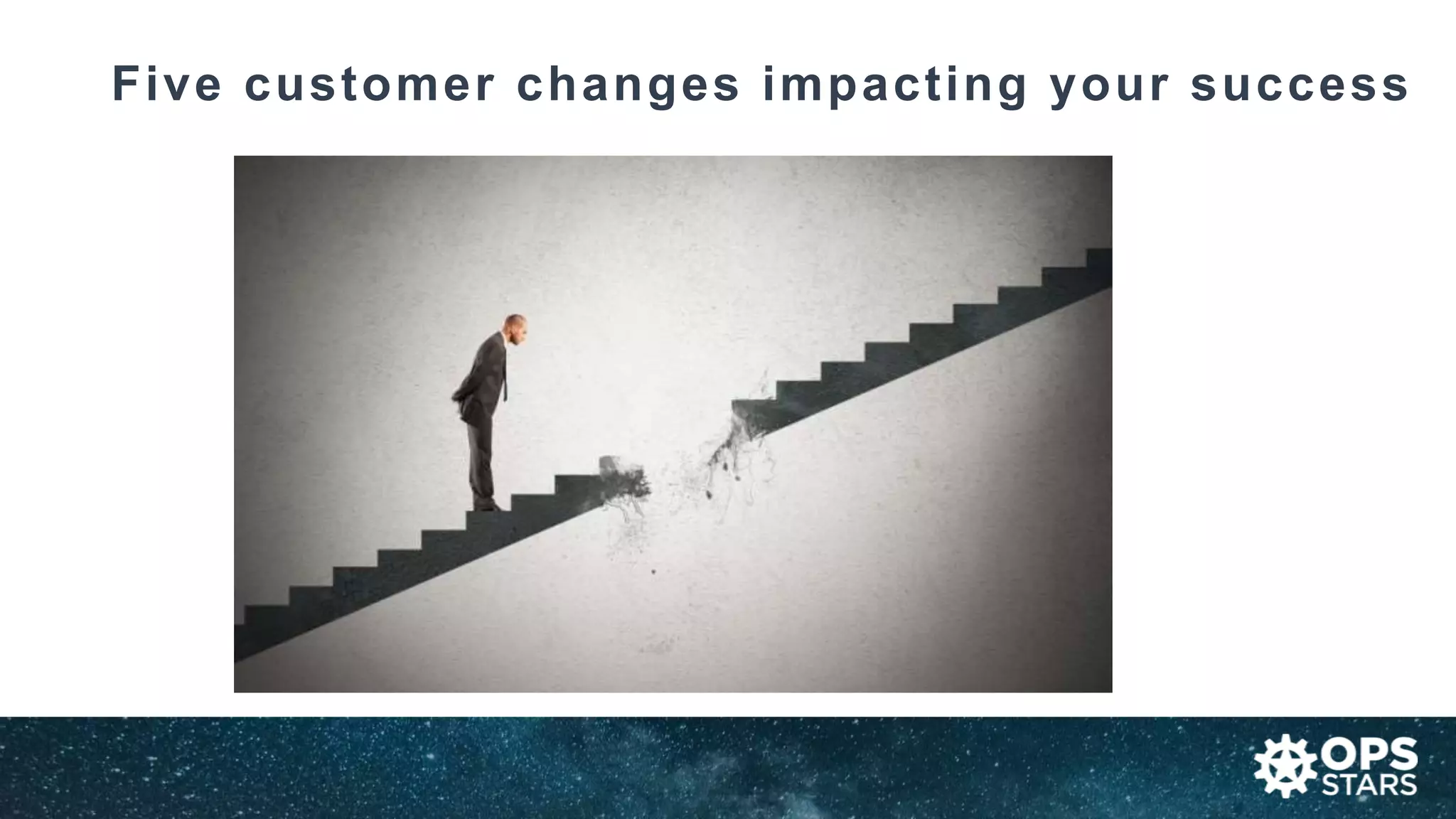
Five customer changes impacting your success
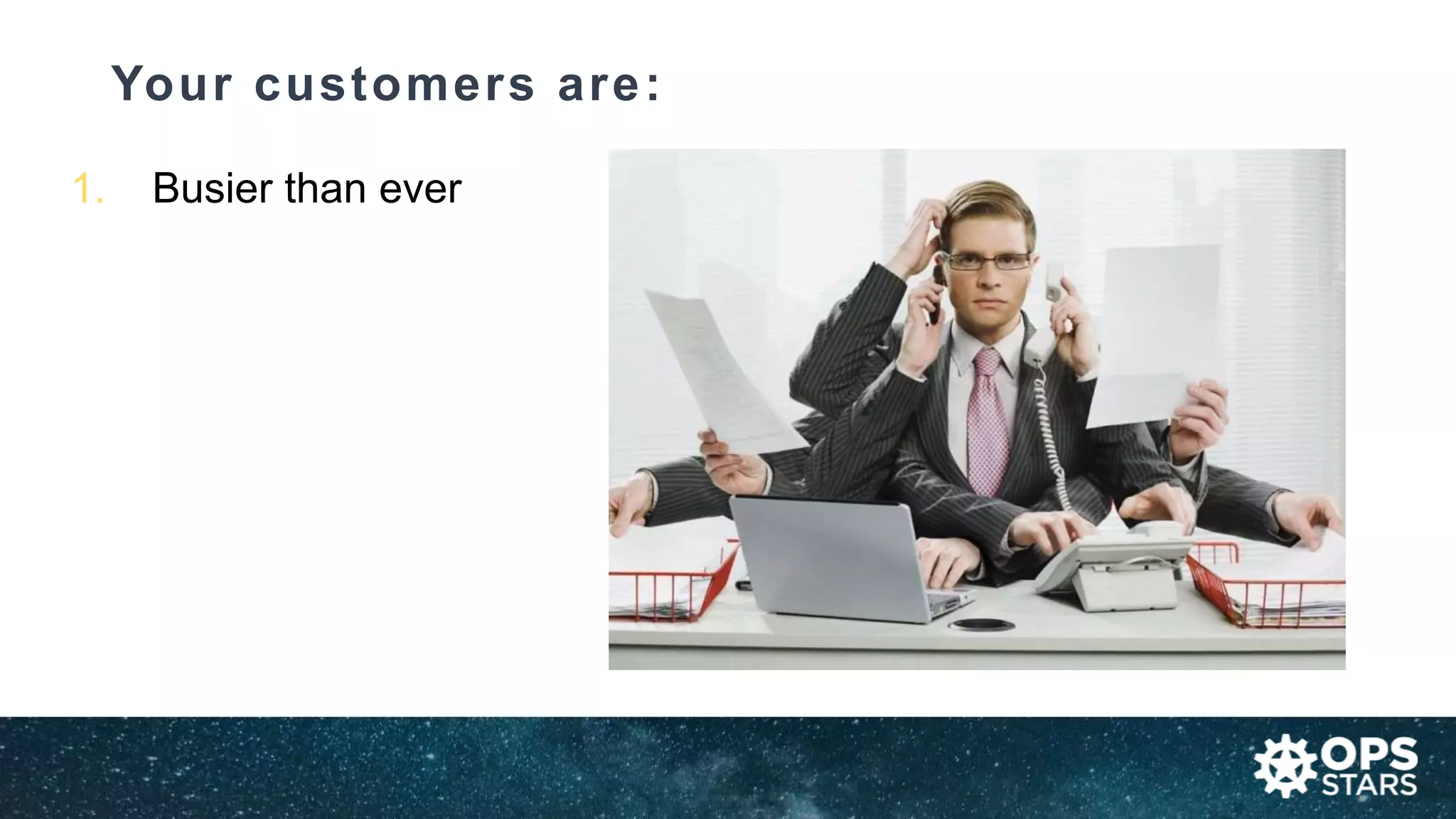
Your customers are:
1. Busier than ever
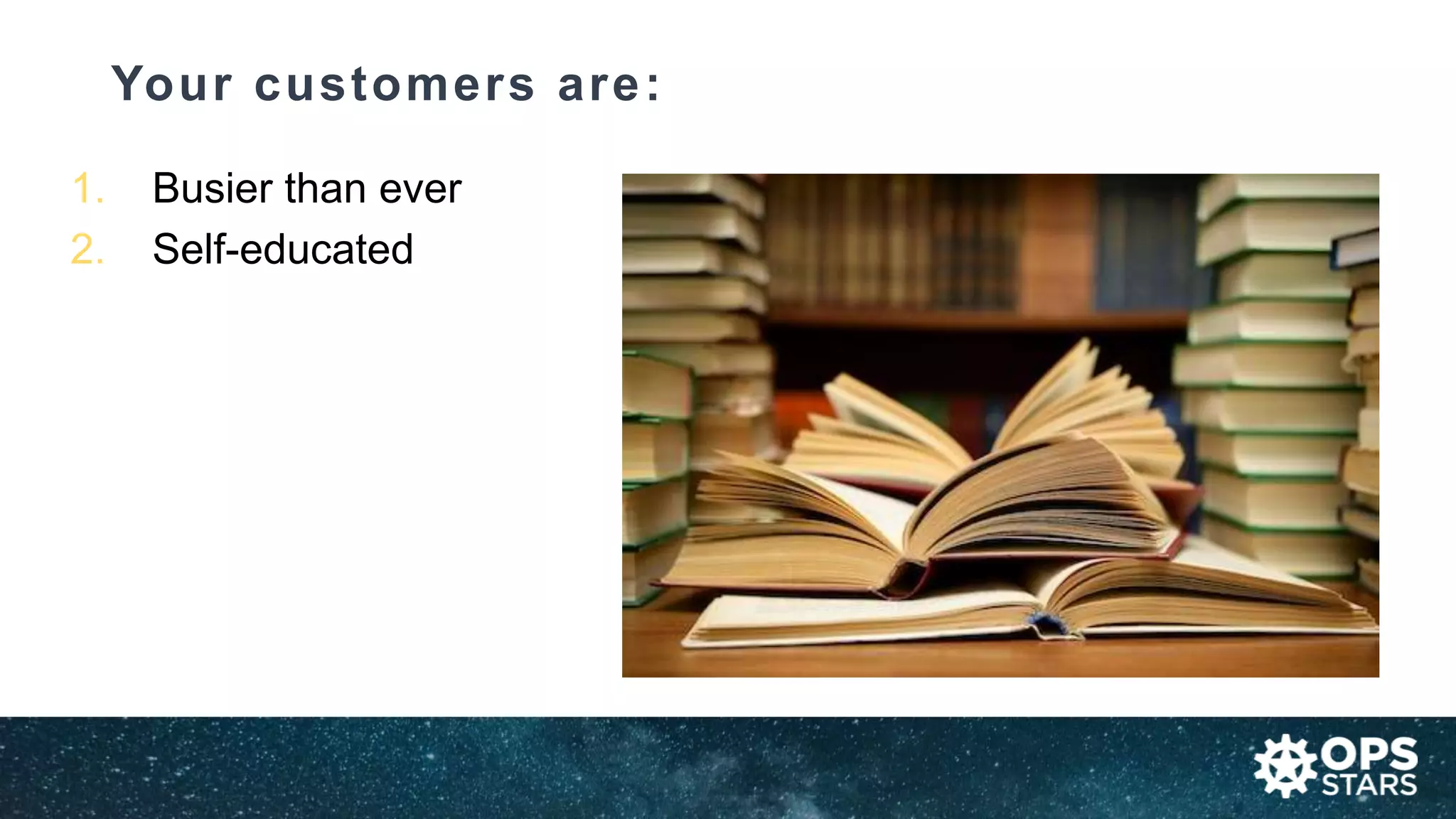
Your customers are:
1. Busier than ever
2. Self-educated
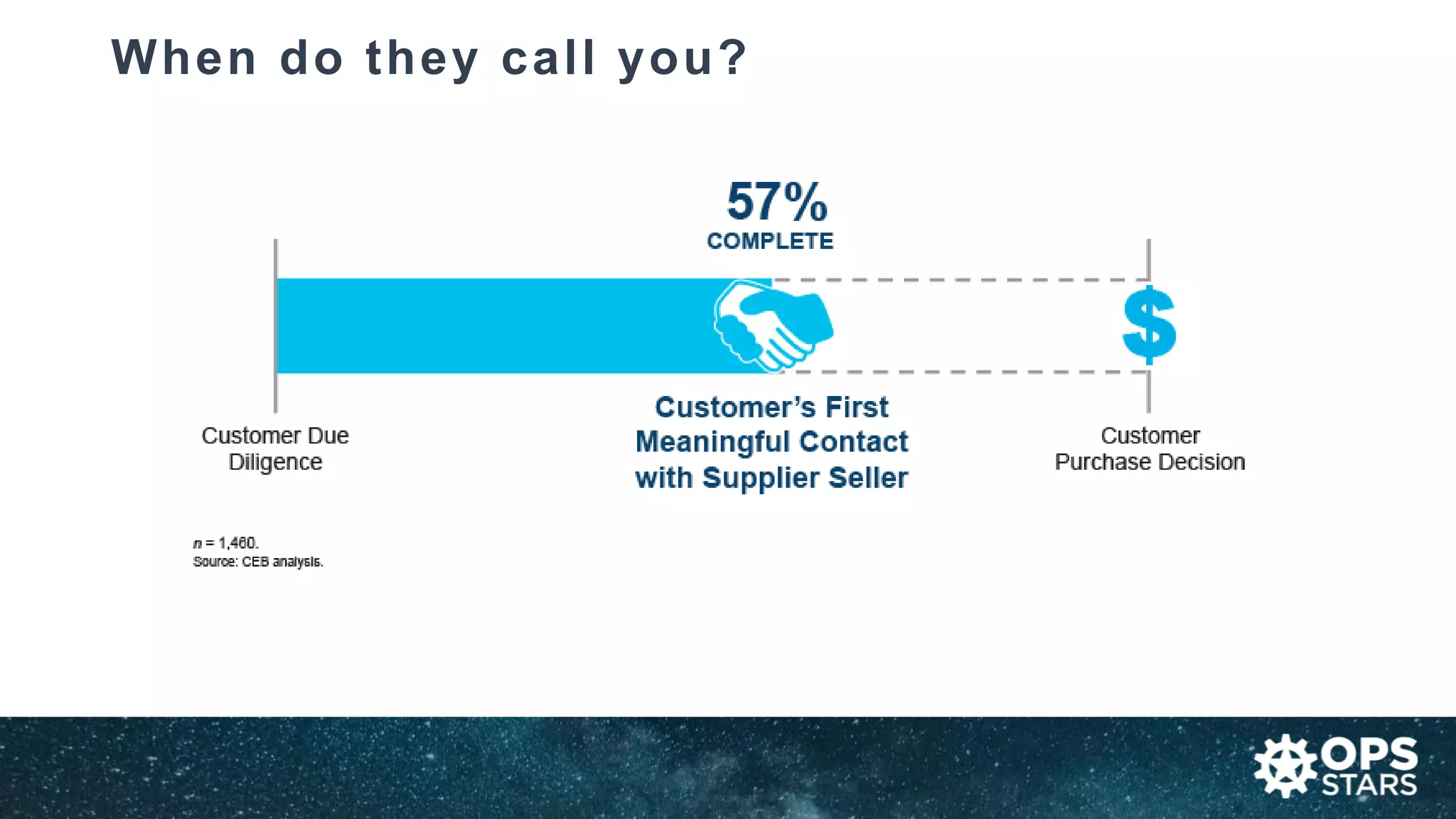
When do they call you?
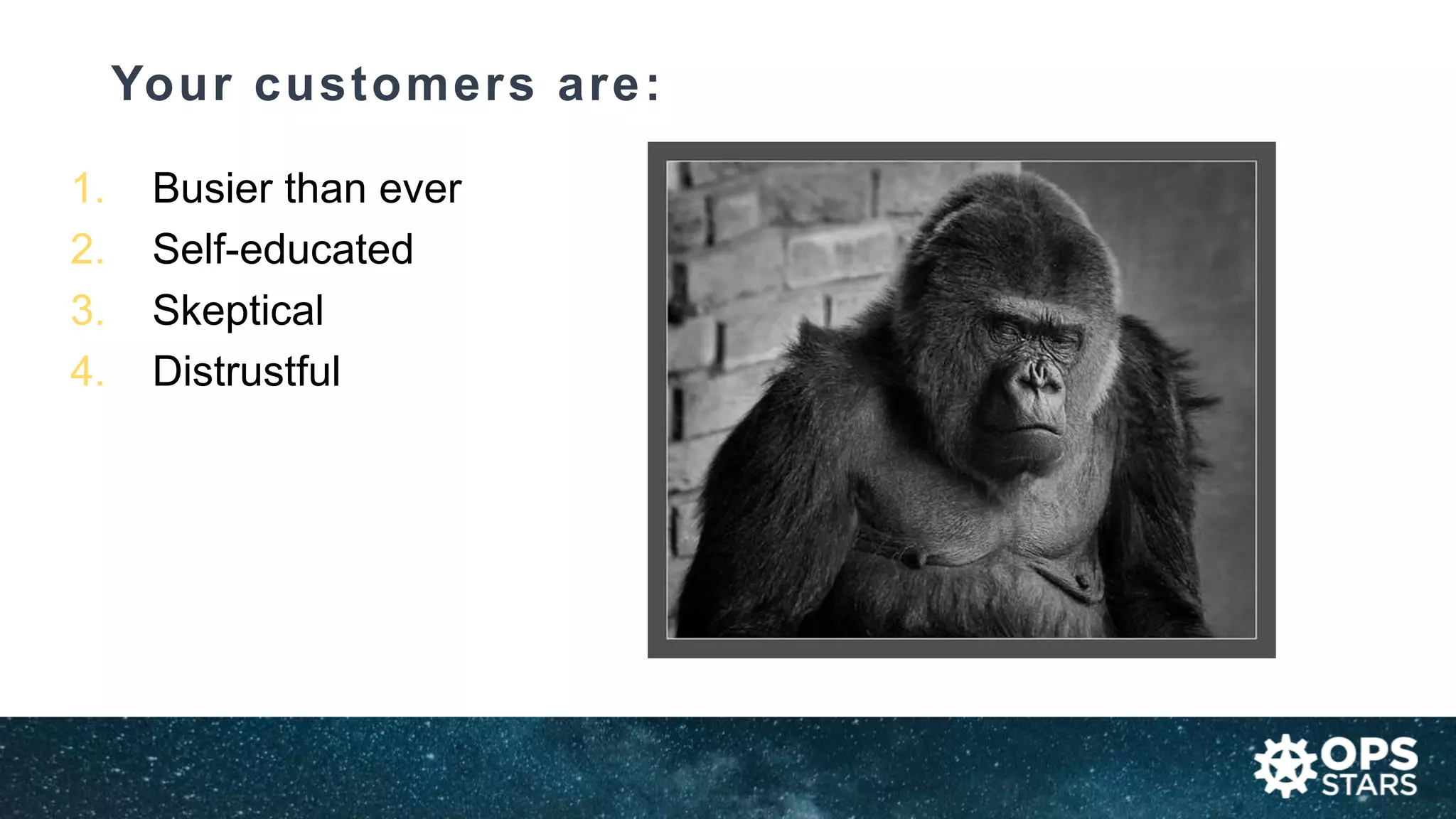
Your customers are:
1. Busier than ever
2. Self-educated
3. Skeptical
4. Distrustful
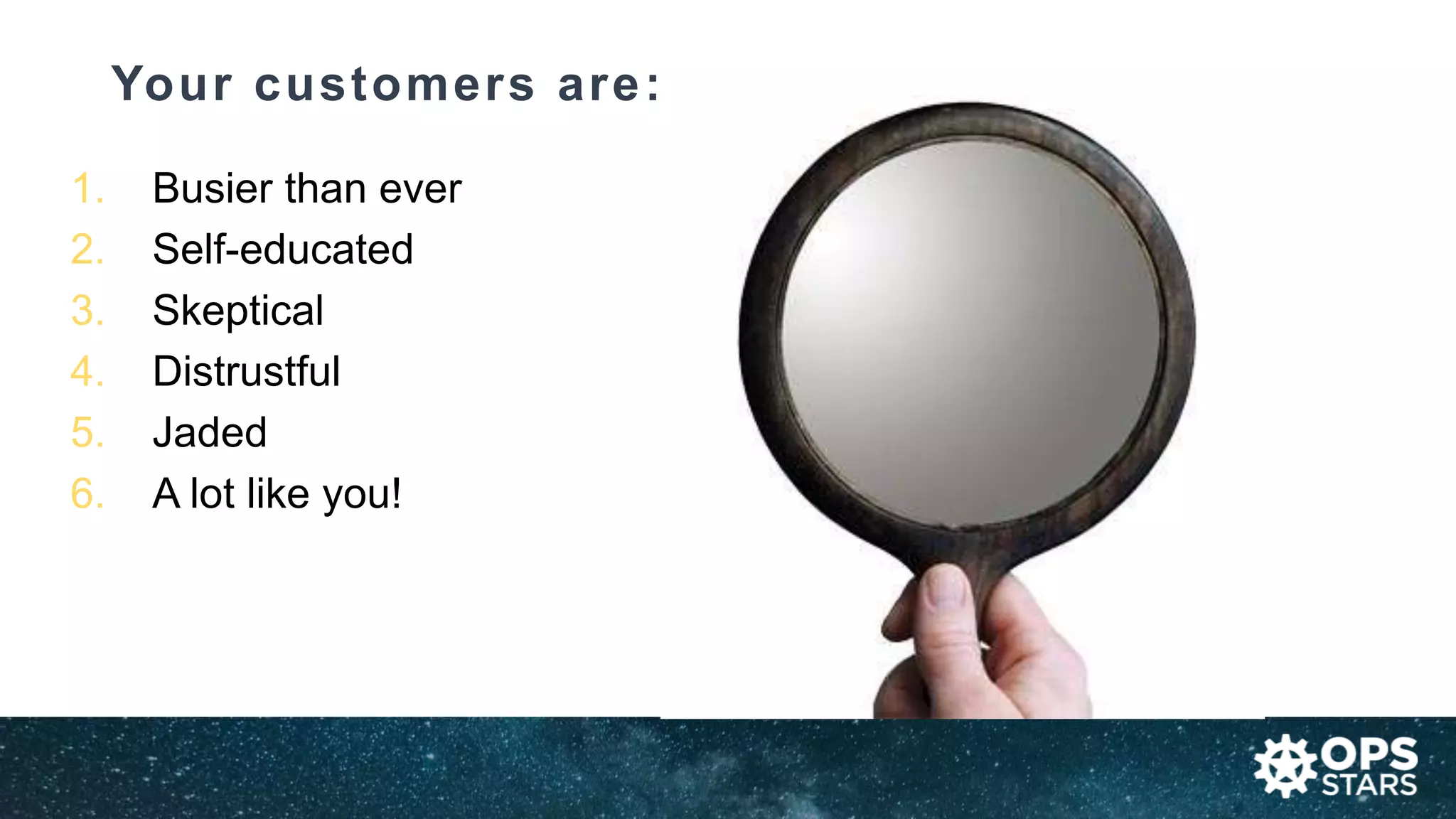
Your customers are:
1. Busier than ever
2. Self-educated
3. Skeptical
4. Distrustful
5. Jaded
6. A lot like you!
So what IS working today?
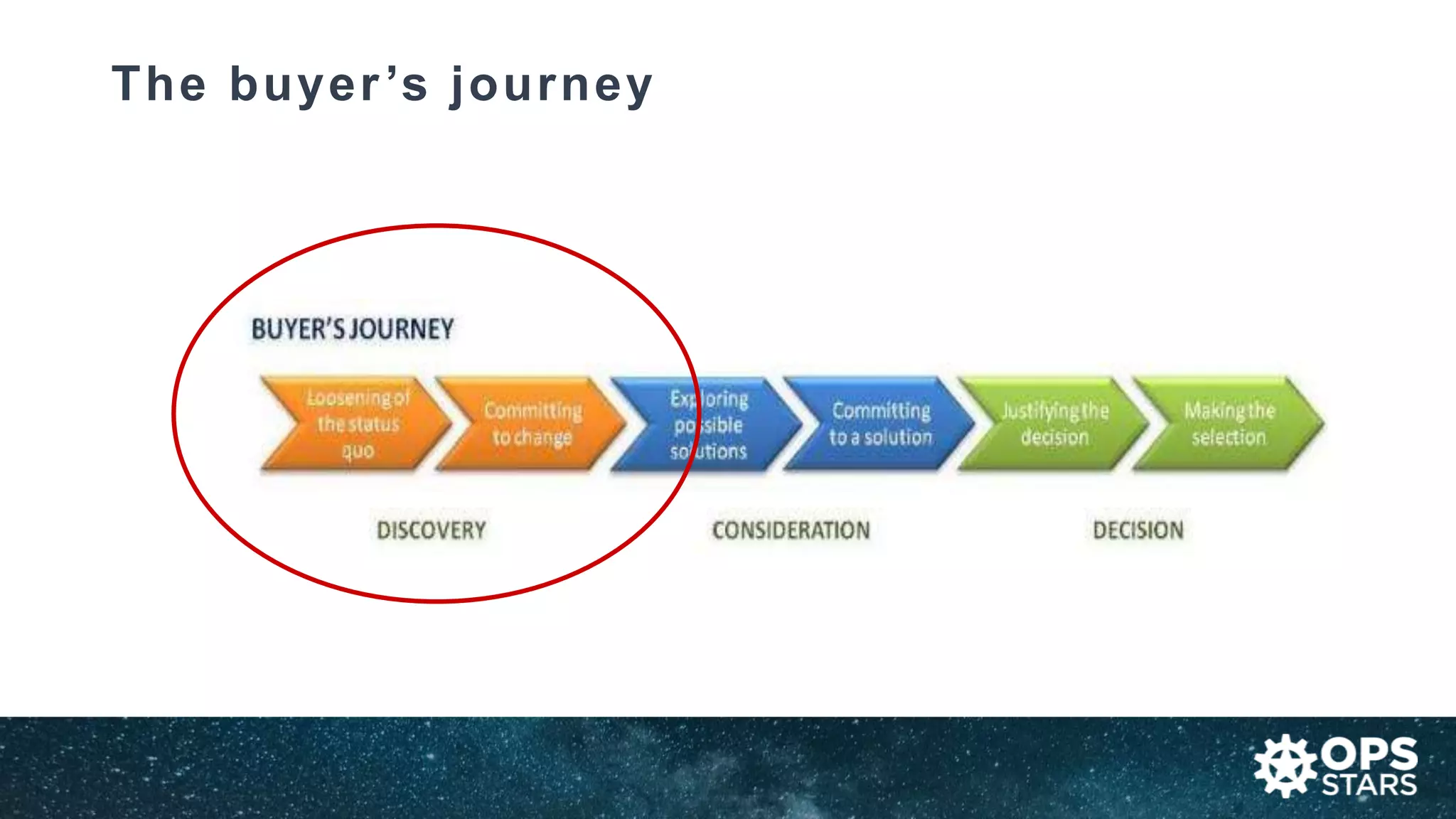
The buyer’s journey
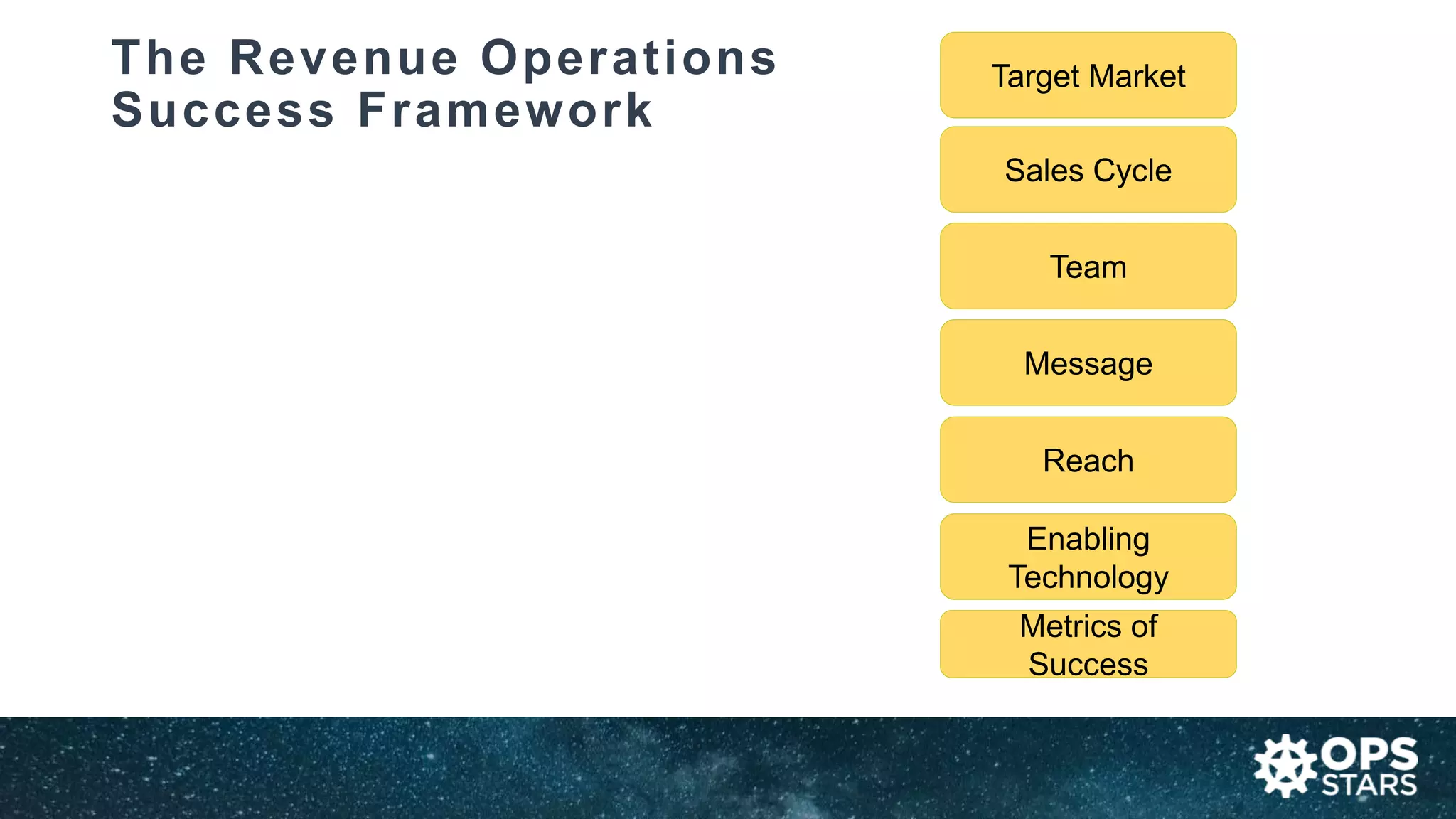
The Revenue Operations
Success Framework
Target Market
Sales Cycle
Team
Message
Reach
Enabling
Technology
Metrics of
Success
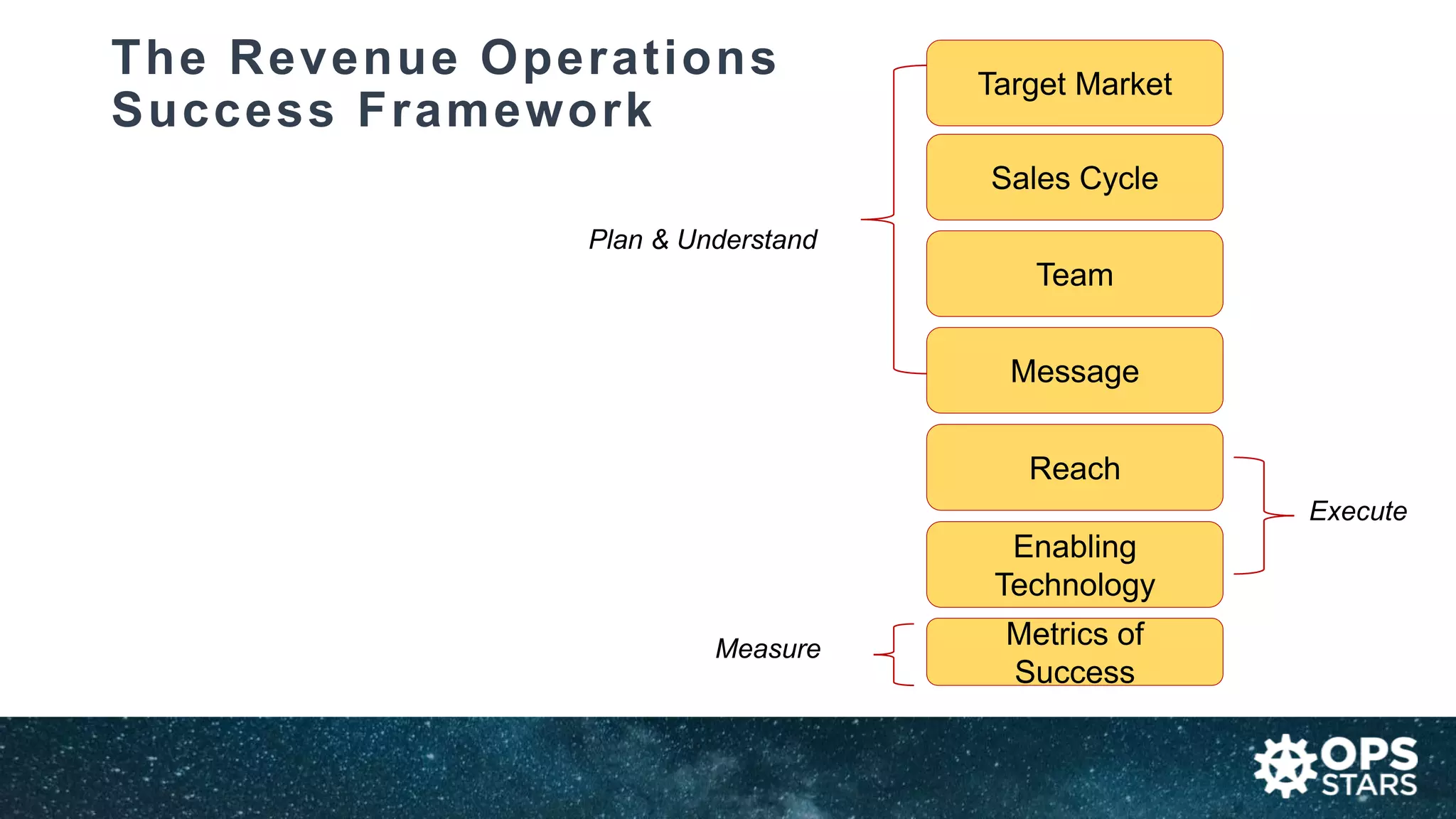
The Revenue Operations
Success Framework
Target Market
Sales Cycle
Team
Message
Reach
Enabling
Technology
Metrics of
Success
Plan & Understand
Execute
Measure
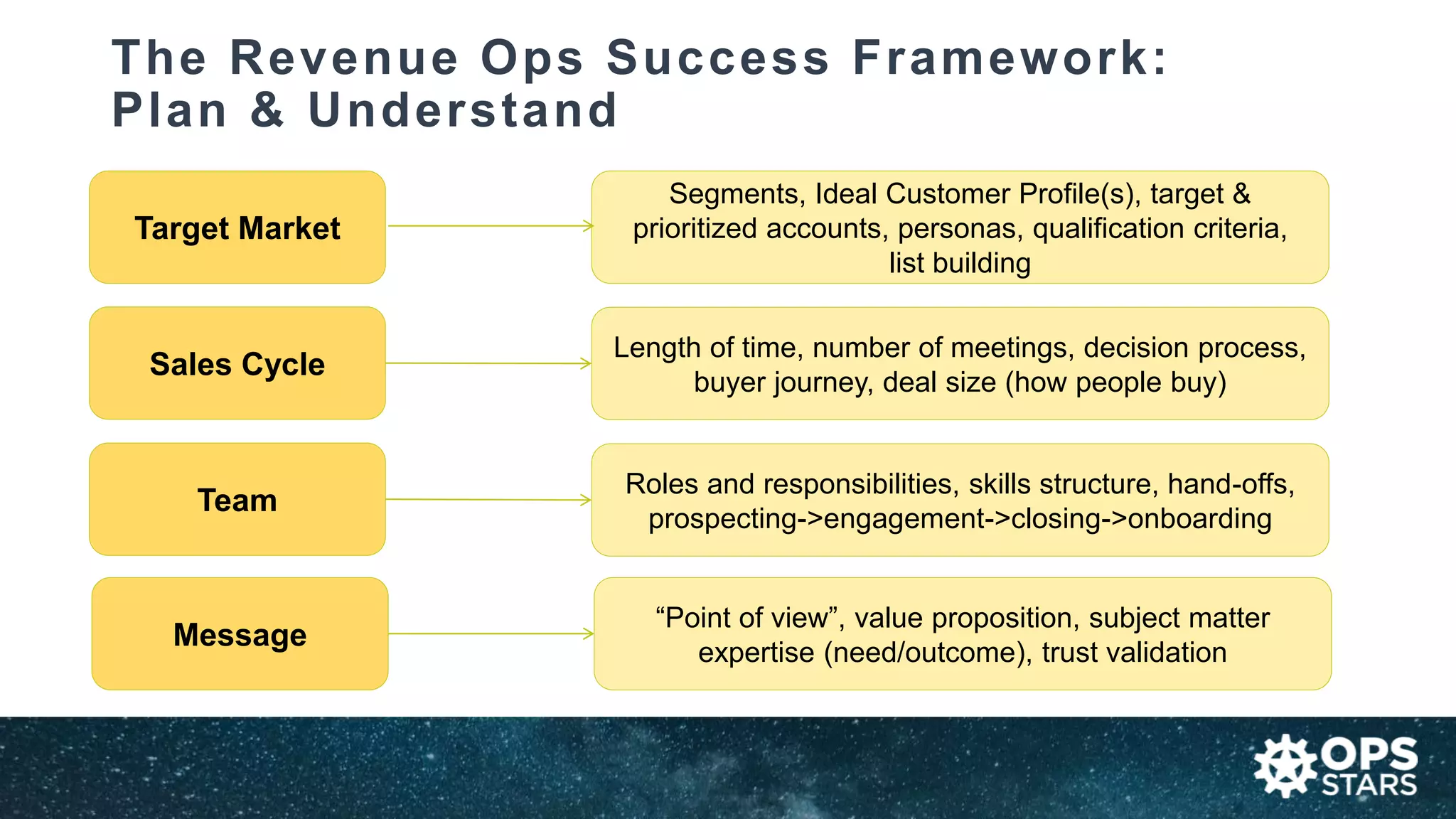
The Revenue Ops Success Framework:
Plan & Understand
Target Market
Sales Cycle
Team
Message
Segments, Ideal Customer Profile(s), target &
prioritized accounts, personas, qualification criteria,
list building
Length of time, number of meetings, decision process,
buyer journey, deal size (how people buy)
Roles and responsibilities, skills structure, hand-offs,
prospecting->engagement->closing->onboarding
“Point of view”, value proposition, subject matter
expertise (need/outcome), trust validation
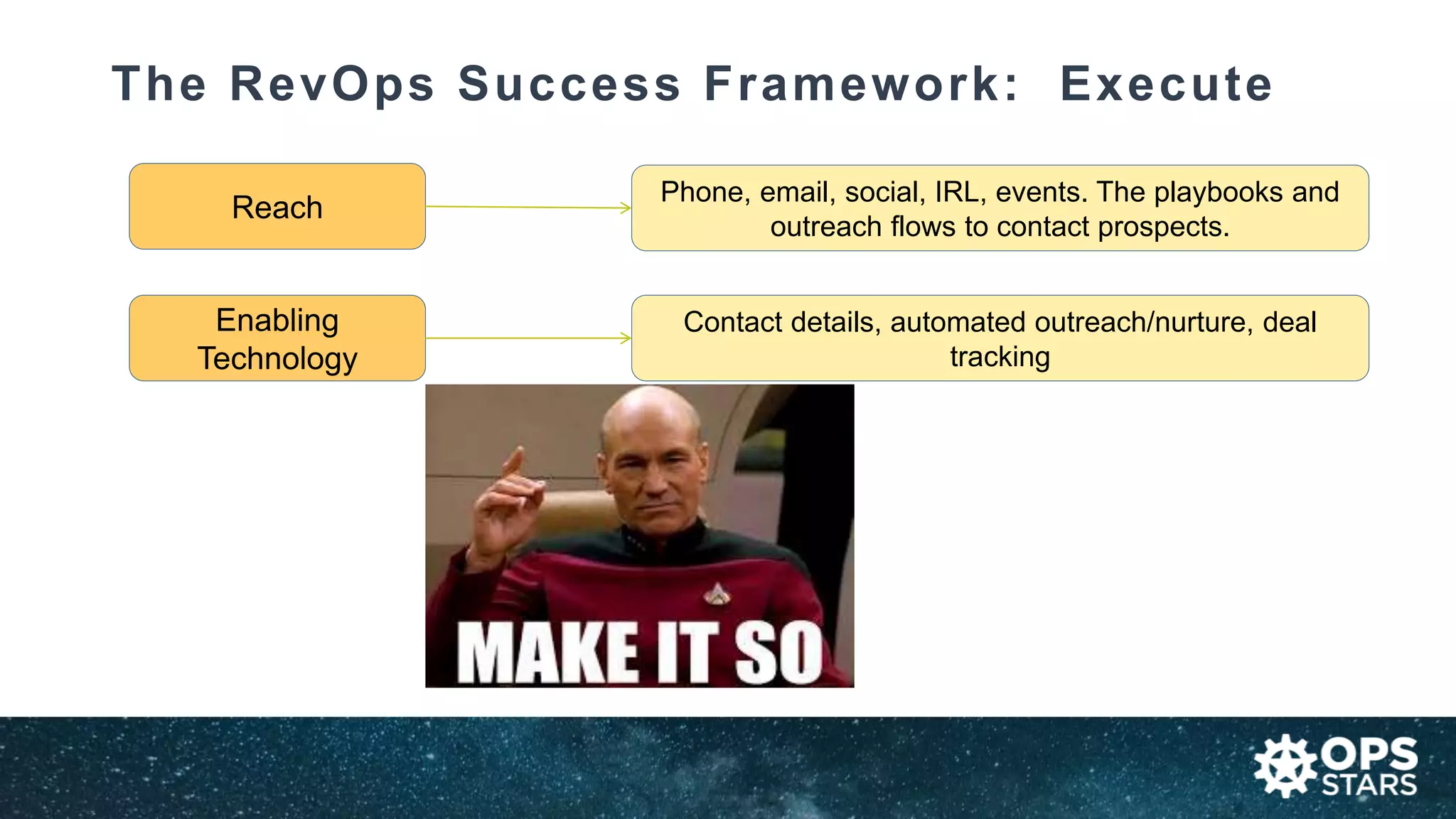
The RevOps Success Framework: Execute
Reach
Enabling
Technology
Phone, email, social, IRL, events. The playbooks and
outreach flows to contact prospects.
Contact details, automated outreach/nurture, deal
tracking
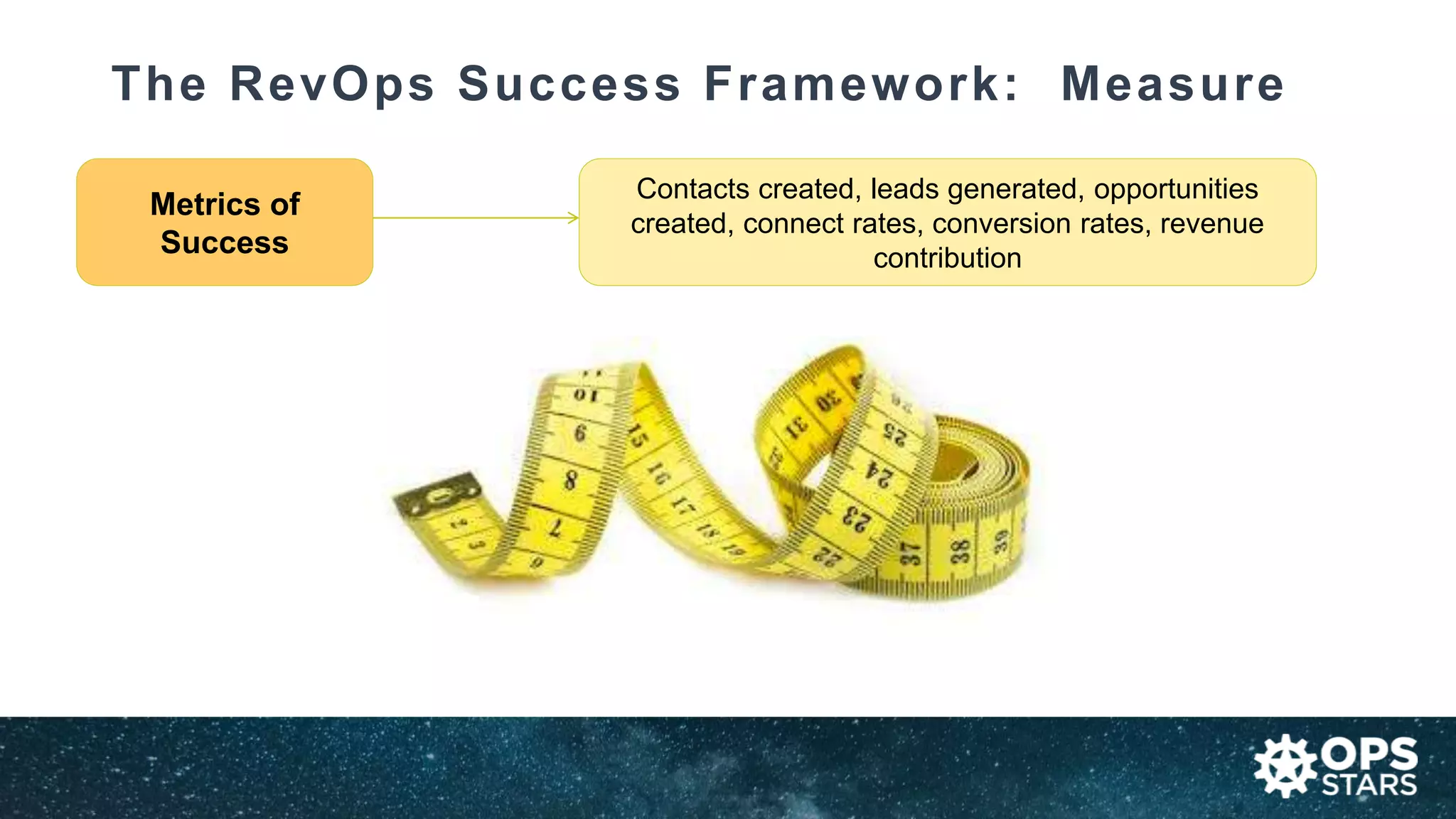
The RevOps Success Framework: Measure
Metrics of
Success
Contacts created, leads generated, opportunities
created, connect rates, conversion rates, revenue
contribution
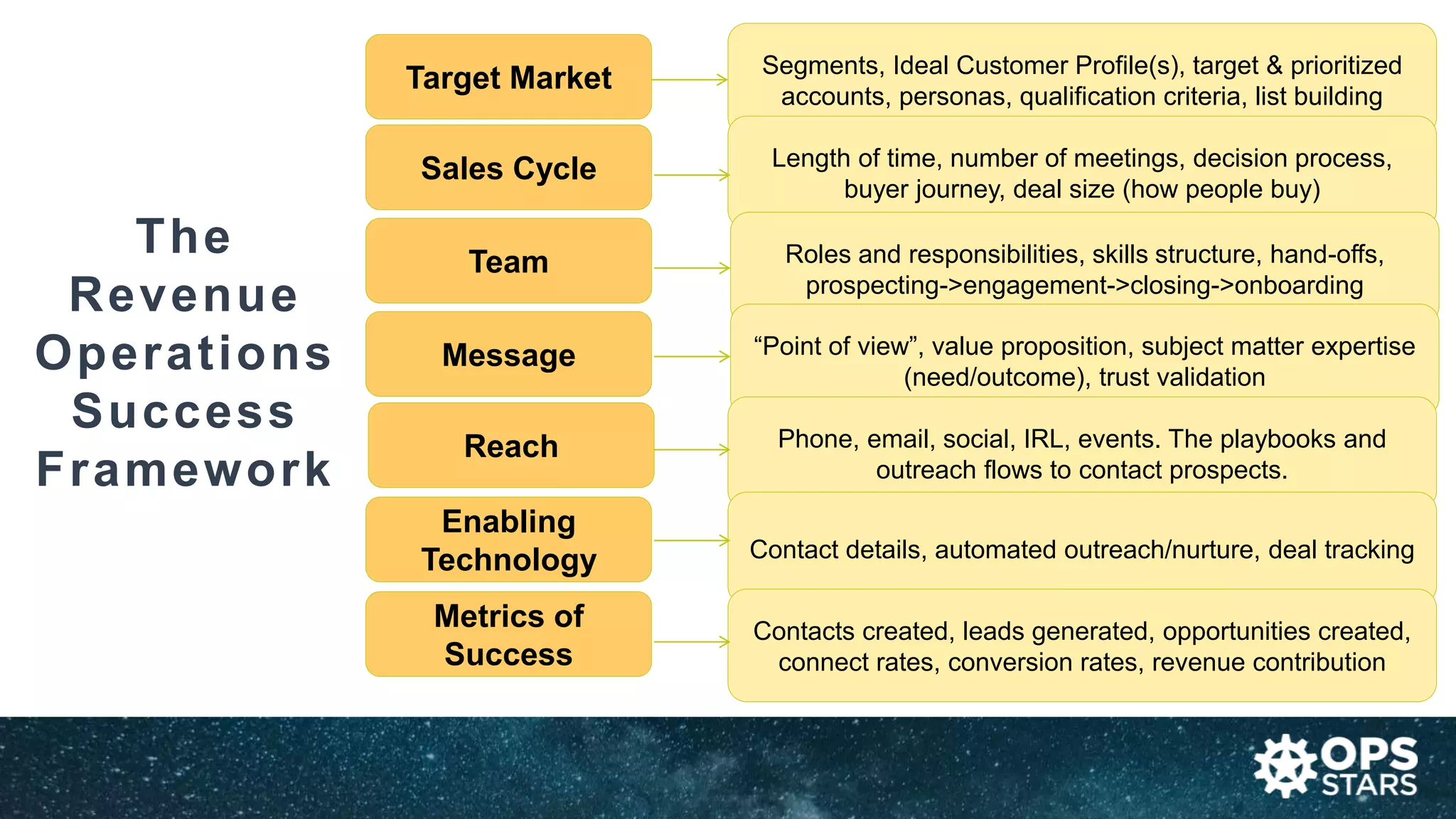
The
Revenue
Operations
Success
Framework
Target Market
Sales Cycle
Team
Message
Reach
Enabling
Technology
Metrics of
Success
Segments, Ideal Customer Profile(s), target & prioritized
accounts, personas, qualification criteria, list building
Length of time, number of meetings, decision process,
buyer journey, deal size (how people buy)
Roles and responsibilities, skills structure, hand-offs,
prospecting->engagement->closing->onboarding
“Point of view”, value proposition, subject matter expertise
(need/outcome), trust validation
Phone, email, social, IRL, events. The playbooks and
outreach flows to contact prospects.
Contact details, automated outreach/nurture, deal tracking
Contacts created, leads generated, opportunities created,
connect rates, conversion rates, revenue contribution
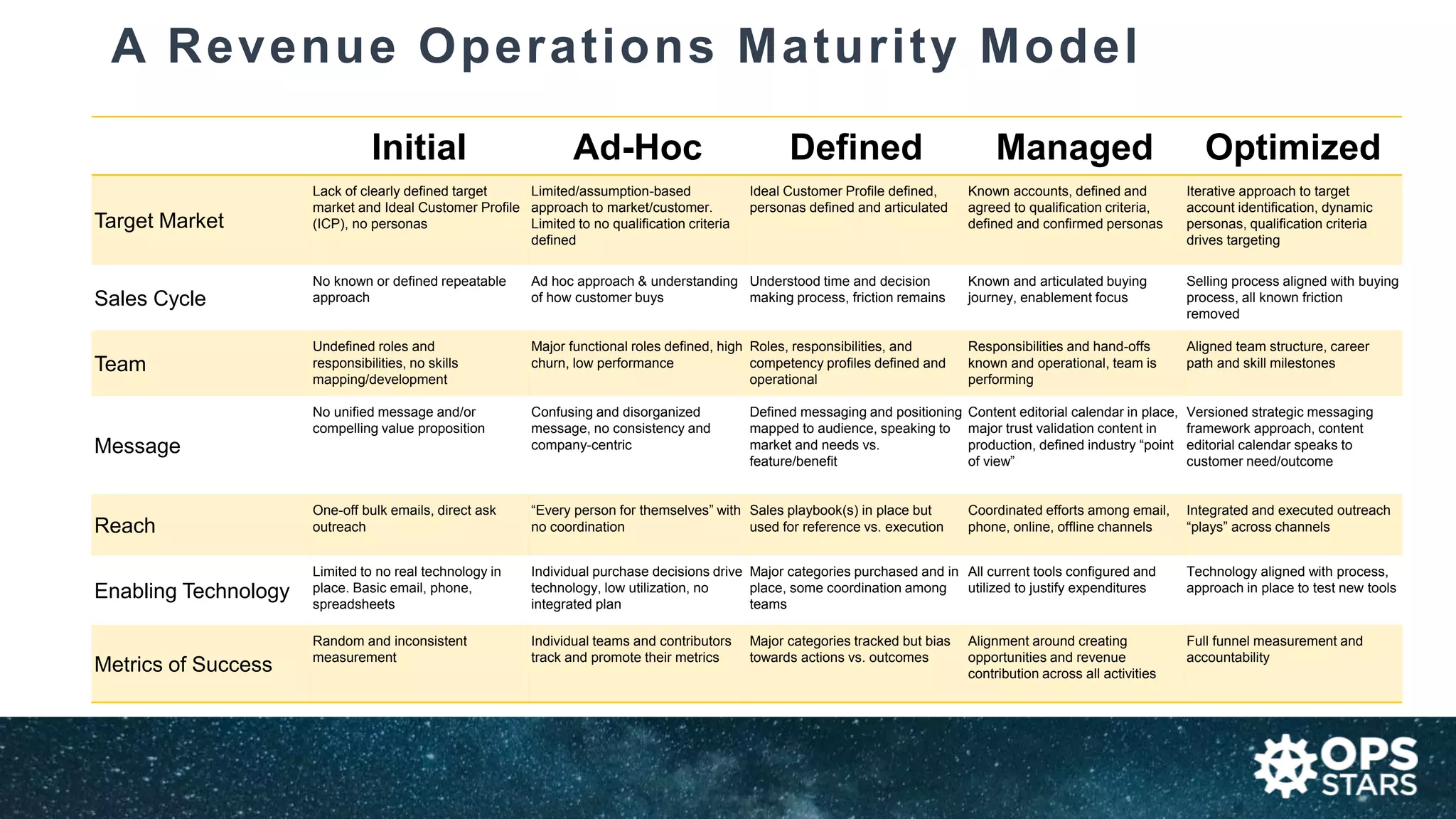
A Revenue Operations Maturity Model
Initial Ad-Hoc Defined Managed Optimized
Target Market
Lack of clearly defined target
market and Ideal Customer Profile
(ICP), no personas
Limited/assumption-based
approach to market/customer.
Limited to no qualification criteria
defined
Ideal Customer Profile defined,
personas defined and articulated
Known accounts, defined and
agreed to qualification criteria,
defined and confirmed personas
Iterative approach to target
account identification, dynamic
personas, qualification criteria
drives targeting
Sales Cycle
No known or defined repeatable
approach
Ad hoc approach & understanding
of how customer buys
Understood time and decision
making process, friction remains
Known and articulated buying
journey, enablement focus
Selling process aligned with buying
process, all known friction
removed
Team
Undefined roles and
responsibilities, no skills
mapping/development
Major functional roles defined, high
churn, low performance
Roles, responsibilities, and
competency profiles defined and
operational
Responsibilities and hand-offs
known and operational, team is
performing
Aligned team structure, career
path and skill milestones
Message
No unified message and/or
compelling value proposition
Confusing and disorganized
message, no consistency and
company-centric
Defined messaging and positioning
mapped to audience, speaking to
market and needs vs.
feature/benefit
Content editorial calendar in place,
major trust validation content in
production, defined industry “point
of view”
Versioned strategic messaging
framework approach, content
editorial calendar speaks to
customer need/outcome
Reach
One-off bulk emails, direct ask
outreach
“Every person for themselves” with
no coordination
Sales playbook(s) in place but
used for reference vs. execution
Coordinated efforts among email,
phone, online, offline channels
Integrated and executed outreach
“plays” across channels
Enabling Technology
Limited to no real technology in
place. Basic email, phone,
spreadsheets
Individual purchase decisions drive
technology, low utilization, no
integrated plan
Major categories purchased and in
place, some coordination among
teams
All current tools configured and
utilized to justify expenditures
Technology aligned with process,
approach in place to test new tools
Metrics of Success
Random and inconsistent
measurement
Individual teams and contributors
track and promote their metrics
Major categories tracked but bias
towards actions vs. outcomes
Alignment around creating
opportunities and revenue
contribution across all activities
Full funnel measurement and
accountability
HOUSEKEEPING
① Copy of this deck and research
② Freebies!
① Full Funnel Marketing (the book)
② Sales Velocity Calculator
③ KPI Metrics Architecture
④ Matt’s bacon recipe
③ Send me an email (matt@heinzmarketing.com)
or bring me a business card with what you
want!
Thank you.
Matt Heinz
Heinz Marketing Inc
@heinzmarketing
matt@heinzmarketing.com

OpsStars NY Session | A B2B Revenue Ops Success Framework and Maturity Model

  • 1.
    Delivering a PredictablePipeline: A B2B Revenue Ops Success Framework and Maturity Model Matt Heinz | President, Heinz Marketing Inc | @heinzmarketing
  • 2.
    HOUSEKEEPING ① Copy ofthis deck and research ② Freebies! ① Full Funnel Marketing (the book) ② Sales Velocity Calculator ③ KPI Metrics Architecture ④ Matt’s bacon recipe ③ Send me an email (matt@heinzmarketing.com) or bring me a business card with what you want!
  • 3.
    Why is sellingso hard today?
  • 4.
    Is it howwe sell? …. how they buy?
  • 5.
    Impact on theentire lifecycle
  • 6.
  • 7.
    New revenue opsresearch • 85% of respondents reported a high level of complexity in their sales process • 37% of respondents reported a “very high” level of complexity in their sales process • Only 15% reported a low level of complexity • 83% of respondents report that their revenue operations strategy has become more complex in the last 12-18 months
  • 8.
    New revenue opsresearch • 71% of respondents indicated that revenue operations is becoming increasingly important to achieving goals • 75% of those hitting their sales number reported the same • 62% of respondents reported an increase in sales conversion rates as a result of revenue operations • 47% reported a sales conversion rate increase of greater than 5% • 21% reported a sales conversion rate increase of greater than 10%
  • 9.
    New revenue opsresearch • Even companies who have implemented revenue operations tools/practices for less than a year reported a lower rate of sales complexity (27% vs 20%) • 44% of companies report that revenue operations is jointly led by marketing and sales • 33% are led by sales • 16% are led by marketing
  • 10.
    New revenue opsresearch • Tools used as a % of total respondents CRM – 92% Marketing Automation – 81% Sales Enablement – 66% Reporting/Attribution – 52% Data Management/Augmentation – 52% Lead Routing – 48% Predictive Modeling – 25% Campaign Orchestration – 17%
  • 11.
    New revenue opsresearch • Less than half of respondents (43%) have a dedicated revenue operations department or team • “Optimize demand gen to produce enough pipeline” was cited as the top go-to-market focus area for 2019 • “An in-depth understanding of our customer’s needs & expectations” was the top-rated sales enablement need among respondents • Among those on track to hit their sales goals, “strong alignment between sales & marketing” rated highest
  • 12.
    Importance vs Effectiveness ImportanceScore Effectiveness Score Gap % Gap In-depth understanding of customer's needs & expectations 6.36 4.91 1.45 23% Strong internal alignment between sales & marketing 6.31 4.66 1.65 26% A sales process that is aligned to the customer purchase journey 6.15 4.56 1.59 26% The tools necessary to execute and/or automate portions of the sales process 6.02 4.74 1.28 21% Content that is aligned to the specific needs of customers and prospects 5.94 4.53 1.41 24% The ability to quickly implement new GTM strategies 5.78 4.42 1.36 24% Identifying and executing multi-channel campaigns 5.66 4.38 1.28 23% Access to clear, impact-based reporting and scorecards across each buying journey stage 5.64 4.04 1.6 28%
  • 13.
    Five customer changesimpacting your success
  • 14.
    Your customers are: 1.Busier than ever
  • 16.
    Your customers are: 1.Busier than ever 2. Self-educated
  • 17.
    When do theycall you?
  • 18.
    Your customers are: 1.Busier than ever 2. Self-educated 3. Skeptical 4. Distrustful
  • 19.
    Your customers are: 1.Busier than ever 2. Self-educated 3. Skeptical 4. Distrustful 5. Jaded 6. A lot like you!
  • 20.
    So what ISworking today?
  • 21.
  • 22.
    The Revenue Operations SuccessFramework Target Market Sales Cycle Team Message Reach Enabling Technology Metrics of Success
  • 23.
    The Revenue Operations SuccessFramework Target Market Sales Cycle Team Message Reach Enabling Technology Metrics of Success Plan & Understand Execute Measure
  • 24.
    The Revenue OpsSuccess Framework: Plan & Understand Target Market Sales Cycle Team Message Segments, Ideal Customer Profile(s), target & prioritized accounts, personas, qualification criteria, list building Length of time, number of meetings, decision process, buyer journey, deal size (how people buy) Roles and responsibilities, skills structure, hand-offs, prospecting->engagement->closing->onboarding “Point of view”, value proposition, subject matter expertise (need/outcome), trust validation
  • 25.
    The RevOps SuccessFramework: Execute Reach Enabling Technology Phone, email, social, IRL, events. The playbooks and outreach flows to contact prospects. Contact details, automated outreach/nurture, deal tracking
  • 26.
    The RevOps SuccessFramework: Measure Metrics of Success Contacts created, leads generated, opportunities created, connect rates, conversion rates, revenue contribution
  • 27.
    The Revenue Operations Success Framework Target Market Sales Cycle Team Message Reach Enabling Technology Metricsof Success Segments, Ideal Customer Profile(s), target & prioritized accounts, personas, qualification criteria, list building Length of time, number of meetings, decision process, buyer journey, deal size (how people buy) Roles and responsibilities, skills structure, hand-offs, prospecting->engagement->closing->onboarding “Point of view”, value proposition, subject matter expertise (need/outcome), trust validation Phone, email, social, IRL, events. The playbooks and outreach flows to contact prospects. Contact details, automated outreach/nurture, deal tracking Contacts created, leads generated, opportunities created, connect rates, conversion rates, revenue contribution
  • 28.
    A Revenue OperationsMaturity Model Initial Ad-Hoc Defined Managed Optimized Target Market Lack of clearly defined target market and Ideal Customer Profile (ICP), no personas Limited/assumption-based approach to market/customer. Limited to no qualification criteria defined Ideal Customer Profile defined, personas defined and articulated Known accounts, defined and agreed to qualification criteria, defined and confirmed personas Iterative approach to target account identification, dynamic personas, qualification criteria drives targeting Sales Cycle No known or defined repeatable approach Ad hoc approach & understanding of how customer buys Understood time and decision making process, friction remains Known and articulated buying journey, enablement focus Selling process aligned with buying process, all known friction removed Team Undefined roles and responsibilities, no skills mapping/development Major functional roles defined, high churn, low performance Roles, responsibilities, and competency profiles defined and operational Responsibilities and hand-offs known and operational, team is performing Aligned team structure, career path and skill milestones Message No unified message and/or compelling value proposition Confusing and disorganized message, no consistency and company-centric Defined messaging and positioning mapped to audience, speaking to market and needs vs. feature/benefit Content editorial calendar in place, major trust validation content in production, defined industry “point of view” Versioned strategic messaging framework approach, content editorial calendar speaks to customer need/outcome Reach One-off bulk emails, direct ask outreach “Every person for themselves” with no coordination Sales playbook(s) in place but used for reference vs. execution Coordinated efforts among email, phone, online, offline channels Integrated and executed outreach “plays” across channels Enabling Technology Limited to no real technology in place. Basic email, phone, spreadsheets Individual purchase decisions drive technology, low utilization, no integrated plan Major categories purchased and in place, some coordination among teams All current tools configured and utilized to justify expenditures Technology aligned with process, approach in place to test new tools Metrics of Success Random and inconsistent measurement Individual teams and contributors track and promote their metrics Major categories tracked but bias towards actions vs. outcomes Alignment around creating opportunities and revenue contribution across all activities Full funnel measurement and accountability
  • 29.
    HOUSEKEEPING ① Copy ofthis deck and research ② Freebies! ① Full Funnel Marketing (the book) ② Sales Velocity Calculator ③ KPI Metrics Architecture ④ Matt’s bacon recipe ③ Send me an email (matt@heinzmarketing.com) or bring me a business card with what you want!
  • 30.
    Thank you. Matt Heinz HeinzMarketing Inc @heinzmarketing matt@heinzmarketing.com