Session Objectives
Discuss theessential needs of
children from birth through
the early childhood years (7K
Para sa Bata)
Community of Learners Foundation
3.
Develop a casescenario or an
activity that support children’s
learning and development
Community of Learners Foundation
4.
Practice critical thinkingwhen
developing activities in
addressing the essential needs
of children
Display oneness in
accomplishing the tasks
Community of Learners Foundation
5.
Let us singtogether
Community of Learners Foundation
(a Nursery Rhyme)
6.
Activity 1
Distribute toeach group 7
sets of words – 1 set to form 1K
word
Each group divides the 7 sets
among themselves
Community of Learners Foundation
7.
Form a wordthat starts with K
Paste the formed word on a
manila paper
Publish your work
Community of Learners Foundation
8.
Activity 2
Distribute toeach group
the pyramid template
and the list of words for
the template
Community of Learners Foundation
Analysis
How did youfind the
activities?
What are the identified
7K for children in Filipino
words?
Community of Learners Foundation
13.
How do theseessential
needs of children
support the child’s
growth and learning
development?
Community of Learners Foundation
14.
BASIC NEEDS
Every childhas basic needs that have
to be met: food, health care,
protection from harm or injury,
affection, interaction, stimulation
and learning through exploration
and discovery.
Community of Learners Foundation
15.
The quality ofcare that the
child receives from
conception, birth and
throughout childhood will
determine whether a child
will develop the best
possible way.
Community of Learners Foundation
16.
kalinga
Madaling magalit, matakotat maiyak
ang mga bata. Kailangan sagana sa
pasensiya, pag-unawa at simpatiya sa
damdamin ng bata ang magulang at
iba pang miyembro ng pamilya.
Community of Learners Foundation
17.
Early Care
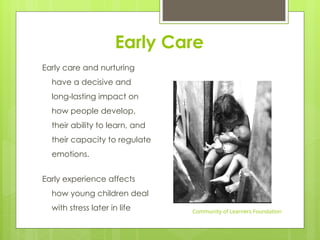
Early careand nurturing
have a decisive and
long-lasting impact on
how people develop,
their ability to learn, and
their capacity to regulate
emotions.
Early experience affects
how young children deal
with stress later in life Community of Learners Foundation
Taking On Challenges
Weshould do more than help
children COPE with stress. We
need to help them learn to take
on challenges.
Community of Learners Foundation
20.
Taking On Challenges
Childrenwho are willing to take
on challenges (instead of
avoiding them or simply coping
with them) do better in school
and in life.
Community of Learners Foundation
21.
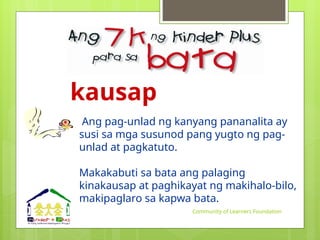
kausap
Ang pag-unlad ngkanyang pananalita ay
susi sa mga susunod pang yugto ng pag-
unlad at pagkatuto.
Makakabuti sa bata ang palaging
kinakausap at paghikayat ng makihalo-bilo,
makipaglaro sa kapwa bata.
Community of Learners Foundation
22.
Children needto hone both listening
and speaking skills.
Community of Learners Foundation
23.
Children need opportunitiesto
engage in meaningful
conversations with peers in
various social contexts.
Community of Learners Foundation
24.
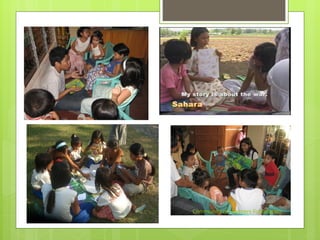
Make reading anintegral part of
our classroom life as this is a
pathway to better
communication skills.
Community of Learners Foundation
kasama
Para siguradong ligtasat nagagabayan
ang bata, mahalaga ang pamilya.
Ang mga magulang, kapatid at kamag-
anak ay ang mga unang guro at taga-
pag-alaga ng bata.
Mula sa pakikipagugnay sa pamilya at
kapwa bata, umuunlad ang bata.
Community of Learners Foundation
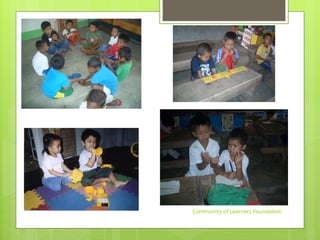
kalaro at panahonmaglaro
Mahalaga ang paglalaro sa pag-unlad ng
isang bata. Ang paglalaro ay isang
magandang paraan upang maging bihasa
ang bata sa pananalita, pag-iisip at
pagsasa-ayos ng kanyang kaisipan.
Natututo siya tungkol sa mundong
kanyang ginagalawan.Community of Learners Foundation
29.
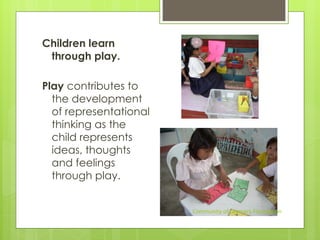
Children learn
through play.
Playcontributes to
the development
of representational
thinking as the
child represents
ideas, thoughts
and feelings
through play.
Community of Learners Foundation
30.
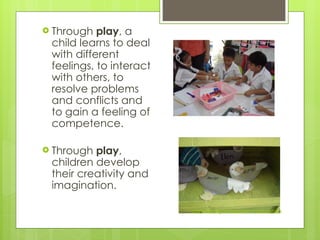
Through play,a
child learns to deal
with different
feelings, to interact
with others, to
resolve problems
and conflicts and
to gain a feeling of
competence.
Through play,
children develop
their creativity and
imagination.
Community of Learners Foundation
SOCIAL INTERACTION
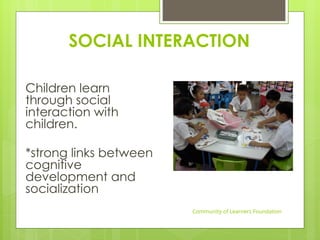
Children learn
throughsocial
interaction with
children.
*strong links between
cognitive
development and
socialization
Community of Learners Foundation
33.
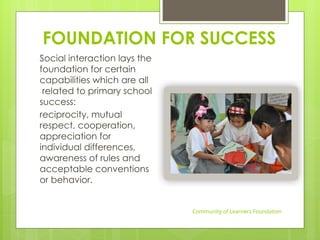
FOUNDATION FOR SUCCESS
Socialinteraction lays the
foundation for certain
capabilities which are all
related to primary school
success:
reciprocity, mutual
respect, cooperation,
appreciation for
individual differences,
awareness of rules and
acceptable conventions
or behavior.
Community of Learners Foundation
34.
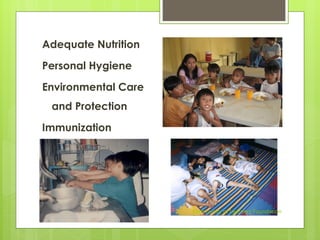
kalusugan
Mas maganda angpag-unlad ng mga
batang malusog at masaya.
Gawing ligtas at malinis ang katawan at
kapaligiran upang maging malusog ang
bata.
Bigyan ng tama at wastong pagkain at
hikayatin silang kumain ng mabuti.
Community of Learners Foundation
35.
All children needa physically
active, healthy lifestyle,
beginning in their early years.
Unfortunately, poor nutrition,
inactivity, childhood obesity
and declining fitness are
common.
Community of Learners Foundation
36.
Psychological Benefitsof Physical activity :
improving their control over symptoms of
anxiety and depression; assisting in social
development by providing opportunities
for self-expression, building self-
confidence, social interaction and
integration.
Community of Learners Foundation
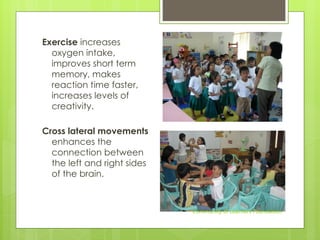
Exercise increases
oxygen intake,
improvesshort term
memory, makes
reaction time faster,
increases levels of
creativity.
Cross lateral movements
enhances the
connection between
the left and right sides
of the brain.
Community of Learners Foundation
39.
Pandama, kasangkapan paramatuto -
paningin, pandinig, pang-amoy, pang-tikim at
pandama
Gaya-gaya, buti nga para matuto!
Pakikipagkapwa-tao
Kapaligiran at kakayahan
Mula sa bahay, day care o kindergarten,
paaralan - panghabang-buhay na pagkatuto.
Kakayahan at kaalaman
Community of Learners Foundation
40.
Patterns & Intelligence
Thebrain thrives on making and detecting
patterns as the brain is not designed for
linear, one-path thought
The ability to see patterns and make
relationships of the patterns is the essence
of intelligence.
Community of Learners Foundation
41.
Making Connections
Making connectionsis at the heart of
learning—figuring out what’s the same and
what’s different—and making unusual
connections is at the core of creativity.
Community of Learners Foundation
42.
Making Connections
In aworld where information is so
accessible, it is the people who can see
connections who are able to go beyond
knowing information to using this
information well.
Community of Learners Foundation
43.
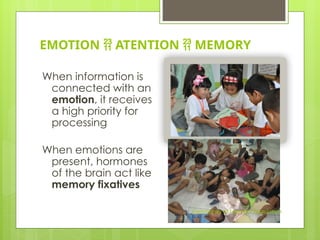
EMOTION ATENTION MEMORY
When information is
connected with an
emotion, it receives
a high priority for
processing
When emotions are
present, hormones
of the brain act like
memory fixatives
Community of Learners Foundation
44.
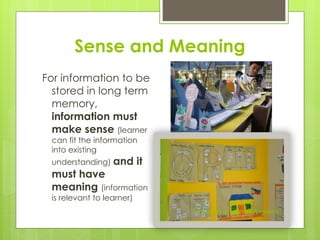
Sense and Meaning
Forinformation to be
stored in long term
memory,
information must
make sense (learner
can fit the information
into existing
understanding) and it
must have
meaning (information
is relevant to learner)
Community of Learners Foundation
45.
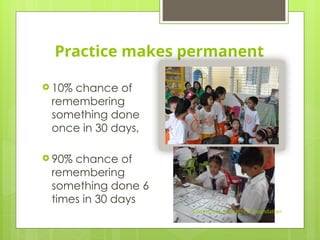
Practice makes permanent
10% chance of
remembering
something done
once in 30 days,
90% chance of
remembering
something done 6
times in 30 days
Community of Learners Foundation
46.
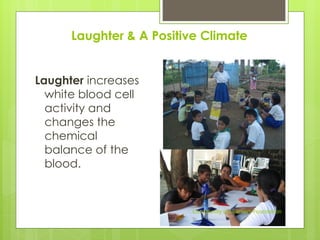
Laughter & APositive Climate
Laughter increases
white blood cell
activity and
changes the
chemical
balance of the
blood.
Community of Learners Foundation
47.
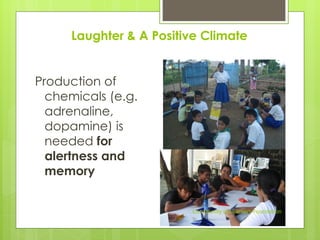
Laughter & APositive Climate
Production of
chemicals (e.g.
adrenaline,
dopamine) is
needed for
alertness and
memory
Community of Learners Foundation
48.
Kapaligirang
mapagpayaman
sa karanasan
Hindi laruanat kasangkapan–
paglalaro, kalaro, pagkilos
Mapagpayaman: karanasan at
imahinasyon at tulungan silang
maging mapag-likha.
Community of Learners Foundation
49.
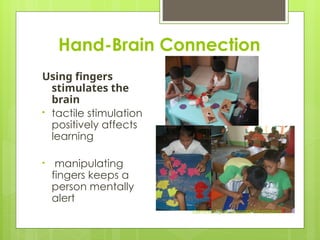
Hand-Brain Connection
Using fingers
stimulatesthe
brain
• tactile stimulation
positively affects
learning
• manipulating
fingers keeps a
person mentally
alert
Community of Learners Foundation
50.
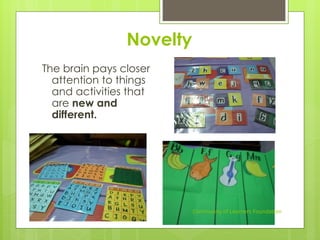
Novelty
The brain payscloser
attention to things
and activities that
are new and
different.
Community of Learners Foundation
51.
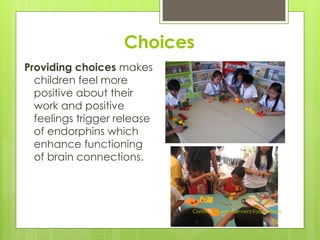
Choices
Providing choices makes
childrenfeel more
positive about their
work and positive
feelings trigger release
of endorphins which
enhance functioning
of brain connections.
Community of Learners Foundation
Application
Community of LearnersFoundation
• Each group creatively develop a
classroom case scenario experience
or an activity to support children’s
learning and development (7K)
Group 1 – Kalinga (Pantomime)
Group 2 –Kausap (Dance Drama)
54.
Community of LearnersFoundation
• Group 3 – Kasama (Song)
• Group 4 – Kalaro at panahon
maglaro (Role Play)
• Group 5 –Kalusugan (Jingle)
• Group 6 – Kakayahan at kaalaman
(Poem)
• Group 7 – Kapaligirang
mapagpayaman sa karanasan (Skit)
Present in plenary (3 minutes per
group)
55.
Community of LearnersFoundation
• Synthesis
• Let me end the session with a song
“Itanong mo sa mga Bata” by Asin
56.
References:
Wilson,Donna, “Flourishingin the First Five Years”
Shiller,Pam, “Start Smart:Building Brain Power in the
Early Years
Galinsky, Ellen, “ Mind in the Making”
Healy, Jane, “ Your Child’s Growing Mind”
Evans,Judith, “Early Childhood Counts”, (The
International Bank for Reconstruction and
Development)
Brazelton, T.Berry M.D. and Greenspan, Stanley M.D,
“The Irreducible Needs of Children: What Every
Child Must Have to Grow, Learn and Flourish”
Editor's Notes
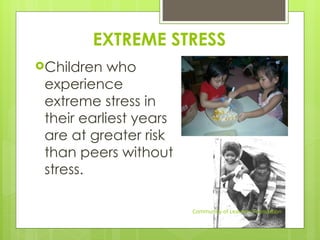
#18 for developing a variety of cognitive, behavioral and emotional difficulties.