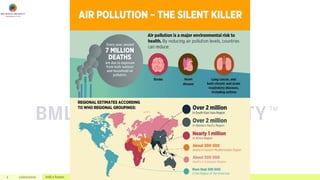
Air Pollution-2
Sesion-12:
Environmental Studies & Disaster
Management
Prof. Ajay Mohan Goel
ajay.goel@bmu.edu.in
2 22/02/2020 Add a footer
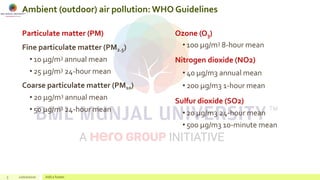
Ambient (outdoor) air pollution: WHO Guidelines
Particulate matter (PM)
Fine particulate matter (PM2.5)
• 10 μg/m3 annual mean
• 25 μg/m3 24-hour mean
Coarse particulate matter (PM10)
• 20 μg/m3 annual mean
• 50 μg/m3 24-hour mean
3 22/02/2020 Add a footer
Ozone (O3)
• 100 μg/m3 8-hour mean
Nitrogen dioxide (NO2)
• 40 μg/m3 annual mean
• 200 μg/m3 1-hour mean
Sulfur dioxide (SO2)
• 20 μg/m3 24-hour mean
• 500 μg/m3 10-minute mean
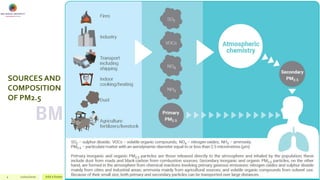
SOURCES AND
COMPOSITION
OF PM2.5
4 22/02/2020 Add a footer
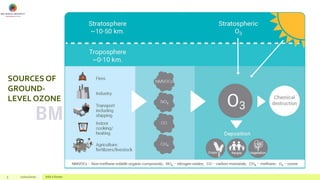
SOURCES OF
GROUND-
LEVEL OZONE
5 22/02/2020 Add a footer
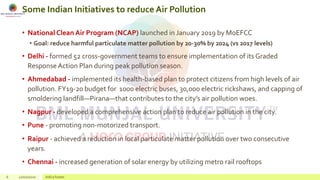
Some Indian Initiatives to reduce Air Pollution
• National Clean Air Program (NCAP) launched in January 2019 by MoEFCC
• Goal: reduce harmful particulate matter pollution by 20-30% by 2024 (vs 2017 levels)
• Delhi - formed 52 cross-government teams to ensure implementation of its Graded
Response Action Plan during peak pollution season.
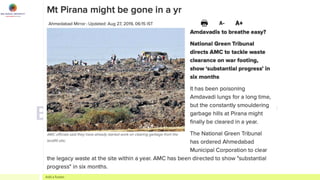
• Ahmedabad - implemented its health-based plan to protect citizens from high levels of air
pollution. FY19-20 budget for 1000 electric buses, 30,000 electric rickshaws, and capping of
smoldering landfill—Pirana—that contributes to the city’s air pollution woes.
• Nagpur - developed a comprehensive action plan to reduce air pollution in the city.
• Pune - promoting non-motorized transport.
• Raipur - achieved a reduction in local particulate matter pollution over two consecutive
years.
• Chennai - increased generation of solar energy by utilizing metro rail rooftops
6 22/02/2020 Add a footer
Add a footer
Solutions for Cities
1. Post-combustion controls: Introduce state-of-the-art end-of-pipe measures to reduce
sulphur dioxide, nitrogen oxides and particulate emissions at power stations and in large-
scale industry
2. Vehicle inspection and maintenance: Enforce mandatory checks and repairs for vehicles
3. Dust control: Suppress construction and road dust; increase green areas
4. Agricultural crop residue: Manage agricultural residues, including strict enforcement of
bans on open burning
5. Residential waste burning: Strictly enforce bans on open burning of household waste
6. Clean cooking and heating: Use clean fuels – electricity, natural gas, liquefied petroleum
gas (LPG) in cities, and LPG and advanced biomass cooking and heating stoves in rural
areas; substitution of coal by briquettes
9 22/02/2020 Add a footer
Solutions for Cities
7. Renewables for power generation: Use incentives to foster extended use of wind, solar
and hydro power for electricity generation and phase out the least efficient plants
8. Energy efficiency for households: Use incentives to improve the energy efficiency of
household appliances, buildings, lighting, heating and cooling; encourage roof-top solar
installations
9. Electric vehicles: Promote the use of electric vehicles
10. Improved public transport: Encourage a shift from private passenger vehicles to public
transport
11. Solid waste management: Encourage centralized waste collection with source separation
and treatment, including gas utilization
12. Wastewater treatment: Introduce well-managed two-stage treatment with biogas
recovery
10 22/02/2020 Add a footer
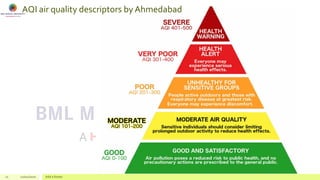
AQI air quality descriptors by Ahmedabad
11 22/02/2020 Add a footer
Solutions
• Invest in Energy Efficient Power Generation
• Build safe and affordable public transport systems and Pedestrian & Cycle friendly
networks
• Improve domestic, industry and municipal waste management
• Reduce Agricultural waste incineration, forest fires and certain agro-forestry
activities.
• Make greener and more compact cities with energy-efficient buildings.
• Provide universal access to clean affordable fuels and technologies for cooking,
heating and lighting.
12 22/02/2020 Add a footer
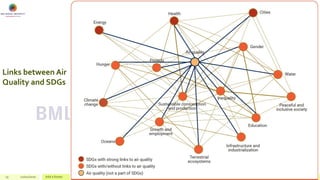
Links between Air
Quality and SDGs
13 22/02/2020 Add a footer
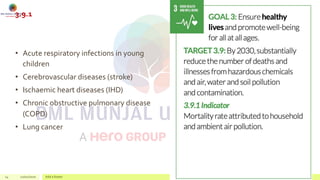
3.9.1
14 22/02/2020 Add a footer
• Acute respiratory infections in young
children
• Cerebrovascular diseases (stroke)
• Ischaemic heart diseases (IHD)
• Chronic obstructive pulmonary disease
(COPD)
• Lung cancer
3.9.1
15 22/02/2020 Add a footer
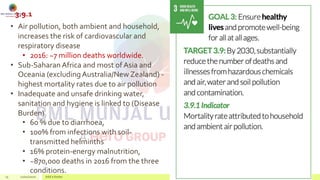
• Air pollution, both ambient and household,
increases the risk of cardiovascular and
respiratory disease
• 2016: ~7 million deaths worldwide.
• Sub-Saharan Africa and most of Asia and
Oceania (excluding Australia/New Zealand) -
highest mortality rates due to air pollution
• Inadequate and unsafe drinking water,
sanitation and hygiene is linked to (Disease
Burden)
• 60 % due to diarrhoea,
• 100% from infections with soil-
transmitted helminths
• 16% protein-energy malnutrition,
• ~870,000 deaths in 2016 from the three
conditions.
7.1.2
16 22/02/2020 Add a footer
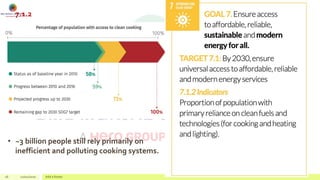
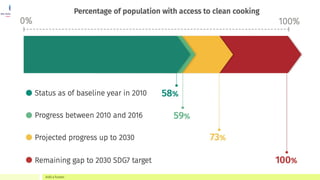
• ~3 billion people still rely primarily on
inefficient and polluting cooking systems.
Add a footer
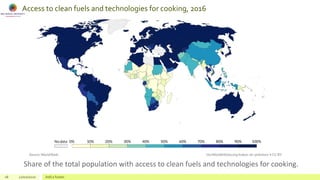
Access to clean fuels and technologies for cooking, 2016
18 22/02/2020 Add a footer
Share of the total population with access to clean fuels and technologies for cooking.
19 22/02/2020 Add a footer
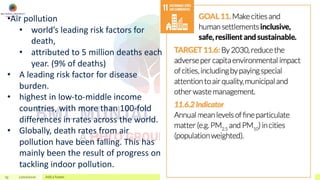
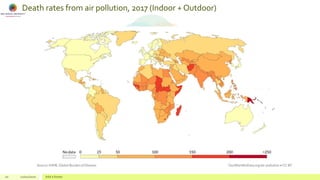
•Air pollution
• world’s leading risk factors for
death,
• attributed to 5 million deaths each
year. (9% of deaths)
• A leading risk factor for disease
burden.
• highest in low-to-middle income
countries, with more than 100-fold
differences in rates across the world.
• Globally, death rates from air
pollution have been falling. This has
mainly been the result of progress on
tackling indoor pollution.
Death rates from air pollution, 2017 (Indoor + Outdoor)
20 22/02/2020 Add a footer
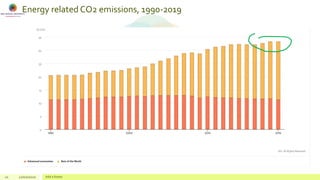
Energy related CO2 emissions, 1990-2019
21 22/02/2020 Add a footer
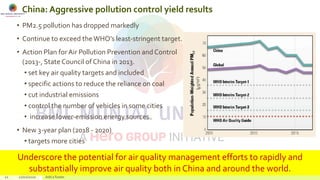
China: Aggressive pollution control yield results
• PM2.5 pollution has dropped markedly
• Continue to exceed theWHO’s least-stringent target.
• Action Plan for Air Pollution Prevention and Control
(2013-, State Council of China in 2013.
• set key air quality targets and included
• specific actions to reduce the reliance on coal
• cut industrial emissions
• control the number of vehicles in some cities
• increase lower-emission energy sources
• New 3-year plan (2018 - 2020)
• targets more cities
22 22/02/2020 Add a footer
Underscore the potential for air quality management efforts to rapidly and
substantially improve air quality both in China and around the world.
Thank you
2322/02/2020 Add a footer
Prof. Ajay Mohan Goel
ajay.goel@bmu.edu.in

Session 12 - Air Pollution-2

  • 1.
    Air Pollution-2 Sesion-12: Environmental Studies& Disaster Management Prof. Ajay Mohan Goel ajay.goel@bmu.edu.in
  • 2.
  • 3.
    Ambient (outdoor) airpollution: WHO Guidelines Particulate matter (PM) Fine particulate matter (PM2.5) • 10 μg/m3 annual mean • 25 μg/m3 24-hour mean Coarse particulate matter (PM10) • 20 μg/m3 annual mean • 50 μg/m3 24-hour mean 3 22/02/2020 Add a footer Ozone (O3) • 100 μg/m3 8-hour mean Nitrogen dioxide (NO2) • 40 μg/m3 annual mean • 200 μg/m3 1-hour mean Sulfur dioxide (SO2) • 20 μg/m3 24-hour mean • 500 μg/m3 10-minute mean
  • 4.
    SOURCES AND COMPOSITION OF PM2.5 422/02/2020 Add a footer
  • 5.
    SOURCES OF GROUND- LEVEL OZONE 522/02/2020 Add a footer
  • 6.
    Some Indian Initiativesto reduce Air Pollution • National Clean Air Program (NCAP) launched in January 2019 by MoEFCC • Goal: reduce harmful particulate matter pollution by 20-30% by 2024 (vs 2017 levels) • Delhi - formed 52 cross-government teams to ensure implementation of its Graded Response Action Plan during peak pollution season. • Ahmedabad - implemented its health-based plan to protect citizens from high levels of air pollution. FY19-20 budget for 1000 electric buses, 30,000 electric rickshaws, and capping of smoldering landfill—Pirana—that contributes to the city’s air pollution woes. • Nagpur - developed a comprehensive action plan to reduce air pollution in the city. • Pune - promoting non-motorized transport. • Raipur - achieved a reduction in local particulate matter pollution over two consecutive years. • Chennai - increased generation of solar energy by utilizing metro rail rooftops 6 22/02/2020 Add a footer
  • 7.
  • 8.
    Solutions for Cities 1.Post-combustion controls: Introduce state-of-the-art end-of-pipe measures to reduce sulphur dioxide, nitrogen oxides and particulate emissions at power stations and in large- scale industry 2. Vehicle inspection and maintenance: Enforce mandatory checks and repairs for vehicles 3. Dust control: Suppress construction and road dust; increase green areas 4. Agricultural crop residue: Manage agricultural residues, including strict enforcement of bans on open burning 5. Residential waste burning: Strictly enforce bans on open burning of household waste 6. Clean cooking and heating: Use clean fuels – electricity, natural gas, liquefied petroleum gas (LPG) in cities, and LPG and advanced biomass cooking and heating stoves in rural areas; substitution of coal by briquettes 9 22/02/2020 Add a footer
  • 9.
    Solutions for Cities 7.Renewables for power generation: Use incentives to foster extended use of wind, solar and hydro power for electricity generation and phase out the least efficient plants 8. Energy efficiency for households: Use incentives to improve the energy efficiency of household appliances, buildings, lighting, heating and cooling; encourage roof-top solar installations 9. Electric vehicles: Promote the use of electric vehicles 10. Improved public transport: Encourage a shift from private passenger vehicles to public transport 11. Solid waste management: Encourage centralized waste collection with source separation and treatment, including gas utilization 12. Wastewater treatment: Introduce well-managed two-stage treatment with biogas recovery 10 22/02/2020 Add a footer
  • 10.
    AQI air qualitydescriptors by Ahmedabad 11 22/02/2020 Add a footer
  • 11.
    Solutions • Invest inEnergy Efficient Power Generation • Build safe and affordable public transport systems and Pedestrian & Cycle friendly networks • Improve domestic, industry and municipal waste management • Reduce Agricultural waste incineration, forest fires and certain agro-forestry activities. • Make greener and more compact cities with energy-efficient buildings. • Provide universal access to clean affordable fuels and technologies for cooking, heating and lighting. 12 22/02/2020 Add a footer
  • 12.
    Links between Air Qualityand SDGs 13 22/02/2020 Add a footer
  • 13.
    3.9.1 14 22/02/2020 Adda footer • Acute respiratory infections in young children • Cerebrovascular diseases (stroke) • Ischaemic heart diseases (IHD) • Chronic obstructive pulmonary disease (COPD) • Lung cancer
  • 14.
    3.9.1 15 22/02/2020 Adda footer • Air pollution, both ambient and household, increases the risk of cardiovascular and respiratory disease • 2016: ~7 million deaths worldwide. • Sub-Saharan Africa and most of Asia and Oceania (excluding Australia/New Zealand) - highest mortality rates due to air pollution • Inadequate and unsafe drinking water, sanitation and hygiene is linked to (Disease Burden) • 60 % due to diarrhoea, • 100% from infections with soil- transmitted helminths • 16% protein-energy malnutrition, • ~870,000 deaths in 2016 from the three conditions.
  • 15.
    7.1.2 16 22/02/2020 Adda footer • ~3 billion people still rely primarily on inefficient and polluting cooking systems.
  • 16.
  • 17.
    Access to cleanfuels and technologies for cooking, 2016 18 22/02/2020 Add a footer Share of the total population with access to clean fuels and technologies for cooking.
  • 18.
    19 22/02/2020 Adda footer •Air pollution • world’s leading risk factors for death, • attributed to 5 million deaths each year. (9% of deaths) • A leading risk factor for disease burden. • highest in low-to-middle income countries, with more than 100-fold differences in rates across the world. • Globally, death rates from air pollution have been falling. This has mainly been the result of progress on tackling indoor pollution.
  • 19.
    Death rates fromair pollution, 2017 (Indoor + Outdoor) 20 22/02/2020 Add a footer
  • 20.
    Energy related CO2emissions, 1990-2019 21 22/02/2020 Add a footer
  • 21.
    China: Aggressive pollutioncontrol yield results • PM2.5 pollution has dropped markedly • Continue to exceed theWHO’s least-stringent target. • Action Plan for Air Pollution Prevention and Control (2013-, State Council of China in 2013. • set key air quality targets and included • specific actions to reduce the reliance on coal • cut industrial emissions • control the number of vehicles in some cities • increase lower-emission energy sources • New 3-year plan (2018 - 2020) • targets more cities 22 22/02/2020 Add a footer Underscore the potential for air quality management efforts to rapidly and substantially improve air quality both in China and around the world.
  • 22.
    Thank you 2322/02/2020 Adda footer Prof. Ajay Mohan Goel ajay.goel@bmu.edu.in