SESSION – 12
By→ Anuj Kumar Singh
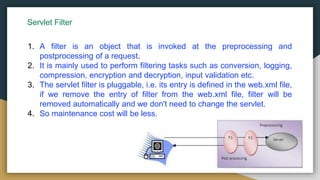
Servlet Filter
1. A filter is an object that is invoked at the preprocessing and
postprocessing of a request.
2. It is mainly used to perform filtering tasks such as conversion, logging,
compression, encryption and decryption, input validation etc.
3. The servlet filter is pluggable, i.e. its entry is defined in the web.xml file,
if we remove the entry of filter from the web.xml file, filter will be
removed automatically and we don't need to change the servlet.
4. So maintenance cost will be less.
Usage of Filter
1. recording all incoming requests
2. logs the IP addresses of the computers from which the requests
originate
3. Conversion
4. data compression
5. encryption and decryption
6. input validation etc.
Advantage of Filter
1. Filter is pluggable.
2. One filter don't have dependency onto another resource.
3. Less Maintenance
Servlet Filter API
Like servlet filter have its own API. The javax.servlet package contains
the three interfaces of Filter API.
1. Filter
2. FilterChain
3. FilterConfig
1) Filter interface
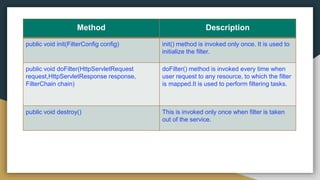
For creating any filter, you must implement the Filter interface. Filter
interface provides the life cycle methods for a filter.
Method Description
public void init(FilterConfig config) init() method is invoked only once. It is used to
initialize the filter.
public void doFilter(HttpServletRequest
request,HttpServletResponse response,
FilterChain chain)
doFilter() method is invoked every time when
user request to any resource, to which the filter
is mapped.It is used to perform filtering tasks.
public void destroy() This is invoked only once when filter is taken
out of the service.
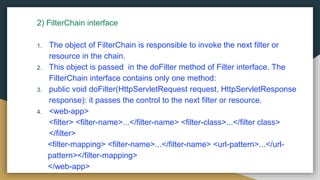
2) FilterChain interface
1. The object of FilterChain is responsible to invoke the next filter or
resource in the chain.
2. This object is passed in the doFilter method of Filter interface. The
FilterChain interface contains only one method:
3. public void doFilter(HttpServletRequest request, HttpServletResponse
response): it passes the control to the next filter or resource.
4. <web-app>
<filter> <filter-name>...</filter-name> <filter-class>...</filter class>
</filter>
<filter-mapping> <filter-name>...</filter-name> <url-pattern>...</url-
pattern></filter-mapping>
</web-app>
Servlet   session 12

Servlet session 12

  • 1.
    SESSION – 12 By→Anuj Kumar Singh
  • 2.
    Servlet Filter 1. Afilter is an object that is invoked at the preprocessing and postprocessing of a request. 2. It is mainly used to perform filtering tasks such as conversion, logging, compression, encryption and decryption, input validation etc. 3. The servlet filter is pluggable, i.e. its entry is defined in the web.xml file, if we remove the entry of filter from the web.xml file, filter will be removed automatically and we don't need to change the servlet. 4. So maintenance cost will be less.
  • 3.
    Usage of Filter 1.recording all incoming requests 2. logs the IP addresses of the computers from which the requests originate 3. Conversion 4. data compression 5. encryption and decryption 6. input validation etc. Advantage of Filter 1. Filter is pluggable. 2. One filter don't have dependency onto another resource. 3. Less Maintenance
  • 4.
    Servlet Filter API Likeservlet filter have its own API. The javax.servlet package contains the three interfaces of Filter API. 1. Filter 2. FilterChain 3. FilterConfig 1) Filter interface For creating any filter, you must implement the Filter interface. Filter interface provides the life cycle methods for a filter.
  • 5.
    Method Description public voidinit(FilterConfig config) init() method is invoked only once. It is used to initialize the filter. public void doFilter(HttpServletRequest request,HttpServletResponse response, FilterChain chain) doFilter() method is invoked every time when user request to any resource, to which the filter is mapped.It is used to perform filtering tasks. public void destroy() This is invoked only once when filter is taken out of the service.
  • 6.
    2) FilterChain interface 1.The object of FilterChain is responsible to invoke the next filter or resource in the chain. 2. This object is passed in the doFilter method of Filter interface. The FilterChain interface contains only one method: 3. public void doFilter(HttpServletRequest request, HttpServletResponse response): it passes the control to the next filter or resource. 4. <web-app> <filter> <filter-name>...</filter-name> <filter-class>...</filter class> </filter> <filter-mapping> <filter-name>...</filter-name> <url-pattern>...</url- pattern></filter-mapping> </web-app>