Chapter 1:
New Perspectives On
Marketing in the
Service Economy

Slide © 2010 by Lovelock & Wirtz

Services Marketing 7/e

Chapter 1 – Page 1
Overview of Chapter 1

 Why Study Services?
 What are Services?
 Marketing Challenges Posed by Services
 Extended Marketing Mix Required for Services
 Integration of Marketing with Other Management Functions
 Developing Effective Service Marketing Strategies
Slide © 2010 by Lovelock & Wirtz

Services Marketing 7/e

Chapter 1 – Page 2
Why Study Services?

Slide © 2010 by Lovelock & Wirtz

Services Marketing 7/e

Chapter 1 – Page 3
Why Study Services?
 Services dominate most economies and are growing
rapidly:
 Services account for more than 60% of GDP worldwide
 Almost all economies have a substantial service sector
 Most new employment is provided by services
 Strongest growth area for marketing

 Understanding services offers you a personal competitive
advantage

Slide © 2010 by Lovelock & Wirtz

Services Marketing 7/e

Chapter 1 – Page 4
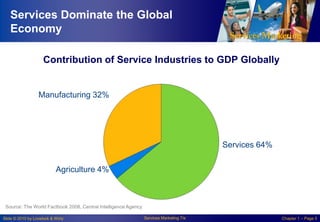
Services Dominate the Global
Economy
Contribution of Service Industries to GDP Globally

Manufacturing 32%

Services 64%
Agriculture 4%

Source: The World Factbook 2008, Central Intelligence Agency
Slide © 2010 by Lovelock & Wirtz

Services Marketing 7/e

Chapter 1 – Page 5
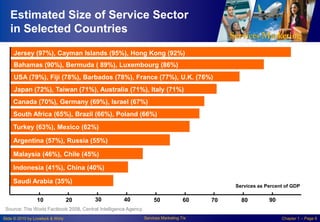
Estimated Size of Service Sector
in Selected Countries
Jersey (97%), Cayman Islands (95%), Hong Kong (92%)
Bahamas (90%), Bermuda ( 89%), Luxembourg (86%)
USA (79%), Fiji (78%), Barbados (78%), France (77%), U.K. (76%)
Japan (72%), Taiwan (71%), Australia (71%), Italy (71%)
Canada (70%), Germany (69%), Israel (67%)
South Africa (65%), Brazil (66%), Poland (66%)
Turkey (63%), Mexico (62%)
Argentina (57%), Russia (55%)

Malaysia (46%), Chile (45%)
Indonesia (41%), China (40%)
Saudi Arabia (35%)
10

20

Services as Percent of GDP

30

40

50

60

70

80

90

Source: The World Factbook 2008, Central Intelligence Agency
Slide © 2010 by Lovelock & Wirtz

Services Marketing 7/e

Chapter 1 – Page 6
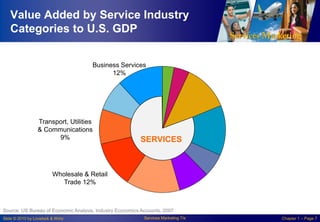
Value Added by Service Industry
Categories to U.S. GDP
Business Services
12%

Transport, Utilities
& Communications
9%

SERVICES

Wholesale & Retail
Trade 12%

Source: US Bureau of Economic Analysis, Industry Economics Accounts, 2007
Slide © 2010 by Lovelock & Wirtz

Services Marketing 7/e

Chapter 1 – Page 7
NAICS: New Way to Classify &
Analyze the Service Economy
 NAICS—North American Industry Classification System
 Classifies industries in the economic statistics of USA, Canada &
Mexico
 Replaces old SIC codes in USA
 Captures huge array of new service industries, each with its own
NAICS code

 NAPCS—North American Product Classification System
 Assigns codes to thousands of service products
 Particularly useful for looking at rented goods services

Slide © 2010 by Lovelock & Wirtz

Services Marketing 7/e

Chapter 1 – Page 8
NAICS Codes of Newer Service
Industries Not Profiled By SIC
 Casino Hotels

 HMO Medical Centers

 Continuing Care Retirement
Communities

 Industrial Design Services

 Diagnostic Imaging Centers

 Investment Banking and Securities
Dealing

 Diet and Weight Reducing Centers

 Management Consulting Services

 Environmental Consulting

 Satellite Telecommunications

 Golf Courses, Country Clubs

 Telemarketing Bureaus

 Hazardous Waste Collection

 Temporary Help Services

Slide © 2010 by Lovelock & Wirtz

Services Marketing 7/e

Chapter 1 – Page 9
Why Study Services?

 Most new jobs are generated by services
 Fastest growth expected in knowledge-based industries
 Significant training and educational qualifications required,
but employees will be more highly compensated
 Will service jobs be lost to lower-cost countries? Yes, some service
jobs can be exported

Slide © 2010 by Lovelock & Wirtz

Services Marketing 7/e

Chapter 1 – Page 10
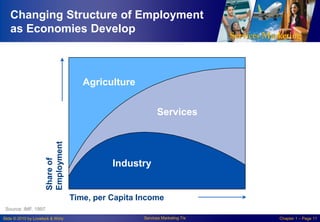
Changing Structure of Employment
as Economies Develop

Agriculture

Share of
Employment

Services

Industry

Time, per Capita Income
Source: IMF, 1997
Slide © 2010 by Lovelock & Wirtz

Services Marketing 7/e

Chapter 1 – Page 11
Why Study Services?
 Powerful forces are transforming service markets
 Government policies, social changes, business trends,
advances in IT, internationalization

 Forces that reshape:
 Demand

 Supply
 The competitive landscape
 Customers‘ choices, power, and decision making

Slide © 2010 by Lovelock & Wirtz

Services Marketing 7/e

Chapter 1 – Page 12
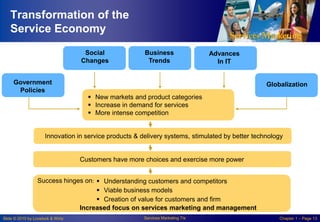
Transformation of the
Service Economy
Social
Changes
Government
Policies

Business
Trends

Advances
In IT

Globalization
 New markets and product categories
 Increase in demand for services
 More intense competition

Innovation in service products & delivery systems, stimulated by better technology

Customers have more choices and exercise more power
Success hinges on:  Understanding customers and competitors
 Viable business models
 Creation of value for customers and firm
Increased focus on services marketing and management
Slide © 2010 by Lovelock & Wirtz

Services Marketing 7/e

Chapter 1 – Page 13
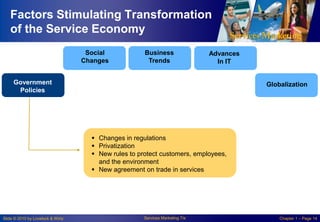
Factors Stimulating Transformation
of the Service Economy
Social
Changes

Business
Trends

Advances
In IT

Government
Policies

Globalization

 Changes in regulations
 Privatization
 New rules to protect customers, employees,
and the environment
 New agreement on trade in services

Slide © 2010 by Lovelock & Wirtz

Services Marketing 7/e

Chapter 1 – Page 14
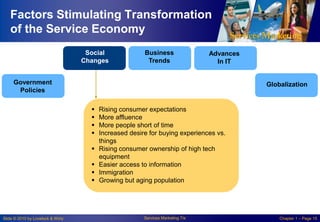
Factors Stimulating Transformation
of the Service Economy
Social
Changes

Business
Trends

Advances
In IT

Government
Policies

Globalization










Slide © 2010 by Lovelock & Wirtz

Rising consumer expectations
More affluence
More people short of time
Increased desire for buying experiences vs.
things
Rising consumer ownership of high tech
equipment
Easier access to information
Immigration
Growing but aging population

Services Marketing 7/e

Chapter 1 – Page 15
Factors Stimulating Transformation
of the Service Economy
Social
Changes

Business
Trends

Advances
In IT

Government
Policies

Globalization

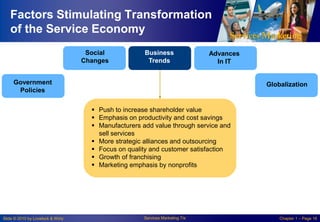
 Push to increase shareholder value
 Emphasis on productivity and cost savings
 Manufacturers add value through service and
sell services
 More strategic alliances and outsourcing
 Focus on quality and customer satisfaction
 Growth of franchising
 Marketing emphasis by nonprofits

Slide © 2010 by Lovelock & Wirtz

Services Marketing 7/e

Chapter 1 – Page 16
Factors Stimulating Transformation
of the Service Economy
Social
Changes

Business
Trends

Advances
In IT

Government
Policies

Globalization








Slide © 2010 by Lovelock & Wirtz

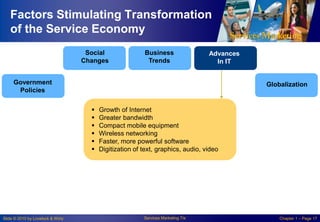
Growth of Internet
Greater bandwidth
Compact mobile equipment
Wireless networking
Faster, more powerful software
Digitization of text, graphics, audio, video

Services Marketing 7/e

Chapter 1 – Page 17
Factors Stimulating Transformation
of the Service Economy
Social
Changes

Business
Trends

Advances
In IT

Government
Policies

Globalization

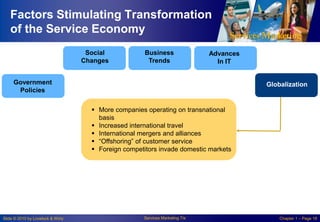
 More companies operating on transnational
basis
 Increased international travel
 International mergers and alliances
 “Offshoring” of customer service
 Foreign competitors invade domestic markets

Slide © 2010 by Lovelock & Wirtz

Services Marketing 7/e

Chapter 1 – Page 18
What are Services?

Slide © 2010 by Lovelock & Wirtz

Services Marketing 7/e

Chapter 1 – Page 19
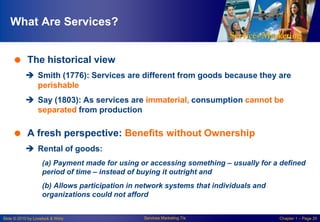
What Are Services?
 The historical view
 Smith (1776): Services are different from goods because they are
perishable
 Say (1803): As services are immaterial, consumption cannot be
separated from production

 A fresh perspective: Benefits without Ownership
 Rental of goods:
(a) Payment made for using or accessing something – usually for a defined
period of time – instead of buying it outright and

(b) Allows participation in network systems that individuals and
organizations could not afford

Slide © 2010 by Lovelock & Wirtz

Services Marketing 7/e

Chapter 1 – Page 20
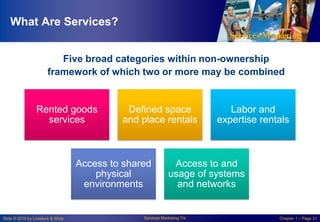
What Are Services?
Five broad categories within non-ownership
framework of which two or more may be combined

Rented goods
services

Defined space
and place rentals

Access to shared
physical
environments

Slide © 2010 by Lovelock & Wirtz

Labor and
expertise rentals

Access to and
usage of systems
and networks

Services Marketing 7/e

Chapter 1 – Page 21
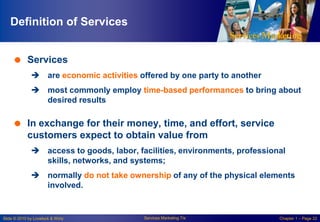
Definition of Services
 Services
 are economic activities offered by one party to another

 most commonly employ time-based performances to bring about
desired results

 In exchange for their money, time, and effort, service
customers expect to obtain value from
 access to goods, labor, facilities, environments, professional
skills, networks, and systems;
 normally do not take ownership of any of the physical elements
involved.

Slide © 2010 by Lovelock & Wirtz

Services Marketing 7/e

Chapter 1 – Page 22
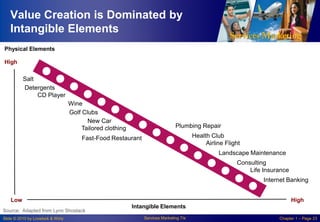
Value Creation is Dominated by
Intangible Elements
Physical Elements
High

Salt
Detergents
CD Player
Wine
Golf Clubs
New Car
Tailored clothing

Plumbing Repair
Health Club
Airline Flight

Fast-Food Restaurant

Landscape Maintenance
Consulting
Life Insurance
Internet Banking
Low
Source; Adapted from Lynn Shostack
Slide © 2010 by Lovelock & Wirtz

High
Intangible Elements
Services Marketing 7/e

Chapter 1 – Page 23
Service Products vs. Customer
Service & After-Sales Service
 A firm‘s market offerings are divided into core product
elements and supplementary service elements

 Need to distinguish between:
 Marketing of services – when service is the core product
 Marketing through service – when good service increases the
value of a core physical good

 Manufacturing firms are reformulating and enhancing
existing added-value services to market them as standalone core products

Slide © 2010 by Lovelock & Wirtz

Services Marketing 7/e

Chapter 1 – Page 24
Service – A Process Perspective
 Differences exist amongst services depending on what is
being processed

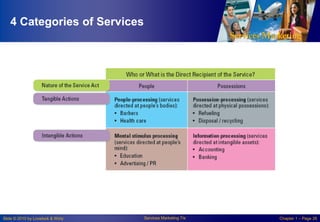
 Classification of services into
 People processing
 Possession processing

 Mental stimulus processing
 Information processing

Slide © 2010 by Lovelock & Wirtz

Services Marketing 7/e

Chapter 1 – Page 25
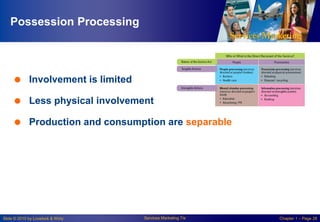
4 Categories of Services

Slide © 2010 by Lovelock & Wirtz

Services Marketing 7/e

Chapter 1 – Page 26
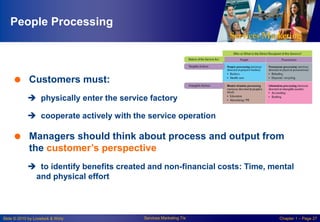
People Processing

 Customers must:
 physically enter the service factory
 cooperate actively with the service operation

 Managers should think about process and output from
the customer‘s perspective
 to identify benefits created and non-financial costs: Time, mental
and physical effort

Slide © 2010 by Lovelock & Wirtz

Services Marketing 7/e

Chapter 1 – Page 27
Possession Processing

 Involvement is limited
 Less physical involvement
 Production and consumption are separable

Slide © 2010 by Lovelock & Wirtz

Services Marketing 7/e

Chapter 1 – Page 28
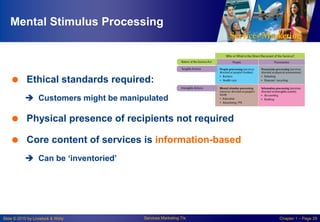
Mental Stimulus Processing

 Ethical standards required:
 Customers might be manipulated

 Physical presence of recipients not required

 Core content of services is information-based
 Can be ‗inventoried‘

Slide © 2010 by Lovelock & Wirtz

Services Marketing 7/e

Chapter 1 – Page 29
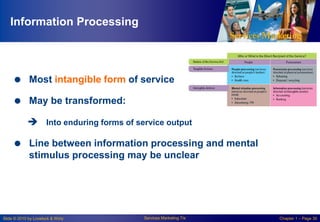
Information Processing

 Most intangible form of service
 May be transformed:
 Into enduring forms of service output

 Line between information processing and mental
stimulus processing may be unclear

Slide © 2010 by Lovelock & Wirtz

Services Marketing 7/e

Chapter 1 – Page 30
Marketing Challenges Posed
by Services

Slide © 2010 by Lovelock & Wirtz

Services Marketing 7/e

Chapter 1 – Page 31
Services Pose Distinctive
Marketing Challenges
 Marketing management tasks in the service sector differ
from those in the manufacturing sector.

 Eight common differences between services and goods but
they do not apply equally to all services
What are marketing implications of these differences?

Slide © 2010 by Lovelock & Wirtz

Services Marketing 7/e

Chapter 1 – Page 32
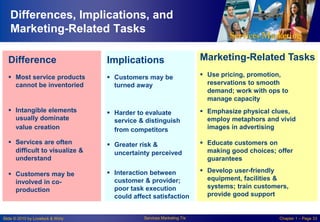
Differences, Implications, and
Marketing-Related Tasks
Difference

Implications

Marketing-Related Tasks

 Most service products
cannot be inventoried

 Customers may be
turned away

 Use pricing, promotion,
reservations to smooth
demand; work with ops to
manage capacity

 Intangible elements
usually dominate
value creation

 Harder to evaluate
service & distinguish
from competitors

 Emphasize physical clues,
employ metaphors and vivid
images in advertising

 Services are often
difficult to visualize &
understand

 Greater risk &
uncertainty perceived

 Educate customers on
making good choices; offer
guarantees

 Customers may be
involved in coproduction

 Interaction between
customer & provider;
poor task execution
could affect satisfaction

 Develop user-friendly
equipment, facilities &
systems; train customers,
provide good support

Slide © 2010 by Lovelock & Wirtz

Services Marketing 7/e

Chapter 1 – Page 33
Differences, Implications, and
Marketing-Related Tasks
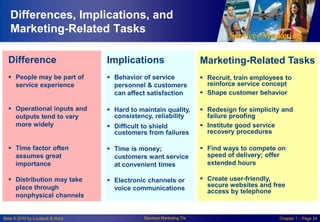
Difference

Implications

Marketing-Related Tasks

 People may be part of
service experience

 Behavior of service
personnel & customers
can affect satisfaction

 Recruit, train employees to
reinforce service concept
 Shape customer behavior

 Operational inputs and
outputs tend to vary
more widely

 Hard to maintain quality,
consistency, reliability
 Difficult to shield
customers from failures

 Redesign for simplicity and
failure proofing
 Institute good service
recovery procedures

 Time factor often
assumes great
importance

 Time is money;
customers want service
at convenient times
 Find ways to compete on
speed of delivery; offer
extended hours

 Distribution may take
place through
nonphysical channels

 Electronic channels or
voice communications

 Create user-friendly,
secure websites and free
access by telephone

Slide © 2010 by Lovelock & Wirtz

Services Marketing 7/e

Chapter 1 – Page 34
Extended Marketing Mix for
Services

Slide © 2010 by Lovelock & Wirtz

Services Marketing 7/e

Chapter 1 – Page 35
Services Require
An Extended Marketing Mix
 Marketing can be viewed as:
 A strategic and competitive thrust pursued by top management

 A set of functional activities performed by line managers
 A customer-driven orientation for the entire organization

 Marketing is only function to bring operating revenues into
a business; all other functions are cost centers
 The ―7 Ps‖ of services marketing are needed to create
viable strategies for meeting customer needs profitably

Slide © 2010 by Lovelock & Wirtz

Services Marketing 7/e

Chapter 1 – Page 36
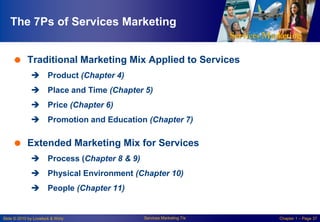
The 7Ps of Services Marketing
 Traditional Marketing Mix Applied to Services
 Product (Chapter 4)

 Place and Time (Chapter 5)
 Price (Chapter 6)
 Promotion and Education (Chapter 7)

 Extended Marketing Mix for Services
 Process (Chapter 8 & 9)
 Physical Environment (Chapter 10)

 People (Chapter 11)

Slide © 2010 by Lovelock & Wirtz

Services Marketing 7/e

Chapter 1 – Page 37
Integration of Marketing with
Other Management Functions

Slide © 2010 by Lovelock & Wirtz

Services Marketing 7/e

Chapter 1 – Page 38
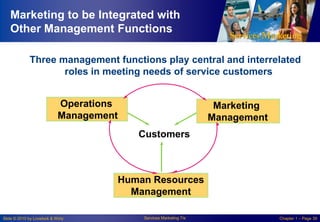
Marketing to be Integrated with
Other Management Functions
Three management functions play central and interrelated
roles in meeting needs of service customers
Operations
Management

Marketing
Management
Customers

Human Resources
Management
Slide © 2010 by Lovelock & Wirtz

Services Marketing 7/e

Chapter 1 – Page 39
Developing Effective Service
Marketing Strategies

Slide © 2010 by Lovelock & Wirtz

Services Marketing 7/e

Chapter 1 – Page 40
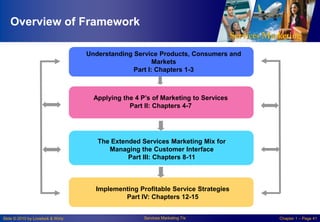
Overview of Framework
Understanding Service Products, Consumers and
Markets
Part I: Chapters 1-3

Applying the 4 P‘s of Marketing to Services
Part II: Chapters 4-7

The Extended Services Marketing Mix for
Managing the Customer Interface
Part III: Chapters 8-11

Implementing Profitable Service Strategies
Part IV: Chapters 12-15

Slide © 2010 by Lovelock & Wirtz

Services Marketing 7/e

Chapter 1 – Page 41
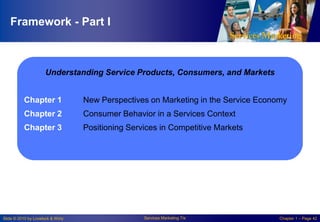
Framework - Part I

Understanding Service Products, Consumers, and Markets
Chapter 1

New Perspectives on Marketing in the Service Economy

Chapter 2

Consumer Behavior in a Services Context

Chapter 3

Positioning Services in Competitive Markets

Slide © 2010 by Lovelock & Wirtz

Services Marketing 7/e

Chapter 1 – Page 42
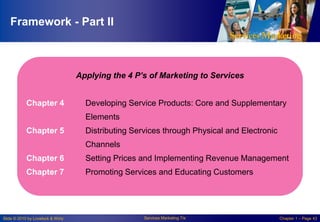
Framework - Part II

Applying the 4 P’s of Marketing to Services
Chapter 4

Developing Service Products: Core and Supplementary
Elements

Chapter 5

Distributing Services through Physical and Electronic
Channels

Chapter 6

Setting Prices and Implementing Revenue Management

Chapter 7

Promoting Services and Educating Customers

Slide © 2010 by Lovelock & Wirtz

Services Marketing 7/e

Chapter 1 – Page 43
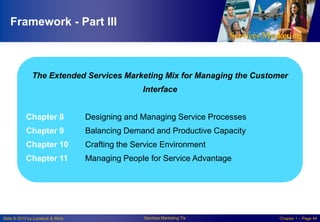
Framework - Part III

The Extended Services Marketing Mix for Managing the Customer
Interface
Chapter 8

Designing and Managing Service Processes

Chapter 9

Balancing Demand and Productive Capacity

Chapter 10

Crafting the Service Environment

Chapter 11

Managing People for Service Advantage

Slide © 2010 by Lovelock & Wirtz

Services Marketing 7/e

Chapter 1 – Page 44
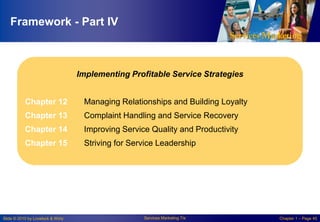
Framework - Part IV

Implementing Profitable Service Strategies
Chapter 12

Managing Relationships and Building Loyalty

Chapter 13

Complaint Handling and Service Recovery

Chapter 14

Improving Service Quality and Productivity

Chapter 15

Striving for Service Leadership

Slide © 2010 by Lovelock & Wirtz

Services Marketing 7/e

Chapter 1 – Page 45
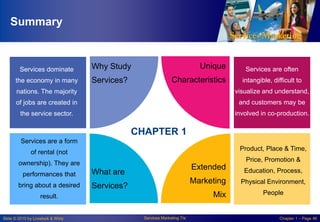
Summary

Services dominate
the economy in many

Services?

Unique

Why Study

Characteristics

Services are often
intangible, difficult to

nations. The majority

visualize and understand,

of jobs are created in

and customers may be

the service sector.

involved in co-production.

CHAPTER 1
Services are a form
Product, Place & Time,

of rental (not

Price, Promotion &

ownership). They are
performances that
bring about a desired

Extended

Services?

Physical Environment,

Mix

result.

Slide © 2010 by Lovelock & Wirtz

Education, Process,

Marketing

What are

Services Marketing 7/e

People

Chapter 1 – Page 46

Services marketing 7e chapter1

  • 1.
    Chapter 1: New PerspectivesOn Marketing in the Service Economy Slide © 2010 by Lovelock & Wirtz Services Marketing 7/e Chapter 1 – Page 1
  • 2.
    Overview of Chapter1  Why Study Services?  What are Services?  Marketing Challenges Posed by Services  Extended Marketing Mix Required for Services  Integration of Marketing with Other Management Functions  Developing Effective Service Marketing Strategies Slide © 2010 by Lovelock & Wirtz Services Marketing 7/e Chapter 1 – Page 2
  • 3.
    Why Study Services? Slide© 2010 by Lovelock & Wirtz Services Marketing 7/e Chapter 1 – Page 3
  • 4.
    Why Study Services? Services dominate most economies and are growing rapidly:  Services account for more than 60% of GDP worldwide  Almost all economies have a substantial service sector  Most new employment is provided by services  Strongest growth area for marketing  Understanding services offers you a personal competitive advantage Slide © 2010 by Lovelock & Wirtz Services Marketing 7/e Chapter 1 – Page 4
  • 5.
    Services Dominate theGlobal Economy Contribution of Service Industries to GDP Globally Manufacturing 32% Services 64% Agriculture 4% Source: The World Factbook 2008, Central Intelligence Agency Slide © 2010 by Lovelock & Wirtz Services Marketing 7/e Chapter 1 – Page 5
  • 6.
    Estimated Size ofService Sector in Selected Countries Jersey (97%), Cayman Islands (95%), Hong Kong (92%) Bahamas (90%), Bermuda ( 89%), Luxembourg (86%) USA (79%), Fiji (78%), Barbados (78%), France (77%), U.K. (76%) Japan (72%), Taiwan (71%), Australia (71%), Italy (71%) Canada (70%), Germany (69%), Israel (67%) South Africa (65%), Brazil (66%), Poland (66%) Turkey (63%), Mexico (62%) Argentina (57%), Russia (55%) Malaysia (46%), Chile (45%) Indonesia (41%), China (40%) Saudi Arabia (35%) 10 20 Services as Percent of GDP 30 40 50 60 70 80 90 Source: The World Factbook 2008, Central Intelligence Agency Slide © 2010 by Lovelock & Wirtz Services Marketing 7/e Chapter 1 – Page 6
  • 7.
    Value Added byService Industry Categories to U.S. GDP Business Services 12% Transport, Utilities & Communications 9% SERVICES Wholesale & Retail Trade 12% Source: US Bureau of Economic Analysis, Industry Economics Accounts, 2007 Slide © 2010 by Lovelock & Wirtz Services Marketing 7/e Chapter 1 – Page 7
  • 8.
    NAICS: New Wayto Classify & Analyze the Service Economy  NAICS—North American Industry Classification System  Classifies industries in the economic statistics of USA, Canada & Mexico  Replaces old SIC codes in USA  Captures huge array of new service industries, each with its own NAICS code  NAPCS—North American Product Classification System  Assigns codes to thousands of service products  Particularly useful for looking at rented goods services Slide © 2010 by Lovelock & Wirtz Services Marketing 7/e Chapter 1 – Page 8
  • 9.
    NAICS Codes ofNewer Service Industries Not Profiled By SIC  Casino Hotels  HMO Medical Centers  Continuing Care Retirement Communities  Industrial Design Services  Diagnostic Imaging Centers  Investment Banking and Securities Dealing  Diet and Weight Reducing Centers  Management Consulting Services  Environmental Consulting  Satellite Telecommunications  Golf Courses, Country Clubs  Telemarketing Bureaus  Hazardous Waste Collection  Temporary Help Services Slide © 2010 by Lovelock & Wirtz Services Marketing 7/e Chapter 1 – Page 9
  • 10.
    Why Study Services? Most new jobs are generated by services  Fastest growth expected in knowledge-based industries  Significant training and educational qualifications required, but employees will be more highly compensated  Will service jobs be lost to lower-cost countries? Yes, some service jobs can be exported Slide © 2010 by Lovelock & Wirtz Services Marketing 7/e Chapter 1 – Page 10
  • 11.
    Changing Structure ofEmployment as Economies Develop Agriculture Share of Employment Services Industry Time, per Capita Income Source: IMF, 1997 Slide © 2010 by Lovelock & Wirtz Services Marketing 7/e Chapter 1 – Page 11
  • 12.
    Why Study Services? Powerful forces are transforming service markets  Government policies, social changes, business trends, advances in IT, internationalization  Forces that reshape:  Demand  Supply  The competitive landscape  Customers‘ choices, power, and decision making Slide © 2010 by Lovelock & Wirtz Services Marketing 7/e Chapter 1 – Page 12
  • 13.
    Transformation of the ServiceEconomy Social Changes Government Policies Business Trends Advances In IT Globalization  New markets and product categories  Increase in demand for services  More intense competition Innovation in service products & delivery systems, stimulated by better technology Customers have more choices and exercise more power Success hinges on:  Understanding customers and competitors  Viable business models  Creation of value for customers and firm Increased focus on services marketing and management Slide © 2010 by Lovelock & Wirtz Services Marketing 7/e Chapter 1 – Page 13
  • 14.
    Factors Stimulating Transformation ofthe Service Economy Social Changes Business Trends Advances In IT Government Policies Globalization  Changes in regulations  Privatization  New rules to protect customers, employees, and the environment  New agreement on trade in services Slide © 2010 by Lovelock & Wirtz Services Marketing 7/e Chapter 1 – Page 14
  • 15.
    Factors Stimulating Transformation ofthe Service Economy Social Changes Business Trends Advances In IT Government Policies Globalization         Slide © 2010 by Lovelock & Wirtz Rising consumer expectations More affluence More people short of time Increased desire for buying experiences vs. things Rising consumer ownership of high tech equipment Easier access to information Immigration Growing but aging population Services Marketing 7/e Chapter 1 – Page 15
  • 16.
    Factors Stimulating Transformation ofthe Service Economy Social Changes Business Trends Advances In IT Government Policies Globalization  Push to increase shareholder value  Emphasis on productivity and cost savings  Manufacturers add value through service and sell services  More strategic alliances and outsourcing  Focus on quality and customer satisfaction  Growth of franchising  Marketing emphasis by nonprofits Slide © 2010 by Lovelock & Wirtz Services Marketing 7/e Chapter 1 – Page 16
  • 17.
    Factors Stimulating Transformation ofthe Service Economy Social Changes Business Trends Advances In IT Government Policies Globalization       Slide © 2010 by Lovelock & Wirtz Growth of Internet Greater bandwidth Compact mobile equipment Wireless networking Faster, more powerful software Digitization of text, graphics, audio, video Services Marketing 7/e Chapter 1 – Page 17
  • 18.
    Factors Stimulating Transformation ofthe Service Economy Social Changes Business Trends Advances In IT Government Policies Globalization  More companies operating on transnational basis  Increased international travel  International mergers and alliances  “Offshoring” of customer service  Foreign competitors invade domestic markets Slide © 2010 by Lovelock & Wirtz Services Marketing 7/e Chapter 1 – Page 18
  • 19.
    What are Services? Slide© 2010 by Lovelock & Wirtz Services Marketing 7/e Chapter 1 – Page 19
  • 20.
    What Are Services? The historical view  Smith (1776): Services are different from goods because they are perishable  Say (1803): As services are immaterial, consumption cannot be separated from production  A fresh perspective: Benefits without Ownership  Rental of goods: (a) Payment made for using or accessing something – usually for a defined period of time – instead of buying it outright and (b) Allows participation in network systems that individuals and organizations could not afford Slide © 2010 by Lovelock & Wirtz Services Marketing 7/e Chapter 1 – Page 20
  • 21.
    What Are Services? Fivebroad categories within non-ownership framework of which two or more may be combined Rented goods services Defined space and place rentals Access to shared physical environments Slide © 2010 by Lovelock & Wirtz Labor and expertise rentals Access to and usage of systems and networks Services Marketing 7/e Chapter 1 – Page 21
  • 22.
    Definition of Services Services  are economic activities offered by one party to another  most commonly employ time-based performances to bring about desired results  In exchange for their money, time, and effort, service customers expect to obtain value from  access to goods, labor, facilities, environments, professional skills, networks, and systems;  normally do not take ownership of any of the physical elements involved. Slide © 2010 by Lovelock & Wirtz Services Marketing 7/e Chapter 1 – Page 22
  • 23.
    Value Creation isDominated by Intangible Elements Physical Elements High Salt Detergents CD Player Wine Golf Clubs New Car Tailored clothing Plumbing Repair Health Club Airline Flight Fast-Food Restaurant Landscape Maintenance Consulting Life Insurance Internet Banking Low Source; Adapted from Lynn Shostack Slide © 2010 by Lovelock & Wirtz High Intangible Elements Services Marketing 7/e Chapter 1 – Page 23
  • 24.
    Service Products vs.Customer Service & After-Sales Service  A firm‘s market offerings are divided into core product elements and supplementary service elements  Need to distinguish between:  Marketing of services – when service is the core product  Marketing through service – when good service increases the value of a core physical good  Manufacturing firms are reformulating and enhancing existing added-value services to market them as standalone core products Slide © 2010 by Lovelock & Wirtz Services Marketing 7/e Chapter 1 – Page 24
  • 25.
    Service – AProcess Perspective  Differences exist amongst services depending on what is being processed  Classification of services into  People processing  Possession processing  Mental stimulus processing  Information processing Slide © 2010 by Lovelock & Wirtz Services Marketing 7/e Chapter 1 – Page 25
  • 26.
    4 Categories ofServices Slide © 2010 by Lovelock & Wirtz Services Marketing 7/e Chapter 1 – Page 26
  • 27.
    People Processing  Customersmust:  physically enter the service factory  cooperate actively with the service operation  Managers should think about process and output from the customer‘s perspective  to identify benefits created and non-financial costs: Time, mental and physical effort Slide © 2010 by Lovelock & Wirtz Services Marketing 7/e Chapter 1 – Page 27
  • 28.
    Possession Processing  Involvementis limited  Less physical involvement  Production and consumption are separable Slide © 2010 by Lovelock & Wirtz Services Marketing 7/e Chapter 1 – Page 28
  • 29.
    Mental Stimulus Processing Ethical standards required:  Customers might be manipulated  Physical presence of recipients not required  Core content of services is information-based  Can be ‗inventoried‘ Slide © 2010 by Lovelock & Wirtz Services Marketing 7/e Chapter 1 – Page 29
  • 30.
    Information Processing  Mostintangible form of service  May be transformed:  Into enduring forms of service output  Line between information processing and mental stimulus processing may be unclear Slide © 2010 by Lovelock & Wirtz Services Marketing 7/e Chapter 1 – Page 30
  • 31.
    Marketing Challenges Posed byServices Slide © 2010 by Lovelock & Wirtz Services Marketing 7/e Chapter 1 – Page 31
  • 32.
    Services Pose Distinctive MarketingChallenges  Marketing management tasks in the service sector differ from those in the manufacturing sector.  Eight common differences between services and goods but they do not apply equally to all services What are marketing implications of these differences? Slide © 2010 by Lovelock & Wirtz Services Marketing 7/e Chapter 1 – Page 32
  • 33.
    Differences, Implications, and Marketing-RelatedTasks Difference Implications Marketing-Related Tasks  Most service products cannot be inventoried  Customers may be turned away  Use pricing, promotion, reservations to smooth demand; work with ops to manage capacity  Intangible elements usually dominate value creation  Harder to evaluate service & distinguish from competitors  Emphasize physical clues, employ metaphors and vivid images in advertising  Services are often difficult to visualize & understand  Greater risk & uncertainty perceived  Educate customers on making good choices; offer guarantees  Customers may be involved in coproduction  Interaction between customer & provider; poor task execution could affect satisfaction  Develop user-friendly equipment, facilities & systems; train customers, provide good support Slide © 2010 by Lovelock & Wirtz Services Marketing 7/e Chapter 1 – Page 33
  • 34.
    Differences, Implications, and Marketing-RelatedTasks Difference Implications Marketing-Related Tasks  People may be part of service experience  Behavior of service personnel & customers can affect satisfaction  Recruit, train employees to reinforce service concept  Shape customer behavior  Operational inputs and outputs tend to vary more widely  Hard to maintain quality, consistency, reliability  Difficult to shield customers from failures  Redesign for simplicity and failure proofing  Institute good service recovery procedures  Time factor often assumes great importance  Time is money; customers want service at convenient times  Find ways to compete on speed of delivery; offer extended hours  Distribution may take place through nonphysical channels  Electronic channels or voice communications  Create user-friendly, secure websites and free access by telephone Slide © 2010 by Lovelock & Wirtz Services Marketing 7/e Chapter 1 – Page 34
  • 35.
    Extended Marketing Mixfor Services Slide © 2010 by Lovelock & Wirtz Services Marketing 7/e Chapter 1 – Page 35
  • 36.
    Services Require An ExtendedMarketing Mix  Marketing can be viewed as:  A strategic and competitive thrust pursued by top management  A set of functional activities performed by line managers  A customer-driven orientation for the entire organization  Marketing is only function to bring operating revenues into a business; all other functions are cost centers  The ―7 Ps‖ of services marketing are needed to create viable strategies for meeting customer needs profitably Slide © 2010 by Lovelock & Wirtz Services Marketing 7/e Chapter 1 – Page 36
  • 37.
    The 7Ps ofServices Marketing  Traditional Marketing Mix Applied to Services  Product (Chapter 4)  Place and Time (Chapter 5)  Price (Chapter 6)  Promotion and Education (Chapter 7)  Extended Marketing Mix for Services  Process (Chapter 8 & 9)  Physical Environment (Chapter 10)  People (Chapter 11) Slide © 2010 by Lovelock & Wirtz Services Marketing 7/e Chapter 1 – Page 37
  • 38.
    Integration of Marketingwith Other Management Functions Slide © 2010 by Lovelock & Wirtz Services Marketing 7/e Chapter 1 – Page 38
  • 39.
    Marketing to beIntegrated with Other Management Functions Three management functions play central and interrelated roles in meeting needs of service customers Operations Management Marketing Management Customers Human Resources Management Slide © 2010 by Lovelock & Wirtz Services Marketing 7/e Chapter 1 – Page 39
  • 40.
    Developing Effective Service MarketingStrategies Slide © 2010 by Lovelock & Wirtz Services Marketing 7/e Chapter 1 – Page 40
  • 41.
    Overview of Framework UnderstandingService Products, Consumers and Markets Part I: Chapters 1-3 Applying the 4 P‘s of Marketing to Services Part II: Chapters 4-7 The Extended Services Marketing Mix for Managing the Customer Interface Part III: Chapters 8-11 Implementing Profitable Service Strategies Part IV: Chapters 12-15 Slide © 2010 by Lovelock & Wirtz Services Marketing 7/e Chapter 1 – Page 41
  • 42.
    Framework - PartI Understanding Service Products, Consumers, and Markets Chapter 1 New Perspectives on Marketing in the Service Economy Chapter 2 Consumer Behavior in a Services Context Chapter 3 Positioning Services in Competitive Markets Slide © 2010 by Lovelock & Wirtz Services Marketing 7/e Chapter 1 – Page 42
  • 43.
    Framework - PartII Applying the 4 P’s of Marketing to Services Chapter 4 Developing Service Products: Core and Supplementary Elements Chapter 5 Distributing Services through Physical and Electronic Channels Chapter 6 Setting Prices and Implementing Revenue Management Chapter 7 Promoting Services and Educating Customers Slide © 2010 by Lovelock & Wirtz Services Marketing 7/e Chapter 1 – Page 43
  • 44.
    Framework - PartIII The Extended Services Marketing Mix for Managing the Customer Interface Chapter 8 Designing and Managing Service Processes Chapter 9 Balancing Demand and Productive Capacity Chapter 10 Crafting the Service Environment Chapter 11 Managing People for Service Advantage Slide © 2010 by Lovelock & Wirtz Services Marketing 7/e Chapter 1 – Page 44
  • 45.
    Framework - PartIV Implementing Profitable Service Strategies Chapter 12 Managing Relationships and Building Loyalty Chapter 13 Complaint Handling and Service Recovery Chapter 14 Improving Service Quality and Productivity Chapter 15 Striving for Service Leadership Slide © 2010 by Lovelock & Wirtz Services Marketing 7/e Chapter 1 – Page 45
  • 46.
    Summary Services dominate the economyin many Services? Unique Why Study Characteristics Services are often intangible, difficult to nations. The majority visualize and understand, of jobs are created in and customers may be the service sector. involved in co-production. CHAPTER 1 Services are a form Product, Place & Time, of rental (not Price, Promotion & ownership). They are performances that bring about a desired Extended Services? Physical Environment, Mix result. Slide © 2010 by Lovelock & Wirtz Education, Process, Marketing What are Services Marketing 7/e People Chapter 1 – Page 46