










































Gamification: Seriously Fun

      TTI Vanguard 2011
          Jesse Schell
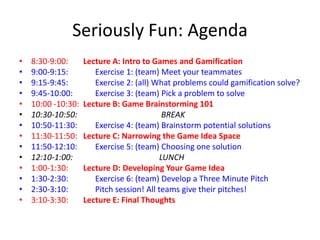
Seriously Fun: Agenda
•   8:30-9:00:      Lecture A: Intro to Games and Gamification
•   9:00-9:15:         Exercise 1: (team) Meet your teammates
•   9:15-9:45:         Exercise 2: (all) What problems could gamification solve?
•   9:45-10:00:        Exercise 3: (team) Pick a problem to solve
•   10:00 -10:30:   Lecture B: Game Brainstorming 101
•   10:30-10:50:                            BREAK
•   10:50-11:30:       Exercise 4: (team) Brainstorm potential solutions
•   11:30-11:50:    Lecture C: Narrowing the Game Idea Space
•   11:50-12:10:       Exercise 5: (team) Choosing one solution
•   12:10-1:00:                            LUNCH
•   1:00-1:30:      Lecture D: Developing Your Game Idea
•   1:30-2:30:         Exercise 6: (team) Develop a Three Minute Pitch
•   2:30-3:10:         Pitch session! All teams give their pitches!
•   3:10-3:30:      Lecture E: Final Thoughts
LEVEL
Lecture A: Introduction
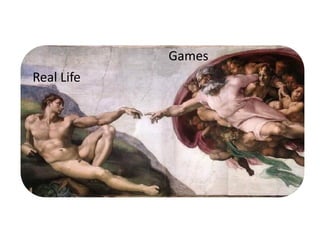
Games
Real Life
The voyage of discovery is not in seeking
new landscapes but in having new eyes.
                        – Marcel Proust
Magic Words
• I am a game designer.

                           • Who is a game designer?
• I am a game designer.
                                     • No you’re not.
• I am a game designer.
                             • What kind of designer?
• I am a game designer.
                          • You mean you play games.
• I am a game designer.
What does “game design” mean?


Game Design is the act of deciding
     what a game should be.
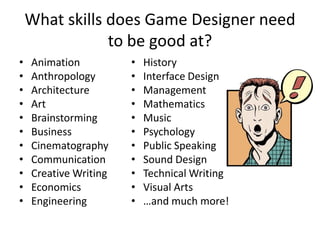
What skills does Game Designer need
                to be good at?
•   Animation          •   History
•   Anthropology       •   Interface Design
•   Architecture       •   Management
•   Art                •   Mathematics
•   Brainstorming      •   Music
•   Business           •   Psychology
•   Cinematography     •   Public Speaking
•   Communication      •   Sound Design
•   Creative Writing   •   Technical Writing
•   Economics          •   Visual Arts
•   Engineering        •   …and much more!
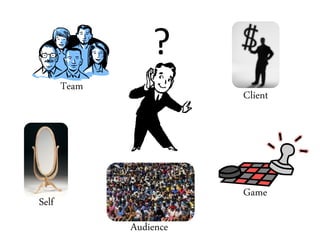
What is the most important skill for a
          game designer?


                  ?
?
       Team
                         Client


                         Game
Self
              Audience
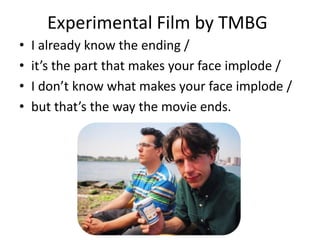
Experimental Film by TMBG
•   I already know the ending /
•   it’s the part that makes your face implode /
•   I don’t know what makes your face implode /
•   but that’s the way the movie ends.
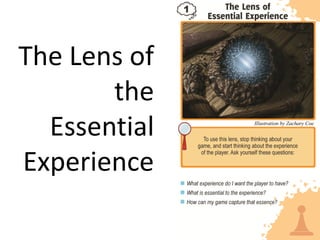
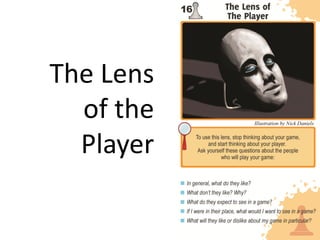
The Lens of
       the
  Essential
Experience
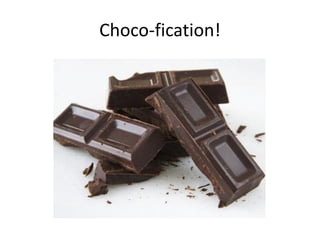
Choco-fication!
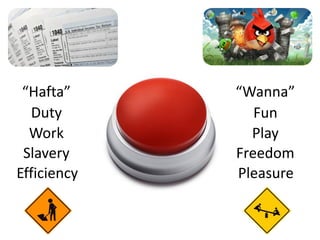
“Hafta”     “Wanna”
  Duty          Fun
  Work         Play
 Slavery     Freedom
Efficiency   Pleasure
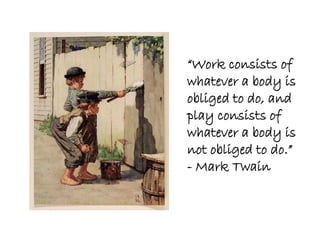
“Work consists of
whatever a body is
obliged to do, and
play consists of
whatever a body is
not obliged to do.”
- Mark Twain
Games are special because…


         • They are interactive
         • They are designed
           ENTIRELY for pleasure
Games provide:
•   Clear Feedback
•   A Sense of Progress
•   The Possibility of Success
•   Mental and Physical Exercise
•   A Chance to Satisfy Your Curiosity
•   A Chance to Solve a Problem
•   A Feeling of Freedom
Laughter
Discovery                 Thrill


 Fantasy       Story     Triumph


Expression   Challenge   Sensation
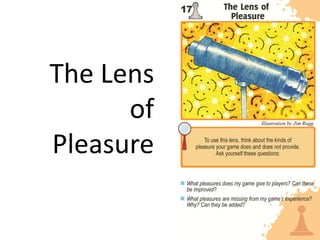
The Lens
      of
Pleasure
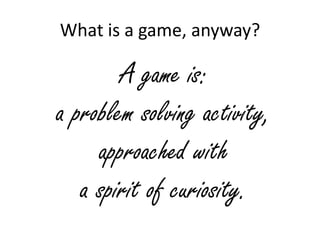
What is a game, anyway?

        A game is:
a problem solving activity,
     approached with
   a spirit of curiosity.
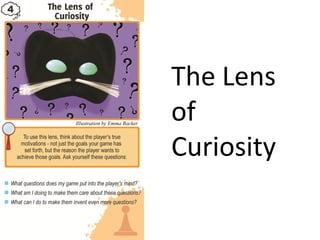
The Lens
of
Curiosity
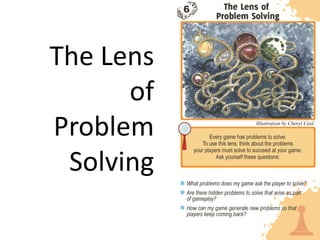
The Lens
      of
Problem
 Solving
LEVEL
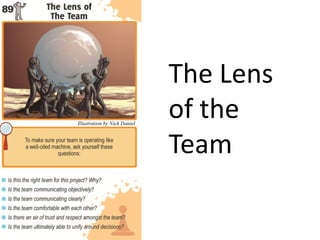
The Lens
of the
Team
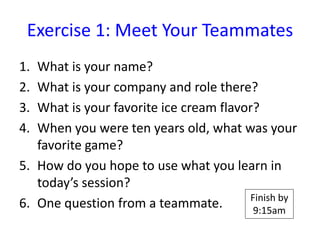
Exercise 1: Meet Your Teammates
1. What is your name?
2. What is your company and role there?
3. What is your favorite ice cream flavor?
4. When you were ten years old, what was your
   favorite game?
5. How do you hope to use what you learn in
   today’s session?
                                        Finish by
6. One question from a teammate.         9:15am
LEVEL
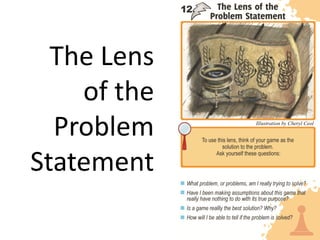
The Lens
    of the
  Problem
Statement
Exercise 2: What Problem to Solve?
LEVEL
Exercise 3: Pick one!
1. Pick a problem that you personally are
   interested in solving – write it down
2. Get everyone’s written ideas up on the easel
3. Come to consensus one which one you will
   pursue

                    Finish by
                    10:00am
LEVEL
Lecture B: Game Brainstorming 101
Idea  Game
1) Think of an idea.
2) Try it out.
3) Keep changing it and testing it until it seems
   good enough.
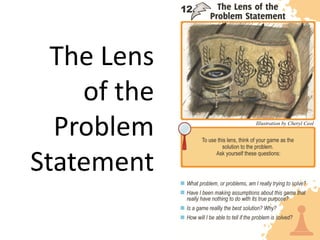
The Lens
    of the
  Problem
Statement
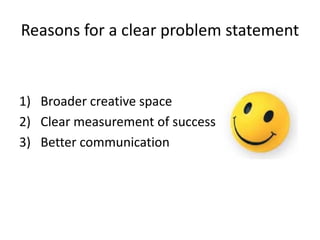
Reasons for a clear problem statement


1) Broader creative space
2) Clear measurement of success
3) Better communication
The best way to
have a good idea
is to have a lot
of ideas.
  - Linus Pauling
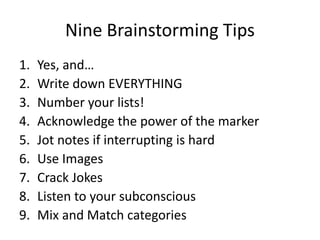
Nine Brainstorming Tips
1.   Yes, and…
2.   Write down EVERYTHING
3.   Number your lists!
4.   Acknowledge the power of the marker
5.   Jot notes if interrupting is hard
6.   Use Images
7.   Crack Jokes
8.   Listen to your subconscious
9.   Mix and Match categories
Ray Bradbury
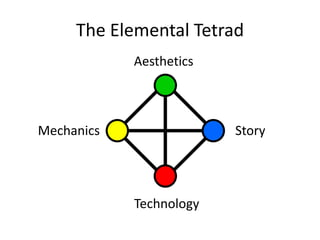
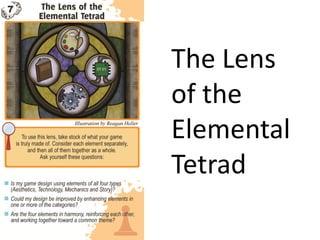
The Elemental Tetrad
            Aesthetics


Mechanics                Story


            Technology
The Lens
of the
Elemental
Tetrad
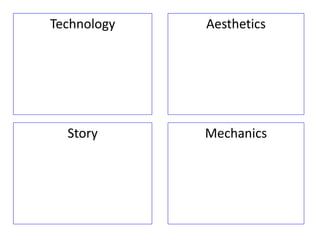
Technology   Aesthetics


  Story      Mechanics
LEVEL
BREAK
  til
10:50
Exercise 4: Brainstorm Solutions!
1.   Yes, and…                         Finish by
                                       11:30am
2.   Write down EVERYTHING
3.   Number your lists!
4.   Acknowledge the power of the marker
5.   Jot notes if interrupting is hard
6.   Use Images
7.   Crack Jokes
8.   Listen to your subconscious
9.   Mix and Match categories
LEVEL
Lecture C: Narrowing
Which idea should I pick?
Pick something!
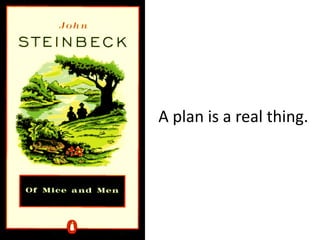
A plan is a real thing.
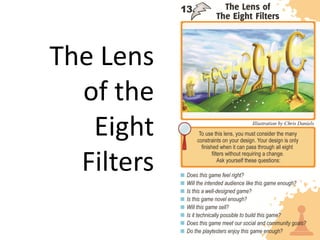
The Lens
  of the
   Eight
  Filters
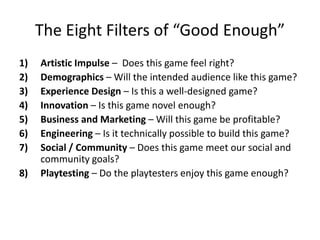
The Eight Filters of “Good Enough”
1)   Artistic Impulse – Does this game feel right?
2)   Demographics – Will the intended audience like this game?
3)   Experience Design – Is this a well-designed game?
4)   Innovation – Is this game novel enough?
5)   Business and Marketing – Will this game be profitable?
6)   Engineering – Is it technically possible to build this game?
7)   Social / Community – Does this game meet our social and
     community goals?
8)   Playtesting – Do the playtesters enjoy this game enough?
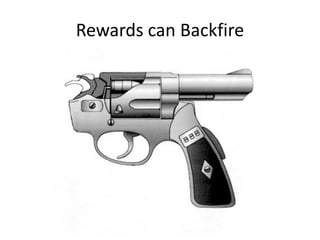
Rewards can Backfire
LEVEL
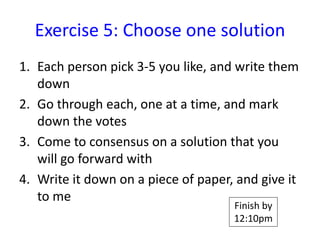
Exercise 5: Choose one solution
1. Each person pick 3-5 you like, and write them
   down
2. Go through each, one at a time, and mark
   down the votes
3. Come to consensus on a solution that you
   will go forward with
4. Write it down on a piece of paper, and give it
   to me
                                     Finish by
                                     12:10pm
LEVEL
LUNCH!
LEVEL
Lecture D: Developing Your Game Idea
Pleasure is COMPLEX
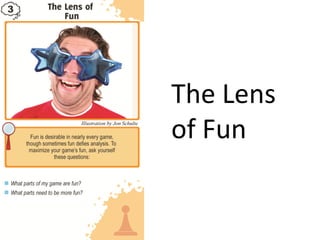
The Lens
of Fun
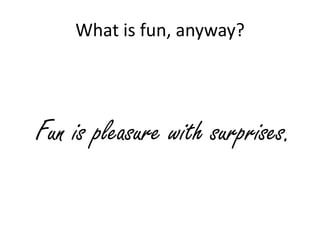
What is fun, anyway?


Fun is pleasure with surprises.
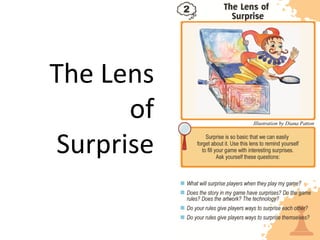
The Lens
      of
Surprise
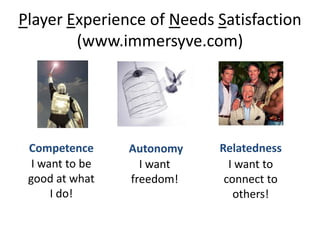
Player Experience of Needs Satisfaction
        (www.immersyve.com)


 Competence      Autonomy   Relatedness
  I want to be     I want     I want to
 good at what    freedom!    connect to
      I do!                    others!
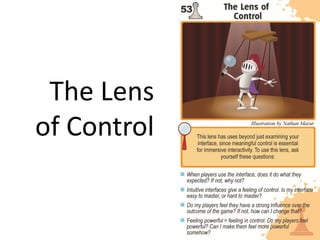
The Lens
of Control
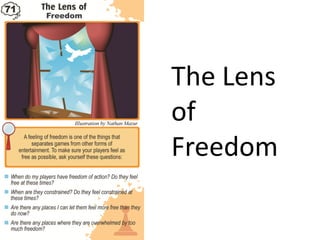
Freedom


          The Lens
          of
          Freedom
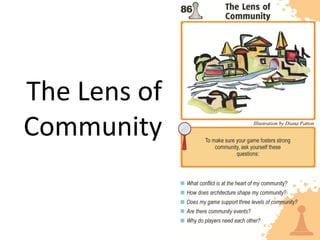
The Lens of
Community
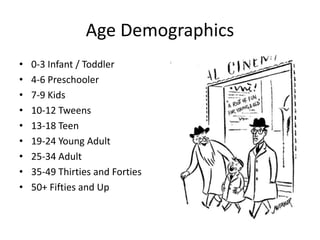
Age Demographics
•   0-3 Infant / Toddler
•   4-6 Preschooler
•   7-9 Kids
•   10-12 Tweens
•   13-18 Teen
•   19-24 Young Adult
•   25-34 Adult
•   35-49 Thirties and Forties
•   50+ Fifties and Up
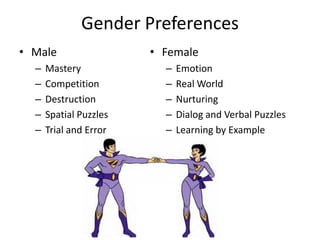
Gender Preferences
• Male                  • Female
  –   Mastery             –   Emotion
  –   Competition         –   Real World
  –   Destruction         –   Nurturing
  –   Spatial Puzzles     –   Dialog and Verbal Puzzles
  –   Trial and Error     –   Learning by Example
The Lens
  of the
  Player
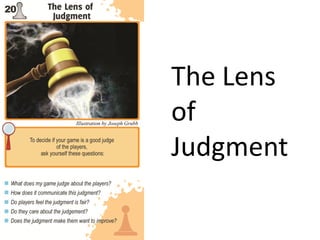
The Lens
of
Judgment
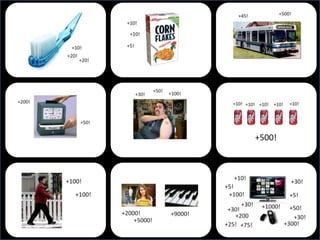
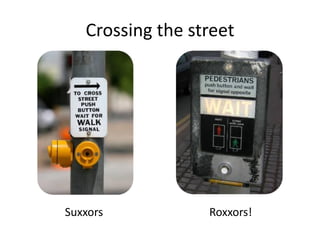
Crossing the street


Suxxors           Roxxors!
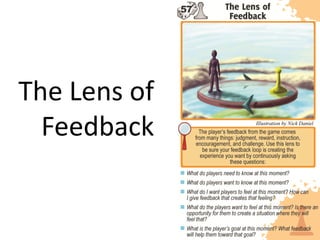
The Lens of
  Feedback
LEVEL
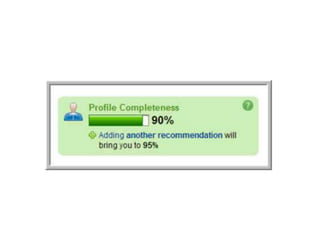
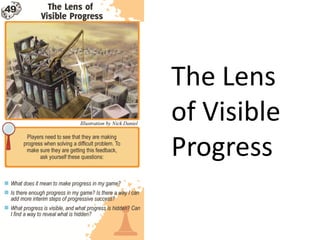
The Lens
of Visible
Progress
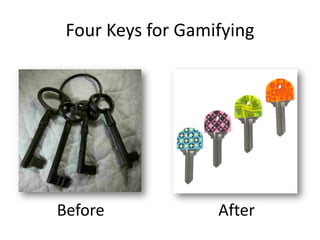
Four Keys for Gamifying


Before             After
Key 1: Make it Engaging
Key 2: Make it Effortless
Key 3: Make it Uncheatable
Key 4: Make it Not Embarrassing
LEVEL
Exercise 6: Develop Your Pitch!
• You will create a three minute Powerpoint
  presentation that explains your idea
• But…
• Your powerpoint will have NO WORDS!
Exercise 6: Develop Your Pitch!
                                           Finish by
1.   What problem are you solving?         2:25pm
2.   Why is this problem worth solving?
3.   Who is the audience for your solution?
4.   How does your solution work? (Walk us through
     an example of it being used)
5.   Is there a compulsion loop? What drives it?
6.   What are the key moments?
7.   What are the social forces?
8.   Why is this a good investment of time and
     resources?
LEVEL
Pitches!
1.   What problem are you solving?
2.   Why is this problem worth solving?
3.   Who is the audience for your solution?
4.   How does your solution work? (Walk us through
     an example of it being used)
5.   Is there a compulsion loop? What drives it?
6.   What are the key moments?
7.   What are the social forces?
8.   Why is this a good investment of time and
     resources?
LEVEL
Final Thoughts
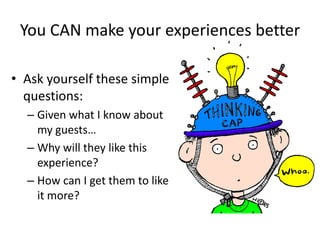
You CAN make your experiences better

• Ask yourself these simple
  questions:
  – Given what I know about
    my guests…
  – Why will they like this
    experience?
  – How can I get them to like
    it more?
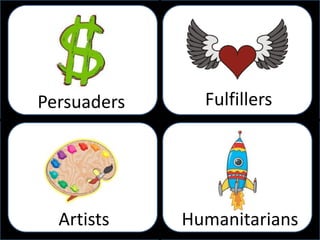
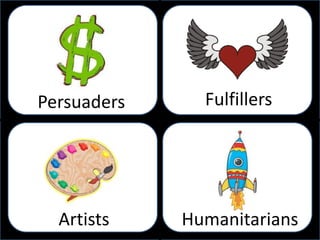
Persuaders     Fulfillers


  Artists    Humanitarians
Persuaders
Fulfillers
Artists
Humanitarians
Persuaders     Fulfillers


  Artists    Humanitarians
“Long experience has taught me that the
crux of my fortunes is whether I can radiate
good will toward my audience. There is only
one way to do it and that is to feel it. You
can fool the eyes and minds of the audience,
but you cannot fool their hearts.”
                    - Howard Thurston
LEVEL
10000
00000
Thanks!


Email: jesse@schellgames.com
    Twitter: @jesseschell
   Slides: jesseschell.com

Seriously fun

  • 1.
    Gamification: Seriously Fun TTI Vanguard 2011 Jesse Schell
  • 2.
    Seriously Fun: Agenda • 8:30-9:00: Lecture A: Intro to Games and Gamification • 9:00-9:15: Exercise 1: (team) Meet your teammates • 9:15-9:45: Exercise 2: (all) What problems could gamification solve? • 9:45-10:00: Exercise 3: (team) Pick a problem to solve • 10:00 -10:30: Lecture B: Game Brainstorming 101 • 10:30-10:50: BREAK • 10:50-11:30: Exercise 4: (team) Brainstorm potential solutions • 11:30-11:50: Lecture C: Narrowing the Game Idea Space • 11:50-12:10: Exercise 5: (team) Choosing one solution • 12:10-1:00: LUNCH • 1:00-1:30: Lecture D: Developing Your Game Idea • 1:30-2:30: Exercise 6: (team) Develop a Three Minute Pitch • 2:30-3:10: Pitch session! All teams give their pitches! • 3:10-3:30: Lecture E: Final Thoughts
  • 3.
  • 4.
  • 6.
  • 8.
    The voyage ofdiscovery is not in seeking new landscapes but in having new eyes. – Marcel Proust
  • 9.
    Magic Words • Iam a game designer. • Who is a game designer? • I am a game designer. • No you’re not. • I am a game designer. • What kind of designer? • I am a game designer. • You mean you play games. • I am a game designer.
  • 10.
    What does “gamedesign” mean? Game Design is the act of deciding what a game should be.
  • 11.
    What skills doesGame Designer need to be good at? • Animation • History • Anthropology • Interface Design • Architecture • Management • Art • Mathematics • Brainstorming • Music • Business • Psychology • Cinematography • Public Speaking • Communication • Sound Design • Creative Writing • Technical Writing • Economics • Visual Arts • Engineering • …and much more!
  • 12.
    What is themost important skill for a game designer? ?
  • 13.
    ? Team Client Game Self Audience
  • 15.
    Experimental Film byTMBG • I already know the ending / • it’s the part that makes your face implode / • I don’t know what makes your face implode / • but that’s the way the movie ends.
  • 16.
    The Lens of the Essential Experience
  • 17.
  • 20.
    “Hafta” “Wanna” Duty Fun Work Play Slavery Freedom Efficiency Pleasure
  • 21.
    “Work consists of whatevera body is obliged to do, and play consists of whatever a body is not obliged to do.” - Mark Twain
  • 22.
    Games are specialbecause… • They are interactive • They are designed ENTIRELY for pleasure
  • 23.
    Games provide: • Clear Feedback • A Sense of Progress • The Possibility of Success • Mental and Physical Exercise • A Chance to Satisfy Your Curiosity • A Chance to Solve a Problem • A Feeling of Freedom
  • 28.
    Laughter Discovery Thrill Fantasy Story Triumph Expression Challenge Sensation
  • 29.
    The Lens of Pleasure
  • 30.
    What is agame, anyway? A game is: a problem solving activity, approached with a spirit of curiosity.
  • 31.
  • 32.
    The Lens of Problem Solving
  • 33.
  • 34.
  • 35.
    Exercise 1: MeetYour Teammates 1. What is your name? 2. What is your company and role there? 3. What is your favorite ice cream flavor? 4. When you were ten years old, what was your favorite game? 5. How do you hope to use what you learn in today’s session? Finish by 6. One question from a teammate. 9:15am
  • 36.
  • 37.
    The Lens of the Problem Statement
  • 38.
    Exercise 2: WhatProblem to Solve?
  • 39.
  • 40.
    Exercise 3: Pickone! 1. Pick a problem that you personally are interested in solving – write it down 2. Get everyone’s written ideas up on the easel 3. Come to consensus one which one you will pursue Finish by 10:00am
  • 41.
  • 42.
    Lecture B: GameBrainstorming 101
  • 43.
    Idea  Game 1)Think of an idea. 2) Try it out. 3) Keep changing it and testing it until it seems good enough.
  • 44.
    The Lens of the Problem Statement
  • 45.
    Reasons for aclear problem statement 1) Broader creative space 2) Clear measurement of success 3) Better communication
  • 46.
    The best wayto have a good idea is to have a lot of ideas. - Linus Pauling
  • 47.
    Nine Brainstorming Tips 1. Yes, and… 2. Write down EVERYTHING 3. Number your lists! 4. Acknowledge the power of the marker 5. Jot notes if interrupting is hard 6. Use Images 7. Crack Jokes 8. Listen to your subconscious 9. Mix and Match categories
  • 49.
  • 50.
    The Elemental Tetrad Aesthetics Mechanics Story Technology
  • 52.
  • 53.
    Technology Aesthetics Story Mechanics
  • 54.
  • 55.
  • 56.
    Exercise 4: BrainstormSolutions! 1. Yes, and… Finish by 11:30am 2. Write down EVERYTHING 3. Number your lists! 4. Acknowledge the power of the marker 5. Jot notes if interrupting is hard 6. Use Images 7. Crack Jokes 8. Listen to your subconscious 9. Mix and Match categories
  • 57.
  • 58.
  • 59.
  • 60.
  • 61.
    A plan isa real thing.
  • 62.
    The Lens of the Eight Filters
  • 63.
    The Eight Filtersof “Good Enough” 1) Artistic Impulse – Does this game feel right? 2) Demographics – Will the intended audience like this game? 3) Experience Design – Is this a well-designed game? 4) Innovation – Is this game novel enough? 5) Business and Marketing – Will this game be profitable? 6) Engineering – Is it technically possible to build this game? 7) Social / Community – Does this game meet our social and community goals? 8) Playtesting – Do the playtesters enjoy this game enough?
  • 65.
  • 68.
  • 69.
    Exercise 5: Chooseone solution 1. Each person pick 3-5 you like, and write them down 2. Go through each, one at a time, and mark down the votes 3. Come to consensus on a solution that you will go forward with 4. Write it down on a piece of paper, and give it to me Finish by 12:10pm
  • 70.
  • 71.
  • 72.
  • 73.
    Lecture D: DevelopingYour Game Idea
  • 74.
  • 79.
  • 80.
    What is fun,anyway? Fun is pleasure with surprises.
  • 81.
    The Lens of Surprise
  • 82.
    Player Experience ofNeeds Satisfaction (www.immersyve.com) Competence Autonomy Relatedness I want to be I want I want to good at what freedom! connect to I do! others!
  • 83.
  • 84.
    Freedom The Lens of Freedom
  • 85.
  • 86.
    Age Demographics • 0-3 Infant / Toddler • 4-6 Preschooler • 7-9 Kids • 10-12 Tweens • 13-18 Teen • 19-24 Young Adult • 25-34 Adult • 35-49 Thirties and Forties • 50+ Fifties and Up
  • 87.
    Gender Preferences • Male • Female – Mastery – Emotion – Competition – Real World – Destruction – Nurturing – Spatial Puzzles – Dialog and Verbal Puzzles – Trial and Error – Learning by Example
  • 88.
    The Lens of the Player
  • 90.
  • 91.
  • 93.
    The Lens of Feedback
  • 95.
  • 96.
  • 98.
    Four Keys forGamifying Before After
  • 99.
    Key 1: Makeit Engaging
  • 100.
    Key 2: Makeit Effortless
  • 101.
    Key 3: Makeit Uncheatable
  • 102.
    Key 4: Makeit Not Embarrassing
  • 103.
  • 104.
    Exercise 6: DevelopYour Pitch! • You will create a three minute Powerpoint presentation that explains your idea • But… • Your powerpoint will have NO WORDS!
  • 106.
    Exercise 6: DevelopYour Pitch! Finish by 1. What problem are you solving? 2:25pm 2. Why is this problem worth solving? 3. Who is the audience for your solution? 4. How does your solution work? (Walk us through an example of it being used) 5. Is there a compulsion loop? What drives it? 6. What are the key moments? 7. What are the social forces? 8. Why is this a good investment of time and resources?
  • 107.
  • 108.
    Pitches! 1. What problem are you solving? 2. Why is this problem worth solving? 3. Who is the audience for your solution? 4. How does your solution work? (Walk us through an example of it being used) 5. Is there a compulsion loop? What drives it? 6. What are the key moments? 7. What are the social forces? 8. Why is this a good investment of time and resources?
  • 109.
  • 110.
  • 111.
    You CAN makeyour experiences better • Ask yourself these simple questions: – Given what I know about my guests… – Why will they like this experience? – How can I get them to like it more?
  • 112.
    Persuaders Fulfillers Artists Humanitarians
  • 113.
  • 114.
  • 115.
  • 116.
  • 117.
    Persuaders Fulfillers Artists Humanitarians
  • 121.
    “Long experience hastaught me that the crux of my fortunes is whether I can radiate good will toward my audience. There is only one way to do it and that is to feel it. You can fool the eyes and minds of the audience, but you cannot fool their hearts.” - Howard Thurston
  • 122.
  • 123.
    Thanks! Email: jesse@schellgames.com Twitter: @jesseschell Slides: jesseschell.com