International Guidelines for
Management of Severe
Sepsis and Septic Shock
2012
Presented by
Dr.Nabina Lala
IMO(Medicine)
CMCH
INTRODUCTION
•Major cause of morbidity and mortality
worldwide.
•Mortality
Sepsis: 15% - 30%
Severe sepsis & Septic Shock :40%-60%
Mortality is highest among the elderly
Risk factors
•Extemesof age(<10yrs and > 70 yrs)
•DM,CLD,alcoholism,malignancy
•Immunosupression(immunosupressive
therapy,corticosteroid,IV drug abusers,organ
and bone marrow transplant
recipients,complement deficiencies)
•Major surgery ,trauma ,burns
•Invasive procedures
(catheters,intravascular device,prosthetic
device,hemodialysis and peritoneal dialysis
catheters,or endotracheal tubes)
•Previous antibiotic treatment
•Prolonged hospitalization
•Malnutrition,child birth,abortion.
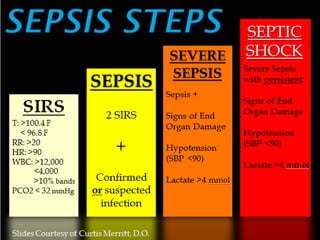
Definitions
Widespread inflammatory response to a
variety of severe clinical insults is known to as
SIRS.
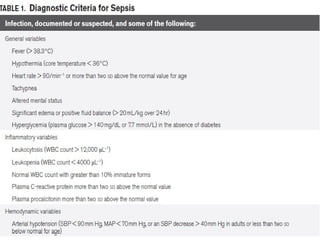
Clinically recognized by the presence of 2 or
more of the following:
-Temperature >38C or < 36C
-Heart Rate >90
-Respiratory Rate > 20 or PaCO2 <32
-WBC > 12,000, < 4000 or > 10% immature forms
Sepsis is defined as the presence of infection
together with systemic manifestations of
infection.
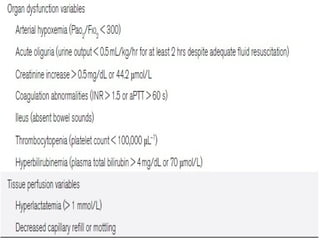
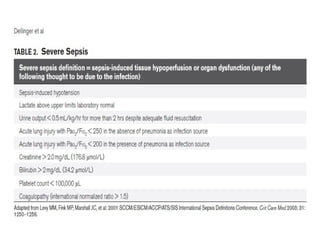
Severe sepsis is defined as sepsis plus
sepsis-induced organ dysfunction or tissue
hypo perfusion.
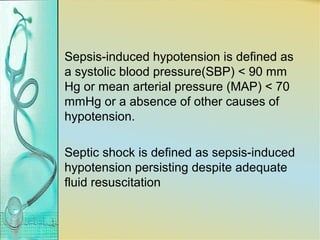
Sepsis-induced hypotension is defined as
a systolic blood pressure(SBP) < 90 mm
Hg or mean arterial pressure (MAP) < 70
mmHg or a absence of other causes of
hypotension.
Septic shock is defined as sepsis-induced
hypotension persisting despite adequate
fluid resuscitation
MANAGEMENT
• Initial Resuscitation and Infection Issues
• Hemodynamic Support &
AdjunctiveTherapy
• Supportive Therapy of Severe Sepsis
Initial Resuscitation and Infection Issues
A. Initial Resuscitation
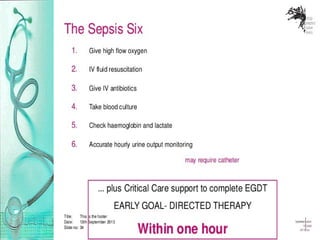
1.During the first 6 hrs of resuscitation, the goals of
initial resuscitation of sepsis-induced hypoperfusion
should include all of the following as a part of a
treatment protocol:
a) CVP 8–12 mm Hg
b) MAP ≥ 65 mm Hg
c) Urine output ≥ 0.5 mL ・ kg ・ hr
d) Superior vena cava oxygenation saturation (Scvo2)
or mixed venous oxygen saturation (Svo2) 70% or
65%,respectively.
2. We suggest targeting resuscitation to normalize
lactate in patients with elevated lactate levels as a
marker of tissue hypoperfusion
B. Screening for Sepsis and
Performance Improvement
•Routine screening of seriously ill patients
for severe sepsis to increase the early
identification of sepsis allow implementation
of early sepsis therapy.
•Performance improvement efforts to
improve patient outcomes and decrease
sepsis-related mortality.
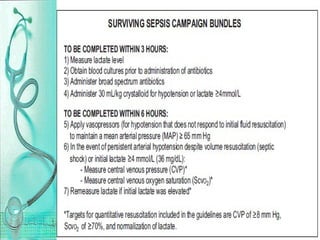
The SSC guidelines and bundles can be
used as the basis of a sepsis performance
improvement program.
Application of the SSC sepsis bundles led
to sustained, continuous quality
improvement in sepsis care and was
associated with reduced mortality.
C. Diagnosis
• Cultures before antibiotic therapy
-Without causing significant delay
• At least 2 blood cultures (both aerobic and
anaerobic)
-percutaneous
-drawn through each lumen of each vascular
access device(if >48 hrs)
• Imaging studies in attempts to confirm a
potential source of infection
Other Cultures if indicated- Urine, CSF,
sputum etc.
Vol of blood sample > 10ml
1,3 β-d-glucan assay , mannan and anti-
mannan antibody assays
-If invasive candidiasis suspected
D. Antimicrobial Therapy
1.The administration of effective intravenous
antimicrobials within the first hour of
recognition of septic shock and severe
sepsis without septic shock should be the
goal of therapy.
2a. Initial empiric anti-infective therapy of one
or more drugs that have activity against all
likely pathogens and that penetrate in
adequate concentrations into tissues
presumed to be the source of sepsis .
2b. Antimicrobial regimen should be
reassessed daily for potential de escalation .
4a.Combination empiric therapy (>=2 )
-Neutropenic patients with severe sepsis
-Difficult-to-treat,multidrug-resistant bacterial
pathogens such as Acinetobacter and
Pseudomonas.
-For patients with severe infections
associated with respiratory failure and septic
shock.
Extended spectrum beta-lactam + AGS/FQs
for P. aeruginosa bacteremia
Beta-lactam and macrolide for bacteremic
Streptococcus pneumoniae infections
Not for more than 3–5 days
-
De-escalation to the most appropriate
single therapy as per susceptibility.
Duration of therapy 7–10 days.
Longer courses if
-slow clinical response
-undrainable foci of infection
-bacteremia with S. aureus
some fungal and viral infections
-immunologic deficiencies
E. Source Control
•Specific anatomical diagnosis of infection
•Intervention for source control within the
first 12 hr of diagnosis.
•Source control with least physiological
insult in severe sepsis.
Intravascular access suspected to be
source of severe sepsis or septic shock –
remove promptly after other vascular
access has been established.
Surgical intervention done when minimally
invasive approaches are inadequate / when
diagnostic uncertainty persists despite
imaging.
F. Infection Prevention
•Selective oral decontamination with Oral
chlorhexidine gluconate has been shown
to reduce VAP
•Selective digestive decontamination
HAEMODYNAMIC SUPPORT &
ADJUNCTIVE THERAPY
•FLUID THERAPY
•VASOPRESSORS
•INOTROPIC SUPPORT
•CORTICOSTEROIDS
FLUID THERAPY
•Crystalloids
•Against the use of hydroxyethyl starches.
Albumin for fluid resuscitation when patients
require substantial amounts of crystalloids
•Initial fluid challenge in patients with sepsis-
induced tissue hypoperfusion & suspected of
hypovoluemia @ 30 mL/kg of crystalloids.`
VASOPRESSORS
•Target a mean arterial pressure (MAP) of 65 mm
Hg
•Norepinephrine as the first choice
Epinephrine added when an additional agent is
needed to maintain adequate B.P.
•Vasopressin 0.03 U/min added to NE for raising
MAP or decreasing NE dosage .
•Low dose vasopressin not recommended
as the single initial vasopressor for sepsis-
induced hypotension
•Vasopressin doses > 0.03-0.04 U/min
reserved for salvage therapy
•Dopamine as an alternative vasopressor
agent to NE only in highly selected patients
with low risk of tachyarrhythmias
absolute or relative bradycardia
•Phenylephrine not recommended
except when
–NE associated with serious arrhythmias
–cardiac output high and BP persistently
low
–as salvage therapy when combined
inotrope/vasopressor drugs and low dose
vasopressin have failed to achieve MAP
–Low dose dopamine should not be used
for renal protection
INOTROPIC THERAPY
•Trial of dobutamine infusion up to 20
mcg/kg/min be administered or added to
vasopressor if
–myocardial dysfunction suggested by elevated
cardiac filling pressures and low cardiac output
–ongoing signs of hypoperfusion, despite
achieving adequate intravascular volume and
adequate MAP.
CORTICOSTEROID
Not indicated if adequate fluid resuscitation
and vasopressor therapy able to restore
hemodynamic stability.
In case not achievable, iv hydrocortisone at
a dose of 200 mg per day.
Corticosteroids not be administered for
treatment of sepsis in the absence of shock
OTHER SUPPORTIVE THERAPY
•Blood products administration
•Immunoglobulins*
•Selenium*
•Mechanical ventilation of sepsis induced
ARDS
•Sedation, anaelgesia & neuromuscular
blockade
•Glucose control
•Renal replacement therapy
•Bicarbonate therapy
•DVT prophylaxis
•Stress ulcer prophylaxis
•Nutrition*
•Setting goals of care
BLOOD PRODUCT ADMINISTRATION
•RBC transfusion only when Hb <7.0 g/dl
•EPO not be used as specific treatment of
anemia associated with severe sepsis.
FFP not be used to correct laboratory clotting
abnormalities in the absence of bleeding or
planned invasive procedures.
•Not using antithrombin for the treatment of
severe sepsis and septic shock.
Platelet transfusion
<10,000/mm3 in the absence of apparent
bleeding.
< 20,000/mm3 if the patient has a
significant risk of bleeding.
Higher platelet counts (≥50,000/mm3)
advised for active bleeding, surgery, or
invasive procedures.
GLUCOSE CONTROL
•A protocolised approach to blood glucose
management in ICU patients with severe
sepsis commencing insulin dosing when
-2 consecutive blood glucose levels are >180
mg/dL.
•Blood glucose values be monitored every
1 to 2 hrs until glucose values and insulin
infusion rates are stable and then every 4 hrs
thereafter.
RENAL REPLACEMENT
THERAPY
•Continuous renal replacement therapies and
intermittent hemodialysis are equivalent in
patients with severe sepsis and acute renal
failure.
•Use continuous therapies to facilitate
management of fluid balance in
hemodynamically unstable septic patients.
DVT PROPHYLAXIS
•VTE prophylaxis required using daily
subcutaneous LMWH.
•If creatinine clearance <30 mL/min, use
dalteparin.
•Patients with severe sepsis should be
treated with a combination of pharmacologic
therapy and intermittent pneumatic
compression devices whenever possible.
•Septic patients who have a contraindication
for heparin use (eg, thrombocytopenia,
severe coagulopathy, active bleeding, recent
intracerebral hemorrhage) not to receive
pharmacoprophylaxis but receive
mechanical prophylactic treatment, such
as graduated compression stockings or
intermittent compression devices , unless
contraindicated.
STRESS ULCER PROPHYLAXIS
•Stress ulcer prophylaxis using H2 blocker or
proton pump inhibitor be given to patients
with severe sepsis/septic shock who
have bleeding risk factors .
•When stress ulcer prophylaxis is used,
proton pump inhibitors rather than H2RA.
•Patients without risk factors do not receive
prophylaxis
NUTRITION
•Administer oral or enteral (if necessary)
feedings, as tolerated, rather than either
complete fasting or provision of only
intravenous glucose within the first 48 hours
after a diagnosis of severe sepsis/septic
shock.
• Avoid mandatory full caloric feeding in the
first week but rather suggest low dose feeding
(eg, up to 500 calories per day),advancing
only as tolerated.
Use i/v glucose + enteral nutrition rather than
TPN alone or parenteral nutrition in the first 7
days after a diagnosis of severe sepsis/septic
shock.
Nutrition without specific immunomodulating
supplementation.
SETTING GOALS OF CARE
•Discuss goals of care and prognosis with
patients and families.
•Incorporate goals of care into treatment and
end-of-life care planning, utilizing palliative
care principles where appropriate .
•Address goals of care as early as feasible,
but no later than within 72 hours of ICU
admission.
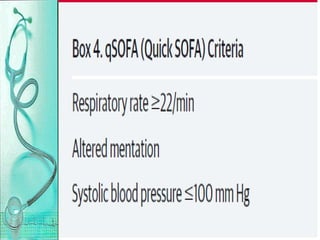
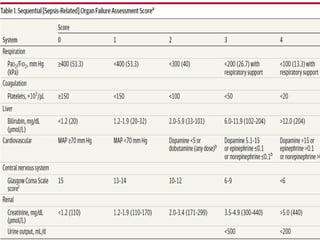
The Third International Consensus
Definitions for Sepsis and Septic Shock
(Sepsis-3)
Septic shock management

Septic shock management

  • 1.
    International Guidelines for Managementof Severe Sepsis and Septic Shock 2012
  • 2.
  • 4.
    INTRODUCTION •Major cause ofmorbidity and mortality worldwide. •Mortality Sepsis: 15% - 30% Severe sepsis & Septic Shock :40%-60% Mortality is highest among the elderly
  • 5.
    Risk factors •Extemesof age(<10yrsand > 70 yrs) •DM,CLD,alcoholism,malignancy •Immunosupression(immunosupressive therapy,corticosteroid,IV drug abusers,organ and bone marrow transplant recipients,complement deficiencies) •Major surgery ,trauma ,burns
  • 6.
    •Invasive procedures (catheters,intravascular device,prosthetic device,hemodialysisand peritoneal dialysis catheters,or endotracheal tubes) •Previous antibiotic treatment •Prolonged hospitalization •Malnutrition,child birth,abortion.
  • 7.
  • 8.
    Widespread inflammatory responseto a variety of severe clinical insults is known to as SIRS. Clinically recognized by the presence of 2 or more of the following: -Temperature >38C or < 36C -Heart Rate >90 -Respiratory Rate > 20 or PaCO2 <32 -WBC > 12,000, < 4000 or > 10% immature forms
  • 9.
    Sepsis is definedas the presence of infection together with systemic manifestations of infection. Severe sepsis is defined as sepsis plus sepsis-induced organ dysfunction or tissue hypo perfusion.
  • 10.
    Sepsis-induced hypotension isdefined as a systolic blood pressure(SBP) < 90 mm Hg or mean arterial pressure (MAP) < 70 mmHg or a absence of other causes of hypotension. Septic shock is defined as sepsis-induced hypotension persisting despite adequate fluid resuscitation
  • 14.
    MANAGEMENT • Initial Resuscitationand Infection Issues • Hemodynamic Support & AdjunctiveTherapy • Supportive Therapy of Severe Sepsis
  • 15.
    Initial Resuscitation andInfection Issues
  • 16.
    A. Initial Resuscitation 1.Duringthe first 6 hrs of resuscitation, the goals of initial resuscitation of sepsis-induced hypoperfusion should include all of the following as a part of a treatment protocol: a) CVP 8–12 mm Hg b) MAP ≥ 65 mm Hg c) Urine output ≥ 0.5 mL ・ kg ・ hr d) Superior vena cava oxygenation saturation (Scvo2) or mixed venous oxygen saturation (Svo2) 70% or 65%,respectively. 2. We suggest targeting resuscitation to normalize lactate in patients with elevated lactate levels as a marker of tissue hypoperfusion
  • 17.
    B. Screening forSepsis and Performance Improvement •Routine screening of seriously ill patients for severe sepsis to increase the early identification of sepsis allow implementation of early sepsis therapy. •Performance improvement efforts to improve patient outcomes and decrease sepsis-related mortality.
  • 18.
    The SSC guidelinesand bundles can be used as the basis of a sepsis performance improvement program. Application of the SSC sepsis bundles led to sustained, continuous quality improvement in sepsis care and was associated with reduced mortality.
  • 20.
    C. Diagnosis • Culturesbefore antibiotic therapy -Without causing significant delay • At least 2 blood cultures (both aerobic and anaerobic) -percutaneous -drawn through each lumen of each vascular access device(if >48 hrs) • Imaging studies in attempts to confirm a potential source of infection
  • 21.
    Other Cultures ifindicated- Urine, CSF, sputum etc. Vol of blood sample > 10ml 1,3 β-d-glucan assay , mannan and anti- mannan antibody assays -If invasive candidiasis suspected
  • 22.
    D. Antimicrobial Therapy 1.Theadministration of effective intravenous antimicrobials within the first hour of recognition of septic shock and severe sepsis without septic shock should be the goal of therapy.
  • 23.
    2a. Initial empiricanti-infective therapy of one or more drugs that have activity against all likely pathogens and that penetrate in adequate concentrations into tissues presumed to be the source of sepsis . 2b. Antimicrobial regimen should be reassessed daily for potential de escalation .
  • 24.
    4a.Combination empiric therapy(>=2 ) -Neutropenic patients with severe sepsis -Difficult-to-treat,multidrug-resistant bacterial pathogens such as Acinetobacter and Pseudomonas. -For patients with severe infections associated with respiratory failure and septic shock.
  • 25.
    Extended spectrum beta-lactam+ AGS/FQs for P. aeruginosa bacteremia Beta-lactam and macrolide for bacteremic Streptococcus pneumoniae infections Not for more than 3–5 days -
  • 26.
    De-escalation to themost appropriate single therapy as per susceptibility. Duration of therapy 7–10 days. Longer courses if -slow clinical response -undrainable foci of infection -bacteremia with S. aureus some fungal and viral infections -immunologic deficiencies
  • 27.
    E. Source Control •Specificanatomical diagnosis of infection •Intervention for source control within the first 12 hr of diagnosis. •Source control with least physiological insult in severe sepsis.
  • 28.
    Intravascular access suspectedto be source of severe sepsis or septic shock – remove promptly after other vascular access has been established. Surgical intervention done when minimally invasive approaches are inadequate / when diagnostic uncertainty persists despite imaging.
  • 29.
    F. Infection Prevention •Selectiveoral decontamination with Oral chlorhexidine gluconate has been shown to reduce VAP •Selective digestive decontamination
  • 30.
  • 31.
  • 32.
  • 33.
    •Crystalloids •Against the useof hydroxyethyl starches. Albumin for fluid resuscitation when patients require substantial amounts of crystalloids •Initial fluid challenge in patients with sepsis- induced tissue hypoperfusion & suspected of hypovoluemia @ 30 mL/kg of crystalloids.`
  • 34.
  • 35.
    •Target a meanarterial pressure (MAP) of 65 mm Hg •Norepinephrine as the first choice Epinephrine added when an additional agent is needed to maintain adequate B.P. •Vasopressin 0.03 U/min added to NE for raising MAP or decreasing NE dosage .
  • 36.
    •Low dose vasopressinnot recommended as the single initial vasopressor for sepsis- induced hypotension •Vasopressin doses > 0.03-0.04 U/min reserved for salvage therapy •Dopamine as an alternative vasopressor agent to NE only in highly selected patients with low risk of tachyarrhythmias absolute or relative bradycardia
  • 37.
    •Phenylephrine not recommended exceptwhen –NE associated with serious arrhythmias –cardiac output high and BP persistently low –as salvage therapy when combined inotrope/vasopressor drugs and low dose vasopressin have failed to achieve MAP –Low dose dopamine should not be used for renal protection
  • 38.
  • 39.
    •Trial of dobutamineinfusion up to 20 mcg/kg/min be administered or added to vasopressor if –myocardial dysfunction suggested by elevated cardiac filling pressures and low cardiac output –ongoing signs of hypoperfusion, despite achieving adequate intravascular volume and adequate MAP.
  • 40.
  • 41.
    Not indicated ifadequate fluid resuscitation and vasopressor therapy able to restore hemodynamic stability. In case not achievable, iv hydrocortisone at a dose of 200 mg per day. Corticosteroids not be administered for treatment of sepsis in the absence of shock
  • 42.
  • 43.
    OTHER SUPPORTIVE THERAPY •Bloodproducts administration •Immunoglobulins* •Selenium* •Mechanical ventilation of sepsis induced ARDS •Sedation, anaelgesia & neuromuscular blockade •Glucose control
  • 44.
    •Renal replacement therapy •Bicarbonatetherapy •DVT prophylaxis •Stress ulcer prophylaxis •Nutrition* •Setting goals of care
  • 45.
  • 46.
    •RBC transfusion onlywhen Hb <7.0 g/dl •EPO not be used as specific treatment of anemia associated with severe sepsis. FFP not be used to correct laboratory clotting abnormalities in the absence of bleeding or planned invasive procedures. •Not using antithrombin for the treatment of severe sepsis and septic shock.

  • 47.
    Platelet transfusion <10,000/mm3 inthe absence of apparent bleeding. < 20,000/mm3 if the patient has a significant risk of bleeding. Higher platelet counts (≥50,000/mm3) advised for active bleeding, surgery, or invasive procedures.
  • 48.
  • 49.
    •A protocolised approachto blood glucose management in ICU patients with severe sepsis commencing insulin dosing when -2 consecutive blood glucose levels are >180 mg/dL. •Blood glucose values be monitored every 1 to 2 hrs until glucose values and insulin infusion rates are stable and then every 4 hrs thereafter.
  • 50.
  • 51.
    •Continuous renal replacementtherapies and intermittent hemodialysis are equivalent in patients with severe sepsis and acute renal failure. •Use continuous therapies to facilitate management of fluid balance in hemodynamically unstable septic patients.
  • 52.
  • 53.
    •VTE prophylaxis requiredusing daily subcutaneous LMWH. •If creatinine clearance <30 mL/min, use dalteparin. •Patients with severe sepsis should be treated with a combination of pharmacologic therapy and intermittent pneumatic compression devices whenever possible.
  • 54.
    •Septic patients whohave a contraindication for heparin use (eg, thrombocytopenia, severe coagulopathy, active bleeding, recent intracerebral hemorrhage) not to receive pharmacoprophylaxis but receive mechanical prophylactic treatment, such as graduated compression stockings or intermittent compression devices , unless contraindicated.
  • 55.
  • 56.
    •Stress ulcer prophylaxisusing H2 blocker or proton pump inhibitor be given to patients with severe sepsis/septic shock who have bleeding risk factors . •When stress ulcer prophylaxis is used, proton pump inhibitors rather than H2RA. •Patients without risk factors do not receive prophylaxis
  • 57.
  • 58.
    •Administer oral orenteral (if necessary) feedings, as tolerated, rather than either complete fasting or provision of only intravenous glucose within the first 48 hours after a diagnosis of severe sepsis/septic shock. • Avoid mandatory full caloric feeding in the first week but rather suggest low dose feeding (eg, up to 500 calories per day),advancing only as tolerated.
  • 59.
    Use i/v glucose+ enteral nutrition rather than TPN alone or parenteral nutrition in the first 7 days after a diagnosis of severe sepsis/septic shock. Nutrition without specific immunomodulating supplementation.
  • 60.
  • 61.
    •Discuss goals ofcare and prognosis with patients and families. •Incorporate goals of care into treatment and end-of-life care planning, utilizing palliative care principles where appropriate . •Address goals of care as early as feasible, but no later than within 72 hours of ICU admission.
  • 62.
    The Third InternationalConsensus Definitions for Sepsis and Septic Shock (Sepsis-3)