A Year of Change
2013 Minnesota State and Federal E-Discovery
Law Update
September 9, 2013
Minnesota’s Amended Discovery Rules
PROPORTIONALITY
MORE DISCLOSURE
COLLABORATION AND INFORMALITY
Minnesota Amends Discovery Rules (link)
Amended rules have made proportionality a
central guiding principle for all civil litigation in
Minnesota.
This is based on Civil Justice Reform Task
Force recommendations. (link)
Civil Justice Reform Task Force
Takeaways:
● Discovery big reason for cost of litigation.
(link)
● Changes intended to “create a presumption
of narrower discovery and require
consideration of proportionality in all
discovery matters...” (link)
● discovery & expense threaten the civil
justice system; proportionality is probably
one of the most important changes. (link)
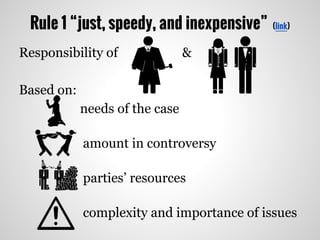
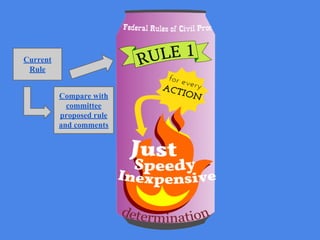
Rule 1 “just, speedy, and inexpensive” (link)
Responsibility of &
Based on:
needs of the case
amount in controversy
parties’ resources
complexity and importance of issues
More Disclosure
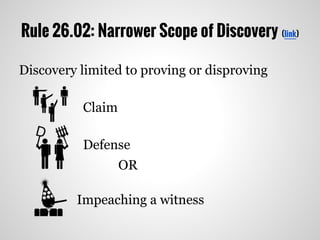
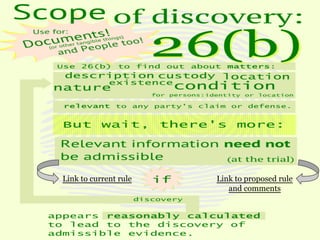
Rule 26.02: Narrower Scope of Discovery (link)
Discovery limited to proving or disproving
Claim
Defense
OR
Impeaching a witness
More Disclosure
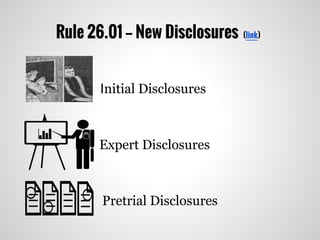
Rule 26.01 -- New Disclosures (link)
Initial Disclosures
Expert Disclosures
Pretrial Disclosures
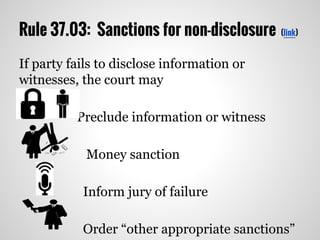
Rule 37.03: Sanctions for non-disclosure (link)
If party fails to disclose information or
witnesses, the court may
Preclude information or witness
Money sanction
Inform jury of failure
Order “other appropriate sanctions”
Collaboration and Informality
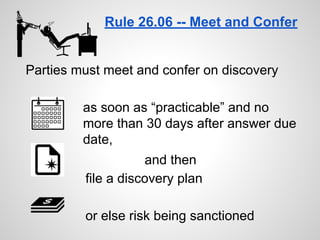
Rule 26.06 -- Meet and Confer
Parties must meet and confer on discovery
as soon as “practicable” and no
more than 30 days after answer due
date,
and then
file a discovery plan
or else risk being sanctioned
Rule 115.04
Motions to Compel
Court may resolve motions to compel through
an informal telephonic conference with the
court.
Minnesota State and Federal Case Law Update
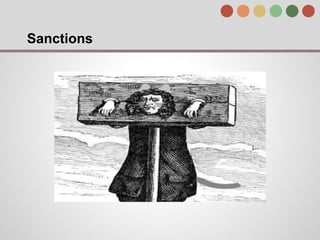
Sanctions
Proposed Amendments to Federal Civil Rules
● These could go into effect in 2015.
● In 2010, Duke Conference proposed ideas for
reducing cost and delay in civil litigation.
● In April 2013, the Advisory Committee on
Civil Rules submitted a report regarding
proposed changes [link].
● In August 2013, the Judicial Conference of
the United States submitted a preliminary
draft of amendments to the Federal Rules of
Civil Procedure [link]. Link to section discussing proposed changes
Default for Discovery Violations
Aviva v. Fingerhut (Jan. 8, 2013)
Takeaways
● Discovery mistakes start small, end big.
● Attorney’s hands-off approach to difficult
client often backfires.
● Once attorney loses credibility with the
court, it is very hard to get it back.
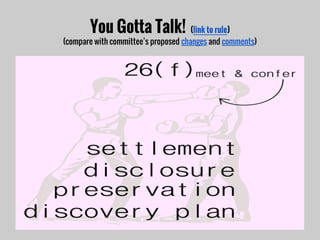
You Gotta Talk! (link to rule)
(compare with committee’s proposed changes and comments)
Rule 26(d) -- Meet and Confer (link)
(Compare with committee’s proposed changes and comments [link])
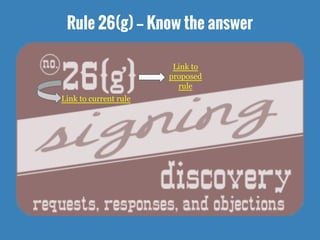
Rule 26(g) -- Know the answer
Link to
proposed
rule
Link to current rule
Failure to Produce
Fields v. Emmerich (Anoka County District Court, Dec.
11, 2012)
Defs intentionally violated duty to disclose and
their counsel failed to adequately investigate
Takeaways
● Rule 26.07 (link) is Rule (link) 11.02 of discovery!
● Can’t hide behind a vendor
● Can’t hand the wheel to your client
Spoliation
Multifeeder Technology v. British
Confectionery (D. Minn. Sept. 18, 2012)
Takeaways
● Attorneys should use a discovery tool to
prevent rogue client from deleting data.
● Lost evidence can be a black box that can
contain whatever the opposing counsel
wants it to.
● Might be good idea to bring in a neutral
early.
Adverse Inference -- Intentional
Takeaways
● Use witness testimony carefully to show
culpable -- or innocent -- state of mind.
● Tell opposing counsel what documents you
want preserved -- the sooner, the better.
● Consider creative sanctions, such as motions
in limine.
Sherman v.
Rinchem (8th Cir.
Aug. 6, 2012)
Adverse Inference -- Negligence
Sekisui v. Hart
(S.D. NY Aug. 15, 2013)
(case infographic [link])
Takeaways
● Important that IT and attorneys
communicate.
● Make sure what you tell opposing counsel
and the court is correct.
● Attempt to quantify and specify what data
was lost.
Attorney’s Discovery Duties
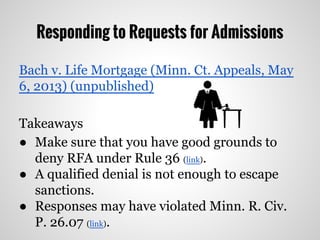
Responding to Requests for Admissions
Bach v. Life Mortgage (Minn. Ct. Appeals, May
6, 2013) (unpublished)
Takeaways
● Make sure that you have good grounds to
deny RFA under Rule 36 (link).
● A qualified denial is not enough to escape
sanctions.
● Responses may have violated Minn. R. Civ.
P. 26.07 (link).
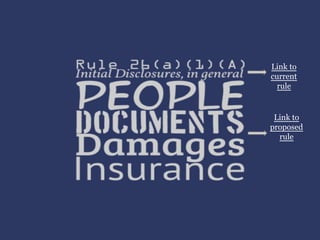
Link to
current
rule
Link to
proposed
rule
Rule 30(b)(6) Deponent Fail
Aviva Sports v. Fingerhut (D. Minn. July 23,
2013)
Takeaways
● A poorly prepared corporate representative
can sink your case.
● Difficult clients do not absolve attorney of
duty to court.
● “Empty head, pure heart” defense doesn’t cut
it.
Privilege Log
S.E.C. v. Welliver (D. Minn. Oct. 26, 2012)
Delay in raising claim of inadvertent disclosure
caused waiver
Scope of Discovery
Compare with
committee
proposed rule
and comments
Current
Rule
Link to current rule Link to proposed rule
and comments
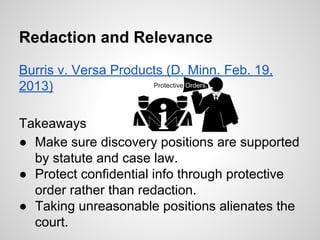
Redaction and Relevance
Burris v. Versa Products (D. Minn. Feb. 19,
2013)
Takeaways
● Make sure discovery positions are supported
by statute and case law.
● Protect confidential info through protective
order rather than redaction.
● Taking unreasonable positions alienates the
court.
Link to
current rule Link to proposed
rule
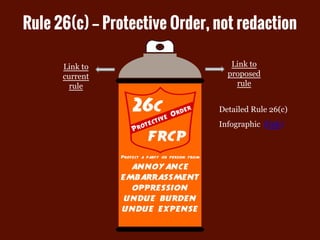
Rule 26(c) -- Protective Order, not redaction
Detailed Rule 26(c)
Infographic (link)
Link to
current
rule
Link to
proposed
rule

Sept e discovery webinar -- partial

  • 1.
    A Year ofChange 2013 Minnesota State and Federal E-Discovery Law Update September 9, 2013
  • 2.
    Minnesota’s Amended DiscoveryRules PROPORTIONALITY MORE DISCLOSURE COLLABORATION AND INFORMALITY
  • 3.
    Minnesota Amends DiscoveryRules (link) Amended rules have made proportionality a central guiding principle for all civil litigation in Minnesota. This is based on Civil Justice Reform Task Force recommendations. (link)
  • 4.
    Civil Justice ReformTask Force Takeaways: ● Discovery big reason for cost of litigation. (link) ● Changes intended to “create a presumption of narrower discovery and require consideration of proportionality in all discovery matters...” (link) ● discovery & expense threaten the civil justice system; proportionality is probably one of the most important changes. (link)
  • 5.
    Rule 1 “just,speedy, and inexpensive” (link) Responsibility of & Based on: needs of the case amount in controversy parties’ resources complexity and importance of issues
  • 6.
  • 7.
    Rule 26.02: NarrowerScope of Discovery (link) Discovery limited to proving or disproving Claim Defense OR Impeaching a witness
  • 8.
  • 9.
    Rule 26.01 --New Disclosures (link) Initial Disclosures Expert Disclosures Pretrial Disclosures
  • 10.
    Rule 37.03: Sanctionsfor non-disclosure (link) If party fails to disclose information or witnesses, the court may Preclude information or witness Money sanction Inform jury of failure Order “other appropriate sanctions”
  • 11.
  • 12.
    Rule 26.06 --Meet and Confer Parties must meet and confer on discovery as soon as “practicable” and no more than 30 days after answer due date, and then file a discovery plan or else risk being sanctioned
  • 13.
    Rule 115.04 Motions toCompel Court may resolve motions to compel through an informal telephonic conference with the court.
  • 14.
    Minnesota State andFederal Case Law Update
  • 15.
  • 16.
    Proposed Amendments toFederal Civil Rules ● These could go into effect in 2015. ● In 2010, Duke Conference proposed ideas for reducing cost and delay in civil litigation. ● In April 2013, the Advisory Committee on Civil Rules submitted a report regarding proposed changes [link]. ● In August 2013, the Judicial Conference of the United States submitted a preliminary draft of amendments to the Federal Rules of Civil Procedure [link]. Link to section discussing proposed changes
  • 17.
    Default for DiscoveryViolations Aviva v. Fingerhut (Jan. 8, 2013) Takeaways ● Discovery mistakes start small, end big. ● Attorney’s hands-off approach to difficult client often backfires. ● Once attorney loses credibility with the court, it is very hard to get it back.
  • 18.
    You Gotta Talk!(link to rule) (compare with committee’s proposed changes and comments)
  • 19.
    Rule 26(d) --Meet and Confer (link) (Compare with committee’s proposed changes and comments [link])
  • 20.
    Rule 26(g) --Know the answer Link to proposed rule Link to current rule
  • 21.
    Failure to Produce Fieldsv. Emmerich (Anoka County District Court, Dec. 11, 2012) Defs intentionally violated duty to disclose and their counsel failed to adequately investigate Takeaways ● Rule 26.07 (link) is Rule (link) 11.02 of discovery! ● Can’t hide behind a vendor ● Can’t hand the wheel to your client
  • 22.
    Spoliation Multifeeder Technology v.British Confectionery (D. Minn. Sept. 18, 2012) Takeaways ● Attorneys should use a discovery tool to prevent rogue client from deleting data. ● Lost evidence can be a black box that can contain whatever the opposing counsel wants it to. ● Might be good idea to bring in a neutral early.
  • 23.
    Adverse Inference --Intentional Takeaways ● Use witness testimony carefully to show culpable -- or innocent -- state of mind. ● Tell opposing counsel what documents you want preserved -- the sooner, the better. ● Consider creative sanctions, such as motions in limine. Sherman v. Rinchem (8th Cir. Aug. 6, 2012)
  • 24.
    Adverse Inference --Negligence Sekisui v. Hart (S.D. NY Aug. 15, 2013) (case infographic [link]) Takeaways ● Important that IT and attorneys communicate. ● Make sure what you tell opposing counsel and the court is correct. ● Attempt to quantify and specify what data was lost.
  • 25.
  • 26.
    Responding to Requestsfor Admissions Bach v. Life Mortgage (Minn. Ct. Appeals, May 6, 2013) (unpublished) Takeaways ● Make sure that you have good grounds to deny RFA under Rule 36 (link). ● A qualified denial is not enough to escape sanctions. ● Responses may have violated Minn. R. Civ. P. 26.07 (link).
  • 27.
  • 28.
    Rule 30(b)(6) DeponentFail Aviva Sports v. Fingerhut (D. Minn. July 23, 2013) Takeaways ● A poorly prepared corporate representative can sink your case. ● Difficult clients do not absolve attorney of duty to court. ● “Empty head, pure heart” defense doesn’t cut it.
  • 29.
    Privilege Log S.E.C. v.Welliver (D. Minn. Oct. 26, 2012) Delay in raising claim of inadvertent disclosure caused waiver
  • 30.
  • 31.
  • 32.
    Link to currentrule Link to proposed rule and comments
  • 33.
    Redaction and Relevance Burrisv. Versa Products (D. Minn. Feb. 19, 2013) Takeaways ● Make sure discovery positions are supported by statute and case law. ● Protect confidential info through protective order rather than redaction. ● Taking unreasonable positions alienates the court.
  • 34.
    Link to current ruleLink to proposed rule
  • 35.
    Rule 26(c) --Protective Order, not redaction Detailed Rule 26(c) Infographic (link) Link to current rule Link to proposed rule