FRIDAY, September 7, 2012
Bellringer: Please answer in your
journal:

1. Journal Prompt (min 3 sentences)
-What is the best advice you ever
received?

2. What are the four basic kinds of
sentences?
Kinds of
 Sentences


© Brent Coley 2008 | www.mrcoley.com
There are four
different kinds of
    sentences.
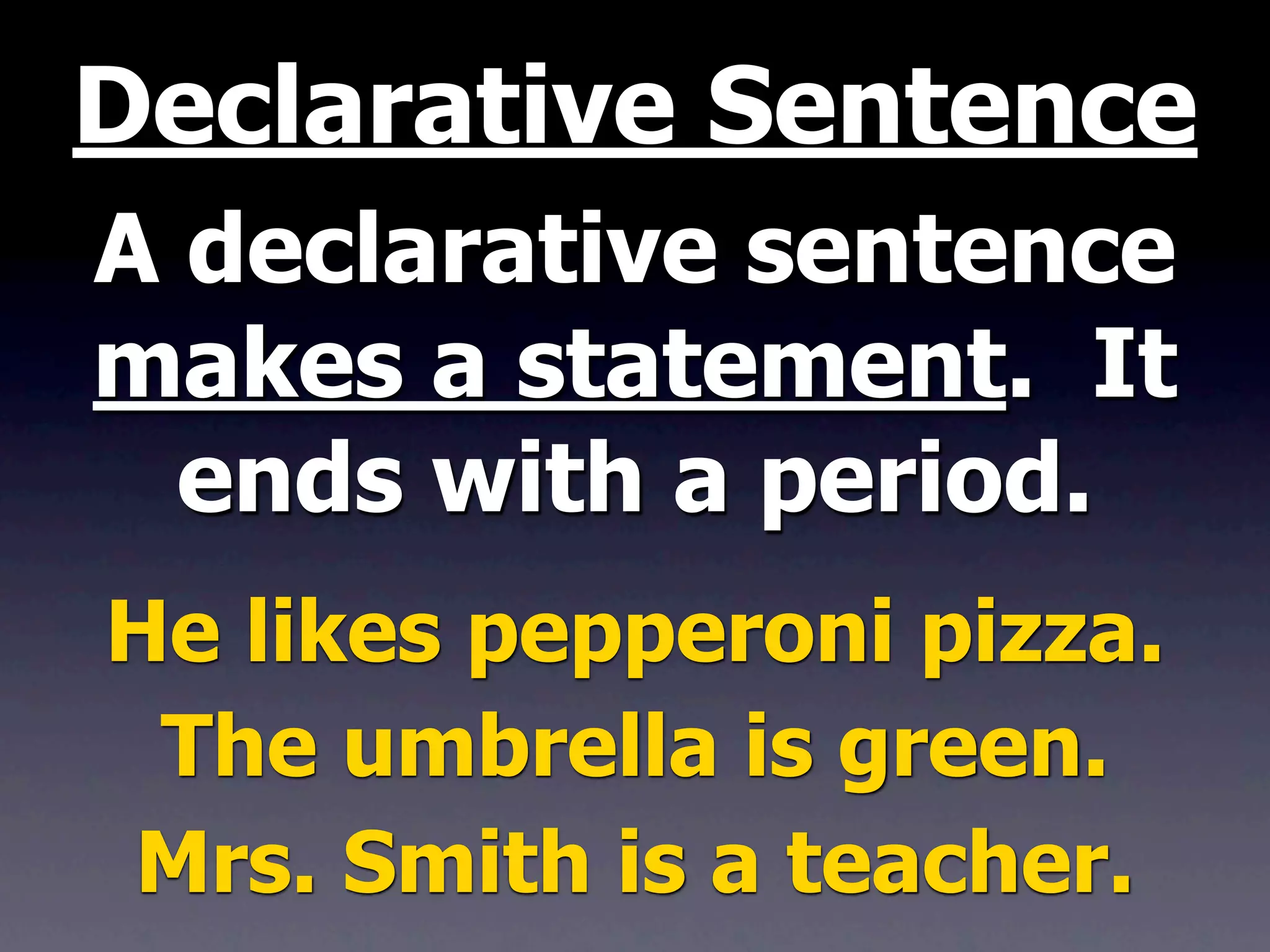
Declarative Sentence
A declarative sentence
makes a statement. It
  ends with a period.
He likes pepperoni pizza.
 The umbrella is green.
Mrs. Smith is a teacher.
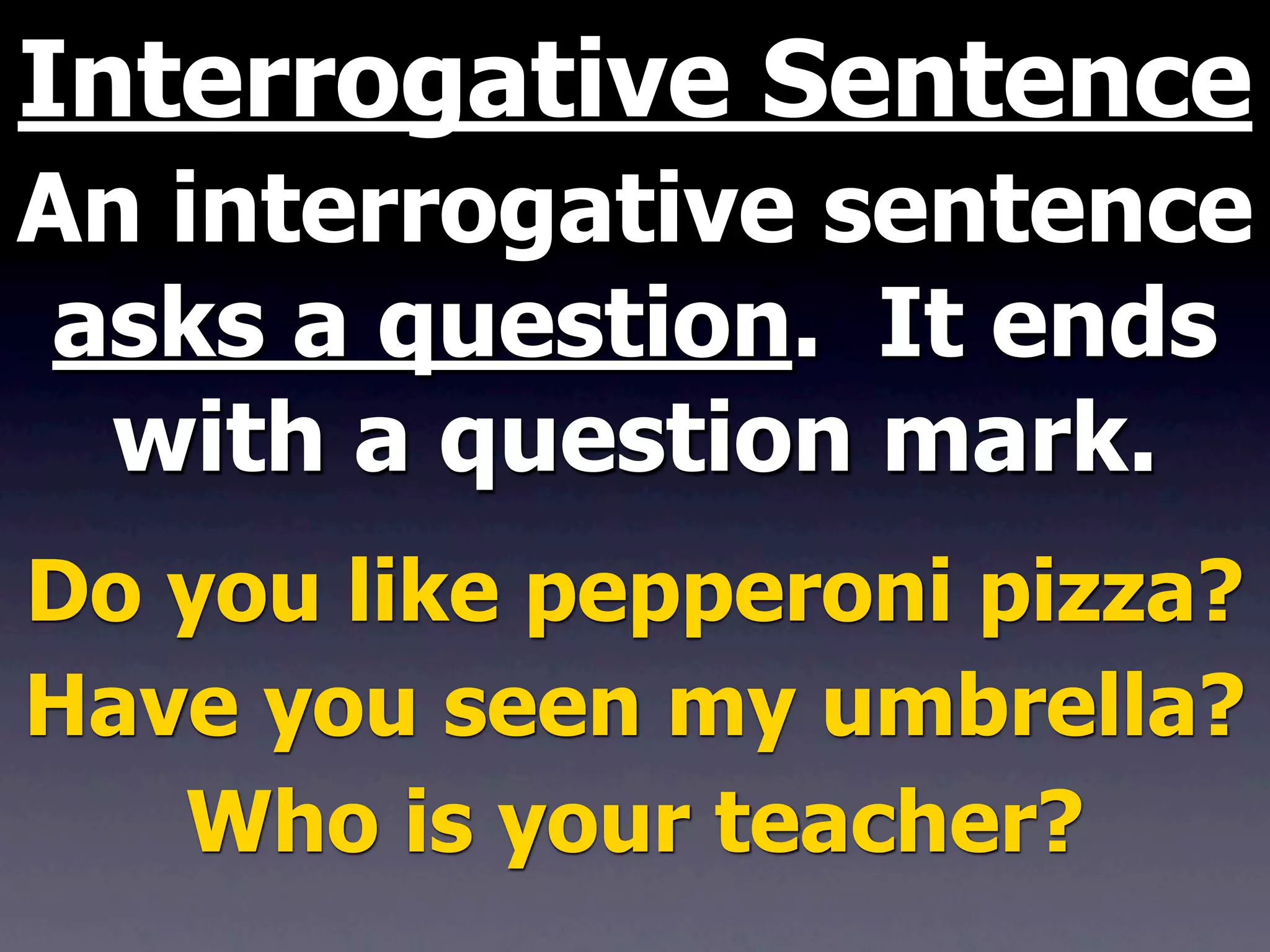
Interrogative Sentence
An interrogative sentence
 asks a question. It ends
  with a question mark.
Do you like pepperoni pizza?
Have you seen my umbrella?
   Who is your teacher?
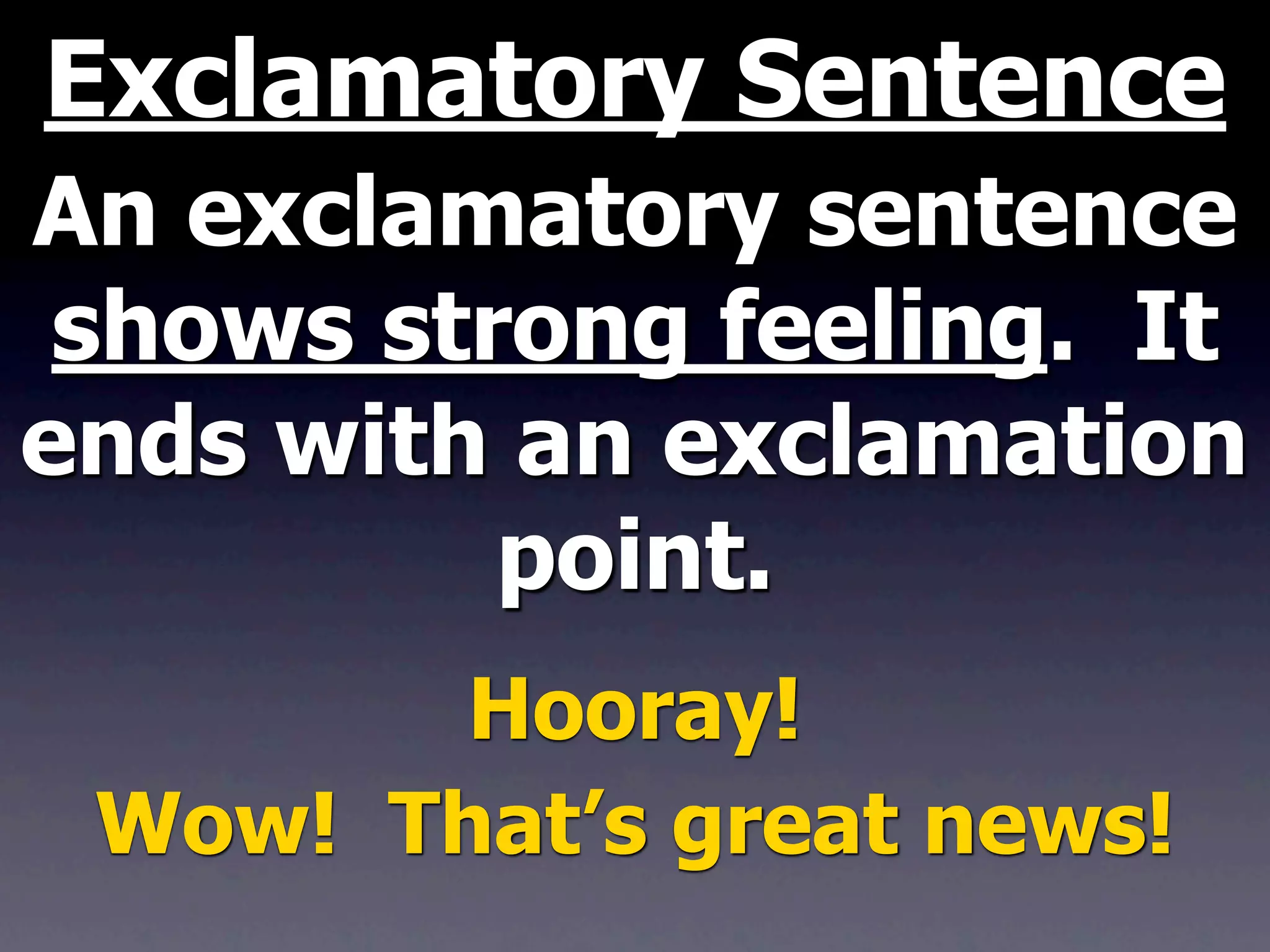
Exclamatory Sentence
An exclamatory sentence
 shows strong feeling. It
ends with an exclamation
          point.
        Hooray!
 Wow! That’s great news!
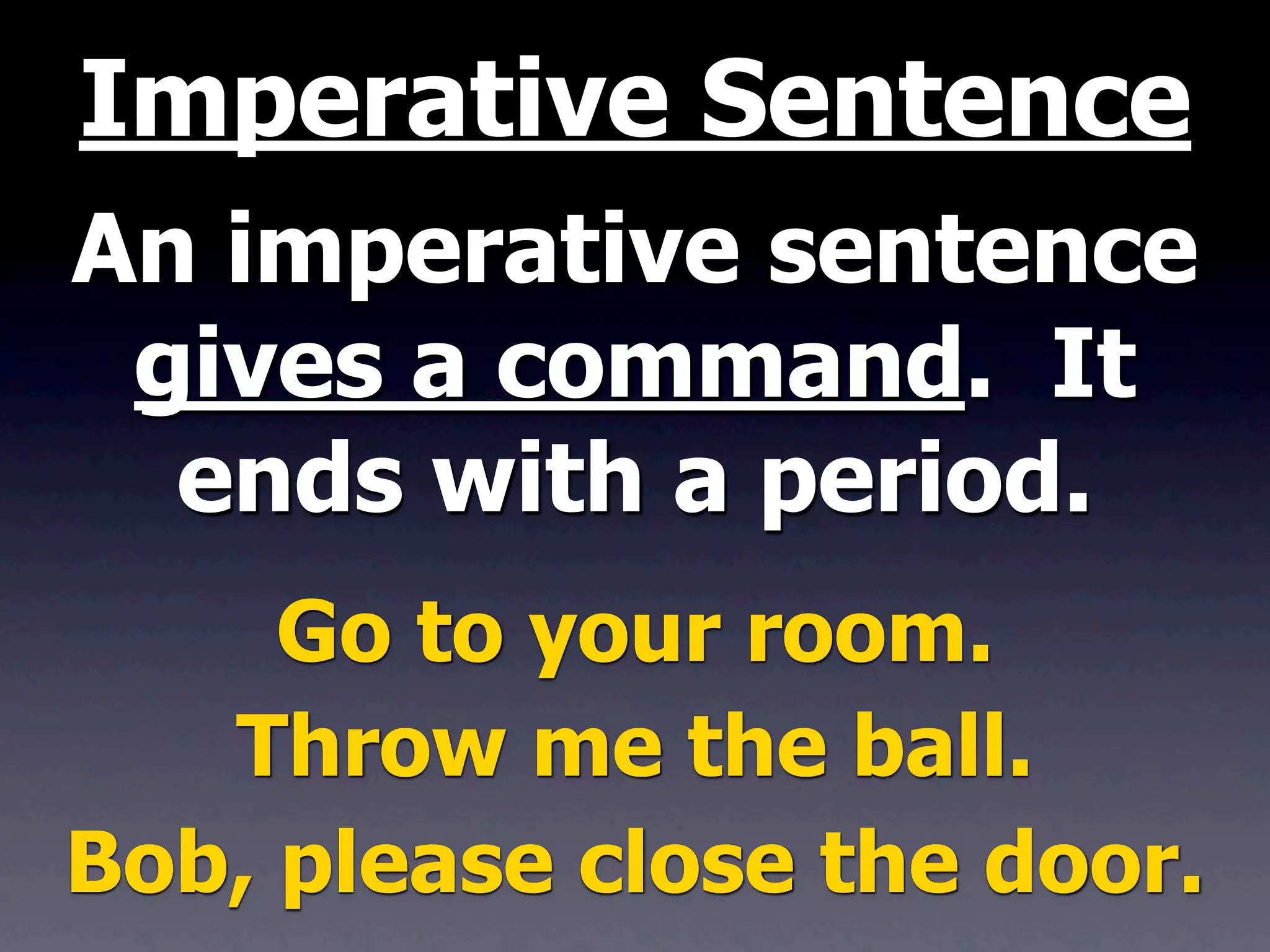
Imperative Sentence
An imperative sentence
 gives a command. It
  ends with a period.
     Go to your room.
   Throw me the ball.
Bob, please close the door.
Sentence Structure

   Sentence Types
Sentence Types

 • Simple
 • Compound
 • Complex
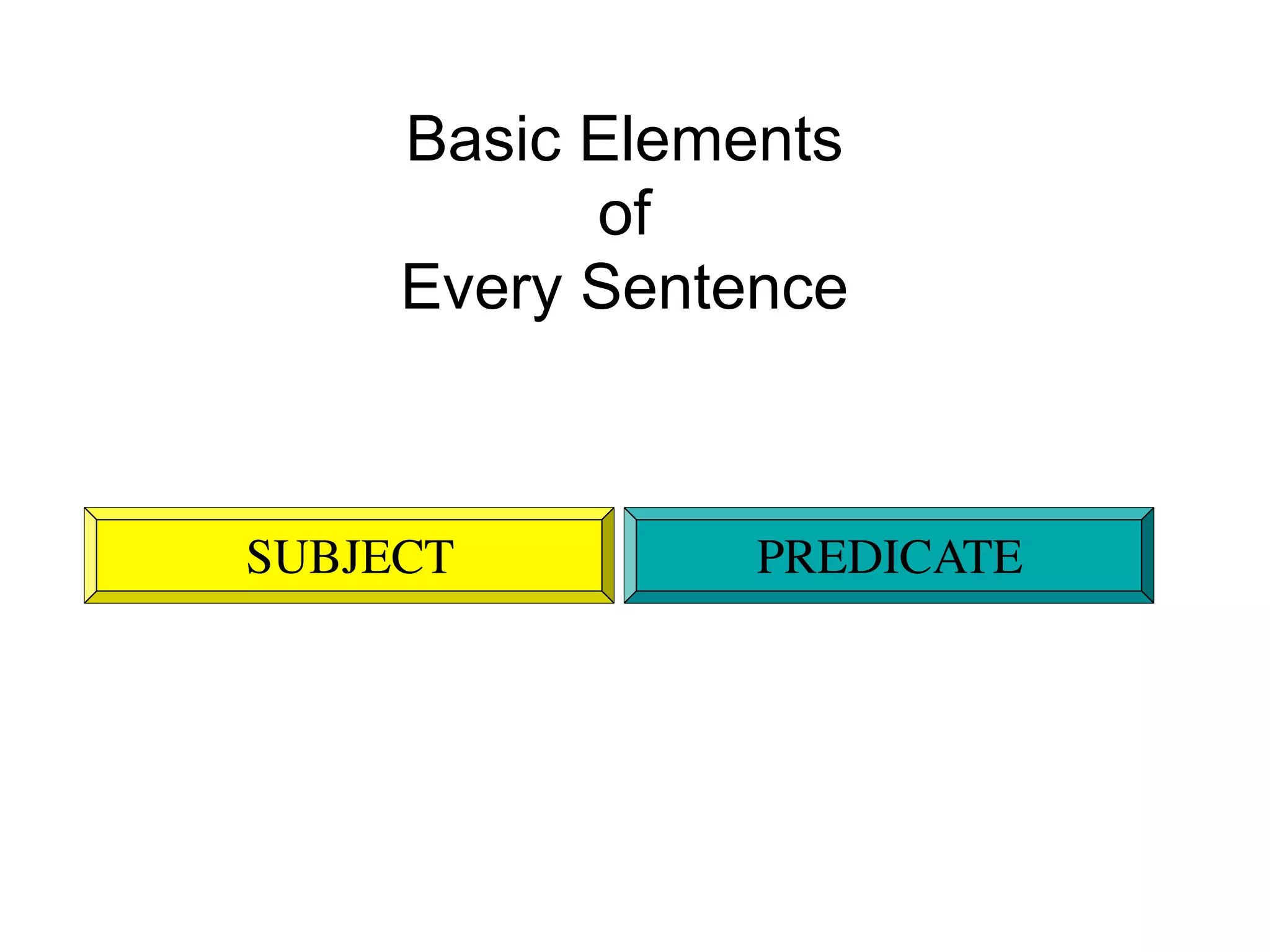
Basic Elements
           of
     Every Sentence


SUBJECT         PREDICATE
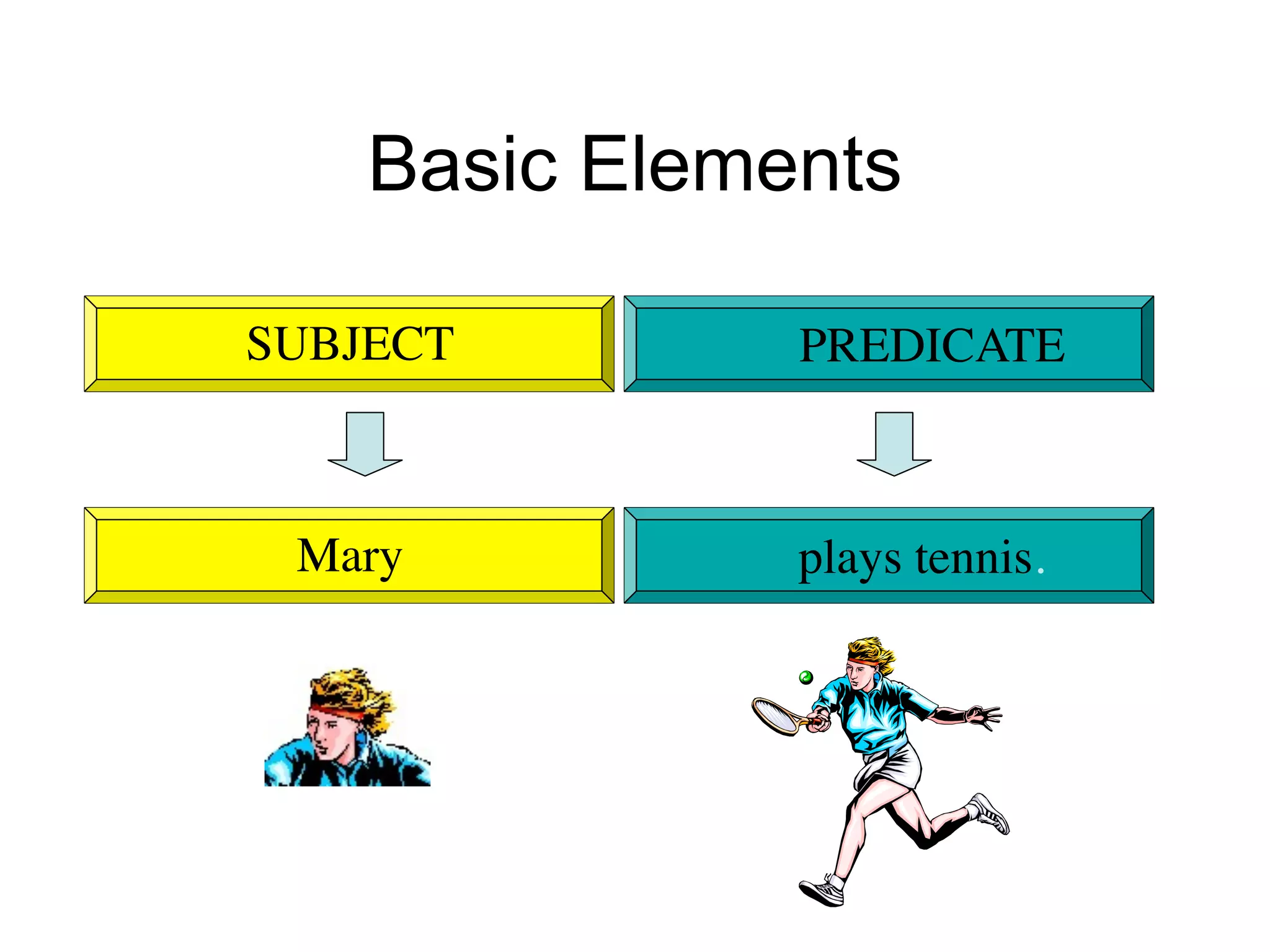
Basic Elements

SUBJECT        PREDICATE


 Mary          plays tennis.
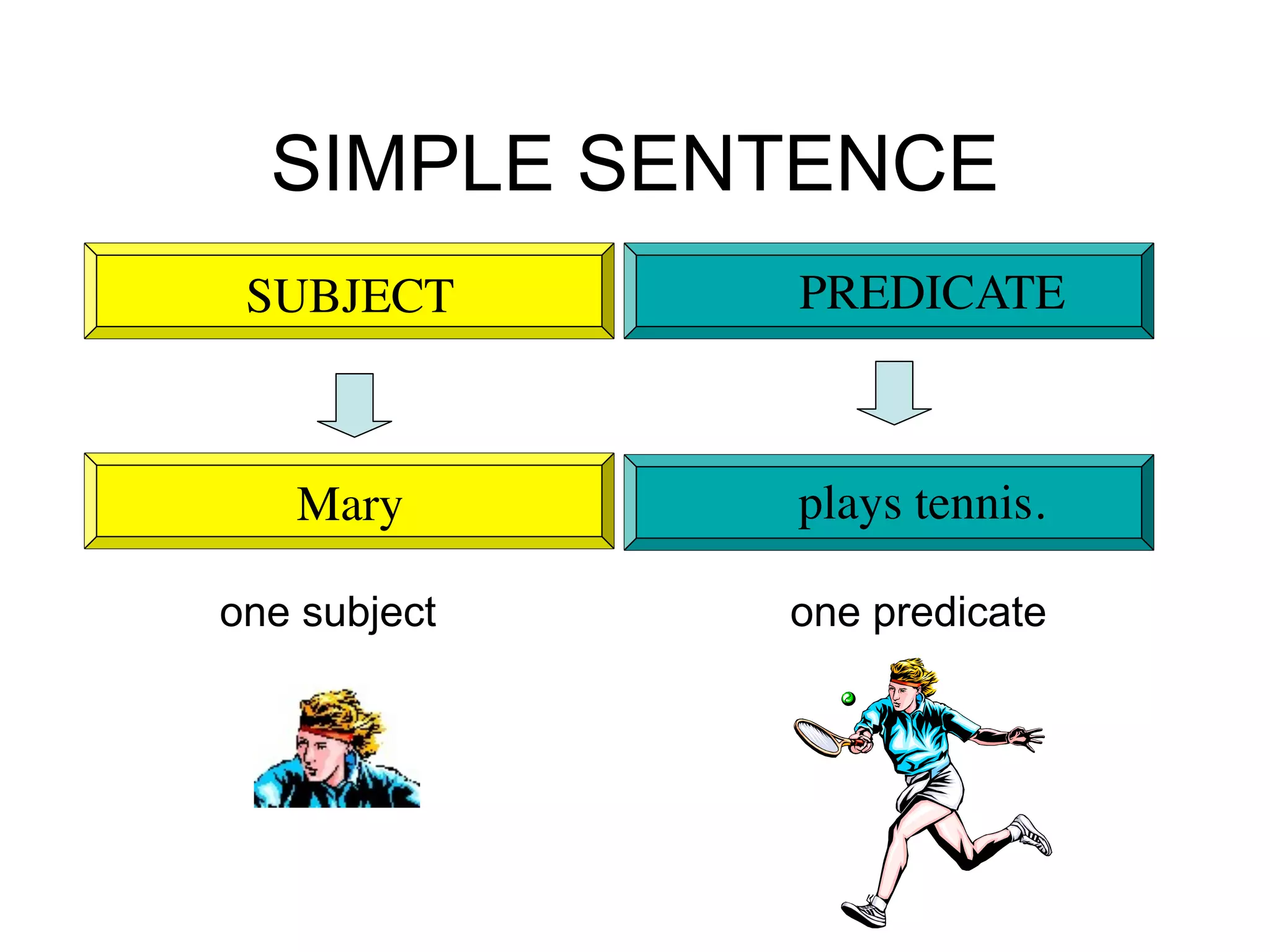
SIMPLE SENTENCE
 SUBJECT      PREDICATE


   Mary       plays tennis.

one subject   one predicate
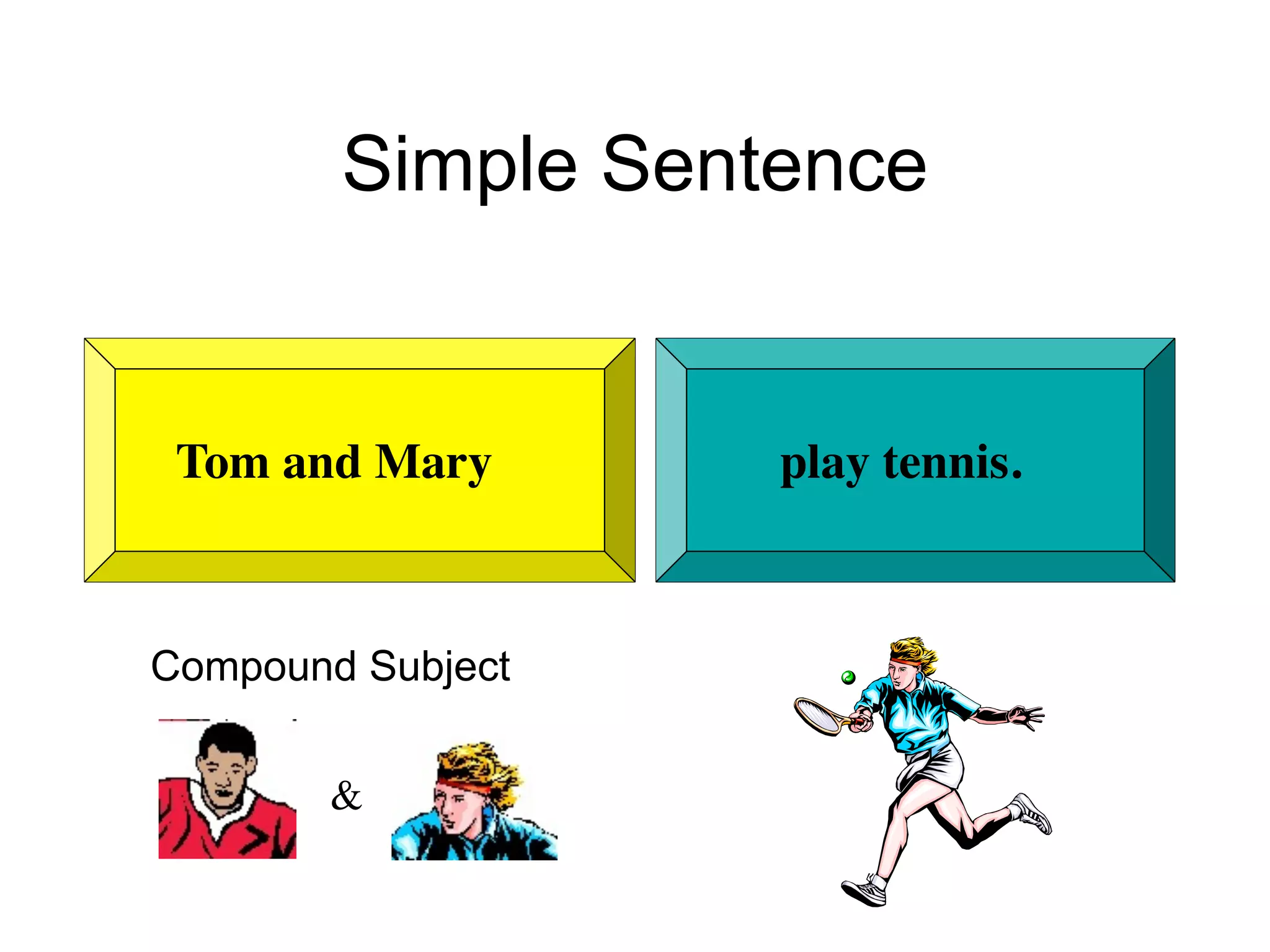
Simple Sentence


 Tom and Mary      play tennis.


Compound Subject


       &
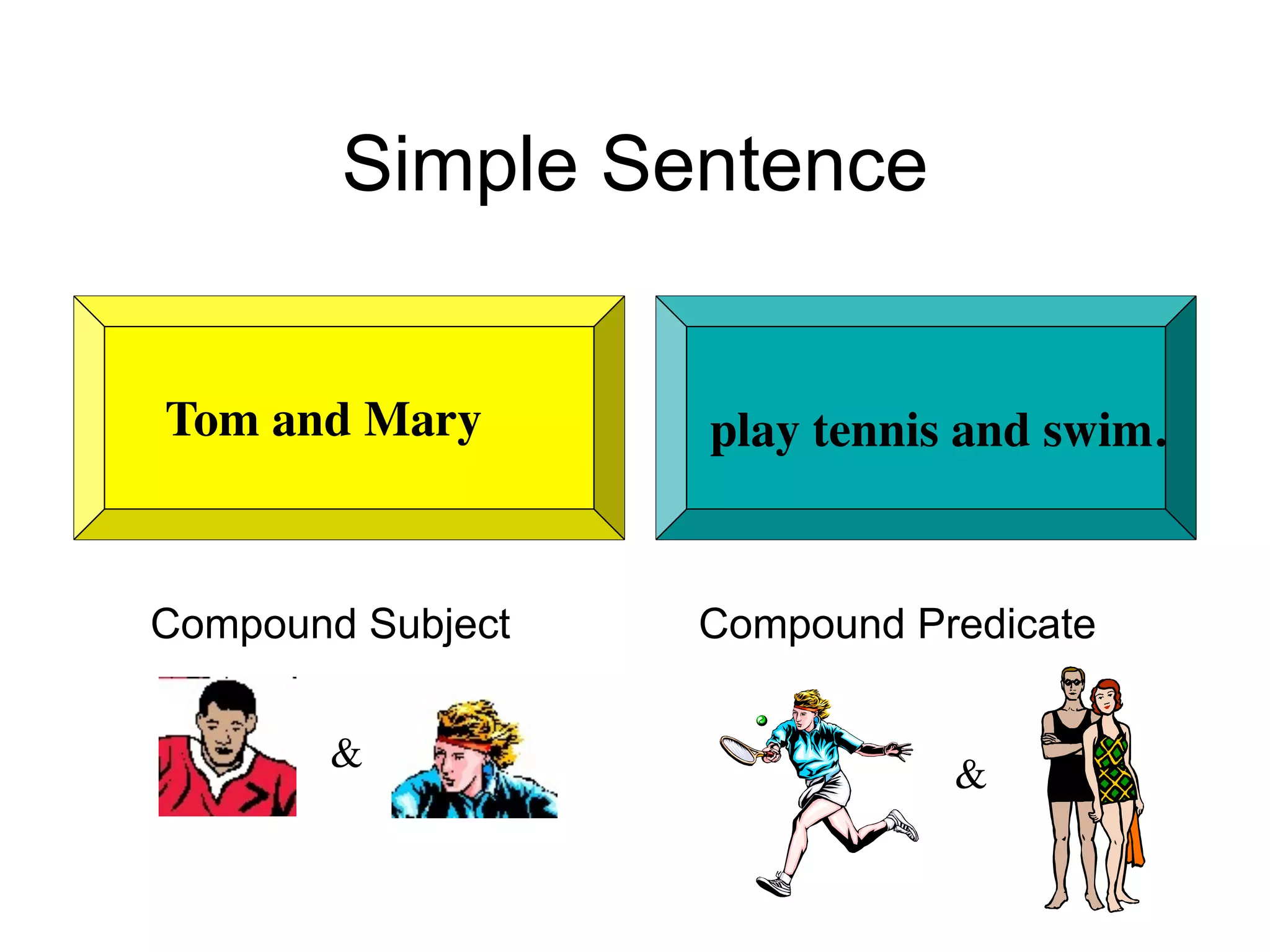
Simple Sentence


Tom and Mary       play tennis and swim.


Compound Subject   Compound Predicate


       &                      &
SIMPLE SENTENCE
   with compound subject


Tom and Mary play tennis.
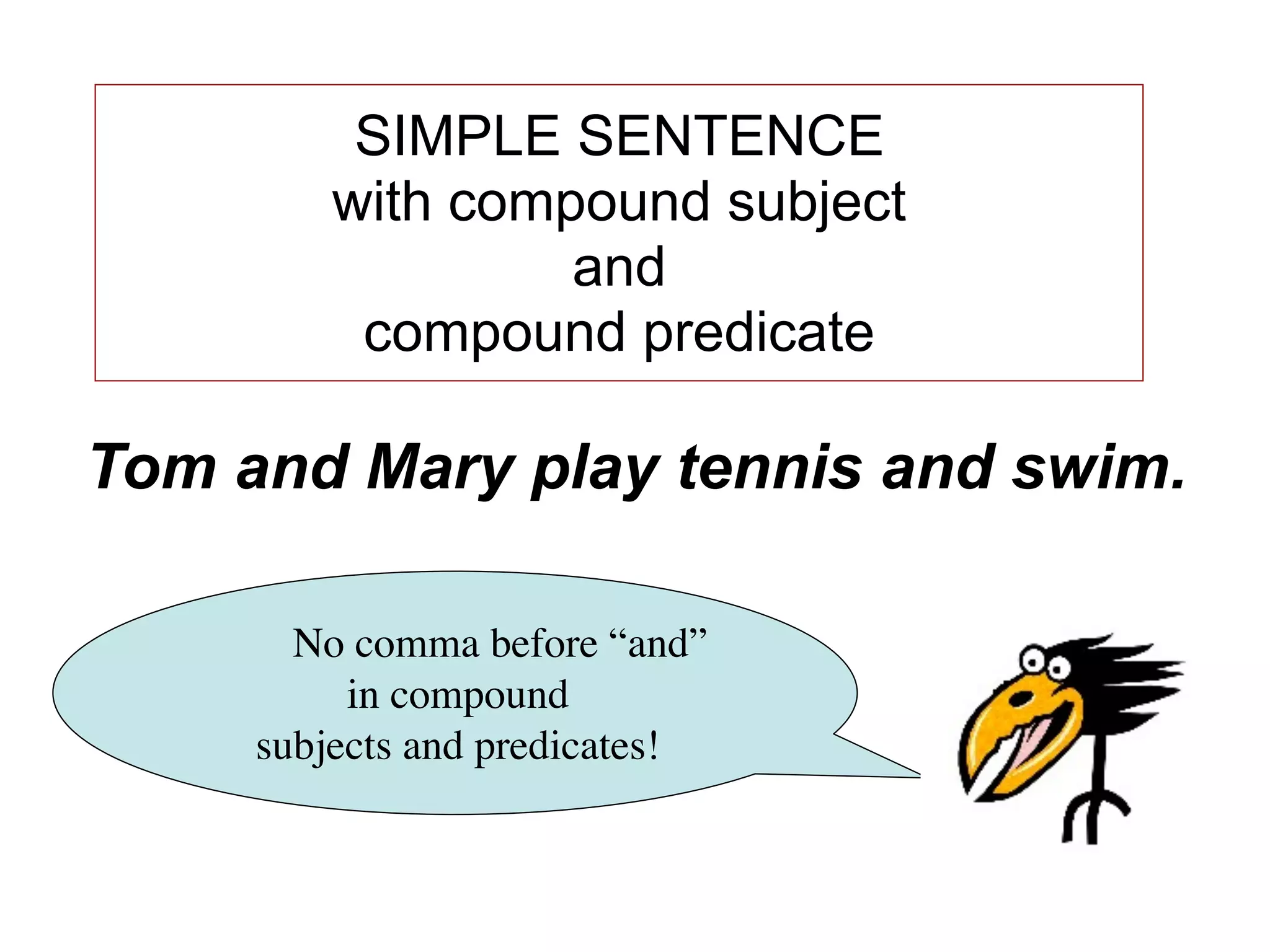
SIMPLE SENTENCE
    with compound subject
             and
     compound predicate

Tom and Mary play tennis and swim.
Hi,
I’m Punctuation Pete!
SIMPLE SENTENCE
         with compound subject
                  and
          compound predicate

Tom and Mary play tennis and swim.

       No comma before “and”
          in compound
     subjects and predicates!
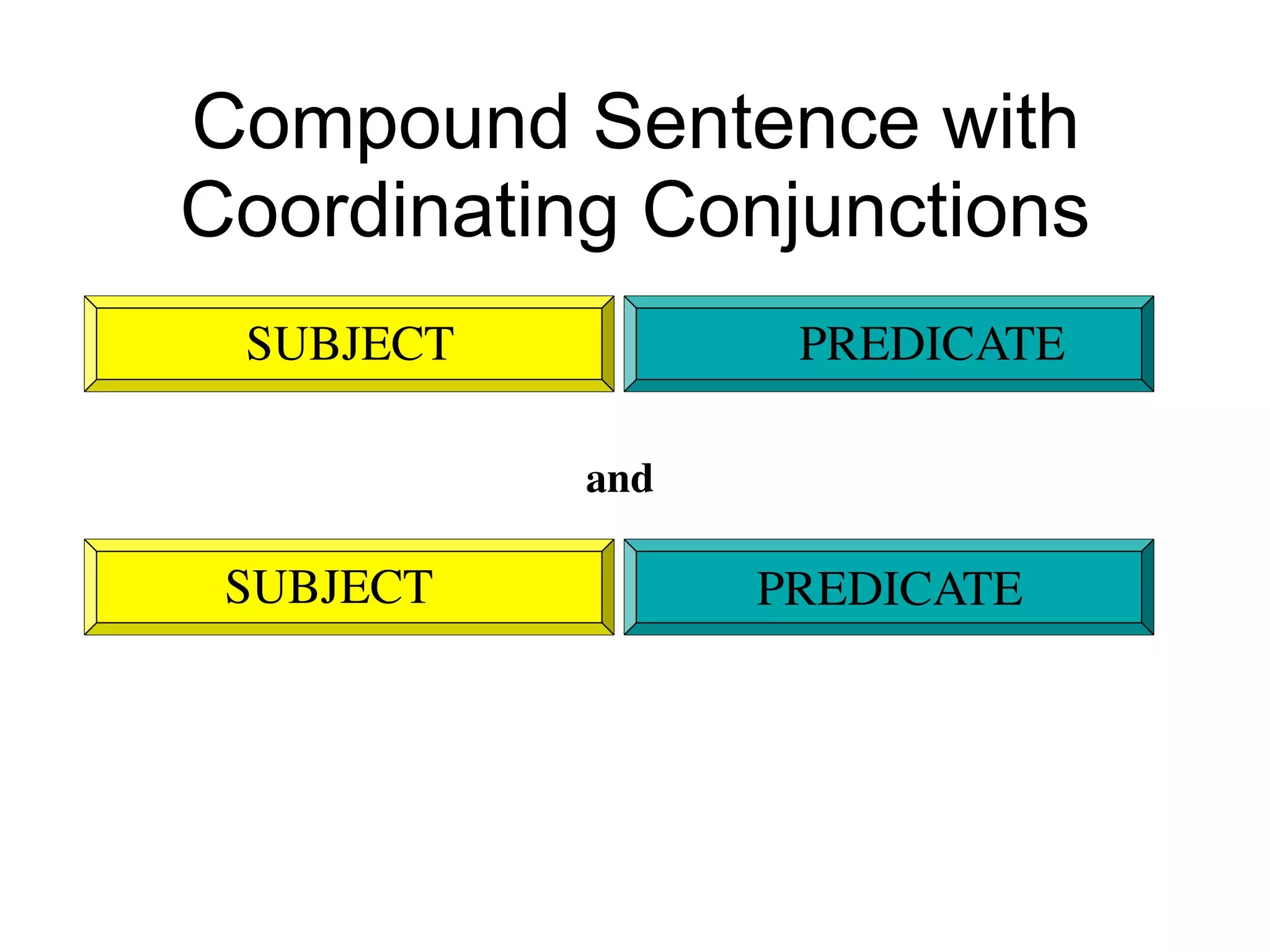
Compound Sentence with
Coordinating Conjunctions
 SUBJECT          PREDICATE

           and

 SUBJECT         PREDICATE
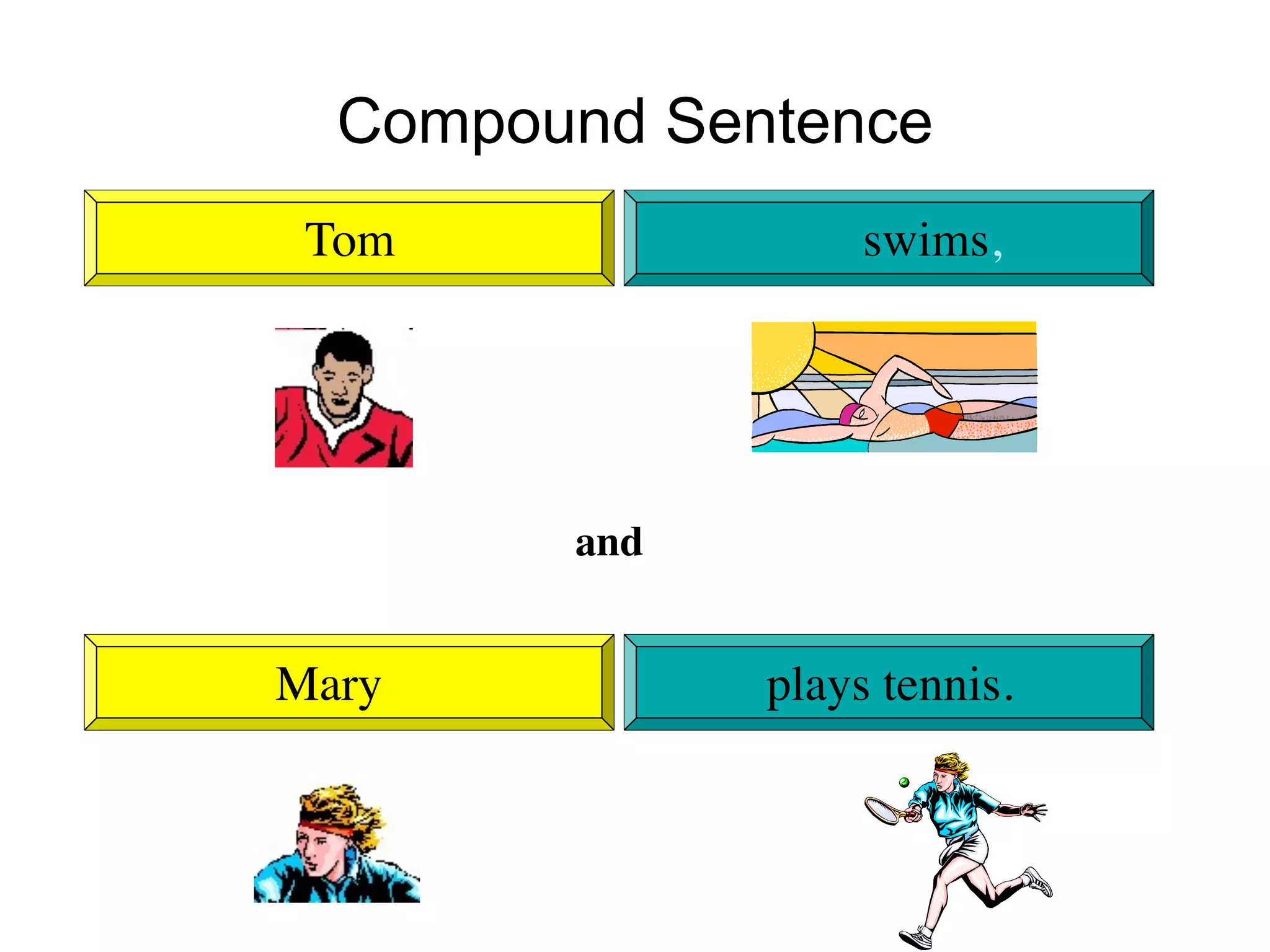
Compound Sentence
 Tom               swims,


        and


Mary          plays tennis.
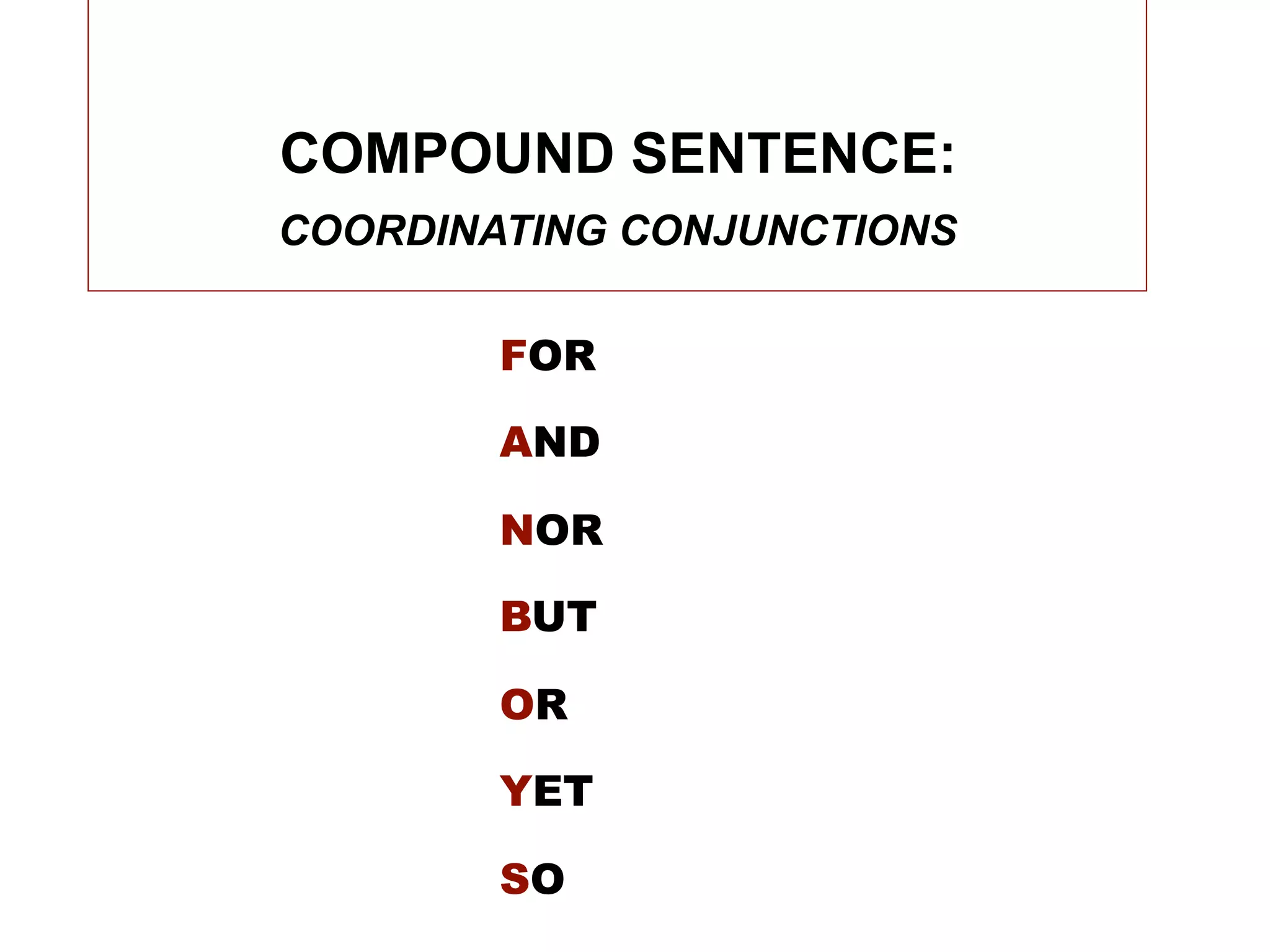
COMPOUND SENTENCE:
COORDINATING CONJUNCTIONS

        FOR

        AND

        NOR

        BUT

        OR

        YET

        SO
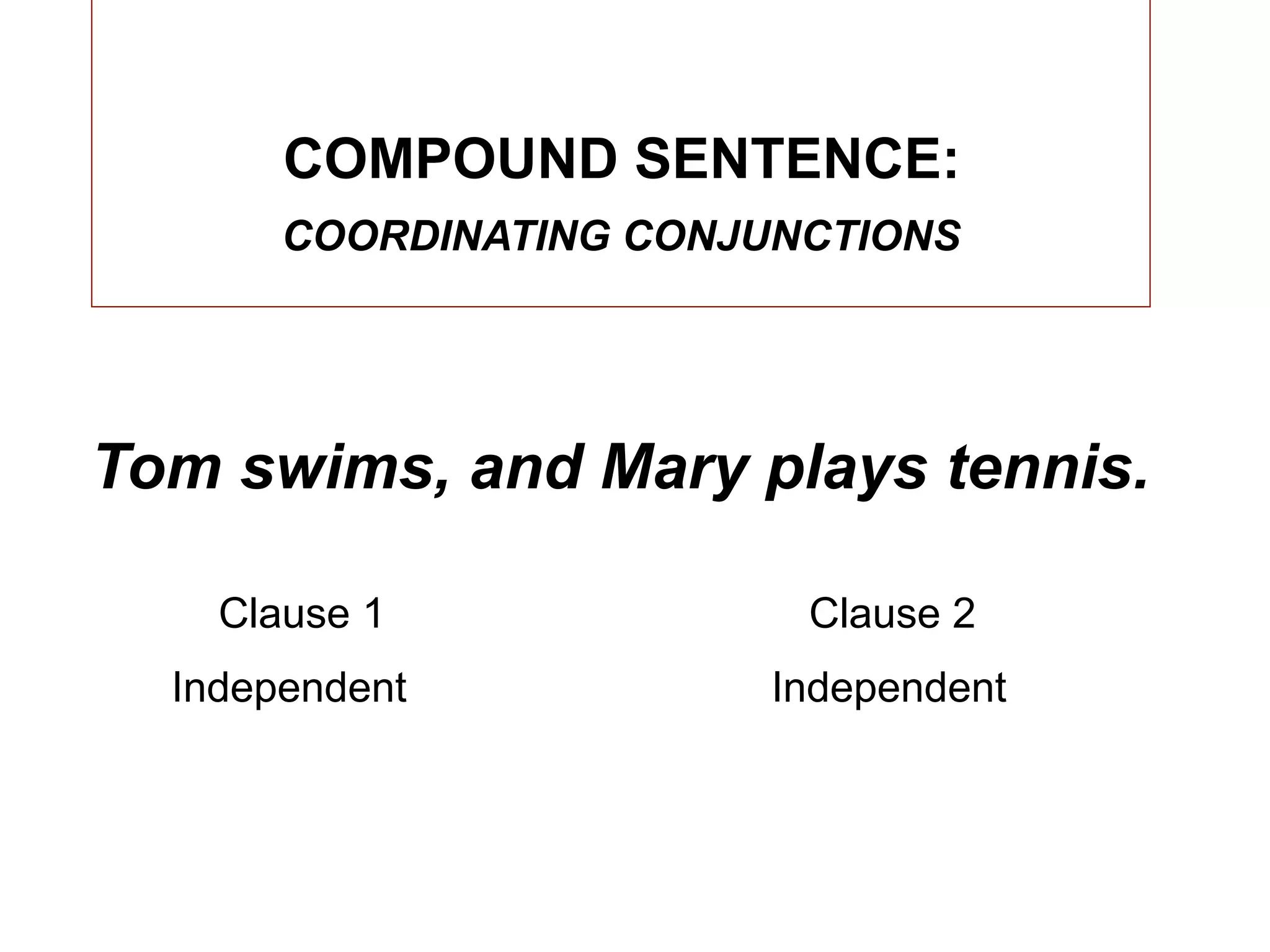
COMPOUND SENTENCE:
       COORDINATING CONJUNCTIONS


Tom swims, and Mary plays tennis.

    Clause 1              Clause 2
  Independent            Independent
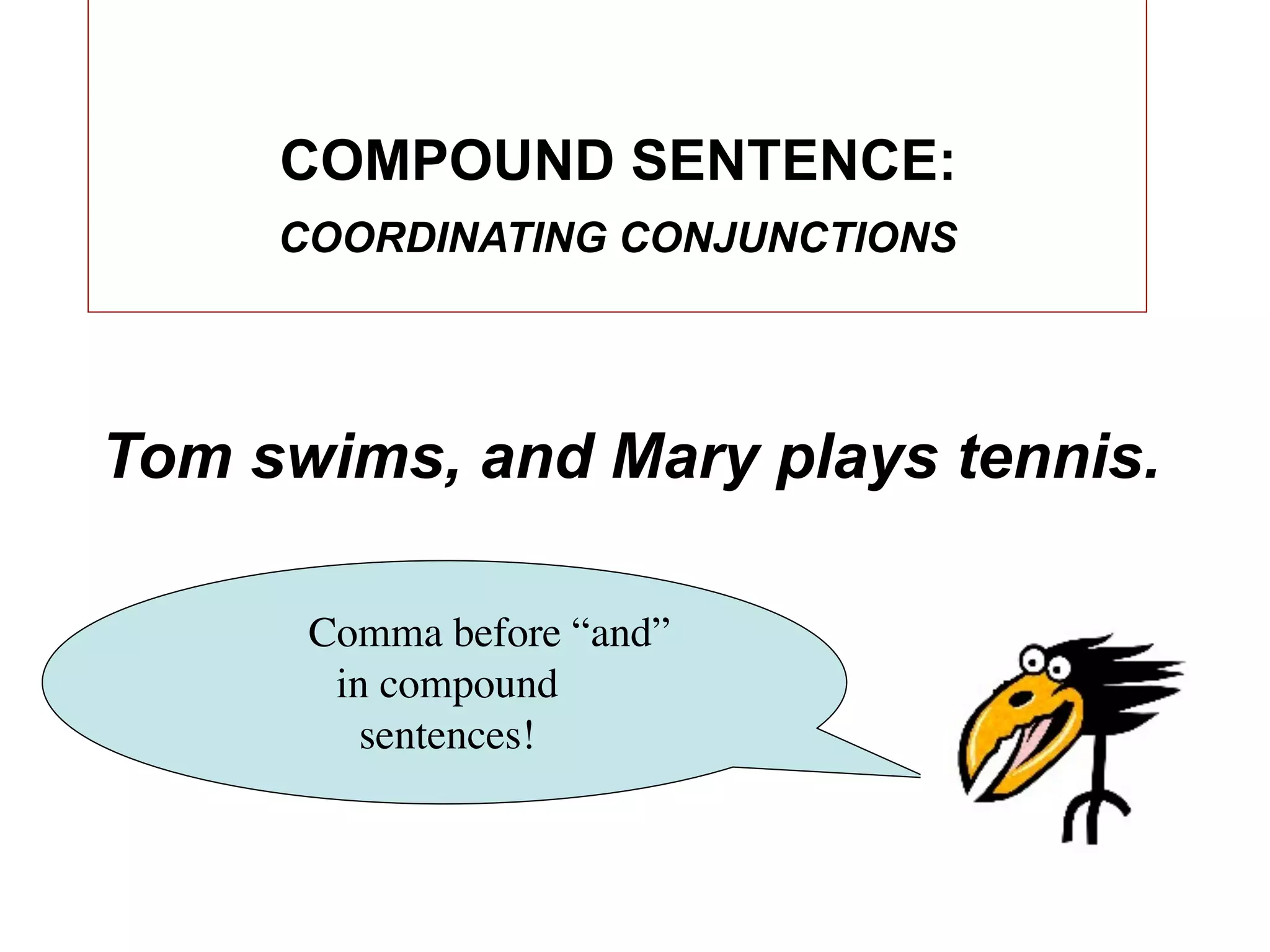
COMPOUND SENTENCE:
     COORDINATING CONJUNCTIONS


Tom swims, and Mary plays tennis.

      Comma before “and”
       in compound
         sentences!
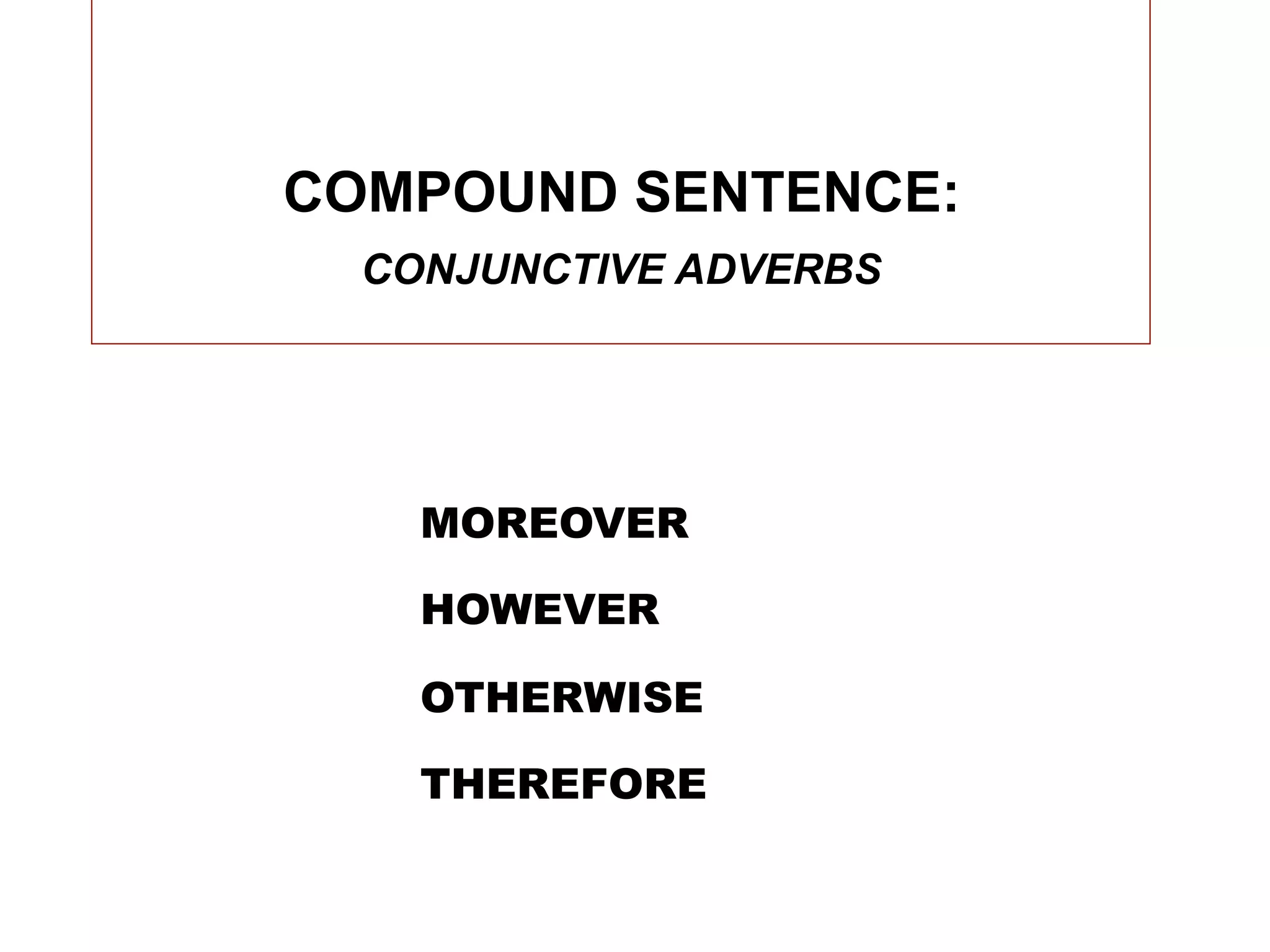
COMPOUND SENTENCE:
  CONJUNCTIVE ADVERBS


    MOREOVER

    HOWEVER

    OTHERWISE

    THEREFORE
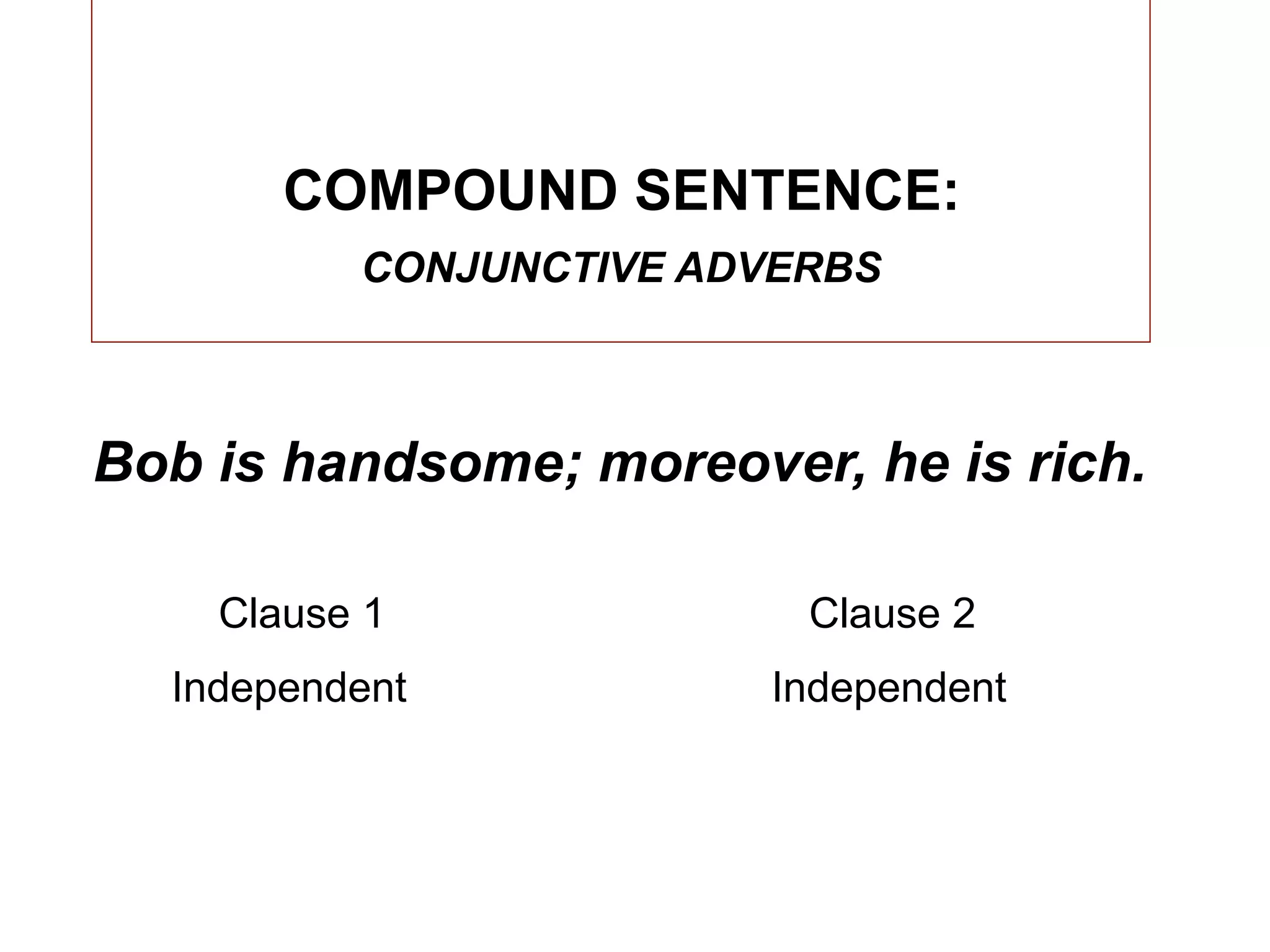
COMPOUND SENTENCE:
          CONJUNCTIVE ADVERBS


Bob is handsome; moreover, he is rich.

    Clause 1              Clause 2
  Independent           Independent
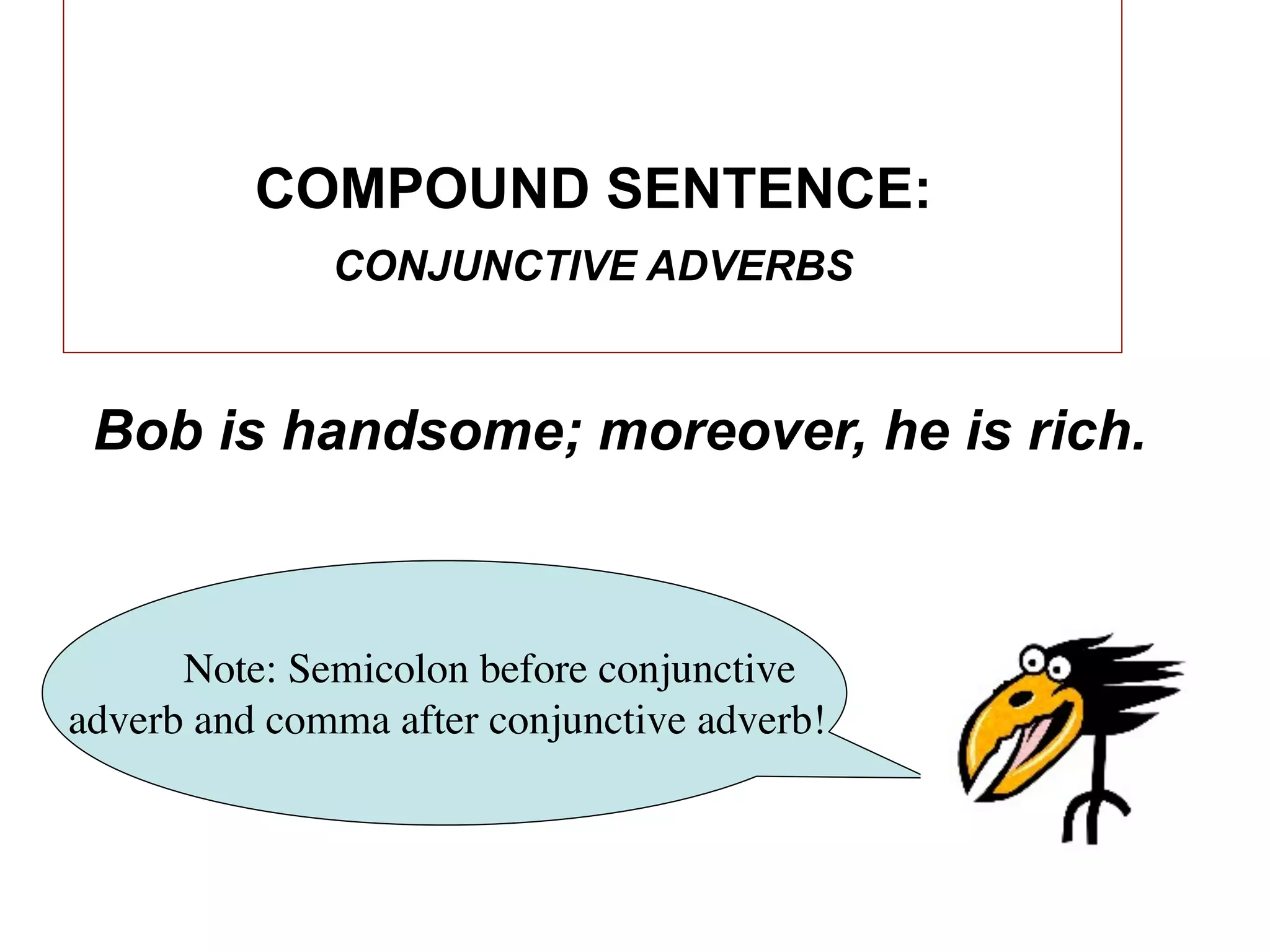
COMPOUND SENTENCE:
              CONJUNCTIVE ADVERBS


 Bob is handsome; moreover, he is rich.


      Note: Semicolon before conjunctive
adverb and comma after conjunctive adverb!
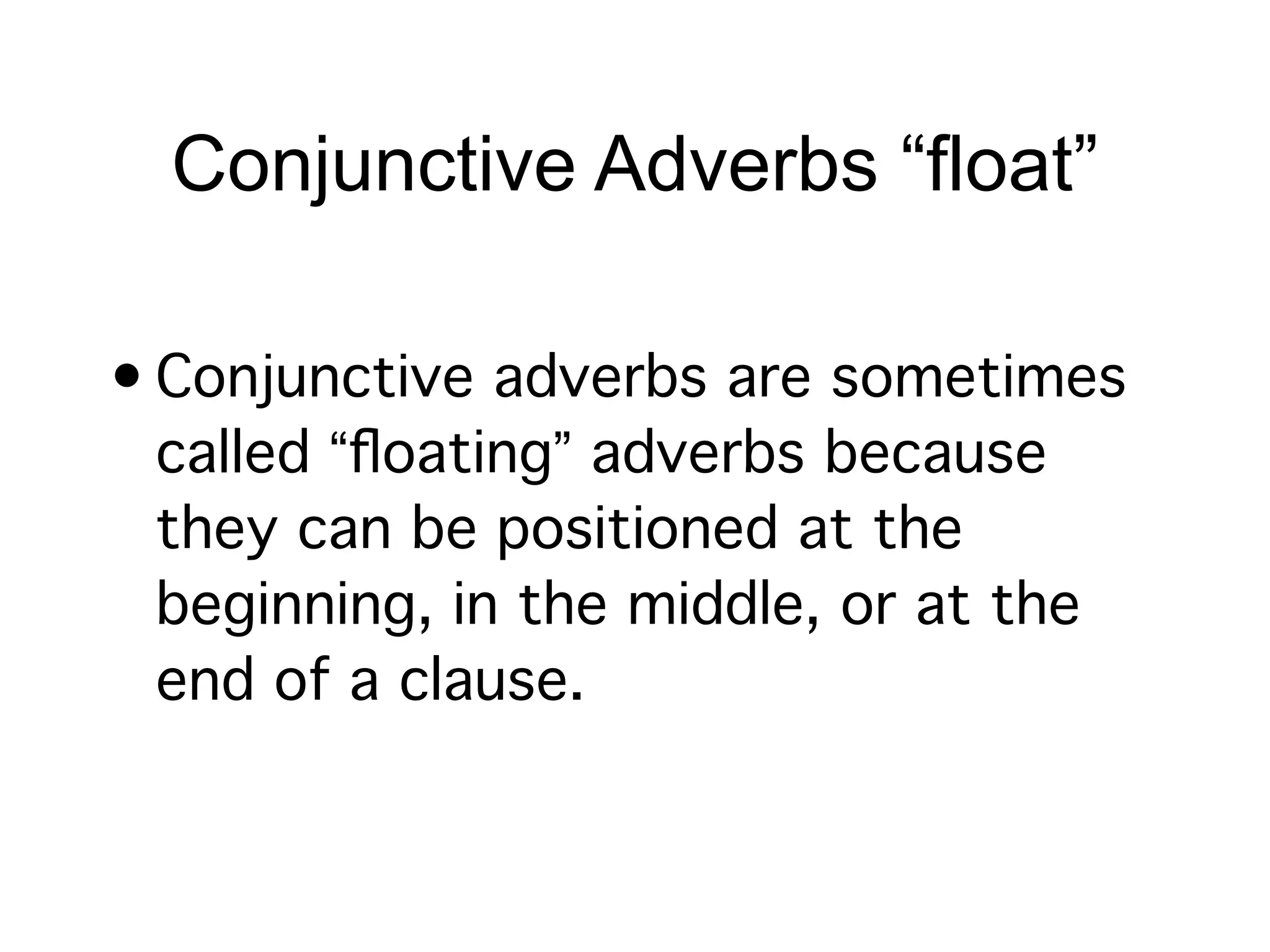
Conjunctive Adverbs “float”

• Conjunctive adverbs are sometimes
  called “floating” adverbs because
  they can be positioned at the
  beginning, in the middle, or at the
  end of a clause.
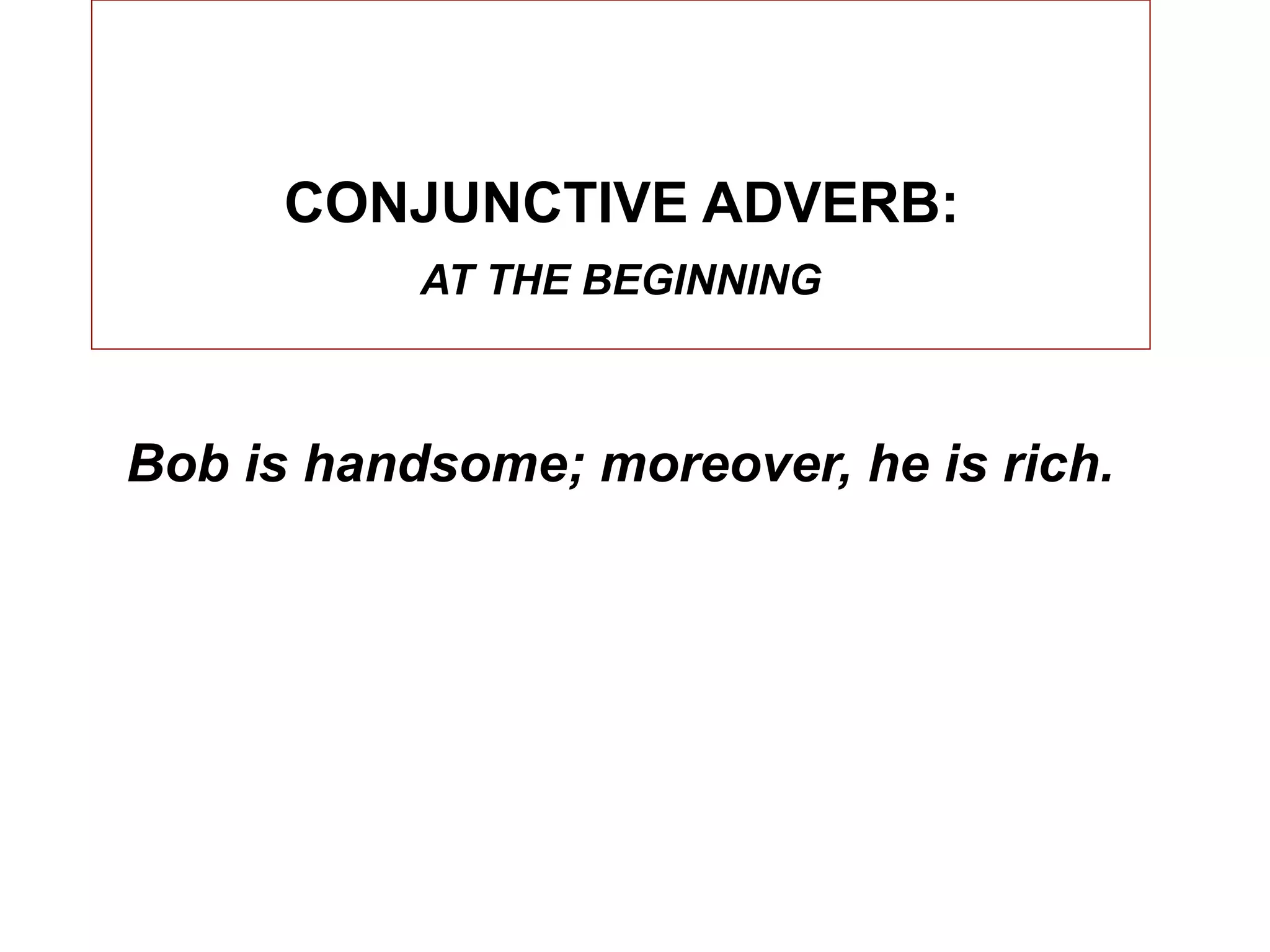
CONJUNCTIVE ADVERB:
           AT THE BEGINNING


Bob is handsome; moreover, he is rich.
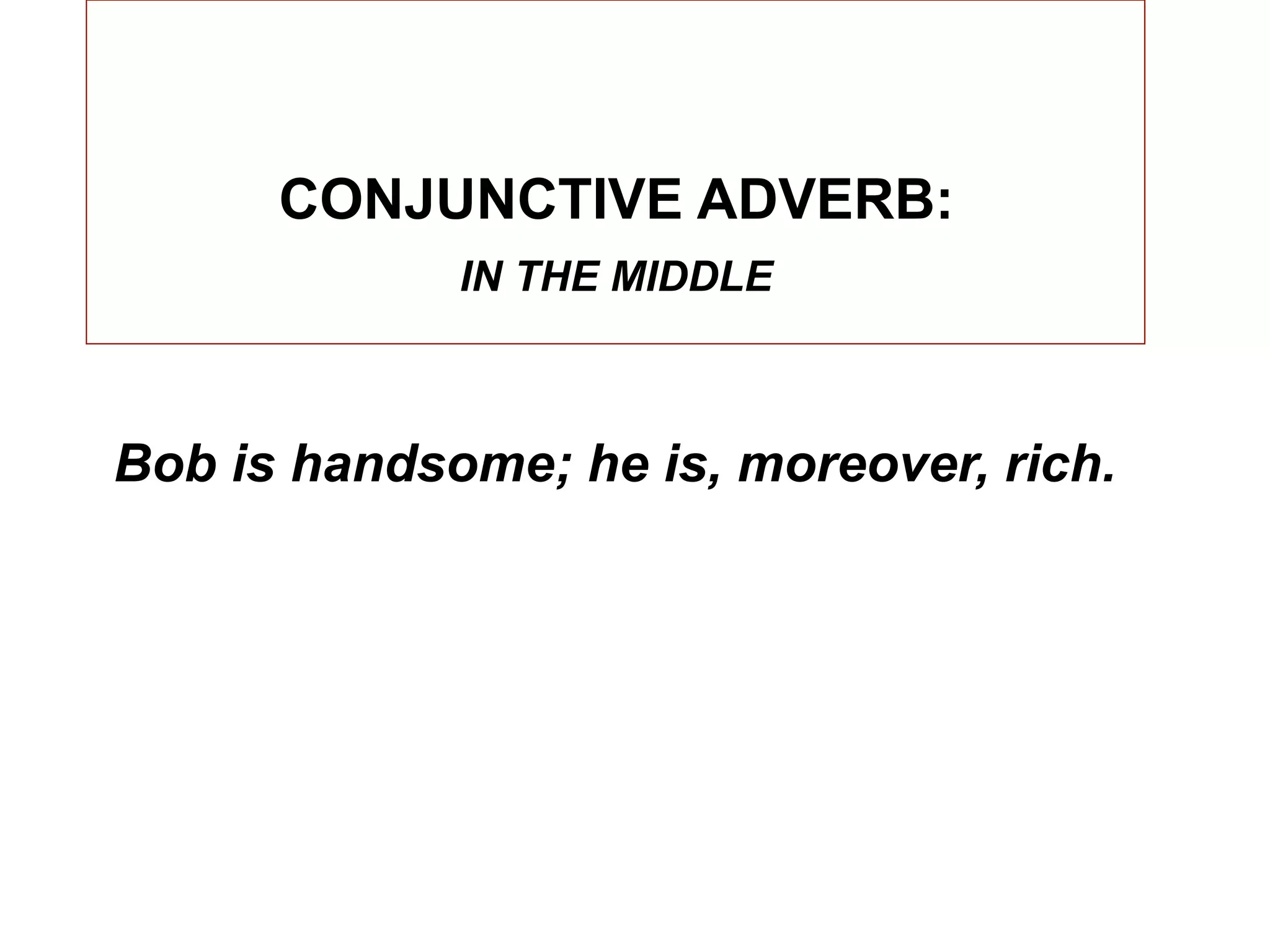
CONJUNCTIVE ADVERB:
             IN THE MIDDLE


Bob is handsome; he is, moreover, rich.
CONJUNCTIVE ADVERB:
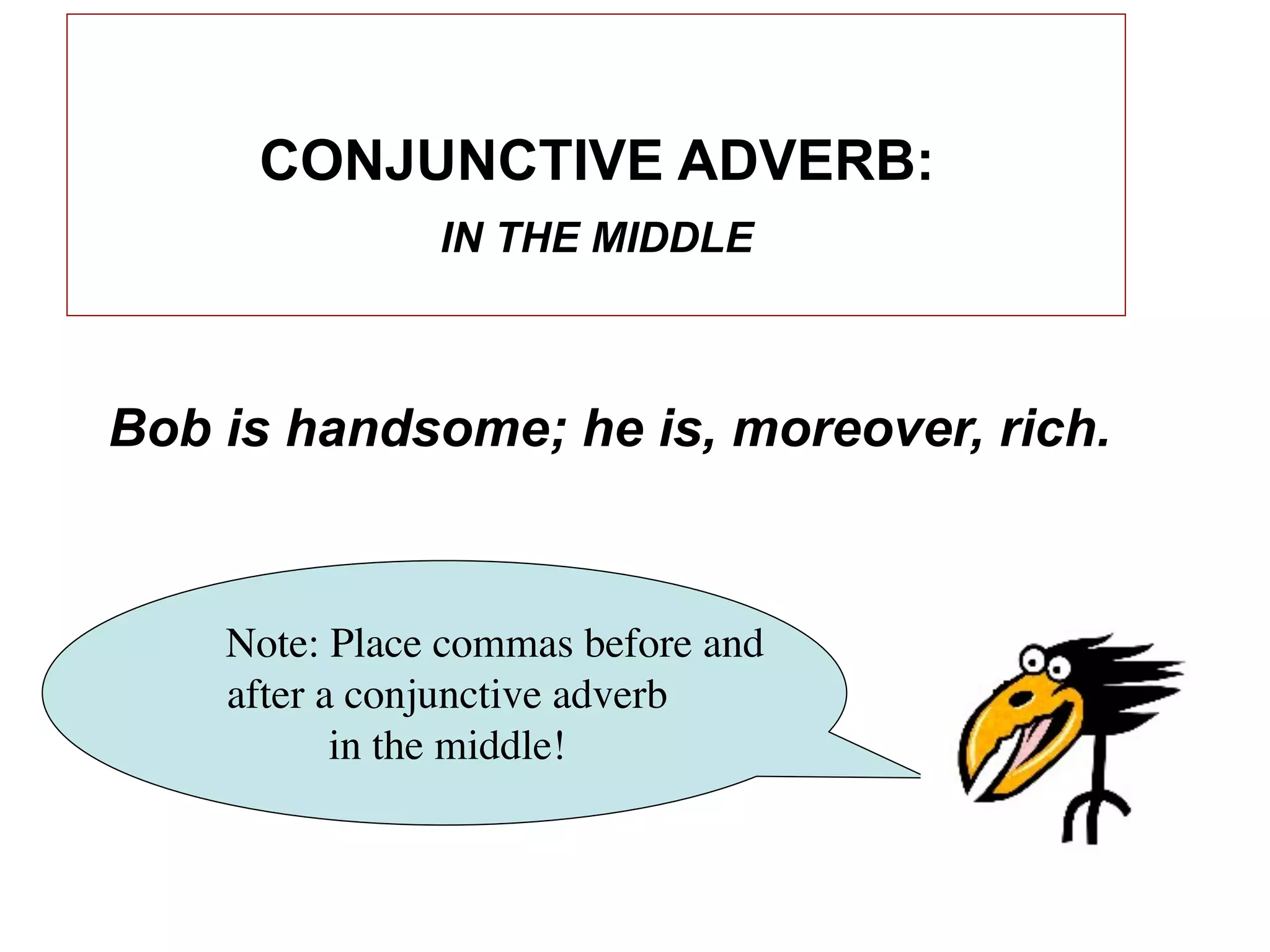
               IN THE MIDDLE


Bob is handsome; he is, moreover, rich.


    Note: Place commas before and
    after a conjunctive adverb
           in the middle!
CONJUNCTIVE ADVERB:
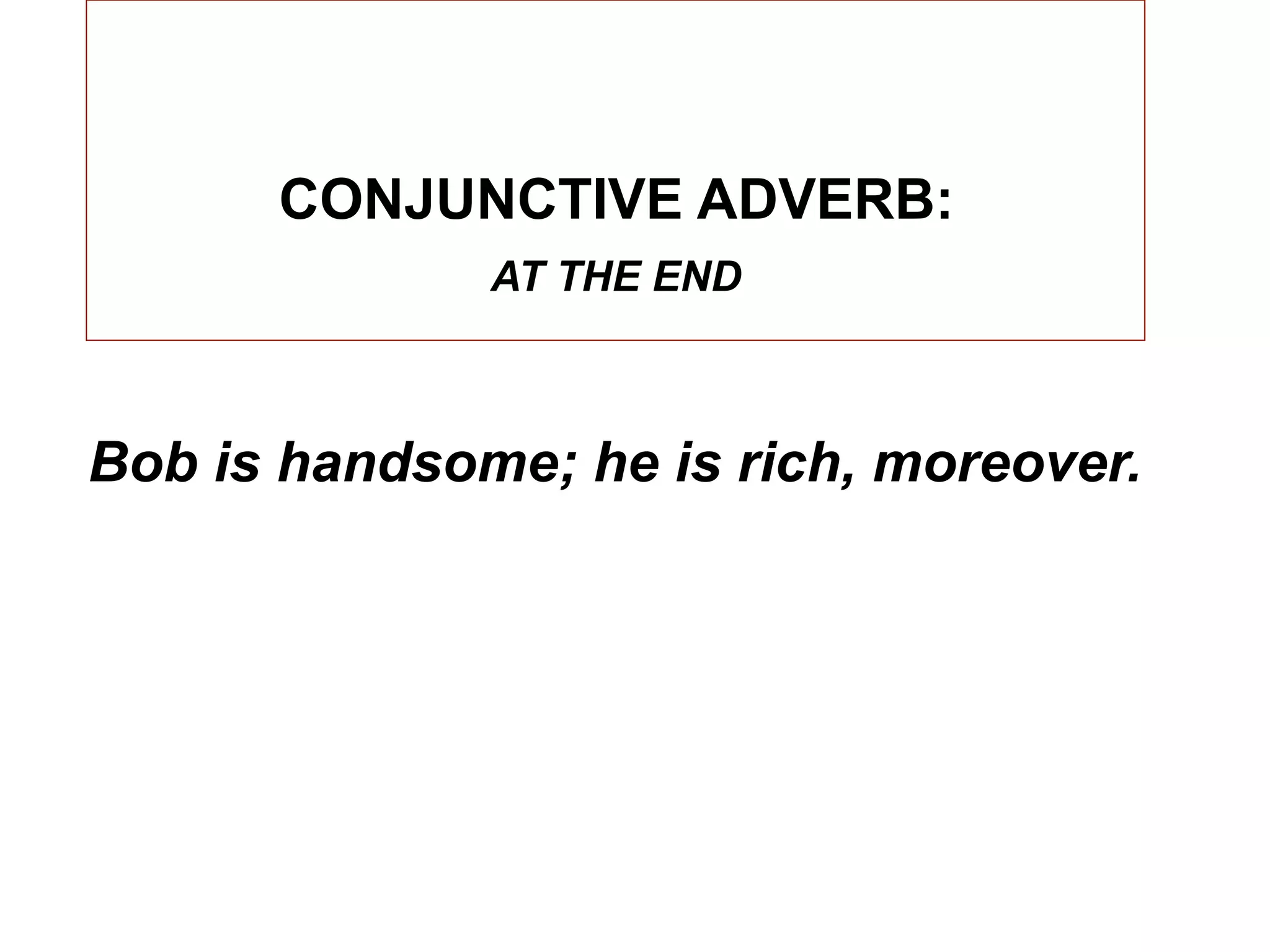
              AT THE END


Bob is handsome; he is rich, moreover.
CONJUNCTIVE ADVERB:
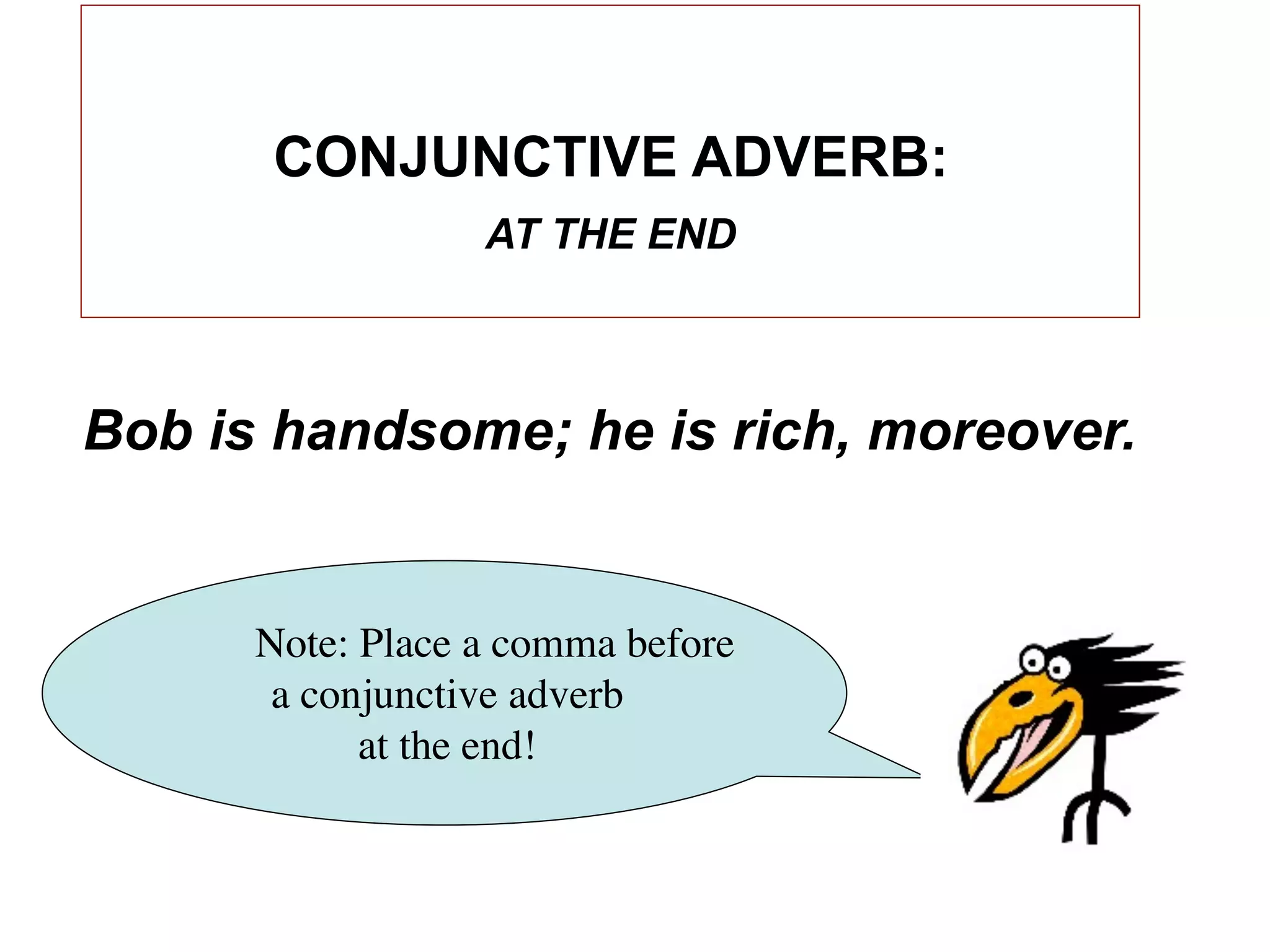
                  AT THE END


Bob is handsome; he is rich, moreover.


      Note: Place a comma before
       a conjunctive adverb
            at the end!
Semicolons

• “If the relation between the ideas
  expressed in the main clauses is
  very close and obvious without a
  conjunction, you can separate the
  clauses with a semicolon” (Little,
  Brown Handbook, 9th Edition, p.
  361).
COMPOUND SENTENCE:
            SEMICOLON


Matt has benefited from his exercise
 program; he is slim and energetic.
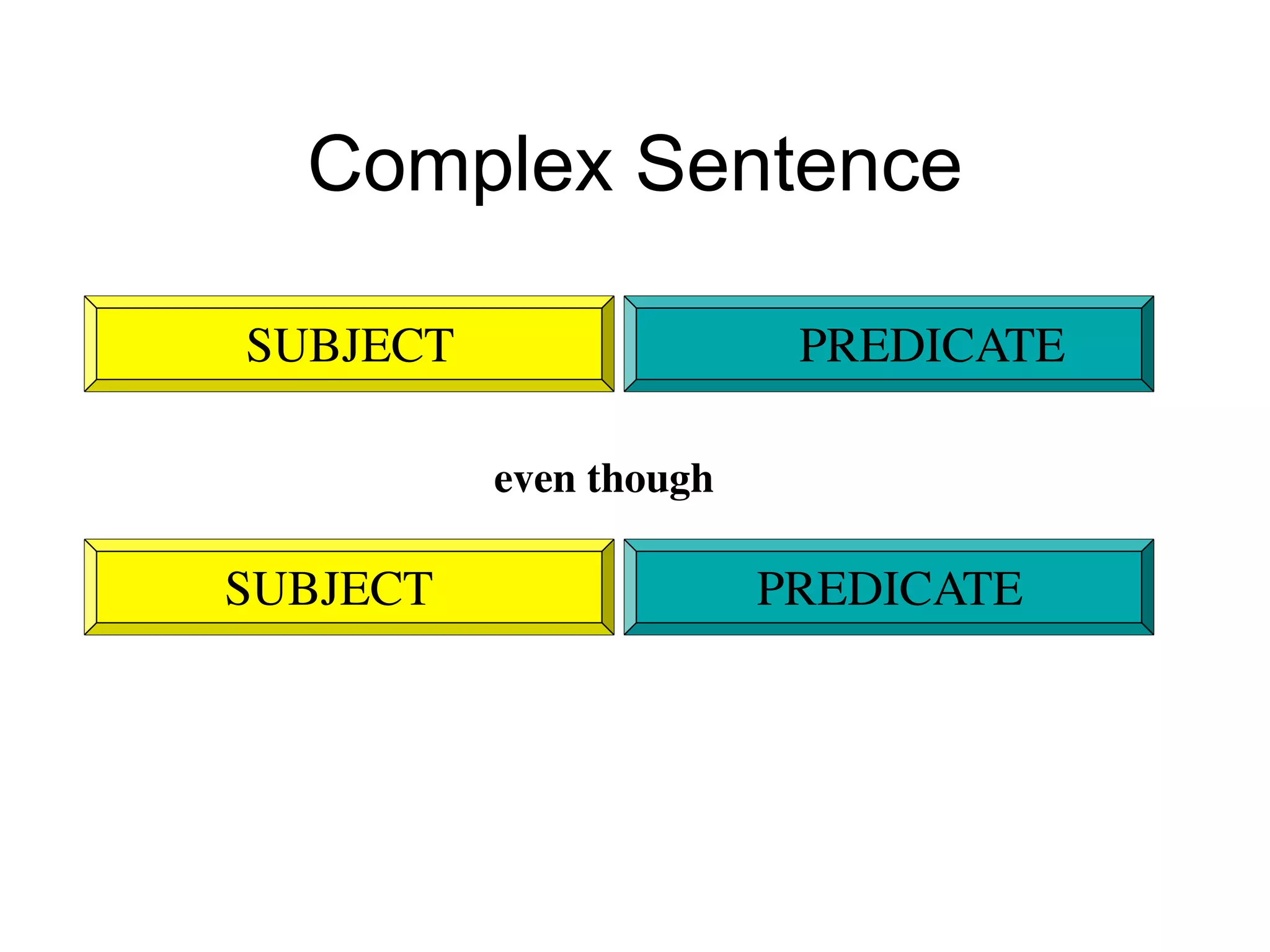
Complex Sentence

SUBJECT                  PREDICATE

          even though

SUBJECT                 PREDICATE
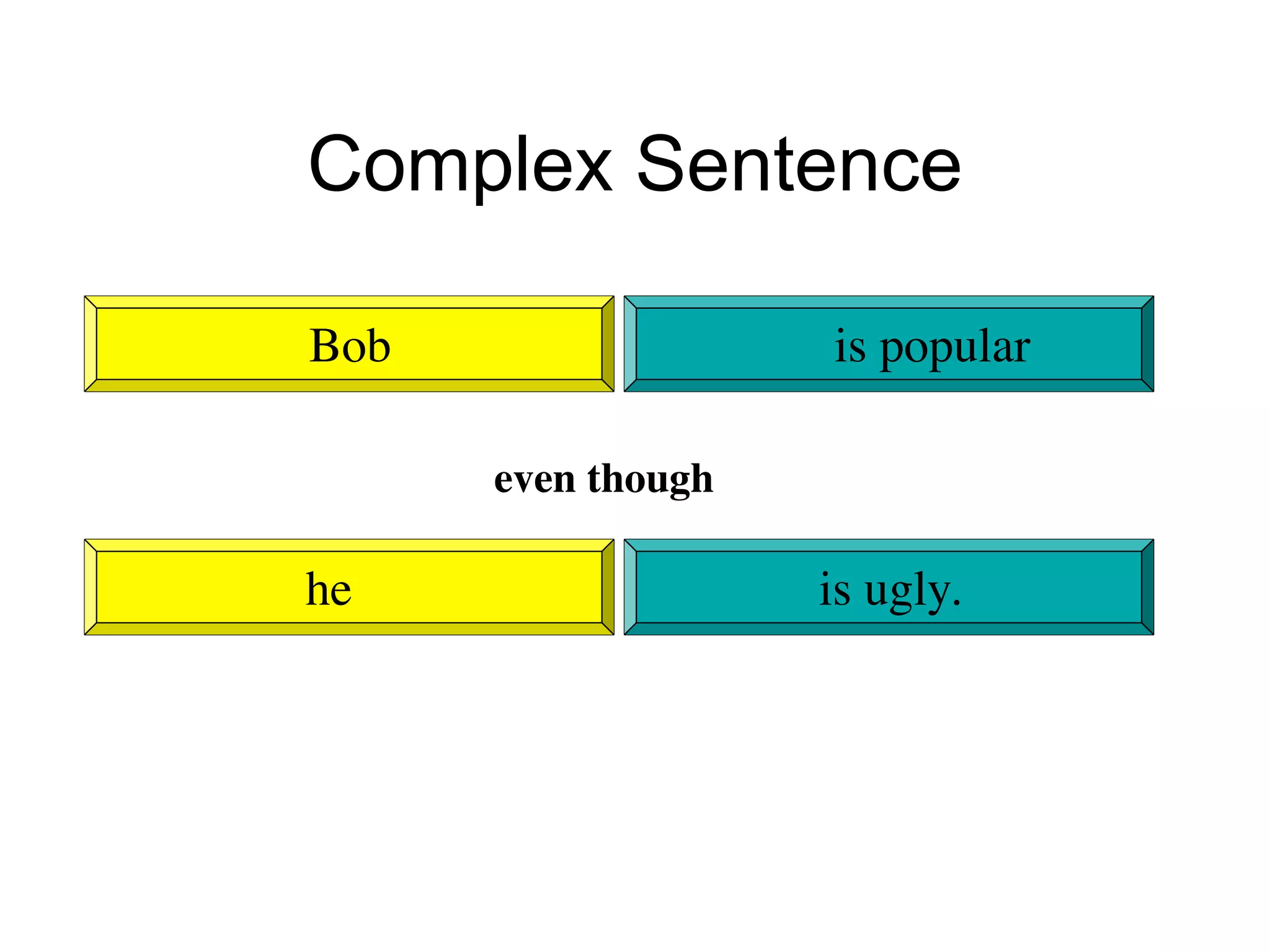
Complex Sentence

Bob                 is popular

      even though

he                  is ugly.
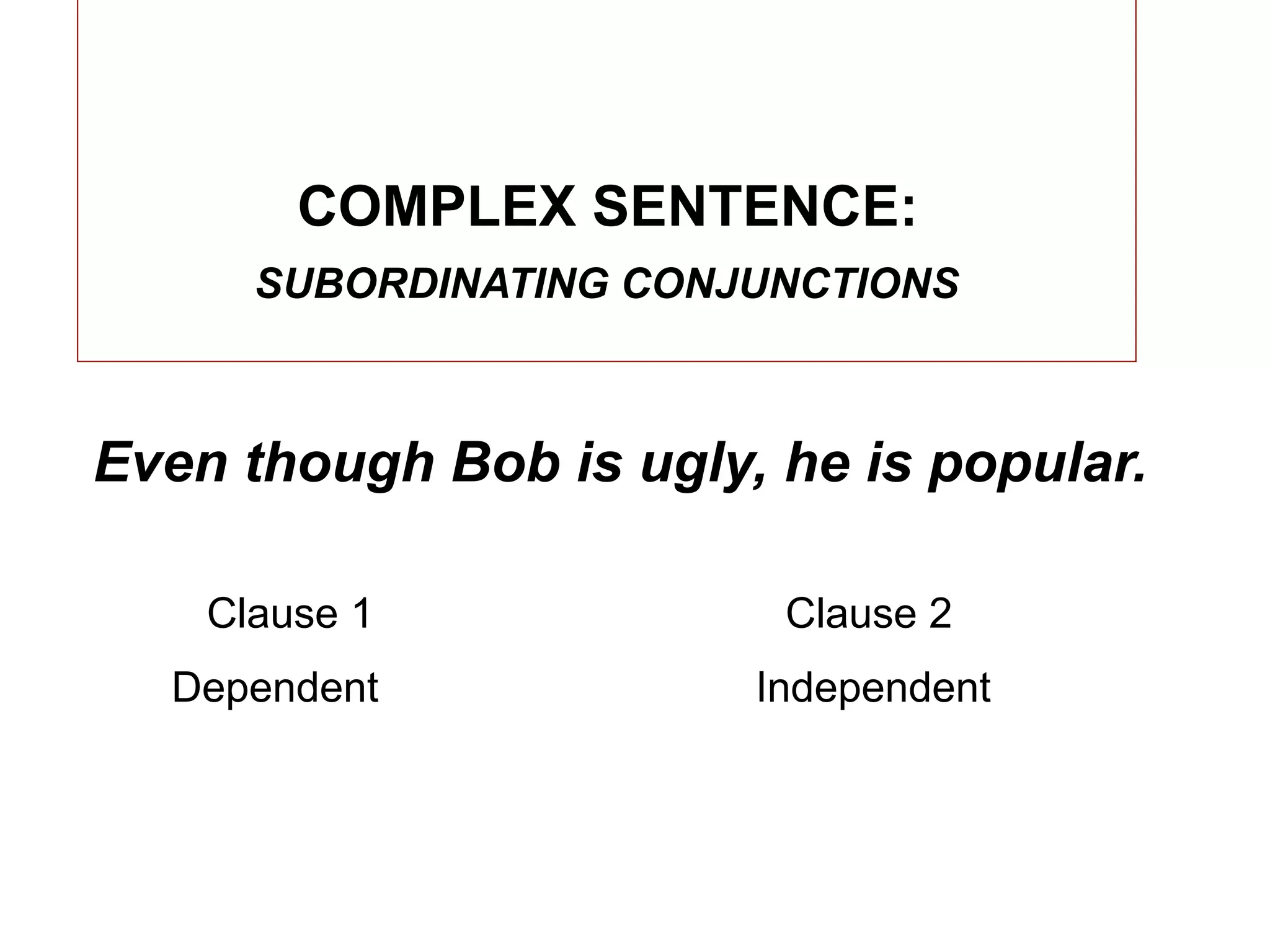
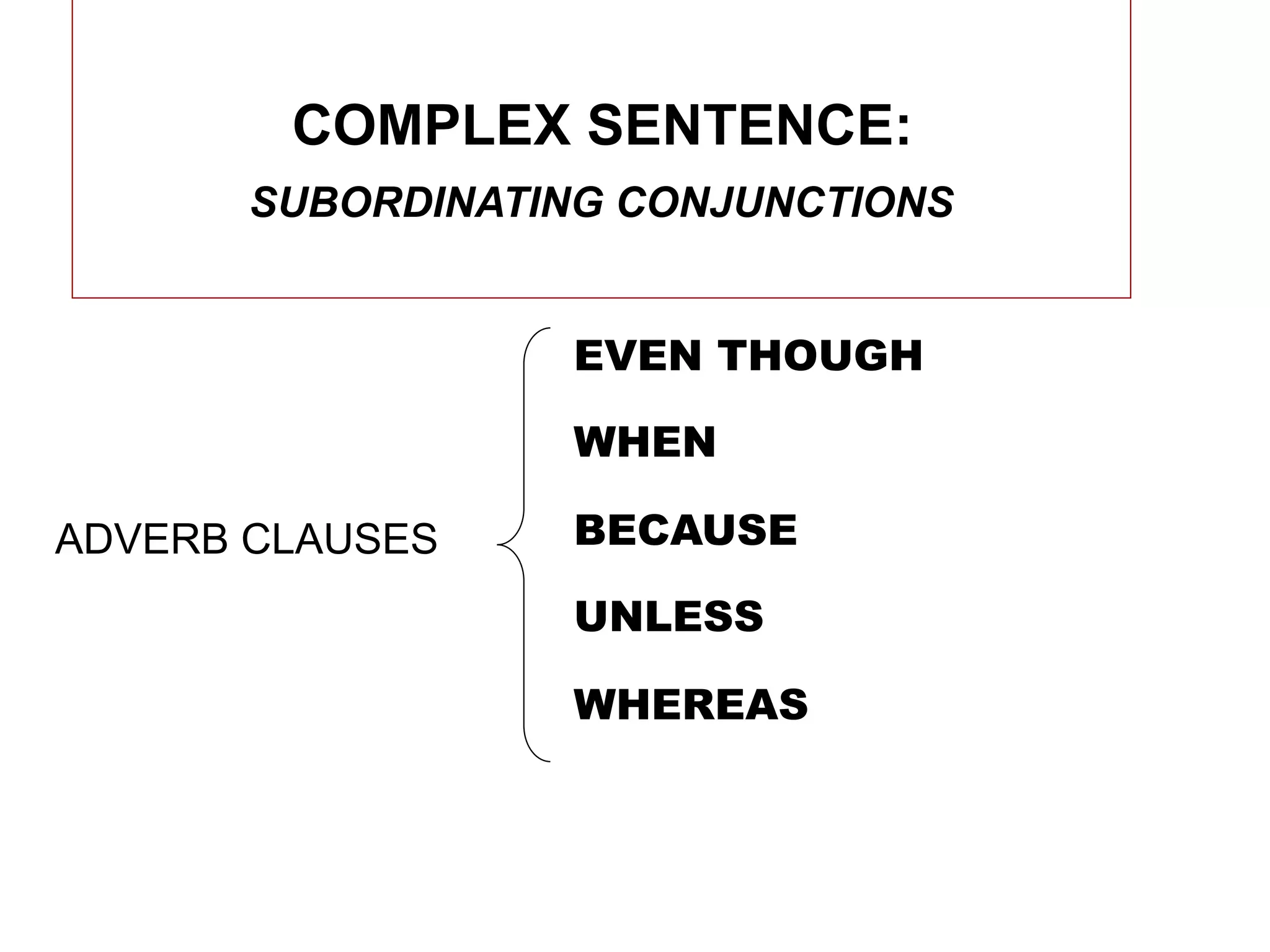
COMPLEX SENTENCE:
       SUBORDINATING CONJUNCTIONS


                  EVEN THOUGH

                  WHEN

ADVERB CLAUSES    BECAUSE

                  UNLESS

                  WHEREAS
COMPLEX SENTENCE:
       SUBORDINATING CONJUNCTIONS


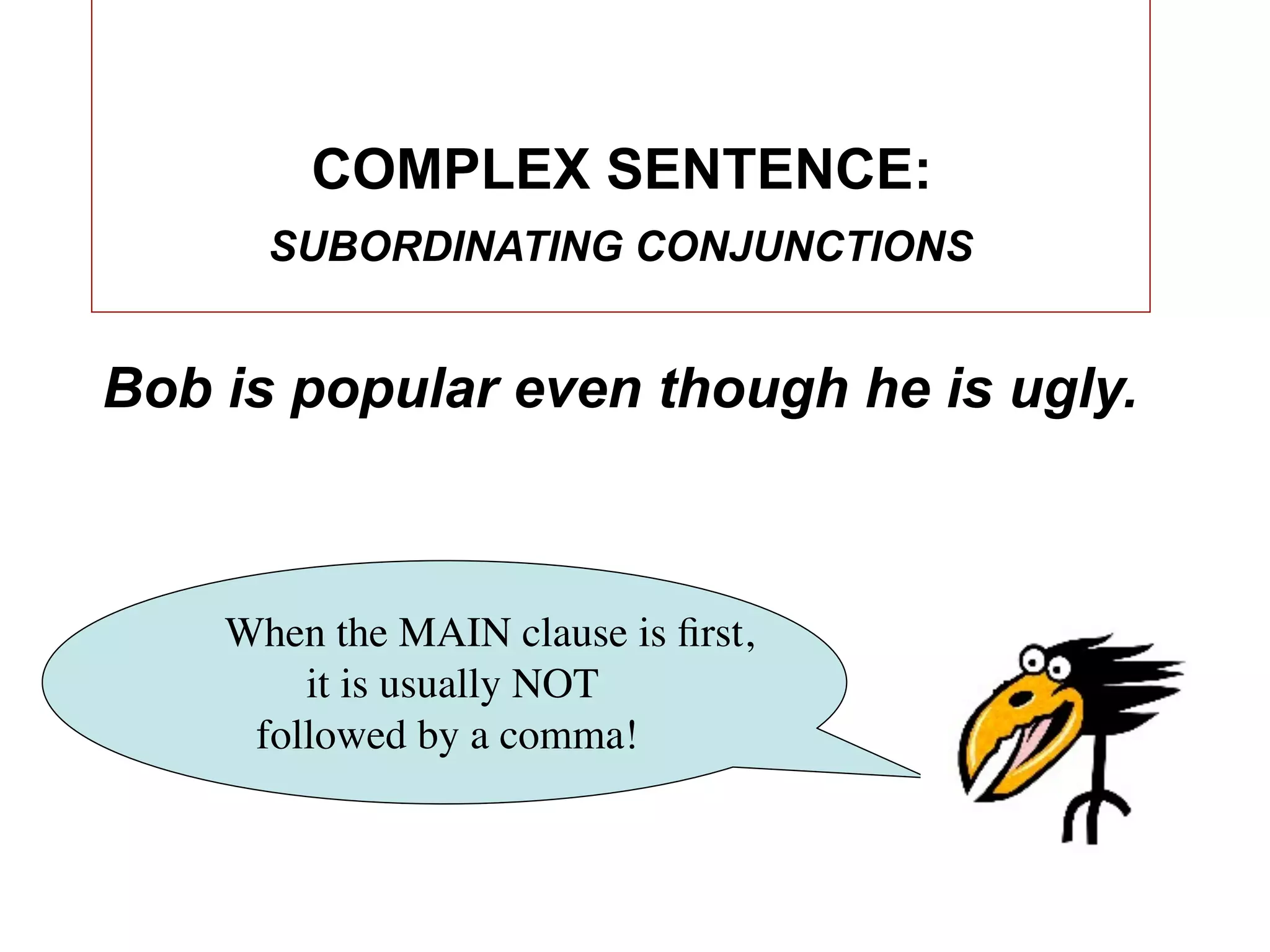
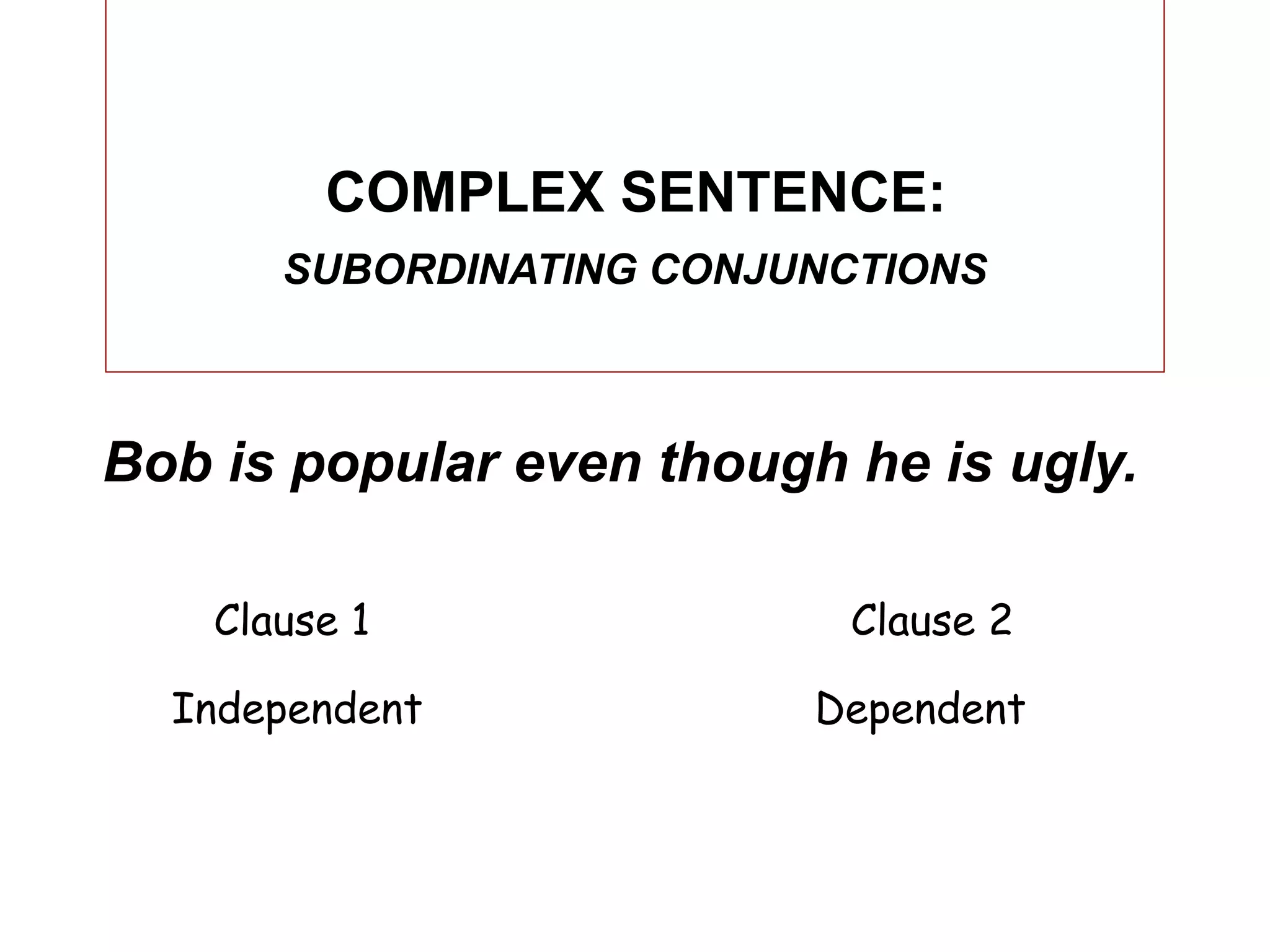
Bob is popular even though he is ugly.

    Clause 1               Clause 2

  Independent             Dependent
COMPLEX SENTENCE:
      SUBORDINATING CONJUNCTIONS


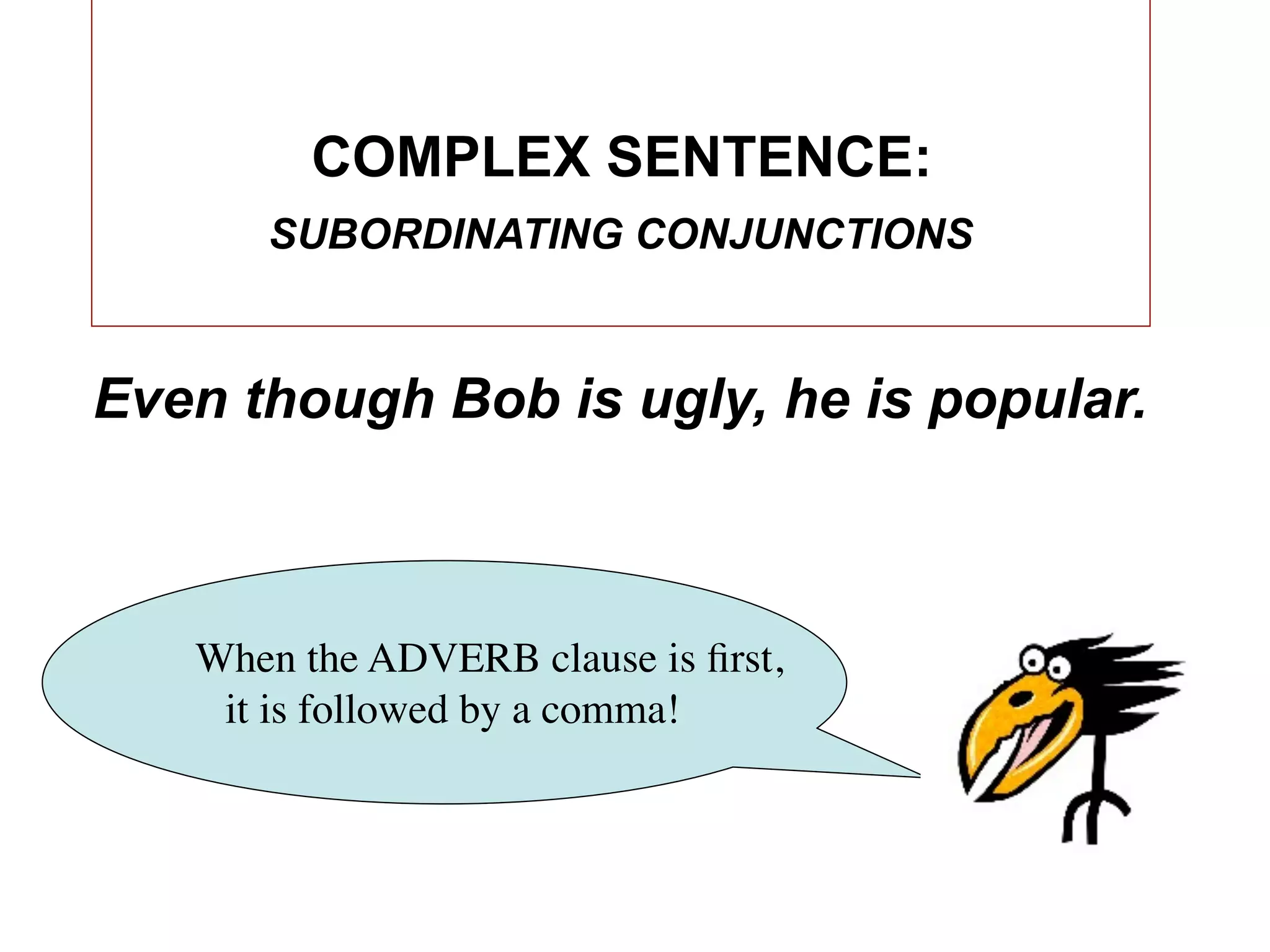
Even though Bob is ugly, he is popular.

    Clause 1             Clause 2
  Dependent             Independent
COMPLEX SENTENCE:
      SUBORDINATING CONJUNCTIONS


Bob is popular even though he is ugly.


    When the MAIN clause is first,
        it is usually NOT
     followed by a comma!
COMPLEX SENTENCE:
      SUBORDINATING CONJUNCTIONS


Even though Bob is ugly, he is popular.


   When the ADVERB clause is first,
    it is followed by a comma!
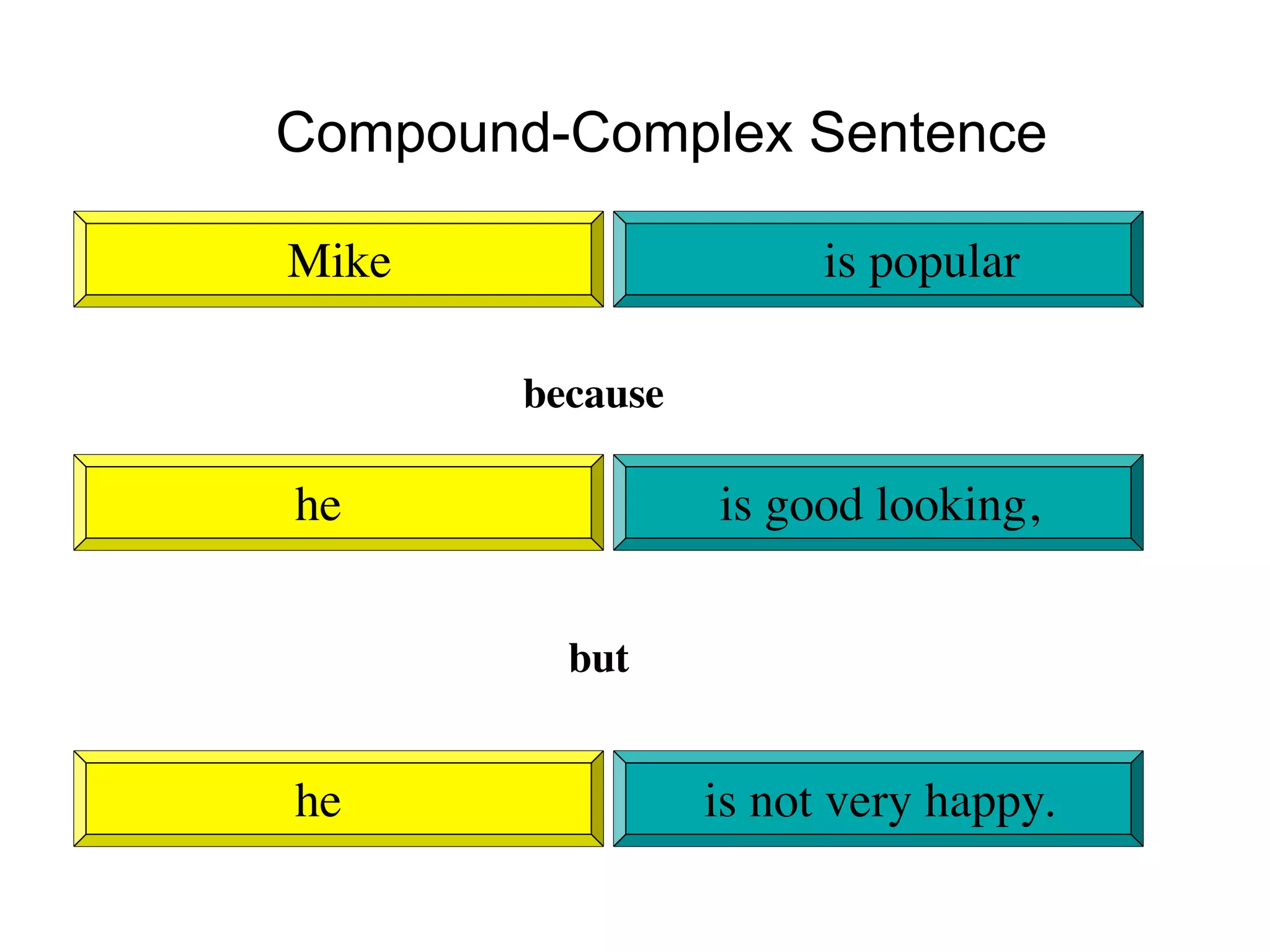
Compound-Complex Sentence

Mike                    is popular

        because

he                is good looking,


          but


he                is not very happy.
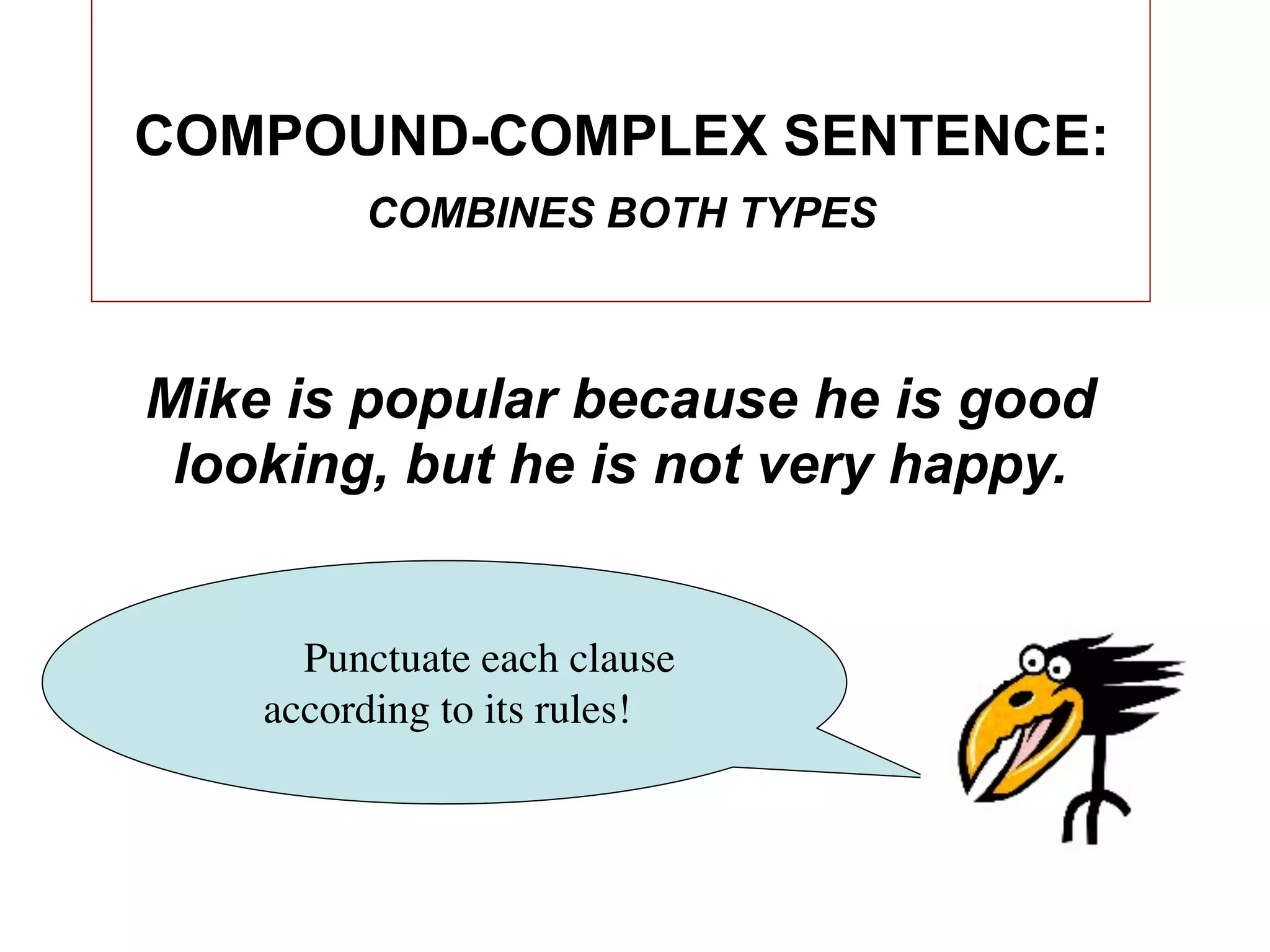
COMPOUND-COMPLEX SENTENCE:
         COMBINES BOTH TYPES


Mike is popular because he is good
 looking, but he is not very happy.


      Punctuate each clause
    according to its rules!
Punctuation
Review!
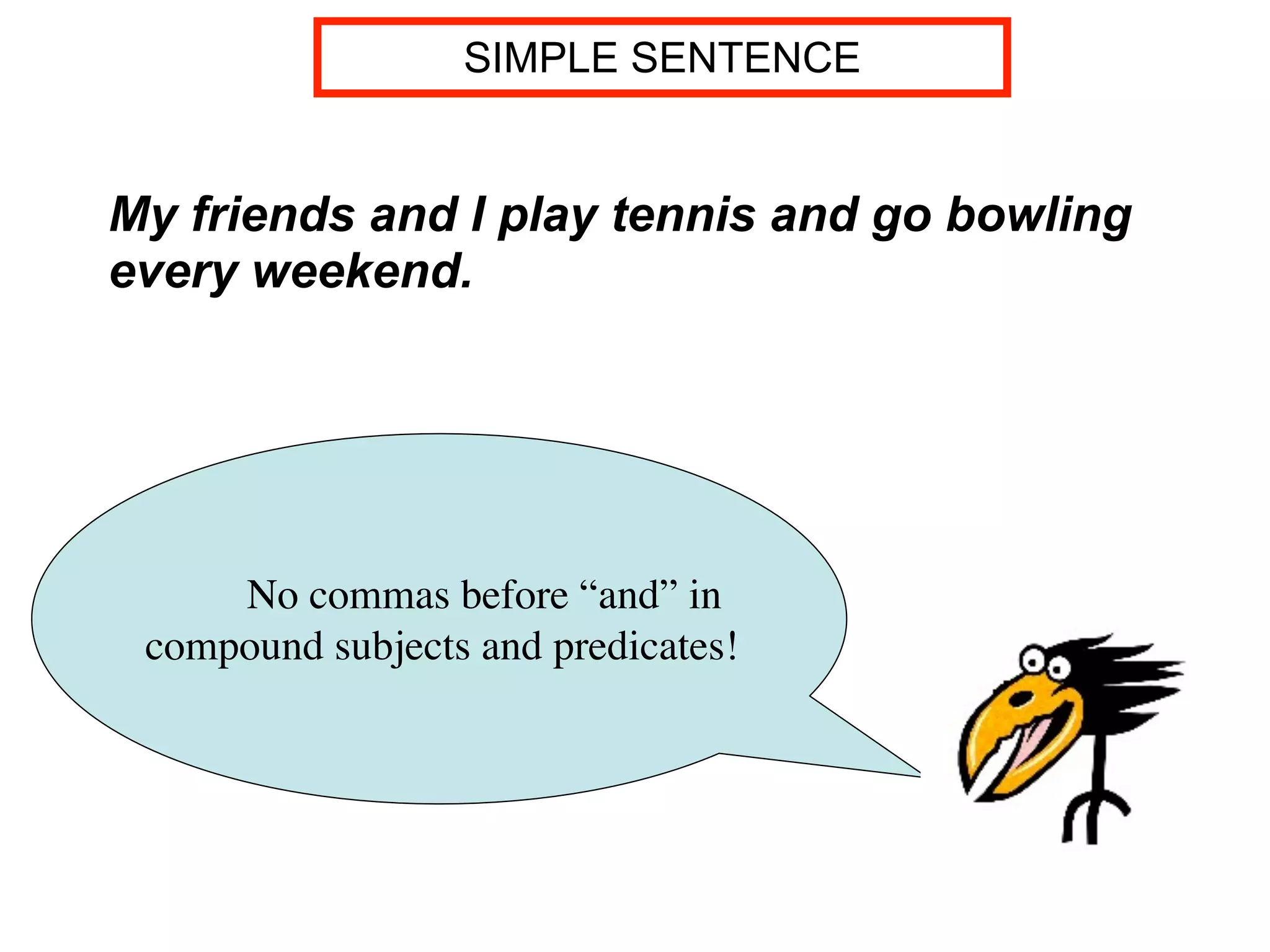
SIMPLE SENTENCE


My friends and I play tennis and go bowling
every weekend.


     No commas before “and” in
 compound subjects and predicates!
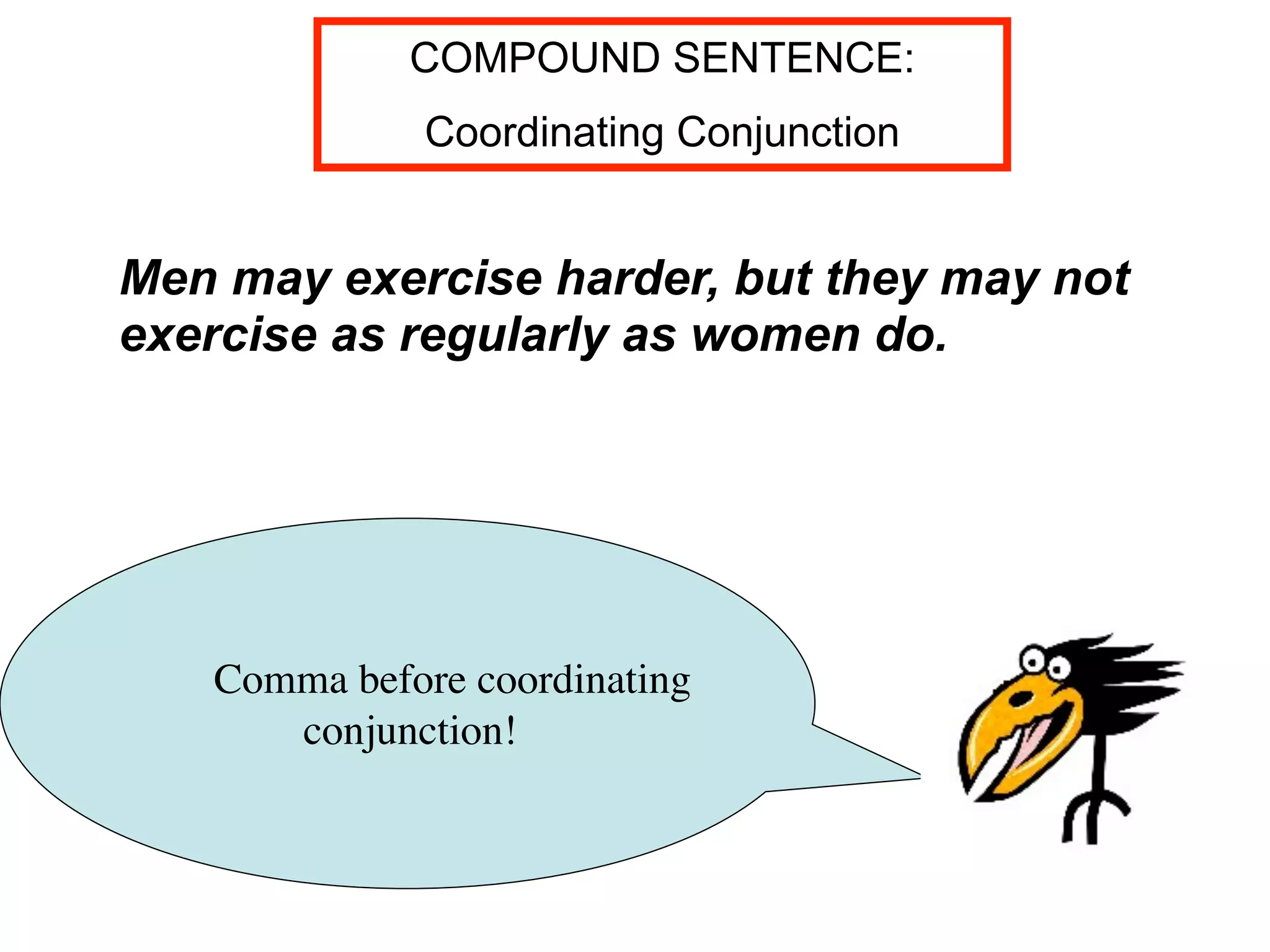
COMPOUND SENTENCE:
              Coordinating Conjunction


Men may exercise harder, but they may not
exercise as regularly as women do.


   Comma before coordinating
      conjunction!
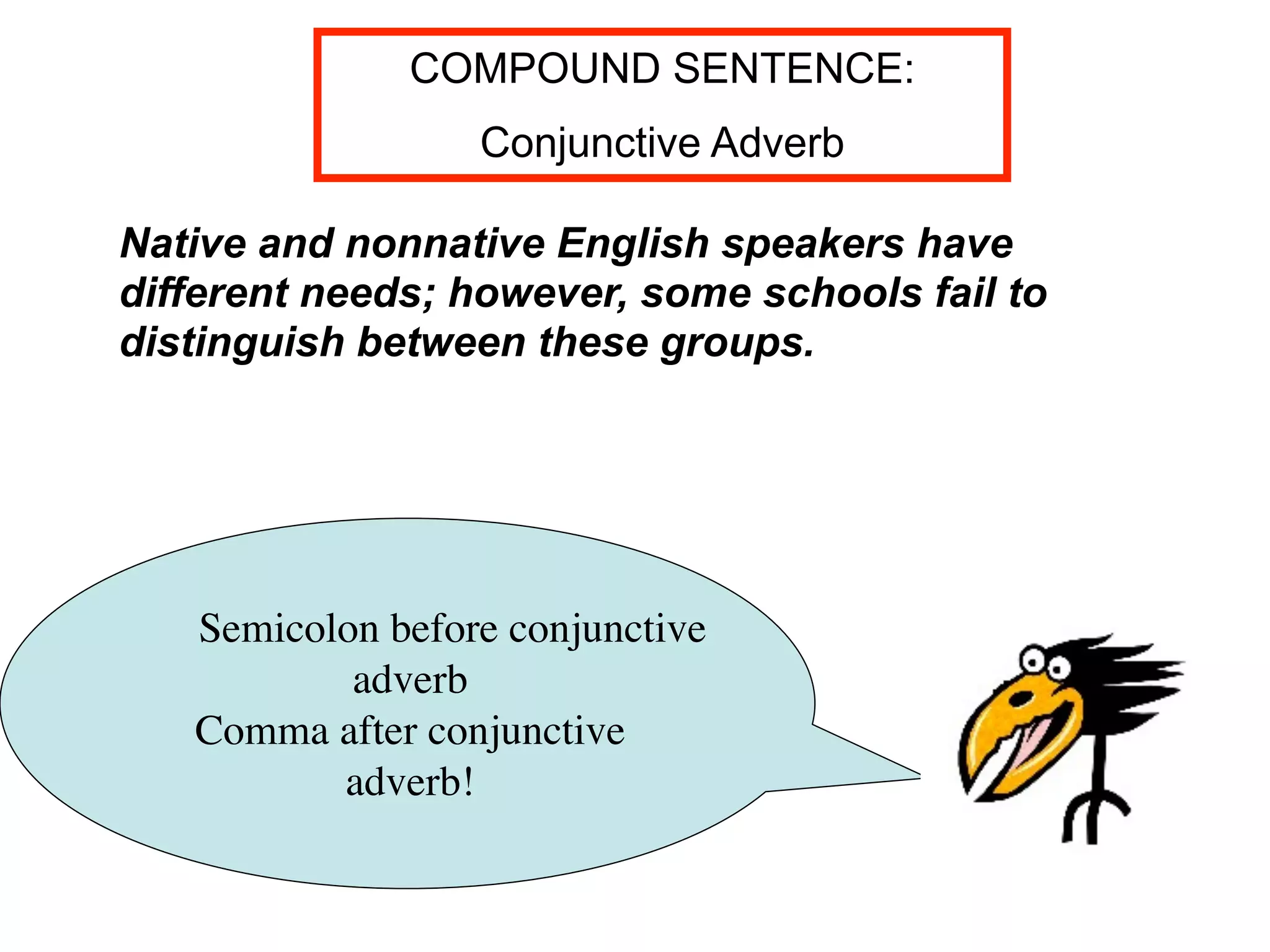
COMPOUND SENTENCE:
                  Conjunctive Adverb

Native and nonnative English speakers have
different needs; however, some schools fail to
distinguish between these groups.


   Semicolon before conjunctive
           adverb
   Comma after conjunctive
          adverb!
COMPOUND SENTENCE:
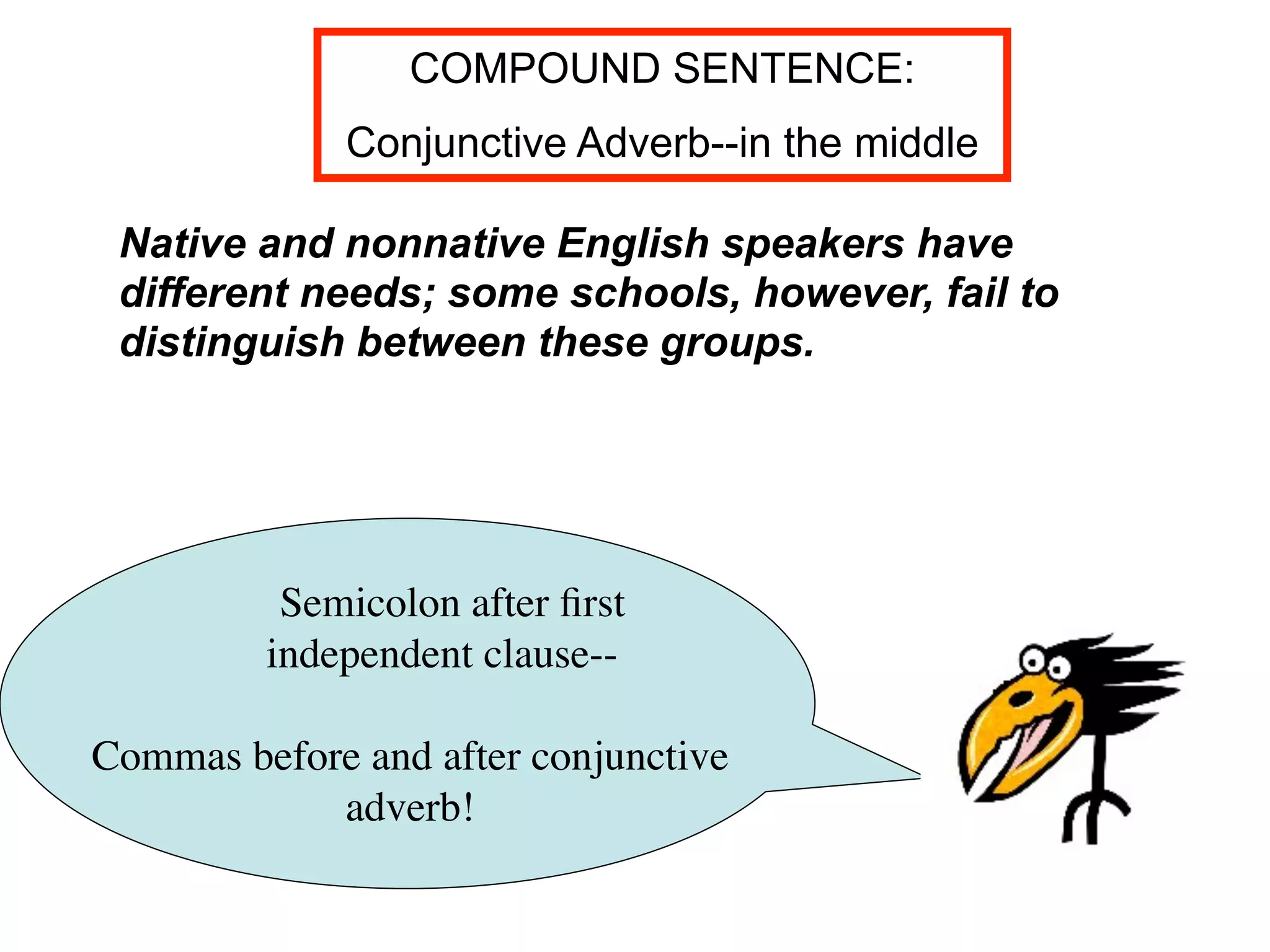
             Conjunctive Adverb--in the middle

 Native and nonnative English speakers have
 different needs; some schools, however, fail to
 distinguish between these groups.


          Semicolon after first
         independent clause--

Commas before and after conjunctive
            adverb!
COMPOUND SENTENCE:
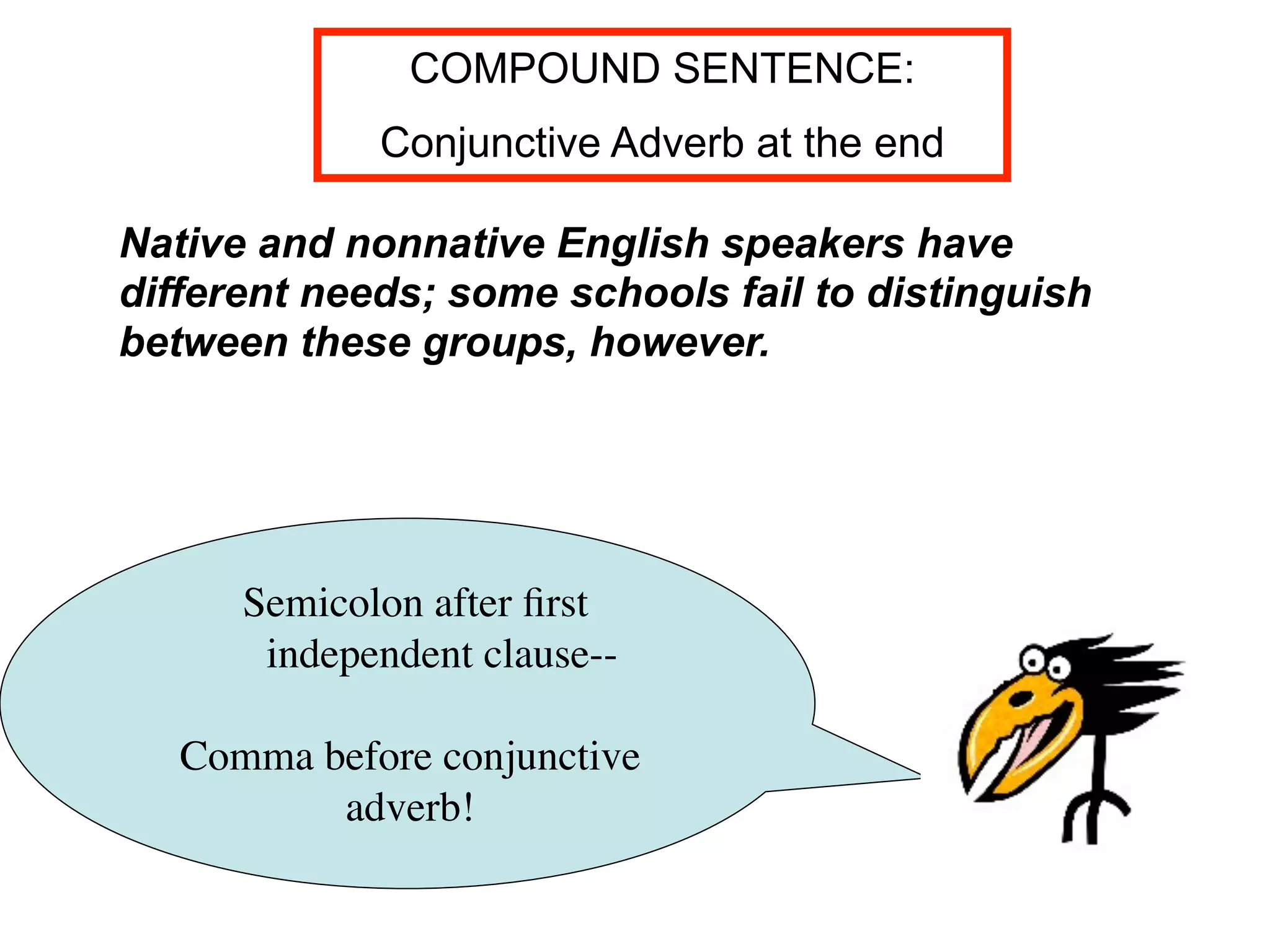
             Conjunctive Adverb at the end

Native and nonnative English speakers have
different needs; some schools fail to distinguish
between these groups, however.


      Semicolon after first
       independent clause--

   Comma before conjunctive
          adverb!
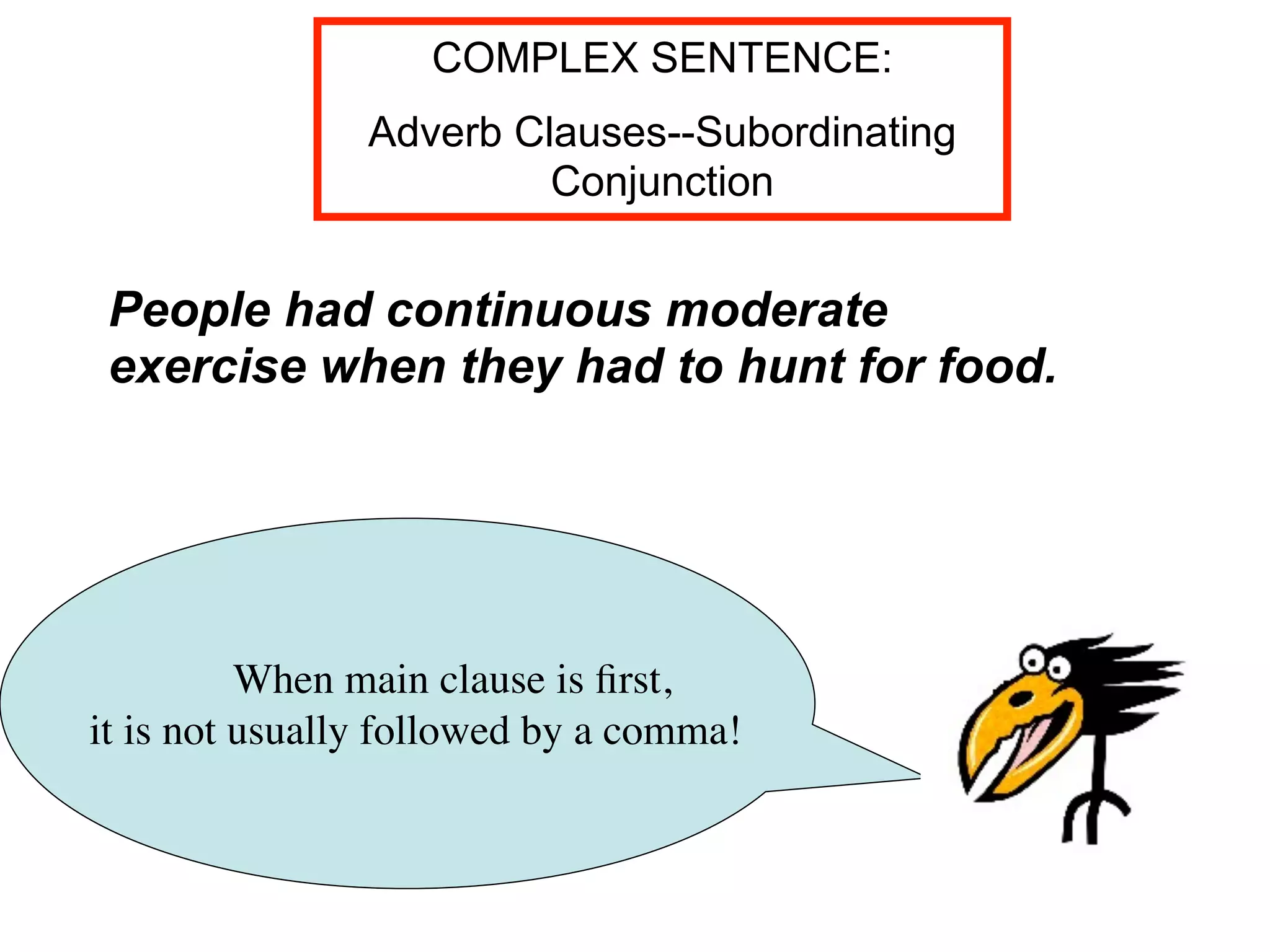
COMPLEX SENTENCE:
                Adverb Clauses--Subordinating
                         Conjunction


 People had continuous moderate
 exercise when they had to hunt for food.


          When main clause is first,
it is not usually followed by a comma!
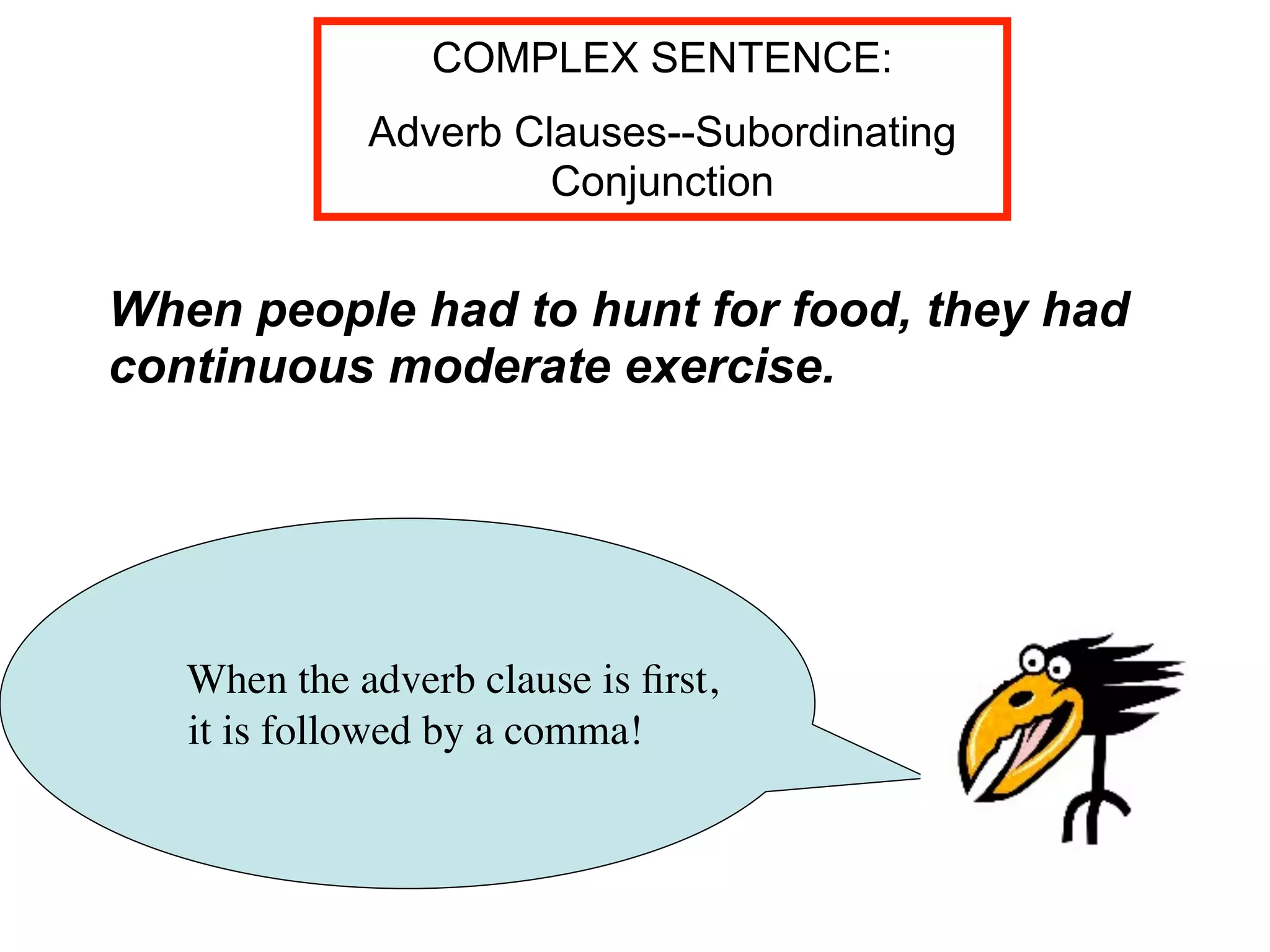
COMPLEX SENTENCE:
             Adverb Clauses--Subordinating
                      Conjunction


When people had to hunt for food, they had
continuous moderate exercise.


   When the adverb clause is first,
   it is followed by a comma!
References
Writing Academic English, Second Edition, by Alice
Oshima and Ann Hogue. White Plains: Addison, Wesley,
Longman, 1999.
The Little, Brown Handbook, by H. Ramsey Fowler and
Jane E. Aaron, Pearson, 2004.

Sentence types

  • 1.
    FRIDAY, September 7,2012 Bellringer: Please answer in your journal: 1. Journal Prompt (min 3 sentences) -What is the best advice you ever received? 2. What are the four basic kinds of sentences?
  • 2.
    Kinds of Sentences ©Brent Coley 2008 | www.mrcoley.com
  • 3.
    There are four differentkinds of sentences.
  • 4.
    Declarative Sentence A declarativesentence makes a statement. It ends with a period. He likes pepperoni pizza. The umbrella is green. Mrs. Smith is a teacher.
  • 5.
    Interrogative Sentence An interrogativesentence asks a question. It ends with a question mark. Do you like pepperoni pizza? Have you seen my umbrella? Who is your teacher?
  • 6.
    Exclamatory Sentence An exclamatorysentence shows strong feeling. It ends with an exclamation point. Hooray! Wow! That’s great news!
  • 7.
    Imperative Sentence An imperativesentence gives a command. It ends with a period. Go to your room. Throw me the ball. Bob, please close the door.
  • 8.
    Sentence Structure Sentence Types
  • 10.
    Sentence Types •Simple • Compound • Complex
  • 11.
    Basic Elements of Every Sentence SUBJECT PREDICATE
  • 12.
    Basic Elements SUBJECT PREDICATE Mary plays tennis.
  • 13.
    SIMPLE SENTENCE SUBJECT PREDICATE Mary plays tennis. one subject one predicate
  • 14.
    Simple Sentence Tomand Mary play tennis. Compound Subject &
  • 15.
    Simple Sentence Tom andMary play tennis and swim. Compound Subject Compound Predicate & &
  • 16.
    SIMPLE SENTENCE with compound subject Tom and Mary play tennis.
  • 17.
    SIMPLE SENTENCE with compound subject and compound predicate Tom and Mary play tennis and swim.
  • 18.
  • 19.
    SIMPLE SENTENCE with compound subject and compound predicate Tom and Mary play tennis and swim. No comma before “and” in compound subjects and predicates!
  • 20.
    Compound Sentence with CoordinatingConjunctions SUBJECT PREDICATE and SUBJECT PREDICATE
  • 21.
    Compound Sentence Tom swims, and Mary plays tennis.
  • 22.
  • 23.
    COMPOUND SENTENCE: COORDINATING CONJUNCTIONS Tom swims, and Mary plays tennis. Clause 1 Clause 2 Independent Independent
  • 24.
    COMPOUND SENTENCE: COORDINATING CONJUNCTIONS Tom swims, and Mary plays tennis. Comma before “and” in compound sentences!
  • 25.
    COMPOUND SENTENCE: CONJUNCTIVE ADVERBS MOREOVER HOWEVER OTHERWISE THEREFORE
  • 26.
    COMPOUND SENTENCE: CONJUNCTIVE ADVERBS Bob is handsome; moreover, he is rich. Clause 1 Clause 2 Independent Independent
  • 27.
    COMPOUND SENTENCE: CONJUNCTIVE ADVERBS Bob is handsome; moreover, he is rich. Note: Semicolon before conjunctive adverb and comma after conjunctive adverb!
  • 28.
    Conjunctive Adverbs “float” •Conjunctive adverbs are sometimes called “floating” adverbs because they can be positioned at the beginning, in the middle, or at the end of a clause.
  • 29.
    CONJUNCTIVE ADVERB: AT THE BEGINNING Bob is handsome; moreover, he is rich.
  • 30.
    CONJUNCTIVE ADVERB: IN THE MIDDLE Bob is handsome; he is, moreover, rich.
  • 31.
    CONJUNCTIVE ADVERB: IN THE MIDDLE Bob is handsome; he is, moreover, rich. Note: Place commas before and after a conjunctive adverb in the middle!
  • 32.
    CONJUNCTIVE ADVERB: AT THE END Bob is handsome; he is rich, moreover.
  • 33.
    CONJUNCTIVE ADVERB: AT THE END Bob is handsome; he is rich, moreover. Note: Place a comma before a conjunctive adverb at the end!
  • 34.
    Semicolons • “If therelation between the ideas expressed in the main clauses is very close and obvious without a conjunction, you can separate the clauses with a semicolon” (Little, Brown Handbook, 9th Edition, p. 361).
  • 35.
    COMPOUND SENTENCE: SEMICOLON Matt has benefited from his exercise program; he is slim and energetic.
  • 36.
    Complex Sentence SUBJECT PREDICATE even though SUBJECT PREDICATE
  • 37.
    Complex Sentence Bob is popular even though he is ugly.
  • 38.
    COMPLEX SENTENCE: SUBORDINATING CONJUNCTIONS EVEN THOUGH WHEN ADVERB CLAUSES BECAUSE UNLESS WHEREAS
  • 39.
    COMPLEX SENTENCE: SUBORDINATING CONJUNCTIONS Bob is popular even though he is ugly. Clause 1 Clause 2 Independent Dependent
  • 40.
    COMPLEX SENTENCE: SUBORDINATING CONJUNCTIONS Even though Bob is ugly, he is popular. Clause 1 Clause 2 Dependent Independent
  • 41.
    COMPLEX SENTENCE: SUBORDINATING CONJUNCTIONS Bob is popular even though he is ugly. When the MAIN clause is first, it is usually NOT followed by a comma!
  • 42.
    COMPLEX SENTENCE: SUBORDINATING CONJUNCTIONS Even though Bob is ugly, he is popular. When the ADVERB clause is first, it is followed by a comma!
  • 43.
    Compound-Complex Sentence Mike is popular because he is good looking, but he is not very happy.
  • 44.
    COMPOUND-COMPLEX SENTENCE: COMBINES BOTH TYPES Mike is popular because he is good looking, but he is not very happy. Punctuate each clause according to its rules!
  • 45.
  • 46.
    SIMPLE SENTENCE My friendsand I play tennis and go bowling every weekend. No commas before “and” in compound subjects and predicates!
  • 47.
    COMPOUND SENTENCE: Coordinating Conjunction Men may exercise harder, but they may not exercise as regularly as women do. Comma before coordinating conjunction!
  • 48.
    COMPOUND SENTENCE: Conjunctive Adverb Native and nonnative English speakers have different needs; however, some schools fail to distinguish between these groups. Semicolon before conjunctive adverb Comma after conjunctive adverb!
  • 49.
    COMPOUND SENTENCE: Conjunctive Adverb--in the middle Native and nonnative English speakers have different needs; some schools, however, fail to distinguish between these groups. Semicolon after first independent clause-- Commas before and after conjunctive adverb!
  • 50.
    COMPOUND SENTENCE: Conjunctive Adverb at the end Native and nonnative English speakers have different needs; some schools fail to distinguish between these groups, however. Semicolon after first independent clause-- Comma before conjunctive adverb!
  • 51.
    COMPLEX SENTENCE: Adverb Clauses--Subordinating Conjunction People had continuous moderate exercise when they had to hunt for food. When main clause is first, it is not usually followed by a comma!
  • 52.
    COMPLEX SENTENCE: Adverb Clauses--Subordinating Conjunction When people had to hunt for food, they had continuous moderate exercise. When the adverb clause is first, it is followed by a comma!
  • 53.
    References Writing Academic English,Second Edition, by Alice Oshima and Ann Hogue. White Plains: Addison, Wesley, Longman, 1999. The Little, Brown Handbook, by H. Ramsey Fowler and Jane E. Aaron, Pearson, 2004.