Early Cognitive Foundations:
Sensation, Perception, and Learning
Early Controversies about Sensory
and Perceptual Development
 Nature vs. nurture
 Nativist philosophers argue that many basic perceptual
abilities are innate.
 Empiricist philosophers believed infants are born tabula
rasa (blank slate) and must learn to interpret sensations.
 Enrichment vs. differentiation
 Enrichment theory claims that sensory stimulation is often
fragmented or confusing.
 Differentiation theory argues that sensory stimulation
provides all we need to interpret our experiences.
"Making Sense" of the Infant's Sensory
and Perceptual Experiences
 The preference method
 Two stimuli are presented simultaneously to see whether
infants will attend more to one of them than the other.
 The habituation method
 Most popular strategy for measuring infant sensory and
perceptual capabilities
 Infants habituate and dishabituate to many different kinds
of stimulation
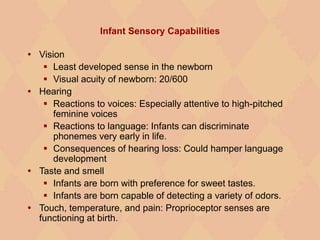
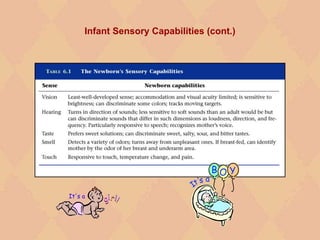
Infant Sensory Capabilities
 Vision
 Least developed sense in the newborn
 Visual acuity of newborn: 20/600
 Hearing
 Reactions to voices: Especially attentive to high-pitched
feminine voices
 Reactions to language: Infants can discriminate
phonemes very early in life.
 Consequences of hearing loss: Could hamper language
development
 Taste and smell
 Infants are born with preference for sweet tastes.
 Infants are born capable of detecting a variety of odors.
 Touch, temperature, and pain: Proprioceptor senses are
functioning at birth.
Infant Sensory Capabilities (cont.)
Perception of Patterns and Forms in Infancy
 Early pattern perception (0 to 2 months)
 Prefer to look at whatever they can see well
 Later form perception (2 months to 1 year)
 Can use object movement to perceive form
 Explaining form perception
 Growth of form perception results from a continuous
interplay among baby's inborn equipment, biological
maturation, and visual experiences.
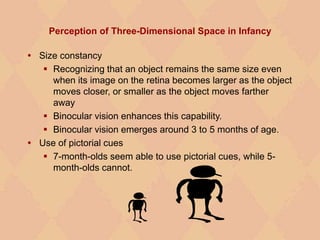
Perception of Three-Dimensional Space in Infancy
 Size constancy
 Recognizing that an object remains the same size even
when its image on the retina becomes larger as the object
moves closer, or smaller as the object moves farther
away
 Binocular vision enhances this capability.
 Binocular vision emerges around 3 to 5 months of age.
 Use of pictorial cues
 7-month-olds seem able to use pictorial cues, while 5-
month-olds cannot.
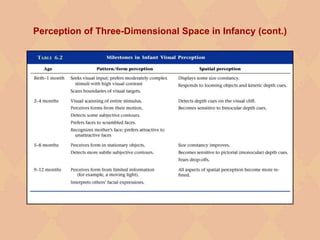
Perception of Three-Dimensional Space in Infancy (cont.)
 Development of depth perception
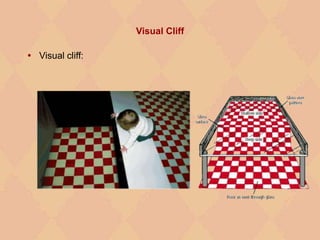
 Visual cliff experiment
 Infants detect a difference between the deep and
shallow sides.
 Motor development and depth perception
 Self-produced movement helps develop depth perception.
Visual Cliff
 Visual cliff:
Perception of Three-Dimensional Space in Infancy (cont.)
Intermodal Perception
 The senses are integrated at birth or shortly thereafter.
 Development of intermodal perception improves dramatically
over the first year of life.
 Explaining intermodal perception is difficult, but seems
consistent with the differentiation theory.
 Sensation and Perception Video
Infant Perception in Perspective—and a Look Ahead
 Perceptual learning in childhood: Gibson’s differentiation
theory
 Perceptual learning occurs when we actively explore and
detect distinctive features.
 Cultural influences on perception
 Subtle, but important effects
 Newborns are equipped to perceive "musicality" and to
discriminate good music from bad music.
 Humans learn not to hear certain phonemes if they are
not distinctive to the language spoken.
Infant Perception in Perspective—and a Look Ahead (cont.)
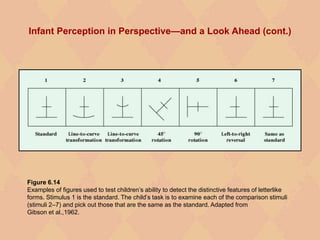
Figure 6.14
Examples of figures used to test children’s ability to detect the distinctive features of letterlike
forms. Stimulus 1 is the standard. The child’s task is to examine each of the comparison stimuli
(stimuli 2–7) and pick out those that are the same as the standard. Adapted from
Gibson et al.,1962.
Basic Learning Processes
 Individual now thinks, perceives, or reacts to the environment
in a new way
 Result of a person's experiences
 Change is relatively permanent.
Habituation: Early Evidence of
Information-Processing and Memory
 Process by which we stop attending or responding to a
stimulus repeated over and over
 Improves dramatically throughout the first year of life
 Individual differences
 Infants who habituate rapidly during the first six to eight
months of life are quicker to understand and use
language during the second year of life.
Classical Conditioning
 A neutral stimulus that initially has no effect on the child
eventually elicits a response of some sort, because it is
associated with a second stimulus that always elicits the
response.
 Classical conditioning of emotions
 Little Albert
 UCS — loud banging noise
 UCR — fearful behavior
 CS — rat
 CR— fearful behavior
 Even newborns can be classically conditioned.
Classical Conditioning (cont.)
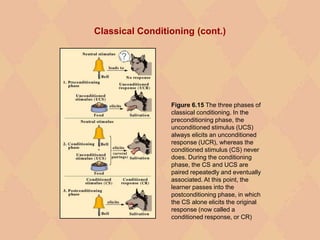
Figure 6.15 The three phases of
classical conditioning. In the
preconditioning phase, the
unconditioned stimulus (UCS)
always elicits an unconditioned
response (UCR), whereas the
conditioned stimulus (CS) never
does. During the conditioning
phase, the CS and UCS are
paired repeatedly and eventually
associated. At this point, the
learner passes into the
postconditioning phase, in which
the CS alone elicits the original
response (now called a
conditioned response, or CR)
 Classically conditioning a 3 year old
Operant (or Instrumental) Conditioning
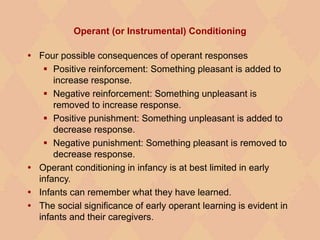
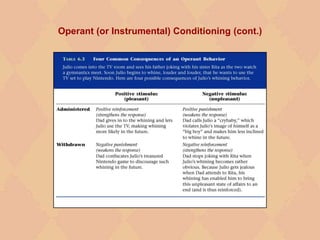
 Four possible consequences of operant responses
 Positive reinforcement: Something pleasant is added to
increase response.
 Negative reinforcement: Something unpleasant is
removed to increase response.
 Positive punishment: Something unpleasant is added to
decrease response.
 Negative punishment: Something pleasant is removed to
decrease response.
 Operant conditioning in infancy is at best limited in early
infancy.
 Infants can remember what they have learned.
 The social significance of early operant learning is evident in
infants and their caregivers.
Operant (or Instrumental) Conditioning (cont.)
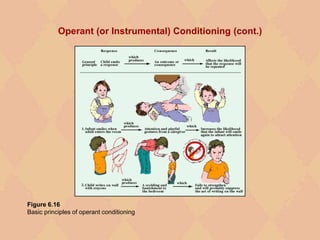
Figure 6.16
Basic principles of operant conditioning
Operant (or Instrumental) Conditioning (cont.)
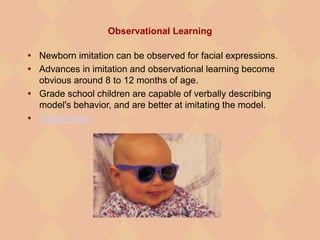
Observational Learning
 Newborn imitation can be observed for facial expressions.
 Advances in imitation and observational learning become
obvious around 8 to 12 months of age.
 Grade school children are capable of verbally describing
model's behavior, and are better at imitating the model.
 Video-Funny

sensation perception and learning.ppt

  • 1.
  • 2.
    Early Controversies aboutSensory and Perceptual Development  Nature vs. nurture  Nativist philosophers argue that many basic perceptual abilities are innate.  Empiricist philosophers believed infants are born tabula rasa (blank slate) and must learn to interpret sensations.  Enrichment vs. differentiation  Enrichment theory claims that sensory stimulation is often fragmented or confusing.  Differentiation theory argues that sensory stimulation provides all we need to interpret our experiences.
  • 3.
    "Making Sense" ofthe Infant's Sensory and Perceptual Experiences  The preference method  Two stimuli are presented simultaneously to see whether infants will attend more to one of them than the other.  The habituation method  Most popular strategy for measuring infant sensory and perceptual capabilities  Infants habituate and dishabituate to many different kinds of stimulation
  • 4.
    Infant Sensory Capabilities Vision  Least developed sense in the newborn  Visual acuity of newborn: 20/600  Hearing  Reactions to voices: Especially attentive to high-pitched feminine voices  Reactions to language: Infants can discriminate phonemes very early in life.  Consequences of hearing loss: Could hamper language development  Taste and smell  Infants are born with preference for sweet tastes.  Infants are born capable of detecting a variety of odors.  Touch, temperature, and pain: Proprioceptor senses are functioning at birth.
  • 5.
  • 6.
    Perception of Patternsand Forms in Infancy  Early pattern perception (0 to 2 months)  Prefer to look at whatever they can see well  Later form perception (2 months to 1 year)  Can use object movement to perceive form  Explaining form perception  Growth of form perception results from a continuous interplay among baby's inborn equipment, biological maturation, and visual experiences.
  • 7.
    Perception of Three-DimensionalSpace in Infancy  Size constancy  Recognizing that an object remains the same size even when its image on the retina becomes larger as the object moves closer, or smaller as the object moves farther away  Binocular vision enhances this capability.  Binocular vision emerges around 3 to 5 months of age.  Use of pictorial cues  7-month-olds seem able to use pictorial cues, while 5- month-olds cannot.
  • 8.
    Perception of Three-DimensionalSpace in Infancy (cont.)  Development of depth perception  Visual cliff experiment  Infants detect a difference between the deep and shallow sides.  Motor development and depth perception  Self-produced movement helps develop depth perception.
  • 9.
  • 10.
    Perception of Three-DimensionalSpace in Infancy (cont.)
  • 11.
    Intermodal Perception  Thesenses are integrated at birth or shortly thereafter.  Development of intermodal perception improves dramatically over the first year of life.  Explaining intermodal perception is difficult, but seems consistent with the differentiation theory.  Sensation and Perception Video
  • 12.
    Infant Perception inPerspective—and a Look Ahead  Perceptual learning in childhood: Gibson’s differentiation theory  Perceptual learning occurs when we actively explore and detect distinctive features.  Cultural influences on perception  Subtle, but important effects  Newborns are equipped to perceive "musicality" and to discriminate good music from bad music.  Humans learn not to hear certain phonemes if they are not distinctive to the language spoken.
  • 13.
    Infant Perception inPerspective—and a Look Ahead (cont.) Figure 6.14 Examples of figures used to test children’s ability to detect the distinctive features of letterlike forms. Stimulus 1 is the standard. The child’s task is to examine each of the comparison stimuli (stimuli 2–7) and pick out those that are the same as the standard. Adapted from Gibson et al.,1962.
  • 14.
    Basic Learning Processes Individual now thinks, perceives, or reacts to the environment in a new way  Result of a person's experiences  Change is relatively permanent.
  • 15.
    Habituation: Early Evidenceof Information-Processing and Memory  Process by which we stop attending or responding to a stimulus repeated over and over  Improves dramatically throughout the first year of life  Individual differences  Infants who habituate rapidly during the first six to eight months of life are quicker to understand and use language during the second year of life.
  • 16.
    Classical Conditioning  Aneutral stimulus that initially has no effect on the child eventually elicits a response of some sort, because it is associated with a second stimulus that always elicits the response.  Classical conditioning of emotions  Little Albert  UCS — loud banging noise  UCR — fearful behavior  CS — rat  CR— fearful behavior  Even newborns can be classically conditioned.
  • 17.
    Classical Conditioning (cont.) Figure6.15 The three phases of classical conditioning. In the preconditioning phase, the unconditioned stimulus (UCS) always elicits an unconditioned response (UCR), whereas the conditioned stimulus (CS) never does. During the conditioning phase, the CS and UCS are paired repeatedly and eventually associated. At this point, the learner passes into the postconditioning phase, in which the CS alone elicits the original response (now called a conditioned response, or CR)
  • 18.
  • 19.
    Operant (or Instrumental)Conditioning  Four possible consequences of operant responses  Positive reinforcement: Something pleasant is added to increase response.  Negative reinforcement: Something unpleasant is removed to increase response.  Positive punishment: Something unpleasant is added to decrease response.  Negative punishment: Something pleasant is removed to decrease response.  Operant conditioning in infancy is at best limited in early infancy.  Infants can remember what they have learned.  The social significance of early operant learning is evident in infants and their caregivers.
  • 20.
    Operant (or Instrumental)Conditioning (cont.) Figure 6.16 Basic principles of operant conditioning
  • 21.
    Operant (or Instrumental)Conditioning (cont.)
  • 22.
    Observational Learning  Newbornimitation can be observed for facial expressions.  Advances in imitation and observational learning become obvious around 8 to 12 months of age.  Grade school children are capable of verbally describing model's behavior, and are better at imitating the model.  Video-Funny