Rathachai CHAWUTHAI, PhD.
Semantic Web & Ontology
Department of Computer Engineering, School of Engineering
King Mongkut's Institute of Technology Ladkrabang
▪ Now
▪ Assoc. Prof. at Computer Engineering
▪ King Mongkut's Institute of Technology
Ladkrabang (KMITL)
▪ Education Background
▪ B.Eng. at KMITL
▪ M.Eng. at AIT
▪ Ph.D at SOKENDAI, Japan
▪ Work Experience
▪ Thomson Reuters Thailand (4 years)
▪ Punsarn Asia (1 years)
▪ NII, Japan (3 years)
2
Rathachai Chawuthai
Rathachai
rathachai
rathachai.c
Journal Papers and Book Chapters
▪ Chawuthai, R., Takeda, H., Wuwongse, V., & Jinbo, U. (2018). Presenting and preserving the change in taxonomic knowledge for linked data. In Semantic
Web Journal.
▪ Chawuthai, R., Jinbo, U., Takeda, H. (2018) “Linked Open Data Model for Taxonomic Information”. In a book titled “Application of Seman tic Technology in
Biodiversity Science”. IOS Press.
Conference and Workshop Papers
▪ Chawuthai, R., Kertkeidkachorn, N., & Racharak, T. (2023). Modelling an RDF Knowledge Graph with Transitivity and Symmetry for Bus Route Path
Finding. In Proceedings of the 2023 6th Artificial Intelligence and Cloud Computing Conference (pp. 126-134).
▪ Chawuthai, R., Takeda, H., Wuwongse, V., & Jinbo, U. (2018). Presenting and preserving the change in taxonomic knowledge for linked data. In
Companion Proceedings of the The Web Conference 2018 (pp. 461-465).
▪ Chawuthai, R., & Takeda, H. (2016). Rdf graph visualization by interpreting linked data as knowledge. In Semantic Technology: 5th Joint International
Conference, JIST 2015, Yichang, China, November 11-13, 2015, Revised Selected Papers 5 (pp. 23-39). Springer International Publishing.
▪ Cazabet, R., Chawuthai, R., & Takeda, H. (2015). Using multiple-criteria methods to evaluate community partitions. arXiv preprint arXiv:1502.05149.
▪ Chawuthai, R., & Takeda, H. (2015). rSim: Simplifying an RDF Graph at the Visualization Tier for Non-Expert Users. In ISWC (Posters & Demos).
▪ Chawuthai, R., Takeda, H., & Hosoya, T. (2015). Link prediction in linked data of interspecies interactions using hybrid recommendation approach. In
Semantic Technology: 4th Joint International Conference, JIST 2014, Chiang Mai, Thailand, November 9-11, 2014. Revised Selected Papers 4 (pp. 113-
128). Springer International Publishing.
▪ Nonthakarn, C., Chawuthai, R., & Wuwongse, V. (2014). An Application Profile for Linked Teacher Profiles and Teaching Resources. In The Emergence of
Digital Libraries–Research and Practices: 16th International Conference on Asia-Pacific Digital Libraries, ICADL 2014, Chiang Mai, Thailand, November
5-7, 2014. Proceedings 16 (pp. 138-148). Springer International Publishing.
▪ Chawuthai, R., Takeda, H., Wuwongse, V., & Jinbo, U. (2013). A logical model for taxonomic concepts for expanding knowledge using Linked Open Data.
Semantics for Biodiversity (S4BioDiv 2013), 9.
▪ Chawuthai, R., Wuwongse, V., & Takeda, H. (2012). A formal approach to the modelling of digital archives. In The Outreach of Digital Libraries: A
Globalized Resource Network: 14th International Conference on Asia-Pacific Digital Libraries, ICADL 2012, Taipei, Taiwan, November 12-15, 2012,
Proceedings 14 (pp. 179-188). Springer Berlin Heidelberg.
3
Publications about Semantic Web
Agenda
▪ Introduction
▪ RDF Graph
▪ RDF Schema
▪ Upper Ontology
▪ Designing Ontology
▪ Reasoning
▪ Query
▪ LOD
Introduction
5
6
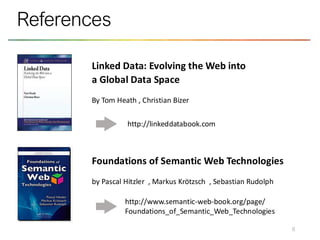
References
Foundations of Semantic Web Technologies
by Pascal Hitzler , Markus Krötzsch , Sebastian Rudolph
http://www.semantic-web-book.org/page/
Foundations_of_Semantic_Web_Technologies
Linked Data: Evolving the Web into
a Global Data Space
By Tom Heath , Christian Bizer
http://linkeddatabook.com
7
Acknowledgements
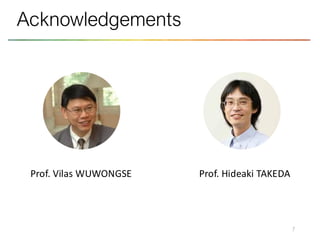
Prof. Vilas WUWONGSE Prof. Hideaki TAKEDA
8
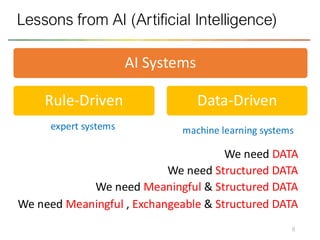
Lessons from AI (Artificial Intelligence)
expert systems machine learning systems
We need DATA
We need Structured DATA
We need Meaningful & Structured DATA
We need Meaningful , Exchangeable & Structured DATA
AI Systems
Rule-Driven Data-Driven
9
Open Data
10
UK
▪ USA: NSF DATA SHARING POLICY
11
USA
Investigators are expected to share with
other researchers the primary data,
samples, physical collections and other
supporting materials created or gathered
in the course of work under NSF grants.
12
Linked Data
https://commons.wikimedia.org/wiki/
File:Linked-Open-Data-BVMC.png
13
Linked Data
http://sites.linkeddata.center/blog/archive/1-2-3linkedopendataarehere
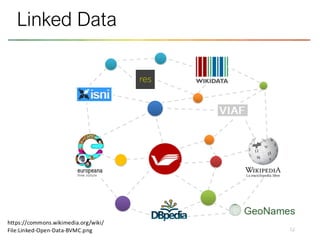
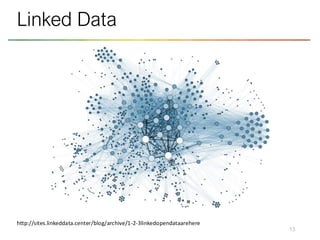
▪ Linked Data is about using the Web to connect related data
that wasn't previously linked, or using the Web to lower the
barriers to linking data currently linked using other methods.
▪ Global Knowledge Management System
▪ More specifically, Wikipedia defines Linked Data as "a term
used to describe a recommended best practice for
exposing, sharing, and connecting pieces of data,
information, and knowledge on the Semantic Web using
URIs and RDF.“
▪ http://linkeddata.org/
14
Linked Open Data
▪ Linked Open Data (LOD) is one practice approach of
Sematic Web.
▪ One significant ability is to integrate open data from different
schemas through the Internet.
▪ A graph is a data structure that is used in LOD.
▪ The reasoning on graph data together with schemas and
ontologies can improve the connection and accessibility of
data.
▪ Thus, we would like to provide background knowledge of
RDF graph, RDF Schema, ontology, reasoning, query, and
LOD cloud.
15
Introduction
16
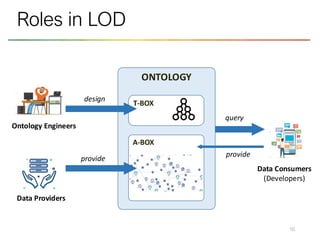
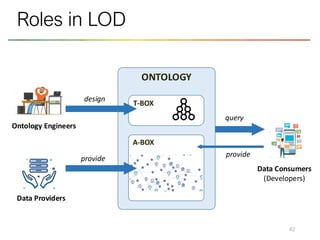
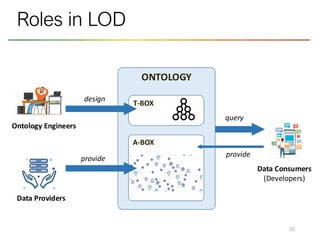
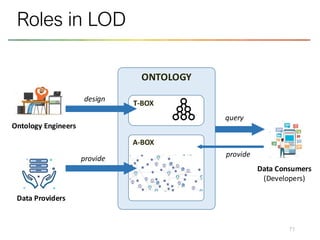
Roles in LOD
ONTOLOGY
T-BOX
A-BOX
Ontology Engineers
Data Providers
Data Consumers
(Developers)
design
provide
query
provide
17
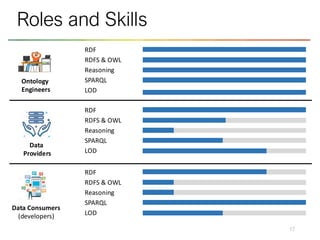
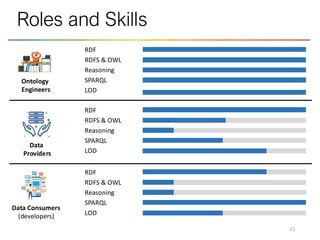
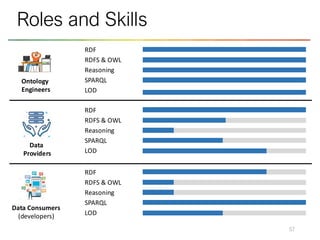
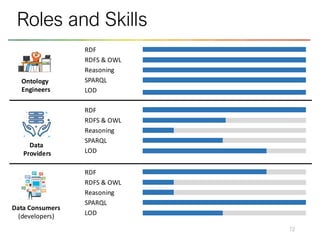
Roles and Skills
Ontology
Engineers
Data
Providers
Data Consumers
(developers)
RDFS & OWL
Reasoning
RDF
SPARQL
LOD
RDFS & OWL
Reasoning
RDF
SPARQL
LOD
RDFS & OWL
Reasoning
RDF
SPARQL
LOD
RDF Graph
18
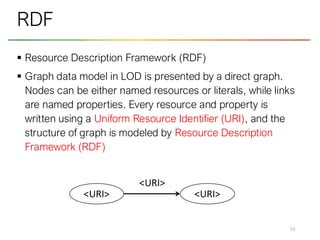
▪ Resource Description Framework (RDF)
▪ Graph data model in LOD is presented by a direct graph.
Nodes can be either named resources or literals, while links
are named properties. Every resource and property is
written using a Uniform Resource Identifier (URI), and the
structure of graph is modeled by Resource Description
Framework (RDF)
19
RDF
<URI> <URI>
<URI>
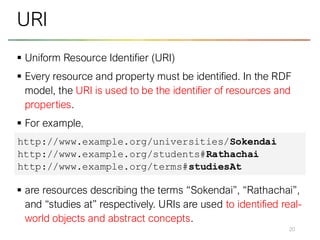
▪ Uniform Resource Identifier (URI)
▪ Every resource and property must be identified. In the RDF
model, the URI is used to be the identifier of resources and
properties.
▪ For example,
▪ are resources describing the terms “Sokendai”, “Rathachai”,
and “studies at” respectively. URIs are used to identified real-
world objects and abstract concepts.
20
URI
http://www.example.org/universities/Sokendai
http://www.example.org/students#Rathachai
http://www.example.org/terms#studiesAt
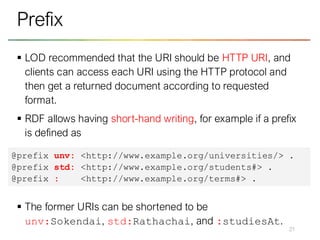
▪ LOD recommended that the URI should be HTTP URI, and
clients can access each URI using the HTTP protocol and
then get a returned document according to requested
format.
▪ RDF allows having short-hand writing, for example if a prefix
is defined as
▪ The former URIs can be shortened to be
unv:Sokendai, std:Rathachai, and :studiesAt.
21
Prefix
@prefix unv: <http://www.example.org/universities/> .
@prefix std: <http://www.example.org/students#> .
@prefix : <http://www.example.org/terms#> .
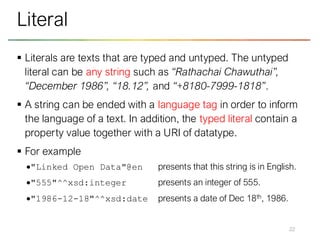
▪ Literals are texts that are typed and untyped. The untyped
literal can be any string such as “Rathachai Chawuthai”,
“December 1986”, “18.12”, and “+8180-7999-1818”.
▪ A string can be ended with a language tag in order to inform
the language of a text. In addition, the typed literal contain a
property value together with a URI of datatype.
▪ For example
•"Linked Open Data"@en presents that this string is in English.
•"555"^^xsd:integer presents an integer of 555.
•"1986-12-18"^^xsd:date presents a date of Dec 18th, 1986.
22
Literal
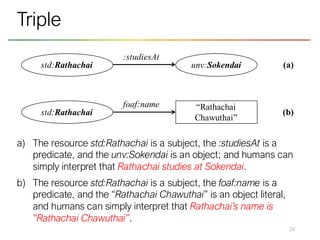
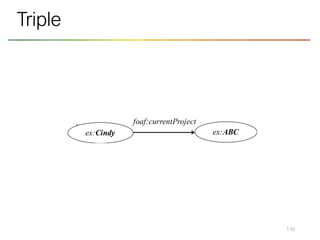
• Triple is a binary relation between two entities, and it is the
fundamental unit of an RDF graph. It includes the sequence
of a subject, a predicate, and an object. Subjects and
predicates are resources represented by URIs, but objects
can be either resources or literals.
• The formal representation of triple is  s,p,o  where s is a
subject, p is a predicate or a property, and o is an object. In
the graph diagram, the URI of a resource is commonly
written inside an eclipse, a literal is presented by a quoted
text inside a rectangle, and an arrows with the URI of
predicate are drawn from a subject to an object.
23
Triple
a) The resource std:Rathachai is a subject, the :studiesAt is a
predicate, and the unv:Sokendai is an object; and humans can
simply interpret that Rathachai studies at Sokendai.
b) The resource std:Rathachai is a subject, the foaf:name is a
predicate, and the “Rathachai Chawuthai” is an object literal,
and humans can simply interpret that Rathachai’s name is
“Rathachai Chawuthai”.
24
Triple
std:Rathachai unv:Sokendai
:studiesAt
std:Rathachai
foaf:name “Rathachai
Chawuthai”
(a)
(b)
25
RDF Syntaxes and Dialects
Kukrit Promoj
dc:creator
http://www.nlt.go.th/novel/
Four-Reins
<rdf:RDF
xmlns:rdf="http://www.w3.org/1999/02/22-rdf-syntax-ns#"
xmlns:dc="http://purl.org/dc/elements/1.1/">
<rdf:Description rdf:about="http://www.nlt.go.th/novel/Four-Reins">
<dc:creator>Kukrit Pramoj</dc:creator>
</rdf:Description>
</rdf:RDF>
RDF/XML
@prefix dc: <http://purl.org/dc/elements/1.1/> .
<http://www.nlt.go.th/novel/Four-Reins> dc:creator “Kukrit Pramote" .
RDF/Turtle
<http://www.nlt.go.th/novel/Four-Reins>
<http://purl.org/dc/elements/1.1/creator> “Kukrit Pramoj" .
N-Triples
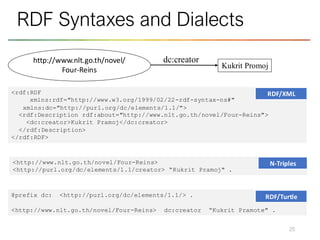
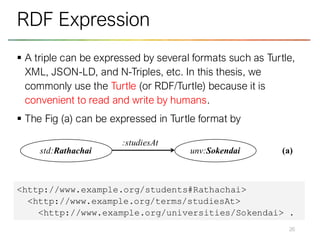
▪ A triple can be expressed by several formats such as Turtle,
XML, JSON-LD, and N-Triples, etc. In this thesis, we
commonly use the Turtle (or RDF/Turtle) because it is
convenient to read and write by humans.
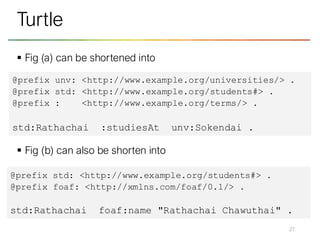
▪ The Fig (a) can be expressed in Turtle format by
26
RDF Expression
<http://www.example.org/students#Rathachai>
<http://www.example.org/terms/studiesAt>
<http://www.example.org/universities/Sokendai> .
std:Rathachai unv:Sokendai
:studiesAt
std:Rathachai
foaf:name “Rathachai
Chawuthai”
(a)
(b)
▪ Fig (a) can be shortened into
▪ Fig (b) can also be shorten into
27
Turtle
@prefix unv: <http://www.example.org/universities/> .
@prefix std: <http://www.example.org/students#> .
@prefix : <http://www.example.org/terms/> .
std:Rathachai :studiesAt unv:Sokendai .
@prefix std: <http://www.example.org/students#> .
@prefix foaf: <http://xmlns.com/foaf/0.1/> .
std:Rathachai foaf:name "Rathachai Chawuthai" .
28
RDF Graph
ex:Alice
ex:Cindy
foaf:name “Alice”
ex:Bob
foaf:knows
foaf:knows
foaf:currentProject
ex:ABC
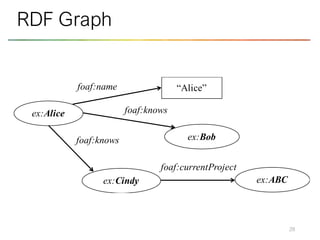
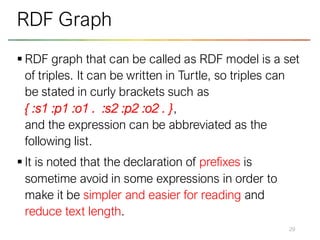
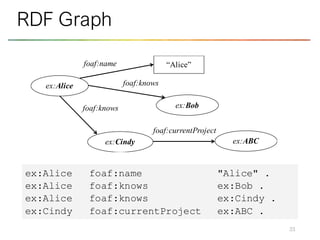
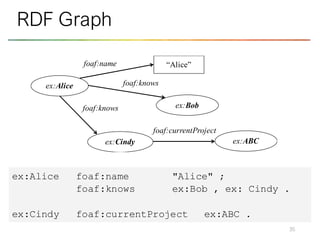
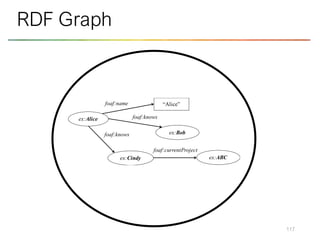
▪ RDF graph that can be called as RDF model is a set
of triples. It can be written in Turtle, so triples can
be stated in curly brackets such as
{ :s1 :p1 :o1 . :s2 :p2 :o2 . },
and the expression can be abbreviated as the
following list.
▪ It is noted that the declaration of prefixes is
sometime avoid in some expressions in order to
make it be simpler and easier for reading and
reduce text length.
29
RDF Graph
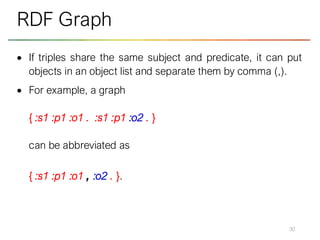
• If triples share the same subject and predicate, it can put
objects in an object list and separate them by comma (,).
• For example, a graph
{ :s1 :p1 :o1 . :s1 :p1 :o2 . }
can be abbreviated as
{ :s1 :p1 :o1 , :o2 . }.
30
RDF Graph
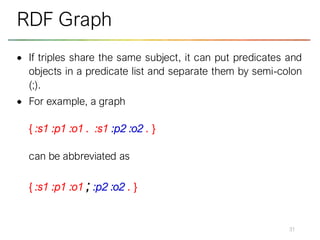
• If triples share the same subject, it can put predicates and
objects in a predicate list and separate them by semi-colon
(;).
• For example, a graph
{ :s1 :p1 :o1 . :s1 :p2 :o2 . }
can be abbreviated as
{ :s1 :p1 :o1 ; :p2 :o2 . }
31
RDF Graph
• If triples contain the chain of same blank node, it can put the
relative cause in square brackets.
• For example, a graph
{ ex:Ryu foaf:knows _:a1 . _:a1 foaf:name “Ken” . }
can be abbreviated as
{ ex:Ryu foaf:knows [ foaf:name “Ken”] . }
which can be read as Ryu knows someone whose name is “Ken”.
32
RDF Graph
33
RDF Graph
ex:Alice
ex:Cindy
foaf:name “Alice”
ex:Bob
foaf:knows
foaf:knows
foaf:currentProject
ex:ABC
ex:Alice foaf:name "Alice" .
ex:Alice foaf:knows ex:Bob .
ex:Alice foaf:knows ex:Cindy .
ex:Cindy foaf:currentProject ex:ABC .
34
RDF Graph
ex:Alice foaf:name "Alice" ;
foaf:knows ex:Bob , ex:Cindy .
ex:Cindy foaf:currentProject ex:ABC .
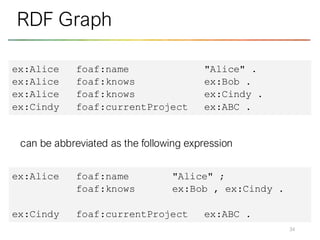
can be abbreviated as the following expression
ex:Alice foaf:name "Alice" .
ex:Alice foaf:knows ex:Bob .
ex:Alice foaf:knows ex:Cindy .
ex:Cindy foaf:currentProject ex:ABC .
35
RDF Graph
ex:Alice foaf:name "Alice" ;
foaf:knows ex:Bob , ex: Cindy .
ex:Cindy foaf:currentProject ex:ABC .
ex:Alice
ex:Cindy
foaf:name “Alice”
ex:Bob
foaf:knows
foaf:knows
foaf:currentProject
ex:ABC
▪ RDF
▪ https://www.w3.org/TR/rdf-primer/
▪ Tools
▪ Protégé
▪ https://protege.stanford.edu/
▪ OpenLink Virtuoso
▪ https://virtuoso.openlinksw.com/
▪ RDF4J
▪ http://rdf4j.org/
36
See Also …
RDF Schema
37
▪ Without interpretation, an RDF statement is just a string of
characters.
▪ Adding meaning to an RDF graph is a key feature of
Semantic Web, and this feature makes an RDF graph
become excellently machine-readable.
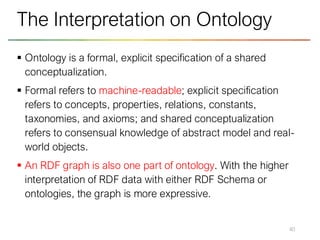
▪ Ontology is a formal, explicit specification of a shared
conceptualization.
38
The Interpretation on Ontology
39
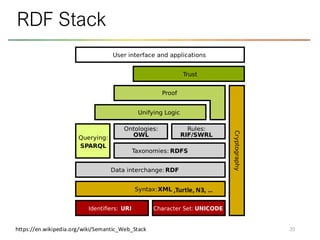
RDF Stack
https://en.wikipedia.org/wiki/Semantic_Web_Stack
,Turtle, N3, …
▪ Ontology is a formal, explicit specification of a shared
conceptualization.
▪ Formal refers to machine-readable; explicit specification
refers to concepts, properties, relations, constants,
taxonomies, and axioms; and shared conceptualization
refers to consensual knowledge of abstract model and real-
world objects.
▪ An RDF graph is also one part of ontology. With the higher
interpretation of RDF data with either RDF Schema or
ontologies, the graph is more expressive.
40
The Interpretation on Ontology
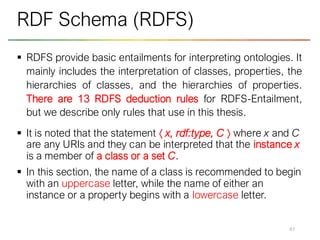
▪ RDFS provide basic entailments for interpreting ontologies. It
mainly includes the interpretation of classes, properties, the
hierarchies of classes, and the hierarchies of properties.
There are 13 RDFS deduction rules for RDFS-Entailment,
but we describe only rules that use in this thesis.
▪ It is noted that the statement  x, rdf:type, C  where x and C
are any URIs and they can be interpreted that the instance x
is a member of a class or a set C.
▪ In this section, the name of a class is recommended to begin
with an uppercase letter, while the name of either an
instance or a property begins with a lowercase letter.
41
RDF Schema (RDFS)
42
Roles in LOD
ONTOLOGY
T-BOX
A-BOX
Ontology Engineers
Data Providers
Data Consumers
(Developers)
design
provide
query
provide
43
Roles and Skills
Ontology
Engineers
Data
Providers
Data Consumers
(developers)
RDFS & OWL
Reasoning
RDF
SPARQL
LOD
RDFS & OWL
Reasoning
RDF
SPARQL
LOD
RDFS & OWL
Reasoning
RDF
SPARQL
LOD
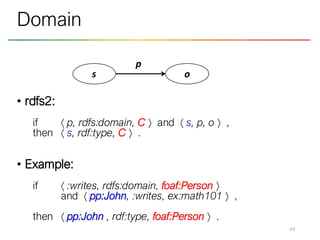
• rdfs2:
if  p, rdfs:domain, C  and  s, p, o  ,
then  s, rdf:type, C  .
• Example:
if  :writes, rdfs:domain, foaf:Person 
and  pp:John, :writes, ex:math101  ,
then  pp:John , rdf:type, foaf:Person  .
44
Domain
s o
p
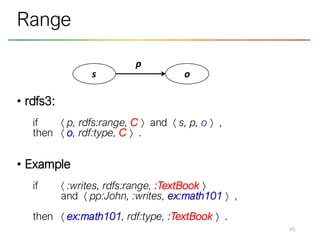
• rdfs3:
if  p, rdfs:range, C  and  s, p, o  ,
then  o, rdf:type, C  .
• Example
if  :writes, rdfs:range, :TextBook 
and  pp:John, :writes, ex:math101  ,
then  ex:math101, rdf:type, :TextBook  .
45
Range
s o
p
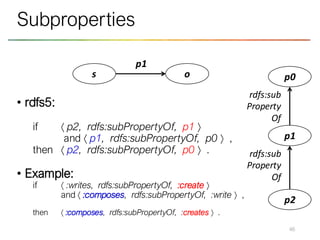
• rdfs5:
if  p2, rdfs:subPropertyOf, p1 
and  p1, rdfs:subPropertyOf, p0  ,
then  p2, rdfs:subPropertyOf, p0  .
• Example:
if  :writes, rdfs:subPropertyOf, :create 
and  :composes, rdfs:subPropertyOf, :write  ,
then  :composes, rdfs:subPropertyOf, :creates  .
46
Subproperties
s o
p1
p1
p0
p2
rdfs:sub
Property
Of
rdfs:sub
Property
Of
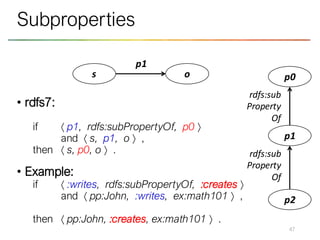
• rdfs7:
if  p1, rdfs:subPropertyOf, p0 
and  s, p1, o  ,
then  s, p0, o  .
• Example:
if  :writes, rdfs:subPropertyOf, :creates 
and  pp:John, :writes, ex:math101  ,
then  pp:John, :creates, ex:math101  .
47
Subproperties
s o
p1
p1
p0
p2
rdfs:sub
Property
Of
rdfs:sub
Property
Of
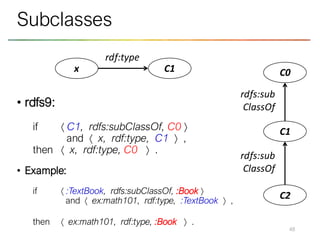
• rdfs9:
if  C1, rdfs:subClassOf, C0 
and  x, rdf:type, C1  ,
then  x, rdf:type, C0  .
• Example:
if  :TextBook, rdfs:subClassOf, :Book 
and  ex:math101, rdf:type, :TextBook  ,
then  ex:math101, rdf:type, :Book  .
48
Subclasses
x C1
rdf:type
C1
C0
C2
rdfs:sub
ClassOf
rdfs:sub
ClassOf
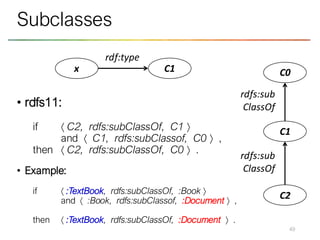
• rdfs11:
if  C2, rdfs:subClassOf, C1 
and  C1, rdfs:subClassof, C0  ,
then  C2, rdfs:subClassOf, C0  .
• Example:
if  :TextBook, rdfs:subClassOf, :Book 
and  :Book, rdfs:subClassof, :Document  ,
then  :TextBook, rdfs:subClassOf, :Document  .
49
Subclasses
x C1
rdf:type
C1
C0
C2
rdfs:sub
ClassOf
rdfs:sub
ClassOf
50
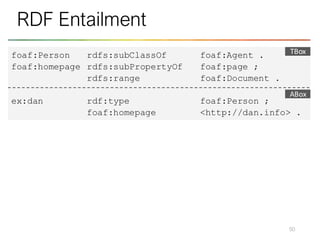
RDF Entailment
foaf:Person rdfs:subClassOf foaf:Agent .
foaf:homepage rdfs:subPropertyOf foaf:page ;
rdfs:range foaf:Document .
ex:dan rdf:type foaf:Person ;
foaf:homepage <http://dan.info> .
TBox
ABox
51
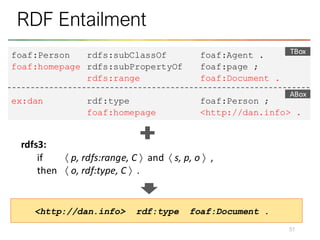
RDF Entailment
rdfs3:
if  p, rdfs:range, C  and  s, p, o  ,
then  o, rdf:type, C  .
foaf:Person rdfs:subClassOf foaf:Agent .
foaf:homepage rdfs:subPropertyOf foaf:page ;
rdfs:range foaf:Document .
ex:dan rdf:type foaf:Person ;
foaf:homepage <http://dan.info> .
<http://dan.info> rdf:type foaf:Document .
TBox
ABox
52
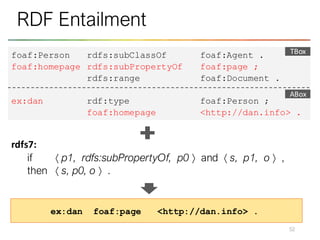
RDF Entailment
rdfs7:
if  p1, rdfs:subPropertyOf, p0  and  s, p1, o  ,
then  s, p0, o  .
foaf:Person rdfs:subClassOf foaf:Agent .
foaf:homepage rdfs:subPropertyOf foaf:page ;
rdfs:range foaf:Document .
ex:dan rdf:type foaf:Person ;
foaf:homepage <http://dan.info> .
ex:dan foaf:page <http://dan.info> .
TBox
ABox
53
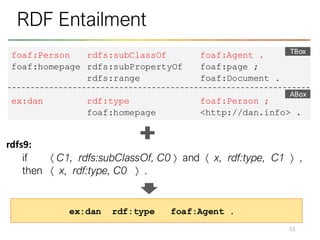
RDF Entailment
rdfs9:
if  C1, rdfs:subClassOf, C0  and  x, rdf:type, C1  ,
then  x, rdf:type, C0  .
foaf:Person rdfs:subClassOf foaf:Agent .
foaf:homepage rdfs:subPropertyOf foaf:page ;
rdfs:range foaf:Document .
ex:dan rdf:type foaf:Person ;
foaf:homepage <http://dan.info> .
ex:dan rdf:type foaf:Agent .
TBox
ABox
54
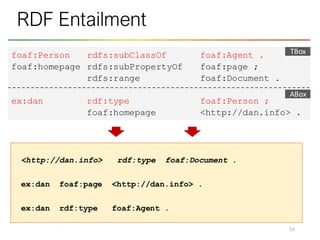
RDF Entailment
foaf:Person rdfs:subClassOf foaf:Agent .
foaf:homepage rdfs:subPropertyOf foaf:page ;
rdfs:range foaf:Document .
ex:dan rdf:type foaf:Person ;
foaf:homepage <http://dan.info> .
TBox
ABox
<http://dan.info> rdf:type foaf:Document .
ex:dan foaf:page <http://dan.info> .
ex:dan rdf:type foaf:Agent .
Ontology
55
56
Roles in LOD
ONTOLOGY
T-BOX
A-BOX
Ontology Engineers
Data Providers
Data Consumers
(Developers)
design
provide
query
provide
57
Roles and Skills
Ontology
Engineers
Data
Providers
Data Consumers
(developers)
RDFS & OWL
Reasoning
RDF
SPARQL
LOD
RDFS & OWL
Reasoning
RDF
SPARQL
LOD
RDFS & OWL
Reasoning
RDF
SPARQL
LOD
58
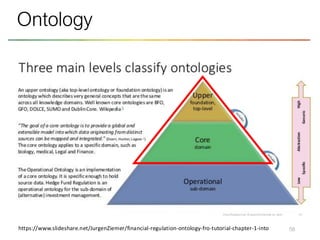
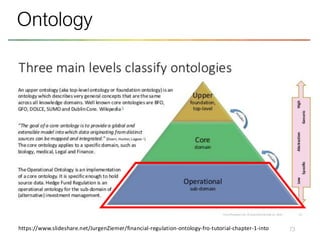
Ontology
https://www.slideshare.net/JurgenZiemer/financial-regulation-ontology-fro-tutorial-chapter-1-into
▪ OWL is a recommended standard for the modelling of
ontologies. It gives higher interpretation over RDF and RDFS,
so the representation of a knowledge graph becomes more
expressive. There are many features and details in OWL,
however, this review selects some features that are
commonly used in this thesis, for example equality and
property characteristics.
▪ It is firstly informed that every instance is belong to
owl:Thing.
59
Web Ontology Language (OWL)
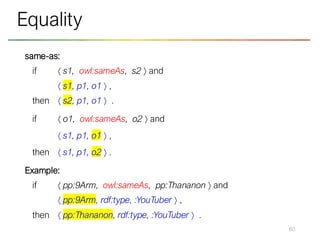
same-as:
if  s1, owl:sameAs, s2  and
 s1, p1, o1  ,
then  s2, p1, o1  .
if  o1, owl:sameAs, o2  and
 s1, p1, o1  ,
then  s1, p1, o2  .
Example:
if  pp:9Arm, owl:sameAs, pp:Thananon  and
 pp:9Arm, rdf:type, :YouTuber  ,
then  pp:Thananon, rdf:type, :YouTuber  .
60
Equality
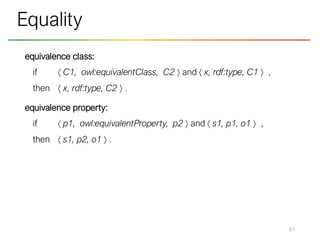
equivalence class:
if  C1, owl:equivalentClass, C2  and  x, rdf:type, C1  ,
then  x, rdf:type, C2  .
equivalence property:
if  p1, owl:equivalentProperty, p2  and  s1, p1, o1  ,
then  s1, p2, o1  .
61
Equality
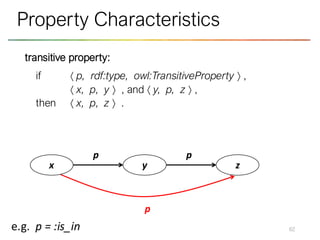
transitive property:
if  p, rdf:type, owl:TransitiveProperty  ,
 x, p, y  , and  y, p, z  ,
then  x, p, z  .
62
Property Characteristics
x y
p
z
p
p
e.g. p = :is_in
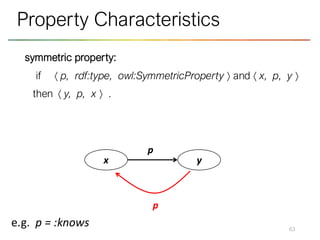
symmetric property:
if  p, rdf:type, owl:SymmetricProperty  and  x, p, y 
then  y, p, x  .
63
Property Characteristics
x y
p
p
e.g. p = :knows
inverse property:
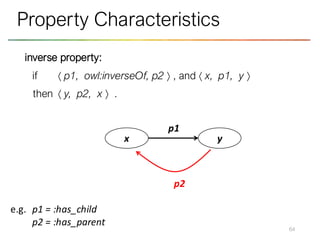
if  p1, owl:inverseOf, p2  , and  x, p1, y 
then  y, p2, x  .
64
Property Characteristics
x y
p1
p2
e.g. p1 = :has_child
p2 = :has_parent
65
OWL Reasoning
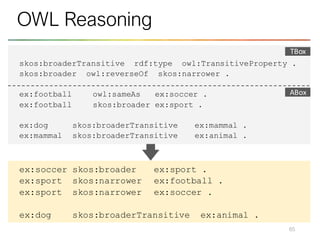
skos:broaderTransitive rdf:type owl:TransitiveProperty .
skos:broader owl:reverseOf skos:narrower .
ex:football owl:sameAs ex:soccer .
ex:football skos:broader ex:sport .
ex:dog skos:broaderTransitive ex:mammal .
ex:mammal skos:broaderTransitive ex:animal .
ex:soccer skos:broader ex:sport .
ex:sport skos:narrower ex:football .
ex:sport skos:narrower ex:soccer .
ex:dog skos:broaderTransitive ex:animal .
TBox
ABox
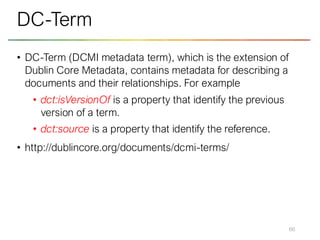
• DC-Term (DCMI metadata term), which is the extension of
Dublin Core Metadata, contains metadata for describing a
documents and their relationships. For example
• dct:isVersionOf is a property that identify the previous
version of a term.
• dct:source is a property that identify the reference.
• http://dublincore.org/documents/dcmi-terms/
66
DC-Term
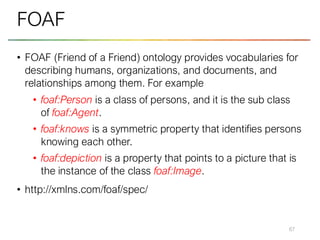
• FOAF (Friend of a Friend) ontology provides vocabularies for
describing humans, organizations, and documents, and
relationships among them. For example
• foaf:Person is a class of persons, and it is the sub class
of foaf:Agent.
• foaf:knows is a symmetric property that identifies persons
knowing each other.
• foaf:depiction is a property that points to a picture that is
the instance of the class foaf:Image.
• http://xmlns.com/foaf/spec/
67
FOAF
• SKOS (Simple Knowledge Organization System) ontology
provides a model for expressing the basic structure and
content of concept schemes. For example
• skos:broader is a property that identifies the board
concept of a given concept.
• skos:broaderTransitive is a transitive property that
identifies the transitively board concept of a given
concept.
• skos:narrower is a property that identifies the narrow
concept of a given concept and it is the inverse property
of skos:broader.
• skos:narrowerTransitive is a property that identifies the
transitively narrow concept of a given concept and it is
the inverse property of skos:broaderTransitive.
• https://www.w3.org/TR/skos-primer/
68
SKOS
▪ RDFS
▪ https://www.w3.org/TR/rdf-schema/
▪ OWL
▪ https://www.w3.org/TR/2012/
REC-owl2-primer-20121211/
▪ List of Ontologies
▪ http://semanticweb.org/wiki/Ontology
69
See Also …
Designing
Ontology
70
71
Roles in LOD
ONTOLOGY
T-BOX
A-BOX
Ontology Engineers
Data Providers
Data Consumers
(Developers)
design
provide
query
provide
72
Roles and Skills
Ontology
Engineers
Data
Providers
Data Consumers
(developers)
RDFS & OWL
Reasoning
RDF
SPARQL
LOD
RDFS & OWL
Reasoning
RDF
SPARQL
LOD
RDFS & OWL
Reasoning
RDF
SPARQL
LOD
73
Ontology
https://www.slideshare.net/JurgenZiemer/financial-regulation-ontology-fro-tutorial-chapter-1-into
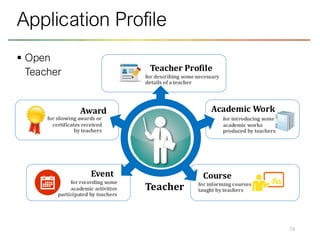
▪ Open
Teacher
74
Application Profile
เพื่อการ
ติดต่อ
Teacher
Teacher Profile
Academic Work
Course
Event
Award
for showing awards or
certificates received
by teachers
for describing some necessary
details of a teacher
for recording some
academic activities
participated by teachers
for introducing some
academic works
produced by teachers
for informing courses
taught by teachers
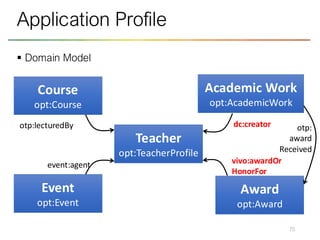
▪ Domain Model
75
Application Profile
Teacher
opt:TeacherProfile
Course
opt:Course
Academic Work
opt:AcademicWork
Event
opt:Event
Award
opt:Award
otp:lecturedBy
vivo:awardOr
HonorFor
dc:creator
event:agent
otp:
award
Received
76
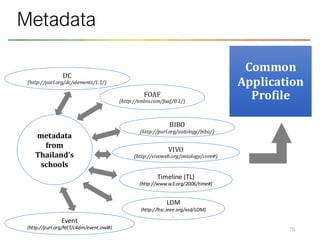
Metadata
metadata
from
Thailand’s
schools
DC
(http://purl.org/dc/elements/1.1/)
FOAF
(http://xmlns.com/foaf/0.1/)
VIVO
(http://vivoweb.org/ontology/core#)
BIBO
(http://purl.org/ontology/bibo/)
Event
(http://purl.org/NET/c4dm/event.owl#)
Timeline (TL)
(http://www.w3.org/2006/time#)
LOM
(http://ltsc.ieee.org/xsd/LOM)
.
Common
Application
Profile
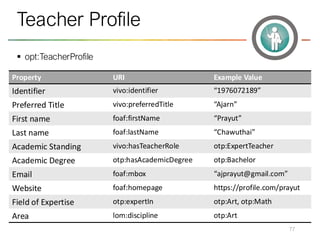
▪ opt:TeacherProfile
77
Teacher Profile
Property URI Example Value
Identifier vivo:identifier “1976072189”
Preferred Title vivo:preferredTitle “Ajarn”
First name foaf:firstName “Prayut”
Last name foaf:lastName “Chawuthai”
Academic Standing vivo:hasTeacherRole otp:ExpertTeacher
Academic Degree otp:hasAcademicDegree otp:Bachelor
Email foaf:mbox “ajprayut@gmail.com”
Website foaf:homepage https://profile.com/prayut
Field of Expertise otp:expertIn otp:Art, otp:Math
Area lom:discipline otp:Art
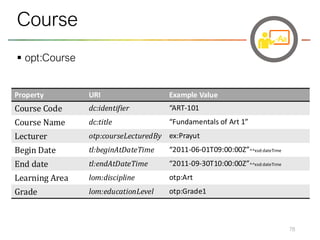
▪ opt:Course
78
Course
Property URI Example Value
Course Code dc:identifier “ART-101
Course Name dc:title “Fundamentals of Art 1”
Lecturer otp:courseLecturedBy ex:Prayut
Begin Date tl:beginAtDateTime “2011-06-01T09:00:00Z”^^xsd:dateTime
End date tl:endAtDateTime “2011-09-30T10:00:00Z”^^xsd:dateTime
Learning Area lom:discipline otp:Art
Grade lom:educationLevel otp:Grade1
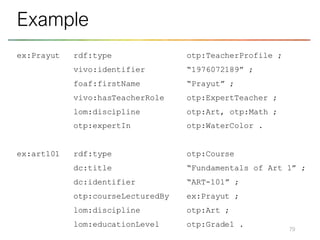
ex:Prayut rdf:type otp:TeacherProfile ;
vivo:identifier “1976072189” ;
foaf:firstName “Prayut” ;
vivo:hasTeacherRole otp:ExpertTeacher ;
lom:discipline otp:Art, otp:Math ;
otp:expertIn otp:WaterColor .
ex:art101 rdf:type otp:Course
dc:title “Fundamentals of Art 1” ;
dc:identifier “ART-101” ;
otp:courseLecturedBy ex:Prayut ;
lom:discipline otp:Art ;
lom:educationLevel otp:Grade1 .
79
Example
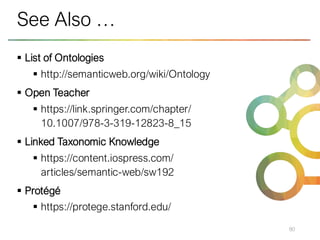
▪ List of Ontologies
▪ http://semanticweb.org/wiki/Ontology
▪ Open Teacher
▪ https://link.springer.com/chapter/
10.1007/978-3-319-12823-8_15
▪ Linked Taxonomic Knowledge
▪ https://content.iospress.com/
articles/semantic-web/sw192
▪ Protégé
▪ https://protege.stanford.edu/
80
See Also …
Reasoning
81
▪ RDFS and OWL provide necessary rules to entail an RDF
graph.
▪ In case some specific requirements beyond RDFS and OWL
are needed, developers can create some Semantic Web
rules.
▪ For creating own rules, the book of Semantic Web
programming recommended to use Apache Jena as a
reasoning engine that is a library of Java.
82
Semantic Web Reasoning
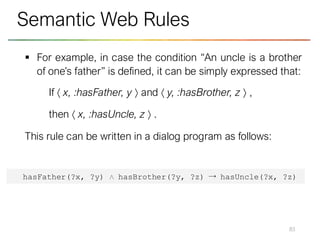
▪ For example, in case the condition “An uncle is a brother
of one’s father” is defined, it can be simply expressed that:
If  x, :hasFather, y  and  y, :hasBrother, z  ,
then  x, :hasUncle, z  .
This rule can be written in a dialog program as follows:
83
Semantic Web Rules
hasFather(?x, ?y) ∧ hasBrother(?y, ?z) → hasUncle(?x, ?z)
▪ Semantic Web Rule
▪ JENA Rule
84
JENA
[rule_identify_uncle:
(?x :hasFather ?y),
(?y :hasBrother ?z)
->(?x :hasUncle ?z)]
hasFather(?x, ?y) ∧ hasBrother(?y, ?z) → hasUncle(?x, ?z)
▪ RDF Data
▪ JENA Rule
▪ Result
85
HEAD
[rule_identify_uncle:
(?x :hasFather ?y),
(?y :hasBrother ?z)
->(?x :hasUncle ?z)]
ex:john :hasFather ex:smith .
ex:smith :hasBrother ex:adam .
ex:john :hasUncle ex:adam .
▪ Semantic Web Rules
▪ https://www.w3.org/Submission/SWRL/
▪ JENA
▪ https://jena.apache.org/
documentation/inference/
▪ Protégé
▪ https://protege.stanford.edu/
86
See Also …
Query
87
88
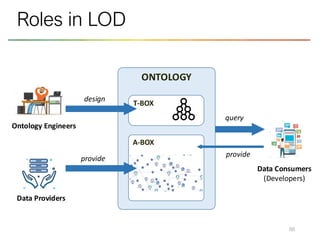
Roles in LOD
ONTOLOGY
T-BOX
A-BOX
Ontology Engineers
Data Providers
Data Consumers
(Developers)
design
provide
query
provide
89
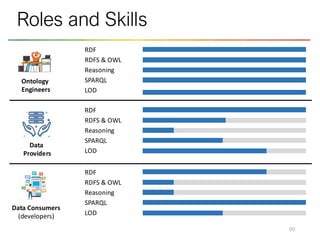
Roles and Skills
Ontology
Engineers
Data
Providers
Data Consumers
(developers)
RDFS & OWL
Reasoning
RDF
SPARQL
LOD
RDFS & OWL
Reasoning
RDF
SPARQL
LOD
RDFS & OWL
Reasoning
RDF
SPARQL
LOD
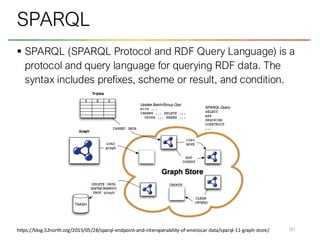
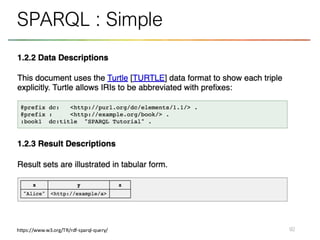
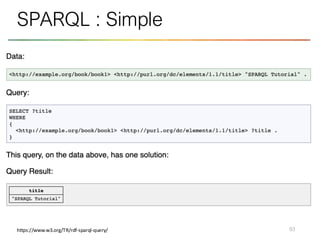
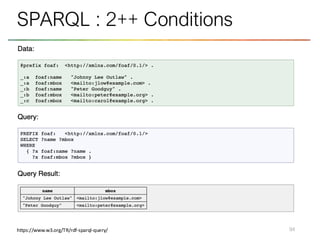
▪ SPARQL (SPARQL Protocol and RDF Query Language) is a
protocol and query language for querying RDF data. The
syntax includes prefixes, scheme or result, and condition.
90
SPARQL
https://blog.52north.org/2015/05/28/sparql-endpoint-and-interoperability-of-envirocar-data/sparql-11-graph-store/
91
SPARQL
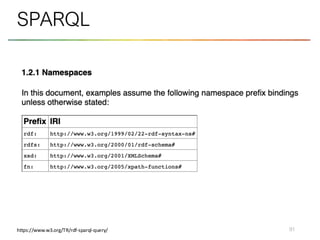
https://www.w3.org/TR/rdf-sparql-query/
92
SPARQL : Simple
https://www.w3.org/TR/rdf-sparql-query/
93
SPARQL : Simple
https://www.w3.org/TR/rdf-sparql-query/
94
SPARQL : 2++ Conditions
https://www.w3.org/TR/rdf-sparql-query/
95
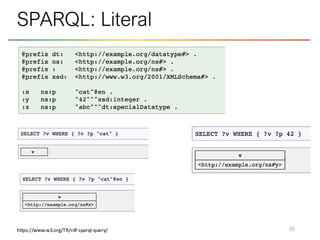
SPARQL: Literal
https://www.w3.org/TR/rdf-sparql-query/
96
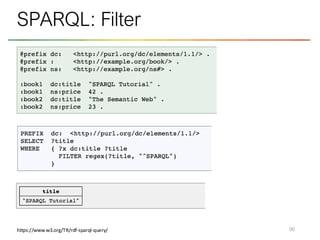
SPARQL: Filter
https://www.w3.org/TR/rdf-sparql-query/
97
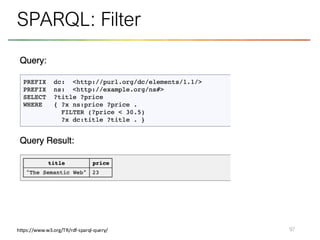
SPARQL: Filter
https://www.w3.org/TR/rdf-sparql-query/
98
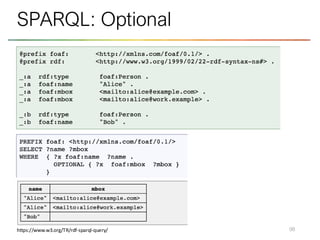
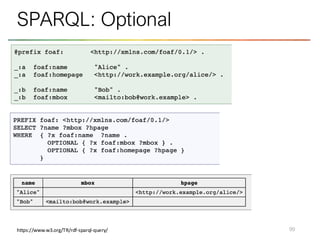
SPARQL: Optional
https://www.w3.org/TR/rdf-sparql-query/
99
SPARQL: Optional
https://www.w3.org/TR/rdf-sparql-query/
100
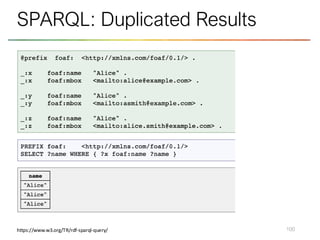
SPARQL: Duplicated Results
https://www.w3.org/TR/rdf-sparql-query/
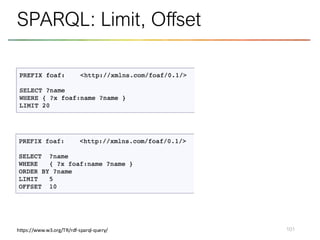
101
SPARQL: Limit, Offset
https://www.w3.org/TR/rdf-sparql-query/
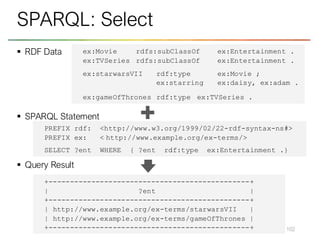
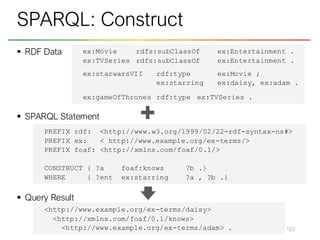
▪ RDF Data
▪ SPARQL Statement
▪ Query Result
102
SPARQL: Select
ex:Movie rdfs:subClassOf ex:Entertainment .
ex:TVSeries rdfs:subClassOf ex:Entertainment .
ex:starwarsVII rdf:type ex:Movie ;
ex:starring ex:daisy, ex:adam .
ex:gameOfThrones rdf:type ex:TVSeries .
PREFIX rdf: <http://www.w3.org/1999/02/22-rdf-syntax-ns#>
PREFIX ex: < http://www.example.org/ex-terms/>
SELECT ?ent WHERE { ?ent rdf:type ex:Entertainment .}
+-----------------------------------------------+
| ?ent |
+-----------------------------------------------+
| http://www.example.org/ex-terms/starwarsVII |
| http://www.example.org/ex-terms/gameOfThrones |
+-----------------------------------------------+
▪ RDF Data
▪ SPARQL Statement
▪ Query Result
103
SPARQL: Construct
ex:Movie rdfs:subClassOf ex:Entertainment .
ex:TVSeries rdfs:subClassOf ex:Entertainment .
ex:starwarsVII rdf:type ex:Movie ;
ex:starring ex:daisy, ex:adam .
ex:gameOfThrones rdf:type ex:TVSeries .
PREFIX rdf: <http://www.w3.org/1999/02/22-rdf-syntax-ns#>
PREFIX ex: < http://www.example.org/ex-terms/>
PREFIX foaf: <http://xmlns.com/foaf/0.1/>
CONSTRUCT { ?a foaf:knows ?b .}
WHERE { ?ent ex:starring ?a , ?b .}
<http://www.example.org/ex-terms/daisy>
<http://xmlns.com/foaf/0.1/knows>
<http://www.example.org/ex-terms/adam> .
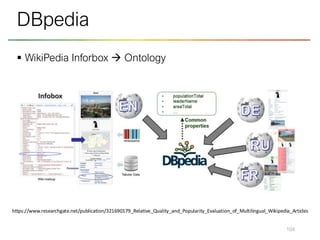
▪ WikiPedia Inforbox → Ontology
104
DBpedia
https://www.researchgate.net/publication/321690179_Relative_Quality_and_Popularity_Evaluation_of_Multilingual_Wikipedia_Articles
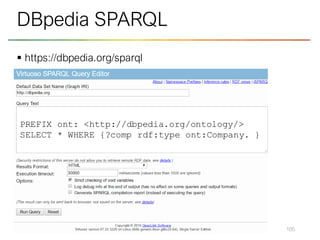
▪ https://dbpedia.org/sparql
105
DBpedia SPARQL
PREFIX ont: <http://dbpedia.org/ontology/>
SELECT * WHERE {?comp rdf:type ont:Company. }
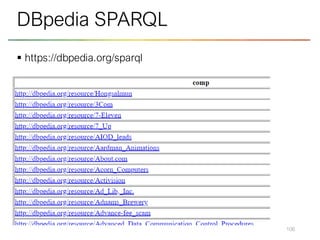
▪ https://dbpedia.org/sparql
106
DBpedia SPARQL
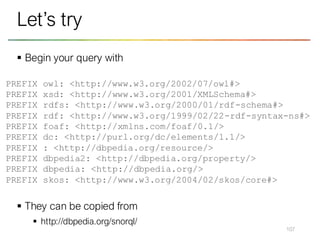
▪ Begin your query with
▪ They can be copied from
▪ http://dbpedia.org/snorql/
107
Let’s try
PREFIX owl: <http://www.w3.org/2002/07/owl#>
PREFIX xsd: <http://www.w3.org/2001/XMLSchema#>
PREFIX rdfs: <http://www.w3.org/2000/01/rdf-schema#>
PREFIX rdf: <http://www.w3.org/1999/02/22-rdf-syntax-ns#>
PREFIX foaf: <http://xmlns.com/foaf/0.1/>
PREFIX dc: <http://purl.org/dc/elements/1.1/>
PREFIX : <http://dbpedia.org/resource/>
PREFIX dbpedia2: <http://dbpedia.org/property/>
PREFIX dbpedia: <http://dbpedia.org/>
PREFIX skos: <http://www.w3.org/2004/02/skos/core#>
108
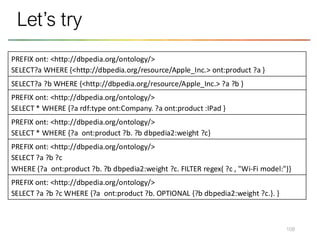
Let’s try
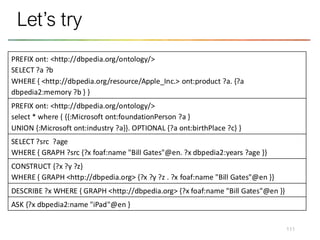
PREFIX ont: <http://dbpedia.org/ontology/>
SELECT?a WHERE {<http://dbpedia.org/resource/Apple_Inc.> ont:product ?a }
SELECT?a ?b WHERE {<http://dbpedia.org/resource/Apple_Inc.> ?a ?b }
PREFIX ont: <http://dbpedia.org/ontology/>
SELECT * WHERE {?a rdf:type ont:Company. ?a ont:product :IPad }
PREFIX ont: <http://dbpedia.org/ontology/>
SELECT * WHERE {?a ont:product ?b. ?b dbpedia2:weight ?c}
PREFIX ont: <http://dbpedia.org/ontology/>
SELECT ?a ?b ?c
WHERE {?a ont:product ?b. ?b dbpedia2:weight ?c. FILTER regex( ?c , "Wi-Fi model:")}
PREFIX ont: <http://dbpedia.org/ontology/>
SELECT ?a ?b ?c WHERE {?a ont:product ?b. OPTIONAL {?b dbpedia2:weight ?c.}. }
109
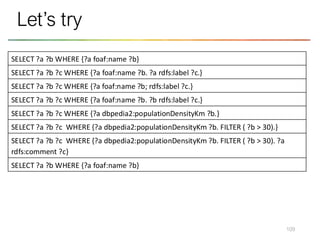
Let’s try
SELECT ?a ?b WHERE {?a foaf:name ?b}
SELECT ?a ?b ?c WHERE {?a foaf:name ?b. ?a rdfs:label ?c.}
SELECT ?a ?b ?c WHERE {?a foaf:name ?b; rdfs:label ?c.}
SELECT ?a ?b ?c WHERE {?a foaf:name ?b. ?b rdfs:label ?c.}
SELECT ?a ?b ?c WHERE {?a dbpedia2:populationDensityKm ?b.}
SELECT ?a ?b ?c WHERE {?a dbpedia2:populationDensityKm ?b. FILTER ( ?b > 30).}
SELECT ?a ?b ?c WHERE {?a dbpedia2:populationDensityKm ?b. FILTER ( ?b > 30). ?a
rdfs:comment ?c}
SELECT ?a ?b WHERE {?a foaf:name ?b}
110
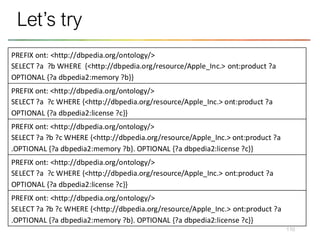
Let’s try
PREFIX ont: <http://dbpedia.org/ontology/>
SELECT ?a ?b WHERE {<http://dbpedia.org/resource/Apple_Inc.> ont:product ?a
OPTIONAL {?a dbpedia2:memory ?b}}
PREFIX ont: <http://dbpedia.org/ontology/>
SELECT ?a ?c WHERE {<http://dbpedia.org/resource/Apple_Inc.> ont:product ?a
OPTIONAL {?a dbpedia2:license ?c}}
PREFIX ont: <http://dbpedia.org/ontology/>
SELECT ?a ?b ?c WHERE {<http://dbpedia.org/resource/Apple_Inc.> ont:product ?a
.OPTIONAL {?a dbpedia2:memory ?b}. OPTIONAL {?a dbpedia2:license ?c}}
PREFIX ont: <http://dbpedia.org/ontology/>
SELECT ?a ?c WHERE {<http://dbpedia.org/resource/Apple_Inc.> ont:product ?a
OPTIONAL {?a dbpedia2:license ?c}}
PREFIX ont: <http://dbpedia.org/ontology/>
SELECT ?a ?b ?c WHERE {<http://dbpedia.org/resource/Apple_Inc.> ont:product ?a
.OPTIONAL {?a dbpedia2:memory ?b}. OPTIONAL {?a dbpedia2:license ?c}}
111
Let’s try
PREFIX ont: <http://dbpedia.org/ontology/>
SELECT ?a ?b
WHERE { <http://dbpedia.org/resource/Apple_Inc.> ont:product ?a. {?a
dbpedia2:memory ?b } }
PREFIX ont: <http://dbpedia.org/ontology/>
select * where { {{:Microsoft ont:foundationPerson ?a }
UNION {:Microsoft ont:industry ?a}}. OPTIONAL {?a ont:birthPlace ?c} }
SELECT ?src ?age
WHERE { GRAPH ?src {?x foaf:name "Bill Gates"@en. ?x dbpedia2:years ?age }}
CONSTRUCT {?x ?y ?z}
WHERE { GRAPH <http://dbpedia.org> {?x ?y ?z . ?x foaf:name "Bill Gates"@en }}
DESCRIBE ?x WHERE { GRAPH <http://dbpedia.org> {?x foaf:name "Bill Gates"@en }}
ASK {?x dbpedia2:name "iPad"@en }
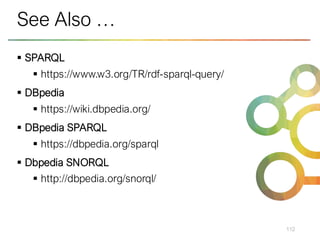
▪ SPARQL
▪ https://www.w3.org/TR/rdf-sparql-query/
▪ DBpedia
▪ https://wiki.dbpedia.org/
▪ DBpedia SPARQL
▪ https://dbpedia.org/sparql
▪ Dbpedia SNORQL
▪ http://dbpedia.org/snorql/
112
See Also …
LOD
Linked Open Data
113
▪ Linked Data is about using the Web to connect related data
that wasn't previously linked, or using the Web to lower the
barriers to linking data currently linked using other methods.
▪ More specifically, Wikipedia defines Linked Data as "a term
used to describe a recommended best practice for
exposing, sharing, and connecting pieces of data,
information, and knowledge on the Semantic Web using
URIs and RDF.“
▪ http://linkeddata.org/
114
Linked Open Data
115
5-star Data
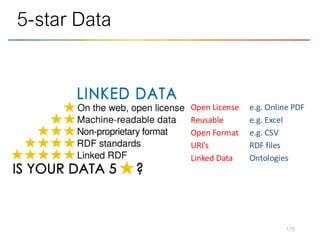
Open License
Reusable
Open Format
URI’s
Linked Data
e.g. Online PDF
e.g. Excel
e.g. CSV
RDF files
Ontologies
116
Triple
ex:Alice
ex:Cindy
foaf:name “Alice”
ex:Bob
foaf:knows
foaf:knows
foaf:currentProject
ex:ABC
117
RDF Graph
ex:Alice
ex:Cindy
foaf:name “Alice”
ex:Bob
foaf:knows
foaf:knows
foaf:currentProject
ex:ABC
118
LOD Cloud → 2007 https://lod-cloud.net/
119
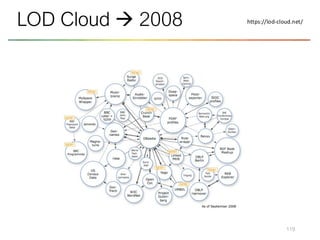
LOD Cloud → 2008 https://lod-cloud.net/
120
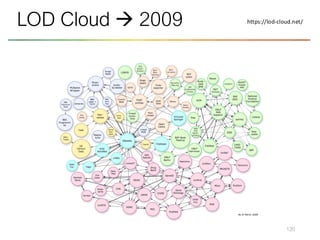
LOD Cloud → 2009 https://lod-cloud.net/
121
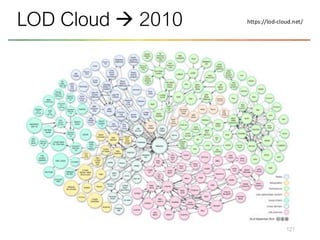
LOD Cloud → 2010 https://lod-cloud.net/
122
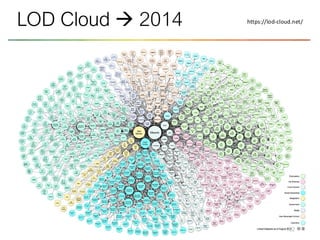
LOD Cloud → 2014 https://lod-cloud.net/
123
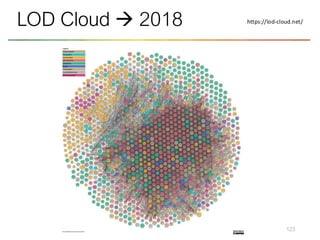
LOD Cloud → 2018 https://lod-cloud.net/
124
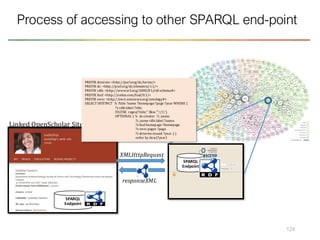
Process of accessing to other SPARQL end-point
SPARQL
Endpoint
SPARQL
Endpoint
Linked OpenScholar Site
PREFIX dcterms: <http://purl.org/dc/terms/>
PREFIX dc: <http://purl.org/dc/elements/1.1/>
PREFIX rdfs: <http://www.w3.org/2000/01/rdf-schema#>
PREFIX foaf: <http://xmlns.com/foaf/0.1/>
PREFIX swrc: <http://swrc.ontoware.org/ontology#>
SELECT DISTINCT ?s ?title ?name ?homepage?page ?year WHERE {
?s rdfs:label ?title.
FILTER regex(?title,"'.$kw.'",'i').
OPTIONAL { ?s dc:creator ?c_name.
?c_name rdfs:label ?name.
?s foaf:homepage ?homepage.
?s swrc:pages ?page.
?s dcterms:issued ?year. } }
order by desc(?year)
XMLHttpRequest
responseXML
125
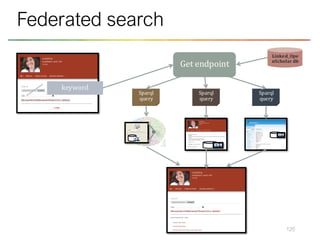
Federated search
keyword
Get endpoint
Linked_Ope
nScholar db
Sparql
query
Sparql
query
Sparql
query
126
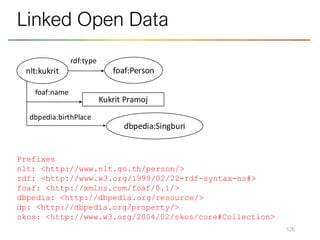
Linked Open Data
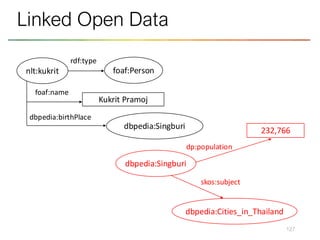
Kukrit Pramoj
dbpedia:Singburi
foaf:name
dbpedia:birthPlace
foaf:Person
rdf:type
nlt:kukrit
Prefixes
nlt: <http://www.nlt.go.th/person/>
rdf: <http://www.w3.org/1999/02/22-rdf-syntax-ns#>
foaf: <http://xmlns.com/foaf/0.1/>
dbpedia: <http://dbpedia.org/resource/>
dp: <http://dbpedia.org/property/>
skos: <http://www.w3.org/2004/02/skos/core#Collection>
127
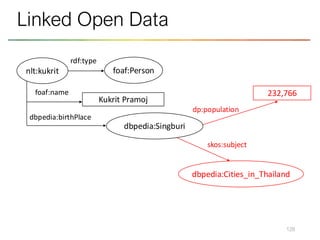
Linked Open Data
Kukrit Pramoj
dbpedia:Singburi
foaf:name
dbpedia:birthPlace
foaf:Person
rdf:type
nlt:kukrit
dbpedia:Cities_in_Thailand
232,766
dp:population
skos:subject
dbpedia:Singburi
dbpedia:Cities_in_Thailand
232,766
dp:population
skos:subject
dbpedia:Singburi
128
Linked Open Data
Kukrit Pramoj
dbpedia:Singburi
foaf:name
dbpedia:birthPlace
foaf:Person
rdf:type
nlt:kukrit
129
Your Data?
▪ DBpedia
▪ https://wiki.dbpedia.org/
▪ Linked Open Data
▪ http://linkeddata.org/
▪ LOD Cloud
▪ https://lod-cloud.net/
130
See Also …
Summary
131
132
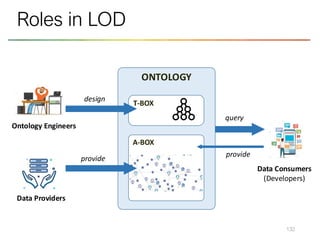
Roles in LOD
ONTOLOGY
T-BOX
A-BOX
Ontology Engineers
Data Providers
Data Consumers
(Developers)
design
provide
query
provide
133
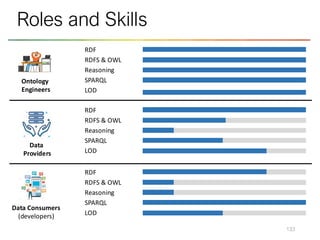
Roles and Skills
Ontology
Engineers
Data
Providers
Data Consumers
(developers)
RDFS & OWL
Reasoning
RDF
SPARQL
LOD
RDFS & OWL
Reasoning
RDF
SPARQL
LOD
RDFS & OWL
Reasoning
RDF
SPARQL
LOD
134
Your Data?
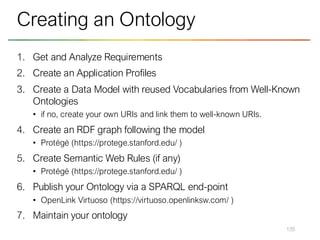
1. Get and Analyze Requirements
2. Create an Application Profiles
3. Create a Data Model with reused Vocabularies from Well-Known
Ontologies
• if no, create your own URIs and link them to well-known URIs.
4. Create an RDF graph following the model
• Protégé (https://protege.stanford.edu/ )
5. Create Semantic Web Rules (if any)
• Protégé (https://protege.stanford.edu/ )
6. Publish your Ontology via a SPARQL end-point
• OpenLink Virtuoso (https://virtuoso.openlinksw.com/ )
7. Maintain your ontology
135
Creating an Ontology

136
Summary
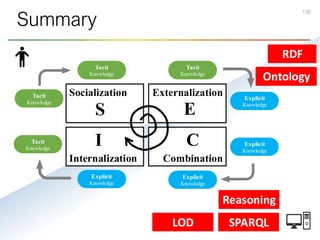
Externalization
Socialization
Combination
Internalization
Tacit
Knowledge
Tacit
Knowledge
Tacit
Knowledge
Tacit
Knowledge
Explicit
Knowledge
Explicit
Knowledge
Explicit
Knowledge
Explicit
Knowledge
S E
I C
RDF
Ontology
Reasoning
SPARQL
LOD
rathachai.creatier.pro
ANY QUESTIONS ARE WELCOME

Semantic Technology

  • 1.
    Rathachai CHAWUTHAI, PhD. SemanticWeb & Ontology Department of Computer Engineering, School of Engineering King Mongkut's Institute of Technology Ladkrabang
  • 2.
    ▪ Now ▪ Assoc.Prof. at Computer Engineering ▪ King Mongkut's Institute of Technology Ladkrabang (KMITL) ▪ Education Background ▪ B.Eng. at KMITL ▪ M.Eng. at AIT ▪ Ph.D at SOKENDAI, Japan ▪ Work Experience ▪ Thomson Reuters Thailand (4 years) ▪ Punsarn Asia (1 years) ▪ NII, Japan (3 years) 2 Rathachai Chawuthai Rathachai rathachai rathachai.c
  • 3.
    Journal Papers andBook Chapters ▪ Chawuthai, R., Takeda, H., Wuwongse, V., & Jinbo, U. (2018). Presenting and preserving the change in taxonomic knowledge for linked data. In Semantic Web Journal. ▪ Chawuthai, R., Jinbo, U., Takeda, H. (2018) “Linked Open Data Model for Taxonomic Information”. In a book titled “Application of Seman tic Technology in Biodiversity Science”. IOS Press. Conference and Workshop Papers ▪ Chawuthai, R., Kertkeidkachorn, N., & Racharak, T. (2023). Modelling an RDF Knowledge Graph with Transitivity and Symmetry for Bus Route Path Finding. In Proceedings of the 2023 6th Artificial Intelligence and Cloud Computing Conference (pp. 126-134). ▪ Chawuthai, R., Takeda, H., Wuwongse, V., & Jinbo, U. (2018). Presenting and preserving the change in taxonomic knowledge for linked data. In Companion Proceedings of the The Web Conference 2018 (pp. 461-465). ▪ Chawuthai, R., & Takeda, H. (2016). Rdf graph visualization by interpreting linked data as knowledge. In Semantic Technology: 5th Joint International Conference, JIST 2015, Yichang, China, November 11-13, 2015, Revised Selected Papers 5 (pp. 23-39). Springer International Publishing. ▪ Cazabet, R., Chawuthai, R., & Takeda, H. (2015). Using multiple-criteria methods to evaluate community partitions. arXiv preprint arXiv:1502.05149. ▪ Chawuthai, R., & Takeda, H. (2015). rSim: Simplifying an RDF Graph at the Visualization Tier for Non-Expert Users. In ISWC (Posters & Demos). ▪ Chawuthai, R., Takeda, H., & Hosoya, T. (2015). Link prediction in linked data of interspecies interactions using hybrid recommendation approach. In Semantic Technology: 4th Joint International Conference, JIST 2014, Chiang Mai, Thailand, November 9-11, 2014. Revised Selected Papers 4 (pp. 113- 128). Springer International Publishing. ▪ Nonthakarn, C., Chawuthai, R., & Wuwongse, V. (2014). An Application Profile for Linked Teacher Profiles and Teaching Resources. In The Emergence of Digital Libraries–Research and Practices: 16th International Conference on Asia-Pacific Digital Libraries, ICADL 2014, Chiang Mai, Thailand, November 5-7, 2014. Proceedings 16 (pp. 138-148). Springer International Publishing. ▪ Chawuthai, R., Takeda, H., Wuwongse, V., & Jinbo, U. (2013). A logical model for taxonomic concepts for expanding knowledge using Linked Open Data. Semantics for Biodiversity (S4BioDiv 2013), 9. ▪ Chawuthai, R., Wuwongse, V., & Takeda, H. (2012). A formal approach to the modelling of digital archives. In The Outreach of Digital Libraries: A Globalized Resource Network: 14th International Conference on Asia-Pacific Digital Libraries, ICADL 2012, Taipei, Taiwan, November 12-15, 2012, Proceedings 14 (pp. 179-188). Springer Berlin Heidelberg. 3 Publications about Semantic Web
  • 4.
    Agenda ▪ Introduction ▪ RDFGraph ▪ RDF Schema ▪ Upper Ontology ▪ Designing Ontology ▪ Reasoning ▪ Query ▪ LOD
  • 5.
  • 6.
    6 References Foundations of SemanticWeb Technologies by Pascal Hitzler , Markus Krötzsch , Sebastian Rudolph http://www.semantic-web-book.org/page/ Foundations_of_Semantic_Web_Technologies Linked Data: Evolving the Web into a Global Data Space By Tom Heath , Christian Bizer http://linkeddatabook.com
  • 7.
  • 8.
    8 Lessons from AI(Artificial Intelligence) expert systems machine learning systems We need DATA We need Structured DATA We need Meaningful & Structured DATA We need Meaningful , Exchangeable & Structured DATA AI Systems Rule-Driven Data-Driven
  • 9.
  • 10.
  • 11.
    ▪ USA: NSFDATA SHARING POLICY 11 USA Investigators are expected to share with other researchers the primary data, samples, physical collections and other supporting materials created or gathered in the course of work under NSF grants.
  • 12.
  • 13.
  • 14.
    ▪ Linked Datais about using the Web to connect related data that wasn't previously linked, or using the Web to lower the barriers to linking data currently linked using other methods. ▪ Global Knowledge Management System ▪ More specifically, Wikipedia defines Linked Data as "a term used to describe a recommended best practice for exposing, sharing, and connecting pieces of data, information, and knowledge on the Semantic Web using URIs and RDF.“ ▪ http://linkeddata.org/ 14 Linked Open Data
  • 15.
    ▪ Linked OpenData (LOD) is one practice approach of Sematic Web. ▪ One significant ability is to integrate open data from different schemas through the Internet. ▪ A graph is a data structure that is used in LOD. ▪ The reasoning on graph data together with schemas and ontologies can improve the connection and accessibility of data. ▪ Thus, we would like to provide background knowledge of RDF graph, RDF Schema, ontology, reasoning, query, and LOD cloud. 15 Introduction
  • 16.
    16 Roles in LOD ONTOLOGY T-BOX A-BOX OntologyEngineers Data Providers Data Consumers (Developers) design provide query provide
  • 17.
    17 Roles and Skills Ontology Engineers Data Providers DataConsumers (developers) RDFS & OWL Reasoning RDF SPARQL LOD RDFS & OWL Reasoning RDF SPARQL LOD RDFS & OWL Reasoning RDF SPARQL LOD
  • 18.
  • 19.
    ▪ Resource DescriptionFramework (RDF) ▪ Graph data model in LOD is presented by a direct graph. Nodes can be either named resources or literals, while links are named properties. Every resource and property is written using a Uniform Resource Identifier (URI), and the structure of graph is modeled by Resource Description Framework (RDF) 19 RDF <URI> <URI> <URI>
  • 20.
    ▪ Uniform ResourceIdentifier (URI) ▪ Every resource and property must be identified. In the RDF model, the URI is used to be the identifier of resources and properties. ▪ For example, ▪ are resources describing the terms “Sokendai”, “Rathachai”, and “studies at” respectively. URIs are used to identified real- world objects and abstract concepts. 20 URI http://www.example.org/universities/Sokendai http://www.example.org/students#Rathachai http://www.example.org/terms#studiesAt
  • 21.
    ▪ LOD recommendedthat the URI should be HTTP URI, and clients can access each URI using the HTTP protocol and then get a returned document according to requested format. ▪ RDF allows having short-hand writing, for example if a prefix is defined as ▪ The former URIs can be shortened to be unv:Sokendai, std:Rathachai, and :studiesAt. 21 Prefix @prefix unv: <http://www.example.org/universities/> . @prefix std: <http://www.example.org/students#> . @prefix : <http://www.example.org/terms#> .
  • 22.
    ▪ Literals aretexts that are typed and untyped. The untyped literal can be any string such as “Rathachai Chawuthai”, “December 1986”, “18.12”, and “+8180-7999-1818”. ▪ A string can be ended with a language tag in order to inform the language of a text. In addition, the typed literal contain a property value together with a URI of datatype. ▪ For example •"Linked Open Data"@en presents that this string is in English. •"555"^^xsd:integer presents an integer of 555. •"1986-12-18"^^xsd:date presents a date of Dec 18th, 1986. 22 Literal
  • 23.
    • Triple isa binary relation between two entities, and it is the fundamental unit of an RDF graph. It includes the sequence of a subject, a predicate, and an object. Subjects and predicates are resources represented by URIs, but objects can be either resources or literals. • The formal representation of triple is  s,p,o  where s is a subject, p is a predicate or a property, and o is an object. In the graph diagram, the URI of a resource is commonly written inside an eclipse, a literal is presented by a quoted text inside a rectangle, and an arrows with the URI of predicate are drawn from a subject to an object. 23 Triple
  • 24.
    a) The resourcestd:Rathachai is a subject, the :studiesAt is a predicate, and the unv:Sokendai is an object; and humans can simply interpret that Rathachai studies at Sokendai. b) The resource std:Rathachai is a subject, the foaf:name is a predicate, and the “Rathachai Chawuthai” is an object literal, and humans can simply interpret that Rathachai’s name is “Rathachai Chawuthai”. 24 Triple std:Rathachai unv:Sokendai :studiesAt std:Rathachai foaf:name “Rathachai Chawuthai” (a) (b)
  • 25.
    25 RDF Syntaxes andDialects Kukrit Promoj dc:creator http://www.nlt.go.th/novel/ Four-Reins <rdf:RDF xmlns:rdf="http://www.w3.org/1999/02/22-rdf-syntax-ns#" xmlns:dc="http://purl.org/dc/elements/1.1/"> <rdf:Description rdf:about="http://www.nlt.go.th/novel/Four-Reins"> <dc:creator>Kukrit Pramoj</dc:creator> </rdf:Description> </rdf:RDF> RDF/XML @prefix dc: <http://purl.org/dc/elements/1.1/> . <http://www.nlt.go.th/novel/Four-Reins> dc:creator “Kukrit Pramote" . RDF/Turtle <http://www.nlt.go.th/novel/Four-Reins> <http://purl.org/dc/elements/1.1/creator> “Kukrit Pramoj" . N-Triples
  • 26.
    ▪ A triplecan be expressed by several formats such as Turtle, XML, JSON-LD, and N-Triples, etc. In this thesis, we commonly use the Turtle (or RDF/Turtle) because it is convenient to read and write by humans. ▪ The Fig (a) can be expressed in Turtle format by 26 RDF Expression <http://www.example.org/students#Rathachai> <http://www.example.org/terms/studiesAt> <http://www.example.org/universities/Sokendai> . std:Rathachai unv:Sokendai :studiesAt std:Rathachai foaf:name “Rathachai Chawuthai” (a) (b)
  • 27.
    ▪ Fig (a)can be shortened into ▪ Fig (b) can also be shorten into 27 Turtle @prefix unv: <http://www.example.org/universities/> . @prefix std: <http://www.example.org/students#> . @prefix : <http://www.example.org/terms/> . std:Rathachai :studiesAt unv:Sokendai . @prefix std: <http://www.example.org/students#> . @prefix foaf: <http://xmlns.com/foaf/0.1/> . std:Rathachai foaf:name "Rathachai Chawuthai" .
  • 28.
  • 29.
    ▪ RDF graphthat can be called as RDF model is a set of triples. It can be written in Turtle, so triples can be stated in curly brackets such as { :s1 :p1 :o1 . :s2 :p2 :o2 . }, and the expression can be abbreviated as the following list. ▪ It is noted that the declaration of prefixes is sometime avoid in some expressions in order to make it be simpler and easier for reading and reduce text length. 29 RDF Graph
  • 30.
    • If triplesshare the same subject and predicate, it can put objects in an object list and separate them by comma (,). • For example, a graph { :s1 :p1 :o1 . :s1 :p1 :o2 . } can be abbreviated as { :s1 :p1 :o1 , :o2 . }. 30 RDF Graph
  • 31.
    • If triplesshare the same subject, it can put predicates and objects in a predicate list and separate them by semi-colon (;). • For example, a graph { :s1 :p1 :o1 . :s1 :p2 :o2 . } can be abbreviated as { :s1 :p1 :o1 ; :p2 :o2 . } 31 RDF Graph
  • 32.
    • If triplescontain the chain of same blank node, it can put the relative cause in square brackets. • For example, a graph { ex:Ryu foaf:knows _:a1 . _:a1 foaf:name “Ken” . } can be abbreviated as { ex:Ryu foaf:knows [ foaf:name “Ken”] . } which can be read as Ryu knows someone whose name is “Ken”. 32 RDF Graph
  • 33.
    33 RDF Graph ex:Alice ex:Cindy foaf:name “Alice” ex:Bob foaf:knows foaf:knows foaf:currentProject ex:ABC ex:Alicefoaf:name "Alice" . ex:Alice foaf:knows ex:Bob . ex:Alice foaf:knows ex:Cindy . ex:Cindy foaf:currentProject ex:ABC .
  • 34.
    34 RDF Graph ex:Alice foaf:name"Alice" ; foaf:knows ex:Bob , ex:Cindy . ex:Cindy foaf:currentProject ex:ABC . can be abbreviated as the following expression ex:Alice foaf:name "Alice" . ex:Alice foaf:knows ex:Bob . ex:Alice foaf:knows ex:Cindy . ex:Cindy foaf:currentProject ex:ABC .
  • 35.
    35 RDF Graph ex:Alice foaf:name"Alice" ; foaf:knows ex:Bob , ex: Cindy . ex:Cindy foaf:currentProject ex:ABC . ex:Alice ex:Cindy foaf:name “Alice” ex:Bob foaf:knows foaf:knows foaf:currentProject ex:ABC
  • 36.
    ▪ RDF ▪ https://www.w3.org/TR/rdf-primer/ ▪Tools ▪ Protégé ▪ https://protege.stanford.edu/ ▪ OpenLink Virtuoso ▪ https://virtuoso.openlinksw.com/ ▪ RDF4J ▪ http://rdf4j.org/ 36 See Also …
  • 37.
  • 38.
    ▪ Without interpretation,an RDF statement is just a string of characters. ▪ Adding meaning to an RDF graph is a key feature of Semantic Web, and this feature makes an RDF graph become excellently machine-readable. ▪ Ontology is a formal, explicit specification of a shared conceptualization. 38 The Interpretation on Ontology
  • 39.
  • 40.
    ▪ Ontology isa formal, explicit specification of a shared conceptualization. ▪ Formal refers to machine-readable; explicit specification refers to concepts, properties, relations, constants, taxonomies, and axioms; and shared conceptualization refers to consensual knowledge of abstract model and real- world objects. ▪ An RDF graph is also one part of ontology. With the higher interpretation of RDF data with either RDF Schema or ontologies, the graph is more expressive. 40 The Interpretation on Ontology
  • 41.
    ▪ RDFS providebasic entailments for interpreting ontologies. It mainly includes the interpretation of classes, properties, the hierarchies of classes, and the hierarchies of properties. There are 13 RDFS deduction rules for RDFS-Entailment, but we describe only rules that use in this thesis. ▪ It is noted that the statement  x, rdf:type, C  where x and C are any URIs and they can be interpreted that the instance x is a member of a class or a set C. ▪ In this section, the name of a class is recommended to begin with an uppercase letter, while the name of either an instance or a property begins with a lowercase letter. 41 RDF Schema (RDFS)
  • 42.
    42 Roles in LOD ONTOLOGY T-BOX A-BOX OntologyEngineers Data Providers Data Consumers (Developers) design provide query provide
  • 43.
    43 Roles and Skills Ontology Engineers Data Providers DataConsumers (developers) RDFS & OWL Reasoning RDF SPARQL LOD RDFS & OWL Reasoning RDF SPARQL LOD RDFS & OWL Reasoning RDF SPARQL LOD
  • 44.
    • rdfs2: if p, rdfs:domain, C  and  s, p, o  , then  s, rdf:type, C  . • Example: if  :writes, rdfs:domain, foaf:Person  and  pp:John, :writes, ex:math101  , then  pp:John , rdf:type, foaf:Person  . 44 Domain s o p
  • 45.
    • rdfs3: if p, rdfs:range, C  and  s, p, o  , then  o, rdf:type, C  . • Example if  :writes, rdfs:range, :TextBook  and  pp:John, :writes, ex:math101  , then  ex:math101, rdf:type, :TextBook  . 45 Range s o p
  • 46.
    • rdfs5: if p2, rdfs:subPropertyOf, p1  and  p1, rdfs:subPropertyOf, p0  , then  p2, rdfs:subPropertyOf, p0  . • Example: if  :writes, rdfs:subPropertyOf, :create  and  :composes, rdfs:subPropertyOf, :write  , then  :composes, rdfs:subPropertyOf, :creates  . 46 Subproperties s o p1 p1 p0 p2 rdfs:sub Property Of rdfs:sub Property Of
  • 47.
    • rdfs7: if p1, rdfs:subPropertyOf, p0  and  s, p1, o  , then  s, p0, o  . • Example: if  :writes, rdfs:subPropertyOf, :creates  and  pp:John, :writes, ex:math101  , then  pp:John, :creates, ex:math101  . 47 Subproperties s o p1 p1 p0 p2 rdfs:sub Property Of rdfs:sub Property Of
  • 48.
    • rdfs9: if C1, rdfs:subClassOf, C0  and  x, rdf:type, C1  , then  x, rdf:type, C0  . • Example: if  :TextBook, rdfs:subClassOf, :Book  and  ex:math101, rdf:type, :TextBook  , then  ex:math101, rdf:type, :Book  . 48 Subclasses x C1 rdf:type C1 C0 C2 rdfs:sub ClassOf rdfs:sub ClassOf
  • 49.
    • rdfs11: if C2, rdfs:subClassOf, C1  and  C1, rdfs:subClassof, C0  , then  C2, rdfs:subClassOf, C0  . • Example: if  :TextBook, rdfs:subClassOf, :Book  and  :Book, rdfs:subClassof, :Document  , then  :TextBook, rdfs:subClassOf, :Document  . 49 Subclasses x C1 rdf:type C1 C0 C2 rdfs:sub ClassOf rdfs:sub ClassOf
  • 50.
    50 RDF Entailment foaf:Person rdfs:subClassOffoaf:Agent . foaf:homepage rdfs:subPropertyOf foaf:page ; rdfs:range foaf:Document . ex:dan rdf:type foaf:Person ; foaf:homepage <http://dan.info> . TBox ABox
  • 51.
    51 RDF Entailment rdfs3: if p, rdfs:range, C  and  s, p, o  , then  o, rdf:type, C  . foaf:Person rdfs:subClassOf foaf:Agent . foaf:homepage rdfs:subPropertyOf foaf:page ; rdfs:range foaf:Document . ex:dan rdf:type foaf:Person ; foaf:homepage <http://dan.info> . <http://dan.info> rdf:type foaf:Document . TBox ABox
  • 52.
    52 RDF Entailment rdfs7: if p1, rdfs:subPropertyOf, p0  and  s, p1, o  , then  s, p0, o  . foaf:Person rdfs:subClassOf foaf:Agent . foaf:homepage rdfs:subPropertyOf foaf:page ; rdfs:range foaf:Document . ex:dan rdf:type foaf:Person ; foaf:homepage <http://dan.info> . ex:dan foaf:page <http://dan.info> . TBox ABox
  • 53.
    53 RDF Entailment rdfs9: if C1, rdfs:subClassOf, C0  and  x, rdf:type, C1  , then  x, rdf:type, C0  . foaf:Person rdfs:subClassOf foaf:Agent . foaf:homepage rdfs:subPropertyOf foaf:page ; rdfs:range foaf:Document . ex:dan rdf:type foaf:Person ; foaf:homepage <http://dan.info> . ex:dan rdf:type foaf:Agent . TBox ABox
  • 54.
    54 RDF Entailment foaf:Person rdfs:subClassOffoaf:Agent . foaf:homepage rdfs:subPropertyOf foaf:page ; rdfs:range foaf:Document . ex:dan rdf:type foaf:Person ; foaf:homepage <http://dan.info> . TBox ABox <http://dan.info> rdf:type foaf:Document . ex:dan foaf:page <http://dan.info> . ex:dan rdf:type foaf:Agent .
  • 55.
  • 56.
    56 Roles in LOD ONTOLOGY T-BOX A-BOX OntologyEngineers Data Providers Data Consumers (Developers) design provide query provide
  • 57.
    57 Roles and Skills Ontology Engineers Data Providers DataConsumers (developers) RDFS & OWL Reasoning RDF SPARQL LOD RDFS & OWL Reasoning RDF SPARQL LOD RDFS & OWL Reasoning RDF SPARQL LOD
  • 58.
  • 59.
    ▪ OWL isa recommended standard for the modelling of ontologies. It gives higher interpretation over RDF and RDFS, so the representation of a knowledge graph becomes more expressive. There are many features and details in OWL, however, this review selects some features that are commonly used in this thesis, for example equality and property characteristics. ▪ It is firstly informed that every instance is belong to owl:Thing. 59 Web Ontology Language (OWL)
  • 60.
    same-as: if  s1,owl:sameAs, s2  and  s1, p1, o1  , then  s2, p1, o1  . if  o1, owl:sameAs, o2  and  s1, p1, o1  , then  s1, p1, o2  . Example: if  pp:9Arm, owl:sameAs, pp:Thananon  and  pp:9Arm, rdf:type, :YouTuber  , then  pp:Thananon, rdf:type, :YouTuber  . 60 Equality
  • 61.
    equivalence class: if C1, owl:equivalentClass, C2  and  x, rdf:type, C1  , then  x, rdf:type, C2  . equivalence property: if  p1, owl:equivalentProperty, p2  and  s1, p1, o1  , then  s1, p2, o1  . 61 Equality
  • 62.
    transitive property: if p, rdf:type, owl:TransitiveProperty  ,  x, p, y  , and  y, p, z  , then  x, p, z  . 62 Property Characteristics x y p z p p e.g. p = :is_in
  • 63.
    symmetric property: if p, rdf:type, owl:SymmetricProperty  and  x, p, y  then  y, p, x  . 63 Property Characteristics x y p p e.g. p = :knows
  • 64.
    inverse property: if p1, owl:inverseOf, p2  , and  x, p1, y  then  y, p2, x  . 64 Property Characteristics x y p1 p2 e.g. p1 = :has_child p2 = :has_parent
  • 65.
    65 OWL Reasoning skos:broaderTransitive rdf:typeowl:TransitiveProperty . skos:broader owl:reverseOf skos:narrower . ex:football owl:sameAs ex:soccer . ex:football skos:broader ex:sport . ex:dog skos:broaderTransitive ex:mammal . ex:mammal skos:broaderTransitive ex:animal . ex:soccer skos:broader ex:sport . ex:sport skos:narrower ex:football . ex:sport skos:narrower ex:soccer . ex:dog skos:broaderTransitive ex:animal . TBox ABox
  • 66.
    • DC-Term (DCMImetadata term), which is the extension of Dublin Core Metadata, contains metadata for describing a documents and their relationships. For example • dct:isVersionOf is a property that identify the previous version of a term. • dct:source is a property that identify the reference. • http://dublincore.org/documents/dcmi-terms/ 66 DC-Term
  • 67.
    • FOAF (Friendof a Friend) ontology provides vocabularies for describing humans, organizations, and documents, and relationships among them. For example • foaf:Person is a class of persons, and it is the sub class of foaf:Agent. • foaf:knows is a symmetric property that identifies persons knowing each other. • foaf:depiction is a property that points to a picture that is the instance of the class foaf:Image. • http://xmlns.com/foaf/spec/ 67 FOAF
  • 68.
    • SKOS (SimpleKnowledge Organization System) ontology provides a model for expressing the basic structure and content of concept schemes. For example • skos:broader is a property that identifies the board concept of a given concept. • skos:broaderTransitive is a transitive property that identifies the transitively board concept of a given concept. • skos:narrower is a property that identifies the narrow concept of a given concept and it is the inverse property of skos:broader. • skos:narrowerTransitive is a property that identifies the transitively narrow concept of a given concept and it is the inverse property of skos:broaderTransitive. • https://www.w3.org/TR/skos-primer/ 68 SKOS
  • 69.
    ▪ RDFS ▪ https://www.w3.org/TR/rdf-schema/ ▪OWL ▪ https://www.w3.org/TR/2012/ REC-owl2-primer-20121211/ ▪ List of Ontologies ▪ http://semanticweb.org/wiki/Ontology 69 See Also …
  • 70.
  • 71.
    71 Roles in LOD ONTOLOGY T-BOX A-BOX OntologyEngineers Data Providers Data Consumers (Developers) design provide query provide
  • 72.
    72 Roles and Skills Ontology Engineers Data Providers DataConsumers (developers) RDFS & OWL Reasoning RDF SPARQL LOD RDFS & OWL Reasoning RDF SPARQL LOD RDFS & OWL Reasoning RDF SPARQL LOD
  • 73.
  • 74.
    ▪ Open Teacher 74 Application Profile เพื่อการ ติดต่อ Teacher TeacherProfile Academic Work Course Event Award for showing awards or certificates received by teachers for describing some necessary details of a teacher for recording some academic activities participated by teachers for introducing some academic works produced by teachers for informing courses taught by teachers
  • 75.
    ▪ Domain Model 75 ApplicationProfile Teacher opt:TeacherProfile Course opt:Course Academic Work opt:AcademicWork Event opt:Event Award opt:Award otp:lecturedBy vivo:awardOr HonorFor dc:creator event:agent otp: award Received
  • 76.
  • 77.
    ▪ opt:TeacherProfile 77 Teacher Profile PropertyURI Example Value Identifier vivo:identifier “1976072189” Preferred Title vivo:preferredTitle “Ajarn” First name foaf:firstName “Prayut” Last name foaf:lastName “Chawuthai” Academic Standing vivo:hasTeacherRole otp:ExpertTeacher Academic Degree otp:hasAcademicDegree otp:Bachelor Email foaf:mbox “ajprayut@gmail.com” Website foaf:homepage https://profile.com/prayut Field of Expertise otp:expertIn otp:Art, otp:Math Area lom:discipline otp:Art
  • 78.
    ▪ opt:Course 78 Course Property URIExample Value Course Code dc:identifier “ART-101 Course Name dc:title “Fundamentals of Art 1” Lecturer otp:courseLecturedBy ex:Prayut Begin Date tl:beginAtDateTime “2011-06-01T09:00:00Z”^^xsd:dateTime End date tl:endAtDateTime “2011-09-30T10:00:00Z”^^xsd:dateTime Learning Area lom:discipline otp:Art Grade lom:educationLevel otp:Grade1
  • 79.
    ex:Prayut rdf:type otp:TeacherProfile; vivo:identifier “1976072189” ; foaf:firstName “Prayut” ; vivo:hasTeacherRole otp:ExpertTeacher ; lom:discipline otp:Art, otp:Math ; otp:expertIn otp:WaterColor . ex:art101 rdf:type otp:Course dc:title “Fundamentals of Art 1” ; dc:identifier “ART-101” ; otp:courseLecturedBy ex:Prayut ; lom:discipline otp:Art ; lom:educationLevel otp:Grade1 . 79 Example
  • 80.
    ▪ List ofOntologies ▪ http://semanticweb.org/wiki/Ontology ▪ Open Teacher ▪ https://link.springer.com/chapter/ 10.1007/978-3-319-12823-8_15 ▪ Linked Taxonomic Knowledge ▪ https://content.iospress.com/ articles/semantic-web/sw192 ▪ Protégé ▪ https://protege.stanford.edu/ 80 See Also …
  • 81.
  • 82.
    ▪ RDFS andOWL provide necessary rules to entail an RDF graph. ▪ In case some specific requirements beyond RDFS and OWL are needed, developers can create some Semantic Web rules. ▪ For creating own rules, the book of Semantic Web programming recommended to use Apache Jena as a reasoning engine that is a library of Java. 82 Semantic Web Reasoning
  • 83.
    ▪ For example,in case the condition “An uncle is a brother of one’s father” is defined, it can be simply expressed that: If  x, :hasFather, y  and  y, :hasBrother, z  , then  x, :hasUncle, z  . This rule can be written in a dialog program as follows: 83 Semantic Web Rules hasFather(?x, ?y) ∧ hasBrother(?y, ?z) → hasUncle(?x, ?z)
  • 84.
    ▪ Semantic WebRule ▪ JENA Rule 84 JENA [rule_identify_uncle: (?x :hasFather ?y), (?y :hasBrother ?z) ->(?x :hasUncle ?z)] hasFather(?x, ?y) ∧ hasBrother(?y, ?z) → hasUncle(?x, ?z)
  • 85.
    ▪ RDF Data ▪JENA Rule ▪ Result 85 HEAD [rule_identify_uncle: (?x :hasFather ?y), (?y :hasBrother ?z) ->(?x :hasUncle ?z)] ex:john :hasFather ex:smith . ex:smith :hasBrother ex:adam . ex:john :hasUncle ex:adam .
  • 86.
    ▪ Semantic WebRules ▪ https://www.w3.org/Submission/SWRL/ ▪ JENA ▪ https://jena.apache.org/ documentation/inference/ ▪ Protégé ▪ https://protege.stanford.edu/ 86 See Also …
  • 87.
  • 88.
    88 Roles in LOD ONTOLOGY T-BOX A-BOX OntologyEngineers Data Providers Data Consumers (Developers) design provide query provide
  • 89.
    89 Roles and Skills Ontology Engineers Data Providers DataConsumers (developers) RDFS & OWL Reasoning RDF SPARQL LOD RDFS & OWL Reasoning RDF SPARQL LOD RDFS & OWL Reasoning RDF SPARQL LOD
  • 90.
    ▪ SPARQL (SPARQLProtocol and RDF Query Language) is a protocol and query language for querying RDF data. The syntax includes prefixes, scheme or result, and condition. 90 SPARQL https://blog.52north.org/2015/05/28/sparql-endpoint-and-interoperability-of-envirocar-data/sparql-11-graph-store/
  • 91.
  • 92.
  • 93.
  • 94.
    94 SPARQL : 2++Conditions https://www.w3.org/TR/rdf-sparql-query/
  • 95.
  • 96.
  • 97.
  • 98.
  • 99.
  • 100.
  • 101.
  • 102.
    ▪ RDF Data ▪SPARQL Statement ▪ Query Result 102 SPARQL: Select ex:Movie rdfs:subClassOf ex:Entertainment . ex:TVSeries rdfs:subClassOf ex:Entertainment . ex:starwarsVII rdf:type ex:Movie ; ex:starring ex:daisy, ex:adam . ex:gameOfThrones rdf:type ex:TVSeries . PREFIX rdf: <http://www.w3.org/1999/02/22-rdf-syntax-ns#> PREFIX ex: < http://www.example.org/ex-terms/> SELECT ?ent WHERE { ?ent rdf:type ex:Entertainment .} +-----------------------------------------------+ | ?ent | +-----------------------------------------------+ | http://www.example.org/ex-terms/starwarsVII | | http://www.example.org/ex-terms/gameOfThrones | +-----------------------------------------------+
  • 103.
    ▪ RDF Data ▪SPARQL Statement ▪ Query Result 103 SPARQL: Construct ex:Movie rdfs:subClassOf ex:Entertainment . ex:TVSeries rdfs:subClassOf ex:Entertainment . ex:starwarsVII rdf:type ex:Movie ; ex:starring ex:daisy, ex:adam . ex:gameOfThrones rdf:type ex:TVSeries . PREFIX rdf: <http://www.w3.org/1999/02/22-rdf-syntax-ns#> PREFIX ex: < http://www.example.org/ex-terms/> PREFIX foaf: <http://xmlns.com/foaf/0.1/> CONSTRUCT { ?a foaf:knows ?b .} WHERE { ?ent ex:starring ?a , ?b .} <http://www.example.org/ex-terms/daisy> <http://xmlns.com/foaf/0.1/knows> <http://www.example.org/ex-terms/adam> .
  • 104.
    ▪ WikiPedia Inforbox→ Ontology 104 DBpedia https://www.researchgate.net/publication/321690179_Relative_Quality_and_Popularity_Evaluation_of_Multilingual_Wikipedia_Articles
  • 105.
    ▪ https://dbpedia.org/sparql 105 DBpedia SPARQL PREFIXont: <http://dbpedia.org/ontology/> SELECT * WHERE {?comp rdf:type ont:Company. }
  • 106.
  • 107.
    ▪ Begin yourquery with ▪ They can be copied from ▪ http://dbpedia.org/snorql/ 107 Let’s try PREFIX owl: <http://www.w3.org/2002/07/owl#> PREFIX xsd: <http://www.w3.org/2001/XMLSchema#> PREFIX rdfs: <http://www.w3.org/2000/01/rdf-schema#> PREFIX rdf: <http://www.w3.org/1999/02/22-rdf-syntax-ns#> PREFIX foaf: <http://xmlns.com/foaf/0.1/> PREFIX dc: <http://purl.org/dc/elements/1.1/> PREFIX : <http://dbpedia.org/resource/> PREFIX dbpedia2: <http://dbpedia.org/property/> PREFIX dbpedia: <http://dbpedia.org/> PREFIX skos: <http://www.w3.org/2004/02/skos/core#>
  • 108.
    108 Let’s try PREFIX ont:<http://dbpedia.org/ontology/> SELECT?a WHERE {<http://dbpedia.org/resource/Apple_Inc.> ont:product ?a } SELECT?a ?b WHERE {<http://dbpedia.org/resource/Apple_Inc.> ?a ?b } PREFIX ont: <http://dbpedia.org/ontology/> SELECT * WHERE {?a rdf:type ont:Company. ?a ont:product :IPad } PREFIX ont: <http://dbpedia.org/ontology/> SELECT * WHERE {?a ont:product ?b. ?b dbpedia2:weight ?c} PREFIX ont: <http://dbpedia.org/ontology/> SELECT ?a ?b ?c WHERE {?a ont:product ?b. ?b dbpedia2:weight ?c. FILTER regex( ?c , "Wi-Fi model:")} PREFIX ont: <http://dbpedia.org/ontology/> SELECT ?a ?b ?c WHERE {?a ont:product ?b. OPTIONAL {?b dbpedia2:weight ?c.}. }
  • 109.
    109 Let’s try SELECT ?a?b WHERE {?a foaf:name ?b} SELECT ?a ?b ?c WHERE {?a foaf:name ?b. ?a rdfs:label ?c.} SELECT ?a ?b ?c WHERE {?a foaf:name ?b; rdfs:label ?c.} SELECT ?a ?b ?c WHERE {?a foaf:name ?b. ?b rdfs:label ?c.} SELECT ?a ?b ?c WHERE {?a dbpedia2:populationDensityKm ?b.} SELECT ?a ?b ?c WHERE {?a dbpedia2:populationDensityKm ?b. FILTER ( ?b > 30).} SELECT ?a ?b ?c WHERE {?a dbpedia2:populationDensityKm ?b. FILTER ( ?b > 30). ?a rdfs:comment ?c} SELECT ?a ?b WHERE {?a foaf:name ?b}
  • 110.
    110 Let’s try PREFIX ont:<http://dbpedia.org/ontology/> SELECT ?a ?b WHERE {<http://dbpedia.org/resource/Apple_Inc.> ont:product ?a OPTIONAL {?a dbpedia2:memory ?b}} PREFIX ont: <http://dbpedia.org/ontology/> SELECT ?a ?c WHERE {<http://dbpedia.org/resource/Apple_Inc.> ont:product ?a OPTIONAL {?a dbpedia2:license ?c}} PREFIX ont: <http://dbpedia.org/ontology/> SELECT ?a ?b ?c WHERE {<http://dbpedia.org/resource/Apple_Inc.> ont:product ?a .OPTIONAL {?a dbpedia2:memory ?b}. OPTIONAL {?a dbpedia2:license ?c}} PREFIX ont: <http://dbpedia.org/ontology/> SELECT ?a ?c WHERE {<http://dbpedia.org/resource/Apple_Inc.> ont:product ?a OPTIONAL {?a dbpedia2:license ?c}} PREFIX ont: <http://dbpedia.org/ontology/> SELECT ?a ?b ?c WHERE {<http://dbpedia.org/resource/Apple_Inc.> ont:product ?a .OPTIONAL {?a dbpedia2:memory ?b}. OPTIONAL {?a dbpedia2:license ?c}}
  • 111.
    111 Let’s try PREFIX ont:<http://dbpedia.org/ontology/> SELECT ?a ?b WHERE { <http://dbpedia.org/resource/Apple_Inc.> ont:product ?a. {?a dbpedia2:memory ?b } } PREFIX ont: <http://dbpedia.org/ontology/> select * where { {{:Microsoft ont:foundationPerson ?a } UNION {:Microsoft ont:industry ?a}}. OPTIONAL {?a ont:birthPlace ?c} } SELECT ?src ?age WHERE { GRAPH ?src {?x foaf:name "Bill Gates"@en. ?x dbpedia2:years ?age }} CONSTRUCT {?x ?y ?z} WHERE { GRAPH <http://dbpedia.org> {?x ?y ?z . ?x foaf:name "Bill Gates"@en }} DESCRIBE ?x WHERE { GRAPH <http://dbpedia.org> {?x foaf:name "Bill Gates"@en }} ASK {?x dbpedia2:name "iPad"@en }
  • 112.
    ▪ SPARQL ▪ https://www.w3.org/TR/rdf-sparql-query/ ▪DBpedia ▪ https://wiki.dbpedia.org/ ▪ DBpedia SPARQL ▪ https://dbpedia.org/sparql ▪ Dbpedia SNORQL ▪ http://dbpedia.org/snorql/ 112 See Also …
  • 113.
  • 114.
    ▪ Linked Datais about using the Web to connect related data that wasn't previously linked, or using the Web to lower the barriers to linking data currently linked using other methods. ▪ More specifically, Wikipedia defines Linked Data as "a term used to describe a recommended best practice for exposing, sharing, and connecting pieces of data, information, and knowledge on the Semantic Web using URIs and RDF.“ ▪ http://linkeddata.org/ 114 Linked Open Data
  • 115.
    115 5-star Data Open License Reusable OpenFormat URI’s Linked Data e.g. Online PDF e.g. Excel e.g. CSV RDF files Ontologies
  • 116.
  • 117.
  • 118.
    118 LOD Cloud →2007 https://lod-cloud.net/
  • 119.
    119 LOD Cloud →2008 https://lod-cloud.net/
  • 120.
    120 LOD Cloud →2009 https://lod-cloud.net/
  • 121.
    121 LOD Cloud →2010 https://lod-cloud.net/
  • 122.
    122 LOD Cloud →2014 https://lod-cloud.net/
  • 123.
    123 LOD Cloud →2018 https://lod-cloud.net/
  • 124.
    124 Process of accessingto other SPARQL end-point SPARQL Endpoint SPARQL Endpoint Linked OpenScholar Site PREFIX dcterms: <http://purl.org/dc/terms/> PREFIX dc: <http://purl.org/dc/elements/1.1/> PREFIX rdfs: <http://www.w3.org/2000/01/rdf-schema#> PREFIX foaf: <http://xmlns.com/foaf/0.1/> PREFIX swrc: <http://swrc.ontoware.org/ontology#> SELECT DISTINCT ?s ?title ?name ?homepage?page ?year WHERE { ?s rdfs:label ?title. FILTER regex(?title,"'.$kw.'",'i'). OPTIONAL { ?s dc:creator ?c_name. ?c_name rdfs:label ?name. ?s foaf:homepage ?homepage. ?s swrc:pages ?page. ?s dcterms:issued ?year. } } order by desc(?year) XMLHttpRequest responseXML
  • 125.
    125 Federated search keyword Get endpoint Linked_Ope nScholardb Sparql query Sparql query Sparql query
  • 126.
    126 Linked Open Data KukritPramoj dbpedia:Singburi foaf:name dbpedia:birthPlace foaf:Person rdf:type nlt:kukrit Prefixes nlt: <http://www.nlt.go.th/person/> rdf: <http://www.w3.org/1999/02/22-rdf-syntax-ns#> foaf: <http://xmlns.com/foaf/0.1/> dbpedia: <http://dbpedia.org/resource/> dp: <http://dbpedia.org/property/> skos: <http://www.w3.org/2004/02/skos/core#Collection>
  • 127.
    127 Linked Open Data KukritPramoj dbpedia:Singburi foaf:name dbpedia:birthPlace foaf:Person rdf:type nlt:kukrit dbpedia:Cities_in_Thailand 232,766 dp:population skos:subject dbpedia:Singburi
  • 128.
    dbpedia:Cities_in_Thailand 232,766 dp:population skos:subject dbpedia:Singburi 128 Linked Open Data KukritPramoj dbpedia:Singburi foaf:name dbpedia:birthPlace foaf:Person rdf:type nlt:kukrit
  • 129.
  • 130.
    ▪ DBpedia ▪ https://wiki.dbpedia.org/ ▪Linked Open Data ▪ http://linkeddata.org/ ▪ LOD Cloud ▪ https://lod-cloud.net/ 130 See Also …
  • 131.
  • 132.
    132 Roles in LOD ONTOLOGY T-BOX A-BOX OntologyEngineers Data Providers Data Consumers (Developers) design provide query provide
  • 133.
    133 Roles and Skills Ontology Engineers Data Providers DataConsumers (developers) RDFS & OWL Reasoning RDF SPARQL LOD RDFS & OWL Reasoning RDF SPARQL LOD RDFS & OWL Reasoning RDF SPARQL LOD
  • 134.
  • 135.
    1. Get andAnalyze Requirements 2. Create an Application Profiles 3. Create a Data Model with reused Vocabularies from Well-Known Ontologies • if no, create your own URIs and link them to well-known URIs. 4. Create an RDF graph following the model • Protégé (https://protege.stanford.edu/ ) 5. Create Semantic Web Rules (if any) • Protégé (https://protege.stanford.edu/ ) 6. Publish your Ontology via a SPARQL end-point • OpenLink Virtuoso (https://virtuoso.openlinksw.com/ ) 7. Maintain your ontology 135 Creating an Ontology

  • 136.
  • 137.