Selected topic in computer science Blockchain and other technology
1.
Other Emerging Technologies
Biotechnology.
____________________________________________________________________________________
Biotechnologyis technology based on biology -biotechnology harnesses
cellular and bimolecular processes to develop technologies and
products that help improve our lives and the health of our planet.
Brewing and baking bread are examples of processes that fall within the
concept of biotechnology (use of yeast (= living organism) to produce
the desired product).
Such traditional processes usually utilize the living organisms in their
natural form (or further developed by breeding), while the more
modern form of biotechnology will generally involve a more advanced
modification of the biological system or organism.
One example of modern biotechnology is genetic engineering. Genetic
engineering is the process of transferring individual genes between
organisms or modifying the genes in an organism to remove or add a
desired trait or characteristic.
2.
Biotechnology.
___________________________________________________________________________________________________
_
Today, biotechnology coversmany different disciplines (e.g. genetics,
biochemistry, molecular biology, etc.).
Application of biotechnology.
Agriculture (Green Biotechnology).
Biotechnology had contributed a lot to modify the genes of the organism
known as Genetically Modified Organisms such as Crops, Animals,
Plants, Fungi, Bacteria, etc. Genetically modified crops are formed by
the manipulation of DNA to introduce a new trait into the crops. These
manipulations are done to introduce traits such as pest resistance,
insect resistance, weed resistance, etc.
3.
Application of biotechnology.
____________________________________________________________________________________________________
Medicine(Medicinal Biotechnology).
This helps in the formation of genetically modified insulin known as humulin. This helps in the
treatment of a large number of diabetes patients. It has also given rise to a technique known as gene
therapy. This technique involves the transfer of a normal gene that works over the non-functional
gene.
Aquaculture Fisheries.
It helps in improving the quality and quantity of fishes. Through biotechnology, fishes are induced
to breed via gonadotropin-releasing hormone.
Environment (Environmental biotechnology).
is used in waste treatment and pollution prevention. Environmental biotechnology can more
efficiently clean up many wastes than conventional methods and greatly reduce our dependence on
methods for land-based disposal. Every organism ingests nutrients to live and produces by-products
as a result.
https://www.youtube.com/watch?v=uvsyIlKhVlQ
4.
Block chain technology.
___________________________________________________________________________________________________
_
Originallyblockchain is a growing list of records, called blocks that are linked
using cryptography. Each block contains a cryptography hash of the previous
block, a timestamp, and transaction data (generally represented as a Merkle tree).
A blockchain is, in the simplest of terms, a time-stamped series of immutable
records of data that is managed by a cluster of computers not owned by any single
entity. Each of these blocks of data (i.e. block) is secured and bound to each other
using cryptographic principles (i.e. chain).
Blocks” on the blockchain are made up of digital pieces of information.
Specifically, they have three parts:
1) Blocks store information about transactions like the date, time, and dollar
amount of your most recent purchase from Amazon.
5.
Block chain technology.
___________________________________________________________________________________________________
_
2)Blocks store information about who is participating in transactions. A
block for your splurge purchase from Amazon would record your name along with
Amazon.com, Inc. Instead of using your actual name, your purchase is recorded
without any identifying information using a unique “digital signature,” sort of like
a username.
3) Blocks store information that distinguishes them from other blocks. Much
like you and I have names to distinguish us from one another, each block stores a
unique code called a “hash” that allows us to tell it apart from every other block.
When a block stores new data it is added to the blockchain. Blockchain, as its name
suggests, consists of multiple blocks strung together. In order for a block to be added to
the blockchain, however, four things must happen:
1) A transaction must occur.
2) That transaction must be verified.
3) That transaction must be stored in a block
4) That block must be given a hash,
6.
Block chain technology
___________________________________________________________________________________________________
_
Bydesign, a block chain is resistant to modification of the data. It is "an open,
distributed ledger that can record transactions between two parties efficiently and
in a verifiable and permanent way".
For use as a distributed ledger, a block chain is typically managed by a peer-to-
peer network collectively adhering to a protocol for inter-node communication and
validating new blocks. Once recorded, the data in any given block cannot be
altered retroactively without the alteration of all subsequent blocks, which requires
the consensus of the network majority
Block chain Explained.
A block chain carries no transaction cost(An infrastructure cost yes,
but no transaction cost.).
The block chain is a simple yet ingenious way of passing information from A to B
in a fully automated and safe manner. This block is verified by thousands and The
verified block is added to a chain, which is stored across the net, creating not just a
unique record, but a unique record with a unique history
7.
The Three Pillarsof Block chain Technology
___________________________________________________________________________________________________
_
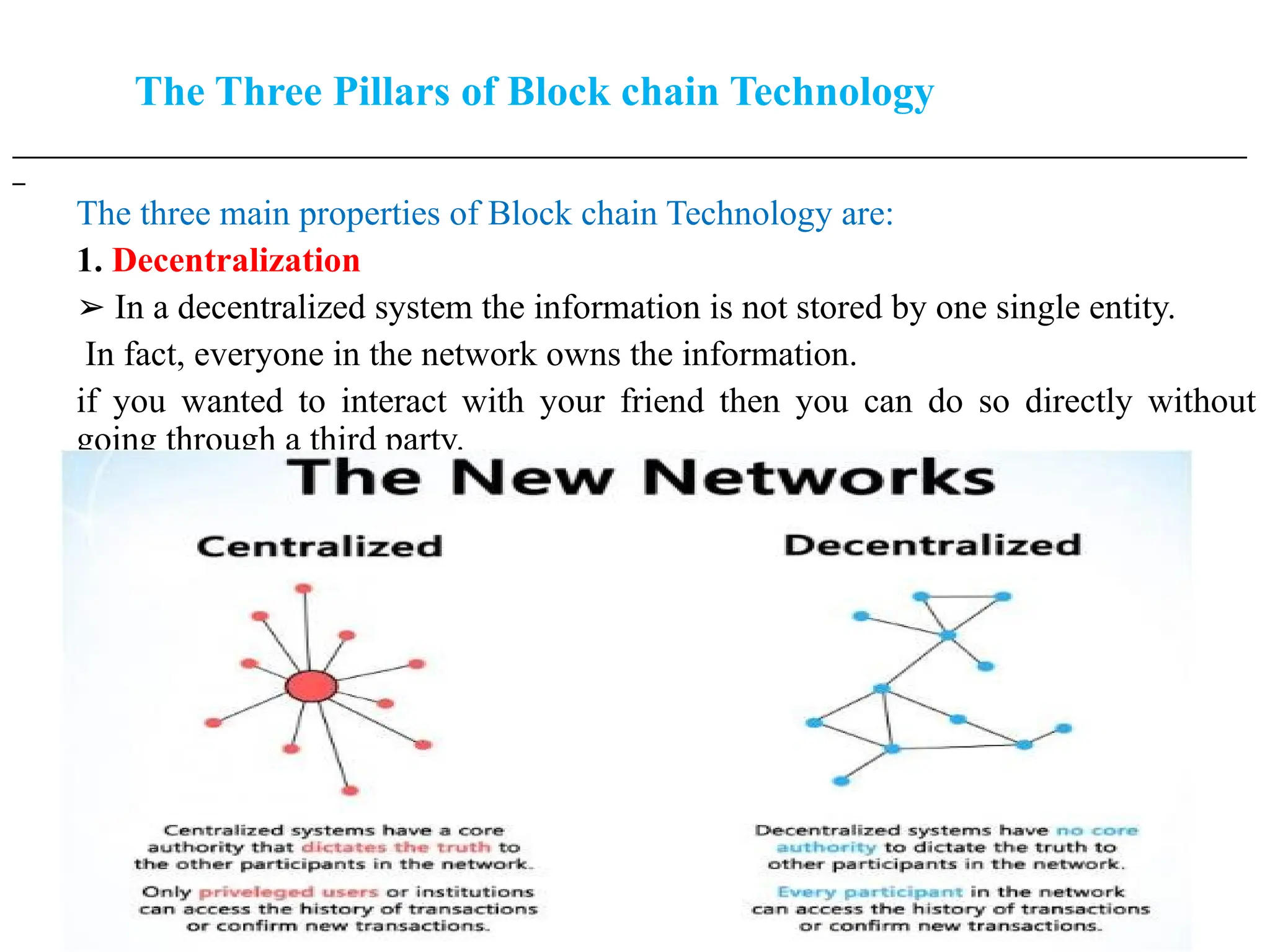
The three main properties of Block chain Technology are:
1. Decentralization
➢ In a decentralized system the information is not stored by one single entity.
In fact, everyone in the network owns the information.
if you wanted to interact with your friend then you can do so directly without
going through a third party.
8.
The Three Pillarsof Blockchain Technology
___________________________________________________________________________________________________
_
2. Transparency
A person’s identity is hidden via complex cryptography and represented only by
their public address.
So, if you were to look up a person’s transaction history, you will not see “Bob
sent 1 BTC” instead you will see “1MF1bhsFLkBzzz9vpFYEmvwT2TbyCt7NZJ
sent 1 BTC”.So, while the person’s real identity is secure, you will still see all the
transactions that were done by their public address.
3, Immutability
➢ Immutability, in the context of the blockchain, means that once something has
been entered into the blockchain, it cannot be tampered with.
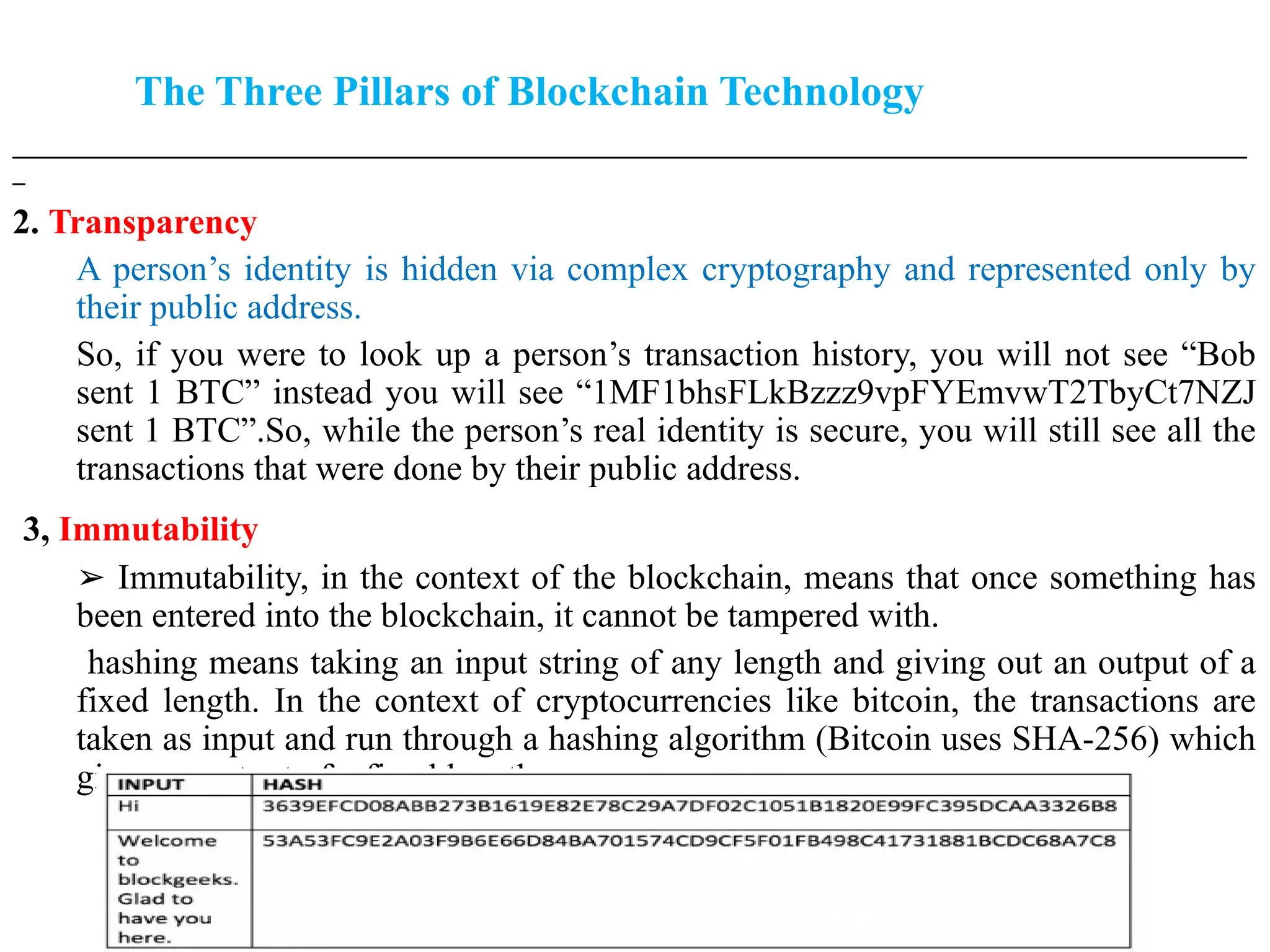
hashing means taking an input string of any length and giving out an output of a
fixed length. In the context of cryptocurrencies like bitcoin, the transactions are
taken as input and run through a hashing algorithm (Bitcoin uses SHA-256) which
gives an output of a fixed length.
9.
How Blockchain Works.
___________________________________________________________________________________________________
_
Informationheld on a blockchain exists as a shared and continually reconciled
database. This is a way of using the network that has obvious benefits. The
blockchain database isn’t stored in any single location, meaning the records it
keeps are truly public and easily verifiable. No centralized version of this
information exists for a hacker to corrupt. Hosted by millions of computers
simultaneously, its data is accessible to anyone on the internet.
The reason why the blockchain has gained so much admiration is that:-
➢ It is not owned by a single entity, hence it is decentralized
➢ The data is cryptographically stored inside
➢ The blockchain is immutable, so no one can tamper with the data that is
inside the blockchain
➢ The blockchain is transparent so one can track the data if they want to .
10.
Why do peopleuse the peer-to-peer network?
___________________________________________________________________________________________________
_
One of the main uses of the peer-to-peer network is file sharing, also called
torrenting.
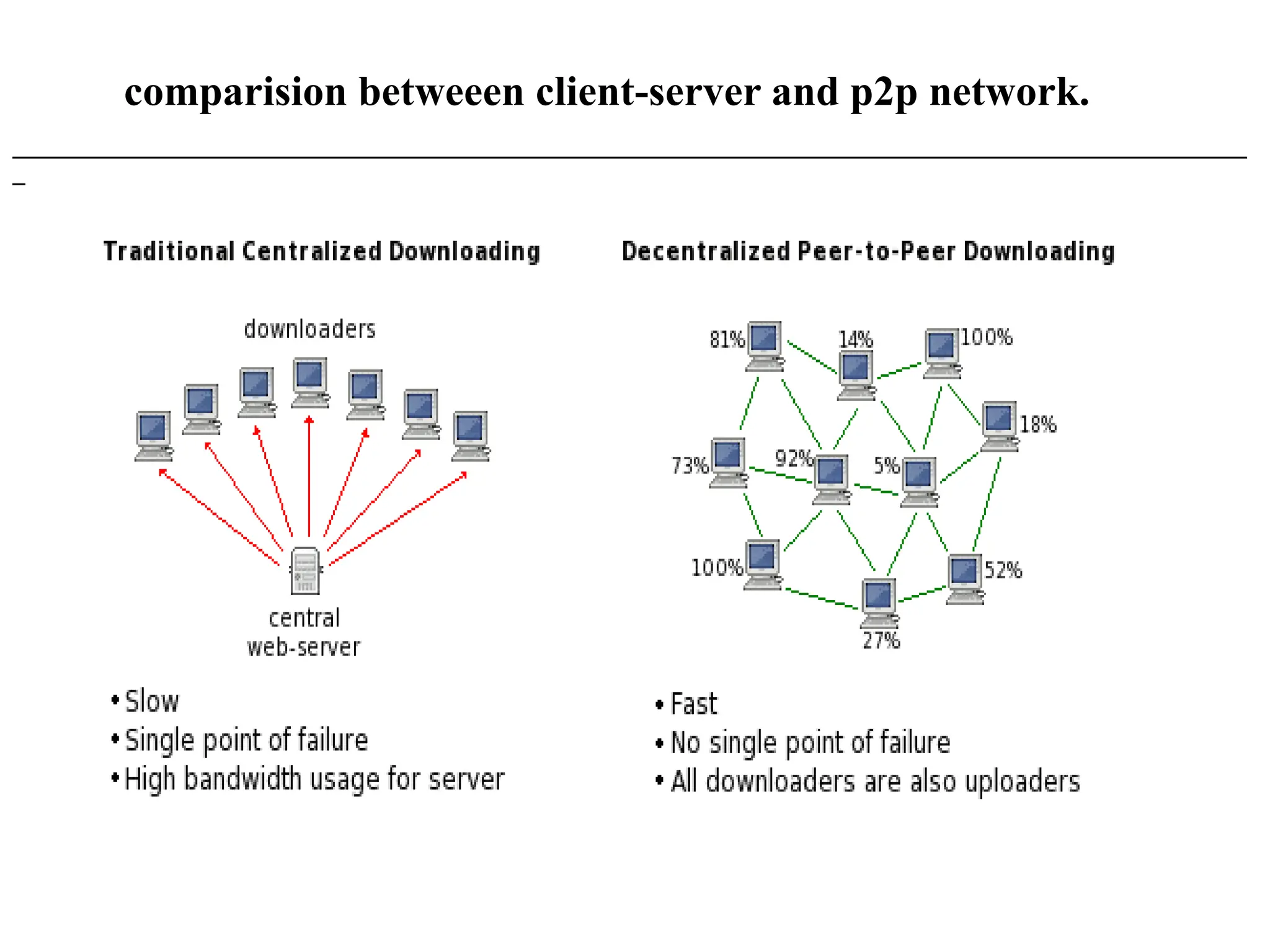
Client-server model for downloading is usually extremely slow and entirely
dependent on the health of the server.
it is prone to censorship
ther is central authority
In a peer-to-peer system, there is no central authority.
hence if even one of the peers in the network goes out of the race, you still have
more peers to download from. Plus, it is not subject to the idealistic standards of a
central system.
Peer-to-peer system also known as Decentralized Peer-to-Peer.
Client-server System is also known as Traditional Centralized.
Application of blockchain.
___________________________________________________________________________________________________
_
a) The sharing economy.
the blockchain opens the door to direct interaction between parties a truly
decentralized sharing economy results.
b) Crowd funding.
Crowd funding initiatives like Kick starter and GoFundMe are doing the advance
work for the emerging peer-to-peer economy. Block chains take this interest to the
next level, potentially creating crowd sourced venture capital funds.
c) Governance.
By making the results fully transparent and publicly accessible, distributed
database technology could bring full transparency to elections or any other kind of
poll taking. Ethereum -based smart contracts help to automate the process. The
app, Boardroom, enables organizational decision-making to happen on the block
chain. In practice, this means company governance becomes fully transparent and
verifiable when managing digital assets, equity or information.
13.
Application of blockchain.
___________________________________________________________________________________________________
_
d)Supply chain auditing.
Consumers increasingly want to know that the ethical claims companies make about their
products are real. Transparency comes with blockchain-based time-stamping of a date and
location — on ethical diamonds, for instance — that corresponds to a product number.
e) File storage
Decentralizing file storage on the internet brings clear benefits. Distributing data throughout
the network protects files from getting hacked or lost.
Interplanetary File System (IPFS) makes it easy to conceptualize how a distributed web
might operate. Similar to the way a BitTorrent moves data around the internet, IPFS gets rid
of the need for centralized client-server relationships (i.e., the current web).
An internet made up of completely decentralized websites has the potential to speed up file
transfer and streaming times.
14.
Cloud and quantumcomputing.
___________________________________________________________________________________________________
_
Cloud computing.
Cloud computing is a means of networking remote servers that are hosted on the
Internet. Rather than storing and processing data on a local server, or a PC's hard drive,
it stored on infrastructures.
three types of cloud infrastructure(cloud Models).
1, public cloud
A third-party provider manages the servers, applications, and storage much like a
public utility. Anyone can subscribe to the provider’s cloud service, which is usually
operated through their own data center.
2, private cloud
It is used by business organization. This might be hosted on their onsite Data center,
although some companies host through a third-party provider instead. Either way, the
computing infrastructure exists as a private network accessible over the Internet.
15.
Cloud and quantumcomputing.
____________________________________________________________________________________________________
3, hybrid cloud.
hybrid offers a business more flexibility. Often a hybrid cloud includes multiple service
providers. Hybrids can offer more computing capacity for a business application when
the need for its spikes. This sudden expansion into the public cloud is known as cloud
bursting.
Hybrids also enable applications to keep sensitive client data in a private cloud but
connect to end-user software in a public cloud.
Cloud computing services can focus on infrastructure, web development or a cloud-based
app. These are often regarded as a stack; all are on-demand, pay-as-you-go basis.
i) Infrastructure as a Service (IaaS):- gives you management of the whole deal:
servers, web development tools, applications.
e.g. Amazon Web Services (AWS) Elastic Compute Cloud (EC2)
With AWS EC2, users can rent virtual servers in the cloud. They have control over the
operating system, can install software, and configure the server as needed.
ii) Platform as a Service (PaaS):- offers a complete web development environment,
without the worry of the hardware that runs it.
Google Colab is an example of a Platform as a Service (PaaS) offering. Google Colab
(short for Colaboratory) provides a cloud-based platform for running and sharing
Jupyter notebooks.
16.
Cloud and quantumcomputing.
iii) Software as a Service (SaaS):- allows access to cloud-based apps,
usually through a web browser interface. SaaS is the top of the stack.
With SaaS, users can access and use software applications without the
need for installation, maintenance, or updates on their local devices.
The software is hosted and maintained by a third-party provider, and
users can access it through a web browser.
Popular examples of SaaS include email services like Gmail,
productivity suites like Microsoft 365, and customer relationship
management (CRM) tools like Salesforce
17.
Cloud and quantumcomputing.
___________________________________________________________________________________________________
_
Advantages of cloud computing.
A provider’s hardware and software are shared.
In effect, energy costs are shared.
Cloud providers have vast resources of computing power at their fingertips.
Cloud providers source on a global scale, so they can deliver the precise
bandwidth, storage and power business needs when it needs it.
allows you and multiple users to access your data from any location.
Smartphone, laptop, desktop, wherever you are, you can access the data you need
at any time.
makes a business processes its data more efficiently, increasing productivity.
Quantum computing.
Quantum computers truly do represent the next generation of computing. Unlike classic
computers, they derive their computing power by harnessing the power of quantum
physics.
18.
Quantum computing.
___________________________________________________________________________________________________
_
Currently, theonly organization which provides a quantum computer in the cloud is
IBM. They allow free access to anyone who wishes to use their 5-qubit machine.
Earlier this year they installed a 17-qubit machine. So far over 40,000 users have taken
advantage of their online service to run experiments.
Not to be outdone, Google provided the fastest quantum computer with 53qubits and
speed of 200 seconds computation while the supercomputer took 10000 years.
what is qubit and how many do you need?.
Qubit is short for a sequence of quantum bits. With a classic computer, data is stored in
tiny transistors that hold a single bit of information, either the binary value of 1 or 0.
With a quantum computer, the data is stored in qubits. Thanks to the mechanics of
quantum physics, where subatomic particles obey their own laws, a qubit can exist in
two states at the same time. This phenomenon is called superposition.
So, a qubit can have a value of 1, 0, or some value between. Two qubits can hold even
more values.
19.
Quantum computing.
___________________________________________________________________________________________________
_
Advantages ofquantum computing.
To make complex calculations that would only overwhelm classic computers.
Help in the discovery of new drugs, by unlocking the complex structure of
chemical molecules.
Used in financial trading, risk management, and supply chain optimization.
Ability to handle more complex numbers, due to this, data could be transferred
over the internet with much safer encryption.
Autonomic computing (AC).
Autonomic computing (AC) is an approach to address the complexity and evolution
problems in software systems. It is a self-managing computing model named after, and
patterned on, the human body's autonomic nervous system.
An autonomic computing system would control the functioning of computer
applications and systems without input from the user, in the same way, that the
autonomic nervous system regulates body systems without conscious input from the
individual
20.
Autonomic computing (AC).
___________________________________________________________________________________________________
_
Thegoal of autonomic computing is to create systems that run themselves, capable of
high-level functioning while keeping the system's complexity invisible to the user. It
refers to the self-managing characteristics of distributed resources, adapting to
unpredictable changes while hiding intrinsic complexity to operators and users.
IBM in 2001,initiates ultimately aimed to develop computer systems capable of self-
management, to overcome the rapidly growing complexity of computing system
management, and to reduce the barrier that complexity poses to further growth.
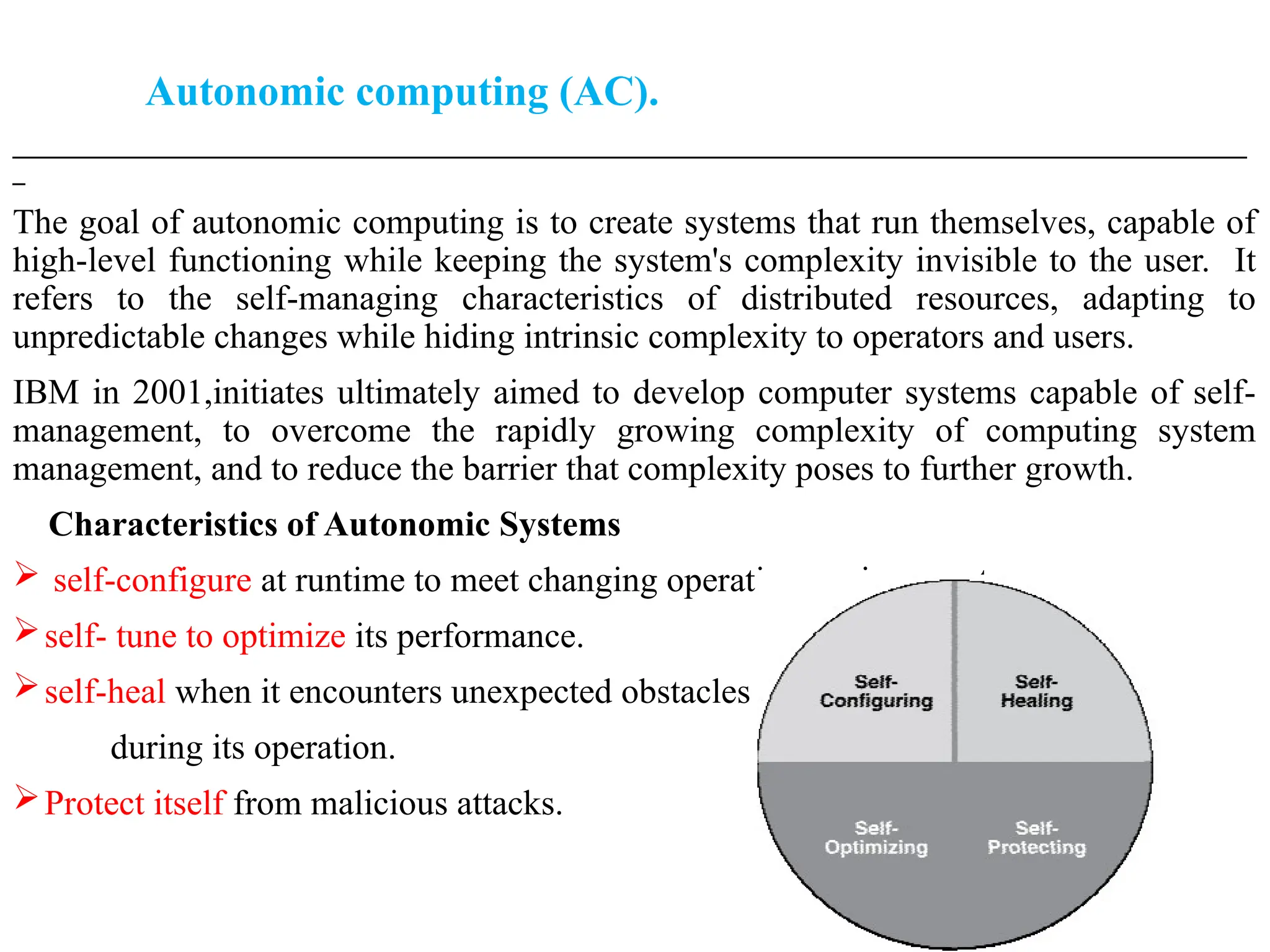
Characteristics of Autonomic Systems
self-configure at runtime to meet changing operating environments.
self- tune to optimize its performance.
self-heal when it encounters unexpected obstacles
during its operation.
Protect itself from malicious attacks.
21.
Autonomic computing (AC).
____________________________________________________________________________________________________
Generally,Autonomic systems/applications exhibit eight defining characteristics.
Self-Awareness:- “knows itself” and is aware of its state and its behaviors.
Self-Configuring:- be able to configure and reconfigure itself under varying and
unpredictable conditions.
Self-Optimizing:- able to detect suboptimal behaviors and optimize itself to improve its
execution.
Self-Healing:- be able to detect and recover from potential problems and continue to
function smoothly.
Self-Protecting:- be capable of detecting and protecting its resources from both internal and
external attacks and maintaining overall system security and integrity.
Context-Aware:- be aware of its execution environment and be able to react to changes in
the environment.
Open:- must function in a heterogeneous world and should be portable across multiple
hardware and software architectures. Consequently, it must be built on standard and open
protocols and interfaces.
Anticipatory: be able to anticipate to the extent possible, its needs and behaviors and those
of its context, and be able to manage itself proactively.
22.
Computer vision
____________________________________________________________________________________________________
History.
The originsof computer vision go back to an MIT undergraduate summer project in
1966. It was believed at the time that computer vision could be solved in one summer, but
we now have a 50year old scientific field that is still far from being solved. Early
experiments in computer vision took place in the 1950s, using some of the first neural
networks to detect the edges of an object and to sort simple objects into categories like
circles and squares.
As the internet matured in the 1990s, making large sets of images available online for
analysis, facial recognition programs flourished. These growing data sets helped make it
possible for machines to identify specific people in photos and videos.
23.
Computer vision
____________________________________________________________________________________________________
Definition.
It isan interdisciplinary scientific field that deals with how computers can be made to gain
a high-level understanding of digital images or videos. From the perspective of engineering,
it seeks to automate tasks that the human visual system can do.
Computer vision tasks include methods for acquiring, processing, analyzing and
understanding digital images, and extraction of high-dimensional data from the real world
in order to produce numerical or symbolic information, e.g. in the forms of decisions.
Another way to define computer vision is through its applications. Computer vision is
building algorithms that can understand the content of images and use it for other
applications.
24.
How computer visionworks.
1, Acquiring an image:
Images, even large sets, can be acquired in real-time through
video, photos or 3D technology for analysis.
2. Processing the image:
Deep learning models automate much of this process, but
the models are often trained by first being fed thousands of
labeled or pre-identified images.
3. Understanding the image:
The final step is the interpretative step, where an object is
identified or classified.
.
25.
Computer vision
____________________________________________________________________________________________________
There aremany types of computer vision that are used in different ways:
➢ Image segmentation:-
partitions an image into multiple regions or pieces to be examined
separately.
➢ Object detection:-
identifies a specific object in an image. Advanced object detection
recognizes many objects in a single image: a football field, an offensive
player, a defensive player, a ball and so on. These models use an X, Y
coordinate to create a bounding box and identify everything inside the box
Facial recognition :-
is an advanced type of object detection that not only recognizes a human face in an image
but identifies a specific individual.
26.
There are manytypes of computer vision that are used in different ways
_________________________________________________________________________________________________
➢ Edge detection:- is a technique used to identify the outside edge of
an object or landscape to better identify what is in the image.
➢ Pattern detection:- is a process of recognizing repeated shapes,
colors and other visual indicators in images.
➢ Image classification:- groups images into different categories.
➢ Feature matching:- is a type of pattern detection that matches
similarities in images to help classify them.
27.
Applications of computervision
___________________________________________________________________________________________________
_
Optical character recognition (OCR): reading handwritten
postal codes on letters and automatic number plate recognition
(ANPR);
➢ Machine inspection: rapid parts inspection for quality
assurance using stereo vision with specialized illumination to
measure tolerances on aircraft wings or auto body parts or
looking for defects in steel castings using X-ray vision;
➢ Retail: object recognition for automated checkout lanes
28.
Applications of computervision
____________________________________________________________________________________________________
Medical imaging: registering pre-operative and intra-operative imagery or
performing long-term studies of people’s brain morphology as they age;
➢ Automotive safety: detecting unexpected obstacles such as pedestrians on
the street, under conditions where active vision techniques such as radar or
lidar do not work well .
➢ Surveillance: monitoring for intruders, analyzing highway traffic and
monitoring pools for drowning victims;
➢ Fingerprint recognition and biometrics: for automatic access
authentication as well as forensic applications
29.
Embedded systems
____________________________________________________________________________________________________
Embedded systemsare specialized computing systems designed to
perform specific tasks or functions within a larger system. They are
embedded into devices or products to control, monitor, or manage
various functions.
It is a controller with a dedicated function within a larger
mechanical or electrical system, often with real-time computing
constraints.
It is embedded as part of a complete device often including
hardware and mechanical parts.
Modern embedded systems are often based on microcontrollers (i.e.
microprocessors with integrated memory and peripheral interfaces),
but ordinary microprocessors (using external chips for memory and
peripheral interface circuits) are also common, especially in more
complex systems.
A common standard class of dedicated processors is the digital
signal processor (DSP).
30.
Advantages and disadvantagesof embedded system
____________________________________________________________________________________________________
Advantages of Embedded
➢ Easily Customizable
➢ Low power consumption
➢ Low cost
➢ Enhanced performance
Disadvantages of Embedded systems
➢ High development effort
➢ Larger time to market
31.
Basic Structure ofan Embedded System
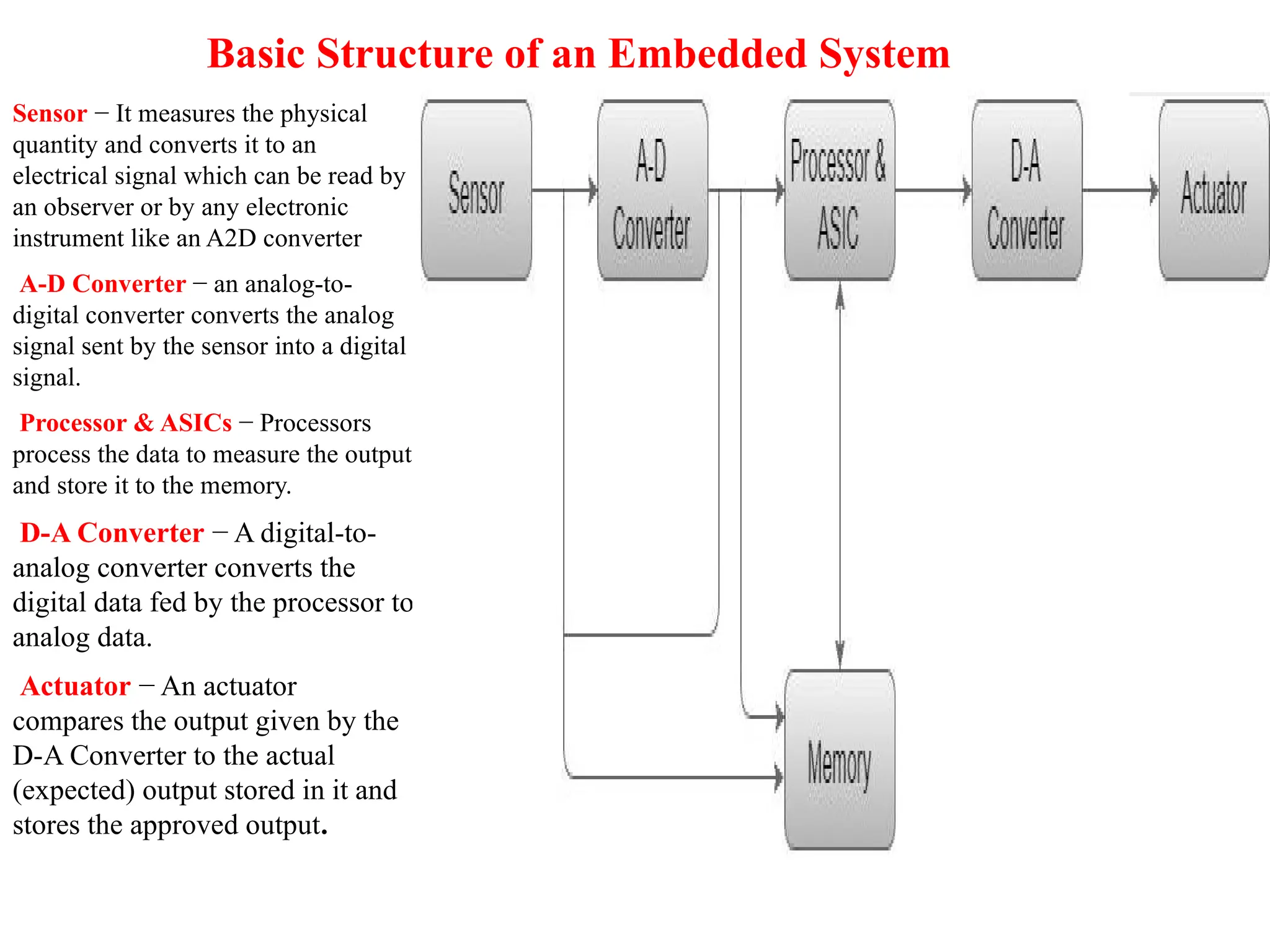
Sensor − It measures the physical
quantity and converts it to an
electrical signal which can be read by
an observer or by any electronic
instrument like an A2D converter
A-D Converter − an analog-to-
digital converter converts the analog
signal sent by the sensor into a digital
signal.
Processor & ASICs − Processors
process the data to measure the output
and store it to the memory.
D-A Converter − A digital-to-
analog converter converts the
digital data fed by the processor to
analog data.
Actuator − An actuator
compares the output given by the
D-A Converter to the actual
(expected) output stored in it and
stores the approved output.
32.
Cyber security
____________________________________________________________________________________________________
Definition
• Itis the protection of computer systems from the theft of or damage to their
hardware, software, or electronic data, as well as from the disruption or
misdirection of the services they provide.
• Cyber security is often confused with information security but it focuses on
protecting computer systems from unauthorized access or being otherwise
damaged or made inaccessible. Information security is a broader category that
looks to protect all information assets, whether in hard copy or in digital form.
• The term cybercrime is used to describe an unlawful activity in which computer or
computing devices such as smartphones, tablets, Personal Digital Assistants
(PDAs), etc. which are standalone or a part of a network are used as a tool or/and
target of criminal activity.
It is often committed by the people of destructive and criminal mindset either for
revenge, greed or adventure
33.
Cyber security measures
Thefollowing are some security measures to be taken to prevent cybercrimes:
Staff awareness training: - Human error is the leading cause of data
breaches, so you need to equip staff with the knowledge to deal with the
threats they face.
Application security: - Web application vulnerabilities are a common point
of intrusion for cybercriminals.
web application security.
Network security: - Network security is the process of protecting the
usability and integrity of your network and data.
Leadership commitment: - Leadership commitment is the key to cyber
resilience. Without it, it is very difficult to establish or enforce effective
processes.
Password management: You should implement a password management
policy that provides guidance to ensure staff create strong passwords and
keep them secure
34.
Types of cybersecurity threats
Ransom ware: - It is a type of malicious software. It is designed
to extort money by blocking access to files or the computer
system until the ransom is paid. Paying the ransom does not
guarantee that the files will be recovered or the system restored.
Malware: - it is a type of software designed to gain unauthorized
access or to cause damage to a computer.
Social engineering: - it is a tactic that adversaries use to trick
you into revealing sensitive information. They can solicit a
monetary payment or gain access to your confidential data.
Phishing: - it is the practice of sending fraudulent emails that
resemble emails from reputable sources. The aim is to steal
sensitive data like credit card numbers and login information.
35.
Benefits of cybersecurity
Business protection against malware, ransomware, phishing, and
social engineering.
➢ Protection for data and networks.
➢ Prevention of unauthorized users.
➢ Improves recovery time after a breach.
➢ Protection for end-users.
➢ Improved confidence in the product for both developers and
customers.
Cyber security vendors.
Vendors in cybersecurity fields will typically use endpoint, network and advanced threat
protection security as well as data loss prevention
Three commonly known cybersecurity vendors include
Cisco,
McAfee, and
Trend Micro.
36.
Additive manufacturing (3DPrinting).
what the experts have to say:
The American Society for Testing and Materials (ASTM)
equates the two terms in their definition: “Additive
manufacturing, also known as 3D printing, uses computer-
aided design to build objects layer by layer.”
➢ Wikipedia says, “Today, the precision, repeatability, and
material range has increased to the point that 3D printing is
considered as industrial production technology, with the name of
additive manufacturing.”
➢ Author Deve Turbide puts it simply, suggesting that additive
manufacturing is “the industrial version of 3D printing
37.
Additive manufacturing (3DPrinting).
3D Printing: It's All About the Printer
Three-dimensional printing is a process under development at MIT for the rapid and
flexible production of prototype parts, endues parts, and tools directly from a CAD model.
Additive Manufacturing.
A Bytes-to-Parts Supply Chain Additive manufacturing (AM) is a big-picture term more at
home in the boardroom than the factory floor or garage. Naturally, AM separates itself
from older, subtractive technologies like milling
Additive manufacturing (AM) describes types of advanced manufacturing that are
used to create
Three-dimensional structures out of plastics, metals, polymers and other materials
that can be Sprayed through a nozzle or aggregated in a vat.
38.
QUIZ 1(Max-10%)
___________________________________________________________________________________________________
1. Whatdo you think blockchain is all about? Just begin by defining the two words
block and chain?
2. Do you know anything about bitcoin? If your answer is yes, is it related to
blockchain?
3. Do you think blockchain is an old science? Can you guess who coined the term
blockchain?
4. what is a transaction in blockchain? Does transaction have a cost in blockchain?
Why?
5. Can you give a concrete example of blockchain?
6. What are the most important principles in blockchains? Is it possible for the
blockchain to be centralized? If your answer is no, Why?
7. Can you give a concrete example of centralized and decentralized systems?
39.
QUIZ 2(Max-10%)
1. Brieflyexplain cloud and quantum computing?
2. What is autonomic computing? Write down some of
its characteristics?
3. What is Computer vision? List down some real-world
applications?
4. Briefly explain embed systems and its components?
5. What is cybersecurity? List some cybersecurity treats?
Write down the advantages of cybersecurity?
6. Briefly explain additive manufacturing?
40.
Assignment 3
1. Whatdo you think about transparency in blockchain? Is transparency in
governance related to transparency in blockchain?
2. Do you think immutability is valuable for financial institutions? If your answer
is yes, Why?
3. What do you think cloud computing is? Is it related to the term cloud?
4. List some applications of cloud computing in business, file storage?
5. What is autonomous? What is computing? What do you think about
autonomous computing?
6. Do you think that the way computer vision works is similar to humans' vision?
7. Write down some specific applications of computer vision within definitions?
8. What is the word embed mean? How can you define embedded systems?
9. Can you describe cybersecurity? Begin by defining the two words cyber and
security? Do you think cybersecurity is important? Why?
10. How can someone secure himself/herself from hackers or digital criminals?
Do you think securing yourself is important at this time