Selectable markers for animal cells:
Thymidine kinase (TK),
Dihydrofolate reductase (dhfr),
Chloramphenicol acetyl transferase(CAT).
Presentation by : Madhwi Sharma
M.Sc. Biotechnology (2nd Year)
Central University of Haryana
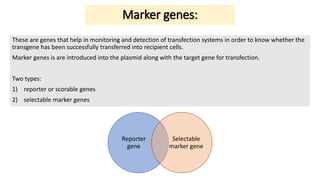
Marker genes:
These are genes that help in monitoring and detection of transfection systems in order to know whether the
transgene has been successfully transferred into recipient cells.
Marker genes is are introduced into the plasmid along with the target gene for transfection.
Two types:
1) reporter or scorable genes
2) selectable marker genes
Reporter
gene
Selectable
marker gene
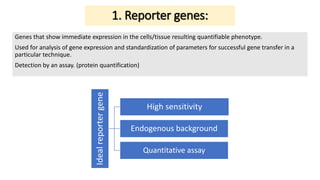
Genes that show immediate expression in the cells/tissue resulting quantifiable phenotype.
Used for analysis of gene expression and standardization of parameters for successful gene transfer in a
particular technique.
Detection by an assay. (protein quantification)
1. Reporter genes:
Ideal
reporter
gene
High sensitivity
Endogenous background
Quantitative assay
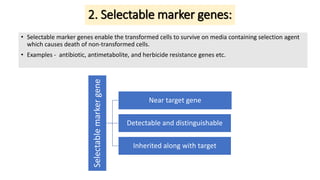
• Selectable marker genes enable the transformed cells to survive on media containing selection agent
which causes death of non-transformed cells.
• Examples - antibiotic, antimetabolite, and herbicide resistance genes etc.
2. Selectable marker genes:
Selectable
marker
gene Near target gene
Detectable and distinguishable
Inherited along with target
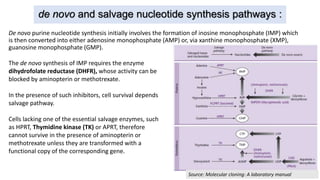
de novo and salvage nucleotide synthesis pathways :
De novo purine nucleotide synthesis initially involves the formation of inosine monophosphate (IMP) which
is then converted into either adenosine monophosphate (AMP) or, via xanthine monophosphate (XMP),
guanosine monophosphate (GMP).
Source: Molecular cloning: A laboratory manual
The de novo synthesis of IMP requires the enzyme
dihydrofolate reductase (DHFR), whose activity can be
blocked by aminopterin or methotrexate.
In the presence of such inhibitors, cell survival depends
salvage pathway.
Cells lacking one of the essential salvage enzymes, such
as HPRT, Thymidine kinase (TK) or APRT, therefore
cannot survive in the presence of aminopterin or
methotrexate unless they are transformed with a
functional copy of the corresponding gene.
More information on Thymidine kinase :
https://www.uniprot.org/uniprot/P04183
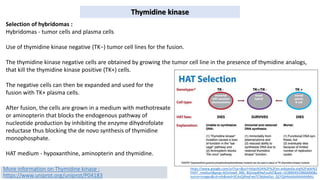
Thymidine kinase
https://www.google.com/url?sa=i&url=https%3A%2F%2Fen.wikipedia.org%2Fwiki%2
FHAT_medium&psig=AOvVaw0_RBS_BGJnqxB9wFzu4IjT&ust=1638904919866000&s
ource=images&cd=vfe&ved=0CAsQjRxqFwoTCNjdoeDyz_QCFQAAAAAdAAAAABAU
Selection of hybridomas :
Hybridomas - tumor cells and plasma cells
Use of thymidine kinase negative (TK−) tumor cell lines for the fusion.
The thymidine kinase negative cells are obtained by growing the tumor cell line in the presence of thymidine analogs,
that kill the thymidine kinase positive (TK+) cells.
The negative cells can then be expanded and used for the
fusion with TK+ plasma cells.
After fusion, the cells are grown in a medium with methotrexate
or aminopterin that blocks the endogenous pathway of
nucleotide production by inhibiting the enzyme dihydrofolate
reductase thus blocking the de novo synthesis of thymidine
monophosphate.
HAT medium - hypoxanthine, aminopterin and thymidine.
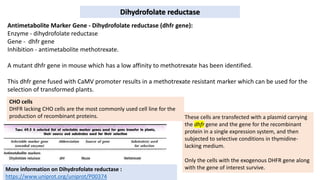
Antimetabolite Marker Gene - Dihydrofolate reductase (dhfr gene):
Enzyme - dihydrofolate reductase
Gene - dhfr gene
Inhibition - antimetabolite methotrexate.
A mutant dhfr gene in mouse which has a low affinity to methotrexate has been identified.
This dhfr gene fused with CaMV promoter results in a methotrexate resistant marker which can be used for the
selection of transformed plants.
More information on Dihydrofolate reductase :
https://www.uniprot.org/uniprot/P00374
CHO cells
DHFR lacking CHO cells are the most commonly used cell line for the
production of recombinant proteins.
Dihydrofolate reductase
These cells are transfected with a plasmid carrying
the dhfr gene and the gene for the recombinant
protein in a single expression system, and then
subjected to selective conditions in thymidine-
lacking medium.
Only the cells with the exogenous DHFR gene along
with the gene of interest survive.
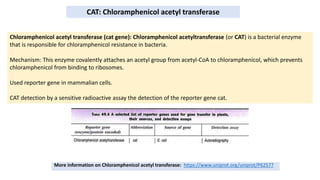
Chloramphenicol acetyl transferase (cat gene): Chloramphenicol acetyltransferase (or CAT) is a bacterial enzyme
that is responsible for chloramphenicol resistance in bacteria.
Mechanism: This enzyme covalently attaches an acetyl group from acetyl-CoA to chloramphenicol, which prevents
chloramphenicol from binding to ribosomes.
Used reporter gene in mammalian cells.
CAT detection by a sensitive radioactive assay the detection of the reporter gene cat.
More information on Chloramphenicol acetyl transferase: https://www.uniprot.org/uniprot/P62577
CAT: Chloramphenicol acetyl transferase
Concern regarding use of marker genes
i. The products of some marker genes may be toxic.
ii. The antibiotic resistance might be transferred to pathogenic microorganisms.
iii. A transgenic cell line with selectable marker genes can’t be transformed again by using the same selectable
markers.
Solutions:
1. Avoiding selectable marker genes: Screening by an advanced technique like polymerase chain reaction.
Drawback: time consuming and expensive.
2. Removal of selectable markers: use of site-specific recombinase systems to selectively excise the marker
genes from the plant genome.
3. Cloning of selectable markers between transposable elements: A selectable marker gene can be cloned
between plant transposable elements (Ds elements) and then inserted.
The selectable marker is planked by the sequences that increase the intra-chromosomal recombination. This results
in the excision of the marker gene.
• https://www.biologydiscussion.com/genetics/engineering/selectable-
marker-genes-and-reporter-genes/10752
• Maniatis, T., Fritsch, E. F., & Sambrook, J. (1982). Molecular cloning: A
laboratory manual. Cold Spring Harbor, N.Y: Cold Spring Harbor
Laboratory.

Selectable markers

  • 1.
    Selectable markers foranimal cells: Thymidine kinase (TK), Dihydrofolate reductase (dhfr), Chloramphenicol acetyl transferase(CAT). Presentation by : Madhwi Sharma M.Sc. Biotechnology (2nd Year) Central University of Haryana
  • 2.
    Marker genes: These aregenes that help in monitoring and detection of transfection systems in order to know whether the transgene has been successfully transferred into recipient cells. Marker genes is are introduced into the plasmid along with the target gene for transfection. Two types: 1) reporter or scorable genes 2) selectable marker genes Reporter gene Selectable marker gene
  • 3.
    Genes that showimmediate expression in the cells/tissue resulting quantifiable phenotype. Used for analysis of gene expression and standardization of parameters for successful gene transfer in a particular technique. Detection by an assay. (protein quantification) 1. Reporter genes: Ideal reporter gene High sensitivity Endogenous background Quantitative assay
  • 4.
    • Selectable markergenes enable the transformed cells to survive on media containing selection agent which causes death of non-transformed cells. • Examples - antibiotic, antimetabolite, and herbicide resistance genes etc. 2. Selectable marker genes: Selectable marker gene Near target gene Detectable and distinguishable Inherited along with target
  • 5.
    de novo andsalvage nucleotide synthesis pathways : De novo purine nucleotide synthesis initially involves the formation of inosine monophosphate (IMP) which is then converted into either adenosine monophosphate (AMP) or, via xanthine monophosphate (XMP), guanosine monophosphate (GMP). Source: Molecular cloning: A laboratory manual The de novo synthesis of IMP requires the enzyme dihydrofolate reductase (DHFR), whose activity can be blocked by aminopterin or methotrexate. In the presence of such inhibitors, cell survival depends salvage pathway. Cells lacking one of the essential salvage enzymes, such as HPRT, Thymidine kinase (TK) or APRT, therefore cannot survive in the presence of aminopterin or methotrexate unless they are transformed with a functional copy of the corresponding gene.
  • 6.
    More information onThymidine kinase : https://www.uniprot.org/uniprot/P04183 Thymidine kinase https://www.google.com/url?sa=i&url=https%3A%2F%2Fen.wikipedia.org%2Fwiki%2 FHAT_medium&psig=AOvVaw0_RBS_BGJnqxB9wFzu4IjT&ust=1638904919866000&s ource=images&cd=vfe&ved=0CAsQjRxqFwoTCNjdoeDyz_QCFQAAAAAdAAAAABAU Selection of hybridomas : Hybridomas - tumor cells and plasma cells Use of thymidine kinase negative (TK−) tumor cell lines for the fusion. The thymidine kinase negative cells are obtained by growing the tumor cell line in the presence of thymidine analogs, that kill the thymidine kinase positive (TK+) cells. The negative cells can then be expanded and used for the fusion with TK+ plasma cells. After fusion, the cells are grown in a medium with methotrexate or aminopterin that blocks the endogenous pathway of nucleotide production by inhibiting the enzyme dihydrofolate reductase thus blocking the de novo synthesis of thymidine monophosphate. HAT medium - hypoxanthine, aminopterin and thymidine.
  • 7.
    Antimetabolite Marker Gene- Dihydrofolate reductase (dhfr gene): Enzyme - dihydrofolate reductase Gene - dhfr gene Inhibition - antimetabolite methotrexate. A mutant dhfr gene in mouse which has a low affinity to methotrexate has been identified. This dhfr gene fused with CaMV promoter results in a methotrexate resistant marker which can be used for the selection of transformed plants. More information on Dihydrofolate reductase : https://www.uniprot.org/uniprot/P00374 CHO cells DHFR lacking CHO cells are the most commonly used cell line for the production of recombinant proteins. Dihydrofolate reductase These cells are transfected with a plasmid carrying the dhfr gene and the gene for the recombinant protein in a single expression system, and then subjected to selective conditions in thymidine- lacking medium. Only the cells with the exogenous DHFR gene along with the gene of interest survive.
  • 8.
    Chloramphenicol acetyl transferase(cat gene): Chloramphenicol acetyltransferase (or CAT) is a bacterial enzyme that is responsible for chloramphenicol resistance in bacteria. Mechanism: This enzyme covalently attaches an acetyl group from acetyl-CoA to chloramphenicol, which prevents chloramphenicol from binding to ribosomes. Used reporter gene in mammalian cells. CAT detection by a sensitive radioactive assay the detection of the reporter gene cat. More information on Chloramphenicol acetyl transferase: https://www.uniprot.org/uniprot/P62577 CAT: Chloramphenicol acetyl transferase
  • 9.
    Concern regarding useof marker genes i. The products of some marker genes may be toxic. ii. The antibiotic resistance might be transferred to pathogenic microorganisms. iii. A transgenic cell line with selectable marker genes can’t be transformed again by using the same selectable markers. Solutions: 1. Avoiding selectable marker genes: Screening by an advanced technique like polymerase chain reaction. Drawback: time consuming and expensive. 2. Removal of selectable markers: use of site-specific recombinase systems to selectively excise the marker genes from the plant genome. 3. Cloning of selectable markers between transposable elements: A selectable marker gene can be cloned between plant transposable elements (Ds elements) and then inserted. The selectable marker is planked by the sequences that increase the intra-chromosomal recombination. This results in the excision of the marker gene.
  • 10.
    • https://www.biologydiscussion.com/genetics/engineering/selectable- marker-genes-and-reporter-genes/10752 • Maniatis,T., Fritsch, E. F., & Sambrook, J. (1982). Molecular cloning: A laboratory manual. Cold Spring Harbor, N.Y: Cold Spring Harbor Laboratory.