6363 Woodway Dr
                                                                                                     Suite 870
                                                                                            Houston, TX 77057
                                                                                          Phone: 713-244-3030
                                                                                            Fax: 713-513-5669

                                                                                  Securities are offered through
                                                                                            RAYMOND JAMES
                                                                                  FINANCIAL SERVICES, INC.
                                                                                         Member FINRA / SIPC


                                                                     Green Financial Group
                                                                                       An Independent Firm


Weekly Commentary by Dr. Scott Brown

Seizing The Narrative

April 11 – April 20, 2011


Later this month, Fed Chairman Bernanke will hold his first post-FOMC meeting press conference.
Officially, the press conference is meant “to present the Federal Open Market Committee's current
economic projections and to provide additional context for the FOMC's policy decisions.” However, the
real goal is to reclaim the narrative. The Fed was caught off guard by the amount of criticism and second-
guessing it received in 2010. Fed Chairman Bernanke tried hard to counter that, appearing on 60
Minutes, speaking to trade groups, and so on. These press conferences should help clear things up
regarding monetary policy – not that we’ll receive clear signals of future Fed policy moves – rather, we’ll
get important information on how the Fed will decide what to do.


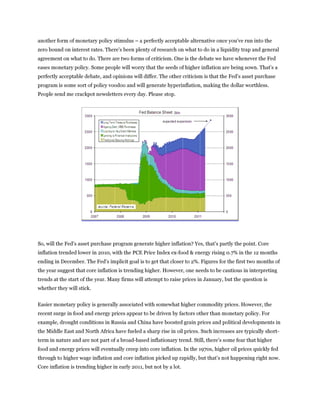
The Fed’s asset purchase program (technically, this isn’t “quantitative easing,” although it’s widely known
by that name) generated considerable criticism and some confusion in 2010. For the Fed, this is simply
another form of monetary policy stimulus – a perfectly acceptable alternative once you’ve run into the
zero bound on interest rates. There’s been plenty of research on what to do in a liquidity trap and general
agreement on what to do. There are two forms of criticism. One is the debate we have whenever the Fed
eases monetary policy. Some people will worry that the seeds of higher inflation are being sown. That’s a
perfectly acceptable debate, and opinions will differ. The other criticism is that the Fed’s asset purchase
program is some sort of policy voodoo and will generate hyperinflation, making the dollar worthless.
People send me crackpot newsletters every day. Please stop.


So, will the Fed’s asset purchase program generate higher inflation? Yes, that’s partly the point. Core
inflation trended lower in 2010, with the PCE Price Index ex-food & energy rising 0.7% in the 12 months
ending in December. The Fed’s implicit goal is to get that closer to 2%. Figures for the first two months of
the year suggest that core inflation is trending higher. However, one needs to be cautious in interpreting
trends at the start of the year. Many firms will attempt to raise prices in January, but the question is
whether they will stick.


Easier monetary policy is generally associated with somewhat higher commodity prices. However, the
recent surge in food and energy prices appear to be driven by factors other than monetary policy. For
example, drought conditions in Russia and China have boosted grain prices and political developments in
the Middle East and North Africa have fueled a sharp rise in oil prices. Such increases are typically short-
term in nature and are not part of a broad-based inflationary trend. Still, there’s some fear that higher
food and energy prices will eventually creep into core inflation. In the 1970s, higher oil prices quickly fed
through to higher wage inflation and core inflation picked up rapidly, but that’s not happening right now.
Core inflation is trending higher in early 2011, but not by a lot.
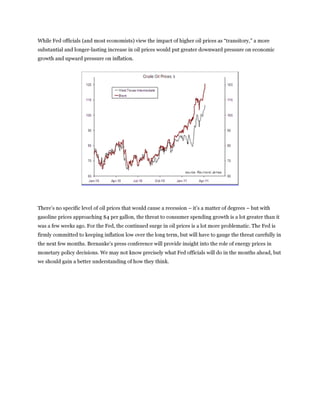
While Fed officials (and most economists) view the impact of higher oil prices as “transitory,” a more
substantial and longer-lasting increase in oil prices would put greater downward pressure on economic
growth and upward pressure on inflation.


There’s no specific level of oil prices that would cause a recession – it’s a matter of degrees – but with
gasoline prices approaching $4 per gallon, the threat to consumer spending growth is a lot greater than it
was a few weeks ago. For the Fed, the continued surge in oil prices is a lot more problematic. The Fed is
firmly committed to keeping inflation low over the long term, but will have to gauge the threat carefully in
the next few months. Bernanke’s press conference will provide insight into the role of energy prices in
monetary policy decisions. We may not know precisely what Fed officials will do in the months ahead, but
we should gain a better understanding of how they think.

Seizing The Narrative

  • 1.
    6363 Woodway Dr Suite 870 Houston, TX 77057 Phone: 713-244-3030 Fax: 713-513-5669 Securities are offered through RAYMOND JAMES FINANCIAL SERVICES, INC. Member FINRA / SIPC Green Financial Group An Independent Firm Weekly Commentary by Dr. Scott Brown Seizing The Narrative April 11 – April 20, 2011 Later this month, Fed Chairman Bernanke will hold his first post-FOMC meeting press conference. Officially, the press conference is meant “to present the Federal Open Market Committee's current economic projections and to provide additional context for the FOMC's policy decisions.” However, the real goal is to reclaim the narrative. The Fed was caught off guard by the amount of criticism and second- guessing it received in 2010. Fed Chairman Bernanke tried hard to counter that, appearing on 60 Minutes, speaking to trade groups, and so on. These press conferences should help clear things up regarding monetary policy – not that we’ll receive clear signals of future Fed policy moves – rather, we’ll get important information on how the Fed will decide what to do. The Fed’s asset purchase program (technically, this isn’t “quantitative easing,” although it’s widely known by that name) generated considerable criticism and some confusion in 2010. For the Fed, this is simply
  • 2.
    another form ofmonetary policy stimulus – a perfectly acceptable alternative once you’ve run into the zero bound on interest rates. There’s been plenty of research on what to do in a liquidity trap and general agreement on what to do. There are two forms of criticism. One is the debate we have whenever the Fed eases monetary policy. Some people will worry that the seeds of higher inflation are being sown. That’s a perfectly acceptable debate, and opinions will differ. The other criticism is that the Fed’s asset purchase program is some sort of policy voodoo and will generate hyperinflation, making the dollar worthless. People send me crackpot newsletters every day. Please stop. So, will the Fed’s asset purchase program generate higher inflation? Yes, that’s partly the point. Core inflation trended lower in 2010, with the PCE Price Index ex-food & energy rising 0.7% in the 12 months ending in December. The Fed’s implicit goal is to get that closer to 2%. Figures for the first two months of the year suggest that core inflation is trending higher. However, one needs to be cautious in interpreting trends at the start of the year. Many firms will attempt to raise prices in January, but the question is whether they will stick. Easier monetary policy is generally associated with somewhat higher commodity prices. However, the recent surge in food and energy prices appear to be driven by factors other than monetary policy. For example, drought conditions in Russia and China have boosted grain prices and political developments in the Middle East and North Africa have fueled a sharp rise in oil prices. Such increases are typically short- term in nature and are not part of a broad-based inflationary trend. Still, there’s some fear that higher food and energy prices will eventually creep into core inflation. In the 1970s, higher oil prices quickly fed through to higher wage inflation and core inflation picked up rapidly, but that’s not happening right now. Core inflation is trending higher in early 2011, but not by a lot.
  • 3.
    While Fed officials(and most economists) view the impact of higher oil prices as “transitory,” a more substantial and longer-lasting increase in oil prices would put greater downward pressure on economic growth and upward pressure on inflation. There’s no specific level of oil prices that would cause a recession – it’s a matter of degrees – but with gasoline prices approaching $4 per gallon, the threat to consumer spending growth is a lot greater than it was a few weeks ago. For the Fed, the continued surge in oil prices is a lot more problematic. The Fed is firmly committed to keeping inflation low over the long term, but will have to gauge the threat carefully in the next few months. Bernanke’s press conference will provide insight into the role of energy prices in monetary policy decisions. We may not know precisely what Fed officials will do in the months ahead, but we should gain a better understanding of how they think.