APPLIED GEOLOGY
NAME:MUHAMMAD UMAR SHAIKH
CONTENTS
SEDIMENTARY ROCK FORMATION OF SEDIMENTARY ROCK IT’S CLASSIFICATION
SEDIMENTARY ROCK
What is Sediment?
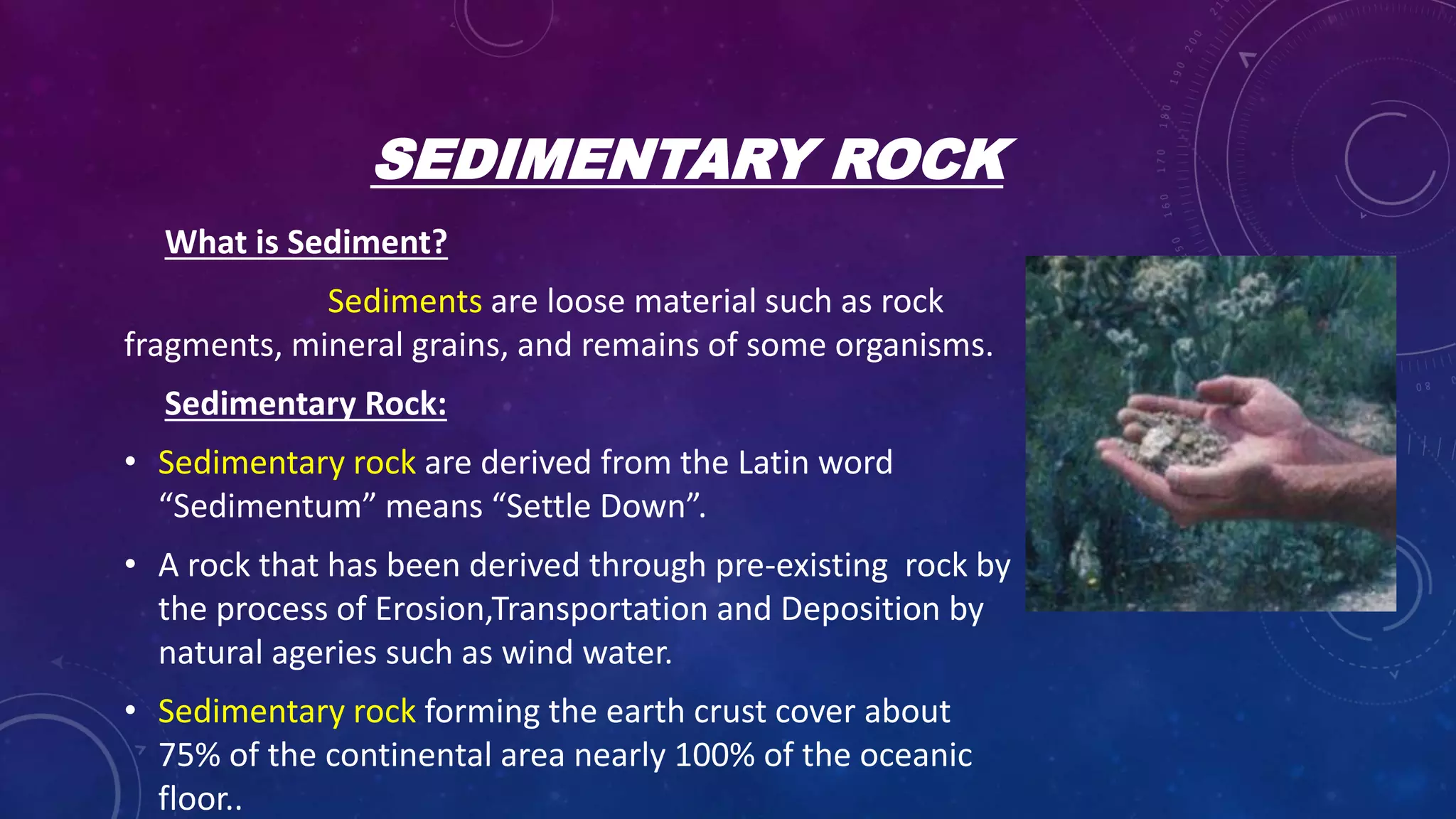
Sediments are loose material such as rock
fragments, mineral grains, and remains of some organisms.
Sedimentary Rock:
• Sedimentary rock are derived from the Latin word
“Sedimentum” means “Settle Down”.
• A rock that has been derived through pre-existing rock by
the process of Erosion,Transportation and Deposition by
natural ageries such as wind water.
• Sedimentary rock forming the earth crust cover about
75% of the continental area nearly 100% of the oceanic
floor..
FORMATION OF SEDIMENTARY ROCK
• Sedimentary rock account for approximately 5% of the
crust. The upper 16Km of Earth.
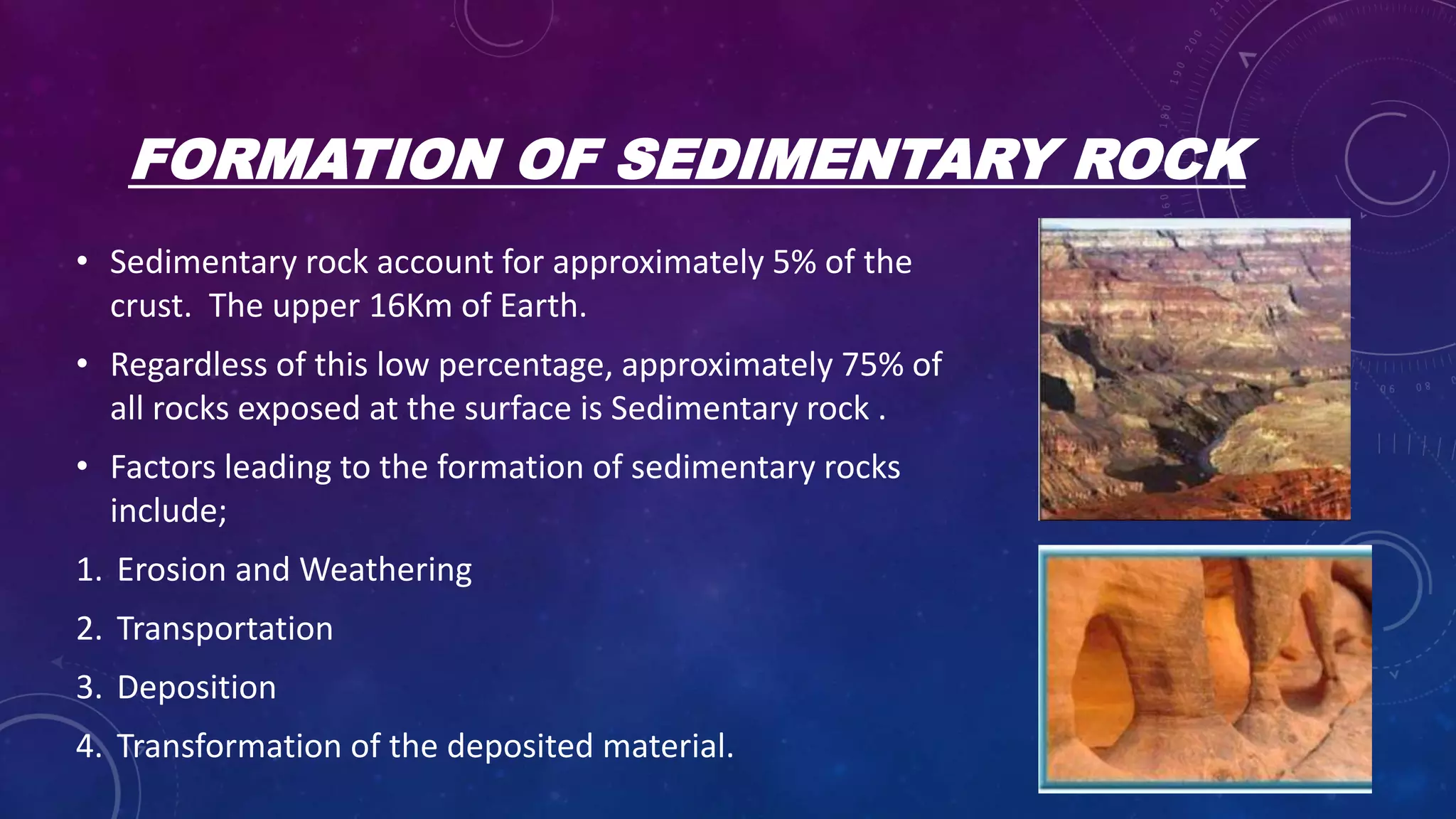
• Regardless of this low percentage, approximately 75% of
all rocks exposed at the surface is Sedimentary rock .
• Factors leading to the formation of sedimentary rocks
include;
1. Erosion and Weathering
2. Transportation
3. Deposition
4. Transformation of the deposited material.
EROSION AND WEATHERING
• In reference to the Rock Cycle, the origin of
sedimentary rock begins with the processes of
Weathering and Erosion.
• Pre-existing rocks can be broken down both
mechanically or chemically to produce Sediment.
Mechanical Weathering:
• Mechanical Weathering happens when a Material
is broken into smaller pieces still retain the
characteristics of original material. Example: freeze
– thaw action
CHEMICAL WEATHERING
• Chemical Weathering happens
when a material is altered by
chemical action and a new
material is produced which is
chemically different than the
original material.
• Examples: Statues and
headstones
TRANSPORTATION OF SEDIMENT
• Erosional agents (such as; wind, water & Ice,)
influenced by gravity, transport the Sediment to
new locations where it is deposited.
• Sediment is broken down during the Transport
phase. This process is called Abrasion.
• Three main agents tend to transport the Sediment,
these being;
1. Water (Rivers and groundwater)
2. Ice (Glaciers)
3. Wind
DEPOSITION OF THE MATERIAL
• The eroded material which is
transported by the
transporting agents is
deposited sooner or later
depending upon the
circumstances. These
Sediments continue to
accumulate in suitable basins
of sedimentation.
TRANSFORMATION OF THE DEPOSITED MATERIAL
• After Sometime when the accumulation is sufficient, the loose
rock particles are subjected to compaction (sometime due to
overlaying Sediments or earth movements) And finally conversion
into sedimentary rocks, under favourable circumstances. The
process pf transformation of loose rock particle into hard and
massive sedimentary rock is achieved through the the following
two ways:
• (i) Welding
• (ii) Cementation
WELDING & CEMENTATION
• Welding: Sometimes the Sediments are compacted under the
Influence of pressure. As a result of the compaction, the water
present in the Sediment is squezed out. This process invariably
result in a very dense packing of the sediments, which are firmly
held together; as if they are subjected to welding.
• Cementation: Sometimes the sediments are Held together by a
foreign binding or cementing material (as the stone chip are held
together by the cement mortor). This cementing material is
generally supplied by the percolating waters.The most common
cementing materials are carbonates pf calcuim and magnesium as
well as oxides of iron and silicon.
CLASSIFICATION OF SEDIMENTARY ROCKS
• The sedimentary rock have been classified by different scientists
on different bases. But there is no definite classification, which
may be accepted universally. The following two classification are
important from the subject point of view:
1. Classification based on the grain-Size of the sediments of the
rocks.
2. Classification based on the mode of formation or origin of the
rocks.
CLASSIFICATION BASED ON THE GRAIN-
SIZE OF THE SEDIMENTS OF THE ROCKS.
• Sedimentary rocks may be classified on the basis of
grain-size of their sediments into the following three
groups:
1.Argillaceous
2.Arenaceous
3.Rudaceous
1. Argillaceous:
Argillaceous (Latin, arigilla=clay) are those sedimentary
rocks which are made up from the finest clay particles.
2. Arenaceous:
Arenaceous (Latin, Arena=Sand) are those
sedimentary rock which are made of particles, having grain size
between 1/10 mm and 2 mm in diameter.
3. Rudaceous:
Rudaceous (Latin, Rudnus=rubble) are those sedimentary
rock which are made of particles, having grain size more than 2 mm
in diameter.
CLASSIFICATION BASED ON THE MODE OF
FORMATION OR ORIGIN OF THE ROCKS.
• Sedimentary rocks may be classified on the basis of
their mode of origin into the following three
groups:
1.Mechanical Origin
2.Chemical Origin
3.Organic Origin
1. Mechanical Origin:
All those sedimentary rocks, which are derived from the pre
existing rocks by the mechanical action (disintegration i.e; fraction and abrasion,
Transportation , Deposition amd consolidation) of the denuding agents, without
any change in their chemical composition, are called sedimentary rocks of
Mechanical Origin.
2. Chemical Origin:
All those sedimentary rocks, which are derived from the pre
existing rocks by the chemical action (decomposition, precipitation
crystallization, etc) of the denuding agents, are called Sedimentary rocks of
Chemical Origin.
3. Organic Origin:
All these sedimentary rocks, which are derived from the pre
existing rocks by the activities of the organisms (Both plants and animals) are
called sedimentary rocks of Organic Origin.
Sedimentary Rocks.pptx

Sedimentary Rocks.pptx

  • 1.
  • 2.
    CONTENTS SEDIMENTARY ROCK FORMATIONOF SEDIMENTARY ROCK IT’S CLASSIFICATION
  • 3.
    SEDIMENTARY ROCK What isSediment? Sediments are loose material such as rock fragments, mineral grains, and remains of some organisms. Sedimentary Rock: • Sedimentary rock are derived from the Latin word “Sedimentum” means “Settle Down”. • A rock that has been derived through pre-existing rock by the process of Erosion,Transportation and Deposition by natural ageries such as wind water. • Sedimentary rock forming the earth crust cover about 75% of the continental area nearly 100% of the oceanic floor..
  • 4.
    FORMATION OF SEDIMENTARYROCK • Sedimentary rock account for approximately 5% of the crust. The upper 16Km of Earth. • Regardless of this low percentage, approximately 75% of all rocks exposed at the surface is Sedimentary rock . • Factors leading to the formation of sedimentary rocks include; 1. Erosion and Weathering 2. Transportation 3. Deposition 4. Transformation of the deposited material.
  • 5.
    EROSION AND WEATHERING •In reference to the Rock Cycle, the origin of sedimentary rock begins with the processes of Weathering and Erosion. • Pre-existing rocks can be broken down both mechanically or chemically to produce Sediment. Mechanical Weathering: • Mechanical Weathering happens when a Material is broken into smaller pieces still retain the characteristics of original material. Example: freeze – thaw action
  • 7.
    CHEMICAL WEATHERING • ChemicalWeathering happens when a material is altered by chemical action and a new material is produced which is chemically different than the original material. • Examples: Statues and headstones
  • 8.
    TRANSPORTATION OF SEDIMENT •Erosional agents (such as; wind, water & Ice,) influenced by gravity, transport the Sediment to new locations where it is deposited. • Sediment is broken down during the Transport phase. This process is called Abrasion. • Three main agents tend to transport the Sediment, these being; 1. Water (Rivers and groundwater) 2. Ice (Glaciers) 3. Wind
  • 9.
    DEPOSITION OF THEMATERIAL • The eroded material which is transported by the transporting agents is deposited sooner or later depending upon the circumstances. These Sediments continue to accumulate in suitable basins of sedimentation.
  • 10.
    TRANSFORMATION OF THEDEPOSITED MATERIAL • After Sometime when the accumulation is sufficient, the loose rock particles are subjected to compaction (sometime due to overlaying Sediments or earth movements) And finally conversion into sedimentary rocks, under favourable circumstances. The process pf transformation of loose rock particle into hard and massive sedimentary rock is achieved through the the following two ways: • (i) Welding • (ii) Cementation
  • 11.
    WELDING & CEMENTATION •Welding: Sometimes the Sediments are compacted under the Influence of pressure. As a result of the compaction, the water present in the Sediment is squezed out. This process invariably result in a very dense packing of the sediments, which are firmly held together; as if they are subjected to welding. • Cementation: Sometimes the sediments are Held together by a foreign binding or cementing material (as the stone chip are held together by the cement mortor). This cementing material is generally supplied by the percolating waters.The most common cementing materials are carbonates pf calcuim and magnesium as well as oxides of iron and silicon.
  • 12.
    CLASSIFICATION OF SEDIMENTARYROCKS • The sedimentary rock have been classified by different scientists on different bases. But there is no definite classification, which may be accepted universally. The following two classification are important from the subject point of view: 1. Classification based on the grain-Size of the sediments of the rocks. 2. Classification based on the mode of formation or origin of the rocks.
  • 13.
    CLASSIFICATION BASED ONTHE GRAIN- SIZE OF THE SEDIMENTS OF THE ROCKS. • Sedimentary rocks may be classified on the basis of grain-size of their sediments into the following three groups: 1.Argillaceous 2.Arenaceous 3.Rudaceous
  • 14.
    1. Argillaceous: Argillaceous (Latin,arigilla=clay) are those sedimentary rocks which are made up from the finest clay particles. 2. Arenaceous: Arenaceous (Latin, Arena=Sand) are those sedimentary rock which are made of particles, having grain size between 1/10 mm and 2 mm in diameter. 3. Rudaceous: Rudaceous (Latin, Rudnus=rubble) are those sedimentary rock which are made of particles, having grain size more than 2 mm in diameter.
  • 15.
    CLASSIFICATION BASED ONTHE MODE OF FORMATION OR ORIGIN OF THE ROCKS. • Sedimentary rocks may be classified on the basis of their mode of origin into the following three groups: 1.Mechanical Origin 2.Chemical Origin 3.Organic Origin
  • 16.
    1. Mechanical Origin: Allthose sedimentary rocks, which are derived from the pre existing rocks by the mechanical action (disintegration i.e; fraction and abrasion, Transportation , Deposition amd consolidation) of the denuding agents, without any change in their chemical composition, are called sedimentary rocks of Mechanical Origin. 2. Chemical Origin: All those sedimentary rocks, which are derived from the pre existing rocks by the chemical action (decomposition, precipitation crystallization, etc) of the denuding agents, are called Sedimentary rocks of Chemical Origin. 3. Organic Origin: All these sedimentary rocks, which are derived from the pre existing rocks by the activities of the organisms (Both plants and animals) are called sedimentary rocks of Organic Origin.