Exploring the future
Ethnographic Futures Research
Florence Dujardin (EDU/CSED, University of East Anglia)
May 2017
SEDA project
http://bit.ly/2oAJckP
Overview
Potential
Practical
© Salvatore Vastano via Flickr
Ethnographic
Futures
Research
© Salvatore Vastano via Flickr
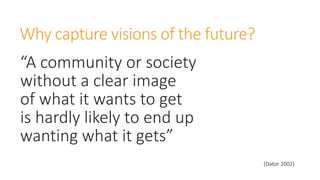
Why capture visions of the future?
“A community or society
without a clear image
of what it wants to get
is hardly likely to end up
wanting what it gets”
(Dator 2002)
Principles
Design elements
Scenarios
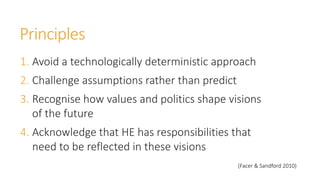
Principles
1. Avoid a technologically deterministic approach
2. Challenge assumptions rather than predict
3. Recognise how values and politics shape visions
of the future
4. Acknowledge that HE has responsibilities that
need to be reflected in these visions
(Facer & Sandford 2010)
Ethnographic orientation
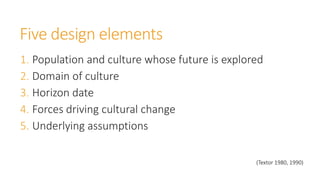
Five design elements
1. Population and culture whose future is explored
2. Domain of culture
3. Horizon date
4. Forces driving cultural change
5. Underlying assumptions
(Textor 1980, 1990)
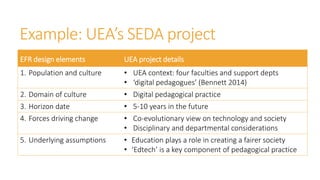
Example: UEA’s SEDA project
EFR design elements UEA project details
1. Population and culture • UEA context: four faculties and support depts
• ‘digital pedagogues’ (Bennett 2014)
2. Domain of culture • Digital pedagogical practice
3. Horizon date • 5-10 years in the future
4. Forces driving change • Co-evolutionary view on technology and society
• Disciplinary and departmental considerations
5. Underlying assumptions • Education plays a role in creating a fairer society
• ‘Edtech’ is a key component of pedagogical practice
The fun bit
“Stories we tell about the future
are powerful resources for
shaping our sense of possibilities
and readiness to fight for change”
(Facer 2011)
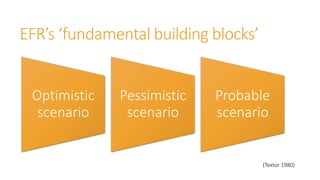
EFR’s ‘fundamental building blocks’
Optimistic
scenario
Pessimistic
scenario
Probable
scenario
(Textor 1980)
Optimistic
scenario
If you could get all the technology
you would wish to support
students, what would the future
look like?
How do you see your (digital)
practice developing?
What supports your uses of
educational technology?
In your university setting, what are
the trends and projects for TEL?
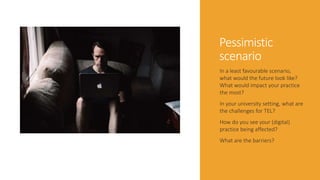
Pessimistic
scenario
In a least favourable scenario,
what would the future look like?
What would impact your practice
the most?
In your university setting, what are
the challenges for TEL?
How do you see your (digital)
practice being affected?
What are the barriers?
Most probable
scenario
Step back from the optimistic and
pessimistic scenarios
What are the most probable
developments?
How would your (digital) practice
look like in this version of the
future?
Look at other people’s contributions
Reflections & comments
Benefits, issues, future use
References
 Bennett, L., 2014. Learning from the early adopters: developing the digital practitioner. Research in Learning
Technology, 22 (July), 1–11.
 Clegg, S., Konrad, J. and Tan, J. (2000), Preparing academic staff to use ICTs in support of student learning,
International Journal for Academic Development, 5 (2): 138–148.
 Dator, J.A., 2002. Advancing Futures: Futures Studies in Higher Education. Westport, CT: Greenwood Publishing Group.
 Facer, K., 2011. Learning Futures: Education, Technology and Social Change. Abingdon: Routledge.
 Facer, K. & Sandford, R. (2010) The next 25 years? Future scenarios and future directions for education and
technology. Journal of Computer Assisted Learning. 26 (1), 74–93.
 Textor, R. B. (1980) A Handbook on Ethnographic Futures Research. 3rd ed. Stanford, CA: Cultural and Futures
Research Project, School of Education and Dept. of Anthropology, Stanford University.
 Textor, R.B., Ladavalya, B.M.L. and Prabudhanitisarn, S. (1984), Alternative Sociocultural Futures for Thailand: A Pilot
Inquiry Among Academics, Faculty of the Social Sciences, Chiang Mai University, Chiang Mai, Thailand.
 Textor, R. B. (1990) ‘Methodological appendix’, in Sippanondha Ketudat (ed.) The Middle Path for the Future of
Thailand: Technology in Harmony with Culture and Environment. Honolulu, HI: Institute for Culture and
Communication, East-West Center. pp. 194–212.

Seda workshop - exploring the future

  • 1.
    Exploring the future EthnographicFutures Research Florence Dujardin (EDU/CSED, University of East Anglia) May 2017
  • 2.
  • 3.
  • 4.
  • 5.
  • 6.
    Why capture visionsof the future?
  • 7.
    Why capture visionsof the future? “A community or society without a clear image of what it wants to get is hardly likely to end up wanting what it gets” (Dator 2002)
  • 8.
  • 9.
    Principles 1. Avoid atechnologically deterministic approach 2. Challenge assumptions rather than predict 3. Recognise how values and politics shape visions of the future 4. Acknowledge that HE has responsibilities that need to be reflected in these visions (Facer & Sandford 2010)
  • 10.
  • 11.
    Five design elements 1.Population and culture whose future is explored 2. Domain of culture 3. Horizon date 4. Forces driving cultural change 5. Underlying assumptions (Textor 1980, 1990)
  • 12.
    Example: UEA’s SEDAproject EFR design elements UEA project details 1. Population and culture • UEA context: four faculties and support depts • ‘digital pedagogues’ (Bennett 2014) 2. Domain of culture • Digital pedagogical practice 3. Horizon date • 5-10 years in the future 4. Forces driving change • Co-evolutionary view on technology and society • Disciplinary and departmental considerations 5. Underlying assumptions • Education plays a role in creating a fairer society • ‘Edtech’ is a key component of pedagogical practice
  • 13.
  • 14.
    “Stories we tellabout the future are powerful resources for shaping our sense of possibilities and readiness to fight for change” (Facer 2011)
  • 15.
    EFR’s ‘fundamental buildingblocks’ Optimistic scenario Pessimistic scenario Probable scenario (Textor 1980)
  • 16.
    Optimistic scenario If you couldget all the technology you would wish to support students, what would the future look like? How do you see your (digital) practice developing? What supports your uses of educational technology? In your university setting, what are the trends and projects for TEL?
  • 17.
    Pessimistic scenario In a leastfavourable scenario, what would the future look like? What would impact your practice the most? In your university setting, what are the challenges for TEL? How do you see your (digital) practice being affected? What are the barriers?
  • 18.
    Most probable scenario Step backfrom the optimistic and pessimistic scenarios What are the most probable developments? How would your (digital) practice look like in this version of the future?
  • 19.
    Look at otherpeople’s contributions
  • 20.
  • 21.
    References  Bennett, L.,2014. Learning from the early adopters: developing the digital practitioner. Research in Learning Technology, 22 (July), 1–11.  Clegg, S., Konrad, J. and Tan, J. (2000), Preparing academic staff to use ICTs in support of student learning, International Journal for Academic Development, 5 (2): 138–148.  Dator, J.A., 2002. Advancing Futures: Futures Studies in Higher Education. Westport, CT: Greenwood Publishing Group.  Facer, K., 2011. Learning Futures: Education, Technology and Social Change. Abingdon: Routledge.  Facer, K. & Sandford, R. (2010) The next 25 years? Future scenarios and future directions for education and technology. Journal of Computer Assisted Learning. 26 (1), 74–93.  Textor, R. B. (1980) A Handbook on Ethnographic Futures Research. 3rd ed. Stanford, CA: Cultural and Futures Research Project, School of Education and Dept. of Anthropology, Stanford University.  Textor, R.B., Ladavalya, B.M.L. and Prabudhanitisarn, S. (1984), Alternative Sociocultural Futures for Thailand: A Pilot Inquiry Among Academics, Faculty of the Social Sciences, Chiang Mai University, Chiang Mai, Thailand.  Textor, R. B. (1990) ‘Methodological appendix’, in Sippanondha Ketudat (ed.) The Middle Path for the Future of Thailand: Technology in Harmony with Culture and Environment. Honolulu, HI: Institute for Culture and Communication, East-West Center. pp. 194–212.

Editor's Notes

  • #3 Enhancing students’ digital literacies has now become a responsibility for lecturers. Academic developers need to support lecturers. UEA’s centre for staff and educational development (CSED) invited a small number of ‘digital pedagogues’ to imagine the future of their digital practice at UEA. We used EFR to elicit their views. Why? - this method has been used to explore digital engagement in society and socio-technical futures in education - we wanted to find out how best to support TEL practices in the future.