Security On Rails
David Paluy
October 2012
"Ruby is simple in appearance,
  but is very complex inside,
  just like our human body."

  Yukihiro "matz" Matsumoto
Agenda

●   Session Hijacking
●   CSRF
●   Mass Assignment
●   SQL Injection
Websites are all about
      the data!
When is a user not a user?
You have no way of knowing
who or where the data that hits
  your application is coming
             from.
Session Hijacking
Session Hijacking
●   Sniff the cookie in an insecure network.
●   Most people don’t clear out the cookies after
    working at a public terminal
●   Cross-Site Scripting (XSS)
●   CSS Injection
●   Header Injection
config.force_ssl = true

●   If you have http assets on an https page, the
    user’s browser will display a mixed-content
    warning in the browser bar.

●   Rails does most of the work for you, but if you
    have any hard-coded “http://” internal-links or
    images, make sure you change them.
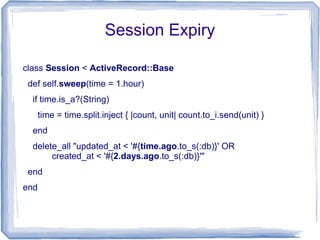
Session Expiry

class Session < ActiveRecord::Base
 def self.sweep(time = 1.hour)
  if time.is_a?(String)
   time = time.split.inject { |count, unit| count.to_i.send(unit) }
  end
  delete_all "updated_at < '#{time.ago.to_s(:db)}' OR
       created_at < '#{2.days.ago.to_s(:db)}'"
 end
end
Provide the user with a log-out
button in the web application,
   and make it prominent.
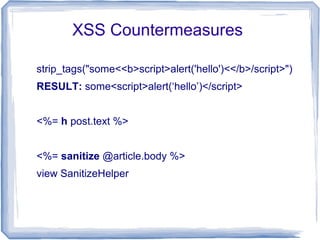
XSS Countermeasures

strip_tags("some<<b>script>alert('hello')<</b>/script>")
RESULT: some<script>alert(‘hello’)</script>


<%= h post.text %>


<%= sanitize @article.body %>
view SanitizeHelper
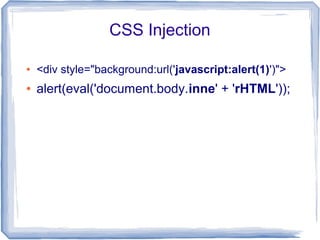
CSS Injection

●   <div style="background:url('javascript:alert(1)')">
●   alert(eval('document.body.inne' + 'rHTML'));
Header Injection

redirect_to params[:referer]
http://www.yourapplication.com/controller/action?
referer=http://www.malicious.tld


Make sure you do it yourself when you
build other header fields with user input.
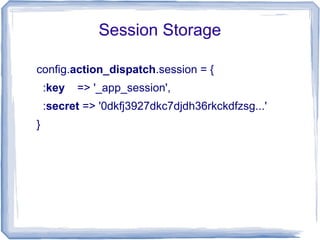
Session Storage

config.action_dispatch.session = {
    :key   => '_app_session',
    :secret => '0dkfj3927dkc7djdh36rkckdfzsg...'
}
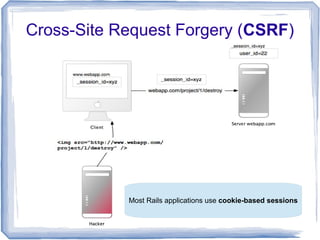
Cross-Site Request Forgery (CSRF)


            Most Rails applications use cookie-based sessions
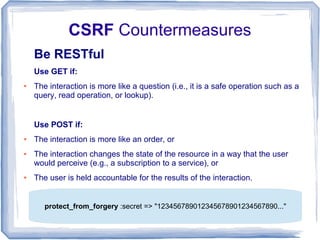
CSRF Countermeasures
    Be RESTful
    Use GET if:
●   The interaction is more like a question (i.e., it is a safe operation such as a
    query, read operation, or lookup).


    Use POST if:
●   The interaction is more like an order, or
●   The interaction changes the state of the resource in a way that the user
    would perceive (e.g., a subscription to a service), or
●   The user is held accountable for the results of the interaction.


       protect_from_forgery :secret => "123456789012345678901234567890..."
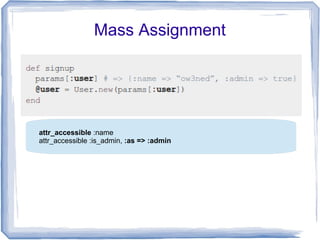
Mass Assignment


attr_accessible :name
attr_accessible :is_admin, :as => :admin
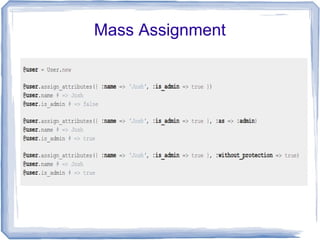
Mass Assignment
SQL Injection

●   Project.where("name = '#{params[:name]}'")
    SELECT * FROM projects WHERE name = '' OR 1'


●   User.first("login = '#{params[:name]}' AND
    password = '#{params[:password]}'")
    SELECT * FROM users WHERE login = '' OR '1'='1' AND
                              password = '' OR '2'>'1' LIMIT 1
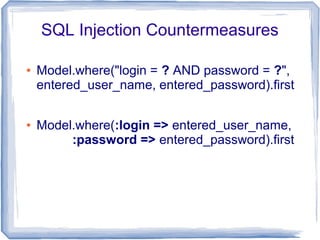
SQL Injection Countermeasures

●   Model.where("login = ? AND password = ?",
    entered_user_name, entered_password).first

●   Model.where(:login => entered_user_name,
         :password => entered_password).first
Tools

●   Brakeman - A static analysis security
    vulnerability scanner for Ruby on Rails
    applications
●   RoRSecurity – explore Rails security
●   Techniques to Secure your Website with RoR
Summary


The security landscape shifts and
 it is important to keep up to date,
because missing a new vulnerability
         can be catastrophic.

Security on Rails