TRANSFORMATIONAL TECHNIQUES TO SECURING
EXISTING APPLICATIONS WITH COLDFUSION
PETE FREITAG, FOUNDEO INC.
foundeo
ABOUT PETE
• My Company: Foundeo Inc.
• Consulting: Code Reviews, Server Reviews, Development
• FuseGuard: Web App Firewall for CFML
• HackMyCF: Server Security Scanner
• Blog (petefreitag.com), Twitter (@pfreitag), #CFML Slack
AGENDA
• Large Codebase Challenges
• How do you get started?
• Low Hanging Fruit
• Things to focus on
• What’s Next?
• Disclaimer: This approach may not be appropriate for all
scenarios. This is a generalized approach which I have found can
work well for many.
AN OLD &
LARGE
CODEBASE?
DO YOU HAVE TO
WORK WITH
TYPICALLY
MATURE CODEBASES
• Has a large codebase (thousands of source code files)
• Has code you hope you don't have to see again.
• Can take weeks, but often months of work to properly secure.
• Can be hard to fix, brittle
• Probably uses outdated techniques
FIXING A LARGE CODEBASE
HOW TO APPROACH
• Beast Mode - Spend several weeks dedicated to identifying &
fixing vulnerabilities.
• Prioritize - Spend time identifying the most critical vulnerabilities
and patch less critical vulnerabilities as you see them.
• As you go - As you work on files fix vulnerabilities as you see
them. You may not ever fix some vulnerabilities with this
approach.
SECURING THAT CODE
HOW DO YOU START?
STEP 1: DELETE THE CODE!
YOU MIGHT
HAVE A LOT
OF CODE THAT
NEVER RUNS
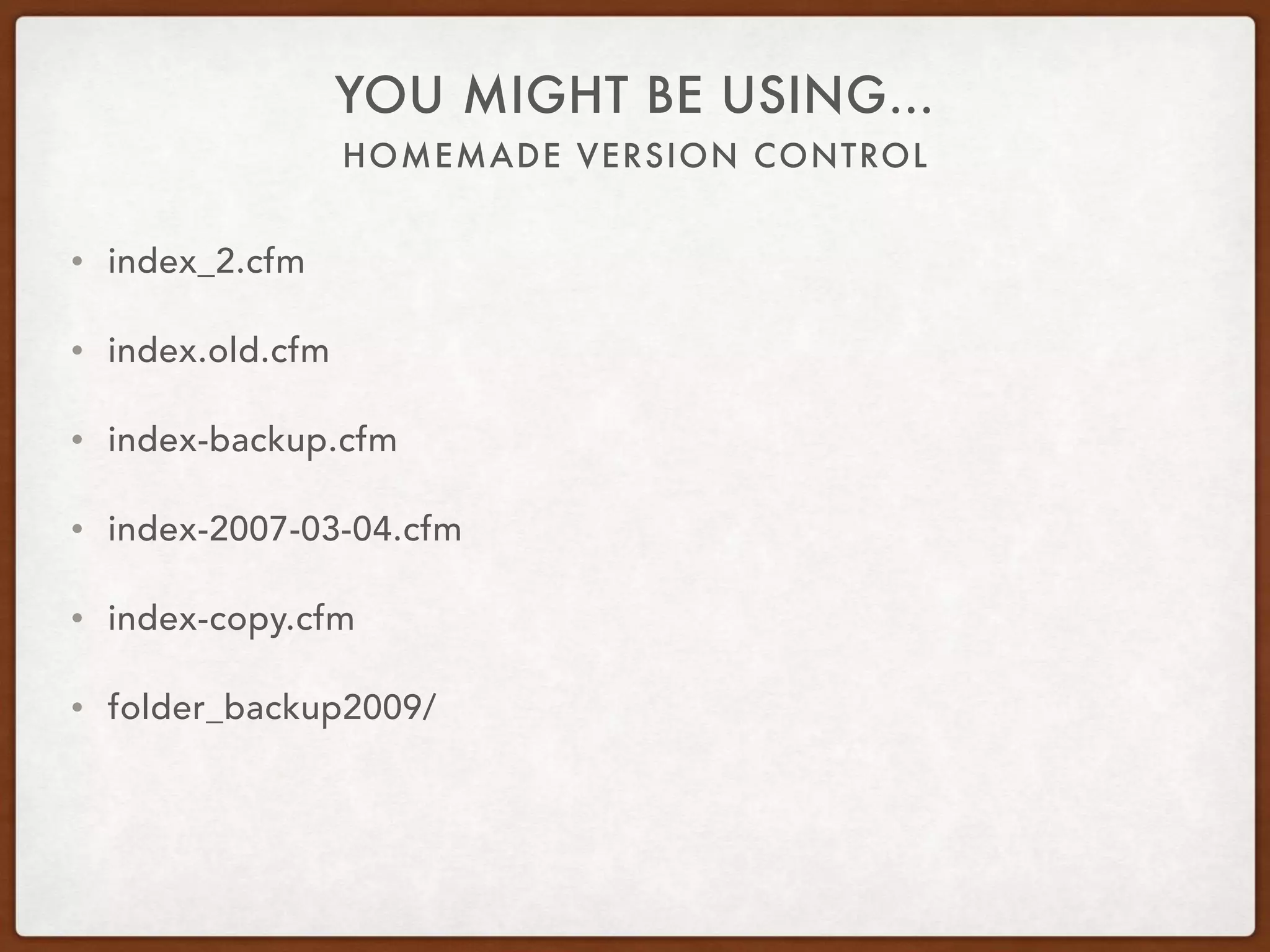
HOMEMADE VERSION CONTROL
YOU MIGHT BE USING…
• index_2.cfm
• index.old.cfm
• index-backup.cfm
• index-2007-03-04.cfm
• index-copy.cfm
• folder_backup2009/
VERSION CONTROL
• Those backup folders and files are probably full of vulnerabilities.
• Version Control Server keeps backups of all your code and all
changes you have ever made to it.
• Sync server source code with version control.
• Identify if someone changed something on the server.
IDENTIFY UNUSED CODE
VERSION CONTROL
• Spend some time to identify unused code.
• Delete it!
• Version control has your back, if you deleted something you can
recover it from the repository.
THERE ARE LOTS OF FADS IN SOFTWARE
DEVELOPMENT, VERSION CONTROL IS NOT
ONE OF THEM.
”
“
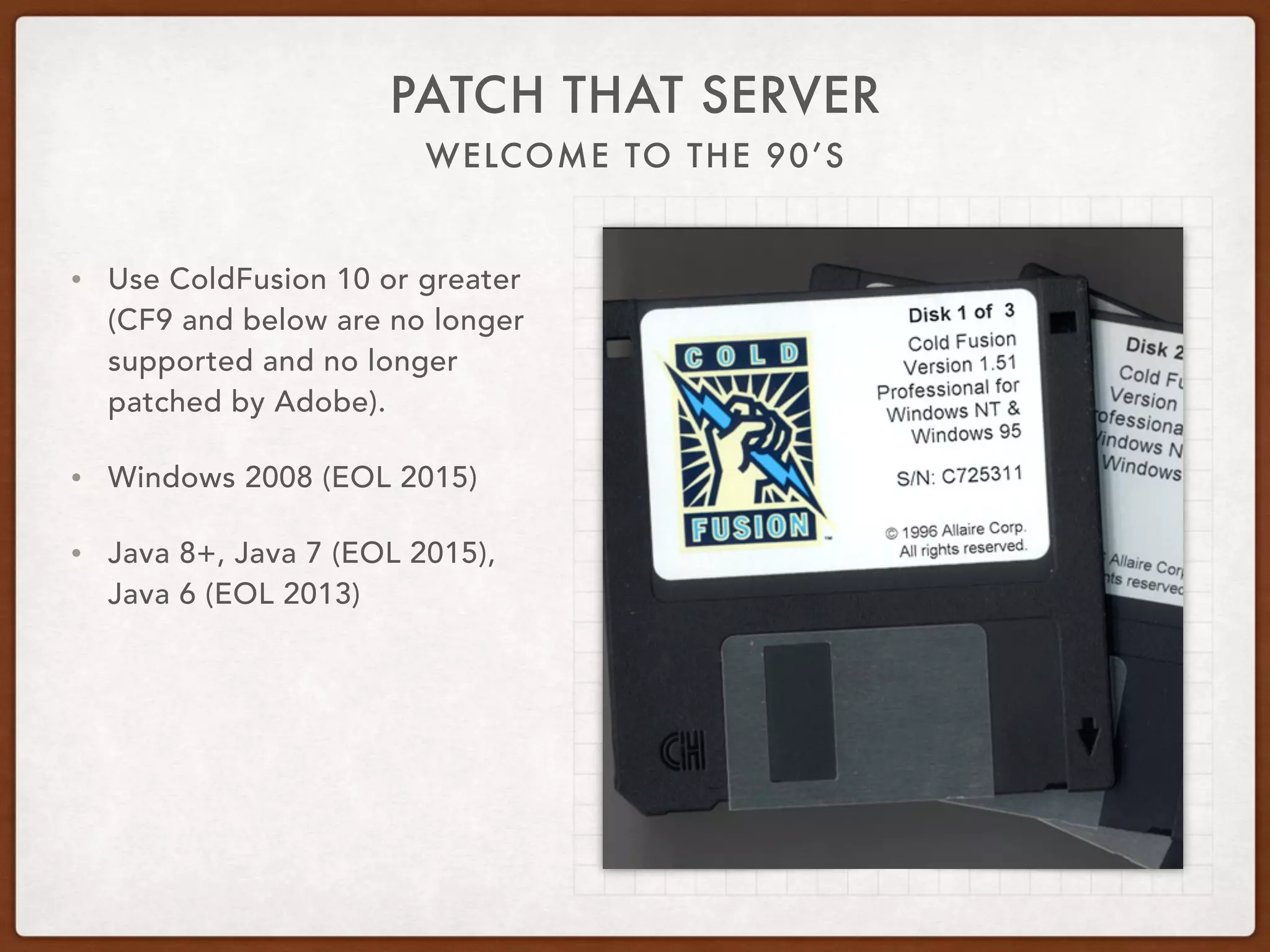
WELCOME TO THE 90’S
PATCH THAT SERVER
• Use ColdFusion 10 or greater
(CF9 and below are no longer
supported and no longer
patched by Adobe).
• Windows 2008 (EOL 2015)
• Java 8+, Java 7 (EOL 2015),
Java 6 (EOL 2013)
FIX VULNERABILITIES
PATCH THAT SERVER
• Multiple Denial of Service Vulnerabilities in old versions of Java
• Path Traversal via Null Byte injection JVM
• CRLF Injection (CF10+)
• File Uploads “somewhat” more secure (CF10+)
• TLS / SSL Protocol Implementations
• Java 8 Not supported on CF9 and below
MITIGATES POTENTIAL IMPACT OF A VULNERABILITY
LOCKDOWN THE SERVER
• If your CFML server is running as SYSTEM or root then the
attacker can do a lot more harm.
• If CFML server user has read only access to web root.
WEB APPLICATION FIREWALLS
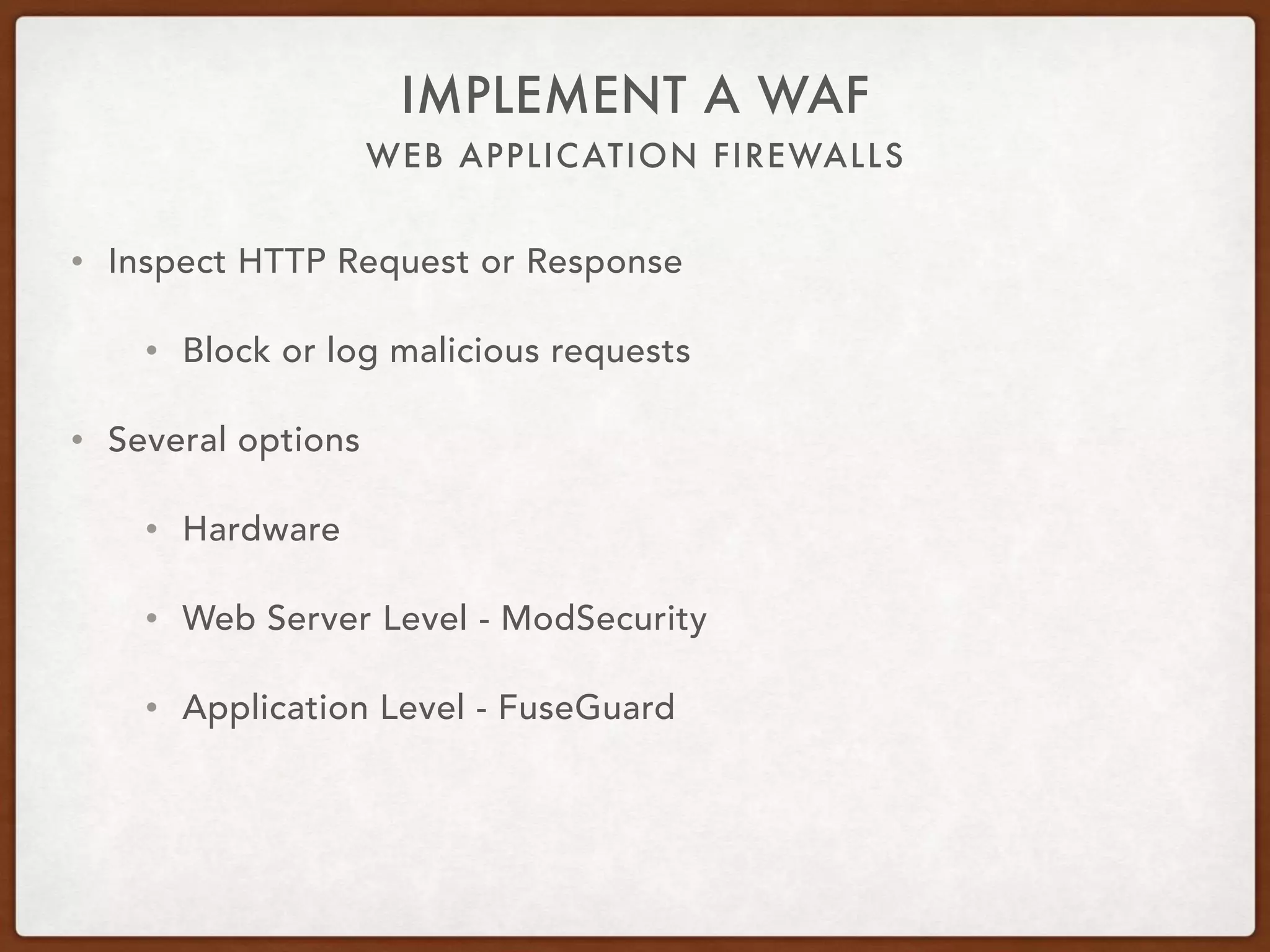
IMPLEMENT A WAF
• Inspect HTTP Request or Response
• Block or log malicious requests
• Several options
• Hardware
• Web Server Level - ModSecurity
• Application Level - FuseGuard
SECURING THAT LARGE CFML CODEBASES?
HOW DO YOU START
STEP 2: IDENTIFY HIGH RISK
VULNERABILITIES IN YOUR CODE.
TAKE CARE OF THESE FIRST
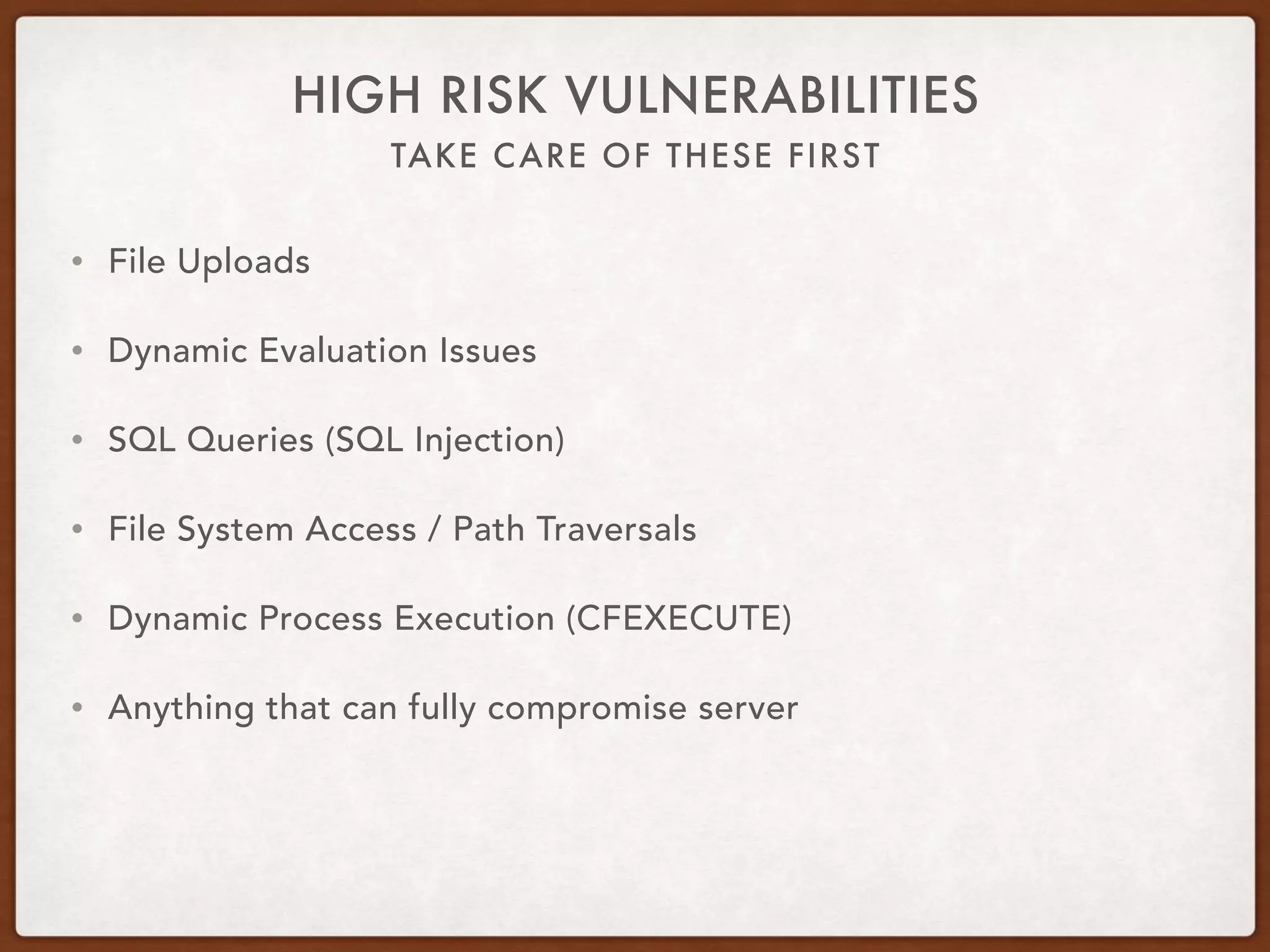
HIGH RISK VULNERABILITIES
• File Uploads
• Dynamic Evaluation Issues
• SQL Queries (SQL Injection)
• File System Access / Path Traversals
• Dynamic Process Execution (CFEXECUTE)
• Anything that can fully compromise server
EVALUATE
REMOTE CODE EXECUTION VIA
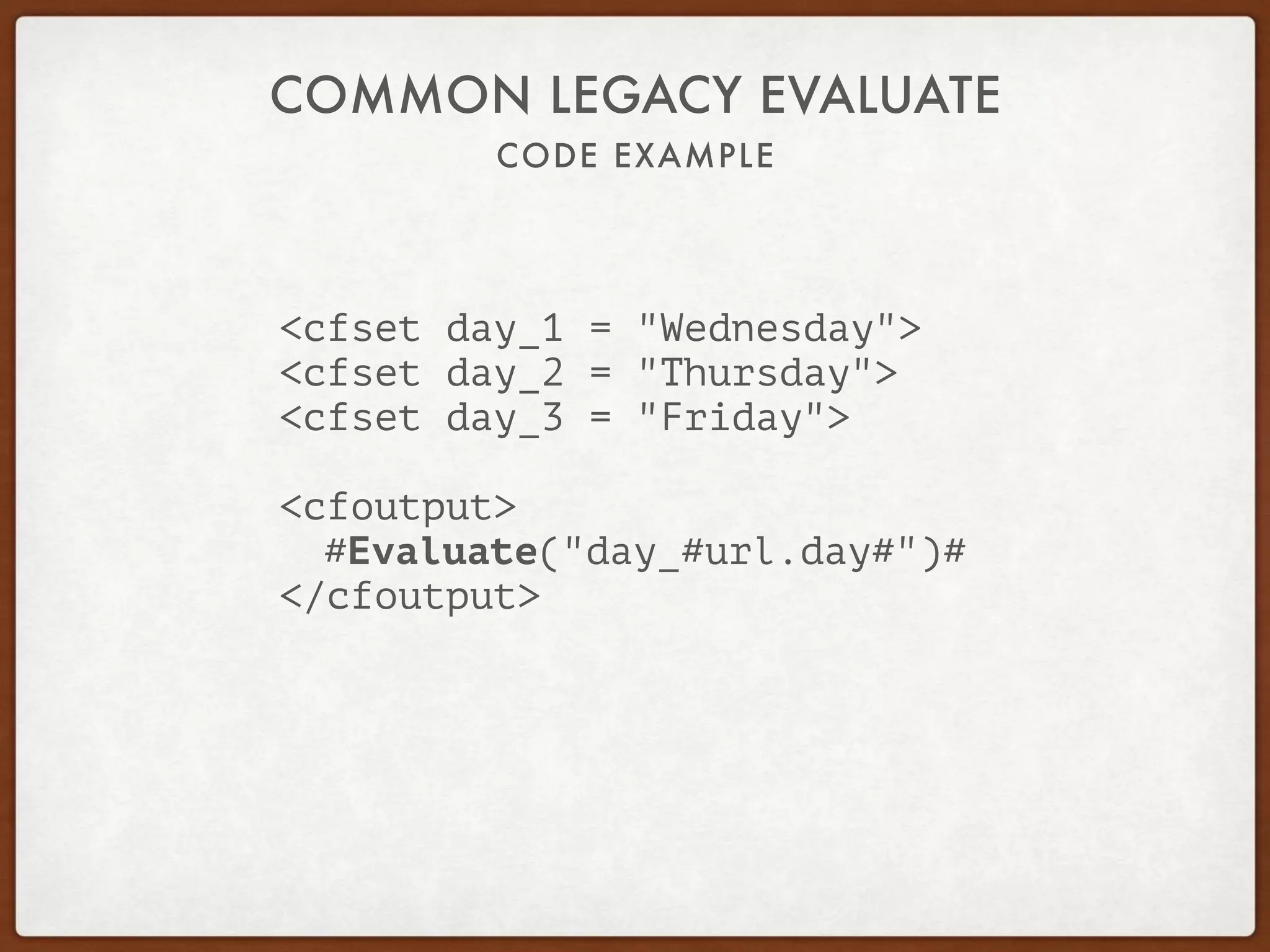
CODE EXAMPLE
COMMON LEGACY EVALUATE
<cfset day_1 = "Wednesday">
<cfset day_2 = "Thursday">
<cfset day_3 = "Friday">
<cfoutput>
#Evaluate("day_#url.day#")#
</cfoutput>
EVALUATE
EXAMPLE
USE BRACKET NOTATION
FIXING LEGACY EVALUATE EXAMPLE
<cfset day_1 = "Wednesday">
<cfset day_2 = "Thursday">
<cfset day_3 = "Friday">
<cfoutput>
#variables["day_#url.day#"]#
</cfoutput>
SEARCH CODE FOR EVALUATE
FIXING EVALUATE ISSUES
• Search Code for "Evaluate"
• In most cases you should not need to use Evaluate at all, use
brackets.
• If the variable is a query you may need to use
queryName[row][columnName] notation.
• Not all cases are super simple to fix, but most are.
• Remove all Evaluate calls from your code.
• Also look at PrecisionEvaluate
DO ANY OTHER
FUNCTIONS EVALUATE
DYNAMICALLY?
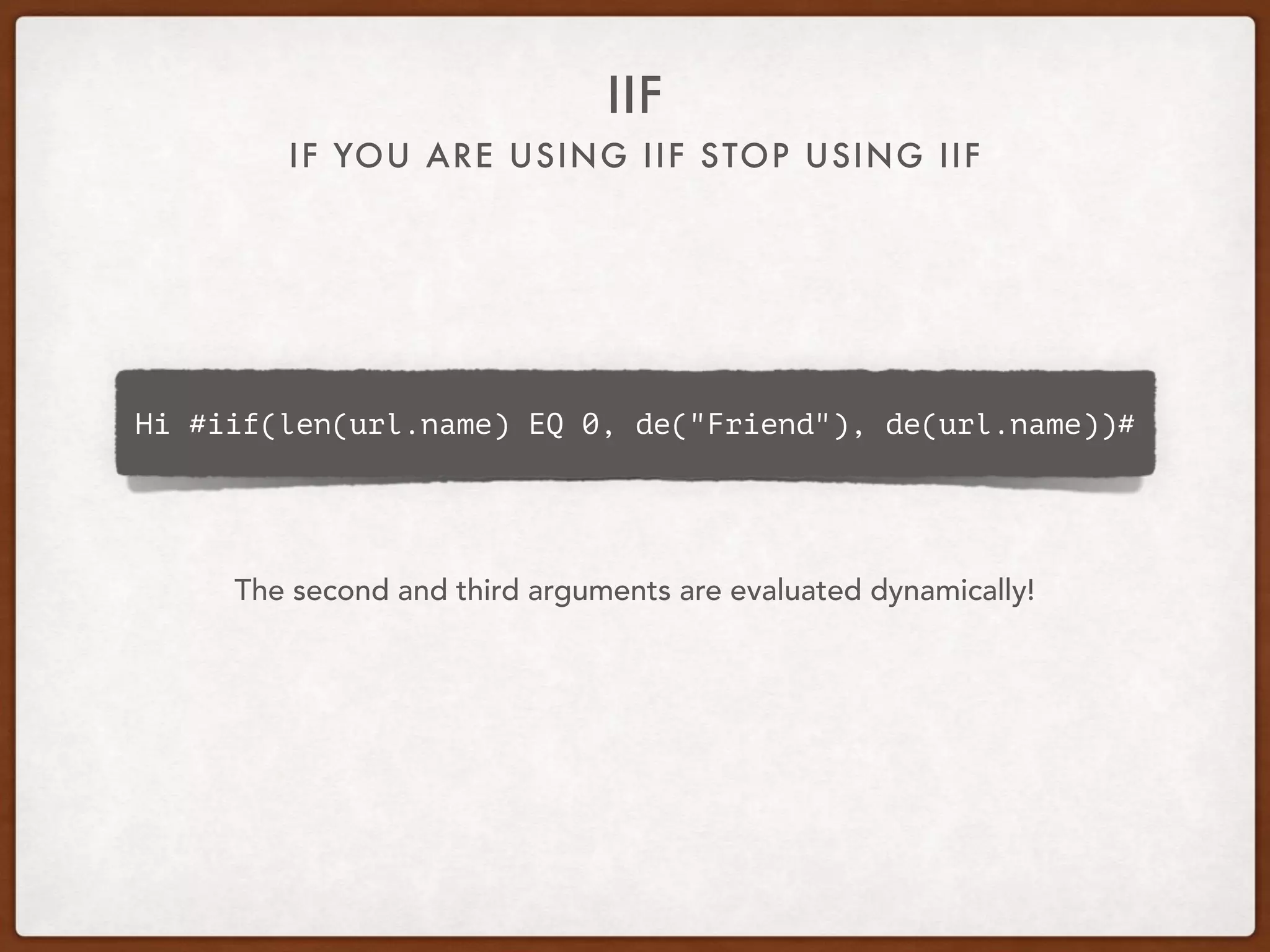
IF YOU ARE USING IIF STOP USING IIF
IIF
Hi #iif(len(url.name) EQ 0, de("Friend"), de(url.name))#
The second and third arguments are evaluated dynamically!
IIF EXAMPLE
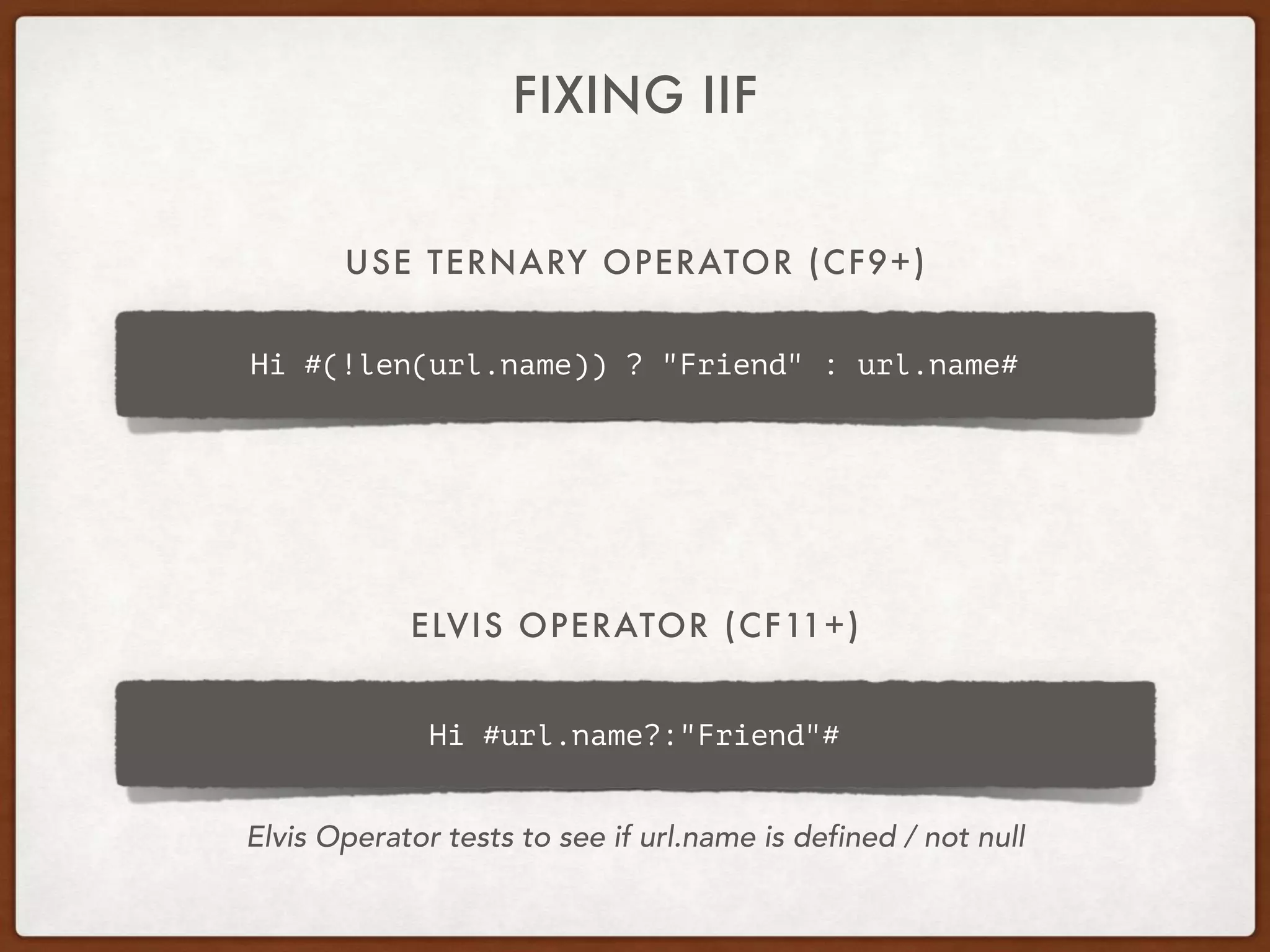
USE TERNARY OPERATOR (CF9+)
FIXING IIF
Hi #(!len(url.name)) ? "Friend" : url.name#
Hi #url.name?:"Friend"#
ELVIS OPERATOR (CF11+)
Elvis Operator tests to see if url.name is defined / not null
FILE UPLOADS
COMMON YET DANGEROUS
FILE UPLOAD
EXAMPLE
3 RULES
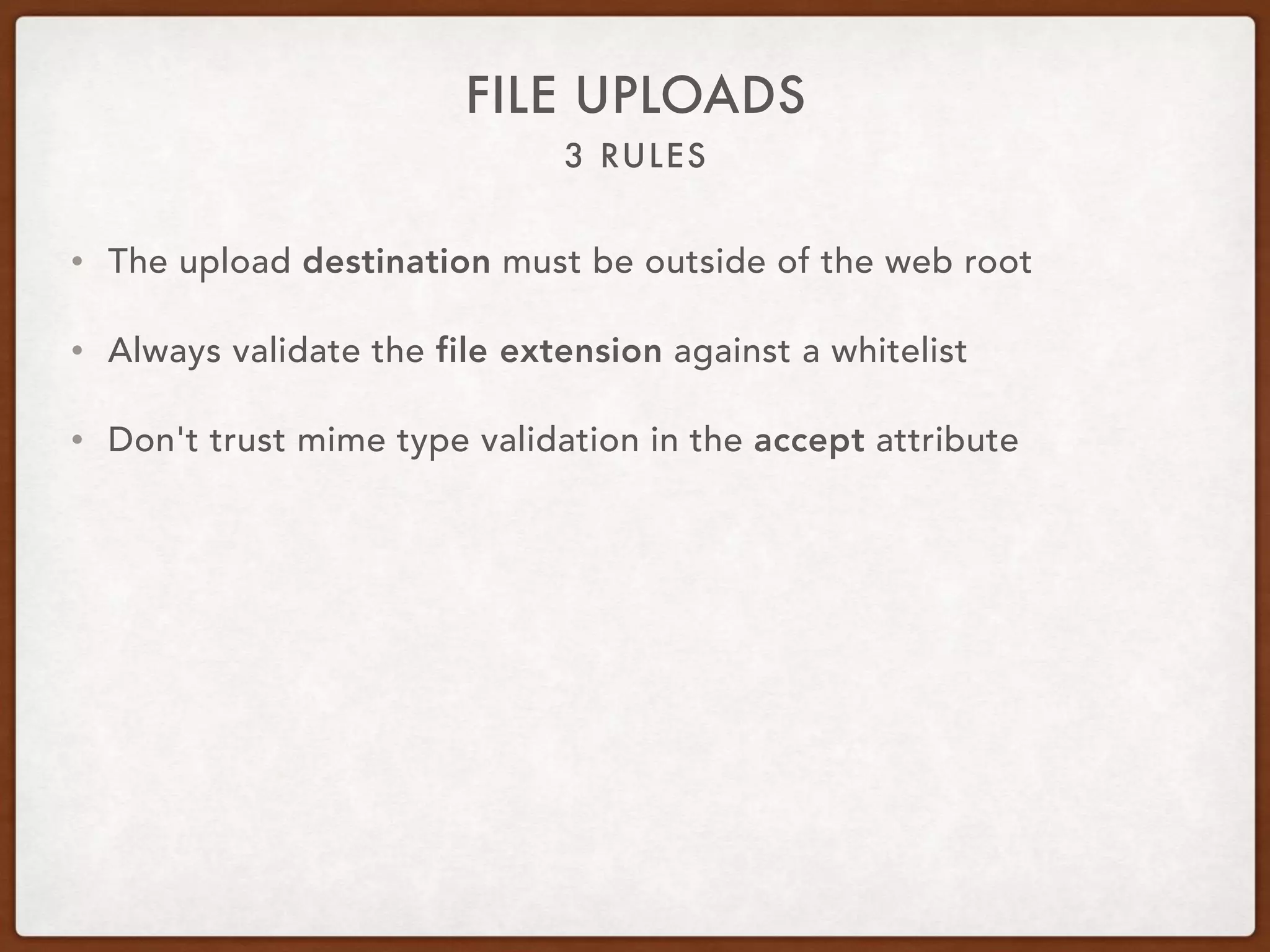
FILE UPLOADS
• The upload destination must be outside of the web root
• Always validate the file extension against a whitelist
• Don't trust mime type validation in the accept attribute
ADDITIONAL TIPS
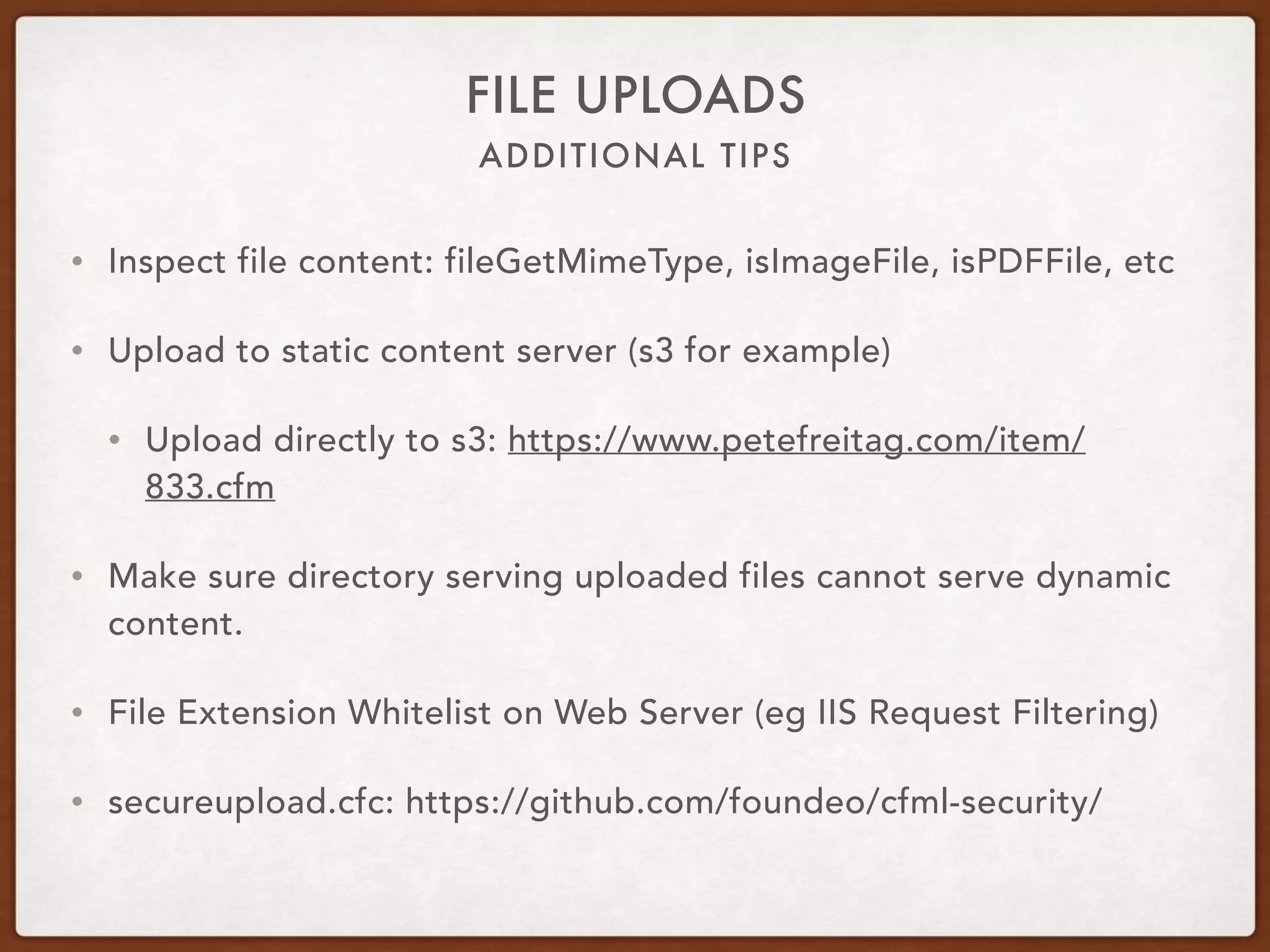
FILE UPLOADS
• Inspect file content: fileGetMimeType, isImageFile, isPDFFile, etc
• Upload to static content server (s3 for example)
• Upload directly to s3: https://www.petefreitag.com/item/
833.cfm
• Make sure directory serving uploaded files cannot serve dynamic
content.
• File Extension Whitelist on Web Server (eg IIS Request Filtering)
• secureupload.cfc: https://github.com/foundeo/cfml-security/
PATH TRAVERSAL
FILE SYSTEM ACCESS &
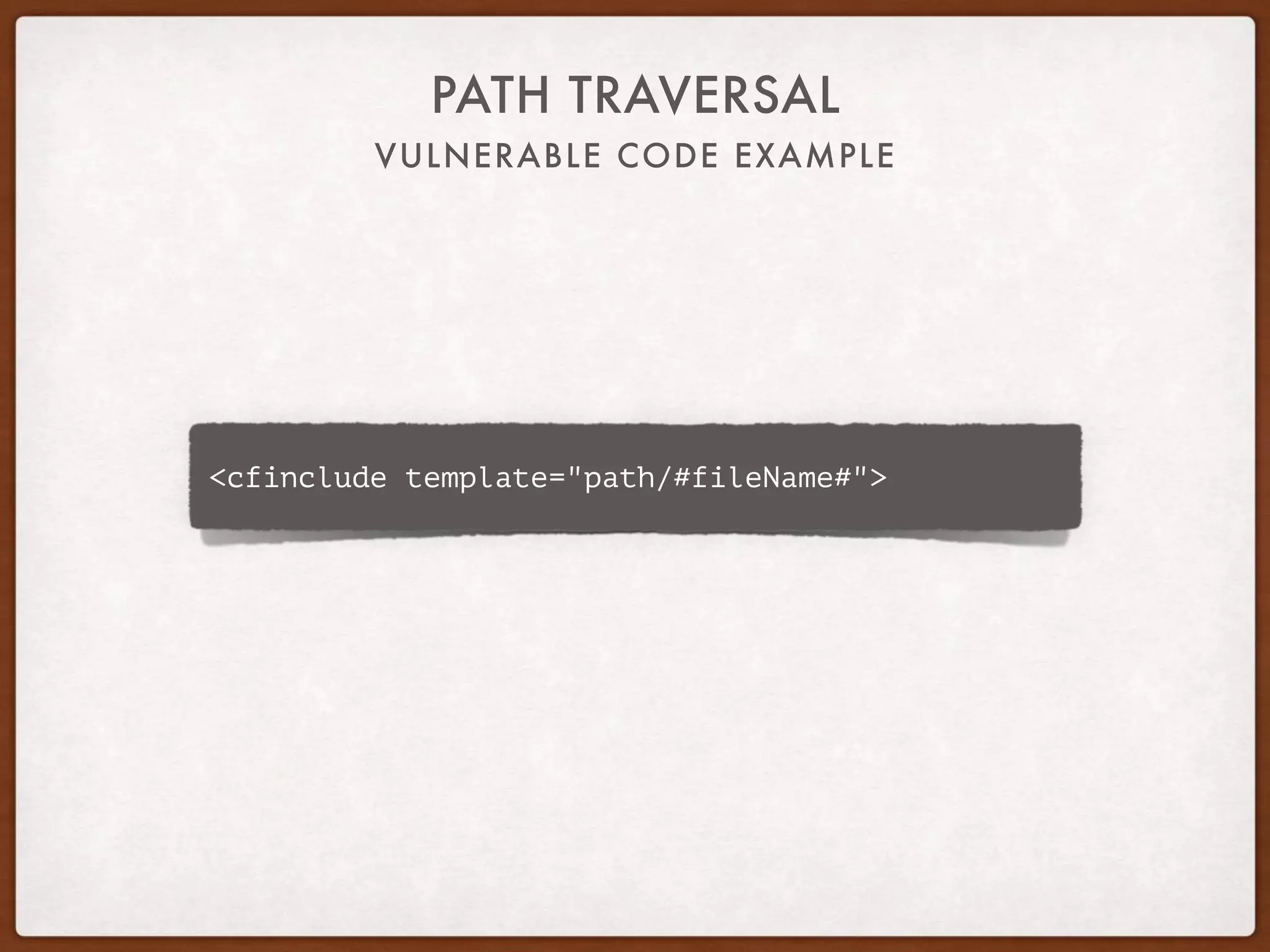
VULNERABLE CODE EXAMPLE
PATH TRAVERSAL
<cfinclude template="path/#fileName#">
PATH TRAVERSAL
EXAMPLE
TIPS
FIXING PATH TRAVERSALS
• Avoid variables in paths
• If you really need to use a variable strip out everything
except a-z0-9
• Use the CF11 Application.cfc setting this.compileExtForInclude
setting.
CAN BE TIME CONSUMING
FINDING FILE ACCESS ISSUES
• Review all function calls / tags that access file system
• cffile, cfdocument, cfinclude, cfmodule, cfspreadsheet
• fileRead, fileWrite, fileOpen, etc
SQL INJECTION
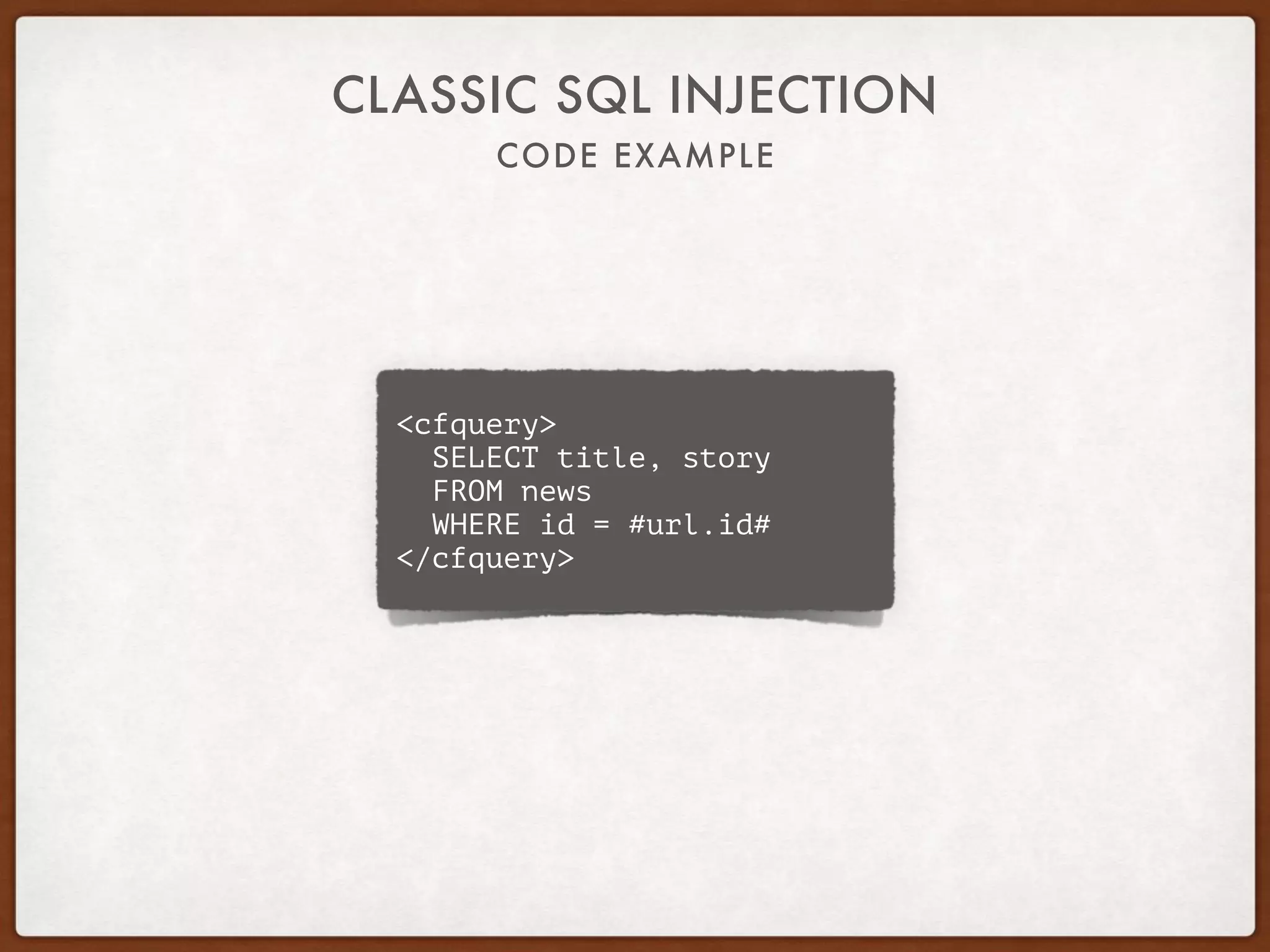
CODE EXAMPLE
CLASSIC SQL INJECTION
<cfquery>
SELECT title, story
FROM news
WHERE id = #url.id#
</cfquery>
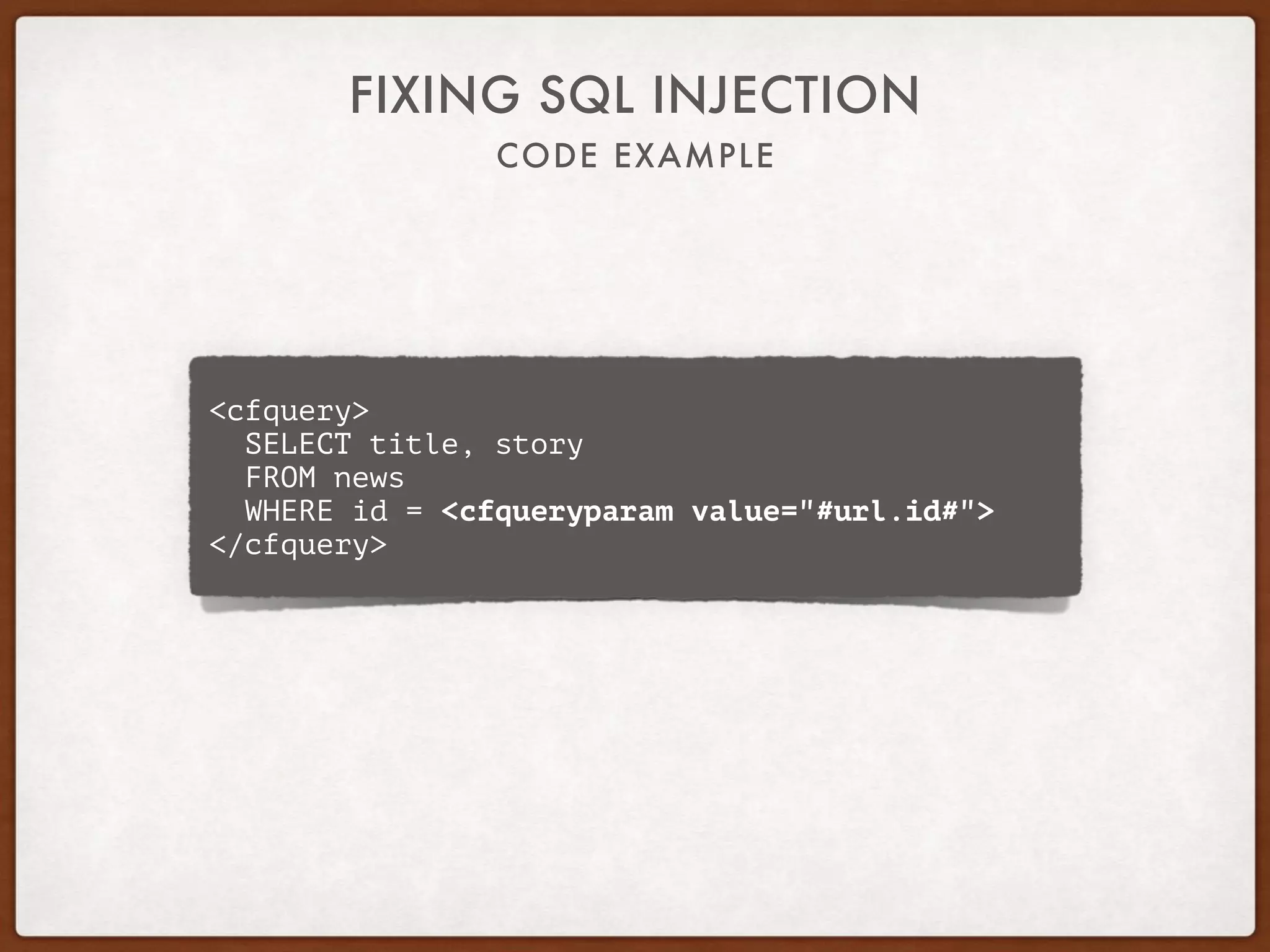
CODE EXAMPLE
FIXING SQL INJECTION
<cfquery>
SELECT title, story
FROM news
WHERE id = <cfqueryparam value="#url.id#">
</cfquery>
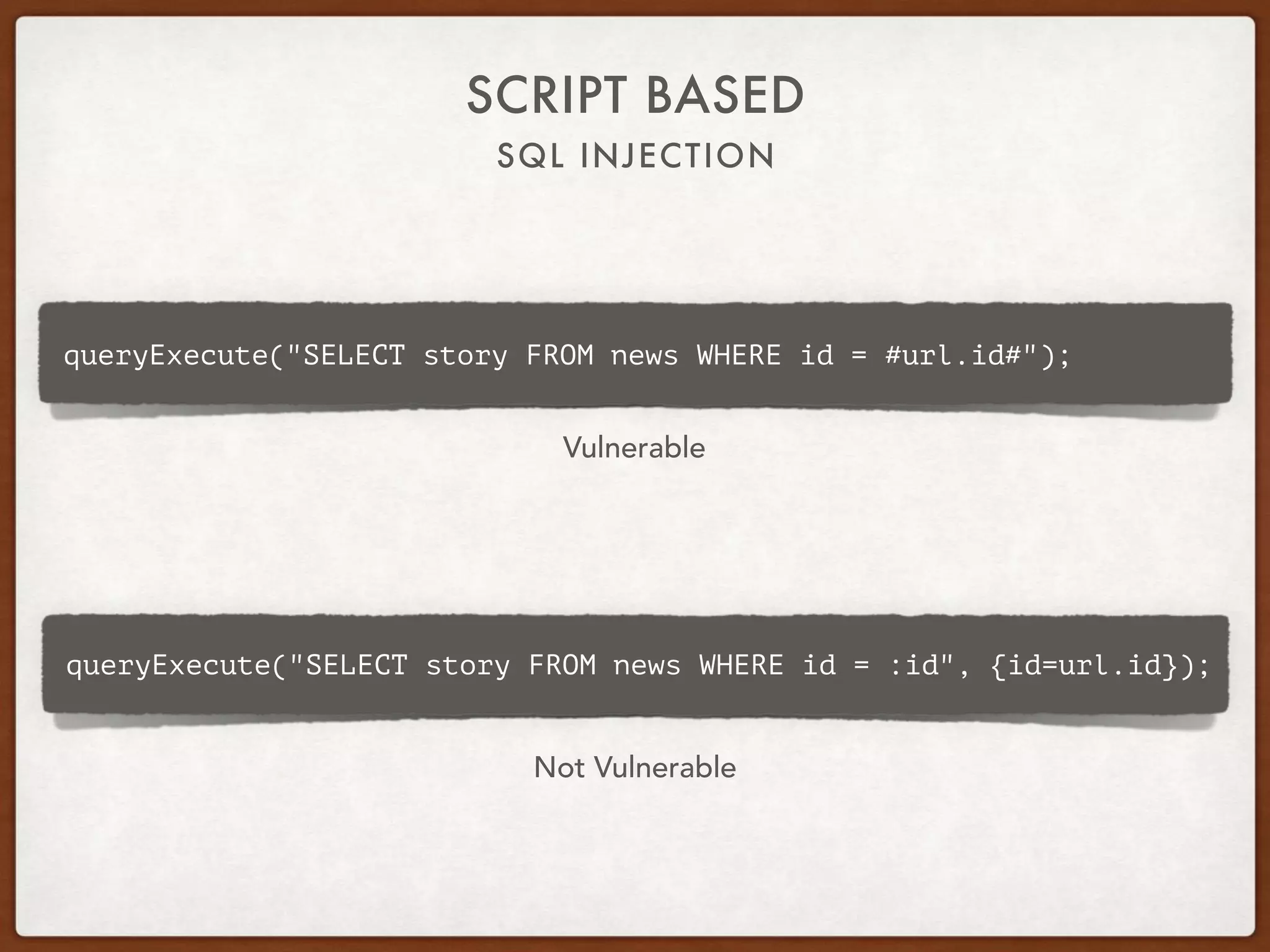
SQL INJECTION
SCRIPT BASED
queryExecute("SELECT story FROM news WHERE id = :id", {id=url.id});
queryExecute("SELECT story FROM news WHERE id = #url.id#");
Vulnerable
Not Vulnerable
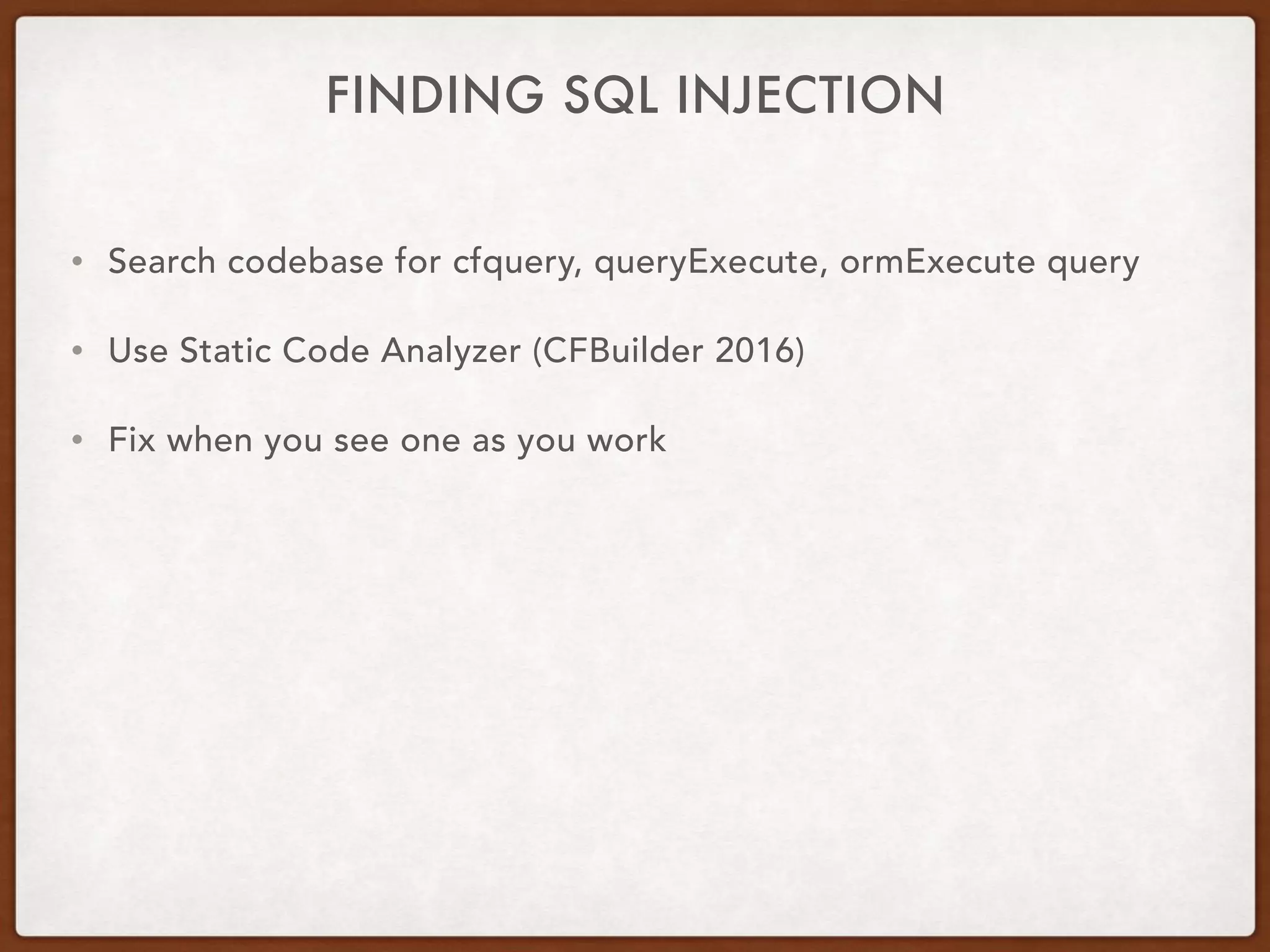
FINDING SQL INJECTION
• Search codebase for cfquery, queryExecute, ormExecute query
• Use Static Code Analyzer (CFBuilder 2016)
• Fix when you see one as you work
SECURING LEGACY CFML
STEP 3: FIX ADDITIONAL
VULNERABILITIES IN YOUR CODE.
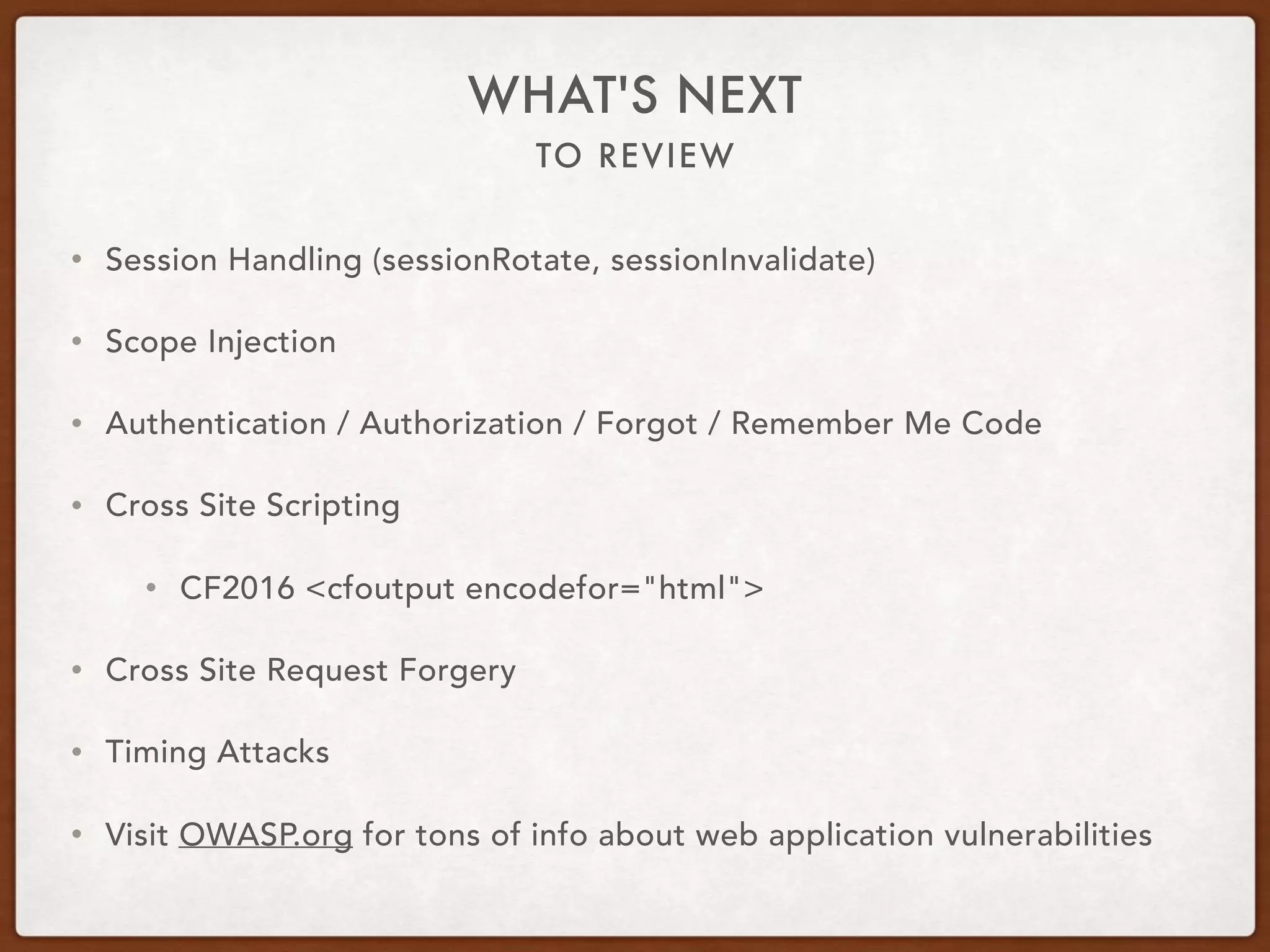
TO REVIEW
WHAT'S NEXT
• Session Handling (sessionRotate, sessionInvalidate)
• Scope Injection
• Authentication / Authorization / Forgot / Remember Me Code
• Cross Site Scripting
• CF2016 <cfoutput encodefor="html">
• Cross Site Request Forgery
• Timing Attacks
• Visit OWASP.org for tons of info about web application vulnerabilities
THANK YOU
Questions?
Pete Freitag
pete@foundeo.com
foundeo.com | fuseguard.com | hackmycf.com
foundeo

Securing applications

  • 1.
    TRANSFORMATIONAL TECHNIQUES TOSECURING EXISTING APPLICATIONS WITH COLDFUSION PETE FREITAG, FOUNDEO INC. foundeo
  • 2.
    ABOUT PETE • MyCompany: Foundeo Inc. • Consulting: Code Reviews, Server Reviews, Development • FuseGuard: Web App Firewall for CFML • HackMyCF: Server Security Scanner • Blog (petefreitag.com), Twitter (@pfreitag), #CFML Slack
  • 3.
    AGENDA • Large CodebaseChallenges • How do you get started? • Low Hanging Fruit • Things to focus on • What’s Next? • Disclaimer: This approach may not be appropriate for all scenarios. This is a generalized approach which I have found can work well for many.
  • 4.
    AN OLD & LARGE CODEBASE? DOYOU HAVE TO WORK WITH
  • 5.
    TYPICALLY MATURE CODEBASES • Hasa large codebase (thousands of source code files) • Has code you hope you don't have to see again. • Can take weeks, but often months of work to properly secure. • Can be hard to fix, brittle • Probably uses outdated techniques
  • 6.
    FIXING A LARGECODEBASE HOW TO APPROACH • Beast Mode - Spend several weeks dedicated to identifying & fixing vulnerabilities. • Prioritize - Spend time identifying the most critical vulnerabilities and patch less critical vulnerabilities as you see them. • As you go - As you work on files fix vulnerabilities as you see them. You may not ever fix some vulnerabilities with this approach.
  • 7.
    SECURING THAT CODE HOWDO YOU START? STEP 1: DELETE THE CODE!
  • 8.
    YOU MIGHT HAVE ALOT OF CODE THAT NEVER RUNS
  • 9.
    HOMEMADE VERSION CONTROL YOUMIGHT BE USING… • index_2.cfm • index.old.cfm • index-backup.cfm • index-2007-03-04.cfm • index-copy.cfm • folder_backup2009/
  • 10.
    VERSION CONTROL • Thosebackup folders and files are probably full of vulnerabilities. • Version Control Server keeps backups of all your code and all changes you have ever made to it. • Sync server source code with version control. • Identify if someone changed something on the server.
  • 11.
    IDENTIFY UNUSED CODE VERSIONCONTROL • Spend some time to identify unused code. • Delete it! • Version control has your back, if you deleted something you can recover it from the repository.
  • 12.
    THERE ARE LOTSOF FADS IN SOFTWARE DEVELOPMENT, VERSION CONTROL IS NOT ONE OF THEM. ” “
  • 13.
    WELCOME TO THE90’S PATCH THAT SERVER • Use ColdFusion 10 or greater (CF9 and below are no longer supported and no longer patched by Adobe). • Windows 2008 (EOL 2015) • Java 8+, Java 7 (EOL 2015), Java 6 (EOL 2013)
  • 14.
    FIX VULNERABILITIES PATCH THATSERVER • Multiple Denial of Service Vulnerabilities in old versions of Java • Path Traversal via Null Byte injection JVM • CRLF Injection (CF10+) • File Uploads “somewhat” more secure (CF10+) • TLS / SSL Protocol Implementations • Java 8 Not supported on CF9 and below
  • 15.
    MITIGATES POTENTIAL IMPACTOF A VULNERABILITY LOCKDOWN THE SERVER • If your CFML server is running as SYSTEM or root then the attacker can do a lot more harm. • If CFML server user has read only access to web root.
  • 16.
    WEB APPLICATION FIREWALLS IMPLEMENTA WAF • Inspect HTTP Request or Response • Block or log malicious requests • Several options • Hardware • Web Server Level - ModSecurity • Application Level - FuseGuard
  • 17.
    SECURING THAT LARGECFML CODEBASES? HOW DO YOU START STEP 2: IDENTIFY HIGH RISK VULNERABILITIES IN YOUR CODE.
  • 18.
    TAKE CARE OFTHESE FIRST HIGH RISK VULNERABILITIES • File Uploads • Dynamic Evaluation Issues • SQL Queries (SQL Injection) • File System Access / Path Traversals • Dynamic Process Execution (CFEXECUTE) • Anything that can fully compromise server
  • 19.
  • 20.
    CODE EXAMPLE COMMON LEGACYEVALUATE <cfset day_1 = "Wednesday"> <cfset day_2 = "Thursday"> <cfset day_3 = "Friday"> <cfoutput> #Evaluate("day_#url.day#")# </cfoutput>
  • 21.
  • 22.
    USE BRACKET NOTATION FIXINGLEGACY EVALUATE EXAMPLE <cfset day_1 = "Wednesday"> <cfset day_2 = "Thursday"> <cfset day_3 = "Friday"> <cfoutput> #variables["day_#url.day#"]# </cfoutput>
  • 23.
    SEARCH CODE FOREVALUATE FIXING EVALUATE ISSUES • Search Code for "Evaluate" • In most cases you should not need to use Evaluate at all, use brackets. • If the variable is a query you may need to use queryName[row][columnName] notation. • Not all cases are super simple to fix, but most are. • Remove all Evaluate calls from your code. • Also look at PrecisionEvaluate
  • 24.
    DO ANY OTHER FUNCTIONSEVALUATE DYNAMICALLY?
  • 25.
    IF YOU AREUSING IIF STOP USING IIF IIF Hi #iif(len(url.name) EQ 0, de("Friend"), de(url.name))# The second and third arguments are evaluated dynamically!
  • 26.
  • 27.
    USE TERNARY OPERATOR(CF9+) FIXING IIF Hi #(!len(url.name)) ? "Friend" : url.name# Hi #url.name?:"Friend"# ELVIS OPERATOR (CF11+) Elvis Operator tests to see if url.name is defined / not null
  • 28.
  • 29.
  • 30.
    3 RULES FILE UPLOADS •The upload destination must be outside of the web root • Always validate the file extension against a whitelist • Don't trust mime type validation in the accept attribute
  • 31.
    ADDITIONAL TIPS FILE UPLOADS •Inspect file content: fileGetMimeType, isImageFile, isPDFFile, etc • Upload to static content server (s3 for example) • Upload directly to s3: https://www.petefreitag.com/item/ 833.cfm • Make sure directory serving uploaded files cannot serve dynamic content. • File Extension Whitelist on Web Server (eg IIS Request Filtering) • secureupload.cfc: https://github.com/foundeo/cfml-security/
  • 32.
  • 33.
    VULNERABLE CODE EXAMPLE PATHTRAVERSAL <cfinclude template="path/#fileName#">
  • 34.
  • 35.
    TIPS FIXING PATH TRAVERSALS •Avoid variables in paths • If you really need to use a variable strip out everything except a-z0-9 • Use the CF11 Application.cfc setting this.compileExtForInclude setting.
  • 36.
    CAN BE TIMECONSUMING FINDING FILE ACCESS ISSUES • Review all function calls / tags that access file system • cffile, cfdocument, cfinclude, cfmodule, cfspreadsheet • fileRead, fileWrite, fileOpen, etc
  • 37.
  • 38.
    CODE EXAMPLE CLASSIC SQLINJECTION <cfquery> SELECT title, story FROM news WHERE id = #url.id# </cfquery>
  • 39.
    CODE EXAMPLE FIXING SQLINJECTION <cfquery> SELECT title, story FROM news WHERE id = <cfqueryparam value="#url.id#"> </cfquery>
  • 40.
    SQL INJECTION SCRIPT BASED queryExecute("SELECTstory FROM news WHERE id = :id", {id=url.id}); queryExecute("SELECT story FROM news WHERE id = #url.id#"); Vulnerable Not Vulnerable
  • 41.
    FINDING SQL INJECTION •Search codebase for cfquery, queryExecute, ormExecute query • Use Static Code Analyzer (CFBuilder 2016) • Fix when you see one as you work
  • 42.
    SECURING LEGACY CFML STEP3: FIX ADDITIONAL VULNERABILITIES IN YOUR CODE.
  • 43.
    TO REVIEW WHAT'S NEXT •Session Handling (sessionRotate, sessionInvalidate) • Scope Injection • Authentication / Authorization / Forgot / Remember Me Code • Cross Site Scripting • CF2016 <cfoutput encodefor="html"> • Cross Site Request Forgery • Timing Attacks • Visit OWASP.org for tons of info about web application vulnerabilities
  • 44.