SECURE HASHING
ALGORITHM
By: Ruth Betcher
Purpose: Authentication
               Not Encryption
Authentication Requirements:
   Masquerade   – Insertion of message from
    fraudulent source
   Content Modification – Changing content of
    message
   Sequence Modification – Insertion, deletion
    and reordering sequence
   Timing Modification – Replaying valid
    sessions
Background Theory
•   Message Digest or “Fingerprint”
       → Condensed Representation
       → Easy to generate for a given file.
•   Computationally infeasible to produce two
    messages with same message digest
•   Impossible to recreate a message given a
    message digest.
•   Data Integrity and Comparison Checking
       → Message Integrity Validation
Applications:
   One-way hash functions
•   Public Key Algorithms
    –   Password Logins
    –   Encryption Key Management
    –   Digital Signatures
•   Integrity Checking
    –   Virus and Malware Scanning
•   Authentication
    –   Secure Web Connections
         •   (PGP, SSL, SSH, S/MIME)
Variants
•   MD4 and MD5 by Ron Rivest (1990,1994)
•   SHA-0, SHA-1 by NSA (1993, 1995)
•   RIPEMD-160 (1996)
•   SHA-2 (2002 – 224, 256, 385, 512)
•   Whirlpool
•   Tiger
•   GOST-3411
•   SHA-3
    •   Winner selected from solicitations in 2012
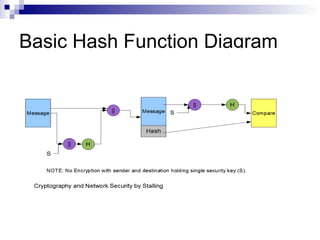
Basic Hash Function Diagram
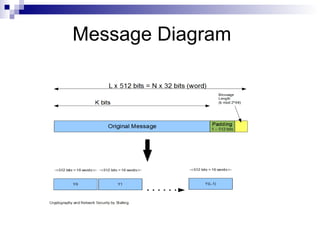
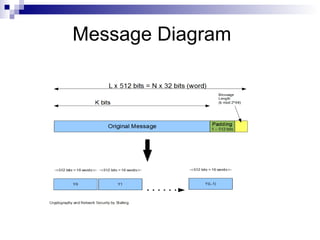
Message Diagram
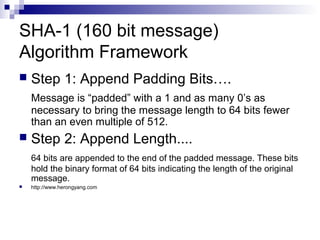
SHA-1 (160 bit message)
Algorithm Framework
   Step 1: Append Padding Bits….
    Message is “padded” with a 1 and as many 0’s as
    necessary to bring the message length to 64 bits fewer
    than an even multiple of 512.
   Step 2: Append Length....
    64 bits are appended to the end of the padded message. These bits
    hold the binary format of 64 bits indicating the length of the original
    message.
   http://www.herongyang.com

        f
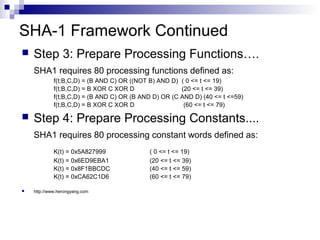
SHA-1 Framework Continued
   Step 3: Prepare Processing Functions….
    SHA1 requires 80 processing functions defined as:
             f(t;B,C,D) = (B AND C) OR ((NOT B) AND D) ( 0 <= t <= 19)
             f(t;B,C,D) = B XOR C XOR D                (20 <= t <= 39)
             f(t;B,C,D) = (B AND C) OR (B AND D) OR (C AND D) (40 <= t <=59)
             f(t;B,C,D) = B XOR C XOR D                 (60 <= t <= 79)

   Step 4: Prepare Processing Constants....
    SHA1 requires 80 processing constant words defined as:
             K(t) = 0x5A827999              ( 0 <= t <= 19)
             K(t) = 0x6ED9EBA1              (20 <= t <= 39)
             K(t) = 0x8F1BBCDC              (40 <= t <= 59)
             K(t) = 0xCA62C1D6              (60 <= t <= 79)

   http://www.herongyang.com
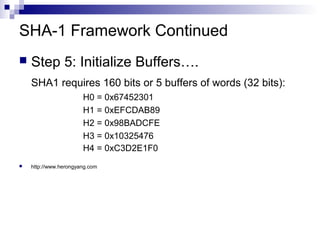
SHA-1 Framework Continued
   Step 5: Initialize Buffers….
    SHA1 requires 160 bits or 5 buffers of words (32 bits):
                       H0 = 0x67452301
                       H1 = 0xEFCDAB89
                       H2 = 0x98BADCFE
                       H3 = 0x10325476
                       H4 = 0xC3D2E1F0
   http://www.herongyang.com
SHA-1 Framework Final Step
   Step 6: Processing Message in 512-bit
    blocks (L blocks in total message)….
    This is the main task of SHA1 algorithm which loops through the
    padded and appended message in 512-bit blocks.
    Input and predefined functions:
          M[1, 2, ..., L]: Blocks of the padded and appended message
    f(0;B,C,D), f(1,B,C,D), ..., f(79,B,C,D): 80 Processing Functions   K(0),
    K(1), ..., K(79): 80 Processing Constant Words
          H0, H1, H2, H3, H4, H5: 5 Word buffers with initial values

   http://www.herongyang.com
SHA-1 Framework Continued
   Step 6: Pseudo Code….
    For loop on k = 1 to L
          (W(0),W(1),...,W(15)) = M[k]       /* Divide M[k] into 16 words */
          For t = 16 to 79 do:
                   W(t) = (W(t-3) XOR W(t-8) XOR W(t-14) XOR W(t-16)) <<< 1
           A = H0, B = H1, C = H2, D = H3, E = H4
           For t = 0 to 79 do:
                TEMP = A<<<5 + f(t;B,C,D) + E + W(t) + K(t) E = D, D = C,
                             C = B<<<30, B = A, A = TEMP
           End of for loop
           H0 = H0 + A, H1 = H1 + B, H2 = H2 + C, H3 = H3 + D, H4 = H4 + E
       End of for loop

Output:
              H0, H1, H2, H3, H4, H5: Word buffers with final message digest
   http://www.herongyang.com
Message Diagram
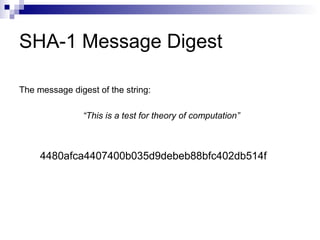
SHA-1 Message Digest

The message digest of the string:

                “This is a test for theory of computation”


     4480afca4407400b035d9debeb88bfc402db514f
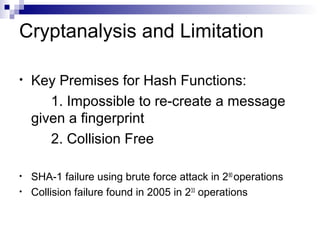
Cryptanalysis and Limitation

•   Key Premises for Hash Functions:
       1. Impossible to re-create a message
    given a fingerprint
       2. Collision Free

•   SHA-1 failure using brute force attack in 280 operations
•   Collision failure found in 2005 in 233 operations
Bibliography
   http://www.herongyang.com
   http://www.ipa.go.jp/security
   Salomon, David, Foundations of Computer
    Security Springer-Verlag London Limited 2006.
   Schneier, Bruce, “Opinion: Cryptanalysis of MD
    % and SHA: Time for a new standard”,
    Computer World, August 2004.
   Stallings, William, Cryptography and Network
    Security, Prentice Hall, 1999.
   Tanenbaum, Andrew, Computer Networks,
    Prentice Hall, 2003.

Secure hashing algorithm

  • 1.
  • 2.
    Purpose: Authentication Not Encryption Authentication Requirements:  Masquerade – Insertion of message from fraudulent source  Content Modification – Changing content of message  Sequence Modification – Insertion, deletion and reordering sequence  Timing Modification – Replaying valid sessions
  • 3.
    Background Theory • Message Digest or “Fingerprint” → Condensed Representation → Easy to generate for a given file. • Computationally infeasible to produce two messages with same message digest • Impossible to recreate a message given a message digest. • Data Integrity and Comparison Checking → Message Integrity Validation
  • 4.
    Applications: One-way hash functions • Public Key Algorithms – Password Logins – Encryption Key Management – Digital Signatures • Integrity Checking – Virus and Malware Scanning • Authentication – Secure Web Connections • (PGP, SSL, SSH, S/MIME)
  • 5.
    Variants • MD4 and MD5 by Ron Rivest (1990,1994) • SHA-0, SHA-1 by NSA (1993, 1995) • RIPEMD-160 (1996) • SHA-2 (2002 – 224, 256, 385, 512) • Whirlpool • Tiger • GOST-3411 • SHA-3 • Winner selected from solicitations in 2012
  • 6.
  • 7.
  • 8.
    SHA-1 (160 bitmessage) Algorithm Framework  Step 1: Append Padding Bits…. Message is “padded” with a 1 and as many 0’s as necessary to bring the message length to 64 bits fewer than an even multiple of 512.  Step 2: Append Length.... 64 bits are appended to the end of the padded message. These bits hold the binary format of 64 bits indicating the length of the original message.  http://www.herongyang.com f
  • 9.
    SHA-1 Framework Continued  Step 3: Prepare Processing Functions…. SHA1 requires 80 processing functions defined as: f(t;B,C,D) = (B AND C) OR ((NOT B) AND D) ( 0 <= t <= 19) f(t;B,C,D) = B XOR C XOR D (20 <= t <= 39) f(t;B,C,D) = (B AND C) OR (B AND D) OR (C AND D) (40 <= t <=59) f(t;B,C,D) = B XOR C XOR D (60 <= t <= 79)  Step 4: Prepare Processing Constants.... SHA1 requires 80 processing constant words defined as: K(t) = 0x5A827999 ( 0 <= t <= 19) K(t) = 0x6ED9EBA1 (20 <= t <= 39) K(t) = 0x8F1BBCDC (40 <= t <= 59) K(t) = 0xCA62C1D6 (60 <= t <= 79)  http://www.herongyang.com
  • 10.
    SHA-1 Framework Continued  Step 5: Initialize Buffers…. SHA1 requires 160 bits or 5 buffers of words (32 bits): H0 = 0x67452301 H1 = 0xEFCDAB89 H2 = 0x98BADCFE H3 = 0x10325476 H4 = 0xC3D2E1F0  http://www.herongyang.com
  • 11.
    SHA-1 Framework FinalStep  Step 6: Processing Message in 512-bit blocks (L blocks in total message)…. This is the main task of SHA1 algorithm which loops through the padded and appended message in 512-bit blocks. Input and predefined functions: M[1, 2, ..., L]: Blocks of the padded and appended message f(0;B,C,D), f(1,B,C,D), ..., f(79,B,C,D): 80 Processing Functions K(0), K(1), ..., K(79): 80 Processing Constant Words H0, H1, H2, H3, H4, H5: 5 Word buffers with initial values  http://www.herongyang.com
  • 12.
    SHA-1 Framework Continued  Step 6: Pseudo Code…. For loop on k = 1 to L (W(0),W(1),...,W(15)) = M[k] /* Divide M[k] into 16 words */ For t = 16 to 79 do: W(t) = (W(t-3) XOR W(t-8) XOR W(t-14) XOR W(t-16)) <<< 1 A = H0, B = H1, C = H2, D = H3, E = H4 For t = 0 to 79 do: TEMP = A<<<5 + f(t;B,C,D) + E + W(t) + K(t) E = D, D = C, C = B<<<30, B = A, A = TEMP End of for loop H0 = H0 + A, H1 = H1 + B, H2 = H2 + C, H3 = H3 + D, H4 = H4 + E End of for loop Output: H0, H1, H2, H3, H4, H5: Word buffers with final message digest  http://www.herongyang.com
  • 13.
  • 14.
    SHA-1 Message Digest Themessage digest of the string: “This is a test for theory of computation” 4480afca4407400b035d9debeb88bfc402db514f
  • 15.
    Cryptanalysis and Limitation • Key Premises for Hash Functions: 1. Impossible to re-create a message given a fingerprint 2. Collision Free • SHA-1 failure using brute force attack in 280 operations • Collision failure found in 2005 in 233 operations
  • 16.
    Bibliography  http://www.herongyang.com  http://www.ipa.go.jp/security  Salomon, David, Foundations of Computer Security Springer-Verlag London Limited 2006.  Schneier, Bruce, “Opinion: Cryptanalysis of MD % and SHA: Time for a new standard”, Computer World, August 2004.  Stallings, William, Cryptography and Network Security, Prentice Hall, 1999.  Tanenbaum, Andrew, Computer Networks, Prentice Hall, 2003.

Editor's Notes

  • #3 Verify that received messages come from the alleged source and have not been altered. Also verify the sequence and timing. Digital Signature is used to combat denial of receipt of a message by either the source or desitination.
  • #6 All variants have a similar framework. The variation is in the bits compressed into the digest. Thereby, differ in the number of blocks and words of data used in hashing.