Operant Conditioning The Ugly Cousin to Classical Conditioning
8.  Explain how Operant Conditioning works and is different than OC.
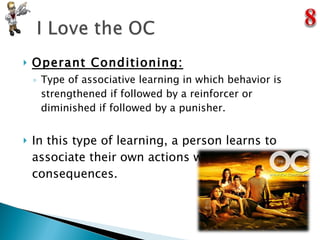
Operant Conditioning: Type of associative learning in which behavior is strengthened if followed by a reinforcer or diminished if followed by a punisher. In this type of learning, a person learns to associate their own actions with consequences.
Look at the dog video on blackboard to see how  easy operant conditioning works.
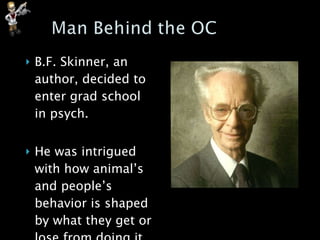
B.F. Skinner, an author, decided to enter grad school in psych. He was intrigued with how animal’s and people’s behavior is shaped by what they get or lose from doing it.
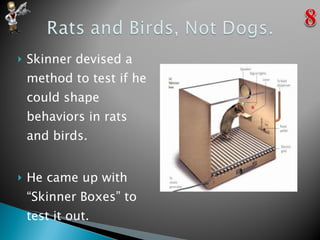
Skinner devised a method to test if he could shape behaviors in rats and birds. He came up with “Skinner Boxes” to test it out.
Pigeon vid
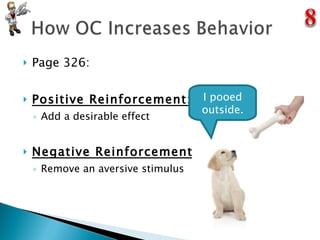
Page 326: Positive Reinforcement: Add a desirable effect Negative Reinforcement: Remove an aversive stimulus I pooed outside.
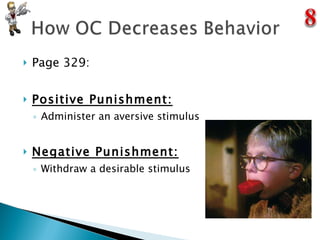
Page 329: Positive Punishment: Administer an aversive stimulus Negative Punishment: Withdraw a desirable stimulus
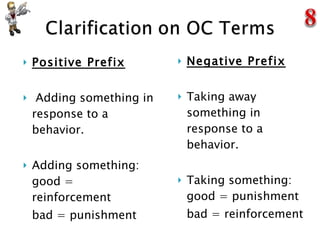
Positive Prefix Adding something in response to a behavior. Adding something: good = reinforcement bad = punishment Negative Prefix Taking away something in response to a behavior. Taking something: good = punishment bad = reinforcement
Calvin gives Hobbes a hug for wiping his feet off before coming inside. Positive  Reinforcement
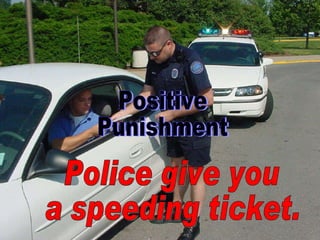
Police give you  a speeding ticket. Positive  Punishment
My wife cuts off my supply of pumpkin delights because of my behavior. Negative Punishment No more for you till you behave yourself.
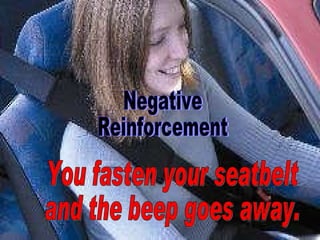
You fasten your seatbelt and the beep goes away. Negative  Reinforcement
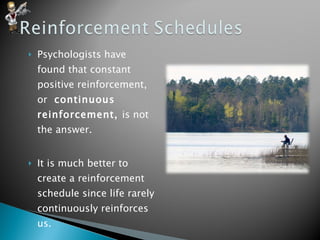
Psychologists have found that constant positive reinforcement, or  continuous reinforcement,  is not the answer. It is much better to create a reinforcement schedule since life rarely continuously reinforces us.
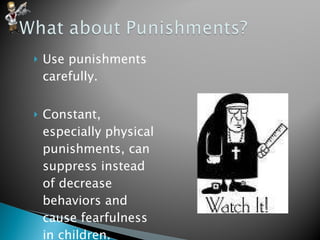
Use punishments carefully. Constant, especially physical punishments, can suppress instead of decrease behaviors and cause fearfulness in children.

Section 2 Operant Conditioning

  • 1.
    Operant Conditioning TheUgly Cousin to Classical Conditioning
  • 2.
    8. Explainhow Operant Conditioning works and is different than OC.
  • 3.
    Operant Conditioning: Typeof associative learning in which behavior is strengthened if followed by a reinforcer or diminished if followed by a punisher. In this type of learning, a person learns to associate their own actions with consequences.
  • 4.
    Look at thedog video on blackboard to see how easy operant conditioning works.
  • 5.
    B.F. Skinner, anauthor, decided to enter grad school in psych. He was intrigued with how animal’s and people’s behavior is shaped by what they get or lose from doing it.
  • 6.
    Skinner devised amethod to test if he could shape behaviors in rats and birds. He came up with “Skinner Boxes” to test it out.
  • 7.
  • 8.
    Page 326: PositiveReinforcement: Add a desirable effect Negative Reinforcement: Remove an aversive stimulus I pooed outside.
  • 9.
    Page 329: PositivePunishment: Administer an aversive stimulus Negative Punishment: Withdraw a desirable stimulus
  • 10.
    Positive Prefix Addingsomething in response to a behavior. Adding something: good = reinforcement bad = punishment Negative Prefix Taking away something in response to a behavior. Taking something: good = punishment bad = reinforcement
  • 11.
    Calvin gives Hobbesa hug for wiping his feet off before coming inside. Positive Reinforcement
  • 12.
    Police give you a speeding ticket. Positive Punishment
  • 13.
    My wife cutsoff my supply of pumpkin delights because of my behavior. Negative Punishment No more for you till you behave yourself.
  • 14.
    You fasten yourseatbelt and the beep goes away. Negative Reinforcement
  • 15.
    Psychologists have foundthat constant positive reinforcement, or continuous reinforcement, is not the answer. It is much better to create a reinforcement schedule since life rarely continuously reinforces us.
  • 16.
    Use punishments carefully.Constant, especially physical punishments, can suppress instead of decrease behaviors and cause fearfulness in children.