BY,
DAMARIS BENNY DANIEL
I Msc. ZOOLOGY
INTRODUCTION
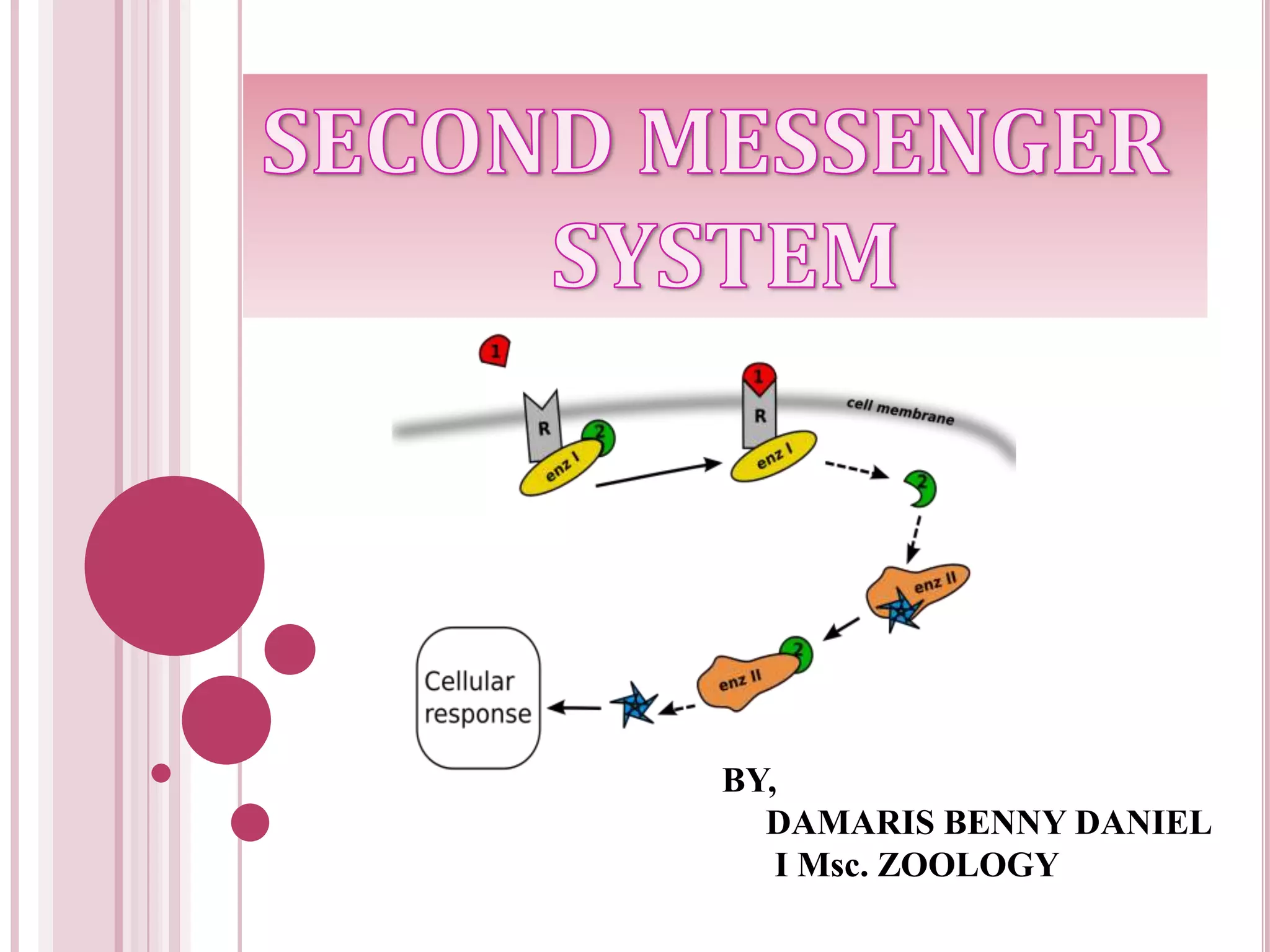
 Second messengers are molecules that relay signals
from receptors on the cell surface to target molecules
inside the cell.
 They greatly amplify the strength of the signal, cause
some kind of change in the activity of the cell.
 They are a component of cell signaling pathways.
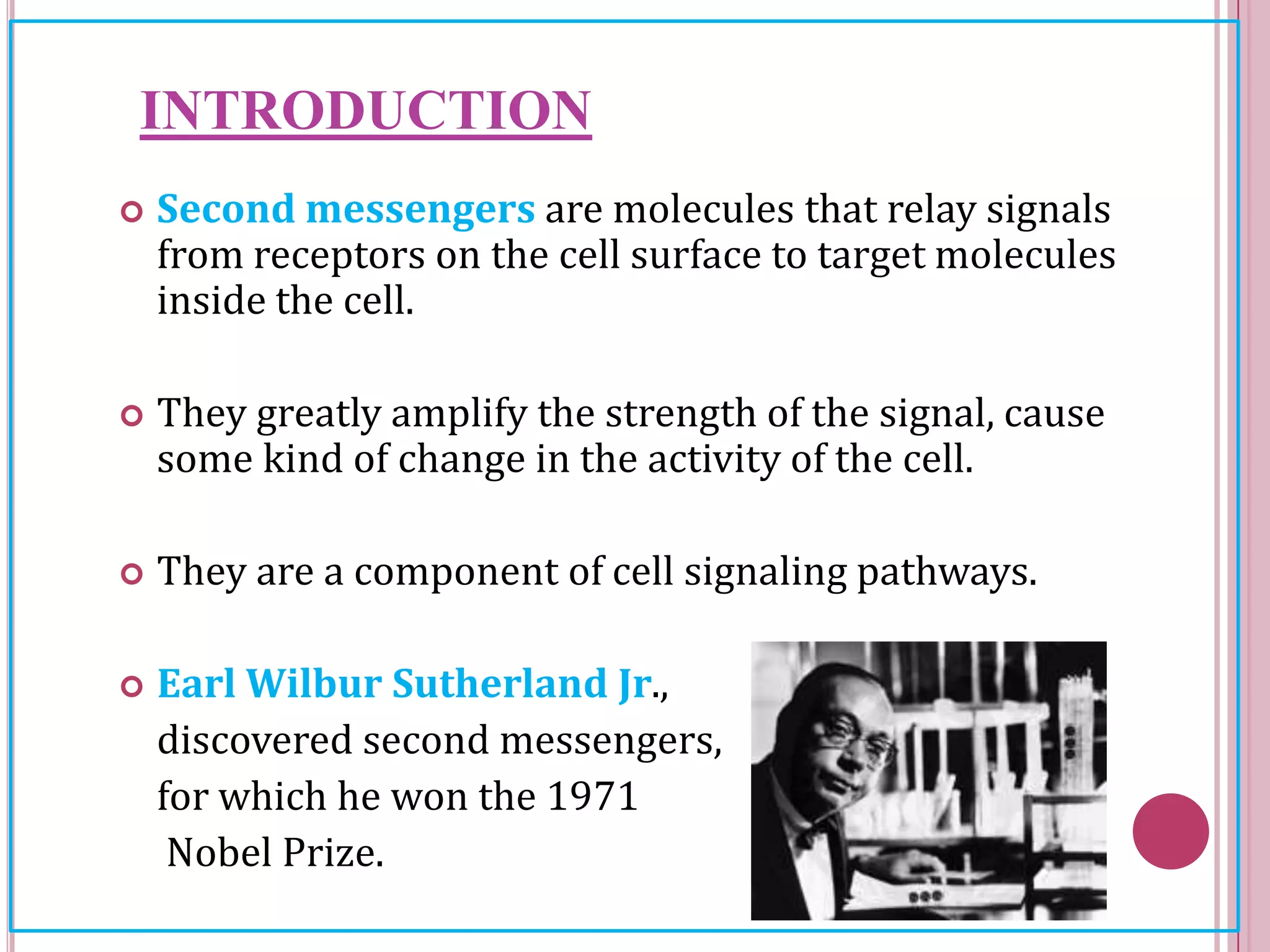
 Earl Wilbur Sutherland Jr.,
discovered second messengers,
for which he won the 1971
Nobel Prize.
SECOND MESSENGERS
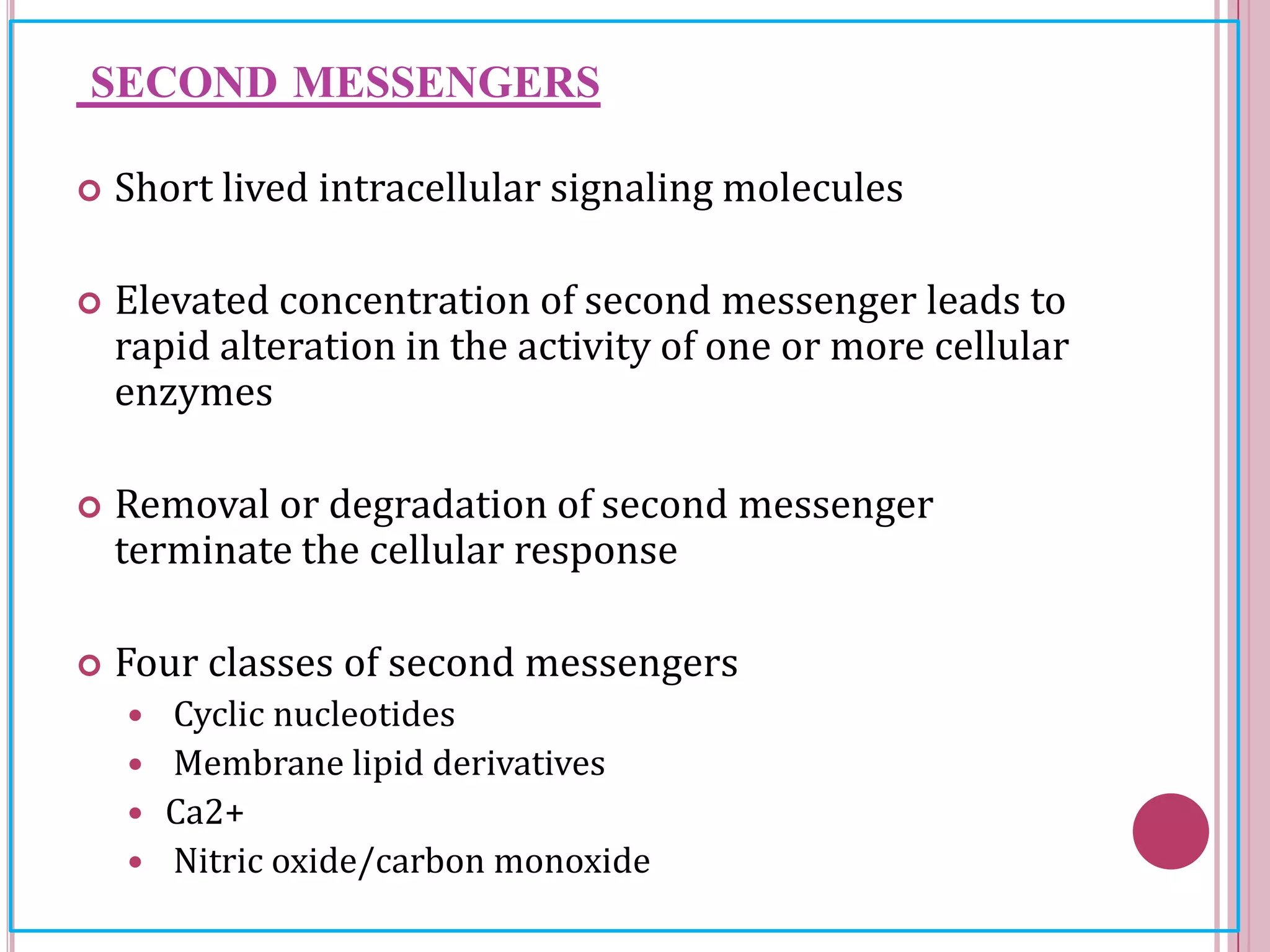
 Short lived intracellular signaling molecules
 Elevated concentration of second messenger leads to
rapid alteration in the activity of one or more cellular
enzymes
 Removal or degradation of second messenger
terminate the cellular response
 Four classes of second messengers
 Cyclic nucleotides
 Membrane lipid derivatives
 Ca2+
 Nitric oxide/carbon monoxide
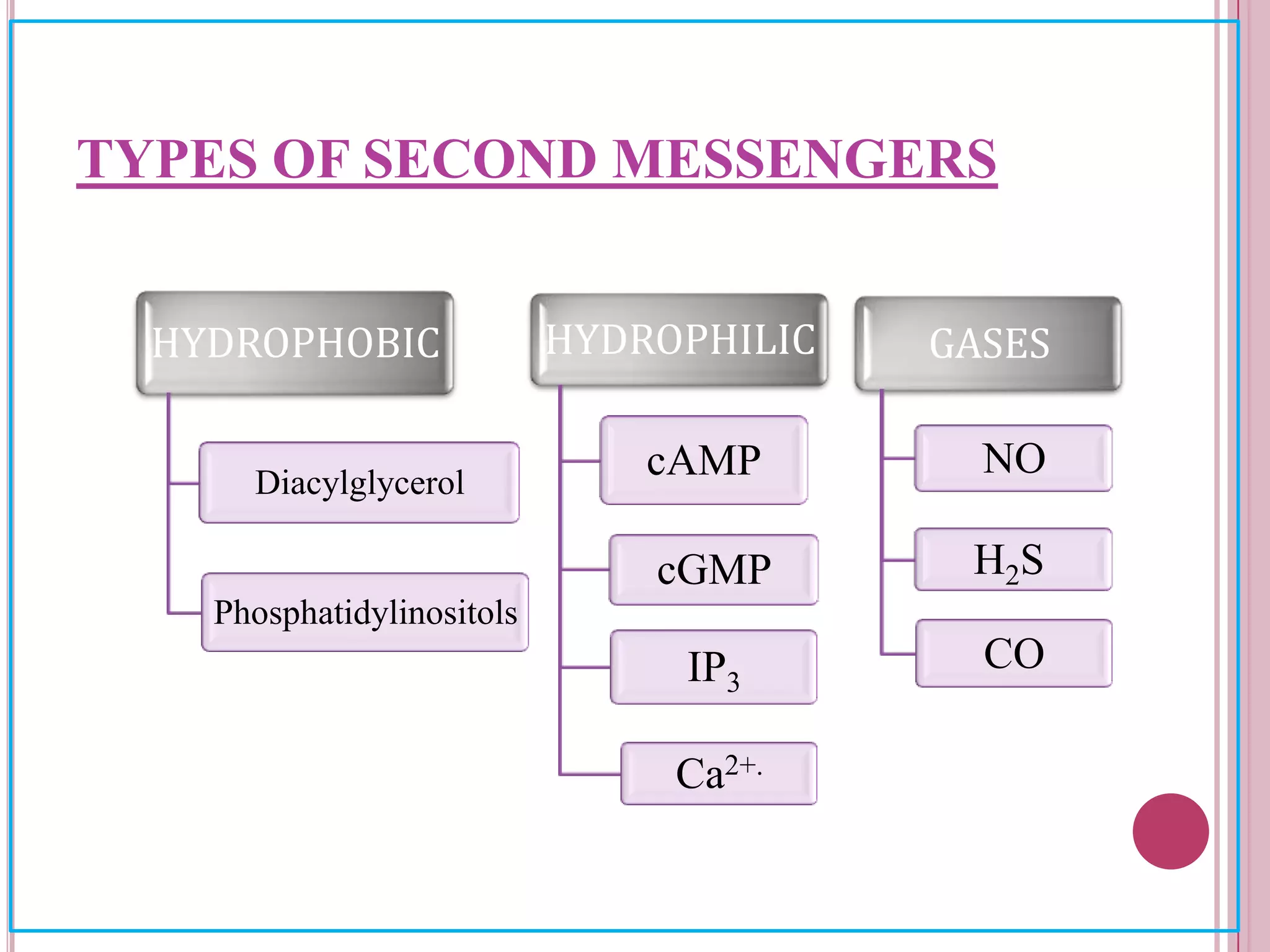
GASES
NO
H2S
CO
HYDROPHOBIC
Diacylglycerol
Phosphatidylinositols
HYDROPHILIC
cAMP
cGMP
IP3
Ca2+.
TYPES OF SECOND MESSENGERS
CYCLIC AMP
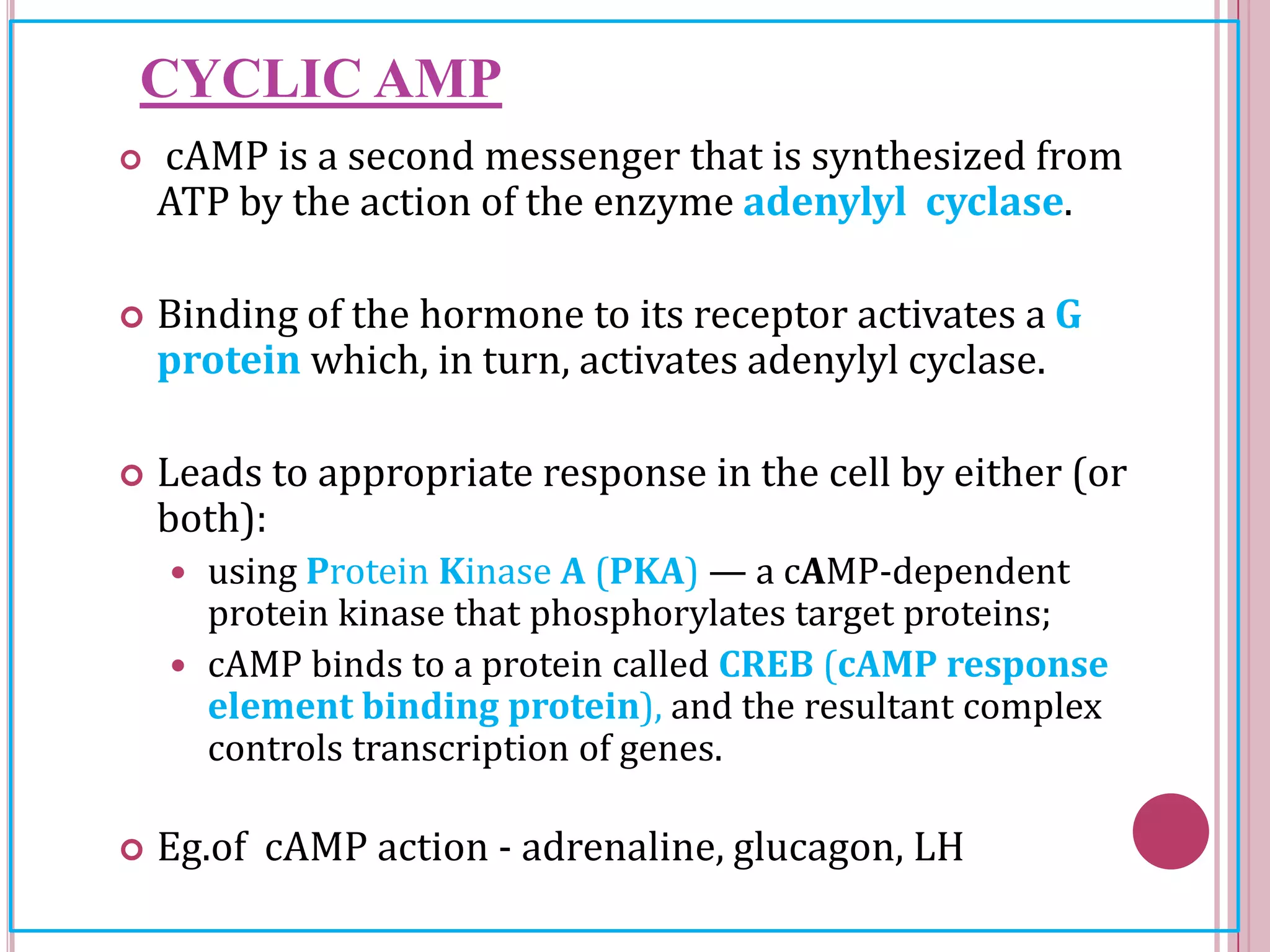
 cAMP is a second messenger that is synthesized from
ATP by the action of the enzyme adenylyl cyclase.
 Binding of the hormone to its receptor activates a G
protein which, in turn, activates adenylyl cyclase.
 Leads to appropriate response in the cell by either (or
both):
 using Protein Kinase A (PKA) — a cAMP-dependent
protein kinase that phosphorylates target proteins;
 cAMP binds to a protein called CREB (cAMP response
element binding protein), and the resultant complex
controls transcription of genes.
 Eg.of cAMP action - adrenaline, glucagon, LH
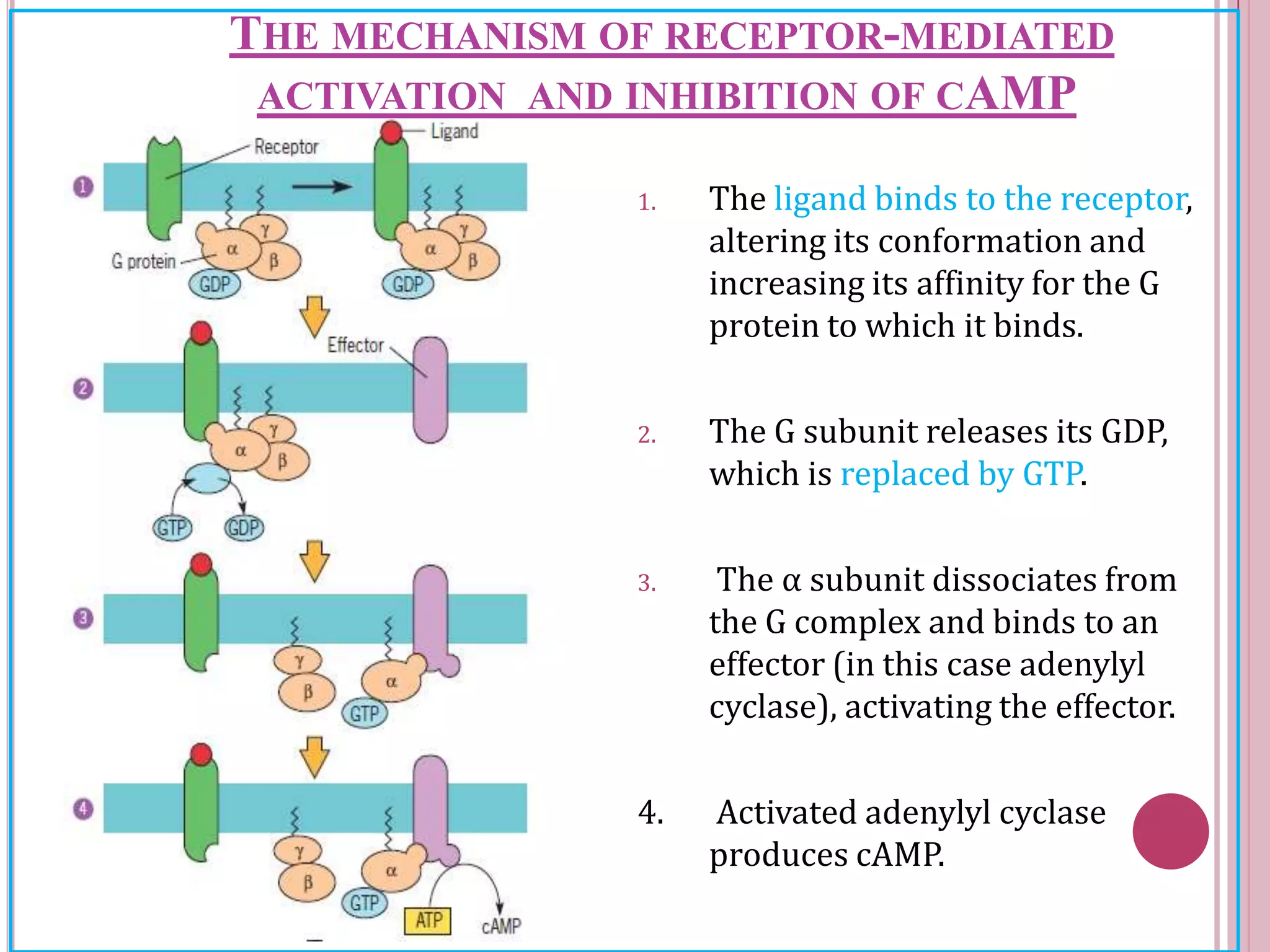
1. The ligand binds to the receptor,
altering its conformation and
increasing its affinity for the G
protein to which it binds.
2. The G subunit releases its GDP,
which is replaced by GTP.
3. The α subunit dissociates from
the G complex and binds to an
effector (in this case adenylyl
cyclase), activating the effector.
4. Activated adenylyl cyclase
produces cAMP.
THE MECHANISM OF RECEPTOR-MEDIATED
ACTIVATION AND INHIBITION OF CAMP
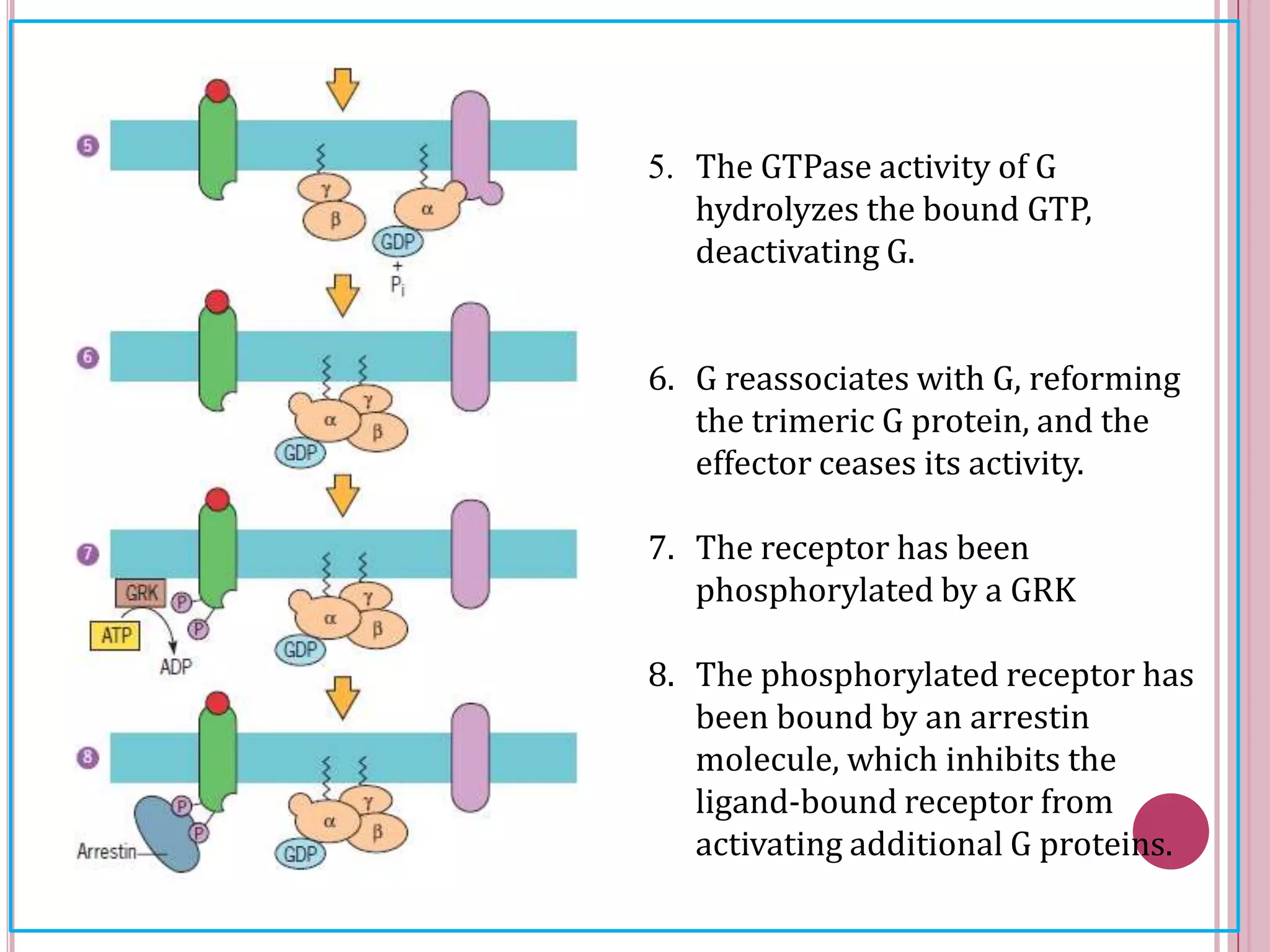
5. The GTPase activity of G
hydrolyzes the bound GTP,
deactivating G.
6. G reassociates with G, reforming
the trimeric G protein, and the
effector ceases its activity.
7. The receptor has been
phosphorylated by a GRK
8. The phosphorylated receptor has
been bound by an arrestin
molecule, which inhibits the
ligand-bound receptor from
activating additional G proteins.
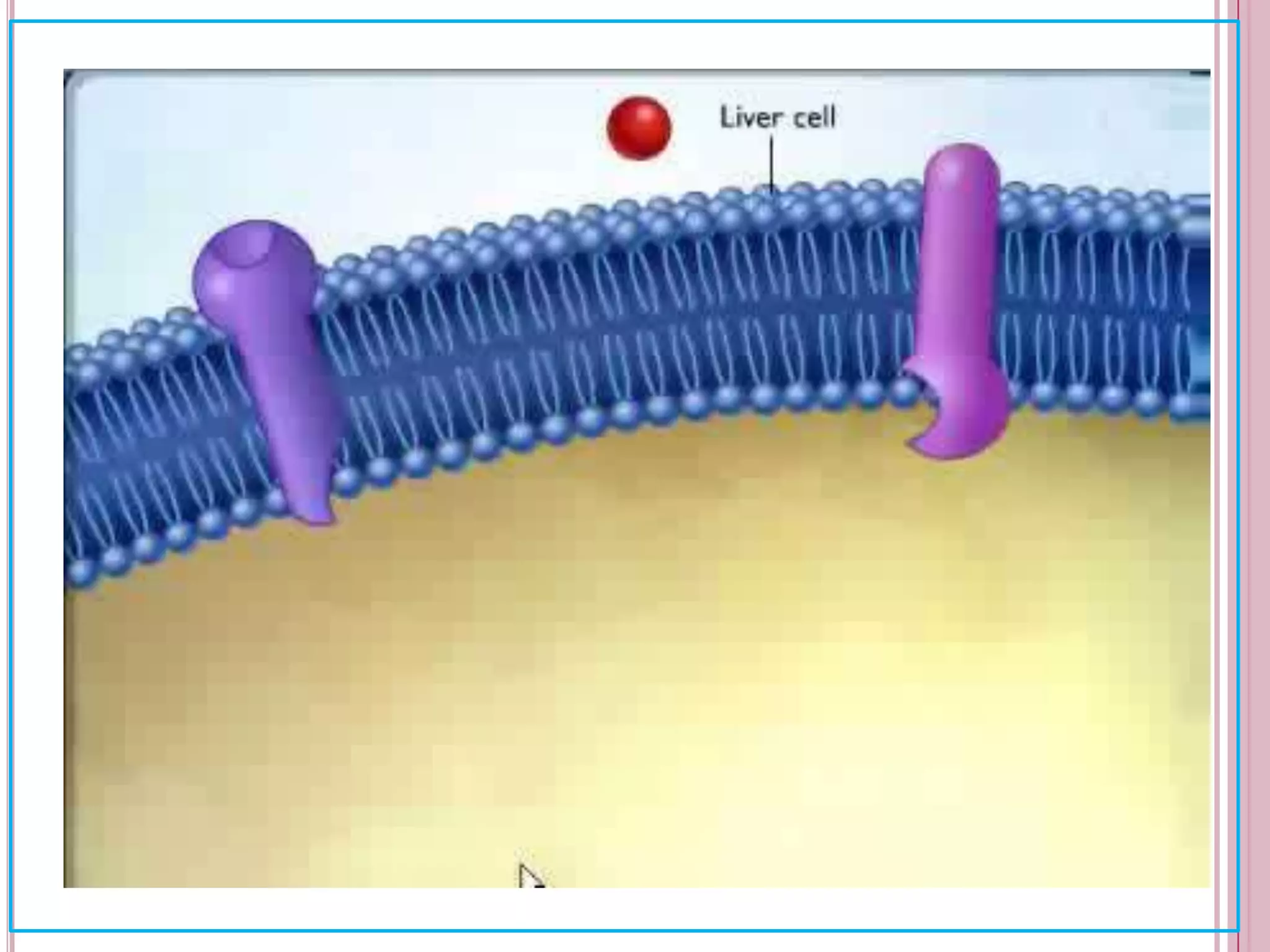
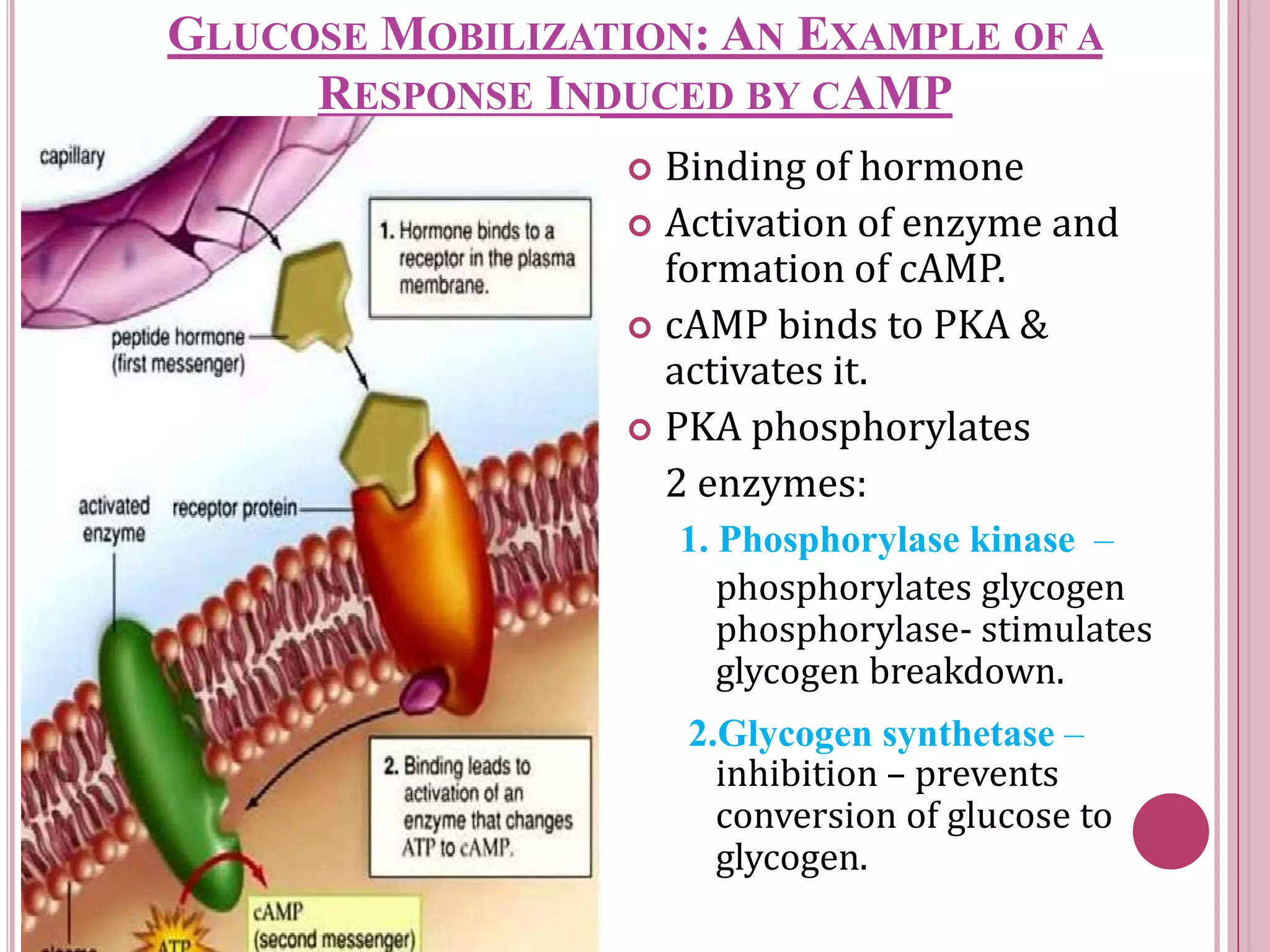
GLUCOSE MOBILIZATION: AN EXAMPLE OF A
RESPONSE INDUCED BY CAMP
 Binding of hormone
 Activation of enzyme and
formation of cAMP.
 cAMP binds to PKA &
activates it.
 PKA phosphorylates
2 enzymes:
phosphorylates glycogen
phosphorylase- stimulates
glycogen breakdown.
inhibition – prevents
conversion of glucose to
glycogen.
1. Phosphorylase kinase –
2.Glycogen synthetase –
CYCLIC GMP
 cGMP is synthesized from the nucleotide GTP using the
enzyme guanylyl cyclase.
 Nitric oxide stimulates the synthesis of cGMP .
 Many cells contain a cGMP-stimulated protein kinase
that contains both catalytic and regulatory subunits.
 Some of the effects of cGMP are mediated through
Protein Kinase G (PKG)
 cGMP serves as the second messenger for
 nitric oxide (NO)
 the response of the rods of the retina to light.
PHOSPHATIDYLINOSITOL-DERIVED
SECOND MESSENGERS
 Phosphatidylinositol ( PI) is a negatively charged
phospholipid and a minor component in eukaryotic cell
membranes.
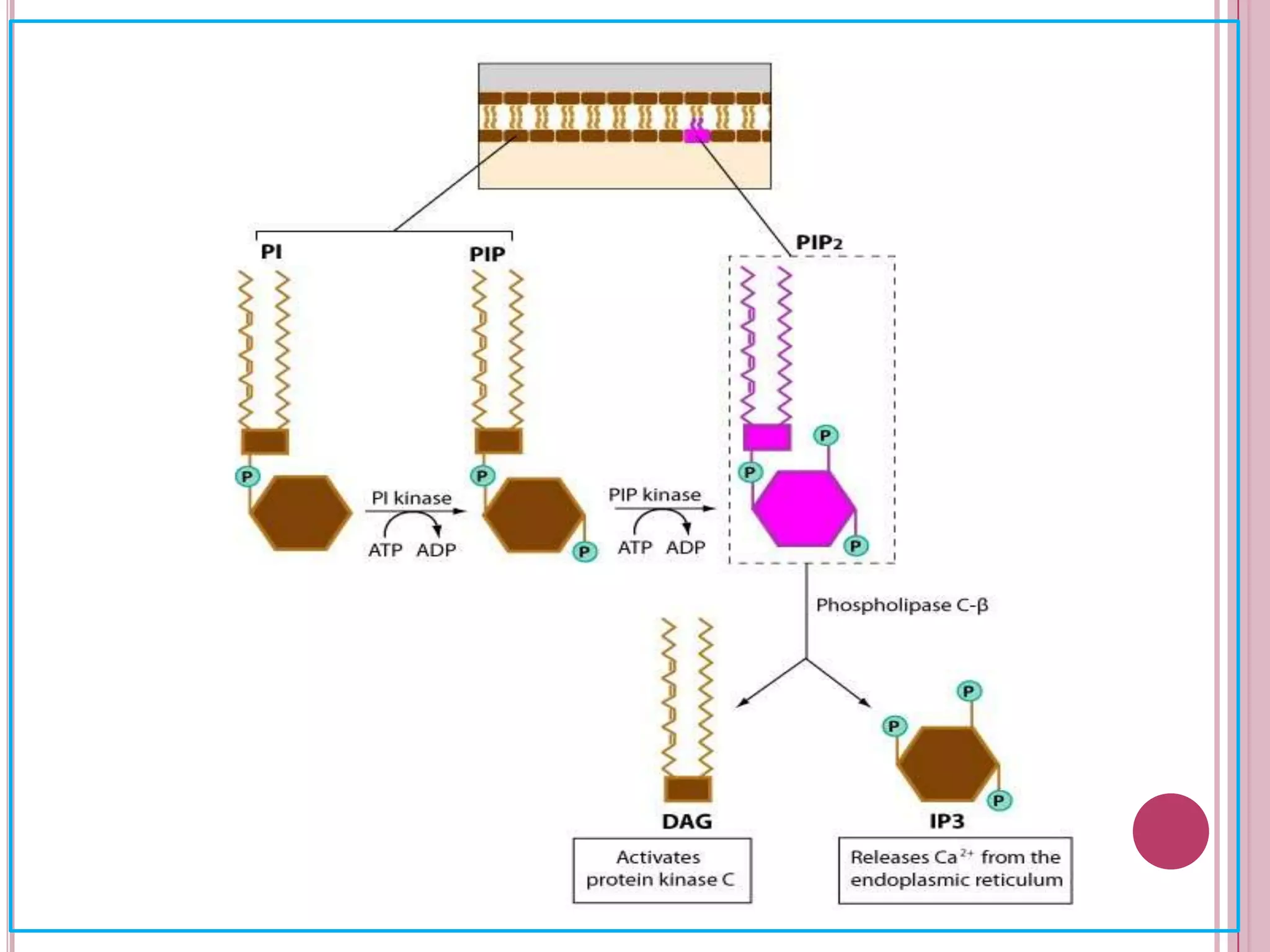
 The inositol can be phosphorylated to form
 Phosphatidylinositol-4-phosphate (PIP)
 Phosphatidylinositol-4,5-bis-phosphate (PIP2)
 Phosphatidylinositol-3,4,5-trisphosphate (PIP3)
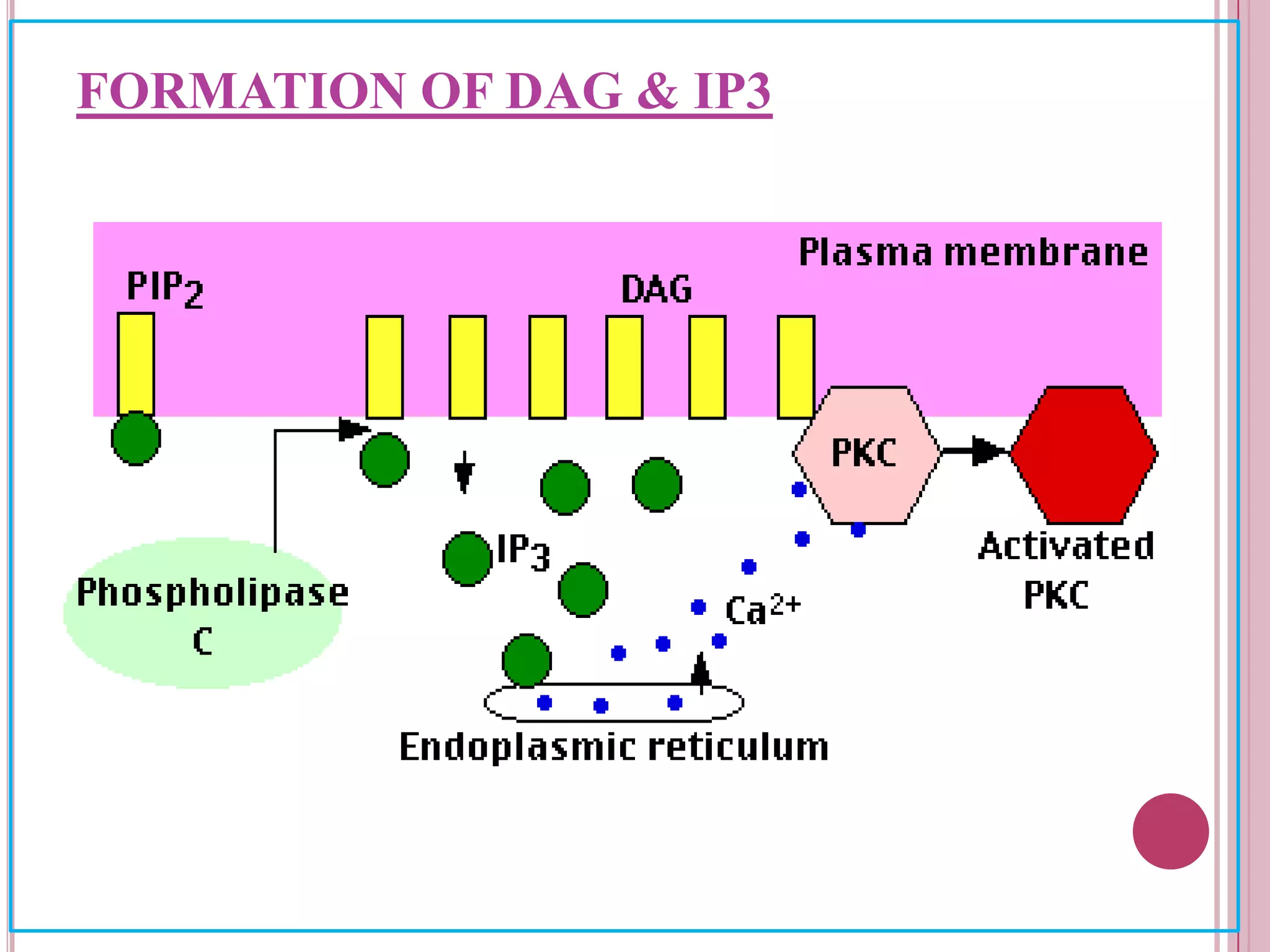
 Intracellular enzyme phospholipase C
(PLC),hydrolyzes PIP2 which is found in the inner layer
of the plasma membrane. Hydrolysis of PIP2 yields two
products:
 Diacylglycerol (DAG)
 Inositol-1,4,5-trisphosphate (IP3)
PHOSPHO
INOSITIDES.
DIACYLGLYCEROL
 Diacylglycerol stimulates protein kinase C activity by
greatly increasing the affinity of the enzyme for calcium
ions.
 Protein kinase C phosphorylates specific serine and
threonine residues in target proteins.
 Known target proteins include calmodulin, the glucose
transporter, HMG-CoA reductase, cytochrome P450 etc.
INOSITOL TRIPHOSPHATE, IP3
 This soluble molecule diffuses through the cytosol
and binds to receptors on the endoplasmic
reticulum causing the release of calcium ions (Ca2+)
into the cytosol.
 The rise in intracellular calcium triggers the response.
 Example: the calcium rise is needed for NF-AT (the
"nuclear factor of activated T cells") to turn on the
appropriate genes in the nucleus.
MODE OF ACTION
 Peptide and protein hormones like vasopressin, TSH, and
neurotransmitters like GABA bind to GPCRs
 This activate the intracellular enzyme phospholipase C
(PLC).
 PLC in turn cleaves PIP2 to yield two products – DAG and
IP3.
 Both of these products act as second messengers.
 So, the cleavage of PIP2 by PLC is the functional equivalent
of the synthesis of cAMP by adenylyl cyclase.
FORMATION OF DAG & IP3
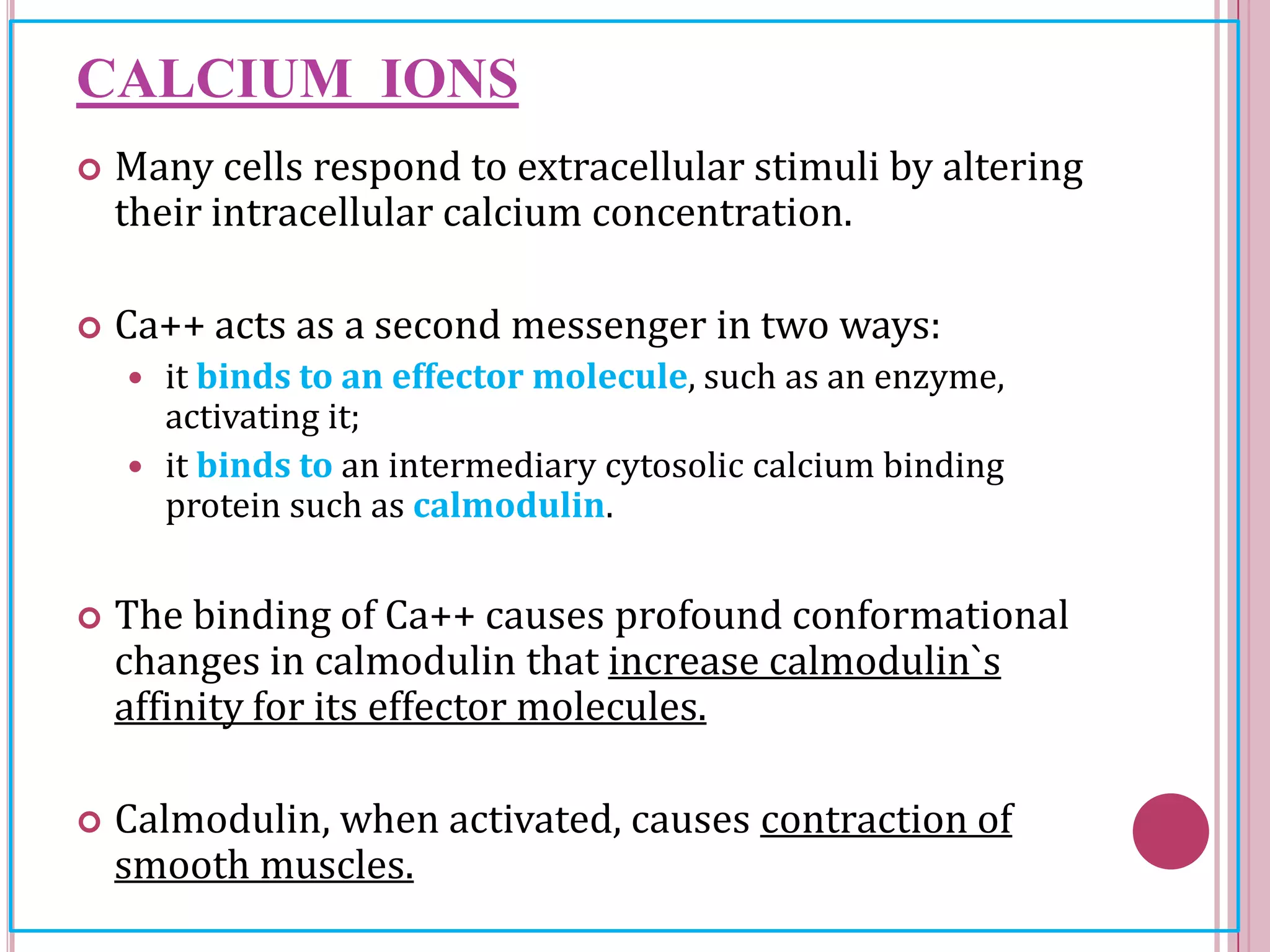
CALCIUM IONS
 Many cells respond to extracellular stimuli by altering
their intracellular calcium concentration.
 Ca++ acts as a second messenger in two ways:
 it binds to an effector molecule, such as an enzyme,
activating it;
 it binds to an intermediary cytosolic calcium binding
protein such as calmodulin.
 The binding of Ca++ causes profound conformational
changes in calmodulin that increase calmodulin`s
affinity for its effector molecules.
 Calmodulin, when activated, causes contraction of
smooth muscles.
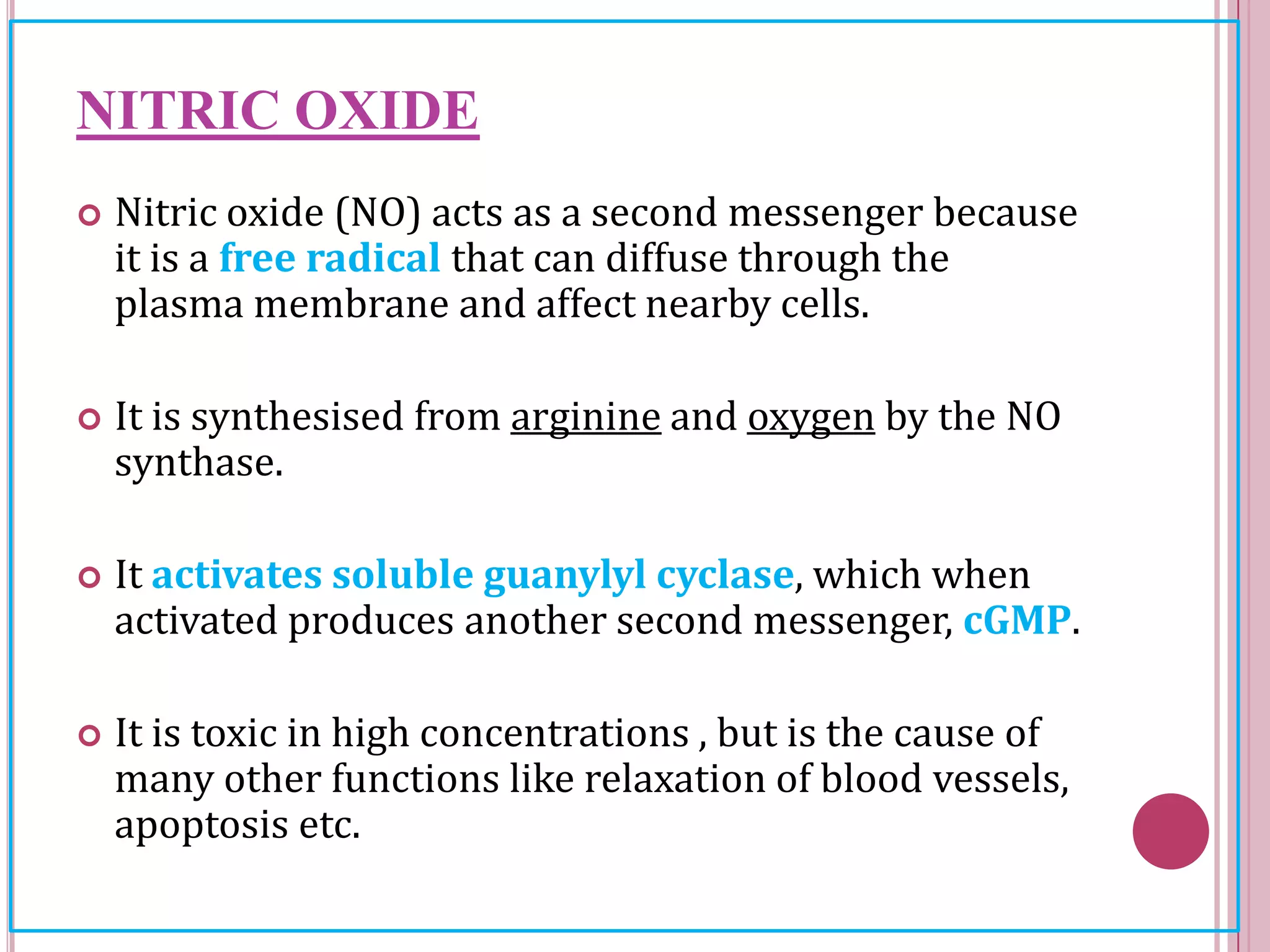
NITRIC OXIDE
 Nitric oxide (NO) acts as a second messenger because
it is a free radical that can diffuse through the
plasma membrane and affect nearby cells.
 It is synthesised from arginine and oxygen by the NO
synthase.
 It activates soluble guanylyl cyclase, which when
activated produces another second messenger, cGMP.
 It is toxic in high concentrations , but is the cause of
many other functions like relaxation of blood vessels,
apoptosis etc.
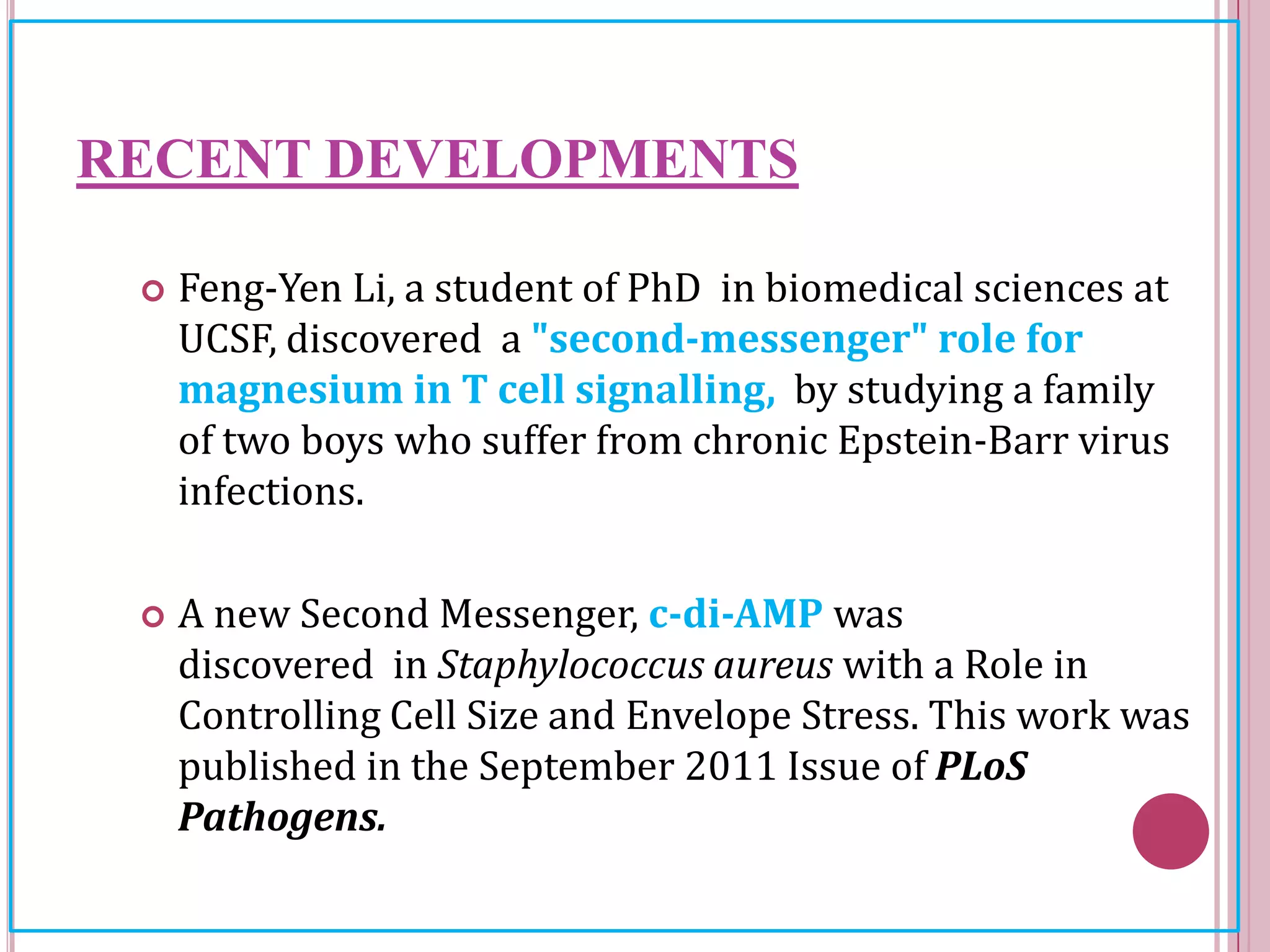
RECENT DEVELOPMENTS
 Feng-Yen Li, a student of PhD in biomedical sciences at
UCSF, discovered a "second-messenger" role for
magnesium in T cell signalling, by studying a family
of two boys who suffer from chronic Epstein-Barr virus
infections.
 A new Second Messenger, c-di-AMP was
discovered in Staphylococcus aureus with a Role in
Controlling Cell Size and Envelope Stress. This work was
published in the September 2011 Issue of PLoS
Pathogens.
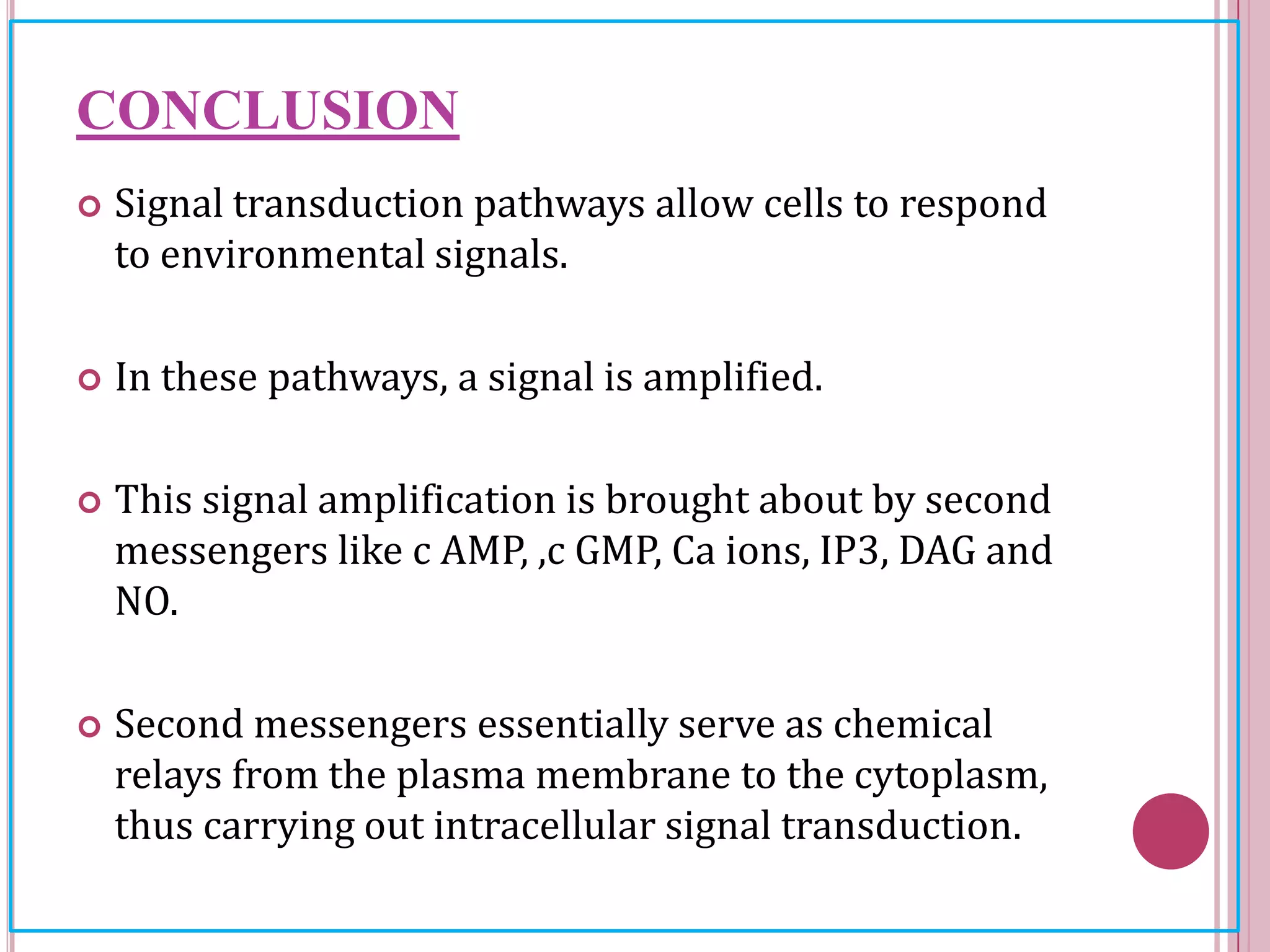
CONCLUSION
 Signal transduction pathways allow cells to respond
to environmental signals.
 In these pathways, a signal is amplified.
 This signal amplification is brought about by second
messengers like c AMP, ,c GMP, Ca ions, IP3, DAG and
NO.
 Second messengers essentially serve as chemical
relays from the plasma membrane to the cytoplasm,
thus carrying out intracellular signal transduction.
REFERENCES
 Karp, Gerald. Cell and Molecular biology, 6th edition, John
Wiley and Sons, Inc.
 Rastogi S.C, Cell and Molecular biology, 3rd edition (2010),
New Age International (P) Limited, publishers.
 Twyman R.M, Advanced Molecular Biology (2003), Viva
Books Private Limited, New Delhi.
 http://users.rcn.com/jkimball.ma.ultranet/BiologyPages/
S/Second_messengers.html
 http://en.wikipedia.org/wiki/Second_messenger_system

Second messenger system

  • 1.
  • 2.
    INTRODUCTION  Second messengersare molecules that relay signals from receptors on the cell surface to target molecules inside the cell.  They greatly amplify the strength of the signal, cause some kind of change in the activity of the cell.  They are a component of cell signaling pathways.  Earl Wilbur Sutherland Jr., discovered second messengers, for which he won the 1971 Nobel Prize.
  • 3.
    SECOND MESSENGERS  Shortlived intracellular signaling molecules  Elevated concentration of second messenger leads to rapid alteration in the activity of one or more cellular enzymes  Removal or degradation of second messenger terminate the cellular response  Four classes of second messengers  Cyclic nucleotides  Membrane lipid derivatives  Ca2+  Nitric oxide/carbon monoxide
  • 4.
  • 5.
    CYCLIC AMP  cAMPis a second messenger that is synthesized from ATP by the action of the enzyme adenylyl cyclase.  Binding of the hormone to its receptor activates a G protein which, in turn, activates adenylyl cyclase.  Leads to appropriate response in the cell by either (or both):  using Protein Kinase A (PKA) — a cAMP-dependent protein kinase that phosphorylates target proteins;  cAMP binds to a protein called CREB (cAMP response element binding protein), and the resultant complex controls transcription of genes.  Eg.of cAMP action - adrenaline, glucagon, LH
  • 6.
    1. The ligandbinds to the receptor, altering its conformation and increasing its affinity for the G protein to which it binds. 2. The G subunit releases its GDP, which is replaced by GTP. 3. The α subunit dissociates from the G complex and binds to an effector (in this case adenylyl cyclase), activating the effector. 4. Activated adenylyl cyclase produces cAMP. THE MECHANISM OF RECEPTOR-MEDIATED ACTIVATION AND INHIBITION OF CAMP
  • 7.
    5. The GTPaseactivity of G hydrolyzes the bound GTP, deactivating G. 6. G reassociates with G, reforming the trimeric G protein, and the effector ceases its activity. 7. The receptor has been phosphorylated by a GRK 8. The phosphorylated receptor has been bound by an arrestin molecule, which inhibits the ligand-bound receptor from activating additional G proteins.
  • 9.
    GLUCOSE MOBILIZATION: ANEXAMPLE OF A RESPONSE INDUCED BY CAMP  Binding of hormone  Activation of enzyme and formation of cAMP.  cAMP binds to PKA & activates it.  PKA phosphorylates 2 enzymes: phosphorylates glycogen phosphorylase- stimulates glycogen breakdown. inhibition – prevents conversion of glucose to glycogen. 1. Phosphorylase kinase – 2.Glycogen synthetase –
  • 10.
    CYCLIC GMP  cGMPis synthesized from the nucleotide GTP using the enzyme guanylyl cyclase.  Nitric oxide stimulates the synthesis of cGMP .  Many cells contain a cGMP-stimulated protein kinase that contains both catalytic and regulatory subunits.  Some of the effects of cGMP are mediated through Protein Kinase G (PKG)  cGMP serves as the second messenger for  nitric oxide (NO)  the response of the rods of the retina to light.
  • 11.
    PHOSPHATIDYLINOSITOL-DERIVED SECOND MESSENGERS  Phosphatidylinositol( PI) is a negatively charged phospholipid and a minor component in eukaryotic cell membranes.  The inositol can be phosphorylated to form  Phosphatidylinositol-4-phosphate (PIP)  Phosphatidylinositol-4,5-bis-phosphate (PIP2)  Phosphatidylinositol-3,4,5-trisphosphate (PIP3)  Intracellular enzyme phospholipase C (PLC),hydrolyzes PIP2 which is found in the inner layer of the plasma membrane. Hydrolysis of PIP2 yields two products:  Diacylglycerol (DAG)  Inositol-1,4,5-trisphosphate (IP3) PHOSPHO INOSITIDES.
  • 13.
    DIACYLGLYCEROL  Diacylglycerol stimulatesprotein kinase C activity by greatly increasing the affinity of the enzyme for calcium ions.  Protein kinase C phosphorylates specific serine and threonine residues in target proteins.  Known target proteins include calmodulin, the glucose transporter, HMG-CoA reductase, cytochrome P450 etc.
  • 14.
    INOSITOL TRIPHOSPHATE, IP3 This soluble molecule diffuses through the cytosol and binds to receptors on the endoplasmic reticulum causing the release of calcium ions (Ca2+) into the cytosol.  The rise in intracellular calcium triggers the response.  Example: the calcium rise is needed for NF-AT (the "nuclear factor of activated T cells") to turn on the appropriate genes in the nucleus.
  • 15.
    MODE OF ACTION Peptide and protein hormones like vasopressin, TSH, and neurotransmitters like GABA bind to GPCRs  This activate the intracellular enzyme phospholipase C (PLC).  PLC in turn cleaves PIP2 to yield two products – DAG and IP3.  Both of these products act as second messengers.  So, the cleavage of PIP2 by PLC is the functional equivalent of the synthesis of cAMP by adenylyl cyclase.
  • 16.
  • 17.
    CALCIUM IONS  Manycells respond to extracellular stimuli by altering their intracellular calcium concentration.  Ca++ acts as a second messenger in two ways:  it binds to an effector molecule, such as an enzyme, activating it;  it binds to an intermediary cytosolic calcium binding protein such as calmodulin.  The binding of Ca++ causes profound conformational changes in calmodulin that increase calmodulin`s affinity for its effector molecules.  Calmodulin, when activated, causes contraction of smooth muscles.
  • 18.
    NITRIC OXIDE  Nitricoxide (NO) acts as a second messenger because it is a free radical that can diffuse through the plasma membrane and affect nearby cells.  It is synthesised from arginine and oxygen by the NO synthase.  It activates soluble guanylyl cyclase, which when activated produces another second messenger, cGMP.  It is toxic in high concentrations , but is the cause of many other functions like relaxation of blood vessels, apoptosis etc.
  • 19.
    RECENT DEVELOPMENTS  Feng-YenLi, a student of PhD in biomedical sciences at UCSF, discovered a "second-messenger" role for magnesium in T cell signalling, by studying a family of two boys who suffer from chronic Epstein-Barr virus infections.  A new Second Messenger, c-di-AMP was discovered in Staphylococcus aureus with a Role in Controlling Cell Size and Envelope Stress. This work was published in the September 2011 Issue of PLoS Pathogens.
  • 20.
    CONCLUSION  Signal transductionpathways allow cells to respond to environmental signals.  In these pathways, a signal is amplified.  This signal amplification is brought about by second messengers like c AMP, ,c GMP, Ca ions, IP3, DAG and NO.  Second messengers essentially serve as chemical relays from the plasma membrane to the cytoplasm, thus carrying out intracellular signal transduction.
  • 21.
    REFERENCES  Karp, Gerald.Cell and Molecular biology, 6th edition, John Wiley and Sons, Inc.  Rastogi S.C, Cell and Molecular biology, 3rd edition (2010), New Age International (P) Limited, publishers.  Twyman R.M, Advanced Molecular Biology (2003), Viva Books Private Limited, New Delhi.  http://users.rcn.com/jkimball.ma.ultranet/BiologyPages/ S/Second_messengers.html  http://en.wikipedia.org/wiki/Second_messenger_system