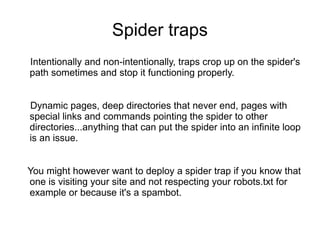
Search Engine Spiders http://scienceforseo.blogspot.com IR tutorial series: Part 2
...programs which scan the web in a methodical and  automated way. ...they copy all the pages they visit and leave them  to the search engine for indexing. ...not all spiders have the same job though,  some check links, or collect email addresses,  or validate code for example. Spiders are... ...some people call them crawlers, bots and even ants or worms. (“Spidering” means to request every page on a site)
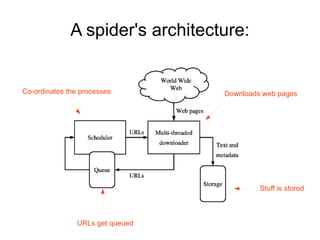
A spider's architecture: Downloads web pages Stuff is stored URLs get queued Co-ordinates the processes
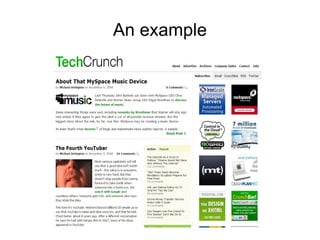
An example
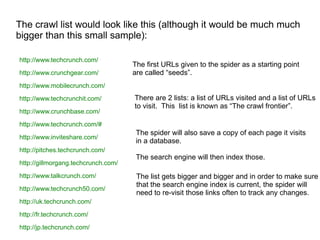
The crawl list would look like this (although it would be much much bigger than this small sample): http://www.techcrunch.com/ http://www.crunchgear.com/ http://www.mobilecrunch.com/ http://www.techcrunchit.com/ http://www.crunchbase.com/ http://www.techcrunch.com/# http://www.inviteshare.com/ http://pitches.techcrunch.com/ http://gillmorgang.techcrunch.com/ http://www.talkcrunch.com/ http://www.techcrunch50.com/ http://uk.techcrunch.com/ http://fr.techcrunch.com/ http://jp.techcrunch.com/ The spider will also save a copy of each page it visits in a database. The search engine will then index those.  The first URLs given to the spider as a starting point are called “seeds”.  The list gets bigger and bigger and in order to make sure that the search engine index is current, the spider will need to re-visit those links often to track any changes.  There are 2 lists: a list of URLs visited and a list of URLs to visit.  This  list is known as “The crawl frontier”.
Difficulties The web is enormous: no search engine indexes more than 16% of the web.  The spider will download only the most relevant pages.  The rate of change is phenomenal – a spider needs to re-visit pages often to check for updates and changes. Server-side scripting languages do not often return unique content but give a lot of URLs for the spider to visit,which is a waste of time for it
Solutions Spiders will use the following policies: A selection policy that states which pages to download.
A re-visit policy that states when to check for changes to the pages.
A politeness policy that states how to avoid overloading websites.
A parallelization policy that states how to coordinate distributed web crawlers.
Build a spider You can use any programming language that you feel comfortable with, although JAVA, Perl and C# ones are the most popular. You can also use these tutorials: Java sun spider -  http://tiny.cc/e2KAy Chilkat in python -  http://tiny.cc/WH7eh Swish-e in Perl -  http://tiny.cc/nNF5Q   Remember that a poorly designed spider can impact overall network and server performance.
OpenSource spiders You can use one of these for free (some knowledge of programming can help in setting them up):  OpenWebSpider in C# -  http://www.openwebspider.org Arachnid in Java -  http://arachnid.sourceforge.net/ Java-web-spider -  http://code.google.com/p/java-web-spider/ MOMSpider in perl -  http://tiny.cc/36XQA
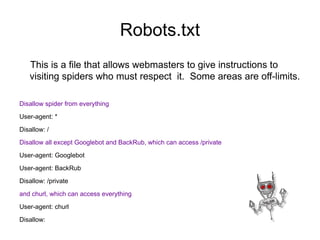
Robots.txt This is a file that allows webmasters to give instructions to visiting spiders who must respect  it.  Some areas are off-limits. Disallow spider from everything User-agent: * Disallow: / Disallow all except Googlebot and BackRub, which can access /private User-agent: Googlebot User-agent: BackRub Disallow: /private and churl, which can access everything User-agent: churl Disallow:
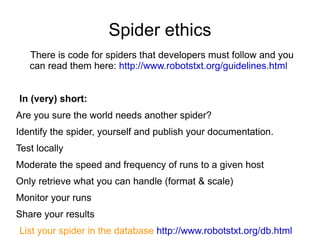
Spider ethics There is code for spiders that developers must follow and you can read them here:  http://www.robotstxt.org/guidelines.html   In (very) short: Are you sure the world needs another spider?
Identify the spider, yourself and publish your documentation.

Search Engine Spiders

  • 1.
    Search Engine Spidershttp://scienceforseo.blogspot.com IR tutorial series: Part 2
  • 2.
    ...programs which scanthe web in a methodical and automated way. ...they copy all the pages they visit and leave them to the search engine for indexing. ...not all spiders have the same job though, some check links, or collect email addresses, or validate code for example. Spiders are... ...some people call them crawlers, bots and even ants or worms. (“Spidering” means to request every page on a site)
  • 3.
    A spider's architecture:Downloads web pages Stuff is stored URLs get queued Co-ordinates the processes
  • 4.
  • 5.
    The crawl listwould look like this (although it would be much much bigger than this small sample): http://www.techcrunch.com/ http://www.crunchgear.com/ http://www.mobilecrunch.com/ http://www.techcrunchit.com/ http://www.crunchbase.com/ http://www.techcrunch.com/# http://www.inviteshare.com/ http://pitches.techcrunch.com/ http://gillmorgang.techcrunch.com/ http://www.talkcrunch.com/ http://www.techcrunch50.com/ http://uk.techcrunch.com/ http://fr.techcrunch.com/ http://jp.techcrunch.com/ The spider will also save a copy of each page it visits in a database. The search engine will then index those. The first URLs given to the spider as a starting point are called “seeds”. The list gets bigger and bigger and in order to make sure that the search engine index is current, the spider will need to re-visit those links often to track any changes. There are 2 lists: a list of URLs visited and a list of URLs to visit. This list is known as “The crawl frontier”.
  • 6.
    Difficulties The webis enormous: no search engine indexes more than 16% of the web. The spider will download only the most relevant pages. The rate of change is phenomenal – a spider needs to re-visit pages often to check for updates and changes. Server-side scripting languages do not often return unique content but give a lot of URLs for the spider to visit,which is a waste of time for it
  • 7.
    Solutions Spiders willuse the following policies: A selection policy that states which pages to download.
  • 8.
    A re-visit policythat states when to check for changes to the pages.
  • 9.
    A politeness policythat states how to avoid overloading websites.
  • 10.
    A parallelization policythat states how to coordinate distributed web crawlers.
  • 11.
    Build a spiderYou can use any programming language that you feel comfortable with, although JAVA, Perl and C# ones are the most popular. You can also use these tutorials: Java sun spider - http://tiny.cc/e2KAy Chilkat in python - http://tiny.cc/WH7eh Swish-e in Perl - http://tiny.cc/nNF5Q Remember that a poorly designed spider can impact overall network and server performance.
  • 12.
    OpenSource spiders Youcan use one of these for free (some knowledge of programming can help in setting them up): OpenWebSpider in C# - http://www.openwebspider.org Arachnid in Java - http://arachnid.sourceforge.net/ Java-web-spider - http://code.google.com/p/java-web-spider/ MOMSpider in perl - http://tiny.cc/36XQA
  • 13.
    Robots.txt This isa file that allows webmasters to give instructions to visiting spiders who must respect it. Some areas are off-limits. Disallow spider from everything User-agent: * Disallow: / Disallow all except Googlebot and BackRub, which can access /private User-agent: Googlebot User-agent: BackRub Disallow: /private and churl, which can access everything User-agent: churl Disallow:
  • 14.
    Spider ethics Thereis code for spiders that developers must follow and you can read them here: http://www.robotstxt.org/guidelines.html In (very) short: Are you sure the world needs another spider?
  • 15.
    Identify the spider,yourself and publish your documentation.