
Search Engine Marketing
And
Search Engine Optimization
Presented By:
Jatin Vaid
1jatinvaid@gmail.com
Search Engines
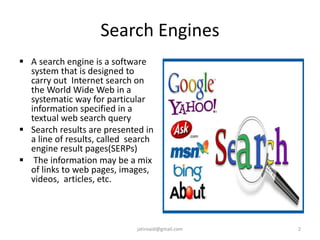
 A search engine is a software
system that is designed to
carry out Internet search on
the World Wide Web in a
systematic way for particular
information specified in a
textual web search query
 Search results are presented in
a line of results, called search
engine result pages(SERPs)
 The information may be a mix
of links to web pages, images,
videos, articles, etc.
2jatinvaid@gmail.com
Search Engine Marketing
 Search Engine Marketing (SEM) is a form
of Internet Marketing that involves the
promotion of websites by increasing their
visibility in search engine result pages (SERPs)
3jatinvaid@gmail.com
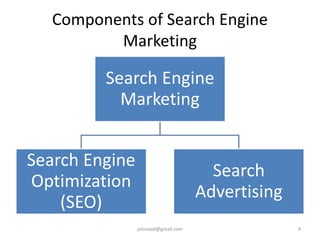
Components of Search Engine
Marketing
Search Engine
Marketing
Search Engine
Optimization
(SEO)
Search
Advertising
4jatinvaid@gmail.com
Components of Search Engine
Marketing
Search Engine Optimization
(SEO)
1. Organic form
2. Takes lots of time for
results to optimize
3. Dependent on complex
algorithms and best
practices
4. Organically reach the top
slots
Search Advertising
1. Paid form
2. Less time consuming for
results to optimize
3. Relevant to user search
query
4. Displayed on top of search
page and labeled as ‘Ad’
5jatinvaid@gmail.com
SEARCH ADVERTISING
I.
6jatinvaid@gmail.com
Why Search Advertising?
1. Capture intent – Ads shown to users who are
interested & have intent to buy
2. Ease of action – Ads are clickable and directs users to
specific web pages to find relevant content
3. Controlled costs – Marketers pay only when users
click on the ad (cost per click). No base charges
4. Analytics – Performance reports of the ads can be
generated showing Avg. CPC, No. of clicks, Money
spent, CTR, etc.
5. Competition – Helps to compete with competitors
having a better organic reach
7jatinvaid@gmail.com
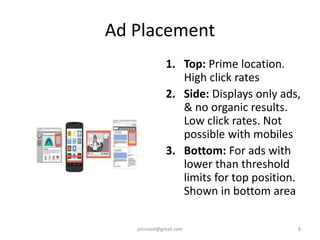
Ad Placement
1. Top: Prime location.
High click rates
2. Side: Displays only ads,
& no organic results.
Low click rates. Not
possible with mobiles
3. Bottom: For ads with
lower than threshold
limits for top position.
Shown in bottom area
8jatinvaid@gmail.com
Best practices for creating
Advertisement Campaigns
1. Keyword targeting
2. Creating advanced Ad formats
i. Call Extension – Provide Phone No. with Ad
ii. Site links – With additional direct links (Product/ store locator/contact)
iii. App Extensions – Downloadable App
iv. Location Extensions – Shows local business address
v. Review Extensions – Include positive reviews, ratings, awards
vi. Structured snippets – Provides a preview of valuable information
vii. Price Extensions – Display prices to increase conversion rates
viii. Google my business – Put business information on search and maps
(add, phone, operating hours)
3. Monitor account regularly
9jatinvaid@gmail.com
SEARCH ENGINE OPTIMIZATION
(SEO)
II.
10jatinvaid@gmail.com
Search Engine Optimization
 It is the process of influencing the visibility of
a website or a webpage so that it appears
higher up in the organic search results
 To establish web presence and get discovered
 To get quality traffic for lead generation and
higher revenues
11jatinvaid@gmail.com
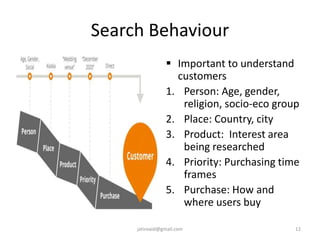
Search Behaviour
 Important to understand
customers
1. Person: Age, gender,
religion, socio-eco group
2. Place: Country, city
3. Product: Interest area
being researched
4. Priority: Purchasing time
frames
5. Purchase: How and
where users buy
12jatinvaid@gmail.com
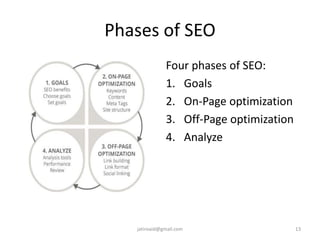
Phases of SEO
Four phases of SEO:
1. Goals
2. On-Page optimization
3. Off-Page optimization
4. Analyze
13jatinvaid@gmail.com
i. Goals
 Decide and setup clear, realistic goals and
targets for SEO campaign
 Assign KPI to the strategy
 Align with 3 stakeholders: searcher, search
engine and website owner
 Benefits: Increased CTR; better engagement;
enhanced reputation; Higher conversions
14jatinvaid@gmail.com
ii. On-Page optimization
 It deals with technical optimization of various elements
of website
 It ensures search engines can easily read, understand
and navigate WebPages to index it correctly
 Keyword research (Offline) – jargons, customer
queries, surveys
 Keyword research (Online) – Google Autocomplete,
Adwords, Trends, SEMrush
 Web page mechanics: URLs, Page name, Meta Tags,
On-page headings, text, images, social sharing
15jatinvaid@gmail.com
iii. Off-Page optimization
 These are the techniques used to influence
website position in organic search results.
 Long-term, iterative process to build digital
footprint and earn online credibility
 Link formats
 Content marketing
 Social sharing
16jatinvaid@gmail.com
iv. Analyze
 A cyclical process of looking at the data coming back,
analyzing it and making the necessary adjustments
 Help achieve goals and implement changes
 Knowing analytical tools to measure search traffic
 Knowledge of volume & source of traffic to website;
Keywords; key pages for conversions
 E.g., Google Analytics; HubSpot
 Compile data
 Report findings
 KPI: Position; Traffic; Conversion
17jatinvaid@gmail.com
References
1. Dodson, I. (2017). The Art of Digital
Marketing: The definitive guide to creating
strategic, targeted and Measurable Online
Campaigns. New Delhi: Wiley.
2. Gupta, S. (2018). Digital Marketing. Delhi: Mc
Graw Hill Education.
18jatinvaid@gmail.com
Thank You!
19jatinvaid@gmail.com

Search Engine Optimization in Digital Marketing

  • 1.
    Search Engine Marketing And SearchEngine Optimization Presented By: Jatin Vaid 1jatinvaid@gmail.com
  • 2.
    Search Engines  Asearch engine is a software system that is designed to carry out Internet search on the World Wide Web in a systematic way for particular information specified in a textual web search query  Search results are presented in a line of results, called search engine result pages(SERPs)  The information may be a mix of links to web pages, images, videos, articles, etc. 2jatinvaid@gmail.com
  • 3.
    Search Engine Marketing Search Engine Marketing (SEM) is a form of Internet Marketing that involves the promotion of websites by increasing their visibility in search engine result pages (SERPs) 3jatinvaid@gmail.com
  • 4.
    Components of SearchEngine Marketing Search Engine Marketing Search Engine Optimization (SEO) Search Advertising 4jatinvaid@gmail.com
  • 5.
    Components of SearchEngine Marketing Search Engine Optimization (SEO) 1. Organic form 2. Takes lots of time for results to optimize 3. Dependent on complex algorithms and best practices 4. Organically reach the top slots Search Advertising 1. Paid form 2. Less time consuming for results to optimize 3. Relevant to user search query 4. Displayed on top of search page and labeled as ‘Ad’ 5jatinvaid@gmail.com
  • 6.
  • 7.
    Why Search Advertising? 1.Capture intent – Ads shown to users who are interested & have intent to buy 2. Ease of action – Ads are clickable and directs users to specific web pages to find relevant content 3. Controlled costs – Marketers pay only when users click on the ad (cost per click). No base charges 4. Analytics – Performance reports of the ads can be generated showing Avg. CPC, No. of clicks, Money spent, CTR, etc. 5. Competition – Helps to compete with competitors having a better organic reach 7jatinvaid@gmail.com
  • 8.
    Ad Placement 1. Top:Prime location. High click rates 2. Side: Displays only ads, & no organic results. Low click rates. Not possible with mobiles 3. Bottom: For ads with lower than threshold limits for top position. Shown in bottom area 8jatinvaid@gmail.com
  • 9.
    Best practices forcreating Advertisement Campaigns 1. Keyword targeting 2. Creating advanced Ad formats i. Call Extension – Provide Phone No. with Ad ii. Site links – With additional direct links (Product/ store locator/contact) iii. App Extensions – Downloadable App iv. Location Extensions – Shows local business address v. Review Extensions – Include positive reviews, ratings, awards vi. Structured snippets – Provides a preview of valuable information vii. Price Extensions – Display prices to increase conversion rates viii. Google my business – Put business information on search and maps (add, phone, operating hours) 3. Monitor account regularly 9jatinvaid@gmail.com
  • 10.
  • 11.
    Search Engine Optimization It is the process of influencing the visibility of a website or a webpage so that it appears higher up in the organic search results  To establish web presence and get discovered  To get quality traffic for lead generation and higher revenues 11jatinvaid@gmail.com
  • 12.
    Search Behaviour  Importantto understand customers 1. Person: Age, gender, religion, socio-eco group 2. Place: Country, city 3. Product: Interest area being researched 4. Priority: Purchasing time frames 5. Purchase: How and where users buy 12jatinvaid@gmail.com
  • 13.
    Phases of SEO Fourphases of SEO: 1. Goals 2. On-Page optimization 3. Off-Page optimization 4. Analyze 13jatinvaid@gmail.com
  • 14.
    i. Goals  Decideand setup clear, realistic goals and targets for SEO campaign  Assign KPI to the strategy  Align with 3 stakeholders: searcher, search engine and website owner  Benefits: Increased CTR; better engagement; enhanced reputation; Higher conversions 14jatinvaid@gmail.com
  • 15.
    ii. On-Page optimization It deals with technical optimization of various elements of website  It ensures search engines can easily read, understand and navigate WebPages to index it correctly  Keyword research (Offline) – jargons, customer queries, surveys  Keyword research (Online) – Google Autocomplete, Adwords, Trends, SEMrush  Web page mechanics: URLs, Page name, Meta Tags, On-page headings, text, images, social sharing 15jatinvaid@gmail.com
  • 16.
    iii. Off-Page optimization These are the techniques used to influence website position in organic search results.  Long-term, iterative process to build digital footprint and earn online credibility  Link formats  Content marketing  Social sharing 16jatinvaid@gmail.com
  • 17.
    iv. Analyze  Acyclical process of looking at the data coming back, analyzing it and making the necessary adjustments  Help achieve goals and implement changes  Knowing analytical tools to measure search traffic  Knowledge of volume & source of traffic to website; Keywords; key pages for conversions  E.g., Google Analytics; HubSpot  Compile data  Report findings  KPI: Position; Traffic; Conversion 17jatinvaid@gmail.com
  • 18.
    References 1. Dodson, I.(2017). The Art of Digital Marketing: The definitive guide to creating strategic, targeted and Measurable Online Campaigns. New Delhi: Wiley. 2. Gupta, S. (2018). Digital Marketing. Delhi: Mc Graw Hill Education. 18jatinvaid@gmail.com
  • 19.