Magnus Klaaborg Stubman,
Improsec A/S
Irina Kostina,
Microsoft
Security Development Lifecycle methodology & DevSecOps
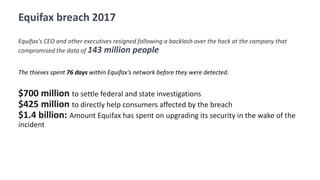
Equifax breach 2017
Equifax's CEO and other executives resigned following a backlash over the hack at the company that
compromised the data of 143 million people
The thieves spent 76 days within Equifax's network before they were detected.
$700 million to settle federal and state investigations
$425 million to directly help consumers affected by the breach
$1.4 billion: Amount Equifax has spent on upgrading its security in the wake of the
incident
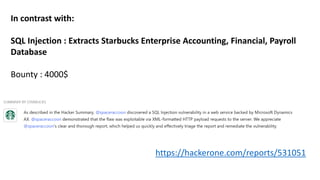
In contrast with:
SQL Injection : Extracts Starbucks Enterprise Accounting, Financial, Payroll
Database
Bounty : 4000$
https://hackerone.com/reports/531051
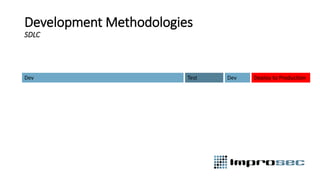
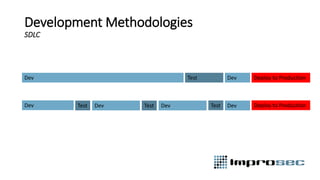
Development Methodologies
SDLC
Dev Test Deploy to ProductionDev
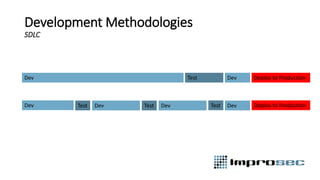
Development Methodologies
SDLC
Dev Test Deploy to ProductionDev
Dev Deploy to ProductionTest Dev Test Dev Test Dev
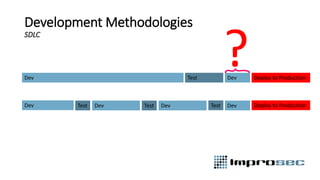
Development Methodologies
SDLC
Dev Test Deploy to ProductionDev
Dev Deploy to ProductionTest Dev Test Dev Test Dev
?
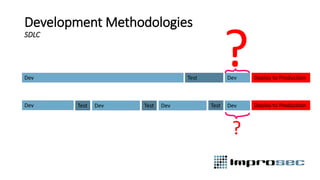
Development Methodologies
SDLC
Dev Test Deploy to ProductionDev
Dev Deploy to ProductionTest Dev Test Dev Test Dev
?
?
Development Methodologies
SDLC
Dev Test Deploy to ProductionDev
Dev Deploy to ProductionTest Dev Test Dev Test Dev
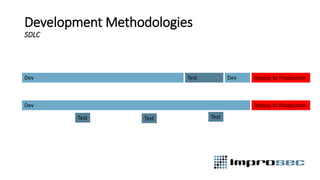
Development Methodologies
SDLC
Dev Test Deploy to ProductionDev
Dev Deploy to Production
Test Test Test
Development Methodologies
SDLC
Dev Test Deploy to ProductionDev
Dev Deploy to Production
Test Test Test
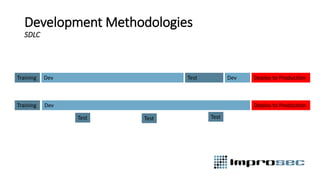
Training
Training
Development Methodologies
SDLC
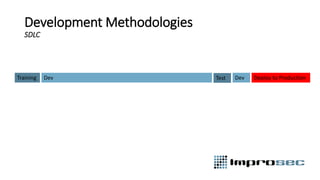
Dev Test Deploy to ProductionDevTraining
Development Methodologies
SDLC
Development Methodologies
SDLC
Development Methodologies
SDLC
Development Methodologies
SDLC
Development Methodologies
SDLC
Development Methodologies
SDLC
Development Methodologies
SDLC
Development Methodologies
SDLC
Development Methodologies
SDLC
How easy/hard is it to get rid of the solution?
Development Methodologies
SDLC
How easy/hard is it to get rid of the solution?
How easy/hard is it to move the solution?
Development Methodologies - summarized
SDLC
• Your mileage may very – one size does not fit all
Development Methodologies - summarized
SDLC
• Your mileage may very – one size does not fit all
• Waterfall approach may increase reliability, but reduce predictability
Development Methodologies - summarized
SDLC
• Your mileage may very – one size does not fit all
• Waterfall approach may increase reliability, but reduce predictability
• Agile approach may increase predictability, but reduce reliability
Development Methodologies - summarized
SDLC
• Your mileage may very – one size does not fit all
• Waterfall approach may increase reliability, but reduce predictability
• Agile approach may increase predictability, but reduce reliability
• Training is a one time cost, and gives value over time
Development Methodologies - summarized
SDLC
• Your mileage may very – one size does not fit all
• Waterfall approach may increase reliability, but reduce predictability
• Agile approach may increase predictability, but reduce reliability
• Training is a one time cost, and gives value over time
• Ask yourself:
• What do you need?
• What works in your organization?
Internal Quality Assurance (QA)
SDLC
• Definition of Done:
• Implemented according to Standards
• Unit test cases has been written for all functionality
• Documented
• Code reviewed by colleague
• Documentation review by colleague
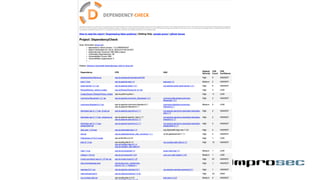
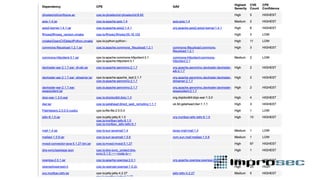
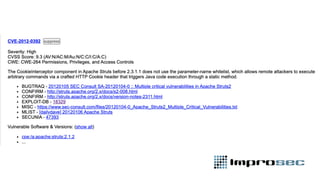
• dependency-check reports 0 vulnerabilities
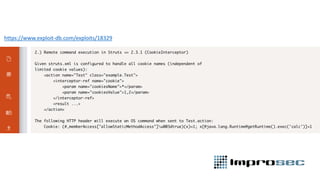
https://www.exploit-db.com/exploits/18329
Security – all or nothing?
• Cost
• Productivity hit
• Security hit
• Horror stories?
Security – all or nothing?
• Cost
• Productivity hit
• Security hit
• Horror stories?
• Start over?
Security – all or nothing?
• Cost
• Productivity hit
• Security hit
• Horror stories?
• Start over?
• The most important step is the first!
• Get started
• Incremental improvements
• Try, try and try again
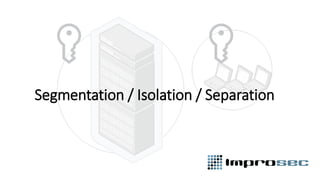
Segmentation
Segmentation / Isolation / Separation
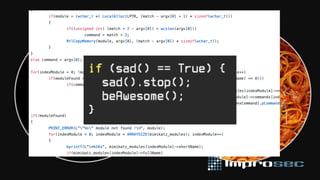
Simplicity
Simplicity
Silver Bullets
• Complex code
• Hard to read
Simplicity
Silver Bullets
• Complex code
• Hard to read
• Hard to review
Simplicity
Silver Bullets
• Complex code
• Hard to read
• Hard to review
• Hard to maintain
Simplicity
Silver Bullets
• Complex code
• Hard to read
• Hard to review
• Hard to maintain
• Hard to add new features
Simplicity
Silver Bullets
• Complex code
• Hard to read
• Hard to review
• Hard to maintain
• Hard to add new features
• Hard to replace/deprecate
Simplicity
Silver Bullets
• Complex code
• Hard to read
• Hard to review
• Hard to maintain
• Hard to add new features
• Hard to replace/deprecate
• Lower developer satisfaction
Simplicity
Silver Bullets
• Complex code
• Hard to read
• Hard to review
• Hard to maintain
• Hard to add new features
• Hard to replace/deprecate
• Lower developer satisfaction
• Harder to pentest
Simplicity
Silver Bullets
• Complex code
• Hard to read
• Hard to review
• Hard to maintain
• Hard to add new features
• Hard to replace/deprecate
• Lower developer satisfaction
• Harder to pentest
Expensive!
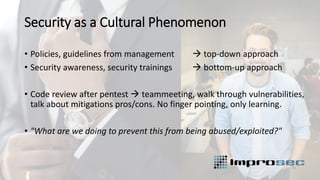
Security as a Cultural Phenomenon
• Policies, guidelines from management → top-down approach
Security as a Cultural Phenomenon
• Policies, guidelines from management → top-down approach
• Security awareness, security trainings → bottom-up approach
Security as a Cultural Phenomenon
• Policies, guidelines from management → top-down approach
• Security awareness, security trainings → bottom-up approach
• Code review after pentest → teammeeting, walk through vulnerabilities,
talk about mitigations pros/cons. No finger pointing, only learning.
Security as a Cultural Phenomenon
• Policies, guidelines from management → top-down approach
• Security awareness, security trainings → bottom-up approach
• Code review after pentest → teammeeting, walk through vulnerabilities,
talk about mitigations pros/cons. No finger pointing, only learning.
• "What are we doing to prevent this from being abused/exploited?"
Security as a Cultural Phenomenon
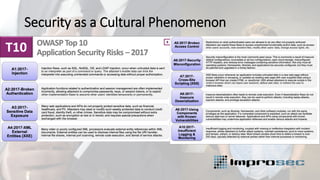
• OWASP
• "Top 10": https://owasp.org/www-project-top-ten/
• Present one topic each once a week, during a lunchmeeting
Security as a Cultural Phenomenon
• OWASP
• "Top 10": https://owasp.org/www-project-top-ten/
• Present one topic each once a week, during a lunchmeeting
Security as a Cultural Phenomenon
• OWASP
• "Top 10": https://owasp.org/www-project-top-ten/
• Present one topic each once a week, during a lunchmeeting
• Copenhagen: https://owasp.org/www-chapter-copenhagen/
• Aarhus: https://owasp.org/www-chapter-aarhus/
Silver Bullets - summarized
SDLC
• Segmentation
• Simplicity
• Culture
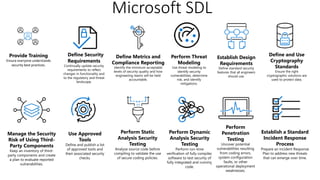
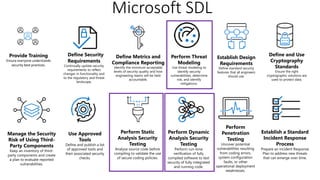
Provide Training
Ensure everyone understands
security best practices.
Define Security
Requirements
Continually update security
requirements to reflect
changes in functionality and
to the regulatory and threat
landscape.
Define Metrics and
Compliance Reporting
Identify the minimum acceptable
levels of security quality and how
engineering teams will be held
accountable.
Perform Threat
Modeling
Use threat modeling to
identify security
vulnerabilities, determine
risk, and identify
mitigations.
Establish Design
Requirements
Define standard security
features that all engineers
should use.
Define and Use
Cryptography
Standards
Ensure the right
cryptographic solutions are
used to protect data.
Manage the Security
Risk of Using Third-
Party Components
Keep an inventory of third-
party components and create
a plan to evaluate reported
vulnerabilities.
Use Approved
Tools
Define and publish a list
of approved tools and
their associated security
checks.
Perform Static
Analysis Security
Testing
Analyze source code before
compiling to validate the use
of secure coding policies.
Perform Dynamic
Analysis Security
Testing
Perform run-time
verification of fully compiled
software to test security of
fully integrated and running
code.
Perform
Penetration
Testing
Uncover potential
vulnerabilities resulting
from coding errors,
system configuration
faults, or other
operational deployment
weaknesses.
Establish a Standard
Incident Response
Process
Prepare an Incident Response
Plan to address new threats
that can emerge over time.
Microsoft SDL
Provide Training
Ensure everyone understands
security best practices.
Define Security
Requirements
Continually update security
requirements to reflect
changes in functionality and
to the regulatory and threat
landscape.
Define Metrics and
Compliance Reporting
Identify the minimum acceptable
levels of security quality and how
engineering teams will be held
accountable.
Perform Threat
Modeling
Use threat modeling to
identify security
vulnerabilities, determine
risk, and identify
mitigations.
Establish Design
Requirements
Define standard security
features that all engineers
should use.
Define and Use
Cryptography
Standards
Ensure the right
cryptographic solutions are
used to protect data.
Manage the Security
Risk of Using Third-
Party Components
Keep an inventory of third-
party components and create
a plan to evaluate reported
vulnerabilities.
Use Approved
Tools
Define and publish a list
of approved tools and
their associated security
checks.
Perform Static
Analysis Security
Testing
Analyze source code before
compiling to validate the use
of secure coding policies.
Perform Dynamic
Analysis Security
Testing
Perform run-time
verification of fully
compiled software to test
security of fully integrated
and running code.
Perform
Penetration
Testing
Uncover potential
vulnerabilities resulting
from coding errors,
system configuration
faults, or other
operational deployment
weaknesses.
Establish a Standard
Incident Response
Process
Prepare an Incident Response
Plan to address new threats
that can emerge over time.
Microsoft SDL
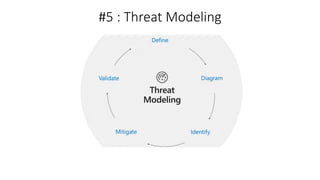
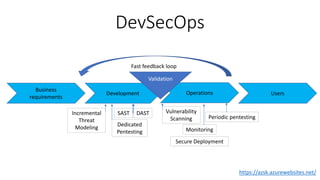
#5 : Threat Modeling
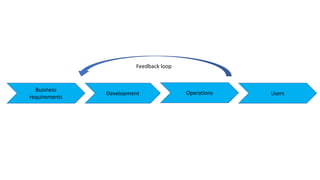
Development
Business
requirements
Operations Users
Feedback loop
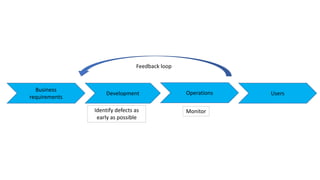
Identify defects as
early as possible
Development
Business
requirements
Operations Users
Feedback loop
Monitor
Development
Business
requirements
Operations UsersDevelopment
Business
requirements
Incremental
Threat
Modeling
DAST
Operations Users
Dedicated
Pentesting
Vulnerability
Scanning
Monitoring
Periodic pentesting
Validation
SAST
Fast feedback loop
DevSecOps
Secure Deployment
https://azsk.azurewebsites.net/
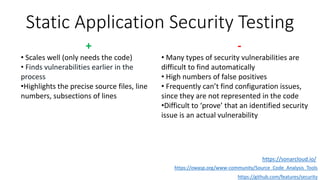
Static Application Security Testing
https://owasp.org/www-community/Source_Code_Analysis_Tools
https://github.com/features/security
+
• Scales well (only needs the code)
• Finds vulnerabilities earlier in the
process
•Highlights the precise source files, line
numbers, subsections of lines
-
• Many types of security vulnerabilities are
difficult to find automatically
• High numbers of false positives
• Frequently can’t find configuration issues,
since they are not represented in the code
•Difficult to ‘prove’ that an identified security
issue is an actual vulnerability
https://sonarcloud.io/
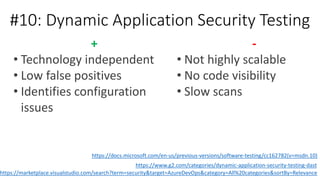
#10: Dynamic Application Security Testing
-
• Not highly scalable
• No code visibility
• Slow scans
+
• Technology independent
• Low false positives
• Identifies configuration
issues
https://docs.microsoft.com/en-us/previous-versions/software-testing/cc162782(v=msdn.10)
https://www.g2.com/categories/dynamic-application-security-testing-dast
https://marketplace.visualstudio.com/search?term=security&target=AzureDevOps&category=All%20categories&sortBy=Relevance
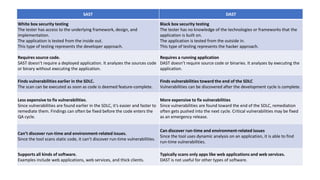
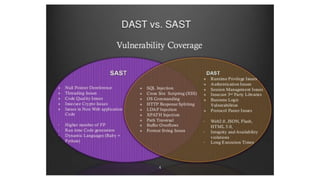
SAST DAST
White box security testing
The tester has access to the underlying framework, design, and
implementation.
The application is tested from the inside out.
This type of testing represents the developer approach.
Black box security testing
The tester has no knowledge of the technologies or frameworks that the
application is built on.
The application is tested from the outside in.
This type of testing represents the hacker approach.
Requires source code.
SAST doesn’t require a deployed application. It analyzes the sources code
or binary without executing the application.
Requires a running application
DAST doesn’t require source code or binaries. It analyzes by executing the
application.
Finds vulnerabilities earlier in the SDLC.
The scan can be executed as soon as code is deemed feature-complete.
Finds vulnerabilities toward the end of the SDLC
Vulnerabilities can be discovered after the development cycle is complete.
Less expensive to fix vulnerabilities.
Since vulnerabilities are found earlier in the SDLC, it’s easier and faster to
remediate them. Findings can often be fixed before the code enters the
QA cycle.
More expensive to fix vulnerabilities
Since vulnerabilities are found toward the end of the SDLC, remediation
often gets pushed into the next cycle. Critical vulnerabilities may be fixed
as an emergency release.
Can’t discover run-time and environment-related issues.
Since the tool scans static code, it can’t discover run-time vulnerabilities.
Can discover run-time and environment-related issues
Since the tool uses dynamic analysis on an application, it is able to find
run-time vulnerabilities.
Supports all kinds of software.
Examples include web applications, web services, and thick clients.
Typically scans only apps like web applications and web services.
DAST is not useful for other types of software.
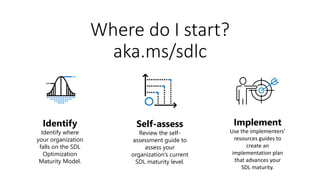
Where do I start?
aka.ms/sdlc
Implement
Use the implementers’
resources guides to
create an
implementation plan
that advances your
SDL maturity.
Self-assess
Review the self-
assessment guide to
assess your
organization’s current
SDL maturity level.
Identify
Identify where
your organization
falls on the SDL
Optimization
Maturity Model.
Thank you!
Any questions?

SDLC & DevSecOps

  • 1.
    Magnus Klaaborg Stubman, ImprosecA/S Irina Kostina, Microsoft Security Development Lifecycle methodology & DevSecOps
  • 2.
    Equifax breach 2017 Equifax'sCEO and other executives resigned following a backlash over the hack at the company that compromised the data of 143 million people The thieves spent 76 days within Equifax's network before they were detected. $700 million to settle federal and state investigations $425 million to directly help consumers affected by the breach $1.4 billion: Amount Equifax has spent on upgrading its security in the wake of the incident
  • 3.
    In contrast with: SQLInjection : Extracts Starbucks Enterprise Accounting, Financial, Payroll Database Bounty : 4000$ https://hackerone.com/reports/531051
  • 4.
  • 5.
    Development Methodologies SDLC Dev TestDeploy to ProductionDev Dev Deploy to ProductionTest Dev Test Dev Test Dev
  • 6.
    Development Methodologies SDLC Dev TestDeploy to ProductionDev Dev Deploy to ProductionTest Dev Test Dev Test Dev ?
  • 7.
    Development Methodologies SDLC Dev TestDeploy to ProductionDev Dev Deploy to ProductionTest Dev Test Dev Test Dev ? ?
  • 8.
    Development Methodologies SDLC Dev TestDeploy to ProductionDev Dev Deploy to ProductionTest Dev Test Dev Test Dev
  • 9.
    Development Methodologies SDLC Dev TestDeploy to ProductionDev Dev Deploy to Production Test Test Test
  • 10.
    Development Methodologies SDLC Dev TestDeploy to ProductionDev Dev Deploy to Production Test Test Test Training Training
  • 11.
    Development Methodologies SDLC Dev TestDeploy to ProductionDevTraining
  • 12.
  • 13.
  • 14.
  • 15.
  • 16.
  • 17.
  • 18.
  • 19.
  • 20.
    Development Methodologies SDLC How easy/hardis it to get rid of the solution?
  • 21.
    Development Methodologies SDLC How easy/hardis it to get rid of the solution? How easy/hard is it to move the solution?
  • 22.
    Development Methodologies -summarized SDLC • Your mileage may very – one size does not fit all
  • 23.
    Development Methodologies -summarized SDLC • Your mileage may very – one size does not fit all • Waterfall approach may increase reliability, but reduce predictability
  • 24.
    Development Methodologies -summarized SDLC • Your mileage may very – one size does not fit all • Waterfall approach may increase reliability, but reduce predictability • Agile approach may increase predictability, but reduce reliability
  • 25.
    Development Methodologies -summarized SDLC • Your mileage may very – one size does not fit all • Waterfall approach may increase reliability, but reduce predictability • Agile approach may increase predictability, but reduce reliability • Training is a one time cost, and gives value over time
  • 26.
    Development Methodologies -summarized SDLC • Your mileage may very – one size does not fit all • Waterfall approach may increase reliability, but reduce predictability • Agile approach may increase predictability, but reduce reliability • Training is a one time cost, and gives value over time • Ask yourself: • What do you need? • What works in your organization?
  • 27.
    Internal Quality Assurance(QA) SDLC • Definition of Done: • Implemented according to Standards • Unit test cases has been written for all functionality • Documented • Code reviewed by colleague • Documentation review by colleague • dependency-check reports 0 vulnerabilities
  • 32.
  • 33.
    Security – allor nothing?
  • 34.
    Security – allor nothing? • Cost • Productivity hit • Security hit • Horror stories?
  • 35.
    Security – allor nothing? • Cost • Productivity hit • Security hit • Horror stories? • Start over?
  • 36.
    Security – allor nothing? • Cost • Productivity hit • Security hit • Horror stories? • Start over? • The most important step is the first! • Get started • Incremental improvements • Try, try and try again
  • 37.
  • 39.
  • 41.
  • 44.
  • 45.
    Simplicity Silver Bullets • Complexcode • Hard to read • Hard to review
  • 46.
    Simplicity Silver Bullets • Complexcode • Hard to read • Hard to review • Hard to maintain
  • 47.
    Simplicity Silver Bullets • Complexcode • Hard to read • Hard to review • Hard to maintain • Hard to add new features
  • 48.
    Simplicity Silver Bullets • Complexcode • Hard to read • Hard to review • Hard to maintain • Hard to add new features • Hard to replace/deprecate
  • 49.
    Simplicity Silver Bullets • Complexcode • Hard to read • Hard to review • Hard to maintain • Hard to add new features • Hard to replace/deprecate • Lower developer satisfaction
  • 50.
    Simplicity Silver Bullets • Complexcode • Hard to read • Hard to review • Hard to maintain • Hard to add new features • Hard to replace/deprecate • Lower developer satisfaction • Harder to pentest
  • 51.
    Simplicity Silver Bullets • Complexcode • Hard to read • Hard to review • Hard to maintain • Hard to add new features • Hard to replace/deprecate • Lower developer satisfaction • Harder to pentest Expensive!
  • 53.
    Security as aCultural Phenomenon • Policies, guidelines from management → top-down approach
  • 54.
    Security as aCultural Phenomenon • Policies, guidelines from management → top-down approach • Security awareness, security trainings → bottom-up approach
  • 55.
    Security as aCultural Phenomenon • Policies, guidelines from management → top-down approach • Security awareness, security trainings → bottom-up approach • Code review after pentest → teammeeting, walk through vulnerabilities, talk about mitigations pros/cons. No finger pointing, only learning.
  • 56.
    Security as aCultural Phenomenon • Policies, guidelines from management → top-down approach • Security awareness, security trainings → bottom-up approach • Code review after pentest → teammeeting, walk through vulnerabilities, talk about mitigations pros/cons. No finger pointing, only learning. • "What are we doing to prevent this from being abused/exploited?"
  • 57.
    Security as aCultural Phenomenon • OWASP • "Top 10": https://owasp.org/www-project-top-ten/ • Present one topic each once a week, during a lunchmeeting
  • 58.
    Security as aCultural Phenomenon • OWASP • "Top 10": https://owasp.org/www-project-top-ten/ • Present one topic each once a week, during a lunchmeeting
  • 59.
    Security as aCultural Phenomenon • OWASP • "Top 10": https://owasp.org/www-project-top-ten/ • Present one topic each once a week, during a lunchmeeting • Copenhagen: https://owasp.org/www-chapter-copenhagen/ • Aarhus: https://owasp.org/www-chapter-aarhus/
  • 60.
    Silver Bullets -summarized SDLC • Segmentation • Simplicity • Culture
  • 61.
    Provide Training Ensure everyoneunderstands security best practices. Define Security Requirements Continually update security requirements to reflect changes in functionality and to the regulatory and threat landscape. Define Metrics and Compliance Reporting Identify the minimum acceptable levels of security quality and how engineering teams will be held accountable. Perform Threat Modeling Use threat modeling to identify security vulnerabilities, determine risk, and identify mitigations. Establish Design Requirements Define standard security features that all engineers should use. Define and Use Cryptography Standards Ensure the right cryptographic solutions are used to protect data. Manage the Security Risk of Using Third- Party Components Keep an inventory of third- party components and create a plan to evaluate reported vulnerabilities. Use Approved Tools Define and publish a list of approved tools and their associated security checks. Perform Static Analysis Security Testing Analyze source code before compiling to validate the use of secure coding policies. Perform Dynamic Analysis Security Testing Perform run-time verification of fully compiled software to test security of fully integrated and running code. Perform Penetration Testing Uncover potential vulnerabilities resulting from coding errors, system configuration faults, or other operational deployment weaknesses. Establish a Standard Incident Response Process Prepare an Incident Response Plan to address new threats that can emerge over time. Microsoft SDL
  • 62.
    Provide Training Ensure everyoneunderstands security best practices. Define Security Requirements Continually update security requirements to reflect changes in functionality and to the regulatory and threat landscape. Define Metrics and Compliance Reporting Identify the minimum acceptable levels of security quality and how engineering teams will be held accountable. Perform Threat Modeling Use threat modeling to identify security vulnerabilities, determine risk, and identify mitigations. Establish Design Requirements Define standard security features that all engineers should use. Define and Use Cryptography Standards Ensure the right cryptographic solutions are used to protect data. Manage the Security Risk of Using Third- Party Components Keep an inventory of third- party components and create a plan to evaluate reported vulnerabilities. Use Approved Tools Define and publish a list of approved tools and their associated security checks. Perform Static Analysis Security Testing Analyze source code before compiling to validate the use of secure coding policies. Perform Dynamic Analysis Security Testing Perform run-time verification of fully compiled software to test security of fully integrated and running code. Perform Penetration Testing Uncover potential vulnerabilities resulting from coding errors, system configuration faults, or other operational deployment weaknesses. Establish a Standard Incident Response Process Prepare an Incident Response Plan to address new threats that can emerge over time. Microsoft SDL
  • 63.
    #5 : ThreatModeling
  • 64.
  • 65.
    Identify defects as earlyas possible Development Business requirements Operations Users Feedback loop Monitor
  • 66.
  • 67.
    Static Application SecurityTesting https://owasp.org/www-community/Source_Code_Analysis_Tools https://github.com/features/security + • Scales well (only needs the code) • Finds vulnerabilities earlier in the process •Highlights the precise source files, line numbers, subsections of lines - • Many types of security vulnerabilities are difficult to find automatically • High numbers of false positives • Frequently can’t find configuration issues, since they are not represented in the code •Difficult to ‘prove’ that an identified security issue is an actual vulnerability https://sonarcloud.io/
  • 68.
    #10: Dynamic ApplicationSecurity Testing - • Not highly scalable • No code visibility • Slow scans + • Technology independent • Low false positives • Identifies configuration issues https://docs.microsoft.com/en-us/previous-versions/software-testing/cc162782(v=msdn.10) https://www.g2.com/categories/dynamic-application-security-testing-dast https://marketplace.visualstudio.com/search?term=security&target=AzureDevOps&category=All%20categories&sortBy=Relevance
  • 69.
    SAST DAST White boxsecurity testing The tester has access to the underlying framework, design, and implementation. The application is tested from the inside out. This type of testing represents the developer approach. Black box security testing The tester has no knowledge of the technologies or frameworks that the application is built on. The application is tested from the outside in. This type of testing represents the hacker approach. Requires source code. SAST doesn’t require a deployed application. It analyzes the sources code or binary without executing the application. Requires a running application DAST doesn’t require source code or binaries. It analyzes by executing the application. Finds vulnerabilities earlier in the SDLC. The scan can be executed as soon as code is deemed feature-complete. Finds vulnerabilities toward the end of the SDLC Vulnerabilities can be discovered after the development cycle is complete. Less expensive to fix vulnerabilities. Since vulnerabilities are found earlier in the SDLC, it’s easier and faster to remediate them. Findings can often be fixed before the code enters the QA cycle. More expensive to fix vulnerabilities Since vulnerabilities are found toward the end of the SDLC, remediation often gets pushed into the next cycle. Critical vulnerabilities may be fixed as an emergency release. Can’t discover run-time and environment-related issues. Since the tool scans static code, it can’t discover run-time vulnerabilities. Can discover run-time and environment-related issues Since the tool uses dynamic analysis on an application, it is able to find run-time vulnerabilities. Supports all kinds of software. Examples include web applications, web services, and thick clients. Typically scans only apps like web applications and web services. DAST is not useful for other types of software.
  • 71.
    Where do Istart? aka.ms/sdlc Implement Use the implementers’ resources guides to create an implementation plan that advances your SDL maturity. Self-assess Review the self- assessment guide to assess your organization’s current SDL maturity level. Identify Identify where your organization falls on the SDL Optimization Maturity Model.
  • 72.