Screw Threads
Screw Cutting
Screw Threads
 There are 4 basic Thread Forms
 Vee Threads
 Buttress
 Square
 Trapezoidal
Screw Threads
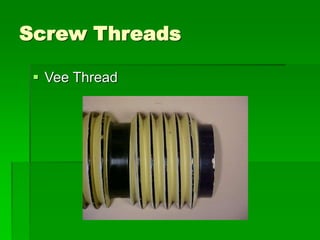
 Vee Thread
Screw Threads
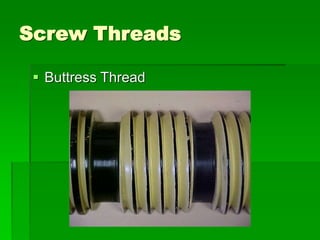
 Buttress Thread
Screw Threads
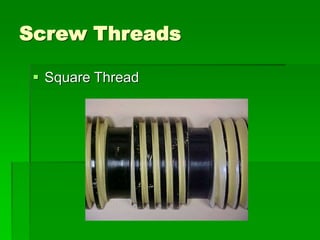
 Square Thread
Screw Threads
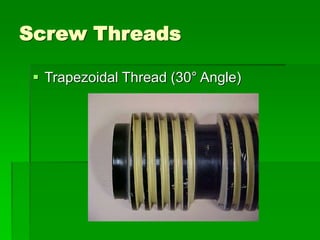
 Trapezoidal Thread (30° Angle)
Screw Threads
 Thread Terminology
Pitch
Distance from a point on one
Thread Groove to the exact
same point on the next Thread
Groove
Screw Threads
 Thread Terminology
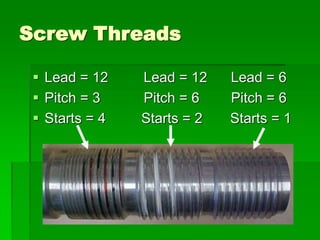
Lead
Pitch x Number of Starts
Screw Threads
 Thread Terminology
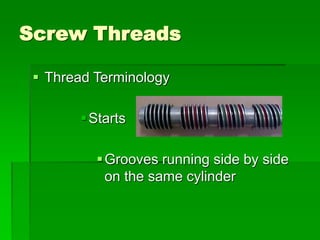
Starts
Grooves running side by side
on the same cylinder
Screw Threads
 Lead = 12 Lead = 12 Lead = 6
 Pitch = 3 Pitch = 6 Pitch = 6
 Starts = 4 Starts = 2 Starts = 1
Screwcutting
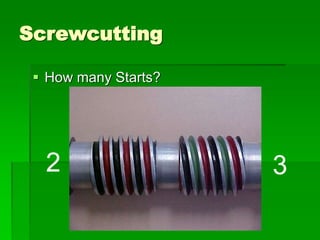
 How many Starts?
2
1
Screwcutting
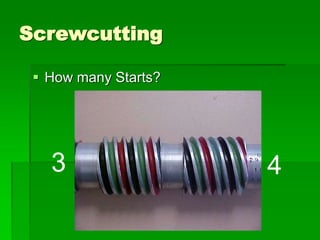
 How many Starts?
3
2
Screwcutting
 How many Starts?
3 4
Screwcutting
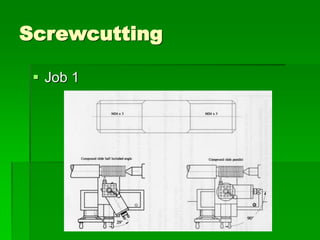
 Job 1
Screwcutting
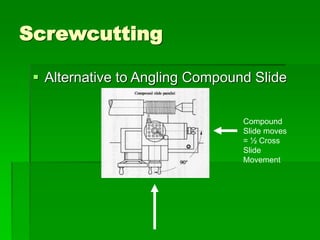
 Alternative to Angling Compound Slide
Compound
Slide moves
= ½ Cross
Slide
Movement
Screwcutting
 Methods of Testing Threads
 Test Nut
Screwcutting
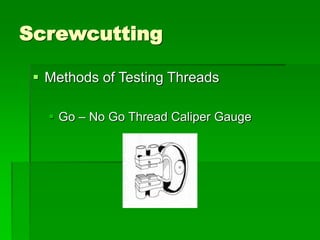
 Methods of Testing Threads
 Go – No Go Thread Caliper Gauge
Screwcutting
 Methods of Testing Threads
 Three Wire Method
Screwcutting
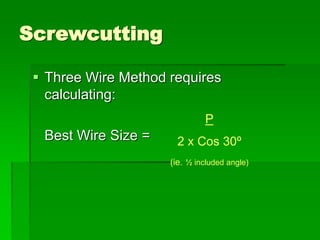
 Three Wire Method requires
calculating:
Best Wire Size =
P
2 x Cos 30º
(ie. ½ included angle)
Screwcutting
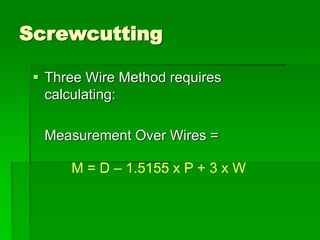
 Three Wire Method requires
calculating:
Measurement Over Wires =
M = D – 1.5155 x P + 3 x W
Screwcutting
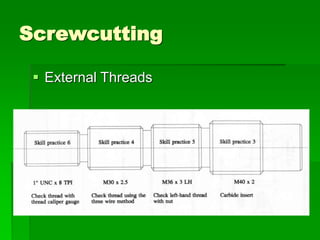
 External Threads
Screwcutting
 Full Form Carbide Insert
Screwcutting
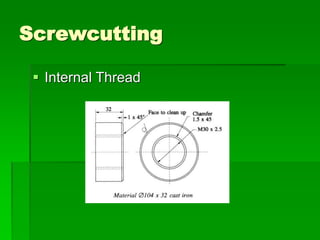
 Internal Thread
Screwcutting
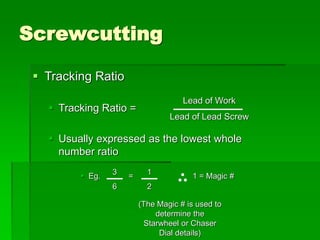
 Tracking Ratio
 Tracking Ratio =
 Usually expressed as the lowest whole
number ratio
 Eg. = 1 = Magic #
Lead of Work
Lead of Lead Screw
1
2
3
6
(The Magic # is used to
determine the
Starwheel or Chaser
Dial details)
Screwcutting
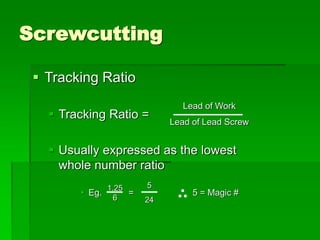
 Tracking Ratio
 Tracking Ratio =
 Usually expressed as the lowest
whole number ratio
 Eg. = 5 = Magic #
Lead of Work
Lead of Lead Screw
1.25
6
5
24
Screwcutting
 Tracking the Thread
 Tracking the Thread means to engage
into the same Thread groove on
successive pass of the tool.
Screwcutting
Methods of Tracking the Thread
 Starwheel
 Chaser Dial
 Reversing the Machine
 Repeat Distance Method
Screwcutting
Starwheel
 A thin gear like disc with teeth cut of a
size to engage with the Leadscrew of
the Lathe
Screwcutting
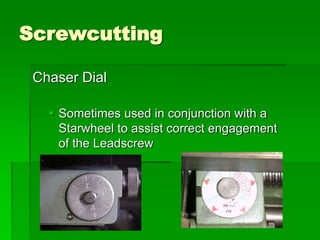
Chaser Dial
 Sometimes used in conjunction with a
Starwheel to assist correct engagement
of the Leadscrew
Screwcutting
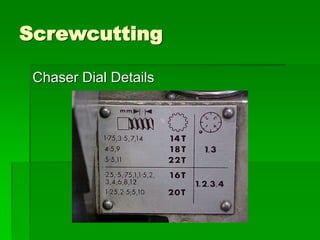
Chaser Dial Details
Screwcutting
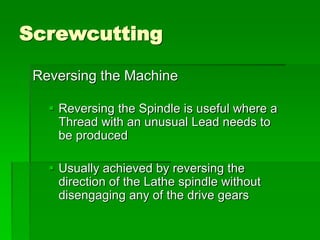
Reversing the Machine
 Reversing the Spindle is useful where a
Thread with an unusual Lead needs to
be produced
 Usually achieved by reversing the
direction of the Lathe spindle without
disengaging any of the drive gears
Screwcutting
Repeat Distance Method
 Repeat Distance is calculated by
multiplying the Tracking Ratio by the
Lead of the Leadscrew
Screwcutting
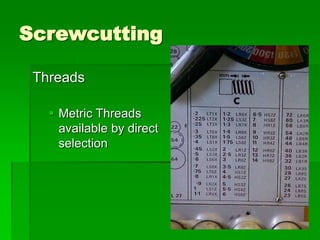
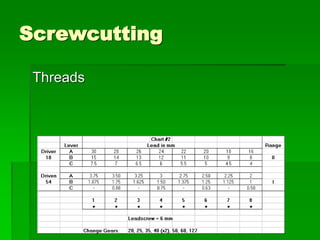
Threads
 Metric Threads
available by direct
selection
Screwcutting
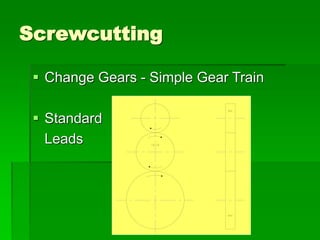
 Change Gears - Simple Gear Train
 Standard
Leads
Screwcutting
Threads
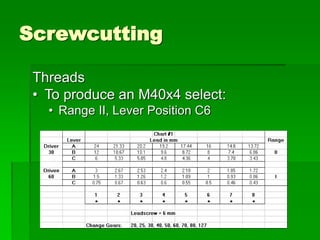
• To produce an M40x4 select:
• Range II, Lever Position C6
Screwcutting
Threads
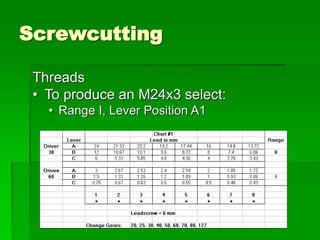
• To produce an M24x3 select:
• Range I, Lever Position A1
Screwcutting
Threads
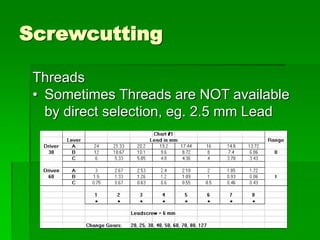
• Sometimes Threads are NOT available
by direct selection, eg. 2.5 mm Lead
Screwcutting
Threads
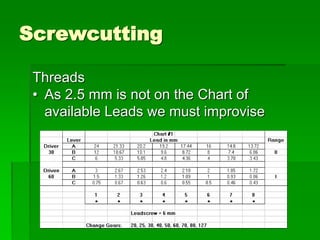
• As 2.5 mm is not on the Chart of
available Leads we must improvise
Screwcutting
Threads
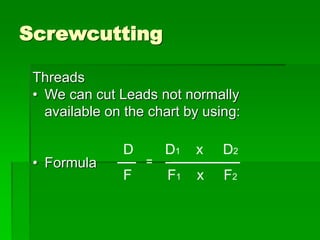
• We can cut Leads not normally
available on the chart by using:
• Formula
D D1 x D2
F F1 x F2
Screwcutting
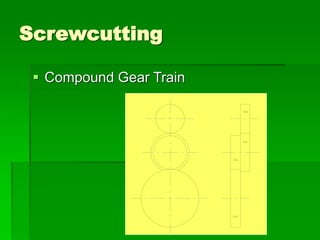
 Compound Gear Train
Screwcutting
Threads
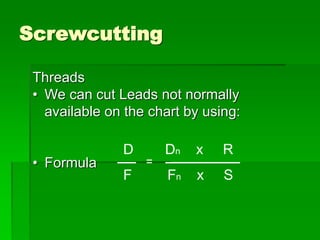
• We can cut Leads not normally
available on the chart by using:
• Formula
D Dn x R
F Fn x S
Screwcutting
Threads
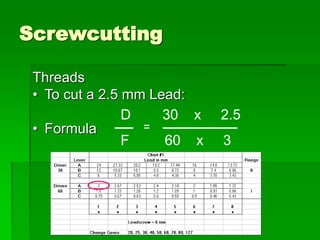
• To cut a 2.5 mm Lead:
• Formula
D 30 x 2.5
F 60 x 3
Screwcutting
Threads
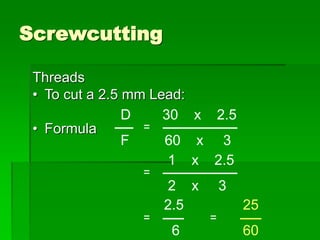
• To cut a 2.5 mm Lead:
• Formula
D 30 x 2.5
F 60 x 3
1 x 2.5
2 x 3
2.5 25
6 60
Screwcutting
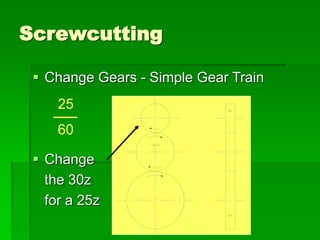
 Change Gears - Simple Gear Train
 Change
the 30z
for a 25z
25
60
Screwcutting
Threads

Screw Threads