Intro to SCIM

   Travis Spencer, CEO
   Twobo Technologies
The Problem

• Modern systems are massively distributed
• Organizations need to automate user/group
  management across domain boundaries
• Large cloud providers have their own APIs
• Enterprise-to-enterprise is a dog’s dinner
• Identity is the fly in the integration ointment
The Resulting Reality

• Tactical, bespoke methods that can’t scale
• Expensive integration work & custom
  development
• Systems maintain isolated silos of user data
• X-employees continue accessing resources
• Solution is automation based on
  open standards
Banding Together to Solve this Problem

• Salesforce, Google, UnboundID, Ping
  Identity, Sailpoint, Technology Nexus, etc.
• Protocol drafted, tested, and released in 2011
   Q1 – Initial draft of spec
   Q2 – Updated draft discussed at IIW
   Q3 – Consortium formed under OWF, interop tests
       at IIW
   Q4 – V. 1 agreed upon by consortium, submitted to
       IETF
SCIM, a Modern Standard for Automation

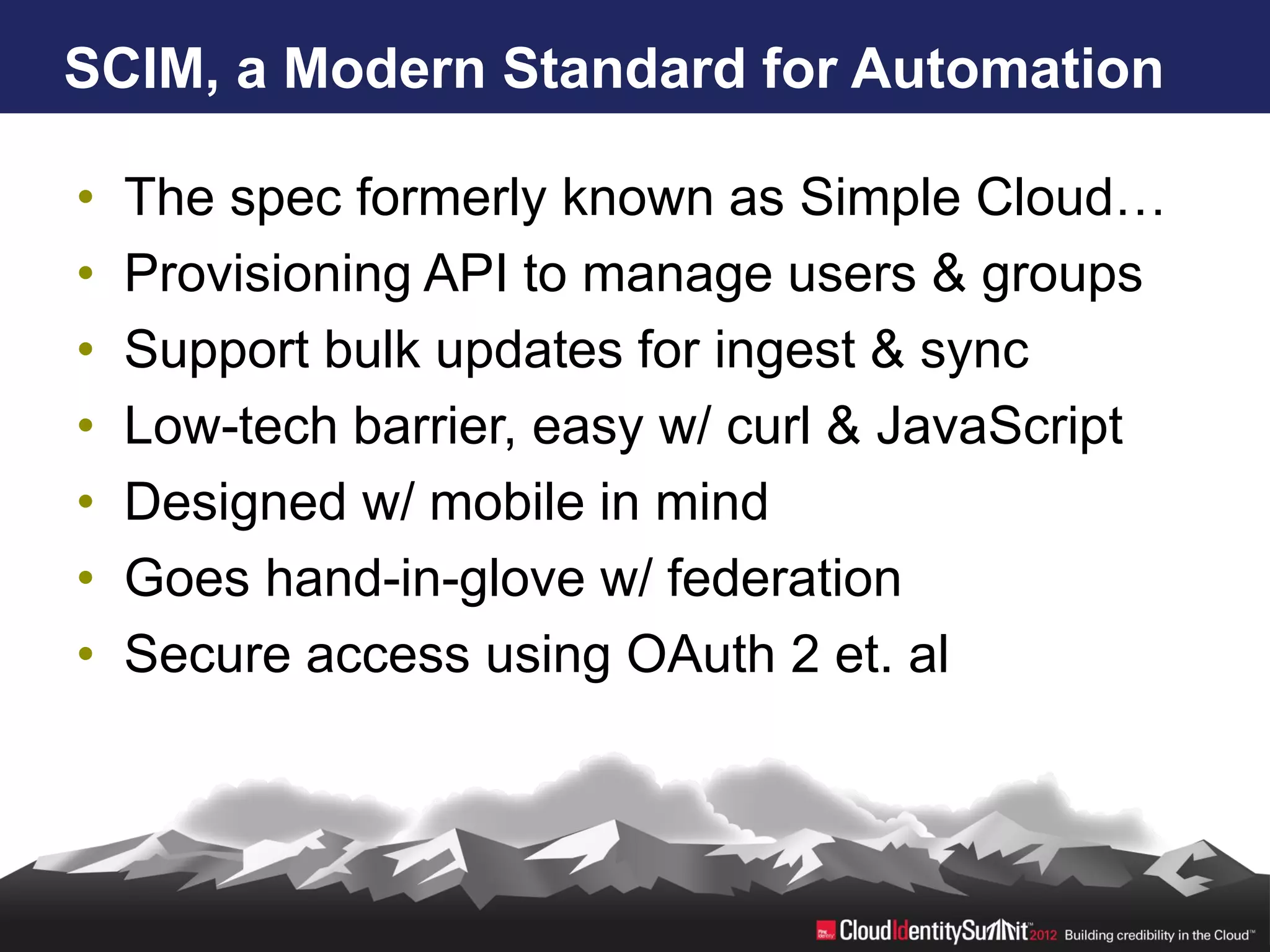
•   The spec formerly known as Simple Cloud…
•   Provisioning API to manage users & groups
•   Support bulk updates for ingest & sync
•   Low-tech barrier, easy w/ curl & JavaScript
•   Designed w/ mobile in mind
•   Goes hand-in-glove w/ federation
•   Secure access using OAuth 2 et. al
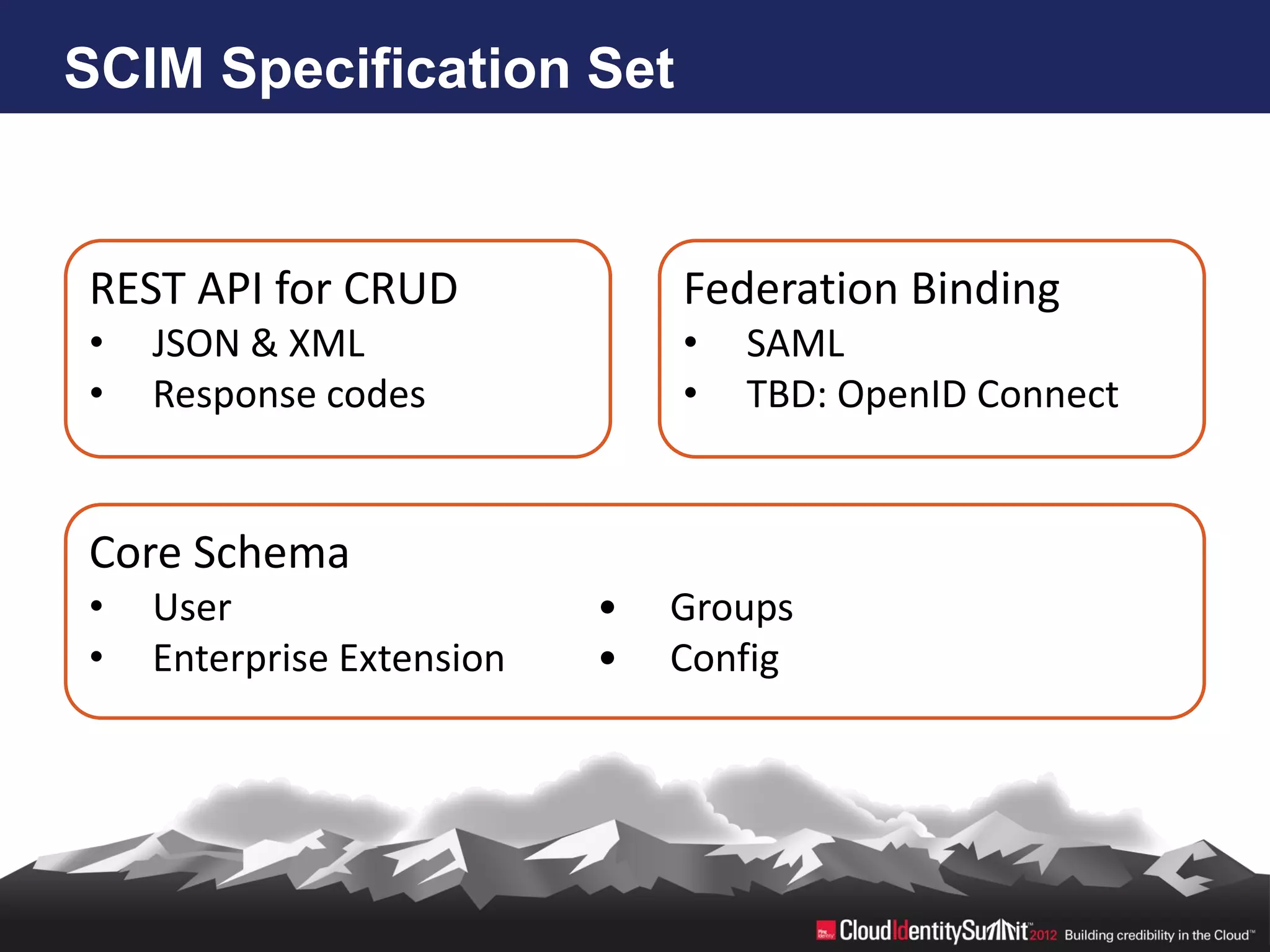
SCIM Specification Set


REST API for CRUD              Federation Binding
•   JSON & XML                 •   SAML
•   Response codes             •   TBD: OpenID Connect


Core Schema
•   User                   •   Groups
•   Enterprise Extension   •   Config
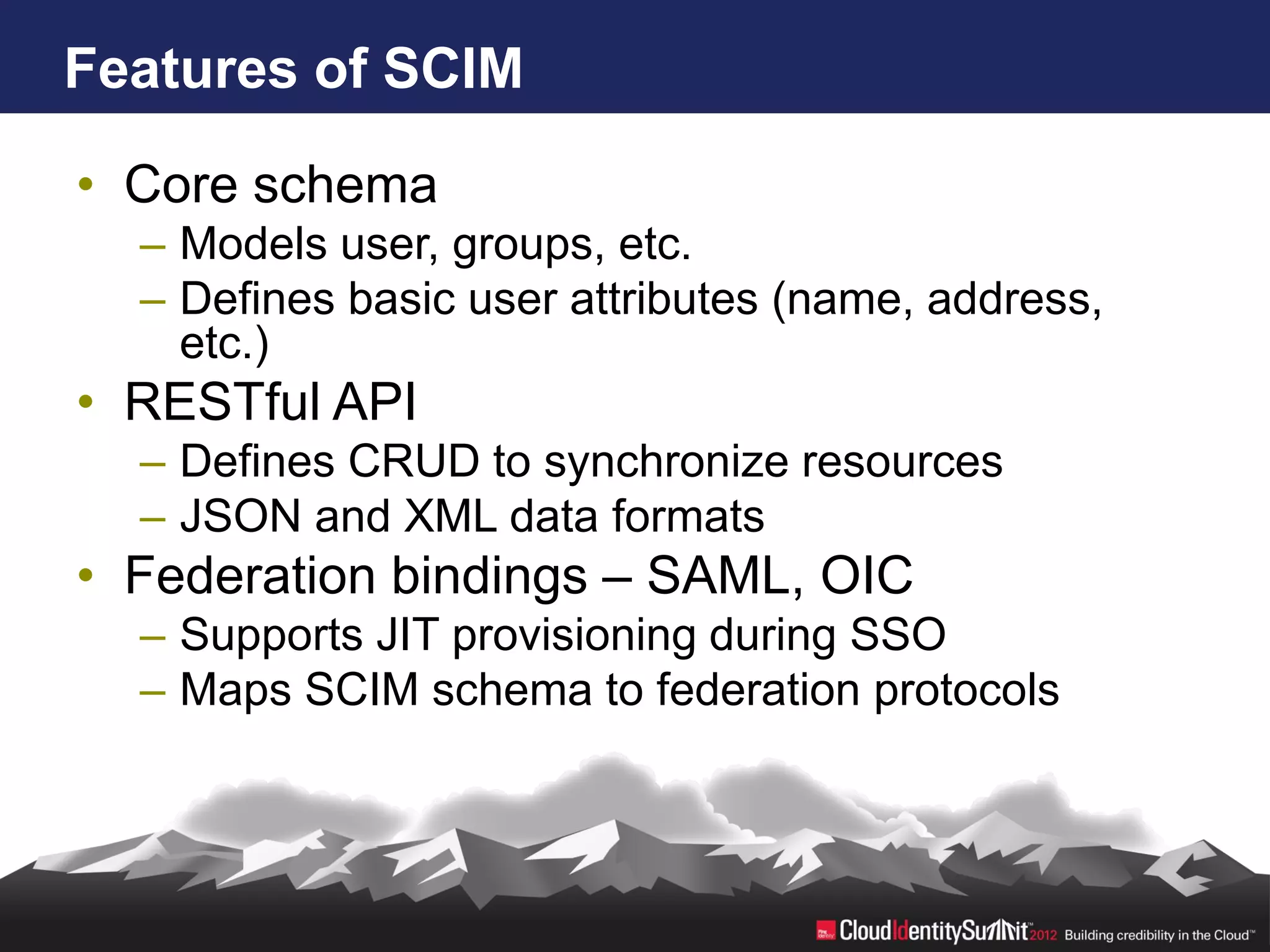
Features of SCIM

• Core schema
  – Models user, groups, etc.
  – Defines basic user attributes (name, address,
    etc.)
• RESTful API
  – Defines CRUD to synchronize resources
  – JSON and XML data formats
• Federation bindings – SAML, OIC
  – Supports JIT provisioning during SSO
  – Maps SCIM schema to federation protocols
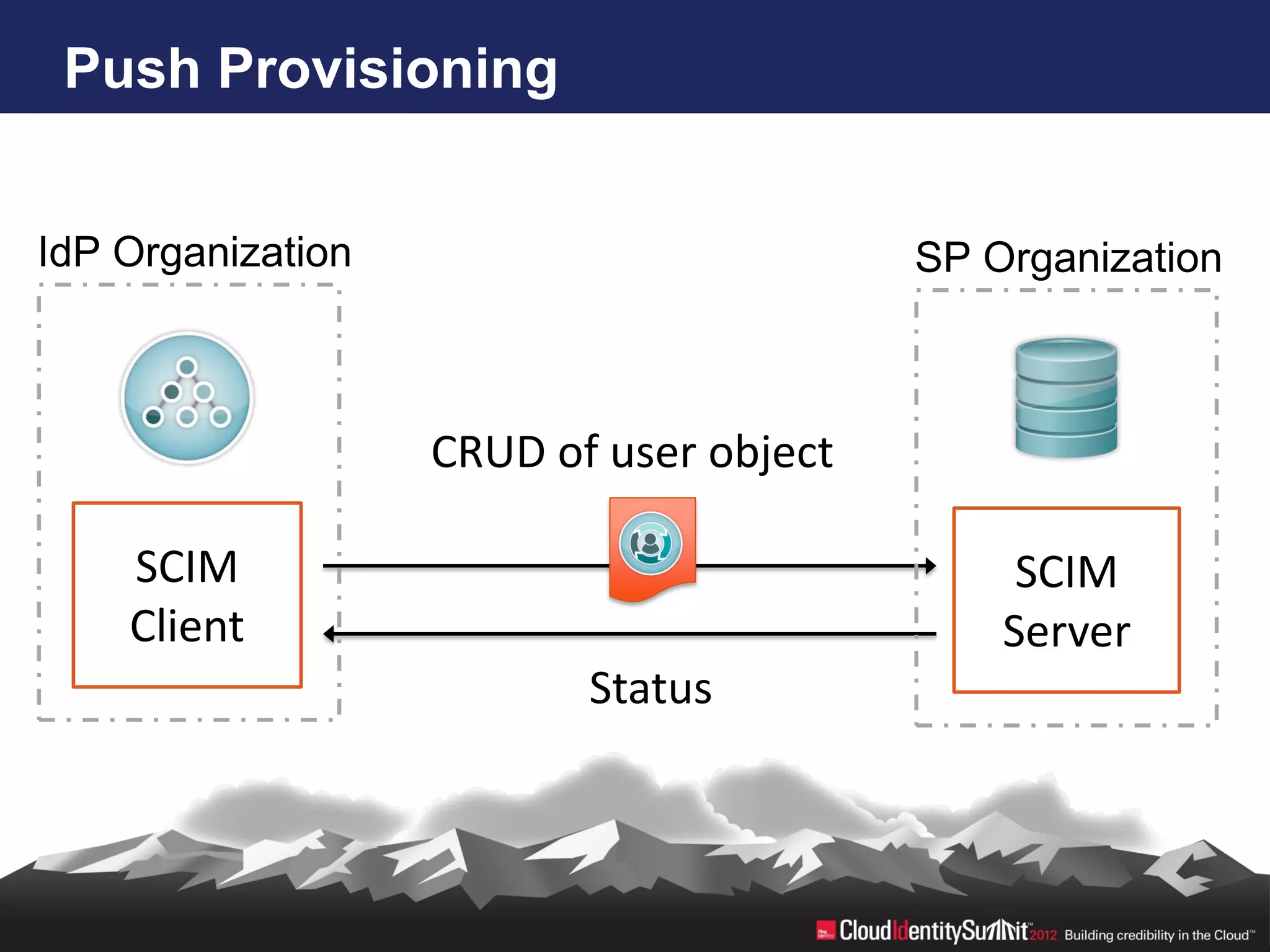
Push Provisioning


IdP Organization                         SP Organization


                   CRUD of user object

    SCIM                                      SCIM
    Client                                   Server
                          Status
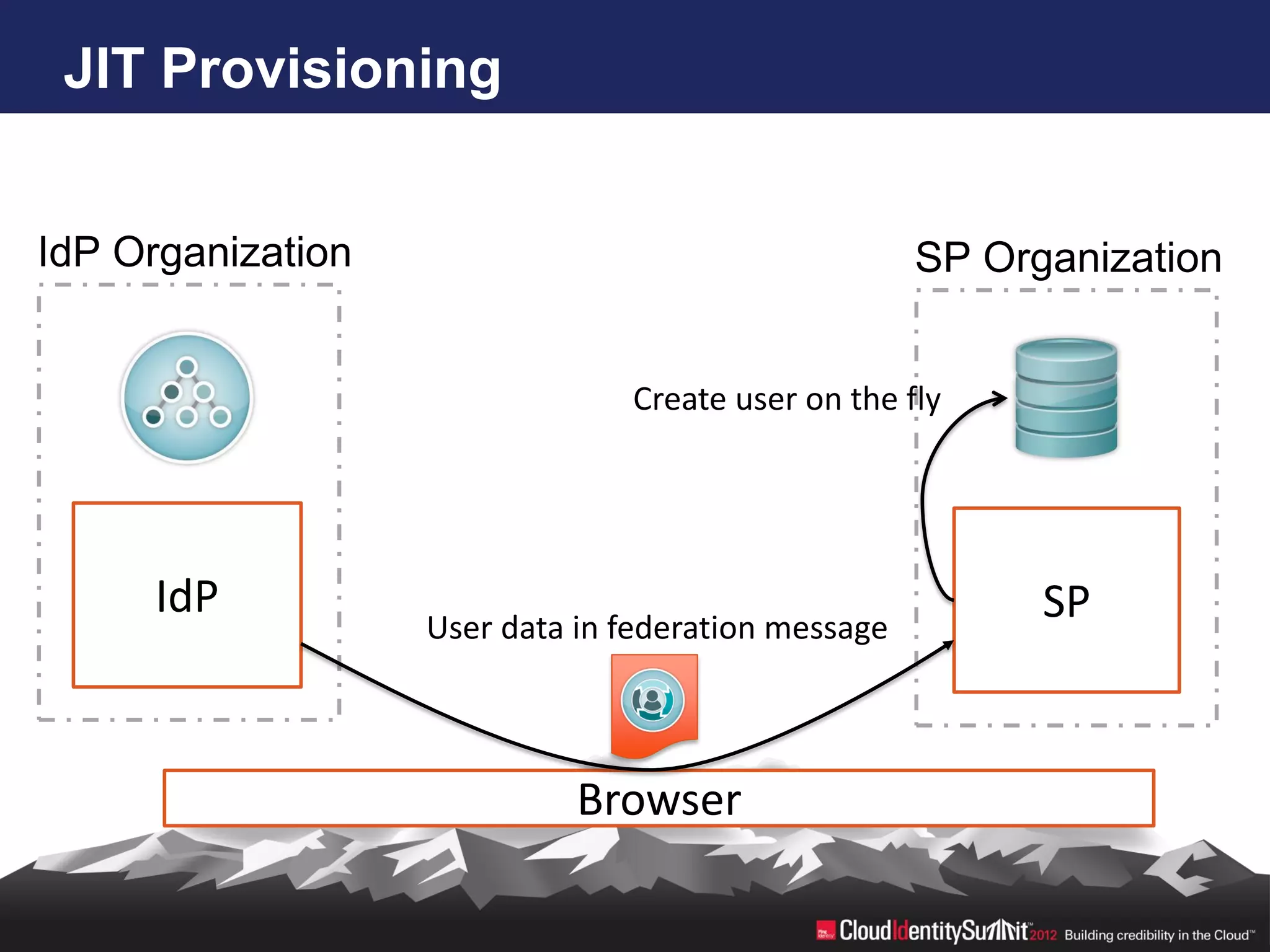
JIT Provisioning


IdP Organization                                     SP Organization


                                Create user on the fly


     IdP                                                   SP
                   User data in federation message


                             Browser
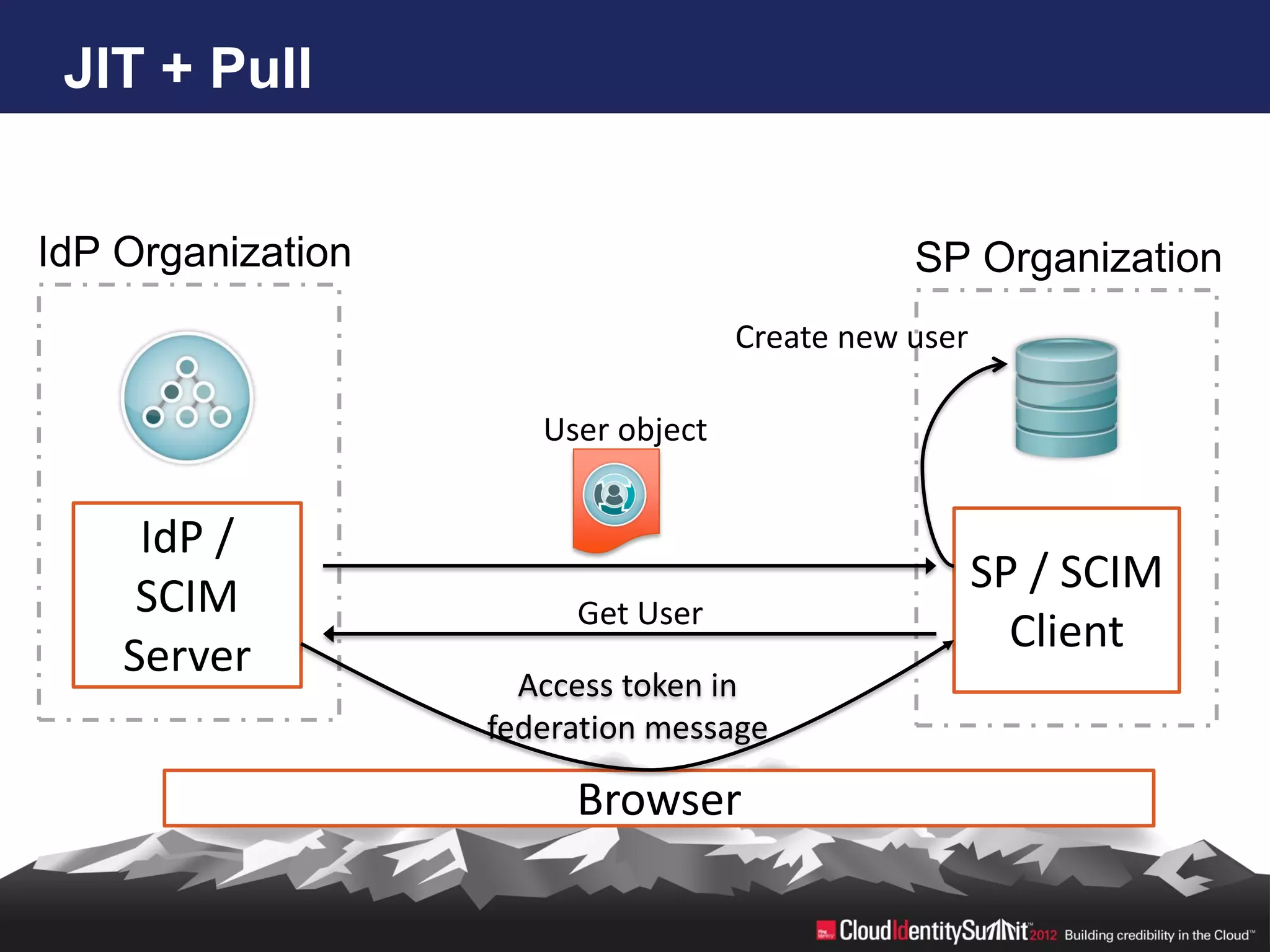
JIT + Pull


IdP Organization                               SP Organization
                                    Create new user

                      User object


     IdP /
     SCIM                                             SP / SCIM
                        Get User
    Server                                              Client
                     Access token in
                   federation message

                        Browser
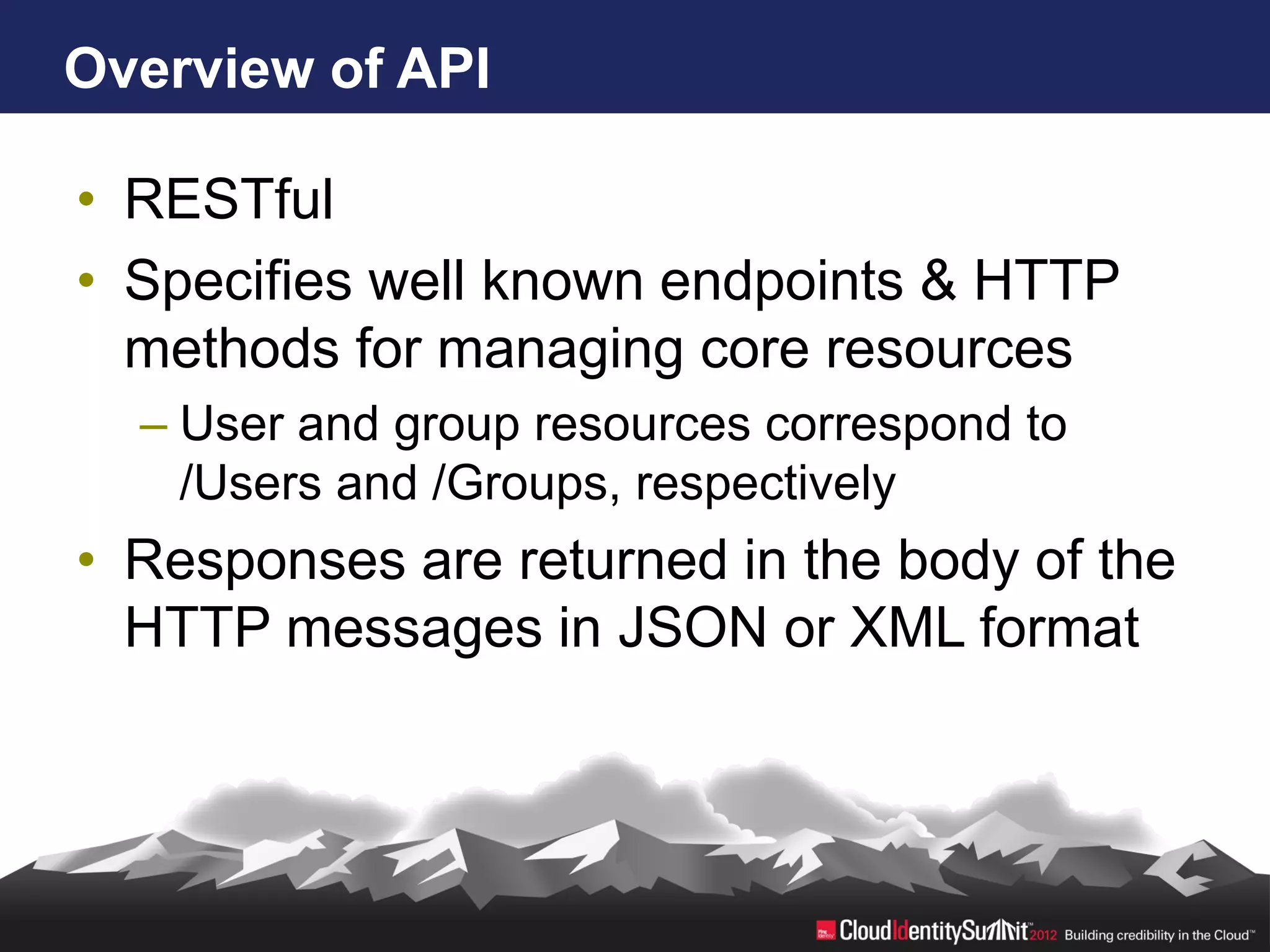
Overview of API

• RESTful
• Specifies well known endpoints & HTTP
  methods for managing core resources
  – User and group resources correspond to
    /Users and /Groups, respectively
• Responses are returned in the body of the
  HTTP messages in JSON or XML format
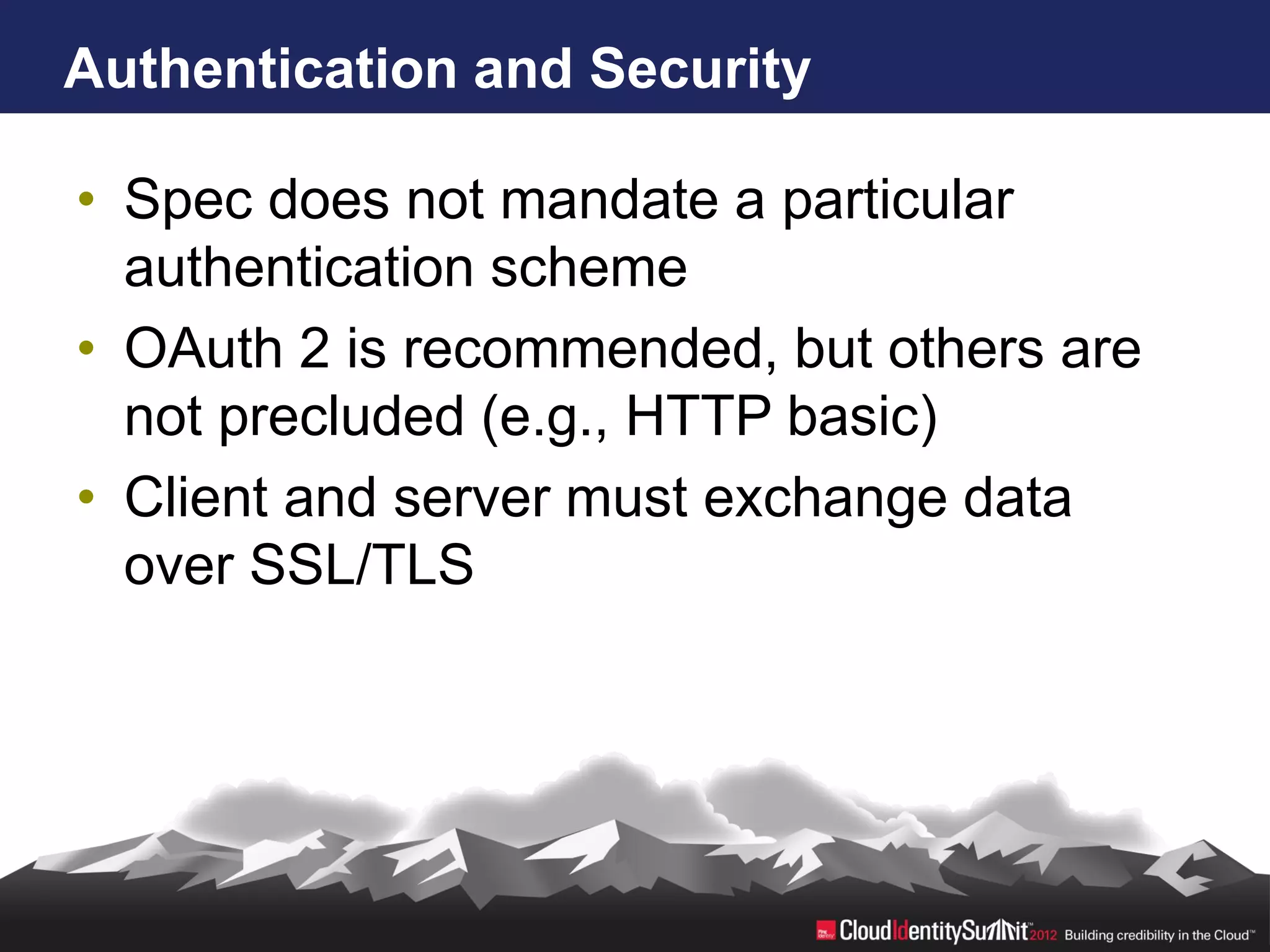
Authentication and Security

• Spec does not mandate a particular
  authentication scheme
• OAuth 2 is recommended, but others are
  not precluded (e.g., HTTP basic)
• Client and server must exchange data
  over SSL/TLS
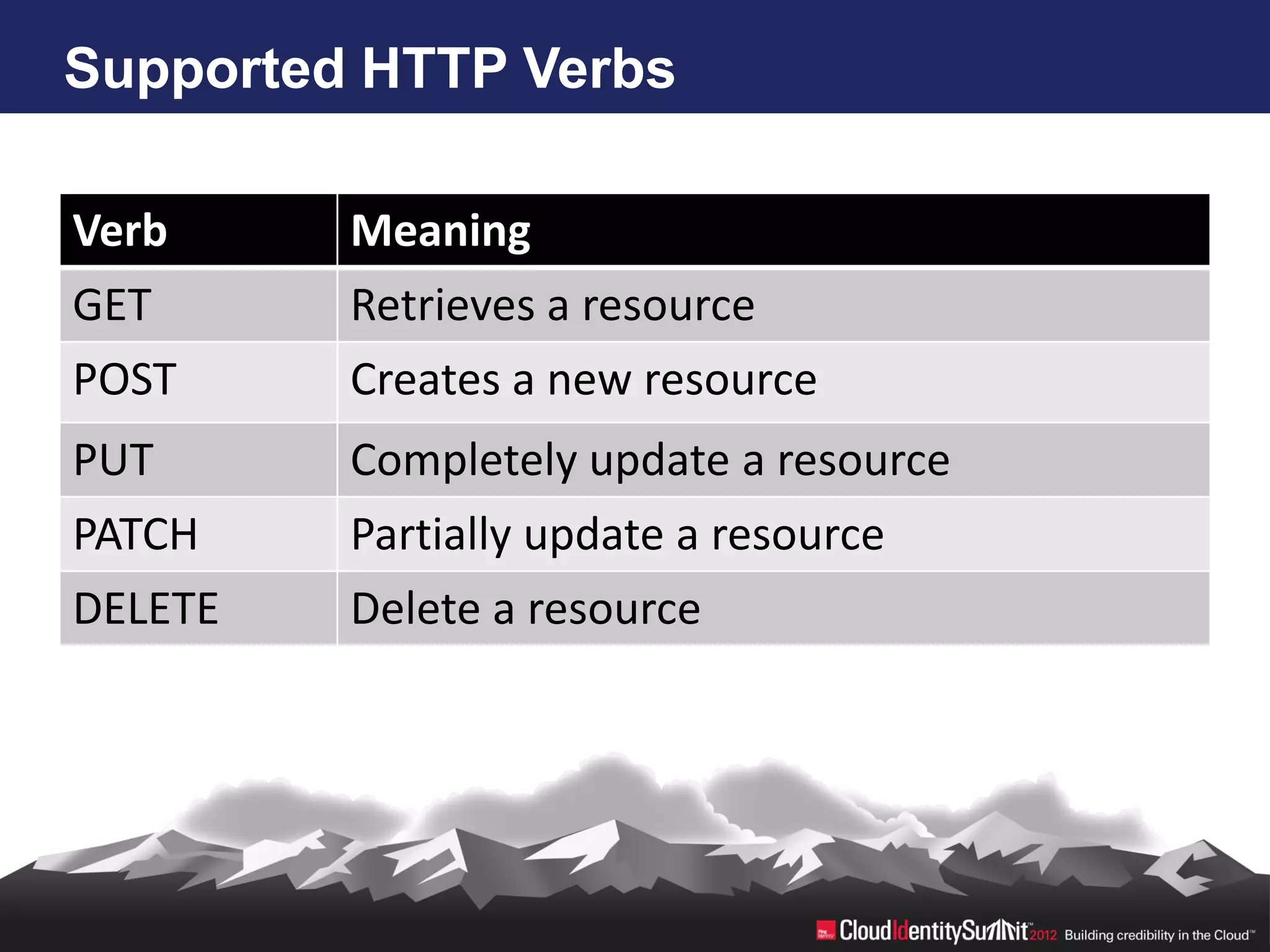
Supported HTTP Verbs

Verb     Meaning
GET      Retrieves a resource
POST     Creates a new resource
PUT      Completely update a resource
PATCH    Partially update a resource
DELETE   Delete a resource
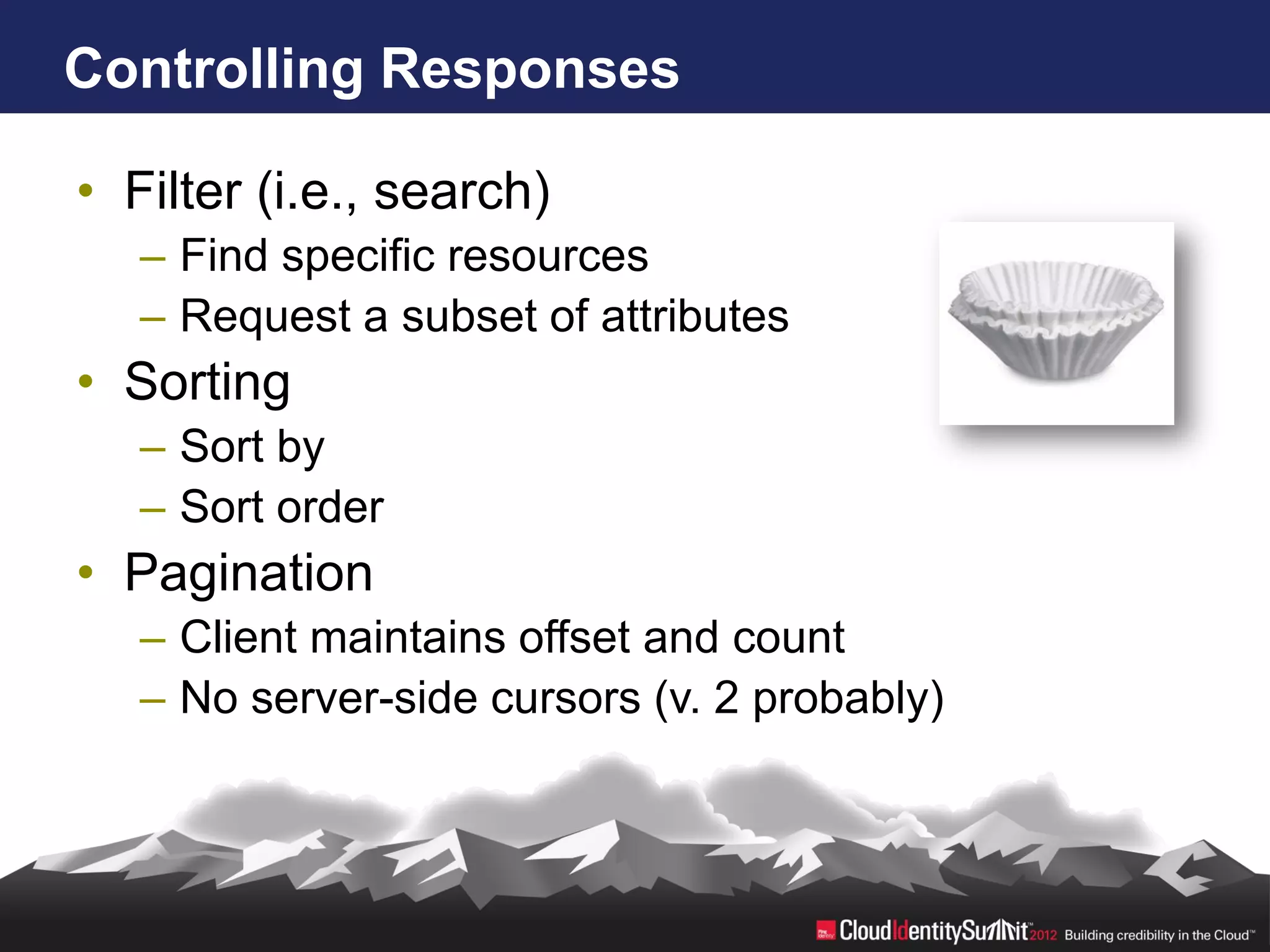
Controlling Responses

• Filter (i.e., search)
   – Find specific resources
   – Request a subset of attributes
• Sorting
   – Sort by
   – Sort order
• Pagination
   – Client maintains offset and count
   – No server-side cursors (v. 2 probably)
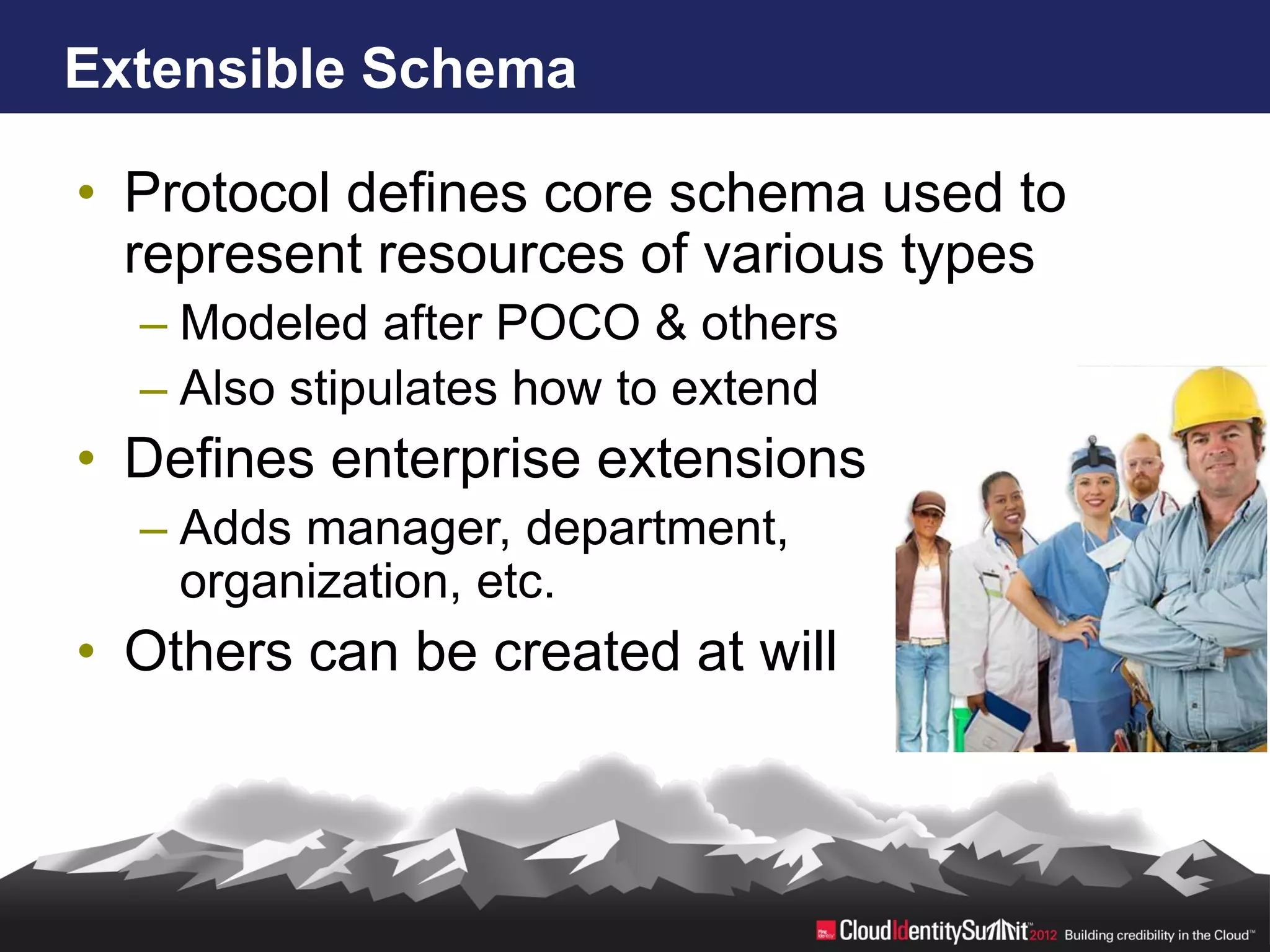
Extensible Schema

• Protocol defines core schema used to
  represent resources of various types
  – Modeled after POCO & others
  – Also stipulates how to extend
• Defines enterprise extensions
  – Adds manager, department,
    organization, etc.
• Others can be created at will
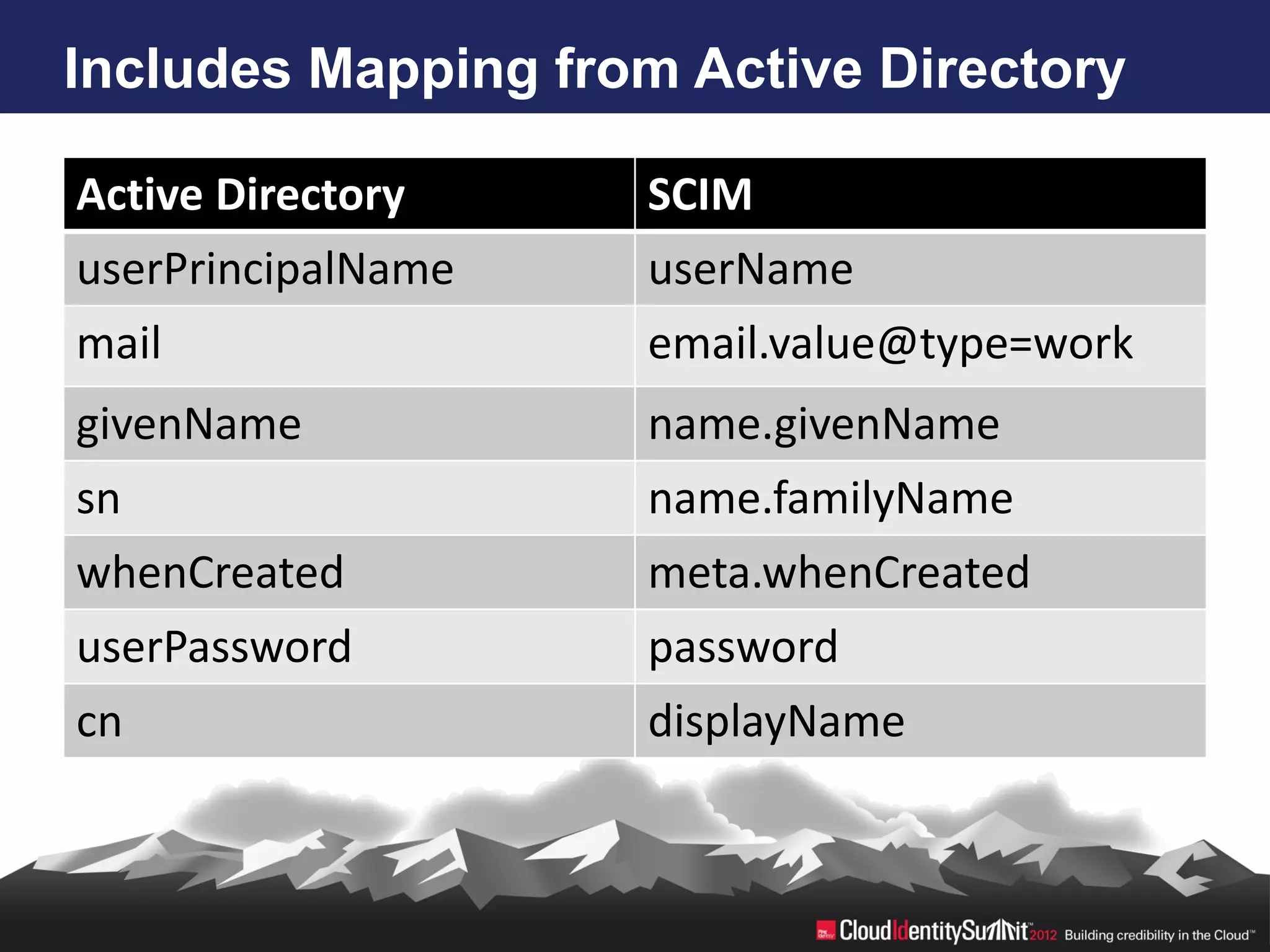
Includes Mapping from Active Directory

Active Directory    SCIM
userPrincipalName   userName
mail                email.value@type=work
givenName           name.givenName
sn                  name.familyName
whenCreated         meta.whenCreated
userPassword        password
cn                  displayName
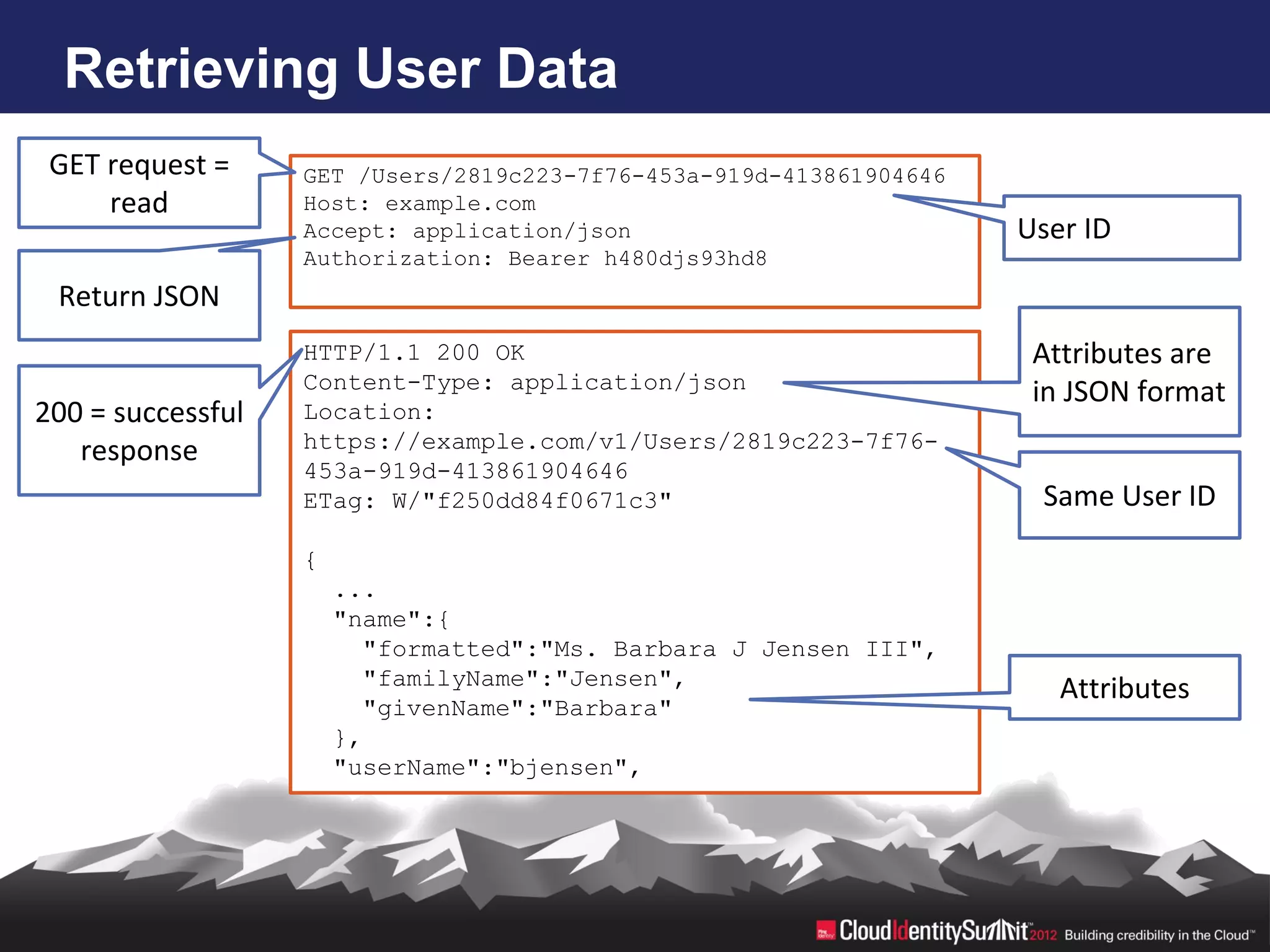
Retrieving User Data
 GET request =     GET /Users/2819c223-7f76-453a-919d-413861904646
     read          Host: example.com
                   Accept: application/json                          User ID
                   Authorization: Bearer h480djs93hd8
 Return JSON
                   HTTP/1.1 200 OK                                    Attributes are
                   Content-Type: application/json                     in JSON format
200 = successful   Location:
   response        https://example.com/v1/Users/2819c223-7f76-
                   453a-919d-413861904646
                   ETag: W/"f250dd84f0671c3"                          Same User ID
                   {
                       ...
                       "name":{
                         "formatted":"Ms. Barbara J Jensen III",
                         "familyName":"Jensen",
                                                                        Attributes
                         "givenName":"Barbara"
                       },
                       "userName":"bjensen",
Updating a Group with a new Member

                PATCH /Groups/acbf3ae7-8463-4692-b4fd-
PATCH = only    9b4da3f908ce
update what’s   Host: example.com                               Secure access
  changed       Accept: application/json                        using OAuth 2
                Authorization: Bearer h480djs93hd8
                ETag: W/"a330bc54f0671c9"

                {
                    "schemas": ["urn:scim:schemas:core:1.0"],
                    "members": [
                      {
                        "display": "Babs Jensen",                 New group
                        "value": "2819c223-7f76-453a…"          member; others
                      }
                                                                are unchanged
                    ]
                }
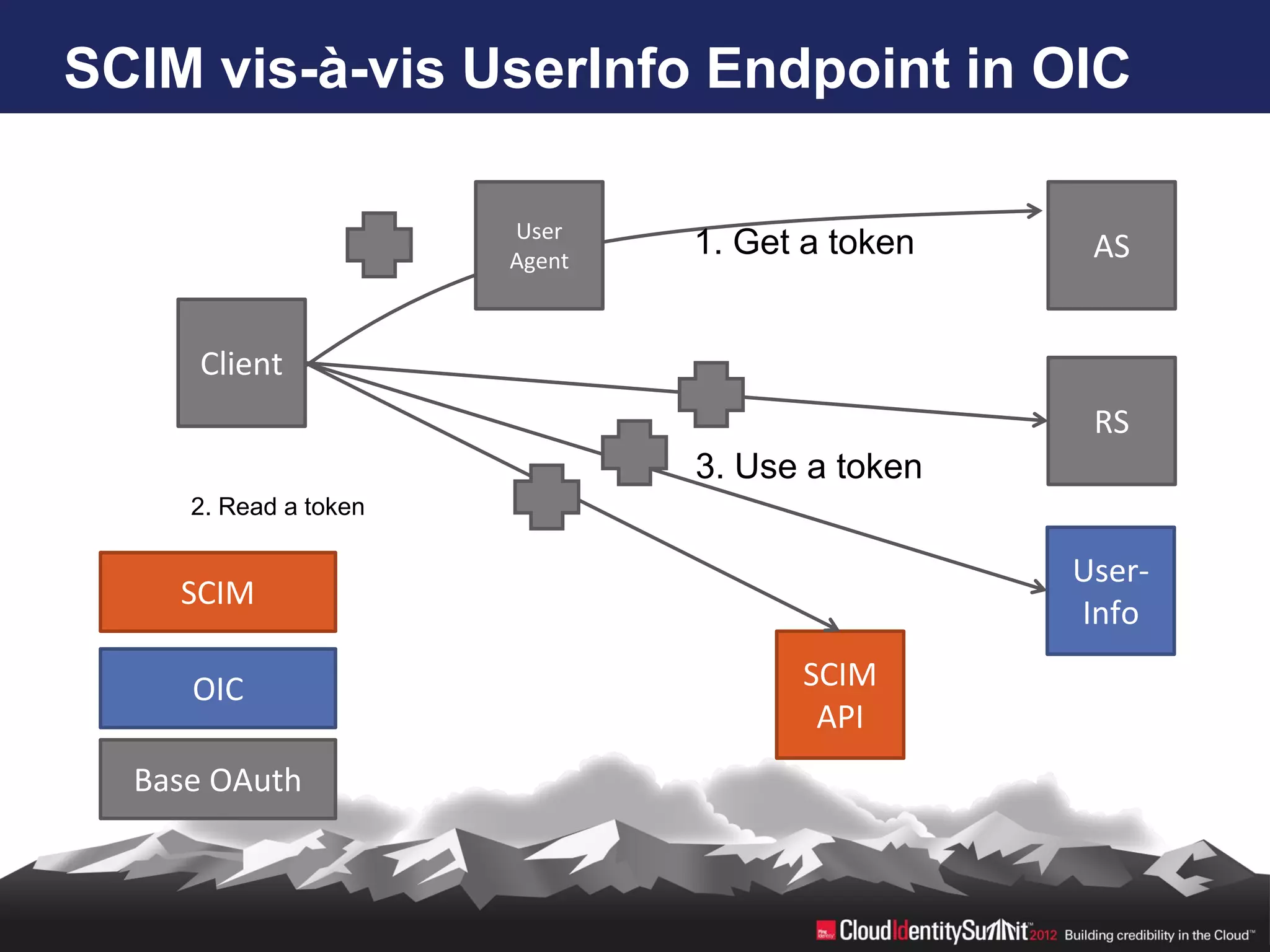
SCIM vis-à-vis UserInfo Endpoint in OIC

                       User
                       Agent
                               1. Get a token    AS


     Client
                                                 RS
                               3. Use a token
     2. Read a token

                                                User-
    SCIM
                                                Info

     OIC                             SCIM
                                      API
  Base OAuth
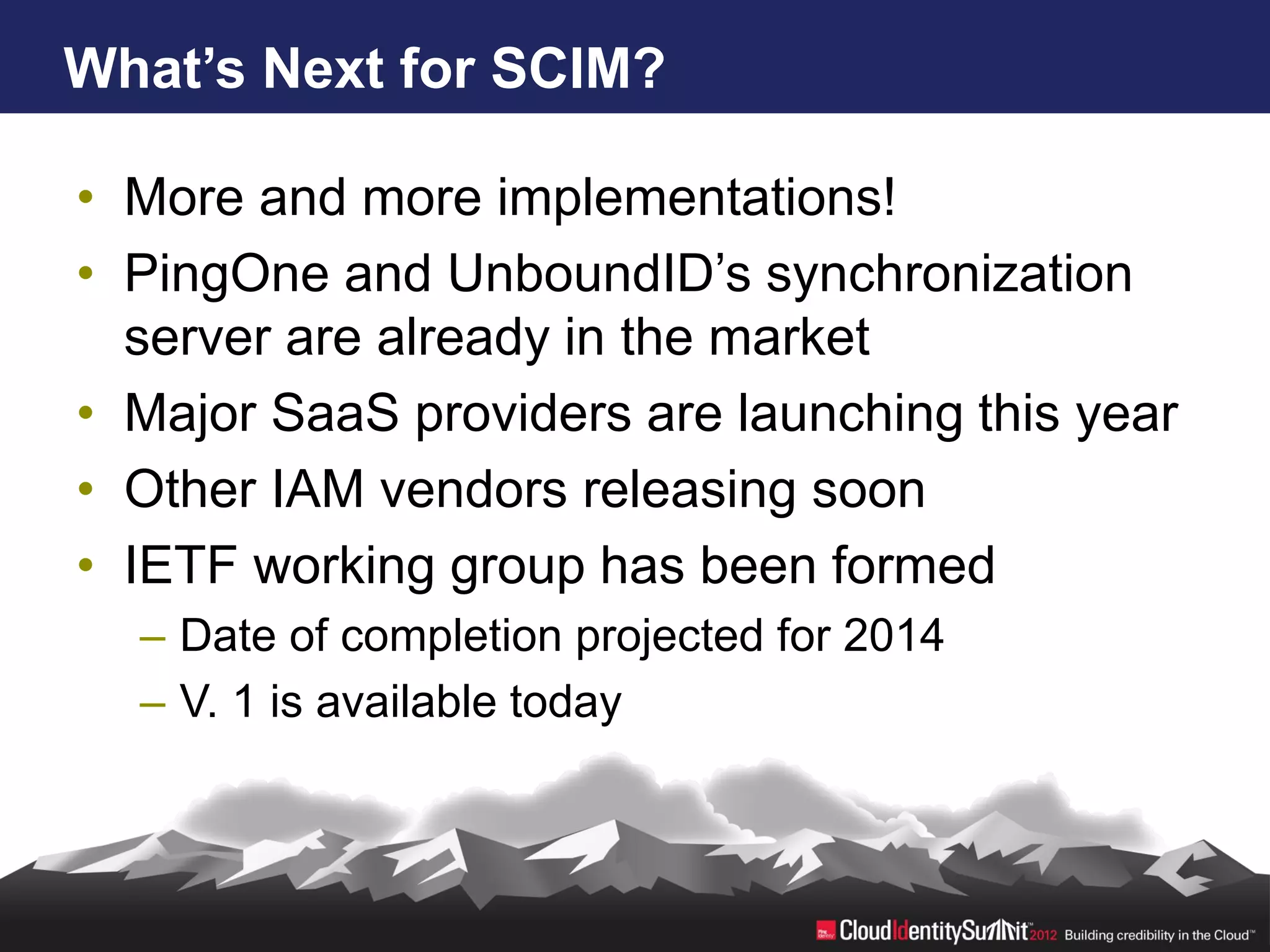
What’s Next for SCIM?

• More and more implementations!
• PingOne and UnboundID’s synchronization
  server are already in the market
• Major SaaS providers are launching this year
• Other IAM vendors releasing soon
• IETF working group has been formed
  – Date of completion projected for 2014
  – V. 1 is available today
Support SCIM

• SaaS and IdM vendors must implement
  SCIM for it to solve anything
• Demand standards-based automation of
  identity; demand SCIM 
• Join IETF mailing list; attend WG meetings
Thank You and More Info

•   @travisspencer
•   @pingidentity
•   simplecloud.info
•   travisspencer.com
•   2botech.com
•   pingidentity.com
SCIM presentation from CIS 2012

SCIM presentation from CIS 2012

  • 1.
    Intro to SCIM Travis Spencer, CEO Twobo Technologies
  • 2.
    The Problem • Modernsystems are massively distributed • Organizations need to automate user/group management across domain boundaries • Large cloud providers have their own APIs • Enterprise-to-enterprise is a dog’s dinner • Identity is the fly in the integration ointment
  • 3.
    The Resulting Reality •Tactical, bespoke methods that can’t scale • Expensive integration work & custom development • Systems maintain isolated silos of user data • X-employees continue accessing resources • Solution is automation based on open standards
  • 4.
    Banding Together toSolve this Problem • Salesforce, Google, UnboundID, Ping Identity, Sailpoint, Technology Nexus, etc. • Protocol drafted, tested, and released in 2011 Q1 – Initial draft of spec Q2 – Updated draft discussed at IIW Q3 – Consortium formed under OWF, interop tests at IIW Q4 – V. 1 agreed upon by consortium, submitted to IETF
  • 5.
    SCIM, a ModernStandard for Automation • The spec formerly known as Simple Cloud… • Provisioning API to manage users & groups • Support bulk updates for ingest & sync • Low-tech barrier, easy w/ curl & JavaScript • Designed w/ mobile in mind • Goes hand-in-glove w/ federation • Secure access using OAuth 2 et. al
  • 6.
    SCIM Specification Set RESTAPI for CRUD Federation Binding • JSON & XML • SAML • Response codes • TBD: OpenID Connect Core Schema • User • Groups • Enterprise Extension • Config
  • 7.
    Features of SCIM •Core schema – Models user, groups, etc. – Defines basic user attributes (name, address, etc.) • RESTful API – Defines CRUD to synchronize resources – JSON and XML data formats • Federation bindings – SAML, OIC – Supports JIT provisioning during SSO – Maps SCIM schema to federation protocols
  • 8.
    Push Provisioning IdP Organization SP Organization CRUD of user object SCIM SCIM Client Server Status
  • 9.
    JIT Provisioning IdP Organization SP Organization Create user on the fly IdP SP User data in federation message Browser
  • 10.
    JIT + Pull IdPOrganization SP Organization Create new user User object IdP / SCIM SP / SCIM Get User Server Client Access token in federation message Browser
  • 11.
    Overview of API •RESTful • Specifies well known endpoints & HTTP methods for managing core resources – User and group resources correspond to /Users and /Groups, respectively • Responses are returned in the body of the HTTP messages in JSON or XML format
  • 12.
    Authentication and Security •Spec does not mandate a particular authentication scheme • OAuth 2 is recommended, but others are not precluded (e.g., HTTP basic) • Client and server must exchange data over SSL/TLS
  • 13.
    Supported HTTP Verbs Verb Meaning GET Retrieves a resource POST Creates a new resource PUT Completely update a resource PATCH Partially update a resource DELETE Delete a resource
  • 14.
    Controlling Responses • Filter(i.e., search) – Find specific resources – Request a subset of attributes • Sorting – Sort by – Sort order • Pagination – Client maintains offset and count – No server-side cursors (v. 2 probably)
  • 15.
    Extensible Schema • Protocoldefines core schema used to represent resources of various types – Modeled after POCO & others – Also stipulates how to extend • Defines enterprise extensions – Adds manager, department, organization, etc. • Others can be created at will
  • 16.
    Includes Mapping fromActive Directory Active Directory SCIM userPrincipalName userName mail email.value@type=work givenName name.givenName sn name.familyName whenCreated meta.whenCreated userPassword password cn displayName
  • 17.
    Retrieving User Data GET request = GET /Users/2819c223-7f76-453a-919d-413861904646 read Host: example.com Accept: application/json User ID Authorization: Bearer h480djs93hd8 Return JSON HTTP/1.1 200 OK Attributes are Content-Type: application/json in JSON format 200 = successful Location: response https://example.com/v1/Users/2819c223-7f76- 453a-919d-413861904646 ETag: W/"f250dd84f0671c3" Same User ID { ... "name":{ "formatted":"Ms. Barbara J Jensen III", "familyName":"Jensen", Attributes "givenName":"Barbara" }, "userName":"bjensen",
  • 18.
    Updating a Groupwith a new Member PATCH /Groups/acbf3ae7-8463-4692-b4fd- PATCH = only 9b4da3f908ce update what’s Host: example.com Secure access changed Accept: application/json using OAuth 2 Authorization: Bearer h480djs93hd8 ETag: W/"a330bc54f0671c9" { "schemas": ["urn:scim:schemas:core:1.0"], "members": [ { "display": "Babs Jensen", New group "value": "2819c223-7f76-453a…" member; others } are unchanged ] }
  • 19.
    SCIM vis-à-vis UserInfoEndpoint in OIC User Agent 1. Get a token AS Client RS 3. Use a token 2. Read a token User- SCIM Info OIC SCIM API Base OAuth
  • 20.
    What’s Next forSCIM? • More and more implementations! • PingOne and UnboundID’s synchronization server are already in the market • Major SaaS providers are launching this year • Other IAM vendors releasing soon • IETF working group has been formed – Date of completion projected for 2014 – V. 1 is available today
  • 21.
    Support SCIM • SaaSand IdM vendors must implement SCIM for it to solve anything • Demand standards-based automation of identity; demand SCIM  • Join IETF mailing list; attend WG meetings
  • 22.
    Thank You andMore Info • @travisspencer • @pingidentity • simplecloud.info • travisspencer.com • 2botech.com • pingidentity.com