Scientific Writing Lecture 3- Research Grant Proposal.ppt
1.
Grant Proposals
(or Giveme the money!)
ARI 7209 Scientific Writing &
Presentation Skills
Professor Jacob Godfrey Agea
Dept. Extension & Innovation Studies, College of Agricultural &
Environmental Sciences, Makerere University,
P.O. Box 7062 Kampala, Uganda.
2.
WHAT THIS LECTURE/PRESENTATIONIS ABOUT?
This lecture/presentation will help you write and revise
grant proposals for research funding in all academic
disciplines (sciences, social sciences, humanities, and
the arts).
It’s targeted primarily to graduate students (Masters
and PhD) and faculty, although it will also be helpful
to undergraduate students who are seeking funding
for research.
3.
THE GRANT WRITINGPROCESS
Grant writing varies widely across the disciplines.
Nonetheless, this lecture attempts to provide a
general introduction to grant writing across the
disciplines.
Although some scholars in the humanities and arts
may not have thought about their projects in terms of
research design, hypotheses, research questions, or
results, reviewers and funding agencies expect you
to frame your project in these terms.
4.
THE GRANT WRITINGPROCESS…
Learning the language of grant writing can be a
lucrative endeavor, so give it a try. You may also find
that thinking about your project in these terms
reveals new aspects of it to you. Writing successful
grant applications is a long process that begins with
an idea.
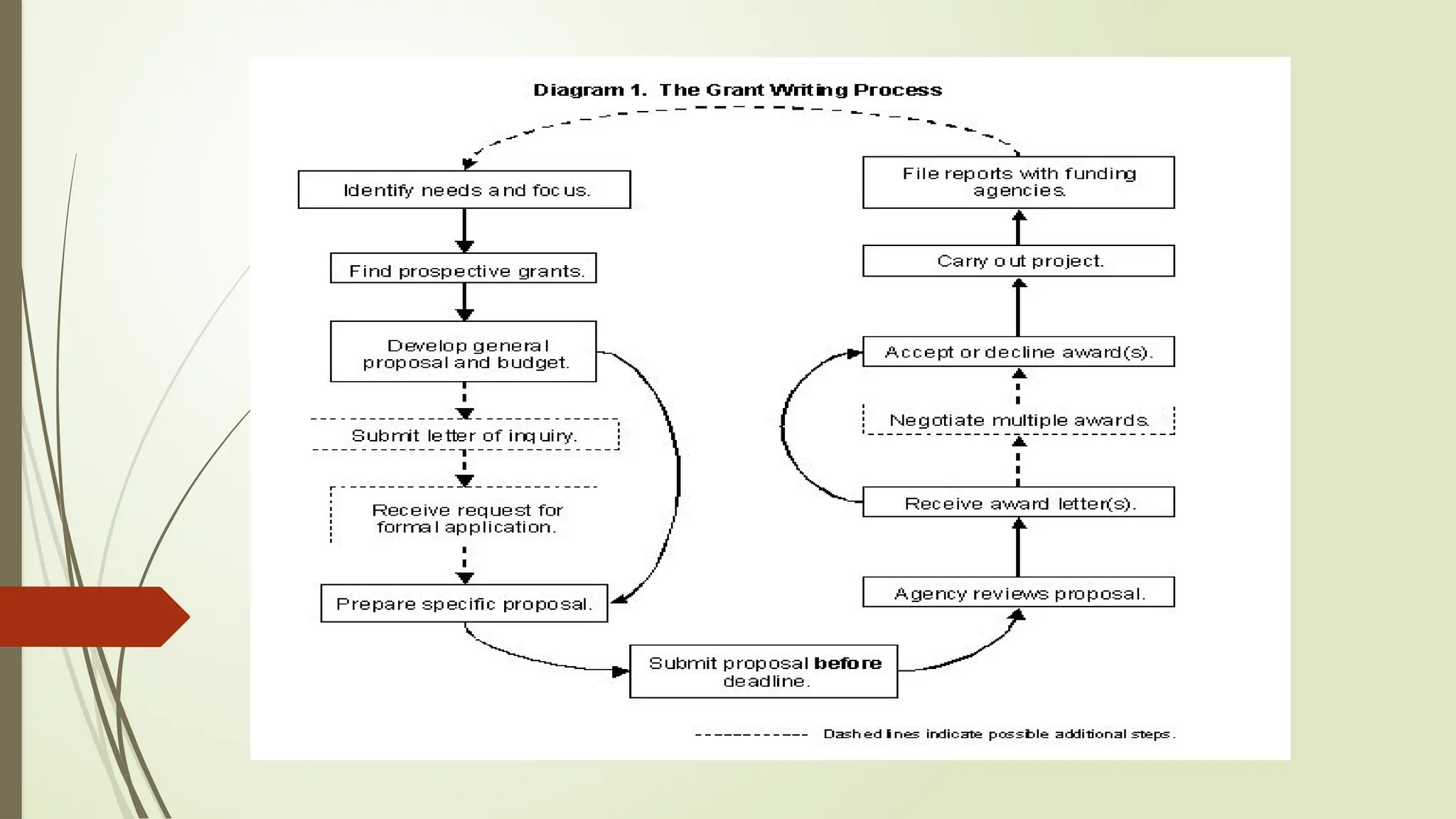
Although many people think of grant writing as a
linear process (from idea to proposal to award), it is a
circular process. Diagram 1 in the next slide provides
an overview of the grant writing process & may help
you plan your proposal dev’t.
6.
Applicants must writegrant proposals, submit them,
receive notice of acceptance or rejection, & then
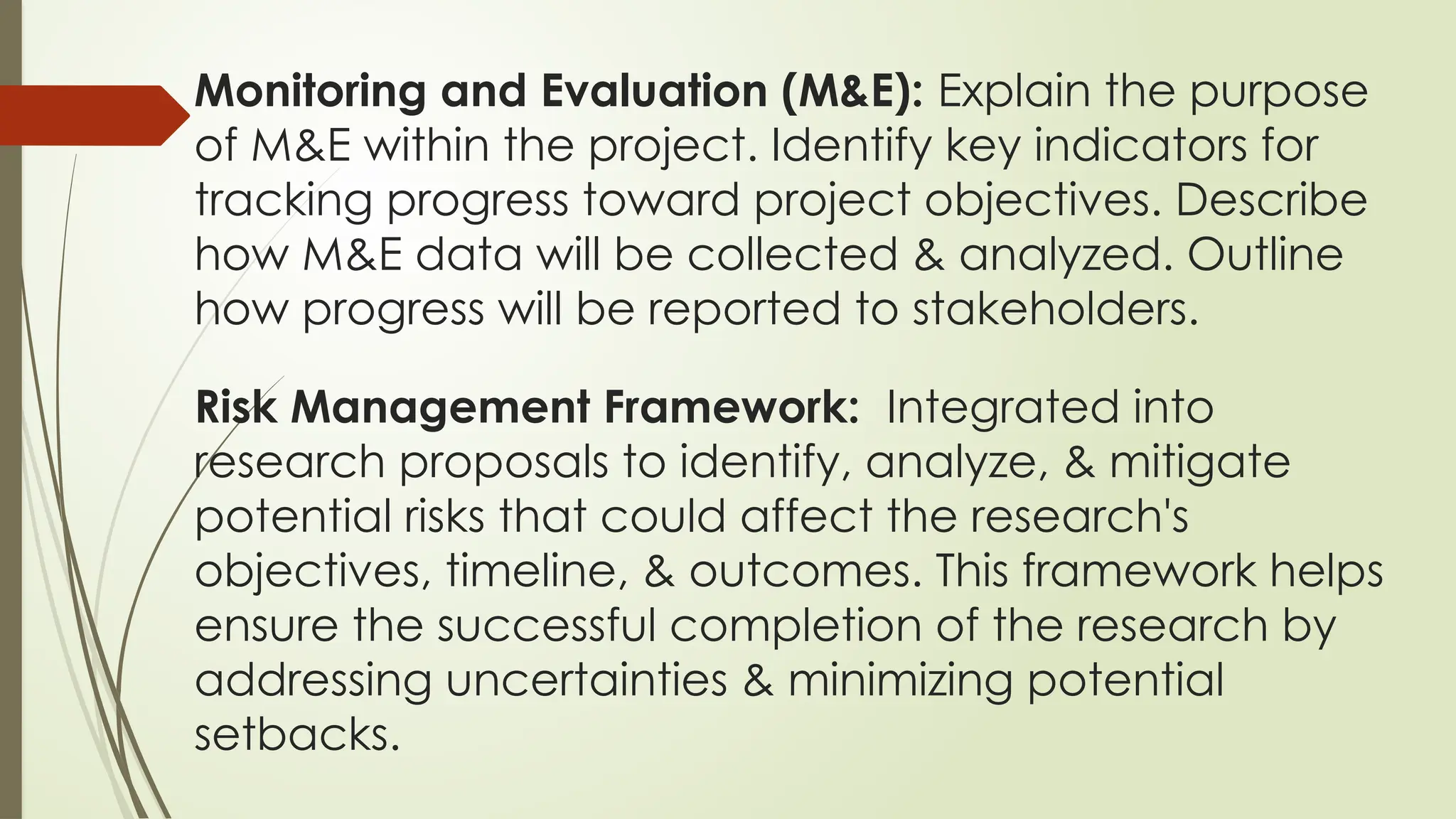
revise their proposals.
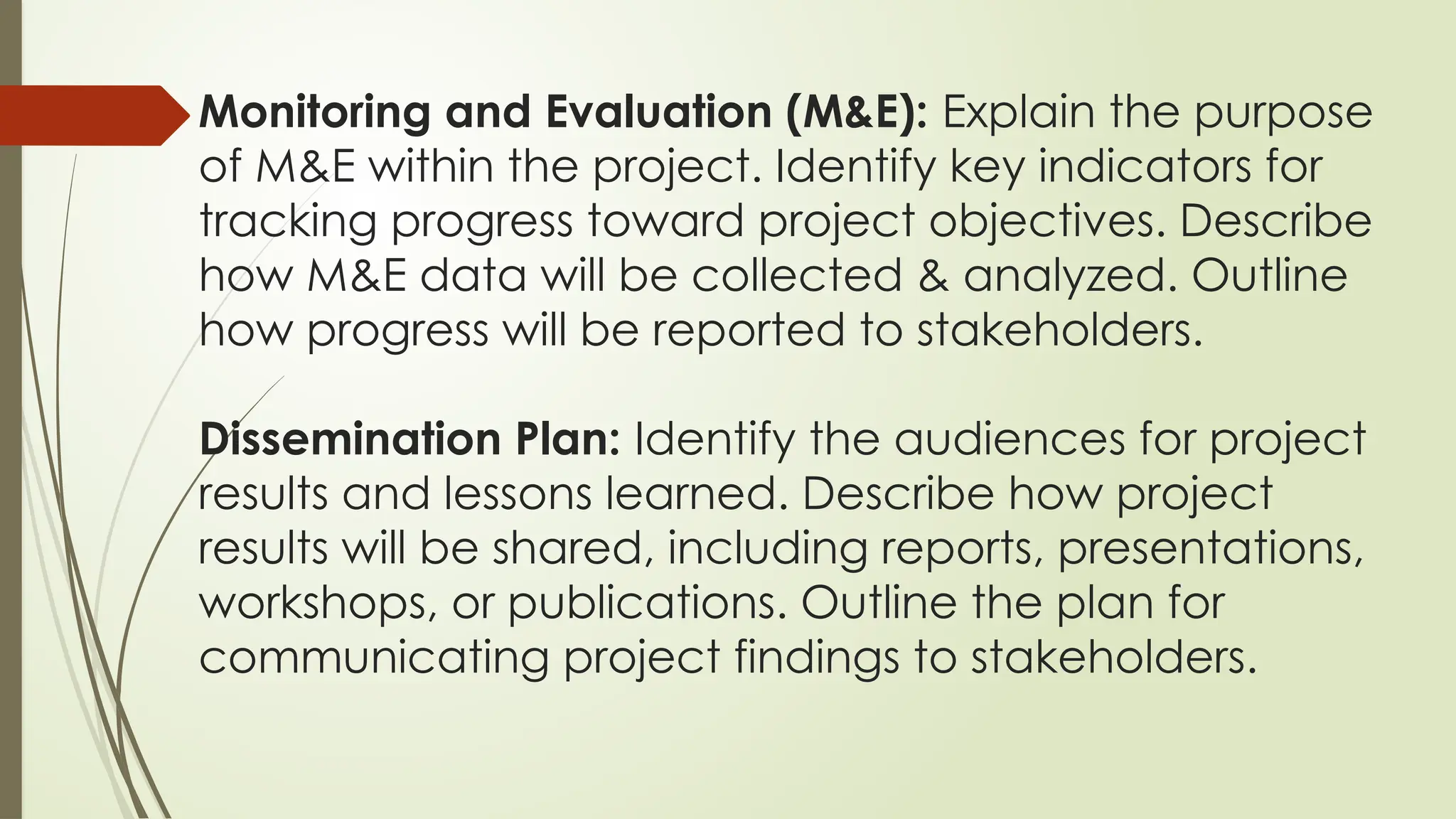
Unsuccessful grant applicants must revise and
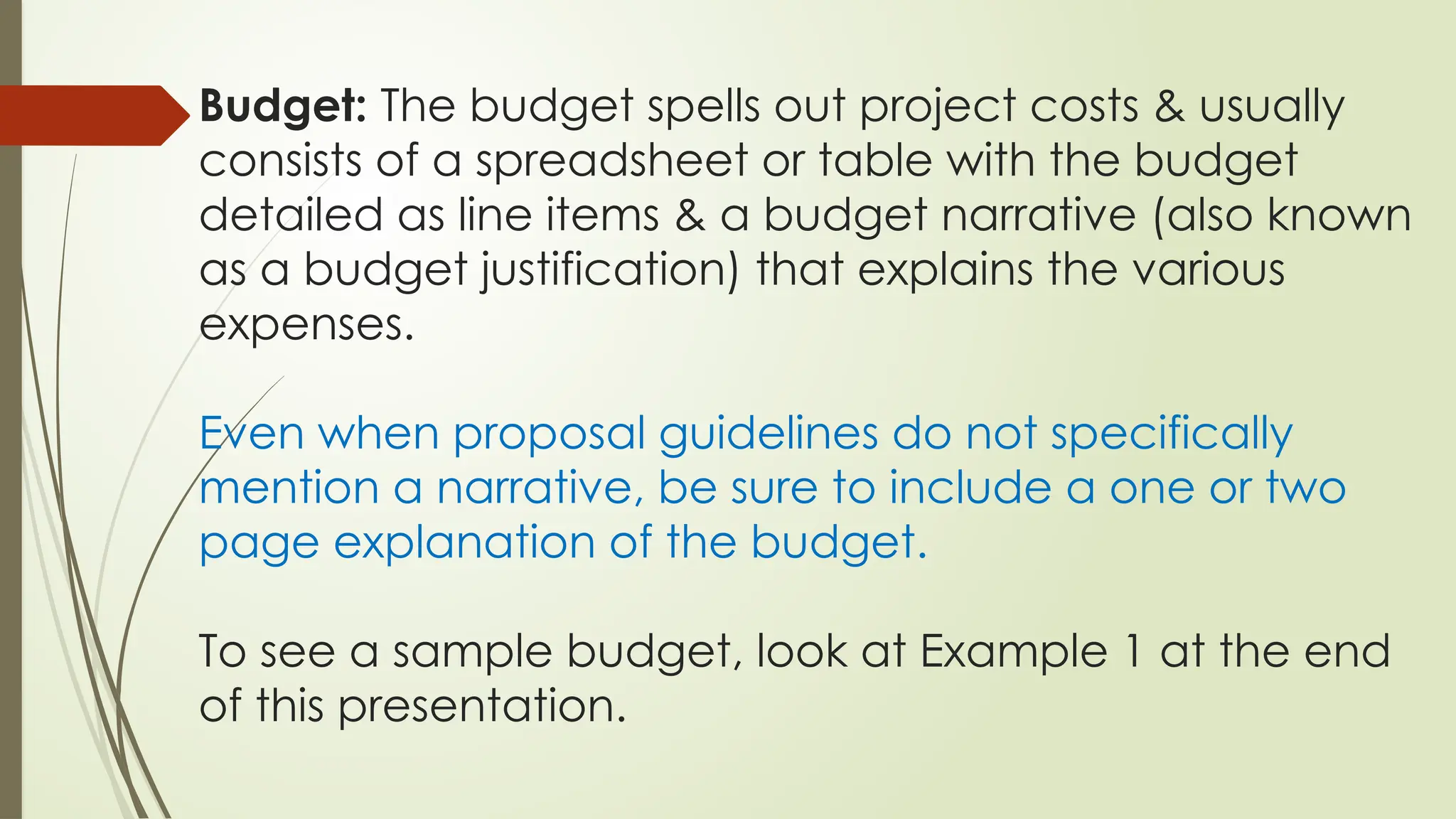
resubmit their proposals during the next funding cycle.
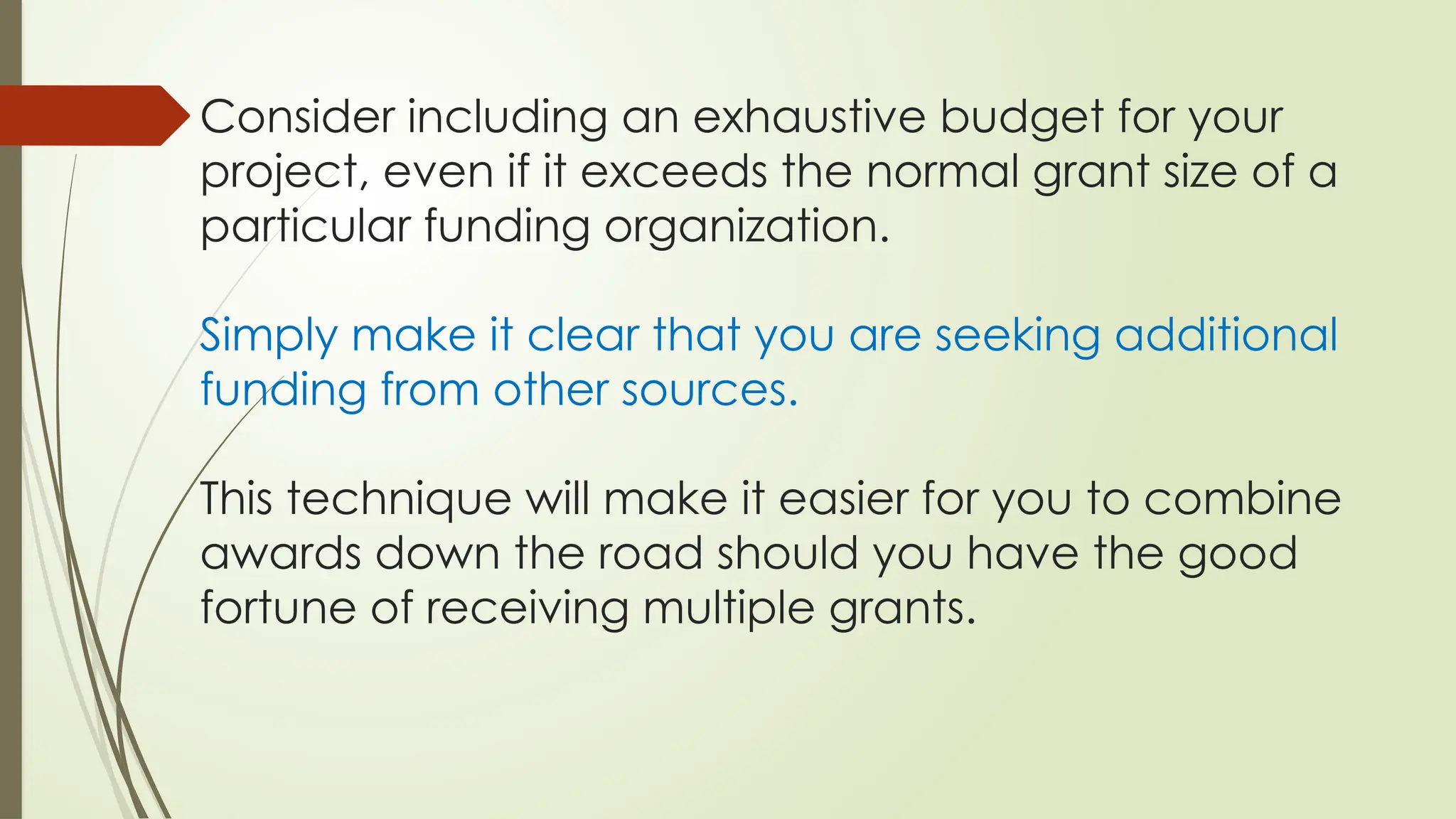
Successful grant applications & the resulting research
lead to ideas for further research & new grant
proposals.
Cultivating an ongoing, positive relationship with
funding agencies may lead to additional grants down
the road.
7.
Thus, make sureyou file progress reports and final
reports in a timely & professional manner.
Although some successful grant applicants may fear
that funding agencies will reject future proposals
because they’ve already received “enough” funding,
the truth is that money follows money.
Individuals or projects awarded grants in the past are
more competitive & thus more likely to receive
funding in the future.
8.
Some general tips
•Begin early.
• Apply early & often.
• Don’t forget to include a cover letter with your
application.
• Answer all questions. (Pre-empt all unstated questions.)
• If rejected, revise your proposal & apply again.
• Give them what they want. Follow the application
guidelines exactly.
9.
Some general tips
•Be explicit & specific.
• Be realistic in designing the project.
• Make explicit the connections between your research
questions & objectives, your objectives and methods,
your methods and results, & your results and
dissemination plan.
• Follow the application guidelines exactly I usually repeat
this tip because it is very, very important).
Identify your needsand focus
First, identify your needs. Answering the following
questions may help you:
• Are you undertaking preliminary or pilot research in
order to develop a full-blown research agenda?
• Are you seeking funding for dissertation research? Pre-
dissertation research? Postdoctoral research?
Archival research? Experimental research? Fieldwork?
• Are you seeking a stipend so that you can write a
dissertation or book? Polish a manuscript?
12.
Identify your needsand focus…
• Do you want a fellowship in residence at an institution
that will offer some programmatic support or other
resources to enhance your project?
• Do you want funding for a large research project that
will last for several years & involve multiple staff
members?
13.
Identify your needsand focus…
Next, think about the focus of your research/project.
Answering the following questions may help you
narrow it down:
• What is the topic? Why is this topic important?
• What are the research questions that you’re trying to
answer? What relevance do your research questions
have?
• What are your hypotheses?
• What are your research methods?
14.
Identify your needsand focus…
• Why is your research/project important? What is its
significance?
• Do you plan on using quantitative methods?
Qualitative methods? Both?
• Will you be undertaking experimental research? Or
non-experimental/social science research?
Once you have identified your needs & focus, you can
begin looking for prospective grants & funding
agencies.
15.
Finding prospective grants& funding
agencies
Whether your proposal receives funding will rely in
large part on whether your purpose & goals closely
match the priorities of granting agencies.
Locating possible grantors is a time consuming task,
but in the long run it will yield the greatest benefits.
Even if you have the most appealing research
proposal in the world, if you don’t send it to the right
institutions, then you’re unlikely to receive funding.
16.
Finding prospective grants& funding
agencies…
There are many sources of information about granting
agencies & grant programs.
Most universities & many schools within universities
have Offices of Research, whose primary purpose is to
support faculty & students in grant-seeking endeavors.
These offices usually have libraries or resource centers
to help people find prospective grants.
Audience
The majority ofgrant programs recruit academic
reviewers with knowledge of the disciplines and/or
program areas of the grant.
Thus, when writing your grant proposals, assume that
you are addressing a colleague who is knowledgeable
in the general area, but who does not necessarily
know the details about your research questions.
Remember that most readers are lazy & will not
respond well to a poorly organized, poorly written, or
confusing proposal.
19.
Audience…
Be sure togive readers what they want. Follow all the
guidelines for the particular grant you are applying for.
This may require you to reframe your project in a
different light or language.
Reframing your project to fit a specific grant’s
requirements is a legitimate & necessary part of the
process unless it will fundamentally change your
project’s goals or outcomes.
20.
Audience…
Final decisions aboutwhich proposals are funded
often come down to whether the proposal convinces
the reviewer that the research project is well planned
and feasible & whether the investigators are well
qualified to execute it.
Throughout the proposal, be as explicit as possible.
Predict the questions that the reviewer may have &
answer them.
21.
Audience…
Przeworski & Salomon(1995) note that reviewers read
with three questions in mind:
• What are we going to learn as a result of the
proposed project that we do not know now? (goals,
aims & outcomes).
• Why is it worth knowing? (significance).
• How will we know that the conclusions are valid?
(criteria for success).
22.
Audience…
Be sure toanswer those questions put forward by
Przeworski & Salomon (1995) in your proposal. Keep in
mind that the reviewer may not read every word of
your proposal.
He/she may only read the abstract, the sections on
research design & methodology, the vitae & the
budget.
Make these sections as clear & straight forward as
possible.
23.
Style
The way youwrite your grant will tell the reviewers a
lot about you.
From reading your proposal, the reviewers will form
an idea of who you are as a scholar, a researcher,
& a person.
They will decide whether you are creative, logical,
analytical, up-to-date in the relevant literature of
the field, &, most importantly, capable of executing
the proposed project.
24.
Style…
Allow your discipline& its conventions to determine
the general style of your writing, but allow your own
voice & personality to come through.
Be sure to clarify your project’s theoretical orientation.
25.
Develop a generalproposal & budget
Because most proposal writers seek funding from several
different agencies or granting programs, it is a good idea to
begin by developing a general grant proposal & budget.
This general proposal is sometimes called a “white paper.”
Your general proposal should explain your project to a
general academic audience.
Before you submit proposals to different grant programs,
you will tailor a specific proposal to their guidelines &
priorities.
26.
Organizing your proposal
Althougheach funding agency will have its own
(usually very specific) requirements, there are several
elements of a proposal that are fairly standard, & they
often come in the following order:
• Title page
• Abstract
• Introduction (statement of the problem, purpose of
research or goals, objectives, and significance of
research)
• Literature review
27.
Organizing your proposal…
•Project narrative (methods, procedures, outcomes or
deliverables, logframe, monitoring evaluation, &
dissemination plan etc)
• Environmental & Social Management Framework
Personnel
• Budget and budget justification
Format the proposal so that it is easy to read. Use headings
to break the proposal up into sections.
If the proposal is long, include a table of contents with
page numbers.
28.
Title page: Thetitle page usually includes a brief yet
explicit title for the research project, the names of the
principle investigator(s), the institutional affiliation of the
applicants (the department & institution), name &
address of the granting agency, project dates, amount
of funding requested, & signatures of personnel
authorizing the proposal (when necessary).
Most funding agencies have specific requirements for
the title page; make sure to follow them.
Project Title and Context: Briefly introduce the project's
title and the context in which it operates.
29.
Abstract: The abstractprovides readers with their first
impression of your project.
To remind themselves of your proposal, readers may
glance at your abstract when making their final
recommendations, so it may also serve as their last
impression of your project.
The abstract should explain the key elements of your
research project in the future tense.
30.
Most abstracts state:
(1)the general purpose,
(2) specific goals,
(3) research design,
(4) methods, &
(5) significance (contribution & rationale).
Be as explicit as possible in your abstract. Use
statements such as, “The objective of this study is to …”
31.
Introduction: The introductionshould cover the key
elements of your proposal, including a statement of the
problem, the purpose of research, research goals or
objectives, & significance of the research.
The statement of problem should provide a
background & rationale for the project and establish
the need & relevance of the research.
How is your project different from previous research on
the same topic?
Will you be using new methodologies or covering new
theoretical territory?
32.
The research goalsor objectives should identify the
anticipated outcomes of the research & should match
up to the needs identified in the statement of problem.
List only the principle goal(s) or objective(s) of your
research & save sub-objectives for the project
narrative.
State the overarching goal the project aims to
achieve.
33.
Literature review: Manyproposals require a literature
review.
Reviewers want to know whether you’ve done the
necessary preliminary research to undertake your
project.
Literature reviews should be selective and critical, not
exhaustive.
Reviewers want to see your evaluation of pertinent
works.
34.
Literature review: Manyproposals require a literature
review.
Reviewers want to know whether you’ve done the
necessary preliminary research to undertake your
project.
Literature reviews should be selective and critical, not
exhaustive.
Reviewers want to see your evaluation of pertinent
works.
35.
Project narrative (Researchplan/ methodology/
implementation Strategy/ procedures, activities, outputs,
outcomes, deliverables/outputs, logframe, monitoring &
evaluation, research risk management framework &
dissemination plan)
The project narrative provides the meat of your proposal
& may require several subsections.
The project narrative should supply all the details of the
project, including a detailed statement of problem,
detailed research objectives or goals, hypotheses,
methods, procedures, outcomes or deliverables, &
monitoring & evaluation, & dissemination of the research.
36.
For the projectnarrative, pre-empt and/or answer all
of the reviewers’ questions.
Don’t leave them wondering about anything.
For example, if you propose to conduct unstructured
interviews with open-ended questions, be sure you’ve
explained why this methodology is best suited to the
specific research questions in your proposal.
37.
Or, if you’reusing item response theory rather than
classical test theory to verify the validity of your survey
instrument, explain the advantages of this innovative
methodology.
Or, if you need to travel to University of Nairobi from
here in Uganda, to access historical archives at the the
University Museum, make it clear what documents you
hope to find and why they are relevant to your to
research.
38.
Clearly and explicitlystate the connections between
your research objectives, research questions,
hypotheses, methodologies, and outcomes.
As the requirements for a strong project narrative vary
widely by discipline, consult a discipline-specific guide
to grant writing for some additional advice.
39.
Implementation Strategy: Describethe project's
approach & methods for achieving the stated goals.
Activities: List the specific activities that will be
undertaken during the project.
Expected Outcomes: Outline the specific, measurable,
achievable, relevant, and time-bound (SMART)
outcomes expected from the project.
Deliverables/Outputs: List the tangible products or
results that will be produced during the project.
40.
Environmental & SocialManagement Framework
(ESMF): You have to describe whether your proposed
project will not will or will not have potential negative
environmental and social impacts.
If it does, then show how project will mitigate those
negative externalities to the environment and affected
communities.
41.
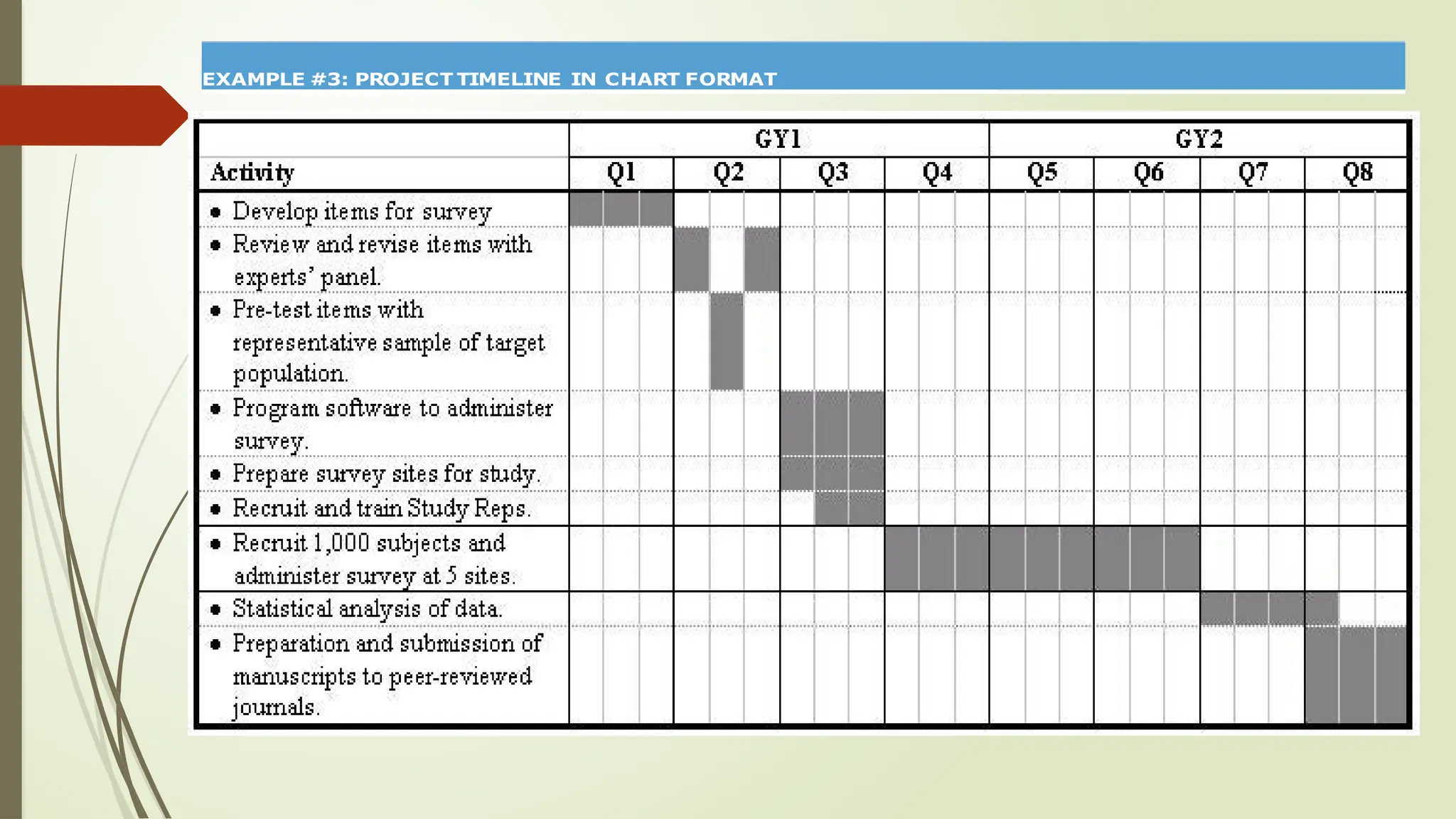
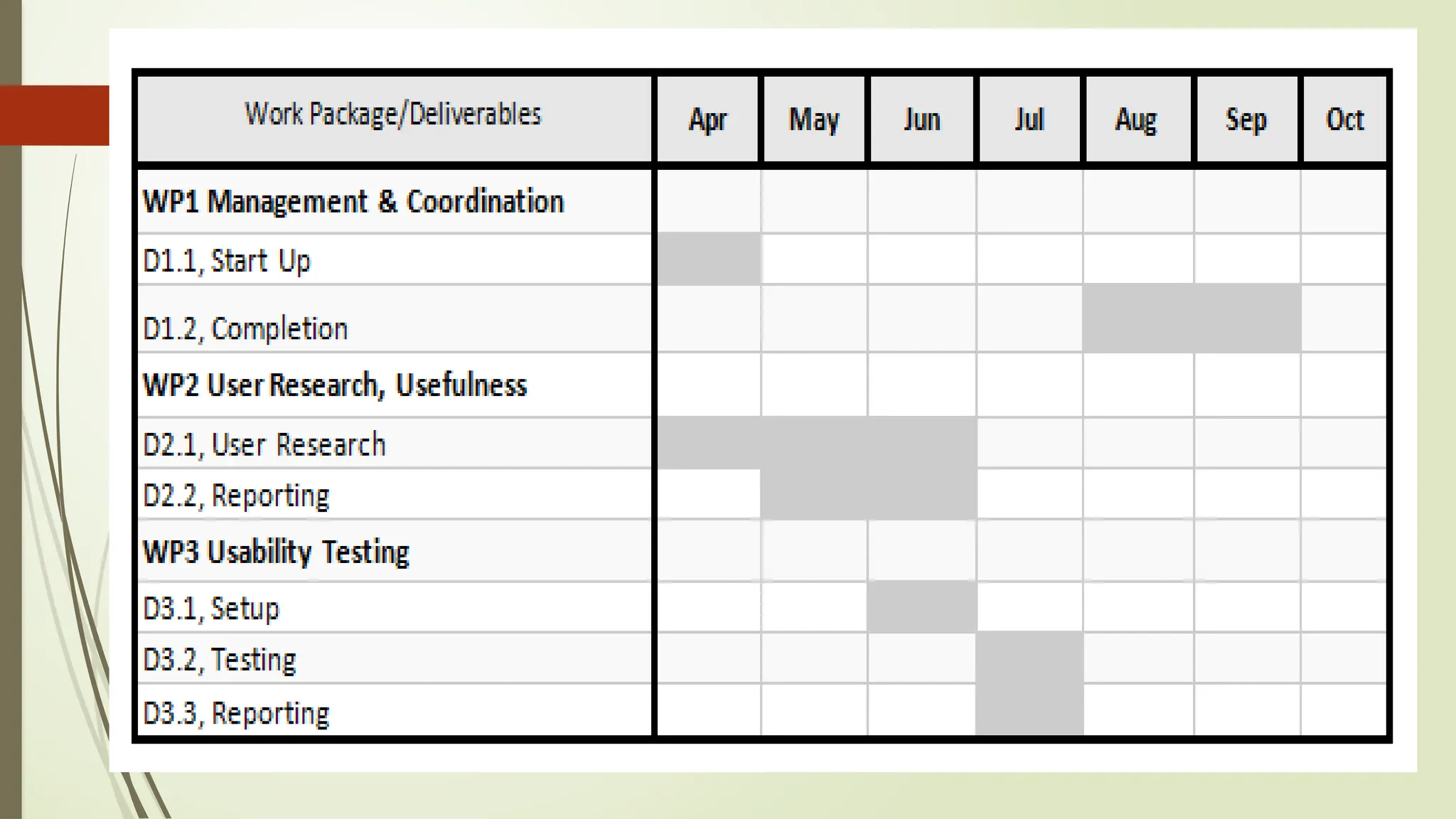
Workplan/Timeframe/Timeline: Explain thetimeframe
for the research project in some detail. This is a
schedule for the project's activities which outlines the
project's stages, tasks, and deadlines.
This plan helps ensure the project is completed on
time & within budget, and it's often a requirement for
funding or approval.
It should be realistic and flexible, allowing for
adjustments if needed. When will you begin &
complete each step? It may be helpful to reviewers if
you present a visual version of your timeline.
43.
Logframe: Is usedto visually represent the project's
logic, including objectives, activities, indicators, and
means of verification.
Key Components of a Logframe are:
Goal: The overarching, long-term objective the
research aims to achieve.
Purpose/Objectives: Specific, measurable, achievable,
relevant, and time-bound (SMART) outcomes that
contribute to the overall goal.
Outputs: The tangible products or services delivered by
the research activities.
44.
Activities: The specifictasks or actions needed to
achieve the outputs and ultimately the research
objectives.
Indicators: Measurable and verifiable ways to track
progress towards the outputs and objectives.
Means of Verification: The sources of evidence used to
demonstrate the achievement of the indicators.
Assumptions: The conditions or factors that are
assumed to be true for the research to be successful.
Risks: Potential challenges or setbacks that could
hinder the research's progress (optional here).
45.
Personnel/Team Competence andMulti-disciplinarity: A
strong research proposal addressing both personnel/team
competence & multi-disciplinarity should clearly articulate
the need for a diverse team, explain the specific skills &
expertise each member brings, & demonstrate how their
combined knowledge will address the research questions.
Example- This research project requires a multidisciplinary
approach to fully address the complex challenges of
[research area]. Our team includes [List of team members]
representing [List of disciplines]. Dr. [Name], a [Discipline],
will contribute expertise in [Specific skills]. Ms. [Name], a
[Discipline], will bring their knowledge of [Specific skills].
46.
Mr. [Name], a[Discipline], will provide crucial expertise in
[Specific skills]. By combining these diverse perspectives
and methodologies, we will be able to [Explain how the
multidisciplinary approach will lead to novel insights].
The team will regularly meet to share data, discuss
findings, and ensure seamless integration of our work. We
are committed to fostering a collaborative environment
where all team members can contribute their expertise
& learn from each other, ultimately leading to a more
comprehensive and impactful research outcome.
47.
Monitoring and Evaluation(M&E): Explain the purpose
of M&E within the project. Identify key indicators for
tracking progress toward project objectives. Describe
how M&E data will be collected & analyzed. Outline
how progress will be reported to stakeholders.
Risk Management Framework: Integrated into
research proposals to identify, analyze, & mitigate
potential risks that could affect the research's
objectives, timeline, & outcomes. This framework helps
ensure the successful completion of the research by
addressing uncertainties & minimizing potential
setbacks.
48.
Monitoring and Evaluation(M&E): Explain the purpose
of M&E within the project. Identify key indicators for
tracking progress toward project objectives. Describe
how M&E data will be collected & analyzed. Outline
how progress will be reported to stakeholders.
Dissemination Plan: Identify the audiences for project
results and lessons learned. Describe how project
results will be shared, including reports, presentations,
workshops, or publications. Outline the plan for
communicating project findings to stakeholders.
49.
Budget: The budgetspells out project costs & usually
consists of a spreadsheet or table with the budget
detailed as line items & a budget narrative (also known
as a budget justification) that explains the various
expenses.
Even when proposal guidelines do not specifically
mention a narrative, be sure to include a one or two
page explanation of the budget.
To see a sample budget, look at Example 1 at the end
of this presentation.
50.
Consider including anexhaustive budget for your
project, even if it exceeds the normal grant size of a
particular funding organization.
Simply make it clear that you are seeking additional
funding from other sources.
This technique will make it easier for you to combine
awards down the road should you have the good
fortune of receiving multiple grants.
51.
Make sure thatall budget items meet the funding
agency’s requirements.
For example, all U.S. government agencies have strict
requirements for airline travel. Be sure the cost of the
airline travel in your budget meets their requirements.
If a line item falls outside an agency’s requirements
(e.g. some organizations will not cover equipment
purchases or other capital expenses), explain in the
budget justification that other grant sources will pay for
the item.
52.
Many universities &other research institutions require
that indirect costs (overhead) be added to grants that
they administer.
Check with the appropriate offices to find out what
the standard (or required) rates are for overhead.
Pass a draft budget by the university/research
institutions’ officer in charge of grant administration for
assistance with indirect costs & costs not directly
associated with research (e.g. facilities use charges).
53.
REVISING YOUR PROPOSAL
Stronggrant proposals take a long time to develop.
Start the process early & leave time to get feedback
from several readers on different drafts.
Seek out a variety of readers, both specialists in your
research area & non-specialist colleagues.
You may also want to request assistance from
knowledgeable readers on specific areas of your
proposal.
54.
REVISING YOUR PROPOSAL…
Forexample, you may want to schedule a meeting
with a statistician to help revise your methodology
section.
Don’t hesitate to seek out specialized assistance from
the relevant research offices on your campus.
In your revision & editing, ask your readers to give
careful consideration to whether you’ve made explicit
the connections between your research objectives &
methodology.
55.
REVISING YOUR PROPOSAL…
•Have you presented a compelling case?
• Have you made your hypotheses explicit?
• Does your project seem feasible? Is it overly
ambitious? Does it have other weaknesses?
• Have you stated the means that grantors can use to
evaluate the success of your project after you’ve
executed it?
If a granting agency lists particular criteria used for
rating & evaluating proposals, be sure to share these
with your own reviewers.
56.
SOME CLOSING ADVICE
Someof us may feel ashamed or embarrassed about
asking for money or promoting ourselves.
Often, these feelings have more to do with our own
insecurities than with problems in the tone or style of our
writing.
If you’re having trouble because of these types of hang-
ups, the most important thing to keep in mind is that it
never hurts to ask.
If you never ask for the money, they’ll never give you the
money. Besides, the worst thing they can do is say no.
57.
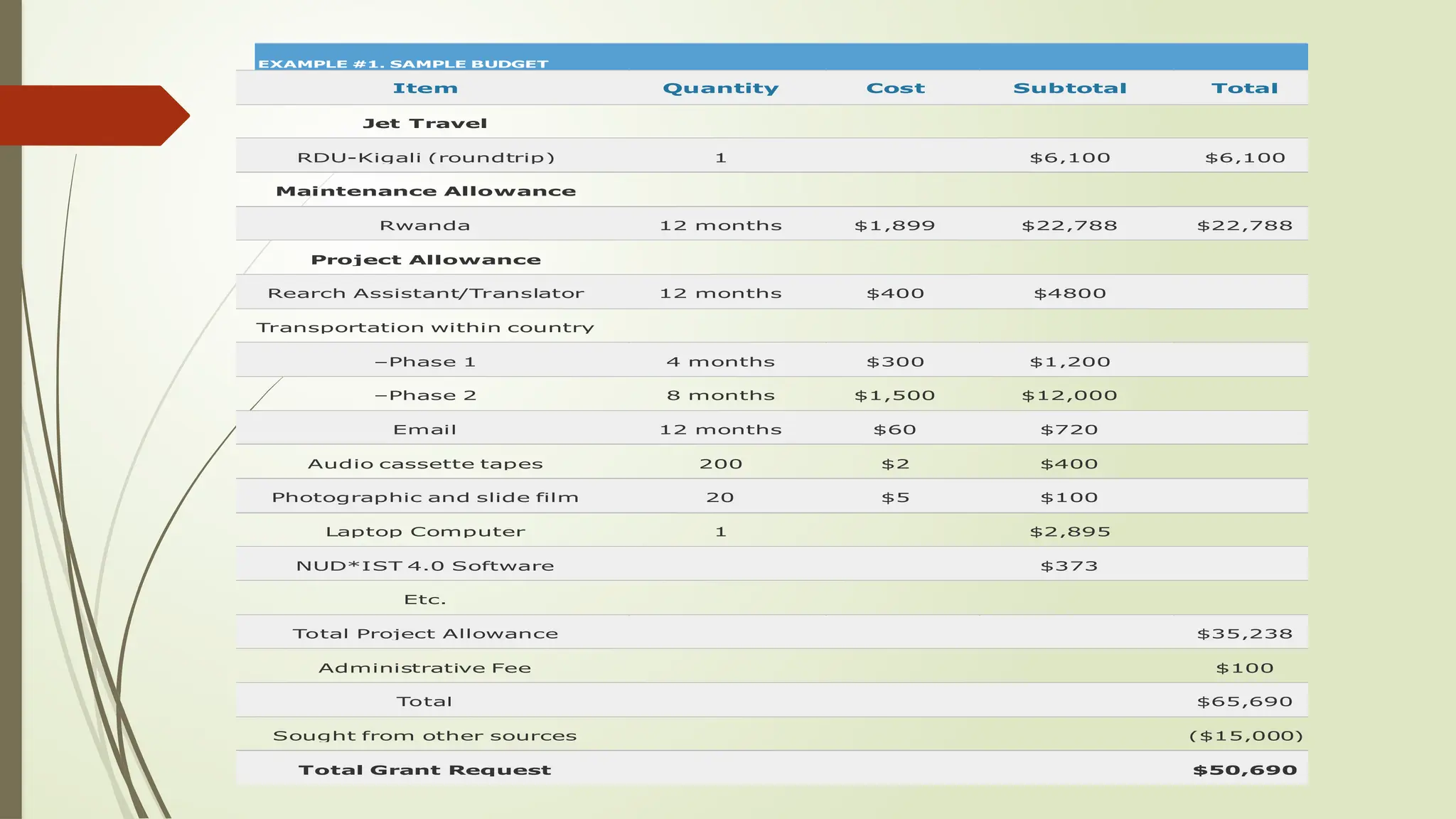
EXAMPLE #1. SAMPLEBUDGET
Item Quantity Cost Subtotal Total
Jet Travel
RDU-Kigali (roundtrip) 1 $6,100 $6,100
Maintenance Allowance
Rwanda 12 months $1,899 $22,788 $22,788
Project Allowance
Rearch Assistant/Translator 12 months $400 $4800
Transportation within country
–Phase 1 4 months $300 $1,200
–Phase 2 8 months $1,500 $12,000
Email 12 months $60 $720
Audio cassette tapes 200 $2 $400
Photographic and slide film 20 $5 $100
Laptop Computer 1 $2,895
NUD*IST 4.0 Software $373
Etc.
Total Project Allowance $35,238
Administrative Fee $100
Total $65,690
Sought from other sources ($15,000)
Total Grant Request $50,690
58.
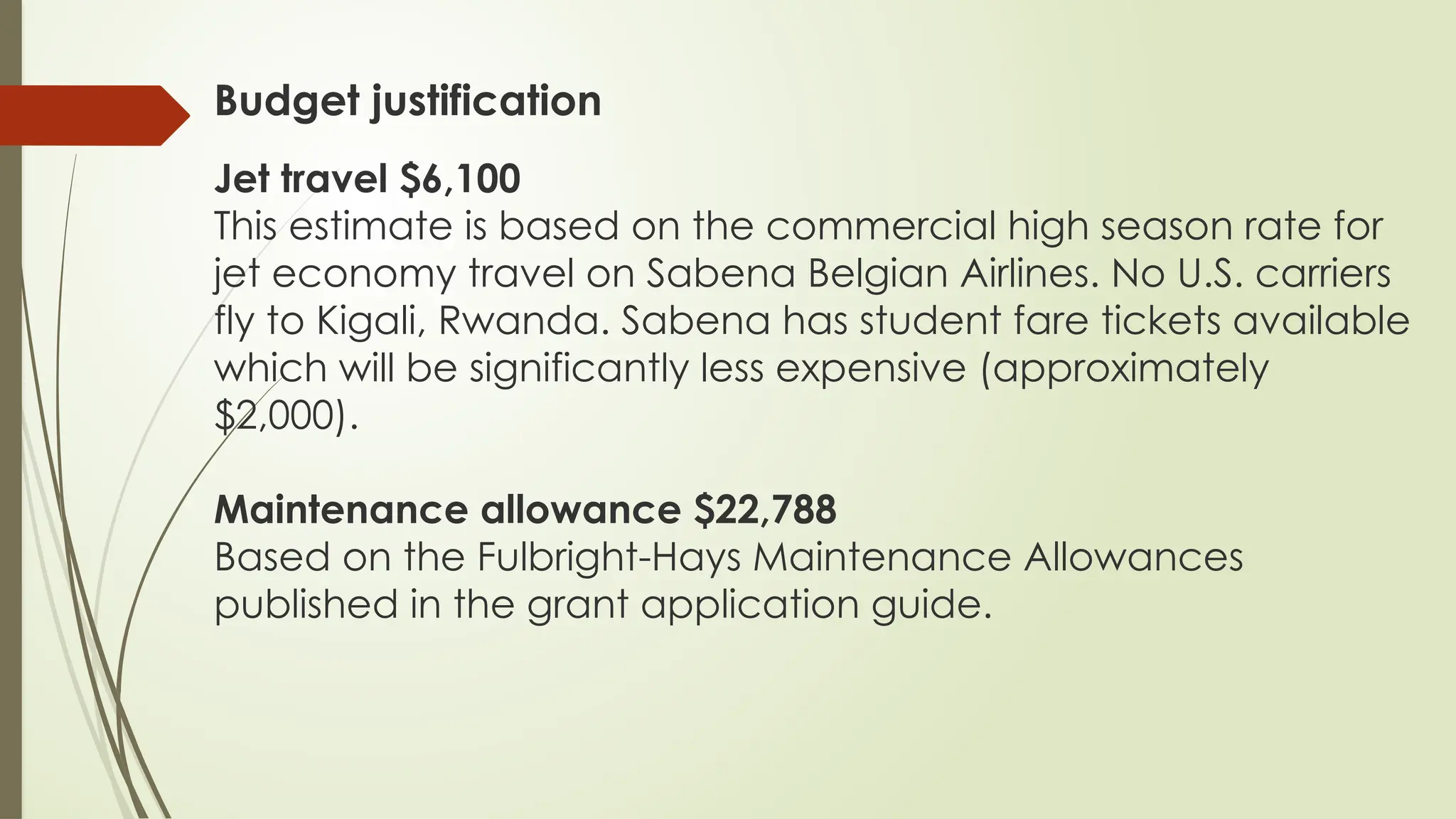
Budget justification
Jet travel$6,100
This estimate is based on the commercial high season rate for
jet economy travel on Sabena Belgian Airlines. No U.S. carriers
fly to Kigali, Rwanda. Sabena has student fare tickets available
which will be significantly less expensive (approximately
$2,000).
Maintenance allowance $22,788
Based on the Fulbright-Hays Maintenance Allowances
published in the grant application guide.
59.
Budget justification…
Research assistant/translator$4,800
The research assistant/translator will be a native (and primary)
speaker of Kinya-rwanda with at least a four-year university
degree. They will accompany the primary investigator during life
history interviews to provide assistance in comprehension. In
addition, they will provide commentary, explanations, and
observations to facilitate the primary investigator’s participant
observation. During the first phase of the project in Kigali, the
research assistant will work forty hours a week and occasional
overtime as needed. During phases two and three in rural
Rwanda, the assistant will stay with the investigator overnight in
the field when necessary. The salary of $400 per month is based on
the average pay rate for individuals with similar qualifications
working for international NGO’s in Rwanda.
60.
Budget justification…
Transportation withincountry, phase one $1,200
The primary investigator and research assistant will need regular
transportation within Kigali by bus and taxi. The average taxi fare in
Kigali is $6-8 and bus fare is $.15. This figure is based on an average of
$10 per day in transportation costs during the first project phase.
Transportation within country, phases two and three $12,000
Project personnel will also require regular transportation between
rural field sites. If it is not possible to remain overnight, daily trips will be
necessary. The average rental rate for a 4×4 vehicle in Rwanda is
$130 per day. This estimate is based on an average of $50 per day in
transportation costs for the second and third project phases. These
costs could be reduced if an arrangement could be made with
either a government ministry or international aid agency for
transportation assistance.
61.
Budget justification…
Email $720
Therate for email service from RwandaTel (the only service provider
in Rwanda) is $60 per month. Email access is vital for receiving news
reports on Rwanda and the region as well as for staying in contact
with dissertation committee members and advisors in the United
States.
Audiocassette tapes $400
Audiocassette tapes will be necessary for recording life history
interviews, musical performances, community events, story telling,
and other pertinent data.
Photographic & slide film $100
Photographic and slide film will be necessary to document visual
data such as landscape, environment, marriages, funerals,
community events, etc.
62.
Budget justification…
Laptop computer$2,895
A laptop computer will be necessary for recording observations,
thoughts, and analysis during research project. Price listed is a
special offer to UNC students through the Carolina Computing
Initiative.
NUD*IST 4.0 software $373.00
NUD*IST, “Nonnumerical, Unstructured Data, Indexing, Searching,
and Theorizing,” is necessary for cataloging, indexing, and
managing field notes both during and following the field research
phase. The program will assist in cataloging themes that emerge
during the life history interviews.
Administrative fee $100
Fee set by Fulbright-Hays for the sponsoring institution.
Useful Phrases: Establishinga Proposal
Territory (Step 1)
Begin with some standard phrases which you may learn and
use in your writing.
Note that they use evaluative language that emphasizes the
interesting, important, or novel character of the research area.
Below is a list of the most widespread phrases:
• A central issue in ... is ...
• It is now generally accepted/recognized that ...
65.
Useful Phrases: Establishinga Proposal
Territory (Step 1) …
• In recent years, researchers have become increasingly interested
in ...
• Recently, there has been an increase of interest in ...
• Many recent studies have focused on ...
• Recently, a great deal of emphasis has been placed on ...
• One of the most important/promising aspects/tasks of ... is ...
• One of the characteristic/important features of... is ...
66.
Useful Phrases: Establishinga Proposal
Territory (Step 1) …
• Over the last decade, research on ... has increasingly
demonstrated that ...
• The development of... has led to ...
• The relationship between ... has been investigated/explored by
many researchers.
• The close relationship between ... has become well established,
supported, in particular, by ...
• The ... has been extensively studied in recent years.
67.
Useful Phrases: Establishinga Niche
(Step 2)
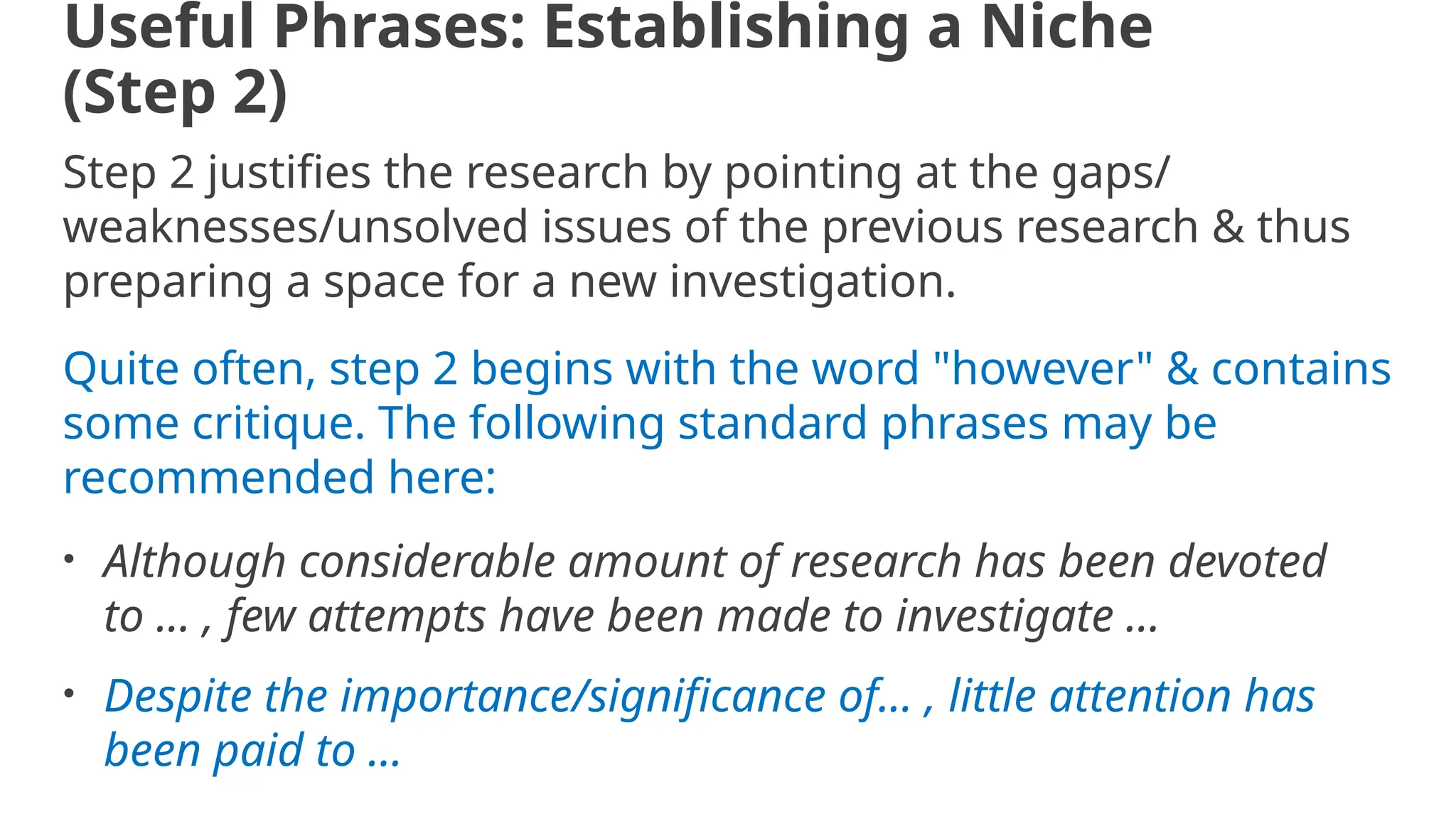
Step 2 justifies the research by pointing at the gaps/
weaknesses/unsolved issues of the previous research & thus
preparing a space for a new investigation.
Quite often, step 2 begins with the word "however" & contains
some critique. The following standard phrases may be
recommended here:
• Although considerable amount of research has been devoted
to ... , few attempts have been made to investigate ...
• Despite the importance/significance of... , little attention has
been paid to ...
68.
Useful Phrases: Establishinga Niche (Step 2)
…
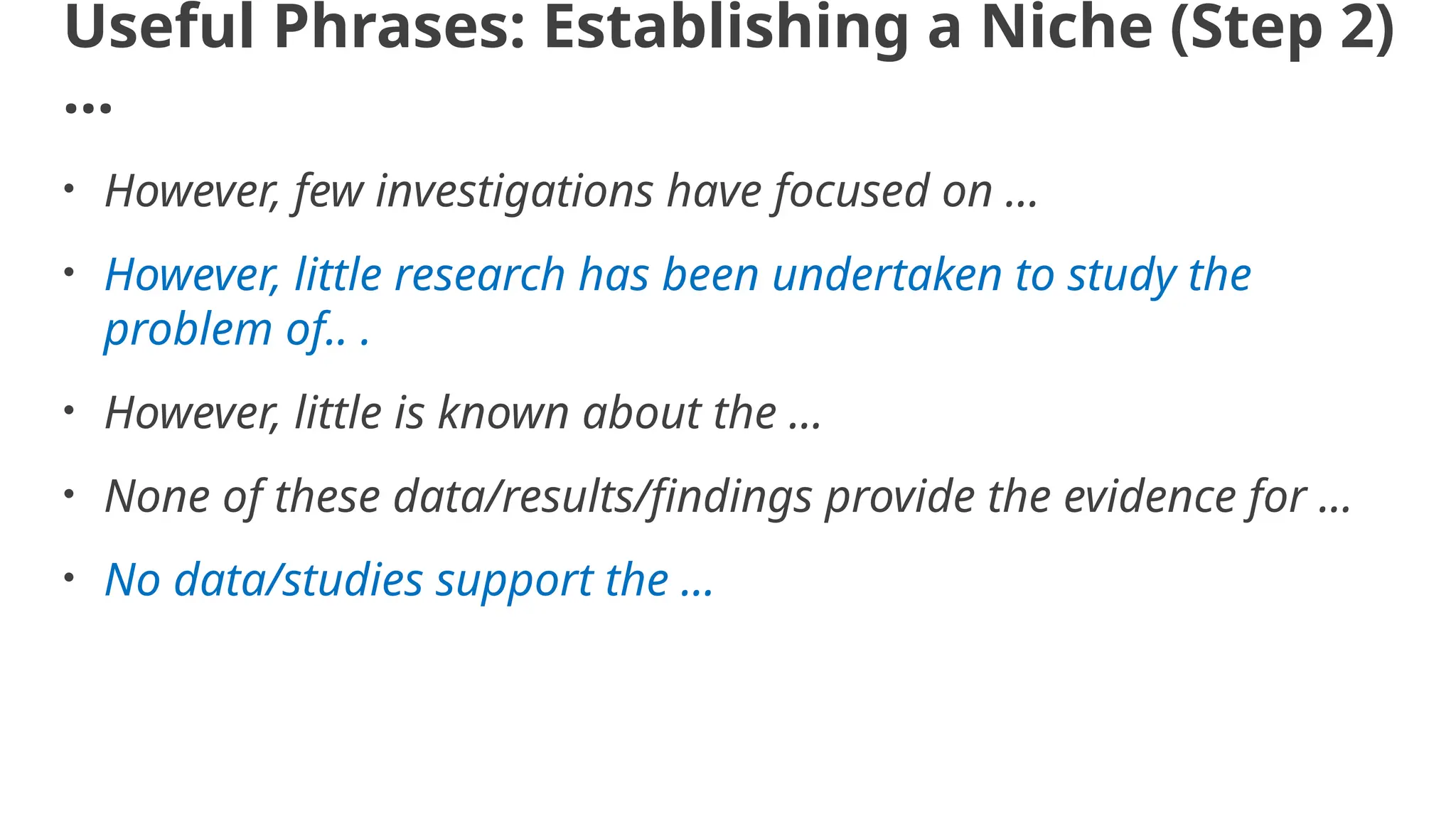
• However, few investigations have focused on ...
• However, little research has been undertaken to study the
problem of.. .
• However, little is known about the ...
• None of these data/results/findings provide the evidence for ...
• No data/studies support the ...
69.
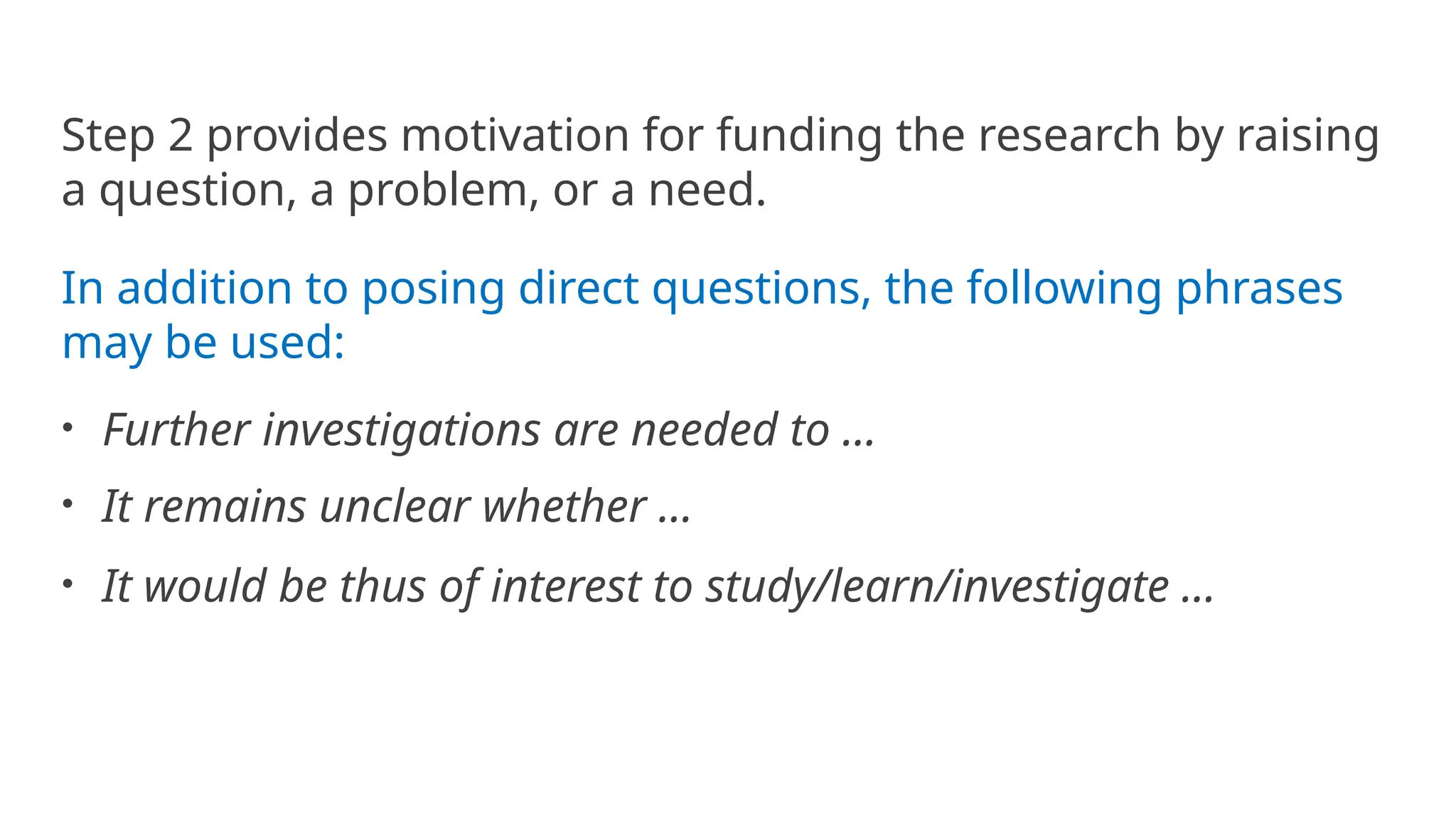
Step 2 providesmotivation for funding the research by raising
a question, a problem, or a need.
In addition to posing direct questions, the following phrases
may be used:
• Further investigations are needed to ...
• It remains unclear whether ...
• It would be thus of interest to study/learn/investigate ...
70.
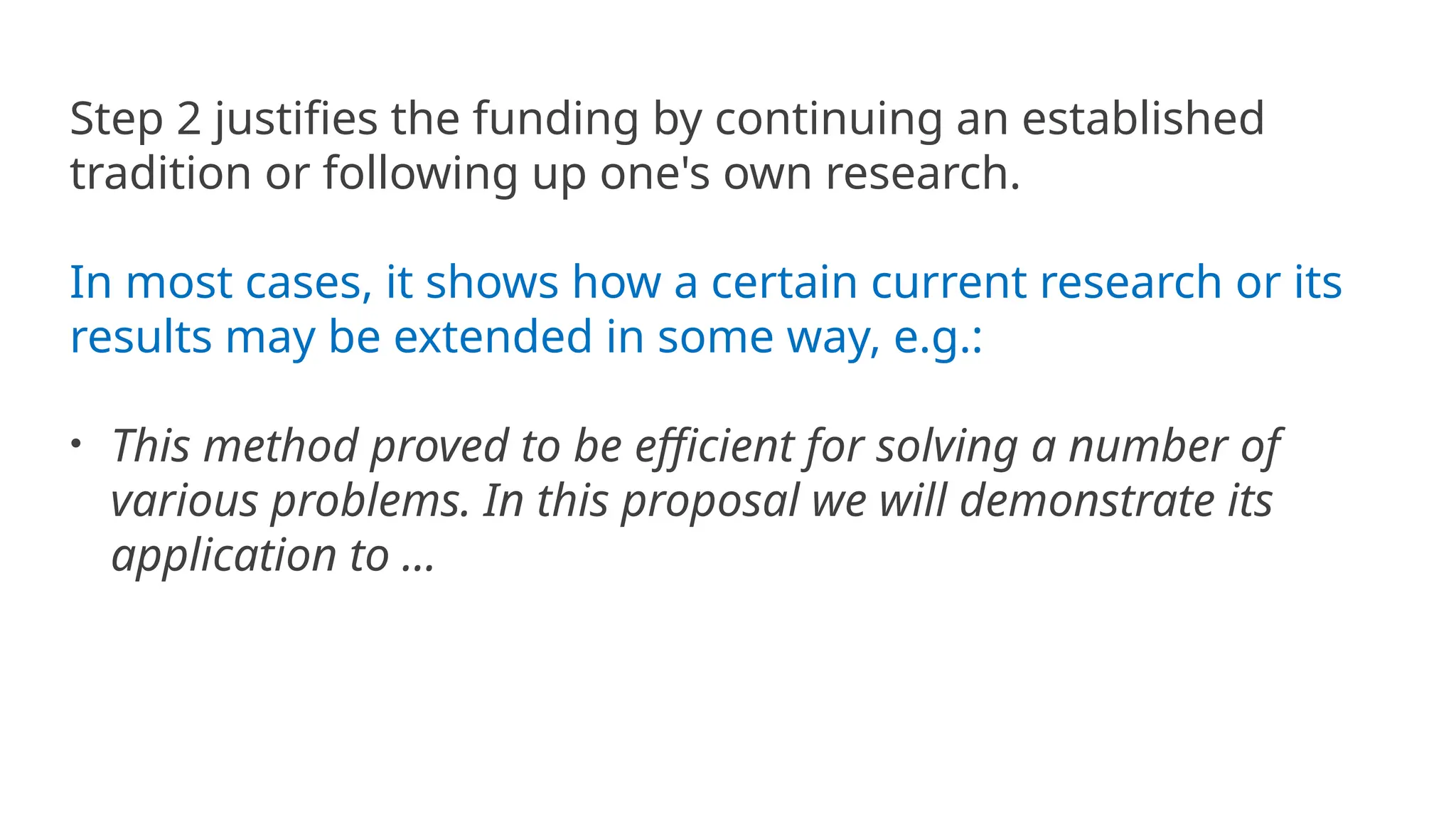
Step 2 justifiesthe funding by continuing an established
tradition or following up one's own research.
In most cases, it shows how a certain current research or its
results may be extended in some way, e.g.:
• This method proved to be efficient for solving a number of
various problems. In this proposal we will demonstrate its
application to …
71.
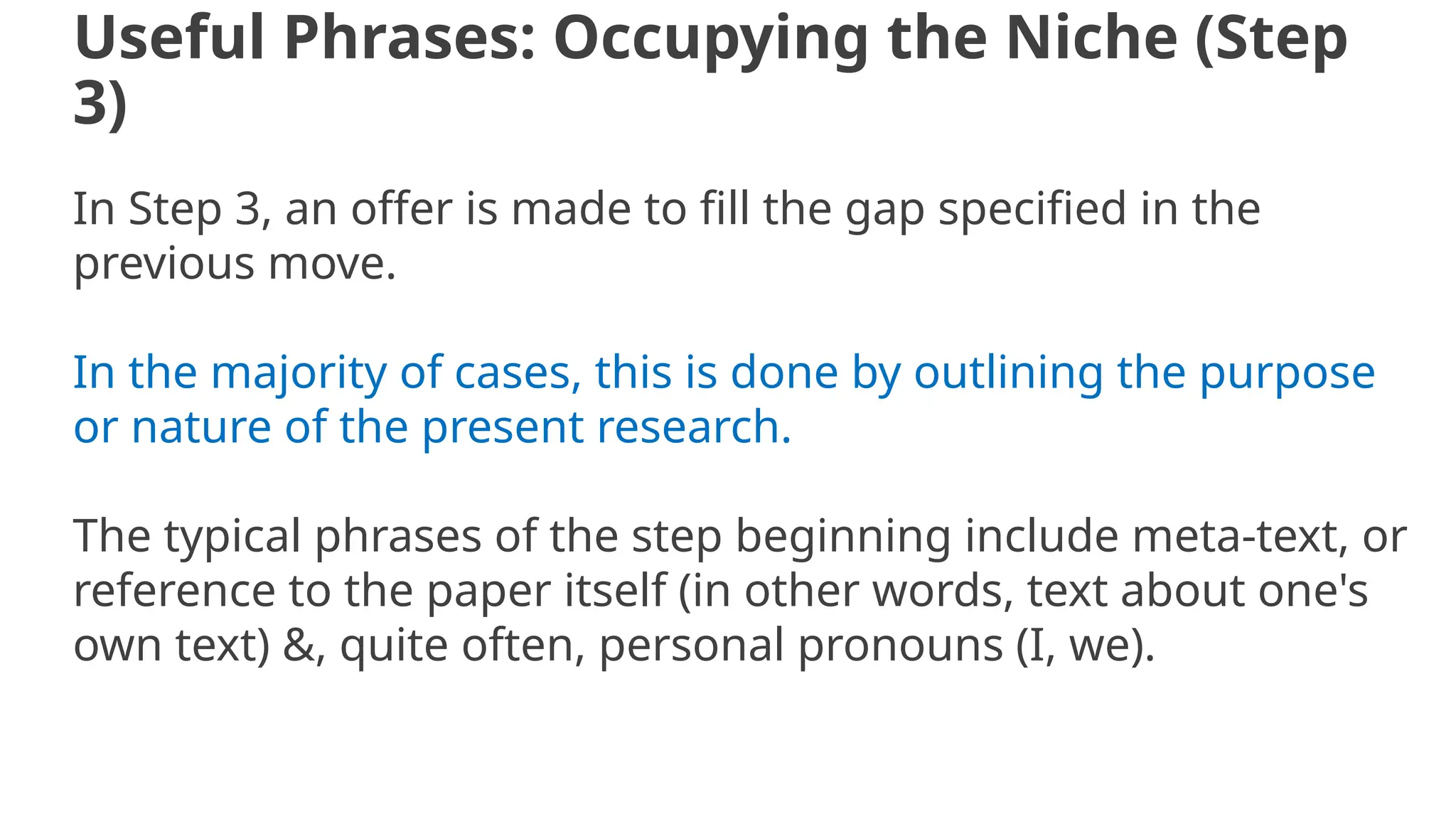
Useful Phrases: Occupyingthe Niche (Step
3)
In Step 3, an offer is made to fill the gap specified in the
previous move.
In the majority of cases, this is done by outlining the purpose
or nature of the present research.
The typical phrases of the step beginning include meta-text, or
reference to the paper itself (in other words, text about one's
own text) &, quite often, personal pronouns (I, we).
72.
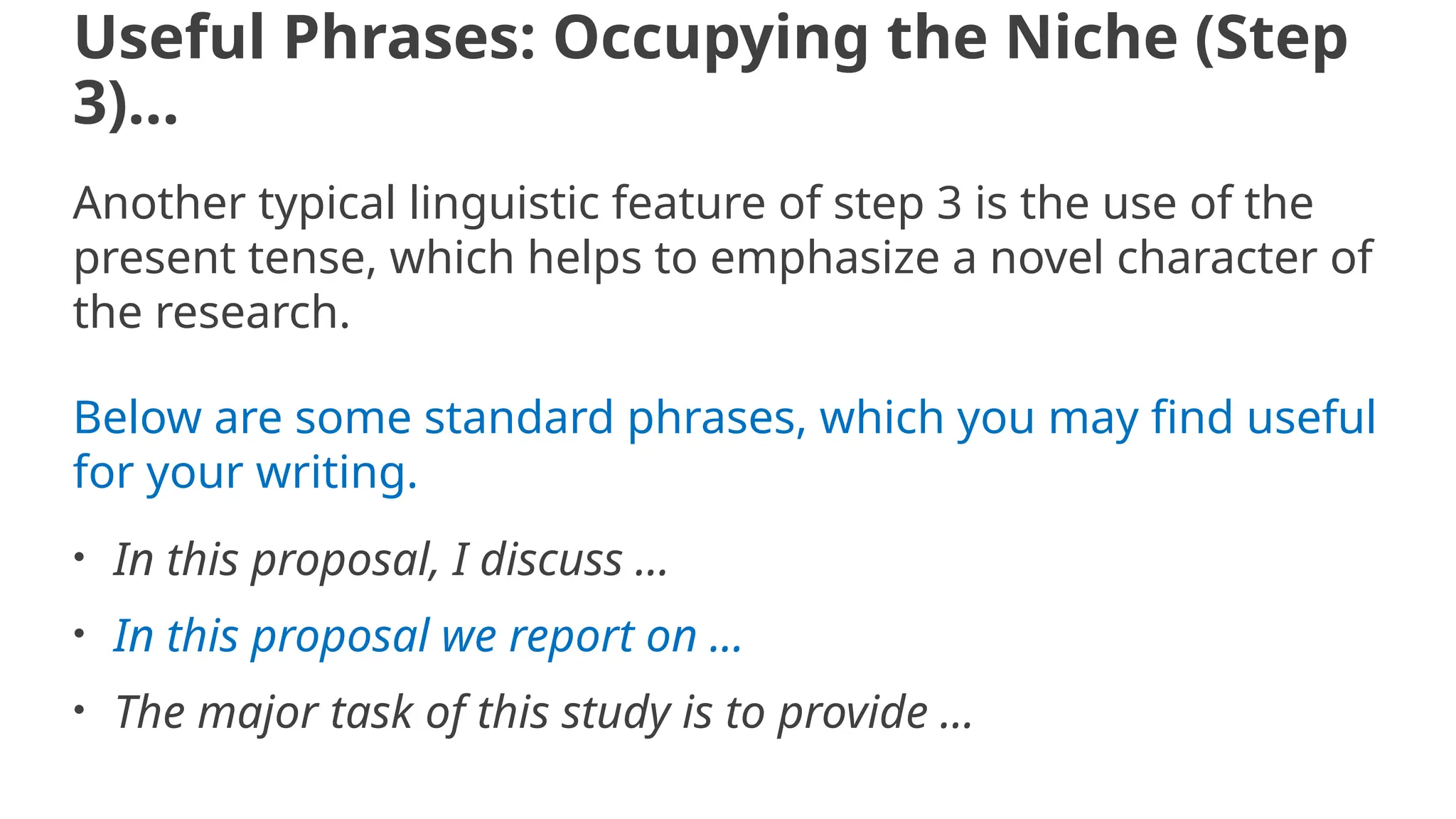
Useful Phrases: Occupyingthe Niche (Step
3)…
Another typical linguistic feature of step 3 is the use of the
present tense, which helps to emphasize a novel character of
the research.
Below are some standard phrases, which you may find useful
for your writing.
• In this proposal, I discuss ...
• In this proposal we report on ...
• The major task of this study is to provide ...
73.
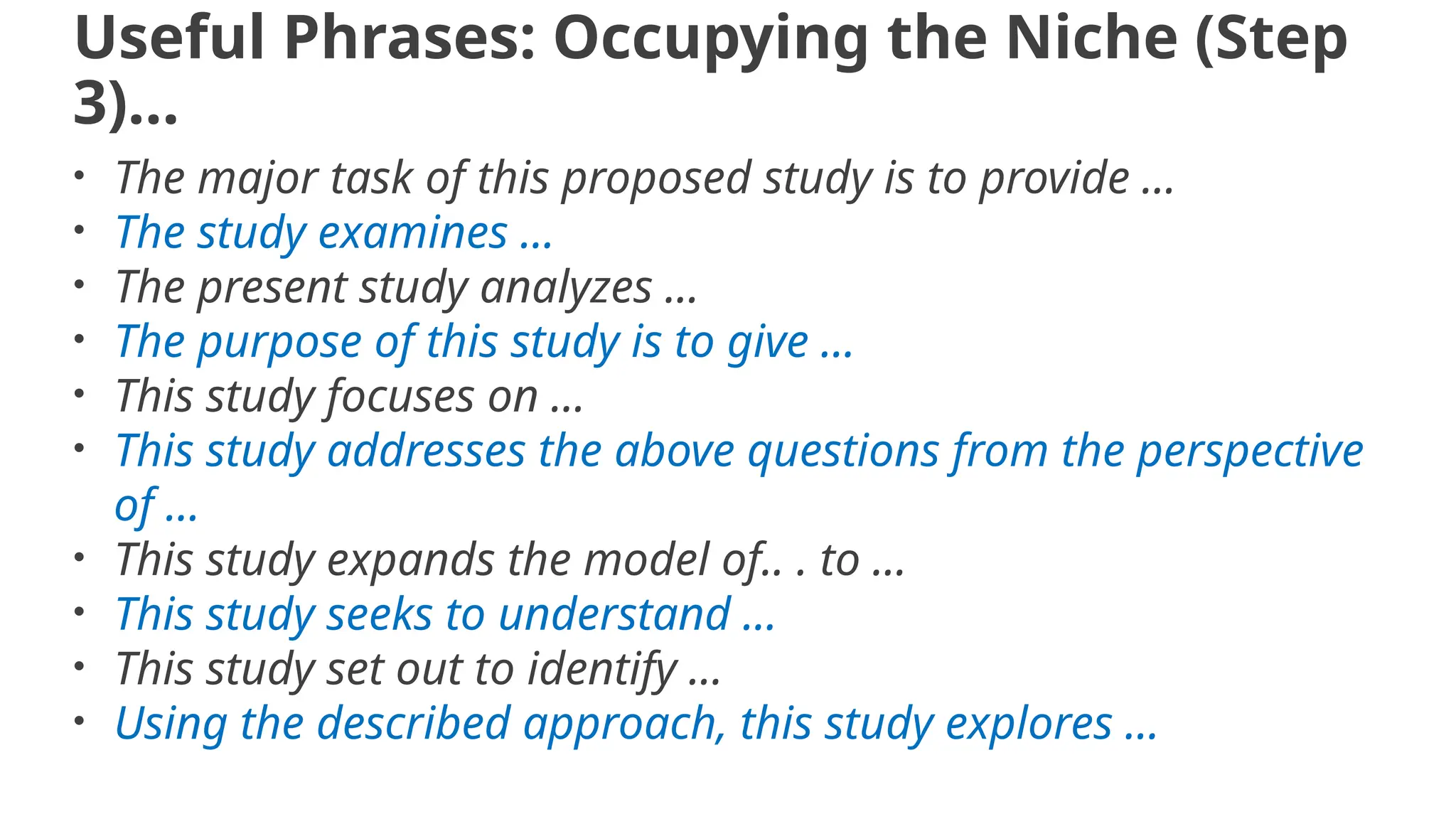
Useful Phrases: Occupyingthe Niche (Step
3)…
• The major task of this proposed study is to provide ...
• The study examines ...
• The present study analyzes ...
• The purpose of this study is to give ...
• This study focuses on ...
• This study addresses the above questions from the perspective
of ...
• This study expands the model of.. . to ...
• This study seeks to understand ...
• This study set out to identify ...
• Using the described approach, this study explores ...



![Personnel/Team Competence and Multi-disciplinarity: A
strong research proposal addressing both personnel/team
competence & multi-disciplinarity should clearly articulate
the need for a diverse team, explain the specific skills &
expertise each member brings, & demonstrate how their
combined knowledge will address the research questions.
Example- This research project requires a multidisciplinary
approach to fully address the complex challenges of
[research area]. Our team includes [List of team members]
representing [List of disciplines]. Dr. [Name], a [Discipline],
will contribute expertise in [Specific skills]. Ms. [Name], a
[Discipline], will bring their knowledge of [Specific skills].](https://image.slidesharecdn.com/scientificwritinglecture3-researchgrantproposal-250515210944-e5fc758c/75/Scientific-Writing-Lecture-3-Research-Grant-Proposal-ppt-45-2048.jpg)
![Mr. [Name], a [Discipline], will provide crucial expertise in
[Specific skills]. By combining these diverse perspectives
and methodologies, we will be able to [Explain how the
multidisciplinary approach will lead to novel insights].
The team will regularly meet to share data, discuss
findings, and ensure seamless integration of our work. We
are committed to fostering a collaborative environment
where all team members can contribute their expertise
& learn from each other, ultimately leading to a more
comprehensive and impactful research outcome.](https://image.slidesharecdn.com/scientificwritinglecture3-researchgrantproposal-250515210944-e5fc758c/75/Scientific-Writing-Lecture-3-Research-Grant-Proposal-ppt-46-2048.jpg)