Scaffolding Reading and WritingAcross the Curriculum
Some starting points:We are often misled when we hear students speak in everyday conversation.
When conversing informally they use a very different type of English than they need for academic purposes.
We cannot assume that students have the knowledge, skills, and strategies needed to read or write in English for a particular academic situation.
We need to explicitly model and teach the academic English that IB tasks require.
If we explicitly address the academic and linguistic demands that IB tasks demand of our students, everyone should benefit.
The “But I have a syllabus to cover!” argumentIn their oral interactions, our students generally use English fluently, confidently, but not accurately.
The textbooks and other materials we use give the students exposure to well-written English, appropriate to a particular type of situation/audience/culture.
In their books and other reading materials students have the opportunity to develop their language skills as well as their subject knowledge, but we need to guide them, or, in the rush to acquire subject knowledge, they miss the chance to enhance their understanding of how the language is used.
The “but as long as they can communicate...isn’t that enough?” argument
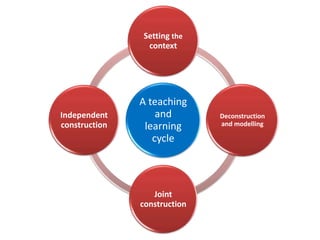
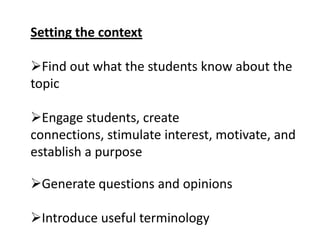
Setting the contextFind out what the students know about the topic
Engage students, create connections, stimulate interest, motivate, and establish a purpose
Generate questions and opinions
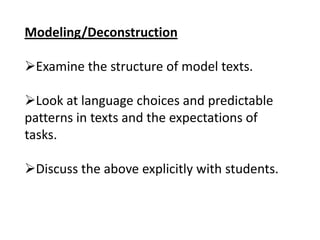
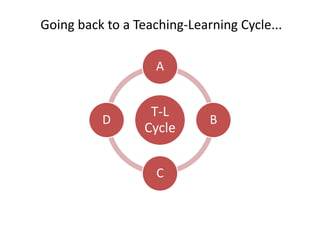
Introduce useful terminologyModeling/DeconstructionExamine the structure of model texts.
Look at language choices and predictable patterns in texts and the expectations of tasks.
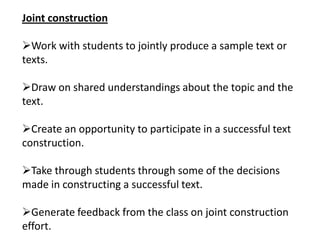
Discuss the above explicitly with students.Joint constructionWork with students to jointly produce a sample text or texts.
Draw on shared understandings about the topic and the text.
Create an opportunity to participate in a successful text construction.
Take through students through some of the decisions made in constructing a successful text.
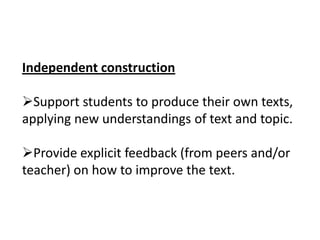
Generate feedback from the class on joint construction effort.Independent constructionSupport students to produce their own texts, applying new understandings of text and topic.Provide explicit feedback (from peers and/or teacher) on how to improve the text.Language can be challenging on account of...variety
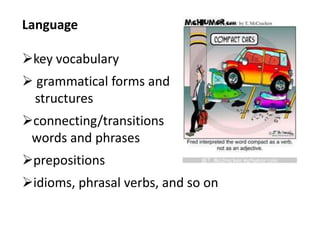
idioms
humour
pronunciation
grammatical structures
sentence length
pronoun references
transition words/phrases
familiar words used in an unfamiliar way
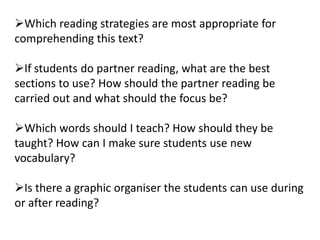
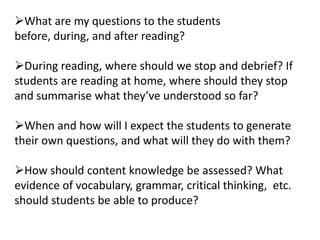
abstract nounsHow can we scaffold  the reading experience for our students?
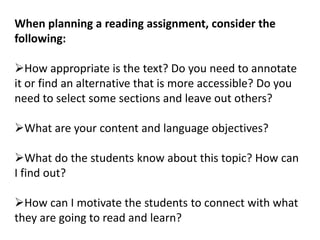
 What do the students need to understand in order to successfully engage with a text?
 PurposeWhy was this written? To explain? Persuade? Argue? Instruct? Describe?
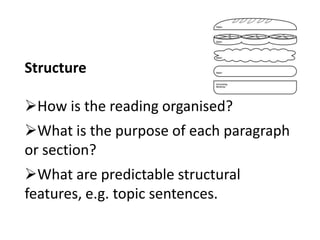
Why are the students being asked to read it? What will they be expected to do with it?Structure How is the reading organised?

Scaffolding workshop notes from 18/8/11