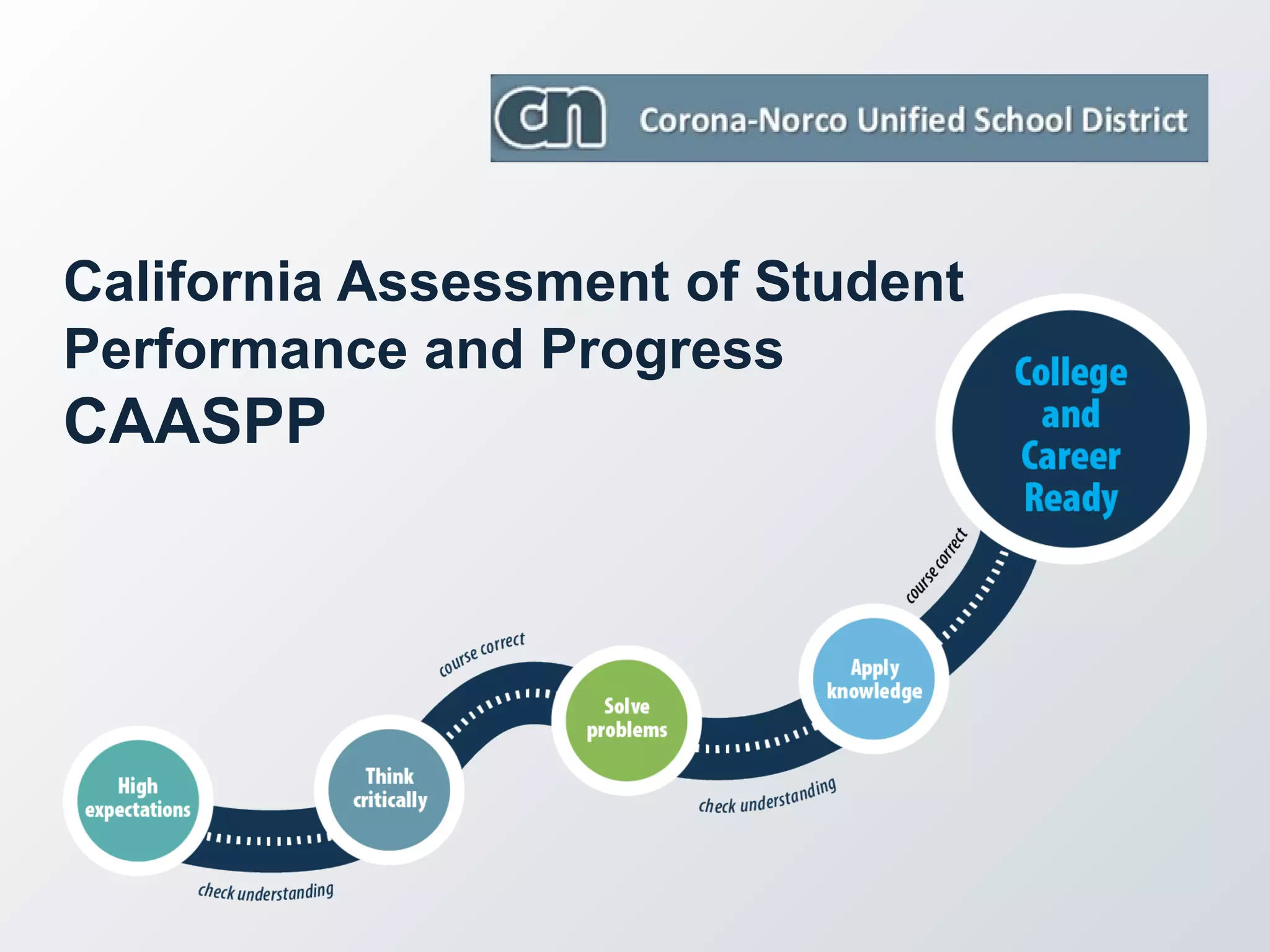
California Assessment of Student
Performance and Progress
CAASPP
We are Preparing for a New Future
• Our students will live and work in the world of
tomorrow
• We have updated our curriculum to match
the demands students will face in college and
careers
• Tomorrow’s need? Workers who are:
• Adaptable
• Can apply knowledge to unpredictable problems
• Can find information, assess its value and integrate
it to arrive at creative solutions
We have built up to this moment
• Implementation of the new approach has
been a process
• Teachers have been learning new
instructional practices
• The curriculum has been aligned to the
CCSS
• Now the annual test will give us a measure
of our progress in CCSS
The Assessment is like your child’s regular
check-up with the pediatrician
• Provides a consistent check on progress - Is
the student meeting expected milestones?
• Allows teachers and parents to
measure growth year to year
• Provides information that
teachers and parents can act
on – is focused support needed?
Tests Provide Information
• Information is used to show us where we
need to improve teaching
• Information is used to target support
before students fall too behind
• The annual test is one measure: Other
measures of student learning include
chapter tests, classroom projects and
formative assessment
Time on SBAC
• Less than 1% of the school year is spent on
the annual statewide test
• Since the test measures the skills and
knowledge we teach all year, there is no
focus on test preparation
• There’s no time limit for the statewide test;
students have the time they need to show
what they know and can do
What’s New about State Testing
CAASPP & SBAC
“Computer adaptive testing (CAT) holds the potential for more
customized assessment with test questions that are
tailored to the students’ ability levels, and identification of
students’ skills and weaknesses using fewer questions and
requiring less testing time.”
Shorr, P. W. (2002, Spring). A look at tools for assessment and
accountability. Administrator Magazine.
Computer Adaptive Testing (CAT):
Philosophy
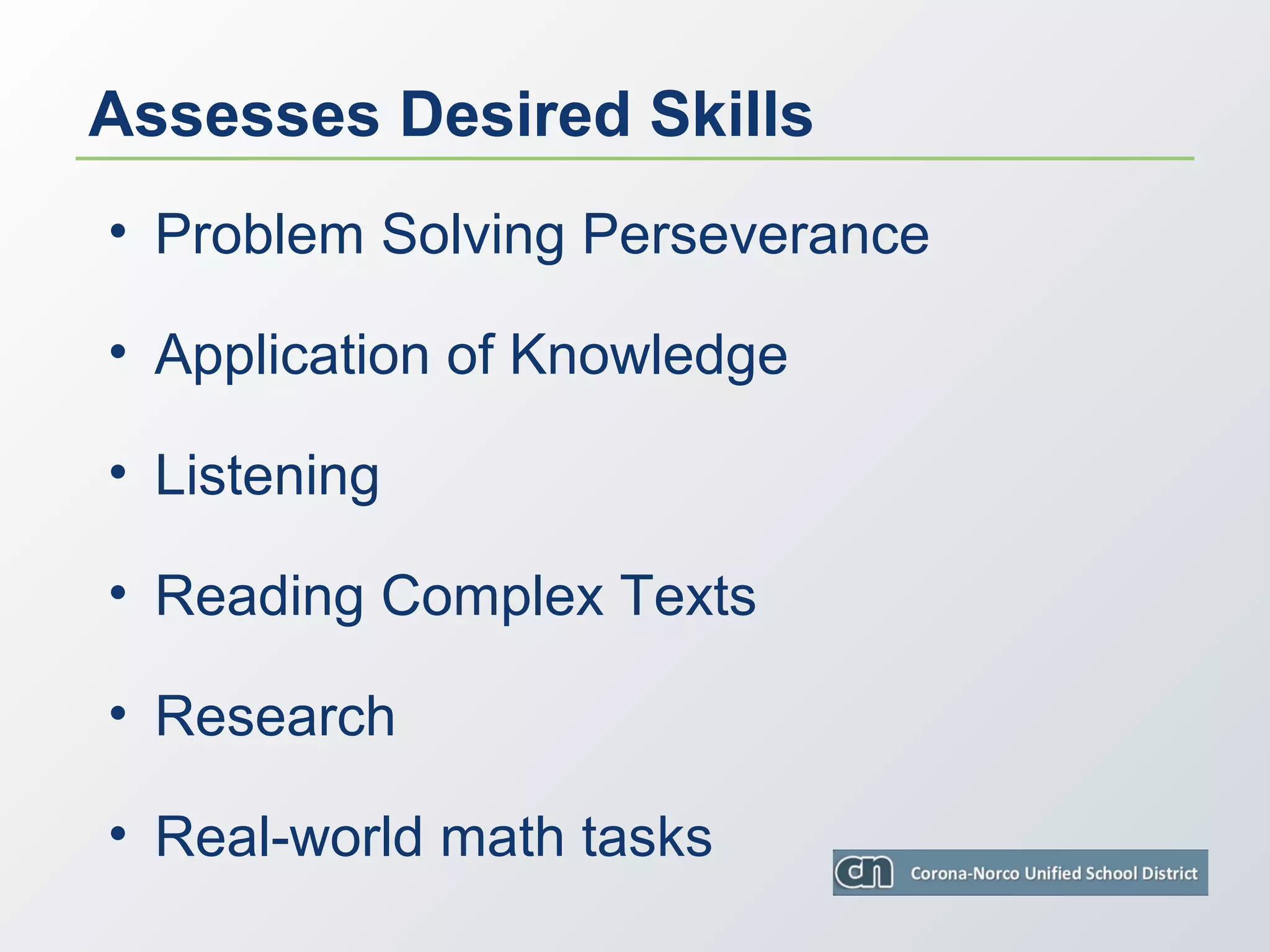
Assesses Desired Skills
• Problem Solving Perseverance
• Application of Knowledge
• Listening
• Reading Complex Texts
• Research
• Real-world math tasks
Student SBAC Results
Results: Last Year’s vs. This Year’s
It’s Like Apples and Oranges – you can’t
compare
The previous test measured different skills, in a
different way
Overall Scores –
2 Content Areas, 4 Levels
English Language Arts and Mathematics
Nearly Met the Standard
Exceeded the Standard
Met the Standard
Has Not Met the Standard
Level 4
Level 3
Level 2
Level 1
Additional Scores – CLAIMS
English Language Arts
1.Reading
2.Writing
3.Speaking & Listening
4.Research/Inquiry
Mathematics
1.Concepts & Procedures
2.Problem Solving
3.Communicating Reasoning
4.Modeling & Data Analysis
BelowStandardAboveStandardAt/NearStandard
Above Standard
At/Near Standard
Below Standard

SBAC parent info

  • 1.
    California Assessment ofStudent Performance and Progress CAASPP
  • 2.
    We are Preparingfor a New Future • Our students will live and work in the world of tomorrow • We have updated our curriculum to match the demands students will face in college and careers • Tomorrow’s need? Workers who are: • Adaptable • Can apply knowledge to unpredictable problems • Can find information, assess its value and integrate it to arrive at creative solutions
  • 3.
    We have builtup to this moment • Implementation of the new approach has been a process • Teachers have been learning new instructional practices • The curriculum has been aligned to the CCSS • Now the annual test will give us a measure of our progress in CCSS
  • 4.
    The Assessment islike your child’s regular check-up with the pediatrician • Provides a consistent check on progress - Is the student meeting expected milestones? • Allows teachers and parents to measure growth year to year • Provides information that teachers and parents can act on – is focused support needed?
  • 5.
    Tests Provide Information •Information is used to show us where we need to improve teaching • Information is used to target support before students fall too behind • The annual test is one measure: Other measures of student learning include chapter tests, classroom projects and formative assessment
  • 6.
    Time on SBAC •Less than 1% of the school year is spent on the annual statewide test • Since the test measures the skills and knowledge we teach all year, there is no focus on test preparation • There’s no time limit for the statewide test; students have the time they need to show what they know and can do
  • 7.
    What’s New aboutState Testing CAASPP & SBAC
  • 8.
    “Computer adaptive testing(CAT) holds the potential for more customized assessment with test questions that are tailored to the students’ ability levels, and identification of students’ skills and weaknesses using fewer questions and requiring less testing time.” Shorr, P. W. (2002, Spring). A look at tools for assessment and accountability. Administrator Magazine. Computer Adaptive Testing (CAT): Philosophy
  • 9.
    Assesses Desired Skills •Problem Solving Perseverance • Application of Knowledge • Listening • Reading Complex Texts • Research • Real-world math tasks
  • 10.
  • 11.
    Results: Last Year’svs. This Year’s It’s Like Apples and Oranges – you can’t compare The previous test measured different skills, in a different way
  • 12.
    Overall Scores – 2Content Areas, 4 Levels English Language Arts and Mathematics Nearly Met the Standard Exceeded the Standard Met the Standard Has Not Met the Standard Level 4 Level 3 Level 2 Level 1
  • 13.
    Additional Scores –CLAIMS English Language Arts 1.Reading 2.Writing 3.Speaking & Listening 4.Research/Inquiry Mathematics 1.Concepts & Procedures 2.Problem Solving 3.Communicating Reasoning 4.Modeling & Data Analysis BelowStandardAboveStandardAt/NearStandard Above Standard At/Near Standard Below Standard

Editor's Notes

  • #6 While Assessments would be the more common term for tests among educators, keep language simple with parents.
  • #10 Students are challenged to demonstrate that they can apply what they know.