


Mobile Commerce Guide
Engage Customers and Build Loyalty
in Developed and Emerging Markets
1
Mobile Commerce Guide
Engage Customers and Build Loyalty
in Developed and Emerging Markets
32 Mobile Commerce Guide Engage Customers and Build Loyalty in Developed and Emerging Markets
Mobile Commerce Guide
Engage Customers And Build Loyalty in Developed and Emerging Markets
Published by:
SAP AG
Dietmar-Hopp-Allee 16
69190 Walldorf
Germany
Copyright © 2013 SAP AG or an SAP affiliate company. All rights reserved
Library of Congress Cataloging-in-Publication Data
SAP Mobile Commerce Guide
Engage Customers & Build Loyalty in Developed and Emerging Markets
Edited by Peggy Anne Salz
p. cm.
ISBN Number: ISBN 9780988588677
1.Mobile technology. 2. Mobile commerce
Library of Congress Control Number: 2013906059
Printed in the United States of America
Except as permitted under the United States Copyright Act of 1976, no part of this publication may be reproduced or distributed
in any form or by any means, or stored in a database or retrieval system, without the prior written permission of the publisher.
11	 FOREWORD
By Sanjay Poonen, President, Corporate Officer, Technology Solutions
and Head of Mobile Division, SAP
14	 PART 1: MOBILE COMMERCE: MAPPING THE COMPETITIVE LANDSCAPE
16	 Mobile: A License To Thrill
A look at how mobile is impacting business, people and society at every level,
everywhere on the planet.
By Tomi T. Ahonen, best-selling mobile author
22	 Who Will Lead The Mobile Commerce Charge?
The advance of mobile and the breakneck pace of technology innovation are coming
together to provide amazing opportunities for banks to extend financial services to
new and existing customers - but banks aren't the only ones taking action.
By Pradipto Pal, Executive, Accenture Mobility
34	 Money 2020 And The Business Case For Mobile Payments:
The Role Of Rewards
Compelling reasons why financial institutions need to leverage the consumer
data that is locked in their debit and credit card products to better service
consumers and better partner with retailers to drive commerce.
By Aaron McPherson, Practice Director, Worldwide Payment Strategies,
IDC Financial Insights
38	 Mobile Commerce And Financial Institutions In Latin America:
An Evolving Ecosystem
Banks are jockeying for competitive advantage using some rather sophisticated
smartphone apps and approaches that deliver utility, drive engagement and
stand out from the crowd.
By Mary A. Gramaglia, Director of Sales, Latin America, Mobile Commerce, SAP
Table of Contents
54 Mobile Commerce Guide Engage Customers and Build Loyalty in Developed and Emerging Markets
43	 Digital Money Sweeps Mexico And Brazil
As the mobile money phenomenon sweeps across Brazil and Mexico banks
aren't the only ones lining up to transform financial services.
By Charmaine Oak, Practice Lead, Digital Money, Shift Thought
50	 PART 2: BANKING IN DEVELOPED MARKETS: TAKING CHARGE
OF CHANGE
52	 Banks: Evolve, Innovate And Embrace ‘True Multichannel’, Or Be Left Behind
Banks must generate customer-centric insights through advanced analytics
that will allow them to enhance products, personalize service bundles —
or make way for companies that will.
By Simon Paris, Global Head of Financial Services Industries, SAP, and
Matthew Talbot, Senior Vice President, Mobile Commerce, SAP
59	 Removing Friction To Build Relationships
At RBS Citizens the goal is to get customers in and out fast — and success
is all about delivering financial services that respect customers' time.
By Scott Manley, SVP, Head of Product – Delivery Channel,
Treasury Solutions, RBS Citizens
64	 The Convergence Of Mobile And Online Banking
This is the future of electronic banking that requires a common middle layer
with business logic and messaging infrastructure.
By Jacob Jegher, Research Director, Celent
69	 Breaking The Mobile Banking Mold
Organizations must be agile. To keep pace First Tennessee Bank delivers financial
services that empower executives to act fast and conduct transactions on the move.
By TaylorJ. Vaughan, Director of Treasury Management Services, First Tennessee Bank
75	 6 Ways To Wring More Value Out Of Multi-Channel Banking
The pressure is now on banks to help their customers make smarter decisions
based on increased visibility into all their accounts as they save, spend and shop.
By Davor Ebling, Director, Mobile Commerce Solutions, SAP
82	 PART 3: BANKING IN DEVELOPING MARKETS: PLOTTING THE COURSE
FOR FINANCIAL INCLUSION AND FINANCIAL SUCCESS
84	 Advancing New Frontiers For Financial Inclusion
Pakistan is one of the fastest growing branchless banking markets in the
world. AbacusConsulting recounts recent developments in mobile banking
and the impact on the local landscape.
By Abbas Khan, Partner, AbacusConsulting
92	 Accelerating Mobile Banking Through Collaboration
Malaysian Central Bank is on a mission to transition Malaysia to a high value-added,
high-income economy by 2020. A big part of the plan involves the widespread and
rapid migration to electronic payments spearheaded by MyClear.
By Siek Kar Teck, Director, Retail Payments Division, MyClear
96	 Mapping The Market For Financial Inclusion
HBL is harnessing mobile technologies to do more than enable the delivery of
innovative banking services; it is providing all people, including the poor and rural
populations, access to convenient mobile banking services that put them in control
of their financial future.
By Faiq Sadiq, Head of Payment Services, Habib Bank Limited
101	 Creating New Pathways For The Poorest
DBBL launched mobile banking services targeting the unbanked, signing up an
average of 100,000 customers each month since the commercial launch in 2012.
Now the bank is planning additional services using new authentication technologies
to grow that number exponentially.
By Abul Kashem Md Shirin, Deputy Managing Director, Dutch-Bangla Bank Limited
108	 Targeting Tomorrow’s Mass Affluent
CIMB Niaga, the number five bank in Indonesia, through innovative services
and social media outreach is preparing for a day when today's unbanked will
be part of the burgeoning middle class.
By Wan Razly Abdullah, Strategy and Finance Director, PT Bank CIMB Niaga Tbk
76 Mobile Commerce Guide Engage Customers and Build Loyalty in Developed and Emerging Markets
114	 Branchless Banking Driven By ‘Disruptive Innovation’
Bank BTPN reveals its plans to disrupt the market with a new and cost-effective
model aimed at empowering people at the bottom of the pyramid to manage an
interest-bearing bank account.
By Donny Prasetya, Head of Business Development, btpnWOW!
122	 PART 4: MOBILE OPERATORS: PAVING THE WAY FOR MOBILE
PAYMENTS AND MORE
124	 SIM-Based NFC: Enabling A New Level Of Interaction For Latin
American Big Events
A string of NFC trials are taking place in Brazil just in time for the FIFA 2014
Soccer World Cup and the 2016 Olympic Games, enabling consumers to make
payments and access information, and highlighting new business opportunities.
By Valter Wolf, Market Development Director, GSMA
127	 Open Solutions Could Help Fulfill The Promise Of Mobile Money
With over 100 mobile money deployments globally, only a handful have reached
meaningful scale. Here are some key examples and learnings revealing what
makes services tremendously successful.
By Sal Karakaplan, Vice President, Mobile Money, MasterCard
131	 Preparing To Deliver ‘Advanced’ Services
From enabling merchant payments to driving financial inclusion, Ooredoo
is positioning itself to be a leading provider of mobile money services and
one of the world's top 20 mobile operators by 2020.
By Rambert Namy, Head of Mobile Financial Services, Ooredoo
136	 Expanding Mobile Wallet Capabilities To Encourage Customer Loyalty
Celcom has made its mark with AirCash, one of the first mobile wallet services
to launch in Malaysia. Now efforts focus on integrating AirCash into its larger
customer loyalty program.
By Afizulazha Abdullah, Chief Digital Services Officer, Celcom Axiata Berhad
140	 PART 5: RETAIL, CONSUMER PRODUCTS: MASSIVE
OPPORTUNITIES AT THE INTERSECTION
142	 Mobile Shopping And Coupons Transform Retail
Yankee connects the dots through recent data and surveys to show why — and
how — mobile coupons are becoming the way to lure shoppers.
By Yankee Group
148	 Opportunity At The Intersection Of Retail And Mobility
Smart marketers in transportation, utilities and consumer products companies
are exploring how they can deliver relevant, timely information, promotions, and
special offers right to the consumers’ smartphone.
By Colin Haig, Program Principal, SAP Retail
153	 Fast Shopper, Slow Store: A Mobile Playbook
Actionable insights and valuable advice to connect with the 'new' mobile consumer.
By Gary Schwartz, CEO, Impact Mobile.
161	 Survival Guide: Evaluating The App Vs. Web Debate
Mobile apps vs. mobile Web is a topic of heated debate in the industry today.
A successful approach is one that uses mobile apps and the mobile Web in the
right combination to make shopping across all channels seamless and personal.
By Panagiotis Papadopoulos, Retail Mobile Lead, SAP
166	 Mobile Retailing 2.0: Connect With The Customer At The Point of Decision
How retailers can realize the full potential of the greatest marketing tool ever
invented to win the battle for the customer and get the edge on online rivals.
By Mickey Haynes, Global Principal, Mobility Solutions in Retail, SAP
171	 Showrooming, Deconstructed
A guide to help retailers build the key capabilities that will allow them to clinch
the deal and stem showrooming.
By Nikki Baird, Managing Partner, RSR Research
98 Mobile Commerce Guide Engage Customers and Build Loyalty in Developed and Emerging Markets
175	 Consumer Focus Key To Closing The Mobile Commerce Loop
Innovative retailers are using mobile to equip their stores and empower their
staff to deliver an omni-channel experience personalized to each customer,
and to accelerate revenues and deliver customer value.
By Rakesh Gandhi, Senior Director, Mobile Application Solution Management
– Consumer Mobile, SAP
182	 PART 6: THE ENGAGED CONSUMER: CREATING A PERSONAL(IZED)
CONNECTION WITH YOUR CUSTOMERS
184	 Gateway To The Future Of Customer Relationship Management
Examining the customer journey, the purchase funnel and the many moving parts
marketers need to understand to encourage commerce, trigger conversions and
boost customer engagement.
By Michael J. Becker, Managing Director North America, Mobile Marketing Association
192	 Reaching The Mobile Consumer
Organizations must be careful not to miss the opportunity to build mobile
into a wider strategy, that is cohesive across all channels, to enable meaningful
— and ongoing — customer engagement.
By Jason A. Oglesby, Director Mobile Solutions Management, SAP
200	The Engaged Retailer: How Mobile And Big Data Improve Revenue,
Retention And Profits
Retailers must take proactive action to turn mobile into an asset that delivers
revenue and customer engagement. They can start by building an information
technology and customer-facing strategy that capitalizes on mobile attributes
such as location, activity, and sensor data to delight customers.
By Maribel Lopez, Founder and Principal Analyst, Lopez Research
204	Detect, Connect And Engage
Technology and analytics are coming together to allow retailers to radically
redefine the relationship they have with their customers in real-time.
By Mark Dahm, Senior Manager, Business Development, Wireless Networking
Group, Cisco Systems and Jason A. Oglesby, Director Mobile Solutions
Management, SAP
210	 Public Transport Drives Personal Loyalty
Canadian transport authority STM has launched an innovative mobile
customer rewards pilot program, delivered by a smartphone app, to thank
existing customers and attract new ones.
By Pierre Bourbonniere, Head of Marketing, Société de transport de Montréal
214	 Utilities Customer Engagement
Customers are moving to mobile and other channels to solve issues, report
outages or simply check their bill — and utilities companies need to prepare.
By Haridas Nair, Vice President, mCommerce Products and Solutions, SAP
220	PART 7: DO YOU TAKE MOBILE? NEW PAYMENT OPPORTUNITIES
AT RETAIL
222	 Starbucks: A Mobile Payments Case Study
Exclusive insights to track and analyze the stellar success of Starbucks'
mobile based payment system called ‘mobile pay’.
By Sam Gellar, Analyst, Portio Research
232	 Weighing The Alternatives To NFC
An evaluation of alternative mobile payment technologies shows the
benefits and drawbacks to conclude that the ideal solution may be a
combination of 'all of the above'.
By Mickey Haynes, Global Principal, Mobility Solutions for Retail, SAP
1110 Mobile Commerce Guide Engage Customers and Build Loyalty in Developed and Emerging Markets
240	A Serious mPOSition
Mobey Forum has seen more than 30 mobile point of sale (mPOS) solutions
launch around the world and considers the implications of this trend for banks
as they forge customer relationships with merchants.
By Sirpa Nordlund, Executive Director of Mobile Financial Services, Mobey Forum
244	 PayPal: Enabling Payments Anytime, Anywhere And Via Any Screen
In Germany PayPal has completed a successful trial of its PayPal QRShopping
solution and shares its strategy to change the entire end-to-end shopping
experience across all screens.
By Tobias Zadow, Business Line Manager, Mobile DE, PayPal
251	 How Apple’s Passbook Ushers In The Third Mobile Marketing Wave
Learn how to leverage this new mobile marketing imperative to drive sales,
boost loyalty, and increase customer engagement.
By Joe Beninato, General Manager, Digital Wallet, Urban Airship
258	 PART 8: CLOSING THOUGHTS: THE ROAD AHEAD
260	Big(ger) Data Pushes The Boundaries
Today, we are arguably on the cusp of a fourth revolution: the age of Trillions.
The impact on all industries will be profound. But the real excitement starts
when these microprocessors join the conversation, communicating with
themselves and with us.
By Mickey McManus, President and CEO, Maya
266	APPENDIX
Company Descriptions
FOREWORD
Sanjay Poonen, President, Corporate Officer
Technology Solutions and Head of Mobile Division, SAP
With nearly 3.2 billion mobile
phone users and counting,
worldwide mobile penetration
has already been remarkable.
But mobility is not only enabling
rich and always-on interactions.
It is also transforming banking
and commerce, creating a new
global mobile marketplace that
is always accessible and always
ready for business.
Indeed, mobile commerce is becoming a
fact of life, driven by the advance of mobile
technologies, a surge of innovation in devel-
oped and developing markets and a growing
consumer requirement for an enhanced,
relevant and — hence — more contextual
retail experience. If we think that the birth
of electronic commerce and the advance
of eBay and amazon.com in 1995 was a big
phenomenon, then the impact of mobile is
going to be transformational.
Mobile has the power to trigger a seismic
shift in commerce because consumers
already live their lives on mobile. Reams of
research documents people — everywhere
— reach to their mobile devices every step
of their daily journey. Already the number of
people using their mobile phone to access
the Internet far exceeds the number using
a desktop PC.
FOREWORD
1312 Mobile Commerce Guide Engage Customers and Build Loyalty in Developed and Emerging Markets
Another driver is the passion Millennials
have for personal mobility. In many regions
of the world, people under the age of 40, a
segment keen to adopt mobility innovations
and integrate mobile into every aspect of their
lives, will be the majority of the population.
This will create new opportunities, and
new pressures, for companies across the
emerging ecosystem — banks, card issuers,
mobile operators, app developers, merchants
— to enable commerce experiences that
know neither boundaries nor friction.
Mobile is also driving financial inclusion,
allowing banks such as Dutch-Bangla Bank
Limited in Bangladesh to extend their
services to the unbanked. The impact is
profound as financial institutions — and
mobile operators where regulation allows
— empower people at the bottom of the
pyramid to participate in society and
improve their quality of life.
Mobile operators are experiencing similar
success. Ooredoo, a multi-country mobile
operator group has identified mobile money
as a key capability and a pillar of its initiative
to be one of the top 20 mobile operators
worldwide by 2020.
Moreover, mobile is evolving, driven by
companies that have succeeded in
enabling person-to-person payments
and have set a course to transform the
entire retail environment.
It’s new territory that offers new challenges
— and huge benefit to the companies that
can master them.
To help you navigate this new market and
grasp the growth opportunities ahead the
second edition of the Mobile Commerce
Guide has brought together a wide variety
of case studies and success stories,
contributed by the executives who helped
make them reality, to show how mobile
impacts the Retail, Consumer Product,
and the Utilities industries.
As this Guide shows, precisely how compa-
nies can deliver value — and communicate
this to their customers — will depend on a
variety of factors. Banks may encourage and
educate unbanked to see their mobile
wallets as instruments that allow them to
save money and plan their financial futures;
mobile operators may share infrastructure
and best practices to reach and educate
customers faster; retailers and consumer
product companies may refine their models
to enable contextual commerce their
customers genuinely welcome and appreciate
because it is personally relevant and valuable;
and utility companies may harness mobile
to provide customers new visibility into the
services they use and the payments they make.
To wield the transformational power of
mobile for your business, you must first
fully understand its impact. The examples
gathered in this Guide for this purpose are
global and diverse. But — more importantly
— the insights presented here, drawn from
the expertise and experiences of more than
40 leading analysts, professional industry
organizations and futurists, are actionable.
These are exciting and challenging times.
Whether you are eager to start planning your
mobile commerce strategy, or seek guidance
as you expand your existing offer, think of
this Guide as a knowledge resource and
companion on the journey ahead.
1514 Mobile Commerce Guide Engage Customers and Build Loyalty in Developed and Emerging Markets
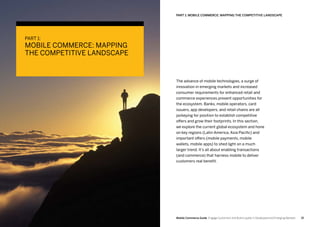
The advance of mobile technologies, a surge of
innovation in emerging markets and increased
consumer requirements for enhanced retail and
commerce experiences present opportunities for
the ecosystem. Banks, mobile operators, card
issuers, app developers, and retail chains are all
jockeying for position to establish competitive
offers and grow their footprints. In this section,
we explore the current global ecosystem and hone
on key regions (Latin America, Asia Pacific) and
important offers (mobile payments, mobile
wallets, mobile apps) to shed light on a much
larger trend. It’s all about enabling transactions
(and commerce) that harness mobile to deliver
customers real benefit.
PART 1: Mobile Commerce: Mapping The Competitive Landscape
PART 1:
MOBILE COMMERCE: MAPPING
THE COMPETITIVE LANDSCAPE
1716 Mobile Commerce Guide Engage Customers and Build Loyalty in Developed and Emerging Markets
Mobile: A License To Thrill
By Tomi T. Ahonen, best-selling mobile author
You may have noticed that the
world’s biggest Internet company,
Google, says the future of the
Internet is mobile. You probably
noticed too that a once hovering-
near-bankruptcy PC maker called
Apple Computer dropped‘computer’
from its name, launched mobile
phones, and today calls itself a
mobile company.
Oh, and you might recall that Apple was
— for a while last year — the most valuable
company on the planet, making the biggest
profits. But did you also know that the
computer-era billionaire Bill Gates is no
longer the worlds’ richest man? That title
was taken by Mexican Carlos Slim.
What could possibly replace computers as
the engine to generate such wealth? In a
word: mobile. By the way, Carlos Slim Helú
runs Mexico-based América Móvil, one of
the world’s largest mobile telecoms empires
stretching across all of Latin America.
Yes, mobile seems to be an engine to deliver
growth, revenues, profits, and wealth for those
technology, telecoms, and IT companies.
Now let me ask you this: Did you hear what
Electronic Arts, the world’s largest game
developer says about the future of gaming?
They declare it is mobile. What about the
BBC, the world’s largest radio and TV broad-
caster? It says that all broadcast content will
become available on mobile phones. What
about Warner Music? It said wireless is the
future of music. What of Sony, the world’s
largest home electronics company? The
CEO there just said that mobile was front
and center of Sony’s future. And Samsung?
The world’s largest tech company said last
year that their mobile unit is the driving
force of their profits. Or Facebook, the
biggest social media company? It revealed
last year that more than half of users now
come from mobile - and that the future of
social media is... (you guessed it!) mobile.
Not to be outdone the Associated Press,
the news agency headquartered, in the U.S.,
announced that it was the mobile phone, not
the traditional Internet, which was the future
of the news media.
I could go on and on. But let’s forget about
the tech and media industries. Take Visa, the
world’s largest financial company by number
of users and obviously the world’s largest
credit card company. They now say that the
future of payments... is mobile.The world’s
largest lock maker,Assa-Abloy is building
locks that are operated by your mobile phone.
The world’s largest airline by passenger miles,
Delta, is now deploying mobile phone based
check-in and boarding passes.
In France Carrefour, the country’s largest
retailer has deployed mobile solutions
so advanced that they will help mobile
shoppers find the shortest route in the
stores. To assist shoppers the shopping
list stored on their mobile phones is even
re-arranged by aisle, depending on which
store you go to. In Japan McDonald’s the
world’s largest restaurant chain, has already
convinced one out of every six Japanese
consumers to sign up to receive mobile
coupons and offers. And speaking of ads,
Coca-Cola, the world’s largest soft drinks
maker, recently ran an international
multi-platform ad campaign with mobile
at the heart of it that achieved a whopping
45 percent response rate!
Mobile is massive
When I wrote my first book about mobile
services and apps over a decade ago, this
whole mobile industry was only an experi-
ment that spanned some random countries
where they spoke languages nobody else
ever bothered to learn, like Finland, Japan,
South Korea and Sweden. It was eccentric
to believe in mobile back then, and an act
of faith to think mobile would ever be big.
When I showed off the ‘cool’ ways these
mobile phones could play elementary music
snippets — known as ‘ringtones’ at the time
- most said it was a fad that would never
catch on. Today mobile data services are a
massive global hit! In fact, they were worth
US$436 billion last year.Yes, bigger than
the Internet, bigger than global radio, bigger
than Hollywood movies, bigger than video
gaming.The mobile data industry is the
fastest-growing industry of all time. No
wonder it turns around companies like
Apple, or creates billionaires like Carlos Slim.
PART 1: Mobile Commerce: Mapping The Competitive Landscape
1918 Mobile Commerce Guide Engage Customers and Build Loyalty in Developed and Emerging Markets
We are mobile, too
But what about you and mobile in your life?
Let’s look at mobile starting with some very
basic services and abilities, and soon you’ll
see that mobile is already a huge part of
daily life in countries across the globe.
Let’s start with children. Did you know
there are now mobile tools and services
that help kids study better for their school
work? In South Africa, for example, a local
mathematics books publisher released a
mobile math practice solution that helped
South African students using it score
14 percent better in national math exams!
Or what about a farmer in India? The time
to go turn on and turn off the irrigation at
the farm can take hours riding a bicycle
from one irrigation valve to another.
Now there is a mobile solution for that.
The solution, which uses SMS, allows the
farmer to control his irrigation from home
at a few clicks of his phone. It’s not just
saving him time, and water, and the costs
of electricity and money - it also saves
with soil erosion! If you irrigate too little,
the ground is dry and is blown away. If you
irrigate too much, the ground is washed
away - to the farmer downstream who
is only too happy to get your topsoil.
Mobile money prospers
And let’s not forget mobile money. In many
parts of the developing world people have
only managed to save small amounts of
money — if any. They cannot qualify
for a bank account to put their money
away safely because they lack the proper
identification and a permanent address.
Literacy is also an issue.
So what do they do? They try to hide what
little cash they have. It’s a risky business.
It’s not safe — and burglars, thieves, animals
and natural disasters can take the money
way. Your life savings are gone.
But once the miracle of mobile payments
arrives, suddenly anyone can have the basic
safety benefits of depositing their money
onto something — a card, a phone, a branch-
less bank account — that is permanent,
trusted, and safe. Run by the mobile operator
or the local bank, these services empower
the poor to save and plan a better future.
M-Pesa in Kenya launched six years ago; last
year the Central Bank of Kenya told us the
amount of money that transited mobile
phones was equal to 48 percent of the total
Kenya GDP.Yes, of the total Kenya economy,
nearly half already transits mobile phones,
and this in only six years.The World Bank
counts nine countries in Africa where already
at least 10 percent of the adult population
uses mobile money or mobile payments.
Mobile, mobile everywhere
Vertical industries are also getting in on the
action. An example is Willer Travel, a long
distance bus company in Japan. They had
a popular Website where they sold tickets.
When they mobilized their Website, they
achieved a three-fold increase in their ticket
sales on their mobile sites.
Similar stats come all around the world.
Tiffany’s the U.S. jewelry store decided
to mobile-optimize their Website which
caused their jewelry sales via the mobile
channel to more than double. The Hockey
News, a weekly ice hockey magazine,
launched a pure mobile version of the
magazine and not only found 100,000
new paying mobile readers as an audience,
they observed a positive knock-on
effect on print sales, which increased
by 5 percent! What print title reports
increases in circulation these days?
The moment the decision was official,
Pope Francis sent his first greetings via
SMS. Was that an innovation for a religious
leader to use text messaging to reach
masses of followers? No, the previous
Pope, Pope Benedict XVI, did it too. Was he
the first mobilista-Pope? No. The Vatican
has been sending mobile messages
to the faithful since January 2003.
Politicians are also harnessing mobile to
drive amazing results. President Barak
Obama’s re-election campaign masterfully
utilized new media in many forms. One of
No matter who you are or what you do
mobile is your tool to get ahead.
2120 Mobile Commerce Guide Engage Customers and Build Loyalty in Developed and Emerging Markets
the highlights was on Election Day, when
Team Obama sent out a text message
to his followers and volunteers, asking
them to make one phone call on behalf
of the President. In total 9.5 million such
SMS text messages were sent to all
those who had given Team Obama their
mobile phone number. This one SMS text
message was estimated to have achieved
1.9 million bonus volunteer phone calls
on Election Day because of the acts of
volunteers who agreed to donate one
phone call to Obama, after receiving that
message that morning of Election Day.
The impact was profound. All the polls in
the last days before the election measured
the vote to be very close, about 1 percent
advantage to Obama. But Obama actually
won by 4 percent. That difference was about
3 million votes. This never-before-used tactic
of sending a text message to call voters to
action (make a phone call to someone
to convince them to vote for Obama)
probably accounted for the lion’s share
of that surprisingly large winning margin.
That, my friends, is the power of mobile.
Mobile to the end
It doesn’t matter if you are a giant company
or a tiny family-run business. It doesn’t
matter if you’re living in the most advanced
digital nirvana or a person carving out an
existence in the developing world. It doesn’t
matter if you are a highly educated MBA or
an illiterate fisherman. No matter who you
are or what you do mobile is your tool to get
ahead. If you are a business you can harness
mobile to get more customers and make
more money — more quickly, more profit-
ably and more reliably. It also helps you
reach better and bigger audiences that will
become more loyal to you, if you get the
value exchange right.
If you’re not a business, mobile can help you
heal the sick, educate the students, get the
votes to be elected and improve your life.
In 2013 there is no industry that is not being
impacted and revolutionized by mobile tech-
nology. From car manufacturers to funeral
homes, mobile is becoming part of their
corporate DNA. Yes, I said funeral homes.
These institutions are now deploying QR
codes to gravestones, so our memories of
our dear departed can be cherished and
shared by friends, relatives and ‘significant
others’ who scan the codes and access the
things the deceased did and held dear.
Yes. Mobile is with us every day everywhere.
It’s the first thing we see when we wake
up and the last thing we look at before we
fall asleep. And now, this industry is even
letting mobile be the way we connect
with the memory of our loved ones long
after they are gone.
Yes,mobile is a wonderful technology that is
completely changing every aspect of our world.
Tomi T. Ahonen is an ex-Nokia executive,
and one of the most published authors in
the mobile industry. He counts over a dozen
books, as well as a regular blog that has
gained him the number one spot in the
Forbes Top 10 Power Influencers in Mobile1
.
Coca-Cola, the world’s largest soft drinks
maker, recently ran an international
multi-platform ad campaign with mobile
at the heart of it that achieved a whopping
45 percent response rate!
FOOTNOTE
1. www.forbes.com/sites/haydnshaughnessy/2012/01/03/who-are-the-top-10-power-
influencers-in-mobile/
2322 Mobile Commerce Guide Engage Customers and Build Loyalty in Developed and Emerging Markets
The advance of mobile technologies,
a surge of innovation in emerging
markets and increased consumer
requirements for enhanced retail
experiences present opportunities
for banks to expand into new
service areas and extend their
existing services to the unbanked.
But banks are not the only ones
taking note. Mobile operators,
card issuers, app developers, and
retail chains are also jockeying to
establish competitive offers and
grow their footprints. Accenture
describes the current ecosystem
and defines the capabilities mix
that will be needed to serve the
market of ‘less cash’ consumers
of the future.
With nearly 6 billion connections and
counting, worldwide mobile penetration
has already been remarkable. But mobility
is not only enabling rich and always-on
interactions. It is also transforming banking
and commerce, creating a new mobile
marketplace that is always accessible
and always ready for business.
The movement toward this new phase of
mobility — which Accenture calls Mobile
Life — is pushing mobile money offers in
three distinct directions: traditional mobile
banking services (mBanking Services),
mobile payment services (mPayment
Services), and mobile enabled consumer
services (mEnabled Consumer Services).
Often the initial point of entry for banks
into the mobility arena, mBanking links
customers’ bank accounts to their mobile
devices and provides customers with a new
way to manage their finances. Services can
range from basic product information and
Who Will Lead The Mobile
Commerce Charge?
By Pradipto Pal, Executive, Accenture Mobility
PART 1: Mobile Commerce: Mapping The Competitive Landscape
Most banks are in the business of making
money — and they have a huge learning
curve to travel before they can serve the
poorest of the poor.
transaction histories, to more advanced
operations such as loan applications and
inter-bank fund transfers.
Mobile money transfers and purchases,
or mPayments, open the door to previously
unbanked markets. These types of services
can vary significantly in their sophistication,
from SMS-based money transfers, to Near
Field Communication (NFC) payments,
to a full “digital wallet” capable of storing
multiple credit cards, prepaid cards, and
discount cards for mobile transactions
and commerce.
Least understood and not yet widely
adopted, mEnabled Consumer Services
encompass a broad range of mobility
offerings catering to specific consumer
lifestyle needs within and outside the
traditional banking realm. Services can
range from simple SMS-based promotion
alerts to location-based targeted market-
ing. With mEnabled Consumer Services,
banks have the opportunity to venture into
new businesses and further embed their
brand in consumers’ daily lives.
Banks may choose to extend existing offerings
to new customers,branch out into new value
segments or increase the sophistication of
their services in a particular area.
However, banks should be aware that
they are not the only ones with this
ambition. While the banking industry
has dominated banking and payment
services for many years, the recent advance
of mobile technologies and emergence of
new consumer behaviors has leveled the
playing field. As a result, new entrants, new
partnerships and new operating models
are flooding the space and transforming
the competitive landscape.
Asia’s affluent
Thus, many banks find themselves in
an unfamiliar position, struggling to keep
up — or join up — with mobile operators,
card issuers, app developers, and retail
chains that are also jockeying for position
in a value chain that spans activities from
banking to commerce to CRM.
24
Figure 1: Based on data from www.accenture.com/Microsites/accenture-innovation-center-asia-pacific/Pages/index.aspx
Competition is stiff, particularly in Asia
Pacific where a digital wave is creating a
market hungry for mobile money services.
Driven by the advance of a tech-savvy
consumer base and a ‘change of the guard’
that sees Generation X making way for
Generation Y to take the helm, this shift
is happening much faster in Asia Pacific
than in Europe or North America.
Indeed, the youth segment in Asia Pacific
is not only far greater in sheer numbers;
it also has a much greater desire to lead a
Mobile Life. This segment, which I describe
as digital natives’, has a huge appetite for
mobile/digital services. In fact, demand
in the region far outstrips supply of both
services and bandwidth.
Notably, the rapid growth of the middle
class across Asia Pacific presents players
with additional opportunities. Another
70 million households are expected to join
this burgeoning class by 2015, and this
impressive income growth extends all the
way up the social ladder. Between 2010 and
2015, the number of millionaires in the Asia
Pacific region is forecast to increase by
25 percent (compared to 17 percent world-
wide), while the ’ultra wealthy’ segment
will swell by 37 percent (nearly double
the global rate).
The region is not only growing richer; it
is also becoming more passionate about
mobile technologies and services.
The outcome will be an increase in smart-
phone penetration, a trend we already
observe, that will drive more mobile
app downloads and usage of the mobile
Internet. Significantly, NFC will likely gain
serious traction, with an estimated 450
million NFC-capable devices expected to
hit the market over the next three years.
As more people embrace a Mobile Life,
the demand for services — including
banking, payments and commerce —
will skyrocket. In fact, Accenture research
found that 60 percent of mass affluent
customers, which includes the region’s
upper middle class and high-net-worth
individuals, are interested in using digital
channels in conjunction with bank branch
visits. In addition, 21 percent of respondents
would prefer to switch completely to
direct banking.
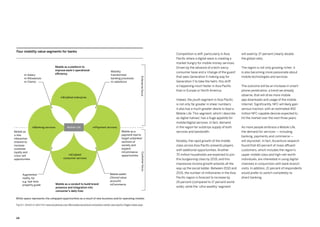
Four mobility value segments for banks
Mobile as a platform to
improve bank’s operational
efficiency
EnterprisefocusCustomerfocus
Mobility
transformed
banking processes
m-salesforce
m-Salary
m-Allowances
m-Claims
mEnabled enterprise
mPayment servicesmBanking services
Mobile as
a new
interactive
channel to
increase
customer
loyalty and
cross-sell
opportunites
mEnabled
consumer services
Mobile as a conduit to build brand
presence and integration into
consumer’s daily lives
Mobile as a
payment tool to
target unbanked
sections of
society and
expand
mCommerce
opportunities
Mobile wallet
(Stored value
account)
mCommerce
Augmented
reality, for
e.g. real-time
property guide
Mobile Life
White space represents the untapped opportunities as a result of new business and/or operating models
2726
Mobile commerce touch points
Now that I have described the key market
demographics and data points across the
Asia Pacific region, let’s examine how
mobile banking services have evolved
across the region.
Dramatic economic growth and rising
household incomes across the region
have created a market of mass affluent.
This segment carries a mobile phone and
is already well accustomed to using mobile
banking services to check balances, pay
bills and make P2P transactions.
The next step is full mobile commerce, a
space where banks and merchants have
an important role to play. Together they
must build on the mobile wallet, a product
banks first provided to make P2P payments,
and extend that functionality to enable and
enhance new retail experiences.
Let’s say I use my mobile wallet, provided
by my bank, to do some shopping and buy
some clothes at Store X, for which I also
receive some loyalty points as part of the
transaction. A few days later I walk into a
shopping mall in a different city, where the
same chain just happens to have an outlet.
I don’t know this, but I do receive a push
notification directly to my mobile phone
that says “Hi Pradip, if you are nearby
and walk into our store, we will give you a
10 percent discount on your next pair of
jeans and you can use your loyalty points”.
Now let’s look at this from the perspective of
the store merchant. First, this is a new retail
experience that only mobile can deliver.
It can’t be done with any other channel
because there is no other channel I have on
my person at all times, even during shopping
and — more importantly — no other channel
can deliver location-based services coupled
with deep customer insight.
The beauty of this is that this channel
allows the consumer to pay from a mobile
wallet and not a credit card, which means
the merchant does not have to pay the
2-3 percent charge to the credit card
company. For the merchant it’s a win-win
all around. They get their money up front
and without having to pay the fee to the
credit card company. What’s more, the
merchant now has a deeper relationship
with the consumer, one that allows them
to grant loyalty points and thereby
encourage a return visit or purchase.
From the perspective of the bank the
mobile wallet currently sits outside the
core banking system. In practice I can
transfer money from my account to a
mobile wallet. However, clever banks are
also taking advantage of the opportunity
to provide me additional wallets for
family members, for example.
In this scenario I have the option to open
up a family wallet, or perhaps separate
wallets for my wife and daughter. I am still
the account holder, but the bank has now
gained two ‘new’ customers — my wife and
daughter — and sees a two-fold increase in
transactions and revenues. The additional
mobile wallets allow us all to conduct
commerce without cash or cards, so we
are happy. The merchant also benefits for
the reasons I mentioned. The result is a
virtuous cycle benefitting the bank, the
merchant and the ‘less cash’ consumer.
But banks are not alone.
Mobile Commerce Guide Engage Customers and Build Loyalty in Developed and Emerging Markets
2928 Mobile Commerce Guide Engage Customers and Build Loyalty in Developed and Emerging Markets
They are confronted by new entrants and
competition from companies across the
merging mobility value chain. Banks must
adjust to this reality, which is why Accenture
has recently surveyed the Asia Pacific land-
scape and developed the Accenture APAC
Banking Mobility Maturity Index1
.
While it is beyond the scope of this article to
discuss the Index and the factors, such as
banking access and mobile subscriptions,
that have important implications on a
bank’s mobile commerce and wider mobility
strategy, it is important to stress that banks
have a limited time to master the capabilities
to deliver a full mobile commerce experience,
one that allows people — especially those
‘born digital’ — to do much more with the
mobile phone they already reach for on
every step of the consumer journey.
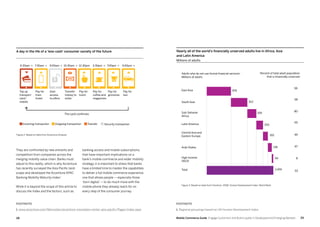
Nearly all of the world’s financially unserved adults live in Africa, Asia
and Latin America
Millions of adults
East Asia
Adults who do not use formal financial services1
Millions of adults
South Asia
Sub-Saharan
Africa
Latin America
Central Asia and
Eastern Europe
Arab States
High Income
OECD
Total
Figure 3: Based on data from Honohan. 2008: Human Development Index: World Bank
Percent of total adult population
that is financially unserved
59
58
80
65
49
67
8
53
876
612
326
250
193
60
2,455
136
FOOTNOTE
1. www.accenture.com/Microsites/accenture-innovation-center-asia-pacific/Pages/index.aspx
FOOTNOTE
1. Regional groupings based on UN Human Development Index
Figure 2: Based on data from Accenture Analysis
A day in the life of a 'less-cash’ consumer society of the future
6.30am >
Top up
transport
card/
mobile
Pay for
train
ticket
Gain
access
to office
Transfer
money to
sister
The cycle continues
Incoming transaction Outgoing transaction Transfer Security transaction
Pay for
lunch
Pay for
coffee and
magazines
Pay for
groceries
Pay for
taxi
7.30am > 9.00am > 10.30am > 12.30pm 3.30pm > 7.00pm > 9.00pm >
3130 Mobile Commerce Guide Engage Customers and Build Loyalty in Developed and Emerging Markets
In the view of Accenture, as the balance
shifts from cash to contactless payment,
banks operating in Asia Pacific have a
unique but fleeting opportunity to extend
their reach across the entire socio-economic
spectrum and position themselves at
the heart of these ‘less cash’ consumer
societies and retail value chains of
the future. Which value segments and
audiences each bank pursues will depend
on the opportunities available in their
markets and their own ability to compete.
Unbanked opportunities
While economic growth across Asia Pacific
has been dramatic, the GSMA reports1
that
2.5 billion adults, just over half of world’s
adult population, are unbanked, meaning
they do not use formal financial services
to save or borrow.
These unbanked populations have quite
basic needs,which first-mover banks such
as Dutch-Bangla Bank in Bangladesh are
meeting with mobile banking services that
include airtime top-up,cash-in,cash-out,utility
payment and remittance — to name a few.
In markets such as China, Indonesia,
Malaysia and the Philippines, where there
is a large population of migrant workers,
the unbanked have a particularly strong
demand for mobile banking services that
allows mobile money transfers within and
across national borders.
Interestingly, this is also a space where
mobile operators, such as Ooredoo, have
a huge opportunity because their footprint
allows them to facilitate remittances on
a large scale. However, that is the catch.
Mobile operators that want to target the
unbanked will not want to do it as single
operators. They will want to do it as part of
a kind of ecosystem so they can benefit from
sharing infrastructure and best practices.
New mindset
Significantly, banks have the capabilities mix
— and the corporate DNA, to extend their
services to the world’s unbanked. However,
not all have the proper mindset for the task.
The unbanked are not unbanked because
they don’t work or earn money. In many
cases, the unbanked lack a residential
address, or fail to earn a salary that covers
the fee structure offered by most banks,
and discourages small deposits. However,
mobile allows economy of scale, increasing
reach and lowering costs and allowing banks
to generate revenues by serving a large
volume of low income customers.
Here the expectation is that the mobile
wallet will evolve to drive financial inclusion
by creating a mobile marketplace where
the unbanked can buy goods and services,
as well as access financial products, such
as insurance, that will allow them to plan a
secure and stable future.
Financial inclusion will also make it much
easier for governments and NGOs (non-
governmental organizations) in developing
markets to disperse aid and so push money
to the mobile wallets of the poor. There is
also a knock-on benefit for NGOs — and
banks that choose to grasp the opportunity
— to provide microfinance. Loans and
credit extended to the poor will not only
help improve their lives; the wealth created
will increase overall GDP and inject new
dynamism into local economies.
Clearly, the role of mobile in these markets
is to facilitate payments. However, it has the
powerful potential to transform entire econ-
omies. In some regions, such as Bangladesh,
it is possible to glimpse that future today.
However, this progress also raises a
question mark over the future role of banks
in enabling commerce in unbanked markets.
While many banks are no doubt defining
the course of mobile commerce, acting as
the ambassadors of mobile commerce, it
is a herculean task that not every bank can
master. Besides, many banks are not able
— or willing — to offer additional services to
encourage commerce at the bottom of the
pyramid. They prefer to focus on serving
Banks have a limited time to master
the capabilities to deliver a full mobile
commerce experience, one that allows
people — especially those ‘born digital’
— to do much more with the mobile phone.
FOOTNOTE
1. www.microfinancegateway.org/gm/document-1.9.40671/25.pdf
3332 Mobile Commerce Guide Engage Customers and Build Loyalty in Developed and Emerging Markets
the customers at the high-end with large
deposits and high-end devices.
Certainly, the banks, with the exception of
those institutions dedicated to driving
financial inclusion, will likely not be among
the legends in the business. Put simply, most
banks are in the business of making money —
and they have a huge learning curve to travel
before they can serve the poorest of the poor.
New entrants, challenges
Driving mobile commerce requires the
grit and the power to roll services out to a
customer base of 100 million customers and
more. It also demands that the company
undertaking this is not measured by the
same KPIs applied to financial institutions.
Therefore, it is quite probable that large
organizations — such as mobile operators,
governments, NGOs or even large petro-
leum companies — will have the resolve
to accept this challenge and drive the
transformation of commerce.
And we should not rule out the potential
of new entrants to stake their turf in the
global mobile commerce space. Banks may
have dominated with banking and payment
services, but many will soon find themselves
struggling to keep up.
Mobile operators are joining together, and
some are teaming up with card issuers,
such as Visa and MasterCard to offer NFC
and mobile wallet services. At the other end
of the spectrum e-money providers such
as PayPal and Singapore-based NTS and
Korea Smart Card Company, which provides
T Money, are capitalizing on their strong
presence in certain local markets.
Finally, transport companies are also taking
advantage of easy access to customers at
the point of sale to offer mobile payment
services. Hong Kong’s Octopus card,
launched by a local transit company
joint venture to facilitate fare payment on
the city’s mass transit system, is a good
example. The Octopus card has since spread
its tentacles to capitalize on growing demand
for contact-less payments in other areas
of consumer life. Today, this rechargeable
stored-value card can be used to pay for
parking and fares on all modes of transport,
and is accepted by many retailers, including
fast food restaurants and supermarkets.
And there other scenarios, enabled by
new technologies, that are poised to move
commerce to the realm of machines. If we
consider the interactions that lead those
‘born digital’ to an actual purchase, we
begin to see a path that takes them from
one ‘machine’ to another. A typical scenario
could look something like this: The digital
native watches Smart TV, using the app
from the relevant app store to purchase
the item they see on TV using their mobile
phone. For that transaction there doesn’t
really have to be a full-fledged digital wallet;
there only needs to be technology in the
background that can ‘see’ the machine-
to-machine operation between the TV and
the mobile phone and relate this to the
customer and CRM.
Although cash is unlikely to be eradicated
completely in the foreseeable future,
the gradual movement toward electronic
currencies and virtual transactions is
edging us ever closer to a ‘less-cash’
society for both consumers and industry.
All indicators suggestAsia Pacific may be first
to fully embrace Mobile Life.Now it is up to
companies across this emerging ecosystem
to adapt to the fast-paced nature of mobile
technology and secure their position in this
increasingly competitive mobility landscape.
Pradipto Pal is responsible for driving
Accenture’s Mobility footprint in Asia across
different industry groups and business
functions. He charters new Mobility solution
offerings and builds assets by cultivating
an ecosystem of leading software vendors.
3534 Mobile Commerce Guide Engage Customers and Build Loyalty in Developed and Emerging Markets
At the Money2020 Conference,
much of the discussion centered
on various types of mobile pay-
ment schemes, from person-to
-person fund transfers to digital
wallets that allow a mobile phone
to be used in place of a payment
card or cash.
It soon became clear that most of these
mobile payment schemes were dependent
to one degree or another on merchant-
funded offers to finance their operation.
In our opinion, the simple replacement
of a payment card with a phone does
not provide enough value to persuade
the average consumer to switch to mobile
payments. While mobile payments do have
advantages over payment cards and cash,
there is a learning curve and switching costs
that inhibit adoption. Therefore, consumers
must have a powerful incentive to try the
new technology.
As it happens,“daily deals” programs such
as Groupon and Living Social have already
provided an example of the sort of incentive
that merchants are willing to finance: a
coupon worth 50 percent of the value of
a purchase of a certain size. The value of
these incentives far exceeds what payment
card issuers have traditionally been able to
offer based on merchant payment card fees
(typically 1 percent or less of the value of a
purchase), and even those minimal rewards
have provoked a class-action lawsuit and
major legislation.
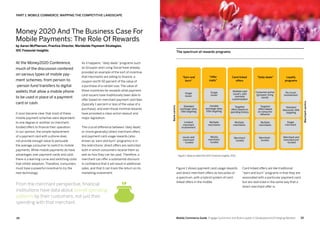
The crucial difference between ‘daily deals,’
or (more generally) direct merchant offers
and payment card usage rewards (also
known as ‘earn and burn’ programs) is in
the restrictions: direct offers are restricted
both in which consumers receive them as
well as how they can be used. Therefore, a
merchant can offer a substantial discount
in confidence that it will result in additional
sales, and that it can track the return on its
marketing investment.
Figure 1 shows payment card usage rewards
and direct merchant offers as two poles of
a spectrum, with a hybrid system of card-
linked offers in the middle.
Card-linked offers are like traditional
“earn and burn” programs in that they are
associated with a particular payment card,
but are restricted in the same way that a
direct merchant offer is.
Money 2020 And The Business Case For
Mobile Payments: The Role Of Rewards
by Aaron McPherson, Practice Director, Worldwide Payment Strategies,
IDC Financial Insights
From the merchant perspective, financial
institutions have data about overall spending
patterns by their customers, not just their
spending with that merchant.
PART 1: Mobile Commerce: Mapping The Competitive Landscape
The spectrum of rewards programs
Figure 1: Base on data from IDC Financial Insights, 2013
Standard
exchange rates,
little targeting
Limited
merchant
involvement
issuer and
merchant
- funded
Variable
exchange rates,
little targeting
Multiple
merchants
Mostly
merchant-
funded
Targeted
offers based on
spending history
Multiple
merchants
Merchant-
funded
Targeted
offers based
on consumer
behavior
Multiple
merchants
Merchant-
funded
Standard
discounts, little
targeting
Single
merchant
Merchant and
manufacturer
-funded
Merchant-centric
Bank-centric
“Earn and
burn”
“Offer
malls”
Card-linked
offers
“Daily deals” Loyalty
programs
Single
issuer
Multiple card
issuers, with
cosmetic
customization
Consumer portal
(groupon, living
social)
No issuer
involvement
Single
issuer
3736 Mobile Commerce Guide Engage Customers and Build Loyalty in Developed and Emerging Markets
Benefits
The main benefit of a card-linked offer for
a card issuer is the additional revenue it can
provide in the form of a commission from
the merchant (or more accurately, from an
offer syndication network). This revenue can
not only offset legally-mandated reductions
in overdraft and interchange revenue, but
can provide funding to support mobile
payment services.
From the merchant perspective, financial
institutions have data about overall
spending patterns by their customers, not
just their spending with that merchant. This
allows more precise delivery of customer
acquisition offers than is possible through
direct mail or advertising.
Considerations
At the Money2020 conference, there was
considerable controversy about the card-
linked offers model, for several reasons:
•	 Both financial institutions and merchants
had concerns about their customers’ data
being used in ways contrary to their inter-
ests; for example, financial institutions
feared reputational damage if a merchant
failed to fulfill an offer, while merchants
worried about their data being used to
generate competitive offers.
•	 Financial institutions are sensitive
to charges that they are selling their
customers’ financial data, so the
programs have to be clearly
documented and presented on
an ‘opt-in’ basis.
•	 Merchants are still uncertain about the
value of card-linked offers, since they do
not have much experience with them, and
there are many competing programs with
different terms and conditions.
•	 Both sides see mobile payments as an
opportunity to increase their influence
over consumer purchasing behavior, and
perceive any increase in influence by one
side as a loss of influence by the other.
•	 Merchants believe that the current payment
card system costs them more than it
benefits them,and are anxious to prevent
financial institutions from re-creating this
situation in the mobile context.
Overcoming these concerns will require
both sides to proceed cautiously but
deliberately in order to establish trust and
a common understanding of the value of
personal financial data.
Conclusion
Financial institutions need to more effectively
leverage the consumer data that is locked in
their debit and credit card products so that
they can obtain new revenue streams and
reduce their reliance on interchange and
overdraft fees. Doing this will require a new
willingness to actively partner with retailers
to drive new business to their stores. While
financial institutions obviously do this today,
transaction-based marketing requires that
they redefine their customer relationship
goals from‘ownership’to influence. The more
a financial institution increases its influence
over its customer’s economic decisions,
the more it will secure its own position.
In addition, the financial institution will
gain more influence over the retailers and
manufacturers with which it does business,
helping to offset the commoditization of
business banking.
Adapted from “Business Strategy: The Strategic Opportunity in
Transaction Marketing Programs”
Copyright Notice
The analyst opinion, analysis, and research results presented in this
IDC Financial Insights Executive Brief are drawn directly from the
more detailed studies published in IDC Financial Insights subscription
services. Any IDC Financial Insights information that is to be used in
advertising, press releases, or promotional materials requires prior
written approval from IDC Financial Insights. Contact IDC Financial
Insights at 508-620-5533 to request permission to quote or source
IDC Financial Insights or for more information on IDC Financial
Insights Executive Briefs. Visit www.idc-fi.com to learn more about
IDC Financial Insights subscription, consulting, and Go-to-Market
services.
Copyright 2013 IDC Financial Insights. Reproduction is forbidden
unless authorized.
Since 2000, Aaron McPherson has led the
global payments research program at IDC
Financial Insights. Aaron writes and consults
with clients on a wide array of subjects,
including enterprise payments, financial
supply chain management, mobile and
emerging payments, card regulation and
international payments.
The more a financial institution increases its influence
over its customer’s economic decisions, the more it will
secure its own position.
3938 Mobile Commerce Guide Engage Customers and Build Loyalty in Developed and Emerging Markets
As banks across the region are
warming to mobile apps, strategies
and offerings are becoming con-
siderably more ambitious. Some
are releasing apps full of features
and functionality to impress cus-
tomers and achieve differentiation;
others are seeing the opportunity
to develop a mobile app strategy
as a chance to revamp their overall
presence via the mobile channel.
And let’s not forget the vast
populations of unbanked or under
banked who do not have access
to a smartphone. No matter the
approach, and the bank taking it,
it's clear that the endgame is
about enabling financial services
that harness mobile to deliver
real benefits to all customers.
Throughout 2012 mobility continued
to be a key area of focus for financial
institutions in Latin America, with
smartphone apps emerging as the
preferred channel for banks seeking to
project a more sophisticated image. In
fact, banks enthusiastically embraced
smartphones’ inherent advantages
despite the reality that a vast majority
of the population still relies on feature
phones with limited data capabilities.
Due to the growing proliferation of
both Android and iOS devices, coupled
with mobile network operators’ offers
of compelling monthly plans, banks
increasingly saw mobile apps as a way
to drive mobile banking adoption and
create differentiated brand and service
offerings. This mobile app phenomenon
held true for leading financial institutions
throughout the Latin American region,
where it was treated as a priority, more so
than targeting the unbanked populations.
That said, rural banks and the majority
of microfinance institutions continued to
offer rudimentary mobile banking services
that leveraged the SMS channel. Mass
market-focused financial institutions,
such as Davivienda in Colombia and Caixa
Econômica in Brazil, also proved to be
the exception, targeting the unbanked
with mobile wallet solutions.
Apart from the proliferation of
smartphones, other factors that drove,
and will continue to drive, banks’
interest in mobile apps include security
considerations, the general lack of a viable
USSD alternative, and the penchant of
mobile operators to dramatically increase
the cost of SMS messages. In some
countries banking regulators’ insistence
on the use of a second authentication
mechanism (2FA), in some cases
involving IVR callback, for SMS banking
transactions caused financial institutions
to appreciate the benefits associated
with offering banking via the mobile app.
PART 1: Mobile Commerce: Mapping The Competitive Landscape
Mobile Commerce And Financial
Institutions In Latin America:
An Evolving Ecosystem
By Mary A. Gramaglia, Director of Sales, Latin America, Mobile Commerce, SAP
Requirements to leverage
location-based services
have grown substantially
and it is not uncommon to
see marketing campaigns
emphasize the importance
of social media integration.
4140 Mobile Commerce Guide Engage Customers and Build Loyalty in Developed and Emerging Markets
Despite the challenges, as banks continue to
place significant emphasis on mobile apps,
service offerings are becoming considerably
more ambitious. Requirements to leverage
location-based services have grown
substantially and it is not uncommon to
see marketing campaigns emphasize the
importance of social media integration.
Many banks leverage the channel to cross-
sell new products and give consumers
the opportunity to apply for, and receive,
on-the-spot credit line increases. Mobile-
app-enabled person-to-person transfers
leveraging consumers’ Facebook contacts
are also gaining traction.
In countries ranging from Costa Rica to
Chile, interest is growing in enabling card-
less cash-out at ATMs so that consumers
who receive funds via P2P transfers, but
who are not existing bank customers, can
still gain access to their funds via ATM
networks. Some services, such as remote
deposit capture, a popular feature in the
U.S., have been absent in Latin America.
This is due to regulation that does not
permit virtual deposit of a physical instru-
ment, and not because of a lack of interest
on the part of either banks or consumers
Different approaches
gain traction
With the widespread focus on mobile apps
among many banks who had previously not
emphasized the channel, leading banks such
as Brazil’s Banco Itau and Banco de Chile
— who were at the forefront in deploying
mobile banking apps — are now re-visiting
their strategy around how applications can
best be used to maintain differentiation and
deal with escalating costs associated with
realizing ambitious plans.
Use of a hybrid container approach for
application deployment has gained traction
as banks seek out vendors with broad
product offerings in an effort to control costs
associated with customization. Ambitious,
feature-rich offerings are being planned
in multiple phases as banks try to quickly
make available differentiated mobile apps
they can steadily expand and improve upon.
In the midst of all the attention given to
the importance of a more sophisticated,
app-driven presence, has come the realization
for the region’s banks that, for the most
part, the mobile channel remains one that
is not easily monetized. The mobile channel
was originally seen as a means for reducing
costs, and only recently, as a new way to
help banks increase revenue through
cross-selling products. In the card-less
ATM cash-out option, banks with significant
physical presence are seeking to reinforce
that differentiation through seamless
integration with their mobile offerings.
Internet banking offerings are being
similarly re-examined, with many
banks convinced that superior mobile
solutions will highlight deficiencies in their
online presence. During 2012 it was not
uncommon to see the region’s financial
institutions launch Internet banking projects
inconjunctionwith,orinparallelto,app-focused
mobile projects. While the majority of initia-
tives had the consumer in mind, during the
past year Latin American banks increasingly
sought to target corporate customers with
enhanced, integrated Internet banking and
app-driven mobile solutions.
With the mobile momentum continuing its
push throughout the region we can expect a
variety of trends to accelerate in the coming
years. Banks facing limited budgets and the
possibility that their IT teams may not be
able to manage increasingly sophisticated
mobile offerings are expected to opt for
SaaS solutions. This will particularly be
the case in the smaller countries of Central
America, where actual numbers of mobile
users are quite low and banks find it hard
to justify significant mobile app related
expenditures and the ongoing effort
required to maintain them.
The reverse will also be true. In those
countries such as Colombia and Argentina,
where outsourced mobile banking solutions
are already in place, local providers
(Redeban and Banelco, respectively) will
be challenged to remain relevant in increas-
ingly competitive, mobile app environments,
in which differentiation will be key. There are
also those financial institutions affiliated
with a strong retailer – such as Chile’s
Banco Falabella and its sister department
store chain Falabella, and Mexico’s Elektra,
which shares the same corporate owner
as Banco Azteca – that will re-imagine the
mobile opportunity by leveraging these
relationships to develop mobile commerce
ecosystems that expand mobile banking
offerings to include point-of-sale purchases
and encourage customer loyalty.
Requirements to leverage location-based services
have grown substantially and it is not uncommon to
see marketing campaigns emphasize the importance
of social media integration.
4342 Mobile Commerce Guide Engage Customers and Build Loyalty in Developed and Emerging Markets
Overall, mobility is likely to take different
forms depending upon a bank’s level
of ambition in the channel, desire for
differentiation, size of actual and targeted
market, and available budget. What is
certain is that Latin American banks will
increasingly perceive the mobile app as a
key tool for reaching customers now and
in the years to come.
Mary A. Gramaglia is responsible for driving
sales of the SAP’s mobile banking, mobile
payments and online banking solutions in
Mexico, Central and South America and the
Caribbean. She has extensive international
experience in both the telecom and financial
services sectors and has worked in sales,
marketing and business development for
a broad range of blue-chip companies
that includes Lockheed Martin, Sprint
International and Citibank.
Latin America and the Caribbean
region (LACA)1
, has been one of
the last regions to get swept up
by the mobile money phenomenon.
Within this region, Mexico and
Brazil are the two largest countries,
both classified as ’Advanced
Emerging’. While Brazil was the
first country to introduce branch-
less banking on a large scale,
Mexico is now poised to transform
financial services through the new
mobile accounts. In this article,
we analyze the similarities and
contrasts, which are useful in
understanding how digital money
initiatives are unfolding in the region
in 2013.The analysis is based on the
continuously updated Digital Money
SAGE knowledge base, and the Shift
Thought Digital Money Series.
Although Mexico has done much to bring
down the costs of remittances from the
U.S., the financial crisis is now affecting the
volumes. Remittances fell by 1.5 percent in
2012 as compared to 2011, with December
2012 marking the sixth consecutive month
of reduction. Meanwhile Brazil, though
relatively unaffected by rising unemployment
in the U.S., does feel the pinch through the
effect on its major trading partner, China.
For Brazil, domestic and regional money
transfers are bigger drivers than in Mexico.
What is common though is that in both
these countries digital money innovations
stand poised to deliver value to mass
markets and, in particular, small enterprises,
which currently drive innovation and
recovery around the world.
Since 2007, when M-Pesa Kenya became
the wallet that launched a 100 others,
Latin American countries largely remained
an untouched “black spot” in the mobile
money revolution. So it is really interesting
to see the picture changing now.
PART 1: Mobile Commerce: Mapping The Competitive Landscape
Digital Money Sweeps Mexico
And Brazil
By Charmaine Oak, Practice Lead, Digital Money, Shift Thought
FOOTNOTE
1. LACA here refers to Latin America (all of the Americas south of the USA) and the Caribbean
While the majority of initiatives had the
consumer in mind, during the past year
Latin American banks increasingly sought to
target corporate customers with enhanced,
integrated Internet banking and app-driven
mobile solutions.
4544 Mobile Commerce Guide Engage Customers and Build Loyalty in Developed and Emerging Markets
Over 2013, Pakistan, Bangladesh, India,
Nepal and many other countries in
Asia Pacific are rapidly reducing the
‘leakage’ in reaching money to the poorer
population. Mexico is poised to do the
same with knock-on effects on both North
and South. Looking north, the change
in the way remittances are disbursed in
Mexico is tipping the balance from cash-
to-cash operators to new entrants like
Xoom. Looking south, towards Central
and South America, if Mexico does for
its domestic money transfer what it did
for the international remittances, a lot
of other countries are likely to follow
with a cookie cutter approach based
on these recent developments.
Key enablers
Mexico has already achieved remarkable
transformation in one area. It managed
to bring down the average cost of
remittances from the U.S. to Mexico to just
US$5.57, as against US$11.95 from the
U.S. to Brazil1
. This was achieved through
remarkable collaboration with the U.S.
and implementation of direct-to-account,
highly competitive services for migrant
transfers. This is significant as Mexico is
the fourth largest recipient in the world.
But even more transformative could be the
next set of changes that unfold over 2013
and affect the way money is transferred
domestically, and in the region.
The driving force behind taking banking
services to the masses is the remarkable
ruling from Mexico’s Ministry of Finance,
requiring all Opportunidades2
payments
to be deposited direct to bank accounts
by December 2012.
Considering that as recently as 2011, over
66 percent were paid in cash, this seems
an incredible feat to expect. However, the
new mobile accounts that are allowed
since mid-2012 are the key enablers that
make this possible. Also, Brazil is a shining
example, having earlier achieved a
transformation to non-cash payments,
so that a mere 1 percent are now paid
in cash through Bolsa Familia, the social
cash transfer scheme equivalent to
Mexico’s Opportunidades.
Another key driver towards the transition
to non-cash payments in Mexico comes
from the Mexican Finance Ministry,
Secretaría de Hacienda y Crédito Público
de México (SHCP). This is by way of anti-
money laundering (AML) regulations that
restrict the amount of physical U.S. Dollars
that can be deposited in Mexican banks, in
an attempt to control money laundering.
It is important to compare the access
that markets in Mexico and Brazil have
to channels and financial services, in
order to understand the need for digital
money initiatives.
Figure 1 compares access channels
available for outreach in each country.
Brazil is already feeling the pain of the
mobile operators in developed countries,
with mobile penetration reaching historic
highs. Mexico, however, still has some
Access channels in Mexico and Brazil
Brazil
Mexico
255
91
82
43
203
115
92
25
InternetMobileBankedPopulation
Figure 1: Based on data from The Shift Thought Digital Money SAGE
What has been labeled as ‘elitist banking’ from foreign banks
that dominate the financial services scene in Mexico leaves
a gap, sought to be filled by the entry of large retailers.
FOOTNOTE
1. World Bank Remittance Prices, Third quarter 2012
2. www.oportunidades.gob.mx/Portal/wb/Web/oportunidades_a_human_development_program
4746 Mobile Commerce Guide Engage Customers and Build Loyalty in Developed and Emerging Markets
way to go to put a mobile into the hand
of every person. While online payments
have taken off in Brazil, it is mobile that
has the real potential in Mexico due to
the paucity of Internet connections.
Payments and ecosystems
More importantly, what has been labeled
as ‘elitist banking’ from foreign banks that
dominate the financial services scene in
Mexico leaves a gap, sought to be filled
by the entry of large retailers. Financial
services with a new business model are
now available from large retail groups
that have set up banks in Mexico. Banco
Wal-Mart and Banco Azteca encourage
people to bank-while-they-shop. There are
also a number of initiatives underway to fill
the gap left by a paucity of ATMs and POS.
Brazil, however, has successfully used the
banking correspondent route to create strong
bank outreach and widespread availability
of POS machines. It has also put debit cards
in the hands of lower income consumers.
Now Mexico aims to follow that path, through
the use of non-bank agents. Since 2008
Mexico has allowed banks to use agents,
and since 2010, mobile operators can be
the agents for banks. However, concern
arises from the dominance of a few players,
not unlike the situation in the banking side.
From Figure 2, it is clear that América
Móvil owned Telcel, and to a lesser extent
Telefónica, could have economies of scale
from existing top-up agreements to build
new agent networks that may further
skew their advantage in the marketplace.
Comparatively, the Brazil mobile market is
much more evenly distributed between the
top four players, as can be seen in Figure 3.
Nature of services
So, the need for the new mobile accounts
in Mexico is there. But how fast will the
services achieve traction? Do the new
services have characteristics that can
transcend long established business models
of the providers and truly deliver value that
attracts daily use? To answer this requires
an analysis of the services as they unfold.
One of the earliest to be announced was
Transfer, the joint venture launched in
Nextel (NII) 4%
Nextel (NII) 2%
Others 0%
Telcel (America Movil)
69%
Vivo (Telefonica)
28%
Telecom Italia (TIM)
25%
Lusacell 4%
Oi (Telemar) 20%
Movistar (Telefonica)
23%
Claro (America Movil)
25%
Indicative market share - Mexico
Indicative market share - Brazil
Figure 2: Based on data from the author
Figure 3: Based on data from the author
4948 Mobile Commerce Guide Engage Customers and Build Loyalty in Developed and Emerging Markets
October 2011 by Citi Group and América
Móvil. Through Telcel, América Móvil
controls close to 70 percent of the mobile
connections in Mexico. América Móvil,
through the Claro brand, is also a dominant
player in Latin America. América Móvil has
stated ambitions of converting 9 percent
of its base to mobile banking by 2012.
The other significant joint venture is
Wanda, the brand announced in February
2012 for the Movistar-MasterCard initiative
earlier announced in January 2011. The
Telefónica Movistar brand has more than
100 million customers in 12 countries in
Latin America.
In Brazil the joint venture targets 65 million
Vivo customers with a mobile wallet. It will
offer an alternative approach to Paggo from
Oi, a relatively simple mobile credit card
SMS-based payment service supported
by an OTA downloadable SIM application.
But where there is a wallet there must be
cash in-cash out agents, and this is where
the retail sector comes in. When the world’s
largest retailer is also a bank, as in the case
of Mexican Banco Wal-Mart, it adds a whole
new dimension for offering value bundles
to the consumer. Further advantage stems
from the availability of better consumer
insights, loyalty offers and the creation
of multiple revenue streams.
Unsurprisingly then, there are interesting
partnerships developing involving players
from the banking, mobile and retail industries.
One of the most important of these is the
launch in Mexico of mobile accounts by
BBVA Bancomer and Coca-Cola Femsa,
the largest soft drinks manufacturer in
Latin America. Through the Coca-Cola
chain store Oxxo, branchless banking
services can now be offered to support a
range of services including money transfer,
bill payment, prepaid mobile recharge and
in-store payment.
What lies ahead?
In the competition that is developing in
each of the markets, it seems the retail
payments outreach in Mexico and Brazil
could start to become more alike. Mexico
stands to benefit with more points of
transaction, ATMs and point of sale devices,
while implementing agency models already
prevalent in Brazil. As prepaid cards
become the ‘mobile accounts’ in Brazil,
consumers stand to gain by getting more
control when they manage them via their
mobiles. This will supplement the debit card
services currently offered with the low value
accounts. Altogether, there promises to be
a great deal of learning for Latin America,
and indeed the world, from the services
rolled out in these two markets over 2013.
The devil lies in the detail, and in the process
of our continuous analysis of digital money
initiatives covering more than 32 services
around the world, one thing we at Shift
Thought have learnt is that no two markets
are alike. Ultimately, there is no substitute
for taking the time to understand each, in
terms of the history and ecosystem, in
order to have a better chance of delivering
appropriate services and staying relevant.
Charmaine Oak brings a unique perspective,
having contributed to the global development
of digital money through the leading money
transfer company Western Union, a leading
bank (Royal Bank of Scotland), a global
mobile operator (Orange FT), LogicaCMG
(the pioneer in SMS) and Wipro a leading
IT provider. Her area of expertise is in
mapping opportunities in digital money and
providing consulting services based on Shift
Thought’s Digital Money SAGE technology.
Digital money innovations stand poised to deliver value to
mass markets and, in particular, small enterprises, which
currently drive innovation and recovery around the world.
5150 Mobile Commerce Guide Engage Customers and Build Loyalty in Developed and Emerging Markets
Smart banks are winning customers by putting
them in control of their experiences and the
channels that deliver them. Some banks are
achieving this through advanced analytics that
will allow them to enhance products, personalize
service bundles and respect customers’ rising
requirements for visibility into all their accounts
on their terms. Others are leveraging ordinary
smartphone apps to achieve extraordinary
results. At the other end of the spectrum, banks
are delighting customers and keeping them loyal
by delivering services that deliver convenience
and utility. We bring together the key learnings
offered by banks (RBS Citizens, First Tennessee
Bank) and industry authorities to provide
guidance as you map a multi-channel strategy
that removes friction and boosts engagement.
PART 2: Banking In Developed Markets: Taking Charge Of Change
PART 2:
BANKING IN DEVELOPED MARKETS:
TAKING CHARGE OF CHANGE
5352 Mobile Commerce Guide Engage Customers and Build Loyalty in Developed and Emerging Markets
Out with the old and in with the
new. The 'old school', which was
all about pushing one-size-fits-all
marketing and offers at customers,
does not resonate with the customer
of today. It’s the customer that
now has all the power and access
to technology, so the 'new school'
is about winning these customers
by giving them control of their
experiences 24/7/365 days
through the channels of their choice.
To make this transformation possible
most Banks must change their
operating model, and generate
customer-centric insights through
advanced analytics that will allow
them to enhance products,
personalize service bundles and
respect customers' rising
requirements for visibility into all
their accounts on their terms.
In decades past banks were in quite an
enviable position. The power of control
was with the bank, and customers adapted
their schedules to make visits only during
banking hours, accepted bank fees and
pricing driven by internal KPIs, not individual
needs. Customers avoided switching banks
because they had limited access to which
products were on offer with the competition
unless they actually visited those banks.
Fast forward, and the shift of power has
moved 360 degrees, and customers are
increasingly in control. Always-on, always-
connected, these empowered consumers
are doing their banking whenever and
wherever they want. Customers also have a
desire for more visibility and more services.
As a result of this power shift and the fact
banks are being forced to service customers
at a lower cost, physical branch banking is
in decline. It will soon join 'one-size-fits-all'
marketing and advertising on the scrapheap
of outdated business models that have failed
to accept today's hard truth: consumers
want what they want the way they want it.
Increasingly, banks are seeing a clear
shift from physical to digital channels.
In fact, Citibank has reported that
95 percent of all transactions for Citi
in Asia occur outside a branch office1
.
But it's not just about flexibility in how
customers access information and advice.
Customers also want visibility into all
their accounts, a one-stop view into their
finances that will allow them to make
smarter decisions and manage their
money whether it’s related to their saving,
current, trading, or insurance account.
It's a demand banks must meet to remain
truly relevant in the 21st century.
(Re)build trust
Addressing the requirement that customers
have unique needs that merit attention
also sends a strong signal that banks are
resolved to serve their customers better.
This is critical at a time when trust in banks
is at an all-time low, especially after the
financial crisis and the continuing issues
we are seeing throughout Europe and
other parts of the world
From the allegations of mortgage fraud at
Deutsche Bank to news of rogue traders
at UBS, hardly a month in 2012 went by
that the financial services was not rocked
by scandal or a crisis in management. The
industry's reputation has suffered, and
now banks must work to rebuild trust.
This is one of the key takeaways offered by
the 13th annual Edelman Trust Barometer2
.
The report, based on a survey of more
than 31,000 respondents in 26 markets
around the world, measures public trust in
institutions, industries and governments.
Specifically, the Trust Barometer shows
a steep decline in trust in banks from
56 percent in 2008 to 45 percent in 2013.
What can banks do to regain their footing
and restore trust? While there are no simple
answers here, the Trust Barometer stresses
that all industries and governments face the
same task and suggests that 'trust building'
attributes are clustered around actions that
encourage engagement.
Banks: Evolve, Innovate And Embrace
‘True Multichannel’, Or Be Left Behind
By Simon Paris, Global Head of Financial Services Industries, SAP,
and Matthew Talbot, Senior Vice President, Mobile Commerce, SAP
PART 2: Banking In Developed Markets: Taking Charge Of Change
FOOTNOTE
1. www.theasianbanker.com/press-releases/citi-mobile-clients-top-one-million-mark-in-
asia-pacific-region
2. www.edelman.com/trust-downloads/press-release/
5554 Mobile Commerce Guide Engage Customers and Build Loyalty in Developed and Emerging Markets
Breaking barriers
Listening to (and responding to) customer
needs, acknowledging customer feedback
(positive and negative) via social
media and offering solutions that help
customers in planning their financial
futures are items that top the agenda for
banks in both developed and developing
markets. Many CEOs today talk about
‘customer centricity’ as a key focus.
Banks must be more customer-centric
and trade-in their outdated product-oriented
processes and legacy systems for holistic
approaches that address individual needs,
and encourage consumers to invest more
of their wallet
Clearly, building the right backbone
and capabilities to enable multi-channel
banking is key, especially as many banks
are restricted in what they can change in
the core due to the cost and ‘heart surgery’
involved. It is not about implementing silo
solutions that allow customers to conduct
banking regardless of their preferred
platform. This approach may bring the
customer in, in the short term, but it does
not address the problem at its roots.
Voice, ATMs, mobile phones, smartphones,
mobile apps, tablets, PCs, personal
navigation devices, games consoles —
and the list goes on. Banks must not only
implement new channels, but they must
also develop solid cross product integration
to achieve consistency across all customer
touch points. Success means a true multi-
channel architecture that also provides
a consistent 360-degree view of the
customer and the various lines of business.
In many cases we have observed first-hand,
banks have jumped on the mobile app
bandwagon, adding mobile as just another
digital channel. While some banks have
built bespoke applications and platforms
that enable banking and other extremely
valuable services using technology
like location-based services, there is
no underlying platform in place to give
banks a consistent user interface or
360-degree view of the customer and
products across all platforms.
Our experience shows this is a flawed
approach that breeds yet more siloed
channels and adds additional costs and
strain to the banks, which they cannot
continue to justify or support. It results
in a fragmented and inconsistent view of
the customer across products and lines
of business. For one Asia-based bank this
approach is now costing it tens of millions
of dollars to just support the release of
new mobile applications!
What’s worse, underestimating the need
for customer data to be accessible and
integrated through all channels may ultimately
cost banks competitive advantage.Their
decision to build on top of the legacy
systems, rather than take the necessary
steps to integrate all channels, leaves the
door open to new entrants and online giants.
Google, Apple, Facebook and Amazon
are just a few of the companies moving
full-speed ahead on aggressive customer-
centric strategies, aimed at piecing together
the clues customers leave behind across all
channels (profiles,preferences,past purchases,
browsing patterns), develop a single view
of the customer and drive commerce with
personal and relevant offers. And there
are other payment companies and mobile
operators that also aspire to take a bigger
chunk of the wallet, and they do not have
‘legacy’ systems to weigh them down.
5756 Mobile Commerce Guide Engage Customers and Build Loyalty in Developed and Emerging Markets
Ironically, banks are very well equipped to
deliver customers more relevant (hence
valuable) bundles of products and services
provided they take steps to become the
authoritative source of consistent customer
data across all channels. The ability to move
from a one to 1000 offer to customer to a
1:1 offer can become reality with the right
architecture in place.
Bright spots
Fortunately, many banks are now seeing
the opportunity ahead. They are competing
smart, armed with comprehensive strate-
gies that harness multi-channel banking
to satisfy customers and grow their
business. We are seeing this with some of
the Tier 1 banks in Australia, including ANZ,
and the Commonwealth Bank of Australia,
as well as in banks across North America
and Europe. This change though is not just
evident in developed markets, it is also
happening in developing markets like
South Africa and Bangladesh.
Standard Bank in South Africa, one of our
core banking partners, is one of the most
innovative banks in the world. The growth
they have seen around ‘Inclusive Banking’
is centered on a multichannel approach.
From offering customers remote account
opening in the field, hundreds of kilometers
from the nearest physical bank, to creative
services like ‘funeral plans’, Standard Bank
is pushing the boundaries around customer
centricity by embracing multichannel.
In a country where over 85 percent of the
population has a mobile phone, the
digital channel is critical for its future.
Another customer Dutch-Bangla Bank
Limited (DBBL) is among the pioneers in
mobile innovation. Some 87 percent of the
population in Bangladesh, a country with
a population of 160 million and a mobile
penetration rate of just around 60 percent,
do not have ‘official’ bank accounts.
Determined to drive financial inclusion
DBBL made the decision to harness
mobile, the channel the unbanked have
made an integral part of their lives.
In early 2012, DBBL launched a suite of
mobile banking services — and 12 months
later — it counted more than 1.2 million
new customers with 5,000 to 6,000 new
customers joining per day. These customers
have deposited more than $7.75 million
using the mobile banking platform, not
the legacy core banking system.
DBBL's suite of mobile banking services
use a technology platform that it currently
operates as a separate platform from its
core banking system. However, there are
plans underway to link these systems to
enable a single, integrated view of the
customer across all channels. The goal is
to use these insights to extend lending
services, in the form of microfinance, to
the unbanked and the underbanked.
In the more developed markets banks
increasingly see multichannel as an
essential step in a wider strategy to
add value (and encourage loyalty) by
providing offers that are completely
aligned with the needs of key customer
segments. It's all about winning the race
to power payments and commerce.
From coupons and vouchers, to location
-based services and proximity payments,
banks are taking advantage of advances
in technology to deliver on the promise
of one-to-one marketing. We are seeing
first-hand how many of our customers like
ATB Financial and CIMB in Canada and
RBS Citizens Bank in North America look
to use digital channels for new services
like QR code payments, remote check
deposit and location-based services.
To this end banks in North America, Europe
and Australia are adopting customer-centric
models that allow them to forge a new value
web with them at the center, a position they
can claim because they have begun to use
analytics to gain deeper customer insights
across all channels. Sharing this information
with merchants and other players — adhering
to personal privacy laws, of course — builds
a robust and sustainable business ecosystem.
It's a critical next step as the mobile phone
morphs into a mobile wallet to ultimately
become everyone's new portable and
personal point-of-sale.
Break away
The evolution of banking mirrors the evolution
of technology. IVR, ATMs, the Internet and
now mobile banking — each channel was
implemented as part of a wider strategy
to improve customer access to products.
In today's increasingly customer-centric
world this outdated approach short
changes both customers and banks.
Research shows that consumers demand
a single view into their accounts — and
every aspect of their relationship with the
bank — across all channels. This demand
Banks must be more customer-centric and trade in their
outdated product-oriented processes and legacy systems
for holistic approaches that address individual needs,
and encourage consumers to invest more of their wallet.
5958 Mobile Commerce Guide Engage Customers and Build Loyalty in Developed and Emerging Markets
will only grow as consumers embrace
digital channels to pay bills, conduct
commerce, purchase transport tickets
and manage their daily lives.
Will customers vote with their feet if banks
fail to offer them a single, consistent view
of their financial services? Let's just say that
the barriers to switching banks (or moving
to a new entrant that offers a helpful and
more holistic view of consumers'
transactions) will be quite low.
For banks, enabling a single and consistent
view into customer data on multiple
channels not only satisfies customers.
It also paves the way for them to generate
additional sales, enhance products, refine
pricing and improve CRM.
French writer Victor Hugo once famously
said, "There is nothing more powerful
than an idea whose time has come."
After decades of building on top of legacy
systems, the arrival of the digital channel
being led by mobile and the emergence
of the empowered consumer have come
together to create a new urgency for new
models. Banks must tear down the silos and
replace their product-driven mindset with a
singular and sincere focus on the customer.
Evolve or get left behind. It’s time for true
multichannel platforms.
Simon Paris leads SAP's end-to-end
footprint in the Financial Services Industries,
that today covers more than 5,700
customers. Previously, Paris served as vice
president at HP, where he was responsible
for the P&L of a US$17 billion division.
Matthew Talbot is responsible for mobile
banking, online banking, mobile consumer
payments and mobile inclusive banking.
Talbot joined SAP in 2004 via the acquisition
of Sybase Inc., where he played a key role
in developing the company’s mobile
commerce initiative. Previously, he was
based in Beijing and Sydney, as CEO
of Mobile Internet Group, a Wireless
Application Service Provider and publisher.
Business school dogma may dictate
that companies must consistently
exceed customer expectations to
beat the competition. But studies
show that delivering simple conve-
nience — not bells and whistles —
results in satisfied customers and
lasting loyalty.This is why RBS
Citizens has purposely chosen a
solid approach to mobile banking
that streamlines important decision
-making and removes the friction
from moving money.
Research suggests that mobile corporate
bankingisinitsinfancy.But,turnthatstatement
on its head, and it’s clear that there is also
a first-mover advantage for banks that
deliver the services customers appreciate
— and use — the most.
Indeed, a strong business case for mobile
corporate banking services exists, and
research, including a string of surveys
conducted by the Aite Group, sheds some
interesting light on what customers expect
— even demand — from their banks.
For example, a survey of 300+ treasury
executives conducted by the Aite Group
highlights key requirements that are just
as pertinent today as they were when the
research firm published them1
in 2010.
Among the findings: approximately two-thirds
of businesses would be at least “somewhat
likely” to perform basic transactions over
corporate mobile banking services in the
next 12 months, while 42 percent described
themselves as ‘likely’ or ‘very likely’ to do so.
More importantly, the Aite group found that
over half (56 percent) of survey participants
expressed interest in performing more
advanced functions, such as approving
transactions and initiating payments.
Fast forward, and these observations,
combined with the results of focus group
research conducted on behalf of RBS
Citizens, underlines the importance of
delivering mobile corporate banking
Removing Friction To Build
Relationships
By Scott Manley, SVP, Head of Product Delivery, Channel Treasury Solutions,
RBS Citizens
PART 2: Banking In Developed Markets: Taking Charge Of Change
It's all about winning the race to
power payments and commerce.
FOOTNOTE
1 www.aitegroup.com/Reports/ReportDetail.aspx?recordItemID=719
6160 Mobile Commerce Guide Engage Customers and Build Loyalty in Developed and Emerging Markets
services that allow decision-makers to
get more done faster using the smart-
phones and connected devices that have
already become part of their daily routine.
Mobile explodes
Obviously, mobile plays a central role, which
is why RBS Citizens launched accessMOBILE
in 2010, a mobile corporate banking offer
catering to the needs of commercial customers,
ranging from small businesses to large
corporations. It currently exists as an
iPhone application, allowing customers
to approve wires, make transfers and
check balances. In the next phase there
are plans to offer an Android app, as well
as a Web browser experience that works
for both Android and iPhone users.
Of course, the meteoric rise of tablets has
also had an impact on the mobile roadmap.
Research documents the massive increase
in tablet sales, showing that shipments have
more than tripled.
Against this backdrop, an increasing
number of corporations, our target audience
for mobile banking services, have started
to issue their executives iPads and tablet
devices. It’s a seismic shift that we have
observed over just the last 12 months, and
clearly one that will continue to impact the
banking business. Small business owners
are also large users of tablets using them
for everything from administrative tasks
to cash registers.
Convenience pays dividends
But it’s the customer, not advances in
technology, that guide strategy, serving
as what we like to call the ‘North Star’ for
RBS Citizens’ mobile banking offerings.
And it’s this singular focus on the customer
that confirms we deliver real value when
we provide mobile banking services that
remove friction and boost efficiency.
Put simply, an approach aimed at merely
replicating online services is sure to fail.
At RBS Citizens we know that the majority
of our online customers who use corporate
banking services are cash management
professionals that are in front of their PC
from 8 to 5 Monday through Friday. However,
What to offer via mobile?
How likely would your business be to consider making the following
types of business
2009 2011
Check bank account balance Already do this
Definitely/probably would consider
13%
24%
33%
31%
Make internal bank funds
transfers
Already do this
Definitely/probably would consider
5%
22%
26%
28%
Pay bills Already do this
Definitely/probably would consider
5%
21%
29%
26%
Approve debit or credit
transactions
Already do this
Definitely/probably would consider
2%
22%
17%
32%
Make expedited payments Already do this
Definitely/probably would consider
1%
22%
19%
33%
Make transfers between
external bank accounts
Already do this
Definitely/probably would consider
2%
18%
15%
31%
Approve wires Already do this
Definitely/probably would consider
1%
17%
14%
26%
Capture and send check images
for remote check deposit using
mobile device camera
Already do this
Definitely/probably would consider
2%
15%
13%
37%
View and make pay/no-pay
decisions on positive pay
exceptions
Already do this
Definitely/probably would consider
1%
15%
12%
32%
Approve payroll batches and
other ACH payments
Already do this
Definitely/probably would consider
1%
13%
15%
23%
Figure 1: Based on data from Aite Group study “The ROI of Small-Business Mobile Banking” 2009 and 2011
The purpose of these mobile banking services, which we
offer customers free of additional charge, is to deepen the
customer relationship thus keeping existing customers loyal.
6362 Mobile Commerce Guide Engage Customers and Build Loyalty in Developed and Emerging Markets
the majority of our mobile customers are
small-business owners, managers on the
move and time-strapped executives that
are everywhere but in front of their PC.
The former group is the one that delves
into the details and handles daily operations,
while the latter wants to make sure they
have the appropriate oversight to keep
things moving while they’re on the move.
Focus group research reveals that roughly
95 percent of our customers do most of
their cash management from their desks.
It’s the remaining five percent, the decision
-makers and the small-business owners
wearing a bunch of hats, who need mobile
services to move the money.They don’t
want or need a month’s worth of data to do
reconciliation.They want to approve wires on
the move and make decisions on positive pay.
The scenario is familiar. A business owner is
on the road, or on vacation, and is contacted
to approve a wire in order to get a payment
through. We know from asking customers,
and from checking this against the majority
of calls received through customer care
services, that this is where mobile must
be harnessed to streamline the process.
That’s why we plan to add additional
functionality to accessMOBILE allowing
customers to initiate wires by filling in
a template on their mobile device. Due
to concerns about security and risk our
customers will not be able to do free-
form wires via mobile, but they will be
able to initiate this from a template.
It also won’t be possible for customers
to change or authorize users via mobile,
but the service will allow customers to
be the second approver on changes
to users within our systems.
Positive impact
The purpose of these mobile banking
services, which we offer customers
free of additional charge, is to deepen
the customer relationship thus keeping
existing customers loyal. Customers,
particularly small-business owners, are
positive about our services, praising
the convenience and speed. As fraud
continues to rise in the commercial space,
treasurers, CFOs and other executives
appreciate having the oversight and ability
to approve transactions while on the go.
In mobile banking speed is everything.
We focus our efforts on making sure the
services we offer are faster and easier than
those of our competitors. If a competitor
service allows customers to conduct
business in five minutes, and our service lets
the customer accomplish the same task in
two clicks, then chances are customers are
going to do their banking business with us.
Ironically, our mindset is the exact opposite
from what it would be if we were offering a
consumer service like news or entertainment.
There the endgame is all about finding
ways to extend the time people spend on a
Website or interact with an app.
At RBS Citizens the goal is to get customers
in and out of the service fast. Success is
all about creating efficiency and respecting
customers’ time. Significantly, that is
the ‘wow’ factor about mobile corporate
banking services that impresses our
customers the most.
After all, this is a customer segment that
is time-strapped and short on resources.
They are under pressure to do more with
less, and mobile banking services that can
reduce complexity and remove friction are
a huge advantage when it comes to building
relationships and driving lasting loyalty.
As Head of Product, Scott Manley is
involved in the conceptualization and
implementation of emerging technologies
and solutions for commercial customers.
He focuses on revenue generating and
process enhancement initiatives as they
relate to Treasury Management solutions
including file transfer, online and mobile
technologies, secure messaging, and
Customer Relationship Management.
It’s a seismic shift that we have observed over
just the last 12 months, and clearly one that will
continue to impact the banking business.
6564
components in a single place. Interchangeable
modules (bill payment, wire transfers, etc.)
would be served up to the device/OS and
modality selected by the user, along with
a properly skinned front end.
This is the future of electronic banking,
and it will take several years to get there.
It requires a common middle layer with
business logic and messaging infrastructure.
Furthermore, these changes will have
profoundimplicationsforthevendorcommunity
and the financial institutions that rely upon
them. Online and mobile banking vendors
have already begun to consolidate in the
consumer space. They will continue to join
forces in the form of acquisition.
Vendors with existing online and mobile port-
folios will invest in bringing them together.
Tablets will become a natural extension
of their solution capabilities. At the end of
the day, users simply expect to pick up any
device and have the appropriate experience.
The burden is on the bank to provide it.
Users are oblivious to the challenges
banks have in getting digital banking
up to the speed of the Web.These
challenges are being compounded
by the range of devices (tablets,
smartphones, computers) and
operating systems, the consumer
may want to use to bank.The digital
world is moving at light speed, and
as banks bolt on additional channel
capabilities (such as mobile), it is
becoming very difficult to manage.
Sure, banks can decide to build an
iPhone app, build an Android app,
refresh the Web experience, and
then build something for the tablet.
If this development is done in
a siloed manner, it will cost the
bank a fortune.
Financial institutions and the software
vendors that serve them need to come
up with a more holistic approach. An ideal
scenario would be for the bank to be able
to house all of its electronic banking
One Solution to Rule Them All?
Convergence goes well beyond front
end online and mobile banking solutions.
For a number of years, a group of software
vendors have been working on creating
a single electronic banking solution.
This solution could serve multiple market
segments, and has taken on several complex
forms over the years (depending on the
vendor and its strategy).
For example, there are solutions that serve
retail and small business online; others that
serve small business and corporate online;
and finally, some that have attempted to
conquer consumer, small business, and
corporate online. This is done by exposing
individual modules of functionality (bill
payment, wires, ACH, etc.) and providing
packaged access to the modules to the
various segments (see Figure 2).
The single solution approach has been
primarily focused on online banking, though
this is bound to change given the criticality
of mobile banking. The shift to a device
agnostic electronic banking platform is
a critical and complex input to a single
solution approach.
The Convergence Of Mobile And
Online Banking
By Jacob Jegher, Research Director, Celent
PART 2: Banking In Developed Markets: Taking Charge Of Change
It’s certainly challenging
to build a single solution;
it’s even more challenging,
and absolutely critical,
to fine tune a segment-
customized front end.
Mobile Commerce Guide Engage Customers and Build Loyalty in Developed and Emerging Markets
6766 Mobile Commerce Guide Engage Customers and Build Loyalty in Developed and Emerging Markets
Is it really possible to have one solution to
rule them all? Are banks interested in this
kind of approach? The answer is not cut-
and-dried. However, financial institutions,
particularly smaller ones, are gravitating
towards single solutions.
•	 Technology hurdles. It requires a great
deal of investment and tech prowess to
accomplish this. Some of the software
vendors that have gone this route have
spent years on this approach and still have
not completed their builds. This should
invite scrutiny from financial institutions.
Even if the meeting does take place, which
group or groups will fund the project?
Which group and individual will lead and
own the project? This is a totally different
story at small banks, where responsibilities,
teams, and clients aren’t as segmented.
One solution to rule them all?
Electronic
banking
platform
Module A
Retail online banking
Small business
online banking
Corporate online banking/
cash management
Module B
Module C
Module D
Figure 2: Based on data from Celent
Digital banking must be device-agnostic while providing a tailored experience
Module A
Module B
Module C
Bite sized
Module D
Electronic
banking
platform
Selective/full
Full solution
Figure 1: Based on data from Celent
Returning users: Log on
User ID
Password
Remember my User ID
Forgot user ID
password?
There are a few key challenges here:
Political battles. Large banks are typically
very siloed. As such it may not be possible
to get the heads of retail online, small
business online, and cash management
online together at the table to explore this.
JohnQPublic
********
6968 Mobile Commerce Guide Engage Customers and Build Loyalty in Developed and Emerging Markets
The convergence of mobile and online
solutions is inevitable and comes with a
tremendous amount of complexity. It’s
important that banks harness technology
but don’t always use it as their best foot
forward. It’s easy to get caught up in the
array of sexy tools and devices on the
market, but at the end of the day it’s
the customer and their experience
that matter most.
Jacob Jegher is a Research Director
within Celent’s banking group. Jegher’s
research focuses on emerging technologies
and business strategies in retail and
wholesale banking. He heads up Celent’s
online banking research (consumer, small
business, corporate cash management)
and is a recognized thought leader in this
space. Recent research has focused on
next-generation online and mobile banking,
personal financial management, social
media, and financial technology startups
•	 User experience chaos. Different-size
businesses will have different requirements
but could access the same technology.
The problems creep up on the front end.
Should the same user interface to the
shared ACH module be provided to large
corporations and small businesses? For
example, do small businesses even know
what ACH is? Many don’t, nor should they
have to care. It’s certainly challenging to
build a single solution; it’s even more
challenging, and absolutely critical, to
fine tune a segment-customized front end.
Challenges aside, there’s one very solid
factor driving the interest—cost. Purchasing
and maintaining one solution as opposed
to two or three solutions can certainly be
attractive. Tight IT budgets are pushing
banks in this direction, albeit at the cost
of user experience.
Understanding that small business owners
must wear several hats, First Tennessee
Bank made the conscious decision to
launch a mobile corporate banking service
that equipped this customer segment
to get more done faster. Ironically, it was
what we chose not to do that has made the
service a success.
For one, we chose to put the customer
experience first, not the technology.
If you look at consumer banking services,
they are, for the most part, convenient,
flexible and easy to use. Our small-business
customers are people before they are
professionals and have no doubt already
been exposed to consumer-facing services
through family members, friends or via the
media. The small-business owner sees this
and says,“Gosh, why can’t I do all my mobile
banking for my business the same way?”
Our answer is to offer a corporate banking
service to meet the very basic — and human
— need for simplicity and speed.
In today’s world, agile execution is
crucial. But companies aren’t the
only ones under pressure to adapt
to market shifts quickly. They also
require mobile banking services
that can keep the pace, allowing
their management to make key
decisions, conduct transactions and
embrace opportunity as it happens.
But rather than try to teach seasoned
executives new mobile tech tricks,
First Tennessee Bank has developed
a hybrid approach to mobile
corporate banking that builds
on the familiar online experience
to deliver impressive results.
It has never been easy for companies to
be nimble. Large enterprises frequently
struggle with a thousand tiny threads
of hierarchy that impact their speed and
agility, and small-businesses, forced to
do more with less, are often constrained
by a lack of time and resources.
If this development is done in a siloed
manner, it will cost the bank a fortune.
Breaking The Mobile Banking Mold
By Taylor J. Vaughan, Director of Treasury Management Services, First Tennessee Bank
PART 2: Banking In Developed Markets: Taking Charge Of Change
7170
mobile corporate banking services.
To date, the penetration percentage
is still in the single digits — but growth
momentum shows no signs of slowing.
But, as mentioned earlier, this is also the
customer segment that can’t be charged
for the new channel, so the challenge
for First Tennessee Bank was to deploy
the service without high cost to do it.
Fortunately, this is where the ability to
build on the bank’s existing online banking
back-end systems, rather than launch a
totally new mobile service or app, came into
place to deliver value to the bank and its
customers. Put simply, we basically bolted
our mobile banking offer onto the Corporate
Online Banking tool from our existing vendor,
that also provides the platform for all our
banking services, both retail and consumer.
In practice, the interfaces that went to all
the systems — Automated Clearing House,
Account Reconciliation, Demand Deposit
Account System and Check Image Systems,
among others — interfaces that took the
team months to build and implement,
were still valid for the mobile banking offer.
Therefore, the cost to implement corporate
banking services on top of this platform was
Free and easy
We also chose not to charge the customer.
Instead we deployed a service that would
practically pay for itself.
In many ways, small business customers
have more in common with consumers than
corporate users.While organizations generally
have a team of financial analysts or a staff
of accounts receivable clerks, the small
business owner is largely a one-man show.
On the other hand, we also knew that we
would more likely see strong usage and
rapid take-up of mobile banking services
among small business customers. After all,
large companies are often constrained by
very clear and protracted policies about
how processes have to run, a mindset that
can slow adoption of new services because
organizations have to change their own
internal processes and policies first.
Small businesses are faster on their feet
because, in many cases, they have to be.
Some 18 months after launch and what was
forecast for our corporate mobile banking
offer is now fact. As we expected, smaller
businesses have been more nimble and
willing to make the decision and adopt
very small because the need to build
interfaces, often the most expensive
part of deploying services, didn’t exist.
By taking a more hybrid approach, bolting
onto the infrastructure we bought off
the shelf, we were also able to accelerate
time-to-market. Allowing some time for the
customization that would transform what
was essentially an online experience into a
mobile one, we were able to get this service
up and running in less than 6 months.
Familiarity boosts utility
First Tennessee did not only get more
value out of its existing online banking
infrastructure -it also used the online
service as a blueprint for the mobile
offering, rather than build a new mobile
banking service from the ground up.
The logic was simple: we didn’t think
customers would appreciate having to take
the effort to learn and internalize a different
model of logging on to use the service. With
this in mind, we made sure that customers
could use the same ID, the same password,
7372 Mobile Commerce Guide Engage Customers and Build Loyalty in Developed and Emerging Markets
response from the customer because they
only have a window of a few hours in the
morning to let the bank know how to handle
these suspicions transactions, which is
why it’s also a perfect match with mobile.
With our service, customers can see an image
of the check that we have called into question
and they can make a decision directly on
their mobile phone as to whether the check
should be paid, processed or returned.
Finally, we also modified Lockbox, another
standard banking service that has been
around for years, to cater to customers on
the move. In practice, we collect their checks
for them, make their deposits for them and
make the totals for those daily deposits
available on their mobile devices. As a
result, customers know exactly what we are
going to deposit in their accounts and what
amounts are going to be available to them
tomorrow, insights that allow them to plan
and execute important business decisions.
Apps vs. Web
Rather than follow the lead of companies
— including banks — racing to launch mobile
and the same security profiles they were
familiar with from the get-go.
What should the customer be able to do
when they logged on? Again we followed
the online model, mobilizing the basic
functions our customers want and use
most. They check their balance, they want
to move money and they want to have
secondary approval of transactions. The
tedious practice of creating the payroll file
in the back office is a long and arduous
process that customers don’t want to do on
their mobile phones. But once that process
is completed, then customers do want to
review it on their mobile phones. So, we
made it possible for the customer to see
the totals, see the amount and provide
the secondary approval.
Another area we addressed was fraud
prevention. We achieved this by allowing
customers to use their mobile phones to
respond quickly in critical situations. An
example is Positive Pay, a service that has
been available in banking for years, allowing
customers to review transactions that
look suspicious to the bank because the
customer did not notify the bank in the first
place. It’s something that requires a quick
remind them that the corporate mobile
banking service uses the same technology.
All we are doing is rendering different
screens on the exact same security ramp.
Go with the flow
At this point, the business benefits of
corporate mobile banking services are
sharply focused on customer retention and
reinforcing the position of First Tennessee
Bank as a bank that is on the forefront.
We use the tools that help them do their
business, and we don’t waste their time
with services that emphasize technology
for technology’s sake. We also see clear
benefits when these satisfied customers
become our advocates, telling their business
colleagues about the benefits of doing
business with a bank that truly understands
the pressures of doing more, faster and the
proper role of mobile devices in the mix.
Right now it’s all about helping our customers
to perform better. But we also see
opportunities to wield mobile to boost our
own performance. It’s easy to imagine a
scenario where mobile can extend and
enhance the entire sales cycle, for example.
apps, we decided to buck the trend and
design a mobile Web experience that
emulated an app, allowing users to use
touch to swipe, stretch and scroll.
The result is a mobile optimized Website
that looks and feels like an app. The
customer doesn’t have the hassle of going
into an app store and downloading the right
apps and we at First Tennessee Bank have
completely avoided the headaches and
costs associated with supporting multiple
device operating systems.
Interestingly, not releasing a mobile app
has allowed First Tennessee Bank to nip
many security concerns in the bud. Popular
reports about mobile apps that collect
and pass on personal data to third parties
without asking consent first have turned
consumers off on apps, and small
business customers are no different.
However, our service is the mobile Web
version of what they know — and trust —
from online. The security profile is identical
to the one they have on their PC.We know that
our customers are already quite comfortable
with the level of security offered by their
online banking service, and we simply
Ironically, it was what we chose not to do that has
made the service a success. For one, we chose to put
the customer experience first, not the technology.
7574 Mobile Commerce Guide Engage Customers and Build Loyalty in Developed and Emerging Markets
This is what we envision as the next step in
our strategy. It’s innovative, but, in a way, it’s
also inevitable. Clearly, mobile has increased
business velocity for our customers, making
it necessary for them to do more, faster.
But mobile also creates an opportunity for
First Tennessee Bank to decrease costs,
increase customer loyalty and remove the
friction from the flow that stands between
the customer and the products they want.
Taylor J. Vaughan has been with First
Tennessee Bank for 23 years and currently
manages the Treasury Management product
team. Accredited as a Certified Treasury
Professional by the Association for Financial
Professionals, Taylor holds a B.B.A. from the
University of Hawaii and an M.I.S from
Roosevelt University of Chicago.
In this scenario a First Tennessee Bank
sales officer goes with their tablet device
to the customer, able to show, not tell, a
customer the real benefits of our products.
With this tool the sales officer could hone in
on the point the customer is not currently
using a product and then show how many
bank customers are using it, the results
they achieve and conclude by doing the
complete ROI analysis for the customer.
If the customer is sold on the product, then
the sales officer can use the same tool to
seal the deal, sending a confirmation email
to the customer, forwarding a copy of the
contract, and providing a delivery date for
equipment, such as scanners. This tool would
also trigger the back-office to move on the
request, ordering the scanners, start the
DDA systems to feed the transaction data so
there is no delay anywhere in the process.
Connectivity and connected devices are
coming together to create more customer
touch points and more distribution
channels. The assumption may be that
everyone is online, but it's important to
remember that everyone is not just online.
People use a variety of channels every day,
switching back and forth between them
frequently. From simple IVR calls, to ATMs,
to sophisticated apps, people decide the
channels they will use to interact with
banks, not the other way around.
It'sanewmulti-channelworldwherecustomers
are in control, and expect anytime, anywhere
access to their financial information via a
multitude of channels and devices.
A 2012 report titled "A Biometric Day in
the Life"1
, commissioned by Time, Inc.
and conducted by Innerscope Research,
found that people who grew up with the
Internet, so-called Digital Natives, switch
their attention between media platforms
(TVs, magazines, tablets, smartphones or
channels within platforms) 27 times per
hour, or about every other minute.
Thanks to the proliferation of
connected devices — PCs, phones,
smartphones, tablets, Smart TVs
and games consoles — consumers
across all demographics now share
a common trait: they are empowered
and they are always connected.
They have the freedom and
flexibility to choose how they interact
with their banks. Consumers, already
masters at multi-tasking, readily
switch between platforms and
devices, tailoring their experiences
to suit their needs. The pressure is
now on the banks to adapt to this
shift in consumer behavior and
help their customers make 'smarter'
decisions based on increased,
real-time visibility into all their
accounts as they shop, spend and
save. Here is a checklist to guide
banks as they map out their
multi-channel strategies.
However, our service is the mobile Web version
of what they know — and trust — from online.
The security profile is identical to the one
they have on their PC.
6 Ways To Wring More Value Out
Of Multi-Channel Banking
By Davor Ebling, Director, Mobile Commerce Solutions, SAP
FOOTNOTE
1. www.timeinc.com/pressroom/detail.php?id=releases/time_inc_study_digital_natives.php
PART 2: Banking In Developed Markets: Taking Charge Of Change
7776 Mobile Commerce Guide Engage Customers and Build Loyalty in Developed and Emerging Markets
At the other end of the spectrum, reams of
research show time-crunched, slightly older
consumers increasingly depend on their
mobile phones to manage their daily lives.
From researching products, to conducting
transactions, to sharing reviews with their
social network, this demographic relies on
mobile to access advice and make decisions.
Urgent need
What do today's always-on, always-connected
customers want from their banks?
There’s no single best answer.When it comes
to customer service, for example, customer
preferences vary greatly. Some want to speak
with a call center agent; others want to perform
self-service tasks using a mobile app, or an
online channel.And a significant and growing
group of consumers want 'all of the above'.
Based on this what customer experience
can — and must — multi-channel banking
deliver? Again, there are no easy answers.
Fortunately, 21st-century PFM for a mass
audience: How to Build Everyday Online
and Mobile PFM1
, a new report from Javelin
created an "urgent need for the financial
services industry to break free from the
1980s thinking about personal finance
management (PFM) and redefine it for the
mobile mass market of the 21st-century."1
Javelin further found that U.S. consumers
"crave a way to view all their account
balances in one place," with nearly half of
Strategy & Research, a firm providing
strategic insights and research in retail
financial services, sheds some important
light on the features U.S. consumers
would like to see most.
As the report points out, the rise of the
empowered and connected customer has
Accept that consumers
want choice, and the
flexibility to disengage
and try another channel
if one doesn’t deliver the
results they want.
FOOTNOTE
1. www.javelinstrategy.com/news/1394/92/
Nearly-Half-of-U-S-Consumers-Want-to-
View-All-Financial-Accounts-in-One-Place/
brochure/280
How U.S. consumers want to view their account balances?
View all account balances
Personal finance alerts
Comparison pricing
Card-reward recommendations
38%
37%
31%
0% 10% 20% 30% 50%40%
Tier 1
Tier 2
Tier 3
49%
Figure 1: Based on data data from Javelin Strategy & Research 2013, from August 2012, N=3,000
Percent of consumers
FOOTNOTE
1. www.javelinstrategy.com/news/1394/92/Nearly-Half-of-U-S-Consumers-Want-to-View-All-
Financial-Accounts-in-One-Place/d,pressRoomDetail
7978 Mobile Commerce Guide Engage Customers and Build Loyalty in Developed and Emerging Markets
their customers a single view into all their
actions and aspects of their relationship
with the bank. Javelin has also identified
omni-channel banking in its list of Top Ten
Trends for 2013, stating that financial
institutions "need to change their perception
of omni-channel banking" to see it as
"necessary rather than novel".1
Clearly, multi-channel is the next step in the
evolution of banking. But how do you get
there from here. Here is a checklist of six
key tips to help you develop your strategy to
offer customers a truly seamless experience,
and so enhance the quality of your brand.
#1 Open your eyes. To make
meaningful improvements you
need to be clear about how you do things
now and what you need to change moving
forward. This also means accepting some
hard truths in the process. Branch traffic
is on the decline, and shows no signs of
stopping as time-strapped Boomers and
tech-savvy Millennials, a demographic
weaned on the Internet, flock to digital
channels rather than make the trip to a
physical office. Therefore banks must offer
a variety of channels to reach and delight
customers. If you have been putting off
consumers (49 percent) prioritizing this
feature over all other PFM services.
Against this backdrop, the pressure is on
banks to start seeing multi-channel as
a must-have feature. For banks this means
bringing together all customer information
across all channels to present customers
one unified, integrated, branded, channel
-optimized experience. Delivering a
connected, consistent experience in real-
time is crucial, particularly when it comes
to self-service.
‘Necessary not novel’
'Ease of use' is the new business mantra
here. If consumers can’t accomplish what
they want within an app, because it's too
complicated or too cumbersome, then
they want the flexibility to disengage and try
another channel, such as online or IVR. But
transitioning to another channel often means
starting all over again, an experience that will
surely end up in increased customer dissat-
isfaction — and increased costs to the bank
Significantly, I am not alone in my view that
banks need to take steps now to deliver
Within five seconds the customer gets a text
message welcoming them to text banking.
Similarly, you can use your ATM channel to
promote text banking, enabling customers
to sign up for text banking while performing a
financial transaction at the ATM, for instance.
#3 Be consistent. As I have pointed
out, the proliferation of screens —
PC, tablets, mobile, smartphone,
smart TV, in-car navigation systems
— to name a few (!) is also driving consumer
demand for a single view into all their accounts,
in one place, in real-time. No matter how you
connect with your customers, make sure
the customer experience is consistent,
harmonious, and optimized for the specific
channel. Allow the customer to choose the
channel they want to use to get the information
or advice they need. No matter the customer's
preferred medium of communication, be
it e-mail, chat, Facebook, Twitter, or any
other communication channels, be ready
and be responsive.
#4 Optimize self-service.
Customers will try a variety of
channels to get things done. Self-
service is a great place to start
if you want to remove friction and reap the
rewards. Customers that can accomplish
what they set out to do will be more likely
your foray into online or mobile, accept
that a further delay could cost your
business customers.
#2 Focus on the mix.Beimaginative
and you can inject new dynamism
into all your channels, even ATMs.
Just think of it as another screen and then
capitalize on the time you have a captured
audience to initiate a new process in just a
few simple steps, or introduce a new service
to customers most likely to appreciate it.
Your customer database will tell you
when a customer has married or started
a business (because they provided this
information in the first place). Present the
newlywed customer standing in front of your
ATM with a mortgage offer and the option
to schedule a follow up call with a banker.
Be sure that your back-end system 'knows'
about this interaction and notifies that
banker to respond. Think creatively about
how you can utilize the IVR channel to sign
up customers for text banking for example.
From experience, we know that close
to 80 percent of all IVR calls are simple
requests to check available account
balances. Why not enable the callers to sign
up for text banking via IVR? While in the IVR
flow, simply give the customer an option to
provide their mobile phone number to sign
up for a lower cost text banking channel.
Delivering a connected, consistent experience in real-time is
crucial, particularly when it comes to self-service.
FOOTNOTE
1. www.javelinstrategy.com/news/1394/92/Financial-Services-Analyst-Firm-Announces-
Top-Ten-Trends-in-Banking-Payments-Mobile-and-Security-for-2013/d,pressRoomDetail
8180
superior customer service, and fell short of
this goal because the new channels worked
independently of the old ones. To complicate
matters, backend systems are often not real-
time and process transactions in a batch
mode, thus not providing customers real
visibility into their financial affairs. Research
shows customers want one view into their
accounts, so don't disappoint them.
#6 Get personal. My list of tips
focuses on the steps you can follow
to encourage loyalty and increase
customer engagement. There are
significant business benefits if you revamp
processes to provide a truly 360-degree
view of your customer in real-time. You don't
just cut the time needed to provide a client a
quote, by hours or days. You also build a core
set of capabilities to cross-sell and up-sell
your products with increased chances of
success because you can wield your data,
in real-time, to target individual customers
with offers that are personal, relevant and
highly contextual.
The good news: the technology exists
today to analyze huge amounts of data in
real-time, opening up new opportunities
for you to market to your customers
to stay loyal. But don't just add mobile apps
to your arsenal of capabilities. Accept that
consumers want choice, and the flexibility
to disengage and try another channel if one
doesn't deliver the results they want. They
may love your app, for example, but they
will also appreciate an on-click feature from
within the app that allows them to click to call
the call center. Keep in mind that customers
can grow annoyed if their decision to transition
to another channel forces them to start all
over again, so make sure to enable customers
to start the process in one channel, and then
pick up where they left off in another. Real-
time channel awareness is key. Customers
increasingly demand one view into their
entire relationship with the bank, and they
expect their bank to have a similar holistic
view into them as individuals. Visibility
reduces friction and drives positive
results for everyone.
#5 Offer real-time information.
Make sure your channels work
together and share the information
they collect in real-time. Otherwise, you won't
have a complete picture of your customer
— and they won't have one view into their
relationship with you. I know of pilots that
started out with a great vision to deliver
with increased precision and relevance.
In my view, the ability to cross-sell and
up-sell to customers based on completely
accurate and up-to-date information,
thus delivering relevant offers that are
completely aligned with their lifestyles
and life stages, is essential for banks to
achieve and maintain high performance.
The even better news: the reasons many
of my clients list when they explain just
why they can't start planning their multi-
channel strategy now don't hold up when
we compare them to the reality around us.
Clearly, the dizzying array of choices has
created a new appetite for multi-channel
banking. The impact on financial services
will be nothing short of profound.
Davor Ebling has more than ten years of
mobile industry experience, and has been
focused on the Mobile Financial Services
space for more than six years. Prior to
joining SAP, Davor was Vice President,
Mobile, eCommerce and Payments
Strategy with JPMorgan Chase.
Myth #1
Pursuing a multi-channel strategy in order to
deliver on the promise of one-to-one marketing,
or Precision Marketing,is prohibitively expensive.
There are vendors that can provide this solution
right now. And the advance of cloud-based
solutions means banks can 'plug in' to get the
capabilities they need. What better way to stay
in step with the breakneck pace of technology
and the proliferation of channels and devices?
Myth #2
Customers don't see the value in receiving
personal offers. A raft of recent reports confirms
that today's empowered consumers expect,
even demand, relevant offers. Anything else will
be dismissed as spam. What's more, people will
even volunteer additional personal information
if this guarantees them access to personalized
offers that offer real benefit. However, consumer
surveys also found people lose patience if
the offers are intrusive. This is especially true
for offers presented on the mobile device.
Myth #3
Mobile banking is in its infancy, so better
skip that channel for now. Press and analyst
reports document the hockey-stick growth of
mobile banking as customers reach to their
mobile phones to pay bills, scan and deposit
checks, make transfers and much more (!) And
don't ignore the merits of text banking when
you develop your mobile banking approach.
Text is the primary channel for the worlds
unbanked and underbanked, a segment that
cannot afford smartphones. It’s also one of
the best ways to deliver alerts, notifications
and enable customers to quickly check their
account balances in every geography.
MYTHS
Mobile Commerce Guide Engage Customers and Build Loyalty in Developed and Emerging Markets
8382 Mobile Commerce Guide Engage Customers and Build Loyalty in Developed and Emerging Markets
PART 3:
BANKING IN DEVELOPING
MARKETS: PLOTTING THE COURSE
FOR FINANCIAL INCLUSION AND
FINANCIAL SUCCESS
Mobile banking is an essential component
of enabling the developing world to maximize
its demographic dividends, increase financial
stability and achieve financial inclusion.
The GSMA estimates some 2.5 billion people
globally lack access to basic financial services.
Fortunately, this is changing as the spread of
mobile banking and payments transform entire
economies by providing all people, including the
poor and rural populations, access to convenient
mobile banking services that put them in control
of their financial future. We examine the ambitious
strategies banks in Pakistan, Bangladesh,
Indonesia, Malaysia and elsewhere are pursuing
to disrupt the market with a new model aimed
at empowering people at the bottom of the
pyramid to manage an interest-bearing bank
account. We also highlight exciting activities
at the other end of the spectrum, where banks
are targeting the next generation of tech-savvy
customers and mass affluent with disruptive
services tailored to their lifestyles and life stages.
Part 3: Banking In Developing Markets:
Plotting The Course For Financial Inclusion And Financial Success
8584
2012 was a milestone year for mobile
banking services in Pakistan.
The country’s continued efforts
to establish an efficient and thriving
banking system underlined the
resolve of the State Bank of Pakistan
to achieve its goal of financial
inclusion and ‘Banking For All.’
Progress on all fronts, including the
launch of several new mobile banking
services targeting the country’s
poor, prompted the World Bank
to recognize Pakistan as one of
the fastest growing branchless
banking markets in the world.
AbacusConsulting recounts recent
developments in mobile banking and
the impact on the local landscape.
Pakistan has made remarkable progress in
recent years toward the goal of bringing the
unbanked into the formal financial system,
an outcome that obviously enriches the
socio-economic development of the entire
country. To accomplish this the Pakistan
government, together with the State Bank
of Pakistan, has established important
principles to assist in the creation of an
enabling policy and regulatory environment
to drive financial inclusion.
Another factor driving this change is the
fact that mobile operators and banks
have stepped up the introduction of mobile
banking services targeting the needs of the
unbanked. In November 2012 Waseela
Microfinance Bank Limited, in partnership
with mobile operator Mobilink, launched
mobile banking services in Islamabad. The
services, offered under the brand ‘Mobicash’,
include top-ups, utility bill payments, cash
deposit and withdrawal, fund transfer from
account-to-account and person-to-person
transfers. Just a few days later Askari Bank
Limited, in partnership with mobile payments
enabler Zong, launched a mobile banking
service under the brand name TimePey.
In Pakistan regulation permits only banks
to offer banking services, a requirement
that has prompted mobile operators to
acquire local banks. The first to market was
Telenor, a mobile operator that established
Tameer Bank. The next to make its move
was Mobilink, which established Waseela
Bank for its branchless banking services.
In the case of TimePey, Zong, instead
of establishing its own bank, has teamed
up with Askari Bank to launch its mobile
banking offer, which enables users to pay
utility bills, transfer money to specified
recipients anywhere in the country,
deposit and withdraw cash and carry
out account transfers.
The services offered may appear to be quite
basic, but the fact that the unbanked can
access them anywhere in the country using
their mobile phones, is truly transformational.
In fact, the quarterly report issued by the
State Bank Of Pakistan for the period July
-September 2012,1
reveals that the number
of mobile wallets increased by 25 percent,
reaching an impressive total of 1.8 million.
Significantly, a major driver was the
staggering rise (84.2 percent) in Level 0
accounts, the most basic accounts with low
KYC requirements and small transaction limits
catering perfectly to the needs of unbanked.
The activity level also showed growth,
with 66 percent of those total accounts
active at the end of the quarter, after
posting 30 percent growth during the
July-September 2012 period.
Advancing New Frontiers For
Financial Inclusion
By Abbas Khan, Partner, Financial Sector Solutions, AbacusConsulting
Part 3: Banking In Developing Markets:
Plotting The Course For Financial Inclusion And Financial Success
In Pakistan regulation
permits only banks to
offer banking services,
a requirement that has
prompted mobile
operators to acquire
local banks.
FOOTNOTE
1. www.sbp.org.pk/publications/acd/
BranchlessBanking-Jul-Sep-2012.pdf
Mobile Commerce Guide Engage Customers and Build Loyalty in Developed and Emerging Markets
8786 Mobile Commerce Guide Engage Customers and Build Loyalty in Developed and Emerging Markets
The report also details the growth in the
number and value of transactions using
m-wallets. Specifically, more than 31.4
million transactions worth some 139 billion
Rs (US$ 1.4 billion) have been conducted
during the quarter ending September 2012
through branchless banking channels.
wallet services and build more trust
in mobile banking services.
While there are no easy answers, it’s
clear that education must be part of the
solution. The unbanked are obviously not
Call for creative solutions
However, both new and old entrants are
confronted by the same issue: a lack of
customer awareness. They must therefore
work together to encourage use of mobile
Figure 1: Based on data from AbacusConsulting
Status of mobile banking services in Pakistan
Pilot
Dubai Islamic Bank
MCB Bank
Habib Bank
UBank	
Growth in m-wallet accounts
Level 0
Level 1
Level 2
Level 3
32,098
48,893
1,079,309
655,311
29,954
49,436
1,012,287
355,704
+7%
-1%
+7%
+84%
July - September 2012
April - June 2012
Figure 2: Based on data from The State Bank of Pakistan
Bill payment and mobile phone top-ups
accounted for nearly half (45 percent) of
transactions, followed by P2P payments
(38 percent). Overall, the numbers tell a
positive story and underscore the growing
acceptance of mobile banking by the
mainstream market.
Will start pilot
Meezan Bank
Live
• Tameer offers
Easypasia
• UBL offers OMNI	
• Waseela Microfinance
Bank offers Mobicash
• Askari Bank Limited
offers TimePey
8988 Mobile Commerce Guide Engage Customers and Build Loyalty in Developed and Emerging Markets
distribution network and outreach to
the unbanked population.
While the brick-and-mortar retail network
currently stands at around 11,000 outlets
(after 65 years of banking tradition) the
number of branchless banking agents totals
just over 32,000. Official numbers indicate
the agent network is seriously under-utilized,
accustomed to opening and using mobile
accounts. It’s a new experience and players
must come up with creative marketing
strategies and financial literacy schemes
that help customers understand and appreci-
ate the benefits of mobile banking services.
Another focus must be on hiring and
training agents, thus growing the
channels and products, there is also a heavy
reliance among customers and not on
over-the-counter (OTC) transactions which
are predominantly P2P money transfers
followed by a complete cash-out payment.
It would appear that customers prefer to
store cash, rather than store value, on their
with the average number of transactions
per agent per quarter standing at 1,000.
At these agent outlets customers can make
deposits or withdrawals, transfer funds or
pay utility bills.
Despite the significant growth in mobile
banking, driven by innovative delivery
Active accounts Inactive accounts
Share of active and inactive accounts
As of end of a quarter
120%
100%
80%
60%
40%
20%
0%
Q4 2011 Q1 2012 Q2 2012 Q3 2012
46% 47% 36% 34%
66%64%53%54%
Figure 3: Based on data from Development Finance Group, State Bank of Pakistan
Growth in number and value of transactions
Q1 2012
Value of transactions during the quarter (PKR in millions)
No. of transactions during the quarter (in 000s) RHS
20,000
40,000
60,000
80,000
1000,000
120,000
140,000
160,000 35,000
30,000
25,000
20,000
15,000
10,000
5,000
Q4 2011
79,410
+30%
20,597
+35%
25,272
+7%
28,366
+35%
31,447
+21%
85,092
+23%
115,304
+12%
139,011
+11%
Q2 2012 Q3 2013
Figure 4: Based on data from Development Finance Group, State Bank of Pakistan
9190 Mobile Commerce Guide Engage Customers and Build Loyalty in Developed and Emerging Markets
mobile phones. The players are therefore
called upon to introduce new and creative
approaches that can trigger a change in
this customer behavior and so encourage
unbanked to see their mobile wallets
as instruments that allow them to save
money and plan their financial futures.
Numbers speak volumes
Mobile technology is enabling the financial
inclusion of the unbanked in Pakistan, a
country with a population of over 190 million.
If we consider that there are only 35 million
traditional bank accounts and some 120
million mobile phone users, it is clear that
only mobile banking services will serve the
financially excluded market, providing them
convenient and simple access to services
that will allow them to buy goods and
services, pay bills, borrow money and
— ultimately — invest in their future.
Of course, mobile banking services today
focus on providing quite a basic suite of
capabilities and are not yet progressed
to enable investment, offer insurance or
encourage commerce, but the resolve to
push the expansion of mobile banking
services is strong.
Clearly, Pakistan’s regulatory environment
for microfinance and branchless banking,
considered one of the best globally,
provides ideal conditions for the advance
of mobile banking. However, the real boost
comes from market forces and the sheer
determination of new and old entrants to
stake and protect their turf.
The market for mobile banking services
may be in an early stage, but it is also poised
for a new stage of growth and innovation.
Granted, there are hurdles to clear first.
Players must create an ecosystem that sees
mobile operators cultivate relationships
with verticals, including finance, rather than
compete. And radical change must be made
in order to establish a complete and unified
system of governance to allay concerns
that Pakistan is unstable or unsafe.
But there is no denying that it’s gold rush
fever as banks and mobile operators step
up investments and activities to launch
services targeting the unbanked as well
as a growing segment of the population
that is willing and able to spend US$20
to US$40 on a smartphone device. While
the Pakistan economy is set to grow by
2 percent, the market for mobile money
services on the whole is forecast to more
than double, increasing by 250 percent.
Change is underway in the country and the
impact is profound. All major players have
mobile on their radar and I expect to see
some 20-25 players active in the market
in the next 3-5 years. In fact, my own
conversations as a consultant with C-level
executives confirm that the vast majority
have placed mobile at the center of their
services roadmap. What’s more, they
confide to me that they fear they will be
irrelevant if they don’t participate in this
mobile revolution.
Significantly, my experience as a consultant
to all industries, not just finance and
telecoms, suggests that mobile banking
is just the start. The realization is real and
growing that mobile can transform all
industries, allowing Pakistan to reach the
stellar growth rates that have allowed its
neighbors — China to the north and India
to the south — to achieve and sustain
remarkable growth.
Abbas Khan is a Partner and Global
Leader at Abacus. He leads the Information
Technology Solutions vertical and oversees
a broad range of technology services
including the firm’s outsourcing services
portfolio, mobile solutions, SAP ERP solutions,
e-Business and e-Government offerings.
It’s gold rush fever as banks and mobile
operators step up investments and activities to
launch services targeting the unbanked as well
as a growing segment of the population that is
willing and able to spend US$20 to US$40 on
a smartphone device.
9392 Mobile Commerce Guide Engage Customers and Build Loyalty in Developed and Emerging Markets
Mobile banking is an essential
component of enabling the
developing world to maximize its
demographic dividends, increase
financial stability and achieve
financial inclusion. In many coun-
tries the majority of households
lack access to basic financial
services. Fortunately, this is not
the case in Malaysia, where Bank
Negara Malaysia, the Malaysian
Central Bank, is on a mission to
transition Malaysia to a high
value-added, high-income economy
by 2020. A big part of the plan
involves the widespread and rapid
migration to electronic payments
spearheaded by MyClear, a
wholly-owned subsidiary of Bank
Negara Malaysia. It is spearhead-
ing the transformation with the
launch of MyMobile, a mobile
banking services that cater to
users with both feature phones
and smartphone devices.
The payment and settlement systems in
Malaysia have evolved significantly over
the years, supported by a solid regulatory
framework and driven by advances in
mobile penetration. In fact, the MasterCard
Mobile Payments Readiness Index gives the
country high marks, noting that Malaysia
is well on its way to “building a solid
foundation for mobile payments to flourish.”
While consumer adoption in Malaysia is not
as high as it is in other countries, people do
show increased willingness to use their
mobile devices for P2P payments.
Indeed, access to payment systems has
broadened, offering greater efficiency
and convenience to consumers and
businesses.The momentum is significant,
and inextricably linked to the resolve of the
Bank Negara Malaysia (BNM) to improve
the overall efficiency of the payment system
and provide meaningful cost savings and
benefits to the entire economy.
MyClear is charged with hosting a nation-
wide mobile payment infrastructure
platform, which it extends to all banks
and mobile operators in the country in
order to drive the rapid deployment of
mobile banking service.
This collaborative approach offers two key
advantages. First, because the model is
inclusive, not exclusive, it ensures that all
stakeholders share a common infrastructure
and thus enjoy the benefits delivered by cost
savings, reduced complexity and a shorter
time-to-market.
Second, this approach unites the
stakeholders in a focused effort to
educate and empower consumers with
the services, skills and financial literacy
to manage their personal wealth. They
are thus able to offer consumers cost-
effective mobile banking services.
Mobile banking pilot
It is our conviction that it is far better to
allow the stakeholders share a platform,
This vision, detailed in the ambitious
Financial Sector Blueprint, issued by
BNM, sets out the strategies and action
plans necessary to transform the Malaysian
payment system into one that is highly
efficient through more intensive use of
mobile banking by 2020.
In line with this mandate BNM has fostered
the creation of a mobile banking and
payments ecosystem, one that enjoys the
support of key stakeholders including financial
institutions, the Ministry of Finance, the
Malaysia Administrative Modernisation and
Management Planning Unit, the Malaysian
Communications and Multimedia
Commission (MCMC), government agencies
and several major mobile operators.
Open and collaborative
Importantly, the BNM has also established
MyClear (Malaysian Electronic Clearing
Corporation Sdn. Bhd.), a wholly-owned
subsidiary with a mission to spearhead
the migration to mobile and achieve the
objectives outlined in the Blueprint.
Accelerating Mobile Banking
Through Collaboration
By Siek Kar Teck, Director, Retail Payments Division, MyClear
Part 3: Banking In Developing Markets:
Plotting The Course For Financial Inclusion And Financial Success
9594
Since starting the pilot in November
2011, more than 65,000 subscribers have
registered with these banks and more than
355,000 live transactions have taken place.
To date there is a total of 38 million mobile
phone accounts in the country, a vast
segment that MyClear is targeting. We also
expect that this project will grow this year to
include one more mobile operator and a few
additional banks.
To ensure that every customer, regardless
of the type of mobile phone they own,
can conduct mobile banking these pilot
services use USSD1
a global communication
technology that is used to send text between
a mobile phone and an application program
in the network. Since USSD does not store
information, it was considered to be a more
secure technology and one particularly well
suited to offering mobile banking services
for a mass market of consumers, many of
whom live in rural areas and villages.
fully hosted by MyClear, than to make
the development and deployment of
mobile banking services the responsibility
of each individual bank. But we do not only
believe there is great strength in numbers,
particularly when all players are united
behind a common goal. We also have great
results to report.
Among these is the ongoing pilot of mobile
banking services called MyMobile involving
three major Malaysian banks: Maybank,
CIMB Bank and Public Bank, and three
mobile operators, Maxis, Celcom and DiGi.
In practice MyMobile allows customers to
check banking account balances and view
transaction history, pay for their credit
card accounts, manage checks, pay bills
for government services, top up mobile
accounts and transfer funds (mobile-to-
mobile) using the recipient’s mobile phone
number, and not the recipient’s bank
account details.
Smart move
Following the success of the MyMobile
services offer, a mass-market offer
built from the ground up to appeal to
all customers who own a mobile phone,
we are in product development to target
specific customer segments, beginning
with smartphone owners.
However, it’s not just about offering a
mobile app to provide the user experience
smartphone users have come to expect
and demand. MyMobile Smart is also the
first important step in a larger strategy to
encourage and enable mobile commerce,
an activity that is particularly well suited
to smartphone platforms.
Siek Kar Teck oversees Retail Payments
Division for MyClear, where he is responsible
for brand and marketing of products and
services including MyMobile, Interbank
GIRO, e Debit, FPX and Direct Debit. Prior
to his current role, Kar Teck held a variety
of positions in the credit card and prepaid
card industry.
We are in product development to target
specific customer segments, beginning
with smartphone owners.
FOOTNOTE
1. Unstructured Supplementary Service Data
Mobile Commerce Guide Engage Customers and Build Loyalty in Developed and Emerging Markets
This approach unites
the stakeholders in a
focused effort to educate
and empower consumers
with the services, skills
and financial literacy
to manage their
personal wealth.
9796 Mobile Commerce Guide Engage Customers and Build Loyalty in Developed and Emerging Markets
populations, access to convenient
mobile banking services that put
themincontroloftheirfinancialfuture.
Traditionally, banks have lacked a clear
focus on Pakistan’s low-income population.
While this demographic, which accounts for
roughly 60 percent of the country’s total
population, represents a huge potential
market, it has been a difficult one to address.
At one level, this segment of the population,
referred to as the unbanked, lacks familiarity
with banking services. To complicate
matters, the unbanked often find it difficult
to trust services they do not know.
This is unfortunate because, even though
their savings are meaningful and could be
managed to their benefit if they approached
a bank, many are overwhelmed by the
notion of walking into a bricks-and-mortar
building and asking for assistance. A lack
of literacy and formal education makes this
an even more daunting task. Incidentally,
this is why building trust through frequent
interaction, which is enabled by mobile
banking services, is so critical.
The penetration of formal financial
services in Pakistan, where the
World Bank estimates only 10 percent
of the population or some 18 million
people have a formal bank account,
has historically remained below
par compared to other countries
in the region. However, the rapid
uptake of mobile phones, which
are now in the hands of over 131
million citizens, has encouraged
local banks to embrace branchless
banking, also called inclusive bank-
ing, into their mainstream channel.
HBL - Habib Bank Limited, the
country’s largest and oldest financial
institution, is harnessing mobile
technologies to do more than enable
the delivery of innovative banking
services to the country’s unbanked.
It is determined to drive financial
inclusion by providing all people,
including the poor and rural
Start small, think big
These are early days for mobile companies
and financial institutions in Pakistan who
are at various stages in their mobile banking
strategies. Currently the focus is on remit-
tances and utility bill payments. These are
two services that have wide appeal and, at
the same time, help build trust in mobile
banking on the whole as customers make
mobile banking an integral part of how
they manage their lives.
To be clear, remittances to date are limited
to interbank and intrabank remittances,
which means money can either be
transferred from location to location within
a bank’s own office network, or it can be
transferred between two different banks
operating within Pakistan. There are no
international remittances in this bucket.
At another level, banks have been unable
to serve the unbanked because the size
of their individual deposits made it difficult
to justify the operating and administrative
costs associated with distributing financial
services through a traditional branch
banking model.
This is where mobile technologies —
as part of a larger Branchless Banking
strategy — have come to play a transform-
ational role in finance, allowing banks to
offer services that have been specially
priced and designed to target this
population segment.
With mobile penetration rates in Pakistan
nearing 75 percent, it is clear that there
is a huge opportunity for banks to deliver
services to the unbanked at significant
cost savings.
Mapping The Market For
Financial Inclusion
By Faiq Sadiq, Head of Payment Services, Habib Bank Limited
Part 3: Banking In Developing Markets:
Plotting The Course For Financial Inclusion And Financial Success
Mobile banking is just part of a larger
portfolio of capabilities that would allow
Pakistan to close the gap with other
countries in the region and offer a blueprint
for other countries around the world
working to achieve a similar positive.
9998 Mobile Commerce Guide Engage Customers and Build Loyalty in Developed and Emerging Markets
Thinking outside the box
At HBL we have piloted the two services,
remittances and utility bill payments, and
have plans for a commercial launch in Q3
2013. The pilots, which we did not brand
or market actively, were quite successful
and far exceeded our expectations
in terms of volume and results.
The pilots also demonstrated the
importance of putting the customer,
not technology, first. People want ease
and efficiency, and this is what mobile
technologies deliver. Unfortunately,
meeting these customer requirements has
been a bit of an uphill battle for HBL. While
the financial regulator in Pakistan is very
supportive of our efforts, and the efforts
of the entire financial services industry,
to transition Pakistan to a higher income
economy by empowering the unbanked to
participate in society, the same cannot be
said for the country’s mobile operators.
In fact, the mobile operators chose not to
provide banks the USSD channel for the
delivery of mobile banking services to mass
market feature phones. Obviously, this
required HBL to rethink its approach. We
Utility bill payment is a service showing
impressive volumes as the population,
and the country as a whole, moves away
from manual, paper-based solutions.
It is a huge jump for the economy and,
more importantly, paves the way for a
new ecosystem and a change in attitude
that will combine to create ideal conditions
for the introduction of additional mobile
banking and payment services in the
near future.
As customers come to understand the
benefits of bill payments using their mobile
phones they will be open to considering
the many other ways mobile banking can
improve their lives. They will ask themselves:
Can mobile banking allow me to save money
on my account? Is it possible to do other
transactions or even invest using my mobile
phone? This acceptance is critical since we
have learned that change is accelerated
when it has the support of the people.
In other words, the interest — even eager-
ness — of people everywhere to use mobile
banking and payment services can be seen
as a first step that will allow Pakistan as a
whole to transition to a new era marked by
great progress and huge efficiencies.
aimed at achieving the much greater
goal of financial inclusion. Against this
backdrop, mobile banking is just part of
a larger portfolio of capabilities that would
allow Pakistan to close the gap with other
countries in the region and offer a blueprint
for other countries around the world working
to achieve a similar positive outcome.
But first it is important to understand our
vision for financial inclusion.
At its core, financial inclusion is sharply
focused on providing all people access
to quality financial services, at affordable
prices, that allow them to make good,
informed decisions about their financial
future. However, in Pakistan, a big part of
financial inclusion is also about creating
the capabilities and infrastructure that
will allow government and multinational
organizations to manage and distribute
aid to victims of natural disasters such as
floods and earthquakes.
To date Pakistan has made great strides,
providing a prime example for other
countries, including the U.S., to follow
as they work to provide disaster relief to
people in the wake of Hurricane Sandy,
needed a model that customers could
use and appreciate, and one that financial
institutions could also afford. We considered
IVR, but dismissed that since it required
institutions to invest in stable systems
and speech-recognition software.We therefore
decided to develop a telco-agnostic approach
that utilizes a smartphone application
accessible via mobile data and Wi-Fi.
The realization that banks and mobile
operators must work together for the
good of the country has prompted
regulatory authorities to seek dialogue
and demand mobile operators develop a
concrete roadmap that will allow financial
institutions to offer mobile banking services
supported by their mobile networks. Of
course, financial institutions, including HBL,
are not waiting. HBL is planning to launch
the services outlined above, and there are
many more in the pipeline.
Greater goals
At HBL we perceive more than a chance to
deliver a broader range of mobile banking
services. We also see a clear opportunity to
introduce innovative products and services
Utility bill payment is a service showing impressive volumes
as the population, and the country as a whole, moves away
from manual, paper-based solutions.
101100 Mobile Commerce Guide Engage Customers and Build Loyalty in Developed and Emerging Markets
Faiq Sadiq has been with HBL for 22 years,
where his principle activity is to lead and
direct the strategies for HBL’s Payment
Services Group and work on client sales
origination, cross-sell and ensure client
satisfaction for the HBL’s corporate and
financial institution clients in payments
arena. Faiq has held a variety of management
positions within HBL, and has served on
the panels of United Nations and UNESCO
responsible for innovative financing options
for education and gender specific issues.
for example. Of course, there is work to be
done and everyone is learning by doing. The
last natural disaster showed that Pakistan
is still limited in its ability to provide relief
and must build an ecosystem that allows
all organizations, not just a few banks or
institutions, to distribute aid to all strata of
society when disaster strikes so they can
buy food, medicine, or rebuild their homes.
If you consider that, after 60 years of
independence, the 45+ banks operating in
Pakistan count only 18 million customers
out of a population of over 190 million,
then you begin to understand the critical
importance of financial inclusion. Empowering
the unbanked to participate in the financial
system, not only improves their quality
of life because they can save and plan for
necessities like housing, education and life
after retirement. It also allows Pakistan to
look forward to a safe and stable future
because all people are stakeholders and are
determined to work toward a common goal
of prosperity and growth.
Bangladesh is a country full of contradictions.
With a population of 160 million and
a mobile penetration of just around
60 percent (or 95.5 million) it would appear
that Bangladesh should be lagging in the
development and delivery of mobile banking
services. However, a 2012 report on Mobile
Financial Services by the Bangladesh Bank
(Central Bank), reveals the rapid introduction
and uptake of mobile banking services
over just the last two years, has allowed
the country to boost the overall access
to accounts among adults significantly.
This progress is due in part to the strong
commitment of the government, in tandem
with the central bank, to create an enabling
environment, which is essential for a
commercially viable, competitive and safe
market. To date 25 banks have obtained the
central bank’s permission to provide mobile
banking services. Of these, 15 banks have
launched some kind of mobile banking offer.
Another important driver has been the early
decision of the regulator to allow a bank-led
model, permitting only financial institutions
to offer mobile banking services. As a result,
mobile operators and banks must seek to
cooperate, not compete head-on.
In Bangladesh some 3 million
people have made mobile banking
services an integral part of how
they plan and live their lives.
The country continues to witness
strong growth and the government,
in tandem with the central bank,
is determined to drive mobile
banking services as part of a wider
agenda to achieve financial inclusion.
Dutch-Bangla Bank Limited (DBBL)
was the first to launch mobile
banking services targeting the
unbanked. It reports an average
of 100,000 customers have been
signing up each month since the
commercial launch in 2012. To
date these customers have made
more than 150 million transactions
valued over US$300 million and
deposited more than US$8.5
million using the mobile banking
platform, and the bank is planning
a slew of new services paired with
new authentication approaches to
grow that number exponentially.
Creating New Pathways For
The Poorest
By Abul Kashem Md. Shirin, Deputy Managing Director, Dutch-Bangla Bank Limited
Part 3: Banking In Developing Markets:
Plotting The Course For Financial Inclusion And Financial Success
103102 Mobile Commerce Guide Engage Customers and Build Loyalty in Developed and Emerging Markets
Pioneer approach
While regulations clearly encourage all
players to invest their efforts in seeking
solutions to reach and serve the
unbanked, not all are eager to cooperate,
rather than compete.
In the case of DBBL, the bank had negoti-
ated with each of the country’s six mobile
operators separately. Initially, the mobile
operators were reluctant to share the USSD
channel with us.After months of negotiations,
two mobile operators — Banglink and
CityCell — agreed to partner with us.
DBBL launched its service branded “DBBL
Mobile Banking” in March 2011, providing
customers financial services including:
airtime top-up, cash-in, cash-out, real-time
ATM withdrawal, debit interest payment,
merchant payment, utility payment, salary
disbursement and remittance — to name
a few. This mix of services has allowed
us to attract one million new customers
since launch, and we are optimistic that
this number can grow to 3 million by
end-2013. In fact, several services we
offer are ones our competitors are still
not able to provide their customers.
Our suite of mobile banking services use
a technology platform from our solutions
financial services to the 87 percent of
the population that does not yet have a
bank account. At DBBL we have 126 bank
branch offices, and some 2,400 ATMs
located in urban areas, not rural villages.
You might argue that we could drive
financial inclusion by simply installing ATMs
in villages. However, there is a physical
coordination between ATMs and physical
branch offices that are needed to feed the
machines with money. In other words, to
increase the number of ATMs we would also
need to build new offices at each location.
You might then argue that the work to
achieve this is costly, but do-able. However,
this logic leaves out an important variable:
Bangladesh Bank regulations limit the
number of branch offices a bank can open
per year. Imagine that DBBL is only allowed
to open 15 physical offices per year and keep
in mind that there are at least 460 towns and
villages where we should be present in order
to meet the local needs of the unbanked.
Do the math, and it would take 40 years
to build this banking infrastructure. And
even then the poor would have to travel
at least 30 kilometers on foot to visit the
nearest physical branch office and use
our banking services.
vendor, which we operate as a separate
platform from our core banking system.
However, there are plans to link these
systems in the future. This platform uses
various technologies (SMS, IVR and
USSD) to open accounts and process
payments. The main service is a menu-
driven service accessed through USSD
channels provided under agreements
with our mobile operator partners.
This mobile operator agnostic approach
allows DBBL to reach the entire population
of unbanked, regardless of their mobile
provider. Thus subscribers of any mobile
operator can do banking transactions
through the bank nominated agents, be
they Bank recruited or Telco nominated.
In practice customers don’t need to open
a traditional bank account with DBBL to
access the mobile banking services. An
individual can open a mobile account by
presenting the proper identification and
paying a deposit of only Tk 10 (US$ 0.13)
at agent outlets.
Mobile benefits
When it comes to serving the unbanked
mobile is not a choice, it is an imperative.
In our view, no other approach can extend
105104 Mobile Commerce Guide Engage Customers and Build Loyalty in Developed and Emerging Markets
Innovate — often
Access is often seen as the goal of financial
inclusion. However, it’s widespread and
repeated usage that is needed for Bangladesh
to grow and prosper. In fact, providing access
to financial services should be understood
as a first step in a journey that will ultimately
require product innovations in insurance,
credit, pensions and government payments.
To drive usage and also to compete
successfully against the many banks lining
up to steal our lead, DBBL continues to
innovate and test the waters for path-
breaking new services. Unlike banks in other
developing markets, DBBL is not focused on
enabling models that allow P2P payments
and the like. The goal of our strategy is
financial inclusion and developing a savings
habit among everyone that will ultimately
benefit the Bangladesh economy.
For example, DBBL is currently involved in
a pilot with the World Food Program (WFP)
to use mobile banking to deliver assistance
and allowances to the poor directly onto
their mobile phone. It is in the early stages
right now, but there are plans to extend this.
In yet another pilot we are working with
What’s more, having a huge network of
ATMs would not address the real obstacles
that prevent an estimated 60 percent of the
country’s population from having access to
banking services in the first place. According
to the Bangladesh Bank,1
poverty and a
lack of education are the chief challenges to
financial inclusion, which it defines as “the
process of ensuring access to appropriate
financial products and services needed by
the vulnerable groups of the society at an
affordable cost in a fair and transparent
manner by banks and financial institutions.”
Clearly, mobile is the only way to deliver
mobile banking services at an affordable
cost to both the unbanked, who have been
left out of the mainstream financial system,
and the banks that have invested to offer
them in the first place. It’s also the technol-
ogy that will transform the entire country,
boosting rural economies and national GDP
by scaling up money circulation in towns
and villages and bringing new creativity to
banking services to benefit the poor — and
the poorest — of Bangladesh.
mobile service on physical cards. Instead,
we opted to enable a cardless transaction
and introduced a service called ATM
Withdrawal Service.
The positive response to this service alerted
us to yet another opportunity, prompting
us to be the first to partner with Western
Union to provide a channel for remittances.
Of course, Western Union is not an account
service, which means customers still have
to go to a bank and collect the money
in cash. To this end we are working with
Western Union to introduce a new kind of
‘pull’ service that would provide customers
with a PIN number so they can literally ‘pull’
money from Western Union into their mobile
banking account. Once this money is depos-
ited into their account, they can withdraw the
money — in cash — from our ATMs or agents.
In the meantime, we have also partnered
with many remittance companies all over the
world to introduce the remittance through
an NGO, that provides microfinance loans,
to use mobile banking to collect monthly
installments. To date the NGO workers must
travel around the villages and physically
collect the money. Mobile would simplify
the process, and also make it much safer.
DBBL was first to the market with bill
payment, a service we introduced when we
saw that customers demanded a way to
pay all their monthly bills — electricity, gas,
water — using their mobile phone. However,
we soon observed that customers also
wanted a service that would allow them to
buy and pay for goods in a store with their
mobile phones. In response to this we
introduced merchant payment services.
Then we found people also wanted to use
their mobile phones to withdraw money
from an ATM. Since customers lose their
electronic banking cards, or simply fail to
keep them in a safe place, we determined
that the risk was too great to base this
We are also exploring new technologies, such
as biometric or fingerprint recognition that will
allow people who don’t know numbers or read
the alphabet to use mobile banking.
107106 Mobile Commerce Guide Engage Customers and Build Loyalty in Developed and Emerging Markets
This is further confirmed by a recent
consumer survey documented in a policy
paper issued by the Bangladesh Bank.1
While the sample size, one hundred
unbanked across the country, was too
small to be considered statistically
significant, the report said it does provide
an important indication that mobile
banking services are reaching a growing
proportion of the population — and
leaving a lasting impression. Interestingly,
the vast majority of respondents have
a positive view of mobile banking and
75 percent said their primary use of the
service is to send or receive money. Rural
users stressed that the security mobile
offered, allowing them to save money in
a safe place, was a huge advantage.
To ensure the unbanked use the services
DBBL offer we have sharpened our focus on
education and innovation that will empower
the poorest of the poor and the illiterate to
use mobile banking to better their lives.
A big part of this has been our effort to
educate our agents to help our customers.
To date DBBL has a network of just over
24,000 agents in place to serve around 1.10
million customers with 60 percent of them
making at least one transaction in last three
DBBL Mobile Banking Services. Under these
arrangements, wage earners and employees
are able to remit their money to DBBL
Mobile Banking Accounts from the counters
of various exchange houses abroad. Upon
receipt of money in their mobile accounts,
the beneficiaries can withdraw cash from an
ATM or from agents. They can also use the
money deposited on the mobile account to
conduct commerce or pay utility bills.
Moving forward, DBBL is exploring how it
can use mobile to extend lending services,
in the form of microfinance, to the unbanked
and the underbanked.
The road ahead
Being a pioneer has allowed us to be
the country’s leading provider of mobile
banking services. More importantly, it
has provided us deep insight into what
works, and what doesn’t, allowing DBBL
to focus attention on improving usability
and increasing the value it delivers.
Overall, we have noticed that our customers
appreciate simple services that help them
manage their lives. Among these are
top-ups, cash-in and cash-out services.
to grow its customer base. In fact, we are on
track to grow our customer base to 3 million
and reach break-even this year. Our approach,
which has been to set up our own offices
and deploy our own employees to train and
monitor agents, has been a little costly but
it will begin to generate a profit this year.
Mobile is a new channel allowing us to reach
new customers. Therefore our strategy is
squarely aimed at customer acquisition, and
we are convinced that customer retention
will not be a challenge if we observe and
listen to customer needs and behavior.
Innovation is key to encouraging use and
building lasting customer loyalty, which is
why DBBLis determined to launch new
products every six months. Customers that
are presented with choice, and a line-up of new
products to help them better plan and manage
their futures, will choose — and stay with —us.
Abul Kashem Md. Shirin has over 28 years
of experience in financial services. Since
2008, he has undertaken a variety of roles
within DBBL, where he is currently Deputy
Managing Director. Prior to that, he was
the Head of IT and Cards in both DBBL
and BASIC Bank and 8 years with the
Government of Bangladesh.
months. Obviously, we cannot educate just
over one million customers, so we must
equip our agents to take on this task. They
must teach customers, in their native Bengali,
to use and remember a PIN, for example.
But we are also exploring new technologies,
such as biometric or fingerprint recognition
that will allow people who don’t know
numbers or read the alphabet to use mobile
banking. In this scenario customers will
authenticate themselves using their finger
print and local agents will be equipped with
the readers and remote connectivity to scan
and accept a finger print as proof of identity
for deposits and withdrawals.
The government of Bangladesh is now
disbursing allowances to some 20 million of
the country’s ‘ultra poor’ on a monthly basis.
Most of these beneficiaries have no mobile
phone and are illiterate. Thus, the biometric
solution will help us to open accounts for
those beneficiaries although they do not
own a mobile phone. This approach will
pave the way for the government to use
our system to disburse the allowances to
the beneficiaries quickly and directly.
Mobile banking is new to Bangladesh and has
opened up new opportunities from our bank
Having a huge network of ATMs would not address the
real obstacles that prevent an estimated 60 percent of
the country’s population from having access to banking
services in the first place.
FOOTNOTE
1. www.bangladesh-bank.org/pub/research/policypaper/pp072012.pdf
109108
than a technology; it is also completely
aligned with the lifestyles and life stages
of our customer base.
Put simply, mobile is part of the fabric of
Indonesian society. It's a must for youth,
a life-simplifying tool for the urban and
middle class, and a life-saving tool the
poor, disabled, and unbanked. It is also
the channel that will trigger a new phase
of growth and innovation in mobile money
and commerce.
Currently, only 50 million, of a population
of 200 million, have access to a bank
account. The number of bank account
holders is expected to rise to 70 million
banked by end of 2013. Additionally, the
number of mobile phone users in Indonesia
is forecast to exceed 150 million unique
mobile subscribers.
Key economic indicators suggest this
decade will see many unbanked move
quickly up the social ladder to emerge as
tomorrow's middle class. Reports from the
World Bank, confirmed by our own analysts,
predict the per capita income of the average
Indonesian citizen will rise from US$3000
per year to US$10,000 by the year 2020.
It makes business sense for banks
in developing markets to drive
financial inclusion, but it takes
vision to plan for a day when
today's unbanked will be part of
the burgeoning middle class. CIMB
Niaga, the number five bank in
Indonesia, is preparing for that
future now by rolling out a platform
that will allow it to deliver mobile
banking and commerce services to
this new demographic. The effort is
supported by proactive customer
education that harnesses social
media to reach Generation X and
Generation Y customers across
all social strata.
Mobile is simply the most effective way
to deliver banking services to Indonesia's
population of some 250 million spread
out across 13,600 islands, a territory that
is nearly impossible to serve with physical
branch offices. But reach is not the only
reason for our decision to offer mobile
banking. In our view, mobile is much more
New choices
Clearly, the impact of this progress on
our society, and our banking business,
will be profound.
Obviously, when people are earning
US$10,000 per year, they can plan seriously
and diligently for a stable financial future.
Housing, education, travel, credit cards— all
of this and more is possible.
And, when people fully understand what
they can hope to attain, the market for
banking services will explode and expand.
The outcome: popular demand for services
that enable much more than person to
person (P2P) payments. Customers will
require mobile commerce, microfinance
and services that allow them to plan and
track all their personal affairs using their
mobile phones.
At CIMB Niaga we are not waiting for
this future; we are pursuing a strategy to
accelerate this change and —ultimately
— position the bank as the market leader.
At one level, our strategy is sharply focused
on driving financial inclusion. However, we
Targeting Tomorrow’s Mass Affluent
By Wan Razly Abdullah, Strategy and Finance Director, PT Bank CIMB Niaga Tbk
Part 3: Banking In Developing Markets:
Plotting The Course For Financial Inclusion And Financial Success
Mobile Commerce Guide Engage Customers and Build Loyalty in Developed and Emerging Markets
111110 Mobile Commerce Guide Engage Customers and Build Loyalty in Developed and Emerging Markets
are also well aware of the benefits
associated with offering mobile banking
services now that will cement customer
trust, encourage loyalty and ensure that
introducing the other products in the
years to come, such as credit cards and
insurance, will not be such a hard sell.
Double vision
To ride the wave of opportunity coming
CIMB Niaga launched Go Mobile in February
2012. The mobile banking service enables
bill payments, mobile airtime top-ups and
P2P payments to recipients with domestic
bank accounts. While it perfectly matches
the needs of the unbanked for basic mobile
banking services, it also caters to the
requirements of time-strapped urbanites
for simple, convenient services that help
them manage their finances.
Since putting the needs of one customer
segment over the other would be like
leaving money on the table, our strategy
is designed to satisfy the needs of both,
supported by proactive marketing to
capture the attention of trendy Millennials
who consider it a hassle to go to a physical
bank for service.
phenomenal. Go Mobile counts 300,000
users as of December 2012 — and the
momentum shows no signs of slowing.
In an average month we see around
1.5 million log ins to the service and
some 250,000 financial transactions.
Smart marketing
Clearly, our mobile banking services
have been well accepted by our customer
demographic, but the real driver has been
our promotion of the service to the
customers of tomorrow.
Mobile banking is in its early stages in
Indonesia. However, we also recognize that
a large number of the early adopters are
also concentrated in a demographic that
includes Generation Y consumers and young
urban executives. To communicate our value
proposition to these customers CIMB Niaga
has chosen to use the media they
understand and embrace.
We have invested in digital display
advertising online, and we have also
produced commercials for YouTube that
customers can view and share. We have also
been active organizing road shows that we
take to shopping malls, university campuses
For the unbanked, Go Mobile is delivered
using the SMS channel provided by mobile
operators. Some services will also be
delivered by USSD, if the handset supports
it. It is important that the unbanked can
access these services using any make
or model of mobile phone.
For the mass affluent, Go Mobile is also
available as mobile application across all
operating systems that customers can
download to their smartphone. With it they
can check balances and make transactions.
They also benefit from an additional
location-based feature that allows them to
search for ATMs or branch offices nearby.
What's more, our pricing model is simple,
and appeals to both the unbanked and
price-conscious customers across all social
strata. A transfer between different domestic
banks incurs a small fee of US$ 0.50, but is
free of charge between CIMB Niaga account
holders. Likewise, bill payment incurs only
small fees (around US$ 0.35) and only with
certain billers. Service fee for purchase
of mobile phone airtime top up is free.
The rapid uptake of the services has
exceeded our expectations, and growth
from a customer base of zero has been
113112
Rekening Ponsel, our mobile wallet that
launched in March 2013 after a successful
pilot phase, is a service that builds on our
platform that enables customers to make
domestic P2P transfers across all mobile
networks by just knowing the recipients
mobile phone number, not their account.
It is also possible for customers to withdraw
the money from our branch ATMs using
a registered phone number. An ATM card
is not needed for this transaction.
Because this mobile wallet does not require
users to have a bank account, the amount
they can transfer or receive using their
mobile phones cannot exceed Rp 1 million,
or around US$100. When the transfer is
complete the recipient receives a text
message alerting them that the amount
has been transferred and directs them to
the nearest ATM or CIMB Niaga branch to
withdraw the funds. At the ATM the recipient
can make the withdrawal by pressing a
button at the ATM and them inputting their
mobile phone number followed by a PIN.
Customers who want to transfer greater
amounts must register themselves with the
branch, so that means completing the KYC
process and showing ID. Once they have
done this, the Central Bank permits them
and popular events where we demonstrate
the service. To encourage interaction and
interest we invite customers to make
their own commercials and post them
on YouTube, and we award prizes for the
best commercials for our services.
Social media is certainly effective, but it
is equally important to educate customers
about the benefits of the service and
applications in everyday life. To accomplish
this we have trained all our staff in all
our 974 branch offices to use the mobile
application and explain it to customers
who have queries. This approach also
bridges the gap, allowing CIMB Niaga
to teach the unbanked, customers who
can then go out and show others in their
community how to use our services.
Mobile roadmap
Our experience shows continuous education
and marketing is key to rolling out mobile
banking services successfully and at scale.
The effort also paves the way for CIMB Niaga
to offer the other services in the pipeline,
beginning with a mobile wallet and extend-
ing to mobile commerce. Both have a firm
position in our roadmap.
to transfer or receive amounts up to
Rp 5 million, or US$500.
Complete commerce
Our next focus will be on offering mobile
payments and enabling mobile commerce.
Building payment capabilities in a mobile
phone will bring about new ways of doing
things. Along with our passion to be the
market leader in mobile banking, we believe
that mobile commerce is an important
piece to enable end-to-end mobile
solutions to our customers.
There are several options in the develop-
ment stage, and we are working to ensure
that the design of these services is one
that is also easiest for our customers to
understand. In the future we envision
that our customers will take their mobile
phones, not their wallets, with them when
they leave their home.
Wan Razly Abdullah has held the position
of Strategy and Finance Director of PT Bank
CIMB Niaga Tbk since July 2009. Prior to
this he held a variety of senior positions at
Maybank Investment Bank, Northern Trust
Company and PriceWaterhouse Coopers.
Mobile Commerce Guide Engage Customers and Build Loyalty in Developed and Emerging Markets
Obviously, when people
are earning US$10,000
per year, they can plan
seriously and diligently
for a stable financial future.
Housing, education, travel,
credit cards— all of this
and more is possible.
115114 Mobile Commerce Guide Engage Customers and Build Loyalty in Developed and Emerging Markets
technology is the only way to extend the
provision of financial services to the mass
market of unbanked. However, there is a
catch. Consumers in Indonesia need to be
convinced of the value of mobile money
services on the whole.
With mobile network coverage pegged
at 90 percent, the Mobile Payments
Readiness Index compiled by MasterCard
points out that Indonesia 1
“is somewhat
behind the average”. Specifically, penetration
at 48 percent in the key 15- 64 demographic
is lagging behind the index average of
57 percent.
MasterCard stresses that the total number
of people who have mobile phones and
access to networks “needs to increase
in order for mobile payments to develop
commercially going forward”.
Much is at stake, according World Bank
Group reports the gap between bank
account holders and mobile subscribers
is only going to increase over the next few
years as the mobile subscriber population
continues to grow.
Indonesia is in the early stages
of a journey that could see the
country’s unbanked advance past
mobile wallet services offered by
mobile operators in the region to
embrace branchless banking
services, provided by local financial
institutions. Bank BTPN discusses
the distinction between the two
types of services and reveals its
plans to disrupt the market with
a new and cost-effective model
aimed at empowering people at the
bottom of the pyramid to manage
an interest-bearing bank account.
Indonesia is a large untapped market
that offers even greater opportunities
for first-movers able to make the match
between the value proposition they offer
customers and the services people
genuinely need and appreciate.
With a population of 250 million, of which
only 50 million are estimated to have
a bank account, it’s clear that mobile
Reports also note that many of the
commercial banks operating in the
country have been involved in some kind
of mobile banking initiative, and almost all
have been focused on customer retention.
Put another way, commercial banks serve
a relatively small proportion of households
and their financial services are heavily
skewed towards urban areas. This approach
neglects a large — and potentially lucrative
Services skewed
To date mobile banking has been made
available in Indonesia, but it has primarily
been offered as an additional channel for
those customers who already hold a bank
account. Services have been disproportion-
ately concentrated on large and developed
urban areas including Jakarta, the capital,
and Bandung, Surabaya and Denpasar.
Branchless Banking Driven
By ‘Disruptive Innovation’
By Donny Prasetya, Head of Business Development, btpnWOW!
FOOTNOTE
1. mobilereadiness.mastercard.com/country/?id
Part 3: Banking In Developing Markets:
Plotting The Course For Financial Inclusion And Financial Success
90%
Mobile coverage
48%
Mobile phone
prevalence
Mobile readiness factors in Indonesia
Figure 1: Based on data from MasterCard Mobile Readiness Index
mobilereadiness.mastercard.com/country/?id
117116 Mobile Commerce Guide Engage Customers and Build Loyalty in Developed and Emerging Markets
— market of unbanked, the majority of
whom work, earn money and are considered
creditworthy by MFI1
standards.
Of the unbanked poor who seek credit,
about half are deemed to be too small to
be commercially viable.
Since most of Indonesia’s banks aim to serve
the middle income and above segment,
that leaves a large market for BTPN, which
is resolved to reach deeply into the poorer
strata of Indonesian society. Clearly, mobile
is the only efficient and cost-effective way
to reach and serve this mass market, but
mobile technology alone cannot achieve this
ambitious end. It calls for an approach that is
radical and disruptive.
Differences and opportunities
But, before detailing precisely how BTPN
plans to upset the status quo, it’s important
to explain the distinction between mobile
banking services, widely available in Indonesia,
and branchless mobile banking services,
poised to transform the country’s economy
and commerce.
Indeed, branchless banking is where we
will see the forces of disruptive innovation
collide and create new opportunity. Clayton
Christensen — an influential business
thinker and author of the milestone book
The Innovator’s Dilemma1
— writes that
disruptive innovation is an innovation
that helps create a new market and value
network, and eventually goes on to disrupt
an existing market and value network (over
a few years or decades), displacing an earlier
technology. The term is used in business and
technology literature to describe innovations
that improve a product or service in ways
that the market does not expect, typically
first by designing for a different set of
consumers in the new market and later
by lowering prices in the existing market.
Of course, banks are called on to think
of new business models, and not just
jumble branchless banking into the existing
electronic banking channel. Another word of
caution here: this new branchless banking
might not necessarily be complementary
with the traditional retail banking business
and could even end up cannibalizing it.
Traditionally, mobile banking services refer
to financial transactions undertaken using
a mobile device against a bank account
accessible from that device. However,
mobile banking services have evolved to
include mobile payments and mobile money
transfers, activities where an electronic
store of value is linked to the mobile
number of the holder. Thus, the holder is
not required to have a bank account. What’s
more, the value stored in a mobile wallet
can be used as a payment instrument and
a transfer instrument.
Branchless banking is a different kind of
animal. It harnesses mobile to do more than
deliver services; it empowers unbanked
to open and manage an interest-bearing
bank savings account and improve their
standard of living. While it is easy to think
of branchless banking as a service enabled
by mobile technology, it misses the impor-
tance of having an open mind to develop and
embrace new models. In my view, any effort
made to see branchless banking as a subset
of traditional banking potentially imprisons
the new service within old paradigms.
FOOTNOTE
1. Monetary Financial Institutions
FOOTNOTE
1. www.claytonchristensen.com/
119118
in June 2011 and experienced some delays
due to a lack of regulation. In November
2012, however, this changed dramatically
and in our favor when the Central Bank
formally announced its intention to introduce
regulations paving the way for branchless
banking services in 2013. Take advantage of
this window of opportunity we plan to launch
commercially in this timeframe.
Assuming that the appropriate set of
regulations will be introduced by Bank
Indonesia, btpnWOW! will also be the first
commercial branchless banking service to
allow customers to sign up by completing
the KYC process at non-bank agents. This
is a service we will build extensively in the
next 12 months.
In a nutshell, btpnWOW! will deliver all
the standard capabilities associated with
interest-bearing bank accounts including
account opening, cash-in, cash-out,
bill payment and remittance as well as
communication features such as CUG1
,
allowing a group of customers to interconnect
via a mobile network at Ultra Low Cost, while
at the same time enjoying the convenience
of full-service banking over their mobile devices.
WOW factor
For this reason, branchless banking may not
be for every bank to implement. It requires
a radical approach and visionary leadership
that can see beyond today to a tomorrow
where widespread financial inclusion can
benefit all people. At BTPN we are pursuing
a strategy to introduce pure branchless
banking for the mass market of unbanked
at a price point that undercuts the competition.
This is extremely disruptive and allows us
to break new ground.
By way of background, BTPN, which
was founded in 1958, has 1,600 points of
presence including ATMs and branch offices,
and serves over one million customers.
Our customer base includes 800,000
microbanking and the so-called ‘productive
poor’ customers, customers at the bottom
of the pyramid to whom we also hope to
extend loans as well as financial services
moving forward.
To accomplish this goal we began a pilot of
branchless banking services in November
2012 called btpnWOW! Planning for the pilot,
which now involves approximately 14,000 of
our own employees across Indonesia, started
We are mobile operator agnostic in our
approach and currently deliver the pilot
service using the network belonging to
one of Indonesia’s mobile operators.
We are confident that our service will be
available on all the country’s GSM mobile
networks in the course of the year.
Essentially, btpnWOW!, which is slated
to launch in Q3 2013, is designed to be
a ‘market-first’ service that offers mass
market unbanked customers a full-feature
bank account paired with low price and
a radical value proposition. btpnWOW!
will not charge monthly fees, nor will we
require a minimum balance. We are
confident this offer will be rewarded with
long-term customer loyalty toward our
brand and bank. We also see btpnWOW!
as a tool that equips us to identify individual
customers, who would be good candidates
for our more traditional lending products
going forward.
Sustainable success
Pegged at around 70 million, the unbanked
market is huge. However, banks do not need
to make huge investments to serve this
FOOTNOTE
1. Closed User Group
Moving forward, we see
huge opportunities in
commerce, enabling large
companies that buy
commodities like coffee
to pay for those goods
directly to the farmers
and merchants on their
mobile phones.
121120 Mobile Commerce Guide Engage Customers and Build Loyalty in Developed and Emerging Markets
segment. Forget sophisticated — or
complicated — products. Our focus group
research shows the services the unbanked
want most center on cash-in, cash-out, bill
payment and airtime top-ups. Fortunately,
our vendor solution allows us to deliver
these basic services, enhanced by mass
customization, at large scale and low cost.
Research also shows that banks can reap
huge business benefits if they offer the
right product mix at the right price level.
The right price level is critical since the
fee structure offered by most banks
discourages — and even devours — small
deposits. High monthly fees, which banks
must charge to offset administrative costs,
can reduce an account balance to zero in
just months. Little wonder that one third of
Indonesians don’t save at all.
We at BTPN see an opportunity to extend
financial access to a huge, untapped market
that would save money with banks — if they
only could. We are on a mission, supported
by senior management, to innovate banking
by using new technology and new models
to reach new customers and inject new
dynamism into Indonesia’s economy.
The first item on the agenda is to convert
our existing customers to btpnWOW! After
we achieve this milestone we will target the
broader unbanked market. Our aim is to
grow our customer base from one million,
where it is currently to 5 million by 2016.
We will also rely on our existing customer
base to recruit more customers and —
ultimately — entire communities for our
branchless banking services. To accomplish
this we will incentivize certain customers to
work as agents for the bank, and thus solve
some important issues around distribution
and marketing. In both cases our customers
will be our representatives.
Donny Prasetya is a Senior Vice
President with PT. Bank Tabungan
Pensiunan Nasional in Indonesia,
currently heading the business
development aspect of btpnWOW!,
a pioneering branchless banking
service in the country. Prior to BTPN,
Prasetya was an Associate Operations
Officer with IFC who managed the
Indonesia Mobile Banking Project.
.
Moving forward, we see huge opportunities
in commerce, enabling large companies
that buy commodities like coffee to pay
for those goods directly to the farmers and
merchants on their mobile phones. To date
companies that do raw material buying for
companies like Starbucks or Mars, have to
go through the remote farming communities,
lugging cash along with them. It’s hardly an
efficient, let alone secure way to conduct
business. We are therefore involved in a pilot
to provide these independent smallholder
farmers an interest-bearing bank account,
thus allowing them to accept payments
on their mobile phones and — ultimately
— build their business.
We will round out this virtuous cycle by
using mobile to deliver the unbanked the
information and advice they need to plan
their futures and make business decisions.
It may seem quite a stretch for a traditional
bank to host an information portal targeting
customers at the bottom of the pyramid,
but we are convinced that this is the path
we must take to help our customers achieve
sustainable performance and a more stable
financial future.
At BTPN we are pursuing a strategy to
introduce pure branchless banking for the
mass market of unbanked at a price point
that undercuts the competition.
123122 Mobile Commerce Guide Engage Customers and Build Loyalty in Developed and Emerging Markets
With over half of the world’s population using
a mobile phone, nearly twice the number of
people who use a bank account it is no surprise
that mobile operators are lining up to launch
services that enable mobile payments. Mobile
wallets and bill payment are just the start, as
mobile operators scramble to build a capabilities
mix that will allow them to play a leading role in
mobile commerce and secure a central position
in the emerging mobile money value chain.
The strategies are many and the rewards are
high. Ooredoo, for example, is positioning itself
to be a leading provider of mobile money
services and one of the world’s top 20 mobile
operators by 2020. Celcom is mapping a plan
to integrate its mobile wallets into its larger
customer loyalty program. From NFC trials to
comprehensive strategies aimed at creating
commerce ecosystems, we examine what
mobile operators are doing and invite mobile
authorities to evaluate progress to date.
PART 4:
MOBILE OPERATORS:
PAVING THE WAY FOR MOBILE
PAYMENTS AND MORE
Part 4: Mobile Operators: Paving The Way For Mobile Payments And More
125124 Mobile Commerce Guide Engage Customers and Build Loyalty in Developed and Emerging Markets
Excitement grows as Brazil gears
up to host the FIFA 2014 Soccer
World Cup and the 2016 Olympic
Games.However,the main attraction
may be the NFC trials taking
place in Latin America, which are
supported by the GSMA. These
trials will enable users to make
payments and access information
with an NFC-mobile phone. More
important, these NFC trials will
highlight business opportunities
and inspire companies across
all verticals to think of new ways
to harness NFC to connect with
consumers in the context that
matters most.
Soccer fans coming from all over the world
will land in Rio de Janeiro in 2014. Besides
hosting the FIFA World Cup, Rio is well
known for its beauty and tourist attractions.
As they prepare for their trip, travelers to
Rio will be able to charge their NFC-enabled
mobile phones with the tickets they will use
to take buses to popular destinations includ-
ing the Copacabana beach, the Sugar Loaf
and, of course, the Maracanã Stadium.
The GSMA is supporting technology trials
in Latin America to show the possibilities
of NFC-based interactive experiences and
the business opportunities this technology
affords the telecommunications industry
and other sectors. NFC maturity was
running just a few months behind when the
London Olympics happened. But now we are
in sync for the next big, worldwide event.
NFC trials in Rio
One of the trials involves RIOCard (a card
offered by the public transportation ticket
Part 4: Mobile Operators: Paving The Way For Mobile Payments And More
In Nice, France, for example, visitors
can 'touch' a tag with their NFC-enabled
GSM phone and actually hear an audio
description of a point of interest such as a
landmark. They can also access Internet
links for the places, artwork and points of
interest that interest them by just touching
the tag with their mobile phones. Just
imagine the potential of these applications
when they are deployed in all of the cities
hosting the 2014 World Cup and the 2016
Olympics Games.
NFC in big events
NFC is one of the technologies enabling
the Internet of Things, where people can
click or touch elements in the real world
and bring them into their social Web. The
NFC-enabled smartphone is the device
that connects the virtual and real worlds,
allowing a new dimension of interactivity.
Rather than pay for the bus ride using
cash and change, people can pay by simply
tapping their mobile phone to an NFC
reader. People will use the same mobile
phone to access more information about
tourist routes, receive restaurant discount
issuer) and several mobile operators in
Brazil. The idea is to replace the existing
plastic card with an NFC- enabled mobile
phone app. This app, which resides in the
GSM SIM card, behaves as a secure, digital
wallet holding the bus tickets. Companies
like Gemalto, NXP and Samsung are also
participating in this trial, which will start
with 250 handsets delivered by RIOCard
by the beginning of 2013.
People use plastic cards in a wide variety
of scenarios. They have a card to collect
loyalty points from their gas station, a
card to track rewards from retailers where
they buy, an ID card related to their health
insurance and one card for every bank
account they hold. All of these cards can
be replaced by smartphone apps.
Just imagine the amount of paper and
plastic we will be saving by doing this and
the positive impact in our environment. Of
course, for this to happen the point-of-sale
technology and other kinds of NFC readers
must be in place first. This is why the
GSMA is supporting these proof-of-concept
trials, allowing the potential providers to
explore the possibilities and set up the
right partnerships.
SIM-Based NFC: Enabling A New
Level Of Interaction For Latin
American Big Events
By Valter Wolf, Market Development Director, GSMA
NFC is one of the technologies enabling the
Internet of Things, where people can click or
touch elements in the real world and bring
them into their social Web.
127126 Mobile Commerce Guide Engage Customers and Build Loyalty in Developed and Emerging Markets
games they watch or play can be combined
in many ways. This brings creative and
exciting business opportunities to players
across the ecosystem — sponsors, service
providers, mobile operators — which
are yet to be discovered and explored.
Valter Wolf joined the GSMA in 2012 and
is responsible for engaging key ecosystem
stakeholders, developing and facilitating
traction for selected strategic initiatives
of the mobile industry, including SIM-based
NFC, Rich Communication and Connected
Living. He has broad experience in
telecommunications in the Marketing 
Strategy area, with working experience in
Germany and Brazil.
coupons, collect loyalty 'points' based on
places they visit and the games they watch.
By doing this, people will also be able to
unlock badges, get free goodies, qualify
for backstage passes — and much more.
Every big event is made possible by
sponsors wanting to interact with their
customer base in the best and closest way.
NFC lets sponsors link with customers right
on the spot. In other words, NFC allows
sponsors and service providers to make
this connection with people — in the right
context — when people are holding the
NFC smartphone at a given time and place.
The amount of data generated by the
interaction between people using
NFC-enabled mobile phones and the buses
they take, the places they visit and the
Kenya’s M-Pesa is considered the most
successful mobile money solution so far
and a good place to look for key success
factors. The success of M-Pesa is reflected
in the numbers. M-Pesa provides mobile
commerce used by over 70 percent
of country’s adult population and now
processes more transactions domestically
than Western Union does globally 2
.
What caused M-Pesa to be so successful
where other solutions have not? Three
important factors are:
1	Compelling Value Proposition. M-Pesa
did a phenomenal job in understanding
the biggest market need – a better option
for urban workers to send money home to
their family in rural areas – and developed
a mobile money solution that was materially
better than existing options. M-Pesa also
kept the initial solution simple to under-
stand and effectively communicated the
value proposition in a way that resonated
with consumers.
2	 Ubiquity. Like all new payment form
factors, mobile money must overcome
the chicken/egg syndrome. Enough stake-
With over half of the world’s
population using a mobile phone,
nearly twice the number of people
who use a bank account it is no
surprise that mobile money is the
next big thing in payments and
financial services. But, mobile
money has not yet lived up to
its promise. This collection of
successful mobile money solutions
answer key questions and offer
valuable learnings.
With over 100 mobile money deployments
globally, only a handful have reached any
meaningful scale. Even bullish forecasts
for mobile payments, 100 percent annual
growth reaching US$500 billion for 20151
,
are small compared to the US$10 trillion
that flows through payment cards or the
US$20+ trillion being paid with cash2
.
However, learnings from some of the
successful mobile money solutions are
raising hope that an open network approach
to mobile money could achieve global
scale in the same way as the global card
networks achieved with payment cards.
GSMA is supporting technology trials in
Latin America to show the possibilities of
NFC-based interactive experiences and the
business opportunities this technology
affords the telecommunications industry
and other sectors.
Open Solutions Could Help Fulfill
The Promise Of Mobile Money
By Sal Karakaplan, Vice President, Mobile Money, MasterCard
FOOTNOTE
1. “Pathways to growth in mobile Payments”, June 2012 by McKinsey
2 “MasterCard Advisors Analysis 2012
3. “Mobile money: Getting Scale in Emerging Markets”, June 2012 by McKinsey
Part 4: Mobile Operators: Paving The Way For Mobile Payments And More
129128 Mobile Commerce Guide Engage Customers and Build Loyalty in Developed and Emerging Markets
holders must utilize the mobile money
to enable it to reach scale but many
stakeholders will not use it until they are
confident it is ubiquitous enough to be
worth their effort to use. In M-Pesa’s case,
Safaricom’s significant national market
coverage, over 60 percent1
, delivered on
the promise of ubiquity. Safaricom did
have to enhance its agent network to
create ubiquity for M-Pesa funding.
3	 Business model that creates value for
all stakeholders. It sounds trivial that a
new business model should create value
for all stakeholders to be successful, but
many payment solutions fail because
of their inability to address this issue.
M-Pesa did benefit from a simple ecosystem
with fewer players, but also ensured all
ecosystem participants benefited. For
example, it paid special attention to the
needs of its agent network, aligning it
with customer growth to ensure its
agents are profitable.
While M-Pesa benefited from specific
market circumstances, the three success
factors are relevant in every market. In
many markets creating an ‘open loop’
mobile money solution could make an
this experience will access a proven
framework for value sharing between
the different ecosystem players. This
solves complex tasks given the divergent
interests and objectives. Additionally
‘open loop’ mobile money solutions
are also likely to be more cost efficient
creating more value for stakeholders to
share. This is because of the significant
infrastructure investments the card
networks have already made and the
ability of these card networks to leverage
existing banking infrastructure for the
banked population to move money in
and out of the mobile money ecosystem.
The transition to ‘open loop’ mobile money
solutions is already underway.‘Closed loop’
solutions including M-Pesa, Neteller and
Moneybookers are realizing the value of
‘open loop’ and offering open loop payment
cards linked to their mobile wallets.
Several ‘open loop’ mobile money solutions
have also been launched such as by Western
Union in Italy, Etisalat Nigeria in Italy and
MasterCard in Africa. Payment system
governing bodies like the National Payments
Corporation of India are also emphasizing
interoperability in their mobile payment
solution guidelines.
important difference on the three critical
success factors.
1	Compelling Value Proposition. The
success of open loop card payment
solutions (credit, debit, prepaid) has
largely been driven by the rigorous and
the disciplined approach for developing
compelling value proposition referred
to as program management. ‘Open loop’
mobile money solutions will also benefit
from this approach and are likely to
create compelling value propositions
on a sustained basis.
2	Ubiquity. The card networks already
have the broad connectivity in many
markets. Mobile money solutions that
leverage this infrastructure can achieve
instant ubiquity.
3	Business model that creates value
for all stakeholders. The card networks
have also invested heavily to arbitrate
large ecosystems of stakeholders equitably
sharing the value of card payment solutions.
The franchise rules, risk management
policies and rich information content
ensures the integrity of this value share.
Mobile money solutions that leverage
In many markets
creating an ‘open
loop’ mobile money
solution could make
an important difference.
FOOTNOTE
1 “Pathways to growth in mobile Payments”,
June 2012 by McKinsey
131130 Mobile Commerce Guide Engage Customers and Build Loyalty in Developed and Emerging Markets
Sal Karakaplan is a Vice President in the
Mobile and Industry Alliances group of
MasterCard. He leads MasterCard’s Mobile
Money business globally in charge of
strategy, product development, product
commercialization and partnerships. 
Prior, Karakaplan was part of MasterCard’s
Mergers and Acquisitions team, and led
MasterCard’s equity investments in the
emerging payments arena.
And mobile money is not the only place
where this transition to ‘open loop’ is
happening. Transit payment systems
globally (Suica Card in Japan, Octopus
Card in Hong Kong, Metro Card in New
York) are already recognizing the benefits
of open payment solutions and are
transitioning towards them.
Mobile money solutions that are based on
open network based solutions as those
offered by the global open card networks
are likely to address the key success factors
demonstrated by success stories like
M-Pesa. And they are not limited to local
boundaries, the global interoperability of
the card networks could make the mobile
money solutions expand beyond the
national boundaries.
Taking a pragmatic approach, the group
determined early on that 7 of its 17 markets
were ready for mobile money services.
It then focused its efforts on developing
a service offer that matched the needs
of customers in these regions based on
a keen understanding of local conditions
and requirements.
This approach has allowed Ooredoo to
identify two distinct customer segments,
markets that span large geographic areas,
not just individual countries. This is
obviously a great benefit when it comes
to executing the next step in our strategy
to develop a turnkey solution that will allow
our Operator Companies access to the
technology and know-how that will allow
them to roll out mobile money services
quickly and confidently across their footprint.
Fulfilling needs
In the first market, which includes countries
like Kuwait, Qatar and Oman, many of our
customers are migrant or ex-pat workers who
desperately need a service that allows them
In February 2013 Qatar Telecom,
or Qtel, made the decision to
change its brand name to Ooredoo,
which means 'I want' in Arabic.
The move doesn't only allow the
multi-country carrier to create and
communicate a coherent identity.
It marks a new phase in the group's
strategy to deliver mobile money
services that are aligned with what
its large and diverse customer base
genuinely 'wants' and appreciates.
From enabling merchant payments
to driving financial inclusion,
Ooredoo is positioning itself to be
a leading provider of mobile money
services and one of the world's top
20 mobile operators by 2020.
With over 85 million subscribers across
17 counties Ooredoo has had to make
some tough choices in order to meet
— and exceed — the expectations of
its diverse customer base.
M-Pesa did benefit from a simple ecosystem with fewer players,
but also ensured all ecosystem participants benefited.
Part 4: Mobile Operators: Paving The Way For Mobile Payments And More
Preparing To Deliver ‘Advanced’ Services
By Rambert Namy, Head of Mobile Financial Services, Ooredoo
133132 Mobile Commerce Guide Engage Customers and Build Loyalty in Developed and Emerging Markets
The second market we serve, which includes
countries like Indonesia, Iraq,Tunisia and
Algeria, is one where mobile money services
are squarely focused on driving financial
inclusion. Put simply, our offer addresses
the two issues countries in this market have
in common: a lack of infrastructure and a
growing population of unbanked.Thus, our
aim is to enable what this population needs
most: P2P payments, utility bill payments
and airtime top ups.
Agenda 2020
At Ooredoo our goal is to build trust in our
mobile money services, boost customer
loyalty through frequent use and —
ultimately — offer services that will grow
to include microfinance. It is part of a larger
group-led initiative we call 'the 20-20',
because it is the plan Ooredoo will follow
to be one of the top 20 mobile operators
worldwide by 2020. Mobile money has been
identified as a key capability that will allow
us to reach this goal.
At one level, it is about cultivating a
customer base of unbanked whom we will
empower to access financial services and
to remit a portion of their monthly salaries to
their families in their home countries.
We answer this need with a mobile money
service, linked to a mobile wallet, that allows
this customer segment to transfer money
back home directly from their mobile wallet.
This is a huge convenience for the millions of
workers — approximately one million in Qatar
alone — who would normally have to queue
up for hours in temperatures of around 50
degrees at a money exchange house. Cost
is another benefit of this market approach
since Ooredoo can offer its service in these
countries at a price point significantly lower
than organizations like Western Union charge.
To put this into perspective: the outgoing
flows of remittance in the three markets,
Qatar, Kuwait and Oman, total over US$25
billion. However, a mobile wallet situation
only addresses one side of the transaction.
Ooredoo must also build an ecosystem
of partners and players in the receiving
countries.Another challenge is the strict
regulation regarding international
remittance and the requirements for KYC,
which are naturally needed to prevent
money laundering.
But it's not just about adopting the skills
and mindset that will allow us to offer
mobile money services. It's also about
learning to do what no business school
taught us: how to market successfully
to the bottom of the pyramid.
A big part of this is educating people about
the service, which must be done on-location,
not from behind a desk. At Ooredoo
experience has taught us we must go out in
the field, meet with community leaders and
encourage word-of-mouth marketing by
connecting face-to-face with customers and
fans who can help us recruit new customers.
Of course, this takes time, even years,
which is why it may seem that uptake
and usage of mobile money services is
slow. However, in reality, uptake of mobile
money services is healthy and growing.
Now it's up to Ooredoo to implement a
model that will get the services — and
the education — to the people faster.
Turnkey innovation
It's all about reducing time to market, which
we at Ooredoo will accomplish by offering
so improve their lives. Obviously, Ooredoo
is also a profit organization that must
consider the huge benefit around offering
services to our mobile customers — the
vast majority of whom are pre-paid users
and multi-SIMers who change from one
mobile network to another based on the
promotions, prices and bundles on offer
— that will encourage lasting loyalty.
Put another way, mobile money services are
an effective way to combat churn. Customers
may switch operators for a better bundle,
but they will hardly change bank accounts
every day. Providing our customers a bank
account will keep them loyal to our brand.
The aim of our initiative is clear, but it is also
a complicated undertaking that will require
new skills and deep commitment. Since we
are essentially asking telecoms professionals
to become bankers we are supporting our
Operator Companies through programs to
share our best practice, and through
partnerships with companies across the
ecosystem. This allows us to gather valuable
know-how and share this expertise with
every Operator Company across the group.
However, we also strive to trigger a shift in customer
behavior that will encourage savings and spark interest in
services around personal credit, microfinance and lending.
135134 Mobile Commerce Guide Engage Customers and Build Loyalty in Developed and Emerging Markets
Under the new partnership, Ooredoo
customers are able to send money to
284,000 local agents in 196 countries in
Europe, the Americas and Asia including
India, Pakistan, Nepal, Sri Lanka, Bangladesh
and the Philippines. In practice the transfer
of the money is almost instantaneous and
recipients can collect the cash safely and
reliably from the MoneyGram local agents.
The deal is the first in the world of its kind,
and represents another improvement in
the customer experience delivered by our
mobile money services, which is incidentally
the fastest-growing financial transfer service
of its kind. In parallel to this partnership,
Ooredoo will still work to build its own
remittance solution, one that will see us
establishing a bilateral agreement with
the countries in question and so own the
customer base. However, this partnership
achieves this goal faster, allowing us to claim
a bigger role in the remittance value chain.
Real progress
Clearly, our efforts are focused on extending
financial services to people who have been
excluded from the formal banking system.
However, we also strive to trigger a shift
our Operator Companies a turnkey solution.
Our first step in this direction has been
to build a group platform together with
our vendor partner, which is fully hosted.
Because the platform is cloud-based it
provides the Operator Companies a variety
of benefits. Chief among these is the
guarantee of security and quality of
service, and the cost is low because
the infrastructure costs are shared.
Additionally, we are building a team of
experts that — similar to a SWAT force —
comes into the Operator Companies and
help them in the implementation phase by
providing them expertise and best-practice.
The Operator Companies have indicated
they are very pleased with our approach
and the results, which is quite encouraging.
Our partnership with MoneyGram, which
we announced in November 2012, will also
allow us to reduce time-to-market for our
remittance service. Rather than have to
build a remittance solution from scratch,
or partner with providers in every single
receiving country, we have signed an
agreement with MoneyGram that makes
it possible — in one go — for our customers
to transfer money to almost every country
in the world using their mobile phone.
This service is currently available to our
customers in Qatar.
them to offer couponing, loyalty programs
and gift cards.
After all, the unbanked is not unbanked
because they have no money. They are
unbanked because they live — and work
— in areas where there is no physical bank
branch office that they can visit. Or they
simply don't earn enough money to pay the
fees and charges to maintain a minimum
deposit. There is a huge market opportunity
for mobile operators if they forge the right
partnerships. However, the key to success
is to move from becoming experts in selling
value-added services — which is what
operators have traditionally done best —
to demonstrating the value of mobile money
services to the unbanked, a huge and sceptical
demographic that will only embrace these
services when they show real benefit.
Rambert Namy heads Mobile Financial
Services (MFS) for the Ooredoo Group,
which operates in 17 countries and territories
and counts 85 million customers. Namy
has more than 15 years of experience in the
electronic payment space, with specialist
knowledge in financial services such as
Electronic Payment and Mobile Commerce
and all aspects related to stored value
applications. Previously, Namy headed
the Mobile Money program for the
France Telecom Group.
in customer behavior that will encourage
savings and spark interest in services around
personal credit, microfinance and lending.
Offering so-called advanced financial
services is the next step on the group
roadmap. It makes sense to offer insurance
linked to a remittance service, for example,
because if someone is transferring
hundreds of dollars, they may also want
to consider purchasing health insurance
or car insurance. Mobile allows us to
leverage our networks, perhaps even in
partnership with microfinance institutions,
to extend a broader range of financial
services to the unbanked.
Moving forward, we are also exploring
services to enable commerce, using
technologies such as NFC to allow people
to make merchant payments. In this
scenario we would provide the merchants
with the capabilities, starting with a
terminal, to accept payments from our
customers. In fact, we are looking at mPoss,
which is a dongle that merchants can plug
into any handset, turning their device into a
card reader terminal. Once this framework
is in place to accept payments, it's easy
to imagine how we could enrich the value
proposition of the merchants by enabling
This is a huge convenience for the millions of workers
— approximately one million in Qatar alone — who would
normally have to queue up for hours in temperatures of
around 50 degrees at a money exchange house.
137136 Mobile Commerce Guide Engage Customers and Build Loyalty in Developed and Emerging Markets
progress on mobile infrastructure conducive
to mobile payments coupled with the
existence of a robust ecosystem has
helped make Malaysia an international
and respected Islamic financial center.
Malaysia benefits from three key factors:
high mobile penetration, increasing
customer interest in mobile commerce
offerings, and an enabling regulatory
environment that grants mobile operators
with the necessary permissions and licenses
to issue mobile wallets and conduct money
transfers. Celcom secured a license in 2008,
making it a pioneer in the market for mobile
money services.
Nevertheless, in such a mature and
advanced market, the provision of a mobile
wallet service alone is not a differentiator
as the concept is not yet widely accepted
in Malaysia. To stand out, Celcom must
offer additional value and services, which
is why we are focused on building an
ecosystem that will enable convenience,
easy access, and ultimately encourage
more utilization and loyalty.
Currently the largest mobile
broadband and corporate services
provider in Malaysia and part of
the Axiata Group of Companies,
Celcom is now moving towards
integrated multi-access and
multimedia services, in line
with evolving technologies and
consumer behavior in the country.
A big part of this vision is about
advancing mobile payments, an
area where Celcom has made its
mark with AirCash, one of the first
mobile wallet services to launch
in Malaysia. While its uptake is
significant, the real innovation
may be Celcom’s current plan to
integrate AirCash into its larger
customer loyalty program.
Malaysia boasts a strong banking sector and
a vibrant economy where the government
estimates only 20 percent of the population
are unbanked or underbanked. Significant
Celcom has also been granted a license to
operate remittance services with a focus
on international money transfer. In practice,
AirCash customers can use the service to
make outbound remittances, especially the
large population of migrant workers who
work in Malaysia and who regularly send
their salaries to family abroad. The use of
mobile phones makes these transactions
fast and secure.
To date, outbound remittance from Malaysia
is enabled via corridors with two receiver
countries: Indonesia, where our parent
company Axiata’s Operator Company XL
operates, and the Philippines, where Celcom
partners with Globe Telecom. Remittance
recipients can perform over-the-counter
cash outs or store the amount in their
mobile wallet. In Indonesia, XL – another
Axiata Operator Company – offers a mobile
wallet service under the brand XL Tunai.
Currently, airtime top up is the most popular
service AirCash supports. However, Celcom
working to market remittance services
aggressively to customers by first creating
more cash-in outlets in relevant areas to
serve customers best. We are hopeful that
this ecosystem will be in place in 2013,
Experience and remittance
Celcom, which has over 12.7 million
subscribers, has been quick to see the
potential of mobile payments. In 2009,
we launched AirCash which provides
customers the convenience of having
a virtual mobile wallet for cashless
transactions such as money transfer,
airtime transfer, bill payment, and very
soon, the ability to purchase
physical goods.
With AirCash, customers can deposit
money into their Celcom AirCash account
from over 1,000 touch points including
online channels, Celcom branches and
outlets, and Celcom Payment Kiosks.
Customers can also withdraw their
AirCash balances at Celcom branches.
Through AirCash, customers can pay for
their utility bills and Celcom accounts,
check their balance in real time, view their
last three transactions on their mobile
phone. They can also top up airtime in
Malaysia or 10 selected countries where
Celcom has partner networks. Prepaid
users on AirCash can also transfer airtime
to other users.
Expanding Mobile Wallet Capabilities
To Encourage Customer Loyalty
By Afizulazha Abdullah, Chief Digital Services Officer, Celcom Axiata Berhad
Part 4: Mobile Operators: Paving The Way For Mobile Payments And More
Currently, airtime top up is the most
popular service AirCash supports.
139138 Mobile Commerce Guide Engage Customers and Build Loyalty in Developed and Emerging Markets
This is the key reason why Celcom launched
a series of NFC trials last year that provides
users an NFC sticker for their mobile phones.
The trials involved closed communities of
several hundred users including Celcom
company employees and local high school
and university students. The aim was to
enable seamless NFC payments for food
and beverages in cafeterias and school
supplies in school shops.
To enable the actual payments, users “tap”
the NFC stickers on their mobile devices on
the terminal at the point-of-sale. In the back-
ground, the terminal communicates with the
point-of-sale server,which then communicates
to the AirCash mobile wallet. After this live
online connection was made, the amount
was deducted from the user’s AirCash
account and the payment was completed.
A key learning from the results of the trials
which lasted several months was the
importance of reducing the time taken for
payments to match the benchmark of credit
cards. We also plan to work closely with
credit card merchants or card associations
such as MasterCard or Visa this year to
enable AirCash as one of the payment
sources in their respective networks.
This tap-and-pay approach is an interim
solution that allows us to go-to-market
with a cashless payment service that is
and are also confident that the subscription
of remittance services will increase
significantly as a result.
Payment options
Payments are a huge part of Celcom’s
strategy moving forward. To this end, we
have partnered with iPay88, an Online
Payment Gateway partner and provider of
a one-stop online payment service. Some
2,000 online merchants use the company’s
gateway and we want to enable these
merchants to accept AirCash as one of
their payment methods. So far, Celcom
has targeted around 10 of the leading online
merchants in Malaysia and hope to extend
this to include merchants with physical
stores as well in anticipation of the variation
in the e-money license approval we will
receive from the Central Bank this year
to offer mobile payments via NFC.
It is early days for mobile payments in
Malaysia and it is important to be flexible
and be prepared by enabling the many
platforms that enable this service. Smart-
phones will no doubt be a big part of this in
the future, but with just under 30 percent
penetration in Malaysia, it is important for
us to enable payments on all mobile
phones and not just high-end devices.
Consumer behavior will also change
with time, as smartphone penetration
grows and consumers grow accustomed
by the ease and convenience of mobiles.
The key challenge is people – specifically
how to boost consumer readiness for mobile
commerce. In a mature market like Malaysia
where most people have a bank account,
customers have to be convinced that this
new way of making payments is better than
just paying a bill or making a purchase online
or with their bank account card or credit card.
No matter when and how it happens, we
at Celcom want to be ready for it. Achieving
‘platform readiness’ is our main focus
because it is the only way to be prepared
to drive, or even lead, Malaysia’s coming
cashless society.
Afizulazha Abdullah (Afiz) is Chief Digital
Services Officer of Celcom Axiata Berhad
and spearheads the development and
growth of Celcom’s Digital Services and
VAS business by providing leadership and
strategic guidance for four business pillars;
Digital Commerce, Digital Payment, Digital
Advertising and VAS/Content. Prior, Afiz was
the Chief Operations, Advanced Data Officer
responsible for the data access and VAS/
Content business. He has over 22 years’
experience in the Information Technology
and Telecommunication industry.
not limited to certain devices or dependent
upon a critical number of NFC-capable
devices in the market.
Driving loyalty
Celcom sees the AirCash mobile wallet as a
key tool in retaining our existing customers.
Its convenience combined with the extensive
ecosystem of partners we are orchestrating
to enable the convenience of mobile
payments goes a long way to encourage
customer use. With this in mind, Celcom is
exploring models that provide bonuses to
our prepaid customers in the form of airtime
credit that is transferred directly to their
AirCash wallet. Additionally, these customers
have the option to use their rewards and
loyalty points to pay at one of the many
destinations or merchants that accept
AirCash as a payment method.
From our mobile wallet to recent NFC
trials, Celcom’s overall strategy leverages
our position as a mobile operator to play a
central role in the value chain. The end-game
is all about building key capabilities to enable
mobile payments. If we consider that online
commerce took around five years to take off,
it will likely take the same amount of time for
mobile payments enabled by NFC to cross
the chasm.
If we consider that online commerce took around five years
to take off, it will likely take the same amount of time for
mobile payments enabled by NFC to cross the chasm.
141140 Mobile Commerce Guide Engage Customers and Build Loyalty in Developed and Emerging Markets
PART 5:
RETAIL, CONSUMER PRODUCTS:
MASSIVE OPPORTUNITIES AT
THE INTERSECTION
The technology components of a winning
strategy are quite clear: your toolbox of
capabilities must include messaging, mobile
apps, QR codes, NFC, and much more. However,
competitive advantage comes from getting
the mix right in order to develop and deliver
an integrated experience that will move the
would-be buyer from ’I intend to buy‘ to ’I
will buy‘. In this section we draw from real-life
examples, leading industry research, and a new
best-selling book to show how you must evolve
your retail strategy to enable direct interaction
between you and your customers to boost loyalty.
PART 5: RETAIL, CONSUMER PRODUCTS: MASSIVE OPPORTUNITIES AT THE INTERSECTION
143142
Largely driven by smartphone
growth and greater adoption of
data services, consumer behavior
is revolutionizing the overall retail
shopping experience. Yankee
Group’s 2012 US Mobile Money
Survey,September shows 41 percent
of respondents use their mobile
phone in-store for a variety of
shopping-related tasks such as
price comparisons and product
reviews.Mobile shopping applications
are also a top downloaded
application—right on par with
social networking applications.
What’s even more interesting is the growth
in the number of consumers using smart-
phones to access product information and
coupons. Between 2011 and 2012, consumers
using their phone’s camera to scan or use a
bar code almost doubled, with roughly 25
percent of consumers now engaged in
mobile couponing (see Figure 1).
Why is the mobile couponing trend
important? Retailers are looking for new
ways to not only engage with loyal
customers, but also avoid‘showrooming’,
whereby consumers use their phone in-store
to scan product codes and find a better
price online. To foster loyalty and curtail
showrooming, retailers need better insight
to determine whether a purchase has been
made by a new or existing customer, then
understand how they can best serve that
customer moving forward to build up a true
relationship to keep him or her coming back.
From a retailer perspective, the value
proposition of mobile payments is in itself
rarely sufficient since in almost all cases
m-payment systems simply use existing
networks such as Visa, MasterCard and
PayPal. Mobile couponing provides the
value addition that is needed to persuade
consumers to divulge personal data,
allowing ever more targeted and timely
incentives to shop.
Today, we see mobile coupons becoming
the gateway to lure shoppers with offers or
added value. Three especially hot areas are:
Location-based offers. Businesses today
need to think locally. It’s not just about
location-based applications, but also
PART 5: RETAIL, CONSUMER PRODUCTS: MASSIVE OPPORTUNITIES AT THE INTERSECTION
Mobile Shopping And Coupons
Transform Retail
By Yankee Group
Mobile Commerce Guide Engage Customers and Build Loyalty in Developed and Emerging Markets
geo-fencing—utilizing virtual perimeters for
real-world geographic areas.This technology
helps retailers target customers in the
physical domain, shifting the power from a
defensive price-shopping mode to offensive
customer engagement. In fact, Yankee
Group’s 2012 US IT Decision-Maker Mobile
Money Survey, September, finds that 56
percent of respondents say personalized
offers based on location are a high priority,
while 43 percent say they plan to deploy
personalized offers using location data over
the next two years.
Social sharing and engagement. While
Facebook looks to add gifting capabilities
to its social network, other social gifting
companies such as Wrapp and Boomerang
are using Facebook integration to offer
similar services (see the October 2012
Personalization is the holy grail
of business strategies from
marketing to customer service,
and mobile transactions
provide new opportunities
for better customization
than ever before.
145144 Mobile Commerce Guide Engage Customers and Build Loyalty in Developed and Emerging Markets
applications. We also see augmented
reality mobile apps coming to the fore.
These create a more engaging experience
that lets shoppers use their smartphones
to scan items or even store shelves to
receive personalized product tips,
recommendations and coupons.
Mobile Money Strategies Perspective
“Facebook Gifts Is No Social-Mobile Savior”).
Beyond pure-play social firms, however, we
see retailers getting into the social gifting
game. Retailers have very little barrier to
entry in enabling Facebook-integrated social
gifting, and they can readily deliver the
goods via their e-commerce or even mobile
is a wired or wireless connection used to
transfer product or promotional information
and transactional information to enhance
the retail operation, as well as the retail
buying experience for customers. At the
other end of the connection, data is then
stored and mined for near real-time
intelligence on buying patterns, inventories
Connected devices. Retailers are just
beginning to integrate specialized machinery
such as POS terminals, digital signage,
kiosks and smart vending machines into
the brick-and-mortar shopping experience
(see the June 2012 Yankee Group report
“Reshaping Retail With Connected Devices”).
The common thread between these devices
Cellular retail m2m devices will experience strong growth through 2016
Millions
0
5
10
15
20
25
35
20162015201420132012
15.0
12.2
18.3
22.4
27.4
33.2
2011
30
Future outlook: Mobile retail leverages back-end data to get even more strategic
Consumers increasingly turn to mobile coupons
Tapping the phone
to wirelessly grab
information and get
more details on a
product/service or
receive coupons
Using the phone’s
camera to scan
images/bar codes
to get more
information on a
product/service to
get coupons
Using the
phone to
receive
coupons via
SMS or MMS
0%
5%
10%
15%
20%
25%
30%
26%
14%
18%
24%
2011
2012
12%
6%
Have you completed the following tasks while physically shopping?
Figure 1: Based on Data fromYankee Group’s 2011 US consumer survey, December, and 2012 US consumer survey, September Figure 2: Yankee Group’s global connected view forecast, March 2012
Retailers are already rolling out connected ATMs, PoS Systems, Kiosks and Vending Machines
Millionsofcellularconnections
147146 Mobile Commerce Guide Engage Customers and Build Loyalty in Developed and Emerging Markets
responding to what offers, enabling them
to make better decisions. Using mobility
improves retailers’ understanding of their
customers and the best offers to provide
them with competitive differentiation. In
the next few years, retailers will continue
to build on these early initiatives and
move toward streamlining the mobile
retail experience. Key examples include:
Social will become measurable. In the
next few years, we see social intermediaries
continuing to muddy the mobile mix with
broader offerings targeted toward loyalty.
But we also see offer-oriented companies
including Groupon, LivingSocial and even
major financial institutions such as Bank of
America with its BankAmerideals moving
toward measurable transactions. They will
realize it’s not about check-ins or deals per
se, but engaging customers across the life
cycle, from first coupon to commerce to
care (see the February 2012 Yankee Group
report “Mobile Transactions Across the
Customer Life Cycle: Coupons, Commerce
and Care”). Personalization is the holy grail
of business strategies from marketing to
customer service, and mobile transactions
provide new opportunities for better
customization than ever before.
and consumer demand trends. Retailers are
also looking toward self-service solutions
and mobile POS as a way to decrease overall
service costs, reach new demographics and
provide differentiation at the point of sale.
In the past year, we’ve seen several large-
scale rollouts of each of these solutions and
expect the trend to continue in the future as
evidenced by our latest forecast numbers.
Yankee Group expects a high rate of growth
in this segment, from 15 million connections
at the end of 2012 to 33.2 million connections
in 2016, a CAGR of 22 percent (see Figure 2).
FUTURE OUTLOOK: MOBILE RETAIL
LEVERAGES BACK-END DATA TO GET
EVEN MORE STRATEGIC
The future will be about measurement and
engagement. Within the next two to three
years, we will see not only more adoption
by consumers, but also more retailers
successfully integrating their personalized
offers into cardless loyalty programs. Mobile
loyalty apps with coupons offer the capability
of delivering a unique identifier to each
specific coupon and/or customer.
This allows retailers to gather more CRM
intelligence about which customers are
Devices will become increasingly
interactive and ubiquitous. We see
low-latency, high-bandwidth broadband
networks such as LTE integrated with
supportive M2M connectivity modules
opening the door to new devices such as
self-service kiosks that integrate human
interaction. In this example, customers
walk up to a kiosk and have the option to
interact directly with an agent standing
by to exchange information and/or help
drive a transaction to completion. These
collaborative kiosks will serve as a robust
augmentation to existing retail staff,
increase sales capacity and improve the
overall retail customer experience. While
we will see these kiosks pop up in fixed
locations, integrating an LTE connection
also opens the possibility to deploy kiosks
in temporary locations such as malls or
at festivals. The widespread availability
of 4G connectivity will also catalyze the
market for digital signage solutions enabled
with real-time streaming of advertising
content and store/warehouse surveillance
applications via 4G connected cameras.
Data will be more tightly integrated. 
Overall, retailers will start tying their various
mobile initiatives to their own customer
data. Retailers will start providing special
offers aligned with specific customer
attributes, behaviors and preferences at
the right time and right location. A broad
range of promotion types, including local
limited-time offers, point incentives and
social-networking-based motivations, will
give businesses additional opportunities to
engage mobile consumers with tools such
as cardless loyalty programs, social gifting,
inventory availability, real-time personalized
offers, personal shoppers and self-checkout.
Frictionless processes will ease consumer
and retailer adoption. In the future, the
talk won’t be about technology and whether
QR codes, NFC, cardless apps or mobile
commerce apps are used. Instead, the
focus will be on how businesses can use
seamless execution to differentiate their
mobile initiatives and drive revenue, enhance
loyalty and improve care. Retailers and
brands need to ensure back-end systems
remain flexible from offer to redemption.
Mobile couponing provides the value addition that is needed
to persuade consumers to divulge personal data, allowing
ever more targeted and timely incentives to shop.
149148 Mobile Commerce Guide Engage Customers and Build Loyalty in Developed and Emerging Markets
As a retailer or consumer-centric company,
you’ve likely recognized your brand is not
entirely under your control, but the
customer experience you deliver can be.
In the late 1990’s, e-commerce made the
industry adapt to selling via new channels,
but it led to silos and differing visions of how
best to connect with the shopper. Retailers
that survived the financial downturn since
2008 got better operationally. As a result,
most chose to deliver a better customer
experience, with some achieving this by
breaking down the silos to unite store
point-of-sale and e-commerce processes.
Unfortunately, customers do not think in
terms of channels, and most do not think
about the shopping process. Retailers must.
One approach you can use to map their
journey, and improve your capabilities to
satisfy your customers every step of the
way is to use a methodology called design
thinking to understand how shoppers
connect with retailers.
Taking this approach allows you to discover
how people, processes, and systems can
eliminate boundaries between the channels
and improve your brand experience. This is
key since the advent of mobility, mobile
Shoppers with smartphones are
leading the greatest change in
retail since the adoption of the
barcode, over 40 years ago. How
will your business navigate the
way in the new, uncharted territory
created by this consumer-led
sea-change? This overview will help
you plot the transformational path
your business needs to succeed in
mobile commerce and retail.
Consumers have more influence and impact
on a retail brand than ever before. They are
empowered by the smartphone, inexpensive
data plans, the Internet, and social
networks. Shoppers have unprecedented,
instantaneous access to competitive pricing,
reviews, advice, and product availability. The
smartphone has given shoppers fingertip
access to information that can either tarnish
your brand or unearth new treasure. People
use social networks that span the globe,
and in milliseconds a consumer can sink
your brand’s reputation or put wind in your
sails and more cash in your sales. They are
connected. Are you?
information in exchange for value. Thus, in
their dealings with retailers, they want time-
liness, transparency, and expect retailers
to operate with as much ‘tech-savvy’ and
openness as they do.
Reinventing customer loyalty
There is a resurgence of interest in customer
loyalty, but it is being reinvented in the mobile
world. Mobile allows consumers to download
loyalty apps to their smartphone, replacing
the plastic card they have in their wallet. Even
your existing loyalty programs can benefit by
adding this mobile component to extend your
brand to the consumer’s phone, in place
of their wallet.
But it’s not just an opportunity for retailers.
Smart marketers in transportation, utilities
and consumer products companies are
exploring how they can deliver relevant,
timely information, promotions, and special
offers right to the consumers’smartphone,
at their request, using geo-location, purchase
and payment history, and the consumer’s
declared preferences and interests.
commerce, messaging and mobile payments
can change how retailers connect with con-
sumers, build loyalty, empower employees,
and increase sales with lower risk.
Commerce call-to-action
Leading retailers are starting to offer solu-
tions that enable the curb-side pickup of
grocery orders placed on a smartphone,
as well as cross-channel activities that allow
‘click and collect’, enabling consumers to
buy online and pick up in store.
Again, the customer doesn’t think in terms
of modalities or channels. They naturally use
their tablet, PC or mobile phone to research
and select what they want to buy. They just
know they want to order and pick it up later.
They don’t think about how it happens – and
they demand it to be seamless.
This ‘instant gratification’ is top of mind with
Millennials, a customer segment of digital
natives that have grown up with technology
and the Internet. Customers in this segment
not only expect a good experience, they also
care deeply about our planet and causes,
and they are willing to volunteer personal
PART 5: RETAIL, CONSUMER PRODUCTS: MASSIVE OPPORTUNITIES AT THE INTERSECTION
Opportunity At The Intersection
Of Retail And Mobility
By Colin Haig, Program Principal, SAP Retail
151150 Mobile Commerce Guide Engage Customers and Build Loyalty in Developed and Emerging Markets
This isn’t about deploying simple loyalty
software. Organizations are harnessing
very advanced analytics and a learning
engine designed to deliver value to the
consumer, insight to the marketer — and
mutual benefit.
Tapping the touch points
The use of gift cards are reaching new
peaks, in part because they are a staple of
holiday sales. Stores love the power of the
gift card, and the sister concept of returns
cards, where retailers can issue a plastic
card as a credit in place of cash, is also
gaining traction.
Like loyalty cards, consumers are eager to
clean their wallets of plastic cards and look
to a day when they neither have to fish them
out of their wallets, or know if they even have
one on their person.
Emerging mobile wallet technology also
answers this requirement with convenience,
allowing a retailer to deliver stored-value
card capability on a smartphone, with the
inherent security of the mobile network, and
the ease of text messaging. Retailers are
using this approach to remind customers of
prescription renewals, parcels for pickup,
or promotions of interest.
Banks in the last decade have also
embraced mobile. They use it to create
better customer engagement supported by
highly interactive, beautiful apps that allow
customers to check their account balance,
transaction history, and more. We envision
retailer credit operations that will harness
this as well, potentially combining it with
other functionality in a branded app.
Retail revolution
Consumers always have their mobile
phones with them, especially while
shopping. Although the showrooming trend
of visiting a store to investigate a product
before purchasing online continues, there is
no reason retailers can’t turn this habit of
researching products in-store into a new
opportunity to connect with the consumer
while store staff are at hand to help.
Of course, store staff need to be as
empowered as the shopper has become.
Many retailers have yet to map out a
mobile strategy to engage and enable
their store team and the regional and
district managers that support them.
Although the handheld barcode scanner
we used to call an ‘inventory gun’ is still
commonplace, best-run retailers are
adopting solutions to equip and educate
store staff to improve the service and advice
they offer customers in the aisle. With a
smartphone, tablet, or other handheld,
there is no reason for staff to ever leave the
customer’s side to get more information
or ask a superior. Store staff can use their
devices to check stock price, availability, and
locations to ensure that the customer gets
instant answers and instant gratification.
Managers can also use mobile to monitor
store performance, key indicators and
goals. Other solutions with mobile at the
center give staff and managers guidance
on fast-moving items that need to be
reordered, with timely alerts, and all
needed information on their tablet.
This eliminates the drudgery of walking
the aisles and counting product, and
waiting to reorder until the day’s sales
are done. It saves hundreds of hours in
most chains, reduces inventory carried,
and helps eliminate out-of-shelf  and
out-of-stock situations.
Real-time advantage
We are also seeing a revolution in POS.
In some stores today you can use a mobile
device to complete a transaction without
queuing up at the checkout. Retailers using
mobile POS and other in-store solutions
are seeing higher customer and employee
satisfaction. They are also able to maximize
sales because mobile functionality provides
real-time inventory information anywhere in
the store. Thus retailers can meet shoppers’
needs and encourage sales because the
visibility mobile provides shows and
confirms products are in stock.
Mobile empowers consumers to shop
on their terms. But mobility isn’t just
about making life for the consumer better.
It also equips employees — and the entire
organization — to serve the customer
better by streamlining processes, enabling
new loyalty programs and ensuring that
consumers get quick and helpful answers
to their questions in real-time.
Empowered employees are also engaged
employees, and that means greater
productivity, pride in their work and
improved retention. This has a profound
The advent of mobility, mobile commerce, messaging and
mobile payments can change how retailers connect with
consumers, build loyalty, empower employees and increase
sales with lower risk.
153152 Mobile Commerce Guide Engage Customers and Build Loyalty in Developed and Emerging Markets
impact on staff turnover. What’s more, a
mobile strategy can even help retailers win
the war for talent, ensuring that Millennials
joining the business are much more excited
to go to work and aren’t embarrassed by
outdated current store technology.
Inevitably, the Information Technology
team has to make it all work, and work well.
Building a mobile optimized Website isn’t
enough.You need to build a comprehensive
mobile strategy that covers all aspects of
your business – from warehouse, through
the shop floor, to the hands for the consumer.
Colin Haig is a domain expert for retail
industry trends and store strategy with
25 years of experience in store systems,
high technology and telecommunications.
He focuses on mobility, store operations,
business development, thought leadership,
and acts as an advocate for retailers
of all sizes.
There is only a small window of
engagement on a mobile phone.
Selling requires quick one-liners.
How can you make a value statement
within the first few seconds, when
you have the consumer’s attention?
How can you connect with your
consumer on a fast-moving mobile
screen? And how can you move
the would-be buyer from ’I intend
to buy‘ to ’I will buy‘?
Farhan Ahmad, the director of emerging
payments at Discover Financial Services,
the issuer of the Discover Card, the third
largest credit card brand in the United
States, explains that “Mobile payment is
a small subset of mobile commerce. Mobile
commerce is primarily about shopper
engagement and marketing.”To paraphrase
Farhan: We need to develop a ‘pickup
strategy’ to court the consumer before
we can close the sale.
What mobile marketing mechanisms will
engage with mobile shoppers and stay con-
nected and relevant all the way to the cash
register? Twitter’s microblogging, Facebook’s
community building, Foursquare’s crowd
sourcing, and Google Offers are all valuable
tools, but any brand or retailer that is
committed to executing a digital strategy
across all its customers’ screens needs to
establish a direct relationship with shoppers.
While one would think that the social
nature of shopping today, where consumers
connect with friends in both the real world
and their social networks to get feedback
on what they should buy, or a second
opinion about purchases they are about to
make, would give social networking giants
the ability to compete with Amazon.com
and PayPal. However, this success has so
far not materialized.
Though Facebook’s director of business
development, David Fisch, has correctly
acknowledged that 'social' and 'commerce'
are a perfect combination, Facebook has
not delivered on its promise to leverage
its millions of customers to shop
cross-channel. Nonetheless analysts and
pundits forecast that sales of physical
goods through Facebook and other social
networks is set to jump from US$5 billion to
Store staff can use
their devices to check
stock price, availability,
and locations to ensure
that customer gets
instant answers and
instant gratification.
Fast Shopper, Slow Store:
A Mobile Playbook
By Gary Schwartz, CEO of Impact Mobile.
PART 5: RETAIL, CONSUMER PRODUCTS: MASSIVE OPPORTUNITIES AT THE INTERSECTION
155154 Mobile Commerce Guide Engage Customers and Build Loyalty in Developed and Emerging Markets
US$30 billion by 2015. But these numbers
are hard to swallow. Facebook folk are
there to meet and socialize, not to shop.
North American retailers Banana Republic
and Old Navy learned this lesson the hard
way. They tried to monetize their Facebook
community by opening stores inside the
social network. After underwhelming results
they shut their virtual doors. Other retailers,
including Nordstrom and JCPenney, that
tried to cash in on community have also
failed. Even GameStop, the world’s largest
video game retailer with over 6,600 stores in
15 countries worldwide and online and more
than 4 million Facebook fans, shut down
shop after six months.
Start it social, keep it direct
Clearly, it’s key for brands and retailers to
cultivate social ties with consumers and
start a relationship in the social Web to kick
off the conversation and develop a direct
relationship with the consumer. But that is
precisely the point: it must be direct.
This is where the mobile channel
excels, as the only two-way method of
communications (and more) that allows
companies to connect with the shopper
across all the retail touch points.
Why is mobile so powerful? Because once
a direct, permission-based relationship is
established between a shopper and a brand
or retailer, it cannot be disintermediated.
In other words, competitors who want to
own the customer — Facebook, foursquare,
Google, Apple — cannot insert themselves
between you and your shopper.
Once there is a direct, trusted relationship,
the brand or retailer can refine how it uses
mobile, and take steps to develop mobile
as a targeted and personalized communica-
tions channel. This effort pays measurable
dividends, improving brand recall and
conversion rates. The results are even better
if the brand or retailer is up front about the
value exchange (that is, the benefits to the
consumer when they agree to opt in and
receive messages/offers) and clear about
the expectations (that is, delivering a clear
shopping call-to-action that consumers can
understand and appreciate).
Freedom of choice
Success is all about activation.When Amazon.
com designed its Price Check app, it offered
comparison shoppers several activation
channels: MMS, SMS, voice, scan, and manual
form input. Read between the lines, and it’s
clear that activation needs to be on the
shopper’s terms and accommodate all the
channels the consumer has at their disposal.
Activation triggers include 2D barcodes
(QR), tapping NFC tags, and direct-from-
mobile-phone text opt-ins. Opt-in channels
can harness an app download or follow on
directly from a Website. Increasingly, the
products themselves are part of the picture,
as an on-shelf call-to-action.
With so many formats and approaches it
is important to understand the differences
Here are some tips to guide retailers and
brands as they develop an activation
strategy to drive engagement — and sales.
1. Click
The Web is probably the most logical place
to start for most brands, as it extends their
existing consumer relationship manage-
ment (CRM) opt-in and offers shoppers
a choice of channel.As in all marketing,
shoppers should be given a choice of
channels. Enabling opt-ins through Web
forms facilitates the change from large-
screen to small-screen messaging that is
closer to the point of purchase and point of
decision. The key is to immediately engage
on the mobile channel after the Submit
Harness NFC to create new
use cases and engagement
scenarios: Tag a product
or poster to enable
‘Tap2Opt-in’,‘Tap2Web’,
‘Tap2Coupon’,‘Tap2Shop’.
The possibilities are endless.
157156 Mobile Commerce Guide Engage Customers and Build Loyalty in Developed and Emerging Markets
button is pressed. (For a good example of
this, go to www. maccosmetics.com and
view the sign-up page.) Mozilla (Firefox)
and Linux (Tizen) are going head to head
to capture next-generation developers
with their WWeb-based operating system.
Mobile-Web tools will allow retailers and
brands to increasingly use WWeb-based
HTML5 applications and not rely on mobile
apps for their consumer engagement.
2. Scan
2D barcodes, also called QR codes, are
showing up on paper media (magazines,
newspapers, circulars and flyers), presenting
a possible way for companies to bridge the
physical (paper) and digital (Internetworlds
and inject new dynamism into old media
(TV commercials, for example). They’re
cheap and easy to implement, and a scan
on the part of the consumer using their
smartphone moves the shopper to the Web.
However, the long-term goal is to move
shoppers to a two-way opt-in relationship.
If you want to move the shopper directly
to the mobile Web, make sure you enable
messaging opt-in on the landing page when
they arrive. This will encourage the shopper
to grant permission for you to continue
interacting with them. Without opt-in, this
is a just an anonymous click meaning you
cannot know who the shopper is and you
have no opportunity to reengage with
this potential customer.
An alternative activation channel that
also requires a scan is image recognition.
This technology allows consumers to take
a photo of a product or advertisement
and send it to a cloud-based service that
recognizes the image and sends back an
offer or communication related to the
product. Augmented reality (AR) is an
extension of this technology, enabling more
virtual interactivity and animation around
the image recognition technology. What
you see is what you get? It’s not quite that
simple. While we wait for Google Glass
to become a mainstream add-on to our
eyewear, there are substantial barriers to
consumer adoption. The biggest marketing
hurdle is that most AR solutions require a
bespoke application, one that is (presently)
not standard or native to the mobile phone.
In many cases you need to educate the
consumer to download your mobile app first
or force them to use your application as a
visual interface which is buried behind many
mobile clicks and swipes. So ask yourself:
If you are required to spend marketing
dollars to drive an application download,
does it detract from your effort to drive your
product and services?
3. Tap
Near Field Communication (NFC) is
native to newer Android smartphones
in the market, which automatically limits
the size of your consumer audience to
smartphone owners. To date NFC seems
to be all about payments, but it also
has huge applications around proximity
marketing. Harness NFC to create new use
cases and engagement scenarios: Tag a
product or poster to enable ‘Tap2Opt-in’,
’Tap2Web’,‘Tap2Coupon’,‘Tap2Shop’.
The possibilities are endless. Think of
tap as a more frictionless scan, enabling
contactless marketing that does not
require an app and is native to the handset
— keeping the consumers always-on and
always a tap away from activation.
Samsung’s NFC TecTiles, which allow
consumers to program stickers with phone
commands, are the first step to what I refer
to as ‘CommerceTiles’, which will enable
tap-to-buy activation via any media.
The challenge is around building a critical
mass in the marketplace. Handset
penetration has a way to go. And many in
the industry are politely waiting for Apple to
include NFC into their next handset launch.
4. Text
Text messaging is the only two-way
communications channel that has widespread
adoption. Surveys show that a whopping
74 percent of smartphone users use SMS,
as opposed to email at 14 percent. Text
messaging is native to the mobile phone
— all mobile phones — and enables brands
and retailers to deliver a ‘rich content’
relationship with shoppers that can
drive brand loyalty and measurable sales.
Significantly, the two direct marketing
channels — text and email — also work
very well together. Text complements email
by providing an actionable reminder that
reinforces the email blast. Focus on driving
text-based opt-in to a monthly or weekly
subscription with brand loyalists, and use text
messaging to mobilize existing promotions
and engagements that lead to purchase.
In-app push notifications are often viewed
as being similar to text messages because
they emulate the SMS function on a phone.
The only caveat about this messaging
channel: it has an in-built limitation of sorts.
The in-app alert is tied to the mobile app,
which is where the platform provider calls
the shots. Thus, the relationship behind the
alert is owned by Apple or Google. If the
phone owner deletes the app then you have
lost this relationship with the consumer.
159158 Mobile Commerce Guide Engage Customers and Build Loyalty in Developed and Emerging Markets
That is why, in July 2010, Google’s YouTube
jettisoned its Apple-bound phone applica-
tion (and nascent community) and moved
into the phone’s mobile browser. In the case
of Android, the push notifications appear
out-of-channel and can often become lost
in the bevy of service notifications.
Apple’s Passbook, on the other hand, is
an interesting hybrid. It has aggregated
coupons, tickets, and vouchers into a super
app. It allows brands to send a message to
the phone with a ZIP file (digitally signed and
blessed by Apple) that inserts a dynamic
coupon, ticket or voucher into the Passbook.
While the relationship is not two-way, the
and tracked and become what I refer to
as an ”offline interactive” strategy.
Once a brand or retailer has acquired a
shopper’s opt-in, it can profile the shopper
based on geography or call-to-action.
It can run mini surveys to hone and deepen
the customer relationship. Additionally,
the brand or retailer can close the circle
by providing SMS offers and deals with
embedded trackable URLs so they can see
the results for themselves. These deals can
be multiple-use or single-use, depending
on the bricks-and-mortar point of sale
(POS) or online redemption mechanism.
As contactless wallets reach critical mass
in the near future, tap coupons will also
be a viable, more seamless option.
But don’t think you need to jump in firing on
all cylinders. Simple activation and conversion
strategies continue to deliver amazing results.
SMS coupons, for example, are achieving up
to 10 times the conversion rates associated
with email coupons. Offers sent to shoppers’
mobile devices are consistently three times
as likely to be redeemed as the same offers
sent to a shopper’s email address.
content can be updated seamlessly by
the brand and drives commerce activity.
Finally, Twitter is a very effective communi-
cation tool but can confuse the messaging
strategy belonging to your brand or store.
Think of text is an activation channel for
your targeted, always-open customers.
Twitter is a more of a microblogging channel
that addresses a generalist community.
Reduce friction to reap
business benefits
Perhaps the best activation strategy is
to create an activation ‘dashboard’ that
enables shoppers to enter into a relationship
with your brand or store on their terms.
In this scenario NFC, QR codes and text can
be combined into a single call to action. All
activation channels can be serialized and
tracked back to the media location to enable
the brand to affiliate identify the store,
media, and location. This allows for all your
traditional media assets, MDF (media devel-
opment funds) and products to be activated
Activation dashboard off any media.
SCAN
TAP
TEXT
MAY761 TO
UTEXT
(8398)
SCAN
TAP
TEXT
MAY761 TO
UTEXT
(8398)
SCAN
TAP
TEXT
MAY761 TO
UTEXT
(8398)
Figure 1. Based on data from the author
Perhaps the best activation strategy is to create an
activation‘dashboard’that enables shoppers to enter into
a relationship with your brand or store on their terms.
161160 Mobile Commerce Guide Engage Customers and Build Loyalty in Developed and Emerging Markets
between you and your customers. But be
careful not to get distracted, or overwhelmed
by technology. Your strategy must be
customer-focused first. As technology
changes, the principles of loyalty marketing
remain the same, and so does the require-
ment to court the customer with care.
Article inspired from insights contained in
Gary’s new book, Fast Shopper, Slow Store:
A Guide to Courting and Capturing the
Mobile Consumer.
Gary Schwartz has been named the Mobile
Commerce Evangelist of the Year 2013.
Schwartz has been at the frontlines of the
mobile industry for over a decade and is the
author of two books including The Impulse
Economy. Schwartz is also a chair at
emeritus mobile for the Interactive Advertising
Bureau and the Mobile Entertainment Forum
NA. As president of Impact Mobile for
the past 12 years, he has helped retailers
leverage mobile technology to advance their
marketing goals.
By creating a frictionless small-screen
experience for the shopper, national retailers
such as Hot Topic, specialized in music and
pop culture inspired fashion, have repeatedly
harnessed mobile in the mix to achieve
measurable increases in store-based and
cloud-based checkout. In 2011, for example,
Hot Topic managed to generate nearly ten
times (!) the incremental sales off its loyalty
community by leveraging the mobile channel.
Hot Topic believes that adding mobile
messaging to existing CRM / email marketing
programs can produce a significant return
on its marketing investment, especially
during holiday marketing efforts. Indeed,
Hot Topic concludes that mobile messaging,
deployed in addition to email, increases
overall purchase intent and activity.
But it’s not just retailers like Hot Topic.We see
the same strategy deployed by My Starbucks
Rewards [See article: Starbucks: A Mobile
Payments Case Study] by using a clear SMS
activation channel on its push advertising.
Messaging, mobile apps, QR codes, NFC —
these and more can and must belong to your
toolbox of capabilities. Get ready to evolve
your strategy to enable direct interaction
However, mobile-optimized Websites also
have many advantages, allowing retailers to
address the needs of all their customers, not
just smartphone owners. From the customer
perspective, the mobile Web experience also
provides additional comfort (user-friendly
and familiar interface) and confidence,
in many cases taking the hassle out of
researching products and inputting data
to complete the transaction.
So, should a retailer build mobile apps into
their arsenal of capabilities? Or should they
focus efforts on ensuring their mobile Web
presence is optimized to remove the
friction from finding and buying online and
on the move?
It’s not a case of ‘either-or’. To get to the real
answers you need to think about what your
customers really want out of their mobile
commerce experience. The customer must
be your starting point.
So, let’s begin with an examination of
the mobile commerce use cases that are
relevant to your business.
Mobile apps vs. mobile Web is
the topic of heated debate in
the industry today. But could it
be that the question, and the
discussion around it, misses
the point completely? After all,
commerce is about customers,
not just technology. A closer
examination of the components
key to delivering an integrated
experience to customers shows
that a successful approach is
one that uses mobile apps and the
mobile Web in the right combination
to make shopping across all
channels seamless and personal.
A heated debate rages in the industry, one
that has spread to mobile commerce. The
avalanche of mobile apps have indeed whet
consumers’ appetite for apps that can assist
them every step of the shopping journey,
allowing them to make orders, check prices
or put together shopping lists at the
moment of inspiration.
Survival Guide: Evaluating
The App Vs. Web Debate
By Panagiotis Papadopoulos, Retail Mobile Lead, SAP
PART 5: RETAIL, CONSUMER PRODUCTS: MASSIVE OPPORTUNITIES AT THE INTERSECTION
163162
marketers in-store using their mobile phone.
In this case, often described as 'scan and
pay', consumers use their device to scan
a barcode to access information, offers,
coupons or just fun content related to the
physical object.
Significantly, all these scenarios have one
thing in common.They show that mobile
by definition is the only channel that has
the capability to connect all the other
channels that retailers operate (online,
There are three basic scenarios.The first
scenario is all about finding ways to extend
online commerce into mobile commerce, a
use case I call the 'order to home' scenario.
The second scenario is where fulfillment is
made in the store.An example of this is the
'store pick-up', when the customer uses
mobile to order ahead and then pick it up
later in a physical bricks-and-mortar location.
Finally, the third scenario is where consumers
interact with brands, manufacturers and
in-store, signage) together in one integrated
experience. It is also the one channel retailers
must get right to deliver a true omni-channel
experience to their customers.
Prepare for the mobile journey
So, let’s apply observation to the apps vs.Web
debate. Smartphones have unique capabilities
and retailers should carefully evaluate them in
order to make the best use of the features
and functions built into the mobile phones
customers have at their fingertips.
The advance of smartphones has made
mobile apps very popular among consumers.
Mobile apps, as I will show, harness the
unique capabilities of mobile, thus delivering
benefit and value to shoppers on the move.
However, the advance of the mobile Web and
the arrival of HTML5 offer their share of
business advantage as well.
Hence, there are many good reasons to
suggest that mobile apps and mobile Web
live in kind of symbiosis, where each supports
the other and both benefit in the end. This is
especially true for commerce, whereas the
scenarios I mentioned can be powered by
mobile apps, mobile Web — or both.
To better understand the benefits
and how retailers can apply them
to enhance the overall commerce
experience let’s compare some of the
key capabilities associated with mobile
apps and mobile Web.
•• Native apps access features and
functionality deep in the hardware
(such as location) as well as use
offline data.
•• Development costs to build a mobile
Web presence are less than invest-
ment needed to design, develop and
distribute a mobile app — and there
is no need to worry about updating
the app to keep in step with frequent
changes in devices, operator systems
or user requirements.
•• The user experience offered by a
native app is far more consistent
(and smoother).  
Hence, there are many good
reasons to suggest that mobile
apps and mobile Web live in
kind of symbiosis, where each
supports the other and both
benefit in the end
Order to home
•	Based on existing
e-commerce
•	Adds usage of
mobile capabilities,
scanning, offline
etc.
Store pick-up
•	Access of products
and availability
in stores
•	Set an order
for pick up
•	Alerts for pick
up readiness
•	Extension to
up-sell/cross
sell in stores
Scan and pay
•	 Check in stores
•	Self-scanning and
Self-checkout
•	 Payment in store
•	Offers in
real-time and
contextual based
•	Signage
•	 POS integration
Figure 1. Based on data from the author
Weighing the Benefit of
Apps and Web
Mobile connects commerce
165164 Mobile Commerce Guide Engage Customers and Build Loyalty in Developed and Emerging Markets
Mapping the best approach
Mobile app or mobile Web? The decision
also depends on the use case. A raft of
recent research and consumer surveys
from companies like comScore, a premiere
provider of audience analytics, and Flurry,
a mobile app analytics company, suggests
that some consumers might have a
preference depending on what they want
to accomplish. Specifically, Internet users
tend to favor mobile Web for shopping and
searching. Mobile apps are popular when the
task at hand is related to maintaining data,
navigation and socializing with others.
With this in mind, many retailers drive
mobile commerce by cultivating a
strong presence on both mobile apps
and mobile Web. Indeed, recent research
from companies including Acquity Group1
,
which measures ‘mobile readiness’ across
major retailers shows the race is on, with
respondents revealing they are determined
to build a mobile Web presence, supported
by a mobile app offer, by end-2013.
Why both? To satisfy the customer.
Consumer surveys suggest that some
customer segments, like Digital Moms,
many retailers are missing out on the mobile
opportunity. But the endgame is not just
about enabling mobile commerce; it’s about
encouraging lasting customer loyalty.
Panagiotis Papadopoulos has more
than a decade of experience in the Retail
sector, working with global retailers helping
them to define and implement their mobile
strategy to enable mobile commerce as
well as employee -facing scenarios. At SAP
he is responsible for product catalog,
e-commerce, mobile commerce and SAP’s
Mobile Platform.
Indeed, a mobile app, because it is on the
mobile device and can tap into key phone
features, helps cement a closer connection
between the retailer and their customers,
and thus encourages loyalty.
In practice, the offline use that the mobile
app allows also provides customers a unique
and fluid experience. In other words, this
feature makes it possible for consumers
to shop in places where connectivity is not
available, or in-transit, where coverage is
not always reliable.
A mobile app experience also respects the
role of the consumer in deciding when and
how they want to shop in the first place.
The consumer must have the flexibility
to decide the suitable moment to shop —
and have the option to pause the process
(perhaps to start the morning commute)
and then continue at a more convenient
moment. To close the loop a mobile app
should also enable the consumer to make
an order on-the-move and select the right
time slot for pick-up or home delivery.
Convenience is key here, and retailers are
well advised to support an experience that
puts customers in control. It is no secret that
Consumer surveys suggest that some customer segments,
like Digital Moms, mobile-savvy mothers on the move,
appreciate the convenience of an app to check prices and
offers on the go.
FOOTNOTE
1. www.acquitygroup.com/News-And-Ideas/WhitePapers/2012-Brand-eCommerce-
Audit%E2%84%A2/
mobile-savvy mothers on the move,
appreciate the convenience of an app
to check prices and offers on the go. As
a result, many customers view apps as a
utility, one that complements their mobile
Web experience, but doesn’t replace it.
Climbing the transaction trail
Connect the dots, and the ideal mobile
commerce journey starts with a mobile
optimized Web presence, one that is open
to all consumers, not just smartphone
users, and also meets the needs of the more
traditional customer demographic that
prefers to shop online. This should be closely
followed by a more personalized experience,
best delivered by a mobile app.
Perhaps the biggest advantage of an app
is it’s in-built ability to make the best use
of device features including the camera,
GPS (for location and the delivery of
location-based services and offers), WLAN
(for Internet access), accelerometer (which
detects motion and gesture) and data
storage (allowing consumers to save all
the information related to products and
shopping that matters to them).
167166 Mobile Commerce Guide Engage Customers and Build Loyalty in Developed and Emerging Markets
combating showrooming. Many retailers
start in mobile commerce by optimizing
their online websites for mobile, others
develop a mobile app. In both cases the
result is the same. They are mobilizing the
e-commerce channel. I refer to this stage as
mobile e-commerce, or Mobile Retailing 1.0.
This strategy fails to leverage the many
advantages brick-and-mortar retailers
have over their online counterparts, such
as physical stores, showrooms, employees,
inventory, and distribution networks. Most
of the benefit of mobile commerce will be
realized when shoppers are using devices
while they are in the store, at the point of
decision. But very few retailers have built
mobile apps that are designed for the
in-store experience.
What if retailers could add the digital
recommendation power of, say, Amazon.
com, to the in-store shopping experience?
This is what I call Mobile Retailing 2.0.
By adding digital commerce to the physical
store through a mobile device you can deliver
a highly personalized in-store shopping
Consumers now expect, even
demand, personalization. The aim
of Mobile Retailing 2.0 is to leverage
mobile and enable personalized
shopping experiences that build
customer loyalty and drive relevant
content to customers at the point
of decision. Since the point of de-
cision is usually in the actual store
for brick-and-mortar retailers, the
key focus of Mobile Retailing 2.0
is to enable the in-store shopping
experience via mobile devices.
A day in the life of the average
consumer shows how retailers
can realize the full potential of
the greatest marketing tool ever
invented to win the battle for the
customer and get the edge on
online rivals in the process.
The mobile strategies that retailers have
been using have not proven effective at
capturing loyalty, boosting sales, or
The problem with apps is that customers are
bombarded with apps to choose from. Once
they do make a choice they must manually
download them. Naturally, customers are
inclined to keep only their favorite apps on
their phones. Put simply, customers don’t
want to download 100 different apps from
100 different retailers. In many cases they
will only download the two or three apps
from the retailers where they shop most
frequently. And they certainly do not want
to re-enter their credit card and personal
data several times in every app.
Mobile websites are effective at reaching
the masses because customers don’t
have to download an app to access them.
However, the experience of the mobile Web
falls well short of reaching the objectives of
Mobile Retailing 2.0.
So how can a retailer build something with
the complex capabilities of a mobile app,
but still manage to make it extremely easy
for a customer to discover and use, even
if it is the first time the customer has
entered the store?
experience. This approach will help retailers
to improve customer loyalty, increase sales,
and compete with online retailers. The
following scenario is an example of Mobile
Retailing 2.0 in action. It combines digital
commerce capabilities with the power
of the physical world by adding highly
personalized mobile in-store shopping.
With Mobile Retailing 2.0 this routine is
already becoming reality. Wal-Mart, for
example, has already begun allowing
customers to use their smartphones to
pre-scan items and upload them to the
self-checkout.
Make way for the ‘Super-App’
Unfortunately, there is still a major hurdle
to getting Mobile Retailing 2.0 capabilities
in the hands of the customer. After a retailer
has developed the infrastructure and a great
Mobile Retailing 2.0 app, they launch the
app on the marketplaces to find a few
months later that only a few customers
have downloaded the app. Even fewer end
up using the app on a regular basis.
Has the retailer wasted time and money?
PART 5: RETAIL, CONSUMER PRODUCTS: MASSIVE OPPORTUNITIES AT THE INTERSECTION
Mobile Retailing 2.0: Connect With The
Customer At The Point of Decision
By Mickey Haynes, Global Principal, Mobility Solutions in Retail at SAP
169168 Mobile Commerce Guide Engage Customers and Build Loyalty in Developed and Emerging Markets
Real-time retailing in the store, at the point
of decision, will enable brick-and-mortar
retailers to maximize their advantages in the
physical world to compete with e-tailers and
other competitors. This is Mobile Retailing
2.0. The best way to deliver this is to develop
a standard platform for retailers to create
a Super-App together. Software companies
and partners will develop this with them to
spread the investment across the industry.
Mickey Haynes leads business development
globally for mobile in the Retail and
Consumer Products industries at SAP.
In this role, he consults with key global
Retail and CP customers to develop mobile
strategies, architects mobile solutions with
internal and partner development teams,
and evangelizes strategy within SAP.
Previously, Haynes was the Principal
Mobility Architect for The Home Depot,
the fourth largest retailer in the U.S., where
he initiated the mobile commerce program
and led the enterprise-wide mobile strategy.
Even if customers do not want to download
many different apps, they would likely
download a single app that helps them
shop at many different retailers.
Conceptually, if there was a single app that
had a standard API for Mobile Retailing
2.0, many retailers could then build to this
standard and publish to the single app. The
single app would recognize the store that the
customer is in and launch the mobile app, or
storefront, for that retailer. This concept is
called an app-within-an-app, or a Super-App.
The Super-App concept would normalize
and standardize the unexciting, routine
shopping functionality like adding items
to a shopping cart, displaying offers, and
paying for items from a mobile wallet.
Retailers could differentiate themselves
by creating their very own experience and
maintaining their own brand.To achieve this
they could develop custom components
through extensionpointswithintheSuper-App.
Retailers would then have complete control of
the customer experience while the consumer
is in the retailer’s mobile storefront.
Most of the benefit of mobile commerce will be
realized when shoppers are using devices while
they are in the store, at the point of decision.
Mobile Retailing 2.0 in action
When Mary enters the grocery store,
her mobile device reminds her to
launch the store app. She is rewarded
with 100 loyalty points and receives a
few personalized offers based on her
preferences, buying habits, and trends.
Mary reviews the store specials and
adds a few items to her shopping list.
As she walks through the store to
collect the items on her shopping list,
the app guides her from item to item
like a GPS device. She taps each item
with her phone before adding it to her
cart, which builds her electronic
checkout list. Occasionally, the app
reminds Mary about things she needs,
or lets her know if there are special
deals on items that are related to the
ones she is buying.
171170 Mobile Commerce Guide Engage Customers and Build Loyalty in Developed and Emerging Markets
While I agree that showrooming has
always happened (we used to call it ‘cherry
picking’), I also believe that the practice
is having an impact on retail in ways that
the industry has not fully anticipated or
accommodated. So my goal here is two-fold:
to lay out what I know about the trend, and
then provide a few thoughts on how retailers
can respond to the showrooming threat.
Context
In RSR’s benchmark survey on mobile
in retail, 88 percent of our retail survey
respondents reported that staying on top
of how consumers use their mobile phones
while shopping is a top-three business
challenge for them - the highest response
by far of any option on the list. However, in
the same survey, 52 percent of respondents
also reported that they believe consumer
use of mobile phones influences less than
25 percent of the shopping that happens in
their stores today.1
According to our pricing benchmark survey
respondents, 32 percent say they haven’t
seen showrooming happen in their stores
yet, and another 13 percent completely
There are two schools of thought
about showrooming these days.
The first states that showrooming
will single-handedly bring about
the demise of the retail store.
Supporters of this theory look to
Best Buy as the prime example
of a retailer about to be brought
to its knees by showrooming - for
a retailer that has outlasted the
demise of CompUSA and Circuit
City stores, it still struggles to
compete in a world dominated
by Amazon.
The second school of thought points out
that Best Buy has stepped to the fore in
embracing showrooming not as a challenge,
but as an opportunity. Supporters of this
theory say that showrooming has always
happened in retail. The only thing that is
different is the speed at which it is happening
- that mobile phones help shorten the time
it takes to do comparison shopping, when it
can be done on a screen in your hand rather
than via a day’s worth of trips to a bunch of
stores. The behavior hasn’t changed; it’s just
gotten more efficient.
When Mary walks near the wine
section, a store associate, Tim, greets
her by name and asks her how she
enjoyed the wine she bought last week.
Tim notes her comments on his mobile
device and suggests a couple of other
options, which Mary appreciates and
adds a bottle to her cart.
Occasionally, the app reminds Mary about things she needs, or lets
her know if there are special deals on items that are related to the
ones she is buying.
Showrooming, Deconstructed
By Nikki Baird. Managing Partner, RSR Research
PART 5: RETAIL, CONSUMER PRODUCTS: MASSIVE OPPORTUNITIES AT THE INTERSECTION
FOOTNOTE
1. The Impact of Mobile in Retail, RSR Research, January 2013. www.rsrresearch.com
/2013/01/10/the-impact-of-mobile-in-retail/
When Mary completes her shopping, she
pays with her mobile device and does not
have to wait in the queue at the POS. All of
her coupons, loyalty card, and credit cards
are stored in her mobile wallet. She chooses
to pay with her store gift card which is very
convenient and earns her extra loyalty points
when she uses it. She receives a digital
receipt that is automatically uploaded to her
personal finance software for budgeting and
tracking. Mary heads to her car without ever
going through a checkout line.
Figure 1. Based on data from the author
173172 Mobile Commerce Guide Engage Customers and Build Loyalty in Developed and Emerging Markets
at all. The problem is that both of these
mindsets lead to responses that don’t help
either the retailer or the consumer - by
letting the sale walk away in the case of
those who choose to ignore it, or panicky
price matching or erratic policies that vary
from store to store and customer to
customer from those that fear it.
ignore any price comparisons that happen
in their stores.1
(Figure 1) Thankfully, only
13 percent fall on their swords and price match,
while 37 percent strive to be‘competitive’.
Just like industry pundits, retailers seem to
be of two minds about showrooming - some
see it as a threat, and others just don’t see it
The irony is that store-based retailers don’t
lose out to showrooming - particularly the
online aspect - as often as they might think.
ShopSavvy reports that only 30 percent of
first-item scans in their app are transacted
outside of the current store the shopper is
standing in, and of that 30 percent, about
half accrue to another local store - not
online. Where online retailers make the
most competitive inroads is on the second
item to be scanned - half of those won’t
typically convert in the current store, and
these have a much higher likelihood of
converting online.1
Avoiding Pandora’s Box
So how do store-based retailers avoid that
first scan, the one that opens up the whole
basket to showrooming?
First of all, maintain consistency in pricing
across channels. Retailers complain all the
time that stores have a different cost structure
than online, so they have to price differently
to accommodate those costs.And yet,
merchants for years have averaged their
margin across categories or lines so that
they can maximize their selling opportunities.
It’s a Matter of Trust
Either way, retailers are missing out on
the driving factor behind what compels a
consumer to showroom. To me, it comes
down to trust. If a consumer doesn’t trust
that the retailer is looking out for her best
interests, she’ll pull out her phone and start
comparing prices.
What is distressing is that most retailers
don’t seem to realize how often they
break their customers’ trust, and how
much that might ultimately hurt them.
Only 15 percent of retailers in our pricing
benchmark report that they maintain
one price across channels as a response
to consumer price comparisons. The
majority of respondents either ignore
price conflicts completely (43 percent),
or continue to maintain channel-specific
pricing (23 percent). When your primary
showrooming competitor is your own
online site, how do you think that makes
a store shopper feel? And if they can’t trust
you to get them a good deal within your
own channels, how long do you think it
takes them to think they’d better check
around to see how others compare?
0% 10% 20% 30% 40%
What is your policy for responding to mobile price comparisons in stores?
5.0%Beat it
Price match
Ignore it
We haven’t seen it yet
Be ‘competitive'
13.3%
13.3%
31.7%
36.7%
Figure 1: Based on data from RSR's 2013 Pricing Benchmark,to be published April 2013.
The irony is that store-based retailers don’t lose out
to showrooming - particularly the online aspect - as
often as they might think.
FOOTNOTE	
1. RSR’s 2013 Pricing Benchmark, to be published April 2013.
2. Reported by Alexander Muse at RIS News’ Cross-Channel Retail Executive Summit,
October 2012.
FOOTNOTE	
1. Reported by Alexander Muse at RIS News’ Cross-Channel Retail Executive Summit, October
2012.
175174 Mobile Commerce Guide Engage Customers and Build Loyalty in Developed and Emerging Markets
finds the reviews next to a lower price, this is
where the cracks in the customer experience
become chasms and the retailer will lose.
Again, if the phone is going to come out
anyway - and in a context that has nothing
to do with showrooming - where do you want
that shopper to look for the information she
seeks? Your site? Or Amazon’s? And once
she gets to your site, what will she find? The
easier you make it for her to trust that you’re
there to help, the less likely she will be to turn
that phone against you.
Yes, there will always be shoppers that
cherry pick the best prices from the
lowest-cost providers, but no one will keep
those shoppers for long (as even Wal-Mart,
the low price leader, has found in competing
with dollar stores), and only the most careful
retailer can make their margin objectives
while serving the cherry-picking customer.
For the rest, the vast majority of shoppers,
showrooming is much more about trust:
can your shoppers trust you to provide them
with the best information alongside a good
deal? If they can’t find that even within your
own channels, the game is lost.
Nikki Baird is a managing partner at
Retail Systems Research, a market
intelligence firm providing insight into
the retail industry’s business challenges
and technology investments.
Channel-based pricing is channel-based
thinking in a world where consumers don’t
care about your channel constraints. Run
channel-specific promotions if need be,
consumers can understand those for the
most part, but inconsistency across channels
breaks consumer trust - and as soon as they
don’t trust you to help them, the phone comes
out and the comparison shopping begins.
Second, be proactive about your online
assortment. Most retailers these days offer
a much larger assortment online than in
stores, and yet few do a good job advertising
that larger assortment at the shelf. This is as
much a break in trust as pricing inconsistency.
When a retailer only has three toasters on
the shelf, their tendency is to want to push
those toasters on the consumer standing
there. But if that’s not meeting her needs,
where do you want her to go? The phone is
going to come out at that point - is it going
to be pointed to your site, or to Amazon,
what some Millennials have started calling
‘the Google of product search’? A simple
sign with a QR code can save the day -
and the sale.
Finally, be proactive - and transparent - about
your product information.This is probably the
number one reason why consumers pull their
phones out to begin with - to get ratings and
reviews. If a shopper goes to your site and
preparing for the worst, predicting the
unfortunate phenomenon will cause a drop
in sales and — more importantly — a decline
in customer loyalty.
Innovative retailers will turn a problem into
an opportunity, using mobile to equip their
stores and empower their staff to deliver
an omni-channel experience personalized
to each customer.
What will distinguish these leaders from the
long list of also-rans in retail? Their singular
focus on architecting comprehensive
omni-channel strategies focused on:
•	 Attracting and retaining customers
•	 Gaining wallet share and growing revenue
•	 Increasing customer engagement and
boosting loyalty
However, as retailers begin to create a sound
mobile strategy they also face many questions
and challenges. This article will explore these
topics, providing useful recommendations
for organizations whether they are just
Gaining an understanding of
consumer trends, challenges,
influencing factors is the first
critical step towards addressing
the key dilemmas and questions
facing retailers. Chief among these
is the search for solutions that
will provide a solid foundation
upon which retailers can build a
successful consumer mobile
strategy and effectively close the
mobile commerce loop. This article
provides some guidance as
retailers embark on their mobile
journey to accelerate revenues
and deliver customer value.
The mobile explosion has taken the retail
world by storm. It has empowered
consumers, making them more informed
and demanding. As a result, showrooming
has become one of the biggest challenges
retailers face today. Many retailers are
PART 5: RETAIL, CONSUMER PRODUCTS: MASSIVE OPPORTUNITIES AT THE INTERSECTION
Consumer Focus Key To Closing
The Mobile Commerce Loop
By Rakesh Gandhi, Senior Director, Mobile Application Solution Management,
Consumer Mobile, SAP
177176 Mobile Commerce Guide Engage Customers and Build Loyalty in Developed and Emerging Markets
jumping into the mobile fray, or are looking
to take their program to the next level.
Mobile is not just another bubble
For mobile shopping and commerce 2012
was a decisive year. It was marked by a
flurry of activity as several retailers started
leveraging mobile commerce to engage
consumers. Against this backdrop,
research firms reckon mobile commerce
transactions will reach impressive heights
by 2015. Predictably, the advance of
smartphone penetration and usage is
driving a sea change in consumer attitudes
around mobile commerce and shopping.
The numbers speak volumes. According to
a 2012 Ericsson Mobility Report1
,by 2018
almost all handsets in Western Europe
and North America will be smartphones,
compared with only around one third of
handsets for Middle East and Africa and
Asia Pacific. In addition, the report revealed
mobile data traffic doubled between Q3
2011 and Q3 2012. Meantime, comScore,
in its 2012 Mobile Outlook report2
, found
that more than half of smartphone users
in the U.S. reach to their mobile phones to
perform shopping activities (research, read
reviews, make purchases while in store.
Mobile drives brand loyalty
and revenue
Mobile with targeted marketing offers
a solid ROI toward brand marketing and
sales. However, it would appear that many
companies are failing to realize the full
potential of mobile to reach and influence
their target demographic. Indeed, over
60 percent of best in class companies
(companies already using mobile marketing)
aren’t yet using customer behavior information
to target and segment messaging
throughout the mobile channel.
Indeed, research firms stress that mobile
can make a huge difference, allowing
organizations that harness mobile for this
purpose to achieve massive improvements
in campaign click through, for example.
Mobile apps also play an important role
in the daily journey of the mobile shopper.
While reams of research show that consumers
may download dozens of apps, they only
use the apps that offer value. Put another
A good mobile app incorporates the following simple features.
Provides value and
convenience
•	Saves time during shopping by assisting users to find products in
store, social research, product information, etc. literally at their
finger tips
•	Provides easy and collaborative way to plan shopping with
family and peers
•	 Eliminates need to carry coupon clippings
Provides relevance •	Surveys show vast majority of online shoppers prefer
retailers that use personal information to improve the
shopping experience
•	Boosts the store experience (an area where online retailers
can’t compete)
•	Enables shoppers to access assistance, often in the form of
smart personal assistants and smart associates, that help
find more information about products and options, pay for
purchases and collect points/perks at checkout
Provides
personalization
features
•	Offers best-suited products, promotions and coupons based
on shopper buying habits and preferences
•	Harnesses other factors, including location, to deliver
contextual relevance
•	Draws from profile and other information to understand user
needs, make product recommendations, and present products,
offers, coupons based on personal needs
•	Supports a superior shopping experience, one that is well-
designed and intuitive — and which adds value, saves time,
and money for users and helps drive loyalty, brand image
and adoption for the retailer FOOTNOTE
1. www.ericsson.com/res/docs/2012/ericsson-mobility-report-november-2012.pdf
2. www.comscore.com/Insights/Presentations_and_Whitepapers/2012/2012_Mobile_
Future_in_Focus
Figure 1: Based on data from the author
179178 Mobile Commerce Guide Engage Customers and Build Loyalty in Developed and Emerging Markets
from super markets and hypermarkets
to fashion outlets and specialty boutiques.
Each caters to its own unique consumer
segment, in its own special way. Put
another way, a proper strategy has a
lot of moving parts — all related to the target
customer audience, the nature of business
and the brand marketing objectives.
However, one common thread running
through all these strategies is the desire
to leverage consumer mobile trends to
drive revenue.
A successful consumer mobile strategy is
the one that takes the following four strategy
elements into account:
Market to the consumer. Build consumer
awareness by providing personalization with
relevance. Examples of this are personalized
product recommendations, personalized
and relevant offers, and coupons that are
based on shopper in-store location, prefer-
ences, and past shopping behavior.
Engage with the consumer. Strengthen
relationships, drive loyalty, and improve
brand image by providing the consumers
with tools for shopping research and
way, consumers are more likely to buy
from retailers that offer a good mobile app.
The key building blocks for a
successful mobile-first strategy
Consumers have multiple choices where
they shop. Also, in this day and age,
consumers are well informed or have tools
and access to carry out research prior to
shopping in a physical store, as well as when
they are in the premises. The behavior is
driving showrooming, a phenomenon that
highlight the importance of a key question:
‘How can retailers turn the tide to attract
consumers to retailers, drive loyalty, reduce
engagement cost, drive personalization and
gain wallet share?’
Many retailers have adopted a simple path
to optimize their e-commerce Websites for
mobile devices. This is no doubt the fastest
way to offer a mobile access and represents
a relatively good first step. However, this
approach must be supported by a holistic
mobile strategy to effectively engage, market,
and transact with mobile consumers.
The retail industry is broad and is made
up of shops of all types and sizes, ranging
These four strategy elements signify the
importance of closing the loop of mobile
commerce to provide a compelling and
immersive shopping experience. They also
provide a checklist for retailers creating strat-
egies to assist consumers at the most critical
stage of the journey, what is also described
as “moment of truth”, when the customer
is in your store and considering a purchase
decision. It is here that your efforts to assist
in planning, shopping and post shopping will
be most appreciated and valued.
Finally, the fourth strategy element is
essential as it is aligned with mobile’s ability
to capture consumer data, allowing retailers
to analyze consumer insights and behavior
in real-time. For marketing and sales, it
supports their efforts to drive agile and
innovative marketing programs, raise
brand awareness, and achieve sales ROI.
planning. This means integrating key capa-
bilities that enable a smart shopping list, a
personalized product catalogue, access to
product information, social ratings, mobile
loyalty, and wallet features. Delivering this
utility helps drive purchase decisions and
encourage ongoing interaction and loyalty.
Transact and self-service. Use the
convenience offered by mobile commerce
to provide consumers the ability to shop
anywhere and anytime: out of store, in-store,
and with their smartphone device. This
means making sure key capabilities — such
as mobile shopping, in-store product scan,
shopping cart, POS integration, mobile
payment, digital receipts, place order, store
pick-up or home delivery — are supported.
Consumer Intelligence. Collect and
integrate real-time data and insights into
consumer behavior to drive new programs
— and evaluate their effectiveness — to help
drive sales and high performance.
Put another way, a proper strategy has a lot
of moving parts — all related to the target
customer audience, the nature of business
and the brand marketing objectives.
181180 Mobile Commerce Guide Engage Customers and Build Loyalty in Developed and Emerging Markets
platform should bring order to the chaos,
providing retailers an effective way to
consolidate and seamlessly render data
to mobile devices and delivering an
omni-channel experience.
Agile, scalable and low cost. TCO is
a major concern especially when it is
imperative that the complete experience,
including mobile Web and mobile apps,
work across all target mobile devices.
Feature ready: The platform should ready to
support access to new mobile capabilities
such as augmented reality, location-based
services (including indoor location services),
and barcode scanning.
The way to an omni-channel future
Connect the dots, and mobile commerce
is not a fad; it’s a fact. Expect it to be an
integral part of a comprehensive channel
strategy for retailers, particularly as the
advance of connected devices smartphones
and tablets blurs the barrier between
shopping online and in-store.
Rakesh Gandhi, responsible for Consumer
mobile solutions and Mobile Commerce
portfolio for SAP,works closely with customers
in Retail, CPG, Telco, Hospitality and the
Travel industry, to help realize the consumer
mobile vision. He has over 20 years industry
and business process knowledge with Retail,
CPG, Chemical and High Tech.
But it’s not just about building the capabilities
to deliver a seamless,omni-channel experience.
Feedback from consumer surveys clearly
indicates that customers appreciate a
convenient experience that harnesses the
capabilities of their personal devices in order
to deliver relevant offers, not meaningless
promotions they can dismiss as spam.
Thus the key success factor for marketing
and sales departments at retailers
everywhere will be to develop and drive a
well-defined mobile strategy that provides
an immersive, ubiquitous and omni-channel
consumer mobile shopping experience
(outside the store, in-store and on-device).
Moreover, this offer should close the mobile
commerce loop by enabling retailers to
deliver offers that are closely tied with the
data and insights they glean from all
customer interactions: via mobile, online,
Web, and in-store activities. Pursuing an
omni-channel strategy that grants mobile a
central role in the mix allows retailers to drive
agile mobile commerce solutions that meet
— and exceed — the requirements of retailers
for operational excellence and the increasing
demand among for consumers for shopping
assistance when they need it most.
Connect the dots, and mobile commerce is not a fad; it’s a fact.
The benefits of taking a
platform approach
Successful execution of a consumer mobile
commerce strategy hinges on having a
unified enterprise mobile platform that helps
mitigate risk of rapid technology and device
platform evolution. It provides an effective
way for retailers to make their mobile
offering agile, offer omni-channel presence
and stand resilient — even as the mobile
landscape changes.
We believe that taking a mobile platform
approach is therefore a critical success
factor in executing a mobile first strategy for
consumers. The right mobile platform should
be able to offer the following key capabilities:
Rapid change and innovation. The platform
should provide rich re-usable solutions and
services (such as payment, wallet, etc.)
for retailers to develop and deploy new
consumer solutions in a modular way similar
to Lego building blocks. This helps support
standardization and speed time-to-market.
Coherence. Most retailers have a myriad
of backend systems and multiple channels
for interacting with consumers. A mobile
183182 Mobile Commerce Guide Engage Customers and Build Loyalty in Developed and Emerging Markets
PART 6:
THE ENGAGED CONSUMER:
CREATING A PERSONAL(IZED)
CONNECTION WITH YOUR
CUSTOMERS
Mobile is transforming how consumers
interact with organizations throughout their
daily journey to shop, conduct commerce
and self-serve. In this section we explore how
retailers, utilities companies and transport
authorities show how you can beat the
competition by fighting smart and placing
mobile at the core of a customer-facing,
omni-channel strategy to capitalize on the
data and insights mobile delivers to delight
customers with personal and relevant offers
sure to boost their loyalty to your brand.
PART 6: THE ENGAGED CONSUMER: CREATING A PERSONAL(IZED)
CONNECTION WITH YOUR CUSTOMERS
185184 Mobile Commerce Guide Engage Customers and Build Loyalty in Developed and Emerging Markets
There is much more to mobile
commerce than technologies and
transactions. Marketers may be
slightly confused by the many
ways payments are enabled — by
mobile messaging, mobile apps or
proximity payments, to name a few
— but there is a clear consensus
that a mobile wallet is more than
coupons and currency. Indeed,
the reliance of consumers on
their mobile wallets to conduct
commerce will offer marketers a
window into consumer preferences
and potentially fulfill the promise
of one-to-one marketing.
The world is a buzz with mobile. It is every-
where and omnipresent in every commercial
conversation, from the boardroom to the
showroom floor. A key question that is
addressed in these conversations is: What
exactly is mobile?
This is followed by: What exactly can it do
for our business? How and what do we
execute a mobile strategy? What kind of
money should we put in to mobile? And,
finally, what can we get in return?
While these are great questions, with
answers far too detailed for this article,
there are two inalienable truths about
mobile to understand: 1. Consumers are
mobile 2. Mobile gets you closer to your
consumer than any other media or
sales channel.
When you are close to your consumers by
creating awareness and driving engagement,
you will earn their loyalty to accelerate the
growth of your business. That is why it is
vital to understand and embrace mobile as
a key element of your business strategy. It
is not just good for business; it is critical for
long-term survival.
Today, Pandora makes 55 percent of its
US$425 million of revenue from mobile,
while Google makes 17 percent of its
US$41.5 billion in revenue from mobile.
The list goes on.
The Framework: Mobile and the
path to purchase
To be clear, mobile is not just a smartphone
or a tablet. Nor is mobile just a phablet, that
According to the Internet Retailer Mobile
400 Guide the top 400 retailers in mobile
racked up a combined $12,135,864,798 in
sales via mobile in 2012! Now that is a big
number, one that speaks volumes.
Gateway To The Future Of Customer
Relationship Management
By Michael J. Becker, Managing Director North America,
Mobile Marketing Association
PART 6: THE ENGAGED CONSUMER: CREATING A PERSONAL(IZED)
CONNECTION WITH YOUR CUSTOMERS
Growth of mobile payments in 2012 from 2011
Percentage of cellular connections
0%
PayPal
Amazon
Orbitz
Fandango
MarriottInt
RueLaLa.com
Target
SubHub
Fathead
Amtrak
50%
100%
150%
200%
250%
300%
350%
400%
Figure 1: Based on data from the author
250
100
300
218
127
108
350
233
214
200
187186 Mobile Commerce Guide Engage Customers and Build Loyalty in Developed and Emerging Markets
channels and media. It is the connective
tissue that binds the consumer with the
brand. Toys ‘R’ Us said it best, in a world of
mobile we need to leverage the omni-channel
and enable our customers to “buy from
anywhere and fulfill from anywhere.”
To understand mobile in the broader context
of consumer engagement, I find it is best to
illustrate the dialog through the lens of the
path to purchase and/or purchase funnel.
mid-range device between the smartphone
and tablet. Mobile encompasses all of these
devices and more. Mobile is also the feature
phone, the passive monitoring device (i.e.
Jawbone UP), the second screen experi-
ence, the eReader, the games console, SMS
or MMS, apps or mobile Web experience.
In fact, mobile influences and powers a
unique, untethered, interactive consumer
experience as people engage across all
As shown in Figure 2, there are many steps
along the path to purchase, which can be
divided into two groups, the Upper Funnel
and Lower Funnel. These are separated by
the Point of Conversion.
The Upper Funnel refers to the decision
making milestones a consumer encounters
prior to making a purchase, including:
Awareness. A consumer becomes aware of
products, goods or services through paid,
owned and earned media.
Consideration. A consumer considers or
researches a product via means including
the search and the review of paid, owned
and earned media. Examples of activity at
this stage include watching a video or
subscribing to alerts and notifications.
Preference. A consumer develops a prefer-
ence for a good or service and expresses
this by an action such as adding the product
to their shopping cart, inputting it in their
wish list,‘liking’ it in their social network or
posting a comment.
The Lower Funnel are the steps the consumer
engages in following a purchase or value
exchange with a marketer, including:
Service consumption and/or product use.
The first step in consuming a service or
good, or installing a good.
Loyalty.The process of repeat purchase or use.
Advocacy. The process of sharing one’s
experience with the product or good with the
marketer, as well as the overall relationship.
And, in the middle of all of this is the point
of conversion. A consumer purchases the
good or service.
Understanding mobile commerce
within the framework
It is critical to realize that, while the purchase
funnel may look like a linear flow of consumer
milestones, life is not linear. Rather, we must
remember that consumers will engage in any
of the steps, regardless of the order.
For example, a consumer could discover
your product before they search, or are
Conversion Support Advocacy
Loyalty
Lower funnelUpper funnel
Preference
Consideration
Awareness
Mobile marketing path to purchase framework
As consumers use their mobile device as a tool of transaction,
marketers reap the benefits with a wealth of data with every
swipe, click or purchase.
Figure 2: Based on data from the author
189188 Mobile Commerce Guide Engage Customers and Build Loyalty in Developed and Emerging Markets
even aware of the brand. From there,
they will need to be educated, usually via
mobile Web browsing, before they are
sold. Consumers will also jump around
milestones on the path to purchase and so
it is imperative that marketers adjust and
remain agile across the funnel.
Assume the consumer is ready to buy a
product, so they are at the Point of Conver-
sion or the transaction point. At this point,
the marketer and consumer exchange value
for a product. Generally speaking, analysts
agree there are three forms of mobile
commerce or payments:
Proximity payments. Where payment is
made at the point-of-sale and initiated from
a mobile phone that uses NFC technology.
Remittances. Where customers use their
mobile device to send and receive monetary
value - or more simply put, to transfer
money electronically person-to person
(P2P) using a mobile phone.
Remote Payments. Where the retailer is
remote and payment for goods and services
occurs via a mobile device enabled by
mobile media like mobile Websites, apps
and messaging.
Analysts forecast that mobile payments
usage will skyrocket in the next five years,
with proximity payments accounting for as
much as half of all transactions.
Mobile wallet and mobile commerce
This view of mobile commerce is powered
by what is commonly referred to as the
mobile wallet. The mobile wallet — offered
by players like Google, Sprint, Isis, PayPal,
Square, LevelUp and others — is a software,
cloud-based, version of a physical wallet.
Like a physical wallet, the mobile wallet can
assume any number of forms and styles. It
can hold cash, credit cards, debit cards and
loyalty cards. A mobile wallet may also hold
coupons, advertisements and promotions,
rebates and more.
These assets in the wallet can be used to
purchase goods and services, and use a
variety of methods to complete the payment
and offer rewards. They can send an SMS
(as in the case of Shopkick, first mobile app
that gives consumers rewards and offers
simply for walking into store), or require
a consumer to click a button or scan a
barcode (as in the case of LevelUp, a mobile
app that allows users to link their debit or
Apple will also be playing a major role in the
mobile wallet with its Passbook offering that
features a number of apps all dedicated to
mobile commerce. There is so much that
has happened and will continue to happen
in the near future. We’re just getting started.
Finally, we have to remember that a mobile
wallet will contain more than just coupons
and currency. The mobile wallet is also a
window into our identity, a tool for managing
our relationships, a storage for our political
preference and donor status, a hideaway
for a key or password, and so much more.
Indeed, the mobile wallet is an extension of
self and a gateway to the future of customer
relationship management.
More than the transaction
There is more to mobile commerce than
the processing of a transaction. Mobile
commerce is like sunlight in that it is often
defined by how it is measured. Depending
how you measure sunlight you’ll either get
a particle or a waveform. The same thing
happens with mobile commerce. Depending
on how you measure it you’ll either get
a particle (measuring a transaction at a
point in time), or you’ll see waveform (the
process of commerce from the consumers
credit card to a unique QR code displayed
within the app, or pay via a LevelUp card
on which their unique QR code is printed).
Additionally, consumers may wave their
mobile device across an NFC-enabled
point-of-sale terminal. Again, just like it
would be using a real wallet, making a
purchase pulls from cash consumers have
stored in a pre-paid account like a credit
card or debit card.
Also, let’s not forget the incentive element
of the wallet. Prior to a payment being
processed, the mobile wallet can deduct
relevant coupons, store rebates, Facebook
credits, linked loyalty program point totals
that can be converted to real currency.
A prime example is Swift Exchange, which
allows rewards from multiple programs to
be used in various combinations and spent
like cash - in places consumers already
shop, online or in-store.
Importantly, these deductions are made in
real time without the need for consumers
to fumble around for discounts or coupons
post-transaction, as in the case of American
Express crediting a charge after a Foursquare:
Check In.
191190 Mobile Commerce Guide Engage Customers and Build Loyalty in Developed and Emerging Markets
marketing. As a result, few are executing
against a fully integrated mobile marketing
strategy throughout their marketing mix.
It is a missed opportunity for seamless
consumer engagement.
The richness of mobile
Beyond the Mobile Marketing Framework
and deciphering the value of mobile, it is
crucial to understand that we are just
scratching the surface.
point of preference to their initial use of
the product and service). I refer to this
waveform of mobile commerce as the
‘Mobile Commerce Window’ within the
overall Mobile Marketing Framework.
Understanding this distinction is incredi-
bly important since it will help define how
you integrate mobile marketing into your
business strategy and the steps you take.
Some analyst reports suggest that most
brands rely solely on upper funnel mobile
advertising initiatives or lower funnel mobile
have the capability for one-to-one marketing
with mobile. However, it is early days. As we
continue to peel back new layers of value
with mobile, we should move forward.
But we should also remain cautious so
to not misuse emerging platforms and
opportunities. From now on, marketing
and commerce will never be the same.
Welcome to the mobile world.
Michael Becker is North American
Managing Director of the MMA, where
he oversees the association’s regional
membership, research, strategic
initiatives, events and education businesses.
He is also Founder and Strategic Advisor
to Archer Mobile, an industry-leading
mobile marketing solutions provider, as
well as founder and publisher of the MMA
International Journal of Mobile Marketing.
He has authored two books (Mobile
Marketing for Dummies and Web Marketing
All-in-One for Dummies) and written more
than 100 articles on mobile marketing. 
For example, on the commercial front, there
are inter-related capabilities around the
mobile wallet that need to be considered.
This includes the integration of retail
elements like a mobile-enabled point-of-
sale or Website and app, which may include
physical goods and services, but may also
cover virtual goods.
And, as consumers use their mobile device
as a tool of transaction, marketers reap
the benefits with a wealth of data with every
swipe, click or purchase.With the appropriate
permissions, brands can leverage the
context of a consumer’s mobile life. From
where and when, to specific consumer
behaviors or event ambient conditions
(such as, speed, elevation, temperature
and possibly even temperament), mobile
is going to change everything.
Don Peppers in his seminal work in 1992
coined the term one-to-one marketing.
For the last two decades this concept has
been science fiction, but no more. We now
The mobile wallet is an extension of self
and a gateway to the future of customer
relationship management.
Figure 3: Based on data from the author
Advocacy
Loyalty
Lower funnelUpper funnel
Awareness
Mobile commerce window
Consideration Support
Preference
Conversion
Mobile commerce window
193192 Mobile Commerce Guide Engage Customers and Build Loyalty in Developed and Emerging Markets
that they intended to use their devices to
research and purchase gifts, décor, food
items, and more. A raft of research since
underlines the pivotal role of mobile in
holiday shopping, and in making routine
transactions the whole year through.
This also represents a significant shift in
where, when and how consumer engage-
ment occurs. Contrary to the approach that
many companies are taking when they opt
to simply tack mobile onto their existing
channels, mobile is not just an extension to
online interaction.
Mobility occurs in continuity with the user as
opposed to the session-based interactions
characteristic to online technologies. Put
simply, mobile devices are an extension of
the consumer. The mobile phone is always
with the consumer, much like a wallet or a
handbag. Based on this behavior the mobile
phone may replace wallets and purses in the
future (though I'm not certain when we’ll
see the arrival of a mobile device that can
carry spare lipstick and sunglasses, so the
handbag is safe for the time being).
As a result, mobile devices serve as the pivot
point between online and in store interac-
tions. Whether companies provide a mobile
Mobile is changing the game
for manufacturers, and retailers
alike. Empowered consumers
are reaching to their mobile
phones every step of the journey,
to research products, check for
reviews and make purchasing
decisions. Clearly, mobile
applications must assist them
in the process, adding value to
the experience. But organizations
should not miss the opportunity to
build mobile into a wider strategy,
that is cohesive across all
channels, to enable meaningful —
and ongoing—customer engagement.
Mobile is transforming the way consumers
discover, research, shop and purchase.
According to the 'NRF Consumer Holiday
Spending Survey', a report published by
the National Retail Federation, the world’s
largest retail trade association and the voice
of retail worldwide, over half (52.9 percent)
of those who own smartphones and
64.1 percent of those who own tablets said in
advance of the last holiday shopping season
support and connect them are going to
be transformed by the mobile consumer.
Ironically, there is an upside since research
shows shoppers who use mobile and
online channels to research and make
purchases actually tend to spend more than
in-store shoppers. It would seem that more
opportunities to shop using more channels
increases convenience and encourages
consumers to shop more.
Clearly those organizations that can
successfully evolve and create meaningful
engagement with the mobile consumer,
maintain relevance and keep pace with the
ever-changing mobile landscape will outpace
their competition over the next five years.
In order for organizations to effectively
engage the consumer via mobile they
first have to understand what experience(s)
will deliver value that is significant enough
to justify taking space — and thus
capturing mindshare — within the user’s
mobile universe.
As mentioned earlier, the mobile device is
an extension of the user. It contains their
personal information and contacts, serves as
a line of communication, perceives the world
around them and provides instantaneous
information access and feedback.Accordingly,
experience for the consumer or not, the
consumer is creating their own experience.
Shoppers are creating lists online and
accessing them while walking the aisles via
their mobile device. Furthermore, the retail
storefront has become an access point
where the consumer is assembling recipes,
putting together outfits and reviewing
recommendations via social media.
Mobile changes the retail rules
Showrooming, the practice of evaluating
items in store and subsequently purchasing
online, is shifting to real-time at the expense
of the retailer. Shoppers are comparing
products, reading reviews/social media
and price shopping with 'Over the Top'
retailers or directly with manufacturers
on their smart phone while they are in the
store. Against this backdrop, research and
services paint a dismal picture, documenting
that the vast majority of retailers expect to
be impacted by showrooming and see sales
drop as a result.
Mobile is changing the game for
manufacturers and retailers alike. The
traditional relationships between these
organizations and the agencies that
Reaching The Mobile Consumer
By Jason A. Oglesby, Director Mobile Solutions Management, SAP
PART 6: THE ENGAGED CONSUMER: CREATING A PERSONAL(IZED)
CONNECTION WITH YOUR CUSTOMERS
195194 Mobile Commerce Guide Engage Customers and Build Loyalty in Developed and Emerging Markets
engagement via mobile should be highly
personalized and relevant to the user.
Delivering personal value
Broadly focused interactions quickly
become background noise and are filtered
or completely discarded. Research from
Accenture, a global management consulting,
technology services company, confirms that
consumers value advertising and offers that
are aligned with their personal preferences.
Among the findings:
•	 3 in 4 online shoppers prefer retailers that
use personal information to improve the
shopping experience
•	 73 percent want 'relevant' ads on their
mobile device
•	 65 percent like to receive offers to their
smartphone based on past purchases
while in-store
Consumer engagement begins with creating
a delightful and simple way to connect with
the consumer that is aligned with your brand
and understands how consumers perceive
the relationship.
your consumer and how they view their
relationship with your business, and how
they interact (physically and digitally) with
you today based on their requirements.
You also need to ask yourself: How do
you take that information and, based on
it, provide your customers services and
interactions that are the most intuitive and
comfortable fit with their mobile universe?
However, finding the best way to connecting
with the consumer is just the beginning.
You must also find a way to deliver value on
a personal level to them as an individual.
Interestingly, providing value doesn't just
mean offering consumers a discount or
giving something away for free.
Research shows that consumers genuinely
appreciate a mobile shopping experience
that gives them convenience ease of use and
confidence that the transaction is secure.
Based on these insights I have identified
five critical engagement technologies that
support the delivery of a retail experience
that offers mobile shoppers value because
it is personal, relevant and convenient.
Important questions to ask are: Is the
consumer savvy enough to take advantage
of a QR scan to reach your mobile presence,
or do they need a more step-wise approach?
How often does the consumer interact
with your brand and products? Not every
retailer should be the main attractions in
the shopping mall, nor should they behave
like this when they approach mobile.
Ecosystems (that is, the shopping mall
concept) will be just as applicable via the
mobile device. These ecosystems will
present game-changing opportunities
for the small retailer, allowing them to
create alliances with manufacturers
where there is the opportunity to have
those close relationships.
Ecosystem opportunities will arise not
only from the traditional brick-and-mortar
organizations that support shopping malls
today, but will arise from banking, telecom,
communities (think chamber of commerce),
social networking and alliances.
Much of this is being driven by the current
race to own the mobile wallet, but that
is a topic well beyond the scope of this
article. The key here is to understand
Organizations that can
successfully evolve and
create meaningful
engagement with the
mobile consumer,
maintain relevance
and keep pace with the
ever-changing mobile
landscape will outpace
their competition over
the next five years.
197196 Mobile Commerce Guide Engage Customers and Build Loyalty in Developed and Emerging Markets
consumer experience? In an age where a
raft of recent consumer surveys point out
that shoppers increasingly consult their
social communities, or read other customer
reviews, before making a purchase, it's clear
that shopping has become a social activity.
In addition, it is certainly useful to have
access to targeted and personalized offers,
offers perfectly tailored to a specific spouse
or relative, delivered via a mobile device
when gift shopping. This is also where
collaborative shopping lists that incorporate
the wishes and interests of the entire
family, which can come in to enhance
the mobile experience.
In both scenarios the user interface itself
should be easy to use, intuitively designed
and deliver a delightful experience to the
consumer. This experience should be
immediately identifiable with your brand
and create interfaces that are relevant and
engaging to the consumer.
It is important to engage methodologies
like Design Thinking to work directly with
the end-user, or consumer, in defining
specific mobile use cases and how those
interactions should be structured to facili-
1. Interactive shopping lists
2. Product location, availability
and research tools
3. Contextual 1:1 personalized marketing
4. Simplified payment options
5. Immediate rewards
Significantly, these types of services are
decoupled from the mobile client and can
be leveraged across a variety of channels
as well as across product lines and
brands. In fact, this engagement should
cohesively cross channels so that the mobile
experience becomes effortlessly integrated
with the individual consumer’s lifestyle.
Shopping is social
While it is important to offer a mobile
experience that is seamlessly integrated into
the consumer’s lifestyle, it is also important
to examine the opportunities introduced via
social media and community.
Are there ways to leverage social circles in
the mobile application that will enhance the
want the opportunity to find the perfect
choice. But in reality, what we really want
is a great choosing experience. To have
the confidence in our preferences. To
feel competent rather than questioning
ourselves, 'Did I really get it right ?'”
With so many options in the market it
is often impossible for the consumer to
feel that they have adequately evaluated,
compared and selected the right products
from all the products available on the
market.As a result,retailers and manufacturers
are seeing a decline in brand loyalty
attributed to the fact that consumers
are becoming less sure of their buying
decisions. Successfully engaging the
mobile consumer should provide the tools
to reverse this trend and deliver a great
choosing experience.
Consumer fatigue is particularly evident in
loyalty and reward program participation.
There are only so many loyalty membership
cards or keychain dongles that a consumer
is willing to carry with them. Mobile
applications also appear to have lost their
luster. In view of this, organizations that
have invested in a mobile presence must
develop a strategy that protects their
tate the way the consumer would naturally
engage with your brand. This is the user
engagement that should determine which
mobile technologies are employed in the
overall consumer experience.
Mobile experience guidelines
Too many mobile applications put
technology, not people, first — an approach
that can backfire because an organization is
more committed to delivering an innovative
experience as opposed to providing the
consumer an intuitive and elegant design
they can use and appreciate.
Beyond engagement via user experience,
one must also consider the forces
competing for consumer mindshare. With
global competition and the unparalleled
availability of information the consumer is
presented with an overwhelming variety of
options in the market.
Sheena Iyengar, Professor at Columbia
Business School and author of The Art
of Choosing, has studied the impact of
choice on consumers. She concludes,
“Most of us aren’t experts in everything.
We say we want more choices because we
199198 Mobile Commerce Guide Engage Customers and Build Loyalty in Developed and Emerging Markets
Furthermore, we find that many of these
applications are not part of a larger strategy,
as they should be. They have been released
as little more than a mobile novelty, seasonal
or promotional 'Throw away' application,
one that rapidly loses relevance and mobile
mindshare. Rather than strengthening the
brand message these applications achieve
the opposite, becoming chaff and diluting
brand value in the app stores.
Organizations should therefore seek to
create a more durable mobile presence
that provides a consistent foundation of
engagement services (such as loyalty and
rewards, personalized offers and coupons)
de-coupled from the end presentation layer
on a specific mobile device, or for that
matter the engagement channel itself.
This foundation should serve as a platform
for innovation, allowing an organization
to deliver iterative seasonal layouts as
well as promotional experiences across
multiple device platforms, while the base
interactions with the consumer remain
consistent and cohesive across channels.
investment and maintains their relevance
in the consumer’s mobile universe.
Fast-moving mobile
The pace of mobile is moving at a velocity
that has not been seen before, with new
devices released on a yearly basis and
significant revisions to mobile operating
systems happening as frequently as 2-3
times a year.
As device manufacturers deliver new
innovation in every release to stay relevant
in this super-competitive market, it becomes
very difficult for organizations to build and
maintain exciting and engaging mobile
experiences on those platforms.
Additionally, organizations are challenged
with developing mature mobile engagements
in an environment where the target is
continuously changing. Thus, many
organizations find themselves today in
possession of several disjointed mobile
applications, all too frequently that have
been built within different teams on
different platforms.
Furthermore, by de-coupling the complexity
from the client tier these organizations
will avoid technology lock-in and enjoy the
flexibility to rapidly uptake new devices,
technologies and support new channels as
they appear in the market.Those that do this
well, will redefine how we think about loyalty
and brand awareness in the years to come.
Jason A. Oglesby is part of the SAP Mobile
Solutions Management organization
focused upon Consumer Engagement and
Mobile Consumer Applications. Previously,
he was with Kony Solutions where he served
as a senior sales engineer in Banking and
financial services. His first experience
with mobile was building an application
to control a ceiling fan on a Windows CE
device while in college.
Consumers in control
A significant paradigm shift that we are
seeing in mobile is linked to the emergence
of the empowered consumer. In other words,
the consumer is demanding and defining
their mobile experience.
Indeed, catering to this new kind of
consumer, one empowered by advances
in online and mobile technologies, is a new
experience for many companies. In order to
engage the mobile consumer and capture
their mindshare on their personal mobile
device, organizations must deliver value
and a relationship that is personalized and
intimate, mirroring the relationship users
have with their mobile devices.
But organizations can't stop there. In order
to maintain and grow that mindshare,
the mobile presence needs to evolve and
innovate in lock step with the changes made
by device manufactures and the changing
attitudes of consumers. By employing a
reference architecture and building mobile
engagement around a foundation of durable
services that deliver cross-channel coherence,
organizations can create a platform to
reduce risk and promote innovation.
Organizations are challenged with developing mature
mobile engagements in an environment where
the target is continuously changing.
201200 Mobile Commerce Guide Engage Customers and Build Loyalty in Developed and Emerging Markets
Mobile technologies have become
an integral part of the shopping
process. Retailers are under
pressure to take proactive action
to turn mobile into an asset that
delivers revenue and customer
engagement. The challenge is
huge, but the solution is clear:
building an information technology
and customer-facing strategy that
capitalizes on mobile attributes
such as location, activity, and
sensor data to delight customers
and convince them to come back
— again and again.
Consumer adoption of mobile devices has
grown exponentially with mobile subscribers
now amounting to more than 5 billion
worldwide. The devices consumers carry
are also more advanced and have more
capabilities than their simpler counterparts
of the past. Today, there are over 1 billion
smartphones deployed globally, and Apple
alone is expected to ship nearly 100 million
tablets in 2013. In many countries, mobile
adoption has also exceeded 100 percent
as many individuals carry multiple
connected devices.
The widespread adoption of mobile has
changed customer expectations across
every industry, especially retail. Consumers
expect to research, locate and purchase
products wherever they are.
Consumers also expect real-time data that
is accurate and consistent across a retailer’s
Website and its physical locations. Today
consumers are using smartphones while in
the store to check pricing,inventory availability
and product reviews. Retailers now have to
contend with ’showrooming’ — the act of a
customer viewing merchandise in a physical
retail store only to then purchase the
merchandise online or from another retailer.
While showrooming has created challenges
for retailers,mobility also provides tremendous
opportunity to reach the customer
wherever they are and frequently at the
point of decision. The challenge is building
an information technology and customer
-facing strategy that capitalizes on mobile
attributes such as location, activity, and
sensor data.
Adaptive and personalized’
Leading retailers will use big data processing
and real-time analytics software to analyze
information from mobile devices, mobile
applications, and prior transactions. This will
create adaptive and personalized services
that get smarter over time through customer
-specific data analysis. These smarter
services, which Lopez Research defines as
Right-time Experiences (RTEs), will deliver
the right information or service, at the point
ofneedtoaretailer’scustomersandemployees.
Right-time Experiences differ from what
retailers deliver today because they are
adaptable, learning, and predictive. RTEs
will analyze a person’s transaction history,
analyze mobile data such as location, and
respond with information that is relevant to
the individual at that moment.
The best services will learn and adapt to a
user’s behaviors over time. For example, a
customer may always prefer to begin their
interaction with a retailer by clicking on the
sales page of the mobile Website or app
belonging to that retailer. An RTE would
learn this user’s behavior and automatically
load the sales page whenever the user
launches the app or Website.
If the user’s context changes, the RTE
should self-adapt. For example, the user
experience should adapt as a person
moves between devices such as a laptop
to a smartphone, or to a tablet.
The Engaged Retailer: How Mobile
And Big Data Improve Revenue,
Retention And Profits
By Maribel Lopez, Founder and Principal Analyst, Lopez Research
Retailers, such as Best Buy, Sears, and Wal-Mart
are now integrating Web and physical retail
channels with ‘Site to Store’ options that allow
customers to purchase merchandise online and
then have it delivered to the store of their choice.
PART 6: THE ENGAGED CONSUMER: CREATING A PERSONAL(IZED)
CONNECTION WITH YOUR CUSTOMERS
203202 Mobile Commerce Guide Engage Customers and Build Loyalty in Developed and Emerging Markets
Power of push
With the appropriate opt-in policy, retailers
can tailor the type and timing of an experi-
ence by tapping into contextual items such
as location, time of day and device type.
For example, a grocer could send a push
notification during a customer’s normal
commute time after work to remind the
customer of a promotion on rotisserie
chicken, hoping to prompt that customer to
stop in on the way home. An advanced RTE
would allow the consumer to pre-purchase
the chicken and pick it up at the store.
By combining information streams, retailers
can learn more about their customers, more
about what services are used, and also
what promotions work. For example, if a
consumer is using the retailer’s app, the
retailer could learn if the consumer used
a digital coupon, shared a promotion or
scanned a product code.
3 key categories
Right-time Experiences require retailers
to connect internal corporate data sources
such as pricing, inventory, and promotions.
RTEs will also link applications to Web-
accessible data that lives outside the company
such as reviews, product comparisons,
transaction clearinghouses, authentication
services, and click-to-call services.
While there are many types of RTEs, there
are at least three categories that will help
retailers increase the average basket
purchase, add new customers, and improve
overall customer engagement.
Care. Many retailers will begin to improve
customer service by providing their employees
with on-the-go access to corporate data. For
example, Lowe’s has deployed smartphones
and several custom apps to its employees.
The Lowe’s employee app gives staff access
to product availability and inventory, as well
as enabling mobile checkout. If a product
is out of stock, a store employee can locate
inventory, order the product, and solve
the customer’s problem. Moreover, Tesco
employs mobile devices and video in order
to improve care by preventing items from
being out of stock in its stores with a“broccoli
cam”that monitors its produce shelves and
alerts workers via their mobile devices to refill
the produce trays when needed.
Commerce. Retailers will improve sales
with RTEs that link to external information,
enable mobile commerce, and integrate
commerce across channels. If a retailer’s
price is higher than an e-commerce
retailer, the store’s manager could offer a
competitive price match to close the sale.
Tesco offered a new mobile commerce
experience by using the walls of a Korean
metro station located in Seoul in order
to create a 'virtual supermarket' where
shoppers can use their mobile devices to
choose products and have them delivered.
Retailers, such as Best Buy, Sears, and
Wal-Mart are now integrating Web and
physical retail channels with ‘Site to
Store’ options that allow customers to
purchase merchandise online and then
have it delivered to the store of their choice.
Wal-Mart also offers a 'Pick Up Today'
service, which allows customers to check
if their desired store has specific items in
stock, and, if so, allow them to place an
order for the items they want.
Communications. Retailers will use
mobile to transform when, how, and what
they communicate to their customers. For
example, a retailer could offer a check-in
option with a mobile app that provides
relevant offers based on the user’s
transaction history. Walgreens now offers
email, SMS, and push notifications to
remind its customers to refill prescriptions.
It’s also considering using push notifications
to remind customers when to take
medications, alert customers when a
prescription is ready for pickup, and notify
customers when photo prints are ready.
Get ready to excel
Mobile technologies have become an
integral part of the shopping process.
Retailers must take proactive action to turn
mobile into an asset that delivers revenue
and customer engagement. Retailers that
understand and prepare for this paradigm
shift will create a sustainable, competitive
advantage via mobile and big data technology
that will undoubtedly put them in position
to excel above the rest.
Maribel Lopez, founded Lopez Research
LLC in 2008. Prior, Maribel was a
respected analyst for over 10 years at
Forrester Research, where she provided
analysis on multiple topics including
network and service strategies, enterprise
communications and consumer markets
for voice, video and data.
Tesco employs mobile devices and video in order to improve
care by preventing items from being out of stock in its stores
with a “broccoli cam” that monitors its produce shelves and
alerts workers via their mobile devices to refill the produce
trays when needed.
205204 Mobile Commerce Guide Engage Customers and Build Loyalty in Developed and Emerging Markets
Today’s retail environment is
challenging, to say the least.
Connected, informed consumers
expect the best products at the
best prices, regardless of channel.
Fortunately, retailers can meet
and exceed these expectations by
leveraging Wi-Fi networks to cater
to customers based on where they
are in the aisles and how they
react to offers around them. This
approach, focused on reaching the
right customers at the right time
with the right offer,respects personal
privacy and provides retailers the
analytics they need to deliver
'precision at the point of decision'.
Under any circumstances, retail is an
extremely competitive industry. But today,
an uncertain economy and low consumer
confidence, coupled with shorter product
lifecycles and well-informed, demanding
customers, make it especially difficult to
execute a profitable strategy. Retailers have
only a narrow window to make the sale and
seize the opportunity. Thriving in this
environment means maximizing the profit
potential of each interaction, transaction,
and customer contact.
To reach the right customers at the right
time with the right offer, retailers must be
able to react to events as they happen.
At one level, this means having, and using,
the right information. Most retailers can
access an enormous amount of data via
point-of-sale (POS) systems, for example.
But that is information that documents
outcomes, providing insights into the
purchases consumers make, the channels
they use, and the loyalty schemes they
appreciate. It doesn't arm retailers to
influence purchasing decisions or add
value by presenting consumers with deals,
discounts or useful recommendations.
It also doesn't equip retailers to contend
with “showrooming,” where a customer uses
their physical retail store as a place to view
products only to then purchase them online
- often with the help of a mobile app that
allows consumers to make a purchase at
the all-important moment of decision.
Clearly, retailers need to find ways to
reach the customer when it matters most.
Put another way, they need to insert
themselves in the consumer journey where
they can offer consumers (especially their
most loyal customers) assistance, advice
and additional offers they are likely to
appreciate. Even better if the store staff can
do this before the customer asks or knows
they need help in the first place.
Today, technology has influenced the
purchase decision, and consumers are
bringing their own technology – smart-
phones and mobile devices – to help on
their shopping excursions. In a world
where Cisco findings show 74 percent
of smartphone owners use their mobile
phones to get real-time location-based
information1
, retailers need to harness
the power of mobility to reach the loyal
customers and market to those consumers
in real-time.
Detect
Retailers can start by leveraging the
store’s existing Wi-Fi network to drive a
premium consumer experience in store.
This is exciting because it allows retailers
to wring additional value out the same
technology it formerly viewed a cost
component. Additionally, with the advent of
Next Generation Hotspot (NGH)2
and the
.11u3
standard, the seamless and secure
roaming of devices from 3G/4G cellular to
NGH-enabled Wi-Fi Networks in retail stores
will make this transition simple and secure.
Previously, retailers that implemented
Wi-Fi, provided by Cisco and other vendors,
focused only on access, allowing customers
sitting on benches in the mall or tables at
PART 6: THE ENGAGED CONSUMER: CREATING A PERSONAL(IZED)
CONNECTION WITH YOUR CUSTOMERS
FOOTNOTE
1. Cisco Internet Business Solutions Group (IBSG), January 2013
2. Next-Generation Hotspot is about solving the security and usability problems of today’s
hotspots to make Wi-Fi as secure and as easy to use as 3G cellular
3. IEEE 802.11u-2011 is an amendment to the IEEE 802.11-2007 standard to add features that
improve interworking with external networks. 802.11 is a family of IEEE technical standards for
mobile communication devices such as mobile phones and laptops to join a wireless local area
network (WLAN) widely used in the home, public hotspots and commercial establishments.
Detect, Connect And Engage
By Mark Dahm, Senior Manager, Business Development, Wireless Networking Group,
Cisco Systems, and Jason A. Oglesby, Director Mobile Solutions Management, SA
207206 Mobile Commerce Guide Engage Customers and Build Loyalty in Developed and Emerging Markets
the food lounge to log on to the free Wi-Fi
network, branded by the retailer. Some
retailers also used the network to access
B2B mobility applications to manage
inventory or activate signage.
That was then. Today it's becoming increas-
ingly clear that these Wi-Fi networks aren't
an opex cost. They are investments that will
help retailers reach the next level, equipping
them to deliver real-time, context-aware
offers and assistance customers will find
genuinely useful and valuable.
This capability allows retailers to achieve
much more than the vision of one-to-one
marketing, which is why we call it precision
marketing. At its core is the capability to
support precision retailing, which is all
about influencing in-store buying decisions
via special offers based on the consumer's
past purchases and explicit preferences.
The next step will be solutions that leverage
the indoor-location combined with analytic
capabilities to optimize the in-store expe-
rience for consumers and retailers. This
will pave the way for a connected shopping
experience that will bring real-time and
location-based deals to shoppers and
allow retailers to improve customer
service and more accurately track ROI.
Connect
The benefit of combining indoor location
based services with analytics is to deliver
the capabilities that will allow retailers to
understand and fulfill customer needs. But
its also about arming retailers to accelerate
insight, act decisively and affect outcomes.
This means harnessing network analytics
and powerful data analysis to optimize
the supply chain (making sure shelves
are stocked) and execute the real-time
decisions that will allow them to competitively
differentiate their retail experience for every
customer who walks in the store.
We believe that retailers should treat customers
like old friends coming for a visit. They
should be greeted at the door, and they
should shown around in a way that pays
special attention to showing them the
attractions you 'know' they will appreciate
the most. In practice this means being able
to analyze customer purchasing history,
in store inventory information, customer
profiling preferences, along with context-
based information to determine what sort
of offers an individual consumer would
value and identify the ways to make it
personal and relevant in real time.
The real precision comes when you couple
this with a technology like Cisco’s Wi-Fi
access and analytics to provide indoor
location services, allowing the retailer deep
insights into how customers interact with
their physical environment based upon
where they are in the store and what
they are doing at that point in time.
As the following scenario shows, insights
into customer sentiment allows retailers
to refine their offers in real-time to accelerate
revenue generation and encourage
customer loyalty.
Imagine customers carrying a smartphone
into their favorite store, instantly connecting
to the store’s Wi-Fi network, which prompts
them to launch the store’s mobile app.
The automatic check-in feature rewards
the consumer with loyalty points and the
store manager receives customer shopping
details (with opt-in permission), using the
app’s location service. Leveraging the Wi-Fi
network intelligence, the store staff can
also get in on the action. They are able to
quickly find and assist customers looking
for clothing in their size, or an appliance
that is extremely energy efficient.
Finally, the shopping experience ends
with customers scanning a barcode at the
register and getting credit for the points
collected. Meanwhile, store management
tracks the ROI of the deals and offers sent
through the mobile app and can even
forecast inventory levels based on current
customer consumption.
Engage
As we have shown, the technology and
analytics are coming together to allow
retailers to radically redefine the relation-
ship they have with their customers,
managing even in a high-volume shopping
situation to have a one-on-one relationship
with them in real-time.
Part of this is building the capabilities to
enable shoppers to make smart decisions
and receive instant discounts on their
mobile devices to put towards their
purchases and loyalty programs.
But an even bigger part of this is harnessing
technology to help customers when they
need it most. It's easy to imagine many
scenarios where the retailer, acting as a kind
of concierge, could personalize the shopping
experience and deliver assistance — even
before customers ask for it.
Brands and Consumer Product (CP)
companies also benefit because this
approach gives them new opportunities
to interact with their customers, and new
possibilities to work with retailers to create
It's easy to imagine many scenarios where the retailer,
acting as a kind of concierge, could personalize the
shopping experience and deliver assistance
— even before customers ask for it.
209208 Mobile Commerce Guide Engage Customers and Build Loyalty in Developed and Emerging Markets
shopping experiences that benefit all
stakeholders, including consumers.
In practice, the brand or CP has the
opportunity to get closer to the consumer
while they are in the store and thus better
manage their brand and product information.
Take a brand like Kraft. Traditionally, they
control their brand and promotions through
media, using channels that range from print
ads and coupons, to online destinations
where the consumer logs on to learn new
and interesting ways to use Kraft products
in preparing a meal.
What a brand can do with the coupons is
almost radical. Rather than being in print
ads or online, they can be loaded into the
retailer's system, which is cloud-based and
powered by precision retailing. Imagine a
scenario where the consumer enters the
store and can receive relevant coupons
directly from the brand via the retail
system and store them in their wallet to be
accessed and redeemed at the checkout.
Revolutionary retail
This is just one way that the brand or CP
can be part of the shopping experience. It's
easy to imagine scenarios that completely
revolutionize who engages with the
consumer and how.
It's also very exciting for retailers and
their business ecosystem because
precision retailing equips them to
overcome the dilemma that plagues
all marketing: trackability. Over a century
ago, the department-store magnate John
Wanamaker observed, “I know half my
advertising dollars are wasted. I just don’t
know which half.” Real-time information
and analytics removes the guesswork,
enabling retailers to deliver personalized
offers and cross-sell based on items
customers have in the shopping carts,
or in their purchasing history.
Finally, the technology that powers precision
retailing gets smarter over time to satisfy,
meet — even predict — customer needs.
This is possible because of the option
consumers have to rate offers, 'I like this
one' or 'I don’t like that one', when they are
delivered. After all, information and insights
that retailers can gain by just asking their
customers has its merits. Through data
the system gathers and the information
customers volunteer the system learns
and adapts to consumers over time.
Moving forward, instead of being assaulted
by thousands of offers and being overwhelmed
by choice, consumers will be able to receive
a limited number of offers that are specifically
tailored to them as individuals based on
preferences they established (a combination
of consumers' actual consumption and
the information they opt in to volunteer).
This is the way to build — and deepen —
consumer engagement and break the barriers
that exist today in reaching consumers.
Mark Dahm is a seasoned professional with
a twenty year history of success in Silicon
Valley and international markets in the
disciplines of Sales, Business Development
and Product Management. He has an
established track record with Global
100 companies and has held leadership
positions with four start-up companies.
Mark is a sought after spokesman, panel
participant and recognized expert for
Wireless and Mobility strategies in the
Enterprise, Service Provider and “Connected
Consumer” markets.
Jason Oglesby is part of the SAP Mobile
Solutions Management organization
focused upon Consumer Engagement and
Mobile Consumer Applications. Previously,
he was with Kony Solutions where he served
as a senior sales engineer in Banking and
financial services. His first experience
with mobile was building an application to
control a ceiling fan on a Windows CE
device while in college.
Efficient operations,
new opportunities
Retailers can harness network analytics and
powerful data analysis to improve their rela-
tionships with loyal customers and track the
success of sales tactics. Retailers can also
leverage these real-time insights to improve
their operations.
First and foremost, this technology gives
retailers new visibility into customer activity
at the aisle level. It's important to stress
that — out of respect to personal privacy
and simply because it's good business
practice — retailers can only see 'dots' on a
dashboard that represent consumer footfall.
They do not have the capability to identify
individual customers as they walk through
the store premises.
Retailers are therefore equipped to monitor
— in real-time — how specific offers and
promotions within the store are performing.
One indication is where consumers are
going based on traffic patterns, their activity
speaks volumes about the products and offers
they like. All this is visualized on a heat map
that shows where customers ('dots') are
spending their time — and money.
Say, for instance, that there is a ‘cold spot’
over by toys. Armed with this insight the
retailer can experiment with placement and
promotions to catch customer interest and
drive sales. More importantly, retailers can
run these experiments, and adjust their
strategy accordingly, based on real-time
analytics and feedback. They can evaluate
each promotional campaign and then select
the one that delivers the best results for the
store — and its customers.
The next step will be solutions that leverage the indoor-location
combined with analytic capabilities to optimize the in-store
experience for consumers and retailers.
211210 Mobile Commerce Guide Engage Customers and Build Loyalty in Developed and Emerging Markets
Loyalty programs are common-
place across the retail industry,
but now other verticals are
exploring such schemes to help
them drive revenue and keep
customers. A prime example is
Canadian transport authority
Société de transport de Montréal
(STM), which has launched an
innovative mobile customer rewards
pilot program, delivered by a
smartphone app, to thank existing
customers and attract new ones.
In 2008 Société de transport de Montréal
(STM), Montreal’s transport authority, intro-
duced the Opus card, a smart card allowing
passengers the ability to load their tickets
and monthly passes and providing for extra
convenience and security.
In practice commuters can load the transit
smart cards at one of over 200 fare vending
machines and use it for travel using the STM
system of subways and buses. In addition
to storing all fares and monthly passes
purchased by the owner, the card can also
store customer information, such as email
addresses, that commuters volunteer
in return for value-added services, such
as monthly newsletters and additional
insurance if the card is lost.
By 2012 the transport authority reported
some three million loyalty cards were in
circulation, two-thirds of which were used
by commuters on a daily basis.
While STM was quite satisfied by the uptake
of the smart card offer, it also saw the
untapped opportunity to take the program
to the next level as part of a larger strategy
to increase ridership by 40 percent by 2020.
To achieve this ambitious goal required a
revolutionary new loyalty program. STM
wanted to avoid being ‘just another loyalty
card that collected points’. It wanted to build
an ecosystem of partners and offers that
would “reward users on the spot” for their
continued loyalty.
Instant gratification
Given the central role that mobile plays in
the lives of Digital Natives, users raised on
the Internet, as well as time-strapped
commuters, STM made the decision to
release a mobile app for the popular iPhone
smartphone, announcing plans to follow
later with an app for the Android platform.
Interestingly, internal STM company
research had also determined that the
youth demographic, a key customer
segment, would be particularly positive
toward a loyalty scheme that could deliver
‘instant gratification’, and even a few
surprises, along the way.
Thus, STM was resolved to launch a pilot
that would last for a period of six months,
that would create excitement — and value
— for commuters by offering them relevant
real-time offers aligned with their preferences
and location. Of course, recognizing that
personal privacy is paramount, STM
partnered with a vendor that created a
firewall between marketers and commuters,
making sure the identity of the individual
commuter remained hidden.
The pilot, called STM MERCI using SAP
Precision Marketing, launched in spring
of 2012, inviting commuters via public
advertising in stations, and in some
cases emails sent to Opus card holders,
to download the mobile app. Once
downloaded, riders are prompted to input
their specific preferences, such as their
interest in sporting events, cultural arts,
restaurants and other hobbies.
Context matters
By leveraging the CRM solution of its vendor,
STM can delve into OPUS rider histories and
preferences to create and deliver personal-
ized, geo-localized offers to commuters on
the move. The aim is to build an ecosystem
of more than 1,500 business partners. The
key to success is offering the right individual
the right offer at the right time, and at the
right place. That formula is what makes this
an extremely unique program.
Using the mobile app allows commuters
to receive notifications about available
rewards from STM business partners,
including the Opera de Montreal, promoters
Against this backdrop, the mobile app approach
effectively places the STM at the forefront in the
field of customer relationship strategy
PART 6: THE ENGAGED CONSUMER: CREATING A PERSONAL(IZED)
CONNECTION WITH YOUR CUSTOMERS
Public Transport Drives Personal Loyalty
By Pierre Bourbonnière, Head of Marketing at Société de transport de Montréal
Against this backdrop, the mobile app approach
effectively places the STM at the forefront in the
field of customer relationship strategy
PART 6: THE ENGAGED CONSUMER: CREATING A PERSONAL(IZED)
CONNECTION WITH YOUR CUSTOMERS
213212
of local events, as well as over 125 local
retailers, ranging from coffee houses to
specialty shops. In the backend STM’s
ability to segment geo-localized promotions
ensures that notifications are a match
with the commuters demographics and
personal preferences, information they have
volunteered in return for relevant offers.
The objective of the program is to under-
stand customer preferences and then
answer these requirements using a CRM
solution that delivers promotions that they
can genuinely appreciate because they are
personal and relevant.
Transformational model
Precision Marketing is a retention program
for STM’s most valued customers, and
as a way of encouraging the occasional
commuter to move up to a monthly
or annual pass. In addition, Precision
Marketing can also help smooth out
peak travel by advising customers of
better options, and then reward them
for choosing an alternative route or time,
rather than adding to the problem.
This is more achievable thanks to STM’s
c-level decision to harness mobile to take
its loyalty programs to the next level.
As Michel Labrecque, STM chairman,
put it in a company press release.
“We’ve grown from an era where 1.2
million customers travelled anonymously
in public transit to a world where we can
communicate directly with every person.
The launch of this program responds to a
need expressed by a portion of customers.
They’ve told us that they want access to
solutions in mobile technology that will
improve the customer experience. They also
appreciate being rewarded for their loyalty.”
Against this backdrop, the mobile app
approach effectively places the STM at
the forefront in the field of customer
relationship strategy. Having deep insights
into the habits, behaviors, preferences and
needs of its commuters allows STM, and its
ecosystem of partners, to deliver offers
and notifications that are suitable to the
real-time situation and personalized to
the individual customer.“It’s our way of
thanking and attracting new customers
to public transit,” Labrecque concluded.
Clearly, STM is well progressed in developing
strategy that will not only generate additional
ridership; it will also generate a significant
amount of revenue from business partners
and retailers eager to connect with the
transport authority’s captured audience
of commuters.
Whether they are waiting at a bus stop, or
just enjoying the ride to downtown attractions,
these customers benefit from relevant
offers — as well as a reward scheme — that
respects their privacy and personal tastes.
The program, which connects directly with
commuters on the move has the potential
in all verticals, not just transport, to seek
new ways to use mobile to reward individual
consumers for their loyalty.
Pierre Bourbonnière has served as Director
of Marketing at STM for the past five years.
Prior to this Bourbonnière held a variety
of marketing positions at Air Canada
and Aeroplan, where he was in charge of
premium services such as Concierge, Maple
Leaf Lounges, Express check-in kiosks, and
Aeroplan benefit packages.
To achieve this ambitious
goal required a revolutionary
new loyalty program. STM
wanted to avoid being ‘just
another loyalty card that
collected points’.
Mobile Commerce Guide Engage Customers and Build Loyalty in Developed and Emerging Markets
215214 Mobile Commerce Guide Engage Customers and Build Loyalty in Developed and Emerging Markets
Hurricane Sandy, what is hailed
as the biggest storm to hit the
North Eastern seaboard in history,
saw those affected turn to their
smartphones to get information
from utilities companies about
when electricity would be restored.
While during times of crisis and
power outages, people use mobile
devices to gain information to
determine and plan the impact of
the disaster, this shouldn’t be the
only interaction between utilities
companies and their customers.
Companies should also harness
mobile to deliver information
and assistance easily and quickly
to their customers. Improving
self-service is key to increasing
customer satisfaction and
encouraging lasting loyalty.
Mobile usage showed a peak in New York
City on October 29, 2012, when Hurricane
Sandy whipped across the Eastern sea-
board. Across the area companies prepared
for the impending disaster. Mobile operators
advised their customers to text, don’t call”
once the storm hits. Meanwhile, some enter-
prising people prepared for the imminent
rise in mobile use by setting up services
where consumers could create a Twitter
account, allowing them to send and receive
tweets via SMS. In fact, Twitter reported
more than 20 million tweets about the storm
between October 27 and November 1, and
we can be sure a significant number originated
from people using a mobile device.
For utilities companies, maintaining a
customer link during such disasters has
become a challenge. Storms like Hurricane
Sandy show that call centers and Websites
aren’t effective when it comes to informing
customers. During an emergency, mobile
provides a perfect channel, allowing utilities
companies to reach out to customers and
thus maintain a customer link.
But mobile is not just a robust and critical
channel in the wake of natural disasters.
Even during normal days mobile has its
advantages as a channel that allows these
companies to extend the reach of their
services to their customers. Indeed, mobile
offers tremendous value as it reduces the
burden and cost on call centers and enables
Utilities Customer Engagement
By Haridas Nair, Vice President, mCommerce Products and Solutions, SAP
PART 6: THE ENGAGED CONSUMER: CREATING A PERSONAL(IZED)
CONNECTION WITH YOUR CUSTOMERS
Figure 1: Based on data from the author
Typical engagement model
Welcome and validation
Action your desire
• Request services info
• Start/stop service
• View bills
• Make payments
• Update account
• Analyze consumption
Report service issue
• Capture a photo
• Select an address
• Enter information
• Receive confirmation
Service issue status
View outage
information
Confirm restoration
of service
217216 Mobile Commerce Guide Engage Customers and Build Loyalty in Developed and Emerging Markets
transactions across multiple backend
systems, and even handle payments.
Key capabilities
Clearly, the best solution is one that
provides richness of functionality required
for engaging with customers on the
mobile, backed by a platform that
provides the robustness required for
a consumer mobile service.
So, what could such an application look like?
What functionality would it need to support?
Unlike a mobile banking app, where perhaps
the most used function is checking your
balance, closely followed by bill pay – utilities
companies must be much more focused on
taking customer self-service to a new level.
SAP utilities
Figure 2: Based on data from the author
self-service. More importantly, mobile allows
utilities companies to begin and maintain
a two-way dialog with the customer.
Encouraging engagement
Mobile is an ideal channel for interaction and
engagement. What would a customer expect
and what should a utilities company need to
deliver? Figure 1 shows a typical engagement
model, detailing the relationship between
what customers would want to accomplish
and how mobile can support this.
The functionality that customers expect on
their mobile or tablet device include services
around bill payment, consumption analysis,
and the ability to report service issues, as
well as access updates and view outage
information. In fact an outage provides the
perfect opportunity for a utilities company
to respond using mobile to deliver a push
notification or text message.This represents
an ideal way to initiate a two-way interactive
communication, one that also allows the
utilities company to receive immediate
customer feedback on restoration. It’s an
exchange that ensures crews can fix lingering
problems before they leave the area.
An application that can support these capa-
bilities is more than just another mobile app.
It is a full-fledged mobile consumer service.
Utilities companies planning and designing
such a customer-focused mobile service,
one that has to handle peak loads, should
consider the following four requirements:
Scope of channels. The service must offer
support for mobile phones, smartphones
and mobile Web, as well as messaging and
online channels.
Scale of service. The service should be
able to scale to tens of thousands even to
millions of users.
Support applications. The service needs
to support Web or mobile Web apps that
enable customers to register, update
their data and change service. Keep in
mind that certain actions that require the
customer to type in data are best handled
via the Web channel.
Span of platform. The platform that will
support such a service needs to be a robust
transaction platform, one which can handle
business logic, integrate and orchestrate
219218 Mobile Commerce Guide Engage Customers and Build Loyalty in Developed and Emerging Markets
With this goal in mind, key capabilities
necessary for such an application would
need to include:
•	 View and pay current or past bills
•	 Update Account Information
•	 View service details and report
service problems
•	 Display outage information or report
a new outage
•	 Receive important alerts from the
utility company
The benefits of moving to a mobile-enabled
engagement channel are many. Customers
can pay at their convenience, be notified
when payment is due, and manage their
billing and payment history on the go.
They are also empowered to use self-
service and accomplish what they set out
to do on their own terms. They can even
report services issues using the in-built
camera on their mobile device. Additionally,
customers have access to their account
anywhere, anytime — convenience they
are sure to appreciate.
The mobile channel also enables delivery
of important service notices that can either
be pushed to the app or requested from
inside the application. This paves the way
for utilities companies to deliver new offers
and services that are personalized right
into the application — precisely when
customers are using it
Management and engagement
Another benefit of moving to a mobile-
enabled engagement channel is the
data and insights it delivers both
utilities companies and their customers.
Understanding usage is the first step to
managing consumption. By delivering
analysis of usage customers can better
manage their consumption. Interactive
tools can also be provided in the application
to understand the consumption patterns
of individual rooms and devices.
As utilities companies deploy such solutions
to customers they will also learn more
about usage and interaction. This, in turn,
will trigger a move to smart meters as
consumers demand more information about
their services delivered to their mobile.
Once consumers become comfortable
consuming information about utilities use
on their mobile, they will also welcome other
services that put them in control, allowing
them to regulate the settings for heat and
air conditioning remotely anytime anywhere
using their mobile phone. In the background
thermostats connected to the network can
work in conjunction with smart meters to
provide customers proactive advice on
managing their energy consumption and
provide optimum setting recommendations.
The future of Utilities Customer
Engagement on mobile is just dawning.
And a bright future it is! The possibilities
are endless and customers will benefit
tremendously from being able to use
mobile to manage their consumption,
access timely information, and control
energy use remotely. Utilities companies
will not only benefit from delivering a
convenient and cost-effective service to
their customers; they will also reap rich
rewards as customers move to self-service
channels to solve issues, report outages or
simply check their bill. Enabling customers
to perform a simple task on their mobile
goes a long way toward encouraging
customer engagement and cementing
long-lasting loyalty.
Haridas Nair is responsible for driving the
strategy and solutions for Multi-Channel
Banking and Mobile Commerce spanning
Mobile Banking, Mobile Payments, Mobile
Money across Banking and Telco industries,
and the extension of Mobile Commerce to
new industries like Utilities and Retail at
SAP. Prior, he was responsible for driving
the strategy and evaluating emerging
technologies for the three to five year
horizon within Information Technology
Solutions Group at Sybase.
In fact an outage provides the perfect opportunity for a
utilities company to respond using mobile to deliver a
push notification or text message.
221220 Mobile Commerce Guide Engage Customers and Build Loyalty in Developed and Emerging Markets
Innovation around mobile payments has been
driven by the desire of ecosystem players — banks,
mobile operators and third party providers —to
enable person-to-person payments and develop
mobile wallet strategies to secure competitive
advantage. Fast forward, and mobile commerce
has arrived, sparking new excitement around
mobile payments opportunities, and creating some
confusion around the many different categories and
subcategories of mobile payments. In this section,
we explore the strategies of leading players and
retailers (PayPal Germany, Starbucks) and evaluate
the many mobile payments technologies (QR codes,
NFC, cloud-based wallets) that organizations are
using to enable commerce, involve merchants and
empower consumers to pay the way(s) they want.
PART 7:
DO YOU TAKE MOBILE?
NEW PAYMENT OPPORTUNITIES
AT RETAIL
PART 7: DO YOU TAKE MOBILE? NEW PAYMENT OPPORTUNITIES AT RETAIL
223222 Mobile Commerce Guide Engage Customers and Build Loyalty in Developed and Emerging Markets
Starbucks launched its mobile
based payment system, called
‘mobile pay’, as a feature of its iOS
and Android app in January 2011.
Customers can associate their
prepaid ‘My Starbucks Rewards’
cards with this application that
then enables them to use it for
their day to day purchases at
Starbucks’ outlets. Consumers
can also use the application to
top-up their My Starbucks
Rewards card balance, and the
app even helps give directions
to the nearest stores, explore the
nutritional value of food, beverages
and coffees and learn about new
offers. In Q4 2012 Starbucks also
struck a partnership deal with
Square and launched its mobile
wallet service across its stores.
Promoting the channel
Starbucks has run a number of campaigns,
and initiated reward schemes to encourage
its customers to switch to using the
new mobile payment channel, and it has
increased transaction volumes successfully.
Though the ‘My Starbucks Rewards’ loyalty
program already boasted more than
10 million members, the majority of whom
voluntarily receive communications from
Starbucks, the enhanced loyalty program
offers fully digital rewards, and also makes
it easier for customers to earn them.
Between August 27 and September 9, 2012,
Starbucks ran a mobile campaign called
12 Star Dash to encourage customers to
use the Starbucks mobile app to pay for
12 drinks in order to receive a US$5 eGift.
In October 2012, Starbucks ran a mobile
advertising campaign through its mobile
payment channel to increase store traffic,
and revenue for its new Verismo System
home products.
PART 7: DO YOU TAKE MOBILE? NEW PAYMENT OPPORTUNITIES AT RETAIL
Key Performance Indicators –
Starbucks U. S.
Since its launch in January 2011, Starbucks
customer transactions through the mobile
payment channel are estimated to have
risen more than 20-fold in the last 7 quarters.
As shown in figure 2 below, at the end of the
first full year of being in service, we estimate
that Starbucks customers had carried out
26 million mobile payment transactions,
with the holiday quarter witnessing a near
2-fold increase quarter-on-quarter.
Starbucks: A Mobile Payments
Case Study
By Sam Gellar, Analyst, Portio Research
Starbucks mobile payment solution
In-store activity
Figure 1: Based on data from Portio Research Ltd
Note: as of January 2013 rewards program is not associated with Square Wallet
She places
her order and
plays using the
mobile app on
her handset
Customer enters
a Starbucks
outlet with her
mobile handset
Customer gets
reward points
in her account
which can be
redeemed later
Handset
generates a
barcode which is
scanned at the
coffee shop
Customer
downloads
Starbucks
App on her
mobile phone
Customer
downloads
Square Wallet
on her mobile
phone
Customer
associates
her Starbucks
card with the
download app
Customer
associates her
credit/debit
card with the
Square Wallet
One-time setup activity
This is a substantial flow of cash, and
Starbucks is leading the way globally in
terms of demonstrating a successful
implementation of a mobile payment solution.
Or
Or
225224 Mobile Commerce Guide Engage Customers and Build Loyalty in Developed and Emerging Markets
Starbucks U.S. mobile payment transactions per quarter
(In million, Q1 2011E-Q4 2012E)
Figure 2: Based on data from Portio Research Ltd
Q4 2012EQ2 2012E Q3 2012EQ1 2012EQ4 2011E
Mobilepaymenttransactionsperquarter(inmillion)
Q3 2011EQ2 2011EQ1 2011E
2
4
7
13
16
27
31
42
0
10
5
15
20
25
30
35
40
45
Starbucks U.S. mobile payment transactions per month
(In million, January 2011E-December 2012E)
2011E 2012E
M1
0
2
4
6
8
10
12
14
16
18
M1M2 M2M3 M3M4 M4M5 M5M6 M6M7 M7M8 M8M9 M9M10 M10M11 M11M12 M12
Mobilepaymenttransactionspermonth(inmillions)
Figure 3: Based on data from Portio Research Ltd
Thereafter, the number of mobile payment
transactions is estimated to have risen
exponentially, crossing the 26 million
transactions per quarter mark by the
quarter ending June 2012. We estimate
that Starbucks ended the last quarter of
calendar year 2012 with 42 million mobile
payment transactions during the holiday
quarter, realizing a more than 300 percent
year-on-year growth rate.
As figure 3 depicts, monthly mobile
payment transactions crossed the
1 million mark in March 2011 for the first
time, and quickly reached the 3 million
mark by October 2011 in a short span of
only 9 months since launch. Over the next
E = estimated
E = estimated
227226 Mobile Commerce Guide Engage Customers and Build Loyalty in Developed and Emerging Markets
9 months, this figure is estimated to have
crossed the 10 million monthly transactions
mark, implying a weekly rate of more than
2 million mobile payments transactions
for Starbucks U.S.
Figure 4 shows the various mobile payment
transaction milestones achieved by Starbucks
U.S. cumulatively. The first 50 million
transactions took 16 months, and the next
50 million a mere 5 months. We forecast
that the next 150 million transactions
thereafter will be completed in less than
4 months total.
As far as revenues driven through the
mobile payment channel are concerned,
figure 5 charts the revenues achieved
quarterly by Starbucks U.S. through mobile
payments received.
Revenues are estimated to have first
crossed the US$ 50 million mark in the
4th quarter of 2011, a year after launch,
thereafter marching on to cross the
US$100 million mark in 2Q 2012, and
inching close to the US$200 million mark
in 4Q2012. In line with the number of
transactions, the revenue from mobile
payment transactions has also increase
more than 20-fold over a period of 2 years.
In total, from the date of service launch
and up to the end of December 2012,
Starbucks U.S. is estimated to have carried
more than US$600 million in revenues from
Starbucks U.S. cumulative mobile payment transactions
(In million, January 2011E - December 2012E)
Figure 4: Based on data from Portio Research Ltd
2011E
August 2011:
crossed 10 million
December 2011:
crossed 25 million
April 2012:
crossed 50 million
September 2012:
crossed 100 million
Cumulativemobilepaymenttransactions(inmillion)
2012E
M1 M1
0
20
40
60
80
100
120
140
160
M2 M2M3 M3M4 M4M5 M5M6 M6M7 M7M8 M8M9 M9M10 M10M11 M11M12 M12
Starbucks U.S. mobile payments revenue per quarter
(In US$ million, Q1 2011E-Q4 2012E)
189
137
118
69
53
30
178
Q1 2011E Q1 2012E Q2 2012E Q3 2012E Q4 2012EQ2 2011E Q3 2011E Q4 2011E
0
20
40
60
40
80
100
120
140
180
200
Figure 5: Based on data from Portio Research Ltd
E = estimated
E = estimated
Mobilepaymentsrevenueperquarter(inUS$million)
229228 Mobile Commerce Guide Engage Customers and Build Loyalty in Developed and Emerging Markets
transactions carried out by customers
using the new mobile payment channel.
This is a substantial flow of cash, and
Starbucks is leading the way in terms
of demonstrating a successful
implementation of a mobile payment
solution. The various revenue milestones
are captured in figure 6.
As a percentage of Starbucks U.S. total
revenues, mobile payments accounted
for just over 1 percent in its first full year
of service, ending December 2011.
Starbucks U.S. revenue break-out (in percent, 2011E and 2012E)
2011E
Non - mobile
payments revenue
98.7%
Non - mobile
payments revenue
94.3%
Mobile payments
revenue
6.7%
2012E
Figure 7: Based on data from Portio Research Ltd
Mobile payments
revenue
1.3%
Starbucks U.S. cumulative mobile payments revenue
(In US$ million, January 2011E-December 2012E)
Cumulativemobilepaymentstransactions(inmillions)
2011E 2012E
Q1
0
100
200
300
400
500
600
700
Q2 Q2Q3 Q3Q4 Q1
Crossed US$ 100
million in revenue
Crossed US$ 50
million in revenue
Crossed US$ 400
million in revenue
Figure 6: Based on data from Portio Research Ltd
E = estimated
E = estimated
231230
Starbucks mobile payments - way forward
(In US$ million, January 2011E - December 2012E)
Ability to pay with the
customer’s name/
hands-free checkout
Tipping
Making the My Starbucks
rewards benefits available
to the Square Wallet
while paying
Supporting the
Starbucks Card as a
payment source
Figure 8: Based on data from Portio Research Ltd
Benefits and
success factors
Revenues are
estimated to have
first crossed the
US$50 million mark
in 4Q 2011, a year
after launch.
For Starbucks
•• An extremely simplified,
aesthetically pleasing mobile POS
terminal that facilitates frictionless
payment acceptance
•• Enhanced customer experience
during check-out
•• Transparent, simplified, and
possibly cheaper, credit card
processing fees
For customers
•• Hassle-free payment channel – no
more fumbling with cash or credit
cards, and handling a wallet, everyone
always has their phone to hand
•• Requires no signature
•• Receipts are digitally delivered
into the Square app installed
on the phone
•• Enhanced overall customer
experience during check-out
This contribution, however, has grown
rapidly, and our estimates show that it is
already nearing 6 percent for the second
full year ending December 2012. This is
shown in figure 7.
Way forward
The Square Wallet will further enhance
the payment experience at Starbucks
by including additional features, as
depicted in Figure 8.
Sam Gellar has more than six years of
experience in the telecoms space, covering
both the fixed-line and wireless sectors.
Geller specializes in VAS related product
management, revenue planning and
industry research and data analytics.
233232 Mobile Commerce Guide Engage Customers and Build Loyalty in Developed and Emerging Markets
Near Field Communications (NFC)
is an interesting new technology
enabling the exchange of data
between two machines. It remains
to be seen, however, if NFC will
become the standard for mobile
payments. Mobile payments with
NFC and the Secure Element was
designed many years ago, before
wide adoption of smartphones,
ubiquitous, unlimited 3G and
4G networks, and public Wi-Fi
networks. More importantly, NFC
payments fail to accomplish the
single greatest need of merchants,
which is reducing transaction fees.
Also, there are other payment
methods that have evolved that
are far more focused on harness-
ing the unique capabilities of
mobile to enable payments and
— ultimately — encourage
engagement. This evaluation of
the alternative mobile payment
technologies outlines the benefits
and drawbacks, to conclude
that the ideal solution may be a
combination of 'all of the above'.
Simply put, NFC is a wireless technology
to exchange data between two machines
that are close to each other. NFC is much
easier to use and more secure than existing
versions of Bluetooth or other wireless
technologies. NFC opens many exciting
scenarios for shoppers such as the ability
to tap a product and see a video, interact
with a smart poster, or even pay for goods
and services. These scenarios, as well as
many others unrelated to mobile retailing,
will help to drive widespread adoption of
NFC over time.
Several years ago, banks, mobile operators,
and technology companies defined the
Secure Element1
to securely store private
data (such as credit cards) on a mobile
device and transmit that data using NFC.
The aim was to enable customers to store
credit cards on their mobile phones instead
of in their wallets, thus requiring minimal
changes to the existing payment ecosystem.
Unfortunately, when NFC payments were
designed, merchants and retailers were
absent from the discussion. Most retailers
were waiting for widespread smartphone
adoption before worrying about mobile
payments. Others did not understand the
sweeping changes that mobile payments
could bring. If retailers and merchants had
been part of the discussion, they would have
insisted that any payment solution should
decrease the costs and risks of plastic
credit and debit cards, such as transaction
fees, PCI compliance costs, POS costs, and
credit card dispute resolution overhead.
NFC is a good technology for some mobile
payment scenarios, especially when the
payer and the payee are not connected to a
network, such as when paying for tickets at
a subway station. However, there are many
other payment scenarios that NFC cannot
support, such as prepayment, money
transfer and omni-channel payments.
In addition, many merchants and retailers
have their own private label credit cards
that they want to encourage customers
to use because they have low transaction
costs. NFC effectively blocks merchants
from getting these cards to the top of the
wallet, which tends to discourage rather
than encourage use. Merchants are also
concerned that NFC payment solution
providers would serve up advertisements
for products from competitive retailers.
Interestingly, several industry executives
have recently voiced these concerns.
•	 Mike Cook, VP and Assistant Treasurer
of Wal-Mart, stated …I don't think [NFC
is] becoming a technology that will
handle payments.
•	 Keith Rabois, COO of Square, points out
that NFC has no value proposition for
consumers and merchants and stated:
I've never met a single merchant in the
U.S. who says 'I want this NFC thing.
•	 David Marcus, president of PayPal, also
spoke out at against NFC at the DLD
conference in Germany earlier this
Weighing The Alternatives To NFC
By Mickey Haynes, Global Principal, Mobility Solutions for Retail, SAP
PART 7: DO YOU TAKE MOBILE? NEW PAYMENT OPPORTUNITIES AT RETAIL
FOOTNOTE
1. A secure element (SE) is a tamper-resistant platform (typically a one chip secure
microcontroller) capable of securely hosting applications and their confidential and
cryptographic data (e.g. key management) in accordance with the rules and security
requirements set forth by a set of well-identified trusted authorities
235234 Mobile Commerce Guide Engage Customers and Build Loyalty in Developed and Emerging Markets
year1
, arguing that NFC might actually
make the retail experience worse.
Retailers say NFC stands for Not For
Commerce, he told the audience.
While it is beyond the scope of this
article to examine the merits of these
statements and their applicability to
other markets outside the U.S., it is
important to understand what retailers
expect from a mobile payments solution.
From a retailer’s point of view, the ideal
mobile payment solution must:
•	 Reduce transaction fees associated with
credit and debit card transactions
•	 Work with, not counter to, the retailer’s
customer relationship and mobile
marketing strategy
•	 Facilitate top of wallet capability for the
retailer’s private label and gift cards
•	 Provide a holistic solution that supports
different mobile and multi-channel
payment scenarios
•	 Improve, or at least not degrade, the
customer experience at store checkout
A holistic mobile payment solution must
therefore handle the five key payment
scenarios outlined below. Following is
the use case for each mobile payment
method, outlining the benefits and
drawbacks to each.
Cloud Wallet
In a Cloud Wallet, the customer stores
one or more forms of payment in a secure
online account. Cloud Wallets can be used
to do transactions at the POS, to prepay
for goods and services, to bypass the POS,
to transfer money to other individuals, or
to make purchases on devices other than
phones. In all of these scenarios, the
customer’s Cloud Wallet connects to the
payment device (POS, ecommerce engine,
etc.) through a cloud payment service to
make the transaction.
Pros
A Cloud Wallet offers great potential. It has
the ability to store all payment types —
credit, debit, gift card, stored value, bank
accounts, etc.— in the cloud where they can
be accessed anywhere and by any channel,
including mobile, PC, tablet, kiosk, or POS.
Nearly any kind of data can be stored in the
Cloud Wallet, such as coupons and offers,
movie tickets, or any other kind of personal
information. The Cloud Wallet can easily
be connected to personal finance software
to upload itemized transaction data and to
manage budgeting and forecasting. Since
the customer’s credit card data is never
actually stored on the phone, she need
not worry about canceling all her cards if
she should ever lose her phone. If it does
happen, the customer just gets another
phone and accesses her data in the cloud,
where it is stored securely. The retailer also
benefits. Since credit card data is never
transmitted to the retailer, the retailer can
reduce its dependency on expensive credit/
debit infrastructure and business processes.
Key aspects of an ideal mobile payment solution
Omni-channel Pay ahead Pay at POS
(offline)
Pay at POS
(offline)
Aisle buying
A mobile
payment
solution should
be omni-channel.
Customers
should be able
to buy products
from the
retailer’s
eCommerce
site as well as in
store products.
Customers
should be able
to purchase
items from
the store and
pay for them
in advance.
A customer
should be able
to pre-order
and pre-pay for
items like coffee,
groceries, food,
etc., and have
it ready when
she arrives,
bypassing
the queue.
In some cases,
neither the
customer’s
mobile device
nor the POS are
connected to a
network. This
is a common
scenario
for vending
machines,
train stations,
and other
self-serve
environments.
If either the
customer’s
mobile device
or the POS is
connected to
the network it
is considered
an online
transaction.
This method
offers a wide
variety of
payment
options and a
very high level of
security, which
means lower
transaction
costs.
In the
Aisle Buying
scenario, the
customer self-
scans items as
she shops. She
then pays for
items form
her phone,
bypassing
the POS.
Figure 1. Based on data from the author
FOOTNOTE
1. blogs.wsj.com/tech-europe/2013/01/25/nfc-not-the-answer-for-retailers-says-paypal/
237236 Mobile Commerce Guide Engage Customers and Build Loyalty in Developed and Emerging Markets
Cons
Today, Cloud Wallet transactions that are
funded by credit/debit cards would be
charged at card-not-present rates, which
are higher than a standard swipe fee. POS
modifications may also be required to
communicate with the Cloud Wallet. The
retailer would need to carefully monitor
the customer experience to ensure that
it would not slow down the queue.
Evaluation
The Cloud Wallet scenario does not
immediately appear to reduce transaction
fees, which is one of the primary goals
of the retailer. However, new security
offered by mobile devices like multi-factor
authentication and location awareness
could lead to a much more secure model
than mag stripe credit cards. New security
features could also lower transaction fees.
It is widely expected that, in the near future,
credit card providers will offer new ways
of handling Cloud Wallet transactions that
would be charged at card-present rates.
While working out the transaction fee
issue, the Cloud Wallet could be used to
fund a stored value account, or gift card,
to reduce transaction fees. Cloud Wallets
could also link directly to bank accounts
for ACH/EFT transfers, which would
nearly eliminate transaction fees. Real-
time debit to checking accounts would
be the ideal solution for the retailer.
The Cloud Wallet offers maximum
flexibility to pay with whatever instrument
a customer chooses, however they choose,
through any channel. It supports all of the
four key payment scenarios that we have
outlined. To avoid the card-not-present fees,
a Cloud Wallet could be integrated with an
NFC wallet. This would enable NFC to be
used for checkout at POS and cloud to be
used for everything else. Since complex
POS modifications would be required,
Cloud Wallet providers need to work with
POS software companies to integrate their
capabilities directly.
A private Cloud Wallet (one that is built by
the retailer for that retailer’s own customers)
could be very interesting, but customers
will not want to set up 100 different Cloud
Wallets with 100 different retailers.
Payment as a Service
In this payment scenario a customer funds
an account with a Payment Service Provider
(PSP) using the payment method of their
choice. If the consumer chooses credit or
debit as a method, the customer pays the
transaction fee. EFT or ACH transfers are
usually free. Once the consumer has funded
the account, she can begin shopping at
any retailer who accepts the PSP. The PSP
guarantees retailers a fixed rate transaction
fee that is usually more expensive than
debit, but less expensive than credit.
Pros
The average cost per transaction for the
retailer is likely cheaper than what it pays
today. This new form of tender eliminates
the dependency on debit/credit cards
infrastructure and PCI compliance.
Cons
POS modifications would be required to
accept the new tender type. Competition
for customer mindshare could develop
since PSPs are very interested in
collecting data on customer spending
habits and selling advertisements that
could enable a third party to pop up an
advertisement at the decisive moment
in an attempt to steal the sale.
Evaluation
This solution does have the potential to
reduce transaction fees. What's more, it
could work with all of our key payment
scenarios. However, it might open up a
channel to advertising that could threaten to
get between the retailer and his customer.
This model is very attractive, but it seems
there is money on the table. The retailer
might actually be able to get better rates
than the PSP is offering by simply doing
what the PSP is doing. The PSP can make
money at both ends, charging both the
retailer and the customer a transaction fee.
If customers are willing to pay extra for debit
and credit, then retailers should just build
their own Payment Provider system without
the risks of opening the door to a third party.
A customer who buys a mobile gift card
is much more likely to spend faster and is
less likely to go to a competitor.
239238 Mobile Commerce Guide Engage Customers and Build Loyalty in Developed and Emerging Markets
Mobile Gift Card
The most successful mobile payment
solution so far is the mobile gift card. In the
U.S. Starbucks, Target, and Dunkin’ Donuts
have adopted this strategy. In this scenario
a customer buys a mobile gift card using
a credit or debit card. The customer can
top up the gift card, or set parameters to
auto top up. To pay, the customer simply
launches the mobile app and displays
the barcode. The POS is equipped with a
barcode scanner that reads the barcode,
which is just a gift card number, and
processes the transaction as it would if
the consumer had an ordinary gift card.
Pros
A customer who buys a mobile gift card is
much more likely to spend faster and is less
likely to go to a competitor. Sales velocity
and repeat business increase. The app is
also very easy to use for consumers. There
are no software changes required at the
POS since the barcode simply emulates a
gift card number, which the system already
knows how to process.
Cons
Since the customer tops up her gift card
with credit/debit card information that is
stored in the cloud or on the mobile phone,
the retailer must pay a card-not-present
transaction fee which is higher than a
swipe fee (see Cloud Wallet section). If the
card could be topped up via a direct debit
(EFT or ACH) transaction rather than to a
debit or credit card, much of this fee would
be eliminated.
There is a hardware investment required to
purchase barcode scanners that can read
the barcodes off a mobile phone. The app
would be most successful at retailers with
frequent re-purchase cycles, such as grocery
stores, restaurants, and gas stations.
Customers may not want to download an
app from every retailer with whom they
want to pay with mobile. Ideally for the
customer, one app (like the Starbucks
app) could be used to pay at many
different retailers.
Evaluation
This solution does not reduce transaction
fees because of card-not-present
transactions. However, it could be changed
to use direct debit so that it actually would
reduce transaction fees. This solution would
work very well with a retailer’s customer
strategy. It could also deliver all of the key
payment scenarios. Overall, Mobile Gift
Card payments would be much more
lucrative if the top up transaction were
cheaper (or free); if the POS hardware was
not required (or was cheaper); and if it
worked ubiquitously across many retailers.
The takeaway
In this evaluation of mobile payment
technologies, it's clear that there are
upsides and downsides to every mobile
payment method. But rather than focus on
advantages and shortcomings of each, it's
important to take a Big Picture view and
see the massive benefits of a solution that
combines them all.
Indeed, the best solution would be a single
mobile app that works similarly to the
Starbucks app but would work at many
different retailers and be based on direct
debit rather than on card-not-present
transactions. This would dramatically lower
transaction fees for retailers and offer a very
convenient payment solution for customers.
Meanwhile, an integrated NFC + Cloud
Wallet approach has the potential to
offer the most flexibility while keeping
transaction fees at card-present rates
for some mobile payment scenarios.
To deliver the ideal mobile payment solution
key players in the ecosystem — including
banks, mobile operators, retailers, device
manufacturers, and others — must come
together, to solve challenges and maximize
benefits. This will allow them to not only
satisfy their specific business needs, but it
will ultimately equip them to engage and
win over the customer.
Mickey Haynes leads business development
globally for mobile in the Retail and
Consumer Products industries at SAP.
In this role, he consults with key global
Retail and CP customers to develop mobile
strategies, architects mobile solutions
with internal and partner development
teams, and evangelizes strategy within
SAP. Previously, Haynes was the Principal
Mobility Architect for The Home Depot, the
fourth largest retailer in the U.S., where he
initiated the mobile commerce program and
led the enterprise-wide mobile strategy.
The Cloud Wallet offers maximum flexibility to pay with
whatever instrument a customer chooses, however they
choose, through any channel.
241240 Mobile Commerce Guide Engage Customers and Build Loyalty in Developed and Emerging Markets
with mobile network operator Everything
Everywhere. The offer enables merchants
to accept transactions using an iPhone,
iPad or Android-based device with a neat
plug-in card reader. Hot on its heels is O2,
a mobile operator that has also announced
the launch of a new mPOS service in
partnership with Visa Europe and Global
Payments. This service allows merchants to
accept credit and debit card payments by
connecting a chip and PIN pad accessory
to their existing smart phone or tablet.
Nimble newcomers
However, there are concerns about how the
market is developing. Most mPOS device
providers are start-ups. To their credit,
these start-ups have been able to innovate
in an area where there has been very little
movement for the past 30 years. Most of
the solutions currently available, however,
have been built on newly established
payment networks, which may well
increase security risks for a stand-alone
payment infrastructure.
Also, in order to turn a profit for the provider,
mPOS devices need to process a high
volume of transactions. Not all providers will
In the last eighteen months there
have been more than 30 mobile
point of sale (mPOS) solutions
launch around the world. This
article considers the implications
of this trend for banks during
what is a pivotal time in the
evolution of their customer
relationships with merchants.
We have all heard predictions of how
emerging mobile payments will reduce
or even kill cash, but in terms of actual
solutions the market has remained quiet,
with one exception: the mPOS device, which
has begun to launch to market throughout
Europe, North America and Asia. This fast
growing cash killer has not emerged via
consumer handsets, but through micro
merchants, who have until now, relied on
cash as their primary means of accepting
payment. With mPOS devices growing in
popularity, and with merchants showing a
real interest, you can tell mobile payments
are starting to get close to the mainstream.
A variety of stakeholders are getting in on
the act. Social payments company, iZettle,
for example, recently launched in the U.K.
be able to achieve such volumes in the time
required to ensure commercial sustainability,
so it will be no surprise to see many of
these start-ups dropping off the mPOS map
as the market continues to take shape.
Out of all the players, the banks have been
notably hesitant to engage with mPOS
technology, and not without good reason.
Most of the mPOS devices launched in
Europe are chip and signature (or even
magstripe and signature) and are, therefore,
not EMV compliant. The lack of certified
devices available on which a user can enter
a PIN (noting that a mobile phone does not
constitute a ‘certified device’) has been one
of the main factors slowing the development
of this new segment, and will inevitably
result in an increase in fraud in the market.
These are important factors to bear in mind
when considering a possible roll-out of a new
acceptance infrastructure. The development
of this ecosystem is a significant step for all
stakeholders as the industry moves away
from a traditional closed-loop environment
to open distribution, where suddenly
becoming a merchant simply requires a user
to download an app onto a mobile device
and respond to a few questions. Distribution
has gone digital.
PART 7: DO YOU TAKE MOBILE? NEW PAYMENT OPPORTUNITIES AT RETAIL
What mPOS has done is
provide a vehicle for third
party stakeholders, like
mobile operators and
innovative start-ups, to
engage merchants in
territory that has
traditionally been held
by the banks and payment
schemes alone.
A Serious mPOSition
By Sirpa Nordlund, Executive Director of Mobile Financial Services, Mobey Forum
243242 Mobile Commerce Guide Engage Customers and Build Loyalty in Developed and Emerging Markets
Large, well known stores in the U.S., such
as JCPenney, Nordstrom and even fast food
chain McDonald’s are now using mPOS
devices to reduce queues and make the
payment process as pain-free as possible.
Reaching new heights
As this continues, some of the most
successful providers, together with those
with the biggest investors, will climb way
up into the clouds. The value chain, which
started from e-receipts that enable
customer recognition and a direct marketing
channel, will soon see an mPOS terminal
capable of integrating a complete merchant
database, along with supporting functionality
for customer interaction, marketing,
inventory management, account
management and more.
This erosion of the banks’ corner comes at
a difficult time. Mobile Financial Services
(MFS) stakeholders widely acknowledge
that value added services, such as
e-voucher promotions, mobile couponing
and loyalty rewards will play a vital role in
driving widespread consumer adoption of
mobile payments. Unfortunately, many of
Tapping new segments
New mPOS devices are initially targeting an
untapped segment: the micro merchants.
This segment includes those that have not
been able to afford an expensive EMV1
certified point-of-sale (POS) device; mobile
merchants who do not have continuous
access to electricity; and those that for a
variety of other reasons have no available
payment option aside from cash.
These factors mean that this is a segment
with no competition. What mPOS has
done is provide a vehicle for third party
stakeholders, like mobile operators and
innovative start-ups, to engage merchants
in territory that has traditionally been held
by the banks and payment schemes alone.
Every bank knows that maintaining rock
solid relationships with merchant customers
is fundamental to its future prosperity.
Even though the current market entry point
for mPOS is via micro merchants, we are
already beginning to see mPOS solutions
climbing up the value chain to the bigger
and more lucrative high street stores.
In 2013, it is vital that banks stay close not
only to their customers, but especially to
merchant customers, investing time
strengthening relationships as the MFS
landscape evolves. Only by doing so can
they hope to maintain a watch on who else
is approaching them, what they are offering,
and how their customers value the increased
convenience and opportunities. Equally
important is for banks to stay on top of the
technology evolution and develop and follow
a solid technology strategy within product
line development. This level of intelligence is
needed if a sound market engagement
strategy is to be formed, one that will defend
their traditional space and guard against
them being marginalized by other players
in the ecosystem.
Sirpa Nordlund currently serves as
Executive Director of Mobey Forum, and
is responsible for the direction of Mobey
Forum initiatives and for overseeing the
operational management of the group.
Prior, Nordlund served ten years at Nokia,
where she held several management
positions and was also involved with
the business development of NFC.
these practices are unfamiliar to banks,
which have historically enjoyed some of the
highest levels of customer loyalty across any
industry sector.
Merchants on the other hand, especially
high street retailers, are experts. So, just at
a time when the banks would really benefit
from forging closer ties with their merchant
customers in order to shore up their
expertise in MFS, they are gradually being
squeezed out of the market.
Lower cost, convenience purchases from
big branded merchants are also well suited
to this model, together with the value based
schemes that accompany this kind of sale.
And to ignore this market, is to ignore a much
bigger picture.The customer profiling data
generated through value added services can
be hugely valuable to banks. It can enable
them to refine, personalize and market their
range of products and services in accordance
with individual customer preferences.
As the hardware continues to develop,
mPOS solutions will play a key role in
collecting and channeling this data, so if
the banks don’t establish a presence here,
it is hard to see how they will be able to lay
claim to any of the resultant streams of data.
In 2013, it is vital that banks stay close not only to their
customers, but especially to merchant customers,
investing time strengthening relationships as the MFS
landscape evolves.
FOOTNOTE
1. Euro-pay, MasterCard and Visa
245244 Mobile Commerce Guide Engage Customers and Build Loyalty in Developed and Emerging Markets
While PayPal is thought to have its roots
firmly in online commerce, the company was
actually founded to transfer money between
Palm Pilot PDA mobile devices back in 1998.
The idea was a bit ahead of its time and so
the founders decided to focus energies on
e-commerce until mobile finally crossed the
chasm. Of course, this milestone has been
reached, prompting PayPal to tap back into
its corporate DNA to power payments using
the mobile channel.
The first step was the release of PayPal
Mobile, a mobile app for all smartphone
platforms that allows users to pay for
goods and services, send money and
request money immediately through their
mobile phone. In practice customers
send money without sharing financial
information, with the flexibility to pay using
their account balances, bank accounts,
credit cards or promotional financing.
Enabling mobile payments and commerce
is paying dividends for PayPal. In 2012
the company processed US$14 billion in
mobile payment volume – more than 3
times the mobile payment volume of US$4
billion it processed in 2011. In 2013 PayPal
expects to process US$20 billion in mobile
PayPal is perhaps best known
as one of the leading electronic
payment providers in the online
e-commerce world. But PayPal
is also fast becoming a giant in
mobile commerce, releasing a
mobile app available across
multiple platforms that processed
US$14 billion in mobile payments
volume in 2012, more than 3x the
volume it processed the previous
year. Next on the company agenda
is multi-channel commerce,
consumer behavior the company
hopes to inspire — and influence
— by leveraging existing
technologies such as QR codes
to bridge the physical and digital
worlds. In Germany PayPal has
completed a successful trial of
its PayPal QRShopping solution
and shares its strategy to change
the entire end-to-end shopping
experience across all screens.
companies jockeying for position. And,
PayPal is clearly on a path that will also
see it integrated as a payment method
at the point-of-sale.
To fully appreciate PayPal strategy in this area
it is important to understand how we view the
value chain. It’s really quite simple: there is the
merchant and there is PayPal.And, depending
on whether the customer uses plastic cards
or accounts, there is the bank or the credit
card company. Neither mobile operators,
nor the disruptive players such as Google
and Apple have a role in our value chain.
Clearly, payments — and this value chain
— will evolve to bridge commerce in the
digital and physical worlds. In recognition
of this shift PayPal is working today to
secure its competitive advantage as a first-
mover in cross-channel commerce, an
area we feel will be key to differentiation
moving forward. Success is all about
making the right technology choices to
have huge impact on global commerce
and the consumer experience.
payment volume. Moving forward it is clear
that global commerce leaders will be the
players that build the capabilities to enable
commerce across all screens, starting with
mobile, of course.
Lines blur
The lines between e-commerce, mobile
commerce and commerce are blurring.
At the end of the day it all becomes
commerce, and the channel through which
the purchase is made becomes less and
less a distinguishing factor.
In the interim it’s critical to enable
commerce using the channels consumers
currently have at their disposal. To this
end PayPal enables payments through
mobile Web or mobile apps. Another area of
interest for PayPal is payment at the point-
of-sale, where proximity technology plays
a central role.
There are no clear winners or losers among
the enabling technologies, but that hasn’t
stopped companies from competing for
advantage. The space is crowding fast, with
banks, mobile operators and credit card
PayPal: Enabling Payments Anytime,
Anywhere And Via Any Screen
By Tobias Zadow, Business Line Manager Mobile DE, PayPal
PART 7: DO YOU TAKE MOBILE? NEW PAYMENT OPPORTUNITIES AT RETAIL
247246 Mobile Commerce Guide Engage Customers and Build Loyalty in Developed and Emerging Markets
we close the circle and create an ecosystem
that benefits our merchants.
In the back-end PayPal, through this app,
connects directly to the retailer’s system.
Of course, we also build some integration to
their system so that product information is
synchronized, that way, if the price changes
in the merchant system, it also changes in
our system. Today the item will be delivered
to the consumer, but in the future it will be
also possible for the consumer to take the
purchase with them, if they so choose.
Impressive progress
The PayPal QRShopping app is available for
the iOS and Android platforms, and there are
currently no plans to support other devices.
We count over 30,000 downloads and
dozens of pilots involving local merchants,
including major retailers.
Thus, the app lays the groundwork for a
larger multi-channel approach that will
allow our merchants to use the channels at
their disposal — at that place and time — to
encourage commerce. The trigger can be
a poster at a bus stop, a flyer in a package,
QRShopping
PayPal is technology-agnostic. We embrace
everything that makes sense to us as we
work to provide customers a secure and
stable way to transact. We also prefer
to deliver solutions based on already
existing technologies, which is why we
have launched a solution using QR codes.
Sticking to our strategy of bringing out
solutions based on existing technologies,
PayPal Germany unveiled the PayPal
QRShopping solution in 2012. In practice
the mobile app allows consumers to scan
the QR code of a given item, choose a
special size or color and then add it to a
virtual shopping basket within the app,
where consumers can pay directly with
PayPal. They authorize the order with a
four digit PIN, one that they set up the first
time they connect their PayPal account
with the app.
Importantly, we use a standard QR code,
one that sends people who happen to scan
the code with an app other than the PayPal
QRShopping app — directly to a PayPal
landing page where they can read more
about the app and the solution. This way
awareness increases from its current low
level. Specifically, the Index finds that
Germany“scores low on consumer familiarity,
willingness and usage of mobile payments.”
Specifically, Germany scores less than half
the index average (nine percent versus
20 percent) in mobile commerce familiarity.
However, there is a bright spot: in actual
usage Germany tracks more strongly than
its familiarity numbers would suggest,
indicating that a strong consumer awareness
campaign could yield positive results.
For German consumers payments have to
be simple and secure. That is why PayPal
Germany has focused its efforts on
providing a simple solution, namely a mobile
app that allows people to make payments
without having to learn — or trust — a totally
new way of transacting.
Important lessons
Vast differences between demographics also
meant that merchants reported mixed results.
Take flower shops. Since the trial took
place in time for the holiday season,
an advertisement in a magazine, a com-
mercial on TV or a price tag modified to
display a QR code. Merchants have used
all of these channels — and more — to
enable the purchase of items through the
shopping window offered by the app.
While PayPal prefers not to disclose the
volume of payments made using the
QRShopping app, we can say results since
the launch in March 2012 have exceeded
our expectations. Overall, consumer uptake
of mobile payments in Germany, where
we count more than 12 million users, is
encouraging. Indeed, mobile payments in
Germany at the end of 2012 accounted for
over ten percent of total payments volume
processed by PayPal, up from around just
four percent in the beginning the of the
year. We expect these numbers to increase
significantly over the next two to three years.
This growth is truly significant if we
consider that Germany is hardly a market
you would associate with high mobile
commerce readiness or awareness of mobile
payments.According to the MasterCard
Mobile Readiness Index1
, Germany has an
excellent environment for mobile payments
to grow and flourish — provided consumers
In recognition of this shift PayPal is working today to secure
its competitive advantage as a first-mover in cross-channel
commerce, an area we feel will be key to differentiation
moving forward.
FOOTNOTE
1	 mobilereadiness.mastercard.com/country/?de
249248 Mobile Commerce Guide Engage Customers and Build Loyalty in Developed and Emerging Markets
embraced the idea of scanning a special
barcode to order an Apple device from a
location that wasn’t really even a store.
And this behavior also gave us at PayPal an
idea. While some retailers will no doubt see
this technology as a great way to enlarge
their store virtually to create more revenues
per floor space, our QRShopping solution
also provides independent merchants the
flexibility to conduct commerce when and
where it suits the customer. In other words,
commerce is not linked to a place in the
physical or digital world; it can happen
where the customer is.
The next step is to test more shopping
contexts to identify the variables that come
together to encourage commerce on the
move. It’s all about finding out what works,
and then sharing this information with our
merchants.We also want to roll this solution
out to a broader group of merchants and
offer integration modules for several types of
shopping carts.That way, shoppers would just
need to install a small module, which would
be free and cater to commerce online and off.
the merchants benefitted from the fact
consumers had gifts and home decoration
top of mind. While numbers of orders were
processed, this was a clear case where the
mobile app was competing head-on with
established consumer behavior — namely,
cash and cards — and a lack of awareness
about mobile payments. Interestingly,
the flower shops did see a jump in online
orders processed by the standard online
shop, showing that advertising QR codes on
posters prompted consumers to remember
to make their order from the shop’s Website.
At the other end of the spectrum, consumer
electronics shops reported very positive
results, confirming our observation that the
customer demographic — tech-savvy con-
sumers and early adopters — and context are
decisive in driving multi-channel commerce.
In one particularly interesting pilot, an Apple
premium reseller that traveled to trade
shows in a remodeled school bus to
showcase the newest innovations in Apple
devices could finally close the circle,
providing consumers a chance to literally
buy what they saw on exhibit. Predictably,
this demographic, one that was already
enamored of technology immediately
But mobile is not the only screen.
In our view, mobile is both an additional
payment channel and a bridge that connects
the different worlds of commerce. Put
another way, mobile payments are a catalyst
for all commerce: storefront, online, mobile
and even purchasing on the go. This is why
Multi-channel commerce
Our vision is to enable payments anytime,
anyplace and by any means. We see mobile
payments as a catalyst for innovation. The
broad features of mobile devices allow us
to change the way people are shopping and
how merchants interact with consumers.
Global perspective in consumer sentiment in Germany
0%
16%
3% 4% 9% 4% 9% 12% 2% 5% 6%
11% 20% 19% 17% 21% 8% 5% 9%
25%
50%
75%
100%
Familiar
P2P P2P P2PPOS POS POSm-comm m-comm m-comm
Willing Using
Country score Index average Leading country score
Figure 1: Based on data from mobilereadiness.mastercard.com/germany
251250 Mobile Commerce Guide Engage Customers and Build Loyalty in Developed and Emerging Markets
More screens means more opportunity, but
is also means more transparency. The
pressure on the transaction price in retail is
significant, and will even grow. That’s where
PayPal will come in with solutions to support
our merchants and enable them, and us, to
take advantage of additional revenue poten-
tial beyond transactions in value added
services such as couponing, deals, rewards,
and instant commerce that can take place
because tight integration enables the eco-
system — PayPal, the merchant and the
customer — access to up-to-date inventory
and product information.
Tobias Zadow started his career at the
commerce software provider Intershop,
where he worked on the mobile commerce
product strategy. In 2011 Zadow joined
PayPal, where he is responsible for driving
mobile across markets including Germany,
Austria and Switzerland.
PayPal provides payment options that offer
our ecosystem of merchants the flexibility
they demand to transact the way they
want, using the channels they choose.
PayPal can offer that flexibility because
our own corporate DNA, being a bank and
an Internet player, allows us to see beyond
mobile to innovate the entire shopping
process. Our focus is to change the whole
end-to-end shopping experience and
that means picking up the customers
very early in their shopping experience
by empowering them to find product
information or deals using their mobile
phones. It also means allowing them to
choose between different payment methods
once they make the decision to purchase.
However, mobile shopping doesn’t
necessarily have to take place on a mobile
screen. Merchants everywhere, including
Germany, are exploring ways to harness the
many screens their consumers are exposed
to in a routine day — mobile, tablet, ATMs,
car navigations systems and smart TVs —
to deliver their offers and encourage loyalty.
smartphones to conduct business and make
daily decisions. Significantly, people also
rely on their mobile phones at every stage
of the consumer journey. From researching
products, to shopping, to sharing a product
review with their social network, people
reach for their smartphones. And it’s
getting easier and easier to engage with
apps considering the inclusion of GPS,
accelerometers, cameras and more.
Ironically, smartphones aren’t really
smart unto themselves. It’s the mobile
apps that have given these devices the
information and authority to play a major
role in their daily lives. Put another way,
it’s all about communication.
The consumers’ love affair with apps has
changed the way we think about market-
ing. The rise of these third-party apps has
created the need for a new kind of
conversation, one that allows companies
to connect with the people who use their
apps and communicate helpful and relevant
information.  Multiple studies find that the
use of mobile apps surpasses use of mobile
Web browsers, and analyst research
estimates that the total 45 billion app
downloads forecast for this
Last year Apple officially took the
wraps off Passbook, a new feature
of its iOS mobile platform that col-
lects coupons and boarding passes
into an easy-to-use interface on
Apple devices including iPhone
and iPod. The app aims to replace
every paper ticket or plastic gift
card consumers traditionally carry
in their wallets, thus ‘mobilizing’
many of the loyalty programs and
offers provided by airlines, retailers
venues — and more. Apple’s Pass-
book is the new mobile marketing
imperative: learn how to leverage
it to drive sales, boost loyalty, and
increase customer engagement.
Smartphones are with us in every situation
— every day, all day. They’re the medium
that’s with us wherever we go and allows us
to record our daily routines, stay up to date,
manage our social and business lives, and
figure out what to do next and where. As a
result, people are increasingly moving away
from personal computers and using their
Mobile shopping doesn’t necessarily have
to take place on a mobile screen.
PART 7: DO YOU TAKE MOBILE? NEW PAYMENT OPPORTUNITIES AT RETAIL
How Apple’s Passbook Ushers In
The Third Mobile Marketing Wave
By Joe Beninato, General Manager, Digital Wallet, Urban Airship
253252 Mobile Commerce Guide Engage Customers and Build Loyalty in Developed and Emerging Markets
year — double the number of downloads in
2011 — will be nearly seven-fold by 2016.
Fortunately, there are several tools that
can be used to help businesses build
mobile relationships with their consumers.
We’ll assume at this point that we all
understand SMS and its power to help
acquire customers.
The next step in a mobile strategy is
push notifications to help drive customer
engagement and loyalty. For a bit of clarity,
push notifications are messages sent from
the app directly to the devices’ ho me screen
or to the notification center. Contrary to
SMS messages, push notifications are sent
over the data network, which means no
relationship with the carrier is required.
Push messaging allows businesses to send
targeted messages that bring users back
to the app to help build loyalty, increase
customer engagement and most
importantly, drive sales.
As more companies fine tune their push
messaging campaigns to drive mobile
relationships with their customers, we
have seen remarkable results that directly
impact the bottom line. Effective push
messaging has been shown to double app
user retention and quadruple engagement,
making push notifications mobile’s primary
system of engagement. In 2012, Forrester
included push notifications as part of its
messaging mandate, recognizing it as
a must have communications channel
alongside traditional mail, telemarketing,
email, social media and SMS. 
Turning mobile upside down:
Enter Passbook
Solutions like Apple Passbook lower the
barriers to entry for both businesses and
consumers. Businesses can more rapidly
and inexpensively have a persistent presence
on consumers’ devices through passes that
can be dynamically updated on the fly.
Consumers can easily add passes to their
phone, received through email, SMS, Web
pages and banner ads, marrying their intent
to mobile loyalty and reward programs.
And for both businesses and consumers
the whole process is more streamlined,
integrated and convenient. Marketers can
more easily close the loop between mobile
acquisition and conversion, while
Marketers can more
easily close the loop
between mobile acquisition
and conversion, while
consumers have
everything they need
on one device with
time-and location-relevant
popups automatically
helping them maximize
their value.
Major League Baseball trademarks and copyrights are used with the permission
of MLB Advanced Media, L.P. All rights reserved. Starbucks pass is coming soon.
255254 Mobile Commerce Guide Engage Customers and Build Loyalty in Developed and Emerging Markets
consumers have everything they need on
one device with time- and location-relevant
pop-ups automatically helping them
maximize their value.
Think of Passbook as a hybrid connection
to your consumers. You extend an offer,
sending through email, SMS, banner ads,
and once the consumer downloads the
pass to their phone, you now have a direct
relationship with them on their mobile device
and you can now message them directly.
Another powerful opportunity for companies
is mobile payments. Many analyst reports
predict significant numbers of consumer
brands will integrate payment into their
branded mobile apps by 2015. We are
already seeing customers integrate payment
into their mobile wallets. The possibilities are
endless with managing the entire customer
lifecycle within Passbook and each company
will have various uses for Passbook as all
companies, regardless of vertical, are
interested in increasing brand awareness,
increasing customer engagement and
driving sales.
Mobile loyalty. The consumer finds value
in the app and uses it regularly. This is
encouraged through periodic and valuable
push messages and additions of passes in
the form of coupons, tickets, use of loyalty
cards, mobile payments and more.
Mobile lifetime value. The app stays on the
consumer’s phone and is used regularly; a
competitive lock-in.
So, what is your Passbook strategy?
Mobile relationship cycles
As with any marketing solution where
marketers have clear methods for achieving
their acquisition, engagement and retention
goals, the same can be said for the mobile
relationship. It’s a relationship that spans
the following phases and stages.
Mobile discovery. The consumer receives
a physical promotion in the form of SMS,
email, banner ad or a pass. The consumer
does a search within the app store or a
Web search.
Mobile trial. The consumer downloads the
app or adds a pass to Passbook.
Mobile engagement. The consumer
receives a message from the app or
from the pass.
Mobile conversion. The consumer receives
a message about a helpful feature from the
app or redeems their pass.
Global mobile traffic
(Growing rapidly to 13% of internet traffic)
0%
6/1212/116/1112/106/1012/096/0912/08
5%
1% in 12/09
4% in 12/10
13% in 11/12
10%
15%
Figure 1: Based on data from Urban Airship
257256 Mobile Commerce Guide Engage Customers and Build Loyalty in Developed and Emerging Markets
Global smartphone vs mobile phone users
2012E
Figure 2: Based on data from Morgan Stanely research estimates. KPCB Kleiner Perkins
Note: one user may have multiple devices. Therefore the number of actual smartphone and mobile phones devices in use
is likely higher than the user data shown here.
0
1,000
2,000
3,000
4,000
5000
6,000
Globalusers(MM)
Smartphone Mobile phone
5B mobile
phone users
1B smartphone users
Despite tremendous ramp so far smartphone user adoption has huge upside
To stay focused on your core business, it’s
imperative to partner with a company who gets
mobile relationship management.
You know your business better than
anyone else. To stay focused on your core
business, it’s imperative to partner with
a company who gets mobile relationship
management. You need to speak to your
customers today and you don’t have time to
wait for engineers to build passes and send
messages for you. It’s time to take matters
into your own hands. Marketers can now
build passes in a matter of minutes to reach
your most profitable and loyal customers.
You’ve segmented your customers by
gender, interests, purchasing habits,
location, location history and so much more.
Make that information work for you in the
most lucrative and growing space today -
mobile. In a matter of minutes you can build
a pass to be delivered right to someone’s
smartphone or tablet with an offer that will
stay with them until they use it. You can see
if that person has downloaded the pass,
deleted it an hour later or made a purchase.
This is all very powerful information coming
directly from the device which is ALWAYS
with your consumer.
There are no more excuses for not having
a mobile strategy today. And not having
an app is no longer an excuse for not
establishing a relationship with your
customers on their personal devices.
As the General Manager, Digital Wallet,
Joe Beninato is responsible for the strategy
and execution of Urban Airship’s passbook
initiatives. Since graduating from MIT with
a degree in aerospace engineering, he has
worked with more than fifteen startups,
serving as founder, employee, investor
or advisor. Actively involved in the Silicon
Valley startup community, Beninato has
served on the board of directors for
Presto, When.com, eDaycare (acquired
by Arrowsight), and the non-profit
Churchill Club.
259258 Mobile Commerce Guide Engage Customers and Build Loyalty in Developed and Emerging Markets
The growth of mobile over the past two decades
has been unprecedented. Device penetration, and
how we have integrated mobile phones into our daily
routine, has reshaped entire industries, transformed
commerce and impacted our society at all levels.
What’s next? With the rise of digitization, enterprises
in industries ranging from telecoms and media, to
healthcare and financial services have amassed
terabytes of information about their legions of
customers. This digital treasure trove, already
highly valued as a way to help meet the evolving
needs of customers and spot important market
trends, can help companies across all verticals
create new products and services, and even spawn
entirely new businesses. There are significant—
and competitive — advantages to leveraging Big
Data. In this section, we explore this future and the
emergence of new business models that will be
based on little bits of information collected over
vast networks to delight customers and increase
operational efficiencies will rule the day.
PART 8:
CLOSING THOUGHTS:
THE ROAD AHEAD
PART 8: CLOSING THOUGHTS: THE ROAD AHEAD
261260 Mobile Commerce Guide Engage Customers and Build Loyalty in Developed and Emerging Markets
The growth of mobile over the
past two decades has been
unprecedented. Device
penetration, and how we have
integrated mobile phones into our
daily routine, has reshaped entire
industries, transformed commerce
and impacted our society at all
levels. What’s next? MAYA Design,
a leading pervasive computing
design firm, and the inspiration
behind the new book Trillions:
Thriving In The Emerging
Information, guides us through
the wonders and challenges of
“the next information revolution.”
Since the rise of mass-market computing—
some 25 years ago—we have been climbing
a mountain of technological change. Let’s
call it PC Peak. As we approach the timber-
line, just when we think the summit can’t
be too much farther ahead, a much bigger
mountain comes into view. Let’s call that
one Trillions Mountain. It’s steeper, towering
over the current landscape. And the terrain?
The uncharted territory at the intersection
of pervasive computing and people.
It’s a fantastic and unprecedented journey
that lies ahead, taking us from a state where
information was contained in PCs and
devices to a space where, thanks in part
to the advance of mobile, information isn’t
‘in’ anything. Instead, we will live in the
information, in a new collective default state
of ‘connectedness.’
The number of computing devices now
surpasses the number of humans on
the planet — and the momentum shows
no signs of stopping as companies build
microprocessors into everything from cars
and clothes, to pills and packaging. Already
industry manufactures more transistors
than grains of rice and, in a few more
years, the number of microprocessors will
climb into the trillions, creating a world
literally permeated with computation.
To discuss the outcome — in all its majesty
and complexity — is beyond the scope
of this article. But there are some hugely
PART 8: CLOSING THOUGHTS: THE ROAD AHEAD
pleasurable end in itself, should be charged
with writing the codebase of humanity’s
future. Programmers may be the gods of the
microworlds they create, but alone they are
not suited to lead the next phase of the
Information Revolution.
Moreover, preparing to unleash and exploit
trillions of opportunities will require us to
build an entirely new information architecture,
one very different from the Internet we know
today. It must be designed from the bottom
up to liberate information, allowing it to flow
and flourish. And we must work to ensure
that control over much of the data isn’t once
again concentrated in the hands of a few
powerful companies.
Context adds value
Today, we are arguably on the cusp of a
fourth revolution: the Age of Trillions. No one
disputes the evolving phenomenon itself,
though some argue that it is merely a
continuation of the PC revolution. We think
that pervasive computing represents a
profoundly different relationship of people
important developments, largely inevitable,
that will impact every single one of us.
For a start, the world of Trillions will
encompass much more than the Internet
of Things, the vast network that will take
shape when embedded sensors gain the
ability to communicate, or the vision of
machine-to-machine (M2M) communications
that companies have worked towards for
more than a decade.
In a trillion-node-network computing is
turned inside out. Systems morph into eco-
systems where simplicity is supreme and
interoperability becomes a sacrament.
More importantly, our connectedness can
breed catastrophe if we fail to be disciplined
(yet adventurous), rigorous (yet fluid) and
open (yet controlled).
We will also have to abandon the idea that
people should become computer literate.
That’s precisely backward. The hard truth is
that computing should (and must!) become
human literate. This means saying good-bye
to the notion that geek culture, which thrives
on obscurity and sees technology as a
Big(ger) Data Pushes The Boundaries
By Mickey McManus, President and CEO, Maya
263262 Mobile Commerce Guide Engage Customers and Build Loyalty in Developed and Emerging Markets
to information, and that eventually it will be
understood as a distinct epoch of human
history. As an intrinsically networked
phenomenon, it will also continue the
historical trend of acceleration. A decade
in the era of pervasive computing
will bring unimaginable changes.
The impact on all industries will be
profound. But the real excitement starts
when these microprocessors join the
conversation, communicating with
themselves and with us.
In the case of retail, for example, the
explosion of sensors points the way to a
hyper-relevant future where companies
can tap into Big Data to understand the
in-the-moment context of the consumer
to deliver real-time, context-aware offers.
In fact, at MAYA we are working on this
right now, developing prototype packaging
that can ‘sense’ when consumers — people
who likely appreciate the product or intend
to purchase the product — are nearby.
Triggered by the person’s presence the
package could light up to get their attention
or even suggest the consumer buy another
after he didn’t pay his suppliers or staff.
Over time, and as the credit rating fell,
he simply closed down the business,
fired all the employees and disappeared.
In reality he changed his address to the
address next door, hired everyone back
and got back to business-as-usual.
Framing the information in a Trillions
mindset, introduces new and radical
transparency. Banks, businesses, even
brands, are naked when seen through the
Trillions lens, an outcome that has the
potential to change the rules — dramatically.
For example, in the heyday of advertising
big business was made by convincing
consumers that a story about a particular
brand was true. After all, the company
behind the brand (and its activities) was
essentially hidden within a black box. While
storytelling will continue to be a powerful
means of inspiring and setting the context
for a brand, false or misleading storytelling
will be the emperor who has no clothes.
The accelerated feedback loop and radical
transparency of Trillions will drive a blending
of marketing and product development so
that customers’ true stories and passions
about a brand will take center stage.
product to make the meal complete. In this
scenario tortilla chips could suggest a spicy
dip as an accompaniment, and the social
network of products, enabled by sensors
everywhere that infer what we want and
need, could ‘manage’ that purchase process
all the way down to the real-time delivery of a
relevant discount coupon to the customer’s
mobile device and chalking up new loyalty
points to the supermarket club card.
Transparency and transformation
Banking and finance will also be
transformed by pervasive computing.
We have worked with a commercial credit
ratings agency to enrich its stockpile of
business and credit data with unique
identifiers for the companies, executives
and even locations associated with
each organization. This has allowed us
to piece together formerly unrelated
records about businesses that uncover
indicators of fraud and deceit that would
have otherwise been completely hidden.
One example that stands out is a
businessman who made a habit out of
opening companies that started with a
good credit rating and then plummeted
The explosion of
sensors points the
way to a hyper-relevant
future where companies
can tap into Big Data
to understand the
in-the-moment context
of the consumer to
deliver real-time,
context-aware offers.
265264 Mobile Commerce Guide Engage Customers and Build Loyalty in Developed and Emerging Markets
Add trillions of sensors to the mix and
Big Data gets even bigger, allowing a new
breed of companies to get in on the action.
Trillions is a very, very big number.
New revenue streams in the form of high-
volume micro-transactions will become
viable. New business models based
on little bits of information collected
over vast networks will rule the day.
Consider what could happen if you
harvested and shared all the information
your current products could capture or
‘know’ about their surroundings and use
over time. For example, the vibration
sensor in my garage door opener can share
what it learns in real-time with the tens
of millions of other door openers across
the country to detect earthquakes (not
just moving garage doors). Additionally,
optical sensors on those same garage door
openers can capture information about the
degradation of paint on car surfaces that
may be invaluable to paint manufacturers.
Big Data, Big Deal
On the face of it, you could argue that
embedding trillions of sensors into devices
(from watches to washing machines) and
consumer touch points (from in-store
displays to outdoor signage) lays the
groundwork for Big Data and even bigger
opportunities for companies that collect,
collate, distribute and monetize what
futurist, author and consultant Alan Moore
calls the “black gold of the 21st century.”
Little wonder that Fortune magazine
has dubbed Big Data ‘the next big thing’.
With the rise of digitization, enterprises
in industries ranging from telecoms and
media, to healthcare and financial services
have amassed terabytes of information
about their legions of customers. This
digital treasure trove, already highly
valued as a way to help meet the evolving
needs of customers and spot important
market trends, can help companies create
new products and services, and even
spawn entirely new businesses. There
are already significant— and competitive
— advantages to leveraging Big Data.
The value of the information you collect,
the needs you discover, the patterns that
emerge, and the behaviors that you can
foster is inestimable. After all, anything
multiplied by a trillion is an interesting
number. But the biggest benefit may be
to your customers, people that will have
come to expect, even demand, relevance
in marketing, communications, applications,
services — everything — because technology
and data have come together to make it
all possible.
Mickey McManus is president, CEO,
and principal of MAYA Design, a leading
technology design and innovation lab. In
2005, McManus spearheaded the launch
of MAYA’s Pervasive Computing practice to
help companies kick-start innovation around
business challenges in a vastly connected
world. To explore the emerging value at
the intersection of design, technology, and
business, McManus co-authored Trillions:
Thriving in the Emerging Information
Ecology (Wiley 2012). His work has been
published in Bloomberg Businessweek,
Fortune, Fast Company, the Wall Street
Journal, and Harvard Business Review. 
Data exhaust
Today, there is a lot of what I like to call
‘exhaust data’ that companies do not yet
capture or monetize, virtually throwing it
away. In the Trillions world there will be no
waste. Instead, we’ll have a kind of informa-
tion carbon cycle that will close the loop on
data the way that the carbon cycle in nature
recycles the building blocks of life. Nothing
goes to waste, and if you don’t move fast
enough you become food for something else.
It’s all about understanding the value of your
information and planning for an economy
built on t-commerce (trillions commerce).
This approach to Big Data can fuel big(ger)
growth for your business. The importance
of this change cannot be overstated, which
is why we strongly advise companies to
explore ways to foster relationships (even
with strange bedfellows) and make sure that
their products are part of the information
flow. In the Age of Trillions every product
becomes an accessory to every other
product or service.
New revenue streams in the form of high-volume
micro-transactions will become viable. New business
models based on little bits of information collected over
vast networks will rule the day.
267266 Mobile Commerce Guide Engage Customers and Build Loyalty in Developed and Emerging Markets
on serving the mass market segment,
which consists of pensioners, micro/small
business owners and productive poor
through more than 1,800 outlets across
Indonesia. www.btpn.com
Celcom Axiata
Celcom is Malaysia’s first and foremost
mobile telecommunications provider with
over 12.7 million customers. Currently the
largest mobile broadband and corporate
services provider, Celcom is now mov-
ing towards integrated multi-access and
multimedia services, in line with evolving
technologies and consumer behavior in
Malaysia. Celcom is part of the Axiata
Group of Companies, one of the world’s
largest telecommunications companies,
with more than 180 million customers across
10 Asian markets. www.celcom.com.my
CIMB
CIMB Niaga was established as Bank Niaga
in 1955. It offers a comprehensive suite of
banking products and services, through
an expanding delivery channel network of
974 offices across Indonesia that includes
590 branches, 330 Mikro Laju units, and
54 cash/payment points. CIMB Group,
Malaysia’s second largest financial
services provider and one of ASEAN’s
leading universal banking groups, holds a
AbacusConsulting
Through a combination of latest business
methodologies, state of the art tech-
nological tools, and world class services
AbacusConsulting promises a deep scale,
industry focused, and technology driven
intent. The target is to help the clients
realize their dream of being the market
leader. AbacusConsulting also has a
strategic focus on developing and
delivering mobile commerce solutions
to financial institutions and telecom
sectors. www.abacus-global.com
Accenture
Accenture is a global management
consulting, technology services and
outsourcing company, with approximately
259,000 people serving clients in more than
120 countries. Accenture Mobility helps
organizations embrace business to
employee (B2E), business to consumer
(B2C), business to business (B2B) and
machine to machine (M2M) business
opportunities. www.accenture.com
BTPN
Founded in 1958, PT Bank Tabungan
Pensiunan Nasional Tbk. (‘BTPN’) is
a leading mid-size and publicly listed
commercial Bank in Indonesia focusing
Tennessee and 19 FTN Financial Group
offices in the U.S. and abroad. First
Tennessee has the leading combined market
deposit share in the counties where it does
business and one of the highest customer
retention rates of any bank in the country.
www.fhnc.com
GSMA LATAM
The GSMA represents the interests of
mobile operators worldwide. Spanning more
than 220 countries, the GSMA unites nearly
800 of the world’s mobile operators with
more than 230 companies in the broader
mobile ecosystem, including handset
makers, software companies, equipment
providers and Internet companies, as well
as organizations in industry sectors such
as financial services, healthcare, media,
transport and utilities. The GSMA also
produces industry-leading events such
as the Mobile World Congress and Mobile
Asia Expo. www.gsma.com
HBL
HBL was the first commercial bank to be
established in Pakistan in 1947. Over the
years, HBL has grown its branch network
and become the largest private sector bank
with over 1,500 branches and 830 ATMs
97.9 percent stake in CIMB Niaga.
www.cimbniaga.com
Cisco
Cisco (NASDAQ: CSCO) is the worldwide
leader in IT that helps companies seize
the opportunities of tomorrow by proving
that amazing things can happen when you
connect the previously unconnected.
www.cisco.com/go/cmx
DBBL
Dutch-Bangla Bank Limited (DBBL) started
operation is Bangladesh's first joint venture
bank. From the onset, the focus of the bank
has been financing high-growth manufactur-
ing industries in Bangladesh. DBBL's other
focus is Corporate Social Responsibility
(CSR). Due to its investment in this sector,
DBBL has become one of the largest donors
and the largest bank donor in Bangladesh.
The bank has won numerous international
awards because of its unique approach as
a socially conscious bank.
www.dutchbanglabank.com
First Tennessee Bank
The 4,500 employees of First Horizon
National Corp. (NYSE:FHN) provide financial
services through more than 170 First
Tennessee Bank locations in and around
APPENDIX
Company Descriptions
269268 Mobile Commerce Guide Engage Customers and Build Loyalty in Developed and Emerging Markets
trends such as social, cloud and big data
technologies. Lopez Research combines
survey-based research and predictive
analysis to gain insight into coming trends.
Its clients include start-ups, software
vendors, networking vendors, enterprise
IT leaders as well as telecom providers.
www.lopezresearch.com
MasterCard
MasterCard (NYSE: MA) is a technology
company in the global payments industry.
It operates the world’s fastest payments
processing network, connecting consumers,
financial institutions, merchants, govern-
ments and businesses in more than 210
countries and territories. MasterCard’s
products and solutions make everyday
commerce activities – such as shopping,
traveling, running a business and managing
finances – easier, more secure and more
efficient for everyone. www.mastercard.com
Maya
MAYA Design Inc. is a technology design
firm and innovation lab founded in Pittsburgh,
Pennsylvania, to help companies design
more usable and useful technology products,
as well as information-rich services and
environments. It has established a pervasive
across the country and a customer base
exceeding five million relationships. With
a presence in 25 countries, subsidiaries
in Hong Kong and the U.K., affiliates in
Nepal, Nigeria, Kenya and Kyrgyztan and
representative offices in Iran and China,
HBL is also the largest domestic
multinational. www.habibbank.com
IDC Financial Insights
IDC Financial Insights assists financial
service businesses and IT leaders, as well
as the suppliers who serve them, in making
more effective technology decisions by
providing accurate, timely, and insightful
fact-based research and consulting services.
Staffed by senior analysts with decades of
industry experience, our global research
analyzes and advises on business and
technology issues facing the banking, i
nsurance, and securities and investments
industries. www.idc-fi.com
Lopez Research
Lopez Research LLC, founded in 2008, is
a market research and strategy consulting
firm that specializes in IT and communica-
tions technologies. The company’s mission
is to understand how mobile transforms
business by integrating with other market
MyClear
Malaysian Electronic Clearing Corporation
Sdn. Bhd. (MyClear) is a wholly-owned
subsidiary of Bank Negara Malaysia.
Incorporated in October 2008, its main
objective is to provide an efficient and
reliable infrastructure for e-payments,
interbank funds transfer, settlement and
securities depository. For payment services,
MyClear provides real-time high value
interbank funds transfers and operates the
national check clearing system. For retail
services, MyClear provides the e-Debit,
Interbank GIRO, Financial Process Exchange
(FPX), Direct Debit and MyMobile services.
www.myclear.org.my
Ooredoo (formerly QTel)
Ooredoo (Qatar Telecom) provides a full
range of telecommunications services
in Qatar and across its presence in 17
countries. Ooredoo is part of the Qtel Group,
a leading international communications
company, with a significant presence in
the MENA region and Southeast Asia, and
a consolidated customer base of 83.7 million
as of June 2012. Its companies include
Indosat, Asiacell, Wataniya, Nawras,
Nedjma and Tunisiana. www.ooredoo.qa
computing practice to help companies design
smart connected products, environments,
and services.The name is based on an
acronym coined by the industrial designer
Raymond Loewy, and stands for Most
Advanced Yet Acceptable.The company's tag
line is taming complexity. www.maya.com
MMA
The Mobile Marketing Association (MMA)
is the premier global non-profit trade
association established to lead the growth
of mobile marketing and its associated
technologies. The MMA is an action oriented
organization designed to clear obstacles to
market development, establish mobile
media guidelines and best practices for
sustainable growth, and evangelize the use
of the mobile channel. The more than 700
member companies, representing nearly
fifty countries around the globe, include all
members of the mobile media ecosystem.
www.mmaglobal.com
Mobey Forum
Mobey Forum is a global, bank-driven
business association working to accelerate
the evolution and adoption of MFS.
It develops white papers which offer
advice and guidance to banks and other
stakeholders within the MFS ecosystem.
www.mobeyforum.org
271270 Mobile Commerce Guide Engage Customers and Build Loyalty in Developed and Emerging Markets
its affiliation with RBS allows it to extend its
reach to more than 38 countries, providing
local expertise and in-market operations on
a global basis. www.citizensbank.com
RSR Research
Retail Systems Research (RSR) is the
only research company run by retailers
for the retail industry. RSR provides insight
into business and technology challenges
facing the retail industry ecosystem,
and thought leadership and advice on
navigating these challenges for specific
companies and the industry at large.
www.retailsystemsresearch.com
SAP
As market leader in enterprise application
software, SAP helps companies of all sizes
and industries run better. From back office
to boardroom, warehouse to storefront,
desktop to mobile device – SAP empowers
people and organizations to work together
more efficiently and use business insight
more effectively to stay ahead of the
competition. SAP applications and services
enable more than 197,000 customers to
operate profitably, adapt continuously,
and grow sustainably. www.sap.com
PayPal
With more than 123 million active accounts
in 190 markets and 25 currencies around
the world, PayPal enables global commerce.
PayPal provides a fast, safe way to pay and
get paid online, via mobile devices and in
store. PayPal is an eBay (NASDAQ:EBAY)
company headquartered in San Jose, Calif.
with international headquarters in Singapore.
www.paypal.com
Portio Research
Portio Research Ltd is an independent
research company that provides high-
quality reports on the mobile and wireless
industry, and offers a wide range of custom-
ised research services. Its studies specialize
in the products and services connecting
mobile customers, subscribers and network
operators, giving a clear picture of the
market, competitors and customers,
industry trends and futures to facilitate
decision-making and strategy.
www.portioresearch.com
RBS Citizens
As part of the Royal Bank of Scotland Group
(RBS), RBS Citizens Financial Group is one
of the world's leading commercial banking
institutions. RBS Citizens has non-branch
offices in more than 30 states in the U.S. and
Urban Airship
Urban Airship enables brands to build
relationships with their customers through
services that streamline delivering highly
targeted, cross-platform mobile push
messages and Apple Passbook passes.
Billions of push messages and tens
of thousands of passes are delivered
monthly, sparking exceptional consumer
experiences, driving app engagement and
increasing customer loyalty and lifetime
value for leading brands such as CBS
Interactive, ESPN, Groupon, Shopkick,
Walgreens, Warner Bros. and Waze.
www.urbanairship.com
Yankee
Yankee Group, a division of The 451 Group,
is the preeminent research and advisory
firm equipping enterprises to grow revenues
and profit in the mobile world.Yankee Group
forecasts that the mobile revolution is a
$3 trillion market opportunity and dramatic
changes brought on by this revolution will
play a larger role in the lives of consumers,
workers and enterprise decision-makers.
In response,Yankee has made the mobile
revolution its complete focus as a research
and advisory services provider.
www.yankeegroup.com
Shift Thought
Shift Thought specializes in knowledge
relating to Digital Money, monitoring
market developments in this rapidly
growing industry across 32 key services
and 200+ country markets. Shift Thought
has developed the Digital Money SAGE
technology to analyze and share knowledge
across multiple perspectives including
digital money market opportunities,
initiatives, technologies, players and
regulatory environments.The firm
provides regional reports, country
entry strategy and advice on business
development, strategic partnerships,
market development and product
development. www.shiftthought.co.uk
STM
STM is La Société de transport de
Montréal, offering public transit to more
than 1.3 million customers everyday on
the island of Montreal. It provides subway
services at 68 stations and with 228 bus
lines, and has won best public transit
company in North America in 2010.
www.stm.info
272
Mobile Commerce Guide
Editorial Direction
Diarmuid Mallon
Carmel Coscia
Project Managers
Verena Wiszinski
Ashley Lorenz
Shahzia Banth
Design
Boing Design Paris
BoingDesignParis@yahoo.co.uk
Developed and produced
Peggy Anne Salz,
Publisher and Chief Analyst
www.mobilegroove.com
Amanda Roulstone
Assistant to Peggy Anne Salz
www.dragonvirtualassistants.co.uk
Acknowledgements
© 2013 SAP AG or an SAP affiliate company. All rights reserved.
No part of this publication may be reproduced or transmitted in any form or for any purpose without the express permission of SAP AG.
The information contained herein may be changed without prior notice.
Some software products marketed by SAP AG and its distributors contain proprietary software components of other software vendors.
National product specifications may vary.
These materials are provided by SAP AG and its affiliated companies (“SAP Group”) for informational purposes only, without representation
or warranty of any kind, and SAP Group shall not be liable for errors or omissions with respect to the materials. The only warranties for SAP
Group products and services are those that are set forth in the express warranty statements accompanying such products and services, if any.
Nothing herein should be construed as constituting an additional warranty.
SAP and other SAP products and services mentioned herein as well as their respective logos are trademarks or registered trademarks of
SAP AG in Germany and other countries. Please see http://www.sap.com/corporate-en/legal/copyright/index.epx#trademark for additional
trademark information and notices.
sap.com/mobilecommerce

SAP mCommerce Guide 2013

  • 1.
    Mobile Commerce Guide EngageCustomers and Build Loyalty in Developed and Emerging Markets
  • 2.
    1 Mobile Commerce Guide EngageCustomers and Build Loyalty in Developed and Emerging Markets
  • 3.
    32 Mobile CommerceGuide Engage Customers and Build Loyalty in Developed and Emerging Markets Mobile Commerce Guide Engage Customers And Build Loyalty in Developed and Emerging Markets Published by: SAP AG Dietmar-Hopp-Allee 16 69190 Walldorf Germany Copyright © 2013 SAP AG or an SAP affiliate company. All rights reserved Library of Congress Cataloging-in-Publication Data SAP Mobile Commerce Guide Engage Customers & Build Loyalty in Developed and Emerging Markets Edited by Peggy Anne Salz p. cm. ISBN Number: ISBN 9780988588677 1.Mobile technology. 2. Mobile commerce Library of Congress Control Number: 2013906059 Printed in the United States of America Except as permitted under the United States Copyright Act of 1976, no part of this publication may be reproduced or distributed in any form or by any means, or stored in a database or retrieval system, without the prior written permission of the publisher. 11 FOREWORD By Sanjay Poonen, President, Corporate Officer, Technology Solutions and Head of Mobile Division, SAP 14 PART 1: MOBILE COMMERCE: MAPPING THE COMPETITIVE LANDSCAPE 16 Mobile: A License To Thrill A look at how mobile is impacting business, people and society at every level, everywhere on the planet. By Tomi T. Ahonen, best-selling mobile author 22 Who Will Lead The Mobile Commerce Charge? The advance of mobile and the breakneck pace of technology innovation are coming together to provide amazing opportunities for banks to extend financial services to new and existing customers - but banks aren't the only ones taking action. By Pradipto Pal, Executive, Accenture Mobility 34 Money 2020 And The Business Case For Mobile Payments: The Role Of Rewards Compelling reasons why financial institutions need to leverage the consumer data that is locked in their debit and credit card products to better service consumers and better partner with retailers to drive commerce. By Aaron McPherson, Practice Director, Worldwide Payment Strategies, IDC Financial Insights 38 Mobile Commerce And Financial Institutions In Latin America: An Evolving Ecosystem Banks are jockeying for competitive advantage using some rather sophisticated smartphone apps and approaches that deliver utility, drive engagement and stand out from the crowd. By Mary A. Gramaglia, Director of Sales, Latin America, Mobile Commerce, SAP Table of Contents
  • 4.
    54 Mobile CommerceGuide Engage Customers and Build Loyalty in Developed and Emerging Markets 43 Digital Money Sweeps Mexico And Brazil As the mobile money phenomenon sweeps across Brazil and Mexico banks aren't the only ones lining up to transform financial services. By Charmaine Oak, Practice Lead, Digital Money, Shift Thought 50 PART 2: BANKING IN DEVELOPED MARKETS: TAKING CHARGE OF CHANGE 52 Banks: Evolve, Innovate And Embrace ‘True Multichannel’, Or Be Left Behind Banks must generate customer-centric insights through advanced analytics that will allow them to enhance products, personalize service bundles — or make way for companies that will. By Simon Paris, Global Head of Financial Services Industries, SAP, and Matthew Talbot, Senior Vice President, Mobile Commerce, SAP 59 Removing Friction To Build Relationships At RBS Citizens the goal is to get customers in and out fast — and success is all about delivering financial services that respect customers' time. By Scott Manley, SVP, Head of Product – Delivery Channel, Treasury Solutions, RBS Citizens 64 The Convergence Of Mobile And Online Banking This is the future of electronic banking that requires a common middle layer with business logic and messaging infrastructure. By Jacob Jegher, Research Director, Celent 69 Breaking The Mobile Banking Mold Organizations must be agile. To keep pace First Tennessee Bank delivers financial services that empower executives to act fast and conduct transactions on the move. By TaylorJ. Vaughan, Director of Treasury Management Services, First Tennessee Bank 75 6 Ways To Wring More Value Out Of Multi-Channel Banking The pressure is now on banks to help their customers make smarter decisions based on increased visibility into all their accounts as they save, spend and shop. By Davor Ebling, Director, Mobile Commerce Solutions, SAP 82 PART 3: BANKING IN DEVELOPING MARKETS: PLOTTING THE COURSE FOR FINANCIAL INCLUSION AND FINANCIAL SUCCESS 84 Advancing New Frontiers For Financial Inclusion Pakistan is one of the fastest growing branchless banking markets in the world. AbacusConsulting recounts recent developments in mobile banking and the impact on the local landscape. By Abbas Khan, Partner, AbacusConsulting 92 Accelerating Mobile Banking Through Collaboration Malaysian Central Bank is on a mission to transition Malaysia to a high value-added, high-income economy by 2020. A big part of the plan involves the widespread and rapid migration to electronic payments spearheaded by MyClear. By Siek Kar Teck, Director, Retail Payments Division, MyClear 96 Mapping The Market For Financial Inclusion HBL is harnessing mobile technologies to do more than enable the delivery of innovative banking services; it is providing all people, including the poor and rural populations, access to convenient mobile banking services that put them in control of their financial future. By Faiq Sadiq, Head of Payment Services, Habib Bank Limited 101 Creating New Pathways For The Poorest DBBL launched mobile banking services targeting the unbanked, signing up an average of 100,000 customers each month since the commercial launch in 2012. Now the bank is planning additional services using new authentication technologies to grow that number exponentially. By Abul Kashem Md Shirin, Deputy Managing Director, Dutch-Bangla Bank Limited 108 Targeting Tomorrow’s Mass Affluent CIMB Niaga, the number five bank in Indonesia, through innovative services and social media outreach is preparing for a day when today's unbanked will be part of the burgeoning middle class. By Wan Razly Abdullah, Strategy and Finance Director, PT Bank CIMB Niaga Tbk
  • 5.
    76 Mobile CommerceGuide Engage Customers and Build Loyalty in Developed and Emerging Markets 114 Branchless Banking Driven By ‘Disruptive Innovation’ Bank BTPN reveals its plans to disrupt the market with a new and cost-effective model aimed at empowering people at the bottom of the pyramid to manage an interest-bearing bank account. By Donny Prasetya, Head of Business Development, btpnWOW! 122 PART 4: MOBILE OPERATORS: PAVING THE WAY FOR MOBILE PAYMENTS AND MORE 124 SIM-Based NFC: Enabling A New Level Of Interaction For Latin American Big Events A string of NFC trials are taking place in Brazil just in time for the FIFA 2014 Soccer World Cup and the 2016 Olympic Games, enabling consumers to make payments and access information, and highlighting new business opportunities. By Valter Wolf, Market Development Director, GSMA 127 Open Solutions Could Help Fulfill The Promise Of Mobile Money With over 100 mobile money deployments globally, only a handful have reached meaningful scale. Here are some key examples and learnings revealing what makes services tremendously successful. By Sal Karakaplan, Vice President, Mobile Money, MasterCard 131 Preparing To Deliver ‘Advanced’ Services From enabling merchant payments to driving financial inclusion, Ooredoo is positioning itself to be a leading provider of mobile money services and one of the world's top 20 mobile operators by 2020. By Rambert Namy, Head of Mobile Financial Services, Ooredoo 136 Expanding Mobile Wallet Capabilities To Encourage Customer Loyalty Celcom has made its mark with AirCash, one of the first mobile wallet services to launch in Malaysia. Now efforts focus on integrating AirCash into its larger customer loyalty program. By Afizulazha Abdullah, Chief Digital Services Officer, Celcom Axiata Berhad 140 PART 5: RETAIL, CONSUMER PRODUCTS: MASSIVE OPPORTUNITIES AT THE INTERSECTION 142 Mobile Shopping And Coupons Transform Retail Yankee connects the dots through recent data and surveys to show why — and how — mobile coupons are becoming the way to lure shoppers. By Yankee Group 148 Opportunity At The Intersection Of Retail And Mobility Smart marketers in transportation, utilities and consumer products companies are exploring how they can deliver relevant, timely information, promotions, and special offers right to the consumers’ smartphone. By Colin Haig, Program Principal, SAP Retail 153 Fast Shopper, Slow Store: A Mobile Playbook Actionable insights and valuable advice to connect with the 'new' mobile consumer. By Gary Schwartz, CEO, Impact Mobile. 161 Survival Guide: Evaluating The App Vs. Web Debate Mobile apps vs. mobile Web is a topic of heated debate in the industry today. A successful approach is one that uses mobile apps and the mobile Web in the right combination to make shopping across all channels seamless and personal. By Panagiotis Papadopoulos, Retail Mobile Lead, SAP 166 Mobile Retailing 2.0: Connect With The Customer At The Point of Decision How retailers can realize the full potential of the greatest marketing tool ever invented to win the battle for the customer and get the edge on online rivals. By Mickey Haynes, Global Principal, Mobility Solutions in Retail, SAP 171 Showrooming, Deconstructed A guide to help retailers build the key capabilities that will allow them to clinch the deal and stem showrooming. By Nikki Baird, Managing Partner, RSR Research
  • 6.
    98 Mobile CommerceGuide Engage Customers and Build Loyalty in Developed and Emerging Markets 175 Consumer Focus Key To Closing The Mobile Commerce Loop Innovative retailers are using mobile to equip their stores and empower their staff to deliver an omni-channel experience personalized to each customer, and to accelerate revenues and deliver customer value. By Rakesh Gandhi, Senior Director, Mobile Application Solution Management – Consumer Mobile, SAP 182 PART 6: THE ENGAGED CONSUMER: CREATING A PERSONAL(IZED) CONNECTION WITH YOUR CUSTOMERS 184 Gateway To The Future Of Customer Relationship Management Examining the customer journey, the purchase funnel and the many moving parts marketers need to understand to encourage commerce, trigger conversions and boost customer engagement. By Michael J. Becker, Managing Director North America, Mobile Marketing Association 192 Reaching The Mobile Consumer Organizations must be careful not to miss the opportunity to build mobile into a wider strategy, that is cohesive across all channels, to enable meaningful — and ongoing — customer engagement. By Jason A. Oglesby, Director Mobile Solutions Management, SAP 200 The Engaged Retailer: How Mobile And Big Data Improve Revenue, Retention And Profits Retailers must take proactive action to turn mobile into an asset that delivers revenue and customer engagement. They can start by building an information technology and customer-facing strategy that capitalizes on mobile attributes such as location, activity, and sensor data to delight customers. By Maribel Lopez, Founder and Principal Analyst, Lopez Research 204 Detect, Connect And Engage Technology and analytics are coming together to allow retailers to radically redefine the relationship they have with their customers in real-time. By Mark Dahm, Senior Manager, Business Development, Wireless Networking Group, Cisco Systems and Jason A. Oglesby, Director Mobile Solutions Management, SAP 210 Public Transport Drives Personal Loyalty Canadian transport authority STM has launched an innovative mobile customer rewards pilot program, delivered by a smartphone app, to thank existing customers and attract new ones. By Pierre Bourbonniere, Head of Marketing, Société de transport de Montréal 214 Utilities Customer Engagement Customers are moving to mobile and other channels to solve issues, report outages or simply check their bill — and utilities companies need to prepare. By Haridas Nair, Vice President, mCommerce Products and Solutions, SAP 220 PART 7: DO YOU TAKE MOBILE? NEW PAYMENT OPPORTUNITIES AT RETAIL 222 Starbucks: A Mobile Payments Case Study Exclusive insights to track and analyze the stellar success of Starbucks' mobile based payment system called ‘mobile pay’. By Sam Gellar, Analyst, Portio Research 232 Weighing The Alternatives To NFC An evaluation of alternative mobile payment technologies shows the benefits and drawbacks to conclude that the ideal solution may be a combination of 'all of the above'. By Mickey Haynes, Global Principal, Mobility Solutions for Retail, SAP
  • 7.
    1110 Mobile CommerceGuide Engage Customers and Build Loyalty in Developed and Emerging Markets 240 A Serious mPOSition Mobey Forum has seen more than 30 mobile point of sale (mPOS) solutions launch around the world and considers the implications of this trend for banks as they forge customer relationships with merchants. By Sirpa Nordlund, Executive Director of Mobile Financial Services, Mobey Forum 244 PayPal: Enabling Payments Anytime, Anywhere And Via Any Screen In Germany PayPal has completed a successful trial of its PayPal QRShopping solution and shares its strategy to change the entire end-to-end shopping experience across all screens. By Tobias Zadow, Business Line Manager, Mobile DE, PayPal 251 How Apple’s Passbook Ushers In The Third Mobile Marketing Wave Learn how to leverage this new mobile marketing imperative to drive sales, boost loyalty, and increase customer engagement. By Joe Beninato, General Manager, Digital Wallet, Urban Airship 258 PART 8: CLOSING THOUGHTS: THE ROAD AHEAD 260 Big(ger) Data Pushes The Boundaries Today, we are arguably on the cusp of a fourth revolution: the age of Trillions. The impact on all industries will be profound. But the real excitement starts when these microprocessors join the conversation, communicating with themselves and with us. By Mickey McManus, President and CEO, Maya 266 APPENDIX Company Descriptions FOREWORD Sanjay Poonen, President, Corporate Officer Technology Solutions and Head of Mobile Division, SAP With nearly 3.2 billion mobile phone users and counting, worldwide mobile penetration has already been remarkable. But mobility is not only enabling rich and always-on interactions. It is also transforming banking and commerce, creating a new global mobile marketplace that is always accessible and always ready for business. Indeed, mobile commerce is becoming a fact of life, driven by the advance of mobile technologies, a surge of innovation in devel- oped and developing markets and a growing consumer requirement for an enhanced, relevant and — hence — more contextual retail experience. If we think that the birth of electronic commerce and the advance of eBay and amazon.com in 1995 was a big phenomenon, then the impact of mobile is going to be transformational. Mobile has the power to trigger a seismic shift in commerce because consumers already live their lives on mobile. Reams of research documents people — everywhere — reach to their mobile devices every step of their daily journey. Already the number of people using their mobile phone to access the Internet far exceeds the number using a desktop PC. FOREWORD
  • 8.
    1312 Mobile CommerceGuide Engage Customers and Build Loyalty in Developed and Emerging Markets Another driver is the passion Millennials have for personal mobility. In many regions of the world, people under the age of 40, a segment keen to adopt mobility innovations and integrate mobile into every aspect of their lives, will be the majority of the population. This will create new opportunities, and new pressures, for companies across the emerging ecosystem — banks, card issuers, mobile operators, app developers, merchants — to enable commerce experiences that know neither boundaries nor friction. Mobile is also driving financial inclusion, allowing banks such as Dutch-Bangla Bank Limited in Bangladesh to extend their services to the unbanked. The impact is profound as financial institutions — and mobile operators where regulation allows — empower people at the bottom of the pyramid to participate in society and improve their quality of life. Mobile operators are experiencing similar success. Ooredoo, a multi-country mobile operator group has identified mobile money as a key capability and a pillar of its initiative to be one of the top 20 mobile operators worldwide by 2020. Moreover, mobile is evolving, driven by companies that have succeeded in enabling person-to-person payments and have set a course to transform the entire retail environment. It’s new territory that offers new challenges — and huge benefit to the companies that can master them. To help you navigate this new market and grasp the growth opportunities ahead the second edition of the Mobile Commerce Guide has brought together a wide variety of case studies and success stories, contributed by the executives who helped make them reality, to show how mobile impacts the Retail, Consumer Product, and the Utilities industries. As this Guide shows, precisely how compa- nies can deliver value — and communicate this to their customers — will depend on a variety of factors. Banks may encourage and educate unbanked to see their mobile wallets as instruments that allow them to save money and plan their financial futures; mobile operators may share infrastructure and best practices to reach and educate customers faster; retailers and consumer product companies may refine their models to enable contextual commerce their customers genuinely welcome and appreciate because it is personally relevant and valuable; and utility companies may harness mobile to provide customers new visibility into the services they use and the payments they make. To wield the transformational power of mobile for your business, you must first fully understand its impact. The examples gathered in this Guide for this purpose are global and diverse. But — more importantly — the insights presented here, drawn from the expertise and experiences of more than 40 leading analysts, professional industry organizations and futurists, are actionable. These are exciting and challenging times. Whether you are eager to start planning your mobile commerce strategy, or seek guidance as you expand your existing offer, think of this Guide as a knowledge resource and companion on the journey ahead.
  • 9.
    1514 Mobile CommerceGuide Engage Customers and Build Loyalty in Developed and Emerging Markets The advance of mobile technologies, a surge of innovation in emerging markets and increased consumer requirements for enhanced retail and commerce experiences present opportunities for the ecosystem. Banks, mobile operators, card issuers, app developers, and retail chains are all jockeying for position to establish competitive offers and grow their footprints. In this section, we explore the current global ecosystem and hone on key regions (Latin America, Asia Pacific) and important offers (mobile payments, mobile wallets, mobile apps) to shed light on a much larger trend. It’s all about enabling transactions (and commerce) that harness mobile to deliver customers real benefit. PART 1: Mobile Commerce: Mapping The Competitive Landscape PART 1: MOBILE COMMERCE: MAPPING THE COMPETITIVE LANDSCAPE
  • 10.
    1716 Mobile CommerceGuide Engage Customers and Build Loyalty in Developed and Emerging Markets Mobile: A License To Thrill By Tomi T. Ahonen, best-selling mobile author You may have noticed that the world’s biggest Internet company, Google, says the future of the Internet is mobile. You probably noticed too that a once hovering- near-bankruptcy PC maker called Apple Computer dropped‘computer’ from its name, launched mobile phones, and today calls itself a mobile company. Oh, and you might recall that Apple was — for a while last year — the most valuable company on the planet, making the biggest profits. But did you also know that the computer-era billionaire Bill Gates is no longer the worlds’ richest man? That title was taken by Mexican Carlos Slim. What could possibly replace computers as the engine to generate such wealth? In a word: mobile. By the way, Carlos Slim Helú runs Mexico-based América Móvil, one of the world’s largest mobile telecoms empires stretching across all of Latin America. Yes, mobile seems to be an engine to deliver growth, revenues, profits, and wealth for those technology, telecoms, and IT companies. Now let me ask you this: Did you hear what Electronic Arts, the world’s largest game developer says about the future of gaming? They declare it is mobile. What about the BBC, the world’s largest radio and TV broad- caster? It says that all broadcast content will become available on mobile phones. What about Warner Music? It said wireless is the future of music. What of Sony, the world’s largest home electronics company? The CEO there just said that mobile was front and center of Sony’s future. And Samsung? The world’s largest tech company said last year that their mobile unit is the driving force of their profits. Or Facebook, the biggest social media company? It revealed last year that more than half of users now come from mobile - and that the future of social media is... (you guessed it!) mobile. Not to be outdone the Associated Press, the news agency headquartered, in the U.S., announced that it was the mobile phone, not the traditional Internet, which was the future of the news media. I could go on and on. But let’s forget about the tech and media industries. Take Visa, the world’s largest financial company by number of users and obviously the world’s largest credit card company. They now say that the future of payments... is mobile.The world’s largest lock maker,Assa-Abloy is building locks that are operated by your mobile phone. The world’s largest airline by passenger miles, Delta, is now deploying mobile phone based check-in and boarding passes. In France Carrefour, the country’s largest retailer has deployed mobile solutions so advanced that they will help mobile shoppers find the shortest route in the stores. To assist shoppers the shopping list stored on their mobile phones is even re-arranged by aisle, depending on which store you go to. In Japan McDonald’s the world’s largest restaurant chain, has already convinced one out of every six Japanese consumers to sign up to receive mobile coupons and offers. And speaking of ads, Coca-Cola, the world’s largest soft drinks maker, recently ran an international multi-platform ad campaign with mobile at the heart of it that achieved a whopping 45 percent response rate! Mobile is massive When I wrote my first book about mobile services and apps over a decade ago, this whole mobile industry was only an experi- ment that spanned some random countries where they spoke languages nobody else ever bothered to learn, like Finland, Japan, South Korea and Sweden. It was eccentric to believe in mobile back then, and an act of faith to think mobile would ever be big. When I showed off the ‘cool’ ways these mobile phones could play elementary music snippets — known as ‘ringtones’ at the time - most said it was a fad that would never catch on. Today mobile data services are a massive global hit! In fact, they were worth US$436 billion last year.Yes, bigger than the Internet, bigger than global radio, bigger than Hollywood movies, bigger than video gaming.The mobile data industry is the fastest-growing industry of all time. No wonder it turns around companies like Apple, or creates billionaires like Carlos Slim. PART 1: Mobile Commerce: Mapping The Competitive Landscape
  • 11.
    1918 Mobile CommerceGuide Engage Customers and Build Loyalty in Developed and Emerging Markets We are mobile, too But what about you and mobile in your life? Let’s look at mobile starting with some very basic services and abilities, and soon you’ll see that mobile is already a huge part of daily life in countries across the globe. Let’s start with children. Did you know there are now mobile tools and services that help kids study better for their school work? In South Africa, for example, a local mathematics books publisher released a mobile math practice solution that helped South African students using it score 14 percent better in national math exams! Or what about a farmer in India? The time to go turn on and turn off the irrigation at the farm can take hours riding a bicycle from one irrigation valve to another. Now there is a mobile solution for that. The solution, which uses SMS, allows the farmer to control his irrigation from home at a few clicks of his phone. It’s not just saving him time, and water, and the costs of electricity and money - it also saves with soil erosion! If you irrigate too little, the ground is dry and is blown away. If you irrigate too much, the ground is washed away - to the farmer downstream who is only too happy to get your topsoil. Mobile money prospers And let’s not forget mobile money. In many parts of the developing world people have only managed to save small amounts of money — if any. They cannot qualify for a bank account to put their money away safely because they lack the proper identification and a permanent address. Literacy is also an issue. So what do they do? They try to hide what little cash they have. It’s a risky business. It’s not safe — and burglars, thieves, animals and natural disasters can take the money way. Your life savings are gone. But once the miracle of mobile payments arrives, suddenly anyone can have the basic safety benefits of depositing their money onto something — a card, a phone, a branch- less bank account — that is permanent, trusted, and safe. Run by the mobile operator or the local bank, these services empower the poor to save and plan a better future. M-Pesa in Kenya launched six years ago; last year the Central Bank of Kenya told us the amount of money that transited mobile phones was equal to 48 percent of the total Kenya GDP.Yes, of the total Kenya economy, nearly half already transits mobile phones, and this in only six years.The World Bank counts nine countries in Africa where already at least 10 percent of the adult population uses mobile money or mobile payments. Mobile, mobile everywhere Vertical industries are also getting in on the action. An example is Willer Travel, a long distance bus company in Japan. They had a popular Website where they sold tickets. When they mobilized their Website, they achieved a three-fold increase in their ticket sales on their mobile sites. Similar stats come all around the world. Tiffany’s the U.S. jewelry store decided to mobile-optimize their Website which caused their jewelry sales via the mobile channel to more than double. The Hockey News, a weekly ice hockey magazine, launched a pure mobile version of the magazine and not only found 100,000 new paying mobile readers as an audience, they observed a positive knock-on effect on print sales, which increased by 5 percent! What print title reports increases in circulation these days? The moment the decision was official, Pope Francis sent his first greetings via SMS. Was that an innovation for a religious leader to use text messaging to reach masses of followers? No, the previous Pope, Pope Benedict XVI, did it too. Was he the first mobilista-Pope? No. The Vatican has been sending mobile messages to the faithful since January 2003. Politicians are also harnessing mobile to drive amazing results. President Barak Obama’s re-election campaign masterfully utilized new media in many forms. One of No matter who you are or what you do mobile is your tool to get ahead.
  • 12.
    2120 Mobile CommerceGuide Engage Customers and Build Loyalty in Developed and Emerging Markets the highlights was on Election Day, when Team Obama sent out a text message to his followers and volunteers, asking them to make one phone call on behalf of the President. In total 9.5 million such SMS text messages were sent to all those who had given Team Obama their mobile phone number. This one SMS text message was estimated to have achieved 1.9 million bonus volunteer phone calls on Election Day because of the acts of volunteers who agreed to donate one phone call to Obama, after receiving that message that morning of Election Day. The impact was profound. All the polls in the last days before the election measured the vote to be very close, about 1 percent advantage to Obama. But Obama actually won by 4 percent. That difference was about 3 million votes. This never-before-used tactic of sending a text message to call voters to action (make a phone call to someone to convince them to vote for Obama) probably accounted for the lion’s share of that surprisingly large winning margin. That, my friends, is the power of mobile. Mobile to the end It doesn’t matter if you are a giant company or a tiny family-run business. It doesn’t matter if you’re living in the most advanced digital nirvana or a person carving out an existence in the developing world. It doesn’t matter if you are a highly educated MBA or an illiterate fisherman. No matter who you are or what you do mobile is your tool to get ahead. If you are a business you can harness mobile to get more customers and make more money — more quickly, more profit- ably and more reliably. It also helps you reach better and bigger audiences that will become more loyal to you, if you get the value exchange right. If you’re not a business, mobile can help you heal the sick, educate the students, get the votes to be elected and improve your life. In 2013 there is no industry that is not being impacted and revolutionized by mobile tech- nology. From car manufacturers to funeral homes, mobile is becoming part of their corporate DNA. Yes, I said funeral homes. These institutions are now deploying QR codes to gravestones, so our memories of our dear departed can be cherished and shared by friends, relatives and ‘significant others’ who scan the codes and access the things the deceased did and held dear. Yes. Mobile is with us every day everywhere. It’s the first thing we see when we wake up and the last thing we look at before we fall asleep. And now, this industry is even letting mobile be the way we connect with the memory of our loved ones long after they are gone. Yes,mobile is a wonderful technology that is completely changing every aspect of our world. Tomi T. Ahonen is an ex-Nokia executive, and one of the most published authors in the mobile industry. He counts over a dozen books, as well as a regular blog that has gained him the number one spot in the Forbes Top 10 Power Influencers in Mobile1 . Coca-Cola, the world’s largest soft drinks maker, recently ran an international multi-platform ad campaign with mobile at the heart of it that achieved a whopping 45 percent response rate! FOOTNOTE 1. www.forbes.com/sites/haydnshaughnessy/2012/01/03/who-are-the-top-10-power- influencers-in-mobile/
  • 13.
    2322 Mobile CommerceGuide Engage Customers and Build Loyalty in Developed and Emerging Markets The advance of mobile technologies, a surge of innovation in emerging markets and increased consumer requirements for enhanced retail experiences present opportunities for banks to expand into new service areas and extend their existing services to the unbanked. But banks are not the only ones taking note. Mobile operators, card issuers, app developers, and retail chains are also jockeying to establish competitive offers and grow their footprints. Accenture describes the current ecosystem and defines the capabilities mix that will be needed to serve the market of ‘less cash’ consumers of the future. With nearly 6 billion connections and counting, worldwide mobile penetration has already been remarkable. But mobility is not only enabling rich and always-on interactions. It is also transforming banking and commerce, creating a new mobile marketplace that is always accessible and always ready for business. The movement toward this new phase of mobility — which Accenture calls Mobile Life — is pushing mobile money offers in three distinct directions: traditional mobile banking services (mBanking Services), mobile payment services (mPayment Services), and mobile enabled consumer services (mEnabled Consumer Services). Often the initial point of entry for banks into the mobility arena, mBanking links customers’ bank accounts to their mobile devices and provides customers with a new way to manage their finances. Services can range from basic product information and Who Will Lead The Mobile Commerce Charge? By Pradipto Pal, Executive, Accenture Mobility PART 1: Mobile Commerce: Mapping The Competitive Landscape Most banks are in the business of making money — and they have a huge learning curve to travel before they can serve the poorest of the poor. transaction histories, to more advanced operations such as loan applications and inter-bank fund transfers. Mobile money transfers and purchases, or mPayments, open the door to previously unbanked markets. These types of services can vary significantly in their sophistication, from SMS-based money transfers, to Near Field Communication (NFC) payments, to a full “digital wallet” capable of storing multiple credit cards, prepaid cards, and discount cards for mobile transactions and commerce. Least understood and not yet widely adopted, mEnabled Consumer Services encompass a broad range of mobility offerings catering to specific consumer lifestyle needs within and outside the traditional banking realm. Services can range from simple SMS-based promotion alerts to location-based targeted market- ing. With mEnabled Consumer Services, banks have the opportunity to venture into new businesses and further embed their brand in consumers’ daily lives. Banks may choose to extend existing offerings to new customers,branch out into new value segments or increase the sophistication of their services in a particular area. However, banks should be aware that they are not the only ones with this ambition. While the banking industry has dominated banking and payment services for many years, the recent advance of mobile technologies and emergence of new consumer behaviors has leveled the playing field. As a result, new entrants, new partnerships and new operating models are flooding the space and transforming the competitive landscape. Asia’s affluent Thus, many banks find themselves in an unfamiliar position, struggling to keep up — or join up — with mobile operators, card issuers, app developers, and retail chains that are also jockeying for position in a value chain that spans activities from banking to commerce to CRM.
  • 14.
    24 Figure 1: Basedon data from www.accenture.com/Microsites/accenture-innovation-center-asia-pacific/Pages/index.aspx Competition is stiff, particularly in Asia Pacific where a digital wave is creating a market hungry for mobile money services. Driven by the advance of a tech-savvy consumer base and a ‘change of the guard’ that sees Generation X making way for Generation Y to take the helm, this shift is happening much faster in Asia Pacific than in Europe or North America. Indeed, the youth segment in Asia Pacific is not only far greater in sheer numbers; it also has a much greater desire to lead a Mobile Life. This segment, which I describe as digital natives’, has a huge appetite for mobile/digital services. In fact, demand in the region far outstrips supply of both services and bandwidth. Notably, the rapid growth of the middle class across Asia Pacific presents players with additional opportunities. Another 70 million households are expected to join this burgeoning class by 2015, and this impressive income growth extends all the way up the social ladder. Between 2010 and 2015, the number of millionaires in the Asia Pacific region is forecast to increase by 25 percent (compared to 17 percent world- wide), while the ’ultra wealthy’ segment will swell by 37 percent (nearly double the global rate). The region is not only growing richer; it is also becoming more passionate about mobile technologies and services. The outcome will be an increase in smart- phone penetration, a trend we already observe, that will drive more mobile app downloads and usage of the mobile Internet. Significantly, NFC will likely gain serious traction, with an estimated 450 million NFC-capable devices expected to hit the market over the next three years. As more people embrace a Mobile Life, the demand for services — including banking, payments and commerce — will skyrocket. In fact, Accenture research found that 60 percent of mass affluent customers, which includes the region’s upper middle class and high-net-worth individuals, are interested in using digital channels in conjunction with bank branch visits. In addition, 21 percent of respondents would prefer to switch completely to direct banking. Four mobility value segments for banks Mobile as a platform to improve bank’s operational efficiency EnterprisefocusCustomerfocus Mobility transformed banking processes m-salesforce m-Salary m-Allowances m-Claims mEnabled enterprise mPayment servicesmBanking services Mobile as a new interactive channel to increase customer loyalty and cross-sell opportunites mEnabled consumer services Mobile as a conduit to build brand presence and integration into consumer’s daily lives Mobile as a payment tool to target unbanked sections of society and expand mCommerce opportunities Mobile wallet (Stored value account) mCommerce Augmented reality, for e.g. real-time property guide Mobile Life White space represents the untapped opportunities as a result of new business and/or operating models
  • 15.
    2726 Mobile commerce touchpoints Now that I have described the key market demographics and data points across the Asia Pacific region, let’s examine how mobile banking services have evolved across the region. Dramatic economic growth and rising household incomes across the region have created a market of mass affluent. This segment carries a mobile phone and is already well accustomed to using mobile banking services to check balances, pay bills and make P2P transactions. The next step is full mobile commerce, a space where banks and merchants have an important role to play. Together they must build on the mobile wallet, a product banks first provided to make P2P payments, and extend that functionality to enable and enhance new retail experiences. Let’s say I use my mobile wallet, provided by my bank, to do some shopping and buy some clothes at Store X, for which I also receive some loyalty points as part of the transaction. A few days later I walk into a shopping mall in a different city, where the same chain just happens to have an outlet. I don’t know this, but I do receive a push notification directly to my mobile phone that says “Hi Pradip, if you are nearby and walk into our store, we will give you a 10 percent discount on your next pair of jeans and you can use your loyalty points”. Now let’s look at this from the perspective of the store merchant. First, this is a new retail experience that only mobile can deliver. It can’t be done with any other channel because there is no other channel I have on my person at all times, even during shopping and — more importantly — no other channel can deliver location-based services coupled with deep customer insight. The beauty of this is that this channel allows the consumer to pay from a mobile wallet and not a credit card, which means the merchant does not have to pay the 2-3 percent charge to the credit card company. For the merchant it’s a win-win all around. They get their money up front and without having to pay the fee to the credit card company. What’s more, the merchant now has a deeper relationship with the consumer, one that allows them to grant loyalty points and thereby encourage a return visit or purchase. From the perspective of the bank the mobile wallet currently sits outside the core banking system. In practice I can transfer money from my account to a mobile wallet. However, clever banks are also taking advantage of the opportunity to provide me additional wallets for family members, for example. In this scenario I have the option to open up a family wallet, or perhaps separate wallets for my wife and daughter. I am still the account holder, but the bank has now gained two ‘new’ customers — my wife and daughter — and sees a two-fold increase in transactions and revenues. The additional mobile wallets allow us all to conduct commerce without cash or cards, so we are happy. The merchant also benefits for the reasons I mentioned. The result is a virtuous cycle benefitting the bank, the merchant and the ‘less cash’ consumer. But banks are not alone. Mobile Commerce Guide Engage Customers and Build Loyalty in Developed and Emerging Markets
  • 16.
    2928 Mobile CommerceGuide Engage Customers and Build Loyalty in Developed and Emerging Markets They are confronted by new entrants and competition from companies across the merging mobility value chain. Banks must adjust to this reality, which is why Accenture has recently surveyed the Asia Pacific land- scape and developed the Accenture APAC Banking Mobility Maturity Index1 . While it is beyond the scope of this article to discuss the Index and the factors, such as banking access and mobile subscriptions, that have important implications on a bank’s mobile commerce and wider mobility strategy, it is important to stress that banks have a limited time to master the capabilities to deliver a full mobile commerce experience, one that allows people — especially those ‘born digital’ — to do much more with the mobile phone they already reach for on every step of the consumer journey. Nearly all of the world’s financially unserved adults live in Africa, Asia and Latin America Millions of adults East Asia Adults who do not use formal financial services1 Millions of adults South Asia Sub-Saharan Africa Latin America Central Asia and Eastern Europe Arab States High Income OECD Total Figure 3: Based on data from Honohan. 2008: Human Development Index: World Bank Percent of total adult population that is financially unserved 59 58 80 65 49 67 8 53 876 612 326 250 193 60 2,455 136 FOOTNOTE 1. www.accenture.com/Microsites/accenture-innovation-center-asia-pacific/Pages/index.aspx FOOTNOTE 1. Regional groupings based on UN Human Development Index Figure 2: Based on data from Accenture Analysis A day in the life of a 'less-cash’ consumer society of the future 6.30am > Top up transport card/ mobile Pay for train ticket Gain access to office Transfer money to sister The cycle continues Incoming transaction Outgoing transaction Transfer Security transaction Pay for lunch Pay for coffee and magazines Pay for groceries Pay for taxi 7.30am > 9.00am > 10.30am > 12.30pm 3.30pm > 7.00pm > 9.00pm >
  • 17.
    3130 Mobile CommerceGuide Engage Customers and Build Loyalty in Developed and Emerging Markets In the view of Accenture, as the balance shifts from cash to contactless payment, banks operating in Asia Pacific have a unique but fleeting opportunity to extend their reach across the entire socio-economic spectrum and position themselves at the heart of these ‘less cash’ consumer societies and retail value chains of the future. Which value segments and audiences each bank pursues will depend on the opportunities available in their markets and their own ability to compete. Unbanked opportunities While economic growth across Asia Pacific has been dramatic, the GSMA reports1 that 2.5 billion adults, just over half of world’s adult population, are unbanked, meaning they do not use formal financial services to save or borrow. These unbanked populations have quite basic needs,which first-mover banks such as Dutch-Bangla Bank in Bangladesh are meeting with mobile banking services that include airtime top-up,cash-in,cash-out,utility payment and remittance — to name a few. In markets such as China, Indonesia, Malaysia and the Philippines, where there is a large population of migrant workers, the unbanked have a particularly strong demand for mobile banking services that allows mobile money transfers within and across national borders. Interestingly, this is also a space where mobile operators, such as Ooredoo, have a huge opportunity because their footprint allows them to facilitate remittances on a large scale. However, that is the catch. Mobile operators that want to target the unbanked will not want to do it as single operators. They will want to do it as part of a kind of ecosystem so they can benefit from sharing infrastructure and best practices. New mindset Significantly, banks have the capabilities mix — and the corporate DNA, to extend their services to the world’s unbanked. However, not all have the proper mindset for the task. The unbanked are not unbanked because they don’t work or earn money. In many cases, the unbanked lack a residential address, or fail to earn a salary that covers the fee structure offered by most banks, and discourages small deposits. However, mobile allows economy of scale, increasing reach and lowering costs and allowing banks to generate revenues by serving a large volume of low income customers. Here the expectation is that the mobile wallet will evolve to drive financial inclusion by creating a mobile marketplace where the unbanked can buy goods and services, as well as access financial products, such as insurance, that will allow them to plan a secure and stable future. Financial inclusion will also make it much easier for governments and NGOs (non- governmental organizations) in developing markets to disperse aid and so push money to the mobile wallets of the poor. There is also a knock-on benefit for NGOs — and banks that choose to grasp the opportunity — to provide microfinance. Loans and credit extended to the poor will not only help improve their lives; the wealth created will increase overall GDP and inject new dynamism into local economies. Clearly, the role of mobile in these markets is to facilitate payments. However, it has the powerful potential to transform entire econ- omies. In some regions, such as Bangladesh, it is possible to glimpse that future today. However, this progress also raises a question mark over the future role of banks in enabling commerce in unbanked markets. While many banks are no doubt defining the course of mobile commerce, acting as the ambassadors of mobile commerce, it is a herculean task that not every bank can master. Besides, many banks are not able — or willing — to offer additional services to encourage commerce at the bottom of the pyramid. They prefer to focus on serving Banks have a limited time to master the capabilities to deliver a full mobile commerce experience, one that allows people — especially those ‘born digital’ — to do much more with the mobile phone. FOOTNOTE 1. www.microfinancegateway.org/gm/document-1.9.40671/25.pdf
  • 18.
    3332 Mobile CommerceGuide Engage Customers and Build Loyalty in Developed and Emerging Markets the customers at the high-end with large deposits and high-end devices. Certainly, the banks, with the exception of those institutions dedicated to driving financial inclusion, will likely not be among the legends in the business. Put simply, most banks are in the business of making money — and they have a huge learning curve to travel before they can serve the poorest of the poor. New entrants, challenges Driving mobile commerce requires the grit and the power to roll services out to a customer base of 100 million customers and more. It also demands that the company undertaking this is not measured by the same KPIs applied to financial institutions. Therefore, it is quite probable that large organizations — such as mobile operators, governments, NGOs or even large petro- leum companies — will have the resolve to accept this challenge and drive the transformation of commerce. And we should not rule out the potential of new entrants to stake their turf in the global mobile commerce space. Banks may have dominated with banking and payment services, but many will soon find themselves struggling to keep up. Mobile operators are joining together, and some are teaming up with card issuers, such as Visa and MasterCard to offer NFC and mobile wallet services. At the other end of the spectrum e-money providers such as PayPal and Singapore-based NTS and Korea Smart Card Company, which provides T Money, are capitalizing on their strong presence in certain local markets. Finally, transport companies are also taking advantage of easy access to customers at the point of sale to offer mobile payment services. Hong Kong’s Octopus card, launched by a local transit company joint venture to facilitate fare payment on the city’s mass transit system, is a good example. The Octopus card has since spread its tentacles to capitalize on growing demand for contact-less payments in other areas of consumer life. Today, this rechargeable stored-value card can be used to pay for parking and fares on all modes of transport, and is accepted by many retailers, including fast food restaurants and supermarkets. And there other scenarios, enabled by new technologies, that are poised to move commerce to the realm of machines. If we consider the interactions that lead those ‘born digital’ to an actual purchase, we begin to see a path that takes them from one ‘machine’ to another. A typical scenario could look something like this: The digital native watches Smart TV, using the app from the relevant app store to purchase the item they see on TV using their mobile phone. For that transaction there doesn’t really have to be a full-fledged digital wallet; there only needs to be technology in the background that can ‘see’ the machine- to-machine operation between the TV and the mobile phone and relate this to the customer and CRM. Although cash is unlikely to be eradicated completely in the foreseeable future, the gradual movement toward electronic currencies and virtual transactions is edging us ever closer to a ‘less-cash’ society for both consumers and industry. All indicators suggestAsia Pacific may be first to fully embrace Mobile Life.Now it is up to companies across this emerging ecosystem to adapt to the fast-paced nature of mobile technology and secure their position in this increasingly competitive mobility landscape. Pradipto Pal is responsible for driving Accenture’s Mobility footprint in Asia across different industry groups and business functions. He charters new Mobility solution offerings and builds assets by cultivating an ecosystem of leading software vendors.
  • 19.
    3534 Mobile CommerceGuide Engage Customers and Build Loyalty in Developed and Emerging Markets At the Money2020 Conference, much of the discussion centered on various types of mobile pay- ment schemes, from person-to -person fund transfers to digital wallets that allow a mobile phone to be used in place of a payment card or cash. It soon became clear that most of these mobile payment schemes were dependent to one degree or another on merchant- funded offers to finance their operation. In our opinion, the simple replacement of a payment card with a phone does not provide enough value to persuade the average consumer to switch to mobile payments. While mobile payments do have advantages over payment cards and cash, there is a learning curve and switching costs that inhibit adoption. Therefore, consumers must have a powerful incentive to try the new technology. As it happens,“daily deals” programs such as Groupon and Living Social have already provided an example of the sort of incentive that merchants are willing to finance: a coupon worth 50 percent of the value of a purchase of a certain size. The value of these incentives far exceeds what payment card issuers have traditionally been able to offer based on merchant payment card fees (typically 1 percent or less of the value of a purchase), and even those minimal rewards have provoked a class-action lawsuit and major legislation. The crucial difference between ‘daily deals,’ or (more generally) direct merchant offers and payment card usage rewards (also known as ‘earn and burn’ programs) is in the restrictions: direct offers are restricted both in which consumers receive them as well as how they can be used. Therefore, a merchant can offer a substantial discount in confidence that it will result in additional sales, and that it can track the return on its marketing investment. Figure 1 shows payment card usage rewards and direct merchant offers as two poles of a spectrum, with a hybrid system of card- linked offers in the middle. Card-linked offers are like traditional “earn and burn” programs in that they are associated with a particular payment card, but are restricted in the same way that a direct merchant offer is. Money 2020 And The Business Case For Mobile Payments: The Role Of Rewards by Aaron McPherson, Practice Director, Worldwide Payment Strategies, IDC Financial Insights From the merchant perspective, financial institutions have data about overall spending patterns by their customers, not just their spending with that merchant. PART 1: Mobile Commerce: Mapping The Competitive Landscape The spectrum of rewards programs Figure 1: Base on data from IDC Financial Insights, 2013 Standard exchange rates, little targeting Limited merchant involvement issuer and merchant - funded Variable exchange rates, little targeting Multiple merchants Mostly merchant- funded Targeted offers based on spending history Multiple merchants Merchant- funded Targeted offers based on consumer behavior Multiple merchants Merchant- funded Standard discounts, little targeting Single merchant Merchant and manufacturer -funded Merchant-centric Bank-centric “Earn and burn” “Offer malls” Card-linked offers “Daily deals” Loyalty programs Single issuer Multiple card issuers, with cosmetic customization Consumer portal (groupon, living social) No issuer involvement Single issuer
  • 20.
    3736 Mobile CommerceGuide Engage Customers and Build Loyalty in Developed and Emerging Markets Benefits The main benefit of a card-linked offer for a card issuer is the additional revenue it can provide in the form of a commission from the merchant (or more accurately, from an offer syndication network). This revenue can not only offset legally-mandated reductions in overdraft and interchange revenue, but can provide funding to support mobile payment services. From the merchant perspective, financial institutions have data about overall spending patterns by their customers, not just their spending with that merchant. This allows more precise delivery of customer acquisition offers than is possible through direct mail or advertising. Considerations At the Money2020 conference, there was considerable controversy about the card- linked offers model, for several reasons: • Both financial institutions and merchants had concerns about their customers’ data being used in ways contrary to their inter- ests; for example, financial institutions feared reputational damage if a merchant failed to fulfill an offer, while merchants worried about their data being used to generate competitive offers. • Financial institutions are sensitive to charges that they are selling their customers’ financial data, so the programs have to be clearly documented and presented on an ‘opt-in’ basis. • Merchants are still uncertain about the value of card-linked offers, since they do not have much experience with them, and there are many competing programs with different terms and conditions. • Both sides see mobile payments as an opportunity to increase their influence over consumer purchasing behavior, and perceive any increase in influence by one side as a loss of influence by the other. • Merchants believe that the current payment card system costs them more than it benefits them,and are anxious to prevent financial institutions from re-creating this situation in the mobile context. Overcoming these concerns will require both sides to proceed cautiously but deliberately in order to establish trust and a common understanding of the value of personal financial data. Conclusion Financial institutions need to more effectively leverage the consumer data that is locked in their debit and credit card products so that they can obtain new revenue streams and reduce their reliance on interchange and overdraft fees. Doing this will require a new willingness to actively partner with retailers to drive new business to their stores. While financial institutions obviously do this today, transaction-based marketing requires that they redefine their customer relationship goals from‘ownership’to influence. The more a financial institution increases its influence over its customer’s economic decisions, the more it will secure its own position. In addition, the financial institution will gain more influence over the retailers and manufacturers with which it does business, helping to offset the commoditization of business banking. Adapted from “Business Strategy: The Strategic Opportunity in Transaction Marketing Programs” Copyright Notice The analyst opinion, analysis, and research results presented in this IDC Financial Insights Executive Brief are drawn directly from the more detailed studies published in IDC Financial Insights subscription services. Any IDC Financial Insights information that is to be used in advertising, press releases, or promotional materials requires prior written approval from IDC Financial Insights. Contact IDC Financial Insights at 508-620-5533 to request permission to quote or source IDC Financial Insights or for more information on IDC Financial Insights Executive Briefs. Visit www.idc-fi.com to learn more about IDC Financial Insights subscription, consulting, and Go-to-Market services. Copyright 2013 IDC Financial Insights. Reproduction is forbidden unless authorized. Since 2000, Aaron McPherson has led the global payments research program at IDC Financial Insights. Aaron writes and consults with clients on a wide array of subjects, including enterprise payments, financial supply chain management, mobile and emerging payments, card regulation and international payments. The more a financial institution increases its influence over its customer’s economic decisions, the more it will secure its own position.
  • 21.
    3938 Mobile CommerceGuide Engage Customers and Build Loyalty in Developed and Emerging Markets As banks across the region are warming to mobile apps, strategies and offerings are becoming con- siderably more ambitious. Some are releasing apps full of features and functionality to impress cus- tomers and achieve differentiation; others are seeing the opportunity to develop a mobile app strategy as a chance to revamp their overall presence via the mobile channel. And let’s not forget the vast populations of unbanked or under banked who do not have access to a smartphone. No matter the approach, and the bank taking it, it's clear that the endgame is about enabling financial services that harness mobile to deliver real benefits to all customers. Throughout 2012 mobility continued to be a key area of focus for financial institutions in Latin America, with smartphone apps emerging as the preferred channel for banks seeking to project a more sophisticated image. In fact, banks enthusiastically embraced smartphones’ inherent advantages despite the reality that a vast majority of the population still relies on feature phones with limited data capabilities. Due to the growing proliferation of both Android and iOS devices, coupled with mobile network operators’ offers of compelling monthly plans, banks increasingly saw mobile apps as a way to drive mobile banking adoption and create differentiated brand and service offerings. This mobile app phenomenon held true for leading financial institutions throughout the Latin American region, where it was treated as a priority, more so than targeting the unbanked populations. That said, rural banks and the majority of microfinance institutions continued to offer rudimentary mobile banking services that leveraged the SMS channel. Mass market-focused financial institutions, such as Davivienda in Colombia and Caixa Econômica in Brazil, also proved to be the exception, targeting the unbanked with mobile wallet solutions. Apart from the proliferation of smartphones, other factors that drove, and will continue to drive, banks’ interest in mobile apps include security considerations, the general lack of a viable USSD alternative, and the penchant of mobile operators to dramatically increase the cost of SMS messages. In some countries banking regulators’ insistence on the use of a second authentication mechanism (2FA), in some cases involving IVR callback, for SMS banking transactions caused financial institutions to appreciate the benefits associated with offering banking via the mobile app. PART 1: Mobile Commerce: Mapping The Competitive Landscape Mobile Commerce And Financial Institutions In Latin America: An Evolving Ecosystem By Mary A. Gramaglia, Director of Sales, Latin America, Mobile Commerce, SAP Requirements to leverage location-based services have grown substantially and it is not uncommon to see marketing campaigns emphasize the importance of social media integration.
  • 22.
    4140 Mobile CommerceGuide Engage Customers and Build Loyalty in Developed and Emerging Markets Despite the challenges, as banks continue to place significant emphasis on mobile apps, service offerings are becoming considerably more ambitious. Requirements to leverage location-based services have grown substantially and it is not uncommon to see marketing campaigns emphasize the importance of social media integration. Many banks leverage the channel to cross- sell new products and give consumers the opportunity to apply for, and receive, on-the-spot credit line increases. Mobile- app-enabled person-to-person transfers leveraging consumers’ Facebook contacts are also gaining traction. In countries ranging from Costa Rica to Chile, interest is growing in enabling card- less cash-out at ATMs so that consumers who receive funds via P2P transfers, but who are not existing bank customers, can still gain access to their funds via ATM networks. Some services, such as remote deposit capture, a popular feature in the U.S., have been absent in Latin America. This is due to regulation that does not permit virtual deposit of a physical instru- ment, and not because of a lack of interest on the part of either banks or consumers Different approaches gain traction With the widespread focus on mobile apps among many banks who had previously not emphasized the channel, leading banks such as Brazil’s Banco Itau and Banco de Chile — who were at the forefront in deploying mobile banking apps — are now re-visiting their strategy around how applications can best be used to maintain differentiation and deal with escalating costs associated with realizing ambitious plans. Use of a hybrid container approach for application deployment has gained traction as banks seek out vendors with broad product offerings in an effort to control costs associated with customization. Ambitious, feature-rich offerings are being planned in multiple phases as banks try to quickly make available differentiated mobile apps they can steadily expand and improve upon. In the midst of all the attention given to the importance of a more sophisticated, app-driven presence, has come the realization for the region’s banks that, for the most part, the mobile channel remains one that is not easily monetized. The mobile channel was originally seen as a means for reducing costs, and only recently, as a new way to help banks increase revenue through cross-selling products. In the card-less ATM cash-out option, banks with significant physical presence are seeking to reinforce that differentiation through seamless integration with their mobile offerings. Internet banking offerings are being similarly re-examined, with many banks convinced that superior mobile solutions will highlight deficiencies in their online presence. During 2012 it was not uncommon to see the region’s financial institutions launch Internet banking projects inconjunctionwith,orinparallelto,app-focused mobile projects. While the majority of initia- tives had the consumer in mind, during the past year Latin American banks increasingly sought to target corporate customers with enhanced, integrated Internet banking and app-driven mobile solutions. With the mobile momentum continuing its push throughout the region we can expect a variety of trends to accelerate in the coming years. Banks facing limited budgets and the possibility that their IT teams may not be able to manage increasingly sophisticated mobile offerings are expected to opt for SaaS solutions. This will particularly be the case in the smaller countries of Central America, where actual numbers of mobile users are quite low and banks find it hard to justify significant mobile app related expenditures and the ongoing effort required to maintain them. The reverse will also be true. In those countries such as Colombia and Argentina, where outsourced mobile banking solutions are already in place, local providers (Redeban and Banelco, respectively) will be challenged to remain relevant in increas- ingly competitive, mobile app environments, in which differentiation will be key. There are also those financial institutions affiliated with a strong retailer – such as Chile’s Banco Falabella and its sister department store chain Falabella, and Mexico’s Elektra, which shares the same corporate owner as Banco Azteca – that will re-imagine the mobile opportunity by leveraging these relationships to develop mobile commerce ecosystems that expand mobile banking offerings to include point-of-sale purchases and encourage customer loyalty. Requirements to leverage location-based services have grown substantially and it is not uncommon to see marketing campaigns emphasize the importance of social media integration.
  • 23.
    4342 Mobile CommerceGuide Engage Customers and Build Loyalty in Developed and Emerging Markets Overall, mobility is likely to take different forms depending upon a bank’s level of ambition in the channel, desire for differentiation, size of actual and targeted market, and available budget. What is certain is that Latin American banks will increasingly perceive the mobile app as a key tool for reaching customers now and in the years to come. Mary A. Gramaglia is responsible for driving sales of the SAP’s mobile banking, mobile payments and online banking solutions in Mexico, Central and South America and the Caribbean. She has extensive international experience in both the telecom and financial services sectors and has worked in sales, marketing and business development for a broad range of blue-chip companies that includes Lockheed Martin, Sprint International and Citibank. Latin America and the Caribbean region (LACA)1 , has been one of the last regions to get swept up by the mobile money phenomenon. Within this region, Mexico and Brazil are the two largest countries, both classified as ’Advanced Emerging’. While Brazil was the first country to introduce branch- less banking on a large scale, Mexico is now poised to transform financial services through the new mobile accounts. In this article, we analyze the similarities and contrasts, which are useful in understanding how digital money initiatives are unfolding in the region in 2013.The analysis is based on the continuously updated Digital Money SAGE knowledge base, and the Shift Thought Digital Money Series. Although Mexico has done much to bring down the costs of remittances from the U.S., the financial crisis is now affecting the volumes. Remittances fell by 1.5 percent in 2012 as compared to 2011, with December 2012 marking the sixth consecutive month of reduction. Meanwhile Brazil, though relatively unaffected by rising unemployment in the U.S., does feel the pinch through the effect on its major trading partner, China. For Brazil, domestic and regional money transfers are bigger drivers than in Mexico. What is common though is that in both these countries digital money innovations stand poised to deliver value to mass markets and, in particular, small enterprises, which currently drive innovation and recovery around the world. Since 2007, when M-Pesa Kenya became the wallet that launched a 100 others, Latin American countries largely remained an untouched “black spot” in the mobile money revolution. So it is really interesting to see the picture changing now. PART 1: Mobile Commerce: Mapping The Competitive Landscape Digital Money Sweeps Mexico And Brazil By Charmaine Oak, Practice Lead, Digital Money, Shift Thought FOOTNOTE 1. LACA here refers to Latin America (all of the Americas south of the USA) and the Caribbean While the majority of initiatives had the consumer in mind, during the past year Latin American banks increasingly sought to target corporate customers with enhanced, integrated Internet banking and app-driven mobile solutions.
  • 24.
    4544 Mobile CommerceGuide Engage Customers and Build Loyalty in Developed and Emerging Markets Over 2013, Pakistan, Bangladesh, India, Nepal and many other countries in Asia Pacific are rapidly reducing the ‘leakage’ in reaching money to the poorer population. Mexico is poised to do the same with knock-on effects on both North and South. Looking north, the change in the way remittances are disbursed in Mexico is tipping the balance from cash- to-cash operators to new entrants like Xoom. Looking south, towards Central and South America, if Mexico does for its domestic money transfer what it did for the international remittances, a lot of other countries are likely to follow with a cookie cutter approach based on these recent developments. Key enablers Mexico has already achieved remarkable transformation in one area. It managed to bring down the average cost of remittances from the U.S. to Mexico to just US$5.57, as against US$11.95 from the U.S. to Brazil1 . This was achieved through remarkable collaboration with the U.S. and implementation of direct-to-account, highly competitive services for migrant transfers. This is significant as Mexico is the fourth largest recipient in the world. But even more transformative could be the next set of changes that unfold over 2013 and affect the way money is transferred domestically, and in the region. The driving force behind taking banking services to the masses is the remarkable ruling from Mexico’s Ministry of Finance, requiring all Opportunidades2 payments to be deposited direct to bank accounts by December 2012. Considering that as recently as 2011, over 66 percent were paid in cash, this seems an incredible feat to expect. However, the new mobile accounts that are allowed since mid-2012 are the key enablers that make this possible. Also, Brazil is a shining example, having earlier achieved a transformation to non-cash payments, so that a mere 1 percent are now paid in cash through Bolsa Familia, the social cash transfer scheme equivalent to Mexico’s Opportunidades. Another key driver towards the transition to non-cash payments in Mexico comes from the Mexican Finance Ministry, Secretaría de Hacienda y Crédito Público de México (SHCP). This is by way of anti- money laundering (AML) regulations that restrict the amount of physical U.S. Dollars that can be deposited in Mexican banks, in an attempt to control money laundering. It is important to compare the access that markets in Mexico and Brazil have to channels and financial services, in order to understand the need for digital money initiatives. Figure 1 compares access channels available for outreach in each country. Brazil is already feeling the pain of the mobile operators in developed countries, with mobile penetration reaching historic highs. Mexico, however, still has some Access channels in Mexico and Brazil Brazil Mexico 255 91 82 43 203 115 92 25 InternetMobileBankedPopulation Figure 1: Based on data from The Shift Thought Digital Money SAGE What has been labeled as ‘elitist banking’ from foreign banks that dominate the financial services scene in Mexico leaves a gap, sought to be filled by the entry of large retailers. FOOTNOTE 1. World Bank Remittance Prices, Third quarter 2012 2. www.oportunidades.gob.mx/Portal/wb/Web/oportunidades_a_human_development_program
  • 25.
    4746 Mobile CommerceGuide Engage Customers and Build Loyalty in Developed and Emerging Markets way to go to put a mobile into the hand of every person. While online payments have taken off in Brazil, it is mobile that has the real potential in Mexico due to the paucity of Internet connections. Payments and ecosystems More importantly, what has been labeled as ‘elitist banking’ from foreign banks that dominate the financial services scene in Mexico leaves a gap, sought to be filled by the entry of large retailers. Financial services with a new business model are now available from large retail groups that have set up banks in Mexico. Banco Wal-Mart and Banco Azteca encourage people to bank-while-they-shop. There are also a number of initiatives underway to fill the gap left by a paucity of ATMs and POS. Brazil, however, has successfully used the banking correspondent route to create strong bank outreach and widespread availability of POS machines. It has also put debit cards in the hands of lower income consumers. Now Mexico aims to follow that path, through the use of non-bank agents. Since 2008 Mexico has allowed banks to use agents, and since 2010, mobile operators can be the agents for banks. However, concern arises from the dominance of a few players, not unlike the situation in the banking side. From Figure 2, it is clear that América Móvil owned Telcel, and to a lesser extent Telefónica, could have economies of scale from existing top-up agreements to build new agent networks that may further skew their advantage in the marketplace. Comparatively, the Brazil mobile market is much more evenly distributed between the top four players, as can be seen in Figure 3. Nature of services So, the need for the new mobile accounts in Mexico is there. But how fast will the services achieve traction? Do the new services have characteristics that can transcend long established business models of the providers and truly deliver value that attracts daily use? To answer this requires an analysis of the services as they unfold. One of the earliest to be announced was Transfer, the joint venture launched in Nextel (NII) 4% Nextel (NII) 2% Others 0% Telcel (America Movil) 69% Vivo (Telefonica) 28% Telecom Italia (TIM) 25% Lusacell 4% Oi (Telemar) 20% Movistar (Telefonica) 23% Claro (America Movil) 25% Indicative market share - Mexico Indicative market share - Brazil Figure 2: Based on data from the author Figure 3: Based on data from the author
  • 26.
    4948 Mobile CommerceGuide Engage Customers and Build Loyalty in Developed and Emerging Markets October 2011 by Citi Group and América Móvil. Through Telcel, América Móvil controls close to 70 percent of the mobile connections in Mexico. América Móvil, through the Claro brand, is also a dominant player in Latin America. América Móvil has stated ambitions of converting 9 percent of its base to mobile banking by 2012. The other significant joint venture is Wanda, the brand announced in February 2012 for the Movistar-MasterCard initiative earlier announced in January 2011. The Telefónica Movistar brand has more than 100 million customers in 12 countries in Latin America. In Brazil the joint venture targets 65 million Vivo customers with a mobile wallet. It will offer an alternative approach to Paggo from Oi, a relatively simple mobile credit card SMS-based payment service supported by an OTA downloadable SIM application. But where there is a wallet there must be cash in-cash out agents, and this is where the retail sector comes in. When the world’s largest retailer is also a bank, as in the case of Mexican Banco Wal-Mart, it adds a whole new dimension for offering value bundles to the consumer. Further advantage stems from the availability of better consumer insights, loyalty offers and the creation of multiple revenue streams. Unsurprisingly then, there are interesting partnerships developing involving players from the banking, mobile and retail industries. One of the most important of these is the launch in Mexico of mobile accounts by BBVA Bancomer and Coca-Cola Femsa, the largest soft drinks manufacturer in Latin America. Through the Coca-Cola chain store Oxxo, branchless banking services can now be offered to support a range of services including money transfer, bill payment, prepaid mobile recharge and in-store payment. What lies ahead? In the competition that is developing in each of the markets, it seems the retail payments outreach in Mexico and Brazil could start to become more alike. Mexico stands to benefit with more points of transaction, ATMs and point of sale devices, while implementing agency models already prevalent in Brazil. As prepaid cards become the ‘mobile accounts’ in Brazil, consumers stand to gain by getting more control when they manage them via their mobiles. This will supplement the debit card services currently offered with the low value accounts. Altogether, there promises to be a great deal of learning for Latin America, and indeed the world, from the services rolled out in these two markets over 2013. The devil lies in the detail, and in the process of our continuous analysis of digital money initiatives covering more than 32 services around the world, one thing we at Shift Thought have learnt is that no two markets are alike. Ultimately, there is no substitute for taking the time to understand each, in terms of the history and ecosystem, in order to have a better chance of delivering appropriate services and staying relevant. Charmaine Oak brings a unique perspective, having contributed to the global development of digital money through the leading money transfer company Western Union, a leading bank (Royal Bank of Scotland), a global mobile operator (Orange FT), LogicaCMG (the pioneer in SMS) and Wipro a leading IT provider. Her area of expertise is in mapping opportunities in digital money and providing consulting services based on Shift Thought’s Digital Money SAGE technology. Digital money innovations stand poised to deliver value to mass markets and, in particular, small enterprises, which currently drive innovation and recovery around the world.
  • 27.
    5150 Mobile CommerceGuide Engage Customers and Build Loyalty in Developed and Emerging Markets Smart banks are winning customers by putting them in control of their experiences and the channels that deliver them. Some banks are achieving this through advanced analytics that will allow them to enhance products, personalize service bundles and respect customers’ rising requirements for visibility into all their accounts on their terms. Others are leveraging ordinary smartphone apps to achieve extraordinary results. At the other end of the spectrum, banks are delighting customers and keeping them loyal by delivering services that deliver convenience and utility. We bring together the key learnings offered by banks (RBS Citizens, First Tennessee Bank) and industry authorities to provide guidance as you map a multi-channel strategy that removes friction and boosts engagement. PART 2: Banking In Developed Markets: Taking Charge Of Change PART 2: BANKING IN DEVELOPED MARKETS: TAKING CHARGE OF CHANGE
  • 28.
    5352 Mobile CommerceGuide Engage Customers and Build Loyalty in Developed and Emerging Markets Out with the old and in with the new. The 'old school', which was all about pushing one-size-fits-all marketing and offers at customers, does not resonate with the customer of today. It’s the customer that now has all the power and access to technology, so the 'new school' is about winning these customers by giving them control of their experiences 24/7/365 days through the channels of their choice. To make this transformation possible most Banks must change their operating model, and generate customer-centric insights through advanced analytics that will allow them to enhance products, personalize service bundles and respect customers' rising requirements for visibility into all their accounts on their terms. In decades past banks were in quite an enviable position. The power of control was with the bank, and customers adapted their schedules to make visits only during banking hours, accepted bank fees and pricing driven by internal KPIs, not individual needs. Customers avoided switching banks because they had limited access to which products were on offer with the competition unless they actually visited those banks. Fast forward, and the shift of power has moved 360 degrees, and customers are increasingly in control. Always-on, always- connected, these empowered consumers are doing their banking whenever and wherever they want. Customers also have a desire for more visibility and more services. As a result of this power shift and the fact banks are being forced to service customers at a lower cost, physical branch banking is in decline. It will soon join 'one-size-fits-all' marketing and advertising on the scrapheap of outdated business models that have failed to accept today's hard truth: consumers want what they want the way they want it. Increasingly, banks are seeing a clear shift from physical to digital channels. In fact, Citibank has reported that 95 percent of all transactions for Citi in Asia occur outside a branch office1 . But it's not just about flexibility in how customers access information and advice. Customers also want visibility into all their accounts, a one-stop view into their finances that will allow them to make smarter decisions and manage their money whether it’s related to their saving, current, trading, or insurance account. It's a demand banks must meet to remain truly relevant in the 21st century. (Re)build trust Addressing the requirement that customers have unique needs that merit attention also sends a strong signal that banks are resolved to serve their customers better. This is critical at a time when trust in banks is at an all-time low, especially after the financial crisis and the continuing issues we are seeing throughout Europe and other parts of the world From the allegations of mortgage fraud at Deutsche Bank to news of rogue traders at UBS, hardly a month in 2012 went by that the financial services was not rocked by scandal or a crisis in management. The industry's reputation has suffered, and now banks must work to rebuild trust. This is one of the key takeaways offered by the 13th annual Edelman Trust Barometer2 . The report, based on a survey of more than 31,000 respondents in 26 markets around the world, measures public trust in institutions, industries and governments. Specifically, the Trust Barometer shows a steep decline in trust in banks from 56 percent in 2008 to 45 percent in 2013. What can banks do to regain their footing and restore trust? While there are no simple answers here, the Trust Barometer stresses that all industries and governments face the same task and suggests that 'trust building' attributes are clustered around actions that encourage engagement. Banks: Evolve, Innovate And Embrace ‘True Multichannel’, Or Be Left Behind By Simon Paris, Global Head of Financial Services Industries, SAP, and Matthew Talbot, Senior Vice President, Mobile Commerce, SAP PART 2: Banking In Developed Markets: Taking Charge Of Change FOOTNOTE 1. www.theasianbanker.com/press-releases/citi-mobile-clients-top-one-million-mark-in- asia-pacific-region 2. www.edelman.com/trust-downloads/press-release/
  • 29.
    5554 Mobile CommerceGuide Engage Customers and Build Loyalty in Developed and Emerging Markets Breaking barriers Listening to (and responding to) customer needs, acknowledging customer feedback (positive and negative) via social media and offering solutions that help customers in planning their financial futures are items that top the agenda for banks in both developed and developing markets. Many CEOs today talk about ‘customer centricity’ as a key focus. Banks must be more customer-centric and trade-in their outdated product-oriented processes and legacy systems for holistic approaches that address individual needs, and encourage consumers to invest more of their wallet Clearly, building the right backbone and capabilities to enable multi-channel banking is key, especially as many banks are restricted in what they can change in the core due to the cost and ‘heart surgery’ involved. It is not about implementing silo solutions that allow customers to conduct banking regardless of their preferred platform. This approach may bring the customer in, in the short term, but it does not address the problem at its roots. Voice, ATMs, mobile phones, smartphones, mobile apps, tablets, PCs, personal navigation devices, games consoles — and the list goes on. Banks must not only implement new channels, but they must also develop solid cross product integration to achieve consistency across all customer touch points. Success means a true multi- channel architecture that also provides a consistent 360-degree view of the customer and the various lines of business. In many cases we have observed first-hand, banks have jumped on the mobile app bandwagon, adding mobile as just another digital channel. While some banks have built bespoke applications and platforms that enable banking and other extremely valuable services using technology like location-based services, there is no underlying platform in place to give banks a consistent user interface or 360-degree view of the customer and products across all platforms. Our experience shows this is a flawed approach that breeds yet more siloed channels and adds additional costs and strain to the banks, which they cannot continue to justify or support. It results in a fragmented and inconsistent view of the customer across products and lines of business. For one Asia-based bank this approach is now costing it tens of millions of dollars to just support the release of new mobile applications! What’s worse, underestimating the need for customer data to be accessible and integrated through all channels may ultimately cost banks competitive advantage.Their decision to build on top of the legacy systems, rather than take the necessary steps to integrate all channels, leaves the door open to new entrants and online giants. Google, Apple, Facebook and Amazon are just a few of the companies moving full-speed ahead on aggressive customer- centric strategies, aimed at piecing together the clues customers leave behind across all channels (profiles,preferences,past purchases, browsing patterns), develop a single view of the customer and drive commerce with personal and relevant offers. And there are other payment companies and mobile operators that also aspire to take a bigger chunk of the wallet, and they do not have ‘legacy’ systems to weigh them down.
  • 30.
    5756 Mobile CommerceGuide Engage Customers and Build Loyalty in Developed and Emerging Markets Ironically, banks are very well equipped to deliver customers more relevant (hence valuable) bundles of products and services provided they take steps to become the authoritative source of consistent customer data across all channels. The ability to move from a one to 1000 offer to customer to a 1:1 offer can become reality with the right architecture in place. Bright spots Fortunately, many banks are now seeing the opportunity ahead. They are competing smart, armed with comprehensive strate- gies that harness multi-channel banking to satisfy customers and grow their business. We are seeing this with some of the Tier 1 banks in Australia, including ANZ, and the Commonwealth Bank of Australia, as well as in banks across North America and Europe. This change though is not just evident in developed markets, it is also happening in developing markets like South Africa and Bangladesh. Standard Bank in South Africa, one of our core banking partners, is one of the most innovative banks in the world. The growth they have seen around ‘Inclusive Banking’ is centered on a multichannel approach. From offering customers remote account opening in the field, hundreds of kilometers from the nearest physical bank, to creative services like ‘funeral plans’, Standard Bank is pushing the boundaries around customer centricity by embracing multichannel. In a country where over 85 percent of the population has a mobile phone, the digital channel is critical for its future. Another customer Dutch-Bangla Bank Limited (DBBL) is among the pioneers in mobile innovation. Some 87 percent of the population in Bangladesh, a country with a population of 160 million and a mobile penetration rate of just around 60 percent, do not have ‘official’ bank accounts. Determined to drive financial inclusion DBBL made the decision to harness mobile, the channel the unbanked have made an integral part of their lives. In early 2012, DBBL launched a suite of mobile banking services — and 12 months later — it counted more than 1.2 million new customers with 5,000 to 6,000 new customers joining per day. These customers have deposited more than $7.75 million using the mobile banking platform, not the legacy core banking system. DBBL's suite of mobile banking services use a technology platform that it currently operates as a separate platform from its core banking system. However, there are plans underway to link these systems to enable a single, integrated view of the customer across all channels. The goal is to use these insights to extend lending services, in the form of microfinance, to the unbanked and the underbanked. In the more developed markets banks increasingly see multichannel as an essential step in a wider strategy to add value (and encourage loyalty) by providing offers that are completely aligned with the needs of key customer segments. It's all about winning the race to power payments and commerce. From coupons and vouchers, to location -based services and proximity payments, banks are taking advantage of advances in technology to deliver on the promise of one-to-one marketing. We are seeing first-hand how many of our customers like ATB Financial and CIMB in Canada and RBS Citizens Bank in North America look to use digital channels for new services like QR code payments, remote check deposit and location-based services. To this end banks in North America, Europe and Australia are adopting customer-centric models that allow them to forge a new value web with them at the center, a position they can claim because they have begun to use analytics to gain deeper customer insights across all channels. Sharing this information with merchants and other players — adhering to personal privacy laws, of course — builds a robust and sustainable business ecosystem. It's a critical next step as the mobile phone morphs into a mobile wallet to ultimately become everyone's new portable and personal point-of-sale. Break away The evolution of banking mirrors the evolution of technology. IVR, ATMs, the Internet and now mobile banking — each channel was implemented as part of a wider strategy to improve customer access to products. In today's increasingly customer-centric world this outdated approach short changes both customers and banks. Research shows that consumers demand a single view into their accounts — and every aspect of their relationship with the bank — across all channels. This demand Banks must be more customer-centric and trade in their outdated product-oriented processes and legacy systems for holistic approaches that address individual needs, and encourage consumers to invest more of their wallet.
  • 31.
    5958 Mobile CommerceGuide Engage Customers and Build Loyalty in Developed and Emerging Markets will only grow as consumers embrace digital channels to pay bills, conduct commerce, purchase transport tickets and manage their daily lives. Will customers vote with their feet if banks fail to offer them a single, consistent view of their financial services? Let's just say that the barriers to switching banks (or moving to a new entrant that offers a helpful and more holistic view of consumers' transactions) will be quite low. For banks, enabling a single and consistent view into customer data on multiple channels not only satisfies customers. It also paves the way for them to generate additional sales, enhance products, refine pricing and improve CRM. French writer Victor Hugo once famously said, "There is nothing more powerful than an idea whose time has come." After decades of building on top of legacy systems, the arrival of the digital channel being led by mobile and the emergence of the empowered consumer have come together to create a new urgency for new models. Banks must tear down the silos and replace their product-driven mindset with a singular and sincere focus on the customer. Evolve or get left behind. It’s time for true multichannel platforms. Simon Paris leads SAP's end-to-end footprint in the Financial Services Industries, that today covers more than 5,700 customers. Previously, Paris served as vice president at HP, where he was responsible for the P&L of a US$17 billion division. Matthew Talbot is responsible for mobile banking, online banking, mobile consumer payments and mobile inclusive banking. Talbot joined SAP in 2004 via the acquisition of Sybase Inc., where he played a key role in developing the company’s mobile commerce initiative. Previously, he was based in Beijing and Sydney, as CEO of Mobile Internet Group, a Wireless Application Service Provider and publisher. Business school dogma may dictate that companies must consistently exceed customer expectations to beat the competition. But studies show that delivering simple conve- nience — not bells and whistles — results in satisfied customers and lasting loyalty.This is why RBS Citizens has purposely chosen a solid approach to mobile banking that streamlines important decision -making and removes the friction from moving money. Research suggests that mobile corporate bankingisinitsinfancy.But,turnthatstatement on its head, and it’s clear that there is also a first-mover advantage for banks that deliver the services customers appreciate — and use — the most. Indeed, a strong business case for mobile corporate banking services exists, and research, including a string of surveys conducted by the Aite Group, sheds some interesting light on what customers expect — even demand — from their banks. For example, a survey of 300+ treasury executives conducted by the Aite Group highlights key requirements that are just as pertinent today as they were when the research firm published them1 in 2010. Among the findings: approximately two-thirds of businesses would be at least “somewhat likely” to perform basic transactions over corporate mobile banking services in the next 12 months, while 42 percent described themselves as ‘likely’ or ‘very likely’ to do so. More importantly, the Aite group found that over half (56 percent) of survey participants expressed interest in performing more advanced functions, such as approving transactions and initiating payments. Fast forward, and these observations, combined with the results of focus group research conducted on behalf of RBS Citizens, underlines the importance of delivering mobile corporate banking Removing Friction To Build Relationships By Scott Manley, SVP, Head of Product Delivery, Channel Treasury Solutions, RBS Citizens PART 2: Banking In Developed Markets: Taking Charge Of Change It's all about winning the race to power payments and commerce. FOOTNOTE 1 www.aitegroup.com/Reports/ReportDetail.aspx?recordItemID=719
  • 32.
    6160 Mobile CommerceGuide Engage Customers and Build Loyalty in Developed and Emerging Markets services that allow decision-makers to get more done faster using the smart- phones and connected devices that have already become part of their daily routine. Mobile explodes Obviously, mobile plays a central role, which is why RBS Citizens launched accessMOBILE in 2010, a mobile corporate banking offer catering to the needs of commercial customers, ranging from small businesses to large corporations. It currently exists as an iPhone application, allowing customers to approve wires, make transfers and check balances. In the next phase there are plans to offer an Android app, as well as a Web browser experience that works for both Android and iPhone users. Of course, the meteoric rise of tablets has also had an impact on the mobile roadmap. Research documents the massive increase in tablet sales, showing that shipments have more than tripled. Against this backdrop, an increasing number of corporations, our target audience for mobile banking services, have started to issue their executives iPads and tablet devices. It’s a seismic shift that we have observed over just the last 12 months, and clearly one that will continue to impact the banking business. Small business owners are also large users of tablets using them for everything from administrative tasks to cash registers. Convenience pays dividends But it’s the customer, not advances in technology, that guide strategy, serving as what we like to call the ‘North Star’ for RBS Citizens’ mobile banking offerings. And it’s this singular focus on the customer that confirms we deliver real value when we provide mobile banking services that remove friction and boost efficiency. Put simply, an approach aimed at merely replicating online services is sure to fail. At RBS Citizens we know that the majority of our online customers who use corporate banking services are cash management professionals that are in front of their PC from 8 to 5 Monday through Friday. However, What to offer via mobile? How likely would your business be to consider making the following types of business 2009 2011 Check bank account balance Already do this Definitely/probably would consider 13% 24% 33% 31% Make internal bank funds transfers Already do this Definitely/probably would consider 5% 22% 26% 28% Pay bills Already do this Definitely/probably would consider 5% 21% 29% 26% Approve debit or credit transactions Already do this Definitely/probably would consider 2% 22% 17% 32% Make expedited payments Already do this Definitely/probably would consider 1% 22% 19% 33% Make transfers between external bank accounts Already do this Definitely/probably would consider 2% 18% 15% 31% Approve wires Already do this Definitely/probably would consider 1% 17% 14% 26% Capture and send check images for remote check deposit using mobile device camera Already do this Definitely/probably would consider 2% 15% 13% 37% View and make pay/no-pay decisions on positive pay exceptions Already do this Definitely/probably would consider 1% 15% 12% 32% Approve payroll batches and other ACH payments Already do this Definitely/probably would consider 1% 13% 15% 23% Figure 1: Based on data from Aite Group study “The ROI of Small-Business Mobile Banking” 2009 and 2011 The purpose of these mobile banking services, which we offer customers free of additional charge, is to deepen the customer relationship thus keeping existing customers loyal.
  • 33.
    6362 Mobile CommerceGuide Engage Customers and Build Loyalty in Developed and Emerging Markets the majority of our mobile customers are small-business owners, managers on the move and time-strapped executives that are everywhere but in front of their PC. The former group is the one that delves into the details and handles daily operations, while the latter wants to make sure they have the appropriate oversight to keep things moving while they’re on the move. Focus group research reveals that roughly 95 percent of our customers do most of their cash management from their desks. It’s the remaining five percent, the decision -makers and the small-business owners wearing a bunch of hats, who need mobile services to move the money.They don’t want or need a month’s worth of data to do reconciliation.They want to approve wires on the move and make decisions on positive pay. The scenario is familiar. A business owner is on the road, or on vacation, and is contacted to approve a wire in order to get a payment through. We know from asking customers, and from checking this against the majority of calls received through customer care services, that this is where mobile must be harnessed to streamline the process. That’s why we plan to add additional functionality to accessMOBILE allowing customers to initiate wires by filling in a template on their mobile device. Due to concerns about security and risk our customers will not be able to do free- form wires via mobile, but they will be able to initiate this from a template. It also won’t be possible for customers to change or authorize users via mobile, but the service will allow customers to be the second approver on changes to users within our systems. Positive impact The purpose of these mobile banking services, which we offer customers free of additional charge, is to deepen the customer relationship thus keeping existing customers loyal. Customers, particularly small-business owners, are positive about our services, praising the convenience and speed. As fraud continues to rise in the commercial space, treasurers, CFOs and other executives appreciate having the oversight and ability to approve transactions while on the go. In mobile banking speed is everything. We focus our efforts on making sure the services we offer are faster and easier than those of our competitors. If a competitor service allows customers to conduct business in five minutes, and our service lets the customer accomplish the same task in two clicks, then chances are customers are going to do their banking business with us. Ironically, our mindset is the exact opposite from what it would be if we were offering a consumer service like news or entertainment. There the endgame is all about finding ways to extend the time people spend on a Website or interact with an app. At RBS Citizens the goal is to get customers in and out of the service fast. Success is all about creating efficiency and respecting customers’ time. Significantly, that is the ‘wow’ factor about mobile corporate banking services that impresses our customers the most. After all, this is a customer segment that is time-strapped and short on resources. They are under pressure to do more with less, and mobile banking services that can reduce complexity and remove friction are a huge advantage when it comes to building relationships and driving lasting loyalty. As Head of Product, Scott Manley is involved in the conceptualization and implementation of emerging technologies and solutions for commercial customers. He focuses on revenue generating and process enhancement initiatives as they relate to Treasury Management solutions including file transfer, online and mobile technologies, secure messaging, and Customer Relationship Management. It’s a seismic shift that we have observed over just the last 12 months, and clearly one that will continue to impact the banking business.
  • 34.
    6564 components in asingle place. Interchangeable modules (bill payment, wire transfers, etc.) would be served up to the device/OS and modality selected by the user, along with a properly skinned front end. This is the future of electronic banking, and it will take several years to get there. It requires a common middle layer with business logic and messaging infrastructure. Furthermore, these changes will have profoundimplicationsforthevendorcommunity and the financial institutions that rely upon them. Online and mobile banking vendors have already begun to consolidate in the consumer space. They will continue to join forces in the form of acquisition. Vendors with existing online and mobile port- folios will invest in bringing them together. Tablets will become a natural extension of their solution capabilities. At the end of the day, users simply expect to pick up any device and have the appropriate experience. The burden is on the bank to provide it. Users are oblivious to the challenges banks have in getting digital banking up to the speed of the Web.These challenges are being compounded by the range of devices (tablets, smartphones, computers) and operating systems, the consumer may want to use to bank.The digital world is moving at light speed, and as banks bolt on additional channel capabilities (such as mobile), it is becoming very difficult to manage. Sure, banks can decide to build an iPhone app, build an Android app, refresh the Web experience, and then build something for the tablet. If this development is done in a siloed manner, it will cost the bank a fortune. Financial institutions and the software vendors that serve them need to come up with a more holistic approach. An ideal scenario would be for the bank to be able to house all of its electronic banking One Solution to Rule Them All? Convergence goes well beyond front end online and mobile banking solutions. For a number of years, a group of software vendors have been working on creating a single electronic banking solution. This solution could serve multiple market segments, and has taken on several complex forms over the years (depending on the vendor and its strategy). For example, there are solutions that serve retail and small business online; others that serve small business and corporate online; and finally, some that have attempted to conquer consumer, small business, and corporate online. This is done by exposing individual modules of functionality (bill payment, wires, ACH, etc.) and providing packaged access to the modules to the various segments (see Figure 2). The single solution approach has been primarily focused on online banking, though this is bound to change given the criticality of mobile banking. The shift to a device agnostic electronic banking platform is a critical and complex input to a single solution approach. The Convergence Of Mobile And Online Banking By Jacob Jegher, Research Director, Celent PART 2: Banking In Developed Markets: Taking Charge Of Change It’s certainly challenging to build a single solution; it’s even more challenging, and absolutely critical, to fine tune a segment- customized front end. Mobile Commerce Guide Engage Customers and Build Loyalty in Developed and Emerging Markets
  • 35.
    6766 Mobile CommerceGuide Engage Customers and Build Loyalty in Developed and Emerging Markets Is it really possible to have one solution to rule them all? Are banks interested in this kind of approach? The answer is not cut- and-dried. However, financial institutions, particularly smaller ones, are gravitating towards single solutions. • Technology hurdles. It requires a great deal of investment and tech prowess to accomplish this. Some of the software vendors that have gone this route have spent years on this approach and still have not completed their builds. This should invite scrutiny from financial institutions. Even if the meeting does take place, which group or groups will fund the project? Which group and individual will lead and own the project? This is a totally different story at small banks, where responsibilities, teams, and clients aren’t as segmented. One solution to rule them all? Electronic banking platform Module A Retail online banking Small business online banking Corporate online banking/ cash management Module B Module C Module D Figure 2: Based on data from Celent Digital banking must be device-agnostic while providing a tailored experience Module A Module B Module C Bite sized Module D Electronic banking platform Selective/full Full solution Figure 1: Based on data from Celent Returning users: Log on User ID Password Remember my User ID Forgot user ID password? There are a few key challenges here: Political battles. Large banks are typically very siloed. As such it may not be possible to get the heads of retail online, small business online, and cash management online together at the table to explore this. JohnQPublic ********
  • 36.
    6968 Mobile CommerceGuide Engage Customers and Build Loyalty in Developed and Emerging Markets The convergence of mobile and online solutions is inevitable and comes with a tremendous amount of complexity. It’s important that banks harness technology but don’t always use it as their best foot forward. It’s easy to get caught up in the array of sexy tools and devices on the market, but at the end of the day it’s the customer and their experience that matter most. Jacob Jegher is a Research Director within Celent’s banking group. Jegher’s research focuses on emerging technologies and business strategies in retail and wholesale banking. He heads up Celent’s online banking research (consumer, small business, corporate cash management) and is a recognized thought leader in this space. Recent research has focused on next-generation online and mobile banking, personal financial management, social media, and financial technology startups • User experience chaos. Different-size businesses will have different requirements but could access the same technology. The problems creep up on the front end. Should the same user interface to the shared ACH module be provided to large corporations and small businesses? For example, do small businesses even know what ACH is? Many don’t, nor should they have to care. It’s certainly challenging to build a single solution; it’s even more challenging, and absolutely critical, to fine tune a segment-customized front end. Challenges aside, there’s one very solid factor driving the interest—cost. Purchasing and maintaining one solution as opposed to two or three solutions can certainly be attractive. Tight IT budgets are pushing banks in this direction, albeit at the cost of user experience. Understanding that small business owners must wear several hats, First Tennessee Bank made the conscious decision to launch a mobile corporate banking service that equipped this customer segment to get more done faster. Ironically, it was what we chose not to do that has made the service a success. For one, we chose to put the customer experience first, not the technology. If you look at consumer banking services, they are, for the most part, convenient, flexible and easy to use. Our small-business customers are people before they are professionals and have no doubt already been exposed to consumer-facing services through family members, friends or via the media. The small-business owner sees this and says,“Gosh, why can’t I do all my mobile banking for my business the same way?” Our answer is to offer a corporate banking service to meet the very basic — and human — need for simplicity and speed. In today’s world, agile execution is crucial. But companies aren’t the only ones under pressure to adapt to market shifts quickly. They also require mobile banking services that can keep the pace, allowing their management to make key decisions, conduct transactions and embrace opportunity as it happens. But rather than try to teach seasoned executives new mobile tech tricks, First Tennessee Bank has developed a hybrid approach to mobile corporate banking that builds on the familiar online experience to deliver impressive results. It has never been easy for companies to be nimble. Large enterprises frequently struggle with a thousand tiny threads of hierarchy that impact their speed and agility, and small-businesses, forced to do more with less, are often constrained by a lack of time and resources. If this development is done in a siloed manner, it will cost the bank a fortune. Breaking The Mobile Banking Mold By Taylor J. Vaughan, Director of Treasury Management Services, First Tennessee Bank PART 2: Banking In Developed Markets: Taking Charge Of Change
  • 37.
    7170 mobile corporate bankingservices. To date, the penetration percentage is still in the single digits — but growth momentum shows no signs of slowing. But, as mentioned earlier, this is also the customer segment that can’t be charged for the new channel, so the challenge for First Tennessee Bank was to deploy the service without high cost to do it. Fortunately, this is where the ability to build on the bank’s existing online banking back-end systems, rather than launch a totally new mobile service or app, came into place to deliver value to the bank and its customers. Put simply, we basically bolted our mobile banking offer onto the Corporate Online Banking tool from our existing vendor, that also provides the platform for all our banking services, both retail and consumer. In practice, the interfaces that went to all the systems — Automated Clearing House, Account Reconciliation, Demand Deposit Account System and Check Image Systems, among others — interfaces that took the team months to build and implement, were still valid for the mobile banking offer. Therefore, the cost to implement corporate banking services on top of this platform was Free and easy We also chose not to charge the customer. Instead we deployed a service that would practically pay for itself. In many ways, small business customers have more in common with consumers than corporate users.While organizations generally have a team of financial analysts or a staff of accounts receivable clerks, the small business owner is largely a one-man show. On the other hand, we also knew that we would more likely see strong usage and rapid take-up of mobile banking services among small business customers. After all, large companies are often constrained by very clear and protracted policies about how processes have to run, a mindset that can slow adoption of new services because organizations have to change their own internal processes and policies first. Small businesses are faster on their feet because, in many cases, they have to be. Some 18 months after launch and what was forecast for our corporate mobile banking offer is now fact. As we expected, smaller businesses have been more nimble and willing to make the decision and adopt very small because the need to build interfaces, often the most expensive part of deploying services, didn’t exist. By taking a more hybrid approach, bolting onto the infrastructure we bought off the shelf, we were also able to accelerate time-to-market. Allowing some time for the customization that would transform what was essentially an online experience into a mobile one, we were able to get this service up and running in less than 6 months. Familiarity boosts utility First Tennessee did not only get more value out of its existing online banking infrastructure -it also used the online service as a blueprint for the mobile offering, rather than build a new mobile banking service from the ground up. The logic was simple: we didn’t think customers would appreciate having to take the effort to learn and internalize a different model of logging on to use the service. With this in mind, we made sure that customers could use the same ID, the same password,
  • 38.
    7372 Mobile CommerceGuide Engage Customers and Build Loyalty in Developed and Emerging Markets response from the customer because they only have a window of a few hours in the morning to let the bank know how to handle these suspicions transactions, which is why it’s also a perfect match with mobile. With our service, customers can see an image of the check that we have called into question and they can make a decision directly on their mobile phone as to whether the check should be paid, processed or returned. Finally, we also modified Lockbox, another standard banking service that has been around for years, to cater to customers on the move. In practice, we collect their checks for them, make their deposits for them and make the totals for those daily deposits available on their mobile devices. As a result, customers know exactly what we are going to deposit in their accounts and what amounts are going to be available to them tomorrow, insights that allow them to plan and execute important business decisions. Apps vs. Web Rather than follow the lead of companies — including banks — racing to launch mobile and the same security profiles they were familiar with from the get-go. What should the customer be able to do when they logged on? Again we followed the online model, mobilizing the basic functions our customers want and use most. They check their balance, they want to move money and they want to have secondary approval of transactions. The tedious practice of creating the payroll file in the back office is a long and arduous process that customers don’t want to do on their mobile phones. But once that process is completed, then customers do want to review it on their mobile phones. So, we made it possible for the customer to see the totals, see the amount and provide the secondary approval. Another area we addressed was fraud prevention. We achieved this by allowing customers to use their mobile phones to respond quickly in critical situations. An example is Positive Pay, a service that has been available in banking for years, allowing customers to review transactions that look suspicious to the bank because the customer did not notify the bank in the first place. It’s something that requires a quick remind them that the corporate mobile banking service uses the same technology. All we are doing is rendering different screens on the exact same security ramp. Go with the flow At this point, the business benefits of corporate mobile banking services are sharply focused on customer retention and reinforcing the position of First Tennessee Bank as a bank that is on the forefront. We use the tools that help them do their business, and we don’t waste their time with services that emphasize technology for technology’s sake. We also see clear benefits when these satisfied customers become our advocates, telling their business colleagues about the benefits of doing business with a bank that truly understands the pressures of doing more, faster and the proper role of mobile devices in the mix. Right now it’s all about helping our customers to perform better. But we also see opportunities to wield mobile to boost our own performance. It’s easy to imagine a scenario where mobile can extend and enhance the entire sales cycle, for example. apps, we decided to buck the trend and design a mobile Web experience that emulated an app, allowing users to use touch to swipe, stretch and scroll. The result is a mobile optimized Website that looks and feels like an app. The customer doesn’t have the hassle of going into an app store and downloading the right apps and we at First Tennessee Bank have completely avoided the headaches and costs associated with supporting multiple device operating systems. Interestingly, not releasing a mobile app has allowed First Tennessee Bank to nip many security concerns in the bud. Popular reports about mobile apps that collect and pass on personal data to third parties without asking consent first have turned consumers off on apps, and small business customers are no different. However, our service is the mobile Web version of what they know — and trust — from online. The security profile is identical to the one they have on their PC.We know that our customers are already quite comfortable with the level of security offered by their online banking service, and we simply Ironically, it was what we chose not to do that has made the service a success. For one, we chose to put the customer experience first, not the technology.
  • 39.
    7574 Mobile CommerceGuide Engage Customers and Build Loyalty in Developed and Emerging Markets This is what we envision as the next step in our strategy. It’s innovative, but, in a way, it’s also inevitable. Clearly, mobile has increased business velocity for our customers, making it necessary for them to do more, faster. But mobile also creates an opportunity for First Tennessee Bank to decrease costs, increase customer loyalty and remove the friction from the flow that stands between the customer and the products they want. Taylor J. Vaughan has been with First Tennessee Bank for 23 years and currently manages the Treasury Management product team. Accredited as a Certified Treasury Professional by the Association for Financial Professionals, Taylor holds a B.B.A. from the University of Hawaii and an M.I.S from Roosevelt University of Chicago. In this scenario a First Tennessee Bank sales officer goes with their tablet device to the customer, able to show, not tell, a customer the real benefits of our products. With this tool the sales officer could hone in on the point the customer is not currently using a product and then show how many bank customers are using it, the results they achieve and conclude by doing the complete ROI analysis for the customer. If the customer is sold on the product, then the sales officer can use the same tool to seal the deal, sending a confirmation email to the customer, forwarding a copy of the contract, and providing a delivery date for equipment, such as scanners. This tool would also trigger the back-office to move on the request, ordering the scanners, start the DDA systems to feed the transaction data so there is no delay anywhere in the process. Connectivity and connected devices are coming together to create more customer touch points and more distribution channels. The assumption may be that everyone is online, but it's important to remember that everyone is not just online. People use a variety of channels every day, switching back and forth between them frequently. From simple IVR calls, to ATMs, to sophisticated apps, people decide the channels they will use to interact with banks, not the other way around. It'sanewmulti-channelworldwherecustomers are in control, and expect anytime, anywhere access to their financial information via a multitude of channels and devices. A 2012 report titled "A Biometric Day in the Life"1 , commissioned by Time, Inc. and conducted by Innerscope Research, found that people who grew up with the Internet, so-called Digital Natives, switch their attention between media platforms (TVs, magazines, tablets, smartphones or channels within platforms) 27 times per hour, or about every other minute. Thanks to the proliferation of connected devices — PCs, phones, smartphones, tablets, Smart TVs and games consoles — consumers across all demographics now share a common trait: they are empowered and they are always connected. They have the freedom and flexibility to choose how they interact with their banks. Consumers, already masters at multi-tasking, readily switch between platforms and devices, tailoring their experiences to suit their needs. The pressure is now on the banks to adapt to this shift in consumer behavior and help their customers make 'smarter' decisions based on increased, real-time visibility into all their accounts as they shop, spend and save. Here is a checklist to guide banks as they map out their multi-channel strategies. However, our service is the mobile Web version of what they know — and trust — from online. The security profile is identical to the one they have on their PC. 6 Ways To Wring More Value Out Of Multi-Channel Banking By Davor Ebling, Director, Mobile Commerce Solutions, SAP FOOTNOTE 1. www.timeinc.com/pressroom/detail.php?id=releases/time_inc_study_digital_natives.php PART 2: Banking In Developed Markets: Taking Charge Of Change
  • 40.
    7776 Mobile CommerceGuide Engage Customers and Build Loyalty in Developed and Emerging Markets At the other end of the spectrum, reams of research show time-crunched, slightly older consumers increasingly depend on their mobile phones to manage their daily lives. From researching products, to conducting transactions, to sharing reviews with their social network, this demographic relies on mobile to access advice and make decisions. Urgent need What do today's always-on, always-connected customers want from their banks? There’s no single best answer.When it comes to customer service, for example, customer preferences vary greatly. Some want to speak with a call center agent; others want to perform self-service tasks using a mobile app, or an online channel.And a significant and growing group of consumers want 'all of the above'. Based on this what customer experience can — and must — multi-channel banking deliver? Again, there are no easy answers. Fortunately, 21st-century PFM for a mass audience: How to Build Everyday Online and Mobile PFM1 , a new report from Javelin created an "urgent need for the financial services industry to break free from the 1980s thinking about personal finance management (PFM) and redefine it for the mobile mass market of the 21st-century."1 Javelin further found that U.S. consumers "crave a way to view all their account balances in one place," with nearly half of Strategy & Research, a firm providing strategic insights and research in retail financial services, sheds some important light on the features U.S. consumers would like to see most. As the report points out, the rise of the empowered and connected customer has Accept that consumers want choice, and the flexibility to disengage and try another channel if one doesn’t deliver the results they want. FOOTNOTE 1. www.javelinstrategy.com/news/1394/92/ Nearly-Half-of-U-S-Consumers-Want-to- View-All-Financial-Accounts-in-One-Place/ brochure/280 How U.S. consumers want to view their account balances? View all account balances Personal finance alerts Comparison pricing Card-reward recommendations 38% 37% 31% 0% 10% 20% 30% 50%40% Tier 1 Tier 2 Tier 3 49% Figure 1: Based on data data from Javelin Strategy & Research 2013, from August 2012, N=3,000 Percent of consumers FOOTNOTE 1. www.javelinstrategy.com/news/1394/92/Nearly-Half-of-U-S-Consumers-Want-to-View-All- Financial-Accounts-in-One-Place/d,pressRoomDetail
  • 41.
    7978 Mobile CommerceGuide Engage Customers and Build Loyalty in Developed and Emerging Markets their customers a single view into all their actions and aspects of their relationship with the bank. Javelin has also identified omni-channel banking in its list of Top Ten Trends for 2013, stating that financial institutions "need to change their perception of omni-channel banking" to see it as "necessary rather than novel".1 Clearly, multi-channel is the next step in the evolution of banking. But how do you get there from here. Here is a checklist of six key tips to help you develop your strategy to offer customers a truly seamless experience, and so enhance the quality of your brand. #1 Open your eyes. To make meaningful improvements you need to be clear about how you do things now and what you need to change moving forward. This also means accepting some hard truths in the process. Branch traffic is on the decline, and shows no signs of stopping as time-strapped Boomers and tech-savvy Millennials, a demographic weaned on the Internet, flock to digital channels rather than make the trip to a physical office. Therefore banks must offer a variety of channels to reach and delight customers. If you have been putting off consumers (49 percent) prioritizing this feature over all other PFM services. Against this backdrop, the pressure is on banks to start seeing multi-channel as a must-have feature. For banks this means bringing together all customer information across all channels to present customers one unified, integrated, branded, channel -optimized experience. Delivering a connected, consistent experience in real- time is crucial, particularly when it comes to self-service. ‘Necessary not novel’ 'Ease of use' is the new business mantra here. If consumers can’t accomplish what they want within an app, because it's too complicated or too cumbersome, then they want the flexibility to disengage and try another channel, such as online or IVR. But transitioning to another channel often means starting all over again, an experience that will surely end up in increased customer dissat- isfaction — and increased costs to the bank Significantly, I am not alone in my view that banks need to take steps now to deliver Within five seconds the customer gets a text message welcoming them to text banking. Similarly, you can use your ATM channel to promote text banking, enabling customers to sign up for text banking while performing a financial transaction at the ATM, for instance. #3 Be consistent. As I have pointed out, the proliferation of screens — PC, tablets, mobile, smartphone, smart TV, in-car navigation systems — to name a few (!) is also driving consumer demand for a single view into all their accounts, in one place, in real-time. No matter how you connect with your customers, make sure the customer experience is consistent, harmonious, and optimized for the specific channel. Allow the customer to choose the channel they want to use to get the information or advice they need. No matter the customer's preferred medium of communication, be it e-mail, chat, Facebook, Twitter, or any other communication channels, be ready and be responsive. #4 Optimize self-service. Customers will try a variety of channels to get things done. Self- service is a great place to start if you want to remove friction and reap the rewards. Customers that can accomplish what they set out to do will be more likely your foray into online or mobile, accept that a further delay could cost your business customers. #2 Focus on the mix.Beimaginative and you can inject new dynamism into all your channels, even ATMs. Just think of it as another screen and then capitalize on the time you have a captured audience to initiate a new process in just a few simple steps, or introduce a new service to customers most likely to appreciate it. Your customer database will tell you when a customer has married or started a business (because they provided this information in the first place). Present the newlywed customer standing in front of your ATM with a mortgage offer and the option to schedule a follow up call with a banker. Be sure that your back-end system 'knows' about this interaction and notifies that banker to respond. Think creatively about how you can utilize the IVR channel to sign up customers for text banking for example. From experience, we know that close to 80 percent of all IVR calls are simple requests to check available account balances. Why not enable the callers to sign up for text banking via IVR? While in the IVR flow, simply give the customer an option to provide their mobile phone number to sign up for a lower cost text banking channel. Delivering a connected, consistent experience in real-time is crucial, particularly when it comes to self-service. FOOTNOTE 1. www.javelinstrategy.com/news/1394/92/Financial-Services-Analyst-Firm-Announces- Top-Ten-Trends-in-Banking-Payments-Mobile-and-Security-for-2013/d,pressRoomDetail
  • 42.
    8180 superior customer service,and fell short of this goal because the new channels worked independently of the old ones. To complicate matters, backend systems are often not real- time and process transactions in a batch mode, thus not providing customers real visibility into their financial affairs. Research shows customers want one view into their accounts, so don't disappoint them. #6 Get personal. My list of tips focuses on the steps you can follow to encourage loyalty and increase customer engagement. There are significant business benefits if you revamp processes to provide a truly 360-degree view of your customer in real-time. You don't just cut the time needed to provide a client a quote, by hours or days. You also build a core set of capabilities to cross-sell and up-sell your products with increased chances of success because you can wield your data, in real-time, to target individual customers with offers that are personal, relevant and highly contextual. The good news: the technology exists today to analyze huge amounts of data in real-time, opening up new opportunities for you to market to your customers to stay loyal. But don't just add mobile apps to your arsenal of capabilities. Accept that consumers want choice, and the flexibility to disengage and try another channel if one doesn't deliver the results they want. They may love your app, for example, but they will also appreciate an on-click feature from within the app that allows them to click to call the call center. Keep in mind that customers can grow annoyed if their decision to transition to another channel forces them to start all over again, so make sure to enable customers to start the process in one channel, and then pick up where they left off in another. Real- time channel awareness is key. Customers increasingly demand one view into their entire relationship with the bank, and they expect their bank to have a similar holistic view into them as individuals. Visibility reduces friction and drives positive results for everyone. #5 Offer real-time information. Make sure your channels work together and share the information they collect in real-time. Otherwise, you won't have a complete picture of your customer — and they won't have one view into their relationship with you. I know of pilots that started out with a great vision to deliver with increased precision and relevance. In my view, the ability to cross-sell and up-sell to customers based on completely accurate and up-to-date information, thus delivering relevant offers that are completely aligned with their lifestyles and life stages, is essential for banks to achieve and maintain high performance. The even better news: the reasons many of my clients list when they explain just why they can't start planning their multi- channel strategy now don't hold up when we compare them to the reality around us. Clearly, the dizzying array of choices has created a new appetite for multi-channel banking. The impact on financial services will be nothing short of profound. Davor Ebling has more than ten years of mobile industry experience, and has been focused on the Mobile Financial Services space for more than six years. Prior to joining SAP, Davor was Vice President, Mobile, eCommerce and Payments Strategy with JPMorgan Chase. Myth #1 Pursuing a multi-channel strategy in order to deliver on the promise of one-to-one marketing, or Precision Marketing,is prohibitively expensive. There are vendors that can provide this solution right now. And the advance of cloud-based solutions means banks can 'plug in' to get the capabilities they need. What better way to stay in step with the breakneck pace of technology and the proliferation of channels and devices? Myth #2 Customers don't see the value in receiving personal offers. A raft of recent reports confirms that today's empowered consumers expect, even demand, relevant offers. Anything else will be dismissed as spam. What's more, people will even volunteer additional personal information if this guarantees them access to personalized offers that offer real benefit. However, consumer surveys also found people lose patience if the offers are intrusive. This is especially true for offers presented on the mobile device. Myth #3 Mobile banking is in its infancy, so better skip that channel for now. Press and analyst reports document the hockey-stick growth of mobile banking as customers reach to their mobile phones to pay bills, scan and deposit checks, make transfers and much more (!) And don't ignore the merits of text banking when you develop your mobile banking approach. Text is the primary channel for the worlds unbanked and underbanked, a segment that cannot afford smartphones. It’s also one of the best ways to deliver alerts, notifications and enable customers to quickly check their account balances in every geography. MYTHS Mobile Commerce Guide Engage Customers and Build Loyalty in Developed and Emerging Markets
  • 43.
    8382 Mobile CommerceGuide Engage Customers and Build Loyalty in Developed and Emerging Markets PART 3: BANKING IN DEVELOPING MARKETS: PLOTTING THE COURSE FOR FINANCIAL INCLUSION AND FINANCIAL SUCCESS Mobile banking is an essential component of enabling the developing world to maximize its demographic dividends, increase financial stability and achieve financial inclusion. The GSMA estimates some 2.5 billion people globally lack access to basic financial services. Fortunately, this is changing as the spread of mobile banking and payments transform entire economies by providing all people, including the poor and rural populations, access to convenient mobile banking services that put them in control of their financial future. We examine the ambitious strategies banks in Pakistan, Bangladesh, Indonesia, Malaysia and elsewhere are pursuing to disrupt the market with a new model aimed at empowering people at the bottom of the pyramid to manage an interest-bearing bank account. We also highlight exciting activities at the other end of the spectrum, where banks are targeting the next generation of tech-savvy customers and mass affluent with disruptive services tailored to their lifestyles and life stages. Part 3: Banking In Developing Markets: Plotting The Course For Financial Inclusion And Financial Success
  • 44.
    8584 2012 was amilestone year for mobile banking services in Pakistan. The country’s continued efforts to establish an efficient and thriving banking system underlined the resolve of the State Bank of Pakistan to achieve its goal of financial inclusion and ‘Banking For All.’ Progress on all fronts, including the launch of several new mobile banking services targeting the country’s poor, prompted the World Bank to recognize Pakistan as one of the fastest growing branchless banking markets in the world. AbacusConsulting recounts recent developments in mobile banking and the impact on the local landscape. Pakistan has made remarkable progress in recent years toward the goal of bringing the unbanked into the formal financial system, an outcome that obviously enriches the socio-economic development of the entire country. To accomplish this the Pakistan government, together with the State Bank of Pakistan, has established important principles to assist in the creation of an enabling policy and regulatory environment to drive financial inclusion. Another factor driving this change is the fact that mobile operators and banks have stepped up the introduction of mobile banking services targeting the needs of the unbanked. In November 2012 Waseela Microfinance Bank Limited, in partnership with mobile operator Mobilink, launched mobile banking services in Islamabad. The services, offered under the brand ‘Mobicash’, include top-ups, utility bill payments, cash deposit and withdrawal, fund transfer from account-to-account and person-to-person transfers. Just a few days later Askari Bank Limited, in partnership with mobile payments enabler Zong, launched a mobile banking service under the brand name TimePey. In Pakistan regulation permits only banks to offer banking services, a requirement that has prompted mobile operators to acquire local banks. The first to market was Telenor, a mobile operator that established Tameer Bank. The next to make its move was Mobilink, which established Waseela Bank for its branchless banking services. In the case of TimePey, Zong, instead of establishing its own bank, has teamed up with Askari Bank to launch its mobile banking offer, which enables users to pay utility bills, transfer money to specified recipients anywhere in the country, deposit and withdraw cash and carry out account transfers. The services offered may appear to be quite basic, but the fact that the unbanked can access them anywhere in the country using their mobile phones, is truly transformational. In fact, the quarterly report issued by the State Bank Of Pakistan for the period July -September 2012,1 reveals that the number of mobile wallets increased by 25 percent, reaching an impressive total of 1.8 million. Significantly, a major driver was the staggering rise (84.2 percent) in Level 0 accounts, the most basic accounts with low KYC requirements and small transaction limits catering perfectly to the needs of unbanked. The activity level also showed growth, with 66 percent of those total accounts active at the end of the quarter, after posting 30 percent growth during the July-September 2012 period. Advancing New Frontiers For Financial Inclusion By Abbas Khan, Partner, Financial Sector Solutions, AbacusConsulting Part 3: Banking In Developing Markets: Plotting The Course For Financial Inclusion And Financial Success In Pakistan regulation permits only banks to offer banking services, a requirement that has prompted mobile operators to acquire local banks. FOOTNOTE 1. www.sbp.org.pk/publications/acd/ BranchlessBanking-Jul-Sep-2012.pdf Mobile Commerce Guide Engage Customers and Build Loyalty in Developed and Emerging Markets
  • 45.
    8786 Mobile CommerceGuide Engage Customers and Build Loyalty in Developed and Emerging Markets The report also details the growth in the number and value of transactions using m-wallets. Specifically, more than 31.4 million transactions worth some 139 billion Rs (US$ 1.4 billion) have been conducted during the quarter ending September 2012 through branchless banking channels. wallet services and build more trust in mobile banking services. While there are no easy answers, it’s clear that education must be part of the solution. The unbanked are obviously not Call for creative solutions However, both new and old entrants are confronted by the same issue: a lack of customer awareness. They must therefore work together to encourage use of mobile Figure 1: Based on data from AbacusConsulting Status of mobile banking services in Pakistan Pilot Dubai Islamic Bank MCB Bank Habib Bank UBank Growth in m-wallet accounts Level 0 Level 1 Level 2 Level 3 32,098 48,893 1,079,309 655,311 29,954 49,436 1,012,287 355,704 +7% -1% +7% +84% July - September 2012 April - June 2012 Figure 2: Based on data from The State Bank of Pakistan Bill payment and mobile phone top-ups accounted for nearly half (45 percent) of transactions, followed by P2P payments (38 percent). Overall, the numbers tell a positive story and underscore the growing acceptance of mobile banking by the mainstream market. Will start pilot Meezan Bank Live • Tameer offers Easypasia • UBL offers OMNI • Waseela Microfinance Bank offers Mobicash • Askari Bank Limited offers TimePey
  • 46.
    8988 Mobile CommerceGuide Engage Customers and Build Loyalty in Developed and Emerging Markets distribution network and outreach to the unbanked population. While the brick-and-mortar retail network currently stands at around 11,000 outlets (after 65 years of banking tradition) the number of branchless banking agents totals just over 32,000. Official numbers indicate the agent network is seriously under-utilized, accustomed to opening and using mobile accounts. It’s a new experience and players must come up with creative marketing strategies and financial literacy schemes that help customers understand and appreci- ate the benefits of mobile banking services. Another focus must be on hiring and training agents, thus growing the channels and products, there is also a heavy reliance among customers and not on over-the-counter (OTC) transactions which are predominantly P2P money transfers followed by a complete cash-out payment. It would appear that customers prefer to store cash, rather than store value, on their with the average number of transactions per agent per quarter standing at 1,000. At these agent outlets customers can make deposits or withdrawals, transfer funds or pay utility bills. Despite the significant growth in mobile banking, driven by innovative delivery Active accounts Inactive accounts Share of active and inactive accounts As of end of a quarter 120% 100% 80% 60% 40% 20% 0% Q4 2011 Q1 2012 Q2 2012 Q3 2012 46% 47% 36% 34% 66%64%53%54% Figure 3: Based on data from Development Finance Group, State Bank of Pakistan Growth in number and value of transactions Q1 2012 Value of transactions during the quarter (PKR in millions) No. of transactions during the quarter (in 000s) RHS 20,000 40,000 60,000 80,000 1000,000 120,000 140,000 160,000 35,000 30,000 25,000 20,000 15,000 10,000 5,000 Q4 2011 79,410 +30% 20,597 +35% 25,272 +7% 28,366 +35% 31,447 +21% 85,092 +23% 115,304 +12% 139,011 +11% Q2 2012 Q3 2013 Figure 4: Based on data from Development Finance Group, State Bank of Pakistan
  • 47.
    9190 Mobile CommerceGuide Engage Customers and Build Loyalty in Developed and Emerging Markets mobile phones. The players are therefore called upon to introduce new and creative approaches that can trigger a change in this customer behavior and so encourage unbanked to see their mobile wallets as instruments that allow them to save money and plan their financial futures. Numbers speak volumes Mobile technology is enabling the financial inclusion of the unbanked in Pakistan, a country with a population of over 190 million. If we consider that there are only 35 million traditional bank accounts and some 120 million mobile phone users, it is clear that only mobile banking services will serve the financially excluded market, providing them convenient and simple access to services that will allow them to buy goods and services, pay bills, borrow money and — ultimately — invest in their future. Of course, mobile banking services today focus on providing quite a basic suite of capabilities and are not yet progressed to enable investment, offer insurance or encourage commerce, but the resolve to push the expansion of mobile banking services is strong. Clearly, Pakistan’s regulatory environment for microfinance and branchless banking, considered one of the best globally, provides ideal conditions for the advance of mobile banking. However, the real boost comes from market forces and the sheer determination of new and old entrants to stake and protect their turf. The market for mobile banking services may be in an early stage, but it is also poised for a new stage of growth and innovation. Granted, there are hurdles to clear first. Players must create an ecosystem that sees mobile operators cultivate relationships with verticals, including finance, rather than compete. And radical change must be made in order to establish a complete and unified system of governance to allay concerns that Pakistan is unstable or unsafe. But there is no denying that it’s gold rush fever as banks and mobile operators step up investments and activities to launch services targeting the unbanked as well as a growing segment of the population that is willing and able to spend US$20 to US$40 on a smartphone device. While the Pakistan economy is set to grow by 2 percent, the market for mobile money services on the whole is forecast to more than double, increasing by 250 percent. Change is underway in the country and the impact is profound. All major players have mobile on their radar and I expect to see some 20-25 players active in the market in the next 3-5 years. In fact, my own conversations as a consultant with C-level executives confirm that the vast majority have placed mobile at the center of their services roadmap. What’s more, they confide to me that they fear they will be irrelevant if they don’t participate in this mobile revolution. Significantly, my experience as a consultant to all industries, not just finance and telecoms, suggests that mobile banking is just the start. The realization is real and growing that mobile can transform all industries, allowing Pakistan to reach the stellar growth rates that have allowed its neighbors — China to the north and India to the south — to achieve and sustain remarkable growth. Abbas Khan is a Partner and Global Leader at Abacus. He leads the Information Technology Solutions vertical and oversees a broad range of technology services including the firm’s outsourcing services portfolio, mobile solutions, SAP ERP solutions, e-Business and e-Government offerings. It’s gold rush fever as banks and mobile operators step up investments and activities to launch services targeting the unbanked as well as a growing segment of the population that is willing and able to spend US$20 to US$40 on a smartphone device.
  • 48.
    9392 Mobile CommerceGuide Engage Customers and Build Loyalty in Developed and Emerging Markets Mobile banking is an essential component of enabling the developing world to maximize its demographic dividends, increase financial stability and achieve financial inclusion. In many coun- tries the majority of households lack access to basic financial services. Fortunately, this is not the case in Malaysia, where Bank Negara Malaysia, the Malaysian Central Bank, is on a mission to transition Malaysia to a high value-added, high-income economy by 2020. A big part of the plan involves the widespread and rapid migration to electronic payments spearheaded by MyClear, a wholly-owned subsidiary of Bank Negara Malaysia. It is spearhead- ing the transformation with the launch of MyMobile, a mobile banking services that cater to users with both feature phones and smartphone devices. The payment and settlement systems in Malaysia have evolved significantly over the years, supported by a solid regulatory framework and driven by advances in mobile penetration. In fact, the MasterCard Mobile Payments Readiness Index gives the country high marks, noting that Malaysia is well on its way to “building a solid foundation for mobile payments to flourish.” While consumer adoption in Malaysia is not as high as it is in other countries, people do show increased willingness to use their mobile devices for P2P payments. Indeed, access to payment systems has broadened, offering greater efficiency and convenience to consumers and businesses.The momentum is significant, and inextricably linked to the resolve of the Bank Negara Malaysia (BNM) to improve the overall efficiency of the payment system and provide meaningful cost savings and benefits to the entire economy. MyClear is charged with hosting a nation- wide mobile payment infrastructure platform, which it extends to all banks and mobile operators in the country in order to drive the rapid deployment of mobile banking service. This collaborative approach offers two key advantages. First, because the model is inclusive, not exclusive, it ensures that all stakeholders share a common infrastructure and thus enjoy the benefits delivered by cost savings, reduced complexity and a shorter time-to-market. Second, this approach unites the stakeholders in a focused effort to educate and empower consumers with the services, skills and financial literacy to manage their personal wealth. They are thus able to offer consumers cost- effective mobile banking services. Mobile banking pilot It is our conviction that it is far better to allow the stakeholders share a platform, This vision, detailed in the ambitious Financial Sector Blueprint, issued by BNM, sets out the strategies and action plans necessary to transform the Malaysian payment system into one that is highly efficient through more intensive use of mobile banking by 2020. In line with this mandate BNM has fostered the creation of a mobile banking and payments ecosystem, one that enjoys the support of key stakeholders including financial institutions, the Ministry of Finance, the Malaysia Administrative Modernisation and Management Planning Unit, the Malaysian Communications and Multimedia Commission (MCMC), government agencies and several major mobile operators. Open and collaborative Importantly, the BNM has also established MyClear (Malaysian Electronic Clearing Corporation Sdn. Bhd.), a wholly-owned subsidiary with a mission to spearhead the migration to mobile and achieve the objectives outlined in the Blueprint. Accelerating Mobile Banking Through Collaboration By Siek Kar Teck, Director, Retail Payments Division, MyClear Part 3: Banking In Developing Markets: Plotting The Course For Financial Inclusion And Financial Success
  • 49.
    9594 Since starting thepilot in November 2011, more than 65,000 subscribers have registered with these banks and more than 355,000 live transactions have taken place. To date there is a total of 38 million mobile phone accounts in the country, a vast segment that MyClear is targeting. We also expect that this project will grow this year to include one more mobile operator and a few additional banks. To ensure that every customer, regardless of the type of mobile phone they own, can conduct mobile banking these pilot services use USSD1 a global communication technology that is used to send text between a mobile phone and an application program in the network. Since USSD does not store information, it was considered to be a more secure technology and one particularly well suited to offering mobile banking services for a mass market of consumers, many of whom live in rural areas and villages. fully hosted by MyClear, than to make the development and deployment of mobile banking services the responsibility of each individual bank. But we do not only believe there is great strength in numbers, particularly when all players are united behind a common goal. We also have great results to report. Among these is the ongoing pilot of mobile banking services called MyMobile involving three major Malaysian banks: Maybank, CIMB Bank and Public Bank, and three mobile operators, Maxis, Celcom and DiGi. In practice MyMobile allows customers to check banking account balances and view transaction history, pay for their credit card accounts, manage checks, pay bills for government services, top up mobile accounts and transfer funds (mobile-to- mobile) using the recipient’s mobile phone number, and not the recipient’s bank account details. Smart move Following the success of the MyMobile services offer, a mass-market offer built from the ground up to appeal to all customers who own a mobile phone, we are in product development to target specific customer segments, beginning with smartphone owners. However, it’s not just about offering a mobile app to provide the user experience smartphone users have come to expect and demand. MyMobile Smart is also the first important step in a larger strategy to encourage and enable mobile commerce, an activity that is particularly well suited to smartphone platforms. Siek Kar Teck oversees Retail Payments Division for MyClear, where he is responsible for brand and marketing of products and services including MyMobile, Interbank GIRO, e Debit, FPX and Direct Debit. Prior to his current role, Kar Teck held a variety of positions in the credit card and prepaid card industry. We are in product development to target specific customer segments, beginning with smartphone owners. FOOTNOTE 1. Unstructured Supplementary Service Data Mobile Commerce Guide Engage Customers and Build Loyalty in Developed and Emerging Markets This approach unites the stakeholders in a focused effort to educate and empower consumers with the services, skills and financial literacy to manage their personal wealth.
  • 50.
    9796 Mobile CommerceGuide Engage Customers and Build Loyalty in Developed and Emerging Markets populations, access to convenient mobile banking services that put themincontroloftheirfinancialfuture. Traditionally, banks have lacked a clear focus on Pakistan’s low-income population. While this demographic, which accounts for roughly 60 percent of the country’s total population, represents a huge potential market, it has been a difficult one to address. At one level, this segment of the population, referred to as the unbanked, lacks familiarity with banking services. To complicate matters, the unbanked often find it difficult to trust services they do not know. This is unfortunate because, even though their savings are meaningful and could be managed to their benefit if they approached a bank, many are overwhelmed by the notion of walking into a bricks-and-mortar building and asking for assistance. A lack of literacy and formal education makes this an even more daunting task. Incidentally, this is why building trust through frequent interaction, which is enabled by mobile banking services, is so critical. The penetration of formal financial services in Pakistan, where the World Bank estimates only 10 percent of the population or some 18 million people have a formal bank account, has historically remained below par compared to other countries in the region. However, the rapid uptake of mobile phones, which are now in the hands of over 131 million citizens, has encouraged local banks to embrace branchless banking, also called inclusive bank- ing, into their mainstream channel. HBL - Habib Bank Limited, the country’s largest and oldest financial institution, is harnessing mobile technologies to do more than enable the delivery of innovative banking services to the country’s unbanked. It is determined to drive financial inclusion by providing all people, including the poor and rural Start small, think big These are early days for mobile companies and financial institutions in Pakistan who are at various stages in their mobile banking strategies. Currently the focus is on remit- tances and utility bill payments. These are two services that have wide appeal and, at the same time, help build trust in mobile banking on the whole as customers make mobile banking an integral part of how they manage their lives. To be clear, remittances to date are limited to interbank and intrabank remittances, which means money can either be transferred from location to location within a bank’s own office network, or it can be transferred between two different banks operating within Pakistan. There are no international remittances in this bucket. At another level, banks have been unable to serve the unbanked because the size of their individual deposits made it difficult to justify the operating and administrative costs associated with distributing financial services through a traditional branch banking model. This is where mobile technologies — as part of a larger Branchless Banking strategy — have come to play a transform- ational role in finance, allowing banks to offer services that have been specially priced and designed to target this population segment. With mobile penetration rates in Pakistan nearing 75 percent, it is clear that there is a huge opportunity for banks to deliver services to the unbanked at significant cost savings. Mapping The Market For Financial Inclusion By Faiq Sadiq, Head of Payment Services, Habib Bank Limited Part 3: Banking In Developing Markets: Plotting The Course For Financial Inclusion And Financial Success Mobile banking is just part of a larger portfolio of capabilities that would allow Pakistan to close the gap with other countries in the region and offer a blueprint for other countries around the world working to achieve a similar positive.
  • 51.
    9998 Mobile CommerceGuide Engage Customers and Build Loyalty in Developed and Emerging Markets Thinking outside the box At HBL we have piloted the two services, remittances and utility bill payments, and have plans for a commercial launch in Q3 2013. The pilots, which we did not brand or market actively, were quite successful and far exceeded our expectations in terms of volume and results. The pilots also demonstrated the importance of putting the customer, not technology, first. People want ease and efficiency, and this is what mobile technologies deliver. Unfortunately, meeting these customer requirements has been a bit of an uphill battle for HBL. While the financial regulator in Pakistan is very supportive of our efforts, and the efforts of the entire financial services industry, to transition Pakistan to a higher income economy by empowering the unbanked to participate in society, the same cannot be said for the country’s mobile operators. In fact, the mobile operators chose not to provide banks the USSD channel for the delivery of mobile banking services to mass market feature phones. Obviously, this required HBL to rethink its approach. We Utility bill payment is a service showing impressive volumes as the population, and the country as a whole, moves away from manual, paper-based solutions. It is a huge jump for the economy and, more importantly, paves the way for a new ecosystem and a change in attitude that will combine to create ideal conditions for the introduction of additional mobile banking and payment services in the near future. As customers come to understand the benefits of bill payments using their mobile phones they will be open to considering the many other ways mobile banking can improve their lives. They will ask themselves: Can mobile banking allow me to save money on my account? Is it possible to do other transactions or even invest using my mobile phone? This acceptance is critical since we have learned that change is accelerated when it has the support of the people. In other words, the interest — even eager- ness — of people everywhere to use mobile banking and payment services can be seen as a first step that will allow Pakistan as a whole to transition to a new era marked by great progress and huge efficiencies. aimed at achieving the much greater goal of financial inclusion. Against this backdrop, mobile banking is just part of a larger portfolio of capabilities that would allow Pakistan to close the gap with other countries in the region and offer a blueprint for other countries around the world working to achieve a similar positive outcome. But first it is important to understand our vision for financial inclusion. At its core, financial inclusion is sharply focused on providing all people access to quality financial services, at affordable prices, that allow them to make good, informed decisions about their financial future. However, in Pakistan, a big part of financial inclusion is also about creating the capabilities and infrastructure that will allow government and multinational organizations to manage and distribute aid to victims of natural disasters such as floods and earthquakes. To date Pakistan has made great strides, providing a prime example for other countries, including the U.S., to follow as they work to provide disaster relief to people in the wake of Hurricane Sandy, needed a model that customers could use and appreciate, and one that financial institutions could also afford. We considered IVR, but dismissed that since it required institutions to invest in stable systems and speech-recognition software.We therefore decided to develop a telco-agnostic approach that utilizes a smartphone application accessible via mobile data and Wi-Fi. The realization that banks and mobile operators must work together for the good of the country has prompted regulatory authorities to seek dialogue and demand mobile operators develop a concrete roadmap that will allow financial institutions to offer mobile banking services supported by their mobile networks. Of course, financial institutions, including HBL, are not waiting. HBL is planning to launch the services outlined above, and there are many more in the pipeline. Greater goals At HBL we perceive more than a chance to deliver a broader range of mobile banking services. We also see a clear opportunity to introduce innovative products and services Utility bill payment is a service showing impressive volumes as the population, and the country as a whole, moves away from manual, paper-based solutions.
  • 52.
    101100 Mobile CommerceGuide Engage Customers and Build Loyalty in Developed and Emerging Markets Faiq Sadiq has been with HBL for 22 years, where his principle activity is to lead and direct the strategies for HBL’s Payment Services Group and work on client sales origination, cross-sell and ensure client satisfaction for the HBL’s corporate and financial institution clients in payments arena. Faiq has held a variety of management positions within HBL, and has served on the panels of United Nations and UNESCO responsible for innovative financing options for education and gender specific issues. for example. Of course, there is work to be done and everyone is learning by doing. The last natural disaster showed that Pakistan is still limited in its ability to provide relief and must build an ecosystem that allows all organizations, not just a few banks or institutions, to distribute aid to all strata of society when disaster strikes so they can buy food, medicine, or rebuild their homes. If you consider that, after 60 years of independence, the 45+ banks operating in Pakistan count only 18 million customers out of a population of over 190 million, then you begin to understand the critical importance of financial inclusion. Empowering the unbanked to participate in the financial system, not only improves their quality of life because they can save and plan for necessities like housing, education and life after retirement. It also allows Pakistan to look forward to a safe and stable future because all people are stakeholders and are determined to work toward a common goal of prosperity and growth. Bangladesh is a country full of contradictions. With a population of 160 million and a mobile penetration of just around 60 percent (or 95.5 million) it would appear that Bangladesh should be lagging in the development and delivery of mobile banking services. However, a 2012 report on Mobile Financial Services by the Bangladesh Bank (Central Bank), reveals the rapid introduction and uptake of mobile banking services over just the last two years, has allowed the country to boost the overall access to accounts among adults significantly. This progress is due in part to the strong commitment of the government, in tandem with the central bank, to create an enabling environment, which is essential for a commercially viable, competitive and safe market. To date 25 banks have obtained the central bank’s permission to provide mobile banking services. Of these, 15 banks have launched some kind of mobile banking offer. Another important driver has been the early decision of the regulator to allow a bank-led model, permitting only financial institutions to offer mobile banking services. As a result, mobile operators and banks must seek to cooperate, not compete head-on. In Bangladesh some 3 million people have made mobile banking services an integral part of how they plan and live their lives. The country continues to witness strong growth and the government, in tandem with the central bank, is determined to drive mobile banking services as part of a wider agenda to achieve financial inclusion. Dutch-Bangla Bank Limited (DBBL) was the first to launch mobile banking services targeting the unbanked. It reports an average of 100,000 customers have been signing up each month since the commercial launch in 2012. To date these customers have made more than 150 million transactions valued over US$300 million and deposited more than US$8.5 million using the mobile banking platform, and the bank is planning a slew of new services paired with new authentication approaches to grow that number exponentially. Creating New Pathways For The Poorest By Abul Kashem Md. Shirin, Deputy Managing Director, Dutch-Bangla Bank Limited Part 3: Banking In Developing Markets: Plotting The Course For Financial Inclusion And Financial Success
  • 53.
    103102 Mobile CommerceGuide Engage Customers and Build Loyalty in Developed and Emerging Markets Pioneer approach While regulations clearly encourage all players to invest their efforts in seeking solutions to reach and serve the unbanked, not all are eager to cooperate, rather than compete. In the case of DBBL, the bank had negoti- ated with each of the country’s six mobile operators separately. Initially, the mobile operators were reluctant to share the USSD channel with us.After months of negotiations, two mobile operators — Banglink and CityCell — agreed to partner with us. DBBL launched its service branded “DBBL Mobile Banking” in March 2011, providing customers financial services including: airtime top-up, cash-in, cash-out, real-time ATM withdrawal, debit interest payment, merchant payment, utility payment, salary disbursement and remittance — to name a few. This mix of services has allowed us to attract one million new customers since launch, and we are optimistic that this number can grow to 3 million by end-2013. In fact, several services we offer are ones our competitors are still not able to provide their customers. Our suite of mobile banking services use a technology platform from our solutions financial services to the 87 percent of the population that does not yet have a bank account. At DBBL we have 126 bank branch offices, and some 2,400 ATMs located in urban areas, not rural villages. You might argue that we could drive financial inclusion by simply installing ATMs in villages. However, there is a physical coordination between ATMs and physical branch offices that are needed to feed the machines with money. In other words, to increase the number of ATMs we would also need to build new offices at each location. You might then argue that the work to achieve this is costly, but do-able. However, this logic leaves out an important variable: Bangladesh Bank regulations limit the number of branch offices a bank can open per year. Imagine that DBBL is only allowed to open 15 physical offices per year and keep in mind that there are at least 460 towns and villages where we should be present in order to meet the local needs of the unbanked. Do the math, and it would take 40 years to build this banking infrastructure. And even then the poor would have to travel at least 30 kilometers on foot to visit the nearest physical branch office and use our banking services. vendor, which we operate as a separate platform from our core banking system. However, there are plans to link these systems in the future. This platform uses various technologies (SMS, IVR and USSD) to open accounts and process payments. The main service is a menu- driven service accessed through USSD channels provided under agreements with our mobile operator partners. This mobile operator agnostic approach allows DBBL to reach the entire population of unbanked, regardless of their mobile provider. Thus subscribers of any mobile operator can do banking transactions through the bank nominated agents, be they Bank recruited or Telco nominated. In practice customers don’t need to open a traditional bank account with DBBL to access the mobile banking services. An individual can open a mobile account by presenting the proper identification and paying a deposit of only Tk 10 (US$ 0.13) at agent outlets. Mobile benefits When it comes to serving the unbanked mobile is not a choice, it is an imperative. In our view, no other approach can extend
  • 54.
    105104 Mobile CommerceGuide Engage Customers and Build Loyalty in Developed and Emerging Markets Innovate — often Access is often seen as the goal of financial inclusion. However, it’s widespread and repeated usage that is needed for Bangladesh to grow and prosper. In fact, providing access to financial services should be understood as a first step in a journey that will ultimately require product innovations in insurance, credit, pensions and government payments. To drive usage and also to compete successfully against the many banks lining up to steal our lead, DBBL continues to innovate and test the waters for path- breaking new services. Unlike banks in other developing markets, DBBL is not focused on enabling models that allow P2P payments and the like. The goal of our strategy is financial inclusion and developing a savings habit among everyone that will ultimately benefit the Bangladesh economy. For example, DBBL is currently involved in a pilot with the World Food Program (WFP) to use mobile banking to deliver assistance and allowances to the poor directly onto their mobile phone. It is in the early stages right now, but there are plans to extend this. In yet another pilot we are working with What’s more, having a huge network of ATMs would not address the real obstacles that prevent an estimated 60 percent of the country’s population from having access to banking services in the first place. According to the Bangladesh Bank,1 poverty and a lack of education are the chief challenges to financial inclusion, which it defines as “the process of ensuring access to appropriate financial products and services needed by the vulnerable groups of the society at an affordable cost in a fair and transparent manner by banks and financial institutions.” Clearly, mobile is the only way to deliver mobile banking services at an affordable cost to both the unbanked, who have been left out of the mainstream financial system, and the banks that have invested to offer them in the first place. It’s also the technol- ogy that will transform the entire country, boosting rural economies and national GDP by scaling up money circulation in towns and villages and bringing new creativity to banking services to benefit the poor — and the poorest — of Bangladesh. mobile service on physical cards. Instead, we opted to enable a cardless transaction and introduced a service called ATM Withdrawal Service. The positive response to this service alerted us to yet another opportunity, prompting us to be the first to partner with Western Union to provide a channel for remittances. Of course, Western Union is not an account service, which means customers still have to go to a bank and collect the money in cash. To this end we are working with Western Union to introduce a new kind of ‘pull’ service that would provide customers with a PIN number so they can literally ‘pull’ money from Western Union into their mobile banking account. Once this money is depos- ited into their account, they can withdraw the money — in cash — from our ATMs or agents. In the meantime, we have also partnered with many remittance companies all over the world to introduce the remittance through an NGO, that provides microfinance loans, to use mobile banking to collect monthly installments. To date the NGO workers must travel around the villages and physically collect the money. Mobile would simplify the process, and also make it much safer. DBBL was first to the market with bill payment, a service we introduced when we saw that customers demanded a way to pay all their monthly bills — electricity, gas, water — using their mobile phone. However, we soon observed that customers also wanted a service that would allow them to buy and pay for goods in a store with their mobile phones. In response to this we introduced merchant payment services. Then we found people also wanted to use their mobile phones to withdraw money from an ATM. Since customers lose their electronic banking cards, or simply fail to keep them in a safe place, we determined that the risk was too great to base this We are also exploring new technologies, such as biometric or fingerprint recognition that will allow people who don’t know numbers or read the alphabet to use mobile banking.
  • 55.
    107106 Mobile CommerceGuide Engage Customers and Build Loyalty in Developed and Emerging Markets This is further confirmed by a recent consumer survey documented in a policy paper issued by the Bangladesh Bank.1 While the sample size, one hundred unbanked across the country, was too small to be considered statistically significant, the report said it does provide an important indication that mobile banking services are reaching a growing proportion of the population — and leaving a lasting impression. Interestingly, the vast majority of respondents have a positive view of mobile banking and 75 percent said their primary use of the service is to send or receive money. Rural users stressed that the security mobile offered, allowing them to save money in a safe place, was a huge advantage. To ensure the unbanked use the services DBBL offer we have sharpened our focus on education and innovation that will empower the poorest of the poor and the illiterate to use mobile banking to better their lives. A big part of this has been our effort to educate our agents to help our customers. To date DBBL has a network of just over 24,000 agents in place to serve around 1.10 million customers with 60 percent of them making at least one transaction in last three DBBL Mobile Banking Services. Under these arrangements, wage earners and employees are able to remit their money to DBBL Mobile Banking Accounts from the counters of various exchange houses abroad. Upon receipt of money in their mobile accounts, the beneficiaries can withdraw cash from an ATM or from agents. They can also use the money deposited on the mobile account to conduct commerce or pay utility bills. Moving forward, DBBL is exploring how it can use mobile to extend lending services, in the form of microfinance, to the unbanked and the underbanked. The road ahead Being a pioneer has allowed us to be the country’s leading provider of mobile banking services. More importantly, it has provided us deep insight into what works, and what doesn’t, allowing DBBL to focus attention on improving usability and increasing the value it delivers. Overall, we have noticed that our customers appreciate simple services that help them manage their lives. Among these are top-ups, cash-in and cash-out services. to grow its customer base. In fact, we are on track to grow our customer base to 3 million and reach break-even this year. Our approach, which has been to set up our own offices and deploy our own employees to train and monitor agents, has been a little costly but it will begin to generate a profit this year. Mobile is a new channel allowing us to reach new customers. Therefore our strategy is squarely aimed at customer acquisition, and we are convinced that customer retention will not be a challenge if we observe and listen to customer needs and behavior. Innovation is key to encouraging use and building lasting customer loyalty, which is why DBBLis determined to launch new products every six months. Customers that are presented with choice, and a line-up of new products to help them better plan and manage their futures, will choose — and stay with —us. Abul Kashem Md. Shirin has over 28 years of experience in financial services. Since 2008, he has undertaken a variety of roles within DBBL, where he is currently Deputy Managing Director. Prior to that, he was the Head of IT and Cards in both DBBL and BASIC Bank and 8 years with the Government of Bangladesh. months. Obviously, we cannot educate just over one million customers, so we must equip our agents to take on this task. They must teach customers, in their native Bengali, to use and remember a PIN, for example. But we are also exploring new technologies, such as biometric or fingerprint recognition that will allow people who don’t know numbers or read the alphabet to use mobile banking. In this scenario customers will authenticate themselves using their finger print and local agents will be equipped with the readers and remote connectivity to scan and accept a finger print as proof of identity for deposits and withdrawals. The government of Bangladesh is now disbursing allowances to some 20 million of the country’s ‘ultra poor’ on a monthly basis. Most of these beneficiaries have no mobile phone and are illiterate. Thus, the biometric solution will help us to open accounts for those beneficiaries although they do not own a mobile phone. This approach will pave the way for the government to use our system to disburse the allowances to the beneficiaries quickly and directly. Mobile banking is new to Bangladesh and has opened up new opportunities from our bank Having a huge network of ATMs would not address the real obstacles that prevent an estimated 60 percent of the country’s population from having access to banking services in the first place. FOOTNOTE 1. www.bangladesh-bank.org/pub/research/policypaper/pp072012.pdf
  • 56.
    109108 than a technology;it is also completely aligned with the lifestyles and life stages of our customer base. Put simply, mobile is part of the fabric of Indonesian society. It's a must for youth, a life-simplifying tool for the urban and middle class, and a life-saving tool the poor, disabled, and unbanked. It is also the channel that will trigger a new phase of growth and innovation in mobile money and commerce. Currently, only 50 million, of a population of 200 million, have access to a bank account. The number of bank account holders is expected to rise to 70 million banked by end of 2013. Additionally, the number of mobile phone users in Indonesia is forecast to exceed 150 million unique mobile subscribers. Key economic indicators suggest this decade will see many unbanked move quickly up the social ladder to emerge as tomorrow's middle class. Reports from the World Bank, confirmed by our own analysts, predict the per capita income of the average Indonesian citizen will rise from US$3000 per year to US$10,000 by the year 2020. It makes business sense for banks in developing markets to drive financial inclusion, but it takes vision to plan for a day when today's unbanked will be part of the burgeoning middle class. CIMB Niaga, the number five bank in Indonesia, is preparing for that future now by rolling out a platform that will allow it to deliver mobile banking and commerce services to this new demographic. The effort is supported by proactive customer education that harnesses social media to reach Generation X and Generation Y customers across all social strata. Mobile is simply the most effective way to deliver banking services to Indonesia's population of some 250 million spread out across 13,600 islands, a territory that is nearly impossible to serve with physical branch offices. But reach is not the only reason for our decision to offer mobile banking. In our view, mobile is much more New choices Clearly, the impact of this progress on our society, and our banking business, will be profound. Obviously, when people are earning US$10,000 per year, they can plan seriously and diligently for a stable financial future. Housing, education, travel, credit cards— all of this and more is possible. And, when people fully understand what they can hope to attain, the market for banking services will explode and expand. The outcome: popular demand for services that enable much more than person to person (P2P) payments. Customers will require mobile commerce, microfinance and services that allow them to plan and track all their personal affairs using their mobile phones. At CIMB Niaga we are not waiting for this future; we are pursuing a strategy to accelerate this change and —ultimately — position the bank as the market leader. At one level, our strategy is sharply focused on driving financial inclusion. However, we Targeting Tomorrow’s Mass Affluent By Wan Razly Abdullah, Strategy and Finance Director, PT Bank CIMB Niaga Tbk Part 3: Banking In Developing Markets: Plotting The Course For Financial Inclusion And Financial Success Mobile Commerce Guide Engage Customers and Build Loyalty in Developed and Emerging Markets
  • 57.
    111110 Mobile CommerceGuide Engage Customers and Build Loyalty in Developed and Emerging Markets are also well aware of the benefits associated with offering mobile banking services now that will cement customer trust, encourage loyalty and ensure that introducing the other products in the years to come, such as credit cards and insurance, will not be such a hard sell. Double vision To ride the wave of opportunity coming CIMB Niaga launched Go Mobile in February 2012. The mobile banking service enables bill payments, mobile airtime top-ups and P2P payments to recipients with domestic bank accounts. While it perfectly matches the needs of the unbanked for basic mobile banking services, it also caters to the requirements of time-strapped urbanites for simple, convenient services that help them manage their finances. Since putting the needs of one customer segment over the other would be like leaving money on the table, our strategy is designed to satisfy the needs of both, supported by proactive marketing to capture the attention of trendy Millennials who consider it a hassle to go to a physical bank for service. phenomenal. Go Mobile counts 300,000 users as of December 2012 — and the momentum shows no signs of slowing. In an average month we see around 1.5 million log ins to the service and some 250,000 financial transactions. Smart marketing Clearly, our mobile banking services have been well accepted by our customer demographic, but the real driver has been our promotion of the service to the customers of tomorrow. Mobile banking is in its early stages in Indonesia. However, we also recognize that a large number of the early adopters are also concentrated in a demographic that includes Generation Y consumers and young urban executives. To communicate our value proposition to these customers CIMB Niaga has chosen to use the media they understand and embrace. We have invested in digital display advertising online, and we have also produced commercials for YouTube that customers can view and share. We have also been active organizing road shows that we take to shopping malls, university campuses For the unbanked, Go Mobile is delivered using the SMS channel provided by mobile operators. Some services will also be delivered by USSD, if the handset supports it. It is important that the unbanked can access these services using any make or model of mobile phone. For the mass affluent, Go Mobile is also available as mobile application across all operating systems that customers can download to their smartphone. With it they can check balances and make transactions. They also benefit from an additional location-based feature that allows them to search for ATMs or branch offices nearby. What's more, our pricing model is simple, and appeals to both the unbanked and price-conscious customers across all social strata. A transfer between different domestic banks incurs a small fee of US$ 0.50, but is free of charge between CIMB Niaga account holders. Likewise, bill payment incurs only small fees (around US$ 0.35) and only with certain billers. Service fee for purchase of mobile phone airtime top up is free. The rapid uptake of the services has exceeded our expectations, and growth from a customer base of zero has been
  • 58.
    113112 Rekening Ponsel, ourmobile wallet that launched in March 2013 after a successful pilot phase, is a service that builds on our platform that enables customers to make domestic P2P transfers across all mobile networks by just knowing the recipients mobile phone number, not their account. It is also possible for customers to withdraw the money from our branch ATMs using a registered phone number. An ATM card is not needed for this transaction. Because this mobile wallet does not require users to have a bank account, the amount they can transfer or receive using their mobile phones cannot exceed Rp 1 million, or around US$100. When the transfer is complete the recipient receives a text message alerting them that the amount has been transferred and directs them to the nearest ATM or CIMB Niaga branch to withdraw the funds. At the ATM the recipient can make the withdrawal by pressing a button at the ATM and them inputting their mobile phone number followed by a PIN. Customers who want to transfer greater amounts must register themselves with the branch, so that means completing the KYC process and showing ID. Once they have done this, the Central Bank permits them and popular events where we demonstrate the service. To encourage interaction and interest we invite customers to make their own commercials and post them on YouTube, and we award prizes for the best commercials for our services. Social media is certainly effective, but it is equally important to educate customers about the benefits of the service and applications in everyday life. To accomplish this we have trained all our staff in all our 974 branch offices to use the mobile application and explain it to customers who have queries. This approach also bridges the gap, allowing CIMB Niaga to teach the unbanked, customers who can then go out and show others in their community how to use our services. Mobile roadmap Our experience shows continuous education and marketing is key to rolling out mobile banking services successfully and at scale. The effort also paves the way for CIMB Niaga to offer the other services in the pipeline, beginning with a mobile wallet and extend- ing to mobile commerce. Both have a firm position in our roadmap. to transfer or receive amounts up to Rp 5 million, or US$500. Complete commerce Our next focus will be on offering mobile payments and enabling mobile commerce. Building payment capabilities in a mobile phone will bring about new ways of doing things. Along with our passion to be the market leader in mobile banking, we believe that mobile commerce is an important piece to enable end-to-end mobile solutions to our customers. There are several options in the develop- ment stage, and we are working to ensure that the design of these services is one that is also easiest for our customers to understand. In the future we envision that our customers will take their mobile phones, not their wallets, with them when they leave their home. Wan Razly Abdullah has held the position of Strategy and Finance Director of PT Bank CIMB Niaga Tbk since July 2009. Prior to this he held a variety of senior positions at Maybank Investment Bank, Northern Trust Company and PriceWaterhouse Coopers. Mobile Commerce Guide Engage Customers and Build Loyalty in Developed and Emerging Markets Obviously, when people are earning US$10,000 per year, they can plan seriously and diligently for a stable financial future. Housing, education, travel, credit cards— all of this and more is possible.
  • 59.
    115114 Mobile CommerceGuide Engage Customers and Build Loyalty in Developed and Emerging Markets technology is the only way to extend the provision of financial services to the mass market of unbanked. However, there is a catch. Consumers in Indonesia need to be convinced of the value of mobile money services on the whole. With mobile network coverage pegged at 90 percent, the Mobile Payments Readiness Index compiled by MasterCard points out that Indonesia 1 “is somewhat behind the average”. Specifically, penetration at 48 percent in the key 15- 64 demographic is lagging behind the index average of 57 percent. MasterCard stresses that the total number of people who have mobile phones and access to networks “needs to increase in order for mobile payments to develop commercially going forward”. Much is at stake, according World Bank Group reports the gap between bank account holders and mobile subscribers is only going to increase over the next few years as the mobile subscriber population continues to grow. Indonesia is in the early stages of a journey that could see the country’s unbanked advance past mobile wallet services offered by mobile operators in the region to embrace branchless banking services, provided by local financial institutions. Bank BTPN discusses the distinction between the two types of services and reveals its plans to disrupt the market with a new and cost-effective model aimed at empowering people at the bottom of the pyramid to manage an interest-bearing bank account. Indonesia is a large untapped market that offers even greater opportunities for first-movers able to make the match between the value proposition they offer customers and the services people genuinely need and appreciate. With a population of 250 million, of which only 50 million are estimated to have a bank account, it’s clear that mobile Reports also note that many of the commercial banks operating in the country have been involved in some kind of mobile banking initiative, and almost all have been focused on customer retention. Put another way, commercial banks serve a relatively small proportion of households and their financial services are heavily skewed towards urban areas. This approach neglects a large — and potentially lucrative Services skewed To date mobile banking has been made available in Indonesia, but it has primarily been offered as an additional channel for those customers who already hold a bank account. Services have been disproportion- ately concentrated on large and developed urban areas including Jakarta, the capital, and Bandung, Surabaya and Denpasar. Branchless Banking Driven By ‘Disruptive Innovation’ By Donny Prasetya, Head of Business Development, btpnWOW! FOOTNOTE 1. mobilereadiness.mastercard.com/country/?id Part 3: Banking In Developing Markets: Plotting The Course For Financial Inclusion And Financial Success 90% Mobile coverage 48% Mobile phone prevalence Mobile readiness factors in Indonesia Figure 1: Based on data from MasterCard Mobile Readiness Index mobilereadiness.mastercard.com/country/?id
  • 60.
    117116 Mobile CommerceGuide Engage Customers and Build Loyalty in Developed and Emerging Markets — market of unbanked, the majority of whom work, earn money and are considered creditworthy by MFI1 standards. Of the unbanked poor who seek credit, about half are deemed to be too small to be commercially viable. Since most of Indonesia’s banks aim to serve the middle income and above segment, that leaves a large market for BTPN, which is resolved to reach deeply into the poorer strata of Indonesian society. Clearly, mobile is the only efficient and cost-effective way to reach and serve this mass market, but mobile technology alone cannot achieve this ambitious end. It calls for an approach that is radical and disruptive. Differences and opportunities But, before detailing precisely how BTPN plans to upset the status quo, it’s important to explain the distinction between mobile banking services, widely available in Indonesia, and branchless mobile banking services, poised to transform the country’s economy and commerce. Indeed, branchless banking is where we will see the forces of disruptive innovation collide and create new opportunity. Clayton Christensen — an influential business thinker and author of the milestone book The Innovator’s Dilemma1 — writes that disruptive innovation is an innovation that helps create a new market and value network, and eventually goes on to disrupt an existing market and value network (over a few years or decades), displacing an earlier technology. The term is used in business and technology literature to describe innovations that improve a product or service in ways that the market does not expect, typically first by designing for a different set of consumers in the new market and later by lowering prices in the existing market. Of course, banks are called on to think of new business models, and not just jumble branchless banking into the existing electronic banking channel. Another word of caution here: this new branchless banking might not necessarily be complementary with the traditional retail banking business and could even end up cannibalizing it. Traditionally, mobile banking services refer to financial transactions undertaken using a mobile device against a bank account accessible from that device. However, mobile banking services have evolved to include mobile payments and mobile money transfers, activities where an electronic store of value is linked to the mobile number of the holder. Thus, the holder is not required to have a bank account. What’s more, the value stored in a mobile wallet can be used as a payment instrument and a transfer instrument. Branchless banking is a different kind of animal. It harnesses mobile to do more than deliver services; it empowers unbanked to open and manage an interest-bearing bank savings account and improve their standard of living. While it is easy to think of branchless banking as a service enabled by mobile technology, it misses the impor- tance of having an open mind to develop and embrace new models. In my view, any effort made to see branchless banking as a subset of traditional banking potentially imprisons the new service within old paradigms. FOOTNOTE 1. Monetary Financial Institutions FOOTNOTE 1. www.claytonchristensen.com/
  • 61.
    119118 in June 2011and experienced some delays due to a lack of regulation. In November 2012, however, this changed dramatically and in our favor when the Central Bank formally announced its intention to introduce regulations paving the way for branchless banking services in 2013. Take advantage of this window of opportunity we plan to launch commercially in this timeframe. Assuming that the appropriate set of regulations will be introduced by Bank Indonesia, btpnWOW! will also be the first commercial branchless banking service to allow customers to sign up by completing the KYC process at non-bank agents. This is a service we will build extensively in the next 12 months. In a nutshell, btpnWOW! will deliver all the standard capabilities associated with interest-bearing bank accounts including account opening, cash-in, cash-out, bill payment and remittance as well as communication features such as CUG1 , allowing a group of customers to interconnect via a mobile network at Ultra Low Cost, while at the same time enjoying the convenience of full-service banking over their mobile devices. WOW factor For this reason, branchless banking may not be for every bank to implement. It requires a radical approach and visionary leadership that can see beyond today to a tomorrow where widespread financial inclusion can benefit all people. At BTPN we are pursuing a strategy to introduce pure branchless banking for the mass market of unbanked at a price point that undercuts the competition. This is extremely disruptive and allows us to break new ground. By way of background, BTPN, which was founded in 1958, has 1,600 points of presence including ATMs and branch offices, and serves over one million customers. Our customer base includes 800,000 microbanking and the so-called ‘productive poor’ customers, customers at the bottom of the pyramid to whom we also hope to extend loans as well as financial services moving forward. To accomplish this goal we began a pilot of branchless banking services in November 2012 called btpnWOW! Planning for the pilot, which now involves approximately 14,000 of our own employees across Indonesia, started We are mobile operator agnostic in our approach and currently deliver the pilot service using the network belonging to one of Indonesia’s mobile operators. We are confident that our service will be available on all the country’s GSM mobile networks in the course of the year. Essentially, btpnWOW!, which is slated to launch in Q3 2013, is designed to be a ‘market-first’ service that offers mass market unbanked customers a full-feature bank account paired with low price and a radical value proposition. btpnWOW! will not charge monthly fees, nor will we require a minimum balance. We are confident this offer will be rewarded with long-term customer loyalty toward our brand and bank. We also see btpnWOW! as a tool that equips us to identify individual customers, who would be good candidates for our more traditional lending products going forward. Sustainable success Pegged at around 70 million, the unbanked market is huge. However, banks do not need to make huge investments to serve this FOOTNOTE 1. Closed User Group Moving forward, we see huge opportunities in commerce, enabling large companies that buy commodities like coffee to pay for those goods directly to the farmers and merchants on their mobile phones.
  • 62.
    121120 Mobile CommerceGuide Engage Customers and Build Loyalty in Developed and Emerging Markets segment. Forget sophisticated — or complicated — products. Our focus group research shows the services the unbanked want most center on cash-in, cash-out, bill payment and airtime top-ups. Fortunately, our vendor solution allows us to deliver these basic services, enhanced by mass customization, at large scale and low cost. Research also shows that banks can reap huge business benefits if they offer the right product mix at the right price level. The right price level is critical since the fee structure offered by most banks discourages — and even devours — small deposits. High monthly fees, which banks must charge to offset administrative costs, can reduce an account balance to zero in just months. Little wonder that one third of Indonesians don’t save at all. We at BTPN see an opportunity to extend financial access to a huge, untapped market that would save money with banks — if they only could. We are on a mission, supported by senior management, to innovate banking by using new technology and new models to reach new customers and inject new dynamism into Indonesia’s economy. The first item on the agenda is to convert our existing customers to btpnWOW! After we achieve this milestone we will target the broader unbanked market. Our aim is to grow our customer base from one million, where it is currently to 5 million by 2016. We will also rely on our existing customer base to recruit more customers and — ultimately — entire communities for our branchless banking services. To accomplish this we will incentivize certain customers to work as agents for the bank, and thus solve some important issues around distribution and marketing. In both cases our customers will be our representatives. Donny Prasetya is a Senior Vice President with PT. Bank Tabungan Pensiunan Nasional in Indonesia, currently heading the business development aspect of btpnWOW!, a pioneering branchless banking service in the country. Prior to BTPN, Prasetya was an Associate Operations Officer with IFC who managed the Indonesia Mobile Banking Project. . Moving forward, we see huge opportunities in commerce, enabling large companies that buy commodities like coffee to pay for those goods directly to the farmers and merchants on their mobile phones. To date companies that do raw material buying for companies like Starbucks or Mars, have to go through the remote farming communities, lugging cash along with them. It’s hardly an efficient, let alone secure way to conduct business. We are therefore involved in a pilot to provide these independent smallholder farmers an interest-bearing bank account, thus allowing them to accept payments on their mobile phones and — ultimately — build their business. We will round out this virtuous cycle by using mobile to deliver the unbanked the information and advice they need to plan their futures and make business decisions. It may seem quite a stretch for a traditional bank to host an information portal targeting customers at the bottom of the pyramid, but we are convinced that this is the path we must take to help our customers achieve sustainable performance and a more stable financial future. At BTPN we are pursuing a strategy to introduce pure branchless banking for the mass market of unbanked at a price point that undercuts the competition.
  • 63.
    123122 Mobile CommerceGuide Engage Customers and Build Loyalty in Developed and Emerging Markets With over half of the world’s population using a mobile phone, nearly twice the number of people who use a bank account it is no surprise that mobile operators are lining up to launch services that enable mobile payments. Mobile wallets and bill payment are just the start, as mobile operators scramble to build a capabilities mix that will allow them to play a leading role in mobile commerce and secure a central position in the emerging mobile money value chain. The strategies are many and the rewards are high. Ooredoo, for example, is positioning itself to be a leading provider of mobile money services and one of the world’s top 20 mobile operators by 2020. Celcom is mapping a plan to integrate its mobile wallets into its larger customer loyalty program. From NFC trials to comprehensive strategies aimed at creating commerce ecosystems, we examine what mobile operators are doing and invite mobile authorities to evaluate progress to date. PART 4: MOBILE OPERATORS: PAVING THE WAY FOR MOBILE PAYMENTS AND MORE Part 4: Mobile Operators: Paving The Way For Mobile Payments And More
  • 64.
    125124 Mobile CommerceGuide Engage Customers and Build Loyalty in Developed and Emerging Markets Excitement grows as Brazil gears up to host the FIFA 2014 Soccer World Cup and the 2016 Olympic Games.However,the main attraction may be the NFC trials taking place in Latin America, which are supported by the GSMA. These trials will enable users to make payments and access information with an NFC-mobile phone. More important, these NFC trials will highlight business opportunities and inspire companies across all verticals to think of new ways to harness NFC to connect with consumers in the context that matters most. Soccer fans coming from all over the world will land in Rio de Janeiro in 2014. Besides hosting the FIFA World Cup, Rio is well known for its beauty and tourist attractions. As they prepare for their trip, travelers to Rio will be able to charge their NFC-enabled mobile phones with the tickets they will use to take buses to popular destinations includ- ing the Copacabana beach, the Sugar Loaf and, of course, the Maracanã Stadium. The GSMA is supporting technology trials in Latin America to show the possibilities of NFC-based interactive experiences and the business opportunities this technology affords the telecommunications industry and other sectors. NFC maturity was running just a few months behind when the London Olympics happened. But now we are in sync for the next big, worldwide event. NFC trials in Rio One of the trials involves RIOCard (a card offered by the public transportation ticket Part 4: Mobile Operators: Paving The Way For Mobile Payments And More In Nice, France, for example, visitors can 'touch' a tag with their NFC-enabled GSM phone and actually hear an audio description of a point of interest such as a landmark. They can also access Internet links for the places, artwork and points of interest that interest them by just touching the tag with their mobile phones. Just imagine the potential of these applications when they are deployed in all of the cities hosting the 2014 World Cup and the 2016 Olympics Games. NFC in big events NFC is one of the technologies enabling the Internet of Things, where people can click or touch elements in the real world and bring them into their social Web. The NFC-enabled smartphone is the device that connects the virtual and real worlds, allowing a new dimension of interactivity. Rather than pay for the bus ride using cash and change, people can pay by simply tapping their mobile phone to an NFC reader. People will use the same mobile phone to access more information about tourist routes, receive restaurant discount issuer) and several mobile operators in Brazil. The idea is to replace the existing plastic card with an NFC- enabled mobile phone app. This app, which resides in the GSM SIM card, behaves as a secure, digital wallet holding the bus tickets. Companies like Gemalto, NXP and Samsung are also participating in this trial, which will start with 250 handsets delivered by RIOCard by the beginning of 2013. People use plastic cards in a wide variety of scenarios. They have a card to collect loyalty points from their gas station, a card to track rewards from retailers where they buy, an ID card related to their health insurance and one card for every bank account they hold. All of these cards can be replaced by smartphone apps. Just imagine the amount of paper and plastic we will be saving by doing this and the positive impact in our environment. Of course, for this to happen the point-of-sale technology and other kinds of NFC readers must be in place first. This is why the GSMA is supporting these proof-of-concept trials, allowing the potential providers to explore the possibilities and set up the right partnerships. SIM-Based NFC: Enabling A New Level Of Interaction For Latin American Big Events By Valter Wolf, Market Development Director, GSMA NFC is one of the technologies enabling the Internet of Things, where people can click or touch elements in the real world and bring them into their social Web.
  • 65.
    127126 Mobile CommerceGuide Engage Customers and Build Loyalty in Developed and Emerging Markets games they watch or play can be combined in many ways. This brings creative and exciting business opportunities to players across the ecosystem — sponsors, service providers, mobile operators — which are yet to be discovered and explored. Valter Wolf joined the GSMA in 2012 and is responsible for engaging key ecosystem stakeholders, developing and facilitating traction for selected strategic initiatives of the mobile industry, including SIM-based NFC, Rich Communication and Connected Living. He has broad experience in telecommunications in the Marketing Strategy area, with working experience in Germany and Brazil. coupons, collect loyalty 'points' based on places they visit and the games they watch. By doing this, people will also be able to unlock badges, get free goodies, qualify for backstage passes — and much more. Every big event is made possible by sponsors wanting to interact with their customer base in the best and closest way. NFC lets sponsors link with customers right on the spot. In other words, NFC allows sponsors and service providers to make this connection with people — in the right context — when people are holding the NFC smartphone at a given time and place. The amount of data generated by the interaction between people using NFC-enabled mobile phones and the buses they take, the places they visit and the Kenya’s M-Pesa is considered the most successful mobile money solution so far and a good place to look for key success factors. The success of M-Pesa is reflected in the numbers. M-Pesa provides mobile commerce used by over 70 percent of country’s adult population and now processes more transactions domestically than Western Union does globally 2 . What caused M-Pesa to be so successful where other solutions have not? Three important factors are: 1 Compelling Value Proposition. M-Pesa did a phenomenal job in understanding the biggest market need – a better option for urban workers to send money home to their family in rural areas – and developed a mobile money solution that was materially better than existing options. M-Pesa also kept the initial solution simple to under- stand and effectively communicated the value proposition in a way that resonated with consumers. 2 Ubiquity. Like all new payment form factors, mobile money must overcome the chicken/egg syndrome. Enough stake- With over half of the world’s population using a mobile phone, nearly twice the number of people who use a bank account it is no surprise that mobile money is the next big thing in payments and financial services. But, mobile money has not yet lived up to its promise. This collection of successful mobile money solutions answer key questions and offer valuable learnings. With over 100 mobile money deployments globally, only a handful have reached any meaningful scale. Even bullish forecasts for mobile payments, 100 percent annual growth reaching US$500 billion for 20151 , are small compared to the US$10 trillion that flows through payment cards or the US$20+ trillion being paid with cash2 . However, learnings from some of the successful mobile money solutions are raising hope that an open network approach to mobile money could achieve global scale in the same way as the global card networks achieved with payment cards. GSMA is supporting technology trials in Latin America to show the possibilities of NFC-based interactive experiences and the business opportunities this technology affords the telecommunications industry and other sectors. Open Solutions Could Help Fulfill The Promise Of Mobile Money By Sal Karakaplan, Vice President, Mobile Money, MasterCard FOOTNOTE 1. “Pathways to growth in mobile Payments”, June 2012 by McKinsey 2 “MasterCard Advisors Analysis 2012 3. “Mobile money: Getting Scale in Emerging Markets”, June 2012 by McKinsey Part 4: Mobile Operators: Paving The Way For Mobile Payments And More
  • 66.
    129128 Mobile CommerceGuide Engage Customers and Build Loyalty in Developed and Emerging Markets holders must utilize the mobile money to enable it to reach scale but many stakeholders will not use it until they are confident it is ubiquitous enough to be worth their effort to use. In M-Pesa’s case, Safaricom’s significant national market coverage, over 60 percent1 , delivered on the promise of ubiquity. Safaricom did have to enhance its agent network to create ubiquity for M-Pesa funding. 3 Business model that creates value for all stakeholders. It sounds trivial that a new business model should create value for all stakeholders to be successful, but many payment solutions fail because of their inability to address this issue. M-Pesa did benefit from a simple ecosystem with fewer players, but also ensured all ecosystem participants benefited. For example, it paid special attention to the needs of its agent network, aligning it with customer growth to ensure its agents are profitable. While M-Pesa benefited from specific market circumstances, the three success factors are relevant in every market. In many markets creating an ‘open loop’ mobile money solution could make an this experience will access a proven framework for value sharing between the different ecosystem players. This solves complex tasks given the divergent interests and objectives. Additionally ‘open loop’ mobile money solutions are also likely to be more cost efficient creating more value for stakeholders to share. This is because of the significant infrastructure investments the card networks have already made and the ability of these card networks to leverage existing banking infrastructure for the banked population to move money in and out of the mobile money ecosystem. The transition to ‘open loop’ mobile money solutions is already underway.‘Closed loop’ solutions including M-Pesa, Neteller and Moneybookers are realizing the value of ‘open loop’ and offering open loop payment cards linked to their mobile wallets. Several ‘open loop’ mobile money solutions have also been launched such as by Western Union in Italy, Etisalat Nigeria in Italy and MasterCard in Africa. Payment system governing bodies like the National Payments Corporation of India are also emphasizing interoperability in their mobile payment solution guidelines. important difference on the three critical success factors. 1 Compelling Value Proposition. The success of open loop card payment solutions (credit, debit, prepaid) has largely been driven by the rigorous and the disciplined approach for developing compelling value proposition referred to as program management. ‘Open loop’ mobile money solutions will also benefit from this approach and are likely to create compelling value propositions on a sustained basis. 2 Ubiquity. The card networks already have the broad connectivity in many markets. Mobile money solutions that leverage this infrastructure can achieve instant ubiquity. 3 Business model that creates value for all stakeholders. The card networks have also invested heavily to arbitrate large ecosystems of stakeholders equitably sharing the value of card payment solutions. The franchise rules, risk management policies and rich information content ensures the integrity of this value share. Mobile money solutions that leverage In many markets creating an ‘open loop’ mobile money solution could make an important difference. FOOTNOTE 1 “Pathways to growth in mobile Payments”, June 2012 by McKinsey
  • 67.
    131130 Mobile CommerceGuide Engage Customers and Build Loyalty in Developed and Emerging Markets Sal Karakaplan is a Vice President in the Mobile and Industry Alliances group of MasterCard. He leads MasterCard’s Mobile Money business globally in charge of strategy, product development, product commercialization and partnerships.  Prior, Karakaplan was part of MasterCard’s Mergers and Acquisitions team, and led MasterCard’s equity investments in the emerging payments arena. And mobile money is not the only place where this transition to ‘open loop’ is happening. Transit payment systems globally (Suica Card in Japan, Octopus Card in Hong Kong, Metro Card in New York) are already recognizing the benefits of open payment solutions and are transitioning towards them. Mobile money solutions that are based on open network based solutions as those offered by the global open card networks are likely to address the key success factors demonstrated by success stories like M-Pesa. And they are not limited to local boundaries, the global interoperability of the card networks could make the mobile money solutions expand beyond the national boundaries. Taking a pragmatic approach, the group determined early on that 7 of its 17 markets were ready for mobile money services. It then focused its efforts on developing a service offer that matched the needs of customers in these regions based on a keen understanding of local conditions and requirements. This approach has allowed Ooredoo to identify two distinct customer segments, markets that span large geographic areas, not just individual countries. This is obviously a great benefit when it comes to executing the next step in our strategy to develop a turnkey solution that will allow our Operator Companies access to the technology and know-how that will allow them to roll out mobile money services quickly and confidently across their footprint. Fulfilling needs In the first market, which includes countries like Kuwait, Qatar and Oman, many of our customers are migrant or ex-pat workers who desperately need a service that allows them In February 2013 Qatar Telecom, or Qtel, made the decision to change its brand name to Ooredoo, which means 'I want' in Arabic. The move doesn't only allow the multi-country carrier to create and communicate a coherent identity. It marks a new phase in the group's strategy to deliver mobile money services that are aligned with what its large and diverse customer base genuinely 'wants' and appreciates. From enabling merchant payments to driving financial inclusion, Ooredoo is positioning itself to be a leading provider of mobile money services and one of the world's top 20 mobile operators by 2020. With over 85 million subscribers across 17 counties Ooredoo has had to make some tough choices in order to meet — and exceed — the expectations of its diverse customer base. M-Pesa did benefit from a simple ecosystem with fewer players, but also ensured all ecosystem participants benefited. Part 4: Mobile Operators: Paving The Way For Mobile Payments And More Preparing To Deliver ‘Advanced’ Services By Rambert Namy, Head of Mobile Financial Services, Ooredoo
  • 68.
    133132 Mobile CommerceGuide Engage Customers and Build Loyalty in Developed and Emerging Markets The second market we serve, which includes countries like Indonesia, Iraq,Tunisia and Algeria, is one where mobile money services are squarely focused on driving financial inclusion. Put simply, our offer addresses the two issues countries in this market have in common: a lack of infrastructure and a growing population of unbanked.Thus, our aim is to enable what this population needs most: P2P payments, utility bill payments and airtime top ups. Agenda 2020 At Ooredoo our goal is to build trust in our mobile money services, boost customer loyalty through frequent use and — ultimately — offer services that will grow to include microfinance. It is part of a larger group-led initiative we call 'the 20-20', because it is the plan Ooredoo will follow to be one of the top 20 mobile operators worldwide by 2020. Mobile money has been identified as a key capability that will allow us to reach this goal. At one level, it is about cultivating a customer base of unbanked whom we will empower to access financial services and to remit a portion of their monthly salaries to their families in their home countries. We answer this need with a mobile money service, linked to a mobile wallet, that allows this customer segment to transfer money back home directly from their mobile wallet. This is a huge convenience for the millions of workers — approximately one million in Qatar alone — who would normally have to queue up for hours in temperatures of around 50 degrees at a money exchange house. Cost is another benefit of this market approach since Ooredoo can offer its service in these countries at a price point significantly lower than organizations like Western Union charge. To put this into perspective: the outgoing flows of remittance in the three markets, Qatar, Kuwait and Oman, total over US$25 billion. However, a mobile wallet situation only addresses one side of the transaction. Ooredoo must also build an ecosystem of partners and players in the receiving countries.Another challenge is the strict regulation regarding international remittance and the requirements for KYC, which are naturally needed to prevent money laundering. But it's not just about adopting the skills and mindset that will allow us to offer mobile money services. It's also about learning to do what no business school taught us: how to market successfully to the bottom of the pyramid. A big part of this is educating people about the service, which must be done on-location, not from behind a desk. At Ooredoo experience has taught us we must go out in the field, meet with community leaders and encourage word-of-mouth marketing by connecting face-to-face with customers and fans who can help us recruit new customers. Of course, this takes time, even years, which is why it may seem that uptake and usage of mobile money services is slow. However, in reality, uptake of mobile money services is healthy and growing. Now it's up to Ooredoo to implement a model that will get the services — and the education — to the people faster. Turnkey innovation It's all about reducing time to market, which we at Ooredoo will accomplish by offering so improve their lives. Obviously, Ooredoo is also a profit organization that must consider the huge benefit around offering services to our mobile customers — the vast majority of whom are pre-paid users and multi-SIMers who change from one mobile network to another based on the promotions, prices and bundles on offer — that will encourage lasting loyalty. Put another way, mobile money services are an effective way to combat churn. Customers may switch operators for a better bundle, but they will hardly change bank accounts every day. Providing our customers a bank account will keep them loyal to our brand. The aim of our initiative is clear, but it is also a complicated undertaking that will require new skills and deep commitment. Since we are essentially asking telecoms professionals to become bankers we are supporting our Operator Companies through programs to share our best practice, and through partnerships with companies across the ecosystem. This allows us to gather valuable know-how and share this expertise with every Operator Company across the group. However, we also strive to trigger a shift in customer behavior that will encourage savings and spark interest in services around personal credit, microfinance and lending.
  • 69.
    135134 Mobile CommerceGuide Engage Customers and Build Loyalty in Developed and Emerging Markets Under the new partnership, Ooredoo customers are able to send money to 284,000 local agents in 196 countries in Europe, the Americas and Asia including India, Pakistan, Nepal, Sri Lanka, Bangladesh and the Philippines. In practice the transfer of the money is almost instantaneous and recipients can collect the cash safely and reliably from the MoneyGram local agents. The deal is the first in the world of its kind, and represents another improvement in the customer experience delivered by our mobile money services, which is incidentally the fastest-growing financial transfer service of its kind. In parallel to this partnership, Ooredoo will still work to build its own remittance solution, one that will see us establishing a bilateral agreement with the countries in question and so own the customer base. However, this partnership achieves this goal faster, allowing us to claim a bigger role in the remittance value chain. Real progress Clearly, our efforts are focused on extending financial services to people who have been excluded from the formal banking system. However, we also strive to trigger a shift our Operator Companies a turnkey solution. Our first step in this direction has been to build a group platform together with our vendor partner, which is fully hosted. Because the platform is cloud-based it provides the Operator Companies a variety of benefits. Chief among these is the guarantee of security and quality of service, and the cost is low because the infrastructure costs are shared. Additionally, we are building a team of experts that — similar to a SWAT force — comes into the Operator Companies and help them in the implementation phase by providing them expertise and best-practice. The Operator Companies have indicated they are very pleased with our approach and the results, which is quite encouraging. Our partnership with MoneyGram, which we announced in November 2012, will also allow us to reduce time-to-market for our remittance service. Rather than have to build a remittance solution from scratch, or partner with providers in every single receiving country, we have signed an agreement with MoneyGram that makes it possible — in one go — for our customers to transfer money to almost every country in the world using their mobile phone. This service is currently available to our customers in Qatar. them to offer couponing, loyalty programs and gift cards. After all, the unbanked is not unbanked because they have no money. They are unbanked because they live — and work — in areas where there is no physical bank branch office that they can visit. Or they simply don't earn enough money to pay the fees and charges to maintain a minimum deposit. There is a huge market opportunity for mobile operators if they forge the right partnerships. However, the key to success is to move from becoming experts in selling value-added services — which is what operators have traditionally done best — to demonstrating the value of mobile money services to the unbanked, a huge and sceptical demographic that will only embrace these services when they show real benefit. Rambert Namy heads Mobile Financial Services (MFS) for the Ooredoo Group, which operates in 17 countries and territories and counts 85 million customers. Namy has more than 15 years of experience in the electronic payment space, with specialist knowledge in financial services such as Electronic Payment and Mobile Commerce and all aspects related to stored value applications. Previously, Namy headed the Mobile Money program for the France Telecom Group. in customer behavior that will encourage savings and spark interest in services around personal credit, microfinance and lending. Offering so-called advanced financial services is the next step on the group roadmap. It makes sense to offer insurance linked to a remittance service, for example, because if someone is transferring hundreds of dollars, they may also want to consider purchasing health insurance or car insurance. Mobile allows us to leverage our networks, perhaps even in partnership with microfinance institutions, to extend a broader range of financial services to the unbanked. Moving forward, we are also exploring services to enable commerce, using technologies such as NFC to allow people to make merchant payments. In this scenario we would provide the merchants with the capabilities, starting with a terminal, to accept payments from our customers. In fact, we are looking at mPoss, which is a dongle that merchants can plug into any handset, turning their device into a card reader terminal. Once this framework is in place to accept payments, it's easy to imagine how we could enrich the value proposition of the merchants by enabling This is a huge convenience for the millions of workers — approximately one million in Qatar alone — who would normally have to queue up for hours in temperatures of around 50 degrees at a money exchange house.
  • 70.
    137136 Mobile CommerceGuide Engage Customers and Build Loyalty in Developed and Emerging Markets progress on mobile infrastructure conducive to mobile payments coupled with the existence of a robust ecosystem has helped make Malaysia an international and respected Islamic financial center. Malaysia benefits from three key factors: high mobile penetration, increasing customer interest in mobile commerce offerings, and an enabling regulatory environment that grants mobile operators with the necessary permissions and licenses to issue mobile wallets and conduct money transfers. Celcom secured a license in 2008, making it a pioneer in the market for mobile money services. Nevertheless, in such a mature and advanced market, the provision of a mobile wallet service alone is not a differentiator as the concept is not yet widely accepted in Malaysia. To stand out, Celcom must offer additional value and services, which is why we are focused on building an ecosystem that will enable convenience, easy access, and ultimately encourage more utilization and loyalty. Currently the largest mobile broadband and corporate services provider in Malaysia and part of the Axiata Group of Companies, Celcom is now moving towards integrated multi-access and multimedia services, in line with evolving technologies and consumer behavior in the country. A big part of this vision is about advancing mobile payments, an area where Celcom has made its mark with AirCash, one of the first mobile wallet services to launch in Malaysia. While its uptake is significant, the real innovation may be Celcom’s current plan to integrate AirCash into its larger customer loyalty program. Malaysia boasts a strong banking sector and a vibrant economy where the government estimates only 20 percent of the population are unbanked or underbanked. Significant Celcom has also been granted a license to operate remittance services with a focus on international money transfer. In practice, AirCash customers can use the service to make outbound remittances, especially the large population of migrant workers who work in Malaysia and who regularly send their salaries to family abroad. The use of mobile phones makes these transactions fast and secure. To date, outbound remittance from Malaysia is enabled via corridors with two receiver countries: Indonesia, where our parent company Axiata’s Operator Company XL operates, and the Philippines, where Celcom partners with Globe Telecom. Remittance recipients can perform over-the-counter cash outs or store the amount in their mobile wallet. In Indonesia, XL – another Axiata Operator Company – offers a mobile wallet service under the brand XL Tunai. Currently, airtime top up is the most popular service AirCash supports. However, Celcom working to market remittance services aggressively to customers by first creating more cash-in outlets in relevant areas to serve customers best. We are hopeful that this ecosystem will be in place in 2013, Experience and remittance Celcom, which has over 12.7 million subscribers, has been quick to see the potential of mobile payments. In 2009, we launched AirCash which provides customers the convenience of having a virtual mobile wallet for cashless transactions such as money transfer, airtime transfer, bill payment, and very soon, the ability to purchase physical goods. With AirCash, customers can deposit money into their Celcom AirCash account from over 1,000 touch points including online channels, Celcom branches and outlets, and Celcom Payment Kiosks. Customers can also withdraw their AirCash balances at Celcom branches. Through AirCash, customers can pay for their utility bills and Celcom accounts, check their balance in real time, view their last three transactions on their mobile phone. They can also top up airtime in Malaysia or 10 selected countries where Celcom has partner networks. Prepaid users on AirCash can also transfer airtime to other users. Expanding Mobile Wallet Capabilities To Encourage Customer Loyalty By Afizulazha Abdullah, Chief Digital Services Officer, Celcom Axiata Berhad Part 4: Mobile Operators: Paving The Way For Mobile Payments And More Currently, airtime top up is the most popular service AirCash supports.
  • 71.
    139138 Mobile CommerceGuide Engage Customers and Build Loyalty in Developed and Emerging Markets This is the key reason why Celcom launched a series of NFC trials last year that provides users an NFC sticker for their mobile phones. The trials involved closed communities of several hundred users including Celcom company employees and local high school and university students. The aim was to enable seamless NFC payments for food and beverages in cafeterias and school supplies in school shops. To enable the actual payments, users “tap” the NFC stickers on their mobile devices on the terminal at the point-of-sale. In the back- ground, the terminal communicates with the point-of-sale server,which then communicates to the AirCash mobile wallet. After this live online connection was made, the amount was deducted from the user’s AirCash account and the payment was completed. A key learning from the results of the trials which lasted several months was the importance of reducing the time taken for payments to match the benchmark of credit cards. We also plan to work closely with credit card merchants or card associations such as MasterCard or Visa this year to enable AirCash as one of the payment sources in their respective networks. This tap-and-pay approach is an interim solution that allows us to go-to-market with a cashless payment service that is and are also confident that the subscription of remittance services will increase significantly as a result. Payment options Payments are a huge part of Celcom’s strategy moving forward. To this end, we have partnered with iPay88, an Online Payment Gateway partner and provider of a one-stop online payment service. Some 2,000 online merchants use the company’s gateway and we want to enable these merchants to accept AirCash as one of their payment methods. So far, Celcom has targeted around 10 of the leading online merchants in Malaysia and hope to extend this to include merchants with physical stores as well in anticipation of the variation in the e-money license approval we will receive from the Central Bank this year to offer mobile payments via NFC. It is early days for mobile payments in Malaysia and it is important to be flexible and be prepared by enabling the many platforms that enable this service. Smart- phones will no doubt be a big part of this in the future, but with just under 30 percent penetration in Malaysia, it is important for us to enable payments on all mobile phones and not just high-end devices. Consumer behavior will also change with time, as smartphone penetration grows and consumers grow accustomed by the ease and convenience of mobiles. The key challenge is people – specifically how to boost consumer readiness for mobile commerce. In a mature market like Malaysia where most people have a bank account, customers have to be convinced that this new way of making payments is better than just paying a bill or making a purchase online or with their bank account card or credit card. No matter when and how it happens, we at Celcom want to be ready for it. Achieving ‘platform readiness’ is our main focus because it is the only way to be prepared to drive, or even lead, Malaysia’s coming cashless society. Afizulazha Abdullah (Afiz) is Chief Digital Services Officer of Celcom Axiata Berhad and spearheads the development and growth of Celcom’s Digital Services and VAS business by providing leadership and strategic guidance for four business pillars; Digital Commerce, Digital Payment, Digital Advertising and VAS/Content. Prior, Afiz was the Chief Operations, Advanced Data Officer responsible for the data access and VAS/ Content business. He has over 22 years’ experience in the Information Technology and Telecommunication industry. not limited to certain devices or dependent upon a critical number of NFC-capable devices in the market. Driving loyalty Celcom sees the AirCash mobile wallet as a key tool in retaining our existing customers. Its convenience combined with the extensive ecosystem of partners we are orchestrating to enable the convenience of mobile payments goes a long way to encourage customer use. With this in mind, Celcom is exploring models that provide bonuses to our prepaid customers in the form of airtime credit that is transferred directly to their AirCash wallet. Additionally, these customers have the option to use their rewards and loyalty points to pay at one of the many destinations or merchants that accept AirCash as a payment method. From our mobile wallet to recent NFC trials, Celcom’s overall strategy leverages our position as a mobile operator to play a central role in the value chain. The end-game is all about building key capabilities to enable mobile payments. If we consider that online commerce took around five years to take off, it will likely take the same amount of time for mobile payments enabled by NFC to cross the chasm. If we consider that online commerce took around five years to take off, it will likely take the same amount of time for mobile payments enabled by NFC to cross the chasm.
  • 72.
    141140 Mobile CommerceGuide Engage Customers and Build Loyalty in Developed and Emerging Markets PART 5: RETAIL, CONSUMER PRODUCTS: MASSIVE OPPORTUNITIES AT THE INTERSECTION The technology components of a winning strategy are quite clear: your toolbox of capabilities must include messaging, mobile apps, QR codes, NFC, and much more. However, competitive advantage comes from getting the mix right in order to develop and deliver an integrated experience that will move the would-be buyer from ’I intend to buy‘ to ’I will buy‘. In this section we draw from real-life examples, leading industry research, and a new best-selling book to show how you must evolve your retail strategy to enable direct interaction between you and your customers to boost loyalty. PART 5: RETAIL, CONSUMER PRODUCTS: MASSIVE OPPORTUNITIES AT THE INTERSECTION
  • 73.
    143142 Largely driven bysmartphone growth and greater adoption of data services, consumer behavior is revolutionizing the overall retail shopping experience. Yankee Group’s 2012 US Mobile Money Survey,September shows 41 percent of respondents use their mobile phone in-store for a variety of shopping-related tasks such as price comparisons and product reviews.Mobile shopping applications are also a top downloaded application—right on par with social networking applications. What’s even more interesting is the growth in the number of consumers using smart- phones to access product information and coupons. Between 2011 and 2012, consumers using their phone’s camera to scan or use a bar code almost doubled, with roughly 25 percent of consumers now engaged in mobile couponing (see Figure 1). Why is the mobile couponing trend important? Retailers are looking for new ways to not only engage with loyal customers, but also avoid‘showrooming’, whereby consumers use their phone in-store to scan product codes and find a better price online. To foster loyalty and curtail showrooming, retailers need better insight to determine whether a purchase has been made by a new or existing customer, then understand how they can best serve that customer moving forward to build up a true relationship to keep him or her coming back. From a retailer perspective, the value proposition of mobile payments is in itself rarely sufficient since in almost all cases m-payment systems simply use existing networks such as Visa, MasterCard and PayPal. Mobile couponing provides the value addition that is needed to persuade consumers to divulge personal data, allowing ever more targeted and timely incentives to shop. Today, we see mobile coupons becoming the gateway to lure shoppers with offers or added value. Three especially hot areas are: Location-based offers. Businesses today need to think locally. It’s not just about location-based applications, but also PART 5: RETAIL, CONSUMER PRODUCTS: MASSIVE OPPORTUNITIES AT THE INTERSECTION Mobile Shopping And Coupons Transform Retail By Yankee Group Mobile Commerce Guide Engage Customers and Build Loyalty in Developed and Emerging Markets geo-fencing—utilizing virtual perimeters for real-world geographic areas.This technology helps retailers target customers in the physical domain, shifting the power from a defensive price-shopping mode to offensive customer engagement. In fact, Yankee Group’s 2012 US IT Decision-Maker Mobile Money Survey, September, finds that 56 percent of respondents say personalized offers based on location are a high priority, while 43 percent say they plan to deploy personalized offers using location data over the next two years. Social sharing and engagement. While Facebook looks to add gifting capabilities to its social network, other social gifting companies such as Wrapp and Boomerang are using Facebook integration to offer similar services (see the October 2012 Personalization is the holy grail of business strategies from marketing to customer service, and mobile transactions provide new opportunities for better customization than ever before.
  • 74.
    145144 Mobile CommerceGuide Engage Customers and Build Loyalty in Developed and Emerging Markets applications. We also see augmented reality mobile apps coming to the fore. These create a more engaging experience that lets shoppers use their smartphones to scan items or even store shelves to receive personalized product tips, recommendations and coupons. Mobile Money Strategies Perspective “Facebook Gifts Is No Social-Mobile Savior”). Beyond pure-play social firms, however, we see retailers getting into the social gifting game. Retailers have very little barrier to entry in enabling Facebook-integrated social gifting, and they can readily deliver the goods via their e-commerce or even mobile is a wired or wireless connection used to transfer product or promotional information and transactional information to enhance the retail operation, as well as the retail buying experience for customers. At the other end of the connection, data is then stored and mined for near real-time intelligence on buying patterns, inventories Connected devices. Retailers are just beginning to integrate specialized machinery such as POS terminals, digital signage, kiosks and smart vending machines into the brick-and-mortar shopping experience (see the June 2012 Yankee Group report “Reshaping Retail With Connected Devices”). The common thread between these devices Cellular retail m2m devices will experience strong growth through 2016 Millions 0 5 10 15 20 25 35 20162015201420132012 15.0 12.2 18.3 22.4 27.4 33.2 2011 30 Future outlook: Mobile retail leverages back-end data to get even more strategic Consumers increasingly turn to mobile coupons Tapping the phone to wirelessly grab information and get more details on a product/service or receive coupons Using the phone’s camera to scan images/bar codes to get more information on a product/service to get coupons Using the phone to receive coupons via SMS or MMS 0% 5% 10% 15% 20% 25% 30% 26% 14% 18% 24% 2011 2012 12% 6% Have you completed the following tasks while physically shopping? Figure 1: Based on Data fromYankee Group’s 2011 US consumer survey, December, and 2012 US consumer survey, September Figure 2: Yankee Group’s global connected view forecast, March 2012 Retailers are already rolling out connected ATMs, PoS Systems, Kiosks and Vending Machines Millionsofcellularconnections
  • 75.
    147146 Mobile CommerceGuide Engage Customers and Build Loyalty in Developed and Emerging Markets responding to what offers, enabling them to make better decisions. Using mobility improves retailers’ understanding of their customers and the best offers to provide them with competitive differentiation. In the next few years, retailers will continue to build on these early initiatives and move toward streamlining the mobile retail experience. Key examples include: Social will become measurable. In the next few years, we see social intermediaries continuing to muddy the mobile mix with broader offerings targeted toward loyalty. But we also see offer-oriented companies including Groupon, LivingSocial and even major financial institutions such as Bank of America with its BankAmerideals moving toward measurable transactions. They will realize it’s not about check-ins or deals per se, but engaging customers across the life cycle, from first coupon to commerce to care (see the February 2012 Yankee Group report “Mobile Transactions Across the Customer Life Cycle: Coupons, Commerce and Care”). Personalization is the holy grail of business strategies from marketing to customer service, and mobile transactions provide new opportunities for better customization than ever before. and consumer demand trends. Retailers are also looking toward self-service solutions and mobile POS as a way to decrease overall service costs, reach new demographics and provide differentiation at the point of sale. In the past year, we’ve seen several large- scale rollouts of each of these solutions and expect the trend to continue in the future as evidenced by our latest forecast numbers. Yankee Group expects a high rate of growth in this segment, from 15 million connections at the end of 2012 to 33.2 million connections in 2016, a CAGR of 22 percent (see Figure 2). FUTURE OUTLOOK: MOBILE RETAIL LEVERAGES BACK-END DATA TO GET EVEN MORE STRATEGIC The future will be about measurement and engagement. Within the next two to three years, we will see not only more adoption by consumers, but also more retailers successfully integrating their personalized offers into cardless loyalty programs. Mobile loyalty apps with coupons offer the capability of delivering a unique identifier to each specific coupon and/or customer. This allows retailers to gather more CRM intelligence about which customers are Devices will become increasingly interactive and ubiquitous. We see low-latency, high-bandwidth broadband networks such as LTE integrated with supportive M2M connectivity modules opening the door to new devices such as self-service kiosks that integrate human interaction. In this example, customers walk up to a kiosk and have the option to interact directly with an agent standing by to exchange information and/or help drive a transaction to completion. These collaborative kiosks will serve as a robust augmentation to existing retail staff, increase sales capacity and improve the overall retail customer experience. While we will see these kiosks pop up in fixed locations, integrating an LTE connection also opens the possibility to deploy kiosks in temporary locations such as malls or at festivals. The widespread availability of 4G connectivity will also catalyze the market for digital signage solutions enabled with real-time streaming of advertising content and store/warehouse surveillance applications via 4G connected cameras. Data will be more tightly integrated.  Overall, retailers will start tying their various mobile initiatives to their own customer data. Retailers will start providing special offers aligned with specific customer attributes, behaviors and preferences at the right time and right location. A broad range of promotion types, including local limited-time offers, point incentives and social-networking-based motivations, will give businesses additional opportunities to engage mobile consumers with tools such as cardless loyalty programs, social gifting, inventory availability, real-time personalized offers, personal shoppers and self-checkout. Frictionless processes will ease consumer and retailer adoption. In the future, the talk won’t be about technology and whether QR codes, NFC, cardless apps or mobile commerce apps are used. Instead, the focus will be on how businesses can use seamless execution to differentiate their mobile initiatives and drive revenue, enhance loyalty and improve care. Retailers and brands need to ensure back-end systems remain flexible from offer to redemption. Mobile couponing provides the value addition that is needed to persuade consumers to divulge personal data, allowing ever more targeted and timely incentives to shop.
  • 76.
    149148 Mobile CommerceGuide Engage Customers and Build Loyalty in Developed and Emerging Markets As a retailer or consumer-centric company, you’ve likely recognized your brand is not entirely under your control, but the customer experience you deliver can be. In the late 1990’s, e-commerce made the industry adapt to selling via new channels, but it led to silos and differing visions of how best to connect with the shopper. Retailers that survived the financial downturn since 2008 got better operationally. As a result, most chose to deliver a better customer experience, with some achieving this by breaking down the silos to unite store point-of-sale and e-commerce processes. Unfortunately, customers do not think in terms of channels, and most do not think about the shopping process. Retailers must. One approach you can use to map their journey, and improve your capabilities to satisfy your customers every step of the way is to use a methodology called design thinking to understand how shoppers connect with retailers. Taking this approach allows you to discover how people, processes, and systems can eliminate boundaries between the channels and improve your brand experience. This is key since the advent of mobility, mobile Shoppers with smartphones are leading the greatest change in retail since the adoption of the barcode, over 40 years ago. How will your business navigate the way in the new, uncharted territory created by this consumer-led sea-change? This overview will help you plot the transformational path your business needs to succeed in mobile commerce and retail. Consumers have more influence and impact on a retail brand than ever before. They are empowered by the smartphone, inexpensive data plans, the Internet, and social networks. Shoppers have unprecedented, instantaneous access to competitive pricing, reviews, advice, and product availability. The smartphone has given shoppers fingertip access to information that can either tarnish your brand or unearth new treasure. People use social networks that span the globe, and in milliseconds a consumer can sink your brand’s reputation or put wind in your sails and more cash in your sales. They are connected. Are you? information in exchange for value. Thus, in their dealings with retailers, they want time- liness, transparency, and expect retailers to operate with as much ‘tech-savvy’ and openness as they do. Reinventing customer loyalty There is a resurgence of interest in customer loyalty, but it is being reinvented in the mobile world. Mobile allows consumers to download loyalty apps to their smartphone, replacing the plastic card they have in their wallet. Even your existing loyalty programs can benefit by adding this mobile component to extend your brand to the consumer’s phone, in place of their wallet. But it’s not just an opportunity for retailers. Smart marketers in transportation, utilities and consumer products companies are exploring how they can deliver relevant, timely information, promotions, and special offers right to the consumers’smartphone, at their request, using geo-location, purchase and payment history, and the consumer’s declared preferences and interests. commerce, messaging and mobile payments can change how retailers connect with con- sumers, build loyalty, empower employees, and increase sales with lower risk. Commerce call-to-action Leading retailers are starting to offer solu- tions that enable the curb-side pickup of grocery orders placed on a smartphone, as well as cross-channel activities that allow ‘click and collect’, enabling consumers to buy online and pick up in store. Again, the customer doesn’t think in terms of modalities or channels. They naturally use their tablet, PC or mobile phone to research and select what they want to buy. They just know they want to order and pick it up later. They don’t think about how it happens – and they demand it to be seamless. This ‘instant gratification’ is top of mind with Millennials, a customer segment of digital natives that have grown up with technology and the Internet. Customers in this segment not only expect a good experience, they also care deeply about our planet and causes, and they are willing to volunteer personal PART 5: RETAIL, CONSUMER PRODUCTS: MASSIVE OPPORTUNITIES AT THE INTERSECTION Opportunity At The Intersection Of Retail And Mobility By Colin Haig, Program Principal, SAP Retail
  • 77.
    151150 Mobile CommerceGuide Engage Customers and Build Loyalty in Developed and Emerging Markets This isn’t about deploying simple loyalty software. Organizations are harnessing very advanced analytics and a learning engine designed to deliver value to the consumer, insight to the marketer — and mutual benefit. Tapping the touch points The use of gift cards are reaching new peaks, in part because they are a staple of holiday sales. Stores love the power of the gift card, and the sister concept of returns cards, where retailers can issue a plastic card as a credit in place of cash, is also gaining traction. Like loyalty cards, consumers are eager to clean their wallets of plastic cards and look to a day when they neither have to fish them out of their wallets, or know if they even have one on their person. Emerging mobile wallet technology also answers this requirement with convenience, allowing a retailer to deliver stored-value card capability on a smartphone, with the inherent security of the mobile network, and the ease of text messaging. Retailers are using this approach to remind customers of prescription renewals, parcels for pickup, or promotions of interest. Banks in the last decade have also embraced mobile. They use it to create better customer engagement supported by highly interactive, beautiful apps that allow customers to check their account balance, transaction history, and more. We envision retailer credit operations that will harness this as well, potentially combining it with other functionality in a branded app. Retail revolution Consumers always have their mobile phones with them, especially while shopping. Although the showrooming trend of visiting a store to investigate a product before purchasing online continues, there is no reason retailers can’t turn this habit of researching products in-store into a new opportunity to connect with the consumer while store staff are at hand to help. Of course, store staff need to be as empowered as the shopper has become. Many retailers have yet to map out a mobile strategy to engage and enable their store team and the regional and district managers that support them. Although the handheld barcode scanner we used to call an ‘inventory gun’ is still commonplace, best-run retailers are adopting solutions to equip and educate store staff to improve the service and advice they offer customers in the aisle. With a smartphone, tablet, or other handheld, there is no reason for staff to ever leave the customer’s side to get more information or ask a superior. Store staff can use their devices to check stock price, availability, and locations to ensure that the customer gets instant answers and instant gratification. Managers can also use mobile to monitor store performance, key indicators and goals. Other solutions with mobile at the center give staff and managers guidance on fast-moving items that need to be reordered, with timely alerts, and all needed information on their tablet. This eliminates the drudgery of walking the aisles and counting product, and waiting to reorder until the day’s sales are done. It saves hundreds of hours in most chains, reduces inventory carried, and helps eliminate out-of-shelf  and out-of-stock situations. Real-time advantage We are also seeing a revolution in POS. In some stores today you can use a mobile device to complete a transaction without queuing up at the checkout. Retailers using mobile POS and other in-store solutions are seeing higher customer and employee satisfaction. They are also able to maximize sales because mobile functionality provides real-time inventory information anywhere in the store. Thus retailers can meet shoppers’ needs and encourage sales because the visibility mobile provides shows and confirms products are in stock. Mobile empowers consumers to shop on their terms. But mobility isn’t just about making life for the consumer better. It also equips employees — and the entire organization — to serve the customer better by streamlining processes, enabling new loyalty programs and ensuring that consumers get quick and helpful answers to their questions in real-time. Empowered employees are also engaged employees, and that means greater productivity, pride in their work and improved retention. This has a profound The advent of mobility, mobile commerce, messaging and mobile payments can change how retailers connect with consumers, build loyalty, empower employees and increase sales with lower risk.
  • 78.
    153152 Mobile CommerceGuide Engage Customers and Build Loyalty in Developed and Emerging Markets impact on staff turnover. What’s more, a mobile strategy can even help retailers win the war for talent, ensuring that Millennials joining the business are much more excited to go to work and aren’t embarrassed by outdated current store technology. Inevitably, the Information Technology team has to make it all work, and work well. Building a mobile optimized Website isn’t enough.You need to build a comprehensive mobile strategy that covers all aspects of your business – from warehouse, through the shop floor, to the hands for the consumer. Colin Haig is a domain expert for retail industry trends and store strategy with 25 years of experience in store systems, high technology and telecommunications. He focuses on mobility, store operations, business development, thought leadership, and acts as an advocate for retailers of all sizes. There is only a small window of engagement on a mobile phone. Selling requires quick one-liners. How can you make a value statement within the first few seconds, when you have the consumer’s attention? How can you connect with your consumer on a fast-moving mobile screen? And how can you move the would-be buyer from ’I intend to buy‘ to ’I will buy‘? Farhan Ahmad, the director of emerging payments at Discover Financial Services, the issuer of the Discover Card, the third largest credit card brand in the United States, explains that “Mobile payment is a small subset of mobile commerce. Mobile commerce is primarily about shopper engagement and marketing.”To paraphrase Farhan: We need to develop a ‘pickup strategy’ to court the consumer before we can close the sale. What mobile marketing mechanisms will engage with mobile shoppers and stay con- nected and relevant all the way to the cash register? Twitter’s microblogging, Facebook’s community building, Foursquare’s crowd sourcing, and Google Offers are all valuable tools, but any brand or retailer that is committed to executing a digital strategy across all its customers’ screens needs to establish a direct relationship with shoppers. While one would think that the social nature of shopping today, where consumers connect with friends in both the real world and their social networks to get feedback on what they should buy, or a second opinion about purchases they are about to make, would give social networking giants the ability to compete with Amazon.com and PayPal. However, this success has so far not materialized. Though Facebook’s director of business development, David Fisch, has correctly acknowledged that 'social' and 'commerce' are a perfect combination, Facebook has not delivered on its promise to leverage its millions of customers to shop cross-channel. Nonetheless analysts and pundits forecast that sales of physical goods through Facebook and other social networks is set to jump from US$5 billion to Store staff can use their devices to check stock price, availability, and locations to ensure that customer gets instant answers and instant gratification. Fast Shopper, Slow Store: A Mobile Playbook By Gary Schwartz, CEO of Impact Mobile. PART 5: RETAIL, CONSUMER PRODUCTS: MASSIVE OPPORTUNITIES AT THE INTERSECTION
  • 79.
    155154 Mobile CommerceGuide Engage Customers and Build Loyalty in Developed and Emerging Markets US$30 billion by 2015. But these numbers are hard to swallow. Facebook folk are there to meet and socialize, not to shop. North American retailers Banana Republic and Old Navy learned this lesson the hard way. They tried to monetize their Facebook community by opening stores inside the social network. After underwhelming results they shut their virtual doors. Other retailers, including Nordstrom and JCPenney, that tried to cash in on community have also failed. Even GameStop, the world’s largest video game retailer with over 6,600 stores in 15 countries worldwide and online and more than 4 million Facebook fans, shut down shop after six months. Start it social, keep it direct Clearly, it’s key for brands and retailers to cultivate social ties with consumers and start a relationship in the social Web to kick off the conversation and develop a direct relationship with the consumer. But that is precisely the point: it must be direct. This is where the mobile channel excels, as the only two-way method of communications (and more) that allows companies to connect with the shopper across all the retail touch points. Why is mobile so powerful? Because once a direct, permission-based relationship is established between a shopper and a brand or retailer, it cannot be disintermediated. In other words, competitors who want to own the customer — Facebook, foursquare, Google, Apple — cannot insert themselves between you and your shopper. Once there is a direct, trusted relationship, the brand or retailer can refine how it uses mobile, and take steps to develop mobile as a targeted and personalized communica- tions channel. This effort pays measurable dividends, improving brand recall and conversion rates. The results are even better if the brand or retailer is up front about the value exchange (that is, the benefits to the consumer when they agree to opt in and receive messages/offers) and clear about the expectations (that is, delivering a clear shopping call-to-action that consumers can understand and appreciate). Freedom of choice Success is all about activation.When Amazon. com designed its Price Check app, it offered comparison shoppers several activation channels: MMS, SMS, voice, scan, and manual form input. Read between the lines, and it’s clear that activation needs to be on the shopper’s terms and accommodate all the channels the consumer has at their disposal. Activation triggers include 2D barcodes (QR), tapping NFC tags, and direct-from- mobile-phone text opt-ins. Opt-in channels can harness an app download or follow on directly from a Website. Increasingly, the products themselves are part of the picture, as an on-shelf call-to-action. With so many formats and approaches it is important to understand the differences Here are some tips to guide retailers and brands as they develop an activation strategy to drive engagement — and sales. 1. Click The Web is probably the most logical place to start for most brands, as it extends their existing consumer relationship manage- ment (CRM) opt-in and offers shoppers a choice of channel.As in all marketing, shoppers should be given a choice of channels. Enabling opt-ins through Web forms facilitates the change from large- screen to small-screen messaging that is closer to the point of purchase and point of decision. The key is to immediately engage on the mobile channel after the Submit Harness NFC to create new use cases and engagement scenarios: Tag a product or poster to enable ‘Tap2Opt-in’,‘Tap2Web’, ‘Tap2Coupon’,‘Tap2Shop’. The possibilities are endless.
  • 80.
    157156 Mobile CommerceGuide Engage Customers and Build Loyalty in Developed and Emerging Markets button is pressed. (For a good example of this, go to www. maccosmetics.com and view the sign-up page.) Mozilla (Firefox) and Linux (Tizen) are going head to head to capture next-generation developers with their WWeb-based operating system. Mobile-Web tools will allow retailers and brands to increasingly use WWeb-based HTML5 applications and not rely on mobile apps for their consumer engagement. 2. Scan 2D barcodes, also called QR codes, are showing up on paper media (magazines, newspapers, circulars and flyers), presenting a possible way for companies to bridge the physical (paper) and digital (Internetworlds and inject new dynamism into old media (TV commercials, for example). They’re cheap and easy to implement, and a scan on the part of the consumer using their smartphone moves the shopper to the Web. However, the long-term goal is to move shoppers to a two-way opt-in relationship. If you want to move the shopper directly to the mobile Web, make sure you enable messaging opt-in on the landing page when they arrive. This will encourage the shopper to grant permission for you to continue interacting with them. Without opt-in, this is a just an anonymous click meaning you cannot know who the shopper is and you have no opportunity to reengage with this potential customer. An alternative activation channel that also requires a scan is image recognition. This technology allows consumers to take a photo of a product or advertisement and send it to a cloud-based service that recognizes the image and sends back an offer or communication related to the product. Augmented reality (AR) is an extension of this technology, enabling more virtual interactivity and animation around the image recognition technology. What you see is what you get? It’s not quite that simple. While we wait for Google Glass to become a mainstream add-on to our eyewear, there are substantial barriers to consumer adoption. The biggest marketing hurdle is that most AR solutions require a bespoke application, one that is (presently) not standard or native to the mobile phone. In many cases you need to educate the consumer to download your mobile app first or force them to use your application as a visual interface which is buried behind many mobile clicks and swipes. So ask yourself: If you are required to spend marketing dollars to drive an application download, does it detract from your effort to drive your product and services? 3. Tap Near Field Communication (NFC) is native to newer Android smartphones in the market, which automatically limits the size of your consumer audience to smartphone owners. To date NFC seems to be all about payments, but it also has huge applications around proximity marketing. Harness NFC to create new use cases and engagement scenarios: Tag a product or poster to enable ‘Tap2Opt-in’, ’Tap2Web’,‘Tap2Coupon’,‘Tap2Shop’. The possibilities are endless. Think of tap as a more frictionless scan, enabling contactless marketing that does not require an app and is native to the handset — keeping the consumers always-on and always a tap away from activation. Samsung’s NFC TecTiles, which allow consumers to program stickers with phone commands, are the first step to what I refer to as ‘CommerceTiles’, which will enable tap-to-buy activation via any media. The challenge is around building a critical mass in the marketplace. Handset penetration has a way to go. And many in the industry are politely waiting for Apple to include NFC into their next handset launch. 4. Text Text messaging is the only two-way communications channel that has widespread adoption. Surveys show that a whopping 74 percent of smartphone users use SMS, as opposed to email at 14 percent. Text messaging is native to the mobile phone — all mobile phones — and enables brands and retailers to deliver a ‘rich content’ relationship with shoppers that can drive brand loyalty and measurable sales. Significantly, the two direct marketing channels — text and email — also work very well together. Text complements email by providing an actionable reminder that reinforces the email blast. Focus on driving text-based opt-in to a monthly or weekly subscription with brand loyalists, and use text messaging to mobilize existing promotions and engagements that lead to purchase. In-app push notifications are often viewed as being similar to text messages because they emulate the SMS function on a phone. The only caveat about this messaging channel: it has an in-built limitation of sorts. The in-app alert is tied to the mobile app, which is where the platform provider calls the shots. Thus, the relationship behind the alert is owned by Apple or Google. If the phone owner deletes the app then you have lost this relationship with the consumer.
  • 81.
    159158 Mobile CommerceGuide Engage Customers and Build Loyalty in Developed and Emerging Markets That is why, in July 2010, Google’s YouTube jettisoned its Apple-bound phone applica- tion (and nascent community) and moved into the phone’s mobile browser. In the case of Android, the push notifications appear out-of-channel and can often become lost in the bevy of service notifications. Apple’s Passbook, on the other hand, is an interesting hybrid. It has aggregated coupons, tickets, and vouchers into a super app. It allows brands to send a message to the phone with a ZIP file (digitally signed and blessed by Apple) that inserts a dynamic coupon, ticket or voucher into the Passbook. While the relationship is not two-way, the and tracked and become what I refer to as an ”offline interactive” strategy. Once a brand or retailer has acquired a shopper’s opt-in, it can profile the shopper based on geography or call-to-action. It can run mini surveys to hone and deepen the customer relationship. Additionally, the brand or retailer can close the circle by providing SMS offers and deals with embedded trackable URLs so they can see the results for themselves. These deals can be multiple-use or single-use, depending on the bricks-and-mortar point of sale (POS) or online redemption mechanism. As contactless wallets reach critical mass in the near future, tap coupons will also be a viable, more seamless option. But don’t think you need to jump in firing on all cylinders. Simple activation and conversion strategies continue to deliver amazing results. SMS coupons, for example, are achieving up to 10 times the conversion rates associated with email coupons. Offers sent to shoppers’ mobile devices are consistently three times as likely to be redeemed as the same offers sent to a shopper’s email address. content can be updated seamlessly by the brand and drives commerce activity. Finally, Twitter is a very effective communi- cation tool but can confuse the messaging strategy belonging to your brand or store. Think of text is an activation channel for your targeted, always-open customers. Twitter is a more of a microblogging channel that addresses a generalist community. Reduce friction to reap business benefits Perhaps the best activation strategy is to create an activation ‘dashboard’ that enables shoppers to enter into a relationship with your brand or store on their terms. In this scenario NFC, QR codes and text can be combined into a single call to action. All activation channels can be serialized and tracked back to the media location to enable the brand to affiliate identify the store, media, and location. This allows for all your traditional media assets, MDF (media devel- opment funds) and products to be activated Activation dashboard off any media. SCAN TAP TEXT MAY761 TO UTEXT (8398) SCAN TAP TEXT MAY761 TO UTEXT (8398) SCAN TAP TEXT MAY761 TO UTEXT (8398) Figure 1. Based on data from the author Perhaps the best activation strategy is to create an activation‘dashboard’that enables shoppers to enter into a relationship with your brand or store on their terms.
  • 82.
    161160 Mobile CommerceGuide Engage Customers and Build Loyalty in Developed and Emerging Markets between you and your customers. But be careful not to get distracted, or overwhelmed by technology. Your strategy must be customer-focused first. As technology changes, the principles of loyalty marketing remain the same, and so does the require- ment to court the customer with care. Article inspired from insights contained in Gary’s new book, Fast Shopper, Slow Store: A Guide to Courting and Capturing the Mobile Consumer. Gary Schwartz has been named the Mobile Commerce Evangelist of the Year 2013. Schwartz has been at the frontlines of the mobile industry for over a decade and is the author of two books including The Impulse Economy. Schwartz is also a chair at emeritus mobile for the Interactive Advertising Bureau and the Mobile Entertainment Forum NA. As president of Impact Mobile for the past 12 years, he has helped retailers leverage mobile technology to advance their marketing goals. By creating a frictionless small-screen experience for the shopper, national retailers such as Hot Topic, specialized in music and pop culture inspired fashion, have repeatedly harnessed mobile in the mix to achieve measurable increases in store-based and cloud-based checkout. In 2011, for example, Hot Topic managed to generate nearly ten times (!) the incremental sales off its loyalty community by leveraging the mobile channel. Hot Topic believes that adding mobile messaging to existing CRM / email marketing programs can produce a significant return on its marketing investment, especially during holiday marketing efforts. Indeed, Hot Topic concludes that mobile messaging, deployed in addition to email, increases overall purchase intent and activity. But it’s not just retailers like Hot Topic.We see the same strategy deployed by My Starbucks Rewards [See article: Starbucks: A Mobile Payments Case Study] by using a clear SMS activation channel on its push advertising. Messaging, mobile apps, QR codes, NFC — these and more can and must belong to your toolbox of capabilities. Get ready to evolve your strategy to enable direct interaction However, mobile-optimized Websites also have many advantages, allowing retailers to address the needs of all their customers, not just smartphone owners. From the customer perspective, the mobile Web experience also provides additional comfort (user-friendly and familiar interface) and confidence, in many cases taking the hassle out of researching products and inputting data to complete the transaction. So, should a retailer build mobile apps into their arsenal of capabilities? Or should they focus efforts on ensuring their mobile Web presence is optimized to remove the friction from finding and buying online and on the move? It’s not a case of ‘either-or’. To get to the real answers you need to think about what your customers really want out of their mobile commerce experience. The customer must be your starting point. So, let’s begin with an examination of the mobile commerce use cases that are relevant to your business. Mobile apps vs. mobile Web is the topic of heated debate in the industry today. But could it be that the question, and the discussion around it, misses the point completely? After all, commerce is about customers, not just technology. A closer examination of the components key to delivering an integrated experience to customers shows that a successful approach is one that uses mobile apps and the mobile Web in the right combination to make shopping across all channels seamless and personal. A heated debate rages in the industry, one that has spread to mobile commerce. The avalanche of mobile apps have indeed whet consumers’ appetite for apps that can assist them every step of the shopping journey, allowing them to make orders, check prices or put together shopping lists at the moment of inspiration. Survival Guide: Evaluating The App Vs. Web Debate By Panagiotis Papadopoulos, Retail Mobile Lead, SAP PART 5: RETAIL, CONSUMER PRODUCTS: MASSIVE OPPORTUNITIES AT THE INTERSECTION
  • 83.
    163162 marketers in-store usingtheir mobile phone. In this case, often described as 'scan and pay', consumers use their device to scan a barcode to access information, offers, coupons or just fun content related to the physical object. Significantly, all these scenarios have one thing in common.They show that mobile by definition is the only channel that has the capability to connect all the other channels that retailers operate (online, There are three basic scenarios.The first scenario is all about finding ways to extend online commerce into mobile commerce, a use case I call the 'order to home' scenario. The second scenario is where fulfillment is made in the store.An example of this is the 'store pick-up', when the customer uses mobile to order ahead and then pick it up later in a physical bricks-and-mortar location. Finally, the third scenario is where consumers interact with brands, manufacturers and in-store, signage) together in one integrated experience. It is also the one channel retailers must get right to deliver a true omni-channel experience to their customers. Prepare for the mobile journey So, let’s apply observation to the apps vs.Web debate. Smartphones have unique capabilities and retailers should carefully evaluate them in order to make the best use of the features and functions built into the mobile phones customers have at their fingertips. The advance of smartphones has made mobile apps very popular among consumers. Mobile apps, as I will show, harness the unique capabilities of mobile, thus delivering benefit and value to shoppers on the move. However, the advance of the mobile Web and the arrival of HTML5 offer their share of business advantage as well. Hence, there are many good reasons to suggest that mobile apps and mobile Web live in kind of symbiosis, where each supports the other and both benefit in the end. This is especially true for commerce, whereas the scenarios I mentioned can be powered by mobile apps, mobile Web — or both. To better understand the benefits and how retailers can apply them to enhance the overall commerce experience let’s compare some of the key capabilities associated with mobile apps and mobile Web. •• Native apps access features and functionality deep in the hardware (such as location) as well as use offline data. •• Development costs to build a mobile Web presence are less than invest- ment needed to design, develop and distribute a mobile app — and there is no need to worry about updating the app to keep in step with frequent changes in devices, operator systems or user requirements. •• The user experience offered by a native app is far more consistent (and smoother).   Hence, there are many good reasons to suggest that mobile apps and mobile Web live in kind of symbiosis, where each supports the other and both benefit in the end Order to home • Based on existing e-commerce • Adds usage of mobile capabilities, scanning, offline etc. Store pick-up • Access of products and availability in stores • Set an order for pick up • Alerts for pick up readiness • Extension to up-sell/cross sell in stores Scan and pay • Check in stores • Self-scanning and Self-checkout • Payment in store • Offers in real-time and contextual based • Signage • POS integration Figure 1. Based on data from the author Weighing the Benefit of Apps and Web Mobile connects commerce
  • 84.
    165164 Mobile CommerceGuide Engage Customers and Build Loyalty in Developed and Emerging Markets Mapping the best approach Mobile app or mobile Web? The decision also depends on the use case. A raft of recent research and consumer surveys from companies like comScore, a premiere provider of audience analytics, and Flurry, a mobile app analytics company, suggests that some consumers might have a preference depending on what they want to accomplish. Specifically, Internet users tend to favor mobile Web for shopping and searching. Mobile apps are popular when the task at hand is related to maintaining data, navigation and socializing with others. With this in mind, many retailers drive mobile commerce by cultivating a strong presence on both mobile apps and mobile Web. Indeed, recent research from companies including Acquity Group1 , which measures ‘mobile readiness’ across major retailers shows the race is on, with respondents revealing they are determined to build a mobile Web presence, supported by a mobile app offer, by end-2013. Why both? To satisfy the customer. Consumer surveys suggest that some customer segments, like Digital Moms, many retailers are missing out on the mobile opportunity. But the endgame is not just about enabling mobile commerce; it’s about encouraging lasting customer loyalty. Panagiotis Papadopoulos has more than a decade of experience in the Retail sector, working with global retailers helping them to define and implement their mobile strategy to enable mobile commerce as well as employee -facing scenarios. At SAP he is responsible for product catalog, e-commerce, mobile commerce and SAP’s Mobile Platform. Indeed, a mobile app, because it is on the mobile device and can tap into key phone features, helps cement a closer connection between the retailer and their customers, and thus encourages loyalty. In practice, the offline use that the mobile app allows also provides customers a unique and fluid experience. In other words, this feature makes it possible for consumers to shop in places where connectivity is not available, or in-transit, where coverage is not always reliable. A mobile app experience also respects the role of the consumer in deciding when and how they want to shop in the first place. The consumer must have the flexibility to decide the suitable moment to shop — and have the option to pause the process (perhaps to start the morning commute) and then continue at a more convenient moment. To close the loop a mobile app should also enable the consumer to make an order on-the-move and select the right time slot for pick-up or home delivery. Convenience is key here, and retailers are well advised to support an experience that puts customers in control. It is no secret that Consumer surveys suggest that some customer segments, like Digital Moms, mobile-savvy mothers on the move, appreciate the convenience of an app to check prices and offers on the go. FOOTNOTE 1. www.acquitygroup.com/News-And-Ideas/WhitePapers/2012-Brand-eCommerce- Audit%E2%84%A2/ mobile-savvy mothers on the move, appreciate the convenience of an app to check prices and offers on the go. As a result, many customers view apps as a utility, one that complements their mobile Web experience, but doesn’t replace it. Climbing the transaction trail Connect the dots, and the ideal mobile commerce journey starts with a mobile optimized Web presence, one that is open to all consumers, not just smartphone users, and also meets the needs of the more traditional customer demographic that prefers to shop online. This should be closely followed by a more personalized experience, best delivered by a mobile app. Perhaps the biggest advantage of an app is it’s in-built ability to make the best use of device features including the camera, GPS (for location and the delivery of location-based services and offers), WLAN (for Internet access), accelerometer (which detects motion and gesture) and data storage (allowing consumers to save all the information related to products and shopping that matters to them).
  • 85.
    167166 Mobile CommerceGuide Engage Customers and Build Loyalty in Developed and Emerging Markets combating showrooming. Many retailers start in mobile commerce by optimizing their online websites for mobile, others develop a mobile app. In both cases the result is the same. They are mobilizing the e-commerce channel. I refer to this stage as mobile e-commerce, or Mobile Retailing 1.0. This strategy fails to leverage the many advantages brick-and-mortar retailers have over their online counterparts, such as physical stores, showrooms, employees, inventory, and distribution networks. Most of the benefit of mobile commerce will be realized when shoppers are using devices while they are in the store, at the point of decision. But very few retailers have built mobile apps that are designed for the in-store experience. What if retailers could add the digital recommendation power of, say, Amazon. com, to the in-store shopping experience? This is what I call Mobile Retailing 2.0. By adding digital commerce to the physical store through a mobile device you can deliver a highly personalized in-store shopping Consumers now expect, even demand, personalization. The aim of Mobile Retailing 2.0 is to leverage mobile and enable personalized shopping experiences that build customer loyalty and drive relevant content to customers at the point of decision. Since the point of de- cision is usually in the actual store for brick-and-mortar retailers, the key focus of Mobile Retailing 2.0 is to enable the in-store shopping experience via mobile devices. A day in the life of the average consumer shows how retailers can realize the full potential of the greatest marketing tool ever invented to win the battle for the customer and get the edge on online rivals in the process. The mobile strategies that retailers have been using have not proven effective at capturing loyalty, boosting sales, or The problem with apps is that customers are bombarded with apps to choose from. Once they do make a choice they must manually download them. Naturally, customers are inclined to keep only their favorite apps on their phones. Put simply, customers don’t want to download 100 different apps from 100 different retailers. In many cases they will only download the two or three apps from the retailers where they shop most frequently. And they certainly do not want to re-enter their credit card and personal data several times in every app. Mobile websites are effective at reaching the masses because customers don’t have to download an app to access them. However, the experience of the mobile Web falls well short of reaching the objectives of Mobile Retailing 2.0. So how can a retailer build something with the complex capabilities of a mobile app, but still manage to make it extremely easy for a customer to discover and use, even if it is the first time the customer has entered the store? experience. This approach will help retailers to improve customer loyalty, increase sales, and compete with online retailers. The following scenario is an example of Mobile Retailing 2.0 in action. It combines digital commerce capabilities with the power of the physical world by adding highly personalized mobile in-store shopping. With Mobile Retailing 2.0 this routine is already becoming reality. Wal-Mart, for example, has already begun allowing customers to use their smartphones to pre-scan items and upload them to the self-checkout. Make way for the ‘Super-App’ Unfortunately, there is still a major hurdle to getting Mobile Retailing 2.0 capabilities in the hands of the customer. After a retailer has developed the infrastructure and a great Mobile Retailing 2.0 app, they launch the app on the marketplaces to find a few months later that only a few customers have downloaded the app. Even fewer end up using the app on a regular basis. Has the retailer wasted time and money? PART 5: RETAIL, CONSUMER PRODUCTS: MASSIVE OPPORTUNITIES AT THE INTERSECTION Mobile Retailing 2.0: Connect With The Customer At The Point of Decision By Mickey Haynes, Global Principal, Mobility Solutions in Retail at SAP
  • 86.
    169168 Mobile CommerceGuide Engage Customers and Build Loyalty in Developed and Emerging Markets Real-time retailing in the store, at the point of decision, will enable brick-and-mortar retailers to maximize their advantages in the physical world to compete with e-tailers and other competitors. This is Mobile Retailing 2.0. The best way to deliver this is to develop a standard platform for retailers to create a Super-App together. Software companies and partners will develop this with them to spread the investment across the industry. Mickey Haynes leads business development globally for mobile in the Retail and Consumer Products industries at SAP. In this role, he consults with key global Retail and CP customers to develop mobile strategies, architects mobile solutions with internal and partner development teams, and evangelizes strategy within SAP. Previously, Haynes was the Principal Mobility Architect for The Home Depot, the fourth largest retailer in the U.S., where he initiated the mobile commerce program and led the enterprise-wide mobile strategy. Even if customers do not want to download many different apps, they would likely download a single app that helps them shop at many different retailers. Conceptually, if there was a single app that had a standard API for Mobile Retailing 2.0, many retailers could then build to this standard and publish to the single app. The single app would recognize the store that the customer is in and launch the mobile app, or storefront, for that retailer. This concept is called an app-within-an-app, or a Super-App. The Super-App concept would normalize and standardize the unexciting, routine shopping functionality like adding items to a shopping cart, displaying offers, and paying for items from a mobile wallet. Retailers could differentiate themselves by creating their very own experience and maintaining their own brand.To achieve this they could develop custom components through extensionpointswithintheSuper-App. Retailers would then have complete control of the customer experience while the consumer is in the retailer’s mobile storefront. Most of the benefit of mobile commerce will be realized when shoppers are using devices while they are in the store, at the point of decision. Mobile Retailing 2.0 in action When Mary enters the grocery store, her mobile device reminds her to launch the store app. She is rewarded with 100 loyalty points and receives a few personalized offers based on her preferences, buying habits, and trends. Mary reviews the store specials and adds a few items to her shopping list. As she walks through the store to collect the items on her shopping list, the app guides her from item to item like a GPS device. She taps each item with her phone before adding it to her cart, which builds her electronic checkout list. Occasionally, the app reminds Mary about things she needs, or lets her know if there are special deals on items that are related to the ones she is buying.
  • 87.
    171170 Mobile CommerceGuide Engage Customers and Build Loyalty in Developed and Emerging Markets While I agree that showrooming has always happened (we used to call it ‘cherry picking’), I also believe that the practice is having an impact on retail in ways that the industry has not fully anticipated or accommodated. So my goal here is two-fold: to lay out what I know about the trend, and then provide a few thoughts on how retailers can respond to the showrooming threat. Context In RSR’s benchmark survey on mobile in retail, 88 percent of our retail survey respondents reported that staying on top of how consumers use their mobile phones while shopping is a top-three business challenge for them - the highest response by far of any option on the list. However, in the same survey, 52 percent of respondents also reported that they believe consumer use of mobile phones influences less than 25 percent of the shopping that happens in their stores today.1 According to our pricing benchmark survey respondents, 32 percent say they haven’t seen showrooming happen in their stores yet, and another 13 percent completely There are two schools of thought about showrooming these days. The first states that showrooming will single-handedly bring about the demise of the retail store. Supporters of this theory look to Best Buy as the prime example of a retailer about to be brought to its knees by showrooming - for a retailer that has outlasted the demise of CompUSA and Circuit City stores, it still struggles to compete in a world dominated by Amazon. The second school of thought points out that Best Buy has stepped to the fore in embracing showrooming not as a challenge, but as an opportunity. Supporters of this theory say that showrooming has always happened in retail. The only thing that is different is the speed at which it is happening - that mobile phones help shorten the time it takes to do comparison shopping, when it can be done on a screen in your hand rather than via a day’s worth of trips to a bunch of stores. The behavior hasn’t changed; it’s just gotten more efficient. When Mary walks near the wine section, a store associate, Tim, greets her by name and asks her how she enjoyed the wine she bought last week. Tim notes her comments on his mobile device and suggests a couple of other options, which Mary appreciates and adds a bottle to her cart. Occasionally, the app reminds Mary about things she needs, or lets her know if there are special deals on items that are related to the ones she is buying. Showrooming, Deconstructed By Nikki Baird. Managing Partner, RSR Research PART 5: RETAIL, CONSUMER PRODUCTS: MASSIVE OPPORTUNITIES AT THE INTERSECTION FOOTNOTE 1. The Impact of Mobile in Retail, RSR Research, January 2013. www.rsrresearch.com /2013/01/10/the-impact-of-mobile-in-retail/ When Mary completes her shopping, she pays with her mobile device and does not have to wait in the queue at the POS. All of her coupons, loyalty card, and credit cards are stored in her mobile wallet. She chooses to pay with her store gift card which is very convenient and earns her extra loyalty points when she uses it. She receives a digital receipt that is automatically uploaded to her personal finance software for budgeting and tracking. Mary heads to her car without ever going through a checkout line. Figure 1. Based on data from the author
  • 88.
    173172 Mobile CommerceGuide Engage Customers and Build Loyalty in Developed and Emerging Markets at all. The problem is that both of these mindsets lead to responses that don’t help either the retailer or the consumer - by letting the sale walk away in the case of those who choose to ignore it, or panicky price matching or erratic policies that vary from store to store and customer to customer from those that fear it. ignore any price comparisons that happen in their stores.1 (Figure 1) Thankfully, only 13 percent fall on their swords and price match, while 37 percent strive to be‘competitive’. Just like industry pundits, retailers seem to be of two minds about showrooming - some see it as a threat, and others just don’t see it The irony is that store-based retailers don’t lose out to showrooming - particularly the online aspect - as often as they might think. ShopSavvy reports that only 30 percent of first-item scans in their app are transacted outside of the current store the shopper is standing in, and of that 30 percent, about half accrue to another local store - not online. Where online retailers make the most competitive inroads is on the second item to be scanned - half of those won’t typically convert in the current store, and these have a much higher likelihood of converting online.1 Avoiding Pandora’s Box So how do store-based retailers avoid that first scan, the one that opens up the whole basket to showrooming? First of all, maintain consistency in pricing across channels. Retailers complain all the time that stores have a different cost structure than online, so they have to price differently to accommodate those costs.And yet, merchants for years have averaged their margin across categories or lines so that they can maximize their selling opportunities. It’s a Matter of Trust Either way, retailers are missing out on the driving factor behind what compels a consumer to showroom. To me, it comes down to trust. If a consumer doesn’t trust that the retailer is looking out for her best interests, she’ll pull out her phone and start comparing prices. What is distressing is that most retailers don’t seem to realize how often they break their customers’ trust, and how much that might ultimately hurt them. Only 15 percent of retailers in our pricing benchmark report that they maintain one price across channels as a response to consumer price comparisons. The majority of respondents either ignore price conflicts completely (43 percent), or continue to maintain channel-specific pricing (23 percent). When your primary showrooming competitor is your own online site, how do you think that makes a store shopper feel? And if they can’t trust you to get them a good deal within your own channels, how long do you think it takes them to think they’d better check around to see how others compare? 0% 10% 20% 30% 40% What is your policy for responding to mobile price comparisons in stores? 5.0%Beat it Price match Ignore it We haven’t seen it yet Be ‘competitive' 13.3% 13.3% 31.7% 36.7% Figure 1: Based on data from RSR's 2013 Pricing Benchmark,to be published April 2013. The irony is that store-based retailers don’t lose out to showrooming - particularly the online aspect - as often as they might think. FOOTNOTE 1. RSR’s 2013 Pricing Benchmark, to be published April 2013. 2. Reported by Alexander Muse at RIS News’ Cross-Channel Retail Executive Summit, October 2012. FOOTNOTE 1. Reported by Alexander Muse at RIS News’ Cross-Channel Retail Executive Summit, October 2012.
  • 89.
    175174 Mobile CommerceGuide Engage Customers and Build Loyalty in Developed and Emerging Markets finds the reviews next to a lower price, this is where the cracks in the customer experience become chasms and the retailer will lose. Again, if the phone is going to come out anyway - and in a context that has nothing to do with showrooming - where do you want that shopper to look for the information she seeks? Your site? Or Amazon’s? And once she gets to your site, what will she find? The easier you make it for her to trust that you’re there to help, the less likely she will be to turn that phone against you. Yes, there will always be shoppers that cherry pick the best prices from the lowest-cost providers, but no one will keep those shoppers for long (as even Wal-Mart, the low price leader, has found in competing with dollar stores), and only the most careful retailer can make their margin objectives while serving the cherry-picking customer. For the rest, the vast majority of shoppers, showrooming is much more about trust: can your shoppers trust you to provide them with the best information alongside a good deal? If they can’t find that even within your own channels, the game is lost. Nikki Baird is a managing partner at Retail Systems Research, a market intelligence firm providing insight into the retail industry’s business challenges and technology investments. Channel-based pricing is channel-based thinking in a world where consumers don’t care about your channel constraints. Run channel-specific promotions if need be, consumers can understand those for the most part, but inconsistency across channels breaks consumer trust - and as soon as they don’t trust you to help them, the phone comes out and the comparison shopping begins. Second, be proactive about your online assortment. Most retailers these days offer a much larger assortment online than in stores, and yet few do a good job advertising that larger assortment at the shelf. This is as much a break in trust as pricing inconsistency. When a retailer only has three toasters on the shelf, their tendency is to want to push those toasters on the consumer standing there. But if that’s not meeting her needs, where do you want her to go? The phone is going to come out at that point - is it going to be pointed to your site, or to Amazon, what some Millennials have started calling ‘the Google of product search’? A simple sign with a QR code can save the day - and the sale. Finally, be proactive - and transparent - about your product information.This is probably the number one reason why consumers pull their phones out to begin with - to get ratings and reviews. If a shopper goes to your site and preparing for the worst, predicting the unfortunate phenomenon will cause a drop in sales and — more importantly — a decline in customer loyalty. Innovative retailers will turn a problem into an opportunity, using mobile to equip their stores and empower their staff to deliver an omni-channel experience personalized to each customer. What will distinguish these leaders from the long list of also-rans in retail? Their singular focus on architecting comprehensive omni-channel strategies focused on: • Attracting and retaining customers • Gaining wallet share and growing revenue • Increasing customer engagement and boosting loyalty However, as retailers begin to create a sound mobile strategy they also face many questions and challenges. This article will explore these topics, providing useful recommendations for organizations whether they are just Gaining an understanding of consumer trends, challenges, influencing factors is the first critical step towards addressing the key dilemmas and questions facing retailers. Chief among these is the search for solutions that will provide a solid foundation upon which retailers can build a successful consumer mobile strategy and effectively close the mobile commerce loop. This article provides some guidance as retailers embark on their mobile journey to accelerate revenues and deliver customer value. The mobile explosion has taken the retail world by storm. It has empowered consumers, making them more informed and demanding. As a result, showrooming has become one of the biggest challenges retailers face today. Many retailers are PART 5: RETAIL, CONSUMER PRODUCTS: MASSIVE OPPORTUNITIES AT THE INTERSECTION Consumer Focus Key To Closing The Mobile Commerce Loop By Rakesh Gandhi, Senior Director, Mobile Application Solution Management, Consumer Mobile, SAP
  • 90.
    177176 Mobile CommerceGuide Engage Customers and Build Loyalty in Developed and Emerging Markets jumping into the mobile fray, or are looking to take their program to the next level. Mobile is not just another bubble For mobile shopping and commerce 2012 was a decisive year. It was marked by a flurry of activity as several retailers started leveraging mobile commerce to engage consumers. Against this backdrop, research firms reckon mobile commerce transactions will reach impressive heights by 2015. Predictably, the advance of smartphone penetration and usage is driving a sea change in consumer attitudes around mobile commerce and shopping. The numbers speak volumes. According to a 2012 Ericsson Mobility Report1 ,by 2018 almost all handsets in Western Europe and North America will be smartphones, compared with only around one third of handsets for Middle East and Africa and Asia Pacific. In addition, the report revealed mobile data traffic doubled between Q3 2011 and Q3 2012. Meantime, comScore, in its 2012 Mobile Outlook report2 , found that more than half of smartphone users in the U.S. reach to their mobile phones to perform shopping activities (research, read reviews, make purchases while in store. Mobile drives brand loyalty and revenue Mobile with targeted marketing offers a solid ROI toward brand marketing and sales. However, it would appear that many companies are failing to realize the full potential of mobile to reach and influence their target demographic. Indeed, over 60 percent of best in class companies (companies already using mobile marketing) aren’t yet using customer behavior information to target and segment messaging throughout the mobile channel. Indeed, research firms stress that mobile can make a huge difference, allowing organizations that harness mobile for this purpose to achieve massive improvements in campaign click through, for example. Mobile apps also play an important role in the daily journey of the mobile shopper. While reams of research show that consumers may download dozens of apps, they only use the apps that offer value. Put another A good mobile app incorporates the following simple features. Provides value and convenience • Saves time during shopping by assisting users to find products in store, social research, product information, etc. literally at their finger tips • Provides easy and collaborative way to plan shopping with family and peers • Eliminates need to carry coupon clippings Provides relevance • Surveys show vast majority of online shoppers prefer retailers that use personal information to improve the shopping experience • Boosts the store experience (an area where online retailers can’t compete) • Enables shoppers to access assistance, often in the form of smart personal assistants and smart associates, that help find more information about products and options, pay for purchases and collect points/perks at checkout Provides personalization features • Offers best-suited products, promotions and coupons based on shopper buying habits and preferences • Harnesses other factors, including location, to deliver contextual relevance • Draws from profile and other information to understand user needs, make product recommendations, and present products, offers, coupons based on personal needs • Supports a superior shopping experience, one that is well- designed and intuitive — and which adds value, saves time, and money for users and helps drive loyalty, brand image and adoption for the retailer FOOTNOTE 1. www.ericsson.com/res/docs/2012/ericsson-mobility-report-november-2012.pdf 2. www.comscore.com/Insights/Presentations_and_Whitepapers/2012/2012_Mobile_ Future_in_Focus Figure 1: Based on data from the author
  • 91.
    179178 Mobile CommerceGuide Engage Customers and Build Loyalty in Developed and Emerging Markets from super markets and hypermarkets to fashion outlets and specialty boutiques. Each caters to its own unique consumer segment, in its own special way. Put another way, a proper strategy has a lot of moving parts — all related to the target customer audience, the nature of business and the brand marketing objectives. However, one common thread running through all these strategies is the desire to leverage consumer mobile trends to drive revenue. A successful consumer mobile strategy is the one that takes the following four strategy elements into account: Market to the consumer. Build consumer awareness by providing personalization with relevance. Examples of this are personalized product recommendations, personalized and relevant offers, and coupons that are based on shopper in-store location, prefer- ences, and past shopping behavior. Engage with the consumer. Strengthen relationships, drive loyalty, and improve brand image by providing the consumers with tools for shopping research and way, consumers are more likely to buy from retailers that offer a good mobile app. The key building blocks for a successful mobile-first strategy Consumers have multiple choices where they shop. Also, in this day and age, consumers are well informed or have tools and access to carry out research prior to shopping in a physical store, as well as when they are in the premises. The behavior is driving showrooming, a phenomenon that highlight the importance of a key question: ‘How can retailers turn the tide to attract consumers to retailers, drive loyalty, reduce engagement cost, drive personalization and gain wallet share?’ Many retailers have adopted a simple path to optimize their e-commerce Websites for mobile devices. This is no doubt the fastest way to offer a mobile access and represents a relatively good first step. However, this approach must be supported by a holistic mobile strategy to effectively engage, market, and transact with mobile consumers. The retail industry is broad and is made up of shops of all types and sizes, ranging These four strategy elements signify the importance of closing the loop of mobile commerce to provide a compelling and immersive shopping experience. They also provide a checklist for retailers creating strat- egies to assist consumers at the most critical stage of the journey, what is also described as “moment of truth”, when the customer is in your store and considering a purchase decision. It is here that your efforts to assist in planning, shopping and post shopping will be most appreciated and valued. Finally, the fourth strategy element is essential as it is aligned with mobile’s ability to capture consumer data, allowing retailers to analyze consumer insights and behavior in real-time. For marketing and sales, it supports their efforts to drive agile and innovative marketing programs, raise brand awareness, and achieve sales ROI. planning. This means integrating key capa- bilities that enable a smart shopping list, a personalized product catalogue, access to product information, social ratings, mobile loyalty, and wallet features. Delivering this utility helps drive purchase decisions and encourage ongoing interaction and loyalty. Transact and self-service. Use the convenience offered by mobile commerce to provide consumers the ability to shop anywhere and anytime: out of store, in-store, and with their smartphone device. This means making sure key capabilities — such as mobile shopping, in-store product scan, shopping cart, POS integration, mobile payment, digital receipts, place order, store pick-up or home delivery — are supported. Consumer Intelligence. Collect and integrate real-time data and insights into consumer behavior to drive new programs — and evaluate their effectiveness — to help drive sales and high performance. Put another way, a proper strategy has a lot of moving parts — all related to the target customer audience, the nature of business and the brand marketing objectives.
  • 92.
    181180 Mobile CommerceGuide Engage Customers and Build Loyalty in Developed and Emerging Markets platform should bring order to the chaos, providing retailers an effective way to consolidate and seamlessly render data to mobile devices and delivering an omni-channel experience. Agile, scalable and low cost. TCO is a major concern especially when it is imperative that the complete experience, including mobile Web and mobile apps, work across all target mobile devices. Feature ready: The platform should ready to support access to new mobile capabilities such as augmented reality, location-based services (including indoor location services), and barcode scanning. The way to an omni-channel future Connect the dots, and mobile commerce is not a fad; it’s a fact. Expect it to be an integral part of a comprehensive channel strategy for retailers, particularly as the advance of connected devices smartphones and tablets blurs the barrier between shopping online and in-store. Rakesh Gandhi, responsible for Consumer mobile solutions and Mobile Commerce portfolio for SAP,works closely with customers in Retail, CPG, Telco, Hospitality and the Travel industry, to help realize the consumer mobile vision. He has over 20 years industry and business process knowledge with Retail, CPG, Chemical and High Tech. But it’s not just about building the capabilities to deliver a seamless,omni-channel experience. Feedback from consumer surveys clearly indicates that customers appreciate a convenient experience that harnesses the capabilities of their personal devices in order to deliver relevant offers, not meaningless promotions they can dismiss as spam. Thus the key success factor for marketing and sales departments at retailers everywhere will be to develop and drive a well-defined mobile strategy that provides an immersive, ubiquitous and omni-channel consumer mobile shopping experience (outside the store, in-store and on-device). Moreover, this offer should close the mobile commerce loop by enabling retailers to deliver offers that are closely tied with the data and insights they glean from all customer interactions: via mobile, online, Web, and in-store activities. Pursuing an omni-channel strategy that grants mobile a central role in the mix allows retailers to drive agile mobile commerce solutions that meet — and exceed — the requirements of retailers for operational excellence and the increasing demand among for consumers for shopping assistance when they need it most. Connect the dots, and mobile commerce is not a fad; it’s a fact. The benefits of taking a platform approach Successful execution of a consumer mobile commerce strategy hinges on having a unified enterprise mobile platform that helps mitigate risk of rapid technology and device platform evolution. It provides an effective way for retailers to make their mobile offering agile, offer omni-channel presence and stand resilient — even as the mobile landscape changes. We believe that taking a mobile platform approach is therefore a critical success factor in executing a mobile first strategy for consumers. The right mobile platform should be able to offer the following key capabilities: Rapid change and innovation. The platform should provide rich re-usable solutions and services (such as payment, wallet, etc.) for retailers to develop and deploy new consumer solutions in a modular way similar to Lego building blocks. This helps support standardization and speed time-to-market. Coherence. Most retailers have a myriad of backend systems and multiple channels for interacting with consumers. A mobile
  • 93.
    183182 Mobile CommerceGuide Engage Customers and Build Loyalty in Developed and Emerging Markets PART 6: THE ENGAGED CONSUMER: CREATING A PERSONAL(IZED) CONNECTION WITH YOUR CUSTOMERS Mobile is transforming how consumers interact with organizations throughout their daily journey to shop, conduct commerce and self-serve. In this section we explore how retailers, utilities companies and transport authorities show how you can beat the competition by fighting smart and placing mobile at the core of a customer-facing, omni-channel strategy to capitalize on the data and insights mobile delivers to delight customers with personal and relevant offers sure to boost their loyalty to your brand. PART 6: THE ENGAGED CONSUMER: CREATING A PERSONAL(IZED) CONNECTION WITH YOUR CUSTOMERS
  • 94.
    185184 Mobile CommerceGuide Engage Customers and Build Loyalty in Developed and Emerging Markets There is much more to mobile commerce than technologies and transactions. Marketers may be slightly confused by the many ways payments are enabled — by mobile messaging, mobile apps or proximity payments, to name a few — but there is a clear consensus that a mobile wallet is more than coupons and currency. Indeed, the reliance of consumers on their mobile wallets to conduct commerce will offer marketers a window into consumer preferences and potentially fulfill the promise of one-to-one marketing. The world is a buzz with mobile. It is every- where and omnipresent in every commercial conversation, from the boardroom to the showroom floor. A key question that is addressed in these conversations is: What exactly is mobile? This is followed by: What exactly can it do for our business? How and what do we execute a mobile strategy? What kind of money should we put in to mobile? And, finally, what can we get in return? While these are great questions, with answers far too detailed for this article, there are two inalienable truths about mobile to understand: 1. Consumers are mobile 2. Mobile gets you closer to your consumer than any other media or sales channel. When you are close to your consumers by creating awareness and driving engagement, you will earn their loyalty to accelerate the growth of your business. That is why it is vital to understand and embrace mobile as a key element of your business strategy. It is not just good for business; it is critical for long-term survival. Today, Pandora makes 55 percent of its US$425 million of revenue from mobile, while Google makes 17 percent of its US$41.5 billion in revenue from mobile. The list goes on. The Framework: Mobile and the path to purchase To be clear, mobile is not just a smartphone or a tablet. Nor is mobile just a phablet, that According to the Internet Retailer Mobile 400 Guide the top 400 retailers in mobile racked up a combined $12,135,864,798 in sales via mobile in 2012! Now that is a big number, one that speaks volumes. Gateway To The Future Of Customer Relationship Management By Michael J. Becker, Managing Director North America, Mobile Marketing Association PART 6: THE ENGAGED CONSUMER: CREATING A PERSONAL(IZED) CONNECTION WITH YOUR CUSTOMERS Growth of mobile payments in 2012 from 2011 Percentage of cellular connections 0% PayPal Amazon Orbitz Fandango MarriottInt RueLaLa.com Target SubHub Fathead Amtrak 50% 100% 150% 200% 250% 300% 350% 400% Figure 1: Based on data from the author 250 100 300 218 127 108 350 233 214 200
  • 95.
    187186 Mobile CommerceGuide Engage Customers and Build Loyalty in Developed and Emerging Markets channels and media. It is the connective tissue that binds the consumer with the brand. Toys ‘R’ Us said it best, in a world of mobile we need to leverage the omni-channel and enable our customers to “buy from anywhere and fulfill from anywhere.” To understand mobile in the broader context of consumer engagement, I find it is best to illustrate the dialog through the lens of the path to purchase and/or purchase funnel. mid-range device between the smartphone and tablet. Mobile encompasses all of these devices and more. Mobile is also the feature phone, the passive monitoring device (i.e. Jawbone UP), the second screen experi- ence, the eReader, the games console, SMS or MMS, apps or mobile Web experience. In fact, mobile influences and powers a unique, untethered, interactive consumer experience as people engage across all As shown in Figure 2, there are many steps along the path to purchase, which can be divided into two groups, the Upper Funnel and Lower Funnel. These are separated by the Point of Conversion. The Upper Funnel refers to the decision making milestones a consumer encounters prior to making a purchase, including: Awareness. A consumer becomes aware of products, goods or services through paid, owned and earned media. Consideration. A consumer considers or researches a product via means including the search and the review of paid, owned and earned media. Examples of activity at this stage include watching a video or subscribing to alerts and notifications. Preference. A consumer develops a prefer- ence for a good or service and expresses this by an action such as adding the product to their shopping cart, inputting it in their wish list,‘liking’ it in their social network or posting a comment. The Lower Funnel are the steps the consumer engages in following a purchase or value exchange with a marketer, including: Service consumption and/or product use. The first step in consuming a service or good, or installing a good. Loyalty.The process of repeat purchase or use. Advocacy. The process of sharing one’s experience with the product or good with the marketer, as well as the overall relationship. And, in the middle of all of this is the point of conversion. A consumer purchases the good or service. Understanding mobile commerce within the framework It is critical to realize that, while the purchase funnel may look like a linear flow of consumer milestones, life is not linear. Rather, we must remember that consumers will engage in any of the steps, regardless of the order. For example, a consumer could discover your product before they search, or are Conversion Support Advocacy Loyalty Lower funnelUpper funnel Preference Consideration Awareness Mobile marketing path to purchase framework As consumers use their mobile device as a tool of transaction, marketers reap the benefits with a wealth of data with every swipe, click or purchase. Figure 2: Based on data from the author
  • 96.
    189188 Mobile CommerceGuide Engage Customers and Build Loyalty in Developed and Emerging Markets even aware of the brand. From there, they will need to be educated, usually via mobile Web browsing, before they are sold. Consumers will also jump around milestones on the path to purchase and so it is imperative that marketers adjust and remain agile across the funnel. Assume the consumer is ready to buy a product, so they are at the Point of Conver- sion or the transaction point. At this point, the marketer and consumer exchange value for a product. Generally speaking, analysts agree there are three forms of mobile commerce or payments: Proximity payments. Where payment is made at the point-of-sale and initiated from a mobile phone that uses NFC technology. Remittances. Where customers use their mobile device to send and receive monetary value - or more simply put, to transfer money electronically person-to person (P2P) using a mobile phone. Remote Payments. Where the retailer is remote and payment for goods and services occurs via a mobile device enabled by mobile media like mobile Websites, apps and messaging. Analysts forecast that mobile payments usage will skyrocket in the next five years, with proximity payments accounting for as much as half of all transactions. Mobile wallet and mobile commerce This view of mobile commerce is powered by what is commonly referred to as the mobile wallet. The mobile wallet — offered by players like Google, Sprint, Isis, PayPal, Square, LevelUp and others — is a software, cloud-based, version of a physical wallet. Like a physical wallet, the mobile wallet can assume any number of forms and styles. It can hold cash, credit cards, debit cards and loyalty cards. A mobile wallet may also hold coupons, advertisements and promotions, rebates and more. These assets in the wallet can be used to purchase goods and services, and use a variety of methods to complete the payment and offer rewards. They can send an SMS (as in the case of Shopkick, first mobile app that gives consumers rewards and offers simply for walking into store), or require a consumer to click a button or scan a barcode (as in the case of LevelUp, a mobile app that allows users to link their debit or Apple will also be playing a major role in the mobile wallet with its Passbook offering that features a number of apps all dedicated to mobile commerce. There is so much that has happened and will continue to happen in the near future. We’re just getting started. Finally, we have to remember that a mobile wallet will contain more than just coupons and currency. The mobile wallet is also a window into our identity, a tool for managing our relationships, a storage for our political preference and donor status, a hideaway for a key or password, and so much more. Indeed, the mobile wallet is an extension of self and a gateway to the future of customer relationship management. More than the transaction There is more to mobile commerce than the processing of a transaction. Mobile commerce is like sunlight in that it is often defined by how it is measured. Depending how you measure sunlight you’ll either get a particle or a waveform. The same thing happens with mobile commerce. Depending on how you measure it you’ll either get a particle (measuring a transaction at a point in time), or you’ll see waveform (the process of commerce from the consumers credit card to a unique QR code displayed within the app, or pay via a LevelUp card on which their unique QR code is printed). Additionally, consumers may wave their mobile device across an NFC-enabled point-of-sale terminal. Again, just like it would be using a real wallet, making a purchase pulls from cash consumers have stored in a pre-paid account like a credit card or debit card. Also, let’s not forget the incentive element of the wallet. Prior to a payment being processed, the mobile wallet can deduct relevant coupons, store rebates, Facebook credits, linked loyalty program point totals that can be converted to real currency. A prime example is Swift Exchange, which allows rewards from multiple programs to be used in various combinations and spent like cash - in places consumers already shop, online or in-store. Importantly, these deductions are made in real time without the need for consumers to fumble around for discounts or coupons post-transaction, as in the case of American Express crediting a charge after a Foursquare: Check In.
  • 97.
    191190 Mobile CommerceGuide Engage Customers and Build Loyalty in Developed and Emerging Markets marketing. As a result, few are executing against a fully integrated mobile marketing strategy throughout their marketing mix. It is a missed opportunity for seamless consumer engagement. The richness of mobile Beyond the Mobile Marketing Framework and deciphering the value of mobile, it is crucial to understand that we are just scratching the surface. point of preference to their initial use of the product and service). I refer to this waveform of mobile commerce as the ‘Mobile Commerce Window’ within the overall Mobile Marketing Framework. Understanding this distinction is incredi- bly important since it will help define how you integrate mobile marketing into your business strategy and the steps you take. Some analyst reports suggest that most brands rely solely on upper funnel mobile advertising initiatives or lower funnel mobile have the capability for one-to-one marketing with mobile. However, it is early days. As we continue to peel back new layers of value with mobile, we should move forward. But we should also remain cautious so to not misuse emerging platforms and opportunities. From now on, marketing and commerce will never be the same. Welcome to the mobile world. Michael Becker is North American Managing Director of the MMA, where he oversees the association’s regional membership, research, strategic initiatives, events and education businesses. He is also Founder and Strategic Advisor to Archer Mobile, an industry-leading mobile marketing solutions provider, as well as founder and publisher of the MMA International Journal of Mobile Marketing. He has authored two books (Mobile Marketing for Dummies and Web Marketing All-in-One for Dummies) and written more than 100 articles on mobile marketing.  For example, on the commercial front, there are inter-related capabilities around the mobile wallet that need to be considered. This includes the integration of retail elements like a mobile-enabled point-of- sale or Website and app, which may include physical goods and services, but may also cover virtual goods. And, as consumers use their mobile device as a tool of transaction, marketers reap the benefits with a wealth of data with every swipe, click or purchase.With the appropriate permissions, brands can leverage the context of a consumer’s mobile life. From where and when, to specific consumer behaviors or event ambient conditions (such as, speed, elevation, temperature and possibly even temperament), mobile is going to change everything. Don Peppers in his seminal work in 1992 coined the term one-to-one marketing. For the last two decades this concept has been science fiction, but no more. We now The mobile wallet is an extension of self and a gateway to the future of customer relationship management. Figure 3: Based on data from the author Advocacy Loyalty Lower funnelUpper funnel Awareness Mobile commerce window Consideration Support Preference Conversion Mobile commerce window
  • 98.
    193192 Mobile CommerceGuide Engage Customers and Build Loyalty in Developed and Emerging Markets that they intended to use their devices to research and purchase gifts, décor, food items, and more. A raft of research since underlines the pivotal role of mobile in holiday shopping, and in making routine transactions the whole year through. This also represents a significant shift in where, when and how consumer engage- ment occurs. Contrary to the approach that many companies are taking when they opt to simply tack mobile onto their existing channels, mobile is not just an extension to online interaction. Mobility occurs in continuity with the user as opposed to the session-based interactions characteristic to online technologies. Put simply, mobile devices are an extension of the consumer. The mobile phone is always with the consumer, much like a wallet or a handbag. Based on this behavior the mobile phone may replace wallets and purses in the future (though I'm not certain when we’ll see the arrival of a mobile device that can carry spare lipstick and sunglasses, so the handbag is safe for the time being). As a result, mobile devices serve as the pivot point between online and in store interac- tions. Whether companies provide a mobile Mobile is changing the game for manufacturers, and retailers alike. Empowered consumers are reaching to their mobile phones every step of the journey, to research products, check for reviews and make purchasing decisions. Clearly, mobile applications must assist them in the process, adding value to the experience. But organizations should not miss the opportunity to build mobile into a wider strategy, that is cohesive across all channels, to enable meaningful — and ongoing—customer engagement. Mobile is transforming the way consumers discover, research, shop and purchase. According to the 'NRF Consumer Holiday Spending Survey', a report published by the National Retail Federation, the world’s largest retail trade association and the voice of retail worldwide, over half (52.9 percent) of those who own smartphones and 64.1 percent of those who own tablets said in advance of the last holiday shopping season support and connect them are going to be transformed by the mobile consumer. Ironically, there is an upside since research shows shoppers who use mobile and online channels to research and make purchases actually tend to spend more than in-store shoppers. It would seem that more opportunities to shop using more channels increases convenience and encourages consumers to shop more. Clearly those organizations that can successfully evolve and create meaningful engagement with the mobile consumer, maintain relevance and keep pace with the ever-changing mobile landscape will outpace their competition over the next five years. In order for organizations to effectively engage the consumer via mobile they first have to understand what experience(s) will deliver value that is significant enough to justify taking space — and thus capturing mindshare — within the user’s mobile universe. As mentioned earlier, the mobile device is an extension of the user. It contains their personal information and contacts, serves as a line of communication, perceives the world around them and provides instantaneous information access and feedback.Accordingly, experience for the consumer or not, the consumer is creating their own experience. Shoppers are creating lists online and accessing them while walking the aisles via their mobile device. Furthermore, the retail storefront has become an access point where the consumer is assembling recipes, putting together outfits and reviewing recommendations via social media. Mobile changes the retail rules Showrooming, the practice of evaluating items in store and subsequently purchasing online, is shifting to real-time at the expense of the retailer. Shoppers are comparing products, reading reviews/social media and price shopping with 'Over the Top' retailers or directly with manufacturers on their smart phone while they are in the store. Against this backdrop, research and services paint a dismal picture, documenting that the vast majority of retailers expect to be impacted by showrooming and see sales drop as a result. Mobile is changing the game for manufacturers and retailers alike. The traditional relationships between these organizations and the agencies that Reaching The Mobile Consumer By Jason A. Oglesby, Director Mobile Solutions Management, SAP PART 6: THE ENGAGED CONSUMER: CREATING A PERSONAL(IZED) CONNECTION WITH YOUR CUSTOMERS
  • 99.
    195194 Mobile CommerceGuide Engage Customers and Build Loyalty in Developed and Emerging Markets engagement via mobile should be highly personalized and relevant to the user. Delivering personal value Broadly focused interactions quickly become background noise and are filtered or completely discarded. Research from Accenture, a global management consulting, technology services company, confirms that consumers value advertising and offers that are aligned with their personal preferences. Among the findings: • 3 in 4 online shoppers prefer retailers that use personal information to improve the shopping experience • 73 percent want 'relevant' ads on their mobile device • 65 percent like to receive offers to their smartphone based on past purchases while in-store Consumer engagement begins with creating a delightful and simple way to connect with the consumer that is aligned with your brand and understands how consumers perceive the relationship. your consumer and how they view their relationship with your business, and how they interact (physically and digitally) with you today based on their requirements. You also need to ask yourself: How do you take that information and, based on it, provide your customers services and interactions that are the most intuitive and comfortable fit with their mobile universe? However, finding the best way to connecting with the consumer is just the beginning. You must also find a way to deliver value on a personal level to them as an individual. Interestingly, providing value doesn't just mean offering consumers a discount or giving something away for free. Research shows that consumers genuinely appreciate a mobile shopping experience that gives them convenience ease of use and confidence that the transaction is secure. Based on these insights I have identified five critical engagement technologies that support the delivery of a retail experience that offers mobile shoppers value because it is personal, relevant and convenient. Important questions to ask are: Is the consumer savvy enough to take advantage of a QR scan to reach your mobile presence, or do they need a more step-wise approach? How often does the consumer interact with your brand and products? Not every retailer should be the main attractions in the shopping mall, nor should they behave like this when they approach mobile. Ecosystems (that is, the shopping mall concept) will be just as applicable via the mobile device. These ecosystems will present game-changing opportunities for the small retailer, allowing them to create alliances with manufacturers where there is the opportunity to have those close relationships. Ecosystem opportunities will arise not only from the traditional brick-and-mortar organizations that support shopping malls today, but will arise from banking, telecom, communities (think chamber of commerce), social networking and alliances. Much of this is being driven by the current race to own the mobile wallet, but that is a topic well beyond the scope of this article. The key here is to understand Organizations that can successfully evolve and create meaningful engagement with the mobile consumer, maintain relevance and keep pace with the ever-changing mobile landscape will outpace their competition over the next five years.
  • 100.
    197196 Mobile CommerceGuide Engage Customers and Build Loyalty in Developed and Emerging Markets consumer experience? In an age where a raft of recent consumer surveys point out that shoppers increasingly consult their social communities, or read other customer reviews, before making a purchase, it's clear that shopping has become a social activity. In addition, it is certainly useful to have access to targeted and personalized offers, offers perfectly tailored to a specific spouse or relative, delivered via a mobile device when gift shopping. This is also where collaborative shopping lists that incorporate the wishes and interests of the entire family, which can come in to enhance the mobile experience. In both scenarios the user interface itself should be easy to use, intuitively designed and deliver a delightful experience to the consumer. This experience should be immediately identifiable with your brand and create interfaces that are relevant and engaging to the consumer. It is important to engage methodologies like Design Thinking to work directly with the end-user, or consumer, in defining specific mobile use cases and how those interactions should be structured to facili- 1. Interactive shopping lists 2. Product location, availability and research tools 3. Contextual 1:1 personalized marketing 4. Simplified payment options 5. Immediate rewards Significantly, these types of services are decoupled from the mobile client and can be leveraged across a variety of channels as well as across product lines and brands. In fact, this engagement should cohesively cross channels so that the mobile experience becomes effortlessly integrated with the individual consumer’s lifestyle. Shopping is social While it is important to offer a mobile experience that is seamlessly integrated into the consumer’s lifestyle, it is also important to examine the opportunities introduced via social media and community. Are there ways to leverage social circles in the mobile application that will enhance the want the opportunity to find the perfect choice. But in reality, what we really want is a great choosing experience. To have the confidence in our preferences. To feel competent rather than questioning ourselves, 'Did I really get it right ?'” With so many options in the market it is often impossible for the consumer to feel that they have adequately evaluated, compared and selected the right products from all the products available on the market.As a result,retailers and manufacturers are seeing a decline in brand loyalty attributed to the fact that consumers are becoming less sure of their buying decisions. Successfully engaging the mobile consumer should provide the tools to reverse this trend and deliver a great choosing experience. Consumer fatigue is particularly evident in loyalty and reward program participation. There are only so many loyalty membership cards or keychain dongles that a consumer is willing to carry with them. Mobile applications also appear to have lost their luster. In view of this, organizations that have invested in a mobile presence must develop a strategy that protects their tate the way the consumer would naturally engage with your brand. This is the user engagement that should determine which mobile technologies are employed in the overall consumer experience. Mobile experience guidelines Too many mobile applications put technology, not people, first — an approach that can backfire because an organization is more committed to delivering an innovative experience as opposed to providing the consumer an intuitive and elegant design they can use and appreciate. Beyond engagement via user experience, one must also consider the forces competing for consumer mindshare. With global competition and the unparalleled availability of information the consumer is presented with an overwhelming variety of options in the market. Sheena Iyengar, Professor at Columbia Business School and author of The Art of Choosing, has studied the impact of choice on consumers. She concludes, “Most of us aren’t experts in everything. We say we want more choices because we
  • 101.
    199198 Mobile CommerceGuide Engage Customers and Build Loyalty in Developed and Emerging Markets Furthermore, we find that many of these applications are not part of a larger strategy, as they should be. They have been released as little more than a mobile novelty, seasonal or promotional 'Throw away' application, one that rapidly loses relevance and mobile mindshare. Rather than strengthening the brand message these applications achieve the opposite, becoming chaff and diluting brand value in the app stores. Organizations should therefore seek to create a more durable mobile presence that provides a consistent foundation of engagement services (such as loyalty and rewards, personalized offers and coupons) de-coupled from the end presentation layer on a specific mobile device, or for that matter the engagement channel itself. This foundation should serve as a platform for innovation, allowing an organization to deliver iterative seasonal layouts as well as promotional experiences across multiple device platforms, while the base interactions with the consumer remain consistent and cohesive across channels. investment and maintains their relevance in the consumer’s mobile universe. Fast-moving mobile The pace of mobile is moving at a velocity that has not been seen before, with new devices released on a yearly basis and significant revisions to mobile operating systems happening as frequently as 2-3 times a year. As device manufacturers deliver new innovation in every release to stay relevant in this super-competitive market, it becomes very difficult for organizations to build and maintain exciting and engaging mobile experiences on those platforms. Additionally, organizations are challenged with developing mature mobile engagements in an environment where the target is continuously changing. Thus, many organizations find themselves today in possession of several disjointed mobile applications, all too frequently that have been built within different teams on different platforms. Furthermore, by de-coupling the complexity from the client tier these organizations will avoid technology lock-in and enjoy the flexibility to rapidly uptake new devices, technologies and support new channels as they appear in the market.Those that do this well, will redefine how we think about loyalty and brand awareness in the years to come. Jason A. Oglesby is part of the SAP Mobile Solutions Management organization focused upon Consumer Engagement and Mobile Consumer Applications. Previously, he was with Kony Solutions where he served as a senior sales engineer in Banking and financial services. His first experience with mobile was building an application to control a ceiling fan on a Windows CE device while in college. Consumers in control A significant paradigm shift that we are seeing in mobile is linked to the emergence of the empowered consumer. In other words, the consumer is demanding and defining their mobile experience. Indeed, catering to this new kind of consumer, one empowered by advances in online and mobile technologies, is a new experience for many companies. In order to engage the mobile consumer and capture their mindshare on their personal mobile device, organizations must deliver value and a relationship that is personalized and intimate, mirroring the relationship users have with their mobile devices. But organizations can't stop there. In order to maintain and grow that mindshare, the mobile presence needs to evolve and innovate in lock step with the changes made by device manufactures and the changing attitudes of consumers. By employing a reference architecture and building mobile engagement around a foundation of durable services that deliver cross-channel coherence, organizations can create a platform to reduce risk and promote innovation. Organizations are challenged with developing mature mobile engagements in an environment where the target is continuously changing.
  • 102.
    201200 Mobile CommerceGuide Engage Customers and Build Loyalty in Developed and Emerging Markets Mobile technologies have become an integral part of the shopping process. Retailers are under pressure to take proactive action to turn mobile into an asset that delivers revenue and customer engagement. The challenge is huge, but the solution is clear: building an information technology and customer-facing strategy that capitalizes on mobile attributes such as location, activity, and sensor data to delight customers and convince them to come back — again and again. Consumer adoption of mobile devices has grown exponentially with mobile subscribers now amounting to more than 5 billion worldwide. The devices consumers carry are also more advanced and have more capabilities than their simpler counterparts of the past. Today, there are over 1 billion smartphones deployed globally, and Apple alone is expected to ship nearly 100 million tablets in 2013. In many countries, mobile adoption has also exceeded 100 percent as many individuals carry multiple connected devices. The widespread adoption of mobile has changed customer expectations across every industry, especially retail. Consumers expect to research, locate and purchase products wherever they are. Consumers also expect real-time data that is accurate and consistent across a retailer’s Website and its physical locations. Today consumers are using smartphones while in the store to check pricing,inventory availability and product reviews. Retailers now have to contend with ’showrooming’ — the act of a customer viewing merchandise in a physical retail store only to then purchase the merchandise online or from another retailer. While showrooming has created challenges for retailers,mobility also provides tremendous opportunity to reach the customer wherever they are and frequently at the point of decision. The challenge is building an information technology and customer -facing strategy that capitalizes on mobile attributes such as location, activity, and sensor data. Adaptive and personalized’ Leading retailers will use big data processing and real-time analytics software to analyze information from mobile devices, mobile applications, and prior transactions. This will create adaptive and personalized services that get smarter over time through customer -specific data analysis. These smarter services, which Lopez Research defines as Right-time Experiences (RTEs), will deliver the right information or service, at the point ofneedtoaretailer’scustomersandemployees. Right-time Experiences differ from what retailers deliver today because they are adaptable, learning, and predictive. RTEs will analyze a person’s transaction history, analyze mobile data such as location, and respond with information that is relevant to the individual at that moment. The best services will learn and adapt to a user’s behaviors over time. For example, a customer may always prefer to begin their interaction with a retailer by clicking on the sales page of the mobile Website or app belonging to that retailer. An RTE would learn this user’s behavior and automatically load the sales page whenever the user launches the app or Website. If the user’s context changes, the RTE should self-adapt. For example, the user experience should adapt as a person moves between devices such as a laptop to a smartphone, or to a tablet. The Engaged Retailer: How Mobile And Big Data Improve Revenue, Retention And Profits By Maribel Lopez, Founder and Principal Analyst, Lopez Research Retailers, such as Best Buy, Sears, and Wal-Mart are now integrating Web and physical retail channels with ‘Site to Store’ options that allow customers to purchase merchandise online and then have it delivered to the store of their choice. PART 6: THE ENGAGED CONSUMER: CREATING A PERSONAL(IZED) CONNECTION WITH YOUR CUSTOMERS
  • 103.
    203202 Mobile CommerceGuide Engage Customers and Build Loyalty in Developed and Emerging Markets Power of push With the appropriate opt-in policy, retailers can tailor the type and timing of an experi- ence by tapping into contextual items such as location, time of day and device type. For example, a grocer could send a push notification during a customer’s normal commute time after work to remind the customer of a promotion on rotisserie chicken, hoping to prompt that customer to stop in on the way home. An advanced RTE would allow the consumer to pre-purchase the chicken and pick it up at the store. By combining information streams, retailers can learn more about their customers, more about what services are used, and also what promotions work. For example, if a consumer is using the retailer’s app, the retailer could learn if the consumer used a digital coupon, shared a promotion or scanned a product code. 3 key categories Right-time Experiences require retailers to connect internal corporate data sources such as pricing, inventory, and promotions. RTEs will also link applications to Web- accessible data that lives outside the company such as reviews, product comparisons, transaction clearinghouses, authentication services, and click-to-call services. While there are many types of RTEs, there are at least three categories that will help retailers increase the average basket purchase, add new customers, and improve overall customer engagement. Care. Many retailers will begin to improve customer service by providing their employees with on-the-go access to corporate data. For example, Lowe’s has deployed smartphones and several custom apps to its employees. The Lowe’s employee app gives staff access to product availability and inventory, as well as enabling mobile checkout. If a product is out of stock, a store employee can locate inventory, order the product, and solve the customer’s problem. Moreover, Tesco employs mobile devices and video in order to improve care by preventing items from being out of stock in its stores with a“broccoli cam”that monitors its produce shelves and alerts workers via their mobile devices to refill the produce trays when needed. Commerce. Retailers will improve sales with RTEs that link to external information, enable mobile commerce, and integrate commerce across channels. If a retailer’s price is higher than an e-commerce retailer, the store’s manager could offer a competitive price match to close the sale. Tesco offered a new mobile commerce experience by using the walls of a Korean metro station located in Seoul in order to create a 'virtual supermarket' where shoppers can use their mobile devices to choose products and have them delivered. Retailers, such as Best Buy, Sears, and Wal-Mart are now integrating Web and physical retail channels with ‘Site to Store’ options that allow customers to purchase merchandise online and then have it delivered to the store of their choice. Wal-Mart also offers a 'Pick Up Today' service, which allows customers to check if their desired store has specific items in stock, and, if so, allow them to place an order for the items they want. Communications. Retailers will use mobile to transform when, how, and what they communicate to their customers. For example, a retailer could offer a check-in option with a mobile app that provides relevant offers based on the user’s transaction history. Walgreens now offers email, SMS, and push notifications to remind its customers to refill prescriptions. It’s also considering using push notifications to remind customers when to take medications, alert customers when a prescription is ready for pickup, and notify customers when photo prints are ready. Get ready to excel Mobile technologies have become an integral part of the shopping process. Retailers must take proactive action to turn mobile into an asset that delivers revenue and customer engagement. Retailers that understand and prepare for this paradigm shift will create a sustainable, competitive advantage via mobile and big data technology that will undoubtedly put them in position to excel above the rest. Maribel Lopez, founded Lopez Research LLC in 2008. Prior, Maribel was a respected analyst for over 10 years at Forrester Research, where she provided analysis on multiple topics including network and service strategies, enterprise communications and consumer markets for voice, video and data. Tesco employs mobile devices and video in order to improve care by preventing items from being out of stock in its stores with a “broccoli cam” that monitors its produce shelves and alerts workers via their mobile devices to refill the produce trays when needed.
  • 104.
    205204 Mobile CommerceGuide Engage Customers and Build Loyalty in Developed and Emerging Markets Today’s retail environment is challenging, to say the least. Connected, informed consumers expect the best products at the best prices, regardless of channel. Fortunately, retailers can meet and exceed these expectations by leveraging Wi-Fi networks to cater to customers based on where they are in the aisles and how they react to offers around them. This approach, focused on reaching the right customers at the right time with the right offer,respects personal privacy and provides retailers the analytics they need to deliver 'precision at the point of decision'. Under any circumstances, retail is an extremely competitive industry. But today, an uncertain economy and low consumer confidence, coupled with shorter product lifecycles and well-informed, demanding customers, make it especially difficult to execute a profitable strategy. Retailers have only a narrow window to make the sale and seize the opportunity. Thriving in this environment means maximizing the profit potential of each interaction, transaction, and customer contact. To reach the right customers at the right time with the right offer, retailers must be able to react to events as they happen. At one level, this means having, and using, the right information. Most retailers can access an enormous amount of data via point-of-sale (POS) systems, for example. But that is information that documents outcomes, providing insights into the purchases consumers make, the channels they use, and the loyalty schemes they appreciate. It doesn't arm retailers to influence purchasing decisions or add value by presenting consumers with deals, discounts or useful recommendations. It also doesn't equip retailers to contend with “showrooming,” where a customer uses their physical retail store as a place to view products only to then purchase them online - often with the help of a mobile app that allows consumers to make a purchase at the all-important moment of decision. Clearly, retailers need to find ways to reach the customer when it matters most. Put another way, they need to insert themselves in the consumer journey where they can offer consumers (especially their most loyal customers) assistance, advice and additional offers they are likely to appreciate. Even better if the store staff can do this before the customer asks or knows they need help in the first place. Today, technology has influenced the purchase decision, and consumers are bringing their own technology – smart- phones and mobile devices – to help on their shopping excursions. In a world where Cisco findings show 74 percent of smartphone owners use their mobile phones to get real-time location-based information1 , retailers need to harness the power of mobility to reach the loyal customers and market to those consumers in real-time. Detect Retailers can start by leveraging the store’s existing Wi-Fi network to drive a premium consumer experience in store. This is exciting because it allows retailers to wring additional value out the same technology it formerly viewed a cost component. Additionally, with the advent of Next Generation Hotspot (NGH)2 and the .11u3 standard, the seamless and secure roaming of devices from 3G/4G cellular to NGH-enabled Wi-Fi Networks in retail stores will make this transition simple and secure. Previously, retailers that implemented Wi-Fi, provided by Cisco and other vendors, focused only on access, allowing customers sitting on benches in the mall or tables at PART 6: THE ENGAGED CONSUMER: CREATING A PERSONAL(IZED) CONNECTION WITH YOUR CUSTOMERS FOOTNOTE 1. Cisco Internet Business Solutions Group (IBSG), January 2013 2. Next-Generation Hotspot is about solving the security and usability problems of today’s hotspots to make Wi-Fi as secure and as easy to use as 3G cellular 3. IEEE 802.11u-2011 is an amendment to the IEEE 802.11-2007 standard to add features that improve interworking with external networks. 802.11 is a family of IEEE technical standards for mobile communication devices such as mobile phones and laptops to join a wireless local area network (WLAN) widely used in the home, public hotspots and commercial establishments. Detect, Connect And Engage By Mark Dahm, Senior Manager, Business Development, Wireless Networking Group, Cisco Systems, and Jason A. Oglesby, Director Mobile Solutions Management, SA
  • 105.
    207206 Mobile CommerceGuide Engage Customers and Build Loyalty in Developed and Emerging Markets the food lounge to log on to the free Wi-Fi network, branded by the retailer. Some retailers also used the network to access B2B mobility applications to manage inventory or activate signage. That was then. Today it's becoming increas- ingly clear that these Wi-Fi networks aren't an opex cost. They are investments that will help retailers reach the next level, equipping them to deliver real-time, context-aware offers and assistance customers will find genuinely useful and valuable. This capability allows retailers to achieve much more than the vision of one-to-one marketing, which is why we call it precision marketing. At its core is the capability to support precision retailing, which is all about influencing in-store buying decisions via special offers based on the consumer's past purchases and explicit preferences. The next step will be solutions that leverage the indoor-location combined with analytic capabilities to optimize the in-store expe- rience for consumers and retailers. This will pave the way for a connected shopping experience that will bring real-time and location-based deals to shoppers and allow retailers to improve customer service and more accurately track ROI. Connect The benefit of combining indoor location based services with analytics is to deliver the capabilities that will allow retailers to understand and fulfill customer needs. But its also about arming retailers to accelerate insight, act decisively and affect outcomes. This means harnessing network analytics and powerful data analysis to optimize the supply chain (making sure shelves are stocked) and execute the real-time decisions that will allow them to competitively differentiate their retail experience for every customer who walks in the store. We believe that retailers should treat customers like old friends coming for a visit. They should be greeted at the door, and they should shown around in a way that pays special attention to showing them the attractions you 'know' they will appreciate the most. In practice this means being able to analyze customer purchasing history, in store inventory information, customer profiling preferences, along with context- based information to determine what sort of offers an individual consumer would value and identify the ways to make it personal and relevant in real time. The real precision comes when you couple this with a technology like Cisco’s Wi-Fi access and analytics to provide indoor location services, allowing the retailer deep insights into how customers interact with their physical environment based upon where they are in the store and what they are doing at that point in time. As the following scenario shows, insights into customer sentiment allows retailers to refine their offers in real-time to accelerate revenue generation and encourage customer loyalty. Imagine customers carrying a smartphone into their favorite store, instantly connecting to the store’s Wi-Fi network, which prompts them to launch the store’s mobile app. The automatic check-in feature rewards the consumer with loyalty points and the store manager receives customer shopping details (with opt-in permission), using the app’s location service. Leveraging the Wi-Fi network intelligence, the store staff can also get in on the action. They are able to quickly find and assist customers looking for clothing in their size, or an appliance that is extremely energy efficient. Finally, the shopping experience ends with customers scanning a barcode at the register and getting credit for the points collected. Meanwhile, store management tracks the ROI of the deals and offers sent through the mobile app and can even forecast inventory levels based on current customer consumption. Engage As we have shown, the technology and analytics are coming together to allow retailers to radically redefine the relation- ship they have with their customers, managing even in a high-volume shopping situation to have a one-on-one relationship with them in real-time. Part of this is building the capabilities to enable shoppers to make smart decisions and receive instant discounts on their mobile devices to put towards their purchases and loyalty programs. But an even bigger part of this is harnessing technology to help customers when they need it most. It's easy to imagine many scenarios where the retailer, acting as a kind of concierge, could personalize the shopping experience and deliver assistance — even before customers ask for it. Brands and Consumer Product (CP) companies also benefit because this approach gives them new opportunities to interact with their customers, and new possibilities to work with retailers to create It's easy to imagine many scenarios where the retailer, acting as a kind of concierge, could personalize the shopping experience and deliver assistance — even before customers ask for it.
  • 106.
    209208 Mobile CommerceGuide Engage Customers and Build Loyalty in Developed and Emerging Markets shopping experiences that benefit all stakeholders, including consumers. In practice, the brand or CP has the opportunity to get closer to the consumer while they are in the store and thus better manage their brand and product information. Take a brand like Kraft. Traditionally, they control their brand and promotions through media, using channels that range from print ads and coupons, to online destinations where the consumer logs on to learn new and interesting ways to use Kraft products in preparing a meal. What a brand can do with the coupons is almost radical. Rather than being in print ads or online, they can be loaded into the retailer's system, which is cloud-based and powered by precision retailing. Imagine a scenario where the consumer enters the store and can receive relevant coupons directly from the brand via the retail system and store them in their wallet to be accessed and redeemed at the checkout. Revolutionary retail This is just one way that the brand or CP can be part of the shopping experience. It's easy to imagine scenarios that completely revolutionize who engages with the consumer and how. It's also very exciting for retailers and their business ecosystem because precision retailing equips them to overcome the dilemma that plagues all marketing: trackability. Over a century ago, the department-store magnate John Wanamaker observed, “I know half my advertising dollars are wasted. I just don’t know which half.” Real-time information and analytics removes the guesswork, enabling retailers to deliver personalized offers and cross-sell based on items customers have in the shopping carts, or in their purchasing history. Finally, the technology that powers precision retailing gets smarter over time to satisfy, meet — even predict — customer needs. This is possible because of the option consumers have to rate offers, 'I like this one' or 'I don’t like that one', when they are delivered. After all, information and insights that retailers can gain by just asking their customers has its merits. Through data the system gathers and the information customers volunteer the system learns and adapts to consumers over time. Moving forward, instead of being assaulted by thousands of offers and being overwhelmed by choice, consumers will be able to receive a limited number of offers that are specifically tailored to them as individuals based on preferences they established (a combination of consumers' actual consumption and the information they opt in to volunteer). This is the way to build — and deepen — consumer engagement and break the barriers that exist today in reaching consumers. Mark Dahm is a seasoned professional with a twenty year history of success in Silicon Valley and international markets in the disciplines of Sales, Business Development and Product Management. He has an established track record with Global 100 companies and has held leadership positions with four start-up companies. Mark is a sought after spokesman, panel participant and recognized expert for Wireless and Mobility strategies in the Enterprise, Service Provider and “Connected Consumer” markets. Jason Oglesby is part of the SAP Mobile Solutions Management organization focused upon Consumer Engagement and Mobile Consumer Applications. Previously, he was with Kony Solutions where he served as a senior sales engineer in Banking and financial services. His first experience with mobile was building an application to control a ceiling fan on a Windows CE device while in college. Efficient operations, new opportunities Retailers can harness network analytics and powerful data analysis to improve their rela- tionships with loyal customers and track the success of sales tactics. Retailers can also leverage these real-time insights to improve their operations. First and foremost, this technology gives retailers new visibility into customer activity at the aisle level. It's important to stress that — out of respect to personal privacy and simply because it's good business practice — retailers can only see 'dots' on a dashboard that represent consumer footfall. They do not have the capability to identify individual customers as they walk through the store premises. Retailers are therefore equipped to monitor — in real-time — how specific offers and promotions within the store are performing. One indication is where consumers are going based on traffic patterns, their activity speaks volumes about the products and offers they like. All this is visualized on a heat map that shows where customers ('dots') are spending their time — and money. Say, for instance, that there is a ‘cold spot’ over by toys. Armed with this insight the retailer can experiment with placement and promotions to catch customer interest and drive sales. More importantly, retailers can run these experiments, and adjust their strategy accordingly, based on real-time analytics and feedback. They can evaluate each promotional campaign and then select the one that delivers the best results for the store — and its customers. The next step will be solutions that leverage the indoor-location combined with analytic capabilities to optimize the in-store experience for consumers and retailers.
  • 107.
    211210 Mobile CommerceGuide Engage Customers and Build Loyalty in Developed and Emerging Markets Loyalty programs are common- place across the retail industry, but now other verticals are exploring such schemes to help them drive revenue and keep customers. A prime example is Canadian transport authority Société de transport de Montréal (STM), which has launched an innovative mobile customer rewards pilot program, delivered by a smartphone app, to thank existing customers and attract new ones. In 2008 Société de transport de Montréal (STM), Montreal’s transport authority, intro- duced the Opus card, a smart card allowing passengers the ability to load their tickets and monthly passes and providing for extra convenience and security. In practice commuters can load the transit smart cards at one of over 200 fare vending machines and use it for travel using the STM system of subways and buses. In addition to storing all fares and monthly passes purchased by the owner, the card can also store customer information, such as email addresses, that commuters volunteer in return for value-added services, such as monthly newsletters and additional insurance if the card is lost. By 2012 the transport authority reported some three million loyalty cards were in circulation, two-thirds of which were used by commuters on a daily basis. While STM was quite satisfied by the uptake of the smart card offer, it also saw the untapped opportunity to take the program to the next level as part of a larger strategy to increase ridership by 40 percent by 2020. To achieve this ambitious goal required a revolutionary new loyalty program. STM wanted to avoid being ‘just another loyalty card that collected points’. It wanted to build an ecosystem of partners and offers that would “reward users on the spot” for their continued loyalty. Instant gratification Given the central role that mobile plays in the lives of Digital Natives, users raised on the Internet, as well as time-strapped commuters, STM made the decision to release a mobile app for the popular iPhone smartphone, announcing plans to follow later with an app for the Android platform. Interestingly, internal STM company research had also determined that the youth demographic, a key customer segment, would be particularly positive toward a loyalty scheme that could deliver ‘instant gratification’, and even a few surprises, along the way. Thus, STM was resolved to launch a pilot that would last for a period of six months, that would create excitement — and value — for commuters by offering them relevant real-time offers aligned with their preferences and location. Of course, recognizing that personal privacy is paramount, STM partnered with a vendor that created a firewall between marketers and commuters, making sure the identity of the individual commuter remained hidden. The pilot, called STM MERCI using SAP Precision Marketing, launched in spring of 2012, inviting commuters via public advertising in stations, and in some cases emails sent to Opus card holders, to download the mobile app. Once downloaded, riders are prompted to input their specific preferences, such as their interest in sporting events, cultural arts, restaurants and other hobbies. Context matters By leveraging the CRM solution of its vendor, STM can delve into OPUS rider histories and preferences to create and deliver personal- ized, geo-localized offers to commuters on the move. The aim is to build an ecosystem of more than 1,500 business partners. The key to success is offering the right individual the right offer at the right time, and at the right place. That formula is what makes this an extremely unique program. Using the mobile app allows commuters to receive notifications about available rewards from STM business partners, including the Opera de Montreal, promoters Against this backdrop, the mobile app approach effectively places the STM at the forefront in the field of customer relationship strategy PART 6: THE ENGAGED CONSUMER: CREATING A PERSONAL(IZED) CONNECTION WITH YOUR CUSTOMERS Public Transport Drives Personal Loyalty By Pierre Bourbonnière, Head of Marketing at Société de transport de Montréal Against this backdrop, the mobile app approach effectively places the STM at the forefront in the field of customer relationship strategy PART 6: THE ENGAGED CONSUMER: CREATING A PERSONAL(IZED) CONNECTION WITH YOUR CUSTOMERS
  • 108.
    213212 of local events,as well as over 125 local retailers, ranging from coffee houses to specialty shops. In the backend STM’s ability to segment geo-localized promotions ensures that notifications are a match with the commuters demographics and personal preferences, information they have volunteered in return for relevant offers. The objective of the program is to under- stand customer preferences and then answer these requirements using a CRM solution that delivers promotions that they can genuinely appreciate because they are personal and relevant. Transformational model Precision Marketing is a retention program for STM’s most valued customers, and as a way of encouraging the occasional commuter to move up to a monthly or annual pass. In addition, Precision Marketing can also help smooth out peak travel by advising customers of better options, and then reward them for choosing an alternative route or time, rather than adding to the problem. This is more achievable thanks to STM’s c-level decision to harness mobile to take its loyalty programs to the next level. As Michel Labrecque, STM chairman, put it in a company press release. “We’ve grown from an era where 1.2 million customers travelled anonymously in public transit to a world where we can communicate directly with every person. The launch of this program responds to a need expressed by a portion of customers. They’ve told us that they want access to solutions in mobile technology that will improve the customer experience. They also appreciate being rewarded for their loyalty.” Against this backdrop, the mobile app approach effectively places the STM at the forefront in the field of customer relationship strategy. Having deep insights into the habits, behaviors, preferences and needs of its commuters allows STM, and its ecosystem of partners, to deliver offers and notifications that are suitable to the real-time situation and personalized to the individual customer.“It’s our way of thanking and attracting new customers to public transit,” Labrecque concluded. Clearly, STM is well progressed in developing strategy that will not only generate additional ridership; it will also generate a significant amount of revenue from business partners and retailers eager to connect with the transport authority’s captured audience of commuters. Whether they are waiting at a bus stop, or just enjoying the ride to downtown attractions, these customers benefit from relevant offers — as well as a reward scheme — that respects their privacy and personal tastes. The program, which connects directly with commuters on the move has the potential in all verticals, not just transport, to seek new ways to use mobile to reward individual consumers for their loyalty. Pierre Bourbonnière has served as Director of Marketing at STM for the past five years. Prior to this Bourbonnière held a variety of marketing positions at Air Canada and Aeroplan, where he was in charge of premium services such as Concierge, Maple Leaf Lounges, Express check-in kiosks, and Aeroplan benefit packages. To achieve this ambitious goal required a revolutionary new loyalty program. STM wanted to avoid being ‘just another loyalty card that collected points’. Mobile Commerce Guide Engage Customers and Build Loyalty in Developed and Emerging Markets
  • 109.
    215214 Mobile CommerceGuide Engage Customers and Build Loyalty in Developed and Emerging Markets Hurricane Sandy, what is hailed as the biggest storm to hit the North Eastern seaboard in history, saw those affected turn to their smartphones to get information from utilities companies about when electricity would be restored. While during times of crisis and power outages, people use mobile devices to gain information to determine and plan the impact of the disaster, this shouldn’t be the only interaction between utilities companies and their customers. Companies should also harness mobile to deliver information and assistance easily and quickly to their customers. Improving self-service is key to increasing customer satisfaction and encouraging lasting loyalty. Mobile usage showed a peak in New York City on October 29, 2012, when Hurricane Sandy whipped across the Eastern sea- board. Across the area companies prepared for the impending disaster. Mobile operators advised their customers to text, don’t call” once the storm hits. Meanwhile, some enter- prising people prepared for the imminent rise in mobile use by setting up services where consumers could create a Twitter account, allowing them to send and receive tweets via SMS. In fact, Twitter reported more than 20 million tweets about the storm between October 27 and November 1, and we can be sure a significant number originated from people using a mobile device. For utilities companies, maintaining a customer link during such disasters has become a challenge. Storms like Hurricane Sandy show that call centers and Websites aren’t effective when it comes to informing customers. During an emergency, mobile provides a perfect channel, allowing utilities companies to reach out to customers and thus maintain a customer link. But mobile is not just a robust and critical channel in the wake of natural disasters. Even during normal days mobile has its advantages as a channel that allows these companies to extend the reach of their services to their customers. Indeed, mobile offers tremendous value as it reduces the burden and cost on call centers and enables Utilities Customer Engagement By Haridas Nair, Vice President, mCommerce Products and Solutions, SAP PART 6: THE ENGAGED CONSUMER: CREATING A PERSONAL(IZED) CONNECTION WITH YOUR CUSTOMERS Figure 1: Based on data from the author Typical engagement model Welcome and validation Action your desire • Request services info • Start/stop service • View bills • Make payments • Update account • Analyze consumption Report service issue • Capture a photo • Select an address • Enter information • Receive confirmation Service issue status View outage information Confirm restoration of service
  • 110.
    217216 Mobile CommerceGuide Engage Customers and Build Loyalty in Developed and Emerging Markets transactions across multiple backend systems, and even handle payments. Key capabilities Clearly, the best solution is one that provides richness of functionality required for engaging with customers on the mobile, backed by a platform that provides the robustness required for a consumer mobile service. So, what could such an application look like? What functionality would it need to support? Unlike a mobile banking app, where perhaps the most used function is checking your balance, closely followed by bill pay – utilities companies must be much more focused on taking customer self-service to a new level. SAP utilities Figure 2: Based on data from the author self-service. More importantly, mobile allows utilities companies to begin and maintain a two-way dialog with the customer. Encouraging engagement Mobile is an ideal channel for interaction and engagement. What would a customer expect and what should a utilities company need to deliver? Figure 1 shows a typical engagement model, detailing the relationship between what customers would want to accomplish and how mobile can support this. The functionality that customers expect on their mobile or tablet device include services around bill payment, consumption analysis, and the ability to report service issues, as well as access updates and view outage information. In fact an outage provides the perfect opportunity for a utilities company to respond using mobile to deliver a push notification or text message.This represents an ideal way to initiate a two-way interactive communication, one that also allows the utilities company to receive immediate customer feedback on restoration. It’s an exchange that ensures crews can fix lingering problems before they leave the area. An application that can support these capa- bilities is more than just another mobile app. It is a full-fledged mobile consumer service. Utilities companies planning and designing such a customer-focused mobile service, one that has to handle peak loads, should consider the following four requirements: Scope of channels. The service must offer support for mobile phones, smartphones and mobile Web, as well as messaging and online channels. Scale of service. The service should be able to scale to tens of thousands even to millions of users. Support applications. The service needs to support Web or mobile Web apps that enable customers to register, update their data and change service. Keep in mind that certain actions that require the customer to type in data are best handled via the Web channel. Span of platform. The platform that will support such a service needs to be a robust transaction platform, one which can handle business logic, integrate and orchestrate
  • 111.
    219218 Mobile CommerceGuide Engage Customers and Build Loyalty in Developed and Emerging Markets With this goal in mind, key capabilities necessary for such an application would need to include: • View and pay current or past bills • Update Account Information • View service details and report service problems • Display outage information or report a new outage • Receive important alerts from the utility company The benefits of moving to a mobile-enabled engagement channel are many. Customers can pay at their convenience, be notified when payment is due, and manage their billing and payment history on the go. They are also empowered to use self- service and accomplish what they set out to do on their own terms. They can even report services issues using the in-built camera on their mobile device. Additionally, customers have access to their account anywhere, anytime — convenience they are sure to appreciate. The mobile channel also enables delivery of important service notices that can either be pushed to the app or requested from inside the application. This paves the way for utilities companies to deliver new offers and services that are personalized right into the application — precisely when customers are using it Management and engagement Another benefit of moving to a mobile- enabled engagement channel is the data and insights it delivers both utilities companies and their customers. Understanding usage is the first step to managing consumption. By delivering analysis of usage customers can better manage their consumption. Interactive tools can also be provided in the application to understand the consumption patterns of individual rooms and devices. As utilities companies deploy such solutions to customers they will also learn more about usage and interaction. This, in turn, will trigger a move to smart meters as consumers demand more information about their services delivered to their mobile. Once consumers become comfortable consuming information about utilities use on their mobile, they will also welcome other services that put them in control, allowing them to regulate the settings for heat and air conditioning remotely anytime anywhere using their mobile phone. In the background thermostats connected to the network can work in conjunction with smart meters to provide customers proactive advice on managing their energy consumption and provide optimum setting recommendations. The future of Utilities Customer Engagement on mobile is just dawning. And a bright future it is! The possibilities are endless and customers will benefit tremendously from being able to use mobile to manage their consumption, access timely information, and control energy use remotely. Utilities companies will not only benefit from delivering a convenient and cost-effective service to their customers; they will also reap rich rewards as customers move to self-service channels to solve issues, report outages or simply check their bill. Enabling customers to perform a simple task on their mobile goes a long way toward encouraging customer engagement and cementing long-lasting loyalty. Haridas Nair is responsible for driving the strategy and solutions for Multi-Channel Banking and Mobile Commerce spanning Mobile Banking, Mobile Payments, Mobile Money across Banking and Telco industries, and the extension of Mobile Commerce to new industries like Utilities and Retail at SAP. Prior, he was responsible for driving the strategy and evaluating emerging technologies for the three to five year horizon within Information Technology Solutions Group at Sybase. In fact an outage provides the perfect opportunity for a utilities company to respond using mobile to deliver a push notification or text message.
  • 112.
    221220 Mobile CommerceGuide Engage Customers and Build Loyalty in Developed and Emerging Markets Innovation around mobile payments has been driven by the desire of ecosystem players — banks, mobile operators and third party providers —to enable person-to-person payments and develop mobile wallet strategies to secure competitive advantage. Fast forward, and mobile commerce has arrived, sparking new excitement around mobile payments opportunities, and creating some confusion around the many different categories and subcategories of mobile payments. In this section, we explore the strategies of leading players and retailers (PayPal Germany, Starbucks) and evaluate the many mobile payments technologies (QR codes, NFC, cloud-based wallets) that organizations are using to enable commerce, involve merchants and empower consumers to pay the way(s) they want. PART 7: DO YOU TAKE MOBILE? NEW PAYMENT OPPORTUNITIES AT RETAIL PART 7: DO YOU TAKE MOBILE? NEW PAYMENT OPPORTUNITIES AT RETAIL
  • 113.
    223222 Mobile CommerceGuide Engage Customers and Build Loyalty in Developed and Emerging Markets Starbucks launched its mobile based payment system, called ‘mobile pay’, as a feature of its iOS and Android app in January 2011. Customers can associate their prepaid ‘My Starbucks Rewards’ cards with this application that then enables them to use it for their day to day purchases at Starbucks’ outlets. Consumers can also use the application to top-up their My Starbucks Rewards card balance, and the app even helps give directions to the nearest stores, explore the nutritional value of food, beverages and coffees and learn about new offers. In Q4 2012 Starbucks also struck a partnership deal with Square and launched its mobile wallet service across its stores. Promoting the channel Starbucks has run a number of campaigns, and initiated reward schemes to encourage its customers to switch to using the new mobile payment channel, and it has increased transaction volumes successfully. Though the ‘My Starbucks Rewards’ loyalty program already boasted more than 10 million members, the majority of whom voluntarily receive communications from Starbucks, the enhanced loyalty program offers fully digital rewards, and also makes it easier for customers to earn them. Between August 27 and September 9, 2012, Starbucks ran a mobile campaign called 12 Star Dash to encourage customers to use the Starbucks mobile app to pay for 12 drinks in order to receive a US$5 eGift. In October 2012, Starbucks ran a mobile advertising campaign through its mobile payment channel to increase store traffic, and revenue for its new Verismo System home products. PART 7: DO YOU TAKE MOBILE? NEW PAYMENT OPPORTUNITIES AT RETAIL Key Performance Indicators – Starbucks U. S. Since its launch in January 2011, Starbucks customer transactions through the mobile payment channel are estimated to have risen more than 20-fold in the last 7 quarters. As shown in figure 2 below, at the end of the first full year of being in service, we estimate that Starbucks customers had carried out 26 million mobile payment transactions, with the holiday quarter witnessing a near 2-fold increase quarter-on-quarter. Starbucks: A Mobile Payments Case Study By Sam Gellar, Analyst, Portio Research Starbucks mobile payment solution In-store activity Figure 1: Based on data from Portio Research Ltd Note: as of January 2013 rewards program is not associated with Square Wallet She places her order and plays using the mobile app on her handset Customer enters a Starbucks outlet with her mobile handset Customer gets reward points in her account which can be redeemed later Handset generates a barcode which is scanned at the coffee shop Customer downloads Starbucks App on her mobile phone Customer downloads Square Wallet on her mobile phone Customer associates her Starbucks card with the download app Customer associates her credit/debit card with the Square Wallet One-time setup activity This is a substantial flow of cash, and Starbucks is leading the way globally in terms of demonstrating a successful implementation of a mobile payment solution. Or Or
  • 114.
    225224 Mobile CommerceGuide Engage Customers and Build Loyalty in Developed and Emerging Markets Starbucks U.S. mobile payment transactions per quarter (In million, Q1 2011E-Q4 2012E) Figure 2: Based on data from Portio Research Ltd Q4 2012EQ2 2012E Q3 2012EQ1 2012EQ4 2011E Mobilepaymenttransactionsperquarter(inmillion) Q3 2011EQ2 2011EQ1 2011E 2 4 7 13 16 27 31 42 0 10 5 15 20 25 30 35 40 45 Starbucks U.S. mobile payment transactions per month (In million, January 2011E-December 2012E) 2011E 2012E M1 0 2 4 6 8 10 12 14 16 18 M1M2 M2M3 M3M4 M4M5 M5M6 M6M7 M7M8 M8M9 M9M10 M10M11 M11M12 M12 Mobilepaymenttransactionspermonth(inmillions) Figure 3: Based on data from Portio Research Ltd Thereafter, the number of mobile payment transactions is estimated to have risen exponentially, crossing the 26 million transactions per quarter mark by the quarter ending June 2012. We estimate that Starbucks ended the last quarter of calendar year 2012 with 42 million mobile payment transactions during the holiday quarter, realizing a more than 300 percent year-on-year growth rate. As figure 3 depicts, monthly mobile payment transactions crossed the 1 million mark in March 2011 for the first time, and quickly reached the 3 million mark by October 2011 in a short span of only 9 months since launch. Over the next E = estimated E = estimated
  • 115.
    227226 Mobile CommerceGuide Engage Customers and Build Loyalty in Developed and Emerging Markets 9 months, this figure is estimated to have crossed the 10 million monthly transactions mark, implying a weekly rate of more than 2 million mobile payments transactions for Starbucks U.S. Figure 4 shows the various mobile payment transaction milestones achieved by Starbucks U.S. cumulatively. The first 50 million transactions took 16 months, and the next 50 million a mere 5 months. We forecast that the next 150 million transactions thereafter will be completed in less than 4 months total. As far as revenues driven through the mobile payment channel are concerned, figure 5 charts the revenues achieved quarterly by Starbucks U.S. through mobile payments received. Revenues are estimated to have first crossed the US$ 50 million mark in the 4th quarter of 2011, a year after launch, thereafter marching on to cross the US$100 million mark in 2Q 2012, and inching close to the US$200 million mark in 4Q2012. In line with the number of transactions, the revenue from mobile payment transactions has also increase more than 20-fold over a period of 2 years. In total, from the date of service launch and up to the end of December 2012, Starbucks U.S. is estimated to have carried more than US$600 million in revenues from Starbucks U.S. cumulative mobile payment transactions (In million, January 2011E - December 2012E) Figure 4: Based on data from Portio Research Ltd 2011E August 2011: crossed 10 million December 2011: crossed 25 million April 2012: crossed 50 million September 2012: crossed 100 million Cumulativemobilepaymenttransactions(inmillion) 2012E M1 M1 0 20 40 60 80 100 120 140 160 M2 M2M3 M3M4 M4M5 M5M6 M6M7 M7M8 M8M9 M9M10 M10M11 M11M12 M12 Starbucks U.S. mobile payments revenue per quarter (In US$ million, Q1 2011E-Q4 2012E) 189 137 118 69 53 30 178 Q1 2011E Q1 2012E Q2 2012E Q3 2012E Q4 2012EQ2 2011E Q3 2011E Q4 2011E 0 20 40 60 40 80 100 120 140 180 200 Figure 5: Based on data from Portio Research Ltd E = estimated E = estimated Mobilepaymentsrevenueperquarter(inUS$million)
  • 116.
    229228 Mobile CommerceGuide Engage Customers and Build Loyalty in Developed and Emerging Markets transactions carried out by customers using the new mobile payment channel. This is a substantial flow of cash, and Starbucks is leading the way in terms of demonstrating a successful implementation of a mobile payment solution. The various revenue milestones are captured in figure 6. As a percentage of Starbucks U.S. total revenues, mobile payments accounted for just over 1 percent in its first full year of service, ending December 2011. Starbucks U.S. revenue break-out (in percent, 2011E and 2012E) 2011E Non - mobile payments revenue 98.7% Non - mobile payments revenue 94.3% Mobile payments revenue 6.7% 2012E Figure 7: Based on data from Portio Research Ltd Mobile payments revenue 1.3% Starbucks U.S. cumulative mobile payments revenue (In US$ million, January 2011E-December 2012E) Cumulativemobilepaymentstransactions(inmillions) 2011E 2012E Q1 0 100 200 300 400 500 600 700 Q2 Q2Q3 Q3Q4 Q1 Crossed US$ 100 million in revenue Crossed US$ 50 million in revenue Crossed US$ 400 million in revenue Figure 6: Based on data from Portio Research Ltd E = estimated E = estimated
  • 117.
    231230 Starbucks mobile payments- way forward (In US$ million, January 2011E - December 2012E) Ability to pay with the customer’s name/ hands-free checkout Tipping Making the My Starbucks rewards benefits available to the Square Wallet while paying Supporting the Starbucks Card as a payment source Figure 8: Based on data from Portio Research Ltd Benefits and success factors Revenues are estimated to have first crossed the US$50 million mark in 4Q 2011, a year after launch. For Starbucks •• An extremely simplified, aesthetically pleasing mobile POS terminal that facilitates frictionless payment acceptance •• Enhanced customer experience during check-out •• Transparent, simplified, and possibly cheaper, credit card processing fees For customers •• Hassle-free payment channel – no more fumbling with cash or credit cards, and handling a wallet, everyone always has their phone to hand •• Requires no signature •• Receipts are digitally delivered into the Square app installed on the phone •• Enhanced overall customer experience during check-out This contribution, however, has grown rapidly, and our estimates show that it is already nearing 6 percent for the second full year ending December 2012. This is shown in figure 7. Way forward The Square Wallet will further enhance the payment experience at Starbucks by including additional features, as depicted in Figure 8. Sam Gellar has more than six years of experience in the telecoms space, covering both the fixed-line and wireless sectors. Geller specializes in VAS related product management, revenue planning and industry research and data analytics.
  • 118.
    233232 Mobile CommerceGuide Engage Customers and Build Loyalty in Developed and Emerging Markets Near Field Communications (NFC) is an interesting new technology enabling the exchange of data between two machines. It remains to be seen, however, if NFC will become the standard for mobile payments. Mobile payments with NFC and the Secure Element was designed many years ago, before wide adoption of smartphones, ubiquitous, unlimited 3G and 4G networks, and public Wi-Fi networks. More importantly, NFC payments fail to accomplish the single greatest need of merchants, which is reducing transaction fees. Also, there are other payment methods that have evolved that are far more focused on harness- ing the unique capabilities of mobile to enable payments and — ultimately — encourage engagement. This evaluation of the alternative mobile payment technologies outlines the benefits and drawbacks, to conclude that the ideal solution may be a combination of 'all of the above'. Simply put, NFC is a wireless technology to exchange data between two machines that are close to each other. NFC is much easier to use and more secure than existing versions of Bluetooth or other wireless technologies. NFC opens many exciting scenarios for shoppers such as the ability to tap a product and see a video, interact with a smart poster, or even pay for goods and services. These scenarios, as well as many others unrelated to mobile retailing, will help to drive widespread adoption of NFC over time. Several years ago, banks, mobile operators, and technology companies defined the Secure Element1 to securely store private data (such as credit cards) on a mobile device and transmit that data using NFC. The aim was to enable customers to store credit cards on their mobile phones instead of in their wallets, thus requiring minimal changes to the existing payment ecosystem. Unfortunately, when NFC payments were designed, merchants and retailers were absent from the discussion. Most retailers were waiting for widespread smartphone adoption before worrying about mobile payments. Others did not understand the sweeping changes that mobile payments could bring. If retailers and merchants had been part of the discussion, they would have insisted that any payment solution should decrease the costs and risks of plastic credit and debit cards, such as transaction fees, PCI compliance costs, POS costs, and credit card dispute resolution overhead. NFC is a good technology for some mobile payment scenarios, especially when the payer and the payee are not connected to a network, such as when paying for tickets at a subway station. However, there are many other payment scenarios that NFC cannot support, such as prepayment, money transfer and omni-channel payments. In addition, many merchants and retailers have their own private label credit cards that they want to encourage customers to use because they have low transaction costs. NFC effectively blocks merchants from getting these cards to the top of the wallet, which tends to discourage rather than encourage use. Merchants are also concerned that NFC payment solution providers would serve up advertisements for products from competitive retailers. Interestingly, several industry executives have recently voiced these concerns. • Mike Cook, VP and Assistant Treasurer of Wal-Mart, stated …I don't think [NFC is] becoming a technology that will handle payments. • Keith Rabois, COO of Square, points out that NFC has no value proposition for consumers and merchants and stated: I've never met a single merchant in the U.S. who says 'I want this NFC thing. • David Marcus, president of PayPal, also spoke out at against NFC at the DLD conference in Germany earlier this Weighing The Alternatives To NFC By Mickey Haynes, Global Principal, Mobility Solutions for Retail, SAP PART 7: DO YOU TAKE MOBILE? NEW PAYMENT OPPORTUNITIES AT RETAIL FOOTNOTE 1. A secure element (SE) is a tamper-resistant platform (typically a one chip secure microcontroller) capable of securely hosting applications and their confidential and cryptographic data (e.g. key management) in accordance with the rules and security requirements set forth by a set of well-identified trusted authorities
  • 119.
    235234 Mobile CommerceGuide Engage Customers and Build Loyalty in Developed and Emerging Markets year1 , arguing that NFC might actually make the retail experience worse. Retailers say NFC stands for Not For Commerce, he told the audience. While it is beyond the scope of this article to examine the merits of these statements and their applicability to other markets outside the U.S., it is important to understand what retailers expect from a mobile payments solution. From a retailer’s point of view, the ideal mobile payment solution must: • Reduce transaction fees associated with credit and debit card transactions • Work with, not counter to, the retailer’s customer relationship and mobile marketing strategy • Facilitate top of wallet capability for the retailer’s private label and gift cards • Provide a holistic solution that supports different mobile and multi-channel payment scenarios • Improve, or at least not degrade, the customer experience at store checkout A holistic mobile payment solution must therefore handle the five key payment scenarios outlined below. Following is the use case for each mobile payment method, outlining the benefits and drawbacks to each. Cloud Wallet In a Cloud Wallet, the customer stores one or more forms of payment in a secure online account. Cloud Wallets can be used to do transactions at the POS, to prepay for goods and services, to bypass the POS, to transfer money to other individuals, or to make purchases on devices other than phones. In all of these scenarios, the customer’s Cloud Wallet connects to the payment device (POS, ecommerce engine, etc.) through a cloud payment service to make the transaction. Pros A Cloud Wallet offers great potential. It has the ability to store all payment types — credit, debit, gift card, stored value, bank accounts, etc.— in the cloud where they can be accessed anywhere and by any channel, including mobile, PC, tablet, kiosk, or POS. Nearly any kind of data can be stored in the Cloud Wallet, such as coupons and offers, movie tickets, or any other kind of personal information. The Cloud Wallet can easily be connected to personal finance software to upload itemized transaction data and to manage budgeting and forecasting. Since the customer’s credit card data is never actually stored on the phone, she need not worry about canceling all her cards if she should ever lose her phone. If it does happen, the customer just gets another phone and accesses her data in the cloud, where it is stored securely. The retailer also benefits. Since credit card data is never transmitted to the retailer, the retailer can reduce its dependency on expensive credit/ debit infrastructure and business processes. Key aspects of an ideal mobile payment solution Omni-channel Pay ahead Pay at POS (offline) Pay at POS (offline) Aisle buying A mobile payment solution should be omni-channel. Customers should be able to buy products from the retailer’s eCommerce site as well as in store products. Customers should be able to purchase items from the store and pay for them in advance. A customer should be able to pre-order and pre-pay for items like coffee, groceries, food, etc., and have it ready when she arrives, bypassing the queue. In some cases, neither the customer’s mobile device nor the POS are connected to a network. This is a common scenario for vending machines, train stations, and other self-serve environments. If either the customer’s mobile device or the POS is connected to the network it is considered an online transaction. This method offers a wide variety of payment options and a very high level of security, which means lower transaction costs. In the Aisle Buying scenario, the customer self- scans items as she shops. She then pays for items form her phone, bypassing the POS. Figure 1. Based on data from the author FOOTNOTE 1. blogs.wsj.com/tech-europe/2013/01/25/nfc-not-the-answer-for-retailers-says-paypal/
  • 120.
    237236 Mobile CommerceGuide Engage Customers and Build Loyalty in Developed and Emerging Markets Cons Today, Cloud Wallet transactions that are funded by credit/debit cards would be charged at card-not-present rates, which are higher than a standard swipe fee. POS modifications may also be required to communicate with the Cloud Wallet. The retailer would need to carefully monitor the customer experience to ensure that it would not slow down the queue. Evaluation The Cloud Wallet scenario does not immediately appear to reduce transaction fees, which is one of the primary goals of the retailer. However, new security offered by mobile devices like multi-factor authentication and location awareness could lead to a much more secure model than mag stripe credit cards. New security features could also lower transaction fees. It is widely expected that, in the near future, credit card providers will offer new ways of handling Cloud Wallet transactions that would be charged at card-present rates. While working out the transaction fee issue, the Cloud Wallet could be used to fund a stored value account, or gift card, to reduce transaction fees. Cloud Wallets could also link directly to bank accounts for ACH/EFT transfers, which would nearly eliminate transaction fees. Real- time debit to checking accounts would be the ideal solution for the retailer. The Cloud Wallet offers maximum flexibility to pay with whatever instrument a customer chooses, however they choose, through any channel. It supports all of the four key payment scenarios that we have outlined. To avoid the card-not-present fees, a Cloud Wallet could be integrated with an NFC wallet. This would enable NFC to be used for checkout at POS and cloud to be used for everything else. Since complex POS modifications would be required, Cloud Wallet providers need to work with POS software companies to integrate their capabilities directly. A private Cloud Wallet (one that is built by the retailer for that retailer’s own customers) could be very interesting, but customers will not want to set up 100 different Cloud Wallets with 100 different retailers. Payment as a Service In this payment scenario a customer funds an account with a Payment Service Provider (PSP) using the payment method of their choice. If the consumer chooses credit or debit as a method, the customer pays the transaction fee. EFT or ACH transfers are usually free. Once the consumer has funded the account, she can begin shopping at any retailer who accepts the PSP. The PSP guarantees retailers a fixed rate transaction fee that is usually more expensive than debit, but less expensive than credit. Pros The average cost per transaction for the retailer is likely cheaper than what it pays today. This new form of tender eliminates the dependency on debit/credit cards infrastructure and PCI compliance. Cons POS modifications would be required to accept the new tender type. Competition for customer mindshare could develop since PSPs are very interested in collecting data on customer spending habits and selling advertisements that could enable a third party to pop up an advertisement at the decisive moment in an attempt to steal the sale. Evaluation This solution does have the potential to reduce transaction fees. What's more, it could work with all of our key payment scenarios. However, it might open up a channel to advertising that could threaten to get between the retailer and his customer. This model is very attractive, but it seems there is money on the table. The retailer might actually be able to get better rates than the PSP is offering by simply doing what the PSP is doing. The PSP can make money at both ends, charging both the retailer and the customer a transaction fee. If customers are willing to pay extra for debit and credit, then retailers should just build their own Payment Provider system without the risks of opening the door to a third party. A customer who buys a mobile gift card is much more likely to spend faster and is less likely to go to a competitor.
  • 121.
    239238 Mobile CommerceGuide Engage Customers and Build Loyalty in Developed and Emerging Markets Mobile Gift Card The most successful mobile payment solution so far is the mobile gift card. In the U.S. Starbucks, Target, and Dunkin’ Donuts have adopted this strategy. In this scenario a customer buys a mobile gift card using a credit or debit card. The customer can top up the gift card, or set parameters to auto top up. To pay, the customer simply launches the mobile app and displays the barcode. The POS is equipped with a barcode scanner that reads the barcode, which is just a gift card number, and processes the transaction as it would if the consumer had an ordinary gift card. Pros A customer who buys a mobile gift card is much more likely to spend faster and is less likely to go to a competitor. Sales velocity and repeat business increase. The app is also very easy to use for consumers. There are no software changes required at the POS since the barcode simply emulates a gift card number, which the system already knows how to process. Cons Since the customer tops up her gift card with credit/debit card information that is stored in the cloud or on the mobile phone, the retailer must pay a card-not-present transaction fee which is higher than a swipe fee (see Cloud Wallet section). If the card could be topped up via a direct debit (EFT or ACH) transaction rather than to a debit or credit card, much of this fee would be eliminated. There is a hardware investment required to purchase barcode scanners that can read the barcodes off a mobile phone. The app would be most successful at retailers with frequent re-purchase cycles, such as grocery stores, restaurants, and gas stations. Customers may not want to download an app from every retailer with whom they want to pay with mobile. Ideally for the customer, one app (like the Starbucks app) could be used to pay at many different retailers. Evaluation This solution does not reduce transaction fees because of card-not-present transactions. However, it could be changed to use direct debit so that it actually would reduce transaction fees. This solution would work very well with a retailer’s customer strategy. It could also deliver all of the key payment scenarios. Overall, Mobile Gift Card payments would be much more lucrative if the top up transaction were cheaper (or free); if the POS hardware was not required (or was cheaper); and if it worked ubiquitously across many retailers. The takeaway In this evaluation of mobile payment technologies, it's clear that there are upsides and downsides to every mobile payment method. But rather than focus on advantages and shortcomings of each, it's important to take a Big Picture view and see the massive benefits of a solution that combines them all. Indeed, the best solution would be a single mobile app that works similarly to the Starbucks app but would work at many different retailers and be based on direct debit rather than on card-not-present transactions. This would dramatically lower transaction fees for retailers and offer a very convenient payment solution for customers. Meanwhile, an integrated NFC + Cloud Wallet approach has the potential to offer the most flexibility while keeping transaction fees at card-present rates for some mobile payment scenarios. To deliver the ideal mobile payment solution key players in the ecosystem — including banks, mobile operators, retailers, device manufacturers, and others — must come together, to solve challenges and maximize benefits. This will allow them to not only satisfy their specific business needs, but it will ultimately equip them to engage and win over the customer. Mickey Haynes leads business development globally for mobile in the Retail and Consumer Products industries at SAP. In this role, he consults with key global Retail and CP customers to develop mobile strategies, architects mobile solutions with internal and partner development teams, and evangelizes strategy within SAP. Previously, Haynes was the Principal Mobility Architect for The Home Depot, the fourth largest retailer in the U.S., where he initiated the mobile commerce program and led the enterprise-wide mobile strategy. The Cloud Wallet offers maximum flexibility to pay with whatever instrument a customer chooses, however they choose, through any channel.
  • 122.
    241240 Mobile CommerceGuide Engage Customers and Build Loyalty in Developed and Emerging Markets with mobile network operator Everything Everywhere. The offer enables merchants to accept transactions using an iPhone, iPad or Android-based device with a neat plug-in card reader. Hot on its heels is O2, a mobile operator that has also announced the launch of a new mPOS service in partnership with Visa Europe and Global Payments. This service allows merchants to accept credit and debit card payments by connecting a chip and PIN pad accessory to their existing smart phone or tablet. Nimble newcomers However, there are concerns about how the market is developing. Most mPOS device providers are start-ups. To their credit, these start-ups have been able to innovate in an area where there has been very little movement for the past 30 years. Most of the solutions currently available, however, have been built on newly established payment networks, which may well increase security risks for a stand-alone payment infrastructure. Also, in order to turn a profit for the provider, mPOS devices need to process a high volume of transactions. Not all providers will In the last eighteen months there have been more than 30 mobile point of sale (mPOS) solutions launch around the world. This article considers the implications of this trend for banks during what is a pivotal time in the evolution of their customer relationships with merchants. We have all heard predictions of how emerging mobile payments will reduce or even kill cash, but in terms of actual solutions the market has remained quiet, with one exception: the mPOS device, which has begun to launch to market throughout Europe, North America and Asia. This fast growing cash killer has not emerged via consumer handsets, but through micro merchants, who have until now, relied on cash as their primary means of accepting payment. With mPOS devices growing in popularity, and with merchants showing a real interest, you can tell mobile payments are starting to get close to the mainstream. A variety of stakeholders are getting in on the act. Social payments company, iZettle, for example, recently launched in the U.K. be able to achieve such volumes in the time required to ensure commercial sustainability, so it will be no surprise to see many of these start-ups dropping off the mPOS map as the market continues to take shape. Out of all the players, the banks have been notably hesitant to engage with mPOS technology, and not without good reason. Most of the mPOS devices launched in Europe are chip and signature (or even magstripe and signature) and are, therefore, not EMV compliant. The lack of certified devices available on which a user can enter a PIN (noting that a mobile phone does not constitute a ‘certified device’) has been one of the main factors slowing the development of this new segment, and will inevitably result in an increase in fraud in the market. These are important factors to bear in mind when considering a possible roll-out of a new acceptance infrastructure. The development of this ecosystem is a significant step for all stakeholders as the industry moves away from a traditional closed-loop environment to open distribution, where suddenly becoming a merchant simply requires a user to download an app onto a mobile device and respond to a few questions. Distribution has gone digital. PART 7: DO YOU TAKE MOBILE? NEW PAYMENT OPPORTUNITIES AT RETAIL What mPOS has done is provide a vehicle for third party stakeholders, like mobile operators and innovative start-ups, to engage merchants in territory that has traditionally been held by the banks and payment schemes alone. A Serious mPOSition By Sirpa Nordlund, Executive Director of Mobile Financial Services, Mobey Forum
  • 123.
    243242 Mobile CommerceGuide Engage Customers and Build Loyalty in Developed and Emerging Markets Large, well known stores in the U.S., such as JCPenney, Nordstrom and even fast food chain McDonald’s are now using mPOS devices to reduce queues and make the payment process as pain-free as possible. Reaching new heights As this continues, some of the most successful providers, together with those with the biggest investors, will climb way up into the clouds. The value chain, which started from e-receipts that enable customer recognition and a direct marketing channel, will soon see an mPOS terminal capable of integrating a complete merchant database, along with supporting functionality for customer interaction, marketing, inventory management, account management and more. This erosion of the banks’ corner comes at a difficult time. Mobile Financial Services (MFS) stakeholders widely acknowledge that value added services, such as e-voucher promotions, mobile couponing and loyalty rewards will play a vital role in driving widespread consumer adoption of mobile payments. Unfortunately, many of Tapping new segments New mPOS devices are initially targeting an untapped segment: the micro merchants. This segment includes those that have not been able to afford an expensive EMV1 certified point-of-sale (POS) device; mobile merchants who do not have continuous access to electricity; and those that for a variety of other reasons have no available payment option aside from cash. These factors mean that this is a segment with no competition. What mPOS has done is provide a vehicle for third party stakeholders, like mobile operators and innovative start-ups, to engage merchants in territory that has traditionally been held by the banks and payment schemes alone. Every bank knows that maintaining rock solid relationships with merchant customers is fundamental to its future prosperity. Even though the current market entry point for mPOS is via micro merchants, we are already beginning to see mPOS solutions climbing up the value chain to the bigger and more lucrative high street stores. In 2013, it is vital that banks stay close not only to their customers, but especially to merchant customers, investing time strengthening relationships as the MFS landscape evolves. Only by doing so can they hope to maintain a watch on who else is approaching them, what they are offering, and how their customers value the increased convenience and opportunities. Equally important is for banks to stay on top of the technology evolution and develop and follow a solid technology strategy within product line development. This level of intelligence is needed if a sound market engagement strategy is to be formed, one that will defend their traditional space and guard against them being marginalized by other players in the ecosystem. Sirpa Nordlund currently serves as Executive Director of Mobey Forum, and is responsible for the direction of Mobey Forum initiatives and for overseeing the operational management of the group. Prior, Nordlund served ten years at Nokia, where she held several management positions and was also involved with the business development of NFC. these practices are unfamiliar to banks, which have historically enjoyed some of the highest levels of customer loyalty across any industry sector. Merchants on the other hand, especially high street retailers, are experts. So, just at a time when the banks would really benefit from forging closer ties with their merchant customers in order to shore up their expertise in MFS, they are gradually being squeezed out of the market. Lower cost, convenience purchases from big branded merchants are also well suited to this model, together with the value based schemes that accompany this kind of sale. And to ignore this market, is to ignore a much bigger picture.The customer profiling data generated through value added services can be hugely valuable to banks. It can enable them to refine, personalize and market their range of products and services in accordance with individual customer preferences. As the hardware continues to develop, mPOS solutions will play a key role in collecting and channeling this data, so if the banks don’t establish a presence here, it is hard to see how they will be able to lay claim to any of the resultant streams of data. In 2013, it is vital that banks stay close not only to their customers, but especially to merchant customers, investing time strengthening relationships as the MFS landscape evolves. FOOTNOTE 1. Euro-pay, MasterCard and Visa
  • 124.
    245244 Mobile CommerceGuide Engage Customers and Build Loyalty in Developed and Emerging Markets While PayPal is thought to have its roots firmly in online commerce, the company was actually founded to transfer money between Palm Pilot PDA mobile devices back in 1998. The idea was a bit ahead of its time and so the founders decided to focus energies on e-commerce until mobile finally crossed the chasm. Of course, this milestone has been reached, prompting PayPal to tap back into its corporate DNA to power payments using the mobile channel. The first step was the release of PayPal Mobile, a mobile app for all smartphone platforms that allows users to pay for goods and services, send money and request money immediately through their mobile phone. In practice customers send money without sharing financial information, with the flexibility to pay using their account balances, bank accounts, credit cards or promotional financing. Enabling mobile payments and commerce is paying dividends for PayPal. In 2012 the company processed US$14 billion in mobile payment volume – more than 3 times the mobile payment volume of US$4 billion it processed in 2011. In 2013 PayPal expects to process US$20 billion in mobile PayPal is perhaps best known as one of the leading electronic payment providers in the online e-commerce world. But PayPal is also fast becoming a giant in mobile commerce, releasing a mobile app available across multiple platforms that processed US$14 billion in mobile payments volume in 2012, more than 3x the volume it processed the previous year. Next on the company agenda is multi-channel commerce, consumer behavior the company hopes to inspire — and influence — by leveraging existing technologies such as QR codes to bridge the physical and digital worlds. In Germany PayPal has completed a successful trial of its PayPal QRShopping solution and shares its strategy to change the entire end-to-end shopping experience across all screens. companies jockeying for position. And, PayPal is clearly on a path that will also see it integrated as a payment method at the point-of-sale. To fully appreciate PayPal strategy in this area it is important to understand how we view the value chain. It’s really quite simple: there is the merchant and there is PayPal.And, depending on whether the customer uses plastic cards or accounts, there is the bank or the credit card company. Neither mobile operators, nor the disruptive players such as Google and Apple have a role in our value chain. Clearly, payments — and this value chain — will evolve to bridge commerce in the digital and physical worlds. In recognition of this shift PayPal is working today to secure its competitive advantage as a first- mover in cross-channel commerce, an area we feel will be key to differentiation moving forward. Success is all about making the right technology choices to have huge impact on global commerce and the consumer experience. payment volume. Moving forward it is clear that global commerce leaders will be the players that build the capabilities to enable commerce across all screens, starting with mobile, of course. Lines blur The lines between e-commerce, mobile commerce and commerce are blurring. At the end of the day it all becomes commerce, and the channel through which the purchase is made becomes less and less a distinguishing factor. In the interim it’s critical to enable commerce using the channels consumers currently have at their disposal. To this end PayPal enables payments through mobile Web or mobile apps. Another area of interest for PayPal is payment at the point- of-sale, where proximity technology plays a central role. There are no clear winners or losers among the enabling technologies, but that hasn’t stopped companies from competing for advantage. The space is crowding fast, with banks, mobile operators and credit card PayPal: Enabling Payments Anytime, Anywhere And Via Any Screen By Tobias Zadow, Business Line Manager Mobile DE, PayPal PART 7: DO YOU TAKE MOBILE? NEW PAYMENT OPPORTUNITIES AT RETAIL
  • 125.
    247246 Mobile CommerceGuide Engage Customers and Build Loyalty in Developed and Emerging Markets we close the circle and create an ecosystem that benefits our merchants. In the back-end PayPal, through this app, connects directly to the retailer’s system. Of course, we also build some integration to their system so that product information is synchronized, that way, if the price changes in the merchant system, it also changes in our system. Today the item will be delivered to the consumer, but in the future it will be also possible for the consumer to take the purchase with them, if they so choose. Impressive progress The PayPal QRShopping app is available for the iOS and Android platforms, and there are currently no plans to support other devices. We count over 30,000 downloads and dozens of pilots involving local merchants, including major retailers. Thus, the app lays the groundwork for a larger multi-channel approach that will allow our merchants to use the channels at their disposal — at that place and time — to encourage commerce. The trigger can be a poster at a bus stop, a flyer in a package, QRShopping PayPal is technology-agnostic. We embrace everything that makes sense to us as we work to provide customers a secure and stable way to transact. We also prefer to deliver solutions based on already existing technologies, which is why we have launched a solution using QR codes. Sticking to our strategy of bringing out solutions based on existing technologies, PayPal Germany unveiled the PayPal QRShopping solution in 2012. In practice the mobile app allows consumers to scan the QR code of a given item, choose a special size or color and then add it to a virtual shopping basket within the app, where consumers can pay directly with PayPal. They authorize the order with a four digit PIN, one that they set up the first time they connect their PayPal account with the app. Importantly, we use a standard QR code, one that sends people who happen to scan the code with an app other than the PayPal QRShopping app — directly to a PayPal landing page where they can read more about the app and the solution. This way awareness increases from its current low level. Specifically, the Index finds that Germany“scores low on consumer familiarity, willingness and usage of mobile payments.” Specifically, Germany scores less than half the index average (nine percent versus 20 percent) in mobile commerce familiarity. However, there is a bright spot: in actual usage Germany tracks more strongly than its familiarity numbers would suggest, indicating that a strong consumer awareness campaign could yield positive results. For German consumers payments have to be simple and secure. That is why PayPal Germany has focused its efforts on providing a simple solution, namely a mobile app that allows people to make payments without having to learn — or trust — a totally new way of transacting. Important lessons Vast differences between demographics also meant that merchants reported mixed results. Take flower shops. Since the trial took place in time for the holiday season, an advertisement in a magazine, a com- mercial on TV or a price tag modified to display a QR code. Merchants have used all of these channels — and more — to enable the purchase of items through the shopping window offered by the app. While PayPal prefers not to disclose the volume of payments made using the QRShopping app, we can say results since the launch in March 2012 have exceeded our expectations. Overall, consumer uptake of mobile payments in Germany, where we count more than 12 million users, is encouraging. Indeed, mobile payments in Germany at the end of 2012 accounted for over ten percent of total payments volume processed by PayPal, up from around just four percent in the beginning the of the year. We expect these numbers to increase significantly over the next two to three years. This growth is truly significant if we consider that Germany is hardly a market you would associate with high mobile commerce readiness or awareness of mobile payments.According to the MasterCard Mobile Readiness Index1 , Germany has an excellent environment for mobile payments to grow and flourish — provided consumers In recognition of this shift PayPal is working today to secure its competitive advantage as a first-mover in cross-channel commerce, an area we feel will be key to differentiation moving forward. FOOTNOTE 1 mobilereadiness.mastercard.com/country/?de
  • 126.
    249248 Mobile CommerceGuide Engage Customers and Build Loyalty in Developed and Emerging Markets embraced the idea of scanning a special barcode to order an Apple device from a location that wasn’t really even a store. And this behavior also gave us at PayPal an idea. While some retailers will no doubt see this technology as a great way to enlarge their store virtually to create more revenues per floor space, our QRShopping solution also provides independent merchants the flexibility to conduct commerce when and where it suits the customer. In other words, commerce is not linked to a place in the physical or digital world; it can happen where the customer is. The next step is to test more shopping contexts to identify the variables that come together to encourage commerce on the move. It’s all about finding out what works, and then sharing this information with our merchants.We also want to roll this solution out to a broader group of merchants and offer integration modules for several types of shopping carts.That way, shoppers would just need to install a small module, which would be free and cater to commerce online and off. the merchants benefitted from the fact consumers had gifts and home decoration top of mind. While numbers of orders were processed, this was a clear case where the mobile app was competing head-on with established consumer behavior — namely, cash and cards — and a lack of awareness about mobile payments. Interestingly, the flower shops did see a jump in online orders processed by the standard online shop, showing that advertising QR codes on posters prompted consumers to remember to make their order from the shop’s Website. At the other end of the spectrum, consumer electronics shops reported very positive results, confirming our observation that the customer demographic — tech-savvy con- sumers and early adopters — and context are decisive in driving multi-channel commerce. In one particularly interesting pilot, an Apple premium reseller that traveled to trade shows in a remodeled school bus to showcase the newest innovations in Apple devices could finally close the circle, providing consumers a chance to literally buy what they saw on exhibit. Predictably, this demographic, one that was already enamored of technology immediately But mobile is not the only screen. In our view, mobile is both an additional payment channel and a bridge that connects the different worlds of commerce. Put another way, mobile payments are a catalyst for all commerce: storefront, online, mobile and even purchasing on the go. This is why Multi-channel commerce Our vision is to enable payments anytime, anyplace and by any means. We see mobile payments as a catalyst for innovation. The broad features of mobile devices allow us to change the way people are shopping and how merchants interact with consumers. Global perspective in consumer sentiment in Germany 0% 16% 3% 4% 9% 4% 9% 12% 2% 5% 6% 11% 20% 19% 17% 21% 8% 5% 9% 25% 50% 75% 100% Familiar P2P P2P P2PPOS POS POSm-comm m-comm m-comm Willing Using Country score Index average Leading country score Figure 1: Based on data from mobilereadiness.mastercard.com/germany
  • 127.
    251250 Mobile CommerceGuide Engage Customers and Build Loyalty in Developed and Emerging Markets More screens means more opportunity, but is also means more transparency. The pressure on the transaction price in retail is significant, and will even grow. That’s where PayPal will come in with solutions to support our merchants and enable them, and us, to take advantage of additional revenue poten- tial beyond transactions in value added services such as couponing, deals, rewards, and instant commerce that can take place because tight integration enables the eco- system — PayPal, the merchant and the customer — access to up-to-date inventory and product information. Tobias Zadow started his career at the commerce software provider Intershop, where he worked on the mobile commerce product strategy. In 2011 Zadow joined PayPal, where he is responsible for driving mobile across markets including Germany, Austria and Switzerland. PayPal provides payment options that offer our ecosystem of merchants the flexibility they demand to transact the way they want, using the channels they choose. PayPal can offer that flexibility because our own corporate DNA, being a bank and an Internet player, allows us to see beyond mobile to innovate the entire shopping process. Our focus is to change the whole end-to-end shopping experience and that means picking up the customers very early in their shopping experience by empowering them to find product information or deals using their mobile phones. It also means allowing them to choose between different payment methods once they make the decision to purchase. However, mobile shopping doesn’t necessarily have to take place on a mobile screen. Merchants everywhere, including Germany, are exploring ways to harness the many screens their consumers are exposed to in a routine day — mobile, tablet, ATMs, car navigations systems and smart TVs — to deliver their offers and encourage loyalty. smartphones to conduct business and make daily decisions. Significantly, people also rely on their mobile phones at every stage of the consumer journey. From researching products, to shopping, to sharing a product review with their social network, people reach for their smartphones. And it’s getting easier and easier to engage with apps considering the inclusion of GPS, accelerometers, cameras and more. Ironically, smartphones aren’t really smart unto themselves. It’s the mobile apps that have given these devices the information and authority to play a major role in their daily lives. Put another way, it’s all about communication. The consumers’ love affair with apps has changed the way we think about market- ing. The rise of these third-party apps has created the need for a new kind of conversation, one that allows companies to connect with the people who use their apps and communicate helpful and relevant information.  Multiple studies find that the use of mobile apps surpasses use of mobile Web browsers, and analyst research estimates that the total 45 billion app downloads forecast for this Last year Apple officially took the wraps off Passbook, a new feature of its iOS mobile platform that col- lects coupons and boarding passes into an easy-to-use interface on Apple devices including iPhone and iPod. The app aims to replace every paper ticket or plastic gift card consumers traditionally carry in their wallets, thus ‘mobilizing’ many of the loyalty programs and offers provided by airlines, retailers venues — and more. Apple’s Pass- book is the new mobile marketing imperative: learn how to leverage it to drive sales, boost loyalty, and increase customer engagement. Smartphones are with us in every situation — every day, all day. They’re the medium that’s with us wherever we go and allows us to record our daily routines, stay up to date, manage our social and business lives, and figure out what to do next and where. As a result, people are increasingly moving away from personal computers and using their Mobile shopping doesn’t necessarily have to take place on a mobile screen. PART 7: DO YOU TAKE MOBILE? NEW PAYMENT OPPORTUNITIES AT RETAIL How Apple’s Passbook Ushers In The Third Mobile Marketing Wave By Joe Beninato, General Manager, Digital Wallet, Urban Airship
  • 128.
    253252 Mobile CommerceGuide Engage Customers and Build Loyalty in Developed and Emerging Markets year — double the number of downloads in 2011 — will be nearly seven-fold by 2016. Fortunately, there are several tools that can be used to help businesses build mobile relationships with their consumers. We’ll assume at this point that we all understand SMS and its power to help acquire customers. The next step in a mobile strategy is push notifications to help drive customer engagement and loyalty. For a bit of clarity, push notifications are messages sent from the app directly to the devices’ ho me screen or to the notification center. Contrary to SMS messages, push notifications are sent over the data network, which means no relationship with the carrier is required. Push messaging allows businesses to send targeted messages that bring users back to the app to help build loyalty, increase customer engagement and most importantly, drive sales. As more companies fine tune their push messaging campaigns to drive mobile relationships with their customers, we have seen remarkable results that directly impact the bottom line. Effective push messaging has been shown to double app user retention and quadruple engagement, making push notifications mobile’s primary system of engagement. In 2012, Forrester included push notifications as part of its messaging mandate, recognizing it as a must have communications channel alongside traditional mail, telemarketing, email, social media and SMS.  Turning mobile upside down: Enter Passbook Solutions like Apple Passbook lower the barriers to entry for both businesses and consumers. Businesses can more rapidly and inexpensively have a persistent presence on consumers’ devices through passes that can be dynamically updated on the fly. Consumers can easily add passes to their phone, received through email, SMS, Web pages and banner ads, marrying their intent to mobile loyalty and reward programs. And for both businesses and consumers the whole process is more streamlined, integrated and convenient. Marketers can more easily close the loop between mobile acquisition and conversion, while Marketers can more easily close the loop between mobile acquisition and conversion, while consumers have everything they need on one device with time-and location-relevant popups automatically helping them maximize their value. Major League Baseball trademarks and copyrights are used with the permission of MLB Advanced Media, L.P. All rights reserved. Starbucks pass is coming soon.
  • 129.
    255254 Mobile CommerceGuide Engage Customers and Build Loyalty in Developed and Emerging Markets consumers have everything they need on one device with time- and location-relevant pop-ups automatically helping them maximize their value. Think of Passbook as a hybrid connection to your consumers. You extend an offer, sending through email, SMS, banner ads, and once the consumer downloads the pass to their phone, you now have a direct relationship with them on their mobile device and you can now message them directly. Another powerful opportunity for companies is mobile payments. Many analyst reports predict significant numbers of consumer brands will integrate payment into their branded mobile apps by 2015. We are already seeing customers integrate payment into their mobile wallets. The possibilities are endless with managing the entire customer lifecycle within Passbook and each company will have various uses for Passbook as all companies, regardless of vertical, are interested in increasing brand awareness, increasing customer engagement and driving sales. Mobile loyalty. The consumer finds value in the app and uses it regularly. This is encouraged through periodic and valuable push messages and additions of passes in the form of coupons, tickets, use of loyalty cards, mobile payments and more. Mobile lifetime value. The app stays on the consumer’s phone and is used regularly; a competitive lock-in. So, what is your Passbook strategy? Mobile relationship cycles As with any marketing solution where marketers have clear methods for achieving their acquisition, engagement and retention goals, the same can be said for the mobile relationship. It’s a relationship that spans the following phases and stages. Mobile discovery. The consumer receives a physical promotion in the form of SMS, email, banner ad or a pass. The consumer does a search within the app store or a Web search. Mobile trial. The consumer downloads the app or adds a pass to Passbook. Mobile engagement. The consumer receives a message from the app or from the pass. Mobile conversion. The consumer receives a message about a helpful feature from the app or redeems their pass. Global mobile traffic (Growing rapidly to 13% of internet traffic) 0% 6/1212/116/1112/106/1012/096/0912/08 5% 1% in 12/09 4% in 12/10 13% in 11/12 10% 15% Figure 1: Based on data from Urban Airship
  • 130.
    257256 Mobile CommerceGuide Engage Customers and Build Loyalty in Developed and Emerging Markets Global smartphone vs mobile phone users 2012E Figure 2: Based on data from Morgan Stanely research estimates. KPCB Kleiner Perkins Note: one user may have multiple devices. Therefore the number of actual smartphone and mobile phones devices in use is likely higher than the user data shown here. 0 1,000 2,000 3,000 4,000 5000 6,000 Globalusers(MM) Smartphone Mobile phone 5B mobile phone users 1B smartphone users Despite tremendous ramp so far smartphone user adoption has huge upside To stay focused on your core business, it’s imperative to partner with a company who gets mobile relationship management. You know your business better than anyone else. To stay focused on your core business, it’s imperative to partner with a company who gets mobile relationship management. You need to speak to your customers today and you don’t have time to wait for engineers to build passes and send messages for you. It’s time to take matters into your own hands. Marketers can now build passes in a matter of minutes to reach your most profitable and loyal customers. You’ve segmented your customers by gender, interests, purchasing habits, location, location history and so much more. Make that information work for you in the most lucrative and growing space today - mobile. In a matter of minutes you can build a pass to be delivered right to someone’s smartphone or tablet with an offer that will stay with them until they use it. You can see if that person has downloaded the pass, deleted it an hour later or made a purchase. This is all very powerful information coming directly from the device which is ALWAYS with your consumer. There are no more excuses for not having a mobile strategy today. And not having an app is no longer an excuse for not establishing a relationship with your customers on their personal devices. As the General Manager, Digital Wallet, Joe Beninato is responsible for the strategy and execution of Urban Airship’s passbook initiatives. Since graduating from MIT with a degree in aerospace engineering, he has worked with more than fifteen startups, serving as founder, employee, investor or advisor. Actively involved in the Silicon Valley startup community, Beninato has served on the board of directors for Presto, When.com, eDaycare (acquired by Arrowsight), and the non-profit Churchill Club.
  • 131.
    259258 Mobile CommerceGuide Engage Customers and Build Loyalty in Developed and Emerging Markets The growth of mobile over the past two decades has been unprecedented. Device penetration, and how we have integrated mobile phones into our daily routine, has reshaped entire industries, transformed commerce and impacted our society at all levels. What’s next? With the rise of digitization, enterprises in industries ranging from telecoms and media, to healthcare and financial services have amassed terabytes of information about their legions of customers. This digital treasure trove, already highly valued as a way to help meet the evolving needs of customers and spot important market trends, can help companies across all verticals create new products and services, and even spawn entirely new businesses. There are significant— and competitive — advantages to leveraging Big Data. In this section, we explore this future and the emergence of new business models that will be based on little bits of information collected over vast networks to delight customers and increase operational efficiencies will rule the day. PART 8: CLOSING THOUGHTS: THE ROAD AHEAD PART 8: CLOSING THOUGHTS: THE ROAD AHEAD
  • 132.
    261260 Mobile CommerceGuide Engage Customers and Build Loyalty in Developed and Emerging Markets The growth of mobile over the past two decades has been unprecedented. Device penetration, and how we have integrated mobile phones into our daily routine, has reshaped entire industries, transformed commerce and impacted our society at all levels. What’s next? MAYA Design, a leading pervasive computing design firm, and the inspiration behind the new book Trillions: Thriving In The Emerging Information, guides us through the wonders and challenges of “the next information revolution.” Since the rise of mass-market computing— some 25 years ago—we have been climbing a mountain of technological change. Let’s call it PC Peak. As we approach the timber- line, just when we think the summit can’t be too much farther ahead, a much bigger mountain comes into view. Let’s call that one Trillions Mountain. It’s steeper, towering over the current landscape. And the terrain? The uncharted territory at the intersection of pervasive computing and people. It’s a fantastic and unprecedented journey that lies ahead, taking us from a state where information was contained in PCs and devices to a space where, thanks in part to the advance of mobile, information isn’t ‘in’ anything. Instead, we will live in the information, in a new collective default state of ‘connectedness.’ The number of computing devices now surpasses the number of humans on the planet — and the momentum shows no signs of stopping as companies build microprocessors into everything from cars and clothes, to pills and packaging. Already industry manufactures more transistors than grains of rice and, in a few more years, the number of microprocessors will climb into the trillions, creating a world literally permeated with computation. To discuss the outcome — in all its majesty and complexity — is beyond the scope of this article. But there are some hugely PART 8: CLOSING THOUGHTS: THE ROAD AHEAD pleasurable end in itself, should be charged with writing the codebase of humanity’s future. Programmers may be the gods of the microworlds they create, but alone they are not suited to lead the next phase of the Information Revolution. Moreover, preparing to unleash and exploit trillions of opportunities will require us to build an entirely new information architecture, one very different from the Internet we know today. It must be designed from the bottom up to liberate information, allowing it to flow and flourish. And we must work to ensure that control over much of the data isn’t once again concentrated in the hands of a few powerful companies. Context adds value Today, we are arguably on the cusp of a fourth revolution: the Age of Trillions. No one disputes the evolving phenomenon itself, though some argue that it is merely a continuation of the PC revolution. We think that pervasive computing represents a profoundly different relationship of people important developments, largely inevitable, that will impact every single one of us. For a start, the world of Trillions will encompass much more than the Internet of Things, the vast network that will take shape when embedded sensors gain the ability to communicate, or the vision of machine-to-machine (M2M) communications that companies have worked towards for more than a decade. In a trillion-node-network computing is turned inside out. Systems morph into eco- systems where simplicity is supreme and interoperability becomes a sacrament. More importantly, our connectedness can breed catastrophe if we fail to be disciplined (yet adventurous), rigorous (yet fluid) and open (yet controlled). We will also have to abandon the idea that people should become computer literate. That’s precisely backward. The hard truth is that computing should (and must!) become human literate. This means saying good-bye to the notion that geek culture, which thrives on obscurity and sees technology as a Big(ger) Data Pushes The Boundaries By Mickey McManus, President and CEO, Maya
  • 133.
    263262 Mobile CommerceGuide Engage Customers and Build Loyalty in Developed and Emerging Markets to information, and that eventually it will be understood as a distinct epoch of human history. As an intrinsically networked phenomenon, it will also continue the historical trend of acceleration. A decade in the era of pervasive computing will bring unimaginable changes. The impact on all industries will be profound. But the real excitement starts when these microprocessors join the conversation, communicating with themselves and with us. In the case of retail, for example, the explosion of sensors points the way to a hyper-relevant future where companies can tap into Big Data to understand the in-the-moment context of the consumer to deliver real-time, context-aware offers. In fact, at MAYA we are working on this right now, developing prototype packaging that can ‘sense’ when consumers — people who likely appreciate the product or intend to purchase the product — are nearby. Triggered by the person’s presence the package could light up to get their attention or even suggest the consumer buy another after he didn’t pay his suppliers or staff. Over time, and as the credit rating fell, he simply closed down the business, fired all the employees and disappeared. In reality he changed his address to the address next door, hired everyone back and got back to business-as-usual. Framing the information in a Trillions mindset, introduces new and radical transparency. Banks, businesses, even brands, are naked when seen through the Trillions lens, an outcome that has the potential to change the rules — dramatically. For example, in the heyday of advertising big business was made by convincing consumers that a story about a particular brand was true. After all, the company behind the brand (and its activities) was essentially hidden within a black box. While storytelling will continue to be a powerful means of inspiring and setting the context for a brand, false or misleading storytelling will be the emperor who has no clothes. The accelerated feedback loop and radical transparency of Trillions will drive a blending of marketing and product development so that customers’ true stories and passions about a brand will take center stage. product to make the meal complete. In this scenario tortilla chips could suggest a spicy dip as an accompaniment, and the social network of products, enabled by sensors everywhere that infer what we want and need, could ‘manage’ that purchase process all the way down to the real-time delivery of a relevant discount coupon to the customer’s mobile device and chalking up new loyalty points to the supermarket club card. Transparency and transformation Banking and finance will also be transformed by pervasive computing. We have worked with a commercial credit ratings agency to enrich its stockpile of business and credit data with unique identifiers for the companies, executives and even locations associated with each organization. This has allowed us to piece together formerly unrelated records about businesses that uncover indicators of fraud and deceit that would have otherwise been completely hidden. One example that stands out is a businessman who made a habit out of opening companies that started with a good credit rating and then plummeted The explosion of sensors points the way to a hyper-relevant future where companies can tap into Big Data to understand the in-the-moment context of the consumer to deliver real-time, context-aware offers.
  • 134.
    265264 Mobile CommerceGuide Engage Customers and Build Loyalty in Developed and Emerging Markets Add trillions of sensors to the mix and Big Data gets even bigger, allowing a new breed of companies to get in on the action. Trillions is a very, very big number. New revenue streams in the form of high- volume micro-transactions will become viable. New business models based on little bits of information collected over vast networks will rule the day. Consider what could happen if you harvested and shared all the information your current products could capture or ‘know’ about their surroundings and use over time. For example, the vibration sensor in my garage door opener can share what it learns in real-time with the tens of millions of other door openers across the country to detect earthquakes (not just moving garage doors). Additionally, optical sensors on those same garage door openers can capture information about the degradation of paint on car surfaces that may be invaluable to paint manufacturers. Big Data, Big Deal On the face of it, you could argue that embedding trillions of sensors into devices (from watches to washing machines) and consumer touch points (from in-store displays to outdoor signage) lays the groundwork for Big Data and even bigger opportunities for companies that collect, collate, distribute and monetize what futurist, author and consultant Alan Moore calls the “black gold of the 21st century.” Little wonder that Fortune magazine has dubbed Big Data ‘the next big thing’. With the rise of digitization, enterprises in industries ranging from telecoms and media, to healthcare and financial services have amassed terabytes of information about their legions of customers. This digital treasure trove, already highly valued as a way to help meet the evolving needs of customers and spot important market trends, can help companies create new products and services, and even spawn entirely new businesses. There are already significant— and competitive — advantages to leveraging Big Data. The value of the information you collect, the needs you discover, the patterns that emerge, and the behaviors that you can foster is inestimable. After all, anything multiplied by a trillion is an interesting number. But the biggest benefit may be to your customers, people that will have come to expect, even demand, relevance in marketing, communications, applications, services — everything — because technology and data have come together to make it all possible. Mickey McManus is president, CEO, and principal of MAYA Design, a leading technology design and innovation lab. In 2005, McManus spearheaded the launch of MAYA’s Pervasive Computing practice to help companies kick-start innovation around business challenges in a vastly connected world. To explore the emerging value at the intersection of design, technology, and business, McManus co-authored Trillions: Thriving in the Emerging Information Ecology (Wiley 2012). His work has been published in Bloomberg Businessweek, Fortune, Fast Company, the Wall Street Journal, and Harvard Business Review.  Data exhaust Today, there is a lot of what I like to call ‘exhaust data’ that companies do not yet capture or monetize, virtually throwing it away. In the Trillions world there will be no waste. Instead, we’ll have a kind of informa- tion carbon cycle that will close the loop on data the way that the carbon cycle in nature recycles the building blocks of life. Nothing goes to waste, and if you don’t move fast enough you become food for something else. It’s all about understanding the value of your information and planning for an economy built on t-commerce (trillions commerce). This approach to Big Data can fuel big(ger) growth for your business. The importance of this change cannot be overstated, which is why we strongly advise companies to explore ways to foster relationships (even with strange bedfellows) and make sure that their products are part of the information flow. In the Age of Trillions every product becomes an accessory to every other product or service. New revenue streams in the form of high-volume micro-transactions will become viable. New business models based on little bits of information collected over vast networks will rule the day.
  • 135.
    267266 Mobile CommerceGuide Engage Customers and Build Loyalty in Developed and Emerging Markets on serving the mass market segment, which consists of pensioners, micro/small business owners and productive poor through more than 1,800 outlets across Indonesia. www.btpn.com Celcom Axiata Celcom is Malaysia’s first and foremost mobile telecommunications provider with over 12.7 million customers. Currently the largest mobile broadband and corporate services provider, Celcom is now mov- ing towards integrated multi-access and multimedia services, in line with evolving technologies and consumer behavior in Malaysia. Celcom is part of the Axiata Group of Companies, one of the world’s largest telecommunications companies, with more than 180 million customers across 10 Asian markets. www.celcom.com.my CIMB CIMB Niaga was established as Bank Niaga in 1955. It offers a comprehensive suite of banking products and services, through an expanding delivery channel network of 974 offices across Indonesia that includes 590 branches, 330 Mikro Laju units, and 54 cash/payment points. CIMB Group, Malaysia’s second largest financial services provider and one of ASEAN’s leading universal banking groups, holds a AbacusConsulting Through a combination of latest business methodologies, state of the art tech- nological tools, and world class services AbacusConsulting promises a deep scale, industry focused, and technology driven intent. The target is to help the clients realize their dream of being the market leader. AbacusConsulting also has a strategic focus on developing and delivering mobile commerce solutions to financial institutions and telecom sectors. www.abacus-global.com Accenture Accenture is a global management consulting, technology services and outsourcing company, with approximately 259,000 people serving clients in more than 120 countries. Accenture Mobility helps organizations embrace business to employee (B2E), business to consumer (B2C), business to business (B2B) and machine to machine (M2M) business opportunities. www.accenture.com BTPN Founded in 1958, PT Bank Tabungan Pensiunan Nasional Tbk. (‘BTPN’) is a leading mid-size and publicly listed commercial Bank in Indonesia focusing Tennessee and 19 FTN Financial Group offices in the U.S. and abroad. First Tennessee has the leading combined market deposit share in the counties where it does business and one of the highest customer retention rates of any bank in the country. www.fhnc.com GSMA LATAM The GSMA represents the interests of mobile operators worldwide. Spanning more than 220 countries, the GSMA unites nearly 800 of the world’s mobile operators with more than 230 companies in the broader mobile ecosystem, including handset makers, software companies, equipment providers and Internet companies, as well as organizations in industry sectors such as financial services, healthcare, media, transport and utilities. The GSMA also produces industry-leading events such as the Mobile World Congress and Mobile Asia Expo. www.gsma.com HBL HBL was the first commercial bank to be established in Pakistan in 1947. Over the years, HBL has grown its branch network and become the largest private sector bank with over 1,500 branches and 830 ATMs 97.9 percent stake in CIMB Niaga. www.cimbniaga.com Cisco Cisco (NASDAQ: CSCO) is the worldwide leader in IT that helps companies seize the opportunities of tomorrow by proving that amazing things can happen when you connect the previously unconnected. www.cisco.com/go/cmx DBBL Dutch-Bangla Bank Limited (DBBL) started operation is Bangladesh's first joint venture bank. From the onset, the focus of the bank has been financing high-growth manufactur- ing industries in Bangladesh. DBBL's other focus is Corporate Social Responsibility (CSR). Due to its investment in this sector, DBBL has become one of the largest donors and the largest bank donor in Bangladesh. The bank has won numerous international awards because of its unique approach as a socially conscious bank. www.dutchbanglabank.com First Tennessee Bank The 4,500 employees of First Horizon National Corp. (NYSE:FHN) provide financial services through more than 170 First Tennessee Bank locations in and around APPENDIX Company Descriptions
  • 136.
    269268 Mobile CommerceGuide Engage Customers and Build Loyalty in Developed and Emerging Markets trends such as social, cloud and big data technologies. Lopez Research combines survey-based research and predictive analysis to gain insight into coming trends. Its clients include start-ups, software vendors, networking vendors, enterprise IT leaders as well as telecom providers. www.lopezresearch.com MasterCard MasterCard (NYSE: MA) is a technology company in the global payments industry. It operates the world’s fastest payments processing network, connecting consumers, financial institutions, merchants, govern- ments and businesses in more than 210 countries and territories. MasterCard’s products and solutions make everyday commerce activities – such as shopping, traveling, running a business and managing finances – easier, more secure and more efficient for everyone. www.mastercard.com Maya MAYA Design Inc. is a technology design firm and innovation lab founded in Pittsburgh, Pennsylvania, to help companies design more usable and useful technology products, as well as information-rich services and environments. It has established a pervasive across the country and a customer base exceeding five million relationships. With a presence in 25 countries, subsidiaries in Hong Kong and the U.K., affiliates in Nepal, Nigeria, Kenya and Kyrgyztan and representative offices in Iran and China, HBL is also the largest domestic multinational. www.habibbank.com IDC Financial Insights IDC Financial Insights assists financial service businesses and IT leaders, as well as the suppliers who serve them, in making more effective technology decisions by providing accurate, timely, and insightful fact-based research and consulting services. Staffed by senior analysts with decades of industry experience, our global research analyzes and advises on business and technology issues facing the banking, i nsurance, and securities and investments industries. www.idc-fi.com Lopez Research Lopez Research LLC, founded in 2008, is a market research and strategy consulting firm that specializes in IT and communica- tions technologies. The company’s mission is to understand how mobile transforms business by integrating with other market MyClear Malaysian Electronic Clearing Corporation Sdn. Bhd. (MyClear) is a wholly-owned subsidiary of Bank Negara Malaysia. Incorporated in October 2008, its main objective is to provide an efficient and reliable infrastructure for e-payments, interbank funds transfer, settlement and securities depository. For payment services, MyClear provides real-time high value interbank funds transfers and operates the national check clearing system. For retail services, MyClear provides the e-Debit, Interbank GIRO, Financial Process Exchange (FPX), Direct Debit and MyMobile services. www.myclear.org.my Ooredoo (formerly QTel) Ooredoo (Qatar Telecom) provides a full range of telecommunications services in Qatar and across its presence in 17 countries. Ooredoo is part of the Qtel Group, a leading international communications company, with a significant presence in the MENA region and Southeast Asia, and a consolidated customer base of 83.7 million as of June 2012. Its companies include Indosat, Asiacell, Wataniya, Nawras, Nedjma and Tunisiana. www.ooredoo.qa computing practice to help companies design smart connected products, environments, and services.The name is based on an acronym coined by the industrial designer Raymond Loewy, and stands for Most Advanced Yet Acceptable.The company's tag line is taming complexity. www.maya.com MMA The Mobile Marketing Association (MMA) is the premier global non-profit trade association established to lead the growth of mobile marketing and its associated technologies. The MMA is an action oriented organization designed to clear obstacles to market development, establish mobile media guidelines and best practices for sustainable growth, and evangelize the use of the mobile channel. The more than 700 member companies, representing nearly fifty countries around the globe, include all members of the mobile media ecosystem. www.mmaglobal.com Mobey Forum Mobey Forum is a global, bank-driven business association working to accelerate the evolution and adoption of MFS. It develops white papers which offer advice and guidance to banks and other stakeholders within the MFS ecosystem. www.mobeyforum.org
  • 137.
    271270 Mobile CommerceGuide Engage Customers and Build Loyalty in Developed and Emerging Markets its affiliation with RBS allows it to extend its reach to more than 38 countries, providing local expertise and in-market operations on a global basis. www.citizensbank.com RSR Research Retail Systems Research (RSR) is the only research company run by retailers for the retail industry. RSR provides insight into business and technology challenges facing the retail industry ecosystem, and thought leadership and advice on navigating these challenges for specific companies and the industry at large. www.retailsystemsresearch.com SAP As market leader in enterprise application software, SAP helps companies of all sizes and industries run better. From back office to boardroom, warehouse to storefront, desktop to mobile device – SAP empowers people and organizations to work together more efficiently and use business insight more effectively to stay ahead of the competition. SAP applications and services enable more than 197,000 customers to operate profitably, adapt continuously, and grow sustainably. www.sap.com PayPal With more than 123 million active accounts in 190 markets and 25 currencies around the world, PayPal enables global commerce. PayPal provides a fast, safe way to pay and get paid online, via mobile devices and in store. PayPal is an eBay (NASDAQ:EBAY) company headquartered in San Jose, Calif. with international headquarters in Singapore. www.paypal.com Portio Research Portio Research Ltd is an independent research company that provides high- quality reports on the mobile and wireless industry, and offers a wide range of custom- ised research services. Its studies specialize in the products and services connecting mobile customers, subscribers and network operators, giving a clear picture of the market, competitors and customers, industry trends and futures to facilitate decision-making and strategy. www.portioresearch.com RBS Citizens As part of the Royal Bank of Scotland Group (RBS), RBS Citizens Financial Group is one of the world's leading commercial banking institutions. RBS Citizens has non-branch offices in more than 30 states in the U.S. and Urban Airship Urban Airship enables brands to build relationships with their customers through services that streamline delivering highly targeted, cross-platform mobile push messages and Apple Passbook passes. Billions of push messages and tens of thousands of passes are delivered monthly, sparking exceptional consumer experiences, driving app engagement and increasing customer loyalty and lifetime value for leading brands such as CBS Interactive, ESPN, Groupon, Shopkick, Walgreens, Warner Bros. and Waze. www.urbanairship.com Yankee Yankee Group, a division of The 451 Group, is the preeminent research and advisory firm equipping enterprises to grow revenues and profit in the mobile world.Yankee Group forecasts that the mobile revolution is a $3 trillion market opportunity and dramatic changes brought on by this revolution will play a larger role in the lives of consumers, workers and enterprise decision-makers. In response,Yankee has made the mobile revolution its complete focus as a research and advisory services provider. www.yankeegroup.com Shift Thought Shift Thought specializes in knowledge relating to Digital Money, monitoring market developments in this rapidly growing industry across 32 key services and 200+ country markets. Shift Thought has developed the Digital Money SAGE technology to analyze and share knowledge across multiple perspectives including digital money market opportunities, initiatives, technologies, players and regulatory environments.The firm provides regional reports, country entry strategy and advice on business development, strategic partnerships, market development and product development. www.shiftthought.co.uk STM STM is La Société de transport de Montréal, offering public transit to more than 1.3 million customers everyday on the island of Montreal. It provides subway services at 68 stations and with 228 bus lines, and has won best public transit company in North America in 2010. www.stm.info
  • 138.
    272 Mobile Commerce Guide EditorialDirection Diarmuid Mallon Carmel Coscia Project Managers Verena Wiszinski Ashley Lorenz Shahzia Banth Design Boing Design Paris BoingDesignParis@yahoo.co.uk Developed and produced Peggy Anne Salz, Publisher and Chief Analyst www.mobilegroove.com Amanda Roulstone Assistant to Peggy Anne Salz www.dragonvirtualassistants.co.uk Acknowledgements
  • 139.
    © 2013 SAPAG or an SAP affiliate company. All rights reserved. No part of this publication may be reproduced or transmitted in any form or for any purpose without the express permission of SAP AG. The information contained herein may be changed without prior notice. Some software products marketed by SAP AG and its distributors contain proprietary software components of other software vendors. National product specifications may vary. These materials are provided by SAP AG and its affiliated companies (“SAP Group”) for informational purposes only, without representation or warranty of any kind, and SAP Group shall not be liable for errors or omissions with respect to the materials. The only warranties for SAP Group products and services are those that are set forth in the express warranty statements accompanying such products and services, if any. Nothing herein should be construed as constituting an additional warranty. SAP and other SAP products and services mentioned herein as well as their respective logos are trademarks or registered trademarks of SAP AG in Germany and other countries. Please see http://www.sap.com/corporate-en/legal/copyright/index.epx#trademark for additional trademark information and notices. sap.com/mobilecommerce