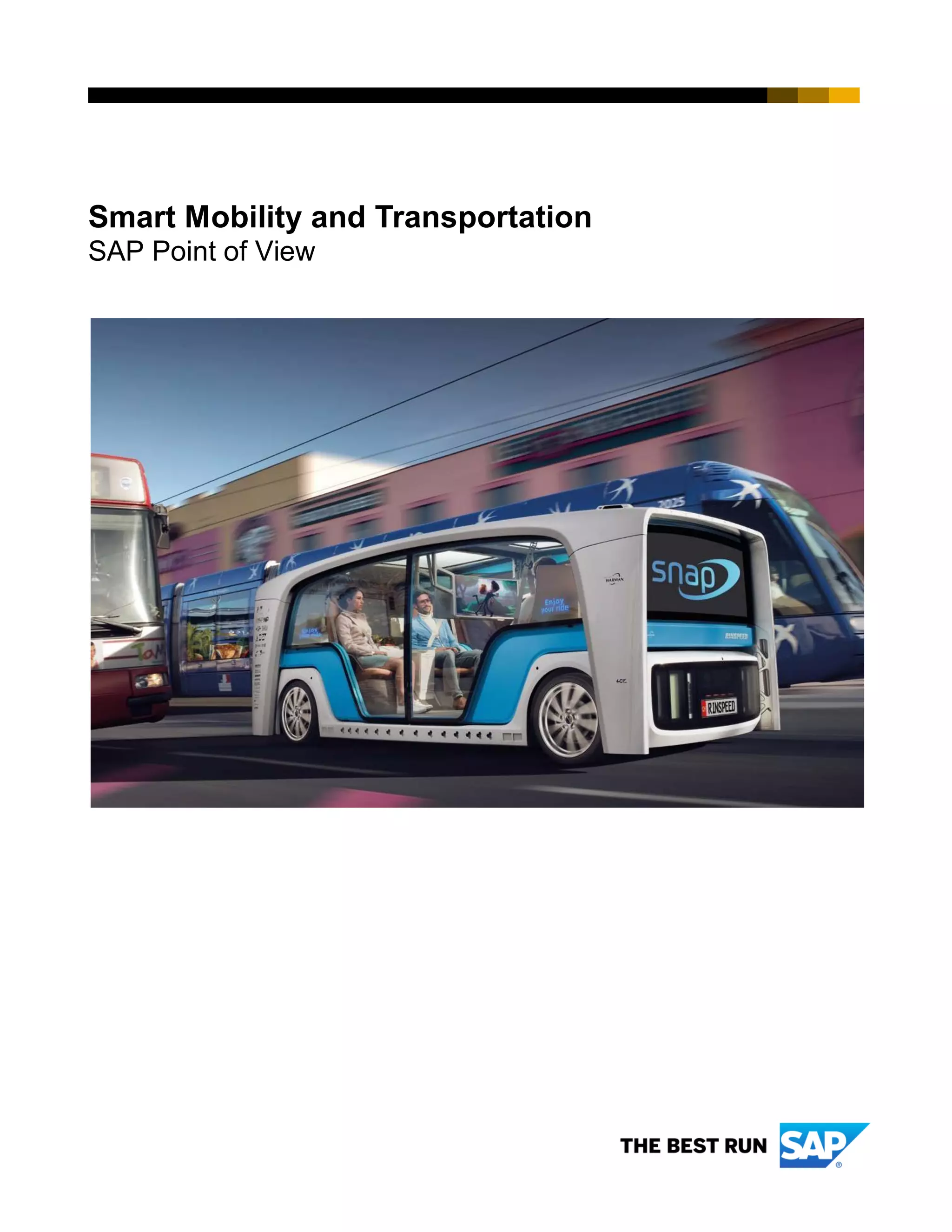
Smart Mobility and Transportation
SAP Point of View
2
Digital disruption is happening everywhere, and the
automotive industry is no exception. To survive,
companies must fundamentally transform themselves.
Advances in vehicle connectivity, e-mobility, ride sharing,
autonomous driving, and blockchain have created a fertile
breeding ground for aggressive startups to scale rapidly
and challenge incumbents. No dominant market position
is safe from new, disruptive business models. Only by
embracing radical change can organizations turn the
uncertainties of today into the opportunities of tomorrow.
AUTOMOTIVE INDUSTRY TRENDS
Automotive companies must sharpen and augment their core competencies to succeed. This requires them to
innovate with speed, leverage trusted technology partners, and radically transform their interactions with
consumers of mobility and transportation.
Successfully embracing the opportunities offered by new technologies and consequently implementing the right
business initiatives will be the foundation of staying relevant in the future of the automotive industry. The
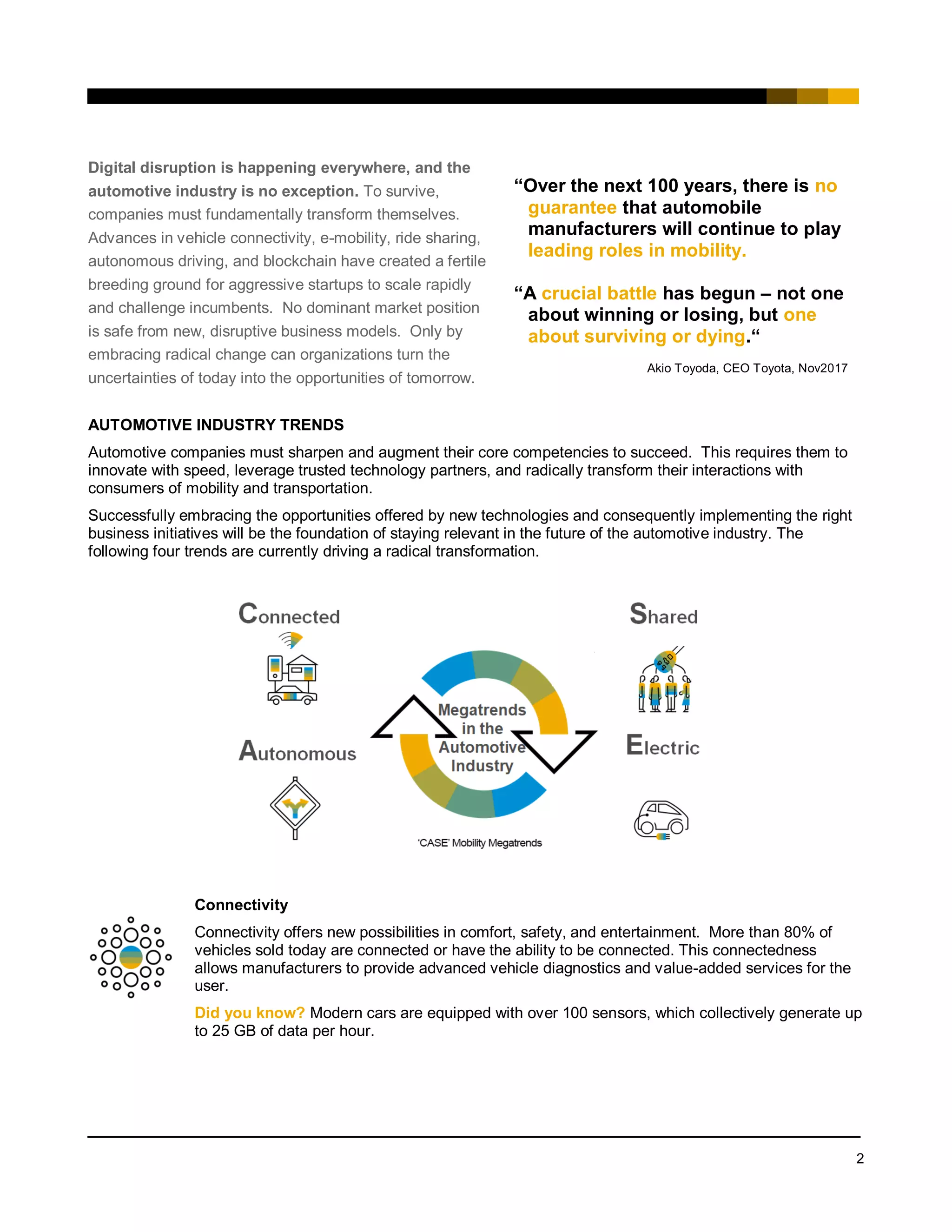
following four trends are currently driving a radical transformation.
Connectivity
Connectivity offers new possibilities in comfort, safety, and entertainment. More than 80% of
vehicles sold today are connected or have the ability to be connected. This connectedness
allows manufacturers to provide advanced vehicle diagnostics and value-added services for the
user.
Did you know? Modern cars are equipped with over 100 sensors, which collectively generate up
to 25 GB of data per hour.
“Over the next 100 years, there is no
guarantee that automobile
manufacturers will continue to play
leading roles in mobility.
“A crucial battle has begun – not one
about winning or losing, but one
about surviving or dying.“
Akio Toyoda, CEO Toyota, Nov2017
3
Autonomy
Autonomous driving creates new technological and social opportunities, giving time back to
people. Artificial intelligence revolutionizes the vehicle with deep learning, self-parking
capabilities, and innovations in vehicle safety. With this technological innovation, mobility
solutions will become more cost effective than owning a car.
Did you know Up to 15% of passenger vehicles sold in 2030 could be fully autonomous.
Shared and Services
Shared mobility is the future. It simplifies people’s everyday lives and gives them more flexibility
in urban areas. Intelligent mobility solutions use apps that combine different mobility services,
flexible car-sharing services, and other on-demand services.
Did you know? The majority of cars are only used for short trips and commutes, leaving them
idle 95% of the time.
Electrification
Innovative products, services, and technologies are helping make smart electric mobility a reality.
Automotive companies use digital technologies to create new value for their customers to reduce
pollution in cities around the world in a completely electric, emission-free, and almost silent
manner. Stricter emission regulations, lower battery cost, and available charging stations are also
supporting the movement towards electrification.
Did you know? By 2030, 24% of new car sales will be electric.
OPPORTUNITY TO INNOVATE WITH SAP
Sustainable mobility will rely on complex and highly interconnected value networks. These include physical and
digital platforms, which will be operated and used by a multitude of players from several industries. Automotive,
public transport, fleet operators, retail, hospitality, utilities, and insurance stakeholders will need to seamlessly
work together to deliver premium customer experiences.
Industry boundaries will increasingly blur as the mobility market shifts to collaboration between players from
multiple industries. In this future, automakers will not simply build cars. They will create new business models
that provide mobility services, provision energy solutions in partnership with utility companies, and build and
operate charging infrastructure. Utility companies will not simply generate and transmit energy; they will closely
work with automakers and fleet operators. SAP will provide the solutions that animate and sustain these
complex business models. Our solutions offer unequaled scalability, interoperability, flexibility, extensibility and
openness.
Our vision:
• Support new business models for mobility services in the cross-industry ecosystem
• Enable mobility service solutions leveraging connected vehicle data
• Enable collaboration through standardization and open interfaces to stand up an integrated cross-industry
ecosystem
• Enable the development of an open Industry Business Network
4
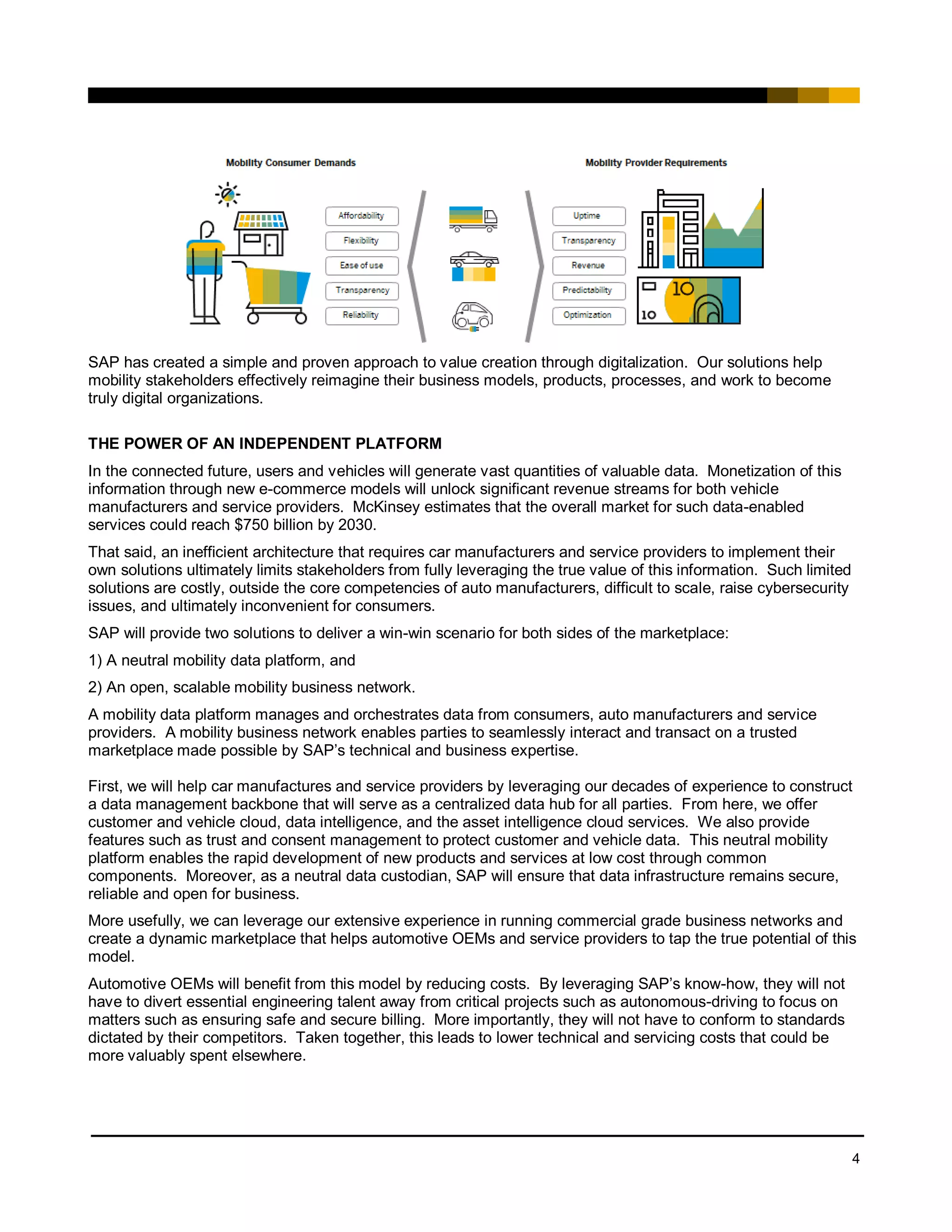
SAP has created a simple and proven approach to value creation through digitalization. Our solutions help
mobility stakeholders effectively reimagine their business models, products, processes, and work to become
truly digital organizations.
THE POWER OF AN INDEPENDENT PLATFORM
In the connected future, users and vehicles will generate vast quantities of valuable data. Monetization of this
information through new e-commerce models will unlock significant revenue streams for both vehicle
manufacturers and service providers. McKinsey estimates that the overall market for such data-enabled
services could reach $750 billion by 2030.
That said, an inefficient architecture that requires car manufacturers and service providers to implement their
own solutions ultimately limits stakeholders from fully leveraging the true value of this information. Such limited
solutions are costly, outside the core competencies of auto manufacturers, difficult to scale, raise cybersecurity
issues, and ultimately inconvenient for consumers.
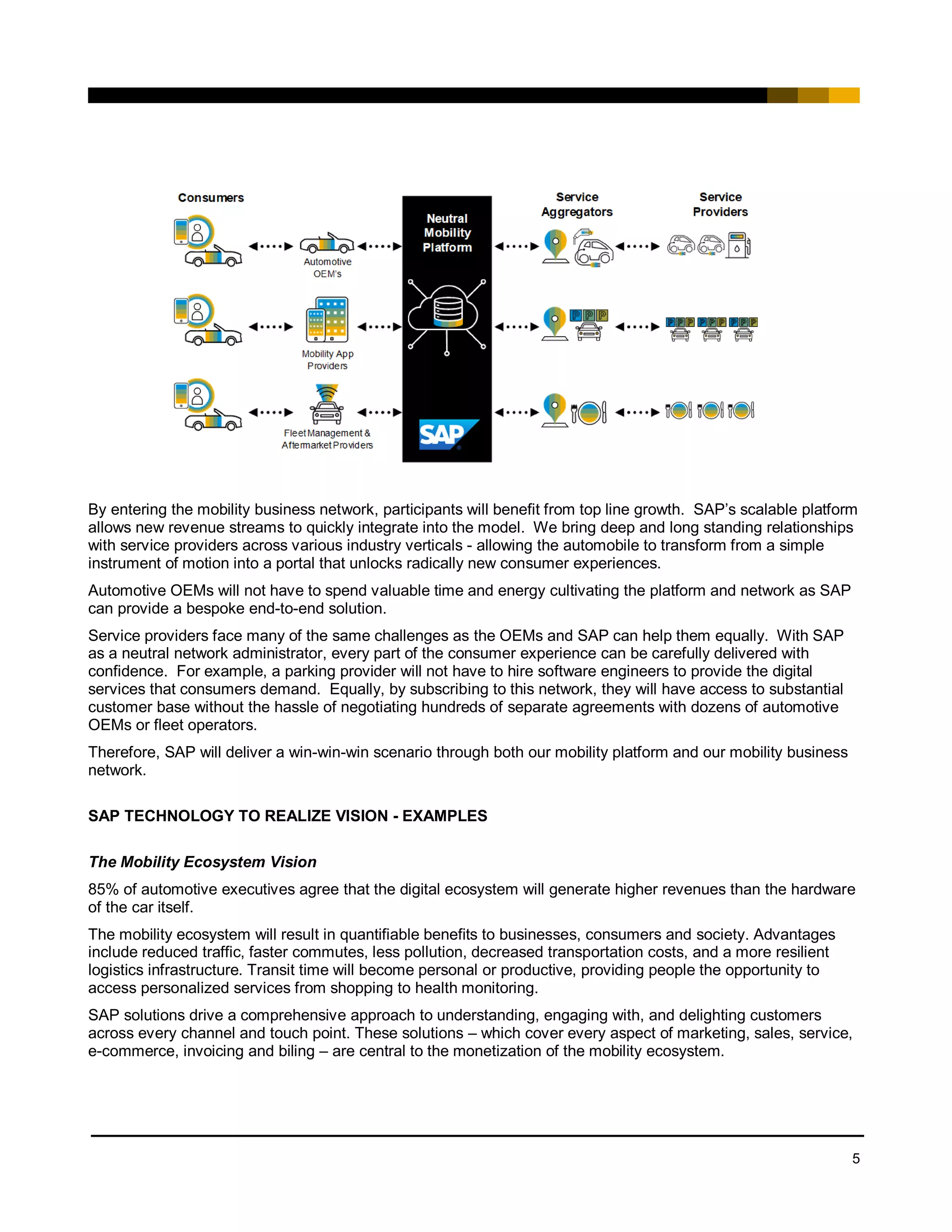
SAP will provide two solutions to deliver a win-win scenario for both sides of the marketplace:
1) A neutral mobility data platform, and
2) An open, scalable mobility business network.
A mobility data platform manages and orchestrates data from consumers, auto manufacturers and service
providers. A mobility business network enables parties to seamlessly interact and transact on a trusted
marketplace made possible by SAP’s technical and business expertise.
First, we will help car manufactures and service providers by leveraging our decades of experience to construct
a data management backbone that will serve as a centralized data hub for all parties. From here, we offer
customer and vehicle cloud, data intelligence, and the asset intelligence cloud services. We also provide
features such as trust and consent management to protect customer and vehicle data. This neutral mobility
platform enables the rapid development of new products and services at low cost through common
components. Moreover, as a neutral data custodian, SAP will ensure that data infrastructure remains secure,
reliable and open for business.
More usefully, we can leverage our extensive experience in running commercial grade business networks and
create a dynamic marketplace that helps automotive OEMs and service providers to tap the true potential of this
model.
Automotive OEMs will benefit from this model by reducing costs. By leveraging SAP’s know-how, they will not
have to divert essential engineering talent away from critical projects such as autonomous-driving to focus on
matters such as ensuring safe and secure billing. More importantly, they will not have to conform to standards
dictated by their competitors. Taken together, this leads to lower technical and servicing costs that could be
more valuably spent elsewhere.
5
By entering the mobility business network, participants will benefit from top line growth. SAP’s scalable platform
allows new revenue streams to quickly integrate into the model. We bring deep and long standing relationships
with service providers across various industry verticals - allowing the automobile to transform from a simple
instrument of motion into a portal that unlocks radically new consumer experiences.
Automotive OEMs will not have to spend valuable time and energy cultivating the platform and network as SAP
can provide a bespoke end-to-end solution.
Service providers face many of the same challenges as the OEMs and SAP can help them equally. With SAP
as a neutral network administrator, every part of the consumer experience can be carefully delivered with
confidence. For example, a parking provider will not have to hire software engineers to provide the digital
services that consumers demand. Equally, by subscribing to this network, they will have access to substantial
customer base without the hassle of negotiating hundreds of separate agreements with dozens of automotive
OEMs or fleet operators.
Therefore, SAP will deliver a win-win-win scenario through both our mobility platform and our mobility business
network.
SAP TECHNOLOGY TO REALIZE VISION - EXAMPLES
The Mobility Ecosystem Vision
85% of automotive executives agree that the digital ecosystem will generate higher revenues than the hardware
of the car itself.
The mobility ecosystem will result in quantifiable benefits to businesses, consumers and society. Advantages
include reduced traffic, faster commutes, less pollution, decreased transportation costs, and a more resilient
logistics infrastructure. Transit time will become personal or productive, providing people the opportunity to
access personalized services from shopping to health monitoring.
SAP solutions drive a comprehensive approach to understanding, engaging with, and delighting customers
across every channel and touch point. These solutions – which cover every aspect of marketing, sales, service,
e-commerce, invoicing and biling – are central to the monetization of the mobility ecosystem.
6
Logistics Optimization
SAP solutions have tremendous power to transform logistics. Their capabilities range from connecting entire
order lifecycles (from asset status to billing) to monitoring live vehicle conditions to providing executives a real-
time overview of all transportation relevant data. We help secure trust and traceability, simplify business
processes, and fuel new levels of ecosystem collaboration. This can be achieved without reliance on third parties
for scheduling, fulfillment, or payment.
Fleet Management
Companies that craft their business models around the autonomous vehicle and the revenue it generates will
need to ensure the asset is functional without manual supervision.
SAP solutions equip companies to gain real-time control over the location, movement, status, and behavior of
any moving asset. They allow direct queries against enterprise data such as reservations, billing, and customer
information. They also integrate IoT-sensor data and unstructured data from external streams such as social
media and weather alerts.
SAP solutions support fleet operators with:
• IoT- and AI-optimized logistics
• Better decision-making around scheduling and routing, resulting in improved on-time delivery
• Lower maintenance costs and less unplanned downtime
• Better capacity planning and higher return on asset investment
• Greater ability to comply with safety regulations
• Automated integration of business processes, from contract management to billing
The result: real-time insights into operational data and customer behavior, plus new opportunities for greater
process efficiencies, lower costs and risks, and better customer service.
Mobility as a Service
In metropolitan areas around the globe, we are witnessing a dramatic business model disruption. Such
disruption is exemplified by mobility as a service (MaaS) – the integration of various transportation activities into
a single, on-demand experience.
Applications powered by SAP solutions are central to enabling MaaS. These solutions cover commerce,
marketing, revenue, sales, and service. They enable companies to get closer to their customers and deliver a
consistently excellent experience across every touch point. These solutions help reduce the cost, time, and
complexity of customer-centric processes.
SAP applications enable companies to collect, map, store, and analyze fleet and vehicle sensor data in real time
to gain new insights into mobile assets. They deliver customer-friendly and profitable digitalized vehicle services
through a connected vehicles business network.
Smart Cities
By 2030, nearly two-thirds of humanity will call cities their home. Cities are centers of innovation and economic
progress. However, they also centralize many of our greatest challenges, including traffic congestion, aging
infrastructures, and threats to quality of life.
Both the public and private sectors will increasingly turn to cloud computing, the IoT, Big Data, and analytics to
make cities more manageable and city life more productive and fulfilling.
In China, for example, SAP technology allows the city of Nanjing to use IoT data to manage its immense traffic
volume and optimize mobility for its 8 million citizens. Nanjing captures data from taxis, buses, traffic cameras,
and other smart devices to monitor traffic patterns at a pace of 100 million records a day. The city can now
7
predict and respond quickly to traffic conditions, while citizens have real- time access to traffic information that
makes their commutes faster and easier.
The result is a smart-city backbone that drives innovation. Combined with other SAP solutions, this foundation
gives urban leaders real-time visibility into smart-city operations and initiatives. Urban leaders can achieve
efficient, safe, and competitive cities, optimizing service to citizens and growing economic prosperity.
The private sector will also leverage the connected city to uncover new opportunities. Since urban mobility will
be consumed as a service, car ownership will become optional. As car ownership declines, ride sharing services
will grow to provide convenient door-to-door transportation. Fleet operators and mobility service providers will
increasingly play an important role in moving consumers. Infrastructure operators will also depend on the
connected urban mobility network to serve consumers.
E-mobility and Energy Infrastructure
Electromobility isn’t simply about propelling vehicles with a new power source. It is the nexus of electric
powertrains, IoT technologies, and connectivity – an ecosystem of technologies, services, and innovations.
SAP solutions empower energy companies to unlock new revenue streams while safeguarding customer data.
We enable real-time, sensor-based vehicle monitoring, with analytics that allow for predictive maintenance. It
also optimizes vehicle charging and load balancing, with digital twins to manage battery lifecycles.
SAP also gives fleet operators complete visibility into their e-fleet, enabling them to optimize energy usage
through intelligent charging algorithms, manage the fleet-charging infrastructure, and gain real-time information
about ROI.
SAP solutions provide a B2B marketplace for connected-car applications and services that drive revenue by
offering location-based, value-added services. The solutions also cover all aspects of customer-facing e-fleet
operations, from initial contact to revenue generation.
SAP empowers the Smart Grid
Connected EVs will align the automotive and energy sectors. From startups to established players, companies in
both sectors will compete and collaborate to help businesses and consumers take full advantage of e-mobility.
Connected EVs will generate data that predicts driving behaviors and matches energy consumption with grid
capacity. They will also act as mobile energy-storage units, feeding power back in to the smart grid at times of
peak demand.
SAP solutions are positioned to drive rapid build-out of the e-mobility infrastructure; optimize energy generation,
transmission, distribution, and retail services, including billing. SAP helps stakeholders across the ecosystem to
meet changing operational, customer, regulatory, security and environmental needs.
SAP solutions include scheduled charging, management and maintenance of charging infrastructure, energy
supply/demand simulation and optimization, and energy trading.
From smart grid analytics and meter data management to demand side management, SAP solutions deliver the
energy usage insights that can enable companies to improve energy efficiency, reduce greenhouse gas
emissions, and drive energy focused business models.
Contact SAP
SAP has the vision, the solutions, and the commitment to go with you all the way, from defining your digital
strategy, to delivering the right solutions, to running your digital backbone in the cloud.
If you are interested in a cross-industry exchange to explore collaborative business opportunities, SAP and its
partners are offering workshops to exchange ideas and to test new business models in smart mobility and
transportation.
8
To connect with us or to register for one of our upcoming Design Thinking workshops, contact us at
http://www.sap.com/contactsap.
www.sap.com/contactsap
© 2018 SAP SE or an SAP affiliate company. All rights reserved.
No part of this publication may be reproduced or transmitted in any form or for any purpose without the express permission of SAP SE or an SAP affiliate company.
The information contained herein may be changed without prior notice. Some software products marketed by SAP SE and its distributors contain proprietary software components of other software vendors.
National product specifications may vary.
These materials are provided by SAP SE or an SAP affiliate company for informational purposes only, without representation or warranty of any kind, and SAP or its affiliated companies shall not be liable
for errors or omissions with respect to the materials. The only warranties for SAP or SAP affiliate company products and services are those that are set forth in the express warranty statements
accompanying such products and services, if any. Nothing herein should be construed as constituting an additional warranty.
In particular, SAP SE or its affiliated companies have no obligation to pursue any course of business outlined in this document or any related presentation, or to develop or release any functionality
mentioned therein. This document, or any related presentation, and SAP SE’s or its affiliated companies’ strategy and possible future developments, products, and/or platform directions and functionality are
all subject to change and may be changed by SAP SE or its affiliated companies at any time for any reason without notice. The information in this document is not a commitment, promise, or legal obligation
to deliver any material, code, or functionality. All forward-looking statements are subject to various risks and uncertainties that could cause actual results to differ materially from expectations. Readers are
cautioned not to place undue reliance on these forward-looking statements, and they should not be relied upon in making purchasing decisions.
SAP and other SAP products and services mentioned herein as well as their respective logos are trademarks or registered trademarks of SAP SE (or an SAP affiliate company) in Germany and other
countries. All other product and service names mentioned are the trademarks of their respective companies. See http://www.sap.com/corporate-en/legal/copyright/index.epx for additional trademark
information and notices.

SAP Point of View: Smart Mobility and Transportation

  • 1.
    Smart Mobility andTransportation SAP Point of View
  • 2.
    2 Digital disruption ishappening everywhere, and the automotive industry is no exception. To survive, companies must fundamentally transform themselves. Advances in vehicle connectivity, e-mobility, ride sharing, autonomous driving, and blockchain have created a fertile breeding ground for aggressive startups to scale rapidly and challenge incumbents. No dominant market position is safe from new, disruptive business models. Only by embracing radical change can organizations turn the uncertainties of today into the opportunities of tomorrow. AUTOMOTIVE INDUSTRY TRENDS Automotive companies must sharpen and augment their core competencies to succeed. This requires them to innovate with speed, leverage trusted technology partners, and radically transform their interactions with consumers of mobility and transportation. Successfully embracing the opportunities offered by new technologies and consequently implementing the right business initiatives will be the foundation of staying relevant in the future of the automotive industry. The following four trends are currently driving a radical transformation. Connectivity Connectivity offers new possibilities in comfort, safety, and entertainment. More than 80% of vehicles sold today are connected or have the ability to be connected. This connectedness allows manufacturers to provide advanced vehicle diagnostics and value-added services for the user. Did you know? Modern cars are equipped with over 100 sensors, which collectively generate up to 25 GB of data per hour. “Over the next 100 years, there is no guarantee that automobile manufacturers will continue to play leading roles in mobility. “A crucial battle has begun – not one about winning or losing, but one about surviving or dying.“ Akio Toyoda, CEO Toyota, Nov2017
  • 3.
    3 Autonomy Autonomous driving createsnew technological and social opportunities, giving time back to people. Artificial intelligence revolutionizes the vehicle with deep learning, self-parking capabilities, and innovations in vehicle safety. With this technological innovation, mobility solutions will become more cost effective than owning a car. Did you know Up to 15% of passenger vehicles sold in 2030 could be fully autonomous. Shared and Services Shared mobility is the future. It simplifies people’s everyday lives and gives them more flexibility in urban areas. Intelligent mobility solutions use apps that combine different mobility services, flexible car-sharing services, and other on-demand services. Did you know? The majority of cars are only used for short trips and commutes, leaving them idle 95% of the time. Electrification Innovative products, services, and technologies are helping make smart electric mobility a reality. Automotive companies use digital technologies to create new value for their customers to reduce pollution in cities around the world in a completely electric, emission-free, and almost silent manner. Stricter emission regulations, lower battery cost, and available charging stations are also supporting the movement towards electrification. Did you know? By 2030, 24% of new car sales will be electric. OPPORTUNITY TO INNOVATE WITH SAP Sustainable mobility will rely on complex and highly interconnected value networks. These include physical and digital platforms, which will be operated and used by a multitude of players from several industries. Automotive, public transport, fleet operators, retail, hospitality, utilities, and insurance stakeholders will need to seamlessly work together to deliver premium customer experiences. Industry boundaries will increasingly blur as the mobility market shifts to collaboration between players from multiple industries. In this future, automakers will not simply build cars. They will create new business models that provide mobility services, provision energy solutions in partnership with utility companies, and build and operate charging infrastructure. Utility companies will not simply generate and transmit energy; they will closely work with automakers and fleet operators. SAP will provide the solutions that animate and sustain these complex business models. Our solutions offer unequaled scalability, interoperability, flexibility, extensibility and openness. Our vision: • Support new business models for mobility services in the cross-industry ecosystem • Enable mobility service solutions leveraging connected vehicle data • Enable collaboration through standardization and open interfaces to stand up an integrated cross-industry ecosystem • Enable the development of an open Industry Business Network
  • 4.
    4 SAP has createda simple and proven approach to value creation through digitalization. Our solutions help mobility stakeholders effectively reimagine their business models, products, processes, and work to become truly digital organizations. THE POWER OF AN INDEPENDENT PLATFORM In the connected future, users and vehicles will generate vast quantities of valuable data. Monetization of this information through new e-commerce models will unlock significant revenue streams for both vehicle manufacturers and service providers. McKinsey estimates that the overall market for such data-enabled services could reach $750 billion by 2030. That said, an inefficient architecture that requires car manufacturers and service providers to implement their own solutions ultimately limits stakeholders from fully leveraging the true value of this information. Such limited solutions are costly, outside the core competencies of auto manufacturers, difficult to scale, raise cybersecurity issues, and ultimately inconvenient for consumers. SAP will provide two solutions to deliver a win-win scenario for both sides of the marketplace: 1) A neutral mobility data platform, and 2) An open, scalable mobility business network. A mobility data platform manages and orchestrates data from consumers, auto manufacturers and service providers. A mobility business network enables parties to seamlessly interact and transact on a trusted marketplace made possible by SAP’s technical and business expertise. First, we will help car manufactures and service providers by leveraging our decades of experience to construct a data management backbone that will serve as a centralized data hub for all parties. From here, we offer customer and vehicle cloud, data intelligence, and the asset intelligence cloud services. We also provide features such as trust and consent management to protect customer and vehicle data. This neutral mobility platform enables the rapid development of new products and services at low cost through common components. Moreover, as a neutral data custodian, SAP will ensure that data infrastructure remains secure, reliable and open for business. More usefully, we can leverage our extensive experience in running commercial grade business networks and create a dynamic marketplace that helps automotive OEMs and service providers to tap the true potential of this model. Automotive OEMs will benefit from this model by reducing costs. By leveraging SAP’s know-how, they will not have to divert essential engineering talent away from critical projects such as autonomous-driving to focus on matters such as ensuring safe and secure billing. More importantly, they will not have to conform to standards dictated by their competitors. Taken together, this leads to lower technical and servicing costs that could be more valuably spent elsewhere.
  • 5.
    5 By entering themobility business network, participants will benefit from top line growth. SAP’s scalable platform allows new revenue streams to quickly integrate into the model. We bring deep and long standing relationships with service providers across various industry verticals - allowing the automobile to transform from a simple instrument of motion into a portal that unlocks radically new consumer experiences. Automotive OEMs will not have to spend valuable time and energy cultivating the platform and network as SAP can provide a bespoke end-to-end solution. Service providers face many of the same challenges as the OEMs and SAP can help them equally. With SAP as a neutral network administrator, every part of the consumer experience can be carefully delivered with confidence. For example, a parking provider will not have to hire software engineers to provide the digital services that consumers demand. Equally, by subscribing to this network, they will have access to substantial customer base without the hassle of negotiating hundreds of separate agreements with dozens of automotive OEMs or fleet operators. Therefore, SAP will deliver a win-win-win scenario through both our mobility platform and our mobility business network. SAP TECHNOLOGY TO REALIZE VISION - EXAMPLES The Mobility Ecosystem Vision 85% of automotive executives agree that the digital ecosystem will generate higher revenues than the hardware of the car itself. The mobility ecosystem will result in quantifiable benefits to businesses, consumers and society. Advantages include reduced traffic, faster commutes, less pollution, decreased transportation costs, and a more resilient logistics infrastructure. Transit time will become personal or productive, providing people the opportunity to access personalized services from shopping to health monitoring. SAP solutions drive a comprehensive approach to understanding, engaging with, and delighting customers across every channel and touch point. These solutions – which cover every aspect of marketing, sales, service, e-commerce, invoicing and biling – are central to the monetization of the mobility ecosystem.
  • 6.
    6 Logistics Optimization SAP solutionshave tremendous power to transform logistics. Their capabilities range from connecting entire order lifecycles (from asset status to billing) to monitoring live vehicle conditions to providing executives a real- time overview of all transportation relevant data. We help secure trust and traceability, simplify business processes, and fuel new levels of ecosystem collaboration. This can be achieved without reliance on third parties for scheduling, fulfillment, or payment. Fleet Management Companies that craft their business models around the autonomous vehicle and the revenue it generates will need to ensure the asset is functional without manual supervision. SAP solutions equip companies to gain real-time control over the location, movement, status, and behavior of any moving asset. They allow direct queries against enterprise data such as reservations, billing, and customer information. They also integrate IoT-sensor data and unstructured data from external streams such as social media and weather alerts. SAP solutions support fleet operators with: • IoT- and AI-optimized logistics • Better decision-making around scheduling and routing, resulting in improved on-time delivery • Lower maintenance costs and less unplanned downtime • Better capacity planning and higher return on asset investment • Greater ability to comply with safety regulations • Automated integration of business processes, from contract management to billing The result: real-time insights into operational data and customer behavior, plus new opportunities for greater process efficiencies, lower costs and risks, and better customer service. Mobility as a Service In metropolitan areas around the globe, we are witnessing a dramatic business model disruption. Such disruption is exemplified by mobility as a service (MaaS) – the integration of various transportation activities into a single, on-demand experience. Applications powered by SAP solutions are central to enabling MaaS. These solutions cover commerce, marketing, revenue, sales, and service. They enable companies to get closer to their customers and deliver a consistently excellent experience across every touch point. These solutions help reduce the cost, time, and complexity of customer-centric processes. SAP applications enable companies to collect, map, store, and analyze fleet and vehicle sensor data in real time to gain new insights into mobile assets. They deliver customer-friendly and profitable digitalized vehicle services through a connected vehicles business network. Smart Cities By 2030, nearly two-thirds of humanity will call cities their home. Cities are centers of innovation and economic progress. However, they also centralize many of our greatest challenges, including traffic congestion, aging infrastructures, and threats to quality of life. Both the public and private sectors will increasingly turn to cloud computing, the IoT, Big Data, and analytics to make cities more manageable and city life more productive and fulfilling. In China, for example, SAP technology allows the city of Nanjing to use IoT data to manage its immense traffic volume and optimize mobility for its 8 million citizens. Nanjing captures data from taxis, buses, traffic cameras, and other smart devices to monitor traffic patterns at a pace of 100 million records a day. The city can now
  • 7.
    7 predict and respondquickly to traffic conditions, while citizens have real- time access to traffic information that makes their commutes faster and easier. The result is a smart-city backbone that drives innovation. Combined with other SAP solutions, this foundation gives urban leaders real-time visibility into smart-city operations and initiatives. Urban leaders can achieve efficient, safe, and competitive cities, optimizing service to citizens and growing economic prosperity. The private sector will also leverage the connected city to uncover new opportunities. Since urban mobility will be consumed as a service, car ownership will become optional. As car ownership declines, ride sharing services will grow to provide convenient door-to-door transportation. Fleet operators and mobility service providers will increasingly play an important role in moving consumers. Infrastructure operators will also depend on the connected urban mobility network to serve consumers. E-mobility and Energy Infrastructure Electromobility isn’t simply about propelling vehicles with a new power source. It is the nexus of electric powertrains, IoT technologies, and connectivity – an ecosystem of technologies, services, and innovations. SAP solutions empower energy companies to unlock new revenue streams while safeguarding customer data. We enable real-time, sensor-based vehicle monitoring, with analytics that allow for predictive maintenance. It also optimizes vehicle charging and load balancing, with digital twins to manage battery lifecycles. SAP also gives fleet operators complete visibility into their e-fleet, enabling them to optimize energy usage through intelligent charging algorithms, manage the fleet-charging infrastructure, and gain real-time information about ROI. SAP solutions provide a B2B marketplace for connected-car applications and services that drive revenue by offering location-based, value-added services. The solutions also cover all aspects of customer-facing e-fleet operations, from initial contact to revenue generation. SAP empowers the Smart Grid Connected EVs will align the automotive and energy sectors. From startups to established players, companies in both sectors will compete and collaborate to help businesses and consumers take full advantage of e-mobility. Connected EVs will generate data that predicts driving behaviors and matches energy consumption with grid capacity. They will also act as mobile energy-storage units, feeding power back in to the smart grid at times of peak demand. SAP solutions are positioned to drive rapid build-out of the e-mobility infrastructure; optimize energy generation, transmission, distribution, and retail services, including billing. SAP helps stakeholders across the ecosystem to meet changing operational, customer, regulatory, security and environmental needs. SAP solutions include scheduled charging, management and maintenance of charging infrastructure, energy supply/demand simulation and optimization, and energy trading. From smart grid analytics and meter data management to demand side management, SAP solutions deliver the energy usage insights that can enable companies to improve energy efficiency, reduce greenhouse gas emissions, and drive energy focused business models. Contact SAP SAP has the vision, the solutions, and the commitment to go with you all the way, from defining your digital strategy, to delivering the right solutions, to running your digital backbone in the cloud. If you are interested in a cross-industry exchange to explore collaborative business opportunities, SAP and its partners are offering workshops to exchange ideas and to test new business models in smart mobility and transportation.
  • 8.
    8 To connect withus or to register for one of our upcoming Design Thinking workshops, contact us at http://www.sap.com/contactsap.
  • 9.
    www.sap.com/contactsap © 2018 SAPSE or an SAP affiliate company. All rights reserved. No part of this publication may be reproduced or transmitted in any form or for any purpose without the express permission of SAP SE or an SAP affiliate company. The information contained herein may be changed without prior notice. Some software products marketed by SAP SE and its distributors contain proprietary software components of other software vendors. National product specifications may vary. These materials are provided by SAP SE or an SAP affiliate company for informational purposes only, without representation or warranty of any kind, and SAP or its affiliated companies shall not be liable for errors or omissions with respect to the materials. The only warranties for SAP or SAP affiliate company products and services are those that are set forth in the express warranty statements accompanying such products and services, if any. Nothing herein should be construed as constituting an additional warranty. In particular, SAP SE or its affiliated companies have no obligation to pursue any course of business outlined in this document or any related presentation, or to develop or release any functionality mentioned therein. This document, or any related presentation, and SAP SE’s or its affiliated companies’ strategy and possible future developments, products, and/or platform directions and functionality are all subject to change and may be changed by SAP SE or its affiliated companies at any time for any reason without notice. The information in this document is not a commitment, promise, or legal obligation to deliver any material, code, or functionality. All forward-looking statements are subject to various risks and uncertainties that could cause actual results to differ materially from expectations. Readers are cautioned not to place undue reliance on these forward-looking statements, and they should not be relied upon in making purchasing decisions. SAP and other SAP products and services mentioned herein as well as their respective logos are trademarks or registered trademarks of SAP SE (or an SAP affiliate company) in Germany and other countries. All other product and service names mentioned are the trademarks of their respective companies. See http://www.sap.com/corporate-en/legal/copyright/index.epx for additional trademark information and notices.