DR.FAUSTUS
PRESENTED BY

Samrah Tayyab
Contents


    Renaissance spirit

        Focused on humankind
       Comparison of medieval and
       renaissance era
Capacity for repentance and sufferrings.
  Conscience vs. temptation
Contents


Exploring the bounds of knowledge
  Contesting for Faustus soul

    Faith and Choice
Renaissance spirit
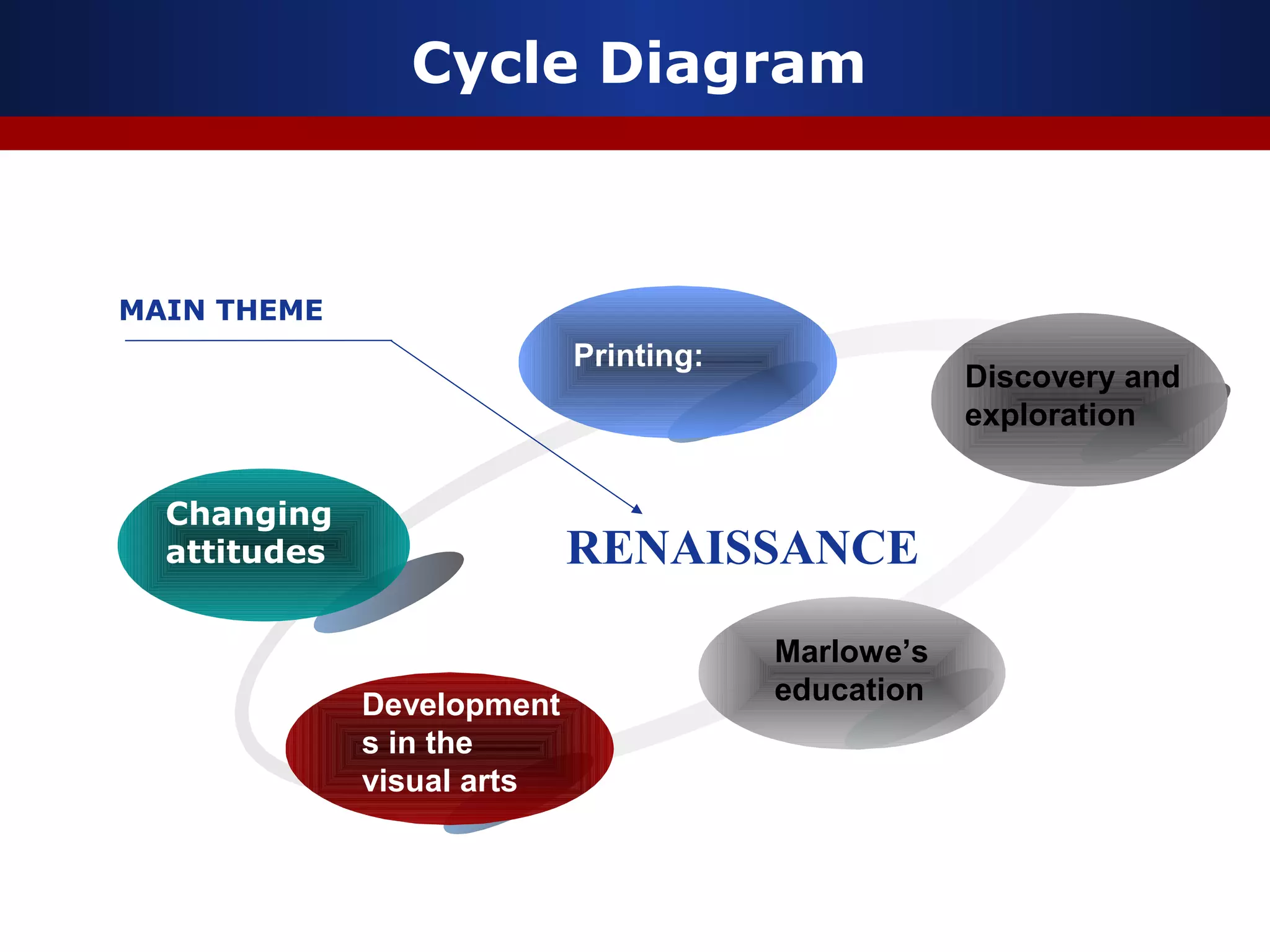
Cycle Diagram


MAIN THEME
                            Printing:
                                                    Discovery and
                                                    exploration


  Changing
  attitudes                 RENAISSANCE
                                        Marlowe’s
              Development               education
              s in the
              visual arts
Exploring the bounds of knowledge

IN many respects, Faustus is representative of this thirst for
knowledge. His long monologues in Scene 1dramatise his
command of - and impatience with - established branches of
knowledge and his desire to move beyond them. On the one hand,
this desire is admirable, representing the highest kind of human
potential. However, the play also represents it as extremely
dangerous, leading, in Faustus’ case, to necromancy and the pact
with Mephastophilis. Furthermore, when Faustus begins to
question Mephastophilis about the secrets of the universe, he is
disappointed because he is told very little that he does not already
know. By the end of the play, he seems to have lost his hunger for
knowledge.
Pride, vanity and lack of self-
               knowledge
If Faustus’ monologue in Scene 1 demonstrates his knowledge
and intelligence, it also begins to reveals the weaknesses in
his character. His pride, arrogance, vanity and lack of self-
knowledge will ultimately bring about his downfall. Pride and
defiance of God was the sin that brought about the fall of
Satan, but Faustus ignores Mephastophilis’ references to
these events and wilfully pursues his own wishes. The play
contains images of falling, in particular of those who overreach
themselves (See Imagery and symbolism > Flight and falling),
but only gradually does Faustus realise that he has passed the
point at which he could have prevented his own fall.
Pride, vanity and lack of self-
               knowledge
If Faustus’ monologue in Scene 1 demonstrates his knowledge and
intelligence, it also begins to reveals the weaknesses in his character.
His pride, arrogance, vanity and lack of self-knowledge will
ultimately bring about his downfall. Pride and defiance of God was
the sin that brought about the fall of Satan, but Faustus ignores
Mephastophilis’ references to these events and wilfully pursues his
own wishes. The play contains images of falling, in particular of
those who overreach themselves (See Imagery and symbolism
> Flight and falling), but only gradually does Faustus realise that he
has passed the point at which he could have prevented his own fall.
        Faustus’ pride leads him to disregard the likely
limitations on human power and knowledge and his
transgression is appropriately punished at the end of the play.
Conscience vs. temptation


The most straightforward way of describing the part
played by the Good and Evil Angels and
appearance of old man in Doctor Faustus is that
they are external, visible embodiments of the two
impulses that are at war within Faustus’ mind
Conscience vs. temptation


The most straightforward way of describing the part
played by the Good and Evil Angels and
appearance of old man in Doctor Faustus is that
they are external, visible embodiments of the two
impulses that are at war within Faustus’ mind
Contesting for Faustus’ soul


The Angels make only one further
appearance, in the same scene, at the point
where Faustus realises that there are some
questions that Mephastophilis will not
answer and that he has reached the limits of
what he can gain from his devilish bargain.
As on previous occasions, the Angels are
seen at a crucial moment, when Faustus is
wavering:
Contesting for Faustus’ soul


The Angels make only one further
appearance, in the same scene, at the point
where Faustus realises that there are some
questions that Mephastophilis will not
answer and that he has reached the limits of
what he can gain from his devilish bargain.
As on previous occasions, the Angels are
seen at a crucial moment, when Faustus is
wavering:
EVIL ANGEL
  Too late.
  GOOD ANGEl
  Never too late, if Faustus can repent.
EVIL ANGEL
If thou repent, devils shall tear thee in pieces.

GOOD ANGEL


Repent, and they shall never raise thy skin.
Exeunt [ANGELS]

FAUSTUS
ah Christ my Saviour, seeks to save
Distressed Faustus’ soul.
Scene 7, 75-80
EVIL ANGEL
If thou repent, devils shall tear thee in pieces.

GOOD ANGEL


Repent, and they shall never raise thy skin.
Exeunt [ANGELS]


Scene 7, 75-80
The Old Man


The Old Man
After Scene 7, the Good and Evil Angels
disappear from the play and their function
is taken over by the Old Man, who appears
only in Scenes 12 and 13. This represents
a very important shift in the play, for
Faustus is not being appealed to by non-
human beings but by afellow human
being and one who has lived his life
according to Christian precepts.
Samrah tayyab

Samrah tayyab

  • 1.
  • 2.
    Contents Renaissance spirit Focused on humankind Comparison of medieval and renaissance era Capacity for repentance and sufferrings. Conscience vs. temptation
  • 3.
    Contents Exploring the boundsof knowledge Contesting for Faustus soul Faith and Choice
  • 4.
  • 5.
    Cycle Diagram MAIN THEME Printing: Discovery and exploration Changing attitudes RENAISSANCE Marlowe’s Development education s in the visual arts
  • 6.
    Exploring the boundsof knowledge IN many respects, Faustus is representative of this thirst for knowledge. His long monologues in Scene 1dramatise his command of - and impatience with - established branches of knowledge and his desire to move beyond them. On the one hand, this desire is admirable, representing the highest kind of human potential. However, the play also represents it as extremely dangerous, leading, in Faustus’ case, to necromancy and the pact with Mephastophilis. Furthermore, when Faustus begins to question Mephastophilis about the secrets of the universe, he is disappointed because he is told very little that he does not already know. By the end of the play, he seems to have lost his hunger for knowledge.
  • 7.
    Pride, vanity andlack of self- knowledge If Faustus’ monologue in Scene 1 demonstrates his knowledge and intelligence, it also begins to reveals the weaknesses in his character. His pride, arrogance, vanity and lack of self- knowledge will ultimately bring about his downfall. Pride and defiance of God was the sin that brought about the fall of Satan, but Faustus ignores Mephastophilis’ references to these events and wilfully pursues his own wishes. The play contains images of falling, in particular of those who overreach themselves (See Imagery and symbolism > Flight and falling), but only gradually does Faustus realise that he has passed the point at which he could have prevented his own fall.
  • 8.
    Pride, vanity andlack of self- knowledge If Faustus’ monologue in Scene 1 demonstrates his knowledge and intelligence, it also begins to reveals the weaknesses in his character. His pride, arrogance, vanity and lack of self-knowledge will ultimately bring about his downfall. Pride and defiance of God was the sin that brought about the fall of Satan, but Faustus ignores Mephastophilis’ references to these events and wilfully pursues his own wishes. The play contains images of falling, in particular of those who overreach themselves (See Imagery and symbolism > Flight and falling), but only gradually does Faustus realise that he has passed the point at which he could have prevented his own fall. Faustus’ pride leads him to disregard the likely limitations on human power and knowledge and his transgression is appropriately punished at the end of the play.
  • 9.
    Conscience vs. temptation Themost straightforward way of describing the part played by the Good and Evil Angels and appearance of old man in Doctor Faustus is that they are external, visible embodiments of the two impulses that are at war within Faustus’ mind
  • 10.
    Conscience vs. temptation Themost straightforward way of describing the part played by the Good and Evil Angels and appearance of old man in Doctor Faustus is that they are external, visible embodiments of the two impulses that are at war within Faustus’ mind
  • 11.
    Contesting for Faustus’soul The Angels make only one further appearance, in the same scene, at the point where Faustus realises that there are some questions that Mephastophilis will not answer and that he has reached the limits of what he can gain from his devilish bargain. As on previous occasions, the Angels are seen at a crucial moment, when Faustus is wavering:
  • 12.
    Contesting for Faustus’soul The Angels make only one further appearance, in the same scene, at the point where Faustus realises that there are some questions that Mephastophilis will not answer and that he has reached the limits of what he can gain from his devilish bargain. As on previous occasions, the Angels are seen at a crucial moment, when Faustus is wavering:
  • 13.
    EVIL ANGEL Too late. GOOD ANGEl Never too late, if Faustus can repent. EVIL ANGEL If thou repent, devils shall tear thee in pieces. GOOD ANGEL Repent, and they shall never raise thy skin. Exeunt [ANGELS] FAUSTUS ah Christ my Saviour, seeks to save Distressed Faustus’ soul. Scene 7, 75-80
  • 14.
    EVIL ANGEL If thourepent, devils shall tear thee in pieces. GOOD ANGEL Repent, and they shall never raise thy skin. Exeunt [ANGELS] Scene 7, 75-80
  • 15.
    The Old Man TheOld Man After Scene 7, the Good and Evil Angels disappear from the play and their function is taken over by the Old Man, who appears only in Scenes 12 and 13. This represents a very important shift in the play, for Faustus is not being appealed to by non- human beings but by afellow human being and one who has lived his life according to Christian precepts.