SAMPLING
To sample or not to sample
real-time customer
experience research
?
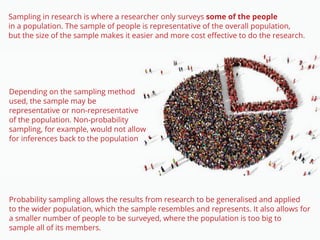
Sampling in research is where a researcher only surveys some of the people
in a population. The sample of people is representative of the overall population,
but the size of the sample makes it easier and more cost effective to do the research.
Probability sampling allows the results from research to be generalised and applied
to the wider population, which the sample resembles and represents. It also allows for
a smaller number of people to be surveyed, where the population is too big to
sample all of its members.
Depending on the sampling method
used, the sample may be
representative or non-representative
of the population. Non-probability
sampling, for example, would not allow
for inferences back to the population
While sampling is standard practice in research, it is almost never applied to customer experience (CX)
surveys. Instead of surveying only a sample of people who call into a contact centre, everyone who calls
gets surveyed.
As much as we don’t have control over the demographics of the people
who call, we don’t have control over the demographics of those
who receive the survey.
In traditional research, it is nearly impossible to survey an
entire population group, but this is overcome in
CX research as time and cost are only minimally
inflated when surveying an entire population when
compared to a sample of that population.
When customers call an organistion to
complain or get something fixed, they receive
an SMS or email to complete a survey about
their experience. Instead of, therefore,
surveying a sample of the organisation’s
customers, we only survey those who call in,
and that group might not be representative of
the organisation’s full customer population.
So, we looked at what the effects or implications might be
(if any) of sampling or not sampling
and we concluded the following:
There is not much written
about sampling in the context
of client experience...
Sampling reduces the
sample size with which
we generate insights.
Sampling would therefore reduce the
number of responses used to
generate valid insights.
In the traditional research space, we would calculate the
appropriate sample size and then draw from a large population.
We then collect data from all participants in this sample.
In CX, volumes seldom approximate the population sizes encountered
in traditional research, and not all customers who get a survey actually
respond (only between 10-20% of the total number of
customers receiving the survey will respond).
Sampling will negatively
affect service.
Sampling can hinder
these efforts.
If only a portion of customers are surveyed, there is a risk that
those who were not surveyed might have had genuine complaints
and intent to leave.
A good CX programme must not only consider research aims, but
also seek to retain customers and reduce customer churn.
The decision to complete a survey is
affected by psychological factors
outside of the researcher’s control.
Sampling does not mitigate
self-selection bias.
Particularly, those who feel that the service was either really great
or really bad are more likely to complete a survey than someone
for whom the experience was “lukewarm”.
This is why normal distributions are rare in market research.
Sampling does not affect this propensity.
However...
in the absence of sampling, non-probability
sampling can create skewed and biased samples.
Post-stratification weighting can mitigate this, where
results for a population group in the sample are
weighted against its proportional weight in
the population.
Also one should take further steps to minimise
participant non-response (and therefore minimise bias)
through attention to user experience in customer
experience research channels to promote open and
click rates, as well as effective questionnaire design and
development to facilitate survey completion.
We believe that sampling is appropriate for traditional research, but
not for real-time customer experience and voice-of-the-customer
research, since sampling on the latter would delay the survey.
For real-time feedback and to create the opportunity for service recovery, there should
be as little delay as possible between the experience itself and the survey about that
experience, as well as between the survey response and the service recovery
intervention from the organisation.
Most importantly, with customer experience
surveys, we don’t have the constraint of not
being able to survey the entire population of
customers who call the contact centre. Every
person who calls can get a survey and can com-
plete the
survey, making sampling unnecessary.
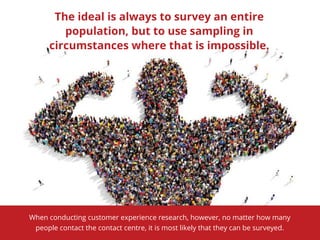
The ideal is always to survey an entire
population, but to use sampling in
circumstances where that is impossible.
When conducting customer experience research, however, no matter how many
people contact the contact centre, it is most likely that they can be surveyed.
We therefore do not believe that sampling
should be applied to real-time feedback on
customer experience. Firstly because it
interrupts the real-time flow of feedback and
secondly because service recovery is
negatively impacted.
If 100 people complained, but we
only sample 30 of them,
what about the other 70 people
who are unhappy with the service?
Ultimately, we must balance
the necessity of conducting
correct and proper research
and the need to reduce
customer churn.
CONTACT US
South Africa Address:
Genex Insights
Building 7, Muirfield,
Fourways Golf Park, Roos St,
Sandton, 2068
Phone: 011 267 1400
Email: info@genex.co.za

Sampling : To sample, or not to sample?

  • 1.
  • 2.
    To sample ornot to sample real-time customer experience research ?
  • 3.
    Sampling in researchis where a researcher only surveys some of the people in a population. The sample of people is representative of the overall population, but the size of the sample makes it easier and more cost effective to do the research. Probability sampling allows the results from research to be generalised and applied to the wider population, which the sample resembles and represents. It also allows for a smaller number of people to be surveyed, where the population is too big to sample all of its members. Depending on the sampling method used, the sample may be representative or non-representative of the population. Non-probability sampling, for example, would not allow for inferences back to the population
  • 4.
    While sampling isstandard practice in research, it is almost never applied to customer experience (CX) surveys. Instead of surveying only a sample of people who call into a contact centre, everyone who calls gets surveyed. As much as we don’t have control over the demographics of the people who call, we don’t have control over the demographics of those who receive the survey. In traditional research, it is nearly impossible to survey an entire population group, but this is overcome in CX research as time and cost are only minimally inflated when surveying an entire population when compared to a sample of that population. When customers call an organistion to complain or get something fixed, they receive an SMS or email to complete a survey about their experience. Instead of, therefore, surveying a sample of the organisation’s customers, we only survey those who call in, and that group might not be representative of the organisation’s full customer population.
  • 5.
    So, we lookedat what the effects or implications might be (if any) of sampling or not sampling and we concluded the following: There is not much written about sampling in the context of client experience...
  • 6.
    Sampling reduces the samplesize with which we generate insights. Sampling would therefore reduce the number of responses used to generate valid insights. In the traditional research space, we would calculate the appropriate sample size and then draw from a large population. We then collect data from all participants in this sample. In CX, volumes seldom approximate the population sizes encountered in traditional research, and not all customers who get a survey actually respond (only between 10-20% of the total number of customers receiving the survey will respond).
  • 7.
    Sampling will negatively affectservice. Sampling can hinder these efforts. If only a portion of customers are surveyed, there is a risk that those who were not surveyed might have had genuine complaints and intent to leave. A good CX programme must not only consider research aims, but also seek to retain customers and reduce customer churn.
  • 8.
    The decision tocomplete a survey is affected by psychological factors outside of the researcher’s control. Sampling does not mitigate self-selection bias. Particularly, those who feel that the service was either really great or really bad are more likely to complete a survey than someone for whom the experience was “lukewarm”. This is why normal distributions are rare in market research. Sampling does not affect this propensity.
  • 9.
    However... in the absenceof sampling, non-probability sampling can create skewed and biased samples. Post-stratification weighting can mitigate this, where results for a population group in the sample are weighted against its proportional weight in the population. Also one should take further steps to minimise participant non-response (and therefore minimise bias) through attention to user experience in customer experience research channels to promote open and click rates, as well as effective questionnaire design and development to facilitate survey completion.
  • 10.
    We believe thatsampling is appropriate for traditional research, but not for real-time customer experience and voice-of-the-customer research, since sampling on the latter would delay the survey. For real-time feedback and to create the opportunity for service recovery, there should be as little delay as possible between the experience itself and the survey about that experience, as well as between the survey response and the service recovery intervention from the organisation. Most importantly, with customer experience surveys, we don’t have the constraint of not being able to survey the entire population of customers who call the contact centre. Every person who calls can get a survey and can com- plete the survey, making sampling unnecessary.
  • 11.
    The ideal isalways to survey an entire population, but to use sampling in circumstances where that is impossible. When conducting customer experience research, however, no matter how many people contact the contact centre, it is most likely that they can be surveyed.
  • 12.
    We therefore donot believe that sampling should be applied to real-time feedback on customer experience. Firstly because it interrupts the real-time flow of feedback and secondly because service recovery is negatively impacted. If 100 people complained, but we only sample 30 of them, what about the other 70 people who are unhappy with the service? Ultimately, we must balance the necessity of conducting correct and proper research and the need to reduce customer churn.
  • 13.
    CONTACT US South AfricaAddress: Genex Insights Building 7, Muirfield, Fourways Golf Park, Roos St, Sandton, 2068 Phone: 011 267 1400 Email: info@genex.co.za