Sampling techniques and its types s.sampling techniques and its typess.
1.
SAMPLING TECHNIQUES
Dr.Bharath VMFM., M.Com., Ph.D
Assistant Professor
Kristu Jayanti College
Bengaluru
1
bharath.v@kristujayanti.com
2.
Sampling Methods
• Samplingmethods are techniques used to select a subset
(sample) from a larger population for research or analysis.
• They help ensure that the sample accurately represents
the population while reducing time and cost constraints.
• Sampling methods fall into two main categories:
probability sampling and non-probability sampling.
2
Probability Sampling (Random)
•Probability sampling is a method of selecting a sample
where every individual in the population has a known and
equal chance of being chosen.
• It is widely used in statistical and scientific research to
ensure that the sample is representative of the population.
• Since the selection process is random, it reduces bias
and allows for generalization of results to the entire
population.
4
5.
Key Features
• Basedon random selection
• Every individual has an equal chance of being chosen
• Allows for statistical generalization
• Reduces selection bias
• Requires a complete list of the population (sampling
frame)
5
6.
Advantages
• Minimizes SelectionBias – Since participants are selected randomly,
there is little to no researcher bias in the selection process.
• Ensures Representativeness – The sample reflects the
characteristics of the entire population, improving accuracy.
• Allows for Statistical Inference – Researchers can apply probability
theory to analyze data and make predictions about the entire
population.
• Reproducible and Reliable – Results obtained from probability
sampling can be repeated and verified by other researchers.
• Suitable for Large Populations – It is particularly useful when
studying large groups, ensuring diversity and fairness.
6
7.
Disadvantages
• Time-Consuming andCostly – Collecting data randomly
requires a complete population list (sampling frame),
making it expensive and complex.
• Requires a Large Population – It may not be practical
for small or specific populations where listing all members
is difficult.
• May Not Capture Specific Subgroups Well – If
subgroups are too small, they might be underrepresented
unless stratified sampling is used.
• Complex Execution – Techniques like stratified or cluster
sampling require additional steps and careful planning.
7
8.
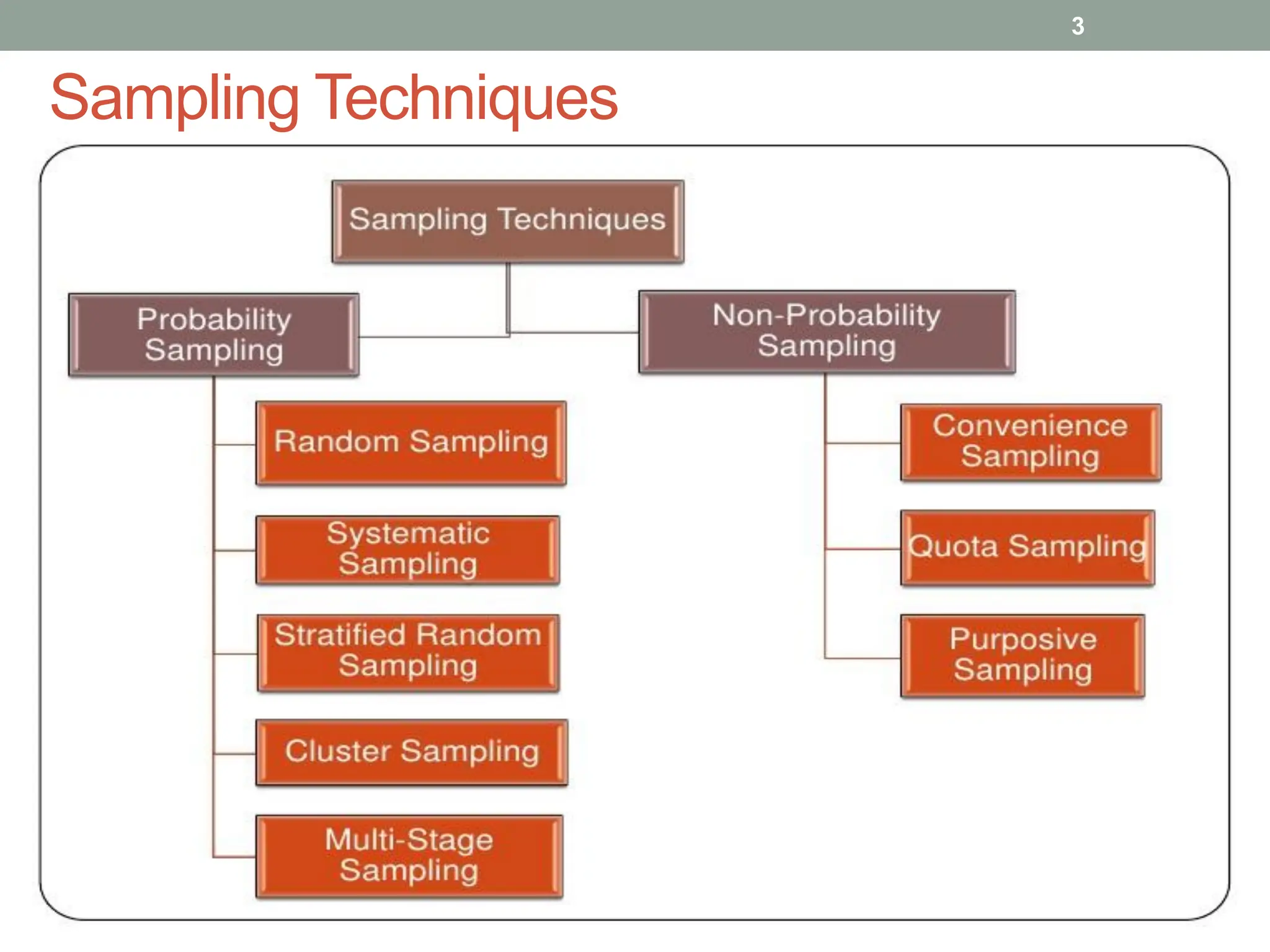
Types of ProbabilitySampling Methods
• Simple Random Sampling (Lottery method, random
number generator)
• Systematic Sampling (Selecting every nth individual)
• Stratified Sampling (Dividing the population into
subgroups)
• Cluster Sampling (Selecting entire groups randomly)
8
9.
Simple Random Sampling
•Simple Random Sampling (SRS) is a probability sampling
method where every individual in the population has an
equal chance of being selected.
• The selection process is completely random, often done
using lottery methods, random number generators, or
computer software.
• This method is commonly used in research where
fairness and unbiased representation are essential.
9
10.
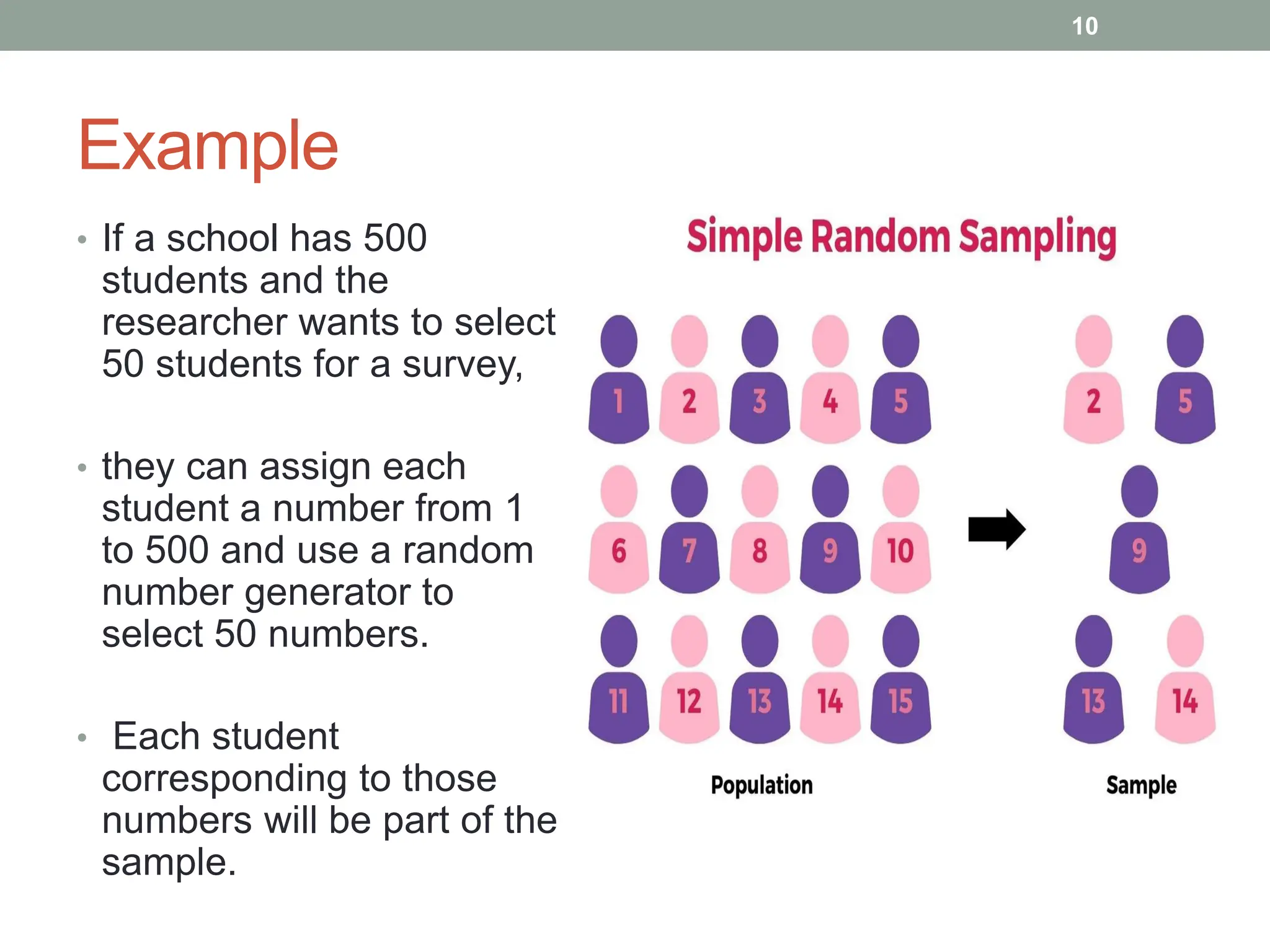
Example
• If aschool has 500
students and the
researcher wants to select
50 students for a survey,
• they can assign each
student a number from 1
to 500 and use a random
number generator to
select 50 numbers.
• Each student
corresponding to those
numbers will be part of the
sample.
10
11.
Advantages
• Unbiased Selection– Each individual has an equal
chance of being selected, reducing the risk of bias.
• Easy to Understand and Implement – The method is
simple and requires minimal technical knowledge.
• Representative Sample – When the population is
homogeneous, the sample is likely to represent the entire
population accurately.
• Allows Statistical Inference – The data collected can be
used to make generalizations about the population.
11
12.
Disadvantages
• Time-Consuming andCostly – It can be difficult to
conduct if the population is large or widely spread out.
• Requires Complete Population List – A comprehensive
list of the population (sampling frame) is necessary, which
is not always available.
• Risk of Unrepresentative Sample – In heterogeneous
populations, simple random sampling might not capture
small subgroups adequately.
• Not Always Practical – Manually randomizing large
populations can be tedious without software assistance.
12
13.
Systematic Sampling
• SystematicSampling is a probability sampling method
where individuals are selected at regular intervals from an
ordered list.
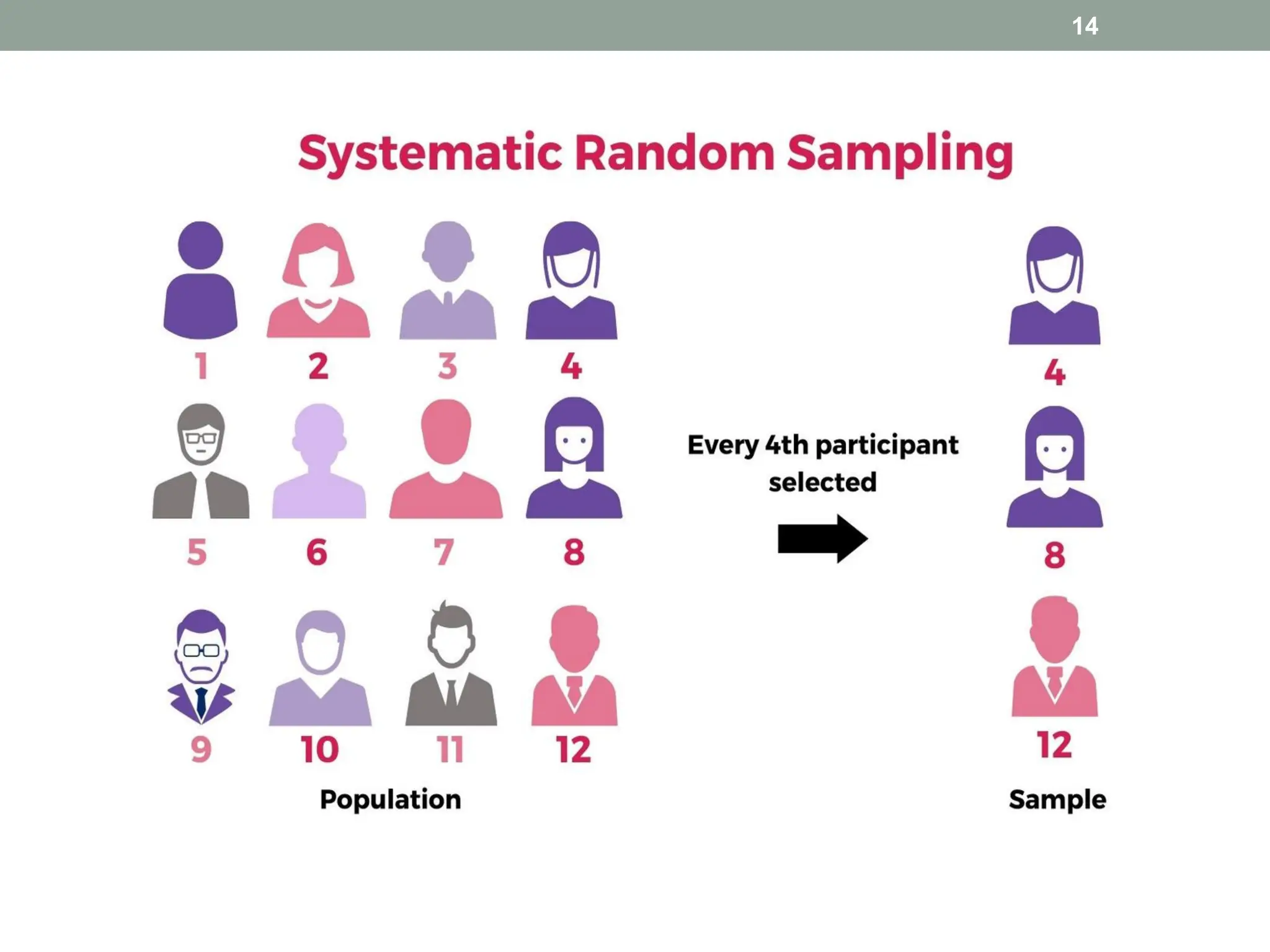
• The first participant is chosen randomly, and then every
nth individual is selected, where "n" is the sampling
interval.
• This method is simpler than simple random sampling and
ensures even coverage of the population.
13
Example
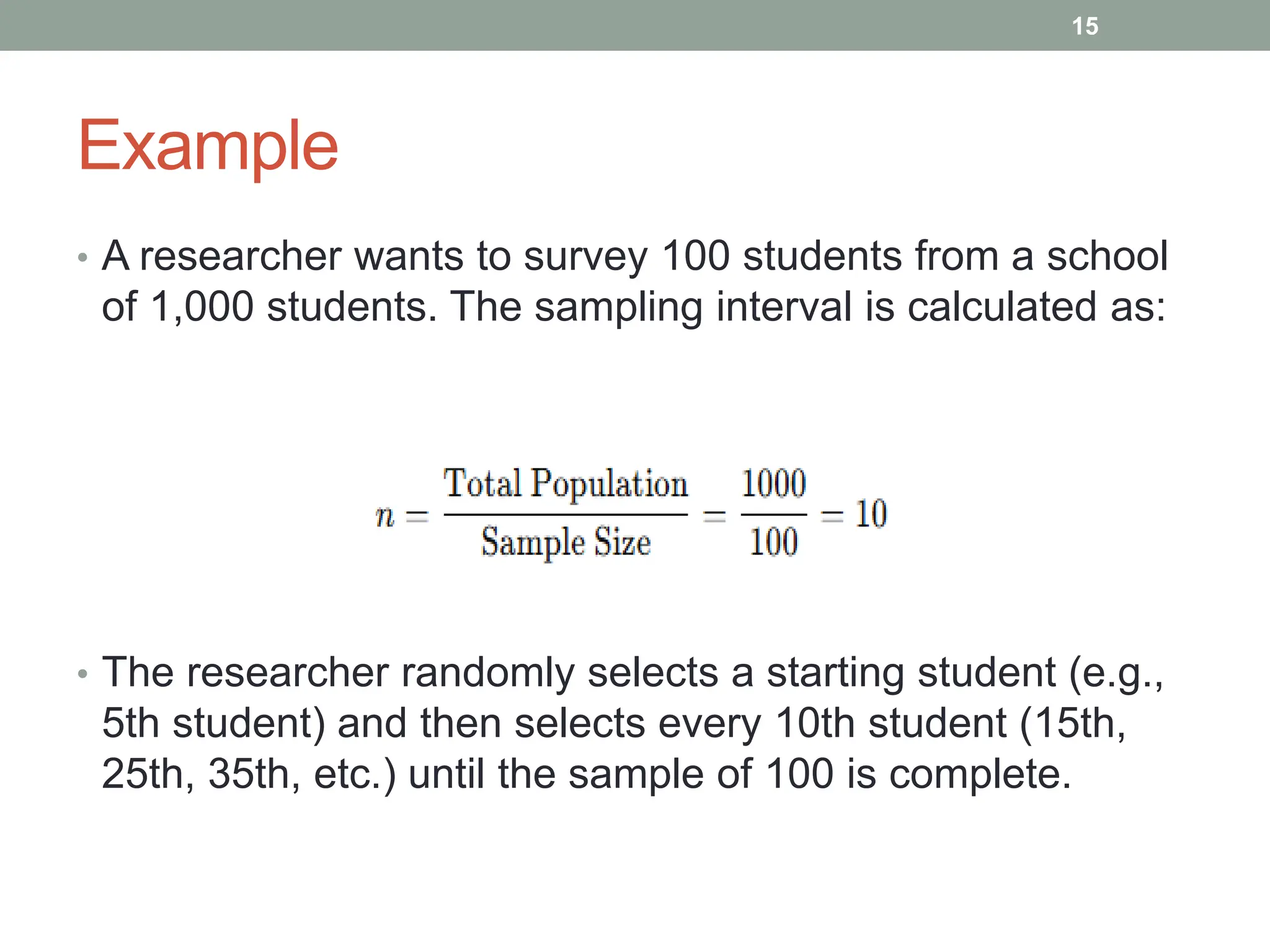
• A researcherwants to survey 100 students from a school
of 1,000 students. The sampling interval is calculated as:
• The researcher randomly selects a starting student (e.g.,
5th student) and then selects every 10th student (15th,
25th, 35th, etc.) until the sample of 100 is complete.
15
16.
Advantages
• Simple andQuick – Easier to implement than simple
random sampling.
• Even Distribution – Ensures a well-spread-out sample
across the population.
• Less Prone to Human Bias – Since selection follows a
fixed interval, it reduces researcher bias.
• Good for Large Populations – Useful when dealing with
large lists or databases.
16
17.
Disadvantages
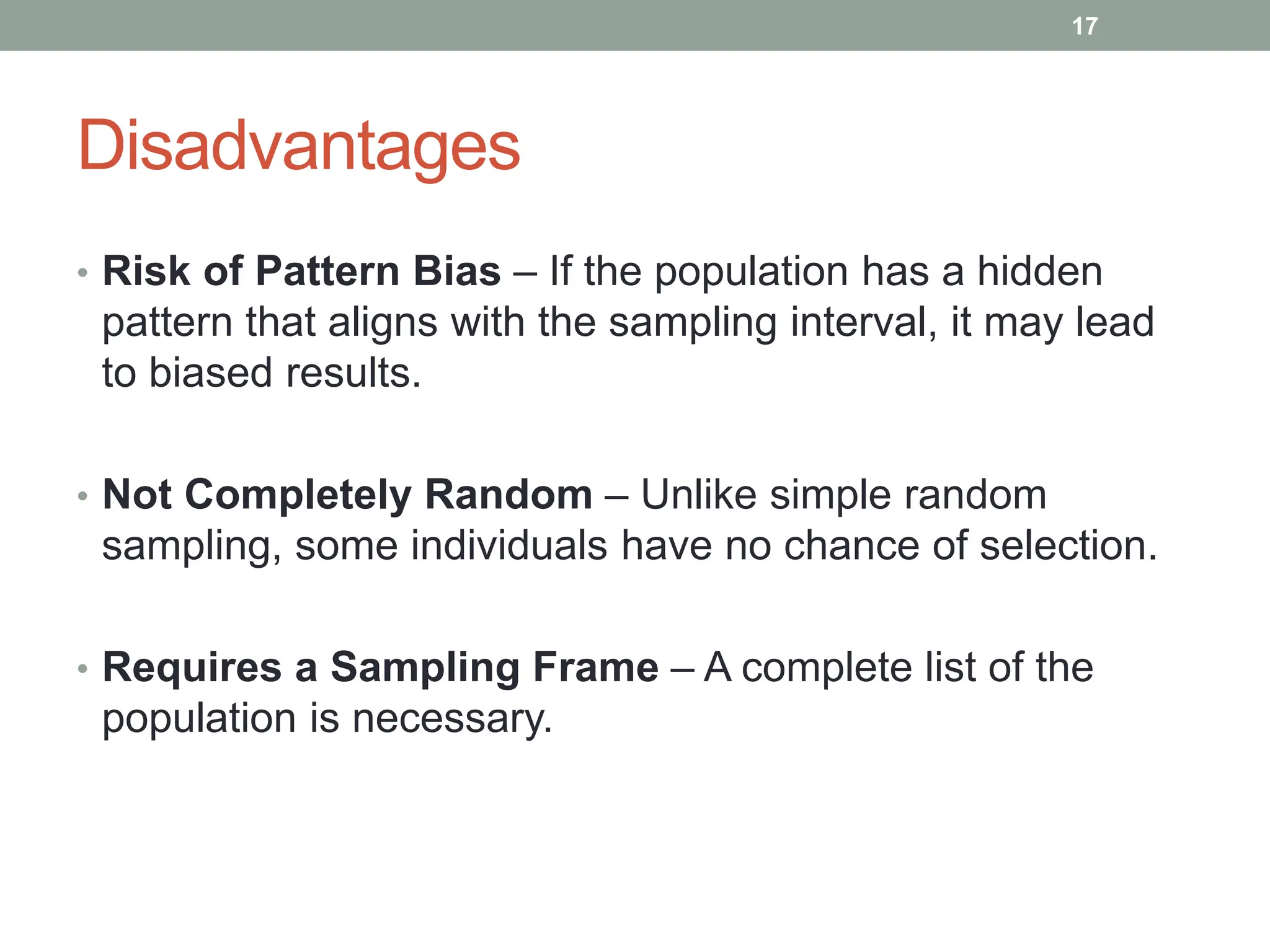
• Risk ofPattern Bias – If the population has a hidden
pattern that aligns with the sampling interval, it may lead
to biased results.
• Not Completely Random – Unlike simple random
sampling, some individuals have no chance of selection.
• Requires a Sampling Frame – A complete list of the
population is necessary.
17
18.
Stratified Sampling
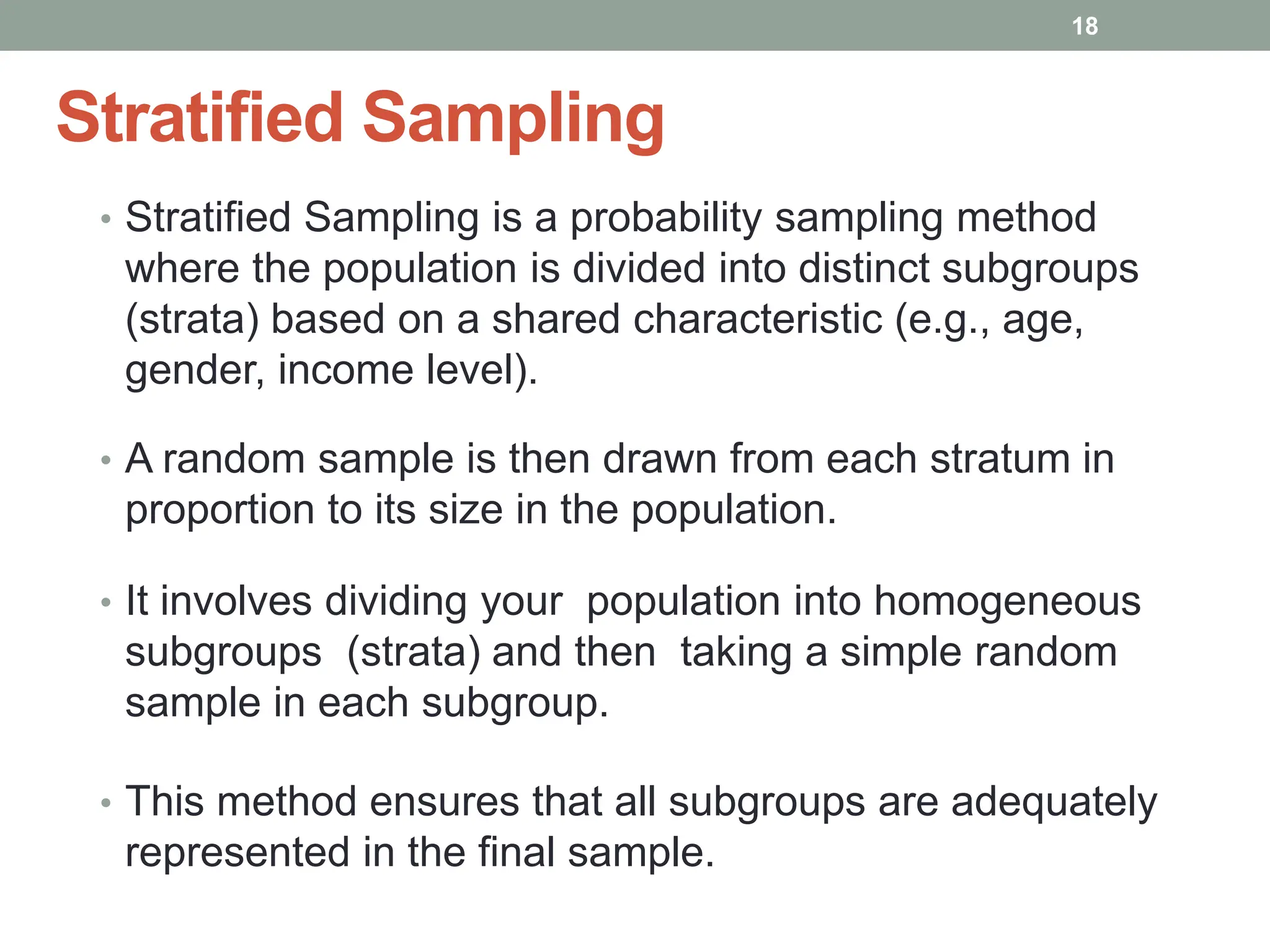
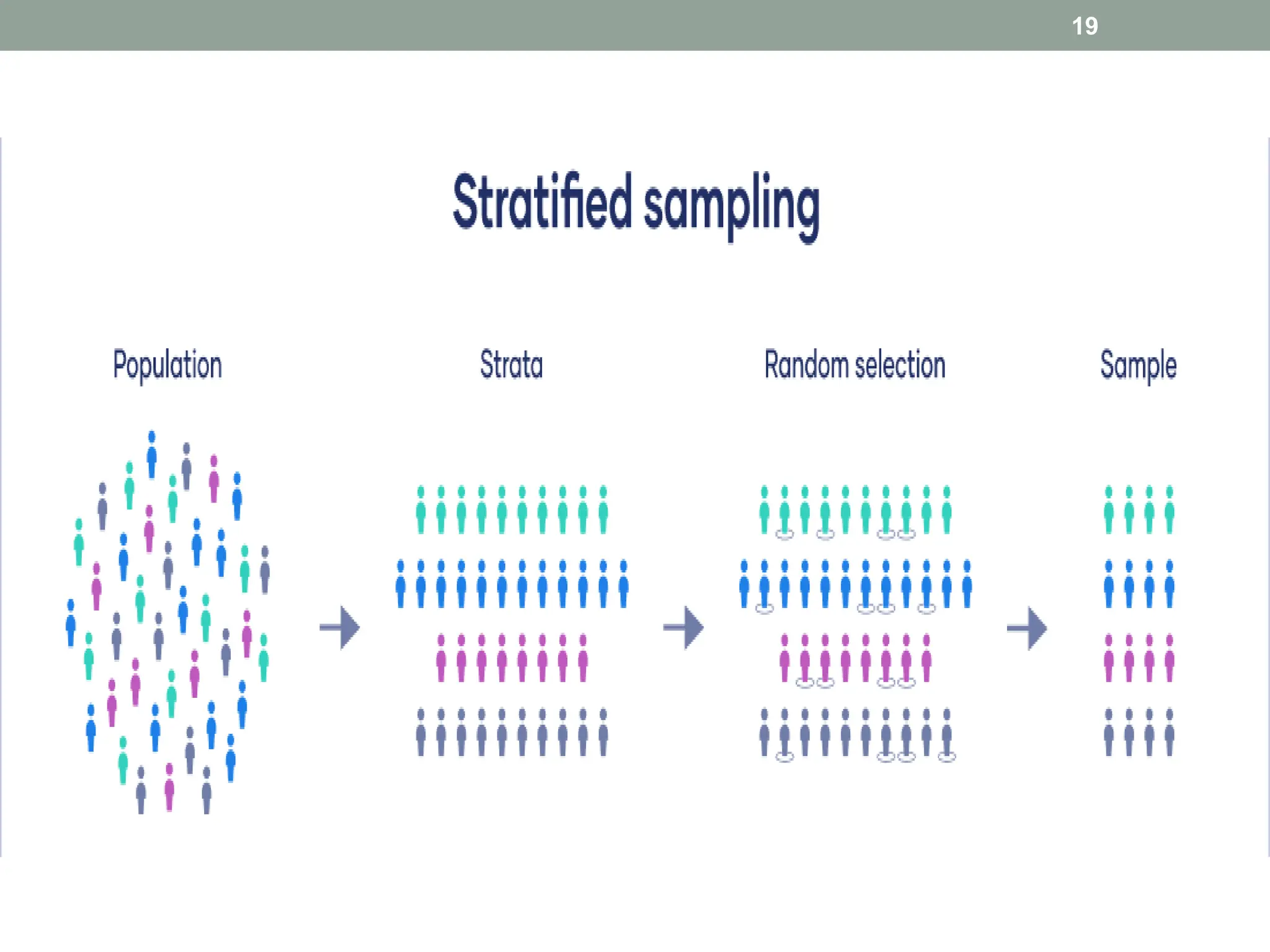
• StratifiedSampling is a probability sampling method
where the population is divided into distinct subgroups
(strata) based on a shared characteristic (e.g., age,
gender, income level).
• A random sample is then drawn from each stratum in
proportion to its size in the population.
• It involves dividing your population into homogeneous
subgroups (strata) and then taking a simple random
sample in each subgroup.
• This method ensures that all subgroups are adequately
represented in the final sample.
18
Example
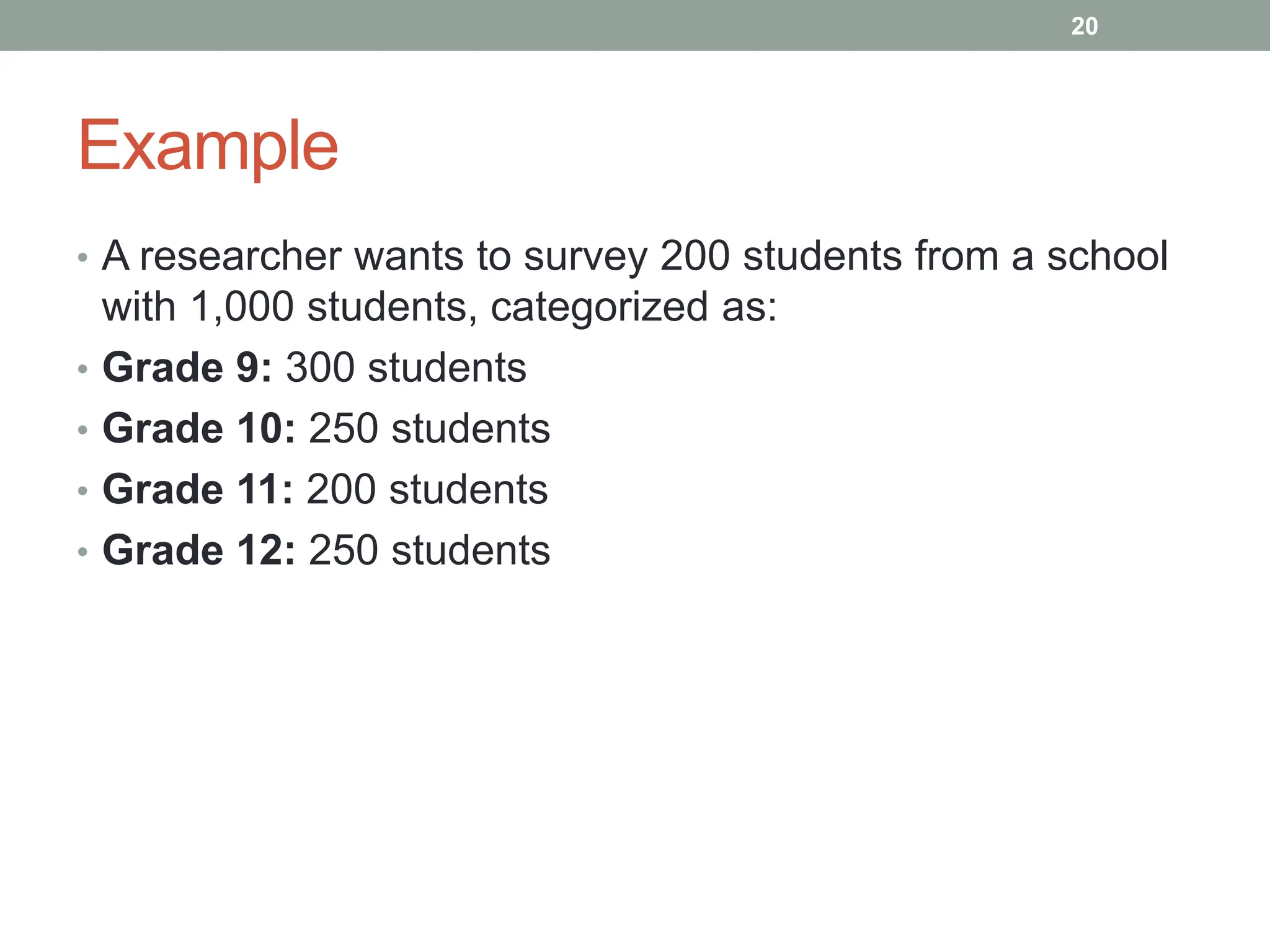
• A researcherwants to survey 200 students from a school
with 1,000 students, categorized as:
• Grade 9: 300 students
• Grade 10: 250 students
• Grade 11: 200 students
• Grade 12: 250 students
20
21.
Advantages
• Ensures Representation– Guarantees that all
subgroups are proportionally included.
• More Precise than Simple Random Sampling –
Reduces variability within each subgroup, leading to
better estimates.
• Allows for Subgroup Analysis – Enables comparisons
across different strata.
• Reduces Sampling Bias – Prevents underrepresentation
of minority groups in the population.
21
22.
Disadvantages
• Requires PopulationInformation – A complete list of the
population and subgroup classifications is necessary.
• Complex and Time-Consuming – Requires additional
steps, such as identifying and dividing strata.
• Not Effective for Homogeneous Populations – If the
population lacks significant differences, stratification may
not be useful.
22
23.
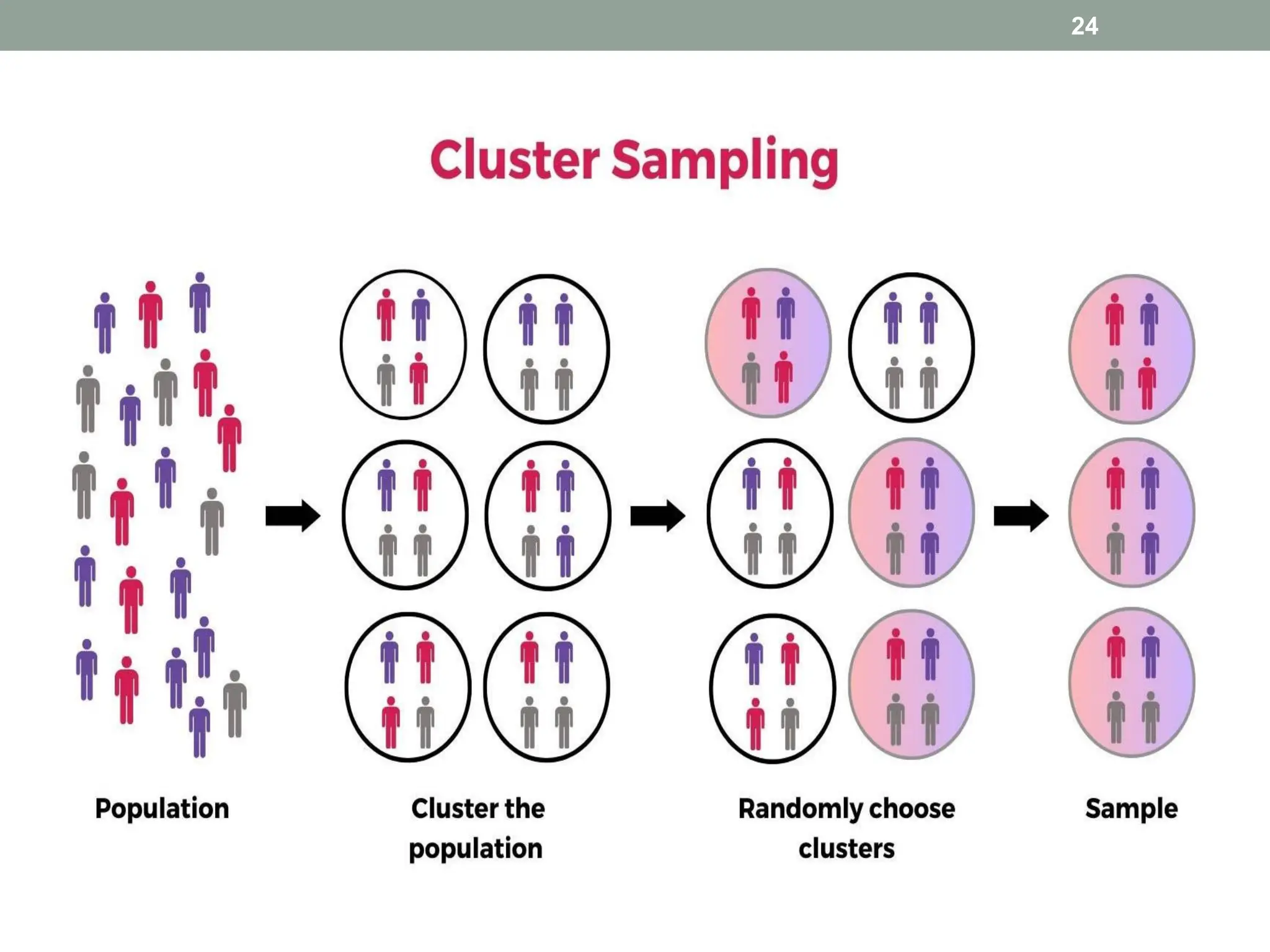
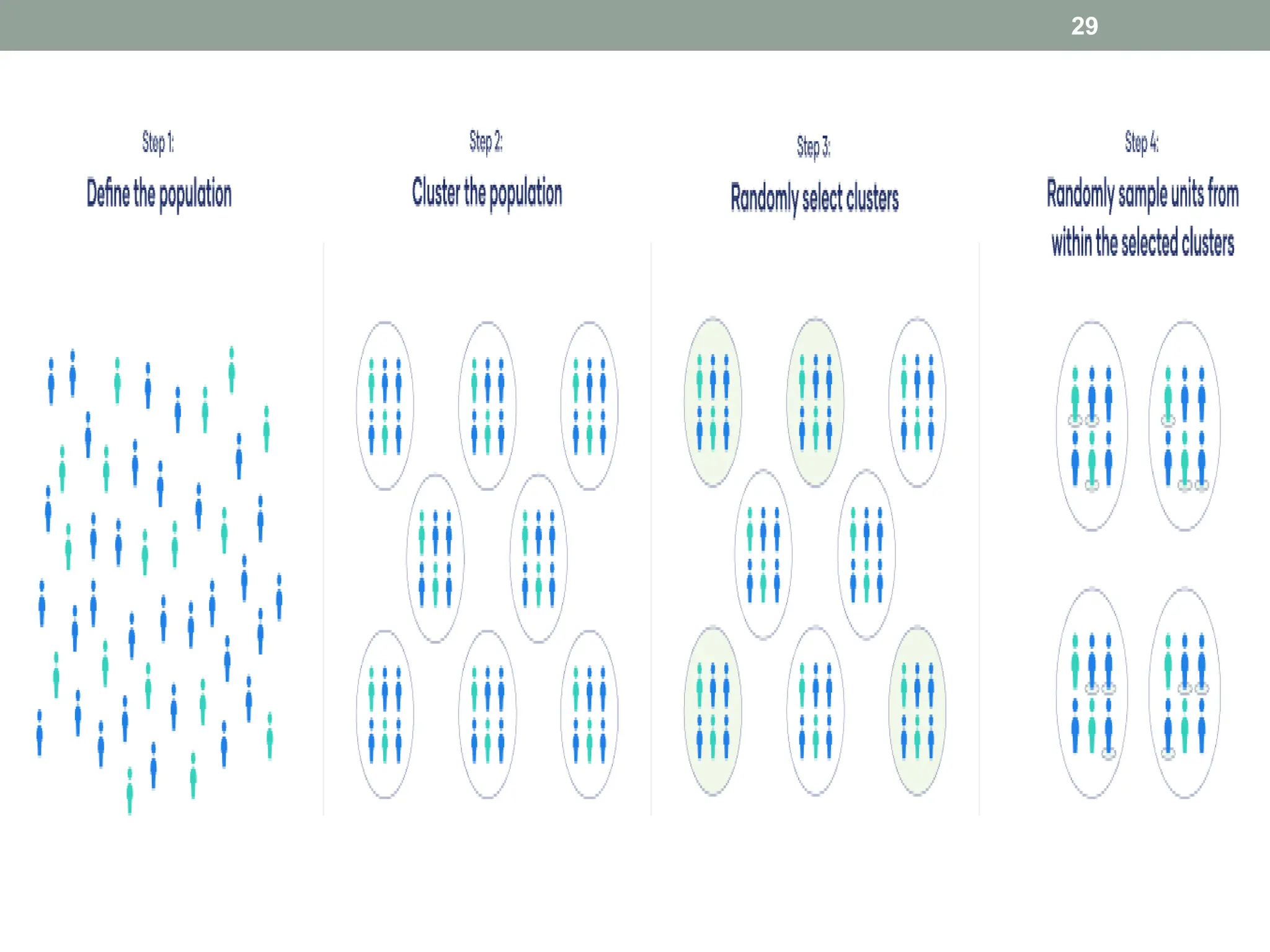
Cluster Sampling
• ClusterSampling is a probability sampling method where
the population is divided into groups (clusters), and a
random selection of clusters is chosen.
• Instead of selecting individuals randomly from the entire
population, researchers randomly select entire clusters
and include all individuals within those clusters in the
sample.
• It is useful when the population is large and
geographically dispersed.
23
Example
• Imagine acompany wants to conduct an employee
satisfaction survey across 500 office branches
worldwide. Instead of surveying employees from all
branches, they use Cluster Sampling:
• Divide the population into clusters – Each office branch
is considered a cluster.
• Randomly select clusters – The company randomly
picks 50 office branches from the 500.
• Survey all employees – All employees in the selected
branches participate in the survey.
25
26.
Advantages
• Cost-Effective andTime-Saving – Reduces costs by
focusing on selected clusters instead of the entire
population.
• Easier to Implement – Useful when a complete list of
individuals is unavailable, but groups (clusters) are
identifiable.
• Suitable for Large Populations – Ideal for large-scale
research where surveying the entire population is
impractical.
26
27.
Disadvantages
• Higher SamplingError – Since fewer clusters are
surveyed, the results may be less representative.
• Risk of Homogeneity Within Clusters – If members
within a cluster are too similar, it may lead to biased
results.
• Less Precision Compared to Stratified Sampling – The
randomness within clusters can lead to variability in
results.
27
28.
Multi-Stage Sampling
• Multi-stagesampling is a type of sampling method
where the population is divided into multiple stages or
levels to gradually select the final sample.
• Instead of directly selecting individuals from the whole
population, selection happens in multiple stages —
making the process more practical, especially for large
populations.
28
Non-Probability Sampling
• Non-probabilitysampling is a type of sampling method
where not every individual in the population has an
equal chance of being selected.
• The selection depends on the researcher's judgment,
convenience, or specific criteria rather than random
selection.
• It is mostly used in qualitative research or when the
population is hard to access.
30
31.
Example
• If aresearcher wants to know the opinions of students
about the new library system:
• The researcher only asks 20 students sitting in the library
(Convenience Sampling).
• Or asks only final-year students (Purposive Sampling).
31
32.
Advantages
• Easy &Quick Process: Takes less time to collect data.
• Less Expensive : Suitable for small budgets.
• Useful for Small Populations: Best for small groups or
niche research.
• Flexible: Can be adjusted based on the researcher's
needs.
• Good for Exploratory Research: Helps in the early
stages of research to understand basic information.
32
33.
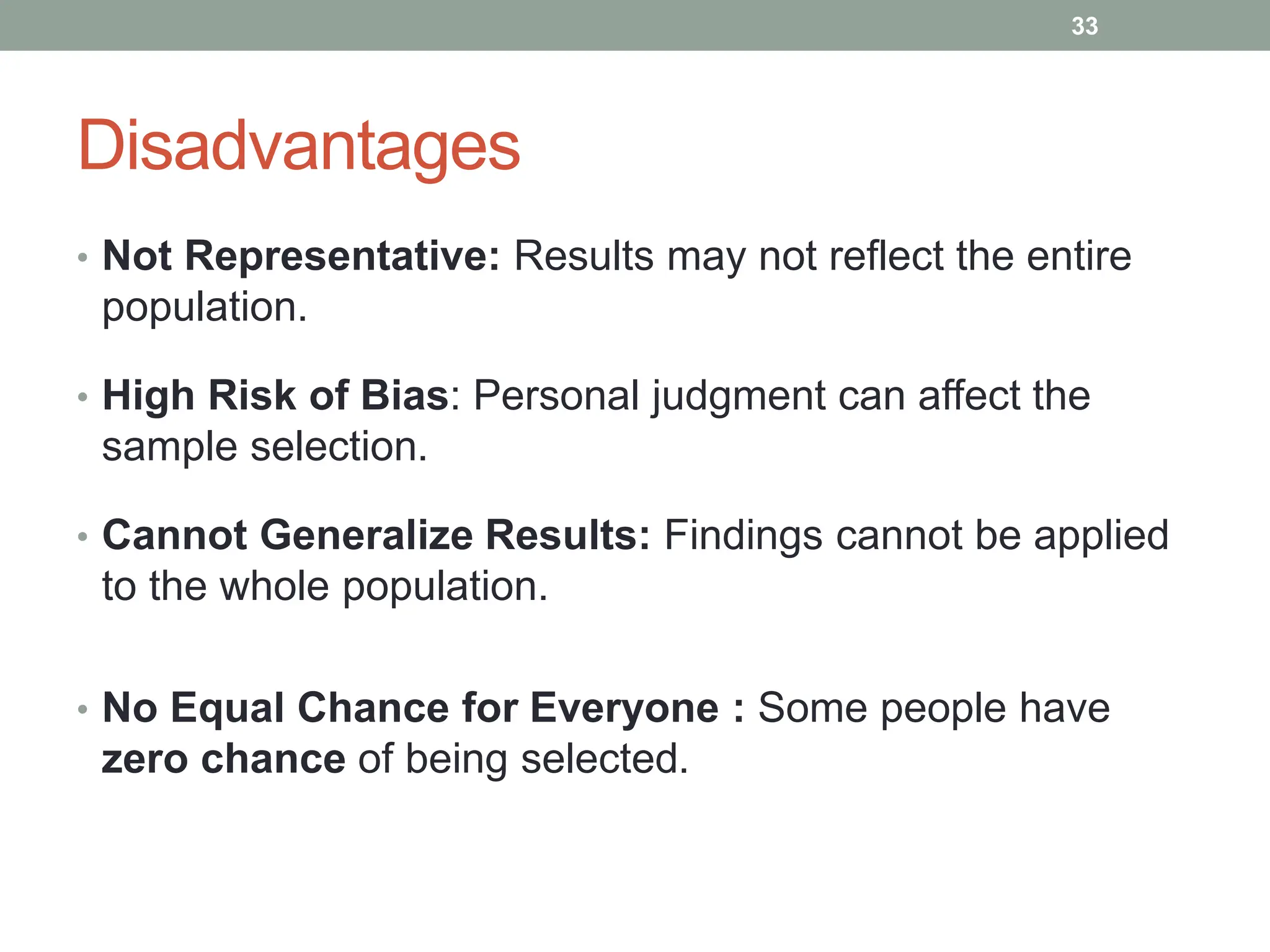
Disadvantages
• Not Representative:Results may not reflect the entire
population.
• High Risk of Bias: Personal judgment can affect the
sample selection.
• Cannot Generalize Results: Findings cannot be applied
to the whole population.
• No Equal Chance for Everyone : Some people have
zero chance of being selected.
33
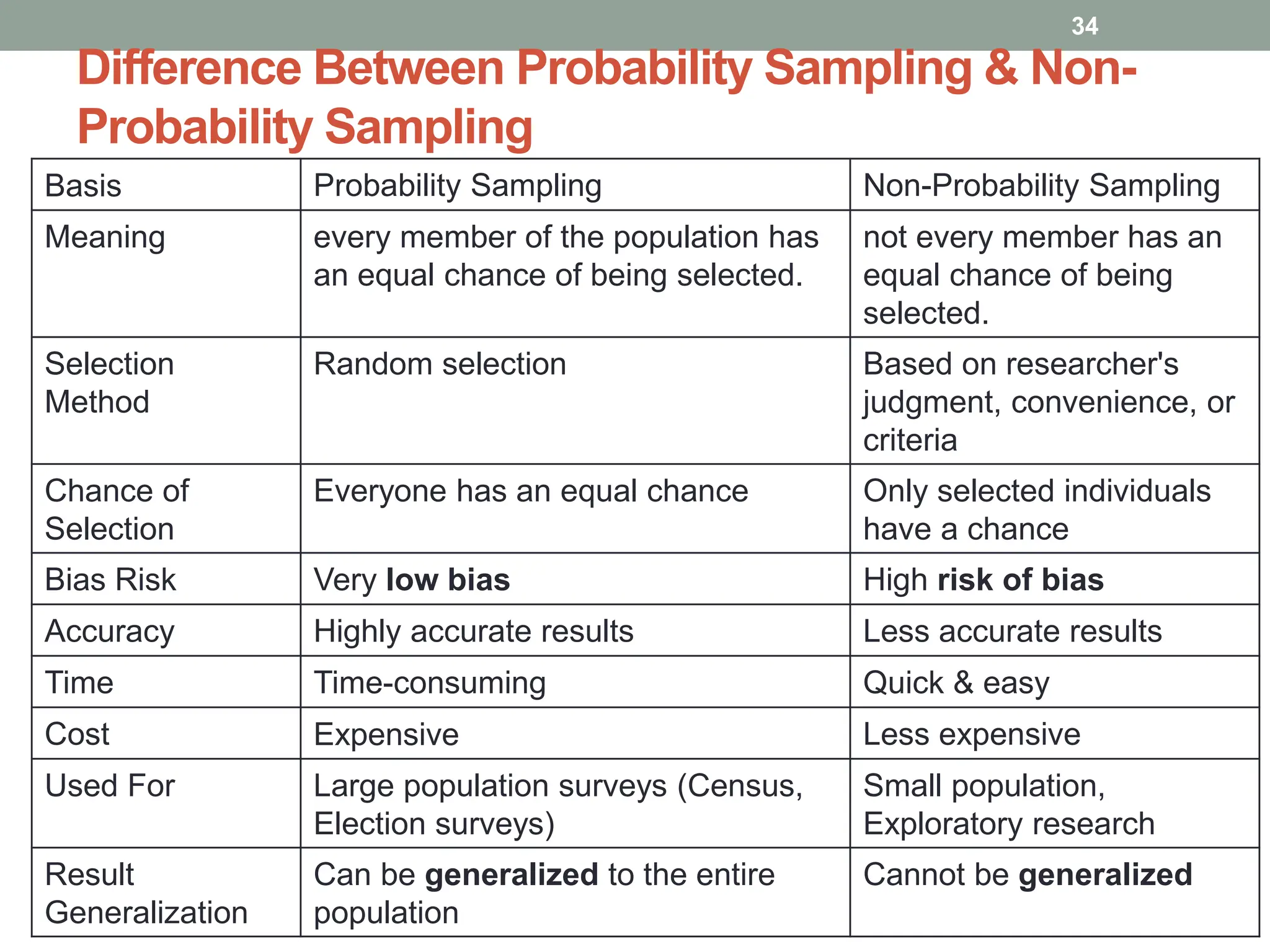
34.
Difference Between ProbabilitySampling & Non-
Probability Sampling
Basis Probability Sampling Non-Probability Sampling
Meaning every member of the population has
an equal chance of being selected.
not every member has an
equal chance of being
selected.
Selection
Method
Random selection Based on researcher's
judgment, convenience, or
criteria
Chance of
Selection
Everyone has an equal chance Only selected individuals
have a chance
Bias Risk Very low bias High risk of bias
Accuracy Highly accurate results Less accurate results
Time Time-consuming Quick & easy
Cost Expensive Less expensive
Used For Large population surveys (Census,
Election surveys)
Small population,
Exploratory research
Result
Generalization
Can be generalized to the entire
population
Cannot be generalized
34
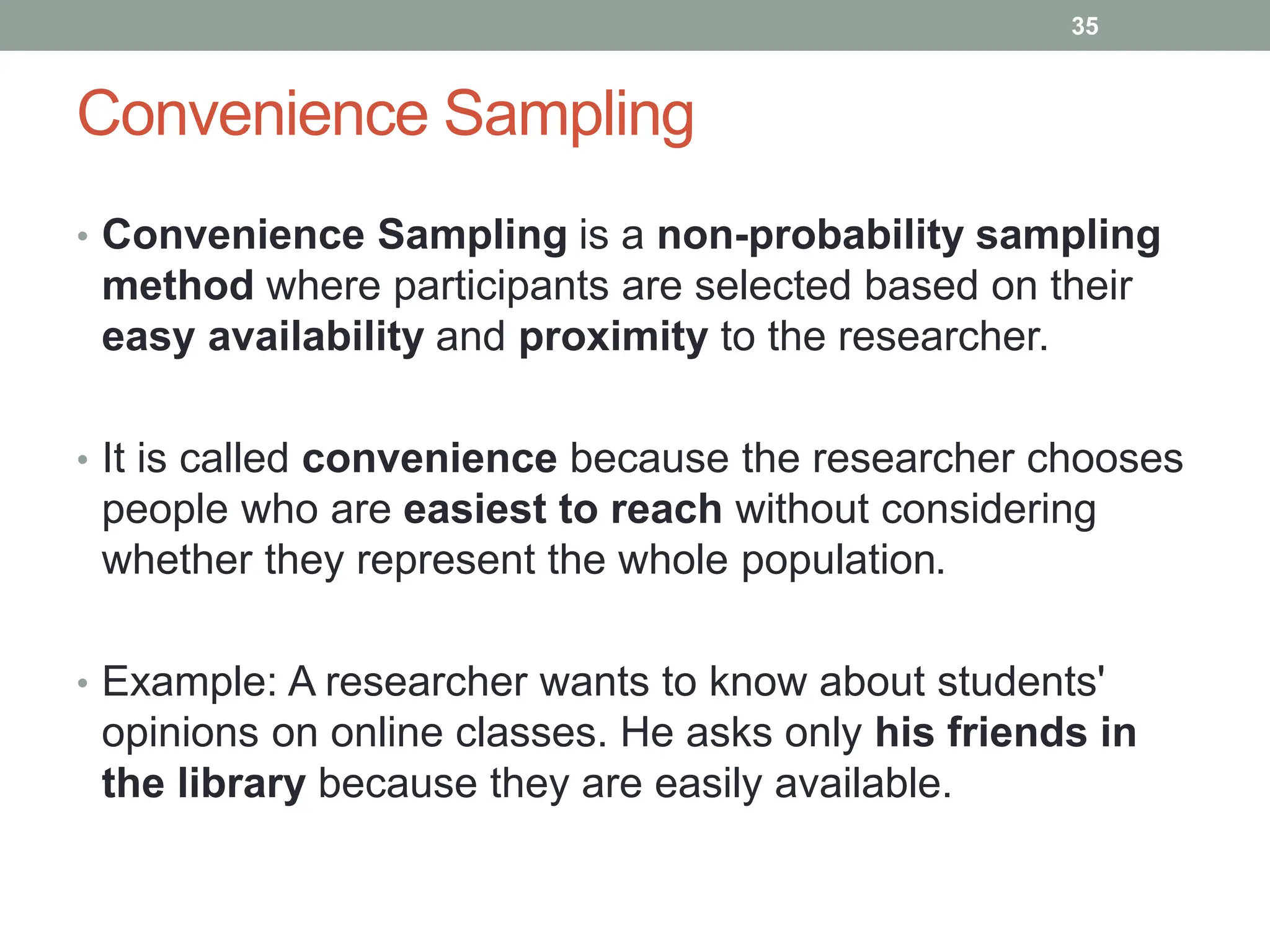
35.
Convenience Sampling
• ConvenienceSampling is a non-probability sampling
method where participants are selected based on their
easy availability and proximity to the researcher.
• It is called convenience because the researcher chooses
people who are easiest to reach without considering
whether they represent the whole population.
• Example: A researcher wants to know about students'
opinions on online classes. He asks only his friends in
the library because they are easily available.
35
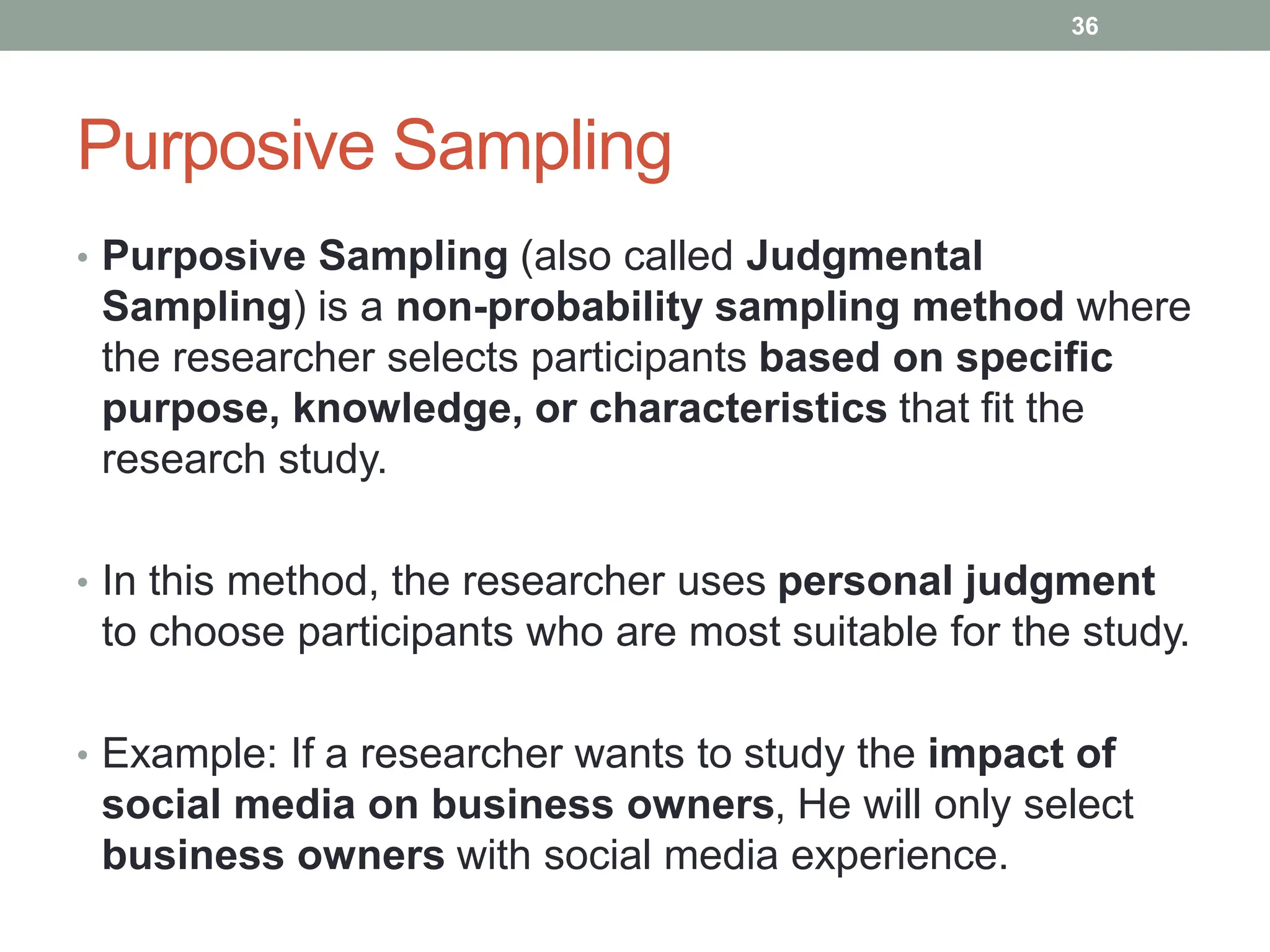
36.
Purposive Sampling
• PurposiveSampling (also called Judgmental
Sampling) is a non-probability sampling method where
the researcher selects participants based on specific
purpose, knowledge, or characteristics that fit the
research study.
• In this method, the researcher uses personal judgment
to choose participants who are most suitable for the study.
• Example: If a researcher wants to study the impact of
social media on business owners, He will only select
business owners with social media experience.
36
37.
Snowball Sampling
• SnowballSampling is a non-probability sampling
method where existing participants help the researcher to
find more participants by referring others.
• It works like a snowball rolling down a hill — the
sample size gets bigger as each participant refers more
people.
• This method is mostly used when the population is hard
to reach or hidden (like rare disease patients).
37
38.
Quota Sampling
• QuotaSampling is a non-probability sampling method
where the population is divided into different groups or
categories based on certain characteristics (like age,
gender, education, or income).
• A fixed number of participants (quota) is selected from
each group.
• The researcher selects participants based on personal
judgment until the required number is reached.
• Example : If a researcher wants to survey 100 students
about online classes:
• 50 males, 50 females
38

![Sample_Designs[1] (1).pptx presentation on education](https://cdn.slidesharecdn.com/ss_thumbnails/sampledesigns11-250706184217-c590a99a-thumbnail.jpg?width=640&height=640&fit=bounds)


![sampling[1].pptx](https://cdn.slidesharecdn.com/ss_thumbnails/sampling1-220819060046-600e7719-thumbnail.jpg?width=640&height=640&fit=bounds)


