1
SALT AFFECTED SOIL
Dr. Surendra Singh
Professor & Former Head
Department of Soil Science and Agril
Chemistry
Institute of Agricultural Science
Banaras Hindu University
Salt affected soils
 Neutral 6.6-7.3
 Slightly alkaline 7.4-7.8
 Moderately alkaline 7.9-8.4
 Strongly alkaline 8.5-9.0
 Very strongly alkaline > 9.0
2
Geographical distribution of salt affected soil
Broad group States in which soil
occur
Approximate
area(Million ha)
Coastal Gujrat Andhra Pradesh 0.714
Arid region Deltaic humid
condition
Orissa,Tamilnadu, West
Bengal
1.394
Medium and deep black Andhra pradesh,
Karnataka, Madhya
pradesh, Maharastra,
Rajsthan
1.42
Arid and semiarid region Gujrat Hariyana, Punjab,
Rajsthan, Uttar pradesh
1.0
Indo-Gangetic plains Bihar, Hariyana,
Madhyapradesh
Rajsthan, Uttar pradesh
2.516
Total 7.044
Distribution of salt affected
soils in India
The semi and indo-gangetic alluvial tract
(Punjab, Hariyana Uttar pradesh and a part of
Bihar)
The arid tracts of Rajsthan and Gujrat
The arid and semi arid racts of black cotton
soils
The coastal alluvium
Sodic soils; 3.77 M ha
Saline soils: 3.0 M ha
Salt affected soils
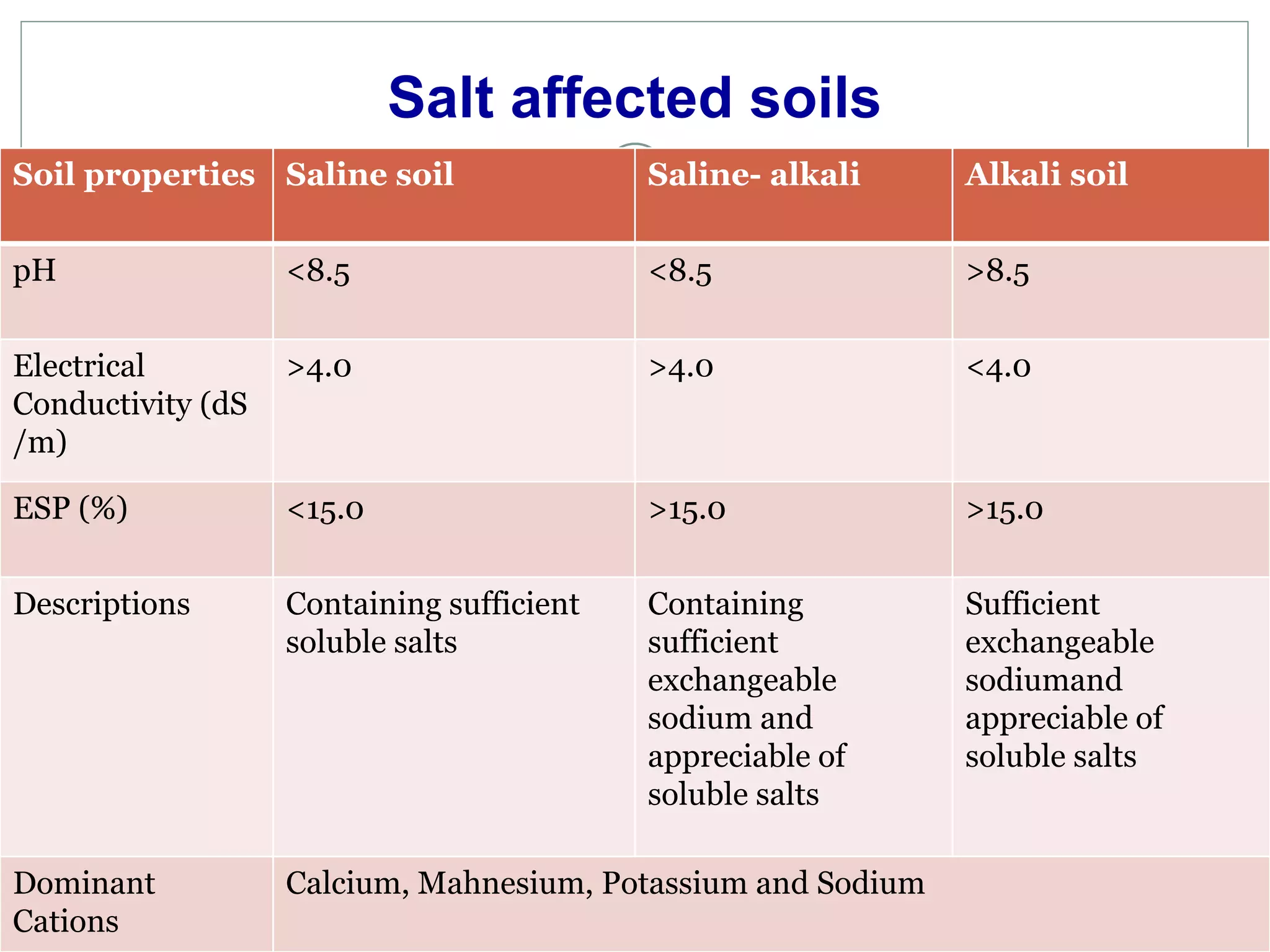
Soil properties Saline soil Saline- alkali Alkali soil
pH <8.5 <8.5 >8.5
Electrical
Conductivity (dS
/m)
>4.0 >4.0 <4.0
ESP (%) <15.0 >15.0 >15.0
Descriptions Containing sufficient
soluble salts
Containing
sufficient
exchangeable
sodium and
appreciable of
soluble salts
Sufficient
exchangeable
sodiumand
appreciable of
soluble salts
Dominant
Cations
Calcium, Mahnesium, Potassium and Sodium
White alkali and Black alkali
 Saline soils are known as white alkali:Ground water comes
with a few meters of the surface, salts accumulate in the
surface of soils. During dry period, these salts appear as a
salt crust (white in colour) the salts present in soils are
sulphate and chloride of sodium and calcium.
 Alkali soils are known as black alkali: Due to Na+, clay and
organic matter are dispersed, dispersed organic matter may
accumulate at the surface of poorly drained areas and
impact as a black colour.In these soils, considerable
amount of Na2Co3 are present. This sodium carbonate
absorbed organic matter and get deposited on the soil
particles turning the soil black.
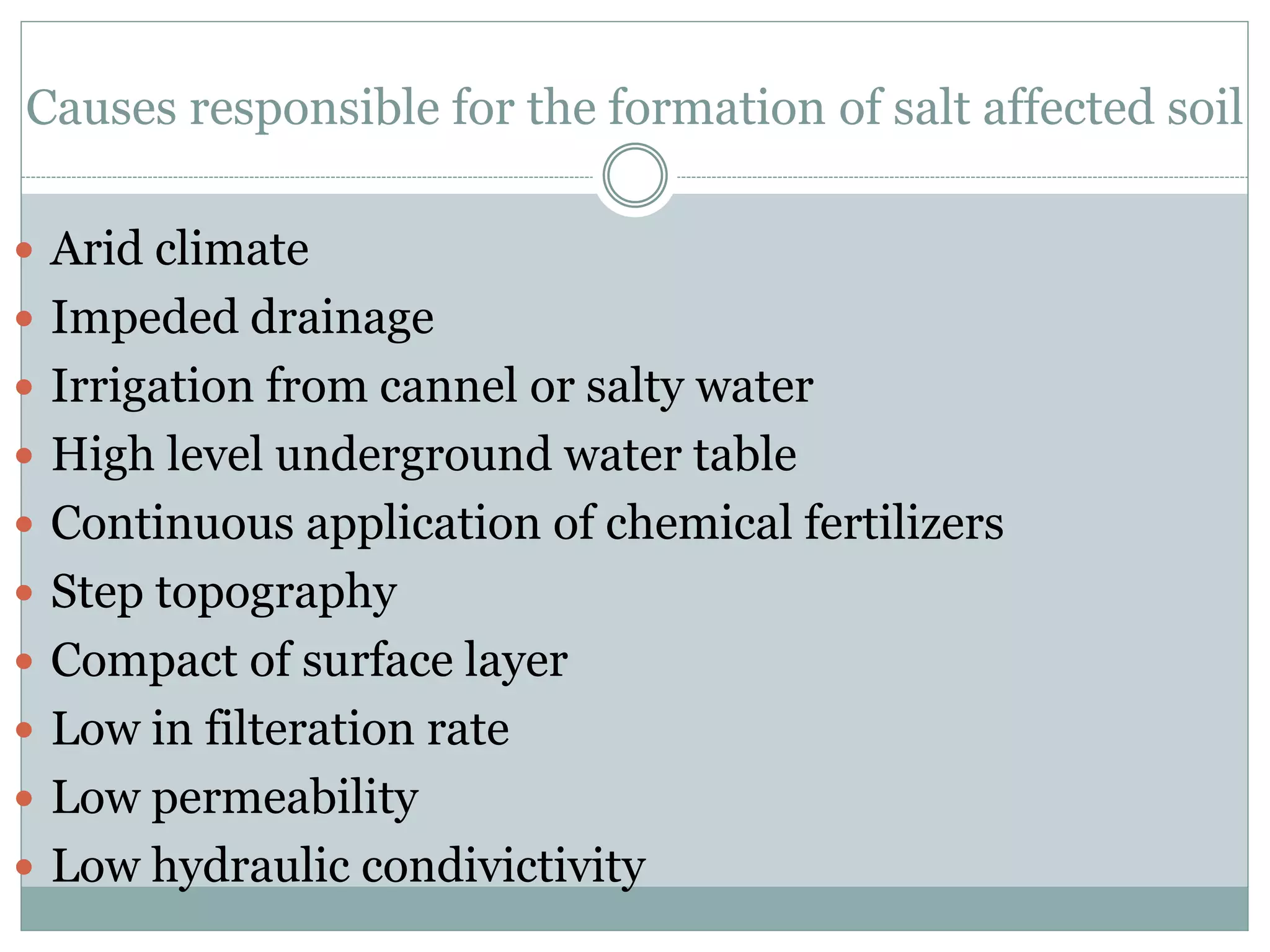
Causes responsible for the formation of salt affected soil
 Arid climate
 Impeded drainage
 Irrigation from cannel or salty water
 High level underground water table
 Continuous application of chemical fertilizers
 Step topography
 Compact of surface layer
 Low in filteration rate
 Low permeability
 Low hydraulic condivictivity
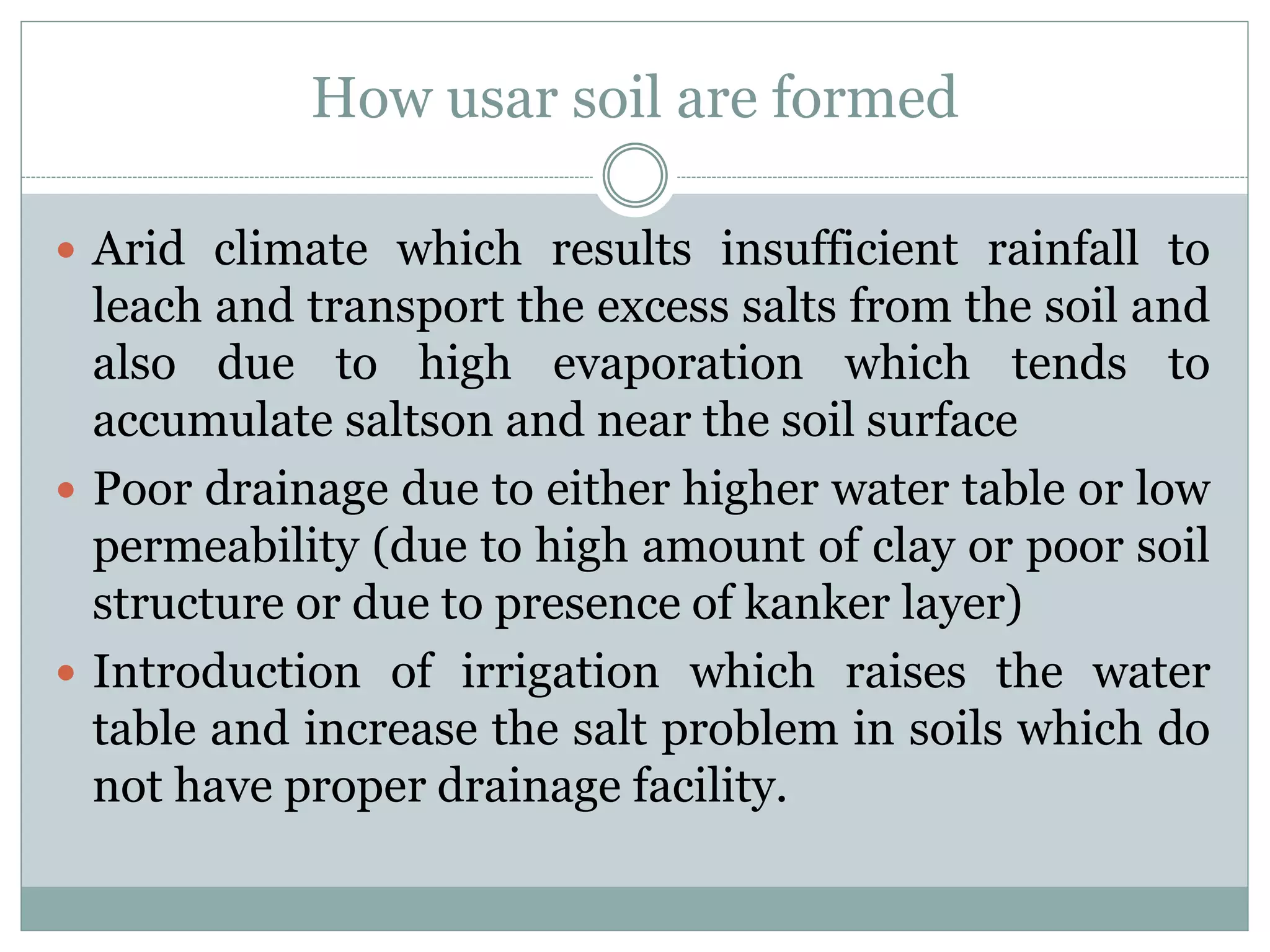
How usar soil are formed
 Arid climate which results insufficient rainfall to
leach and transport the excess salts from the soil and
also due to high evaporation which tends to
accumulate saltson and near the soil surface
 Poor drainage due to either higher water table or low
permeability (due to high amount of clay or poor soil
structure or due to presence of kanker layer)
 Introduction of irrigation which raises the water
table and increase the salt problem in soils which do
not have proper drainage facility.
Sub soil sodicity
 Gypsum incorporated in the soil lower the pH
soluble salts and clay dispersion and increased the
infiltration rate. Yet, these effects were seen in the
surface layers and slowly extended to the lower
layers during the subsequent years. AS a
consequence, sub-soil sodicity remain too high for
deep rooted crops.
Role of the cations (Na+ verses Ca+)
For example: The adsorbed sodium is prominent on the colloidal complex
and in the soil solution and it ample HCO3- and CO3- are present, Na
HCO3- and Na3CO3 will form. Both these salts are water soluble and highly
ionized, thus assuming continued high level of HCO3- and CO3- ions.
NaHCO3- =Na+ + HCO3-
Na2CO3 = 2Na + CO3-
The high concentration of carbonate ions can produce pH values as high as 10 or more
Fortunately Ca+2 is the dominant cations in most alkaline soils. The cation reacts with
carbonic acid H2CO3 to form Ca(HCO3)2 and Ca CO3. The Ca(HCO3)2 is quite soluble
in water and ionize as does NaHCO3.
Ca (HCO3) = ca2+ +2HCO3-
The HCO3- level remains high, there by ensuring the high OH- ion concentration and
high pH levels CaCO3 is not very soluble in water and does not ionize significantly to
provide many CO3- ions. As a result , CaCO3 does not stimulate pH values higher than
those attainable by Ca (HCO3)2. This is fortunate since a wide variety of alkaline soil
contain significant quantities of insoluble Ca CO3- laid down the soils formed. The pH
of those Ca CO3- laden (calcareous ) horizon is coming no higher than 7.5 to 8.0.
Major production constraint in salt
affected soils
SALINE SOILS
Permeable due towell floculateds oil structure
Delayed germination, poor crop stand,stunted growth and reduced yield
ALKALI SOILS
The high Nna content of soils leads to dispersion of fine clay particles
resulting in to low permeability, crusting and hardening of the surface
soil upon drying, as a result the aeration , soil water movement and root
growth is impeded
High Na content is often toxic to many plants which exhibits poor
growth and yield
The sooils have alsopoor aggregate stability, low organic matter
content, toxic concentration of carbonate and bicarbonate, poor
microbial activity and reduced availability of N,P,K,Zn and Fe.
Reclamation
 To determine the type of reclamation will suit a
particular kind of soil. It is necessary to know the
principle underplaying the various methods that are
employed to reclaim saline and alkali soils. Broadly, the
method can be grouped as:
 (i) Physical or hydro-technical amelioration(Deep ploughing,
subsoiling,sand filling and profile inversion)
 (ii)Biological amelioration (Addition of organic matter:
(i)improvement in the water infiltration (ii) Release of CO2 during decomposition)
 (iii)Chemical amelioration (Inorganic chemical agents are used to
reclaim alkali soils and thereby supply to it higher directly or indirectly
calcium that can replace exchangeable Na+.)
Chemical amelioration
Gypsum
Sulphur
Iron sulphate
Pyrite
Lime sulphur
Estimated effectiveness of various materials used to reclaim
alkali soils compared to gypsum
Amendment Amount (tons) equivalent to 1 ton
of gypsum
Gypsum 1.00
Sulphuric acid 0.57
Sulphur 0.18
Iron sulphate l 1.62
Lime sulphur (Calcium polysulphide
containing 24% sulphu)
0.75
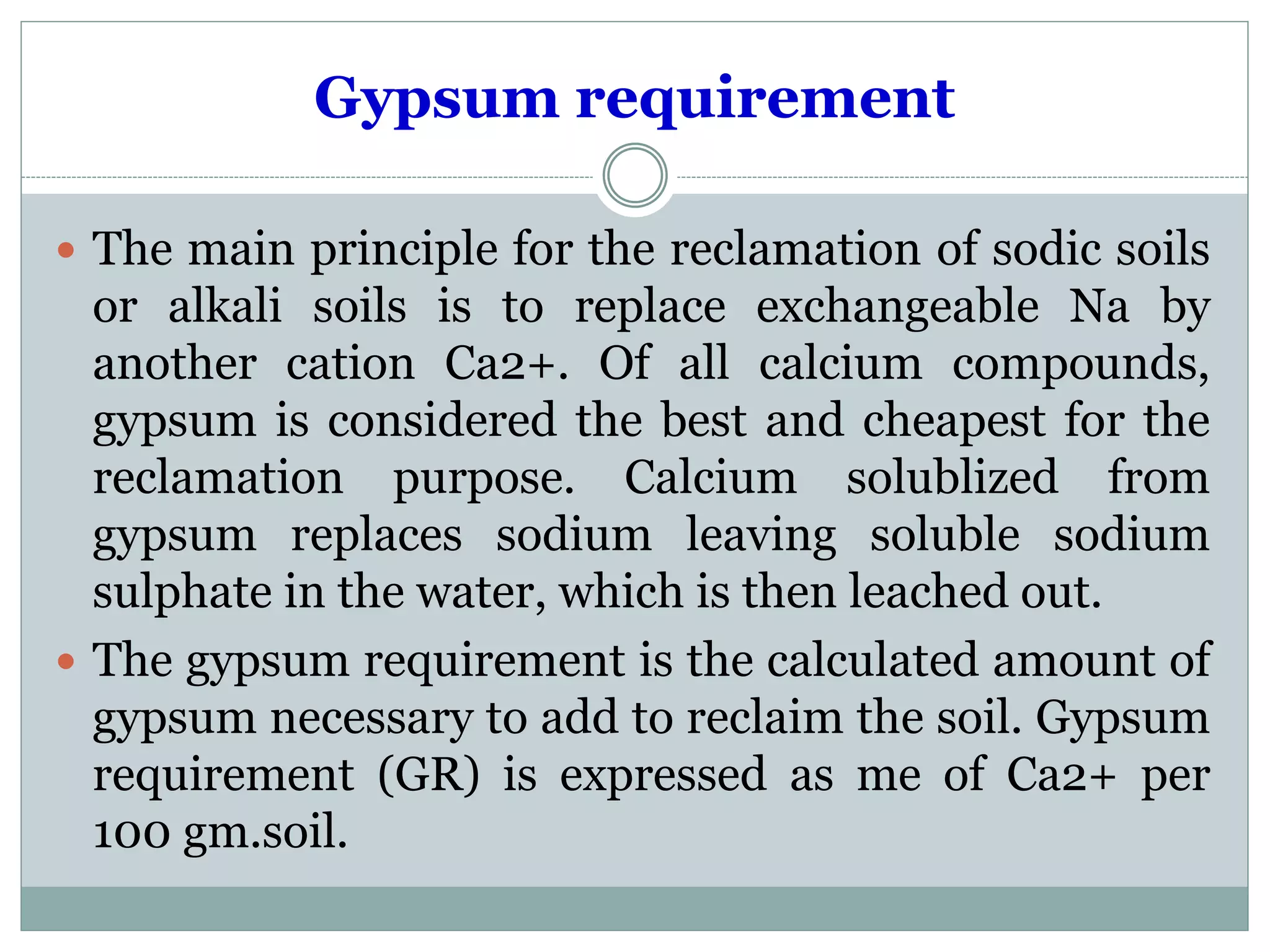
Gypsum requirement
 The main principle for the reclamation of sodic soils
or alkali soils is to replace exchangeable Na by
another cation Ca2+. Of all calcium compounds,
gypsum is considered the best and cheapest for the
reclamation purpose. Calcium solublized from
gypsum replaces sodium leaving soluble sodium
sulphate in the water, which is then leached out.
 The gypsum requirement is the calculated amount of
gypsum necessary to add to reclaim the soil. Gypsum
requirement (GR) is expressed as me of Ca2+ per
100 gm.soil.
Exchangeable Sodium Percentage
(ESP)
 The ESP term is used during the last 10 years in soil
salinity studies .It is determined from exchangeable
Na and CEC by the following equation:
ESP = (Ex Na/CEC) x 100
However, ESP is mathematically related to ESR as
follows:
ESP=(ESR (100))/(1+ESR)
Thus, once the relationship between SAR and ESR has
been determined for a soil, an estimation of ESP can
be calculated (BOWER 1959)
Sodium Absorption Ratio (SAR)
The SAR was calculated from the concentration of cations (meq/L) in the
saturated paste extracted by equation:
SAR = Na/√((Ca +Mg)/2) (all units in meq/L)
Because of the equilibrium relationships between solution and
exchangeable cations in soils, This relationships can be used to estimate
the ESR. The SAR should be related to quantity of Na+ ON THE CEC
which is expressed as the exchangeable sodium ratio (ESR)
Exchangeable Sodium Ratio (ESR)
 The ESR was determined from the exchangeable Na and CEC by the
following relationship:
Exchangeable Na
ESR= ----------------------------------------- (all units in meq/100g)
exchangeable (Ca2+ + Mg + )
The relation ship shown in the Figure can be used to easimate ESR if the
quantity of exchangeable cations has not been measured. The following
equation represents the linear relation ship in Fig.
ESR = 0.015 (SAR)
Exchangeable sodium percentage (ESP)
 Subsequently, ESR is related to exchangeable sodium percentage (ESP)
previously used to classify Na- affected soils.
 ESP = 100 (ESR)
------------
1 +ESR
These parameters and the relationships between them are extremely
valuable in characterizing the solution and exchange chemistry of salt-
and Na- affected soils .The following example illustrate how these
relation ship s can be used.
20
21
22
23
Calculation on SAR,ESR and ESP
(AN EXAMPLE)
A soil analysis revealed that the saturated extract contained 20 meq
Ca2+/L, 10 meq Mg 2+/L and 100 meq Na +/L, EC+2.2 mmho/cm,
soil pH, 8.6, CEC 25 meq/100g. Evaluate this soil for potential
salinity or sodicity problems.
SAR = 100
------ = 25.8
20+10
-------
2
ESR = M0.015 (25.8) =0.39
ESP = 100(0.39)
-----------
1.39
Since the Ecse <4 mmho/cm and ESP > 15 %, This soil would be
classified as sodic. Gypsum application would likely be recommended
to reduce ESP. 24
25
Management of salt
affected soils
Land preparation and tillage method
Cultural practices and planting technique
Irrigation ,leaching and drainage
Crop rotation on saline alkali soils
Amendments, manure and fertilizers
Afforestaion and pasture development
soils
Organic carbon
Nitrogen
Phosphorus
Potassium
Micronutrients
Organic and green manures vis-à-vis
integrated nutrient management
Continue
Organic carbon
 Long term balanced fertlizer use under rice-
wheat system helps in maintaining the organic
carbon status of these soils.
Nitrogen
 Recovery of fertilizer nitrogen normally ranges
from 30 to 40 per cent in alkali soils. Proper
management of fertilizer N is thus necessary for
better N use efficiency.
 Nitrogen use-efficiency can be increased by
integrated use of organic and inorganic sources
of N.
Continue
Phosphorus
 Recommendation for P fertilization in alkali soils
should be based on soil teast.
 Single superphosphate is a better source of P
than other phosphatic fertilizers because of high
Na of alkali soils and as it contains appreciable
amount of calcium sulphate
 Continuous use of P, greenmanuring and FYM to
crops significantly enhanced the yields of rice and
wheat and imporoved P status of the of the
gypsum amended alkali soils.
Potassium
Continue
Continue
Micronutrients
Application of 9 kg Zn /ha (40 kg znc sulphate)
elimated Zn deficiency in rice grown on alkali soils
treated with gypsum, pyrites,FYM and rice husk and
raised the Zn status of soil.
Organic amendments like pressmud, poultry
manure and farmyard manure could effectively
supply zinc to rice from native and applied sources
in saline-sodic soils.
Organic and green manures vis-avis
Integrated nutrient management
Sesbania green manuringor the use of FYM
Nutrient management in saline
soils
Nitrogen
 Fertilizer placed in soil (UPP-urea in paper
packet and UB- urea briqutte) reduced losses
of N to about 5-6 % in saline soils.
 Sulphur coated urea followed by urea briquette
were more efficient than prilled urea for rice
Phosphorus
Availability of fertilizer P in saline soil may be
modified by soil salanity due to higher
precepitation of added soluble P.
Continue
Potassium
Higher level of available K in to the lower depths
indicated continuous release of native and applied
K from saline soils.
Micronutrients
Significan increase in grain yield can be achieved
with application of Zn and Mn fertilization in saline
soils.
Balanced fertilization
More balanced use of soil nutrients in the
presence of adequate phosphorus and potassium
Choice of crop in management of
alkali soil
Sensitive
(ESP around
10)
Semi tolerent
(ESP >15)
Tolerent
(ESP >50)
Cowpea, gram,
lentil,mung, pea,
maize,sunflower,
safflower
Wheat, barely,
oats,berseem,sug
arcane., cotton
potato,
watermelon
Karnalgrass,
Bermunda
grass,rice
sugarbeat,
dhaincha,
spinach, turnip
Salt affected soil(PG).ppt

Salt affected soil(PG).ppt

  • 1.
    1 SALT AFFECTED SOIL Dr.Surendra Singh Professor & Former Head Department of Soil Science and Agril Chemistry Institute of Agricultural Science Banaras Hindu University
  • 2.
    Salt affected soils Neutral 6.6-7.3  Slightly alkaline 7.4-7.8  Moderately alkaline 7.9-8.4  Strongly alkaline 8.5-9.0  Very strongly alkaline > 9.0 2
  • 3.
    Geographical distribution ofsalt affected soil Broad group States in which soil occur Approximate area(Million ha) Coastal Gujrat Andhra Pradesh 0.714 Arid region Deltaic humid condition Orissa,Tamilnadu, West Bengal 1.394 Medium and deep black Andhra pradesh, Karnataka, Madhya pradesh, Maharastra, Rajsthan 1.42 Arid and semiarid region Gujrat Hariyana, Punjab, Rajsthan, Uttar pradesh 1.0 Indo-Gangetic plains Bihar, Hariyana, Madhyapradesh Rajsthan, Uttar pradesh 2.516 Total 7.044
  • 4.
    Distribution of saltaffected soils in India The semi and indo-gangetic alluvial tract (Punjab, Hariyana Uttar pradesh and a part of Bihar) The arid tracts of Rajsthan and Gujrat The arid and semi arid racts of black cotton soils The coastal alluvium Sodic soils; 3.77 M ha Saline soils: 3.0 M ha
  • 5.
    Salt affected soils Soilproperties Saline soil Saline- alkali Alkali soil pH <8.5 <8.5 >8.5 Electrical Conductivity (dS /m) >4.0 >4.0 <4.0 ESP (%) <15.0 >15.0 >15.0 Descriptions Containing sufficient soluble salts Containing sufficient exchangeable sodium and appreciable of soluble salts Sufficient exchangeable sodiumand appreciable of soluble salts Dominant Cations Calcium, Mahnesium, Potassium and Sodium
  • 6.
    White alkali andBlack alkali  Saline soils are known as white alkali:Ground water comes with a few meters of the surface, salts accumulate in the surface of soils. During dry period, these salts appear as a salt crust (white in colour) the salts present in soils are sulphate and chloride of sodium and calcium.  Alkali soils are known as black alkali: Due to Na+, clay and organic matter are dispersed, dispersed organic matter may accumulate at the surface of poorly drained areas and impact as a black colour.In these soils, considerable amount of Na2Co3 are present. This sodium carbonate absorbed organic matter and get deposited on the soil particles turning the soil black.
  • 7.
    Causes responsible forthe formation of salt affected soil  Arid climate  Impeded drainage  Irrigation from cannel or salty water  High level underground water table  Continuous application of chemical fertilizers  Step topography  Compact of surface layer  Low in filteration rate  Low permeability  Low hydraulic condivictivity
  • 8.
    How usar soilare formed  Arid climate which results insufficient rainfall to leach and transport the excess salts from the soil and also due to high evaporation which tends to accumulate saltson and near the soil surface  Poor drainage due to either higher water table or low permeability (due to high amount of clay or poor soil structure or due to presence of kanker layer)  Introduction of irrigation which raises the water table and increase the salt problem in soils which do not have proper drainage facility.
  • 9.
    Sub soil sodicity Gypsum incorporated in the soil lower the pH soluble salts and clay dispersion and increased the infiltration rate. Yet, these effects were seen in the surface layers and slowly extended to the lower layers during the subsequent years. AS a consequence, sub-soil sodicity remain too high for deep rooted crops.
  • 10.
    Role of thecations (Na+ verses Ca+) For example: The adsorbed sodium is prominent on the colloidal complex and in the soil solution and it ample HCO3- and CO3- are present, Na HCO3- and Na3CO3 will form. Both these salts are water soluble and highly ionized, thus assuming continued high level of HCO3- and CO3- ions. NaHCO3- =Na+ + HCO3- Na2CO3 = 2Na + CO3- The high concentration of carbonate ions can produce pH values as high as 10 or more Fortunately Ca+2 is the dominant cations in most alkaline soils. The cation reacts with carbonic acid H2CO3 to form Ca(HCO3)2 and Ca CO3. The Ca(HCO3)2 is quite soluble in water and ionize as does NaHCO3. Ca (HCO3) = ca2+ +2HCO3- The HCO3- level remains high, there by ensuring the high OH- ion concentration and high pH levels CaCO3 is not very soluble in water and does not ionize significantly to provide many CO3- ions. As a result , CaCO3 does not stimulate pH values higher than those attainable by Ca (HCO3)2. This is fortunate since a wide variety of alkaline soil contain significant quantities of insoluble Ca CO3- laid down the soils formed. The pH of those Ca CO3- laden (calcareous ) horizon is coming no higher than 7.5 to 8.0.
  • 11.
    Major production constraintin salt affected soils SALINE SOILS Permeable due towell floculateds oil structure Delayed germination, poor crop stand,stunted growth and reduced yield ALKALI SOILS The high Nna content of soils leads to dispersion of fine clay particles resulting in to low permeability, crusting and hardening of the surface soil upon drying, as a result the aeration , soil water movement and root growth is impeded High Na content is often toxic to many plants which exhibits poor growth and yield The sooils have alsopoor aggregate stability, low organic matter content, toxic concentration of carbonate and bicarbonate, poor microbial activity and reduced availability of N,P,K,Zn and Fe.
  • 12.
    Reclamation  To determinethe type of reclamation will suit a particular kind of soil. It is necessary to know the principle underplaying the various methods that are employed to reclaim saline and alkali soils. Broadly, the method can be grouped as:  (i) Physical or hydro-technical amelioration(Deep ploughing, subsoiling,sand filling and profile inversion)  (ii)Biological amelioration (Addition of organic matter: (i)improvement in the water infiltration (ii) Release of CO2 during decomposition)  (iii)Chemical amelioration (Inorganic chemical agents are used to reclaim alkali soils and thereby supply to it higher directly or indirectly calcium that can replace exchangeable Na+.)
  • 13.
  • 14.
    Estimated effectiveness ofvarious materials used to reclaim alkali soils compared to gypsum Amendment Amount (tons) equivalent to 1 ton of gypsum Gypsum 1.00 Sulphuric acid 0.57 Sulphur 0.18 Iron sulphate l 1.62 Lime sulphur (Calcium polysulphide containing 24% sulphu) 0.75
  • 15.
    Gypsum requirement  Themain principle for the reclamation of sodic soils or alkali soils is to replace exchangeable Na by another cation Ca2+. Of all calcium compounds, gypsum is considered the best and cheapest for the reclamation purpose. Calcium solublized from gypsum replaces sodium leaving soluble sodium sulphate in the water, which is then leached out.  The gypsum requirement is the calculated amount of gypsum necessary to add to reclaim the soil. Gypsum requirement (GR) is expressed as me of Ca2+ per 100 gm.soil.
  • 16.
    Exchangeable Sodium Percentage (ESP) The ESP term is used during the last 10 years in soil salinity studies .It is determined from exchangeable Na and CEC by the following equation: ESP = (Ex Na/CEC) x 100 However, ESP is mathematically related to ESR as follows: ESP=(ESR (100))/(1+ESR) Thus, once the relationship between SAR and ESR has been determined for a soil, an estimation of ESP can be calculated (BOWER 1959)
  • 17.
    Sodium Absorption Ratio(SAR) The SAR was calculated from the concentration of cations (meq/L) in the saturated paste extracted by equation: SAR = Na/√((Ca +Mg)/2) (all units in meq/L) Because of the equilibrium relationships between solution and exchangeable cations in soils, This relationships can be used to estimate the ESR. The SAR should be related to quantity of Na+ ON THE CEC which is expressed as the exchangeable sodium ratio (ESR)
  • 18.
    Exchangeable Sodium Ratio(ESR)  The ESR was determined from the exchangeable Na and CEC by the following relationship: Exchangeable Na ESR= ----------------------------------------- (all units in meq/100g) exchangeable (Ca2+ + Mg + ) The relation ship shown in the Figure can be used to easimate ESR if the quantity of exchangeable cations has not been measured. The following equation represents the linear relation ship in Fig. ESR = 0.015 (SAR)
  • 19.
    Exchangeable sodium percentage(ESP)  Subsequently, ESR is related to exchangeable sodium percentage (ESP) previously used to classify Na- affected soils.  ESP = 100 (ESR) ------------ 1 +ESR These parameters and the relationships between them are extremely valuable in characterizing the solution and exchange chemistry of salt- and Na- affected soils .The following example illustrate how these relation ship s can be used.
  • 20.
  • 21.
  • 22.
  • 23.
  • 24.
    Calculation on SAR,ESRand ESP (AN EXAMPLE) A soil analysis revealed that the saturated extract contained 20 meq Ca2+/L, 10 meq Mg 2+/L and 100 meq Na +/L, EC+2.2 mmho/cm, soil pH, 8.6, CEC 25 meq/100g. Evaluate this soil for potential salinity or sodicity problems. SAR = 100 ------ = 25.8 20+10 ------- 2 ESR = M0.015 (25.8) =0.39 ESP = 100(0.39) ----------- 1.39 Since the Ecse <4 mmho/cm and ESP > 15 %, This soil would be classified as sodic. Gypsum application would likely be recommended to reduce ESP. 24
  • 25.
  • 26.
    Management of salt affectedsoils Land preparation and tillage method Cultural practices and planting technique Irrigation ,leaching and drainage Crop rotation on saline alkali soils Amendments, manure and fertilizers Afforestaion and pasture development
  • 27.
  • 28.
    Continue Organic carbon  Longterm balanced fertlizer use under rice- wheat system helps in maintaining the organic carbon status of these soils. Nitrogen  Recovery of fertilizer nitrogen normally ranges from 30 to 40 per cent in alkali soils. Proper management of fertilizer N is thus necessary for better N use efficiency.  Nitrogen use-efficiency can be increased by integrated use of organic and inorganic sources of N.
  • 29.
    Continue Phosphorus  Recommendation forP fertilization in alkali soils should be based on soil teast.  Single superphosphate is a better source of P than other phosphatic fertilizers because of high Na of alkali soils and as it contains appreciable amount of calcium sulphate  Continuous use of P, greenmanuring and FYM to crops significantly enhanced the yields of rice and wheat and imporoved P status of the of the gypsum amended alkali soils. Potassium Continue
  • 30.
    Continue Micronutrients Application of 9kg Zn /ha (40 kg znc sulphate) elimated Zn deficiency in rice grown on alkali soils treated with gypsum, pyrites,FYM and rice husk and raised the Zn status of soil. Organic amendments like pressmud, poultry manure and farmyard manure could effectively supply zinc to rice from native and applied sources in saline-sodic soils. Organic and green manures vis-avis Integrated nutrient management Sesbania green manuringor the use of FYM
  • 31.
    Nutrient management insaline soils Nitrogen  Fertilizer placed in soil (UPP-urea in paper packet and UB- urea briqutte) reduced losses of N to about 5-6 % in saline soils.  Sulphur coated urea followed by urea briquette were more efficient than prilled urea for rice Phosphorus Availability of fertilizer P in saline soil may be modified by soil salanity due to higher precepitation of added soluble P.
  • 32.
    Continue Potassium Higher level ofavailable K in to the lower depths indicated continuous release of native and applied K from saline soils. Micronutrients Significan increase in grain yield can be achieved with application of Zn and Mn fertilization in saline soils. Balanced fertilization More balanced use of soil nutrients in the presence of adequate phosphorus and potassium
  • 33.
    Choice of cropin management of alkali soil Sensitive (ESP around 10) Semi tolerent (ESP >15) Tolerent (ESP >50) Cowpea, gram, lentil,mung, pea, maize,sunflower, safflower Wheat, barely, oats,berseem,sug arcane., cotton potato, watermelon Karnalgrass, Bermunda grass,rice sugarbeat, dhaincha, spinach, turnip