Study Abroad and Exchange CRICOS Provider Code: 00116K
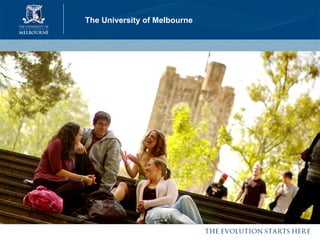
The University of Melbourne
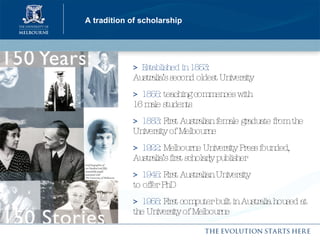
A tradition of scholarship >   Established in 1853:   Australia’s second oldest University  >   1855:  teaching commences with  16 male students >   1883:  First Australian female graduate from the University of Melbourne  >   1922:  Melbourne University Press founded, Australia’s first scholarly publisher >   1945:  First Australian University  to offer PhD >   1955:  First computer built in Australia housed at the University of Melbourne
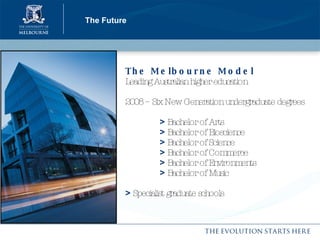
The Future The Melbourne Model   Leading Australian higher education 2008 – Six New Generation undergraduate degrees   >   Bachelor of Arts   >   Bachelor of Bioscience   >   Bachelor of Science   >   Bachelor of Commerce   >   Bachelor of Environments   >   Bachelor of Music >  Specialist graduate schools
The University’s new strategic vision Growing Esteem, Melbourne's new strategy, developed with extensive consultation around the University in 2005: >   Signals the University's intention to remain a leading    education provider in the 21st century >   Is the University’s response to global and educational change >   Brings closer alignment to Melbourne’s international profile >   Sets a new benchmark in higher education and a pioneering model  in Australia
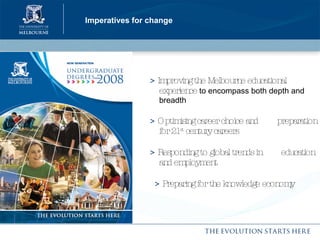
Imperatives for change >  Improving the Melbourne educational experience  to encompass both depth and breadth >  Optimising career choice and  preparation for 21 st  century careers >  Responding to global trends in  education and employment >  Preparing for the knowledge economy
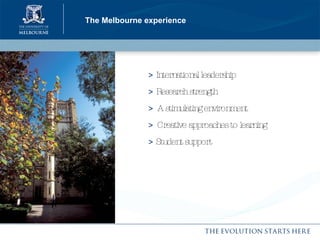
The Melbourne experience >  International leadership >  Research strength >   A stimulating environment >   Creative approaches to learning  >  Student support
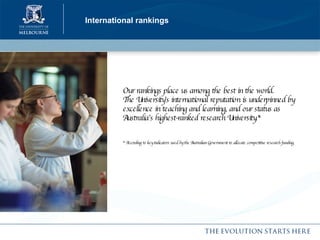
International rankings Our rankings place us among the best in the world. The University’s international reputation is underpinned by excellence in teaching and learning, and our status as Australia’s highest-ranked research University.* * According to key indicators used by the Australian Government to allocate competitive research funding.
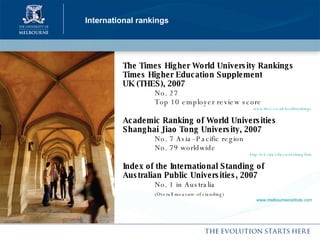
International rankings The Times Higher World University Rankings Times Higher Education Supplement UK (THES), 2007 No. 27  Top 10 employer review score www.thes.co.uk/worldrankings Academic Ranking of World Universities Shanghai Jiao Tong University, 2007 No. 7 Asia–Pacific region No. 79 worldwide http://ed.sjtu.edu.cn/ranking.htm Index of the International Standing of  Australian Public Universities, 2007  No. 1 in Australia (Overall measure of standing) www.melbourneinstitute.com
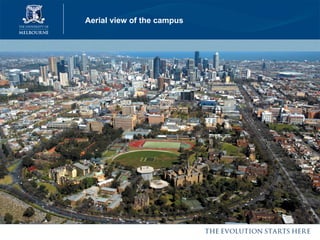
Aerial view of the campus
Partnerships and exchange The University has exchange agreements around the globe. In the US  our exchange partners include: Boston College California Polytechnic State University Carnegie Mellon University Chicago College of Performing Arts Cornell University (College of Agriculture and Life Sciences) Duke University Georgetown University Haverford College New York University (Stern School of Business) Pennsylvania State University University of California  University of Illinois at Urbana-Champaign University of Maine University of Michigan University of North Carolina at Chapel Hill University of Pennsylvania University of Southern California (Marshall School of Business) University of Texas at Austin University of Virginia (U21) University of Washington Virginia Polytechnic Institute Washington University in St Louis (Olin School of Business) Study Abroad students may come to the University from any university  provided they meet the eligibility requirements.
Partnerships and exchange The University has exchange agreements around the globe. Some of  our exchange partners include: University of Vienna, Austria McGill University, Canada University of Toronto, Canada University of Chile Tsinghua University, China University of Copenhagen, Denmark Charles University, Czech Republic Institut d’Etude Politique  ( Sciences Po ), France HEC, School of Management, France Humboldt University, Germany  Trinity College, Dublin Luigi Bocconi University of Commerce, Italy University of Bologna, Italy Hitotsubashi University, Japan Keio University, Japan  Seoul National University, Korea University of Amsterdam, The Netherlands University of Oslo, Norway University of Salamanca, Spain Royal Institute of Technology (KTH), Sweden Uppsala University, Sweden National Taiwan University, Taiwan Chulalongkorn University, Thailand University College, London, UK University of Edinburgh, UK University of Manchester, UK Georgetown University, USA University of California, USA University of Virginia, USA Study Abroad students may come to the University from any university  provided they meet the eligibility requirements.
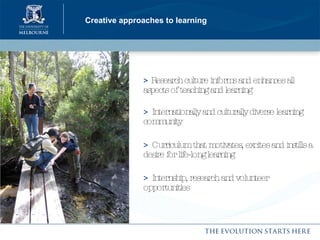
Creative approaches to learning >  Research culture informs and enhances all aspects of teaching and learning >   Internationally and culturally diverse learning community >   Curriculum that motivates, excites and instills a desire for life-long learning  >   Internship, research and volunteer opportunities
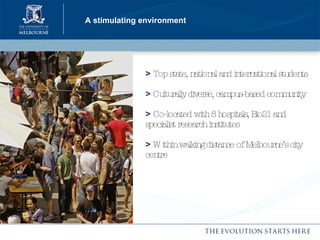
A stimulating environment >   Top state, national and international students >   Culturally diverse, campus-based community  >   Co-located with 8 hospitals, Bio21 and specialist research institutes >   Within walking distance of Melbourne’s city centre
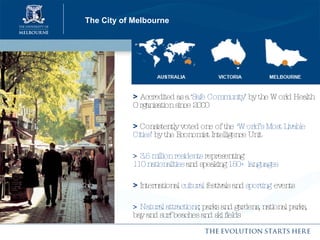
The City of Melbourne >   Accredited as a  ‘Safe Community’  by the World Health Organisation since 2000  >   Consistently voted one of the   ‘World’s Most Livable Cities’  by the Economist Intelligence Unit >  3.5 million residents  representing  110 nationalities  and speaking  150+ languages >   International  cultural  festivals and  sporting   events >  Natural attractions ; parks and gardens, national parks, bay and surf beaches and ski fields
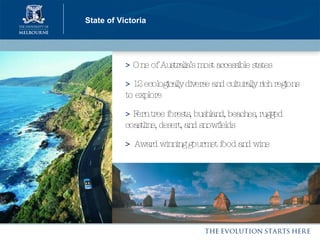
State of Victoria >  One of Australia’s most accessible states >  12 ecologically diverse and culturally rich regions to explore >  Fern tree forests, bushland, beaches, rugged coastline, desert, and snowfields >   Award winning gourmet food and wine
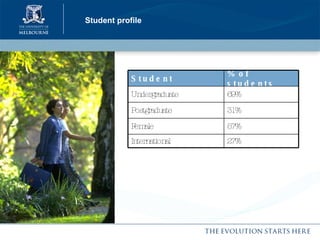
Student profile 57% Female 27% International 31% Postgraduate 69% Undergraduate % of students Student
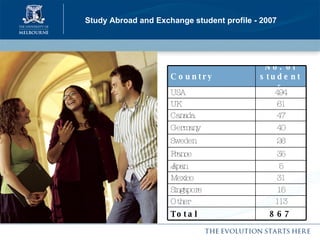
Study Abroad and Exchange student profile - 2007 31 Mexico 113 Other 47 Canada 15 Singapore 5 Japan 35 France 40 Germany 26 Sweden 61 UK 867 Total 494 USA No. of students Country
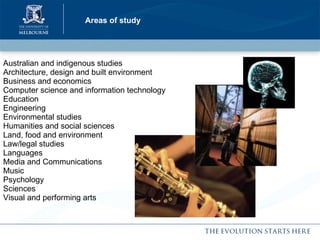
Areas of study Australian and indigenous studies Architecture, design and built environment  Business and economics  Computer science and information technology Education Engineering  Environmental studies Humanities and social sciences Land, food and environment Law/legal studies Languages Media and Communications Music Psychology Sciences Visual and performing arts
The Australian Centre >  Nationally and internationally recognised for teaching and research in Australian studies   >   Introduction into Australian social, political and cultural life >   Collaboration with local government, museums, galleries and new media institutions >   Research, academic publications, public seminars and the administration of major cultural awards
Academic program >  Full load of 4 subjects - choice of 1000s >   Faculty staff can help refine academic program >   Academic culture - greater independent learning >   Credit transfer - statement of results provided by UM but home institution determines transfer of marks
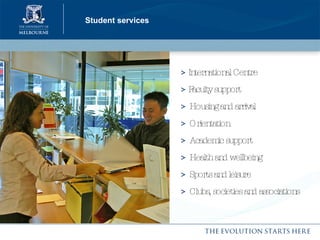
Student services >  International Centre   >  Faculty support >   Housing and arrival >   Orientation  >   Academic support >   Health and wellbeing >   Sports and leisure >   Clubs, societies and associations
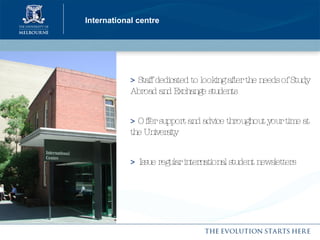
International centre >  Staff dedicated to looking after the needs of Study Abroad and Exchange students >  Offer support and advice throughout your time at the University >   Issue regular international student newsletters
Faculty support >  Each Faculty provides specialist support for Study Abroad and Exchange students >  Advisers for each faculty are available to assist with subject selection >  Faculties can assist with any matter whether it be academic or personal
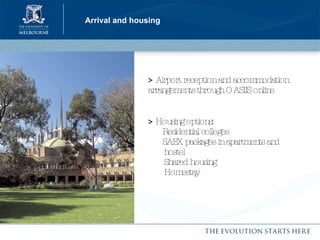
Arrival and housing >  Airport reception and accommodation arrangements through OASIIS online >  Housing options:   Residential colleges   SAEX packages in apartments and  hostel Shared housing Homestay
Cost of living >  Approximate cost  per semester  depending on accommodation option Residential college =  A$10-16,000   Apartment/hostel =  A$10-14,000 Private rental =  A$10-12,000 Costs include: food, public transport, utilities, telephone and personal spending money. >   Study Abroad students Undergraduate Tuition Fee 2008-9  A$10,450
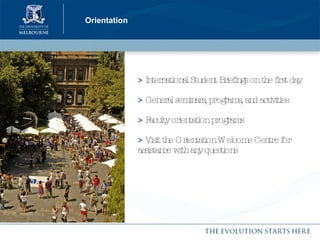
Orientation >  International Student Briefings on the first day >  General seminars, programs, and activities >  Faculty orientation programs >  Visit the Orientation Welcome Centre for assistance with any questions
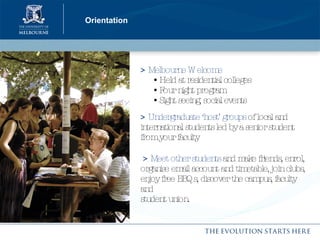
Orientation >   Melbourne Welcome   • Held at residential colleges   • Four night program   • Sight seeing, social events >   Undergraduate ‘host’ groups  of local and international students led by a senior student from your faculty    >   Meet other students  and make friends, enrol, organise email account and timetable, join clubs, enjoy free BBQs, discover the campus, faculty and  student union.
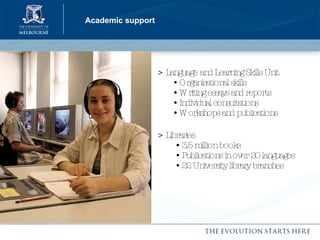
Academic support >  Language and Learning Skills Unit    • Organisational skills   • Writing essays and reports   • Individual consultations   • Workshops and publications >  Libraries   • 3.5 million books   • Publications in over 20 languages   • 22 University library branches
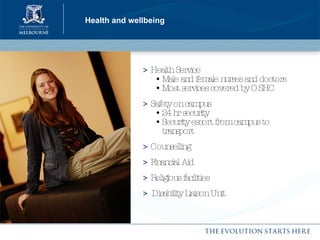
Health and wellbeing >  Health Service    • Male and female nurses and doctors   • Most services covered by OSHC >  Safety on campus    • 24 hr security   • Security escort from campus to    transport >  Counselling >  Financial Aid >  Religious facilities >   Disability Liaison Unit
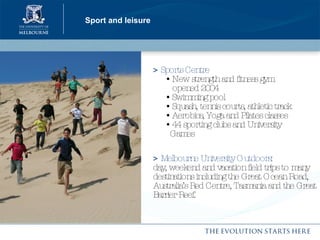
Sport and leisure >   Sports Centre     • New strength and fitness gym    opened 2004   • Swimming pool    • Squash, tennis courts, athletic track   • Aerobics, Yoga and Pilates classes   • 44 sporting clubs and University    Games >   Melbourne University Outdoors:   day, weekend and vacation field trips to many destinations including the Great Ocean Road, Australia’s Red Centre, Tasmania and the Great Barrier Reef.
Clubs, societies and associations >  Melbourne University Student Union    • Student Advisory Service   • Free legal service   • Gallery, theatre, cinema, recreational library >   Study Abroad and   Exchange club (M.U.S.Ex) >  Over 150 clubs and societies >  Melbourne University Overseas Student Service   • Automatic membership   • Festival of Nations   • Seminars, workshops and publications   • MUOSS lounge
Eligibility criteria >  Completed a minimum of 2 semesters of full time University study  >  GPA 3.0 (US & Canada) or equivalent  >   English language proficiency >  Applicants offered a place by the University of Melbourne
Academic calendar 2006/2007 >  Semester 2 / 2008   •  Melbourne Welcome: 16-20 July • Orientation: 21-25 July • Teaching and examination: 28 July - 28 November   >  Semester 1 / 2009   •  Melbourne Welcome: 12 - 16 February • Orientation: 19 - 26 February • Teaching and examination: 2 March - 26 June >  Semester 2 / 2009   •  Melbourne Welcome: 15 - 19 July • Orientation: 20 - 24 July • Teaching and examination: 27 July - 27 November
Australian university accreditation >   Universities can only be established by a Legislative Act at the Federal or State level >   Australian Qualifications Framework >   Australian Universities Quality Assurance  >  The Educational Services for Overseas Students Act
© Copyright The University of Melbourne 2006  CRICOS Provider Code: 00116K

Sa Ex Template2008

  • 1.
    Study Abroad andExchange CRICOS Provider Code: 00116K
  • 2.
  • 3.
    A tradition ofscholarship > Established in 1853: Australia’s second oldest University > 1855: teaching commences with 16 male students > 1883: First Australian female graduate from the University of Melbourne > 1922: Melbourne University Press founded, Australia’s first scholarly publisher > 1945: First Australian University to offer PhD > 1955: First computer built in Australia housed at the University of Melbourne
  • 4.
    The Future TheMelbourne Model Leading Australian higher education 2008 – Six New Generation undergraduate degrees > Bachelor of Arts > Bachelor of Bioscience > Bachelor of Science > Bachelor of Commerce > Bachelor of Environments > Bachelor of Music > Specialist graduate schools
  • 5.
    The University’s newstrategic vision Growing Esteem, Melbourne's new strategy, developed with extensive consultation around the University in 2005: > Signals the University's intention to remain a leading education provider in the 21st century > Is the University’s response to global and educational change > Brings closer alignment to Melbourne’s international profile > Sets a new benchmark in higher education and a pioneering model in Australia
  • 6.
    Imperatives for change> Improving the Melbourne educational experience to encompass both depth and breadth > Optimising career choice and preparation for 21 st century careers > Responding to global trends in education and employment > Preparing for the knowledge economy
  • 7.
    The Melbourne experience> International leadership > Research strength > A stimulating environment > Creative approaches to learning > Student support
  • 8.
    International rankings Ourrankings place us among the best in the world. The University’s international reputation is underpinned by excellence in teaching and learning, and our status as Australia’s highest-ranked research University.* * According to key indicators used by the Australian Government to allocate competitive research funding.
  • 9.
    International rankings TheTimes Higher World University Rankings Times Higher Education Supplement UK (THES), 2007 No. 27 Top 10 employer review score www.thes.co.uk/worldrankings Academic Ranking of World Universities Shanghai Jiao Tong University, 2007 No. 7 Asia–Pacific region No. 79 worldwide http://ed.sjtu.edu.cn/ranking.htm Index of the International Standing of Australian Public Universities, 2007 No. 1 in Australia (Overall measure of standing) www.melbourneinstitute.com
  • 10.
    Aerial view ofthe campus
  • 11.
    Partnerships and exchangeThe University has exchange agreements around the globe. In the US our exchange partners include: Boston College California Polytechnic State University Carnegie Mellon University Chicago College of Performing Arts Cornell University (College of Agriculture and Life Sciences) Duke University Georgetown University Haverford College New York University (Stern School of Business) Pennsylvania State University University of California University of Illinois at Urbana-Champaign University of Maine University of Michigan University of North Carolina at Chapel Hill University of Pennsylvania University of Southern California (Marshall School of Business) University of Texas at Austin University of Virginia (U21) University of Washington Virginia Polytechnic Institute Washington University in St Louis (Olin School of Business) Study Abroad students may come to the University from any university provided they meet the eligibility requirements.
  • 12.
    Partnerships and exchangeThe University has exchange agreements around the globe. Some of our exchange partners include: University of Vienna, Austria McGill University, Canada University of Toronto, Canada University of Chile Tsinghua University, China University of Copenhagen, Denmark Charles University, Czech Republic Institut d’Etude Politique ( Sciences Po ), France HEC, School of Management, France Humboldt University, Germany Trinity College, Dublin Luigi Bocconi University of Commerce, Italy University of Bologna, Italy Hitotsubashi University, Japan Keio University, Japan Seoul National University, Korea University of Amsterdam, The Netherlands University of Oslo, Norway University of Salamanca, Spain Royal Institute of Technology (KTH), Sweden Uppsala University, Sweden National Taiwan University, Taiwan Chulalongkorn University, Thailand University College, London, UK University of Edinburgh, UK University of Manchester, UK Georgetown University, USA University of California, USA University of Virginia, USA Study Abroad students may come to the University from any university provided they meet the eligibility requirements.
  • 13.
    Creative approaches tolearning > Research culture informs and enhances all aspects of teaching and learning > Internationally and culturally diverse learning community > Curriculum that motivates, excites and instills a desire for life-long learning > Internship, research and volunteer opportunities
  • 14.
    A stimulating environment> Top state, national and international students > Culturally diverse, campus-based community > Co-located with 8 hospitals, Bio21 and specialist research institutes > Within walking distance of Melbourne’s city centre
  • 15.
    The City ofMelbourne > Accredited as a ‘Safe Community’ by the World Health Organisation since 2000 > Consistently voted one of the ‘World’s Most Livable Cities’ by the Economist Intelligence Unit > 3.5 million residents representing 110 nationalities and speaking 150+ languages > International cultural festivals and sporting events > Natural attractions ; parks and gardens, national parks, bay and surf beaches and ski fields
  • 16.
    State of Victoria> One of Australia’s most accessible states > 12 ecologically diverse and culturally rich regions to explore > Fern tree forests, bushland, beaches, rugged coastline, desert, and snowfields > Award winning gourmet food and wine
  • 17.
    Student profile 57%Female 27% International 31% Postgraduate 69% Undergraduate % of students Student
  • 18.
    Study Abroad andExchange student profile - 2007 31 Mexico 113 Other 47 Canada 15 Singapore 5 Japan 35 France 40 Germany 26 Sweden 61 UK 867 Total 494 USA No. of students Country
  • 19.
    Areas of studyAustralian and indigenous studies Architecture, design and built environment Business and economics Computer science and information technology Education Engineering Environmental studies Humanities and social sciences Land, food and environment Law/legal studies Languages Media and Communications Music Psychology Sciences Visual and performing arts
  • 20.
    The Australian Centre> Nationally and internationally recognised for teaching and research in Australian studies > Introduction into Australian social, political and cultural life > Collaboration with local government, museums, galleries and new media institutions > Research, academic publications, public seminars and the administration of major cultural awards
  • 21.
    Academic program > Full load of 4 subjects - choice of 1000s > Faculty staff can help refine academic program > Academic culture - greater independent learning > Credit transfer - statement of results provided by UM but home institution determines transfer of marks
  • 22.
    Student services > International Centre > Faculty support > Housing and arrival > Orientation > Academic support > Health and wellbeing > Sports and leisure > Clubs, societies and associations
  • 23.
    International centre > Staff dedicated to looking after the needs of Study Abroad and Exchange students > Offer support and advice throughout your time at the University > Issue regular international student newsletters
  • 24.
    Faculty support > Each Faculty provides specialist support for Study Abroad and Exchange students > Advisers for each faculty are available to assist with subject selection > Faculties can assist with any matter whether it be academic or personal
  • 25.
    Arrival and housing> Airport reception and accommodation arrangements through OASIIS online > Housing options: Residential colleges SAEX packages in apartments and hostel Shared housing Homestay
  • 26.
    Cost of living> Approximate cost per semester depending on accommodation option Residential college = A$10-16,000 Apartment/hostel = A$10-14,000 Private rental = A$10-12,000 Costs include: food, public transport, utilities, telephone and personal spending money. > Study Abroad students Undergraduate Tuition Fee 2008-9 A$10,450
  • 27.
    Orientation > International Student Briefings on the first day > General seminars, programs, and activities > Faculty orientation programs > Visit the Orientation Welcome Centre for assistance with any questions
  • 28.
    Orientation > Melbourne Welcome • Held at residential colleges • Four night program • Sight seeing, social events > Undergraduate ‘host’ groups of local and international students led by a senior student from your faculty > Meet other students and make friends, enrol, organise email account and timetable, join clubs, enjoy free BBQs, discover the campus, faculty and student union.
  • 29.
    Academic support > Language and Learning Skills Unit • Organisational skills • Writing essays and reports • Individual consultations • Workshops and publications > Libraries • 3.5 million books • Publications in over 20 languages • 22 University library branches
  • 30.
    Health and wellbeing> Health Service • Male and female nurses and doctors • Most services covered by OSHC > Safety on campus • 24 hr security • Security escort from campus to transport > Counselling > Financial Aid > Religious facilities > Disability Liaison Unit
  • 31.
    Sport and leisure> Sports Centre • New strength and fitness gym opened 2004 • Swimming pool • Squash, tennis courts, athletic track • Aerobics, Yoga and Pilates classes • 44 sporting clubs and University Games > Melbourne University Outdoors: day, weekend and vacation field trips to many destinations including the Great Ocean Road, Australia’s Red Centre, Tasmania and the Great Barrier Reef.
  • 32.
    Clubs, societies andassociations > Melbourne University Student Union • Student Advisory Service • Free legal service • Gallery, theatre, cinema, recreational library > Study Abroad and Exchange club (M.U.S.Ex) > Over 150 clubs and societies > Melbourne University Overseas Student Service • Automatic membership • Festival of Nations • Seminars, workshops and publications • MUOSS lounge
  • 33.
    Eligibility criteria > Completed a minimum of 2 semesters of full time University study > GPA 3.0 (US & Canada) or equivalent > English language proficiency > Applicants offered a place by the University of Melbourne
  • 34.
    Academic calendar 2006/2007> Semester 2 / 2008 • Melbourne Welcome: 16-20 July • Orientation: 21-25 July • Teaching and examination: 28 July - 28 November > Semester 1 / 2009 • Melbourne Welcome: 12 - 16 February • Orientation: 19 - 26 February • Teaching and examination: 2 March - 26 June > Semester 2 / 2009 • Melbourne Welcome: 15 - 19 July • Orientation: 20 - 24 July • Teaching and examination: 27 July - 27 November
  • 35.
    Australian university accreditation> Universities can only be established by a Legislative Act at the Federal or State level > Australian Qualifications Framework > Australian Universities Quality Assurance > The Educational Services for Overseas Students Act
  • 36.
    © Copyright TheUniversity of Melbourne 2006 CRICOS Provider Code: 00116K