Download to read offline
![Build the EARTH and MOON 1
2
What is this strange thing called an "eclipse?" How is it that the sun or
moon can be hidden?
The Earth is a planet which orbits around the Sun, a journey that takes a
year. The Moon orbits around the Earth, a trip that takes about a month.
An eclipse of the sun, or solar eclipse, occurs when the Moon is aligned
exactly between the Earth and the Sun. Looking up from a part of the Earth
that's in the Moon's shadow, you can see the Sun vanish in the middle of
the day! The Moon's orbit around the Earth is tilted about 5.2 degrees from
the orbit of the Earth around the Sun. As a result of this tilt, a solar eclipse
occurs somewhere on the Earth about two to five times a year.
A lunar eclipse occurs when the Earth is aligned exactly between the Sun
and the Moon, so that the moon falls within the Earth's shadow and thus
vanishes from sight. Lunar eclipses are more rare than solar eclipses,
typically occurring three times a year or less.
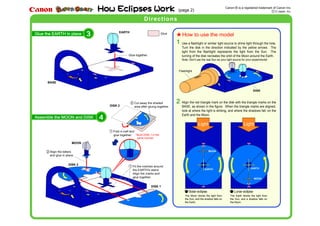
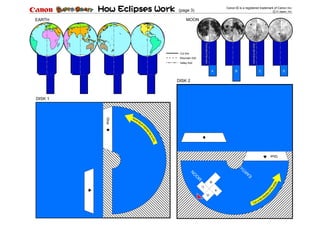
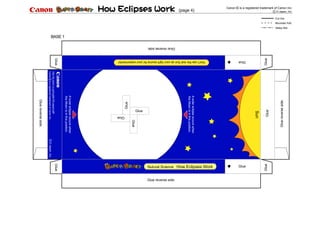
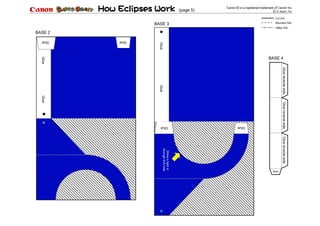
This Papercraft model will let you see for yourself how eclipses work.
Glue
(page 1)
Glue together.
Glue together.
Glue together.
Glue together.
*Build BASE 3 in the
same manner.
Fold 4 sides over
and glue together.
EARTH
BASE 1
BASE 2
BASE 2 BASE 3
MOON
Build the BASE
Glue together.
Align the heart marks
and glue together.
Align the spade marks
and glue together.
BASE 4
Glue near the
center of the
bottom side of
BASE 1.
1
12
1
3
2
Fold in half and
glue together.
2 Cut away the shaded
area after gluing together.
[A4 size 6 pages]Canon is a registered trademark of Canon Inc.R
D Japan, Inc..
DirectionsDirections
Continued on page 2](https://image.slidesharecdn.com/sleclipseea4-170809215119/85/S-l-eclipse_e_a4-1-320.jpg)
![Build the EARTH and MOON 1
2
What is this strange thing called an "eclipse?" How is it that the sun or
moon can be hidden?
The Earth is a planet which orbits around the Sun, a journey that takes a
year. The Moon orbits around the Earth, a trip that takes about a month.
An eclipse of the sun, or solar eclipse, occurs when the Moon is aligned
exactly between the Earth and the Sun. Looking up from a part of the Earth
that's in the Moon's shadow, you can see the Sun vanish in the middle of
the day! The Moon's orbit around the Earth is tilted about 5.2 degrees from
the orbit of the Earth around the Sun. As a result of this tilt, a solar eclipse
occurs somewhere on the Earth about two to five times a year.
A lunar eclipse occurs when the Earth is aligned exactly between the Sun
and the Moon, so that the moon falls within the Earth's shadow and thus
vanishes from sight. Lunar eclipses are more rare than solar eclipses,
typically occurring three times a year or less.
This Papercraft model will let you see for yourself how eclipses work.
Glue
(page 1)
Glue together.
Glue together.
Glue together.
Glue together.
*Build BASE 3 in the
same manner.
Fold 4 sides over
and glue together.
EARTH
BASE 1
BASE 2
BASE 2 BASE 3
MOON
Build the BASE
Glue together.
Align the heart marks
and glue together.
Align the spade marks
and glue together.
BASE 4
Glue near the
center of the
bottom side of
BASE 1.
1
12
1
3
2
Fold in half and
glue together.
2 Cut away the shaded
area after gluing together.
[A4 size 6 pages]Canon is a registered trademark of Canon Inc.R
D Japan, Inc..
DirectionsDirections
Continued on page 2](https://image.slidesharecdn.com/sleclipseea4-170809215119/75/S-l-eclipse_e_a4-1-2048.jpg)
![Solar eclipses, lunar eclipses, and the new moon
(page 6)
Canon is a registered trademark of Canon Inc.R
D Japan, Inc..
Lunar eclipse
New moon
Solar eclipse
EarthSun
Sun MoonEarth Sun Earth
Moon
Moon
Moon
Moon Moon
An eclipse of the sun, or solar eclipse, occurs when the Moon is aligned exactly between the Earth and the Sun. The Moon's shadow
falls on the Earth, and from within that shadow, the Sun appears to vanish in the middle of the day. There are three types of solar
eclipse. During a "total eclipse," the Sun's disk is completely hidden by the Moon. An "annular eclipse" occurs when the Moon is farther
enough from the Earth that the Sun is not completely hidden, and the outer edge of the Sun's disk is visible as a ring, or "annulus."
When the Moon covers only part of the Sun's disk, it is called a "partial eclipse." Solar eclipses occur two to five times per year
somewhere on the Earth. (During a total eclipse, the Sun's outer atmosphere, called the "corona," is visible around the Moon.)
A lunar eclipse occurs when the Earth is aligned exactly between the Sun and the Moon, so that the moon falls within the Earth's
shadow and thus vanishes from sight. There are two types of lunar eclipse. A "total eclipse" occurs when the Moon falls completely
within the Earth's shadow. A "partial eclipse" occurs when only part of the Moon falls within the Earth's shadow. Lunar eclipses occur
up to three times a year, but some years may not occur at all.
A "new Moon" occurs when the Moon is between the Earth and the Sun. In this position, the surface of the Moon seen from the Earth is
not lit by the Sun's light, and thus is not visible. A new Moon occurs about once a month. (Note: in the figure above, the Earth, Moon,
and Sun appear to be directly aligned; however, they are not exactly in alignment.)
[Moon during a total lunar eclipse]
[Moon during a partial lunar eclipse]
[Sun during a total solar eclipse]
[Sun during an annular solar eclipse]
[Sun during a partial solar eclipse]
Corona
Bright ringSun Moon Earth
Total solar eclipse
Partial eclipse
EarthMoonSun
Annular eclipse
Partial eclipse
[Total solar eclipse] [Annular eclipse]
[Total lunar eclipse] [Partial lunar eclipse]
Total lunar eclipse
Partial lunar eclipse
Half moon
New moon
Half moon
Full moon](https://image.slidesharecdn.com/sleclipseea4-170809215119/85/S-l-eclipse_e_a4-6-320.jpg)

The document explains how solar and lunar eclipses occur through the relative positions of the Earth, Moon, and Sun. A solar eclipse happens when the Moon passes between the Earth and Sun, casting its shadow on Earth. A lunar eclipse occurs when Earth passes between the Sun and Moon, casting its shadow on the Moon. The model included can be used to demonstrate how their orbits cause these alignments by turning disks representing the Moon around the Earth.


![Eclipse presentation[1]](https://cdn.slidesharecdn.com/ss_thumbnails/eclipsepresentation1-120104131043-phpapp01-thumbnail.jpg?width=640&height=640&fit=bounds)


