Presented by
Aser mohamed kamal
Physiotherapist
 Describe anatomy of rotator cuff muscles.
 ROTATOR CUFF FUNCTION
 ETIOLOGY
 CLINICAL DIAGNOSIS
 INVESTIGATION
 OUTLINE OF MANAGEMENT
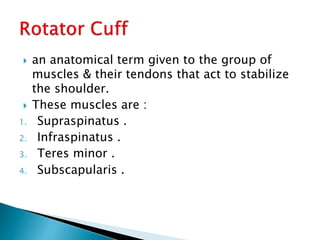
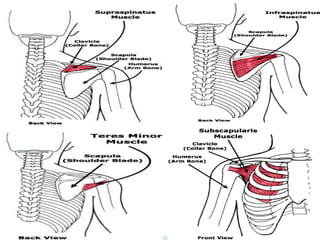
 an anatomical term given to the group of
muscles & their tendons that act to stabilize
the shoulder.
 These muscles are :
1. Supraspinatus .
2. Infraspinatus .
3. Teres minor .
4. Subscapularis .
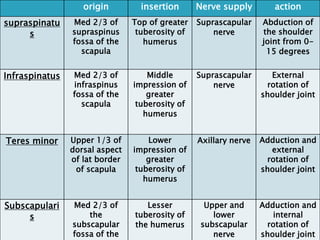
actionNerve supplyinsertionorigin
Abduction of
the shoulder
joint from 0-
15 degrees
Suprascapular
nerve
Top of greater
tuberosity of
humerus
Med 2/3 of
supraspinus
fossa of the
scapula
supraspinatu
s
External
rotation of
shoulder joint
Suprascapular
nerve
Middle
impression of
greater
tuberosity of
humerus
Med 2/3 of
infraspinus
fossa of the
scapula
Infraspinatus
Adduction and
external
rotation of
shoulder joint
Axillary nerveLower
impression of
greater
tuberosity of
humerus
Upper 1/3 of
dorsal aspect
of lat border
of scapula
Teres minor
Adduction and
internal
rotation of
shoulder joint
Upper and
lower
subscapular
nerve
Lesser
tuberosity of
the humerus
Med 2/3 of
the
subscapular
fossa of the
Subscapulari
s
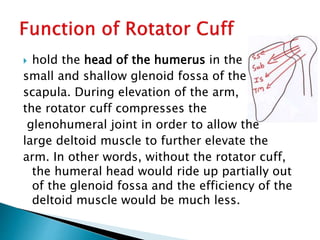
 hold the head of the humerus in the
small and shallow glenoid fossa of the
scapula. During elevation of the arm,
the rotator cuff compresses the
glenohumeral joint in order to allow the
large deltoid muscle to further elevate the
arm. In other words, without the rotator cuff,
the humeral head would ride up partially out
of the glenoid fossa and the efficiency of the
deltoid muscle would be much less.
 injury to 1 or more of the 4 muscles in the
shoulder. This shoulder injury may come on
suddenly and be associated with a specific
injury such as a fall (acute), or it may be
something that gets progressively worse over
time with activity that aggravates the
muscle(s) (chronic).
 can range from an inflammation of the
muscle without any permanent damage, such
as tendinitis, to a complete or partial tear of
the muscle that might require surgery to fix it
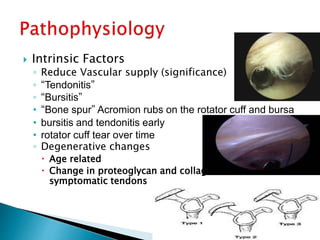
 Intrinsic Factors
◦ Reduce Vascular supply (significance)
◦ “Tendonitis”
◦ “Bursitis”
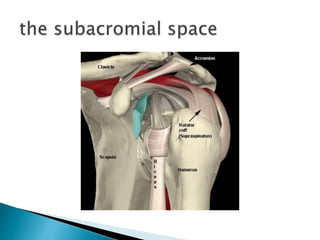
• “Bone spur” Acromion rubs on the rotator cuff and bursa
• bursitis and tendonitis early
• rotator cuff tear over time
◦ Degenerative changes
 Age related
 Change in proteoglycan and collagen content in
symptomatic tendons
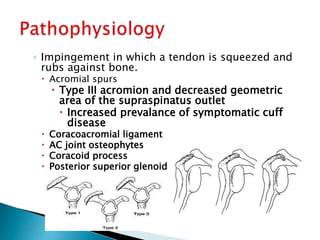
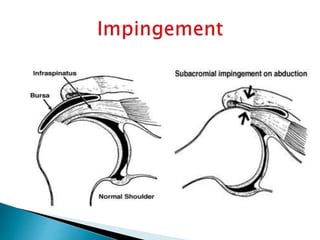
◦ Impingement in which a tendon is squeezed and
rubs against bone.
 Acromial spurs
 Type III acromion and decreased geometric
area of the supraspinatus outlet
 Increased prevalance of symptomatic cuff
disease
 Coracoacromial ligament
 AC joint osteophytes
 Coracoid process
 Posterior superior glenoid
 Extrinsic factors
◦ Repetitive use
 Tensile overload
 Muscle fatigue
 Microtrauma
◦ Glenohumeral instability
 Accentuates abnormal loading
 Can lead to internal impingement
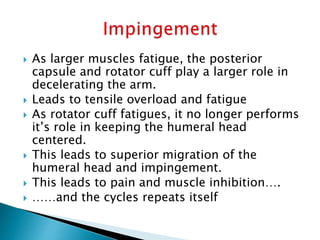
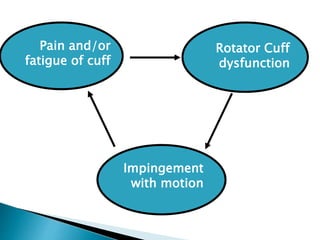
 As larger muscles fatigue, the posterior
capsule and rotator cuff play a larger role in
decelerating the arm.
 Leads to tensile overload and fatigue
 As rotator cuff fatigues, it no longer performs
it’s role in keeping the humeral head
centered.
 This leads to superior migration of the
humeral head and impingement.
 This leads to pain and muscle inhibition….
 ……and the cycles repeats itself

Pain and/or
fatigue of cuff
Rotator Cuff
dysfunction
Impingement
with motion
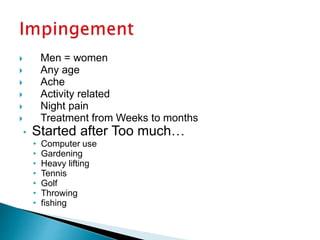
 Men = women
 Any age
 Ache
 Activity related
 Night pain
 Treatment from Weeks to months
• Started after Too much…
• Computer use
• Gardening
• Heavy lifting
• Tennis
• Golf
• Throwing
• fishing
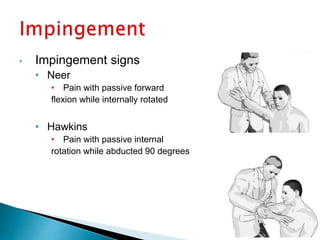
• Impingement signs
• Neer
• Pain with passive forward
flexion while internally rotated
• Hawkins
• Pain with passive internal
rotation while abducted 90 degrees
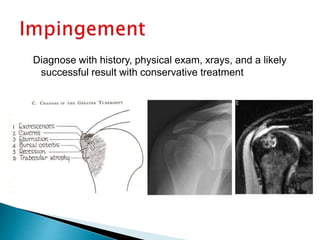
Diagnose with history, physical exam, xrays, and a likely
successful result with conservative treatment
 Initial treatment
• Relative rest
• Ice
• Anti-inflammatory medications
• cortisone injection
• Physical therapy:
1.electoro therapy (U.S, faradic ,ir )
2.passive and active ROM
3.stretching ex
4.muscle energy techniques
5.trigger points realease
6.posture correction
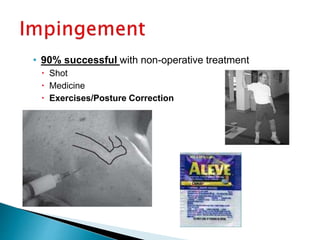
• 90% successful with non-operative treatment
 Shot
 Medicine
 Exercises/Posture Correction
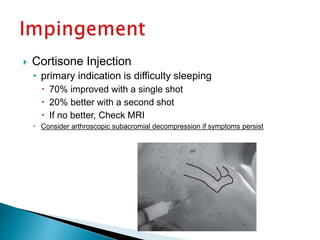
 Cortisone Injection
• primary indication is difficulty sleeping
 70% improved with a single shot
 20% better with a second shot
 If no better, Check MRI
• Consider arthroscopic subacromial decompression if symptoms persist
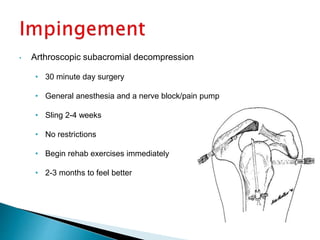
• Arthroscopic subacromial decompression
• 30 minute day surgery
• General anesthesia and a nerve block/pain pump
• Sling 2-4 weeks
• No restrictions
• Begin rehab exercises immediately
• 2-3 months to feel better
 As a result of microtrauma and inflammation.
 Capsule tightens and can no longer
accommodate humeral head as it rotates.
 Leads to obligatory anterior-superior
migration of humeral head.
 Reduces subacromial space
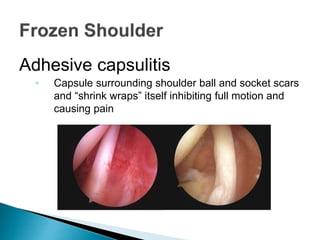
Adhesive capsulitis
◦ Capsule surrounding shoulder ball and socket scars
and “shrink wraps” itself inhibiting full motion and
causing pain
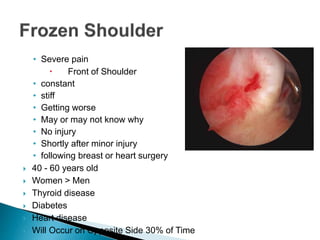
• Severe pain
 Front of Shoulder
• constant
• stiff
• Getting worse
• May or may not know why
• No injury
• Shortly after minor injury
• following breast or heart surgery
 40 - 60 years old
 Women > Men
 Thyroid disease
 Diabetes
 Heart disease
 Will Occur on Opposite Side 30% of Time
 Three phases
• Inflammatory
• Frozen
• Disability
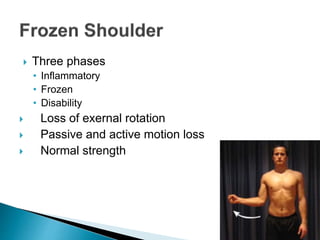
 Loss of exernal rotation
 Passive and active motion loss
 Normal strength
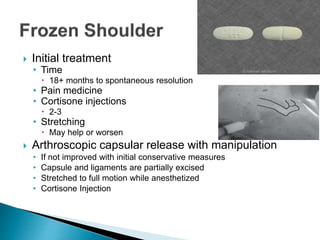
 Initial treatment
• Time
 18+ months to spontaneous resolution
• Pain medicine
• Cortisone injections
 2-3
• Stretching
 May help or worsen
 Arthroscopic capsular release with manipulation
• If not improved with initial conservative measures
• Capsule and ligaments are partially excised
• Stretched to full motion while anesthetized
• Cortisone Injection
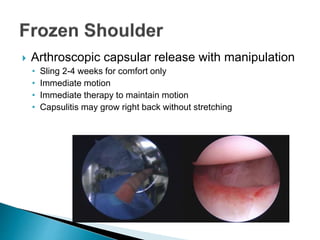
 Arthroscopic capsular release with manipulation
• Sling 2-4 weeks for comfort only
• Immediate motion
• Immediate therapy to maintain motion
• Capsulitis may grow right back without stretching
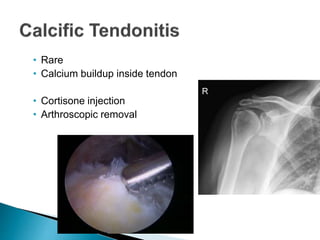
• Rare
• Calcium buildup inside tendon
• Cortisone injection
• Arthroscopic removal
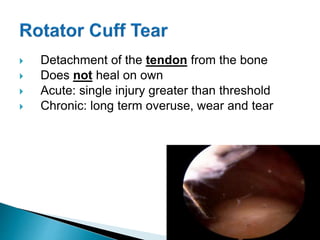
 Detachment of the tendon from the bone
 Does not heal on own
 Acute: single injury greater than threshold
 Chronic: long term overuse, wear and tear
 history
• Injury (25%)
• Pain without injury (75%)
• Loss of overhead or behind the back activity without pain
 Symptoms
• Pain: anterior superior shoulder or deltoid insertion
 Rest
 Night
 activity related
• Weakness or disability
• instability
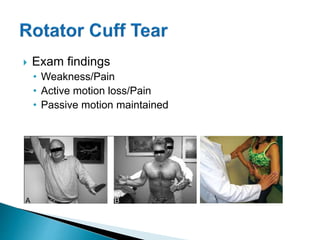
 Exam findings
• Weakness/Pain
• Active motion loss/Pain
• Passive motion maintained
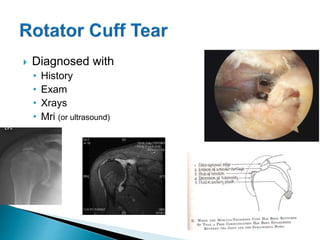
 Diagnosed with
• History
• Exam
• Xrays
• Mri (or ultrasound)
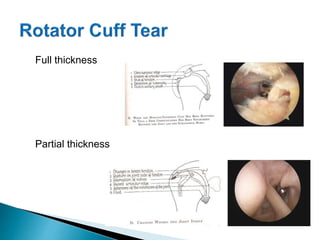
Full thickness
Partial thickness
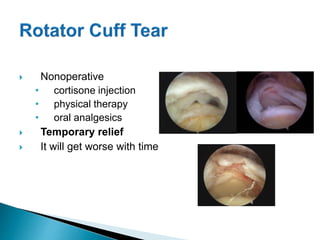
 Nonoperative
• cortisone injection
• physical therapy
• oral analgesics
 Temporary relief
 It will get worse with time

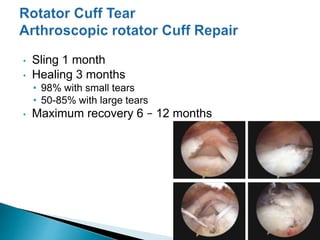
• Sling 1 month
• Healing 3 months
• 98% with small tears
• 50-85% with large tears
• Maximum recovery 6 – 12 months
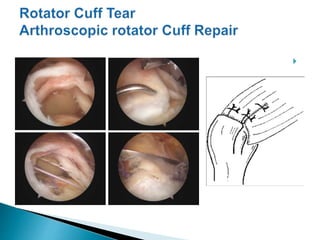
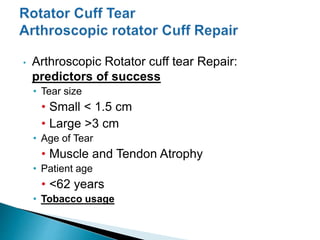
• Arthroscopic Rotator cuff tear Repair:
predictors of success
• Tear size
• Small < 1.5 cm
• Large >3 cm
• Age of Tear
• Muscle and Tendon Atrophy
• Patient age
• <62 years
• Tobacco usage
Rotator cuff disorder

Rotator cuff disorder

  • 1.
    Presented by Aser mohamedkamal Physiotherapist
  • 2.
     Describe anatomyof rotator cuff muscles.  ROTATOR CUFF FUNCTION  ETIOLOGY  CLINICAL DIAGNOSIS  INVESTIGATION  OUTLINE OF MANAGEMENT
  • 3.
     an anatomicalterm given to the group of muscles & their tendons that act to stabilize the shoulder.  These muscles are : 1. Supraspinatus . 2. Infraspinatus . 3. Teres minor . 4. Subscapularis .
  • 4.
    actionNerve supplyinsertionorigin Abduction of theshoulder joint from 0- 15 degrees Suprascapular nerve Top of greater tuberosity of humerus Med 2/3 of supraspinus fossa of the scapula supraspinatu s External rotation of shoulder joint Suprascapular nerve Middle impression of greater tuberosity of humerus Med 2/3 of infraspinus fossa of the scapula Infraspinatus Adduction and external rotation of shoulder joint Axillary nerveLower impression of greater tuberosity of humerus Upper 1/3 of dorsal aspect of lat border of scapula Teres minor Adduction and internal rotation of shoulder joint Upper and lower subscapular nerve Lesser tuberosity of the humerus Med 2/3 of the subscapular fossa of the Subscapulari s
  • 7.
     hold thehead of the humerus in the small and shallow glenoid fossa of the scapula. During elevation of the arm, the rotator cuff compresses the glenohumeral joint in order to allow the large deltoid muscle to further elevate the arm. In other words, without the rotator cuff, the humeral head would ride up partially out of the glenoid fossa and the efficiency of the deltoid muscle would be much less.
  • 8.
     injury to1 or more of the 4 muscles in the shoulder. This shoulder injury may come on suddenly and be associated with a specific injury such as a fall (acute), or it may be something that gets progressively worse over time with activity that aggravates the muscle(s) (chronic).  can range from an inflammation of the muscle without any permanent damage, such as tendinitis, to a complete or partial tear of the muscle that might require surgery to fix it
  • 9.
     Intrinsic Factors ◦Reduce Vascular supply (significance) ◦ “Tendonitis” ◦ “Bursitis” • “Bone spur” Acromion rubs on the rotator cuff and bursa • bursitis and tendonitis early • rotator cuff tear over time ◦ Degenerative changes  Age related  Change in proteoglycan and collagen content in symptomatic tendons
  • 10.
    ◦ Impingement inwhich a tendon is squeezed and rubs against bone.  Acromial spurs  Type III acromion and decreased geometric area of the supraspinatus outlet  Increased prevalance of symptomatic cuff disease  Coracoacromial ligament  AC joint osteophytes  Coracoid process  Posterior superior glenoid
  • 11.
     Extrinsic factors ◦Repetitive use  Tensile overload  Muscle fatigue  Microtrauma ◦ Glenohumeral instability  Accentuates abnormal loading  Can lead to internal impingement
  • 12.
     As largermuscles fatigue, the posterior capsule and rotator cuff play a larger role in decelerating the arm.  Leads to tensile overload and fatigue  As rotator cuff fatigues, it no longer performs it’s role in keeping the humeral head centered.  This leads to superior migration of the humeral head and impingement.  This leads to pain and muscle inhibition….  ……and the cycles repeats itself
  • 13.
     Pain and/or fatigue ofcuff Rotator Cuff dysfunction Impingement with motion
  • 15.
     Men =women  Any age  Ache  Activity related  Night pain  Treatment from Weeks to months • Started after Too much… • Computer use • Gardening • Heavy lifting • Tennis • Golf • Throwing • fishing
  • 16.
    • Impingement signs •Neer • Pain with passive forward flexion while internally rotated • Hawkins • Pain with passive internal rotation while abducted 90 degrees
  • 17.
    Diagnose with history,physical exam, xrays, and a likely successful result with conservative treatment
  • 18.
     Initial treatment •Relative rest • Ice • Anti-inflammatory medications • cortisone injection • Physical therapy: 1.electoro therapy (U.S, faradic ,ir ) 2.passive and active ROM 3.stretching ex 4.muscle energy techniques 5.trigger points realease 6.posture correction
  • 19.
    • 90% successfulwith non-operative treatment  Shot  Medicine  Exercises/Posture Correction
  • 20.
     Cortisone Injection •primary indication is difficulty sleeping  70% improved with a single shot  20% better with a second shot  If no better, Check MRI • Consider arthroscopic subacromial decompression if symptoms persist
  • 21.
    • Arthroscopic subacromialdecompression • 30 minute day surgery • General anesthesia and a nerve block/pain pump • Sling 2-4 weeks • No restrictions • Begin rehab exercises immediately • 2-3 months to feel better
  • 22.
     As aresult of microtrauma and inflammation.  Capsule tightens and can no longer accommodate humeral head as it rotates.  Leads to obligatory anterior-superior migration of humeral head.  Reduces subacromial space
  • 23.
    Adhesive capsulitis ◦ Capsulesurrounding shoulder ball and socket scars and “shrink wraps” itself inhibiting full motion and causing pain
  • 24.
    • Severe pain Front of Shoulder • constant • stiff • Getting worse • May or may not know why • No injury • Shortly after minor injury • following breast or heart surgery  40 - 60 years old  Women > Men  Thyroid disease  Diabetes  Heart disease  Will Occur on Opposite Side 30% of Time
  • 25.
     Three phases •Inflammatory • Frozen • Disability  Loss of exernal rotation  Passive and active motion loss  Normal strength
  • 26.
     Initial treatment •Time  18+ months to spontaneous resolution • Pain medicine • Cortisone injections  2-3 • Stretching  May help or worsen  Arthroscopic capsular release with manipulation • If not improved with initial conservative measures • Capsule and ligaments are partially excised • Stretched to full motion while anesthetized • Cortisone Injection
  • 27.
     Arthroscopic capsularrelease with manipulation • Sling 2-4 weeks for comfort only • Immediate motion • Immediate therapy to maintain motion • Capsulitis may grow right back without stretching
  • 28.
    • Rare • Calciumbuildup inside tendon • Cortisone injection • Arthroscopic removal
  • 29.
     Detachment ofthe tendon from the bone  Does not heal on own  Acute: single injury greater than threshold  Chronic: long term overuse, wear and tear
  • 30.
     history • Injury(25%) • Pain without injury (75%) • Loss of overhead or behind the back activity without pain  Symptoms • Pain: anterior superior shoulder or deltoid insertion  Rest  Night  activity related • Weakness or disability • instability
  • 31.
     Exam findings •Weakness/Pain • Active motion loss/Pain • Passive motion maintained
  • 32.
     Diagnosed with •History • Exam • Xrays • Mri (or ultrasound)
  • 33.
  • 34.
     Nonoperative • cortisoneinjection • physical therapy • oral analgesics  Temporary relief  It will get worse with time
  • 35.
  • 36.
    • Sling 1month • Healing 3 months • 98% with small tears • 50-85% with large tears • Maximum recovery 6 – 12 months
  • 37.
    • Arthroscopic Rotatorcuff tear Repair: predictors of success • Tear size • Small < 1.5 cm • Large >3 cm • Age of Tear • Muscle and Tendon Atrophy • Patient age • <62 years • Tobacco usage