ON RORSCHACH
PSYCHODIGNOSTI
CS
Application number-
d605771ce58311e9a839d1cdc4eb1fad
Name - Mineshi
Name of course- Academic Writing
Affiliation- M.Sc psychology BHU
PROJECTIVE TEST
 Projective tests are based on classical
psychoanalytical theory
 Method of assessment of personality through
unstructured stimuli
 Assumption: Projective techniques is that while
responding to an unstructured stimuli, an
individual projects his own feelings, needs,
emotions, motives etc. (which are mostly latent
and unconscious)
CLASSIFICATION OF PROJECTIVE TESTS
(LINDZEY, 1959)
 Association Techniques
 Construction Techniques
 Completion Techniques
 Expressive Techniques
 Choice Techniques
Association Techniques
 In this category examinee is required to respond
with the associations which are evoked in his
mind after seeing or listening to stimulus
materials.
 Examples: Rorschach Inkblot Test, Word
Association Test
Construction Techniques
 In this category, the examinee is required to
construct a story after seeing the stimulus
materials within a certain specific time.
 Example: The Thematic Apperception Test
(TAT), Children’s Apperception Test (CAT), etc.
Completion Techniques
 Here the subject is supposed to complete a
sentence or give a response to complete a
conversation.
 Examples: The Rosenzweig Picture Frustration
Test, Rotter’s Sentence Completion Test etc.
Expressive Techniques
 In this techniques the examinee express his
personality through the manipulative tasks such
as draw something or performs something.
 Examples: Draw-A- Person Test/ Human Figure
Drawing Test, Role Playing etc.
Choice Techniques
 Requires the subjects to arrange materials
according to their choice.
 For example, Tomkins-Horn Picture
Arrangement Test, Szondi Test etc.
CHARACTERISTICS OF PROJECTIVE TEST
 All projective tests share common assumption of
projective hypothesis
 Projective tests are having unstructured stimuli
 Projective tests asses unconscious aspects of
personality
 Highly influenced by psychoanalytical thinking
 Required trained person for administration,
scoring and interpretation
THE RORSCHACH TEST
 Rorschach Inkblot Test was developed by Herman
Rorschach, a Swiss psychiatrist in 1921
 It is most popular projective technique, having
highly clinical signification and research support
 The test contains 10 cards. Card nos. 1, 4, 5, 6 and
7 are completely achromatic; card nos. 2 and 3 are
partially chromatic and card nos. 8, 9 and 10 are
completely chromatic
 Each card has white background.
Preliminary Preparation:
 Establish rapport with the subject
 Collect adequate history
 Conduct an interview to record the mental status of
the subject
 Handle worries and queries of the subject regarding
test and any aspect of the situation
PROCEDURE OF ADMINISTRATION:
Seating arrangement: Side-by-side.
Introducing the test
1. Prepare the subject for overall assessment process
2. Cards should be stacked in face-down position
3. Location sheet should not be visible during the free
association phase
TEST INSTRUCTIONS
 “You will be given a series of ten cards, one by one.
The cards on them designed made up out of ink
blots. Look at each card, and tell me what you see
on each card, or anything that might be represented
there. Look at each card as long as you like; only
be sure to tell me everything that you see on the
card as you look at it. When you have finished with
a card give it to me”.
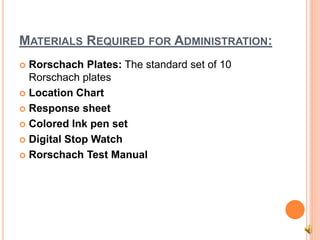
MATERIALS REQUIRED FOR ADMINISTRATION:
 Rorschach Plates: The standard set of 10
Rorschach plates
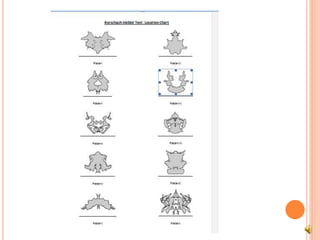
 Location Chart
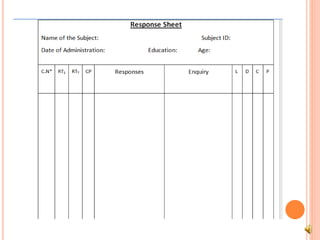
 Response sheet
 Colored Ink pen set
 Digital Stop Watch
 Rorschach Test Manual
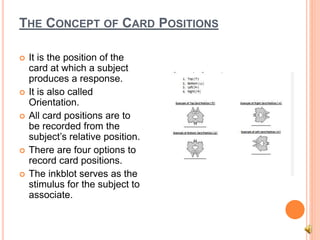
THE CONCEPT OF CARD POSITIONS
 It is the position of the
card at which a subject
produces a response.
 It is also called
Orientation.
 All card positions are to
be recorded from the
subject’s relative position.
 There are four options to
record card positions.
 The inkblot serves as the
stimulus for the subject to
associate.
Inquiry phase:
1. Examiner should read the responses.
2. The instruction in the inquiry phase should be
“Show me where it is and what there is, that makes
it to look like.”
3.Verbatim of all the responses should be recorded.
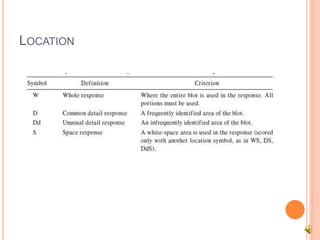
LOCATION
DETERMINANTS
 F responses
 C responses
 CF responses
 FC responses
 Y responses
 FY Responses
 YF Responses
 V responses: perceived object contains the distance,
depth, height, reflection etc.
 Texture (T) responses: subject’s language should
contain the word like rough, hard, soft, warm cool and
so on which implies a sense of touch.
 Movement (M) responses
CONTENT
 Complete Human (H): All complete human beings are coded
as H. Mythological entities in human forms are also coded
here. Examples: two ladies, two persons dancing, a baby,
fairy, ghost
 Part Human (Hd): If the perceived object is any external part
of the body then it is coded as Hd. Examples, human faces,
leg of human being
 Complete animal (A): All complete animals, birds, reptiles
are coded as A. For examples: bat, butterfly, rabbit, bears,
snake, gorilla
 Part Animal (Ad): all external parts of animals are coded as
Ad. For example: wings of a bat, face of a monkey
 Internal Organs (An): All internal organs of living beings are
coded as An. For example, lungs, kidney, ribs
 Art: Art objects, decorations, drawings, paintings,
caricatures, generic cartoons, statues.
 Architecture (Arc): All buildings
CONTENT
 Blood (Bl): All blood responses are coded as Bl.
 Botany (Bt): All plants are coded as Bt.
 Clouds (Cl): All cloud responses are coded as Cl.
 Clothing (Cg): All forms of clothes
 Flowers (Fl): All flowers are coded as Fl.
 Food (Fd) Edible food items
 Geography (Ge): Maps, territorial drawings
 Human Experience (Hx): Human experience,
emotion, or sensation which are clearly attributed to
an object. Sad, fearful, angry
 Household (Hh): Household and domestic items
CONTENT
 Landscape (Ls): Mountains, rocks, islands and
underwater scenes
 Nature (Na): natural objects from the environment which
are not coded Bt or Ls. Sun, sky.
 Religious (Rl): All religious percepts like temple, god,
goddess are scored as Rl.
 Science (Sc): Objects related to science or science-
fiction. The objects which are the products of technology
and industry are also included. Car, Airplane, Computer.
 Sex (Sx): All sex organs whether internal or external are
coded as Sx. For example, breasts, uterus.
 Travel (Tr): All means of travel
 Misc (Ms): Place all remaining items under this category
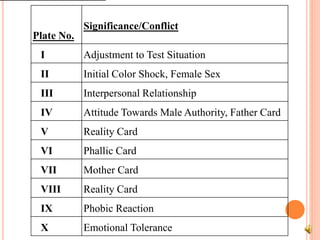
Plate No.
Significance/Conflict
I Adjustment to Test Situation
II Initial Color Shock, Female Sex
III Interpersonal Relationship
IV Attitude Towards Male Authority, Father Card
V Reality Card
VI Phallic Card
VII Mother Card
VIII Reality Card
IX Phobic Reaction
X Emotional Tolerance
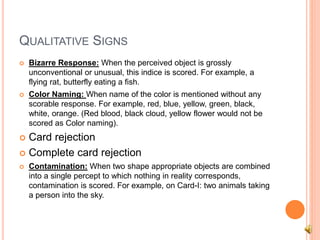
QUALITATIVE SIGNS
 Bizarre Response: When the perceived object is grossly
unconventional or unusual, this indice is scored. For example, a
flying rat, butterfly eating a fish.
 Color Naming: When name of the color is mentioned without any
scorable response. For example, red, blue, yellow, green, black,
white, orange. (Red blood, black cloud, yellow flower would not be
scored as Color naming).
 Card rejection
 Complete card rejection
 Contamination: When two shape appropriate objects are combined
into a single percept to which nothing in reality corresponds,
contamination is scored. For example, on Card-I: two animals taking
a person into the sky.
QUALITATIVE SIGNS
 Hidden Objects: When a subject perceives hidden objects like a
person hiding behind a tree, a person hiding his hands, then Hidden
Objects is scored.
 Impotence: In impotence, a subject is aware that his perception is
inaccurate/inadequate. Wishes to improve it but not able to succeed
in improving the percept.
 Looking at the Back of the Card: When a subject turns the card to
the back and examines the card in that position, this indice is to be
scored.
 Perplexity: When a subject is bewildered manifested by the
remarks such as ‘what it could be’ ‘I can not think’, ‘have I given a
correct response?’ this indice is scored.
 Personal Reference: When a subject relates the perceived object
to self then this indice is scored. For example, my uncle’s face, my
own image, this is the coat very similar to the one I had.
QUALITATIVE SIGNS
 Repetitive Responses (Perseveration): Repetition of the same
response to at three or more consecutive cards without any
intervening responses is scored as Perseveration. For example,
Card-I: bat, Card-II: bat, Card-III: bat. There were no other response
in between these bat responses. (Bat, Dog, Bat, Bat, monkey would
not be scored as perseveration)
QUALITATIVE INTERPRETATION
 Perplexity: Perplexity on Rorschach is an indication of
anxiety and confusion. This can be found in a patient
having marked anxiety or the person who is confused
because of some pathology in the brain.
 Perseveration: Perseveration is the failure in shifting
the mental set. It is an example of extreme cognitive
rigidity. Perseveration is a pathognomonic sign of
psychiatric disorder. A patient who perseverates on
inkblots may also have narrowed interests,
preoccupation and stereotyped thinking. Perseveration
is usually observed in schizophrenic patients and brain
pathology.
 Personal Reference: Personal reference or self-
reference is an indication of loss of ego boundaries. It is
a psychotic phenomenon. Paranoid patients frequently
produce the responses with personal reference.
 Multiple Card Rejection: Psychotic patients reject
many cards. Depressed patients may also have a
tendency to reject many cards, but they may associate
with persuasion.
 Hidden Objects: A subject who is interested in
searching for the hidden objects on Rorschach has
marked lack of trust on others. This phenomenon is an
indication of paranoid attitude.
 Impotence: The recognition of one’s deficiency and
failure in improvising it is an indication of feelings of
inferiority and low self-confidence. When a subject
recognized that his associations to the inkblots are
inadequate and he fails to improve it, just point to the
inferiority feelings and reduced self-confidence.
 Excessive Card Turning: An inquisitive subject
would like to explore various blot areas to produce
associative content. As such it may be a reflection
of superior intellectual functions. But rapid and
excessive card turning is a nervous phenomenon
which point out to the anxiety in the subject
 Bizarre Response: These responses are the
product of autistic thinking, fantasy process. They
are found in psychotic patients.
 Confabulation: Confabulation is an indication of
thinking disturbances. It is generally found in
schizophrenics and organic patients.
 Contamination: Contamination also point out to
disturbed thought processes and generally found in
schizophrenic patients.
 Color Naming: Just naming the colors of inkblots
like red, green, yellow, blue does not constitute as
scorable responses. Color Naming point out to
marked failure in producing a meaningful
associative content to color blot areas. Color
Naming is generally found in Organics, epileptics,
deteriorated schizophrenics and mentally
challenged persons.
QUANTITATIVE INTERPRETATION
 F + %
 Most of the psychotic patients because of the
impairment in reality testing produce low F+%
responses.
 F+% also indicates the Ego Strength. Low F+% are
indicative of poor ego strength
MOVEMENT RESPONSES
 The individuals having superior creativity like
artists, writers; advertisers may produce high shape
appropriate (M+) responses.
 The morbid processes like hallucinations,
interpersonal delusions results in production of high
shape inappropriate (M-) responses.
 These M- responses are indicative more of fantasy
processes and idiosyncratic thinking.
 Pure C color reflects little or no control over
emotional expressions.
 High C and CF responses in a protocol reflect
impulsivity, ego-centricity, emotional lability,
irritability, and aggressiveness in the respondent
 The FC responses are indicative of matured
emotionality which is found in healthy adults. The
FC responses indicate empathy, capacity to
establish rapport with others, matured interpersonal
relationships
EXPERIENCE BALANCE (EB) RATIO
 There are two sides in Experience Balance. M
which is reflective of inner world and C indicates the
external environment.
 If M side is high then the Csum would be
introversive.
 if Csum side is high then M the would be
extratensive and if both are equal e.g. then the
subject would be ambiequal
SHADING (Y) RESPONSES
 The Black & White responses are indicative of
negative emotional experience of depression and
anxiety.
 Therefore, an emphasis of Y responses in a
protocol indicates sadness, depression, emotional
passivity and mostly found in depressive patients.
VISTA (V) RESPONSES
 This attribute reflects feelings of inferiority in the
subject and found mostly in neurotic patients.
TEXTURE (T) RESPONSES
 It reflects vague and free floating anxiety in the
subject. It is mostly produced by neurotic patients.
 It also reflects need for love and affections of the
subject
POPULAR (P) RESPONSES
 An average amount of P responses indicate a
subject’s conformity to social norms, group thinking,
recognition and respect of socio-cultural standards.
 Low P responses are generally found in severe
mental illnesses like psychosis, schizophrenia,
mania, organicity and developmental disabilities
AFFECTIVE RATIO
 The high affective ratio is usually observed in manic
patients.
 Low affective ratio in contrast indicates reduced
ability to experience pleasant emotions, reduced
excitability.
 Low affective ratio is generally observed in
Depressive patients.
ORGANICITY (BRAIN PATHOLOGY):
 Total number of
responses less than 15
 Response time for a
response is greater than
60 seconds
 Not more than one
human action (M)
 Low F+%
 Low P
 FC not more than one
 Pure color or Color-Form
responses
 Color naming
 Perseveration
 Impotence
 Automatic phrases
 Perplexity
 Word finding difficulty
 Repetition of the same
response to the same
card on same blot area
 Confabulation
 Failure in recalling one’s
responses in enquiry
phase
 Mono-response protocol
PSYCHOSIS:
 Low total number of
responses
 Low shape appropriate
responses (F+%)
 Low most frequent
responses (P)
 Confused sequence
 Color Naming
 Perseveration
 Variable RT
 Confabulation
 Contamination
 Multiple card rejection
 Stereotype
 P failure on Card-V
 Bizarre responses
 Personal reference
SCHIZOPHRENIA:
 Low shape appropriate
responses (F+%)
 High CF responses
 Absence of or Low most
frequent responses (P)
 P failure on Card-V
 Multiple Card rejection
 Multiple response rejection
 Confabulation
 Contamination
 Bizarre responses
 Confused Sequence
 Card description
 Color naming
 Variable RT
 Disease percepts
 Perseveration
 Stereotype
 Personal reference
 Many sex responses
 Edging
 Mono-response protocol
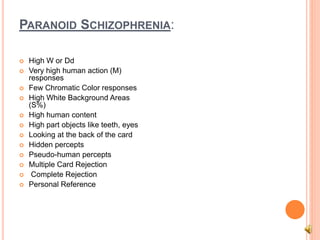
PARANOID SCHIZOPHRENIA:
 High W or Dd
 Very high human action (M)
responses
 Few Chromatic Color responses
 High White Background Areas
(S%)
 High human content
 High part objects like teeth, eyes
 Looking at the back of the card
 Hidden percepts
 Pseudo-human percepts
 Multiple Card Rejection
 Complete Rejection
 Personal Reference
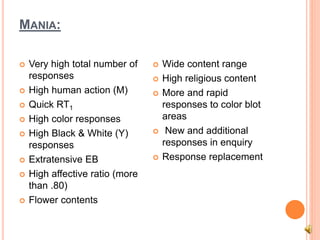
MANIA:
 Very high total number of
responses
 High human action (M)
 Quick RT1
 High color responses
 High Black & White (Y)
responses
 Extratensive EB
 High affective ratio (more
than .80)
 Flower contents
 Wide content range
 High religious content
 More and rapid
responses to color blot
areas
 New and additional
responses in enquiry
 Response replacement
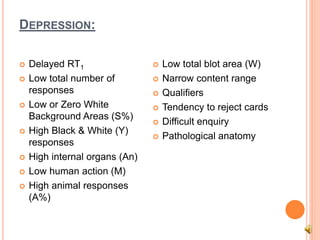
DEPRESSION:
 Delayed RT1
 Low total number of
responses
 Low or Zero White
Background Areas (S%)
 High Black & White (Y)
responses
 High internal organs (An)
 Low human action (M)
 High animal responses
(A%)
 Low total blot area (W)
 Narrow content range
 Qualifiers
 Tendency to reject cards
 Difficult enquiry
 Pathological anatomy
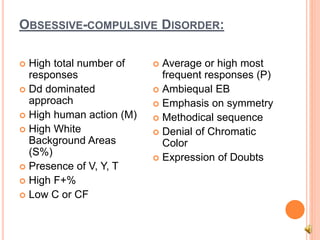
OBSESSIVE-COMPULSIVE DISORDER:
 High total number of
responses
 Dd dominated
approach
 High human action (M)
 High White
Background Areas
(S%)
 Presence of V, Y, T
 High F+%
 Low C or CF
 Average or high most
frequent responses (P)
 Ambiequal EB
 Emphasis on symmetry
 Methodical sequence
 Denial of Chromatic
Color
 Expression of Doubts
ANXIETY DISORDER:
 Low total number of
responses
 Presence of V,Y,T
responses
 High Dd responses
 Average F+%
 Frequent and rapid card
turning
 Shading shock or color
shock
 Average most frequent
responses (P)
 Card rejection – IX

Rorschach psychodignostics[1]

  • 1.
    ON RORSCHACH PSYCHODIGNOSTI CS Application number- d605771ce58311e9a839d1cdc4eb1fad Name- Mineshi Name of course- Academic Writing Affiliation- M.Sc psychology BHU
  • 2.
    PROJECTIVE TEST  Projectivetests are based on classical psychoanalytical theory  Method of assessment of personality through unstructured stimuli  Assumption: Projective techniques is that while responding to an unstructured stimuli, an individual projects his own feelings, needs, emotions, motives etc. (which are mostly latent and unconscious)
  • 3.
    CLASSIFICATION OF PROJECTIVETESTS (LINDZEY, 1959)  Association Techniques  Construction Techniques  Completion Techniques  Expressive Techniques  Choice Techniques
  • 4.
    Association Techniques  Inthis category examinee is required to respond with the associations which are evoked in his mind after seeing or listening to stimulus materials.  Examples: Rorschach Inkblot Test, Word Association Test
  • 5.
    Construction Techniques  Inthis category, the examinee is required to construct a story after seeing the stimulus materials within a certain specific time.  Example: The Thematic Apperception Test (TAT), Children’s Apperception Test (CAT), etc.
  • 6.
    Completion Techniques  Herethe subject is supposed to complete a sentence or give a response to complete a conversation.  Examples: The Rosenzweig Picture Frustration Test, Rotter’s Sentence Completion Test etc.
  • 7.
    Expressive Techniques  Inthis techniques the examinee express his personality through the manipulative tasks such as draw something or performs something.  Examples: Draw-A- Person Test/ Human Figure Drawing Test, Role Playing etc.
  • 8.
    Choice Techniques  Requiresthe subjects to arrange materials according to their choice.  For example, Tomkins-Horn Picture Arrangement Test, Szondi Test etc.
  • 9.
    CHARACTERISTICS OF PROJECTIVETEST  All projective tests share common assumption of projective hypothesis  Projective tests are having unstructured stimuli  Projective tests asses unconscious aspects of personality  Highly influenced by psychoanalytical thinking  Required trained person for administration, scoring and interpretation
  • 10.
    THE RORSCHACH TEST Rorschach Inkblot Test was developed by Herman Rorschach, a Swiss psychiatrist in 1921  It is most popular projective technique, having highly clinical signification and research support  The test contains 10 cards. Card nos. 1, 4, 5, 6 and 7 are completely achromatic; card nos. 2 and 3 are partially chromatic and card nos. 8, 9 and 10 are completely chromatic  Each card has white background.
  • 11.
    Preliminary Preparation:  Establishrapport with the subject  Collect adequate history  Conduct an interview to record the mental status of the subject  Handle worries and queries of the subject regarding test and any aspect of the situation
  • 12.
    PROCEDURE OF ADMINISTRATION: Seatingarrangement: Side-by-side. Introducing the test 1. Prepare the subject for overall assessment process 2. Cards should be stacked in face-down position 3. Location sheet should not be visible during the free association phase
  • 13.
    TEST INSTRUCTIONS  “Youwill be given a series of ten cards, one by one. The cards on them designed made up out of ink blots. Look at each card, and tell me what you see on each card, or anything that might be represented there. Look at each card as long as you like; only be sure to tell me everything that you see on the card as you look at it. When you have finished with a card give it to me”.
  • 14.
    MATERIALS REQUIRED FORADMINISTRATION:  Rorschach Plates: The standard set of 10 Rorschach plates  Location Chart  Response sheet  Colored Ink pen set  Digital Stop Watch  Rorschach Test Manual
  • 17.
    THE CONCEPT OFCARD POSITIONS  It is the position of the card at which a subject produces a response.  It is also called Orientation.  All card positions are to be recorded from the subject’s relative position.  There are four options to record card positions.  The inkblot serves as the stimulus for the subject to associate.
  • 18.
    Inquiry phase: 1. Examinershould read the responses. 2. The instruction in the inquiry phase should be “Show me where it is and what there is, that makes it to look like.” 3.Verbatim of all the responses should be recorded.
  • 20.
  • 21.
    DETERMINANTS  F responses C responses  CF responses  FC responses  Y responses  FY Responses  YF Responses  V responses: perceived object contains the distance, depth, height, reflection etc.  Texture (T) responses: subject’s language should contain the word like rough, hard, soft, warm cool and so on which implies a sense of touch.  Movement (M) responses
  • 22.
    CONTENT  Complete Human(H): All complete human beings are coded as H. Mythological entities in human forms are also coded here. Examples: two ladies, two persons dancing, a baby, fairy, ghost  Part Human (Hd): If the perceived object is any external part of the body then it is coded as Hd. Examples, human faces, leg of human being  Complete animal (A): All complete animals, birds, reptiles are coded as A. For examples: bat, butterfly, rabbit, bears, snake, gorilla  Part Animal (Ad): all external parts of animals are coded as Ad. For example: wings of a bat, face of a monkey  Internal Organs (An): All internal organs of living beings are coded as An. For example, lungs, kidney, ribs  Art: Art objects, decorations, drawings, paintings, caricatures, generic cartoons, statues.  Architecture (Arc): All buildings
  • 23.
    CONTENT  Blood (Bl):All blood responses are coded as Bl.  Botany (Bt): All plants are coded as Bt.  Clouds (Cl): All cloud responses are coded as Cl.  Clothing (Cg): All forms of clothes  Flowers (Fl): All flowers are coded as Fl.  Food (Fd) Edible food items  Geography (Ge): Maps, territorial drawings  Human Experience (Hx): Human experience, emotion, or sensation which are clearly attributed to an object. Sad, fearful, angry  Household (Hh): Household and domestic items
  • 24.
    CONTENT  Landscape (Ls):Mountains, rocks, islands and underwater scenes  Nature (Na): natural objects from the environment which are not coded Bt or Ls. Sun, sky.  Religious (Rl): All religious percepts like temple, god, goddess are scored as Rl.  Science (Sc): Objects related to science or science- fiction. The objects which are the products of technology and industry are also included. Car, Airplane, Computer.  Sex (Sx): All sex organs whether internal or external are coded as Sx. For example, breasts, uterus.  Travel (Tr): All means of travel  Misc (Ms): Place all remaining items under this category
  • 25.
    Plate No. Significance/Conflict I Adjustmentto Test Situation II Initial Color Shock, Female Sex III Interpersonal Relationship IV Attitude Towards Male Authority, Father Card V Reality Card VI Phallic Card VII Mother Card VIII Reality Card IX Phobic Reaction X Emotional Tolerance
  • 28.
    QUALITATIVE SIGNS  BizarreResponse: When the perceived object is grossly unconventional or unusual, this indice is scored. For example, a flying rat, butterfly eating a fish.  Color Naming: When name of the color is mentioned without any scorable response. For example, red, blue, yellow, green, black, white, orange. (Red blood, black cloud, yellow flower would not be scored as Color naming).  Card rejection  Complete card rejection  Contamination: When two shape appropriate objects are combined into a single percept to which nothing in reality corresponds, contamination is scored. For example, on Card-I: two animals taking a person into the sky.
  • 29.
    QUALITATIVE SIGNS  HiddenObjects: When a subject perceives hidden objects like a person hiding behind a tree, a person hiding his hands, then Hidden Objects is scored.  Impotence: In impotence, a subject is aware that his perception is inaccurate/inadequate. Wishes to improve it but not able to succeed in improving the percept.  Looking at the Back of the Card: When a subject turns the card to the back and examines the card in that position, this indice is to be scored.  Perplexity: When a subject is bewildered manifested by the remarks such as ‘what it could be’ ‘I can not think’, ‘have I given a correct response?’ this indice is scored.  Personal Reference: When a subject relates the perceived object to self then this indice is scored. For example, my uncle’s face, my own image, this is the coat very similar to the one I had.
  • 30.
    QUALITATIVE SIGNS  RepetitiveResponses (Perseveration): Repetition of the same response to at three or more consecutive cards without any intervening responses is scored as Perseveration. For example, Card-I: bat, Card-II: bat, Card-III: bat. There were no other response in between these bat responses. (Bat, Dog, Bat, Bat, monkey would not be scored as perseveration)
  • 31.
    QUALITATIVE INTERPRETATION  Perplexity:Perplexity on Rorschach is an indication of anxiety and confusion. This can be found in a patient having marked anxiety or the person who is confused because of some pathology in the brain.  Perseveration: Perseveration is the failure in shifting the mental set. It is an example of extreme cognitive rigidity. Perseveration is a pathognomonic sign of psychiatric disorder. A patient who perseverates on inkblots may also have narrowed interests, preoccupation and stereotyped thinking. Perseveration is usually observed in schizophrenic patients and brain pathology.  Personal Reference: Personal reference or self- reference is an indication of loss of ego boundaries. It is a psychotic phenomenon. Paranoid patients frequently produce the responses with personal reference.
  • 32.
     Multiple CardRejection: Psychotic patients reject many cards. Depressed patients may also have a tendency to reject many cards, but they may associate with persuasion.  Hidden Objects: A subject who is interested in searching for the hidden objects on Rorschach has marked lack of trust on others. This phenomenon is an indication of paranoid attitude.  Impotence: The recognition of one’s deficiency and failure in improvising it is an indication of feelings of inferiority and low self-confidence. When a subject recognized that his associations to the inkblots are inadequate and he fails to improve it, just point to the inferiority feelings and reduced self-confidence.
  • 33.
     Excessive CardTurning: An inquisitive subject would like to explore various blot areas to produce associative content. As such it may be a reflection of superior intellectual functions. But rapid and excessive card turning is a nervous phenomenon which point out to the anxiety in the subject  Bizarre Response: These responses are the product of autistic thinking, fantasy process. They are found in psychotic patients.
  • 34.
     Confabulation: Confabulationis an indication of thinking disturbances. It is generally found in schizophrenics and organic patients.  Contamination: Contamination also point out to disturbed thought processes and generally found in schizophrenic patients.  Color Naming: Just naming the colors of inkblots like red, green, yellow, blue does not constitute as scorable responses. Color Naming point out to marked failure in producing a meaningful associative content to color blot areas. Color Naming is generally found in Organics, epileptics, deteriorated schizophrenics and mentally challenged persons.
  • 35.
    QUANTITATIVE INTERPRETATION  F+ %  Most of the psychotic patients because of the impairment in reality testing produce low F+% responses.  F+% also indicates the Ego Strength. Low F+% are indicative of poor ego strength
  • 36.
    MOVEMENT RESPONSES  Theindividuals having superior creativity like artists, writers; advertisers may produce high shape appropriate (M+) responses.  The morbid processes like hallucinations, interpersonal delusions results in production of high shape inappropriate (M-) responses.  These M- responses are indicative more of fantasy processes and idiosyncratic thinking.
  • 37.
     Pure Ccolor reflects little or no control over emotional expressions.  High C and CF responses in a protocol reflect impulsivity, ego-centricity, emotional lability, irritability, and aggressiveness in the respondent  The FC responses are indicative of matured emotionality which is found in healthy adults. The FC responses indicate empathy, capacity to establish rapport with others, matured interpersonal relationships
  • 38.
    EXPERIENCE BALANCE (EB)RATIO  There are two sides in Experience Balance. M which is reflective of inner world and C indicates the external environment.  If M side is high then the Csum would be introversive.  if Csum side is high then M the would be extratensive and if both are equal e.g. then the subject would be ambiequal
  • 39.
    SHADING (Y) RESPONSES The Black & White responses are indicative of negative emotional experience of depression and anxiety.  Therefore, an emphasis of Y responses in a protocol indicates sadness, depression, emotional passivity and mostly found in depressive patients.
  • 40.
    VISTA (V) RESPONSES This attribute reflects feelings of inferiority in the subject and found mostly in neurotic patients.
  • 41.
    TEXTURE (T) RESPONSES It reflects vague and free floating anxiety in the subject. It is mostly produced by neurotic patients.  It also reflects need for love and affections of the subject
  • 42.
    POPULAR (P) RESPONSES An average amount of P responses indicate a subject’s conformity to social norms, group thinking, recognition and respect of socio-cultural standards.  Low P responses are generally found in severe mental illnesses like psychosis, schizophrenia, mania, organicity and developmental disabilities
  • 43.
    AFFECTIVE RATIO  Thehigh affective ratio is usually observed in manic patients.  Low affective ratio in contrast indicates reduced ability to experience pleasant emotions, reduced excitability.  Low affective ratio is generally observed in Depressive patients.
  • 44.
    ORGANICITY (BRAIN PATHOLOGY): Total number of responses less than 15  Response time for a response is greater than 60 seconds  Not more than one human action (M)  Low F+%  Low P  FC not more than one  Pure color or Color-Form responses  Color naming  Perseveration  Impotence  Automatic phrases  Perplexity  Word finding difficulty  Repetition of the same response to the same card on same blot area  Confabulation  Failure in recalling one’s responses in enquiry phase  Mono-response protocol
  • 45.
    PSYCHOSIS:  Low totalnumber of responses  Low shape appropriate responses (F+%)  Low most frequent responses (P)  Confused sequence  Color Naming  Perseveration  Variable RT  Confabulation  Contamination  Multiple card rejection  Stereotype  P failure on Card-V  Bizarre responses  Personal reference
  • 46.
    SCHIZOPHRENIA:  Low shapeappropriate responses (F+%)  High CF responses  Absence of or Low most frequent responses (P)  P failure on Card-V  Multiple Card rejection  Multiple response rejection  Confabulation  Contamination  Bizarre responses  Confused Sequence  Card description  Color naming  Variable RT  Disease percepts  Perseveration  Stereotype  Personal reference  Many sex responses  Edging  Mono-response protocol
  • 47.
    PARANOID SCHIZOPHRENIA:  HighW or Dd  Very high human action (M) responses  Few Chromatic Color responses  High White Background Areas (S%)  High human content  High part objects like teeth, eyes  Looking at the back of the card  Hidden percepts  Pseudo-human percepts  Multiple Card Rejection  Complete Rejection  Personal Reference
  • 48.
    MANIA:  Very hightotal number of responses  High human action (M)  Quick RT1  High color responses  High Black & White (Y) responses  Extratensive EB  High affective ratio (more than .80)  Flower contents  Wide content range  High religious content  More and rapid responses to color blot areas  New and additional responses in enquiry  Response replacement
  • 49.
    DEPRESSION:  Delayed RT1 Low total number of responses  Low or Zero White Background Areas (S%)  High Black & White (Y) responses  High internal organs (An)  Low human action (M)  High animal responses (A%)  Low total blot area (W)  Narrow content range  Qualifiers  Tendency to reject cards  Difficult enquiry  Pathological anatomy
  • 50.
    OBSESSIVE-COMPULSIVE DISORDER:  Hightotal number of responses  Dd dominated approach  High human action (M)  High White Background Areas (S%)  Presence of V, Y, T  High F+%  Low C or CF  Average or high most frequent responses (P)  Ambiequal EB  Emphasis on symmetry  Methodical sequence  Denial of Chromatic Color  Expression of Doubts
  • 51.
    ANXIETY DISORDER:  Lowtotal number of responses  Presence of V,Y,T responses  High Dd responses  Average F+%  Frequent and rapid card turning  Shading shock or color shock  Average most frequent responses (P)  Card rejection – IX