WASTE-WATER
TREATMENT BY
USING ROOT
ZONE
TECHNOLOGY
IINNDTERXODUCTION
WHAT IS EXACTLY
AIMS AND OBJECTIVES
TYPES OF PLANTS
PROPERTIES AND
NECESSSITY OF
MATERIAL
PROCEDURE AND
METHODS
RESULTS AND
DESCUSSION
APPLICATION AND
FEAUTURE SCOPE
CONCLUSION
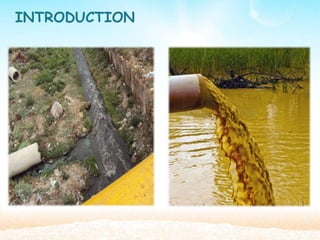
INTRODUCTION
INTRODUCTION:
 Root zone technology is effective technology called
Decentralized Wastewater Systems (DEWATS)
 It was developed in 1970s in Germany and has been
successfully implemented in different countries mainly
in Europe and America.
 The root zone wastewater treatment system makes use
of biological and physical-treatment processes to
remove pollutants from wastewater.
 Due to its natural process, there is no need to add any
input such as chemicals, mechanical pumps or external
energy. This reduces both the maintenance and energy
costs.
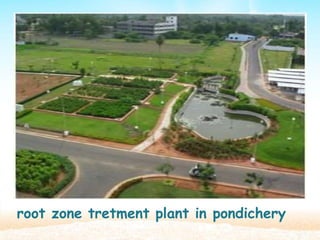
root zone tretment plant in pondichery
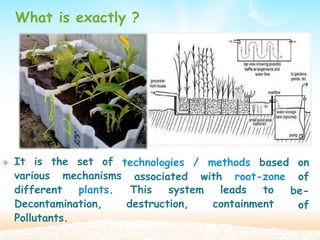
What is exactly ?
technologies /
associated
This system leads to
destruction, containment
methods based on
with root-zone of
be-
of
It is the set of
various mechanisms
different plants.
Decontamination,
Pollutants.
aim:
To cheak the feasability of root zone technology
for treatment of wastewater without any
priliminiry treatment.
objective:
Analysis of waste water at inlet and outlet with
DO, COD, BOD, Nitrate, Phosphate by laboratory
test
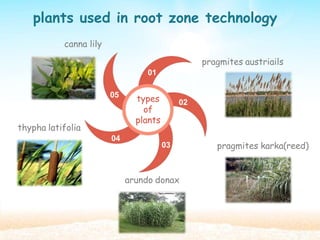
types
of
plants
02
03
04
05
pragmites karka(reed)
arundo donax
thypha latifolia
canna lily
pragmites austriails
01
plants used in root zone technology
Your
title
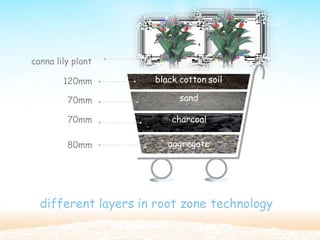
black cotton soil
sand
charcoal
aggregate
120mm
70mm
70mm
80mm
canna lily plant
different layers in root zone technology
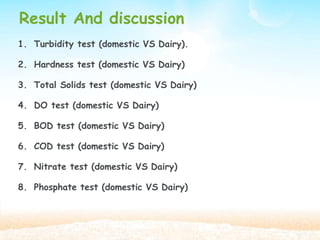
Result And discussion
1. Turbidity test (domestic VS Dairy).
2. Hardness test (domestic VS Dairy)
3. Total Solids test (domestic VS Dairy)
4. DO test (domestic VS Dairy)
5. BOD test (domestic VS Dairy)
6. COD test (domestic VS Dairy)
7. Nitrate test (domestic VS Dairy)
8. Phosphate test (domestic VS Dairy)
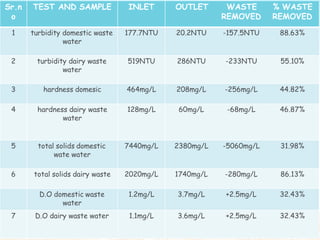
Sr.n
o
TEST AND SAMPLE INLET OUTLET WASTE % WASTE
REMOVED REMOVED
1 turbidity domestic waste
water
177.7NTU 20.2NTU -157.5NTU 88.63%
2 turbidity dairy waste
water
519NTU 286NTU -233NTU 55.10%
3 hardness domesic 464mg/L 208mg/L -256mg/L 44.82%
4 hardness dairy waste
water
128mg/L 60mg/L -68mg/L 46.87%
5 total solids domestic
wate water
7440mg/L 2380mg/L -5060mg/L 31.98%
6 total solids dairy waste 2020mg/L 1740mg/L -280mg/L 86.13%
D.O domestic waste
water
1.2mg/L 3.7mg/L +2.5mg/L 32.43%
7 D.O dairy waste water 1.1mg/L 3.6mg/L +2.5mg/L 32.43%
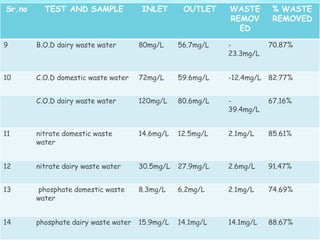
Sr.no TEST AND SAMPLE INLET OUTLET WASTE
REMOV
% WASTE
REMOVED
9 B.O.D dairy waste water 80mg/L 56.7mg/L - 70.87%
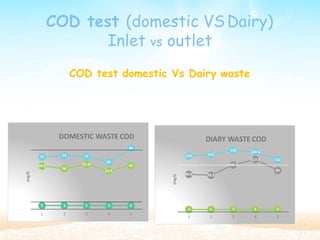
10 C.O.D domestic waste water 72mg/L 59.6mg/L -12.4mg/L 82.77%
C.O.D dairy waste water 120mg/L 80.6mg/L - 67.16%
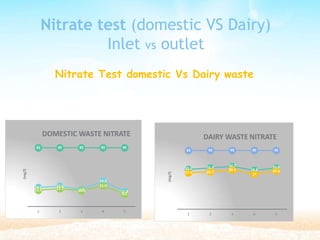
11 nitrate domestic waste 14.6mg/L 12.5mg/L 2.1mg/L 85.61%
12 nitrate dairy waste water 30.5mg/L 27.9mg/L 2.6mg/L 91.47%
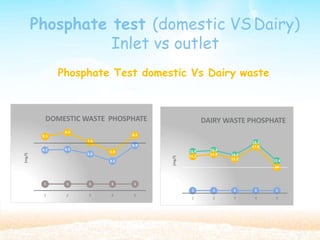
13 phosphate domestic waste 8.3mg/L 6.2mg/L 2.1mg/L 74.69%
14 phosphate dairy waste water 15.9mg/L 14.1mg/L 14.1mg/L 88.67%
ED
23.3mg/L
39.4mg/L
water
water
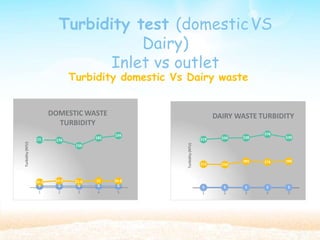
Turbidity test (domesticVS
Dairy)
Inlet vs outlet
Turbidity domestic Vs Dairy waste
177.7 176
156
185
194
20.2 21.6
24.9 25 24.6
5 5 5 5 5
1 2 3 4 5
Turbidity
(NTU)
DOMESTIC WASTE
TURBIDITY
519 534 538
576
539
254 250
285 276 286
5
1
5
2
5
3
5
4
5
5
Turbidity
(NTU)
DAIRY WASTE TURBIDITY
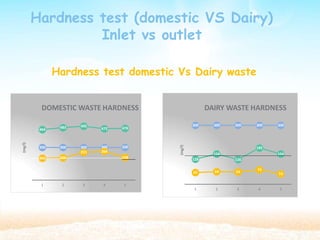
Hardness test (domestic VS Dairy)
Inlet vs outlet
Hardness test domestic Vs Dairy waste
464
483 495
472 476
300 300 300
255
300 300
264
1
201 205 208
2 3 4 5
(mg/l)
DOMESTIC WASTE HARDNESS
185
154 154
128 126
300 300 300 300 300
60 64 63
74
53
1 2 3 4 5
(mg/l)
DAIRY WASTE HARDNESS
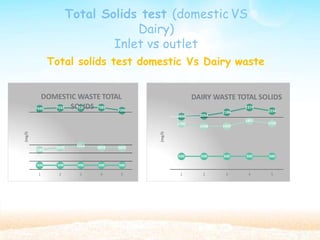
Total Solids test (domestic VS
Dairy)
Inlet vs outlet
Total solids test domestic Vs Dairy waste
7440 7585
7206
2380
(mg/l)
DOMESTIC WASTE TOTAL
7532 SO
75
L
24
IDS
2659 2956 2659 2650
500 500 500 500 500
500 500 500 500 500
1 2 3 4 5 1 2 3 4 5
2186
2374
2234
1740
1648 1659
2020 2054
1857
1759
(mg/l)
DAIRY WASTE TOTAL SOLIDS
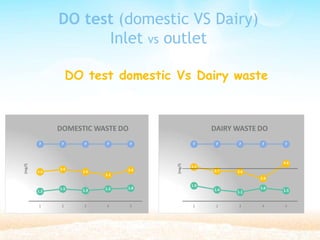
DO test (domestic VS Dairy)
Inlet vs outlet
DO test domestic Vs Dairy waste
1.5 1.5 1.6
7 7 7 7 7
3.6
3.9
3.6
3.2
3.8
(mg/l)
DOMESTIC WASTE DO
1.2 1.3 1.4
1.1 1.3
1 2 3 4 5 1 2 3 4 5
1.9
1.6
7 7 7 7 7
3.7 3.6
2.8
4.6
4.2
(mg/l)
DAIRY WASTE DO
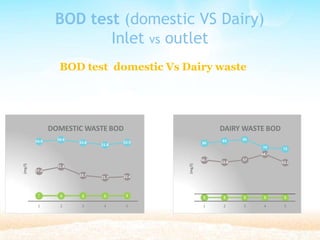
BOD test (domestic VS Dairy)
Inlet vs outlet
BOD test domestic Vs Dairy waste
54.9 56.6
51.8
53.8 53.9
5 5
31.6
27.6
23.7
21.7 22.4
1 5
(mg/l)
DOMESTIC WASTE BOD
5 5 5 5 5 5 5 5
2 3 4 1 2 3 4 5
80
83 85
74 72
56.7
53.8
57
64.7
53.2
(mg/l)
DAIRY WASTE BOD
COD test (domestic VSDairy)
Inlet vs outlet
COD test domestic Vs Dairy waste
5 5 5 5 5
1 2 3 4 5
72 74 73
65
84
59.6
56
61.8
52.9
60
(mg/l)
DOMESTIC WASTE COD
5 5 5 5 5
1 2 3 4 5
120 123
132 128.5
80.6 78.5
112.5 112
100.7
89
(mg/l)
DIARY WASTE COD
Nitrate test (domestic VS Dairy)
Inlet vs outlet
Nitrate Test domestic Vs Dairy waste
14.6 15.6
11.4
45
12.5 13.7
1123.1
19.5
15.9
9.5
1 2 3 4 5
(mg/l)
DOMESTIC WASTE NITRATE
45 45 45 45
45
30.5
27.9
31.6
28.7
32.7
30.1 29.8
27
31.6
29.3
1 2 3 4 5
(mg/l)
DAIRY WASTE NITRATE
45 45 45 45
Phosphate test (domestic VSDairy)
Inlet vs outlet
Phosphate Test domestic Vs Dairy waste
1 1 1 1 1
1 2 3 4 5
8.3
8.9
5.9
8.5
6.2 6.3
5.6
4.5
7.4
6.9
(mg/l)
DOMESTIC WASTE PHOSPHATE
1 1 1 1 1
1 2 3 4 5
15.9
12.4
14.1
16.4
14.9 14.6
13.2
19.3
17.8
10
(mg/l)
DAIRY WASTE PHOSPHATE
Applications
 Bathroom water recycling.
 Treatment of polluted streams, nallas,
rivulets and water-bodies ( floating
beds may be recommended.
 Use recycled water for flush, dish
washes, watering for plant.
Future scope
1. No treatment facility or treatment
method is available for nallaha But the
root zone technology.
2.Best suitable for villages, small towns and
cities.
3.Decentralized waste water treatment
method.
4.Locally available material can be used and
not required skilled labor for
construction.
5.No mechanical equipment's are required
for operation.
Advantages of this treatment method
• Roots of plants provide favorable environment
for bacteria Diversity thereby reducing
pollutant loads.
• Least consumption of electricity. Use of gravity
for water flow.
• Complete biological and Eco friendly method of
treatment.
• No foul odor is released.
Conclusion:
1. As per our Tested samples Turbidity, Hardness,
BOD, COD, Nitrate, Phosphate,etc get Redused
and DO increased.
2. Concentration of COD was high of dairy waste
water.
3.The Reactor was found to be very effective for
sewage treatment.
4.Turbidity of domestically and dairy waste get
removed about 88.63% and 44.89% respectively.
Root zone Cleaning System.pptx

Root zone Cleaning System.pptx

  • 1.
  • 2.
    IINNDTERXODUCTION WHAT IS EXACTLY AIMSAND OBJECTIVES TYPES OF PLANTS PROPERTIES AND NECESSSITY OF MATERIAL PROCEDURE AND METHODS RESULTS AND DESCUSSION APPLICATION AND FEAUTURE SCOPE CONCLUSION
  • 3.
  • 4.
    INTRODUCTION:  Root zonetechnology is effective technology called Decentralized Wastewater Systems (DEWATS)  It was developed in 1970s in Germany and has been successfully implemented in different countries mainly in Europe and America.  The root zone wastewater treatment system makes use of biological and physical-treatment processes to remove pollutants from wastewater.  Due to its natural process, there is no need to add any input such as chemicals, mechanical pumps or external energy. This reduces both the maintenance and energy costs.
  • 5.
    root zone tretmentplant in pondichery
  • 6.
    What is exactly? technologies / associated This system leads to destruction, containment methods based on with root-zone of be- of It is the set of various mechanisms different plants. Decontamination, Pollutants.
  • 7.
    aim: To cheak thefeasability of root zone technology for treatment of wastewater without any priliminiry treatment. objective: Analysis of waste water at inlet and outlet with DO, COD, BOD, Nitrate, Phosphate by laboratory test
  • 8.
    types of plants 02 03 04 05 pragmites karka(reed) arundo donax thyphalatifolia canna lily pragmites austriails 01 plants used in root zone technology
  • 9.
  • 13.
    Result And discussion 1.Turbidity test (domestic VS Dairy). 2. Hardness test (domestic VS Dairy) 3. Total Solids test (domestic VS Dairy) 4. DO test (domestic VS Dairy) 5. BOD test (domestic VS Dairy) 6. COD test (domestic VS Dairy) 7. Nitrate test (domestic VS Dairy) 8. Phosphate test (domestic VS Dairy)
  • 14.
    Sr.n o TEST AND SAMPLEINLET OUTLET WASTE % WASTE REMOVED REMOVED 1 turbidity domestic waste water 177.7NTU 20.2NTU -157.5NTU 88.63% 2 turbidity dairy waste water 519NTU 286NTU -233NTU 55.10% 3 hardness domesic 464mg/L 208mg/L -256mg/L 44.82% 4 hardness dairy waste water 128mg/L 60mg/L -68mg/L 46.87% 5 total solids domestic wate water 7440mg/L 2380mg/L -5060mg/L 31.98% 6 total solids dairy waste 2020mg/L 1740mg/L -280mg/L 86.13% D.O domestic waste water 1.2mg/L 3.7mg/L +2.5mg/L 32.43% 7 D.O dairy waste water 1.1mg/L 3.6mg/L +2.5mg/L 32.43%
  • 15.
    Sr.no TEST ANDSAMPLE INLET OUTLET WASTE REMOV % WASTE REMOVED 9 B.O.D dairy waste water 80mg/L 56.7mg/L - 70.87% 10 C.O.D domestic waste water 72mg/L 59.6mg/L -12.4mg/L 82.77% C.O.D dairy waste water 120mg/L 80.6mg/L - 67.16% 11 nitrate domestic waste 14.6mg/L 12.5mg/L 2.1mg/L 85.61% 12 nitrate dairy waste water 30.5mg/L 27.9mg/L 2.6mg/L 91.47% 13 phosphate domestic waste 8.3mg/L 6.2mg/L 2.1mg/L 74.69% 14 phosphate dairy waste water 15.9mg/L 14.1mg/L 14.1mg/L 88.67% ED 23.3mg/L 39.4mg/L water water
  • 16.
    Turbidity test (domesticVS Dairy) Inletvs outlet Turbidity domestic Vs Dairy waste 177.7 176 156 185 194 20.2 21.6 24.9 25 24.6 5 5 5 5 5 1 2 3 4 5 Turbidity (NTU) DOMESTIC WASTE TURBIDITY 519 534 538 576 539 254 250 285 276 286 5 1 5 2 5 3 5 4 5 5 Turbidity (NTU) DAIRY WASTE TURBIDITY
  • 17.
    Hardness test (domesticVS Dairy) Inlet vs outlet Hardness test domestic Vs Dairy waste 464 483 495 472 476 300 300 300 255 300 300 264 1 201 205 208 2 3 4 5 (mg/l) DOMESTIC WASTE HARDNESS 185 154 154 128 126 300 300 300 300 300 60 64 63 74 53 1 2 3 4 5 (mg/l) DAIRY WASTE HARDNESS
  • 18.
    Total Solids test(domestic VS Dairy) Inlet vs outlet Total solids test domestic Vs Dairy waste 7440 7585 7206 2380 (mg/l) DOMESTIC WASTE TOTAL 7532 SO 75 L 24 IDS 2659 2956 2659 2650 500 500 500 500 500 500 500 500 500 500 1 2 3 4 5 1 2 3 4 5 2186 2374 2234 1740 1648 1659 2020 2054 1857 1759 (mg/l) DAIRY WASTE TOTAL SOLIDS
  • 19.
    DO test (domesticVS Dairy) Inlet vs outlet DO test domestic Vs Dairy waste 1.5 1.5 1.6 7 7 7 7 7 3.6 3.9 3.6 3.2 3.8 (mg/l) DOMESTIC WASTE DO 1.2 1.3 1.4 1.1 1.3 1 2 3 4 5 1 2 3 4 5 1.9 1.6 7 7 7 7 7 3.7 3.6 2.8 4.6 4.2 (mg/l) DAIRY WASTE DO
  • 20.
    BOD test (domesticVS Dairy) Inlet vs outlet BOD test domestic Vs Dairy waste 54.9 56.6 51.8 53.8 53.9 5 5 31.6 27.6 23.7 21.7 22.4 1 5 (mg/l) DOMESTIC WASTE BOD 5 5 5 5 5 5 5 5 2 3 4 1 2 3 4 5 80 83 85 74 72 56.7 53.8 57 64.7 53.2 (mg/l) DAIRY WASTE BOD
  • 21.
    COD test (domesticVSDairy) Inlet vs outlet COD test domestic Vs Dairy waste 5 5 5 5 5 1 2 3 4 5 72 74 73 65 84 59.6 56 61.8 52.9 60 (mg/l) DOMESTIC WASTE COD 5 5 5 5 5 1 2 3 4 5 120 123 132 128.5 80.6 78.5 112.5 112 100.7 89 (mg/l) DIARY WASTE COD
  • 22.
    Nitrate test (domesticVS Dairy) Inlet vs outlet Nitrate Test domestic Vs Dairy waste 14.6 15.6 11.4 45 12.5 13.7 1123.1 19.5 15.9 9.5 1 2 3 4 5 (mg/l) DOMESTIC WASTE NITRATE 45 45 45 45 45 30.5 27.9 31.6 28.7 32.7 30.1 29.8 27 31.6 29.3 1 2 3 4 5 (mg/l) DAIRY WASTE NITRATE 45 45 45 45
  • 23.
    Phosphate test (domesticVSDairy) Inlet vs outlet Phosphate Test domestic Vs Dairy waste 1 1 1 1 1 1 2 3 4 5 8.3 8.9 5.9 8.5 6.2 6.3 5.6 4.5 7.4 6.9 (mg/l) DOMESTIC WASTE PHOSPHATE 1 1 1 1 1 1 2 3 4 5 15.9 12.4 14.1 16.4 14.9 14.6 13.2 19.3 17.8 10 (mg/l) DAIRY WASTE PHOSPHATE
  • 24.
    Applications  Bathroom waterrecycling.  Treatment of polluted streams, nallas, rivulets and water-bodies ( floating beds may be recommended.  Use recycled water for flush, dish washes, watering for plant.
  • 25.
    Future scope 1. Notreatment facility or treatment method is available for nallaha But the root zone technology. 2.Best suitable for villages, small towns and cities. 3.Decentralized waste water treatment method. 4.Locally available material can be used and not required skilled labor for construction. 5.No mechanical equipment's are required for operation.
  • 26.
    Advantages of thistreatment method • Roots of plants provide favorable environment for bacteria Diversity thereby reducing pollutant loads. • Least consumption of electricity. Use of gravity for water flow. • Complete biological and Eco friendly method of treatment. • No foul odor is released.
  • 27.
    Conclusion: 1. As perour Tested samples Turbidity, Hardness, BOD, COD, Nitrate, Phosphate,etc get Redused and DO increased. 2. Concentration of COD was high of dairy waste water. 3.The Reactor was found to be very effective for sewage treatment. 4.Turbidity of domestically and dairy waste get removed about 88.63% and 44.89% respectively.