Root Cause and Corrective Action Workshop January 2009
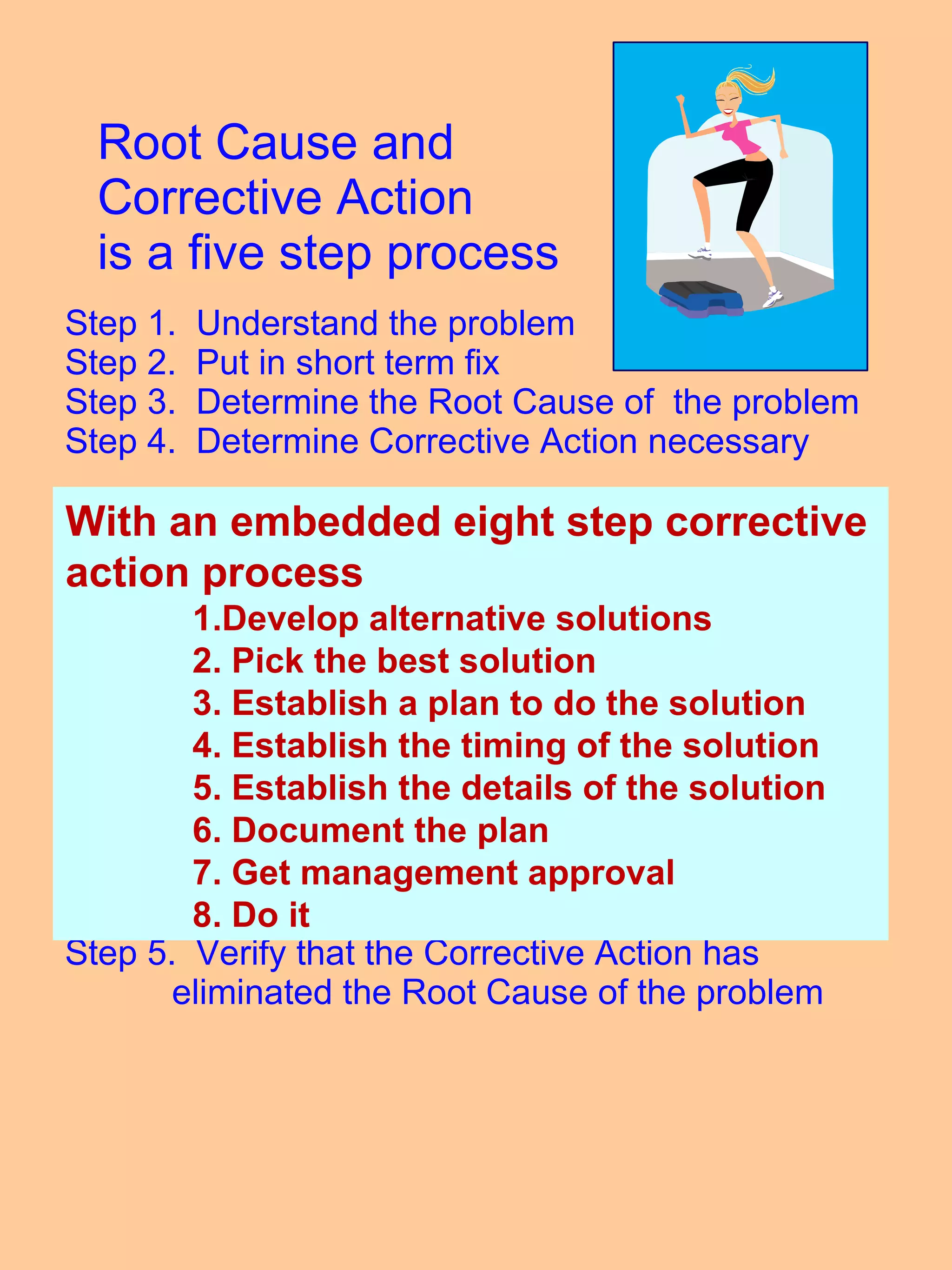
Root Cause and  Corrective Action  is a five step process Step 1.  Understand the problem Step 2.  Put in short term fix Step 3.  Determine the Root Cause of  the problem Step 4.  Determine Corrective Action necessary Step 5.  Verify that the Corrective Action has    eliminated the Root Cause of the problem With an embedded eight step corrective action process 1.Develop alternative solutions 2. Pick the best solution 3. Establish a plan to do the solution 4. Establish the timing of the solution 5. Establish the details of the solution 6. Document the plan 7. Get management approval 8. Do it
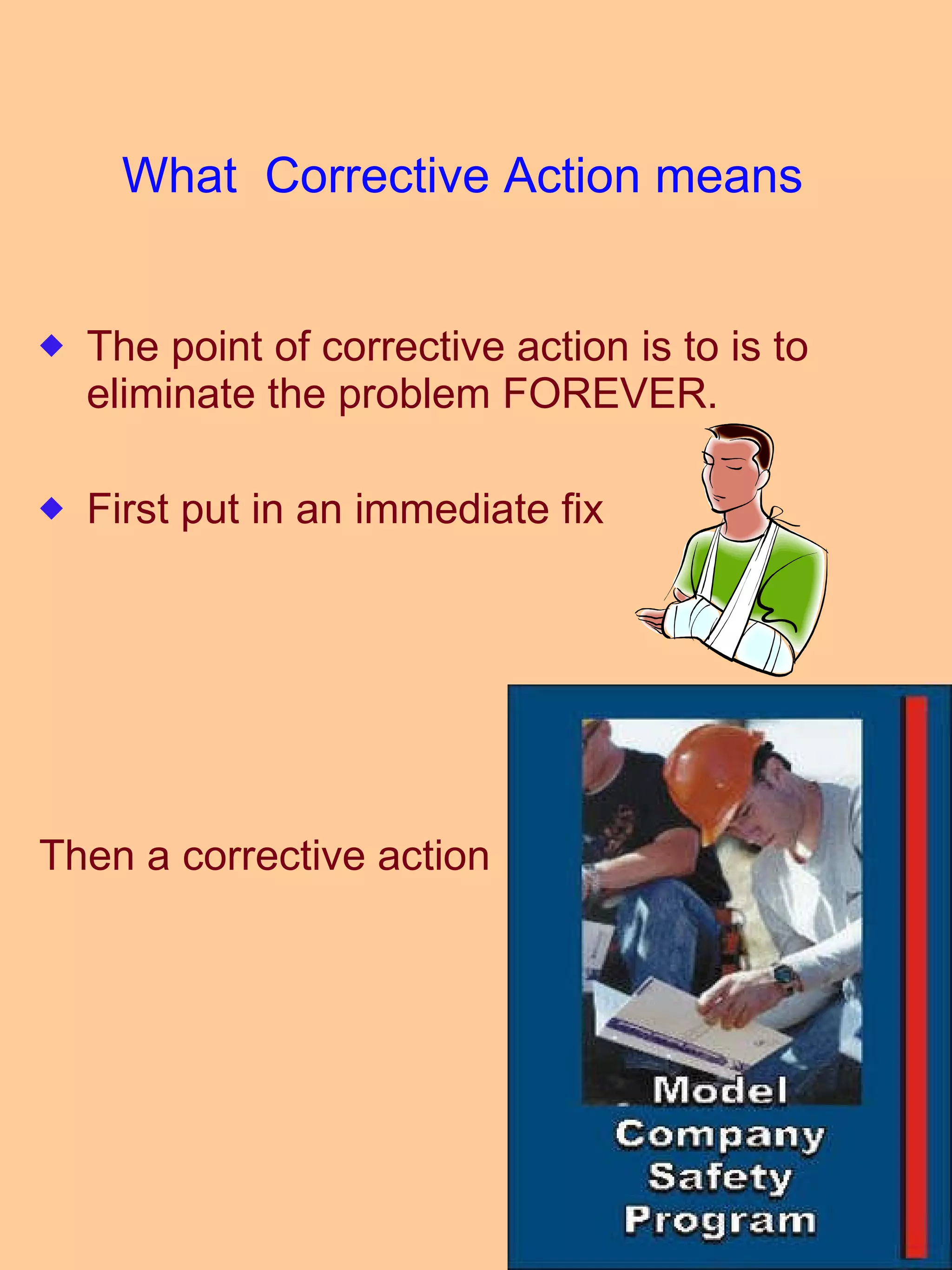
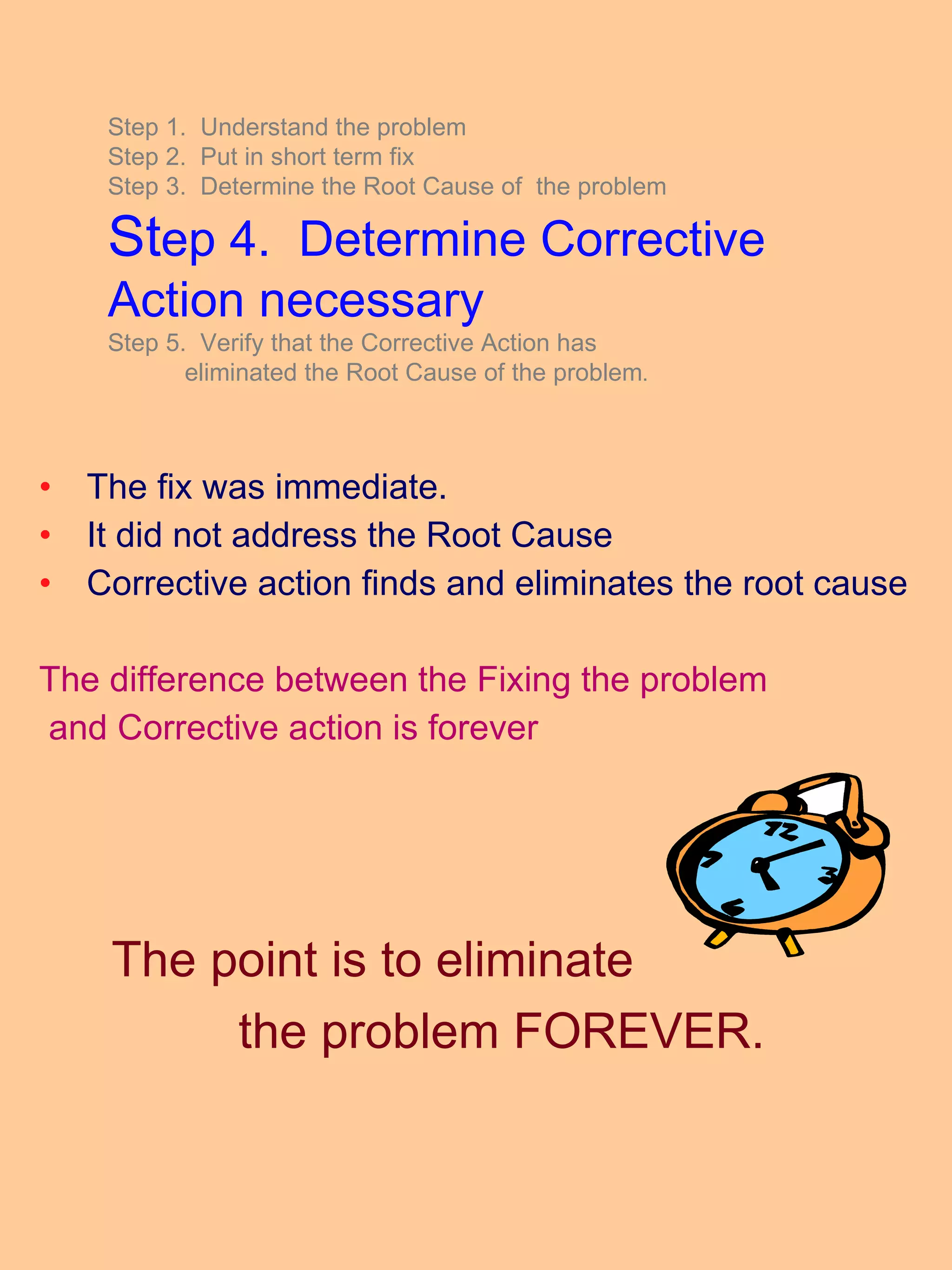
What  Corrective Action means  The point of corrective action is to is to eliminate the problem FOREVER. First put in an immediate fix Then a corrective action
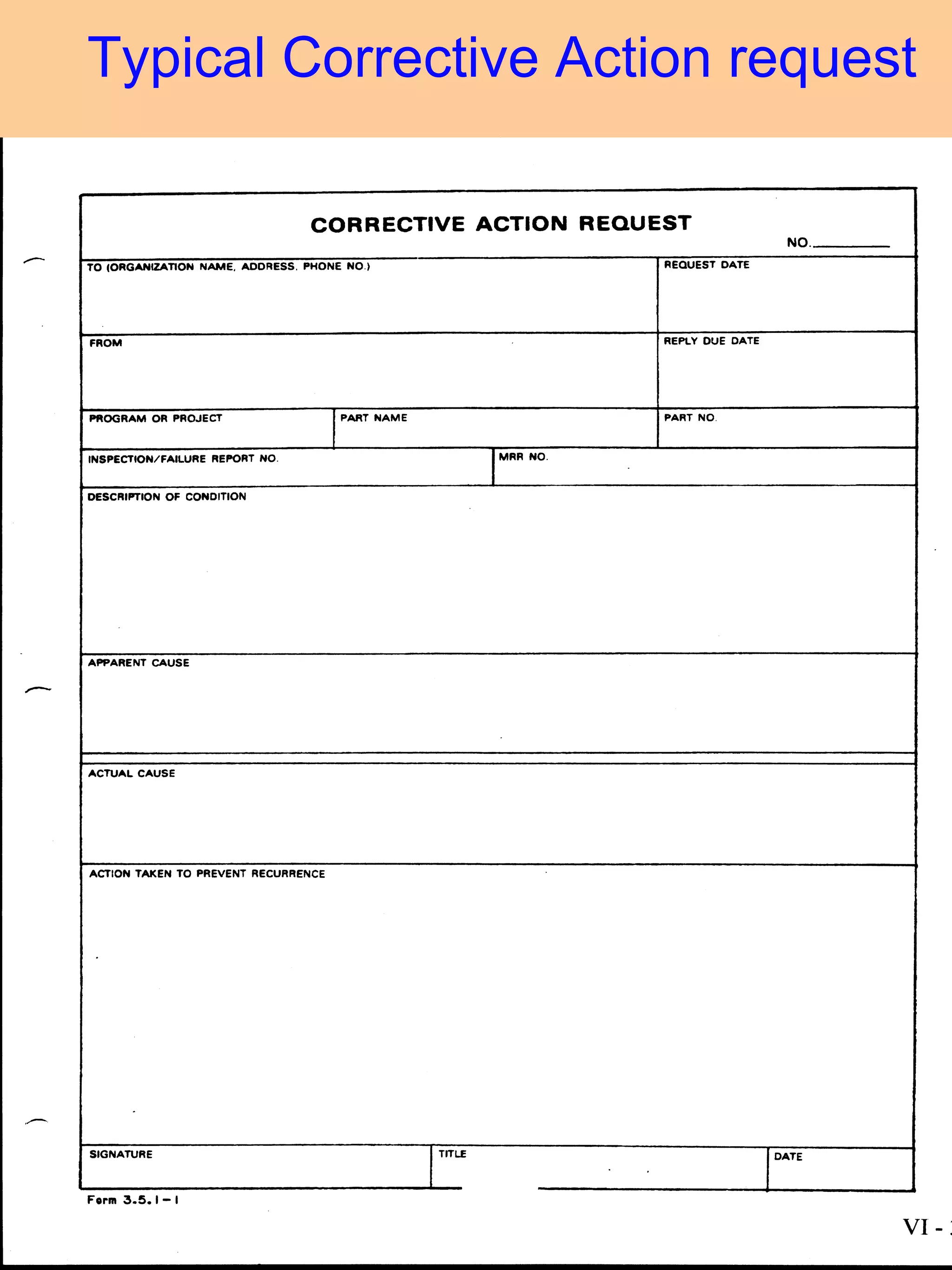
Typical Corrective Action request
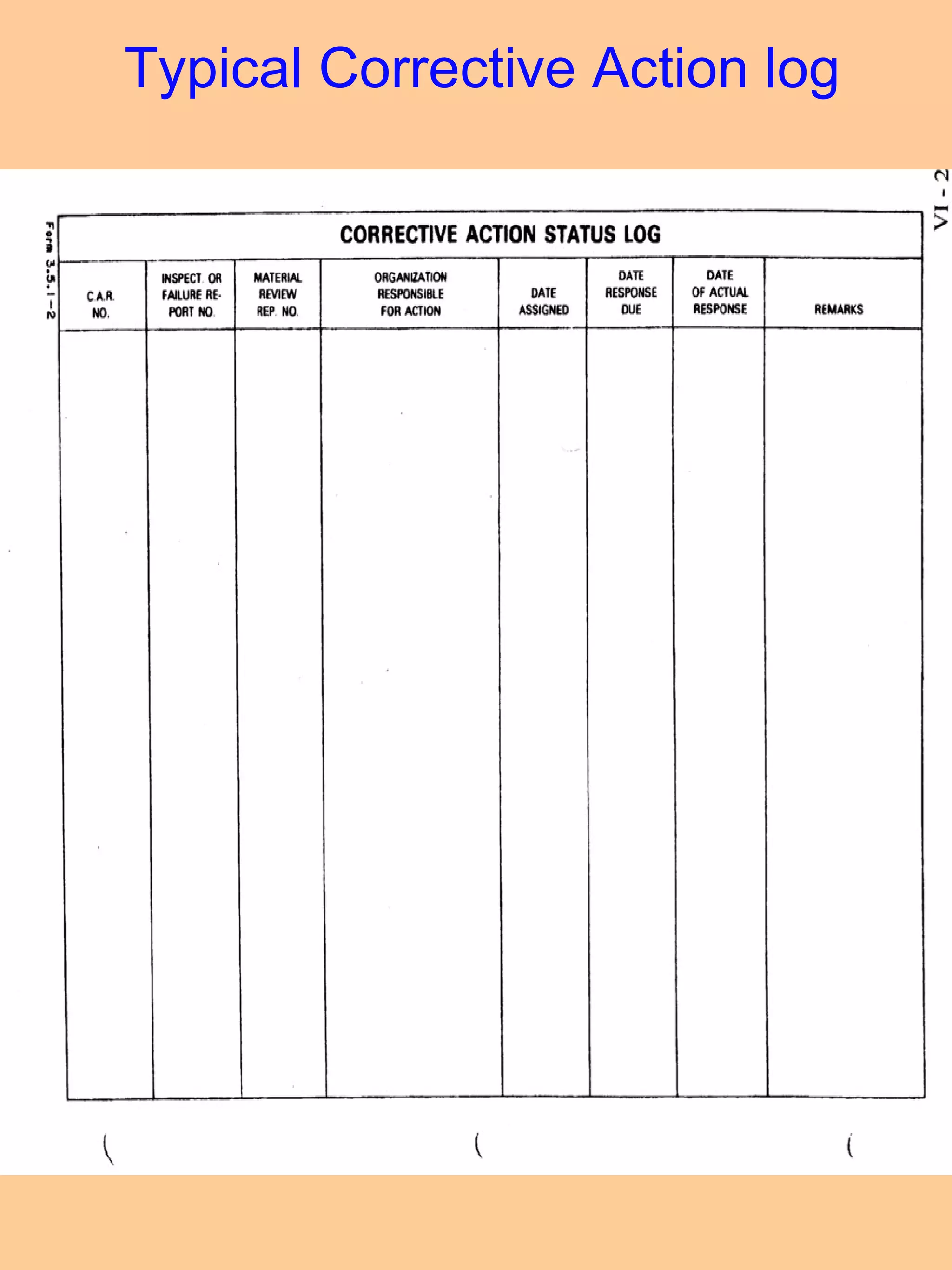
Typical Corrective Action log
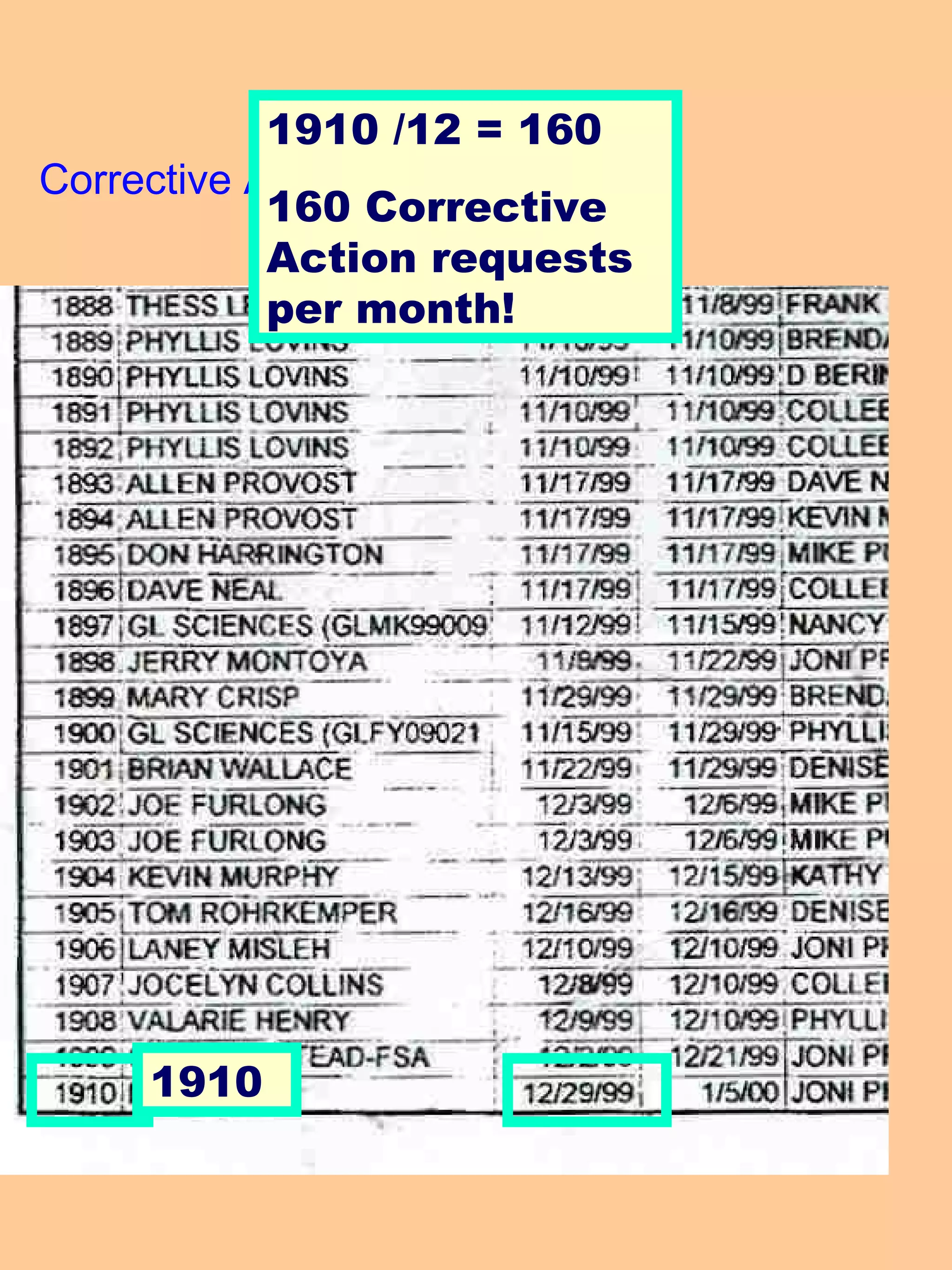
Corrective Action log 1910 1910 /12 = 160 160 Corrective Action requests per month!
Prerequisite:  Quality Management System  [ISO 9000  (1994)] Management Responsibility Quality System Contract Review Design Control Document & Data Control Purchasing Control of Customer-Supplied Product Product Identification & Traceability Process Control Inspection & Testing Control of Inspection, M & TE Inspection & Test Status Control of Non-Conforming Product Corrective & Preventive Action Handling, Storage, Packaging Control of Quality Records Internal Quality Audits Training Servicing Statistical Techniques This is the way we do business to have Quality!
1. Management Responsibility Processes planned Responsibilities for Q  clearly defined, Periodic reviews of  quality and a quality  policy. Knowingly shipped product not to spec to make numbers. Quality policy is for show.  "Defect free, on time"  is really "Some defects, mostly not more then a week  late". Send the salesman out to take care of  it.
 
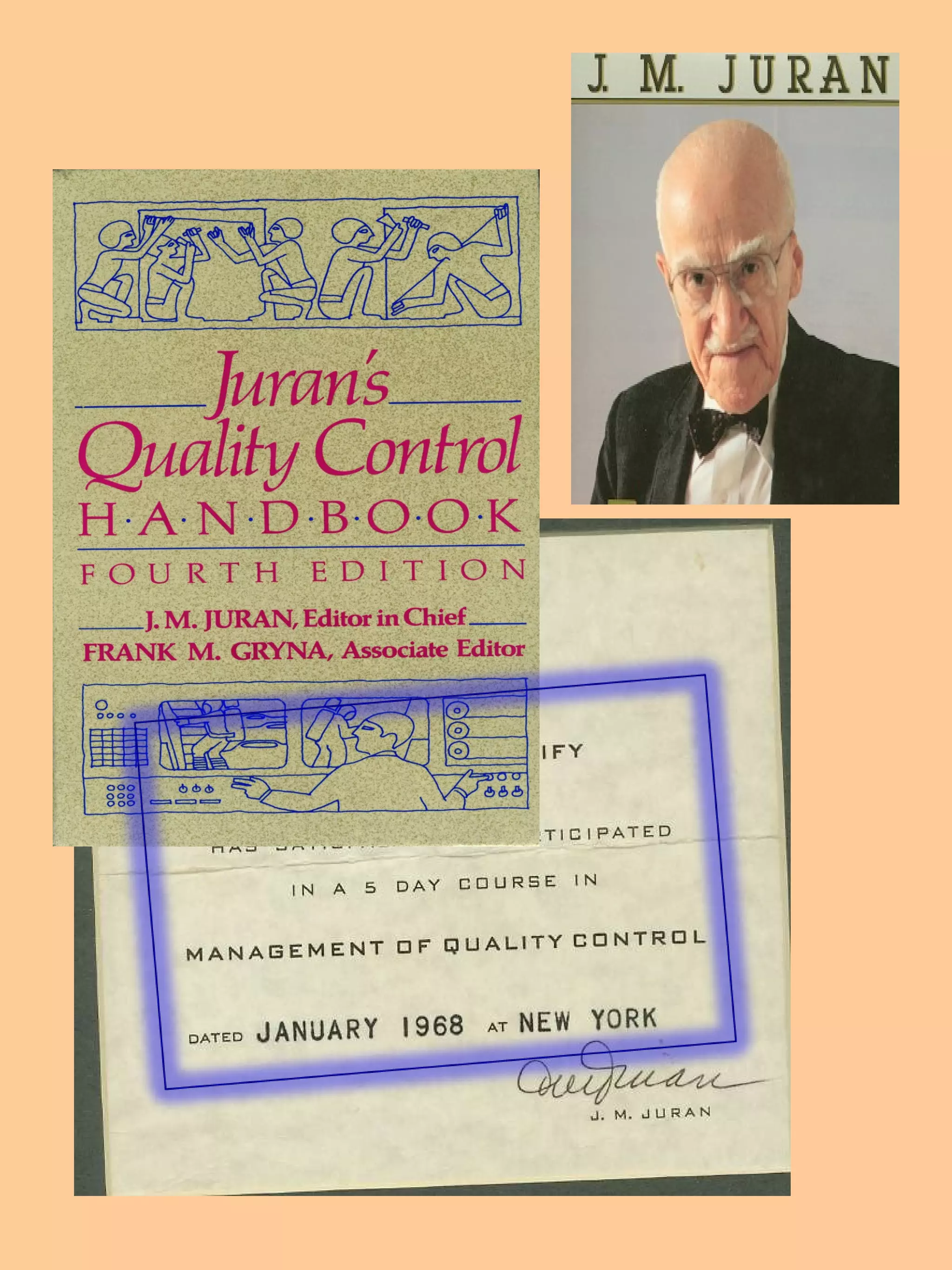
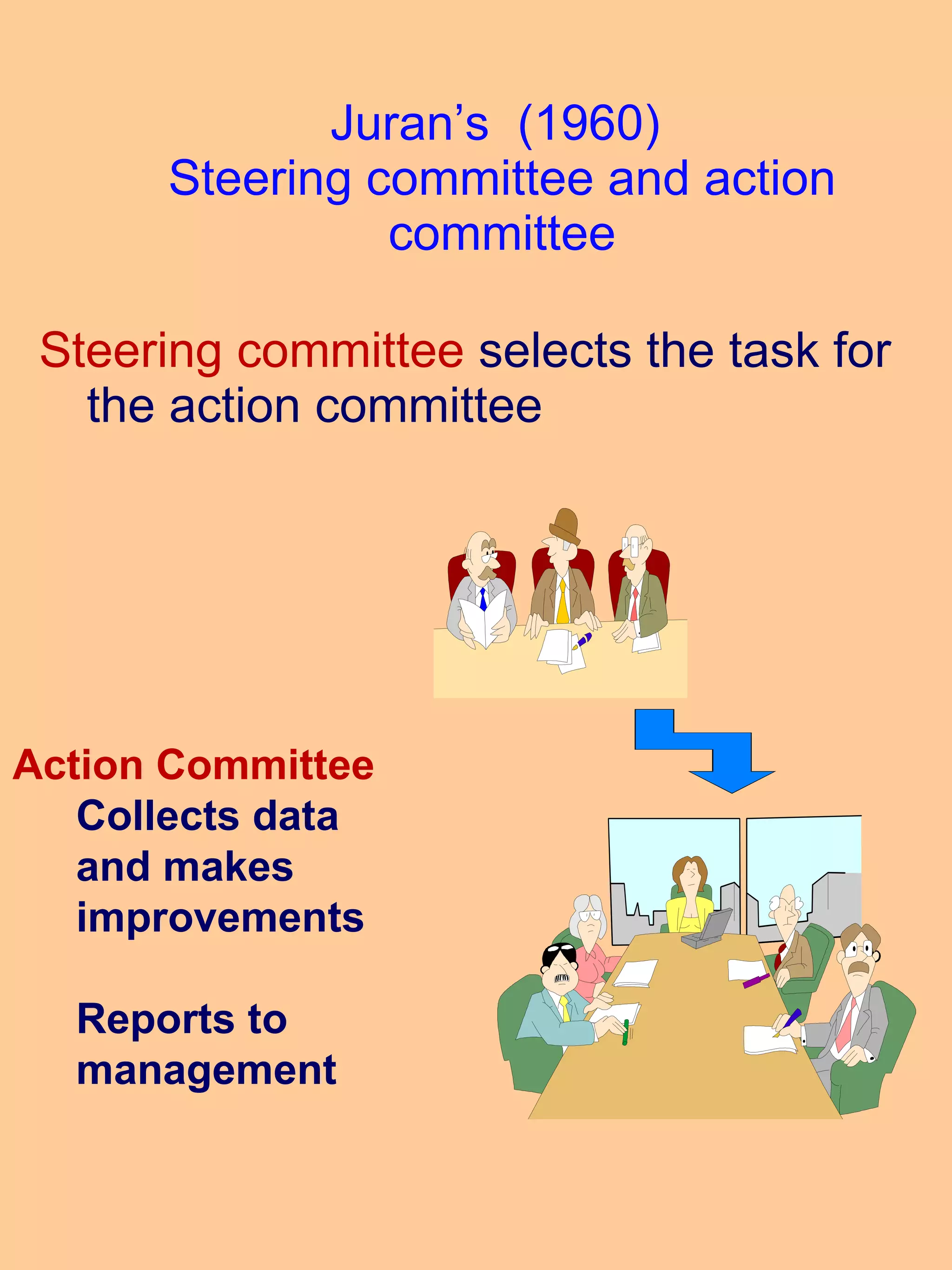
Juran’s  (1960)  Steering committee and action committee Steering committee  selects the task for the action committee Action Committee  Collects data  and makes improvements Reports to management
Classic  Five step    Root Cause    and    Corrective Action Process Step 1.  Understand the problem Step 2.  Put in short term fix Step 3.  Determine the Root Cause of the    problem Step 4.  Determine Corrective Action    necessary Step 5.  Verify that the Corrective Action has  eliminated the Root Cause of the problem.
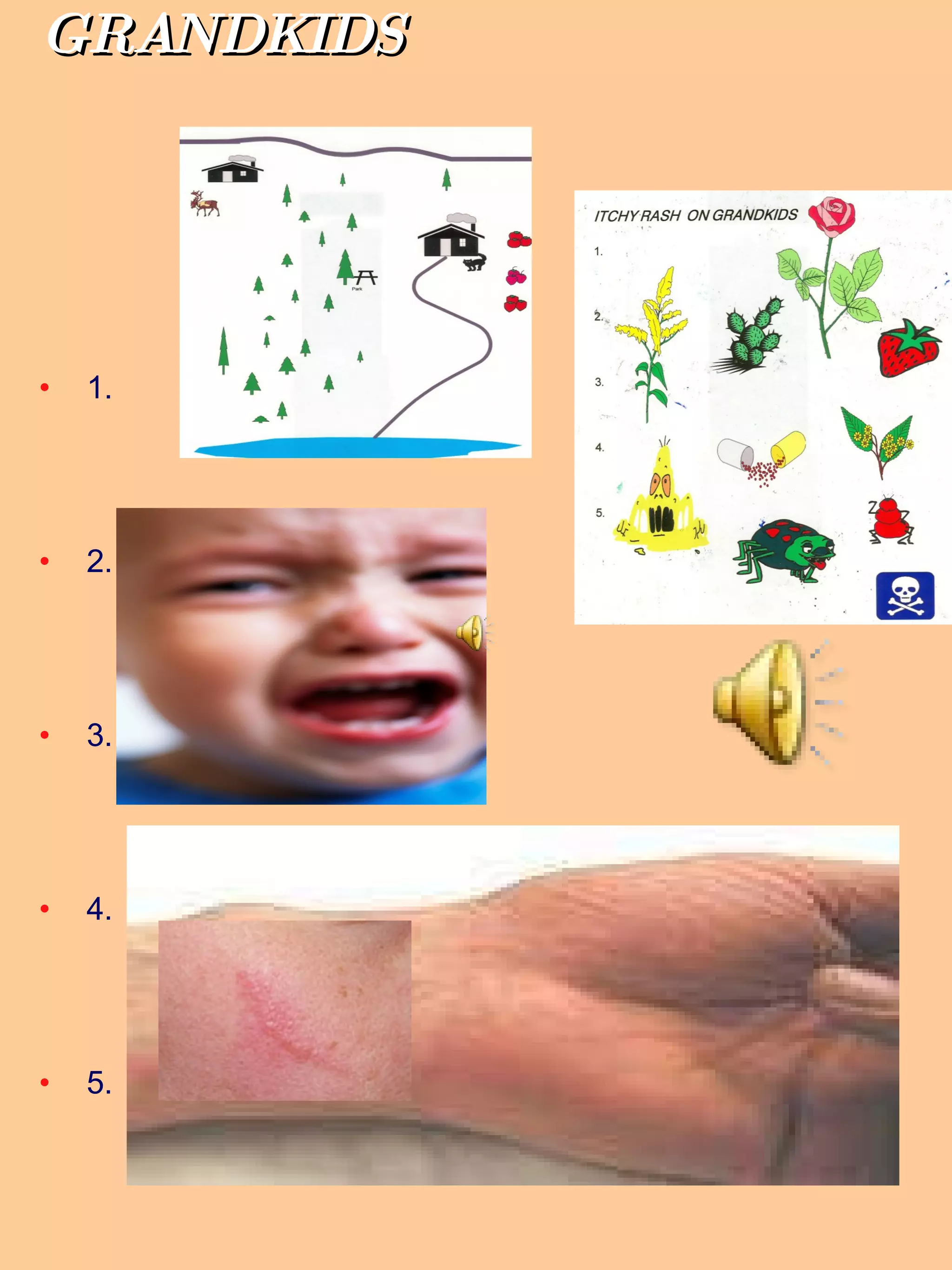
ITCHY RASH   ON GRANDKIDS 1. 2. 3. 4. 5.
Step 1.  Understand the problem Step 2.  Put in short term fix Step 3.  Determine the Root Cause of  the problem Step 4.  Determine Corrective Action necessary Step 5.  Verify that the Corrective Action has    eliminated the Root Cause of the problem . Translate symptoms into an exact understanding Collect the data When Where How long has it happened Describe the problem with a problem statement Clear  Concise Factual Technically correct Get help if the problem is not understood
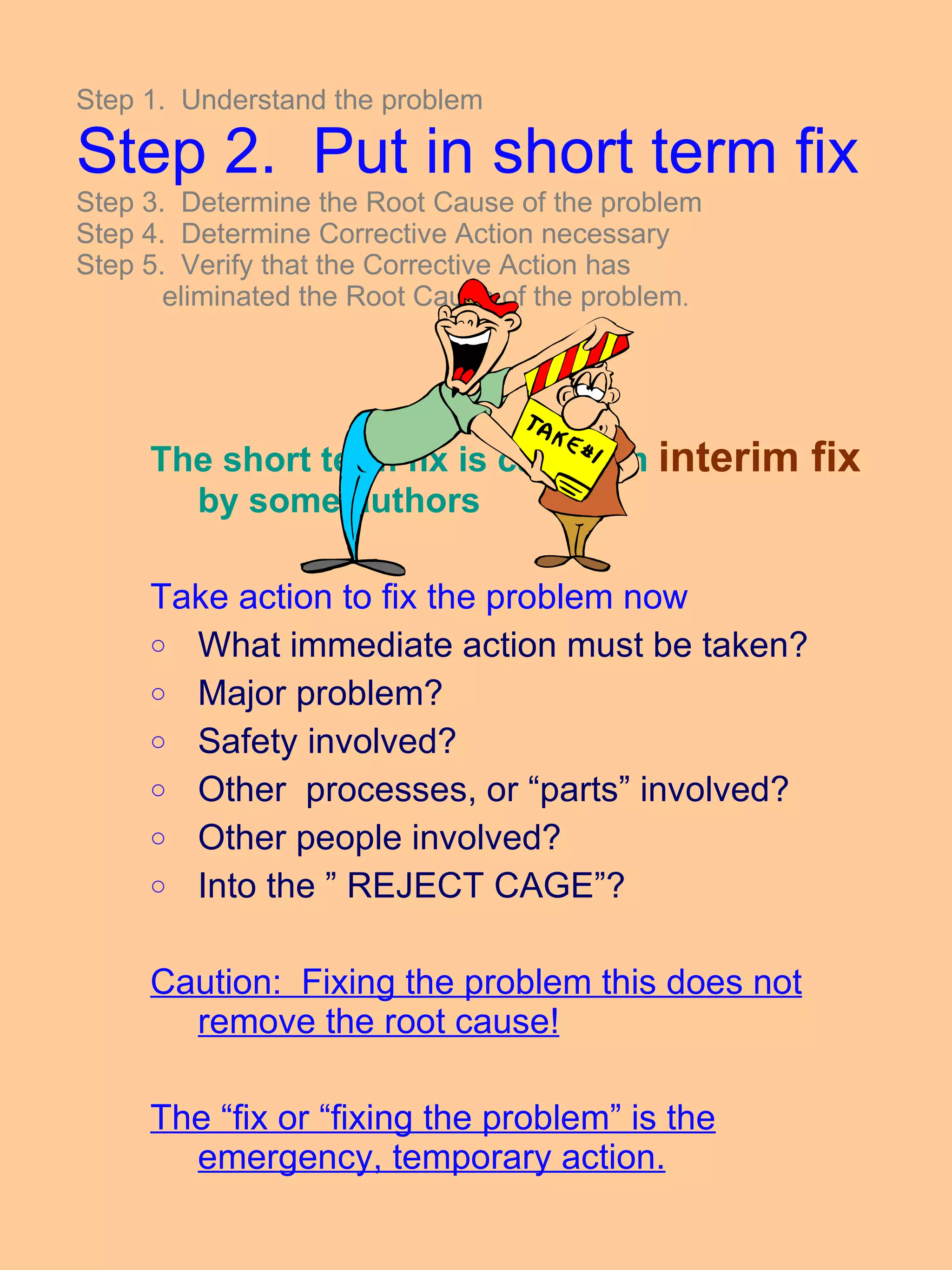
The short term fix is called an  interim fix  by some authors Take action to fix the problem now What immediate action must be taken? Major problem? Safety involved? Other  processes, or “parts” involved? Other people involved? Into the ” REJECT CAGE”? Caution:  Fixing the problem this does not remove the root cause! The “fix or “fixing the problem” is the emergency, temporary action. Step 1.  Understand the problem Step 2.  Put in short term fix Step 3.  Determine the Root Cause of the problem Step 4.  Determine Corrective Action necessary Step 5.  Verify that the Corrective Action has    eliminated the Root Cause of the problem .
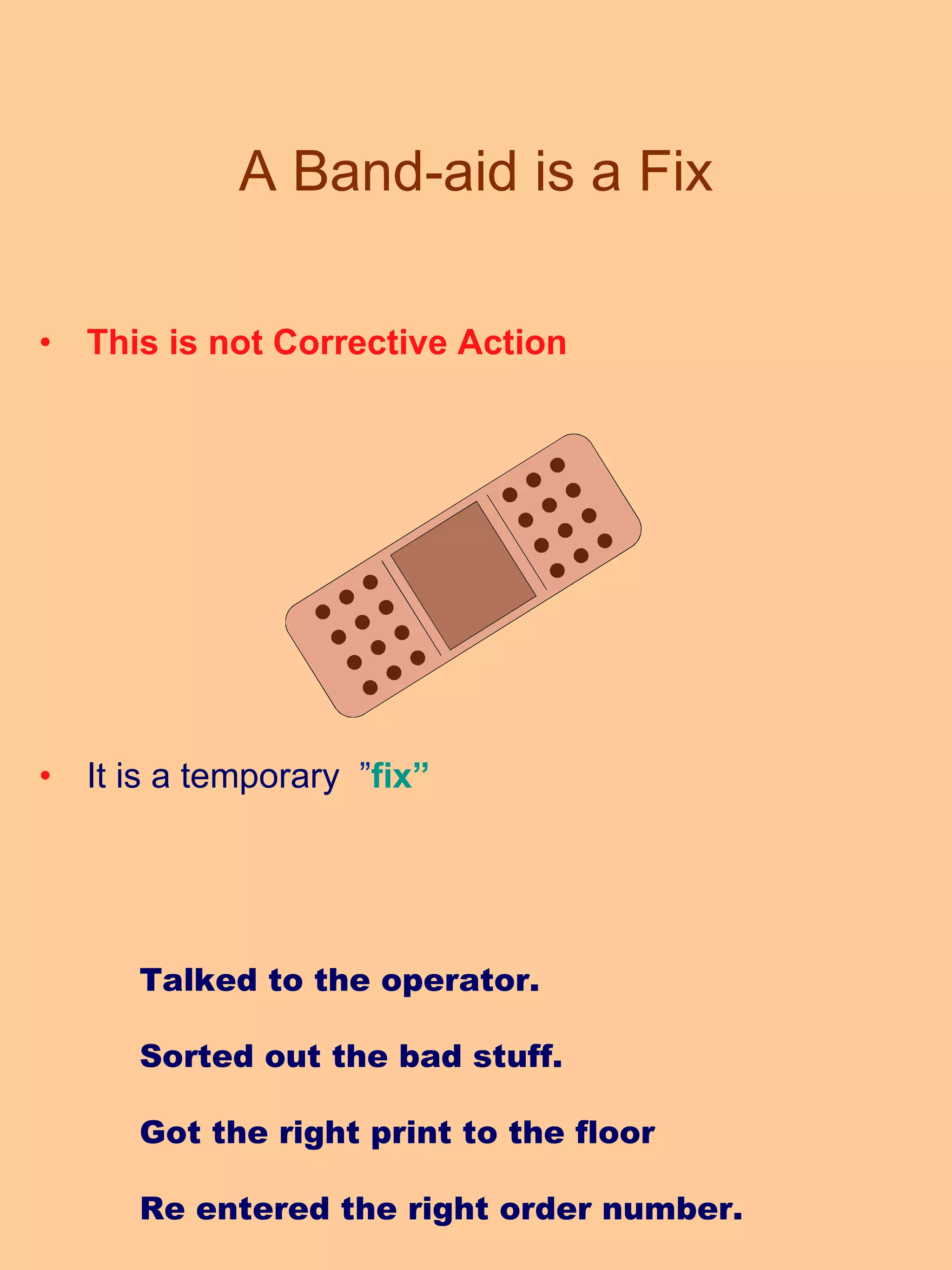
A Band-aid is a Fix This is not Corrective Action It is a temporary  ” fix” Talked to the operator. Sorted out the bad stuff. Got the right print to the floor Re entered the right order number.
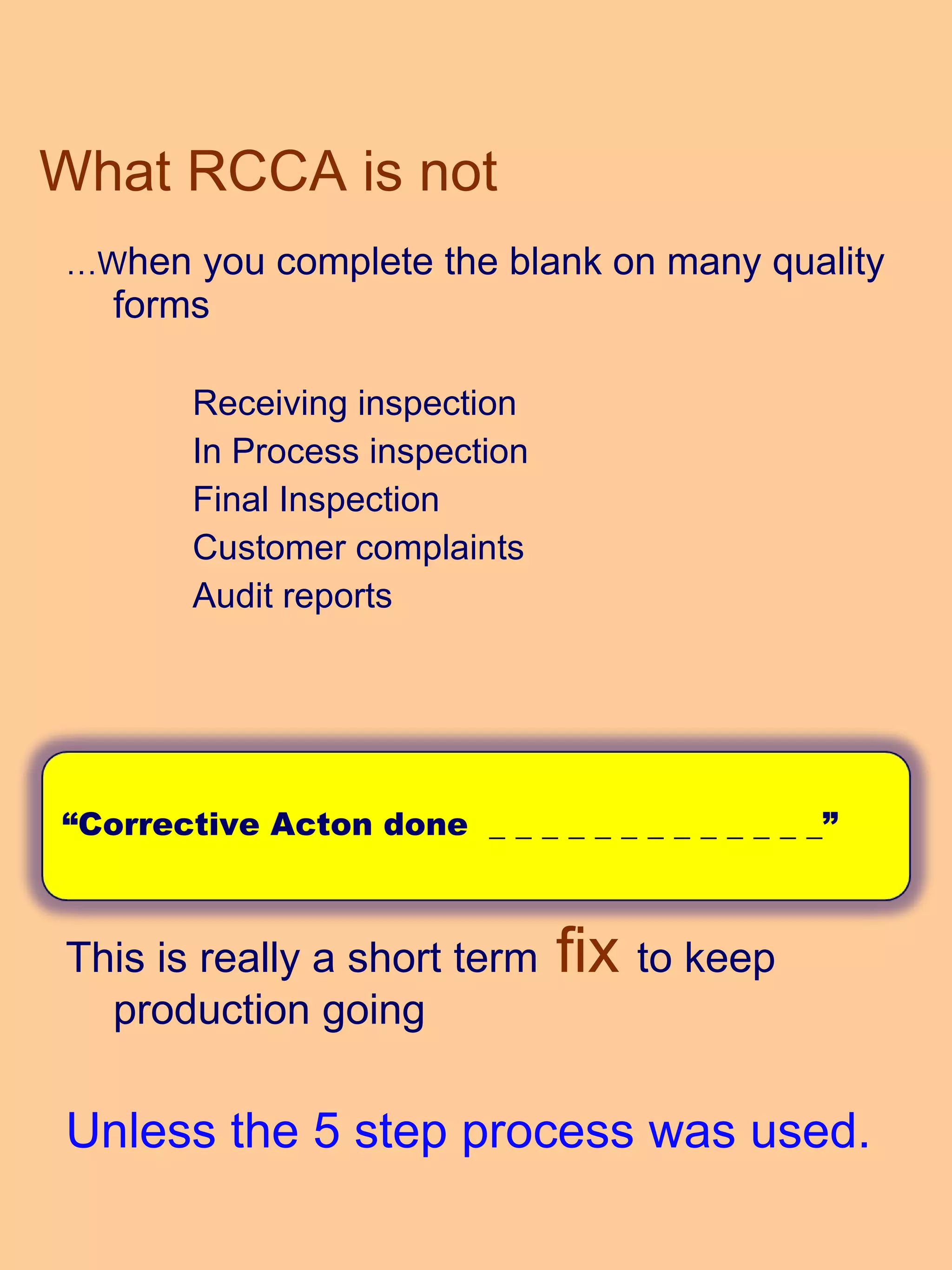
… W hen you complete the blank on many quality forms  Receiving inspection In Process inspection Final Inspection Customer complaints Audit reports This is really a short term  fix  to keep production going Unless the 5 step process was used. What RCCA is not “ Corrective Acton done  _ _ _ _ _ _ _ _ _ _ _ _ _”
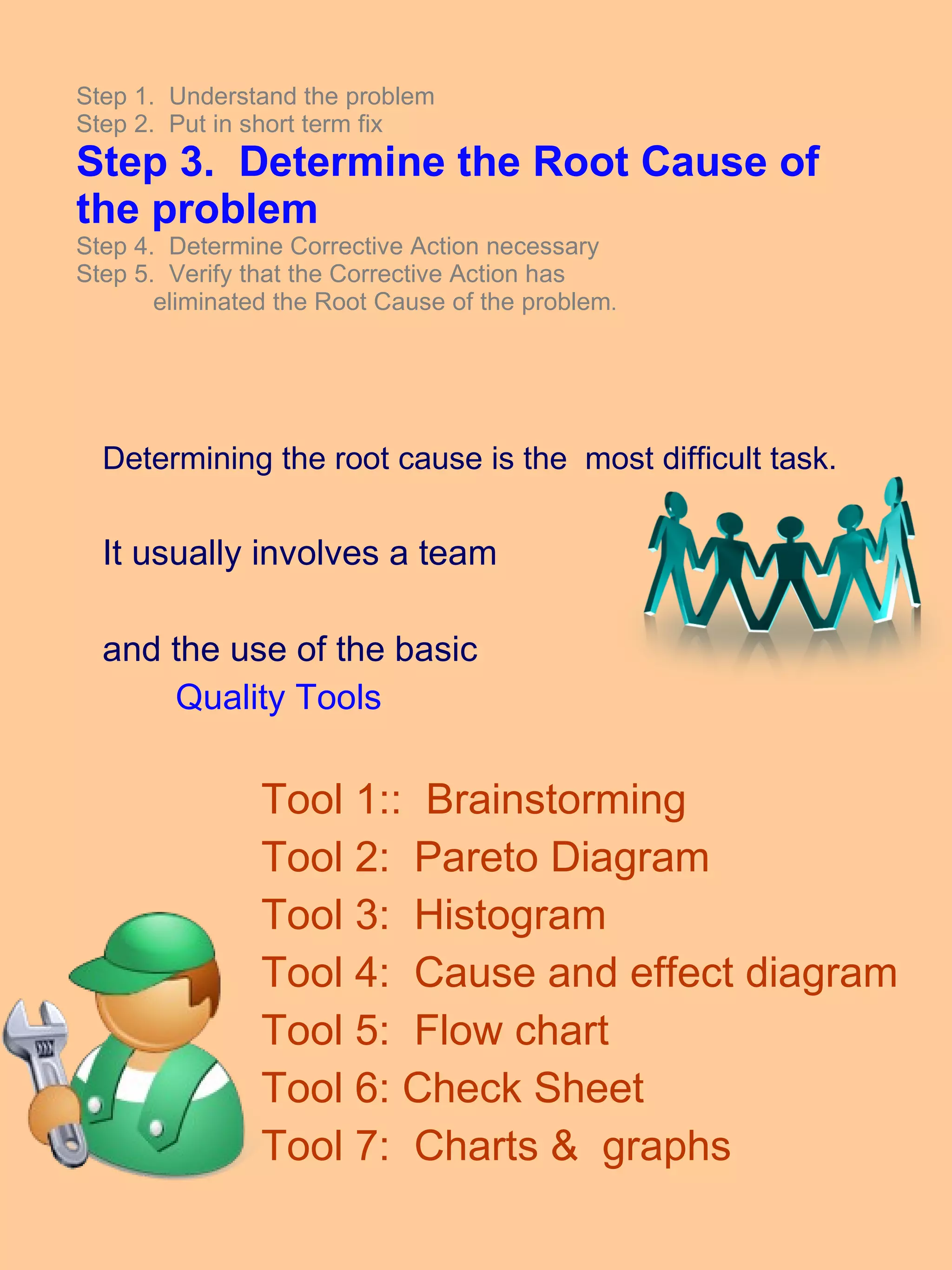
Determining the root cause is the  most difficult task. It usually involves a team  and the use of the basic   Quality Tools Tool 1::  Brainstorming Tool 2:  Pareto Diagram Tool 3:  Histogram Tool 4:  Cause and effect diagram Tool 5:  Flow chart Tool 6: Check Sheet Tool 7:  Charts &  graphs Step 1.  Understand the problem Step 2.  Put in short term fix Step 3.  Determine the Root Cause of  the problem Step 4.  Determine Corrective Action necessary Step 5.  Verify that the Corrective Action has    eliminated the Root Cause of the problem .
Found it!
The fix was immediate. It did not address the Root Cause Corrective action finds and eliminates the root cause The difference between the Fixing the problem  and Corrective action is forever The point is to eliminate the problem FOREVER. Step 1.  Understand the problem Step 2.  Put in short term fix Step 3.  Determine the Root Cause of  the problem St ep 4.  Determine Corrective Action necessary Step 5.  Verify that the Corrective Action has    eliminated the Root Cause of the problem .
An eight item checklist is used to determine Corrective Action 1. Develop alternative solutions 2. Pick the best solution 3. Establish a plan to do the solution 4. Establish the timing of the solution 5. Establish the details of the solution 6. Document the plan 7. Get management approval 8. Do it ! .
What are the solutions?  1. Develop alternative solutions 2. Pick the best solution 3. Establish a plan to do the solution 4. Establish the timing of the solution 5. Establish the details of the solution 6. Document the plan 7. Get management approval 8. Do it  “ There are many ways to skin a cat.” ( The saying came from collecting pelts!) Team brainstorm is the most commonly used tool to develop  solutions
Decide on the best solution. 1. Develop alternative solutions 2. Pick the best solution 3. Establish a plan to do the solution 4. Establish the timing of the solution 5. Establish the details of the solution 6. Document the plan 7. Get management approval 8. Do it  Consider .... Cost Effectiveness Negative side effects Ease of doing the correction
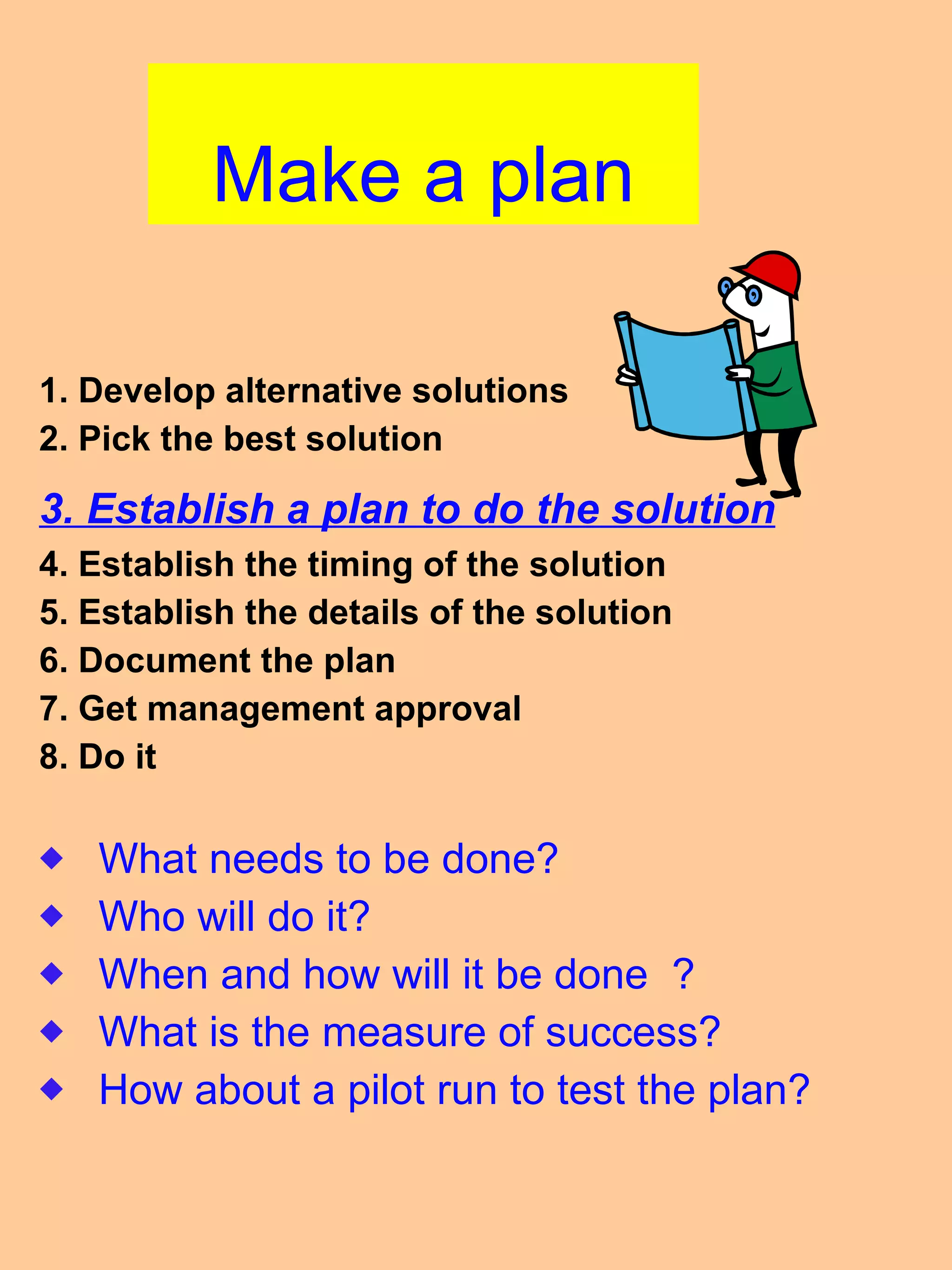
Make a plan 1. Develop alternative solutions 2. Pick the best solution 3. Establish a plan to do the solution 4. Establish the timing of the solution 5. Establish the details of the solution 6. Document the plan 7. Get management approval 8. Do it  What needs to be done? Who will do it? When and how will it be done  ? What is the measure of success? How about a pilot run to test the plan?
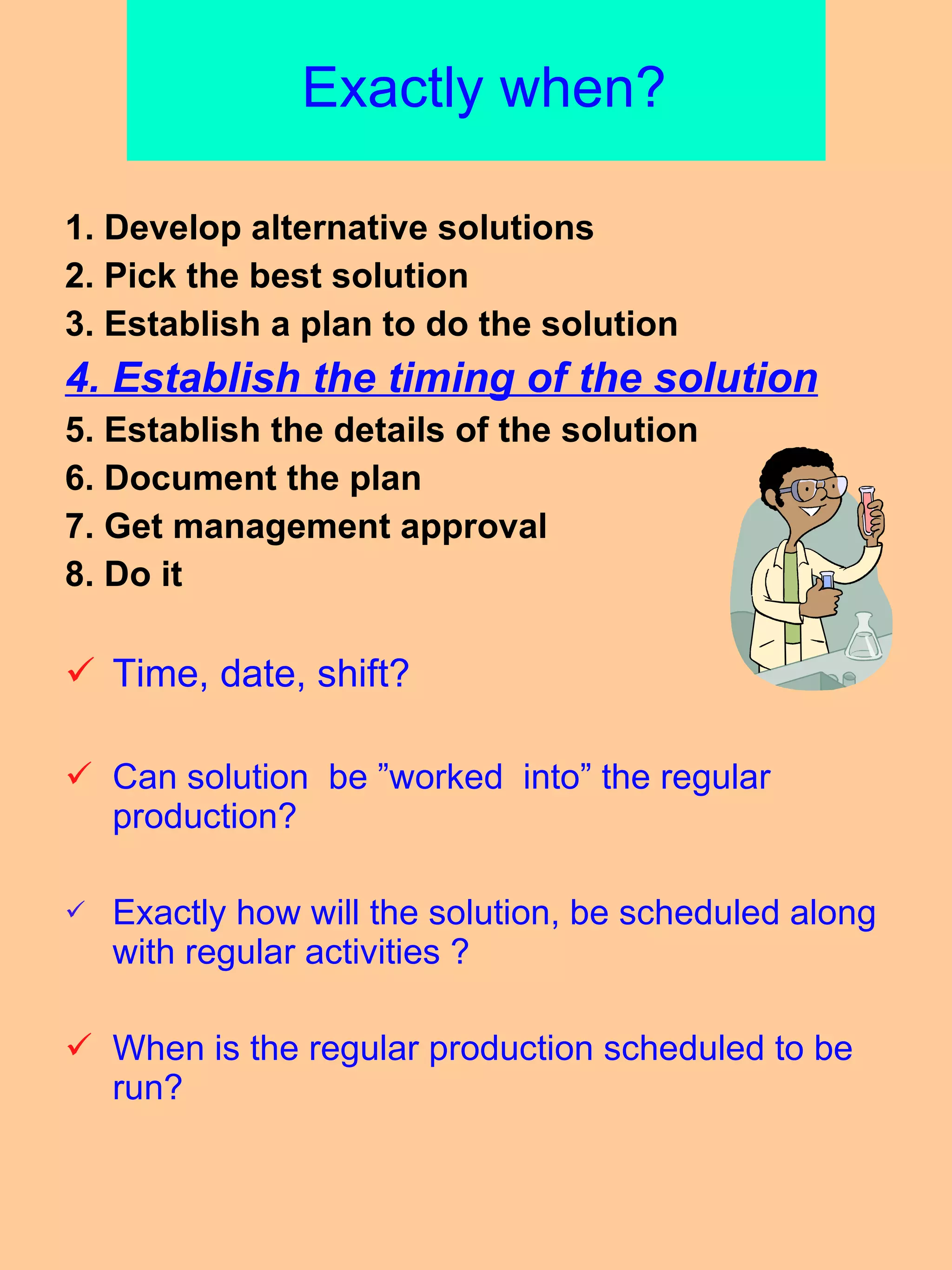
  Exactly when? 1. Develop alternative solutions 2. Pick the best solution 3. Establish a plan to do the solution 4. Establish the timing of the solution 5. Establish the details of the solution 6. Document the plan 7. Get management approval 8. Do it  Time, date, shift? Can solution  be ”worked  into” the regular production? Exactly how will the solution, be scheduled along with regular activities ? When is the regular production scheduled to be run?
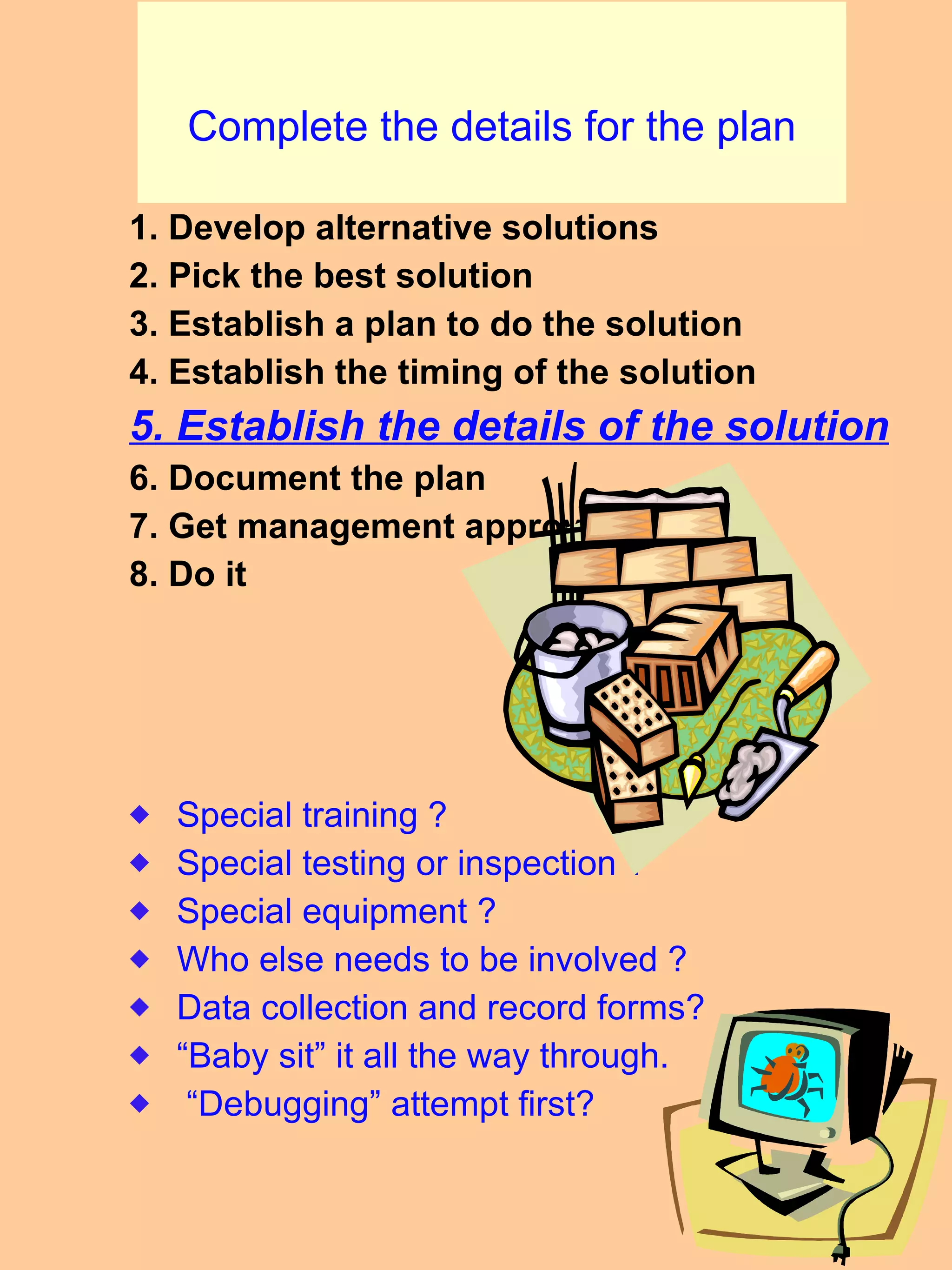
Complete the details for the plan 1. Develop alternative solutions 2. Pick the best solution 3. Establish a plan to do the solution 4. Establish the timing of the solution 5. Establish the details of the solution 6. Document the plan 7. Get management approval 8. Do it  Special training ? Special testing or inspection ? Special equipment ? Who else needs to be involved ? Data collection and record forms? “ Baby sit” it all the way through.  “ Debugging” attempt first?
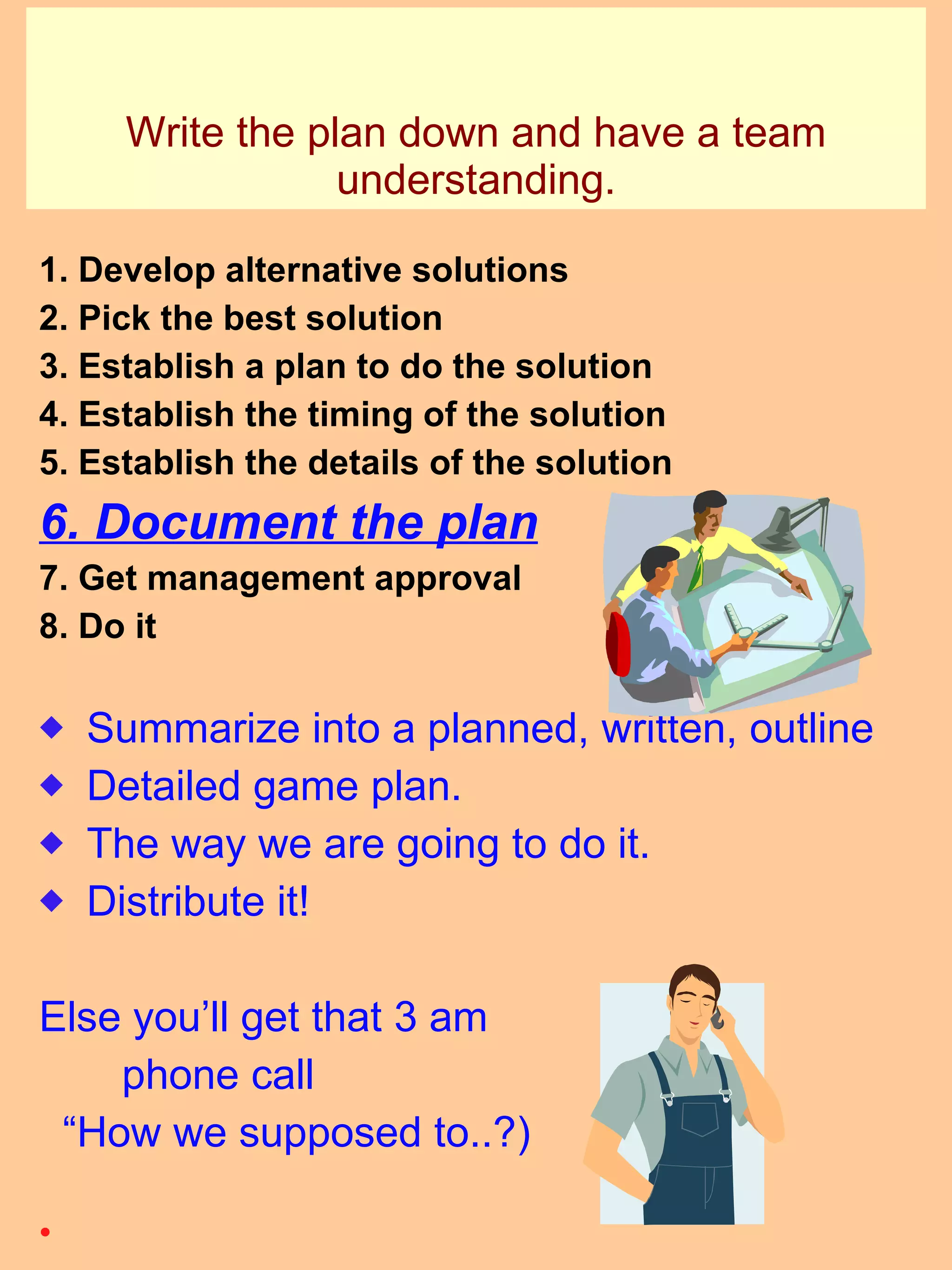
Write the plan down and have a team understanding. 1. Develop alternative solutions 2. Pick the best solution 3. Establish a plan to do the solution 4. Establish the timing of the solution 5. Establish the details of the solution 6. Document the plan 7. Get management approval 8. Do it Summarize into a planned, written, outline Detailed game plan. The way we are going to do it. Distribute it! Else you’ll get that 3 am  phone call “ How we supposed to..?)
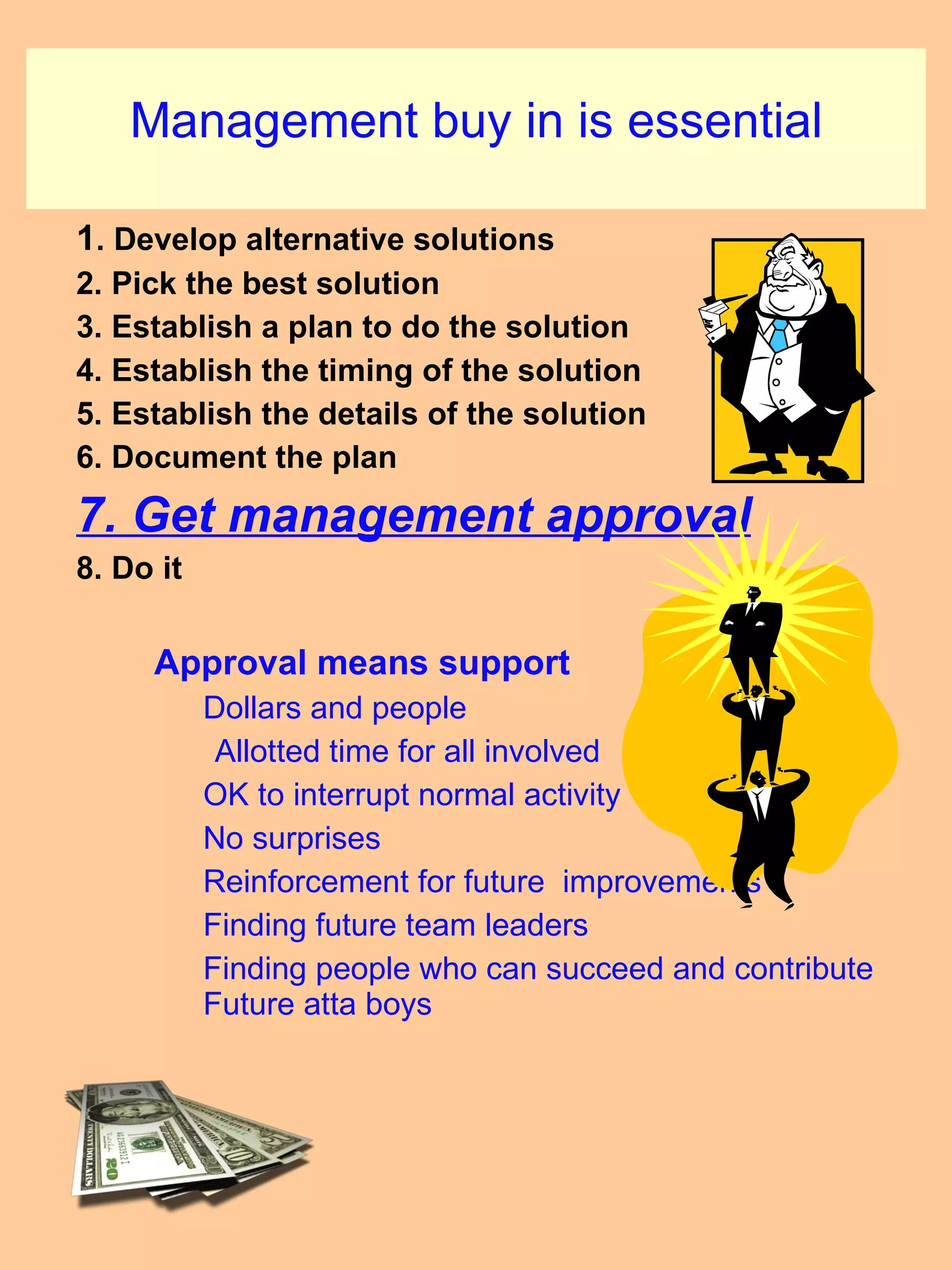
Management buy in is essential 1 . Develop alternative solutions 2. Pick the best solution 3. Establish a plan to do the solution 4. Establish the timing of the solution 5. Establish the details of the solution 6. Document the plan 7. Get management approval 8. Do it Approval means support Dollars and people   Allotted time for all involved OK to interrupt normal activity No surprises Reinforcement for future  improvements  Finding future team leaders Finding people who can succeed and contribute Future atta boys
Put the correction action into action 1. Develop alternative solutions 2. Pick the best solution 3. Establish a plan to do the solution 4. Establish the timing of the solution 5. Establish the details of the solution 6. Document the plan 7. Get management approval 8. Do it Caution: You will never do it according to the plan.  Something will always change or be different  ... absentees or breakdowns, or lost data or  not enough debugging  or not  enough trial run. You  will need to lead the action!
Remember Root Cause and  Corrective Action  is a five step process Step 1.  Understand the problem Step 2.  Put in short term fix Step 3.  Determine the Root Cause of  the problem Step 4.  Determine Corrective Action necessary With an embedded eight step corrective action process 1.Develop alternative solutions 2. Pick the best solution 3. Establish a plan to do the solution 4. Establish the timing of the solution 5. Establish the details of the solution 6. Document the plan 7. Get management approval 8. Do it  Step 5.  Verify that the Corrective Action has eliminated the Root Cause of the problem
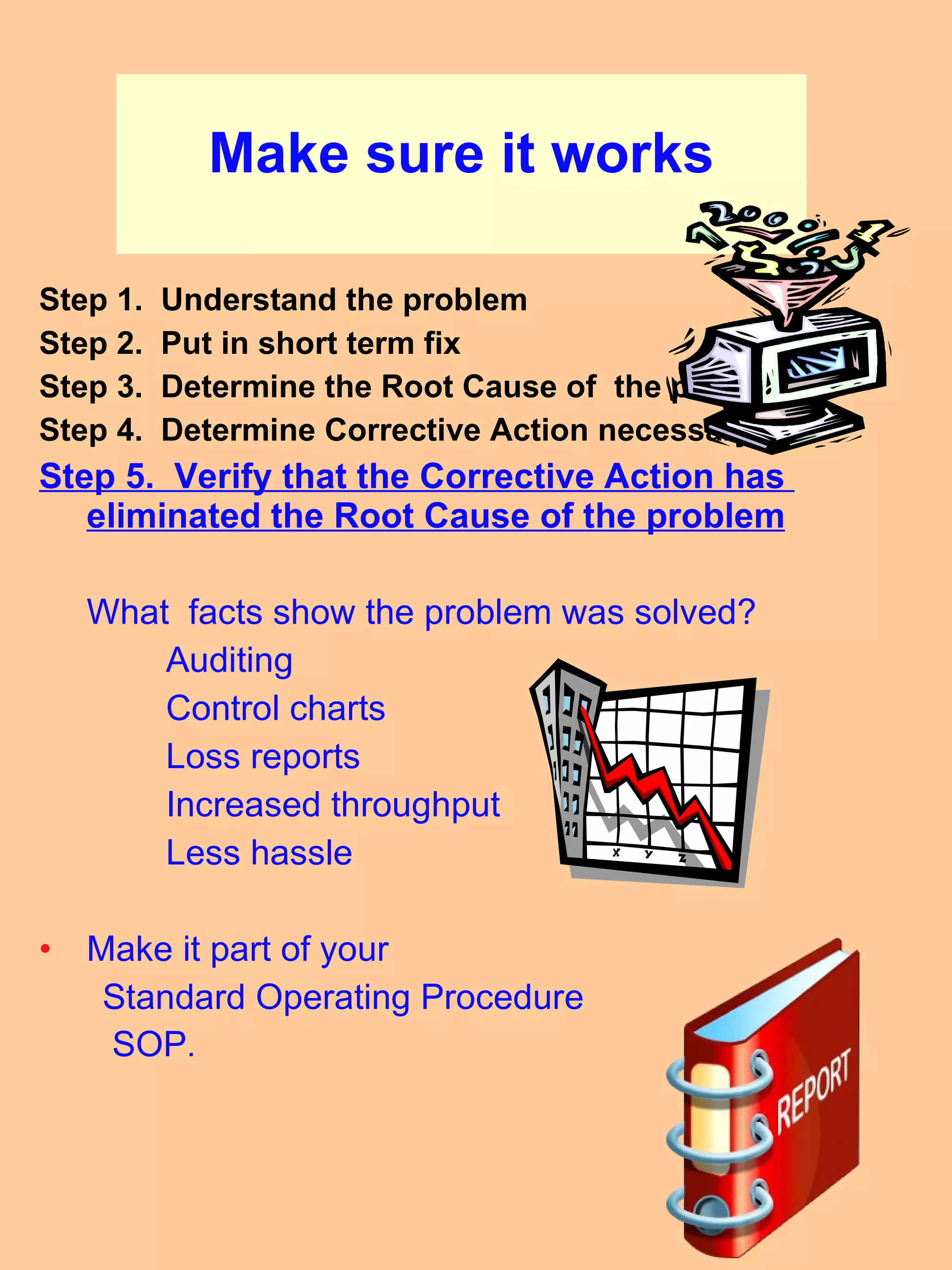
Make sure it works Step 1.  Understand the problem Step 2.  Put in short term fix Step 3.  Determine the Root Cause of  the problem Step 4.  Determine Corrective Action necessary Step 5.  Verify that the Corrective Action has  eliminated the Root Cause of the problem What  facts show the problem was solved? Auditing Control charts Loss reports Increased throughput Less hassle Make it part of your  Standard Operating Procedure  SOP .
Root Cause and  Corrective Action  is a five step process Step 1.  Understand the problem Step 2.  Put in short term fix Step 3.  Determine the Root Cause of  the problem Step 4.  Determine Corrective Action necessary Step 5.  Verify that the Corrective Action has    eliminated the Root Cause of the problem With an embedded eight step corrective action process 1.Develop alternative solutions 2. Pick the best solution 3. Establish a plan to do the solution 4. Establish the timing of the solution 5. Establish the details of the solution 6. Document the plan 7. Get management approval 8. Do it
Questions or comments

Root Cause And Corrective Action Workshop Cinci Asq 2009

  • 1.
    Root Cause andCorrective Action Workshop January 2009
  • 2.
    Root Cause and Corrective Action is a five step process Step 1. Understand the problem Step 2. Put in short term fix Step 3. Determine the Root Cause of the problem Step 4. Determine Corrective Action necessary Step 5. Verify that the Corrective Action has eliminated the Root Cause of the problem With an embedded eight step corrective action process 1.Develop alternative solutions 2. Pick the best solution 3. Establish a plan to do the solution 4. Establish the timing of the solution 5. Establish the details of the solution 6. Document the plan 7. Get management approval 8. Do it
  • 3.
    What CorrectiveAction means The point of corrective action is to is to eliminate the problem FOREVER. First put in an immediate fix Then a corrective action
  • 4.
  • 5.
  • 6.
    Corrective Action log1910 1910 /12 = 160 160 Corrective Action requests per month!
  • 7.
    Prerequisite: QualityManagement System [ISO 9000 (1994)] Management Responsibility Quality System Contract Review Design Control Document & Data Control Purchasing Control of Customer-Supplied Product Product Identification & Traceability Process Control Inspection & Testing Control of Inspection, M & TE Inspection & Test Status Control of Non-Conforming Product Corrective & Preventive Action Handling, Storage, Packaging Control of Quality Records Internal Quality Audits Training Servicing Statistical Techniques This is the way we do business to have Quality!
  • 8.
    1. Management ResponsibilityProcesses planned Responsibilities for Q clearly defined, Periodic reviews of quality and a quality policy. Knowingly shipped product not to spec to make numbers. Quality policy is for show. "Defect free, on time" is really "Some defects, mostly not more then a week late". Send the salesman out to take care of it.
  • 9.
  • 10.
    Juran’s (1960) Steering committee and action committee Steering committee selects the task for the action committee Action Committee Collects data and makes improvements Reports to management
  • 11.
    Classic Fivestep Root Cause and Corrective Action Process Step 1. Understand the problem Step 2. Put in short term fix Step 3. Determine the Root Cause of the problem Step 4. Determine Corrective Action necessary Step 5. Verify that the Corrective Action has eliminated the Root Cause of the problem.
  • 12.
    ITCHY RASH ON GRANDKIDS 1. 2. 3. 4. 5.
  • 13.
    Step 1. Understand the problem Step 2. Put in short term fix Step 3. Determine the Root Cause of the problem Step 4. Determine Corrective Action necessary Step 5. Verify that the Corrective Action has eliminated the Root Cause of the problem . Translate symptoms into an exact understanding Collect the data When Where How long has it happened Describe the problem with a problem statement Clear Concise Factual Technically correct Get help if the problem is not understood
  • 14.
    The short termfix is called an interim fix by some authors Take action to fix the problem now What immediate action must be taken? Major problem? Safety involved? Other processes, or “parts” involved? Other people involved? Into the ” REJECT CAGE”? Caution: Fixing the problem this does not remove the root cause! The “fix or “fixing the problem” is the emergency, temporary action. Step 1. Understand the problem Step 2. Put in short term fix Step 3. Determine the Root Cause of the problem Step 4. Determine Corrective Action necessary Step 5. Verify that the Corrective Action has eliminated the Root Cause of the problem .
  • 15.
    A Band-aid isa Fix This is not Corrective Action It is a temporary ” fix” Talked to the operator. Sorted out the bad stuff. Got the right print to the floor Re entered the right order number.
  • 16.
    … W henyou complete the blank on many quality forms Receiving inspection In Process inspection Final Inspection Customer complaints Audit reports This is really a short term fix to keep production going Unless the 5 step process was used. What RCCA is not “ Corrective Acton done _ _ _ _ _ _ _ _ _ _ _ _ _”
  • 17.
    Determining the rootcause is the most difficult task. It usually involves a team and the use of the basic Quality Tools Tool 1:: Brainstorming Tool 2: Pareto Diagram Tool 3: Histogram Tool 4: Cause and effect diagram Tool 5: Flow chart Tool 6: Check Sheet Tool 7: Charts & graphs Step 1. Understand the problem Step 2. Put in short term fix Step 3. Determine the Root Cause of the problem Step 4. Determine Corrective Action necessary Step 5. Verify that the Corrective Action has eliminated the Root Cause of the problem .
  • 18.
  • 19.
    The fix wasimmediate. It did not address the Root Cause Corrective action finds and eliminates the root cause The difference between the Fixing the problem and Corrective action is forever The point is to eliminate the problem FOREVER. Step 1. Understand the problem Step 2. Put in short term fix Step 3. Determine the Root Cause of the problem St ep 4. Determine Corrective Action necessary Step 5. Verify that the Corrective Action has eliminated the Root Cause of the problem .
  • 20.
    An eight itemchecklist is used to determine Corrective Action 1. Develop alternative solutions 2. Pick the best solution 3. Establish a plan to do the solution 4. Establish the timing of the solution 5. Establish the details of the solution 6. Document the plan 7. Get management approval 8. Do it ! .
  • 21.
    What are thesolutions? 1. Develop alternative solutions 2. Pick the best solution 3. Establish a plan to do the solution 4. Establish the timing of the solution 5. Establish the details of the solution 6. Document the plan 7. Get management approval 8. Do it “ There are many ways to skin a cat.” ( The saying came from collecting pelts!) Team brainstorm is the most commonly used tool to develop solutions
  • 22.
    Decide on thebest solution. 1. Develop alternative solutions 2. Pick the best solution 3. Establish a plan to do the solution 4. Establish the timing of the solution 5. Establish the details of the solution 6. Document the plan 7. Get management approval 8. Do it Consider .... Cost Effectiveness Negative side effects Ease of doing the correction
  • 23.
    Make a plan1. Develop alternative solutions 2. Pick the best solution 3. Establish a plan to do the solution 4. Establish the timing of the solution 5. Establish the details of the solution 6. Document the plan 7. Get management approval 8. Do it What needs to be done? Who will do it? When and how will it be done ? What is the measure of success? How about a pilot run to test the plan?
  • 24.
    Exactlywhen? 1. Develop alternative solutions 2. Pick the best solution 3. Establish a plan to do the solution 4. Establish the timing of the solution 5. Establish the details of the solution 6. Document the plan 7. Get management approval 8. Do it Time, date, shift? Can solution be ”worked into” the regular production? Exactly how will the solution, be scheduled along with regular activities ? When is the regular production scheduled to be run?
  • 25.
    Complete the detailsfor the plan 1. Develop alternative solutions 2. Pick the best solution 3. Establish a plan to do the solution 4. Establish the timing of the solution 5. Establish the details of the solution 6. Document the plan 7. Get management approval 8. Do it Special training ? Special testing or inspection ? Special equipment ? Who else needs to be involved ? Data collection and record forms? “ Baby sit” it all the way through. “ Debugging” attempt first?
  • 26.
    Write the plandown and have a team understanding. 1. Develop alternative solutions 2. Pick the best solution 3. Establish a plan to do the solution 4. Establish the timing of the solution 5. Establish the details of the solution 6. Document the plan 7. Get management approval 8. Do it Summarize into a planned, written, outline Detailed game plan. The way we are going to do it. Distribute it! Else you’ll get that 3 am phone call “ How we supposed to..?)
  • 27.
    Management buy inis essential 1 . Develop alternative solutions 2. Pick the best solution 3. Establish a plan to do the solution 4. Establish the timing of the solution 5. Establish the details of the solution 6. Document the plan 7. Get management approval 8. Do it Approval means support Dollars and people Allotted time for all involved OK to interrupt normal activity No surprises Reinforcement for future improvements Finding future team leaders Finding people who can succeed and contribute Future atta boys
  • 28.
    Put the correctionaction into action 1. Develop alternative solutions 2. Pick the best solution 3. Establish a plan to do the solution 4. Establish the timing of the solution 5. Establish the details of the solution 6. Document the plan 7. Get management approval 8. Do it Caution: You will never do it according to the plan. Something will always change or be different ... absentees or breakdowns, or lost data or not enough debugging or not enough trial run. You will need to lead the action!
  • 29.
    Remember Root Causeand Corrective Action is a five step process Step 1. Understand the problem Step 2. Put in short term fix Step 3. Determine the Root Cause of the problem Step 4. Determine Corrective Action necessary With an embedded eight step corrective action process 1.Develop alternative solutions 2. Pick the best solution 3. Establish a plan to do the solution 4. Establish the timing of the solution 5. Establish the details of the solution 6. Document the plan 7. Get management approval 8. Do it Step 5. Verify that the Corrective Action has eliminated the Root Cause of the problem
  • 30.
    Make sure itworks Step 1. Understand the problem Step 2. Put in short term fix Step 3. Determine the Root Cause of the problem Step 4. Determine Corrective Action necessary Step 5. Verify that the Corrective Action has eliminated the Root Cause of the problem What facts show the problem was solved? Auditing Control charts Loss reports Increased throughput Less hassle Make it part of your Standard Operating Procedure SOP .
  • 31.
    Root Cause and Corrective Action is a five step process Step 1. Understand the problem Step 2. Put in short term fix Step 3. Determine the Root Cause of the problem Step 4. Determine Corrective Action necessary Step 5. Verify that the Corrective Action has eliminated the Root Cause of the problem With an embedded eight step corrective action process 1.Develop alternative solutions 2. Pick the best solution 3. Establish a plan to do the solution 4. Establish the timing of the solution 5. Establish the details of the solution 6. Document the plan 7. Get management approval 8. Do it
  • 32.