ROMANS
Chapter Two
The Jews Under Condemnation
with the Gentile
Bill Fritz
Adult Education
Fellowship Bible Church
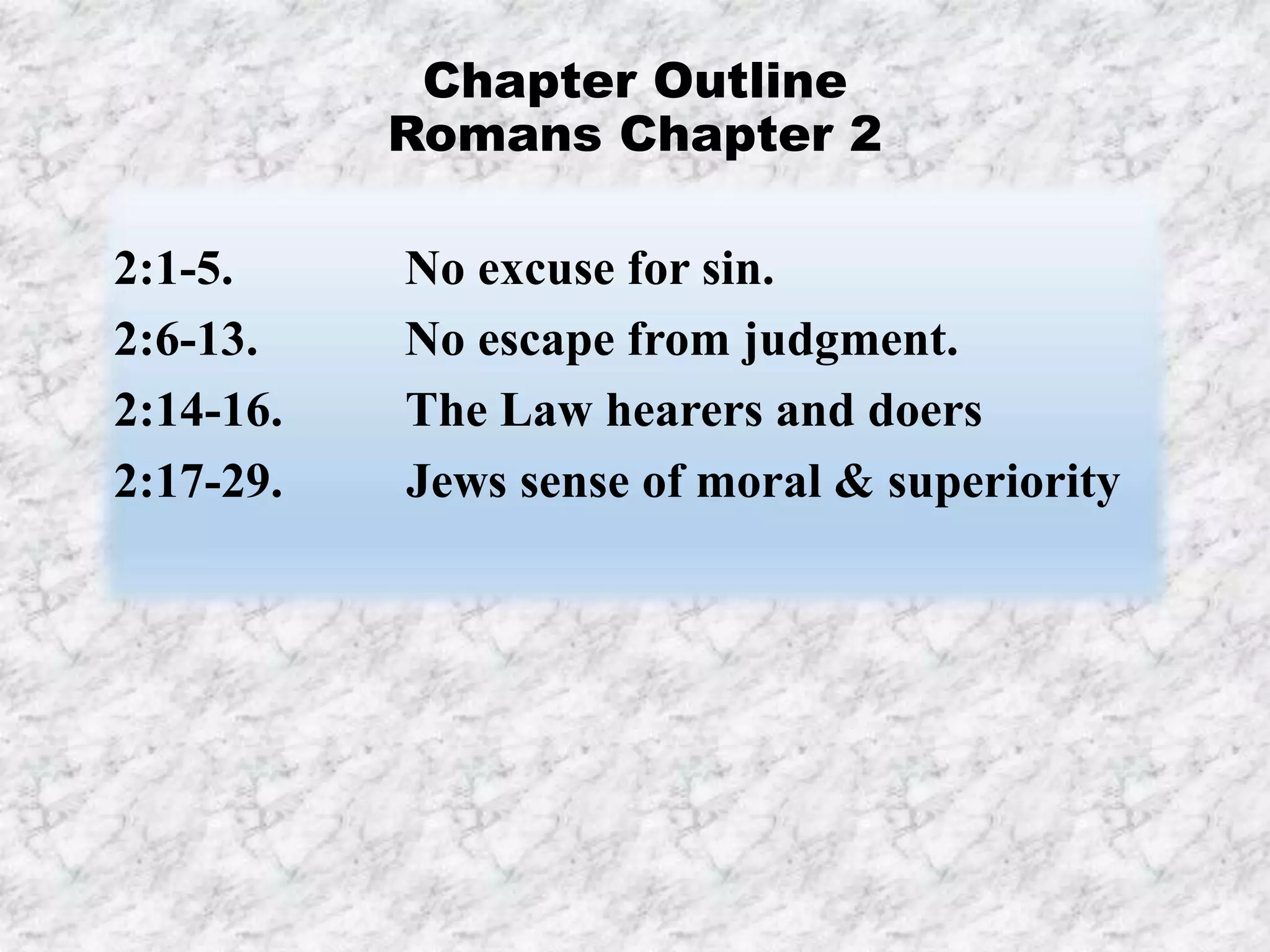
Chapter Outline
Romans Chapter 2
2:1-5. No excuse for sin.
2:6-13. No escape from judgment.
2:14-16. The Law hearers and doers
2:17-29. Jews sense of moral & superiority
Paul Admonishes the Crowd
Roman 2:1-4
Scripture Reading
Verses 1-12
Discussion Questions
Romans 2:1-5
(1) Who was Paul talking to and how does this apply to
modern day society?
“The majority of scholars, however, see the Jew as
the subject throughout chapter 2.” (HCSB)
Moral corruption know no time period restraints.
The same immorality which existed then exists today
even among the Christian community.
Judgement of others is a defense mechanism; by
focusing the attention on someone else's
shortcomings takes the light off our own.
The Jews thought because they were God’s chosen
covenant people they were better than the non-
circumcised.
Jamieson writes: “From those without, the apostle now
turns to those within the pale of revealed religion, the
self-righteous Jews, who looked down upon the
uncovenanted heathen as beyond the pale of God's
mercies, within which they deemed themselves secure,
however inconsistent their life may be.” [Jamieson, Fausette, and
Brown]
Ref V3: What was the Jewish attitude towards the
Christian proselytes?
Picturing sin as water, held back by a dam. What happens
when the dam breaks?
Paul is referring to the great day of wrath. Read Johns
Revelation 6:12 – 17.
You might be frustrated because you see unpunished
sin. However the day of judgment is coming and God
wrath will be poured out.
Judging others while you attempt to hide your own sin
is self-deceit. God, who sees all records the sins of the
unrepentant.
Paul wrote the following to the church of Emphasis:
For God will bring every work into judgment,
Including every secret thing, Whether good or
evil. [Ecc 12:14 NKJV]
Discussion Questions
How are the Christians to be judged?
His judgments are true and just. Rev 19:2
Who will judge us?
Jesus
What criteria do you think
He will use?
1. Cor 3:11-13
2. Cor 5:10
3. Rev 22:12
Are you ready to stand before the
Bema?
DISCUSSION QUESTIONS
Christians are judged according to their
good and bad works; does this mean the
bad works can cancel out the good
works?
This is the judgment of the saved. We are
not talking about losing salvation, but
rather receiving rewards earned and lost
by our works.
How can a saved person sin when the
Holy Spirit resides within?
Not listening to the Holy Spirit, when he
speaks to our spirit to do this or that.
What should our attitude be towards good works.
It is good to seek to do good works with the
anticipation of receiving honor and recognition
from our Lord (ref to Bema judgment).
To seek to do good works to be honored by men for
those good works, destroys the good works. Good
works should be a natural act of listening and
following the direction of the Holy Spirit, who
dwells within the sanctified.
“The most likely one is that works are the outcome
of a person's faith.” HCSB
How do we know what Jesus is looking for in our
works?
Read Matthew 25:31-46 and discuss
Who is Jesus talking to in verses 6-10?
Jesus is talking to the unrighteous (ref to 1:32 &
2:2).
Why the continued reference to “first the Jew”?
The Jew had the Law and knew what was
unrighteous and have no excuse.
DISCUSSION QUESTIONS
Is the law recorded and if so where?
The first five books of the Bible called the Torah.
Are the laws just the Ten Commandments?
No the laws are the culmination of the Ten
Commandments and all other ordinances written in the
Torah.
What was the purpose of the Law, and why was it given
to the Jews?
The law sets boundries.
The law establishes what sin is.
The law is instructions on worship.
Will the Gentiles be judged by the law?
If not by the law, then how will the Gentiles be
judged?
Read Ecclesiastes 12:9-14 and 1 Corinthians 4:1-5
JAMIESON, FAUCETTE AND BROWN
“As touching the Jews, in whose ears the
written law is continually resounding, the
condemnation of as many of them as are
found sinners at the last involves no
difficulty; but even as respects the
heathen, who are strangers to the law in
its positive and written form--since they
show how deeply it is engraven on their
moral nature, which witnesses within
them for righteousness and against
iniquity, accusing or condemning them
according as they violate or obey its stern
dictates--their condemnation also for all
the sin in which they live and die will
carry its dreadful echo in their own
breasts.”
SCRIPTURE READING
Romans 2:17-24
DISCUSSION QUESTIONS
Paul gives an admonishment to
whom?
To the Jewish hypocrites. Enforcing
the fact they know the Law, and in
knowing the law have no excuse for
sinning.
How were the Jews hypocritical?
They would teach those who were
not as well versed in the Law as
they were, and yet were guilty of
violating that which they taught.
This shotgun approach was not
meant for all Jews just the
unrighteousness who by their
actions caused others to sin.
Paul
“2:24 Paul cited Isa 52:5 from the Greek OT (the
Septuagint, or LXX) as support that Jewish sin
resulted in God's name being dishonored among
the pagan nations when the Jews were defeated
and exiled. To pagan perception, Yahweh seemed
powerless since He did not protect His people.”
(HCSB)
Paul knew their hearts because his heart was
like theirs before his conversion, full of wicked
thoughts. HSCB
Matthew Henry’s Commentary
“The ruin of sinners is their walking after a hard and
impenitent heart. Their sinful doings are expressed by
the strong words, "treasuring up wrath." In the
description of the just man, notice the full demand of the
law. It demands that the motives shall be pure, and
rejects all actions from earthly ambition or ends. In the
description of the unrighteous, contention is held forth as
the principle of all evil. The human will is in a state of
enmity against God. Even Gentiles, who had not the
written law, had that within, which directed them what to
do by the light of nature. Conscience is a witness, and
first or last will bear witness. As they nature. Conscience
is a witness, and first or last will bear witness. As they
kept or broke these natural laws and dictates, their
consciences either acquitted or condemned them.
Nothing speaks more terror to sinners, and more comfort
to saints, than that Christ shall be the Judge. Secret
services shall be rewarded, secret sins shall be then
punished, and brought to light.” [Henry, Matthew (2012). Matthew Henry's
Concise Commentary. WORDsearch. Retrieved from https://app.wordsearchbible.com.]
Matthew Henry
a nonconformist minister
and author, born in Wales
Read Romans 2:25-28
DISCUSSION QUESTIONS
The Jewish converts were convinced that the Gentiles
must first become Jews (be circumcised) before they
could be saved.
How can a man who has been circumcised become
uncircumcised?
As circumcision was a sign of the Abrahamic covenant
by not adhering to the law they were breaking the
covenant, and therefore the sign of the covenant had no
significance.
What type of circumcision was Paul speaking of?
He was talking about compliance with the law and
thereby by their actions were circumcised in spirit and
covered by the Abrahamic covenant.
Spirit circumcision is like circumcision of the flesh in
that sin is cut away and cast into the fire(Deu 10:16;
30:6; Jer 4:4.

Romans 2

  • 1.
    ROMANS Chapter Two The JewsUnder Condemnation with the Gentile Bill Fritz Adult Education Fellowship Bible Church
  • 2.
    Chapter Outline Romans Chapter2 2:1-5. No excuse for sin. 2:6-13. No escape from judgment. 2:14-16. The Law hearers and doers 2:17-29. Jews sense of moral & superiority
  • 3.
    Paul Admonishes theCrowd Roman 2:1-4 Scripture Reading Verses 1-12
  • 4.
    Discussion Questions Romans 2:1-5 (1)Who was Paul talking to and how does this apply to modern day society? “The majority of scholars, however, see the Jew as the subject throughout chapter 2.” (HCSB) Moral corruption know no time period restraints. The same immorality which existed then exists today even among the Christian community. Judgement of others is a defense mechanism; by focusing the attention on someone else's shortcomings takes the light off our own.
  • 5.
    The Jews thoughtbecause they were God’s chosen covenant people they were better than the non- circumcised. Jamieson writes: “From those without, the apostle now turns to those within the pale of revealed religion, the self-righteous Jews, who looked down upon the uncovenanted heathen as beyond the pale of God's mercies, within which they deemed themselves secure, however inconsistent their life may be.” [Jamieson, Fausette, and Brown] Ref V3: What was the Jewish attitude towards the Christian proselytes?
  • 6.
    Picturing sin aswater, held back by a dam. What happens when the dam breaks? Paul is referring to the great day of wrath. Read Johns Revelation 6:12 – 17. You might be frustrated because you see unpunished sin. However the day of judgment is coming and God wrath will be poured out. Judging others while you attempt to hide your own sin is self-deceit. God, who sees all records the sins of the unrepentant. Paul wrote the following to the church of Emphasis: For God will bring every work into judgment, Including every secret thing, Whether good or evil. [Ecc 12:14 NKJV]
  • 7.
    Discussion Questions How arethe Christians to be judged? His judgments are true and just. Rev 19:2 Who will judge us? Jesus What criteria do you think He will use? 1. Cor 3:11-13 2. Cor 5:10 3. Rev 22:12 Are you ready to stand before the Bema?
  • 8.
    DISCUSSION QUESTIONS Christians arejudged according to their good and bad works; does this mean the bad works can cancel out the good works? This is the judgment of the saved. We are not talking about losing salvation, but rather receiving rewards earned and lost by our works. How can a saved person sin when the Holy Spirit resides within? Not listening to the Holy Spirit, when he speaks to our spirit to do this or that.
  • 9.
    What should ourattitude be towards good works. It is good to seek to do good works with the anticipation of receiving honor and recognition from our Lord (ref to Bema judgment). To seek to do good works to be honored by men for those good works, destroys the good works. Good works should be a natural act of listening and following the direction of the Holy Spirit, who dwells within the sanctified. “The most likely one is that works are the outcome of a person's faith.” HCSB How do we know what Jesus is looking for in our works? Read Matthew 25:31-46 and discuss Who is Jesus talking to in verses 6-10? Jesus is talking to the unrighteous (ref to 1:32 & 2:2). Why the continued reference to “first the Jew”? The Jew had the Law and knew what was unrighteous and have no excuse.
  • 10.
    DISCUSSION QUESTIONS Is thelaw recorded and if so where? The first five books of the Bible called the Torah. Are the laws just the Ten Commandments? No the laws are the culmination of the Ten Commandments and all other ordinances written in the Torah. What was the purpose of the Law, and why was it given to the Jews? The law sets boundries. The law establishes what sin is. The law is instructions on worship. Will the Gentiles be judged by the law? If not by the law, then how will the Gentiles be judged? Read Ecclesiastes 12:9-14 and 1 Corinthians 4:1-5
  • 11.
    JAMIESON, FAUCETTE ANDBROWN “As touching the Jews, in whose ears the written law is continually resounding, the condemnation of as many of them as are found sinners at the last involves no difficulty; but even as respects the heathen, who are strangers to the law in its positive and written form--since they show how deeply it is engraven on their moral nature, which witnesses within them for righteousness and against iniquity, accusing or condemning them according as they violate or obey its stern dictates--their condemnation also for all the sin in which they live and die will carry its dreadful echo in their own breasts.”
  • 12.
    SCRIPTURE READING Romans 2:17-24 DISCUSSIONQUESTIONS Paul gives an admonishment to whom? To the Jewish hypocrites. Enforcing the fact they know the Law, and in knowing the law have no excuse for sinning. How were the Jews hypocritical? They would teach those who were not as well versed in the Law as they were, and yet were guilty of violating that which they taught. This shotgun approach was not meant for all Jews just the unrighteousness who by their actions caused others to sin. Paul
  • 13.
    “2:24 Paul citedIsa 52:5 from the Greek OT (the Septuagint, or LXX) as support that Jewish sin resulted in God's name being dishonored among the pagan nations when the Jews were defeated and exiled. To pagan perception, Yahweh seemed powerless since He did not protect His people.” (HCSB) Paul knew their hearts because his heart was like theirs before his conversion, full of wicked thoughts. HSCB
  • 14.
    Matthew Henry’s Commentary “Theruin of sinners is their walking after a hard and impenitent heart. Their sinful doings are expressed by the strong words, "treasuring up wrath." In the description of the just man, notice the full demand of the law. It demands that the motives shall be pure, and rejects all actions from earthly ambition or ends. In the description of the unrighteous, contention is held forth as the principle of all evil. The human will is in a state of enmity against God. Even Gentiles, who had not the written law, had that within, which directed them what to do by the light of nature. Conscience is a witness, and first or last will bear witness. As they nature. Conscience is a witness, and first or last will bear witness. As they kept or broke these natural laws and dictates, their consciences either acquitted or condemned them. Nothing speaks more terror to sinners, and more comfort to saints, than that Christ shall be the Judge. Secret services shall be rewarded, secret sins shall be then punished, and brought to light.” [Henry, Matthew (2012). Matthew Henry's Concise Commentary. WORDsearch. Retrieved from https://app.wordsearchbible.com.] Matthew Henry a nonconformist minister and author, born in Wales
  • 15.
    Read Romans 2:25-28 DISCUSSIONQUESTIONS The Jewish converts were convinced that the Gentiles must first become Jews (be circumcised) before they could be saved. How can a man who has been circumcised become uncircumcised? As circumcision was a sign of the Abrahamic covenant by not adhering to the law they were breaking the covenant, and therefore the sign of the covenant had no significance. What type of circumcision was Paul speaking of? He was talking about compliance with the law and thereby by their actions were circumcised in spirit and covered by the Abrahamic covenant. Spirit circumcision is like circumcision of the flesh in that sin is cut away and cast into the fire(Deu 10:16; 30:6; Jer 4:4.

Editor's Notes

  • #5 [Rom 2:1 NKJV] 1 Therefore you are inexcusable, O man, whoever you are who judge, for in whatever you judge another you condemn yourself; for you who judge practice the same things. 2:1 Some interpreters think Paul is speaking about Gentile moralists in verses 1-16, and then Jews beginning at verse 17. The majority of scholars, however, see the Jew as the subject throughout
  • #6  [Rom 2:3-4 NKJV] 3 And do you think this, O man, you who judge those practicing such things, and doing the same, that you will escape the judgment of God? 4 Or do you despise the riches of His goodness, forbearance, and longsuffering, not knowing that the goodness of God leads you to repentance? HSCB -2. Judgment and condemnation follow sin as night follows day. Not all people commit the same sins, but all show by their judging and criticism that they do not live up to the moral law they know. No one is without excuse. SOMETIMES WE SEE THIS SAME ATTITUDE IN THE FACES AND ACTIONS OF CHRISTIANS TODAY. BECAUSE OF JESUS WE ARE NOT BETTER JUST SAVED.
  • #7 Christians judged for their secret things, whether good deeds done in secret or secret motives for doing good deeds. [Rom 2:2-5 NKJV] 2 But we know that the judgment of God is according to truth against those who practice such things. 3 And do you think this, O man, you who judge those practicing such things, and doing the same, that you will escape the judgment of God? 4 Or do you despise the riches of His goodness, forbearance, and longsuffering, not knowing that the goodness of God leads you to repentance? 5 But in accordance with your hardness and your impenitent heart you are treasuring up for yourself wrath in the day of wrath and revelation of the righteous judgment of God, 5. treasurest up unto thyself wrath against--rather "in." the day of wrath--that is wrath to come on thee in the day of wrath. What an awful idea is here expressed--that the sinner himself is amassing, like hoarded treasure, an ever accumulating stock of divine wrath, to burst upon him in "the day of the revelation of the righteous judgment of God!" And this is said not of the reckless, but of those who boasted of their purity of faith and life. 2:5 Like water pooling up behind a dam, people accumulate a debt of wrath as they continue to reject God's grace. One day the dam will break, and the flood of divine wrath will sweep up individuals and entire societies. [Blum, Edwin, The HCSB Translation Team, Howard, Jeremy Royal & Holman Bible Staff (2010). HCSB Study Bible. B&H Publishing Group. Retrieved from https://app.wordsearchbible.com.]
  • #9 [Rom 2:6-10 NKJV] 6 who "will render to each one according to his deeds": 2:6-10 Cranfield ( Romans, I:151) outlines 10 different interpretations of this controversial passage. The most likely one is that works are the outcome of a person's faith. Christians are declared righteous by faith. At the moment of that declaration, the person is joined to Christ and regenerated by the Holy Spirit, becoming a new creation (2Co 5:17) created for good works (Eph 2:10). As Paul wrote, "What matters is faith working through love" (Gal 5:6). Thus the person of faith who seeks glory, honor, and immortality and continues to do good demonstrates that he is truly regenerate and thus is assured of eternal life. To the person who obeys unrighteousness and disobeys truth, however, wrath is his destiny. HCSB by patient continuance in well-doing, &c.--Compare Luke 8:15 : "That on the good ground are they, which in an honest and good heart, having heard the word, keep it, and bring forth fruit with patience"; denoting the enduring and progressive character of the new life. Both righteousness and evil begin in the heart. The good acts of a Christian will be judged according to their motives. Where the motive is to honor and glorify God, the good acts will be rewarded. Good acts of the Christian will be weighed in the balance by Jesus. Jesus, who knows our hearts judges righteously according to our heart. Paul writes in 1Ch 28:9 NKJV: "As for you, my son Solomon, know the God of your father, and serve Him with a loyal heart and with a willing mind; for the LORD searches all hearts and understands all the intent of the thoughts. If you seek Him, He will be found by you; but if you forsake Him, He will cast you off forever.” However having said all this the judgment talked about in verse 5 is the judgement of the unrepentant sinner.
  • #10 [Mat 12:50 NKJV] 50 "For whoever does the will of My Father in heaven is My brother and sister and mother.“ [Rom 2:2 NKJV] 2 But we know that the judgment of God is according to truth against those who practice such things. Rom 2: 7 eternal life to those who by patient continuance in doing good seek for glory, honor, and immortality; 8 but to those who are self-seeking and do not obey the truth, but obey unrighteousness--indignation and wrath, 9 tribulation and anguish, on every soul of man who does evil, of the Jew first and also of the Greek; 10 but glory, honor, and peace to everyone who works what is good, to the Jew first and also to the Greek. 8. But unto them that are contentious, and do not obey the truth, &c.--referring to such keen and determined resistance to the Gospel as he himself had too painfully witnessed on the part of his own countrymen. (See Acts 13:44-46 , Acts 17:5 Acts 17:13 , Acts 18:6 Acts 18:12 ; and compare 1 Thessalonians 2:15 1 Thessalonians 2:16 ).  indignation and wrath--in the bosom of a sin-avenging God. 9. Tribulation and anguish--the effect of these in the sinner himself. 10. to the Jew first--first in perdition if unfaithful; but if obedient to the truth, first in salvation ( Romans 2:10 ). 12. For as many as have sinned--not "as many as have sinned at all," but, "as many as are found in sin" at the judgment of the great day (as the whole context shows).  without law--that is, without the advantage of a positive Revelation.  shall also perish without law--exempt from the charge of rejecting or disregarding it.  and as many as have sinned in the law--within the pale of a positive, written Revelation.  shall be judged by the law--tried and condemned by the higher standard of that written Revelation.
  • #11  [Rom 2:12-16 NKJV] 12 For as many as have sinned without law will also perish without law, and as many as have sinned in the law will be judged by the law 13 (for not the hearers of the law [are] just in the sight of God, but the doers of the law will be justified; 14 for when Gentiles, who do not have the law, by nature do the things in the law, these, although not having the law, are a law to themselves, 15 who show the work of the law written in their hearts, their conscience also bearing witness, and between themselves [their] thoughts accusing or else excusing [them]) 16 in the day when God will judge the secrets of men by Jesus Christ, according to my gospel. 12. For as many as have sinned--not "as many as have sinned at all," but, "as many as are found in sin" at the judgment of the great day (as the whole context shows).  without law--that is, without the advantage of a positive Revelation.  shall also perish without law--exempt from the charge of rejecting or disregarding it.  and as many as have sinned in the law--within the pale of a positive, written Revelation.  shall be judged by the law--tried and condemned by the higher standard of that written Revelation. 13-15. For not the hearers, &c.--As touching the Jews, in whose ears the written law is continually resounding, the condemnation of as many of them as are found sinners at the last involves no difficulty; but even as respects the heathen, who are strangers to the law in its positive and written form--since they show how deeply it is engraven on their moral nature, which witnesses within them for righteousness and against iniquity, accusing or condemning them according as they violate or obey its stern dictates--their condemnation also for all the sin in which they live and die will carry its dreadful echo in their own breasts. 15. their thoughts the meanwhile accusing or else excusing--that is, perhaps by turns doing both. 16. In the day, &c.--Here the unfinished statement of Romans 2:12 is resumed and closed.  shall judge the secrets of men--here specially referring to the unfathomed depths of hypocrisy in the self-righteous whom the apostle had to deal with. (See Ecclesiastes 12:14 , 1 Corinthians 4:5 ).  according to my gospel--to my teaching as a preacher of the Gospel.
  • #13 [Rom 2:17-20 NKJV] 17 Indeed you are called a Jew, and rest on the law, and make your boast in God, 18 and know [His] will, and approve the things that are excellent, being instructed out of the law, 19 and are confident that you yourself are a guide to the blind, a light to those who are in darkness, 20 an instructor of the foolish, a teacher of babes, having the form of knowledge and truth in the law. 2:17-20 Jew was the name given to people who returned to Judea from exile, but later it was extended to cover all Hebrew people (Israelites) wherever they lived. Paul listed eight grounds on which Jews rested their sense of moral superiority over the Gentiles; three times he cited the law as a grounds. The Jews believed that God had granted them special privileges and given them a mission to bring light to the Gentiles (Isa 42:6-7). True enough. And yet Jesus taught, "Much will be required of everyone who has been given much. And even more will be expected of the one who has been entrusted with more" (Lk 12:48). Furthermore, Jesus warned the religious leaders, "On the outside you seem righteous to people, but inside you are full of hypocrisy and lawlessness" (Mt 23:28). Mere possession of the law does not win divine favor. 2:21-23 Following Jesus' example, Paul exposed Jewish hypocrisy. He did so with a series of five rhetorical questions that indicted his people for lacking essential righteousness. Paul did not mean that every Jew committed all these sins but that all transgress the law and lack the righteousness to enter God's presence. Jesus taught that even the thought of adultery violates the law (Mt 5:27-28). Paul knew from his own experience that his heart was full of covetousness (Rm 7:7-10) and therefore unrighteous. There are examples of all five literal violations from contemporary accounts, including a famous case in Rome of sacrilege. The history of the Jewish nation was full of unrighteous acts. Stephen asked, "Which of the prophets did your fathers not persecute?" (Ac 7:52). The religious leaders of the nation were instrumental in putting Jesus to death, Stephen was stoned by the Sanhedrin, and James the Just (half-brother of Jesus) was killed in the temple area. 2:24 Paul cited Isa 52:5 from the Greek OT (the Septuagint, or LXX) as support that Jewish sin resulted in God's name being dishonored among the pagan nations when the Jews were defeated and exiled. To pagan perception, Yahweh seemed powerless since He did not protect His people. [Blum, Edwin, The HCSB Translation Team, Howard, Jeremy Royal & Holman Bible Staff (2010). HCSB Study Bible. B&H Publishing Group. Retrieved from https://app.wordsearchbible.com.] 17-24. Behold--"But if" is, beyond doubt, the true reading here. (It differs but in a single letter from the received reading, and the sense is the same). 18. approvest the things that are excellent--"triest the things that differ" (Margin). Both senses are good, and indeed the former is but the result of the latter action. 20. hast the form of knowledge and of the truth in the law--not being left, as the heathen are, to vague conjecture on divine things, but favored with definite and precise information from heaven. 22. thou that abhorrest idols--as the Jews did ever after their captivity, though bent on them before.  dost thou commit sacrilege?--not, as some excellent interpreters, "dost thou rob idol temples?" but more generally, as we take it, "dost thou profane holy things?" (as in Matthew 21:12 Matthew 21:13 , and in other ways). 24. as it is written--(See Isaiah 52:5 , Marginal reference).
  • #14 Isaiah 52:5 So now what have I here"-- this is the LORD's declaration--" that My people are taken away for nothing? Its rulers wail"-- this is the LORD's declaration--" and My name is continually blasphemed all day long.
  • #16 [Deu 10:16 NKJV] 16 "Therefore circumcise the foreskin of your heart, and be stiff-necked no longer. [Deu 30:6 NKJV] 6 "And the LORD your God will circumcise your heart and the heart of your descendants, to love the LORD your God with all your heart and with all your soul, that you may live. [Jer 4:4 NKJV] 4 Circumcise yourselves to the LORD, And take away the foreskins of your hearts, You men of Judah and inhabitants of Jerusalem, Lest My fury come forth like fire, And burn so that no one can quench [it], Because of the evil of your doings." 25-29. For circumcision--that is, One's being within the covenant of which circumcision was the outward sign and seal. verily profiteth, if thou keep the law--if the inward reality correspond to the outward sign. but if, &c.--that is, "Otherwise, thou art no better than the uncircumcised heathen." 26. Therefore if the uncircumcision keep the . . . law, &c.--Two mistaken interpretations, we think, are given of these words: First, that the case here supposed is an impossible one, and put merely for illustration [HALDANE, CHALMERS, HODGE]; second that it is the case of the heathen who may and do please God when they act, as has been and is done, up to the light of nature [GROTIUS, OLSHAUSEN, &c.]. The first interpretation is, in our judgment, unnatural; the second, opposed to the apostle's own teaching. But the case here put is, we think, such as that of Cornelius ( Acts 10:1-48 ), who, though outside the external pale of God's covenant, yet having come to the knowledge of the truths contained in it, do manifest the grace of the covenant without the seal of it, and exemplify the character and walk of Abraham's children, though not called by the name of Abraham. Thus, this is but another way of announcing that God was about to show the insufficiency of the mere badge of the Abrahamic covenant, by calling from among the Gentiles a seed of Abraham that had never received the seal of circumcision and this interpretation is confirmed by all that follows. 28. he is not a Jew which is one outwardly, &c.--In other words, the name of "Jew" and the rite of "circumcision" were designed but as outward symbols of a separation from the irreligious and ungodly world unto holy devotedness in heart and life to the God of salvation. Where this is realized, the signs are full of significance; but where it is not, they are worse than useless. Note, (1) It is a sad mark of depravity when all that is designed and fitted to melt only hardens the heart ( Romans 2:4 , and compare 2 Peter 3:9 , Ecclesiastes 8:11 ). (2) Amidst all the inequalities of religious opportunity measured out to men, and the mysterious bearing of this upon their character and destiny for eternity, the same great principles of judgment, in a form suited to their respective discipline, will be applied to all, and perfect equity will be seen to reign throughout every stage of the divine administration ( Romans 2:11-16 ). (3) "The law written on the heart" ( Romans 2:14 Romans 2:15 )--or the Ethics of Natural Theology--may be said to be the one deep foundation on which all revealed religion reposes; and where we have what we may call its other foundation--the Physics and Metaphysics of Natural Theology. The testimony of these two passages is to the theologian invaluable, while in the breast of every teachable Christian it wakens such deep echoes as are inexpressibly solemn and precious. (4) High religious professions are a fearful aggravation of the inconsistencies of such as make them ( Romans 2:17-24 ). See 2 Samuel 12:14 . (5) As no external privileges, or badge of discipleship, will shield the unholy from the wrath of God, so neither will the want of them shut out from the kingdom of heaven such as have experienced without them that change of heart which the seals of God's covenant were designed to mark. In the sight of the great Searcher of hearts, the Judge of quick and dead, the renovation of the character in heart and life is all in all. In view of this, have not all baptized, sacramented disciples of the Lord Jesus, who "profess that they know God, but in works deny Him," need to tremble--who, under the guise of friends, are "the enemies of the cross of Christ?"