Role of Statistics 
in 
Scientific Research 
A Special Topic Discussion By; 
Waruna Kodituwakku & Harsha Perera
"Statistics is the grammar of science.” 
Karl Pearson 
"If your experiment needs statistics, you 
ought to have done a better experiment....“ 
Ernest Rutherford
Questions 
What is statistics? 
Why Study Statistics? 
What is the importance of statistics in scientific 
research? 
What is the role of statistics in research? 
Describe the importance of statistics in different 
fields of study
Questions Contd. 
What are the statistical terms used in research 
studies? 
What are the misuses of statistics in a 
research? 
How effectively present stat findings using 
tools such as tables, graphs etc.
What is Statistics?
“Statistics is the science of learning from data, and of 
measuring, controlling, and communicating uncertainty; 
and it thereby provides the navigation essential for 
controlling the course of scientific and societal advances” 
(Davidian and Louis, 2012) 
“Statistics is the study of the collection, analysis, 
interpretation, presentation and organization of data”. 
(Dodge, Y. (2006) The Oxford Dictionary of Statistical 
Terms)
Statistical methods can be used to summarize or describe a 
collection of data; this is called descriptive statistics. 
In addition, patterns in the data may be modeled in a way 
that accounts for randomness and uncertainty in the 
observations, and are then used to draw inferences about the 
process or population being studied; this is called inferential 
statistics.
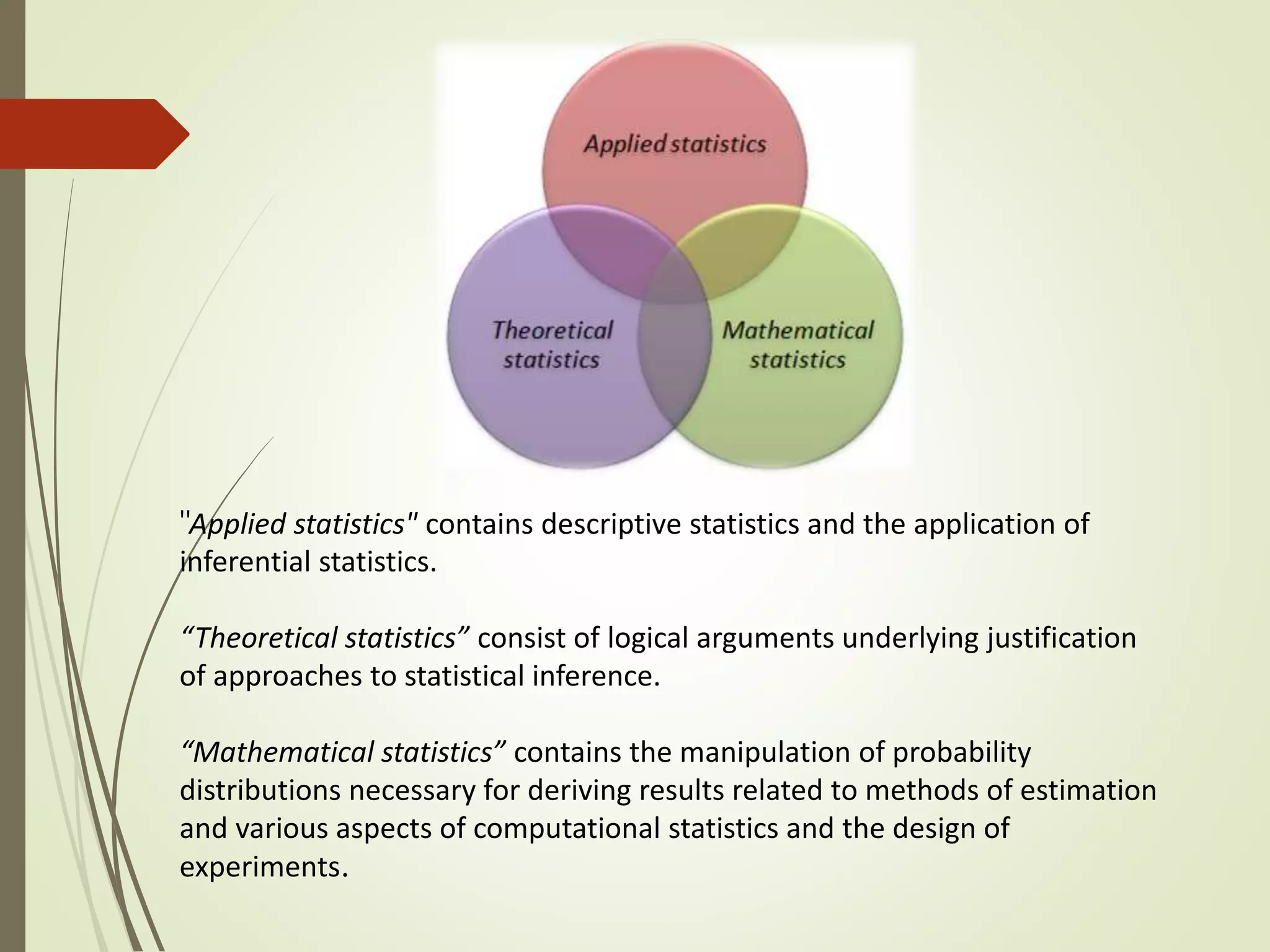
"Applied statistics" contains descriptive statistics and the application of 
inferential statistics. 
“Theoretical statistics” consist of logical arguments underlying justification 
of approaches to statistical inference. 
“Mathematical statistics” contains the manipulation of probability 
distributions necessary for deriving results related to methods of estimation 
and various aspects of computational statistics and the design of 
experiments.
Why Study Statistics?
• Knowledge in statistics provides you with the 
necessary tools and conceptual foundations in 
quantitative reasoning to extract information 
intelligently from this sea of data. 
• Statistical methods and analyses are often used to 
communicate research findings and to support 
hypotheses and give credibility to research 
methodology and conclusions. 
• It is important for researchers and also consumers of 
research to understand statistics so that they can be 
informed, evaluate the credibility and usefulness of 
information, and make appropriate decisions.
What is the importance 
of statistics in 
scientific research?
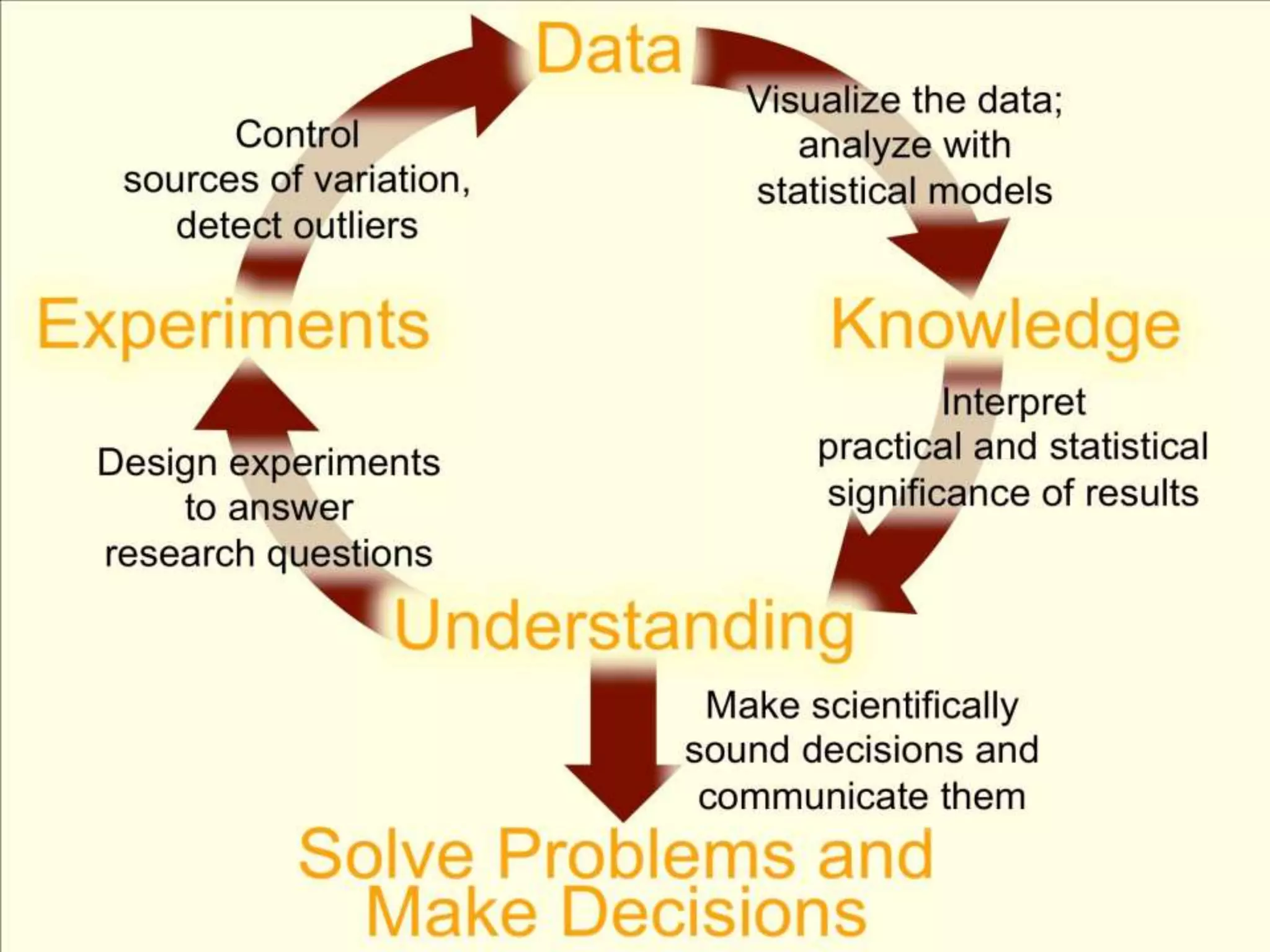
• Statistics play a vital role in researches. For example 
statistics can used as in data collection, analysis, 
interpretation, explanation and presentation. Use of 
statistics will guide researchers in research for proper 
characterization, summarization, presentation and 
interpretation of the result of research. 
• Statistics provides a platform for research as to; How to go 
about your research, either to consider a sample or the 
whole population, the Techniques to use in data collection 
and observation, how to go about the data description 
(using measure of central tendency).
• Statistical methods and analyses are often used to 
communicate research findings and to support 
hypotheses and give credibility to research 
methodology and conclusions. 
• It is important for researchers and also 
consumers of research to understand statistics 
so that they can be informed, evaluate the 
credibility and usefulness of information, and 
make appropriate decisions.
• Statics is very important when it comes to the 
conclusion of the research. 
• In this aspect the major purposes of statistics 
are to help us understand and 
describe phenomena in our word and to help 
us draw reliable conclusions about those 
phenomena.
What is the role of 
statistics in 
scientific research?
Describe the importance of 
statistics in different fields of 
study.
Statistics has important role in determining the 
existing position of per capita income, 
unemployment, population growth rate, housing, 
schooling medical facilities etc…in a country. 
Now statistics holds a central position in almost 
every field like Industry, Commerce, Trade, Physics, 
Chemistry, Economics, Mathematics, Biology, 
Botany, Psychology, Astronomy, Information 
Technology etc…, so application of statistics is very 
wide.
Specialties have evolved to apply statistical theory and methods to 
various disciplines. So there are different fields of application of 
statistics. Some of those are described below. 
• Astrostatistics is the discipline that applies statistical analysis to 
the understanding of astronomical data. 
• Biostatistics is a branch of biology that studies biological 
phenomena and observations by means of statistical analysis, and 
includes medical statistics. 
• Econometrics is a branch of economics that applies statistical 
methods to the empirical study of economic theories and 
relationships. 
• Business analytics is a rapidly developing business process that 
applies statistical methods to data sets to develop new insights 
and understanding of business performance & opportunities.
• Environmental statistics is the application of statistical methods to 
environmental science. Weather, climate, air and water quality are 
included, as are studies of plant and animal populations. 
• Statistical mechanics is the application of probability theory, which 
includes mathematical tools for dealing with large populations, to the 
field of mechanics, which is concerned with the motion of particles or 
objects when subjected to a force. 
• Statistical physics is one of the fundamental theories of physics, and 
uses methods of probability theory in solving physical problems. 
• Actuarial science is the discipline that applies mathematical and 
statistical methods to assess risk in the insurance and finance industries.
What are the statistical terms 
used in research studies?
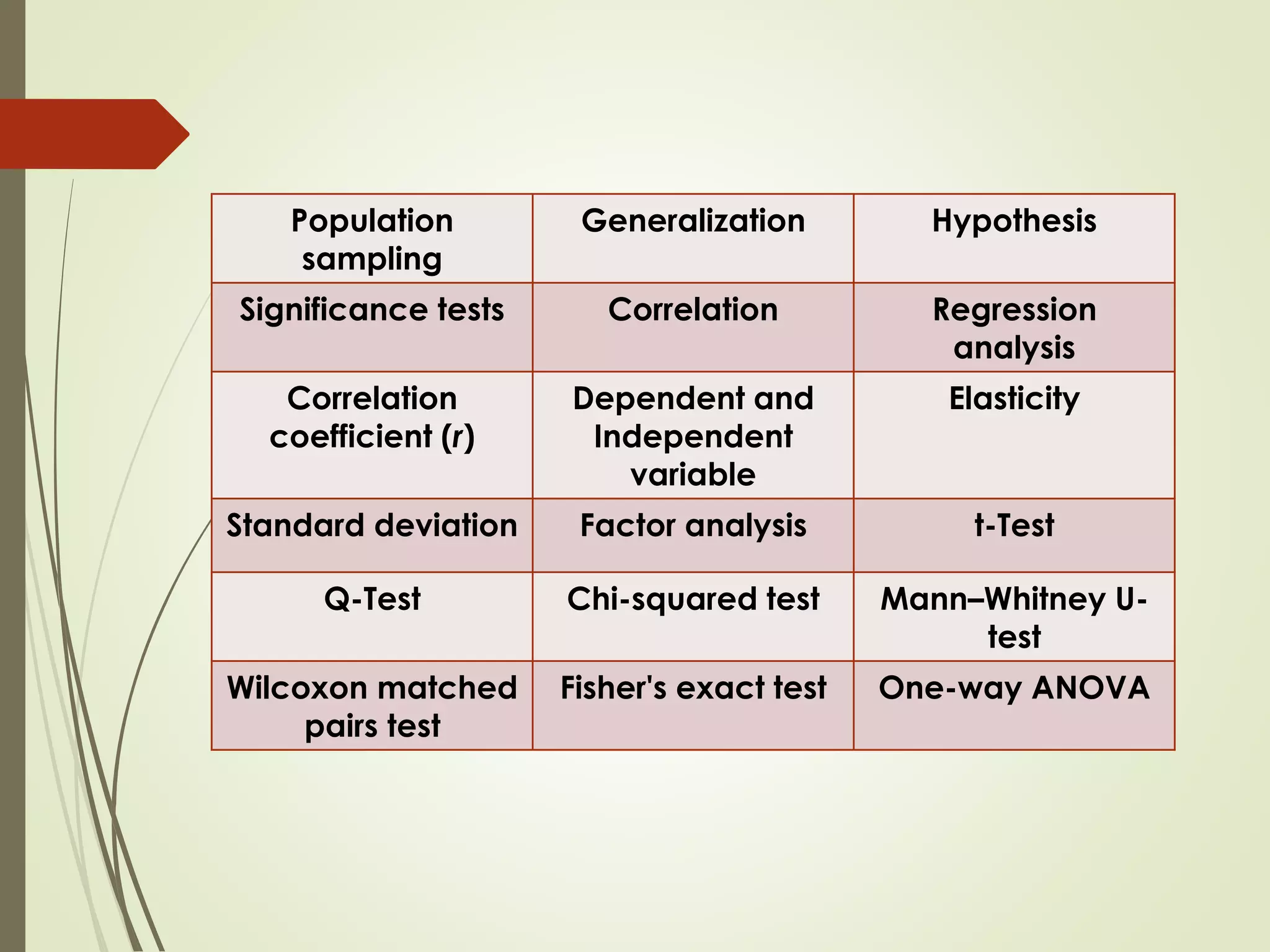
Population 
sampling 
Generalization Hypothesis 
Significance tests Correlation Regression 
analysis 
Correlation 
coefficient (r) 
Dependent and 
Independent 
variable 
Elasticity 
Standard deviation Factor analysis t-Test 
Q-Test Chi-squared test Mann–Whitney U-test 
Wilcoxon matched 
pairs test 
Fisher's exact test One-way ANOVA
What are the misuses of 
statistics in a research?
Discarding unfavorable data Loaded questions 
Overgeneralization Biased samples 
Misreporting or misunderstanding 
of estimated error 
False causality 
Proof of the null hypothesis Confusing statistical significance 
with practical significance 
Misleading Graphs Data manipulation 
Suspect Samples Ambiguous Averages
References 
Bu.edu, 'Why Study Statistics » Statistics » Boston University', 2014. [Online]. Available: 
http://www.bu.edu/stat/undergraduate-program-information/why-study-statistics/. [Accessed: 23- Oct- 
2014]. 
Understanding Descriptive and Inferential Statistics. 2014. Understanding Descriptive and Inferential Statistics. 
[ONLINE] Available at:https://statistics.laerd.com/statistical-guides/descriptive-inferential-statistics.php. 
[Accessed 27 October 2014]. 
Kent, J 2013, ' Why Statistics Is Important To A Research?', Viewed 24 October 2014, 
http://education.blurtit.com/335945/why-statistics-is-important-to-a-research 
Journalists Resources 2014, 'Statistical terms used in research studies', Viewed 24 October 2014, 
http://journalistsresource.org/skills/research/statistics-for-journalists# 
Theanalysisfactor.com, 'Factor Analysis: A Short Introduction, Part 1', 2014. [Online]. Available: 
http://www.theanalysisfactor.com/factor-analysis-1-introduction/. [Accessed: 25- Oct- 2014]. 
Stattrek.com, 'Regression Example', 2014. [Online]. Available: http://stattrek.com/regression/regression-example. 
aspx. [Accessed: 26- Oct- 2014]. 
Ats.ucla.edu, (2014). What statistical analysis should I use? Statistical analyses using Stata. [online] Available 
at: http://www.ats.ucla.edu/stat/stata/whatstat/whatstat.htm [Accessed 26 Oct. 2014].
Role of Statistics in Scientific Research

Role of Statistics in Scientific Research

  • 1.
    Role of Statistics in Scientific Research A Special Topic Discussion By; Waruna Kodituwakku & Harsha Perera
  • 2.
    "Statistics is thegrammar of science.” Karl Pearson "If your experiment needs statistics, you ought to have done a better experiment....“ Ernest Rutherford
  • 3.
    Questions What isstatistics? Why Study Statistics? What is the importance of statistics in scientific research? What is the role of statistics in research? Describe the importance of statistics in different fields of study
  • 4.
    Questions Contd. Whatare the statistical terms used in research studies? What are the misuses of statistics in a research? How effectively present stat findings using tools such as tables, graphs etc.
  • 5.
  • 6.
    “Statistics is thescience of learning from data, and of measuring, controlling, and communicating uncertainty; and it thereby provides the navigation essential for controlling the course of scientific and societal advances” (Davidian and Louis, 2012) “Statistics is the study of the collection, analysis, interpretation, presentation and organization of data”. (Dodge, Y. (2006) The Oxford Dictionary of Statistical Terms)
  • 7.
    Statistical methods canbe used to summarize or describe a collection of data; this is called descriptive statistics. In addition, patterns in the data may be modeled in a way that accounts for randomness and uncertainty in the observations, and are then used to draw inferences about the process or population being studied; this is called inferential statistics.
  • 8.
    "Applied statistics" containsdescriptive statistics and the application of inferential statistics. “Theoretical statistics” consist of logical arguments underlying justification of approaches to statistical inference. “Mathematical statistics” contains the manipulation of probability distributions necessary for deriving results related to methods of estimation and various aspects of computational statistics and the design of experiments.
  • 9.
  • 10.
    • Knowledge instatistics provides you with the necessary tools and conceptual foundations in quantitative reasoning to extract information intelligently from this sea of data. • Statistical methods and analyses are often used to communicate research findings and to support hypotheses and give credibility to research methodology and conclusions. • It is important for researchers and also consumers of research to understand statistics so that they can be informed, evaluate the credibility and usefulness of information, and make appropriate decisions.
  • 11.
    What is theimportance of statistics in scientific research?
  • 12.
    • Statistics playa vital role in researches. For example statistics can used as in data collection, analysis, interpretation, explanation and presentation. Use of statistics will guide researchers in research for proper characterization, summarization, presentation and interpretation of the result of research. • Statistics provides a platform for research as to; How to go about your research, either to consider a sample or the whole population, the Techniques to use in data collection and observation, how to go about the data description (using measure of central tendency).
  • 13.
    • Statistical methodsand analyses are often used to communicate research findings and to support hypotheses and give credibility to research methodology and conclusions. • It is important for researchers and also consumers of research to understand statistics so that they can be informed, evaluate the credibility and usefulness of information, and make appropriate decisions.
  • 14.
    • Statics isvery important when it comes to the conclusion of the research. • In this aspect the major purposes of statistics are to help us understand and describe phenomena in our word and to help us draw reliable conclusions about those phenomena.
  • 15.
    What is therole of statistics in scientific research?
  • 17.
    Describe the importanceof statistics in different fields of study.
  • 18.
    Statistics has importantrole in determining the existing position of per capita income, unemployment, population growth rate, housing, schooling medical facilities etc…in a country. Now statistics holds a central position in almost every field like Industry, Commerce, Trade, Physics, Chemistry, Economics, Mathematics, Biology, Botany, Psychology, Astronomy, Information Technology etc…, so application of statistics is very wide.
  • 19.
    Specialties have evolvedto apply statistical theory and methods to various disciplines. So there are different fields of application of statistics. Some of those are described below. • Astrostatistics is the discipline that applies statistical analysis to the understanding of astronomical data. • Biostatistics is a branch of biology that studies biological phenomena and observations by means of statistical analysis, and includes medical statistics. • Econometrics is a branch of economics that applies statistical methods to the empirical study of economic theories and relationships. • Business analytics is a rapidly developing business process that applies statistical methods to data sets to develop new insights and understanding of business performance & opportunities.
  • 20.
    • Environmental statisticsis the application of statistical methods to environmental science. Weather, climate, air and water quality are included, as are studies of plant and animal populations. • Statistical mechanics is the application of probability theory, which includes mathematical tools for dealing with large populations, to the field of mechanics, which is concerned with the motion of particles or objects when subjected to a force. • Statistical physics is one of the fundamental theories of physics, and uses methods of probability theory in solving physical problems. • Actuarial science is the discipline that applies mathematical and statistical methods to assess risk in the insurance and finance industries.
  • 21.
    What are thestatistical terms used in research studies?
  • 22.
    Population sampling GeneralizationHypothesis Significance tests Correlation Regression analysis Correlation coefficient (r) Dependent and Independent variable Elasticity Standard deviation Factor analysis t-Test Q-Test Chi-squared test Mann–Whitney U-test Wilcoxon matched pairs test Fisher's exact test One-way ANOVA
  • 23.
    What are themisuses of statistics in a research?
  • 24.
    Discarding unfavorable dataLoaded questions Overgeneralization Biased samples Misreporting or misunderstanding of estimated error False causality Proof of the null hypothesis Confusing statistical significance with practical significance Misleading Graphs Data manipulation Suspect Samples Ambiguous Averages
  • 26.
    References Bu.edu, 'WhyStudy Statistics » Statistics » Boston University', 2014. [Online]. Available: http://www.bu.edu/stat/undergraduate-program-information/why-study-statistics/. [Accessed: 23- Oct- 2014]. Understanding Descriptive and Inferential Statistics. 2014. Understanding Descriptive and Inferential Statistics. [ONLINE] Available at:https://statistics.laerd.com/statistical-guides/descriptive-inferential-statistics.php. [Accessed 27 October 2014]. Kent, J 2013, ' Why Statistics Is Important To A Research?', Viewed 24 October 2014, http://education.blurtit.com/335945/why-statistics-is-important-to-a-research Journalists Resources 2014, 'Statistical terms used in research studies', Viewed 24 October 2014, http://journalistsresource.org/skills/research/statistics-for-journalists# Theanalysisfactor.com, 'Factor Analysis: A Short Introduction, Part 1', 2014. [Online]. Available: http://www.theanalysisfactor.com/factor-analysis-1-introduction/. [Accessed: 25- Oct- 2014]. Stattrek.com, 'Regression Example', 2014. [Online]. Available: http://stattrek.com/regression/regression-example. aspx. [Accessed: 26- Oct- 2014]. Ats.ucla.edu, (2014). What statistical analysis should I use? Statistical analyses using Stata. [online] Available at: http://www.ats.ucla.edu/stat/stata/whatstat/whatstat.htm [Accessed 26 Oct. 2014].

Editor's Notes

  • #23 Population sampling As we discussed in previous discussion sessions, population sampling can be defined as the procedure of taking a subset of larger population. Inferential statistics seek to make predictions about a population based on the results observed in a sample of that population. Generalization Generalization is the attempt to extend the results of a sample to a population. When generalizing, sample variation must be taken into account. Even if the sample selection is completely random, still there is a degree of variance within the population. The concept 'margin of error' comes into the field due to this reason. Hypothesis A quantitative research process starts with a hypothesis, and the research design is based on this hypothesis. Hypothesis is defined as a proposed explanation for a phenomenon. A well designed research disproves the null hypothesis. Significance tests Significance tests are used to determine the probability of the research result if the null hypothesis was true. p-value is used to determine this probability statistically. Correlation When two variables move together, they are said to be correlated. Correlation can be either positive where one variable rises, the other variable rises as well or negative where two variables move in opposite directions. Regression analysis Regression analysis is used to determine if there is or isn’t a correlation between two or more variables and how strong any correlation may be. It involves plotting data points on an X/Y graph and looking at the distribution of data it establishes a trend line. Correlation coefficient (r) Correlation coefficient is used to indicate the degree to which two quantitative variables are related. The most common Correlation coefficient which is used is the Pearson coefficient. Causation Causation or cause and effect relationship denotes when one variable changes another. Unlike in correlation relationship, causation flows on only one direction.   Dependent and Independent variable In a causation relationship, the factor that drives change is the independent variable. The variable that is driven is the dependent variable. Elasticity Elasticity is mainly used in economics research. It measures how much a change in one variable affects another. Standard deviation Standard deviation measures the difference from the group's mean to provide an insight of much variation there is within a group of values. Dependent t-test A data analysis procedure that assesses whether the means of two related groups are statistically different from each other. t-Test The t- test is used to calculate the confidence intervals of a measurement when the population standard deviation is not know. The t-test is also used to compare two averages. The t-test corrects for the uncertainty of the sample standard deviation (s) caused by taking a small number of samples. Q-Test This test is used to determine if there is a statistical basis for removing a data point from a data set. The t-test enables to see whether two samples are different when you have data that are continuous and normally distributed. The test allows comparing the means and standard deviations of the two groups to see whether there is a statistically significant difference between them. Chi-squared test The chi-squared test is used with categorical data to see whether any difference in frequencies between sets of results is due to chance. The chi-square test assumes the expected value of each cell is five or higher.  Mann–Whitney U-test The Mann–Whitney U-test is similar to the t-test. It is used when comparing ordinal data that are not normally distributed. Measurements must be categorical, yes or no and independent of each other. The Mann–Whitney U-test could be used to test the effectiveness of an antihistamine tablet compared to a spray in a group of people with hay fever. To do this, you would split the group in half, then give each half a different treatment and ask each person how effective they thought it was. The test could be used to see whether there is a difference in the perceived efficacy of the two treatments. Standard error and 95 per cent confidence limits The standard error and 95 per cent confidence limits allow us to gauge how representative of the real world population the data are. Spearman’s rank correlation coefficient The Spearman’s rank correlation coefficient tests the relationship between two variables in a dataset; for example, is a person’s weight related to their height? If there is a statistically significant relationship, you can reject the null hypothesis, which may be that there is no link between the two variables. Wilcoxon matched pairs test Like the Mann–Whitney U-test, this test is used for discontinuous data that are not normally distributed but do have a link between the two datasets. For example, when asking people to rank how hungry they feel before a meal and doing so again after they have eaten because the same person is providing both answers, the datasets are not independent. Fisher's exact test The Fisher's exact test is used when you want to conduct a chi-square test, but one or more of your cells has an expected frequency of five or less.  Remember that the chi-square test assumes that each cell has an expected frequency of five or more, but the Fisher's exact test has no such assumption and can be used regardless of how small the expected frequency is. One-way ANOVA A one-way analysis of variance (ANOVA) is used when you have a categorical independent variable with two or more categories and a normally distributed interval dependent variable and you wish to test for differences in the means of the dependent variable broken down by the levels of the independent variable. 
  • #25 Discarding unfavorable data This is a main misuse happen in the research. Researchers tend to discard the unfavorable data to their research study Loaded questions The answers to surveys can often be manipulated by wording the question in such a way as to induce a prevalence towards a certain answer from the respondent. For example, in polling support for a war, the questions: Do you support the attempt by the USA to bring freedom and democracy to other places in the world? Do you support the unprovoked military action by the USA? Overgeneralization Overgeneralization is a fallacy occurring when a statistic about a particular population is asserted to hold among members of a group for which the original population is not a representative sample. False causality he fallacy is that an event or action influences another that is not reasonably related. Ex.: "There were many strangers in the room, so naturally they began to argue." Suspect Samples "Three out of four doctors surveyed recommend brand Misleadatron."  If  only 4 doctors were surveyed, the results could have been obtained by  chance alone; however, if 100 doctors were surveyed, the results might  be quite different. But probably not the desired one. Ambiguous Averages "There are four commonly used measures that are loosely called averages. They are the mean, median, mode, and midrange." For the same data set, these averages can differ markedly. People who  know this can, without lying, select the one measure of average that  lends the most evidence to support their position.