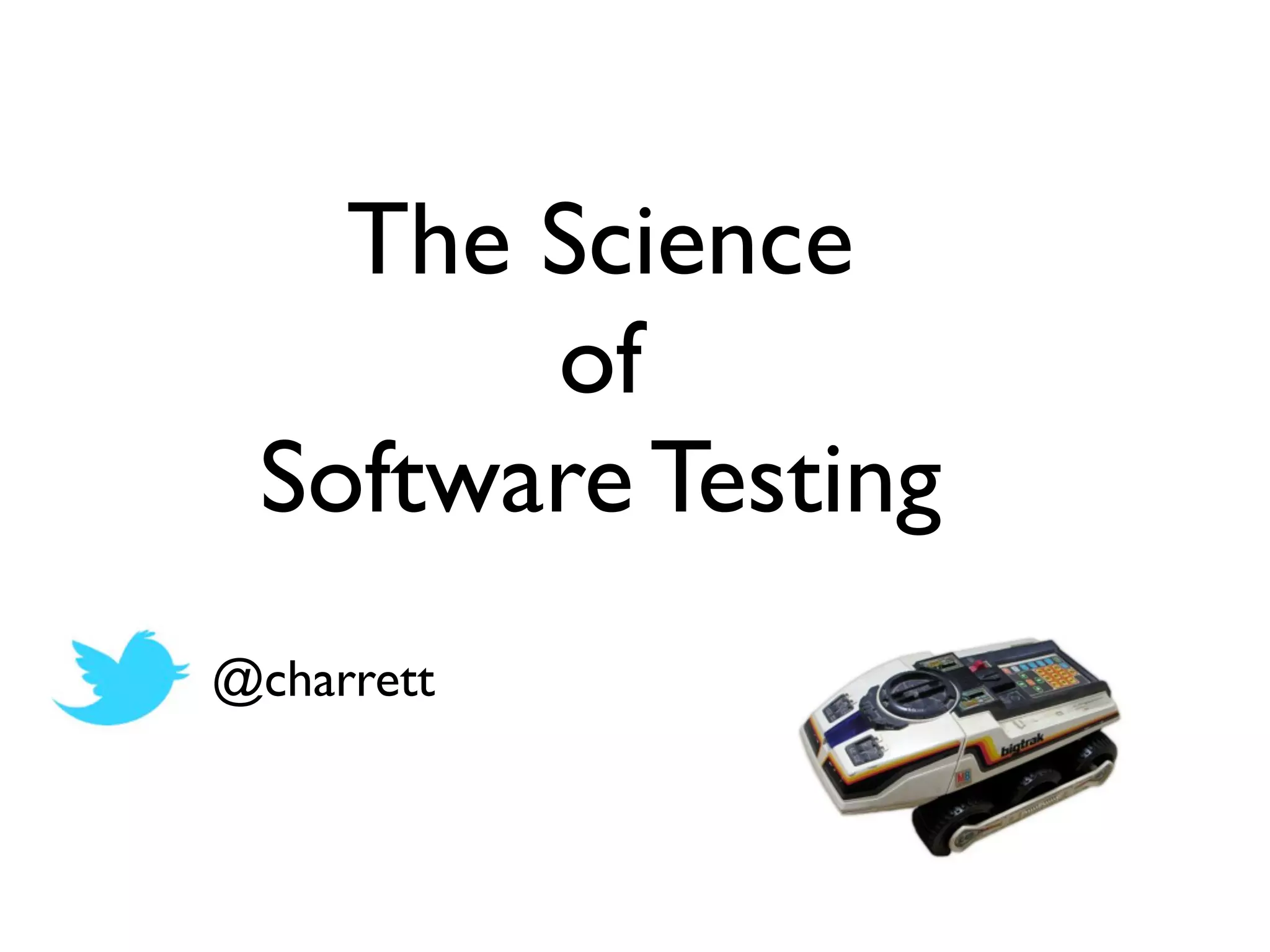

The Science 	

of 	

Software Testing
@charrett
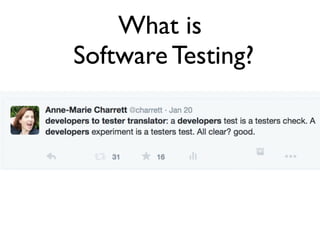
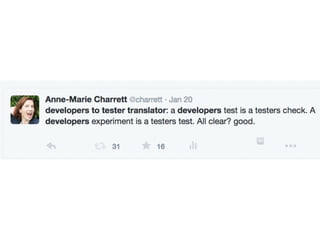
What is	

Software Testing?
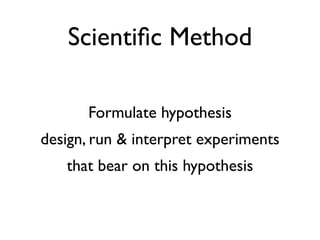
Scientific Method
Formulate hypothesis	

design, run & interpret experiments 	

that bear on this hypothesis
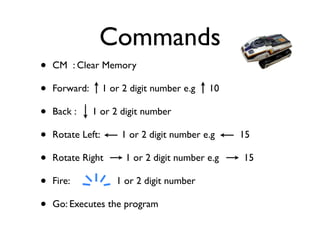
• CM : Clear Memory 	

• Forward: 1 or 2 digit number e.g 10 	

• Back : 1 or 2 digit number 	

• Rotate Left: 1 or 2 digit number e.g 15 	

• Rotate Right 1 or 2 digit number e.g 15	

• Fire: 1 or 2 digit number 	

• Go: Executes the program
Commands
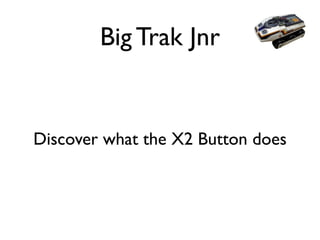
Big Trak Jnr
Discover what the X2 Button does
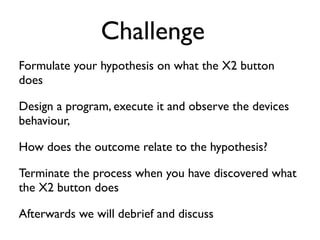
Challenge
Formulate your hypothesis on what the X2 button
does	

Design a program, execute it and observe the devices
behaviour,	

How does the outcome relate to the hypothesis? 	

Terminate the process when you have discovered what
the X2 button does	

Afterwards we will debrief and discuss
You can ask me any
questions
Verbalise your ideas
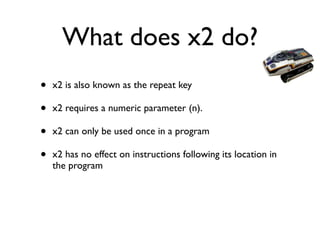
What does x2 do?
• x2 is also known as the repeat key	

• x2 requires a numeric parameter (n). 	

• x2 can only be used once in a program 	

• x2 has no effect on instructions following its location in
the program
What does X2 do?
N repeats the entire program
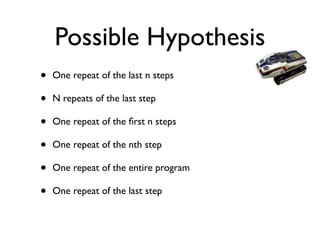
Possible Hypothesis
• One repeat of the last n steps	

• N repeats of the last step	

• One repeat of the first n steps	

• One repeat of the nth step	

• One repeat of the entire program	

• One repeat of the last step
Observations
Exploring Science
• Tests can be easy to construct and easily observable, but
don’t offer much information. 	

• Knowing where to look & Understand what is seen 	

• Experimental design: design of experimental and
observational procedures	

• Hypothesis formation: formation and evaluation of theory	

• Confirmation Bias:“Tendency for people to seek evidence
to verify their hypothesis rather than refute them”
Science & Testing
• Testing requires we ask useful questions, challenge
assumptions	

• Testing is more about acquiring information than pass/fail	

• Testing is about thinking critically about why we test, how
we test and how we evaluate. 	

• Testing like experiments requires good test design	

• Testing like experimentation requires good observational
design 	

• Watch out for Confirmation Bias	

• Don’t conflate Testing with Checking
Suggestions
• Don’t plan all your tests upfront, you need to be able to
react to the information you find 	

• Automated Checking good for confirmation 	

• Exploratory Testing allows us to investigate the product	

• Focus on Testability rather than large automated
regression suites	

• Testability in creating test data	

• Helping to recognise problems
Thank you	

& 	

Tyro Payments 	

for 	

sponsoring me

Robots, Testing and LAST

  • 1.
    The Science of Software Testing @charrett
  • 2.
  • 4.
    Scientific Method Formulate hypothesis design,run & interpret experiments that bear on this hypothesis
  • 5.
    • CM :Clear Memory • Forward: 1 or 2 digit number e.g 10 • Back : 1 or 2 digit number • Rotate Left: 1 or 2 digit number e.g 15 • Rotate Right 1 or 2 digit number e.g 15 • Fire: 1 or 2 digit number • Go: Executes the program Commands
  • 6.
    Big Trak Jnr Discoverwhat the X2 Button does
  • 7.
    Challenge Formulate your hypothesison what the X2 button does Design a program, execute it and observe the devices behaviour, How does the outcome relate to the hypothesis? Terminate the process when you have discovered what the X2 button does Afterwards we will debrief and discuss
  • 8.
    You can askme any questions
  • 9.
  • 10.
    What does x2do? • x2 is also known as the repeat key • x2 requires a numeric parameter (n). • x2 can only be used once in a program • x2 has no effect on instructions following its location in the program
  • 11.
    What does X2do? N repeats the entire program
  • 12.
    Possible Hypothesis • Onerepeat of the last n steps • N repeats of the last step • One repeat of the first n steps • One repeat of the nth step • One repeat of the entire program • One repeat of the last step
  • 13.
  • 14.
    Exploring Science • Testscan be easy to construct and easily observable, but don’t offer much information. • Knowing where to look & Understand what is seen • Experimental design: design of experimental and observational procedures • Hypothesis formation: formation and evaluation of theory • Confirmation Bias:“Tendency for people to seek evidence to verify their hypothesis rather than refute them”
  • 15.
    Science & Testing •Testing requires we ask useful questions, challenge assumptions • Testing is more about acquiring information than pass/fail • Testing is about thinking critically about why we test, how we test and how we evaluate. • Testing like experiments requires good test design • Testing like experimentation requires good observational design • Watch out for Confirmation Bias • Don’t conflate Testing with Checking
  • 16.
    Suggestions • Don’t planall your tests upfront, you need to be able to react to the information you find • Automated Checking good for confirmation • Exploratory Testing allows us to investigate the product • Focus on Testability rather than large automated regression suites • Testability in creating test data • Helping to recognise problems
  • 17.
    Thank you & TyroPayments for sponsoring me