INTRODUCTION
• Human is a social animal who knows to interact
and associate with his fellow being is largely
because of “learning”.
• This learning is from both Environment and
Heredity.
• Nicholas Humphrey described human as ‘homo
Psychologicus’ because we always wanted to
evaluate ourselves and others.
CONCEPT OF LEARNING
• “ Learning is the acquisition of new behavior
or the strengthening or weakening of old
behavior as a result of experience.”
-’Smith’
• Learning may be considered a human
disposition or capability which can be retained
and which is not ascribable to the process of
growth. -’Gagne’
→ Learning is a modification of behavior to
attain certain habits ,knowledge and
capabilities.
(August 21, 1916 – April 28,
2002)
LEARNING OUTCOMES
I. Intellectual Skills
It involves the students ‘ knowing of how to perform an act as
per his knowing for certain conditions.
• Concepts : apple, boy etc
• Discriminations : colors, fruits, vegetables, boy&girl
• Higher-order Rules : makes rule by combining concepts. rules in
connected speech etc
boy play cricket = A child plays cricket.
• Procedures : in Research we use different rules.
II. Verbal information
We acquire different pieces of information in a
verbal form through interaction to our
environment. Then we use it for higher
purposes ie, to state or declare
something. It is also known as
Declarative Knowledge.
Eg:- to define grammar rules,
theories etc
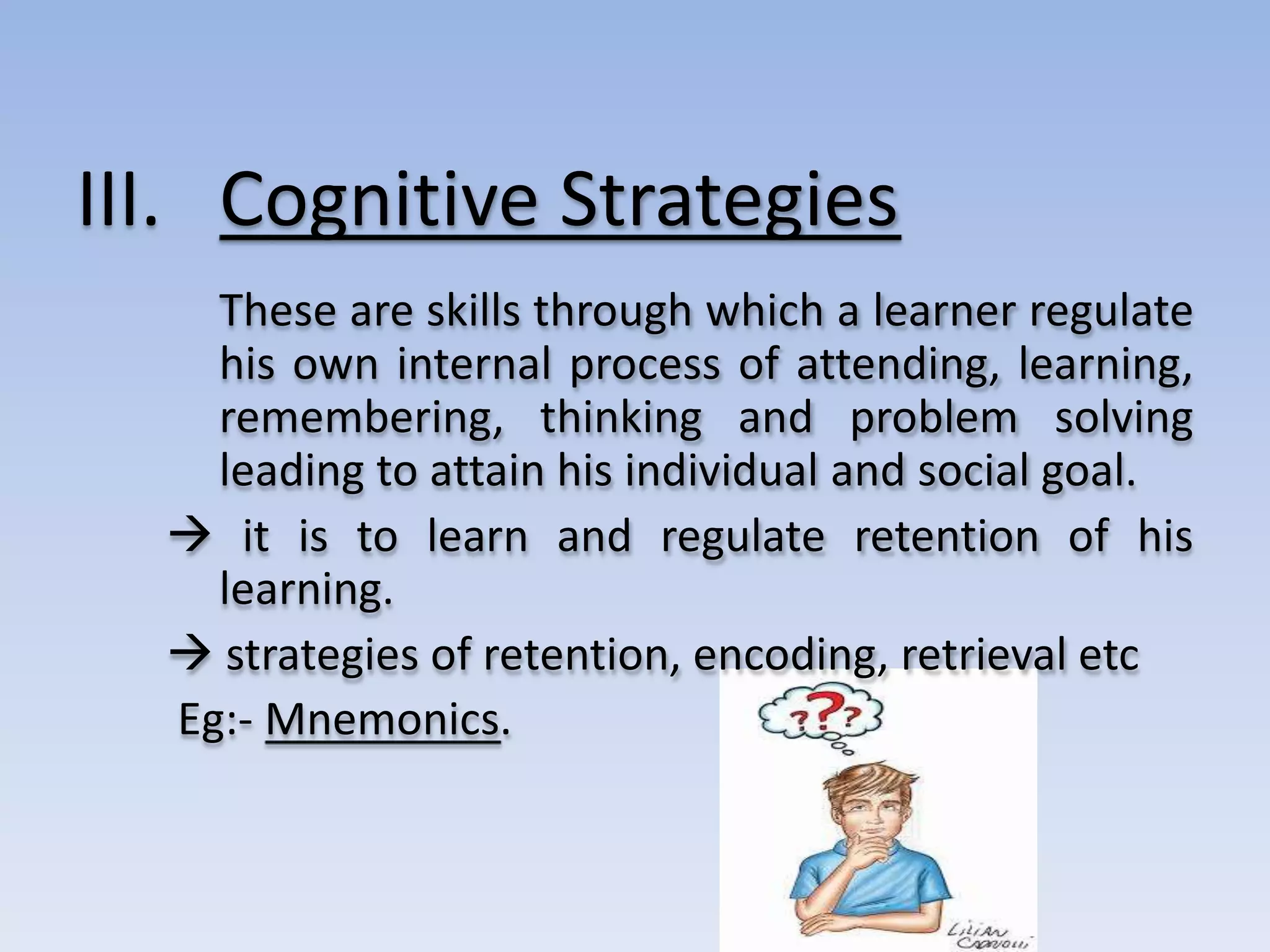
III. Cognitive Strategies
These are skills through which a learner regulate
his own internal process of attending, learning,
remembering, thinking and problem solving
leading to attain his individual and social goal.
 it is to learn and regulate retention of his
learning.
 strategies of retention, encoding, retrieval etc
Eg:- Mnemonics.
IV.Motor Skills
Motor skills are smooth, precise and accurate
execution of movements involving the use of
muscles. Continued practice gives precision and
smoothness to motor skills.
V. Attitudes
Attitudes are inferred internal states of
organization that influences their action
towards certain class of things, person or
events.
 Choices of action or behavior is influenced
significantly by attitudes.
 We cannot observe it but can inference from one
or more kind of observable behavior.
Conditions of learning Intellectual
Skills
INTERNAL
• The previously learned skills
those are components of
new skill.
• The processes that will be
used to recall them and put
them together in a new
form.
EXTERNAL
• To stimulate recall of the
subordinate skill through
verbal communication.
• Inform the learner of
objectives.
• Guiding through question or
hints.
• Providing an occasion to
perform the just learned
skill.
Conditions of learning Cognitive
Strategies
INTERNAL
• Encoding Strategy.
• Some previously learned rules
for new topic.
• Putting the facts in familiar
categories by recalling it.
• Strategy of thinking to solve
problem.
Cognitive strategy can be
measured by the originality of
the work the learner does.
EXTERNAL
• Encouraging the learner to
practice cognitive strategies.
• Providing various kinds of
learning materials to enhance
their cognitive strategies.
• Provide situation to attend,
encode and to retrieve.
• Provide a varied, novel
problem solving situations
thus they will be able to select
different strategies in solution.
Conditions of learning Verbal
information
INTERNAL
• Previous knowledge of the
linguistic items.
• Prior knowledge on
linguistic rules.
EXTERNAL
• Provide ‘Advance Organizer’.
• Informing the learner of
objectives through
‘statements’.
• Ask question from the
passage to which learner is
expected to answer in
sentences.
• Repeated hearing and
speaking drills and reading.
Conditions of learning Motor Skills
INTERNAL
• Prior knowledge.
• ‘Procedural Sequence’
( Executive sub-routine) of
motor skills.
• Through practice .
EXTERNAL
• Provide enough chance for
practice .
• Motivate.
• Provide feedback which is
an inherent part of the act
being performed.
Conditions of learning Attitude
INTERNAL
• Intellectual skill involves in
behavior which results in
Attitude.
• Previously learned
intellectual skill results in
choices.ie, Attitude.
• Born out of imitation or
favourism.
EXTERNAL
• Learner observes someone.
‘Good’ or ‘bad’ effects of
the behavior of a ‘Human
Model’.
• The feedback of
accomplishment and
success is also important
LEARNING HIERARCHY
INTERNAL CONDITION
THEORY OF INSTRUCTION
Instruction is a powerful external condition.
Instruction should be based on the
hierarchical structure of the events of
learning. How the information is processed by
learner makes planning the task of instruction
easy.
The Instruction should enhance and
support internal learning processes for
inculcating the expected learning outcome.
1) Gaining attention
The attention of
students, in the sense
of alertness for
reception of stimuli,
is gained by introducing rapid
stimulus change.
Eg:- by gesturing, loudness of speech by
visual or auditory stimuli
etc
THEORY OF INSTRUCTION
2) Informing learners of the Objectives
When learners comprehend the
objective of instruction, they will
acquire an expectancy that normally
persist throughout the learning and
that will be confirmed through
feedback.
THEORY OF INSTRUCTION
3) Stimulating recall or Prior learning
Make the learner recall his prior
learning regarding the new topic.
THEORY OF INSTRUCTION
4) Presenting the stimulus
Presentation of the essential stimulus.
The stimulus should be perceived as
an initial phase of learning.
THEORY OF INSTRUCTION
5. Providing “Learning Guidance”
The instruction supports the internal
process usually called semantic
encoding, ie, make stimulus as
meaningful as possible.
6) Eliciting Performance
It is the time for the learner to
demonstrate the newly learned
capability according to those
objectives. ( Learning Outcome--)
THEORY OF INSTRUCTION
7) Providing feedback
Feedback about the correctness of
performance should be separately
provided. It reinforces the learner to
repeat the action in future.
THEORY OF INSTRUCTION
8. Assessing performance
In order to assure that the learning
occurred, it is necessary to require
additional instances of the performance.
Assessing is usually by giving a test.
For this the learner retrieves the
learned and reinforced.
9) Enhance Retention and Transfer
Increased amount of practice
constitute a fairly dependable factor for
effecting amount of retention.
THEORY OF INSTRUCTION
 Prerequisite help to
foster learning.
 Instruction can be
arranged properly.
 Teacher should plan
according to the
internal and external
conditions of learning
of the learners.
 Due weightage
should be given to
each learning
outcome.
 Students learn by
modeling, so display
desired behaviors
only.
 Systematic instruction
alleviate learning.
 Teacher can guide
students to master the
skill.
 Feedback reinforces
learners.
 “Effectiveness of Instructional Strategies
Based on Gagne’s Instructional Design(ID) in
Improving Thinking Skill of Secondary School
Students”
-- Dr. Flosy C.R D’Souza & Dr. H.M Kasinath
 “Research in Problem Solving: Improving the
Progression from Novice to Expert”
Roxi Finney
 National Council of Teachers’ of Mathematics
on Problem Solving.
We can consider Gagne’s learning hierarchy
and Theory of instruction as the epitome or
synthesis of several theories such as Classical
Conditioning, Operant Conditioning and he
had taken the propositions of Ausebel, Bruner
et al. and by siting instances from life
situations, he has increased credibility and
applicability of his views. He proposed
computer based training and multimedia
based learning too.
Thus ‘Gagne’s Assumptions’ are an effective
tool in educational system which enhance and
alleviate the learning.
Lami M.C

gagne's learning hierarchy and instruction

  • 3.
    INTRODUCTION • Human isa social animal who knows to interact and associate with his fellow being is largely because of “learning”. • This learning is from both Environment and Heredity. • Nicholas Humphrey described human as ‘homo Psychologicus’ because we always wanted to evaluate ourselves and others.
  • 4.
    CONCEPT OF LEARNING •“ Learning is the acquisition of new behavior or the strengthening or weakening of old behavior as a result of experience.” -’Smith’ • Learning may be considered a human disposition or capability which can be retained and which is not ascribable to the process of growth. -’Gagne’ → Learning is a modification of behavior to attain certain habits ,knowledge and capabilities.
  • 5.
    (August 21, 1916– April 28, 2002)
  • 7.
    LEARNING OUTCOMES I. IntellectualSkills It involves the students ‘ knowing of how to perform an act as per his knowing for certain conditions. • Concepts : apple, boy etc • Discriminations : colors, fruits, vegetables, boy&girl • Higher-order Rules : makes rule by combining concepts. rules in connected speech etc boy play cricket = A child plays cricket. • Procedures : in Research we use different rules.
  • 8.
    II. Verbal information Weacquire different pieces of information in a verbal form through interaction to our environment. Then we use it for higher purposes ie, to state or declare something. It is also known as Declarative Knowledge. Eg:- to define grammar rules, theories etc
  • 9.
    III. Cognitive Strategies Theseare skills through which a learner regulate his own internal process of attending, learning, remembering, thinking and problem solving leading to attain his individual and social goal.  it is to learn and regulate retention of his learning.  strategies of retention, encoding, retrieval etc Eg:- Mnemonics.
  • 10.
    IV.Motor Skills Motor skillsare smooth, precise and accurate execution of movements involving the use of muscles. Continued practice gives precision and smoothness to motor skills.
  • 11.
    V. Attitudes Attitudes areinferred internal states of organization that influences their action towards certain class of things, person or events.  Choices of action or behavior is influenced significantly by attitudes.  We cannot observe it but can inference from one or more kind of observable behavior.
  • 15.
    Conditions of learningIntellectual Skills INTERNAL • The previously learned skills those are components of new skill. • The processes that will be used to recall them and put them together in a new form. EXTERNAL • To stimulate recall of the subordinate skill through verbal communication. • Inform the learner of objectives. • Guiding through question or hints. • Providing an occasion to perform the just learned skill.
  • 16.
    Conditions of learningCognitive Strategies INTERNAL • Encoding Strategy. • Some previously learned rules for new topic. • Putting the facts in familiar categories by recalling it. • Strategy of thinking to solve problem. Cognitive strategy can be measured by the originality of the work the learner does. EXTERNAL • Encouraging the learner to practice cognitive strategies. • Providing various kinds of learning materials to enhance their cognitive strategies. • Provide situation to attend, encode and to retrieve. • Provide a varied, novel problem solving situations thus they will be able to select different strategies in solution.
  • 17.
    Conditions of learningVerbal information INTERNAL • Previous knowledge of the linguistic items. • Prior knowledge on linguistic rules. EXTERNAL • Provide ‘Advance Organizer’. • Informing the learner of objectives through ‘statements’. • Ask question from the passage to which learner is expected to answer in sentences. • Repeated hearing and speaking drills and reading.
  • 18.
    Conditions of learningMotor Skills INTERNAL • Prior knowledge. • ‘Procedural Sequence’ ( Executive sub-routine) of motor skills. • Through practice . EXTERNAL • Provide enough chance for practice . • Motivate. • Provide feedback which is an inherent part of the act being performed.
  • 19.
    Conditions of learningAttitude INTERNAL • Intellectual skill involves in behavior which results in Attitude. • Previously learned intellectual skill results in choices.ie, Attitude. • Born out of imitation or favourism. EXTERNAL • Learner observes someone. ‘Good’ or ‘bad’ effects of the behavior of a ‘Human Model’. • The feedback of accomplishment and success is also important
  • 20.
  • 21.
  • 22.
    THEORY OF INSTRUCTION Instructionis a powerful external condition. Instruction should be based on the hierarchical structure of the events of learning. How the information is processed by learner makes planning the task of instruction easy. The Instruction should enhance and support internal learning processes for inculcating the expected learning outcome.
  • 24.
    1) Gaining attention Theattention of students, in the sense of alertness for reception of stimuli, is gained by introducing rapid stimulus change. Eg:- by gesturing, loudness of speech by visual or auditory stimuli etc THEORY OF INSTRUCTION
  • 25.
    2) Informing learnersof the Objectives When learners comprehend the objective of instruction, they will acquire an expectancy that normally persist throughout the learning and that will be confirmed through feedback. THEORY OF INSTRUCTION
  • 26.
    3) Stimulating recallor Prior learning Make the learner recall his prior learning regarding the new topic. THEORY OF INSTRUCTION
  • 27.
    4) Presenting thestimulus Presentation of the essential stimulus. The stimulus should be perceived as an initial phase of learning. THEORY OF INSTRUCTION
  • 28.
    5. Providing “LearningGuidance” The instruction supports the internal process usually called semantic encoding, ie, make stimulus as meaningful as possible.
  • 29.
    6) Eliciting Performance Itis the time for the learner to demonstrate the newly learned capability according to those objectives. ( Learning Outcome--) THEORY OF INSTRUCTION
  • 30.
    7) Providing feedback Feedbackabout the correctness of performance should be separately provided. It reinforces the learner to repeat the action in future. THEORY OF INSTRUCTION
  • 31.
    8. Assessing performance Inorder to assure that the learning occurred, it is necessary to require additional instances of the performance. Assessing is usually by giving a test. For this the learner retrieves the learned and reinforced.
  • 32.
    9) Enhance Retentionand Transfer Increased amount of practice constitute a fairly dependable factor for effecting amount of retention. THEORY OF INSTRUCTION
  • 33.
     Prerequisite helpto foster learning.  Instruction can be arranged properly.  Teacher should plan according to the internal and external conditions of learning of the learners.  Due weightage should be given to each learning outcome.  Students learn by modeling, so display desired behaviors only.  Systematic instruction alleviate learning.  Teacher can guide students to master the skill.  Feedback reinforces learners.
  • 34.
     “Effectiveness ofInstructional Strategies Based on Gagne’s Instructional Design(ID) in Improving Thinking Skill of Secondary School Students” -- Dr. Flosy C.R D’Souza & Dr. H.M Kasinath  “Research in Problem Solving: Improving the Progression from Novice to Expert” Roxi Finney  National Council of Teachers’ of Mathematics on Problem Solving.
  • 35.
    We can considerGagne’s learning hierarchy and Theory of instruction as the epitome or synthesis of several theories such as Classical Conditioning, Operant Conditioning and he had taken the propositions of Ausebel, Bruner et al. and by siting instances from life situations, he has increased credibility and applicability of his views. He proposed computer based training and multimedia based learning too. Thus ‘Gagne’s Assumptions’ are an effective tool in educational system which enhance and alleviate the learning.
  • 36.