Development of a mechanism for 
transplanting rice seedling 
Edathiparambil Vareed Thomas 
Presented by: 
Priyabrata Pradhan(10AG61R08)
Introduction 
 India is predominantly an agricultural country with rice as one 
of its main food crop. 
 Its produces about 80 million tons rice annually, which is 
about 22% of the world rice production. 
 Culturally, transplanting of young seedlings is preferred over 
direct seeding for better yield and better crop management 
practices. 
 But this operation requires large amount of manpower (about 
400 man-hour/ha) and task is very laborious involving working 
in a stooping posture and moving in muddy field. 
 Hence, this is considered as an activity that needs 
mechanisation.
Objectives 
 To develop a mechanism for transplanting rice seedlings using 
the method of analytical synthesis. 
 To develop a four row self-propelled transplanter and an 
optimized-planting finger using the above mechanism.
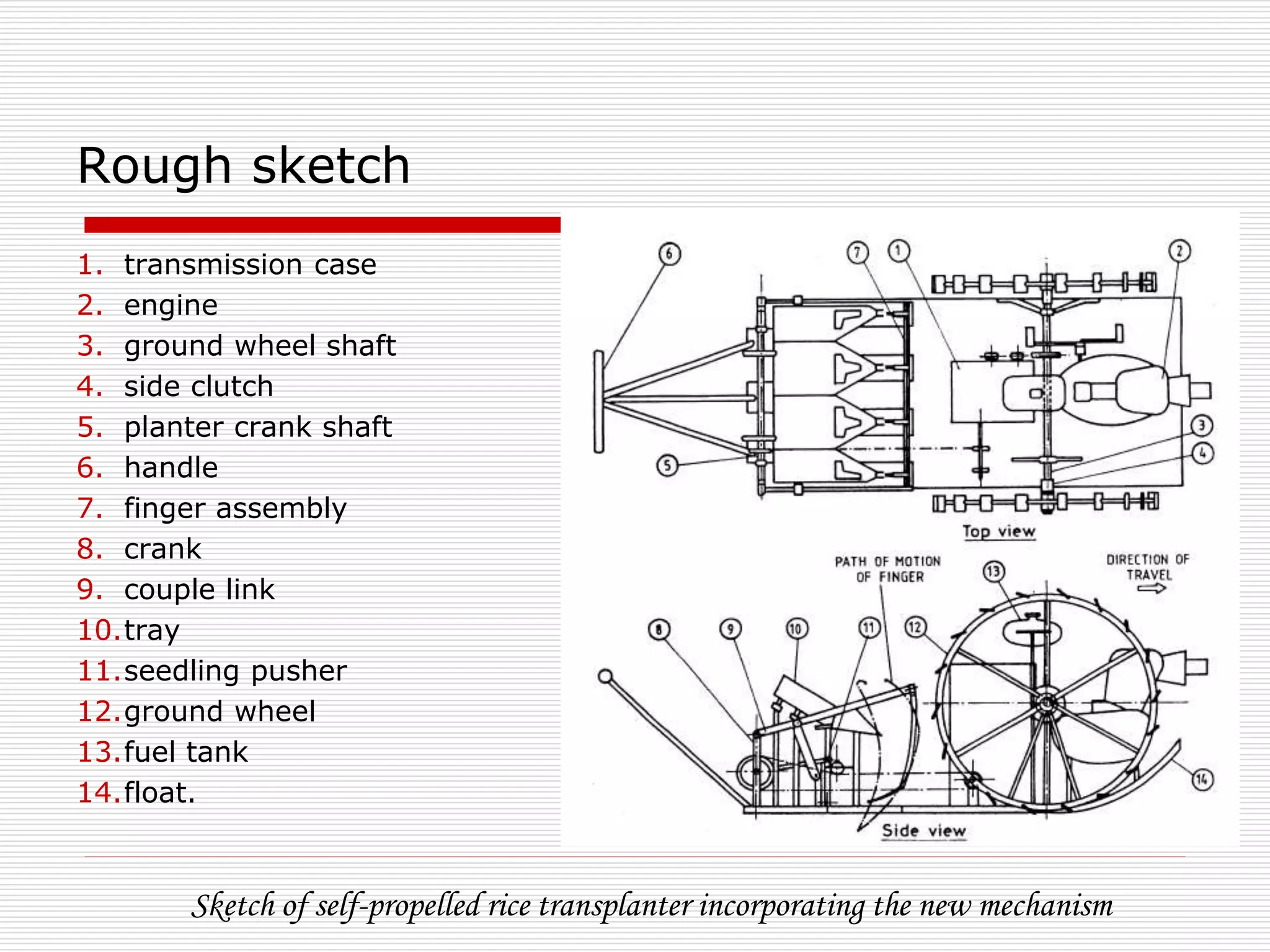
Rough sketch 
1. transmission case 
2. engine 
3. ground wheel shaft 
4. side clutch 
5. planter crank shaft 
6. handle 
7. finger assembly 
8. crank 
9. couple link 
10.tray 
11.seedling pusher 
12.ground wheel 
13.fuel tank 
14.float. 
Sketch of self-propelled rice transplanter incorporating the new mechanism
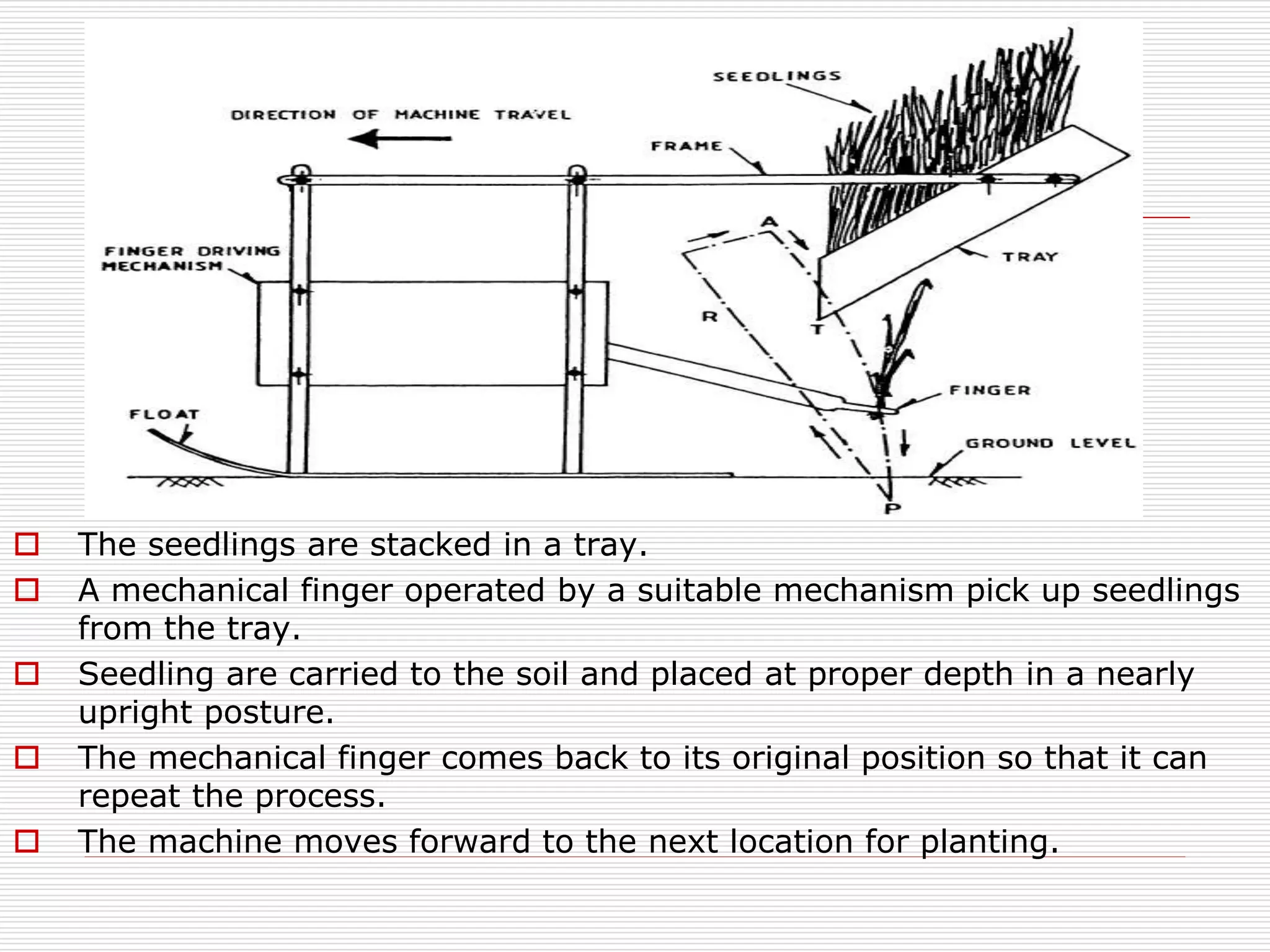
 The seedlings are stacked in a tray. 
 A mechanical finger operated by a suitable mechanism pick up seedlings 
from the tray. 
 Seedling are carried to the soil and placed at proper depth in a nearly 
upright posture. 
 The mechanical finger comes back to its original position so that it can 
repeat the process. 
 The machine moves forward to the next location for planting.
Methodology 
1. Output motion requirements of the proposed planting mechanism 
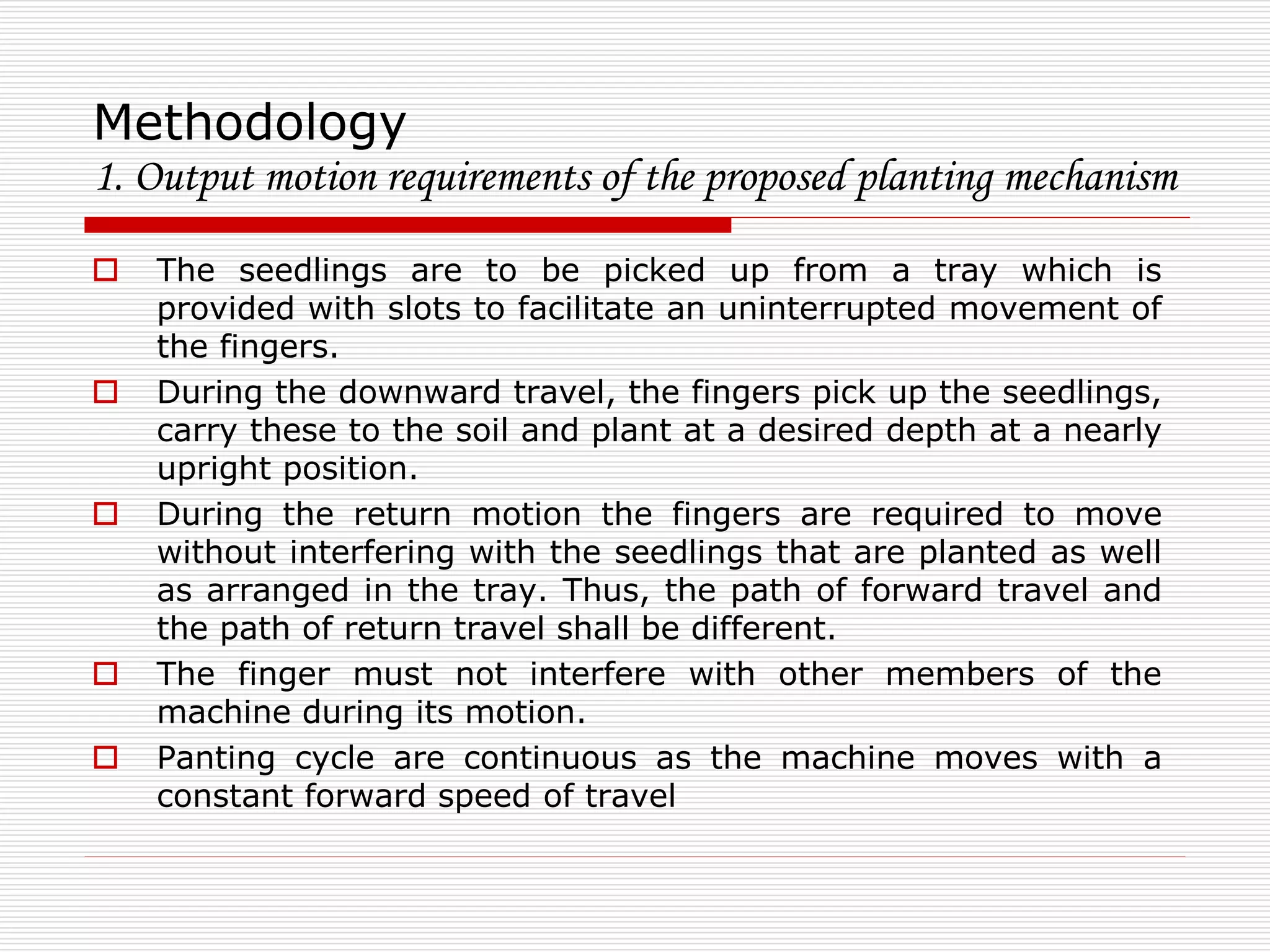
 The seedlings are to be picked up from a tray which is 
provided with slots to facilitate an uninterrupted movement of 
the fingers. 
 During the downward travel, the fingers pick up the seedlings, 
carry these to the soil and plant at a desired depth at a nearly 
upright position. 
 During the return motion the fingers are required to move 
without interfering with the seedlings that are planted as well 
as arranged in the tray. Thus, the path of forward travel and 
the path of return travel shall be different. 
 The finger must not interfere with other members of the 
machine during its motion. 
 Panting cycle are continuous as the machine moves with a 
constant forward speed of travel
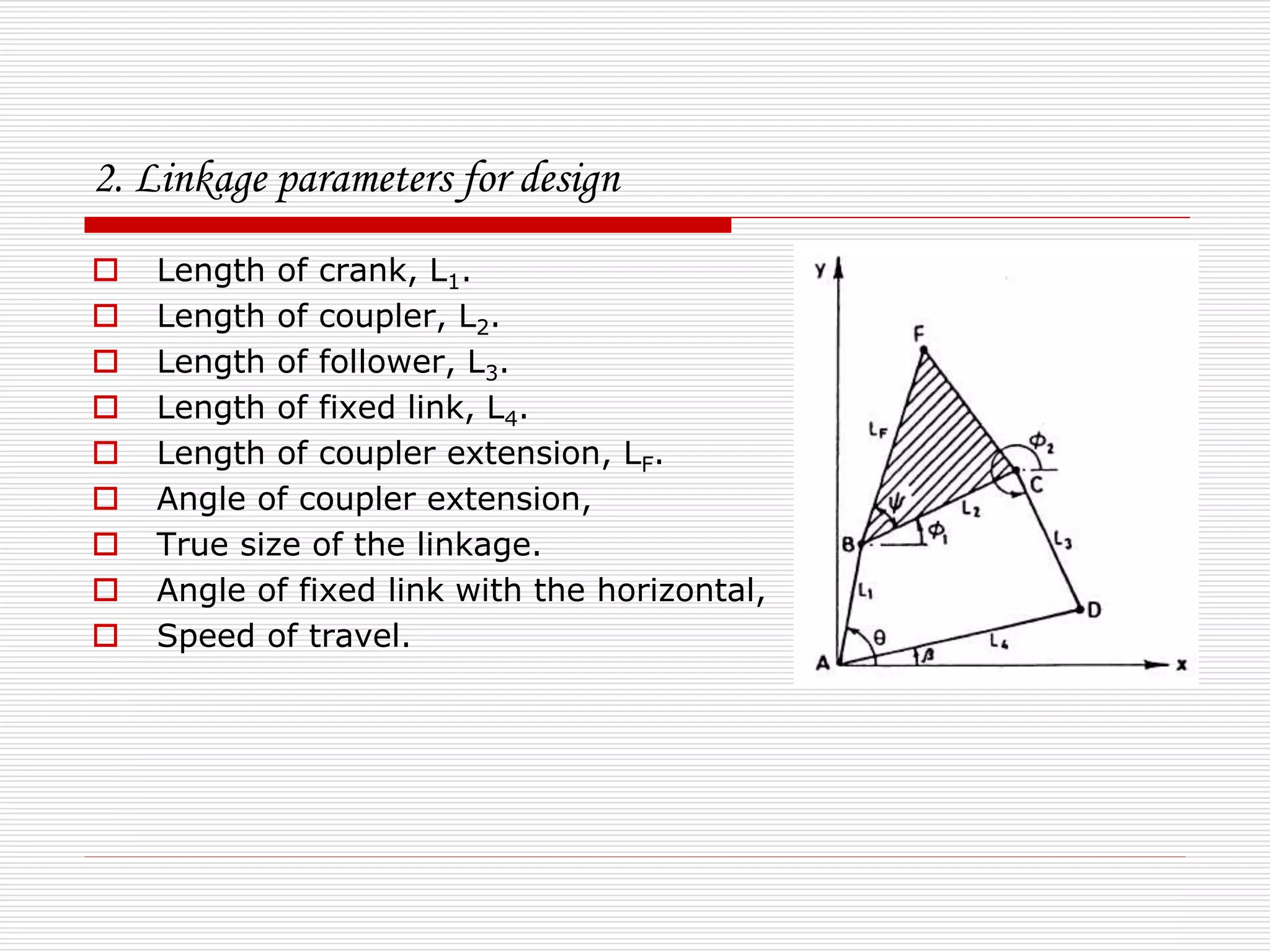
2. Linkage parameters for design 
 Length of crank, L1. 
 Length of coupler, L2. 
 Length of follower, L3. 
 Length of fixed link, L4. 
 Length of coupler extension, LF. 
 Angle of coupler extension, 
 True size of the linkage. 
 Angle of fixed link with the horizontal, 
 Speed of travel.
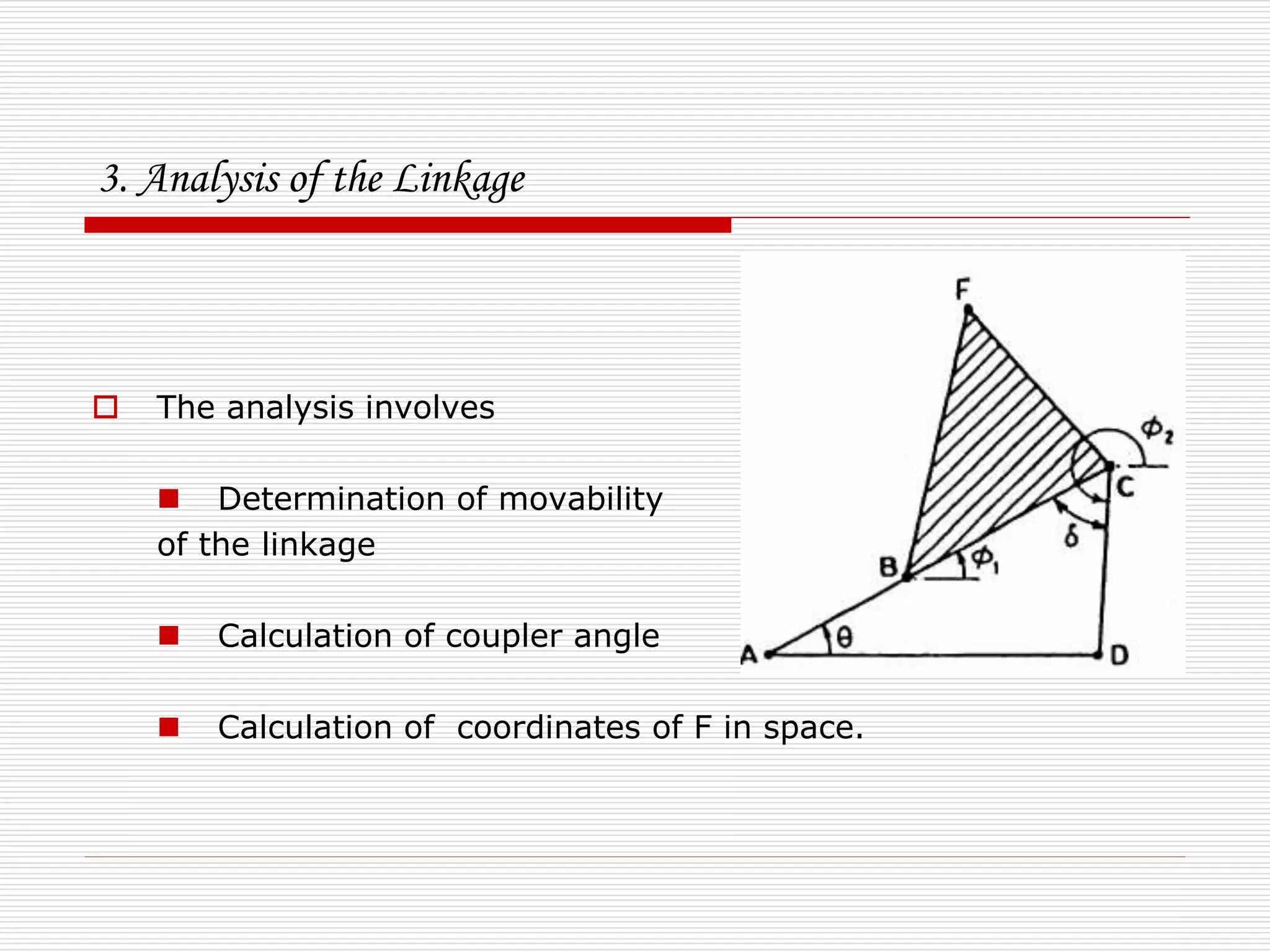
3. Analysis of the Linkage 
 The analysis involves 
 Determination of movability 
of the linkage 
 Calculation of coupler angle 
 Calculation of coordinates of F in space.
Contd… 
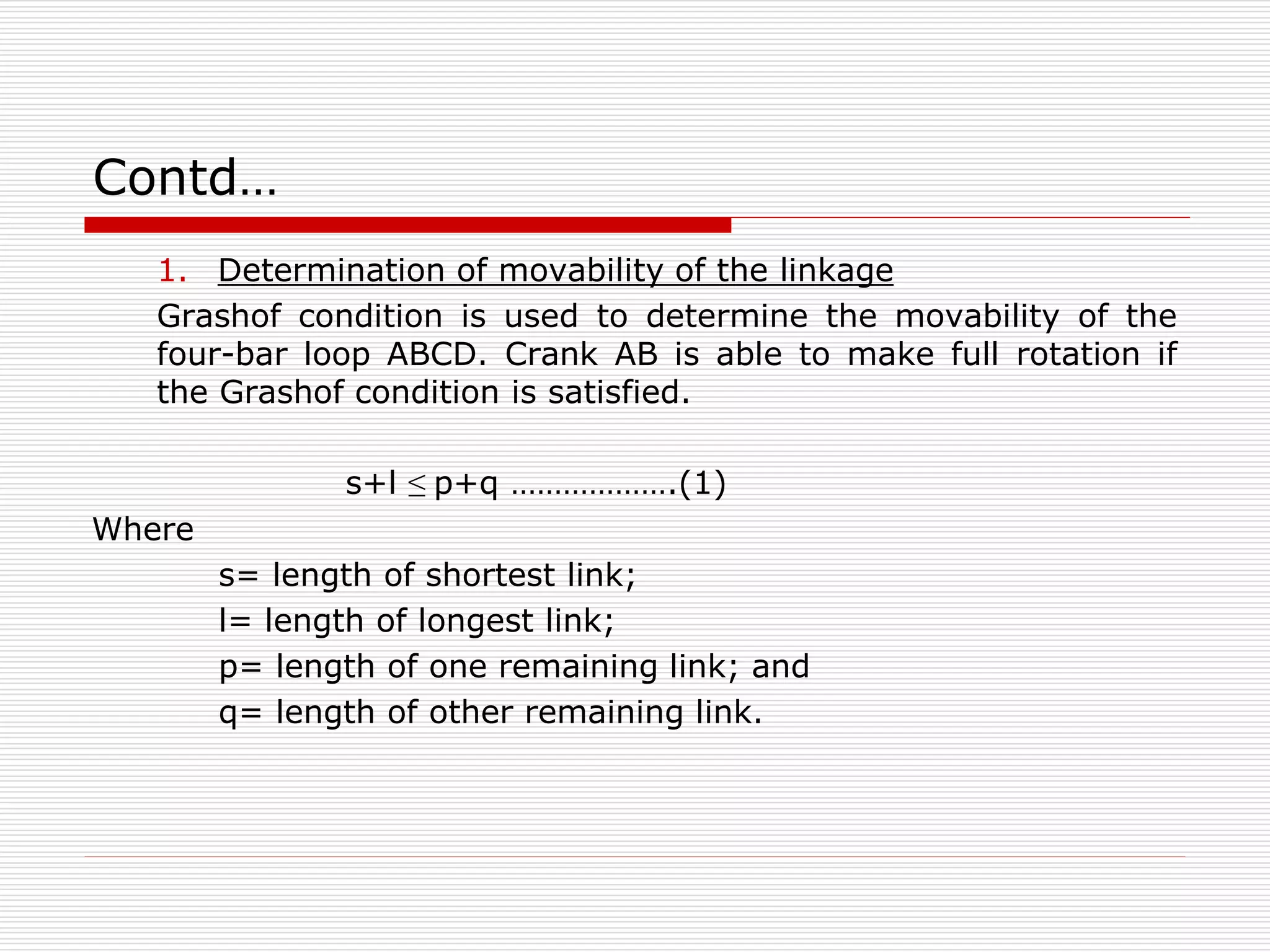
1. Determination of movability of the linkage 
Grashof condition is used to determine the movability of the 
four-bar loop ABCD. Crank AB is able to make full rotation if 
the Grashof condition is satisfied. 
s+l ≤ p+q ……………….(1) 
Where 
s= length of shortest link; 
l= length of longest link; 
p= length of one remaining link; and 
q= length of other remaining link.
Contd… 
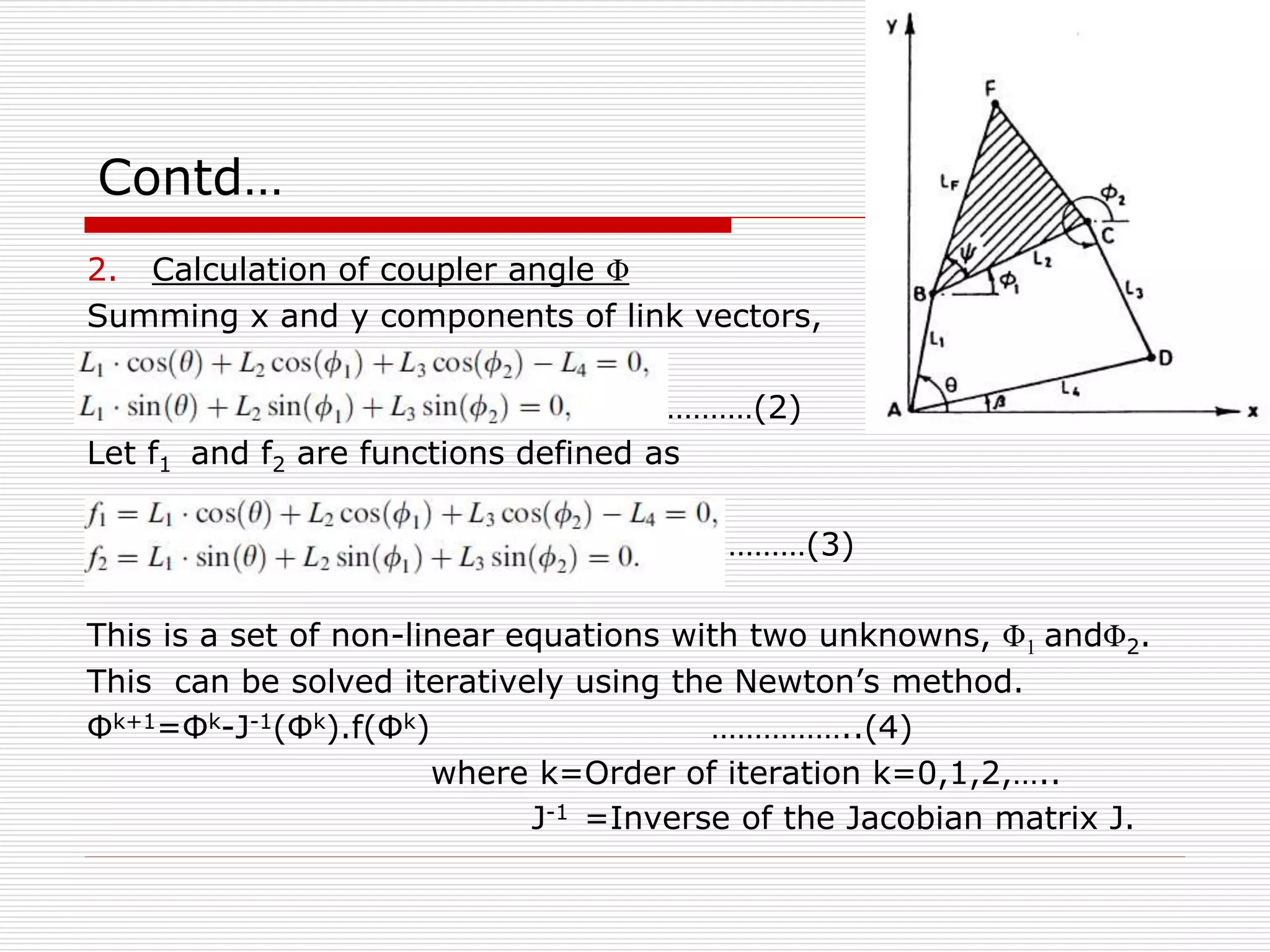
2. Calculation of coupler angle Φ 
Summing x and y components of link vectors, 
…………(2) 
Let f1 and f2 are functions defined as 
………(3) 
This is a set of non-linear equations with two unknowns, Φ1 andΦ2. 
This can be solved iteratively using the Newton’s method. 
Φk+1=Φk-J-1(Φk).f(Φk) ……………..(4) 
where k=Order of iteration k=0,1,2,….. 
J-1 =Inverse of the Jacobian matrix J.
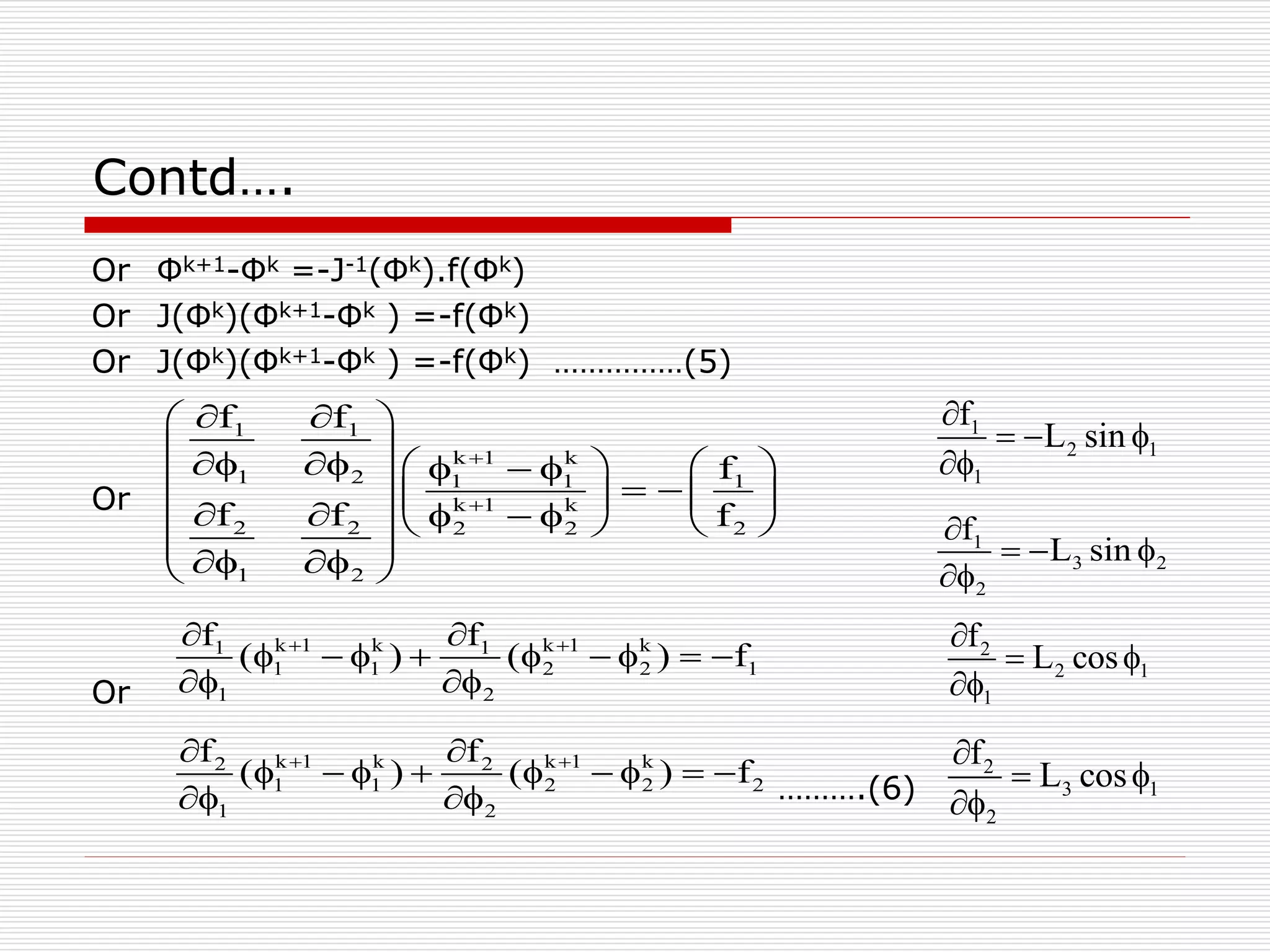
Contd…. 
Or Φk+1-Φk =-J-1(Φk).f(Φk) 
Or J(Φk)(Φk+1-Φk ) =-f(Φk) 
Or J(Φk)(Φk+1-Φk ) =-f(Φk) ……………(5) 
Or 
Or 
    
                  
           
  
    
( ) ( ) f     
         
  
( ) ( ) f     
         
  
……….(6) 
f f 
1 1 
k  
1 k 
1 2 1 1 1 
k  
1 k 
2 2 2 2 2 
1 2 
f 
f f f 
f f 
1 k 1 k 1 k 1 k 
1 1 2 2 1 
1 2 
f f 
2 k 1 k 2 k 1 k 
1 1 2 2 2 
1 2 
1 
2 1 
1 
f 
L sin 
 
   
 
1 
3 2 
2 
f 
L sin 
 
   
 
2 
2 1 
1 
f 
L cos 
 
  
 
2 
3 1 
2 
f 
L cos 
 
  

Contd… 
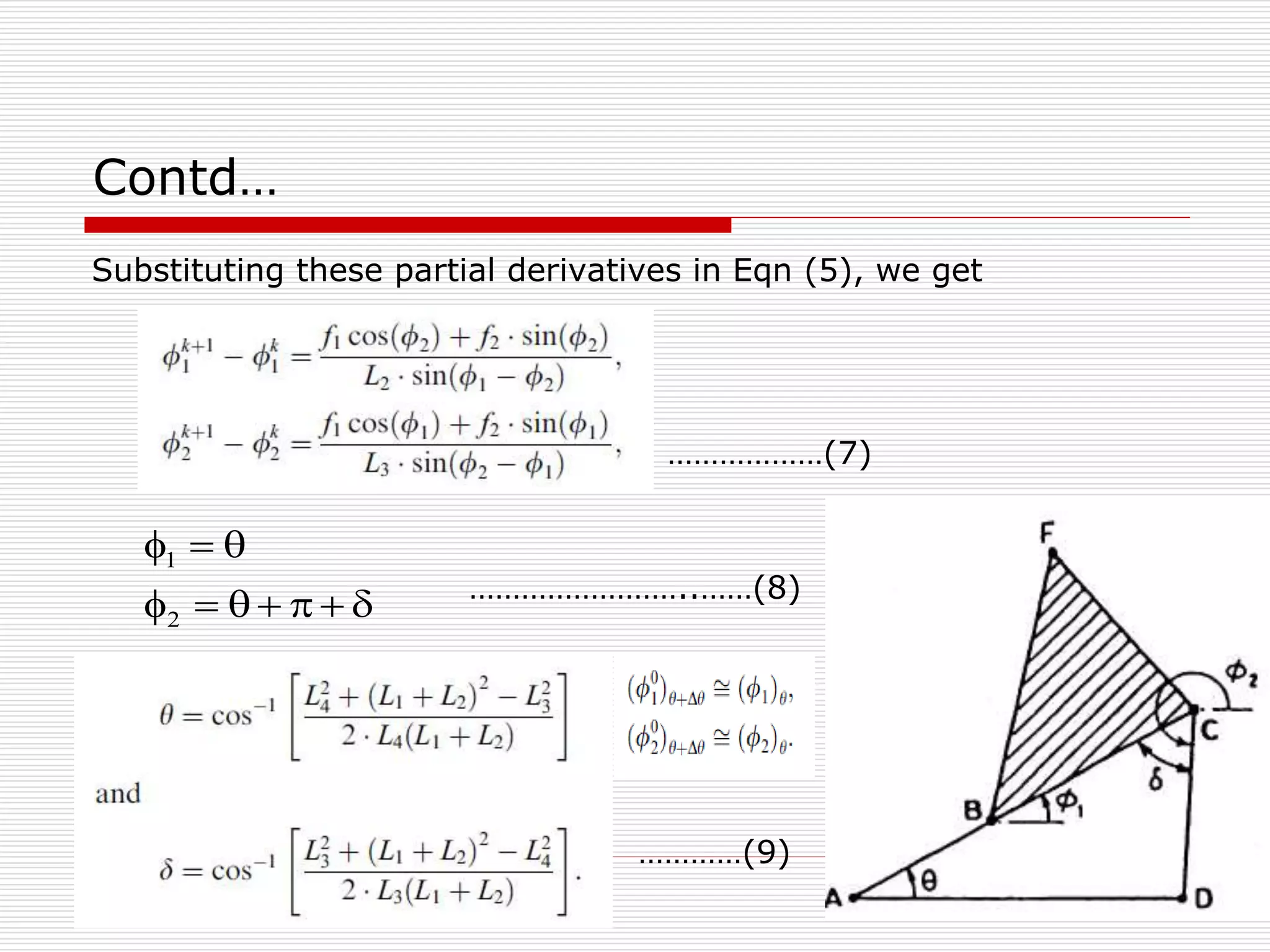
Substituting these partial derivatives in Eqn (5), we get 
………………(7) 
   
1 
       
2 
……………………..……(8) 
…………(9)
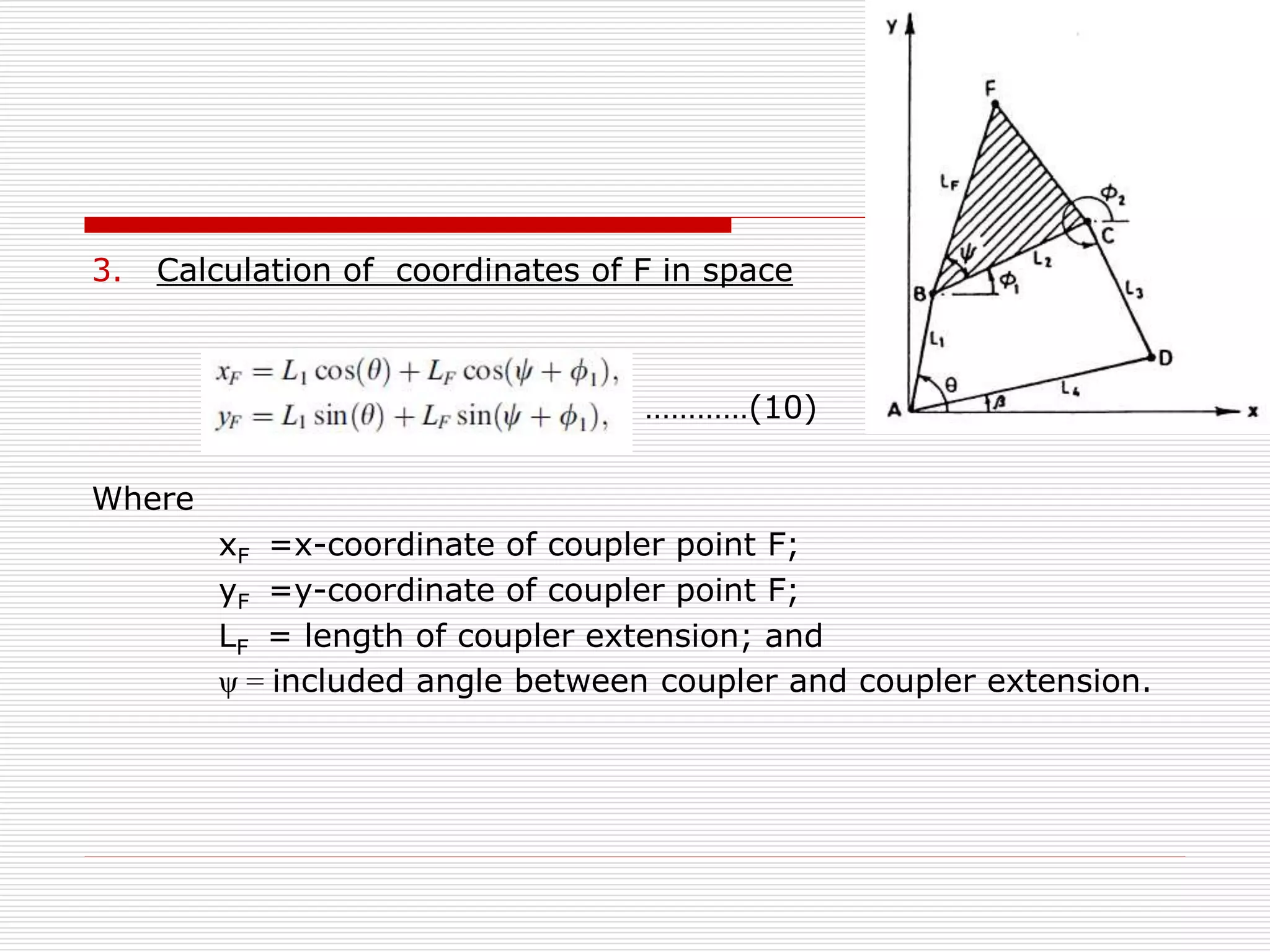
3. Calculation of coordinates of F in space 
…………(10) 
Where 
xF =x-coordinate of coupler point F; 
yF =y-coordinate of coupler point F; 
LF = length of coupler extension; and 
ψ = included angle between coupler and coupler extension.
Computational procedure for calculation and 
display of the path of motion of the finger 
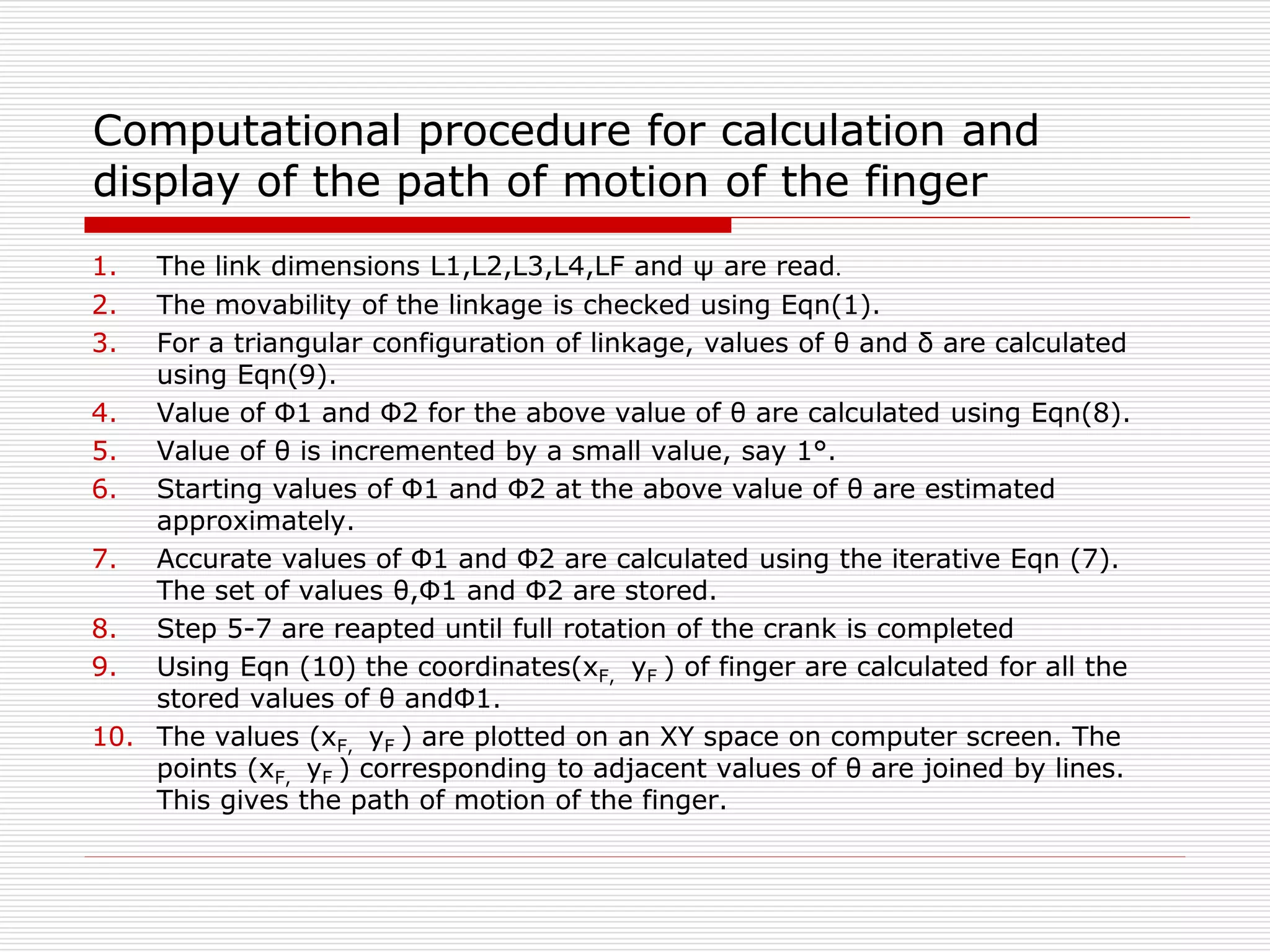
1. The link dimensions L1,L2,L3,L4,LF and ψ are read. 
2. The movability of the linkage is checked using Eqn(1). 
3. For a triangular configuration of linkage, values of θ and δ are calculated 
using Eqn(9). 
4. Value of Φ1 and Φ2 for the above value of θ are calculated using Eqn(8). 
5. Value of θ is incremented by a small value, say 1°. 
6. Starting values of Φ1 and Φ2 at the above value of θ are estimated 
approximately. 
7. Accurate values of Φ1 and Φ2 are calculated using the iterative Eqn (7). 
The set of values θ,Φ1 and Φ2 are stored. 
8. Step 5-7 are reapted until full rotation of the crank is completed 
9. Using Eqn (10) the coordinates(xF, yF ) of finger are calculated for all the 
stored values of θ andΦ1. 
10. The values (xF, yF ) are plotted on an XY space on computer screen. The 
points (xF, yF ) corresponding to adjacent values of θ are joined by lines. 
This gives the path of motion of the finger.
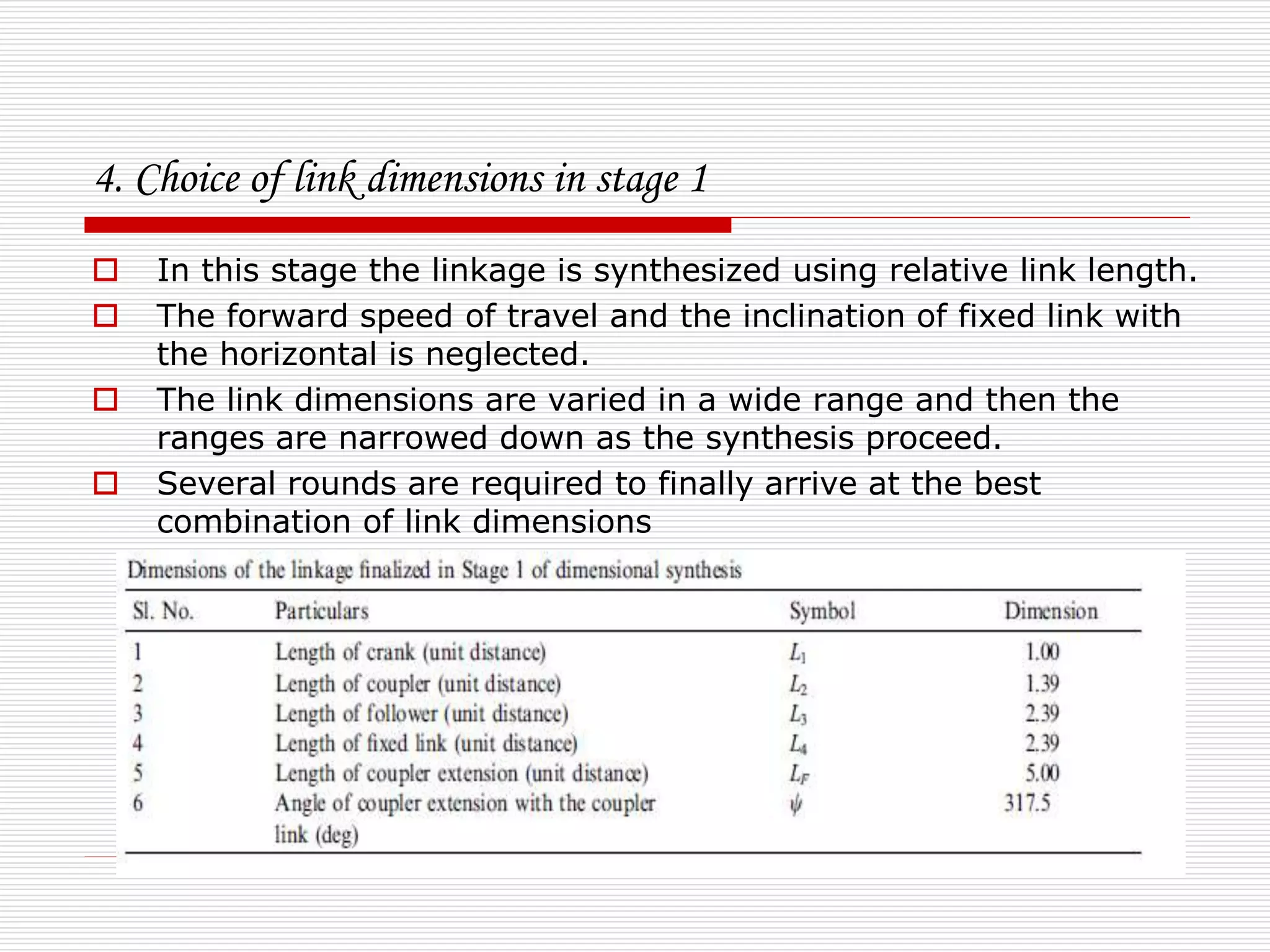
4. Choice of link dimensions in stage 1 
 In this stage the linkage is synthesized using relative link length. 
 The forward speed of travel and the inclination of fixed link with 
the horizontal is neglected. 
 The link dimensions are varied in a wide range and then the 
ranges are narrowed down as the synthesis proceed. 
 Several rounds are required to finally arrive at the best 
combination of link dimensions
Contd… 
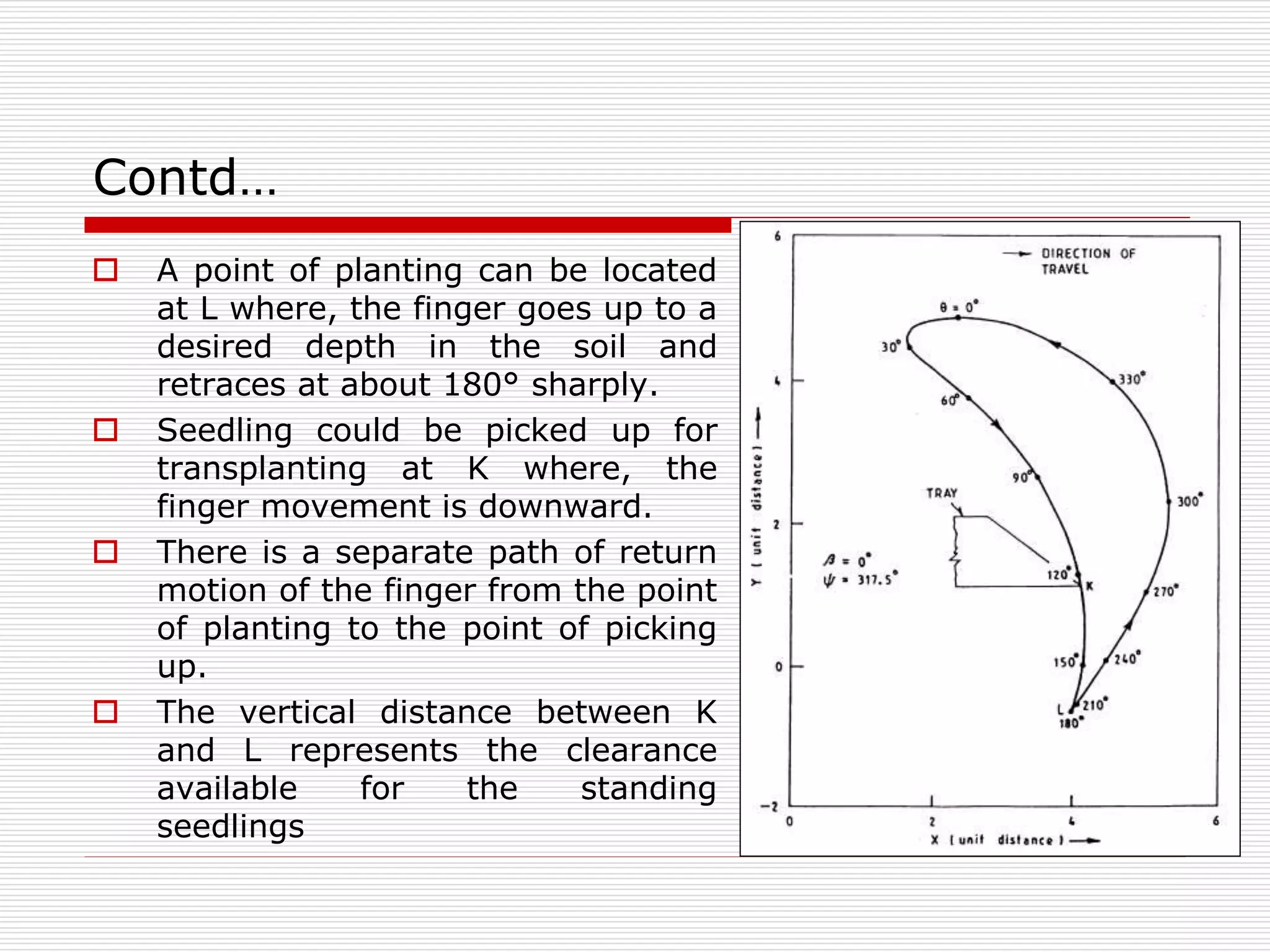
 A point of planting can be located 
at L where, the finger goes up to a 
desired depth in the soil and 
retraces at about 180° sharply. 
 Seedling could be picked up for 
transplanting at K where, the 
finger movement is downward. 
 There is a separate path of return 
motion of the finger from the point 
of planting to the point of picking 
up. 
 The vertical distance between K 
and L represents the clearance 
available for the standing 
seedlings
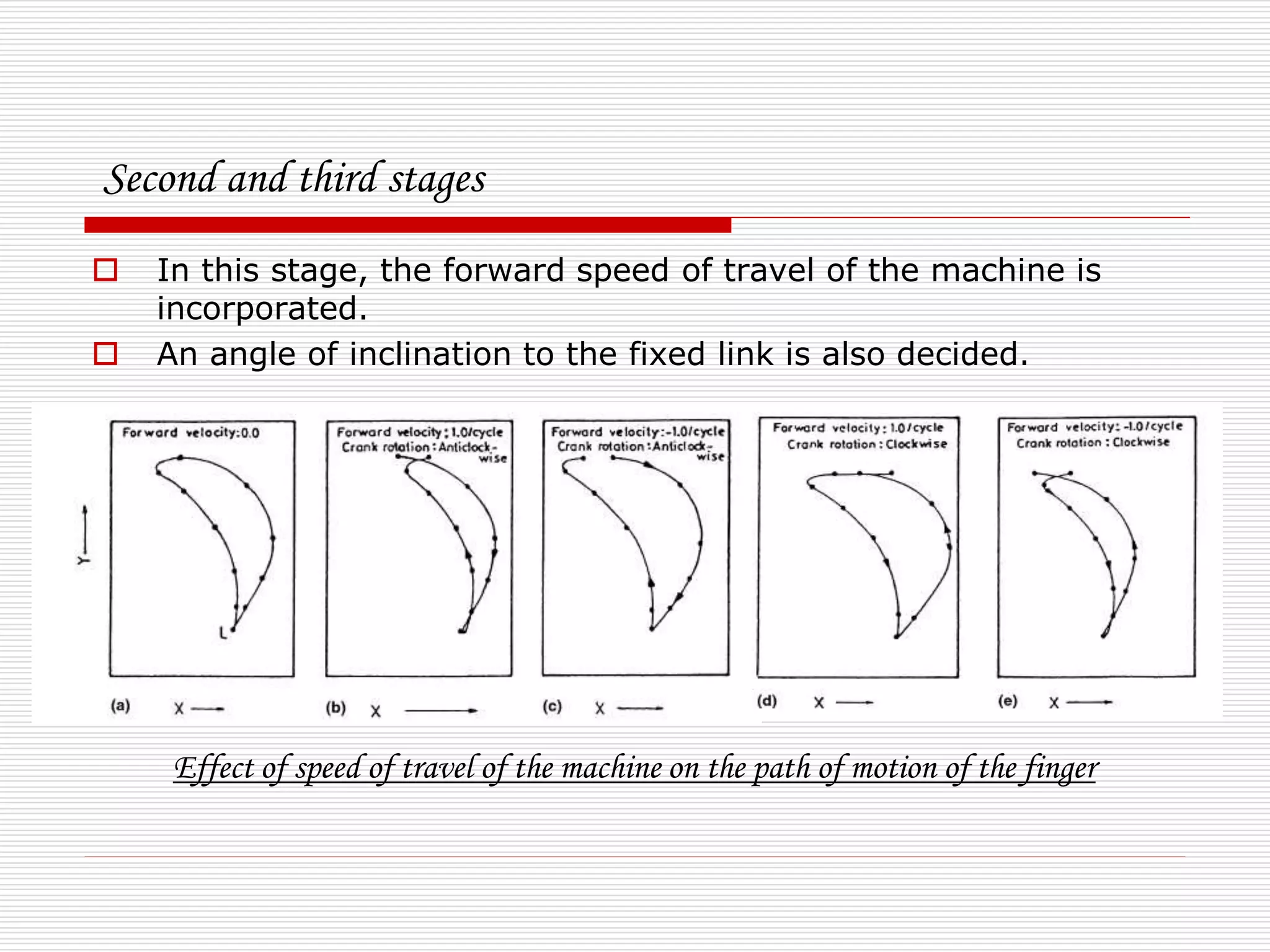
Second and third stages 
 In this stage, the forward speed of travel of the machine is 
incorporated. 
 An angle of inclination to the fixed link is also decided. 
Effect of speed of travel of the machine on the path of motion of the finger
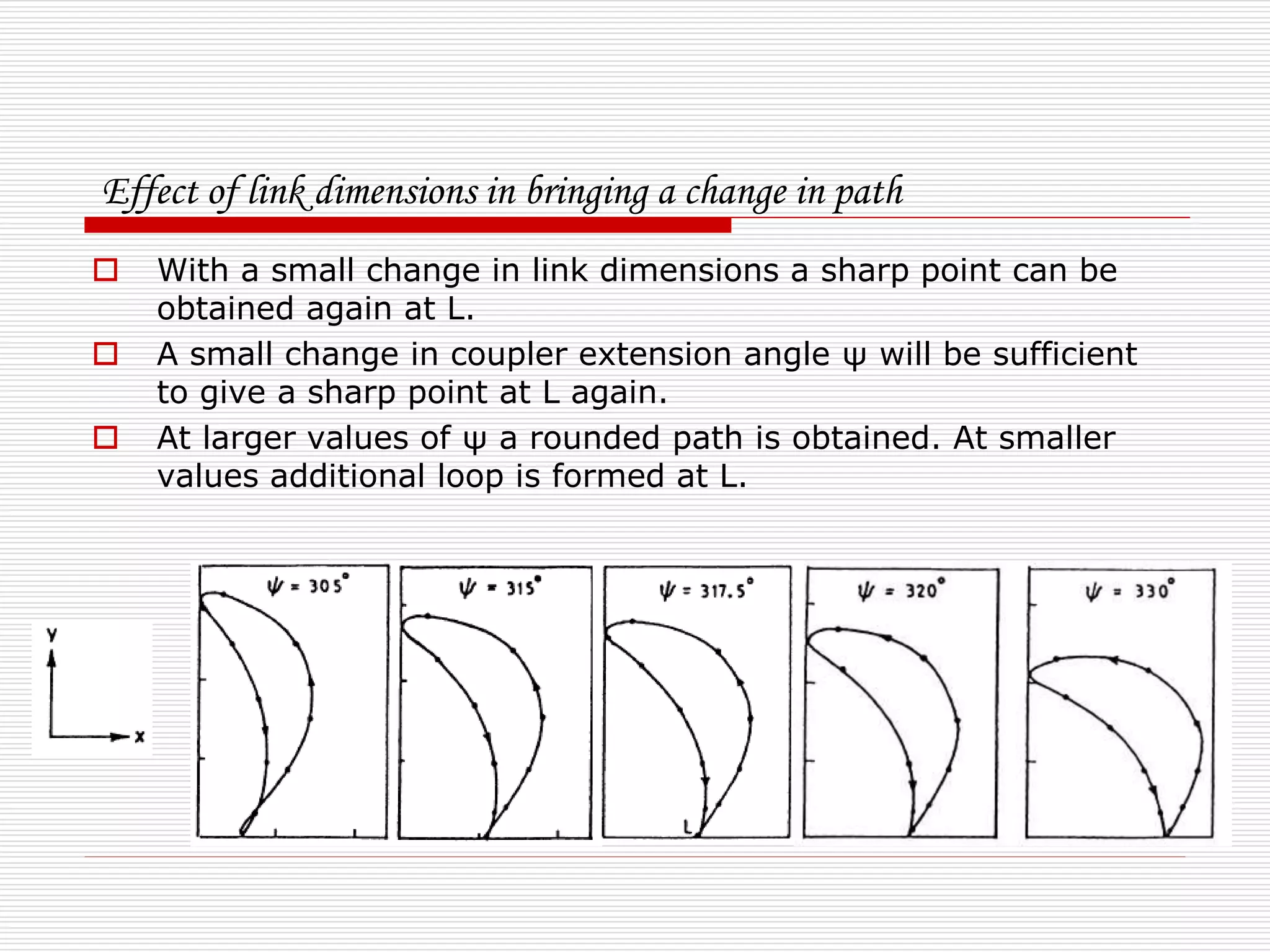
Effect of link dimensions in bringing a change in path 
 With a small change in link dimensions a sharp point can be 
obtained again at L. 
 A small change in coupler extension angle ψ will be sufficient 
to give a sharp point at L again. 
 At larger values of ψ a rounded path is obtained. At smaller 
values additional loop is formed at L.
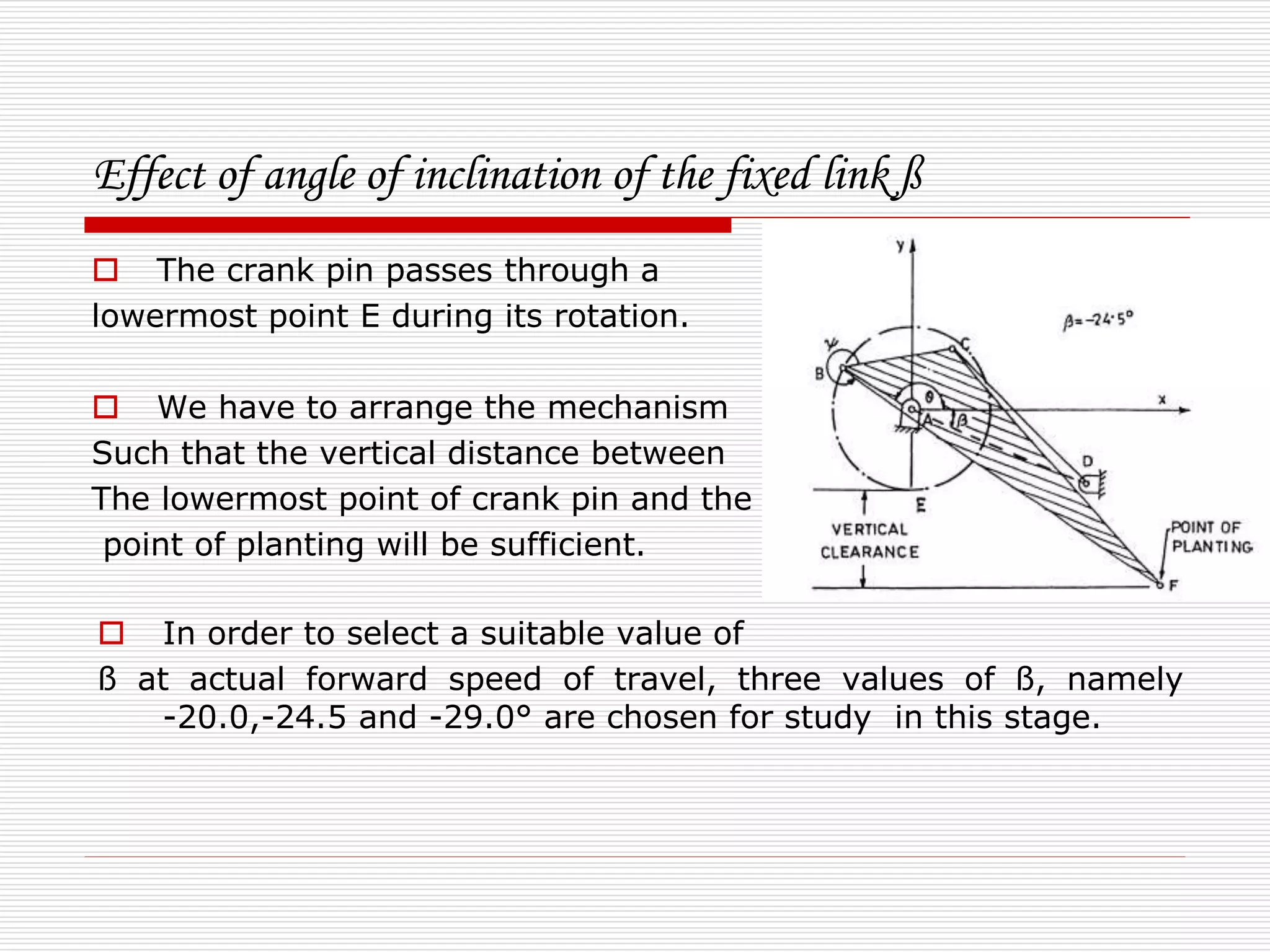
Effect of angle of inclination of the fixed link ß 
 The crank pin passes through a 
lowermost point E during its rotation. 
 We have to arrange the mechanism 
Such that the vertical distance between 
The lowermost point of crank pin and the 
point of planting will be sufficient. 
 In order to select a suitable value of 
ß at actual forward speed of travel, three values of ß, namely 
-20.0,-24.5 and -29.0° are chosen for study in this stage.
Contd… 
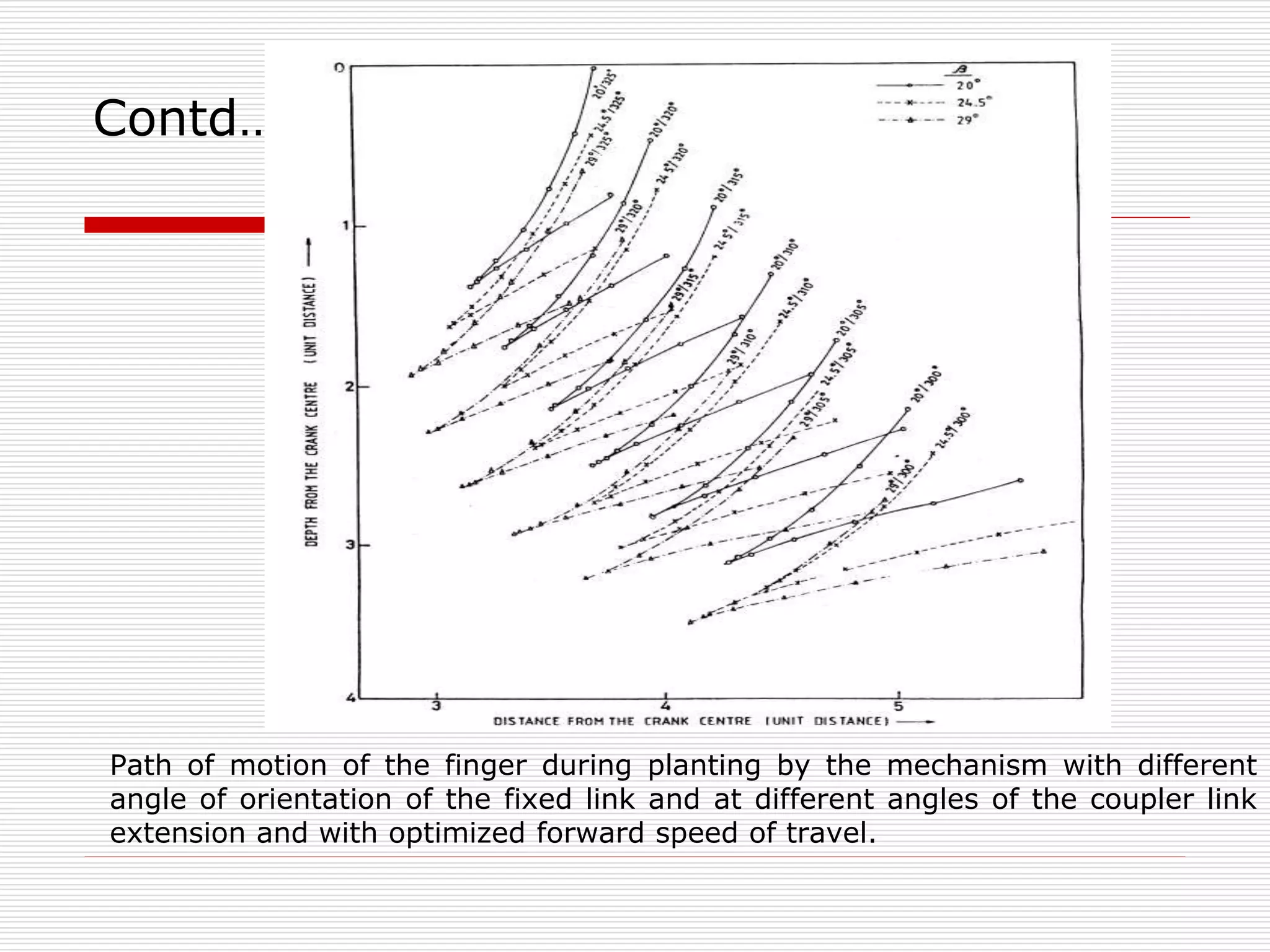
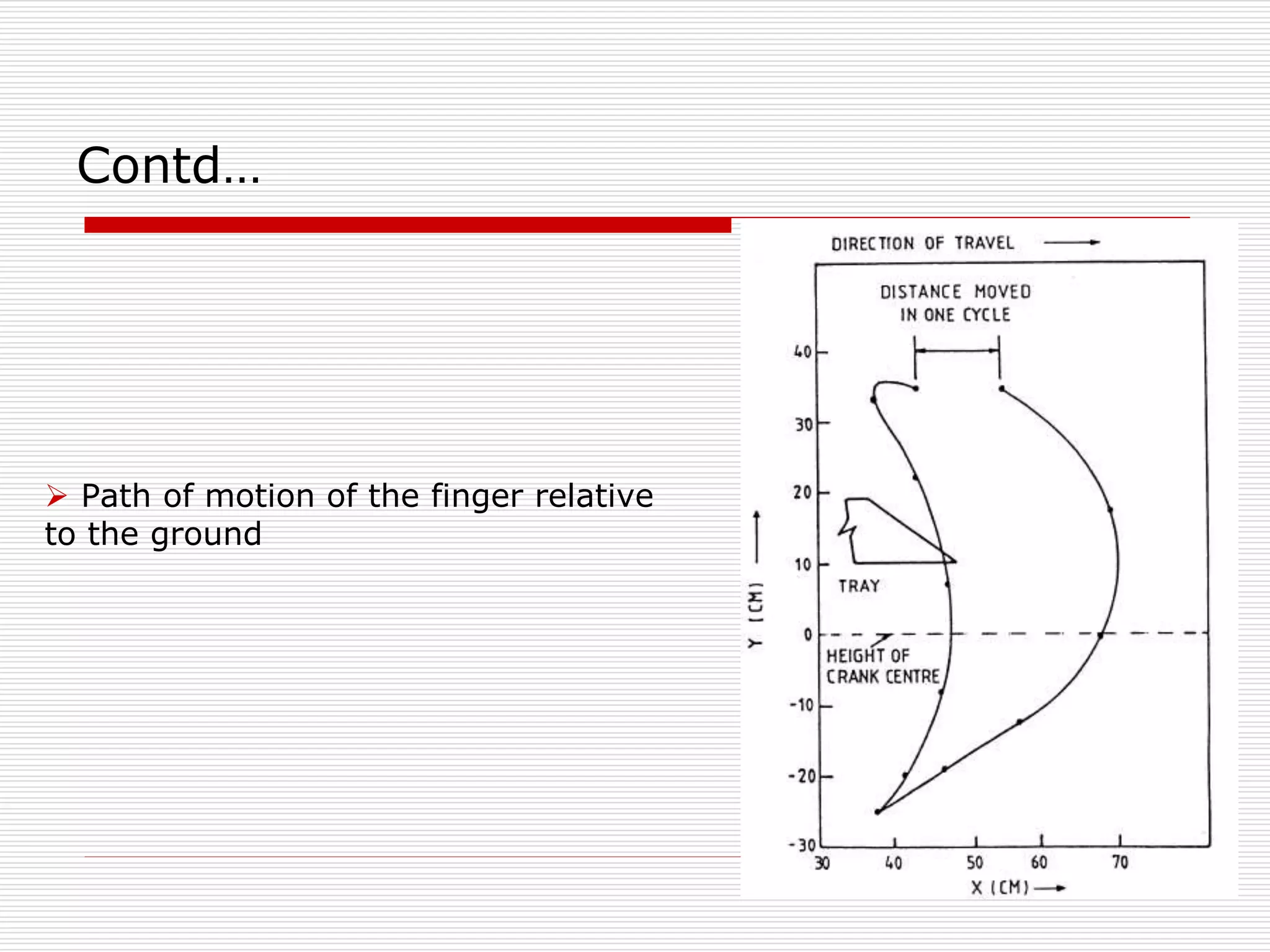
Path of motion of the finger during planting by the mechanism with different 
angle of orientation of the fixed link and at different angles of the coupler link 
extension and with optimized forward speed of travel.
Contd… 
 Path of motion of the finger relative 
to the ground
Conclusions 
 The CAD for the synthesis of a linkage mechanism is an elaborate but 
effective process to attain a near perfect simulation of manual 
transplanting system. 
 The fixed fork type fingers traversed the path in the form of a loop as 
per theoretical design and these are simple in construction and easy to 
operate. 
 Fuel consumption is less because of a smaller engine. It can be further 
reduced by reducing the weight of the machine, using lighter materials 
in frame, transmission system and float. 
 The output of the machine can be further improved by increasing the 
number of rows. 
 The standing posture involved in machine transplanting is more 
comfortable compared to the stooping posture of manual system.
References 
 Thomas E V. Development of a mechanism for transplanting 
rice seedlings. Mechanism and machine Theory 37(2002) 395- 
410 
 Kepner R. A.; Bainer Roy; Barger E.L. Principles of farm 
machinery; crop planting 233-234. 
 J.E. Shigley, Kinematic Analysis of Mechanisms, second edition, 
McGraw-Hill, 1969. 
 L. Zimmerman, Mechanization of Motion, Wiley, New York, 
1961.
Thank you

Rice transplanter mechanism

  • 1.
    Development of amechanism for transplanting rice seedling Edathiparambil Vareed Thomas Presented by: Priyabrata Pradhan(10AG61R08)
  • 2.
    Introduction  Indiais predominantly an agricultural country with rice as one of its main food crop.  Its produces about 80 million tons rice annually, which is about 22% of the world rice production.  Culturally, transplanting of young seedlings is preferred over direct seeding for better yield and better crop management practices.  But this operation requires large amount of manpower (about 400 man-hour/ha) and task is very laborious involving working in a stooping posture and moving in muddy field.  Hence, this is considered as an activity that needs mechanisation.
  • 3.
    Objectives  Todevelop a mechanism for transplanting rice seedlings using the method of analytical synthesis.  To develop a four row self-propelled transplanter and an optimized-planting finger using the above mechanism.
  • 4.
    Rough sketch 1.transmission case 2. engine 3. ground wheel shaft 4. side clutch 5. planter crank shaft 6. handle 7. finger assembly 8. crank 9. couple link 10.tray 11.seedling pusher 12.ground wheel 13.fuel tank 14.float. Sketch of self-propelled rice transplanter incorporating the new mechanism
  • 5.
     The seedlingsare stacked in a tray.  A mechanical finger operated by a suitable mechanism pick up seedlings from the tray.  Seedling are carried to the soil and placed at proper depth in a nearly upright posture.  The mechanical finger comes back to its original position so that it can repeat the process.  The machine moves forward to the next location for planting.
  • 6.
    Methodology 1. Outputmotion requirements of the proposed planting mechanism  The seedlings are to be picked up from a tray which is provided with slots to facilitate an uninterrupted movement of the fingers.  During the downward travel, the fingers pick up the seedlings, carry these to the soil and plant at a desired depth at a nearly upright position.  During the return motion the fingers are required to move without interfering with the seedlings that are planted as well as arranged in the tray. Thus, the path of forward travel and the path of return travel shall be different.  The finger must not interfere with other members of the machine during its motion.  Panting cycle are continuous as the machine moves with a constant forward speed of travel
  • 7.
    2. Linkage parametersfor design  Length of crank, L1.  Length of coupler, L2.  Length of follower, L3.  Length of fixed link, L4.  Length of coupler extension, LF.  Angle of coupler extension,  True size of the linkage.  Angle of fixed link with the horizontal,  Speed of travel.
  • 8.
    3. Analysis ofthe Linkage  The analysis involves  Determination of movability of the linkage  Calculation of coupler angle  Calculation of coordinates of F in space.
  • 9.
    Contd… 1. Determinationof movability of the linkage Grashof condition is used to determine the movability of the four-bar loop ABCD. Crank AB is able to make full rotation if the Grashof condition is satisfied. s+l ≤ p+q ……………….(1) Where s= length of shortest link; l= length of longest link; p= length of one remaining link; and q= length of other remaining link.
  • 10.
    Contd… 2. Calculationof coupler angle Φ Summing x and y components of link vectors, …………(2) Let f1 and f2 are functions defined as ………(3) This is a set of non-linear equations with two unknowns, Φ1 andΦ2. This can be solved iteratively using the Newton’s method. Φk+1=Φk-J-1(Φk).f(Φk) ……………..(4) where k=Order of iteration k=0,1,2,….. J-1 =Inverse of the Jacobian matrix J.
  • 11.
    Contd…. Or Φk+1-Φk=-J-1(Φk).f(Φk) Or J(Φk)(Φk+1-Φk ) =-f(Φk) Or J(Φk)(Φk+1-Φk ) =-f(Φk) ……………(5) Or Or                                        ( ) ( ) f                ( ) ( ) f                ……….(6) f f 1 1 k  1 k 1 2 1 1 1 k  1 k 2 2 2 2 2 1 2 f f f f f f 1 k 1 k 1 k 1 k 1 1 2 2 1 1 2 f f 2 k 1 k 2 k 1 k 1 1 2 2 2 1 2 1 2 1 1 f L sin      1 3 2 2 f L sin      2 2 1 1 f L cos     2 3 1 2 f L cos    
  • 12.
    Contd… Substituting thesepartial derivatives in Eqn (5), we get ………………(7)    1        2 ……………………..……(8) …………(9)
  • 13.
    3. Calculation ofcoordinates of F in space …………(10) Where xF =x-coordinate of coupler point F; yF =y-coordinate of coupler point F; LF = length of coupler extension; and ψ = included angle between coupler and coupler extension.
  • 14.
    Computational procedure forcalculation and display of the path of motion of the finger 1. The link dimensions L1,L2,L3,L4,LF and ψ are read. 2. The movability of the linkage is checked using Eqn(1). 3. For a triangular configuration of linkage, values of θ and δ are calculated using Eqn(9). 4. Value of Φ1 and Φ2 for the above value of θ are calculated using Eqn(8). 5. Value of θ is incremented by a small value, say 1°. 6. Starting values of Φ1 and Φ2 at the above value of θ are estimated approximately. 7. Accurate values of Φ1 and Φ2 are calculated using the iterative Eqn (7). The set of values θ,Φ1 and Φ2 are stored. 8. Step 5-7 are reapted until full rotation of the crank is completed 9. Using Eqn (10) the coordinates(xF, yF ) of finger are calculated for all the stored values of θ andΦ1. 10. The values (xF, yF ) are plotted on an XY space on computer screen. The points (xF, yF ) corresponding to adjacent values of θ are joined by lines. This gives the path of motion of the finger.
  • 15.
    4. Choice oflink dimensions in stage 1  In this stage the linkage is synthesized using relative link length.  The forward speed of travel and the inclination of fixed link with the horizontal is neglected.  The link dimensions are varied in a wide range and then the ranges are narrowed down as the synthesis proceed.  Several rounds are required to finally arrive at the best combination of link dimensions
  • 16.
    Contd…  Apoint of planting can be located at L where, the finger goes up to a desired depth in the soil and retraces at about 180° sharply.  Seedling could be picked up for transplanting at K where, the finger movement is downward.  There is a separate path of return motion of the finger from the point of planting to the point of picking up.  The vertical distance between K and L represents the clearance available for the standing seedlings
  • 17.
    Second and thirdstages  In this stage, the forward speed of travel of the machine is incorporated.  An angle of inclination to the fixed link is also decided. Effect of speed of travel of the machine on the path of motion of the finger
  • 18.
    Effect of linkdimensions in bringing a change in path  With a small change in link dimensions a sharp point can be obtained again at L.  A small change in coupler extension angle ψ will be sufficient to give a sharp point at L again.  At larger values of ψ a rounded path is obtained. At smaller values additional loop is formed at L.
  • 19.
    Effect of angleof inclination of the fixed link ß  The crank pin passes through a lowermost point E during its rotation.  We have to arrange the mechanism Such that the vertical distance between The lowermost point of crank pin and the point of planting will be sufficient.  In order to select a suitable value of ß at actual forward speed of travel, three values of ß, namely -20.0,-24.5 and -29.0° are chosen for study in this stage.
  • 20.
    Contd… Path ofmotion of the finger during planting by the mechanism with different angle of orientation of the fixed link and at different angles of the coupler link extension and with optimized forward speed of travel.
  • 21.
    Contd…  Pathof motion of the finger relative to the ground
  • 22.
    Conclusions  TheCAD for the synthesis of a linkage mechanism is an elaborate but effective process to attain a near perfect simulation of manual transplanting system.  The fixed fork type fingers traversed the path in the form of a loop as per theoretical design and these are simple in construction and easy to operate.  Fuel consumption is less because of a smaller engine. It can be further reduced by reducing the weight of the machine, using lighter materials in frame, transmission system and float.  The output of the machine can be further improved by increasing the number of rows.  The standing posture involved in machine transplanting is more comfortable compared to the stooping posture of manual system.
  • 25.
    References  ThomasE V. Development of a mechanism for transplanting rice seedlings. Mechanism and machine Theory 37(2002) 395- 410  Kepner R. A.; Bainer Roy; Barger E.L. Principles of farm machinery; crop planting 233-234.  J.E. Shigley, Kinematic Analysis of Mechanisms, second edition, McGraw-Hill, 1969.  L. Zimmerman, Mechanization of Motion, Wiley, New York, 1961.
  • 26.