The American Revolutionary War
The French and Indian War
• 1754 to 1763 war fought over the land in America
between the English and French.
• It was called the Seven Years War in Europe.
• Called the French and Indian War because the
Indians helped the French in the war against the
British. The Indians had nothing to lose. The
British were taking their land, the French were
not.
• The British won, but at a cost a lot of money.
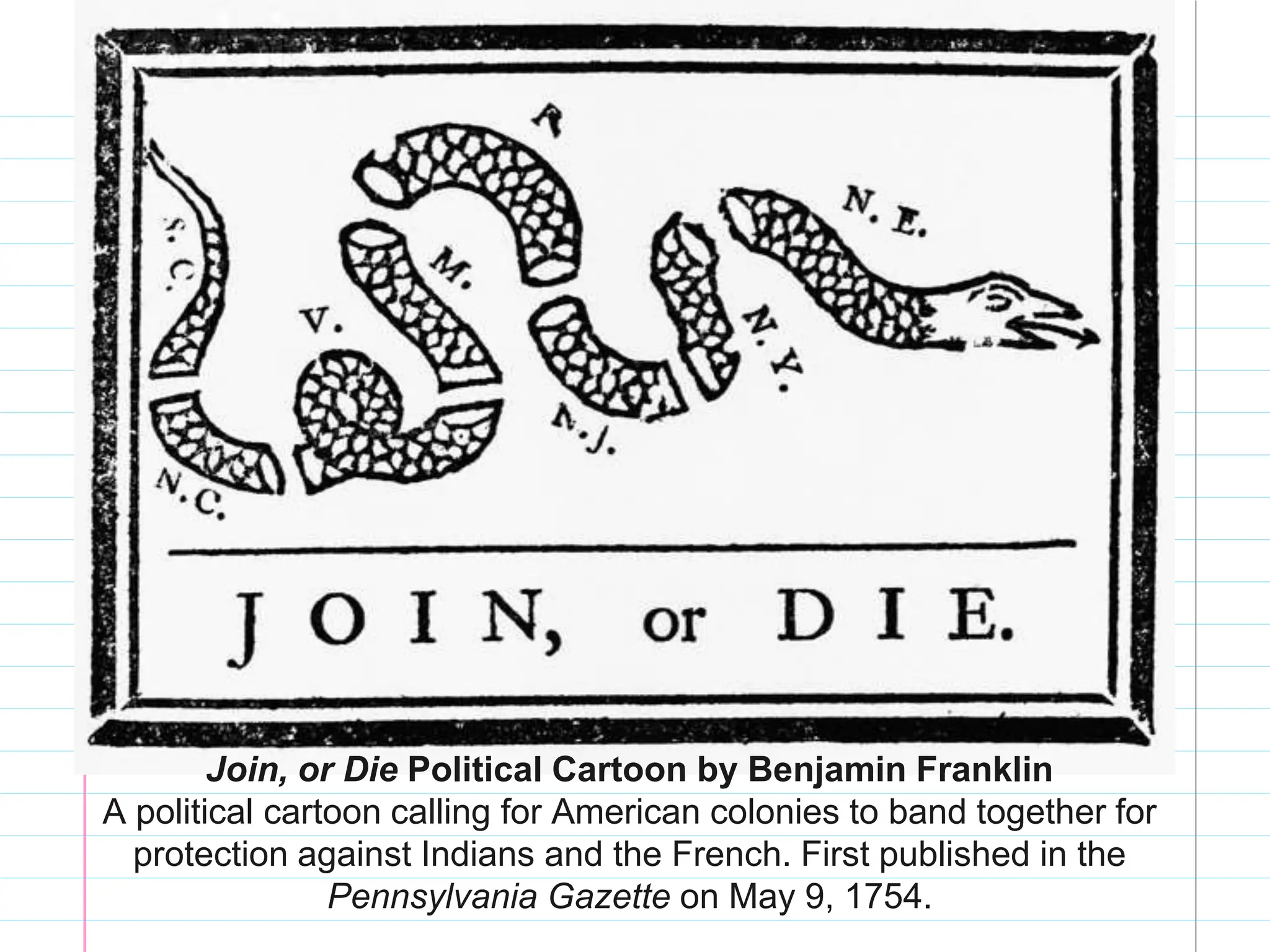
Join, or Die Political Cartoon by Benjamin Franklin
A political cartoon calling for American colonies to band together for
protection against Indians and the French. First published in the
Pennsylvania Gazette on May 9, 1754.
Taxes
• French and Indian War cost a lot of money.
• Parliament (the British government) decided to tax
to colonies to help pay for it.
• The first tax was the Sugar Act of 1764. It placed a
tax on molasses and sugar imported by the
colonies.
• Stamp Act of 1765 placed a tax on all printed
material, such as newspapers and playing cards.
• This tax upset the colonists even more.
No Taxation without
Representation
• The colonists claimed “no taxation without
representation” because they were being
taxed but had no vote in Parliament and had
no say in how the colonies were being
governed.
• The colonists started a boycott, or a refusal
to buy certain goods, from the British.
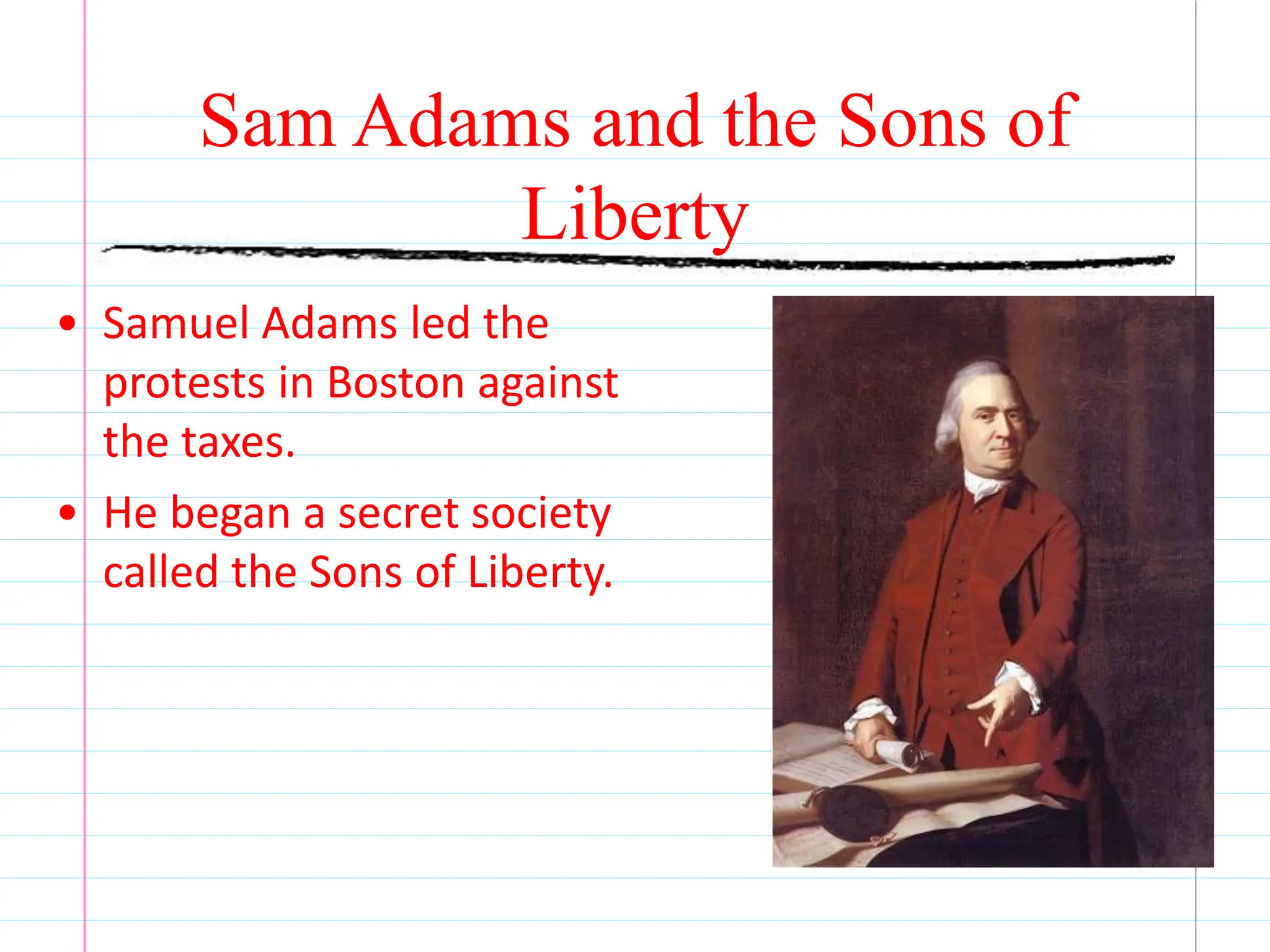
Sam Adams and the Sons of
Liberty
• Samuel Adams led the
protests in Boston against
the taxes.
• He began a secret society
called the Sons of Liberty.
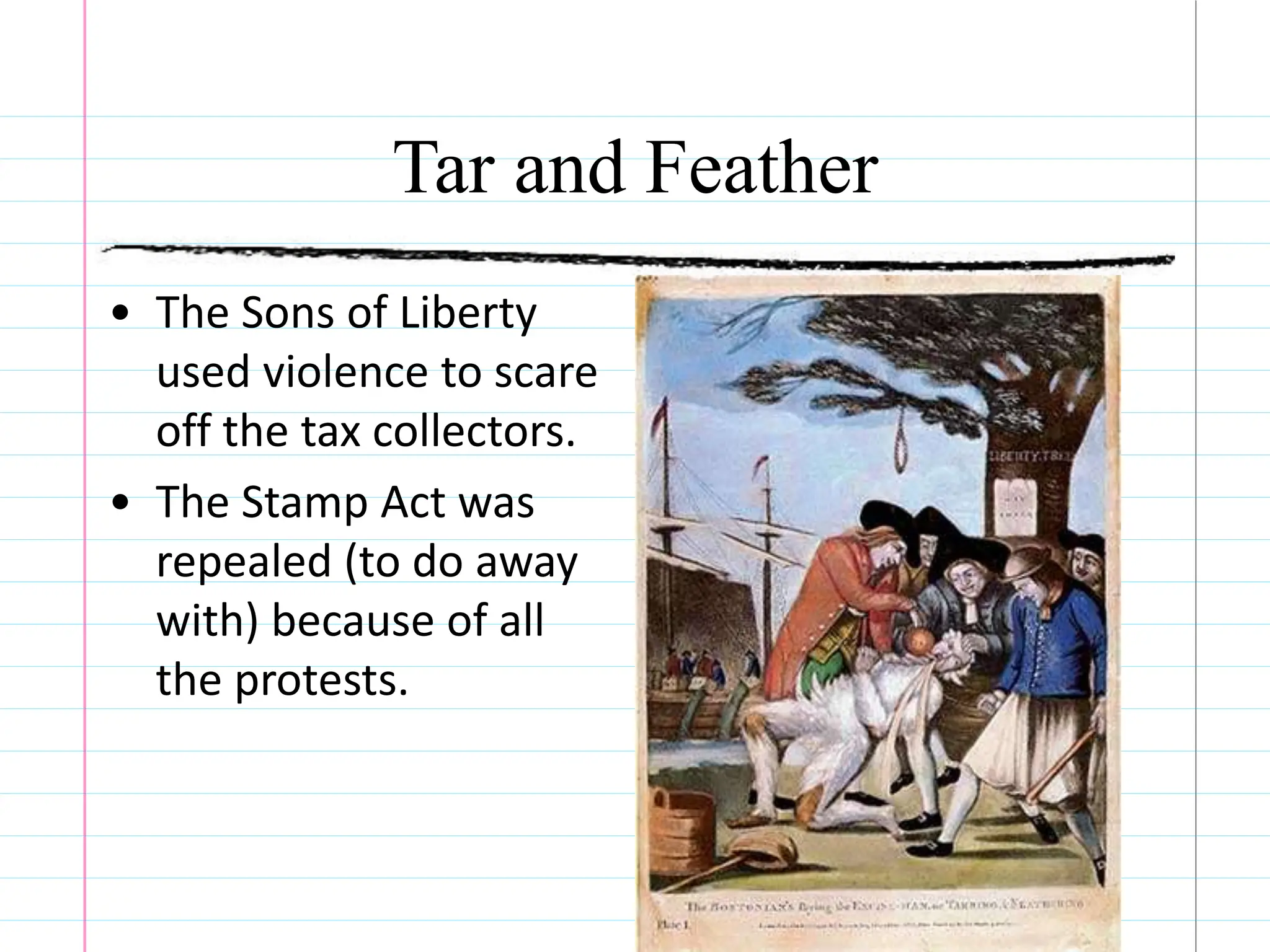
Tar and Feather
• The Sons of Liberty
used violence to scare
off the tax collectors.
• The Stamp Act was
repealed (to do away
with) because of all
the protests.
Townshend Revenue Acts -1767
• Taxes on glass,
paint, oil, lead,
paper, and tea
were applied with
the design of
raising £40,000 a
year for the
administration of
the colonies
• The result was the
resurrection of
colonial hostilities
created by the
Stamp Act.
The Boston Massacre – March 5, 1770
• Colonial men were shouting insults at the British
soldiers.
• They started throwing things, probably snow balls
and rocks.
• Someone yelled “fire” and the Red Coats (what
the British soldiers were called) shot.
• Five colonists were killed. These were the first
Americans killed in the War for Independence.
• Sam Adams started calling the incident the Boston
Massacre. He used the incident to get more people
angry at the British.
A Tax on Tea
• Parliament began taxing tea. Tea was the
most important beverage in the colonies.
• The colonists decided to boycott all British
tea.
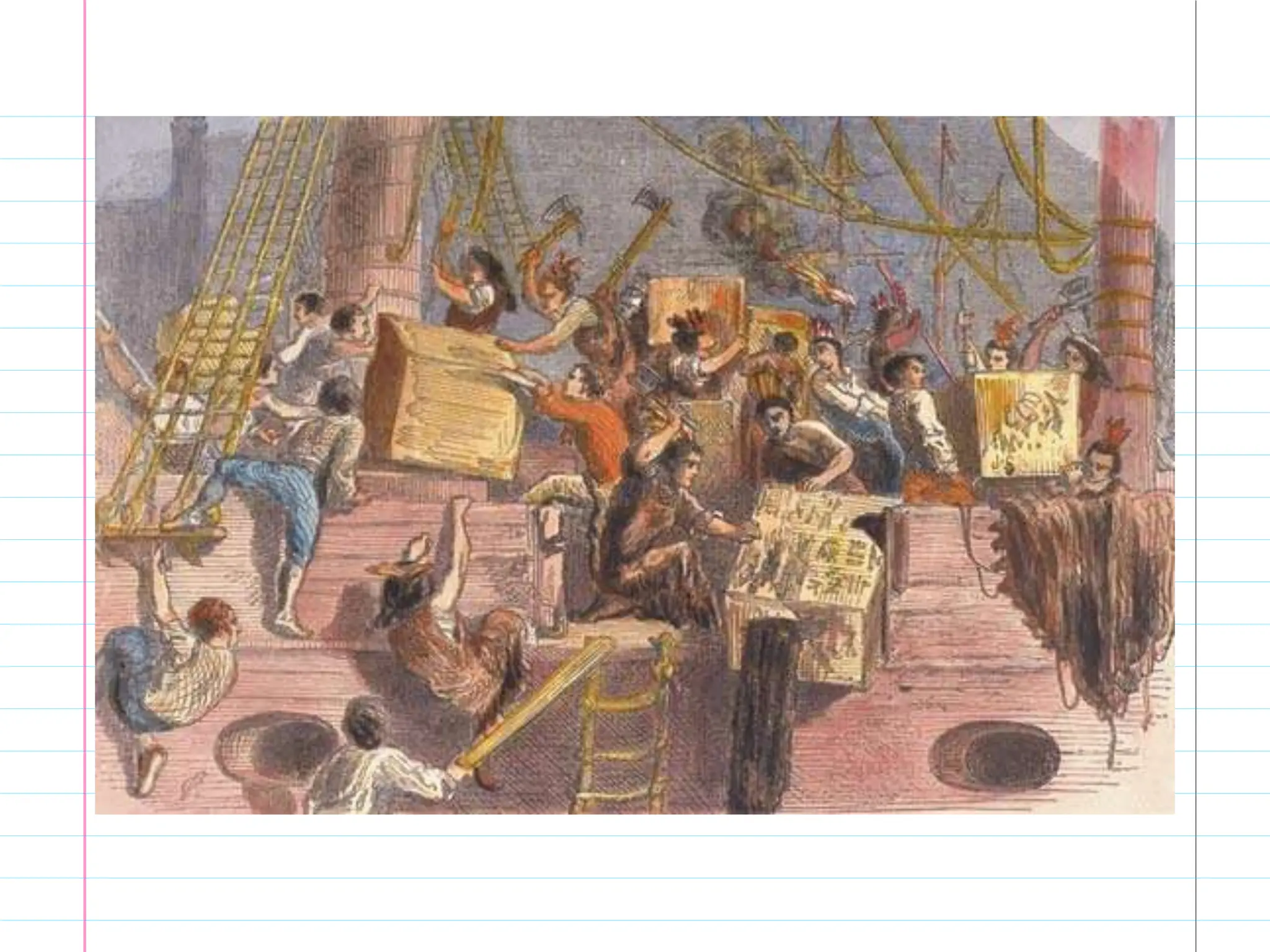
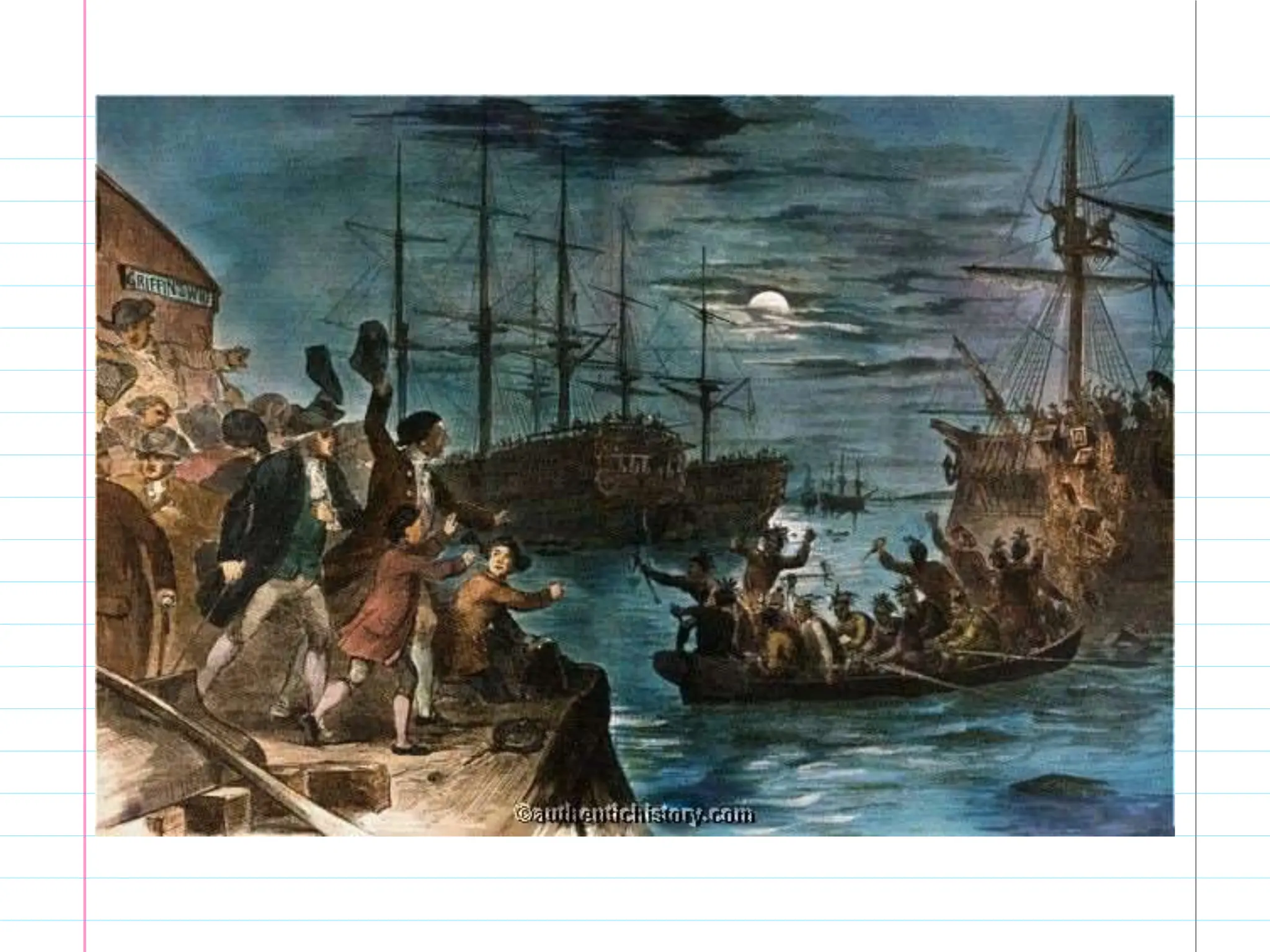
The Boston Tea Party –
December 16, 1773
• Colonists dressed up like Mohawk Indians
and boarded three British ships full of tea.
• The colonists dumped all the tea into the
harbor, about 90,000 pounds.
• King George III was furious!
The Intolerable Acts - 1774
• Laws passed to punish the colonists for the
Boston Tea Party.
• The port of Boston was closed until the tea
was paid for.
• The Quartering Act was put into place
which forced colonists to quarter, or house
and supply British soldiers.
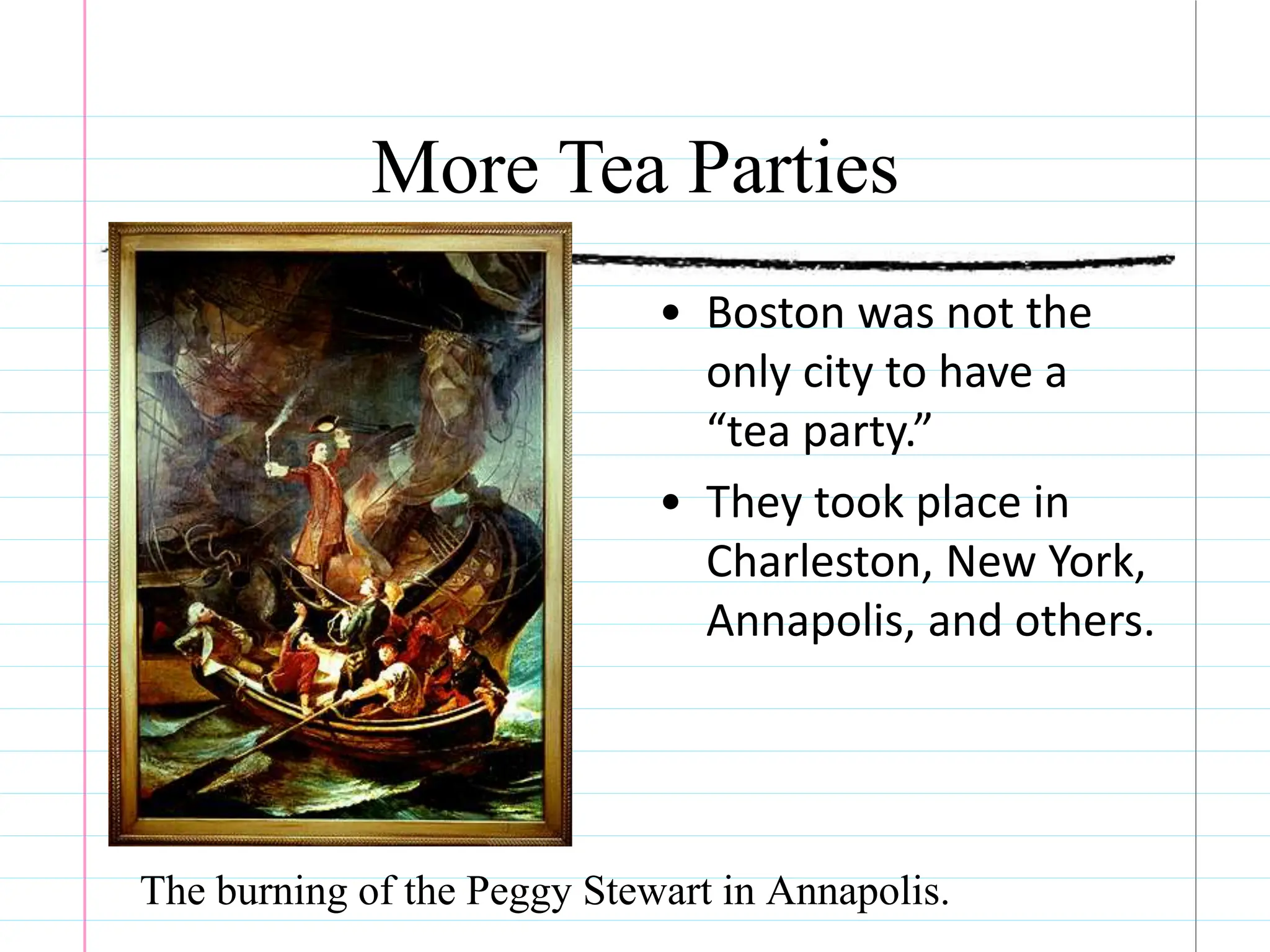
More Tea Parties
• Boston was not the
only city to have a
“tea party.”
• They took place in
Charleston, New York,
Annapolis, and others.
The burning of the Peggy Stewart in Annapolis.
Political cartoon showing the reaction to the Boston Tea Party
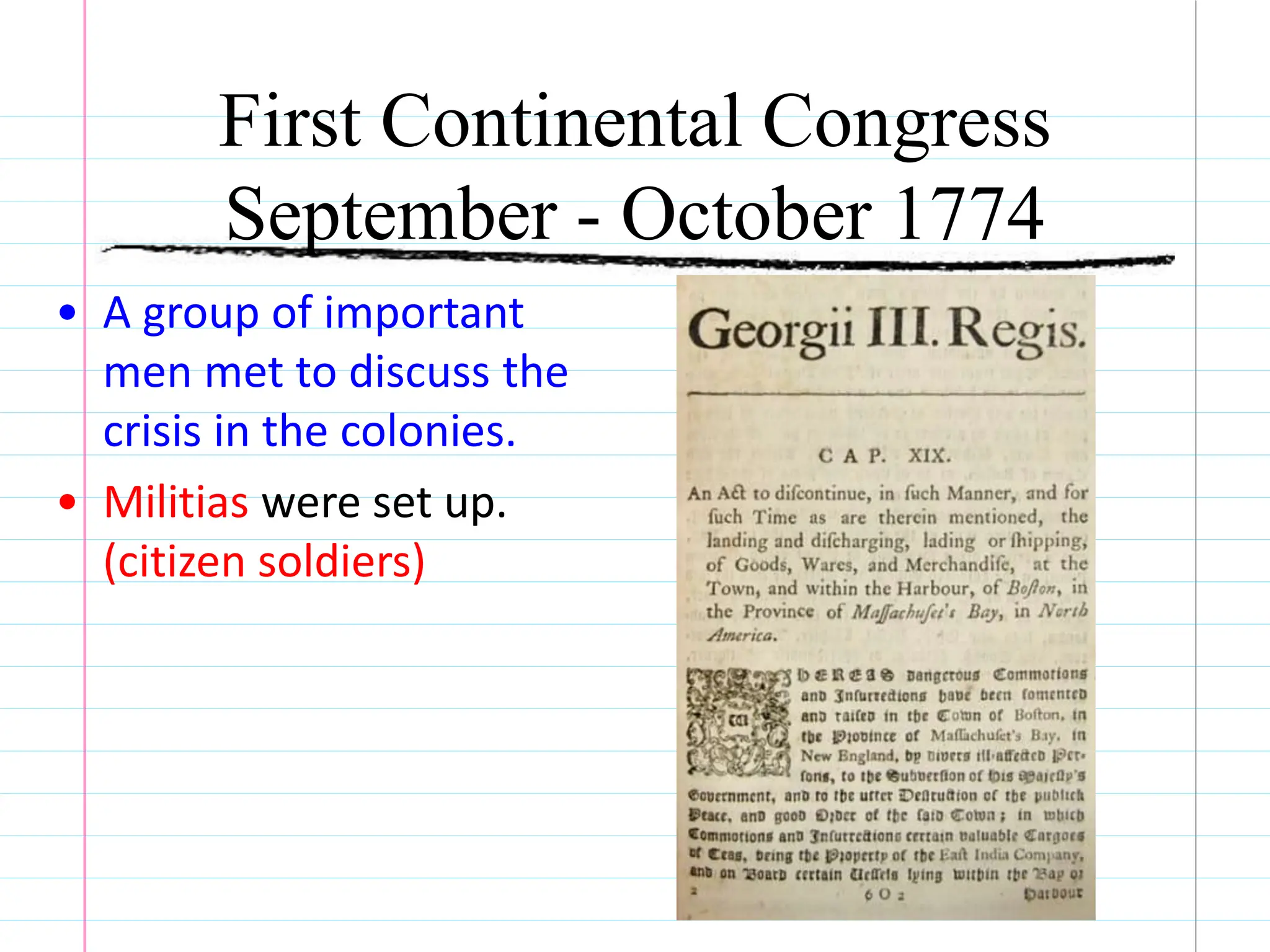
First Continental Congress
September - October 1774
• A group of important
men met to discuss the
crisis in the colonies.
• Militias were set up.
(citizen soldiers)
Battles of Lexington and
Concord
• April 18, 1775
– The British hoped to capture Samuel Adams
and John Hancock at Lexington and destroy
military supplies stored at Concord.
– Paul Revere hears of the British soldiers plan
and rides to warn the militias in Lexington and
Concord.
Lexington and Concord
• April 19, 1775
– The British soldiers arrive in Lexington with
the town’s minutemen ready for battle. The
first shot fired is known as “The shot heard
around the world.”
– The British soldiers arrive in Concord where
the battle continues.
– Significance: The American Revolution begins
with the battles of Lexington and Concord.
Second Continental Congress
• May 1775
– The Second Continental Congress meets in
Philadelphia with John Hancock serving as the
president of the Congress.
– They form the Continental Army and George
Washington becomes the General.
Battle of Bunker Hill
• June 17, 1775- Charlestown, MA
– The Patriots knew that if they could gain
control of Breed’s Hill, they could use cannons
to fire down on the British in Boston.
– The Patriots lost the battle but successfully
killed many British soldiers.
– It showed that Patriots would need allies to
supply gunpowder and assistance if they
wanted to win the war.
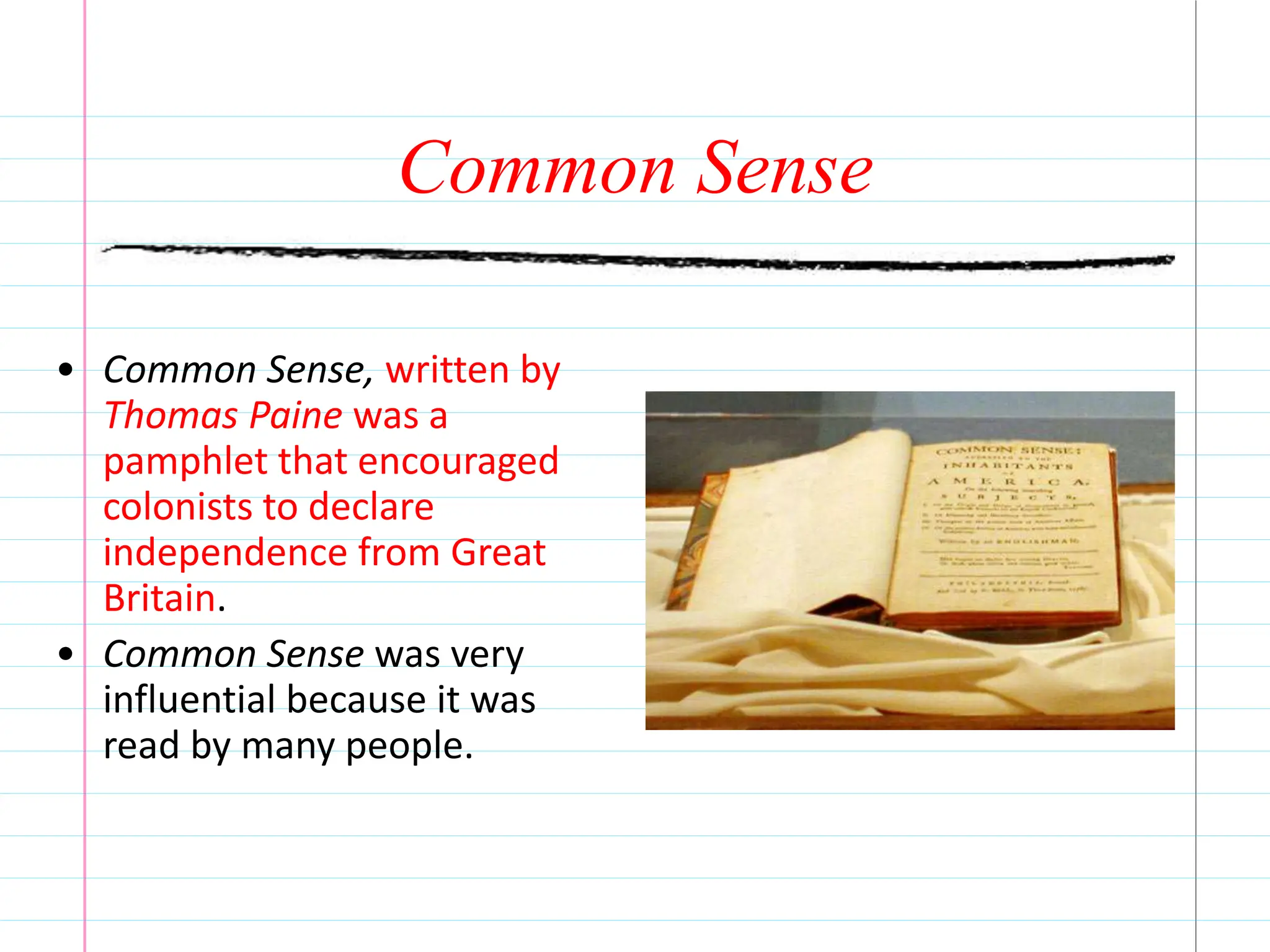
Common Sense
• Common Sense, written by
Thomas Paine was a
pamphlet that encouraged
colonists to declare
independence from Great
Britain.
• Common Sense was very
influential because it was
read by many people.
The Declaration of Independence
• The United States first needed to declare
independence from Great Britain.
• Thomas Jefferson, at the young age of 33, wrote the
Declaration of Independence.
• The Declaration of Independence was signed on July
4, 1776.
• That is why we celebrate Independence Day on July
4th.
• This is the day that the United States of America
declared their independence from King George and
Great Britain.
Declaration of Independence
• The document listed the ways King George
III had abused his power. Those who
signed were seen as traitors to Great Britain.
• Four Major ideas were reflected in the
Declaration of Independence:
“…all men are created equal…”
• Not all men were treated equally because
women, Native Americans and slaves were
not recognized as equals.
“…They are endowed by their Creator with certain
unalienable rights that among these are life, liberty, and the
pursuit of happiness.”
• Rights cannot be denied
“That to secure these rights, governments are instituted
among men, deriving their just powers from the consent of
the governed;”
• The purpose of government is to protect the
rights of the people.
“…whenever any form of government becomes destructive of
these ends, it is the right of the people to alter or to abolish
it,”
• If the government does NOT protect the
rights of the people, the people have the
right to make changes to their government.
Brainpop Video on the
Declaration of Independence
• https://www.brainpop.com/socialstudies/ush
istory/declarationofindependence/
Benjamin Franklin
• Benjamin Franklin,
one of the most
famous men in the
world, was sent to
France to ask for
military aid as well as
a loan.
• And the war was on!
Battle of New York – September 1776
• Washington’s first defeat
• New York taken by large force
• City Burned for days
• Retreat to New Jersey
Battle of Trenton – December 1776
• Washington Crosses Delaware River at
night on Christmas Eve
• Surprise attack on Christmas Day – huge
victory
• Gains supplies- weapons/ammo
• Big morale boost for troops
October 1777 - Battle of Saratoga
– Britain wants control of the Hudson River.
American’s met the British at Saratoga, NY. As
Britain’s army was suffering heavy losses, the
American army was getting larger. Volunteers
came from nearby towns. |
– THIS WAS A MAJOR TURNING POINT!
– Because of this victory, France agreed to help
the Americans with ships, soldiers, supplies and
money against their long-time enemy, Britain.
Valley Forge – Winter of 1777-78
• Terrible Conditions
• Washington holds
troops together
• Survive smallpox
outbreak
• Lack of supplies-
food/clothing
• Baron Von Steuben
–trains troops into
a military force
May 1780 The Siege of
Charleston (South Carolina)
• The British attempt to capture Charleston.
Fort Moultrie - held the British off in the
first attack.
• The second attempt ended in British victory.
The British blockaded the harbor, cutting
off supplies.
• Worst defeat of the war for the Patriots
January 1781 The Battle of
Cowpens (South Carolina)
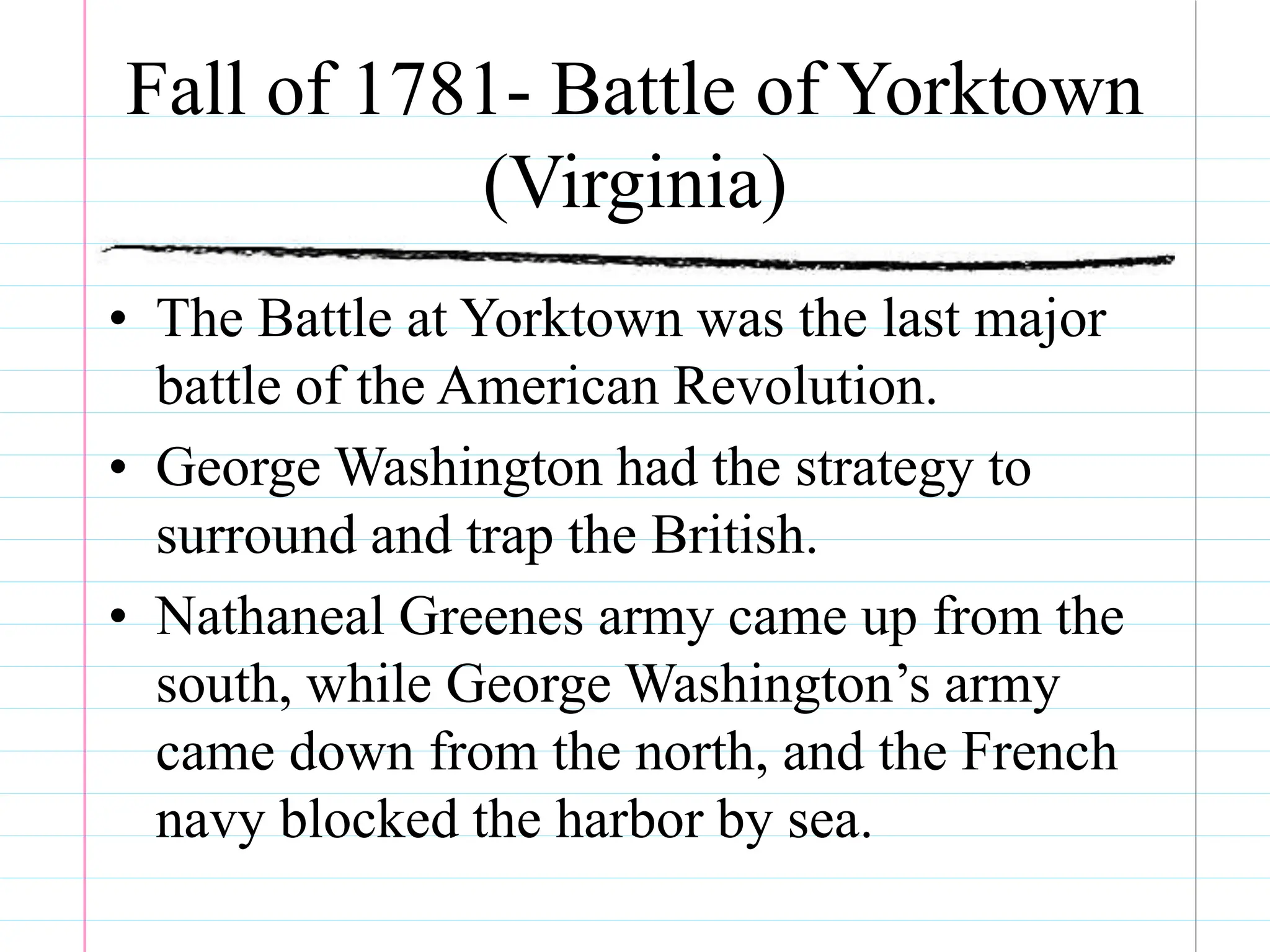
• Partisan forces (Soldiers who formed their
own militia) fought when the British came
near their home and helped the Continental
Army to defeat the British.
• The British retreated to Yorktown, a
peninsula in Virginia.
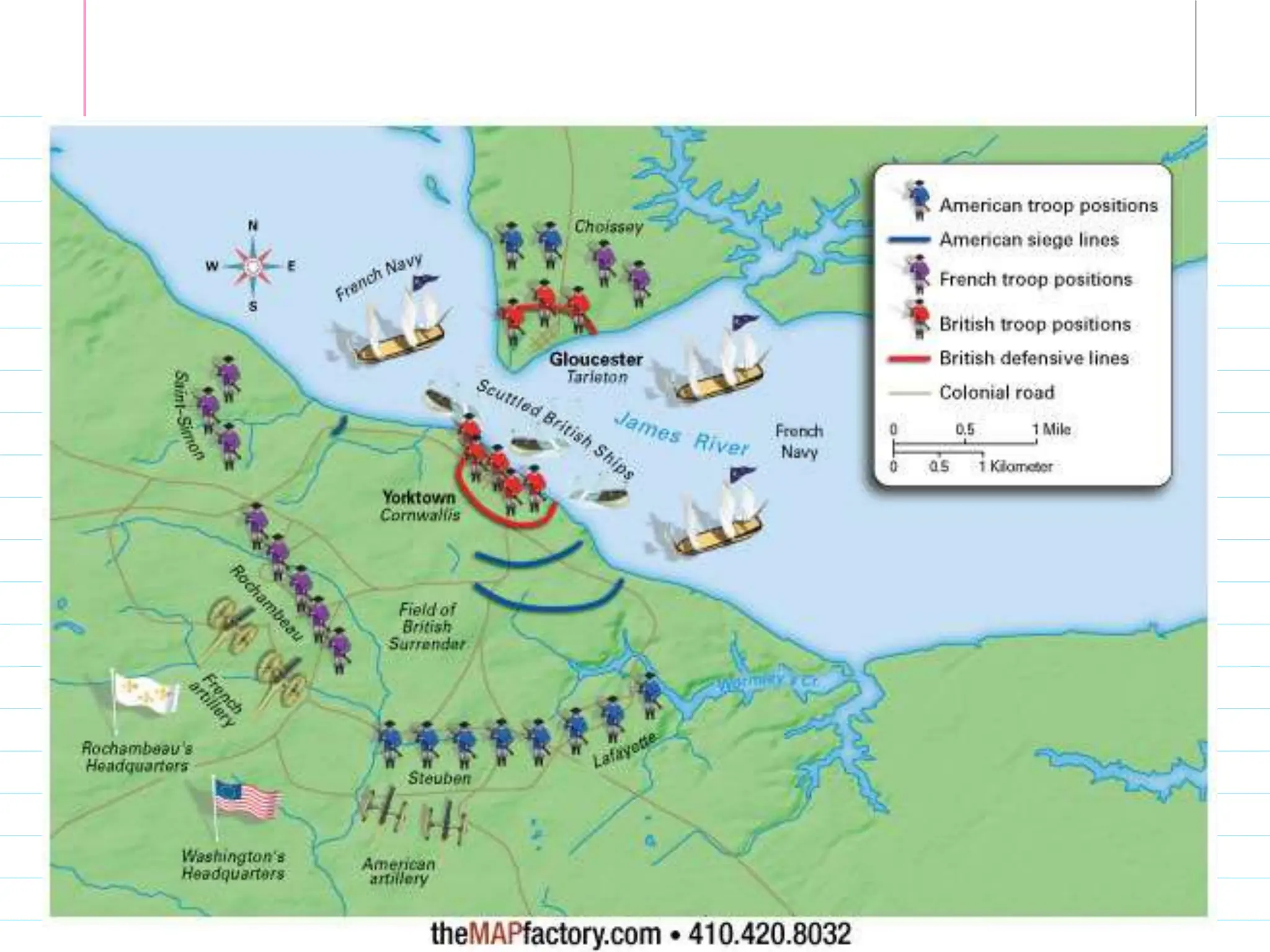
Fall of 1781- Battle of Yorktown
(Virginia)
• The Battle at Yorktown was the last major
battle of the American Revolution.
• George Washington had the strategy to
surround and trap the British.
• Nathaneal Greenes army came up from the
south, while George Washington’s army
came down from the north, and the French
navy blocked the harbor by sea.
Battle of Yorktown
• The British army found themselves out-
maneuvered, defeated and therefore General
Cornwallis was forced to surrender.
1783-Treaty of Paris
• Independence- Recognizes the US as a free
and independent nation.
• Gain all lands from Appalachian Mountains
to the Mississippi River
• Fishing Rights off Canadian Atlantic Coast
• Each side would repay debts
• Return enslaved soldiers
• Congress would return Loyalist land
Why the Americans Won
• Foreign Aid – French/German/Spanish gave
money/troops/naval assistance (ships)
• Better Leadership
• Knowledge of the land
• Motivation – our lives and our property

Revolutionary War 2020.ppt

  • 1.
  • 2.
    The French andIndian War • 1754 to 1763 war fought over the land in America between the English and French. • It was called the Seven Years War in Europe. • Called the French and Indian War because the Indians helped the French in the war against the British. The Indians had nothing to lose. The British were taking their land, the French were not. • The British won, but at a cost a lot of money.
  • 3.
    Join, or DiePolitical Cartoon by Benjamin Franklin A political cartoon calling for American colonies to band together for protection against Indians and the French. First published in the Pennsylvania Gazette on May 9, 1754.
  • 4.
    Taxes • French andIndian War cost a lot of money. • Parliament (the British government) decided to tax to colonies to help pay for it. • The first tax was the Sugar Act of 1764. It placed a tax on molasses and sugar imported by the colonies. • Stamp Act of 1765 placed a tax on all printed material, such as newspapers and playing cards. • This tax upset the colonists even more.
  • 5.
    No Taxation without Representation •The colonists claimed “no taxation without representation” because they were being taxed but had no vote in Parliament and had no say in how the colonies were being governed. • The colonists started a boycott, or a refusal to buy certain goods, from the British.
  • 6.
    Sam Adams andthe Sons of Liberty • Samuel Adams led the protests in Boston against the taxes. • He began a secret society called the Sons of Liberty.
  • 7.
    Tar and Feather •The Sons of Liberty used violence to scare off the tax collectors. • The Stamp Act was repealed (to do away with) because of all the protests.
  • 8.
    Townshend Revenue Acts-1767 • Taxes on glass, paint, oil, lead, paper, and tea were applied with the design of raising £40,000 a year for the administration of the colonies • The result was the resurrection of colonial hostilities created by the Stamp Act.
  • 9.
    The Boston Massacre– March 5, 1770 • Colonial men were shouting insults at the British soldiers. • They started throwing things, probably snow balls and rocks. • Someone yelled “fire” and the Red Coats (what the British soldiers were called) shot. • Five colonists were killed. These were the first Americans killed in the War for Independence. • Sam Adams started calling the incident the Boston Massacre. He used the incident to get more people angry at the British.
  • 10.
    A Tax onTea • Parliament began taxing tea. Tea was the most important beverage in the colonies. • The colonists decided to boycott all British tea.
  • 11.
    The Boston TeaParty – December 16, 1773 • Colonists dressed up like Mohawk Indians and boarded three British ships full of tea. • The colonists dumped all the tea into the harbor, about 90,000 pounds. • King George III was furious!
  • 14.
    The Intolerable Acts- 1774 • Laws passed to punish the colonists for the Boston Tea Party. • The port of Boston was closed until the tea was paid for. • The Quartering Act was put into place which forced colonists to quarter, or house and supply British soldiers.
  • 15.
    More Tea Parties •Boston was not the only city to have a “tea party.” • They took place in Charleston, New York, Annapolis, and others. The burning of the Peggy Stewart in Annapolis.
  • 16.
    Political cartoon showingthe reaction to the Boston Tea Party
  • 17.
    First Continental Congress September- October 1774 • A group of important men met to discuss the crisis in the colonies. • Militias were set up. (citizen soldiers)
  • 18.
    Battles of Lexingtonand Concord • April 18, 1775 – The British hoped to capture Samuel Adams and John Hancock at Lexington and destroy military supplies stored at Concord. – Paul Revere hears of the British soldiers plan and rides to warn the militias in Lexington and Concord.
  • 19.
    Lexington and Concord •April 19, 1775 – The British soldiers arrive in Lexington with the town’s minutemen ready for battle. The first shot fired is known as “The shot heard around the world.” – The British soldiers arrive in Concord where the battle continues. – Significance: The American Revolution begins with the battles of Lexington and Concord.
  • 20.
    Second Continental Congress •May 1775 – The Second Continental Congress meets in Philadelphia with John Hancock serving as the president of the Congress. – They form the Continental Army and George Washington becomes the General.
  • 21.
    Battle of BunkerHill • June 17, 1775- Charlestown, MA – The Patriots knew that if they could gain control of Breed’s Hill, they could use cannons to fire down on the British in Boston. – The Patriots lost the battle but successfully killed many British soldiers. – It showed that Patriots would need allies to supply gunpowder and assistance if they wanted to win the war.
  • 22.
    Common Sense • CommonSense, written by Thomas Paine was a pamphlet that encouraged colonists to declare independence from Great Britain. • Common Sense was very influential because it was read by many people.
  • 23.
    The Declaration ofIndependence • The United States first needed to declare independence from Great Britain. • Thomas Jefferson, at the young age of 33, wrote the Declaration of Independence. • The Declaration of Independence was signed on July 4, 1776. • That is why we celebrate Independence Day on July 4th. • This is the day that the United States of America declared their independence from King George and Great Britain.
  • 24.
    Declaration of Independence •The document listed the ways King George III had abused his power. Those who signed were seen as traitors to Great Britain. • Four Major ideas were reflected in the Declaration of Independence:
  • 25.
    “…all men arecreated equal…” • Not all men were treated equally because women, Native Americans and slaves were not recognized as equals.
  • 26.
    “…They are endowedby their Creator with certain unalienable rights that among these are life, liberty, and the pursuit of happiness.” • Rights cannot be denied
  • 27.
    “That to securethese rights, governments are instituted among men, deriving their just powers from the consent of the governed;” • The purpose of government is to protect the rights of the people.
  • 28.
    “…whenever any formof government becomes destructive of these ends, it is the right of the people to alter or to abolish it,” • If the government does NOT protect the rights of the people, the people have the right to make changes to their government.
  • 29.
    Brainpop Video onthe Declaration of Independence • https://www.brainpop.com/socialstudies/ush istory/declarationofindependence/
  • 31.
    Benjamin Franklin • BenjaminFranklin, one of the most famous men in the world, was sent to France to ask for military aid as well as a loan. • And the war was on!
  • 32.
    Battle of NewYork – September 1776 • Washington’s first defeat • New York taken by large force • City Burned for days • Retreat to New Jersey
  • 33.
    Battle of Trenton– December 1776 • Washington Crosses Delaware River at night on Christmas Eve • Surprise attack on Christmas Day – huge victory • Gains supplies- weapons/ammo • Big morale boost for troops
  • 34.
    October 1777 -Battle of Saratoga – Britain wants control of the Hudson River. American’s met the British at Saratoga, NY. As Britain’s army was suffering heavy losses, the American army was getting larger. Volunteers came from nearby towns. | – THIS WAS A MAJOR TURNING POINT! – Because of this victory, France agreed to help the Americans with ships, soldiers, supplies and money against their long-time enemy, Britain.
  • 35.
    Valley Forge –Winter of 1777-78 • Terrible Conditions • Washington holds troops together • Survive smallpox outbreak • Lack of supplies- food/clothing • Baron Von Steuben –trains troops into a military force
  • 36.
    May 1780 TheSiege of Charleston (South Carolina) • The British attempt to capture Charleston. Fort Moultrie - held the British off in the first attack. • The second attempt ended in British victory. The British blockaded the harbor, cutting off supplies. • Worst defeat of the war for the Patriots
  • 37.
    January 1781 TheBattle of Cowpens (South Carolina) • Partisan forces (Soldiers who formed their own militia) fought when the British came near their home and helped the Continental Army to defeat the British. • The British retreated to Yorktown, a peninsula in Virginia.
  • 38.
    Fall of 1781-Battle of Yorktown (Virginia) • The Battle at Yorktown was the last major battle of the American Revolution. • George Washington had the strategy to surround and trap the British. • Nathaneal Greenes army came up from the south, while George Washington’s army came down from the north, and the French navy blocked the harbor by sea.
  • 40.
    Battle of Yorktown •The British army found themselves out- maneuvered, defeated and therefore General Cornwallis was forced to surrender.
  • 41.
    1783-Treaty of Paris •Independence- Recognizes the US as a free and independent nation. • Gain all lands from Appalachian Mountains to the Mississippi River • Fishing Rights off Canadian Atlantic Coast • Each side would repay debts • Return enslaved soldiers • Congress would return Loyalist land
  • 42.
    Why the AmericansWon • Foreign Aid – French/German/Spanish gave money/troops/naval assistance (ships) • Better Leadership • Knowledge of the land • Motivation – our lives and our property