Revision for prep 3
let’s remember our book
• Unit 7 : our world
• unit 8: protecting our
planet
• unit 9: Build a greener
world
• unit 10:to space and back
• unit 11: Media now and in
the past
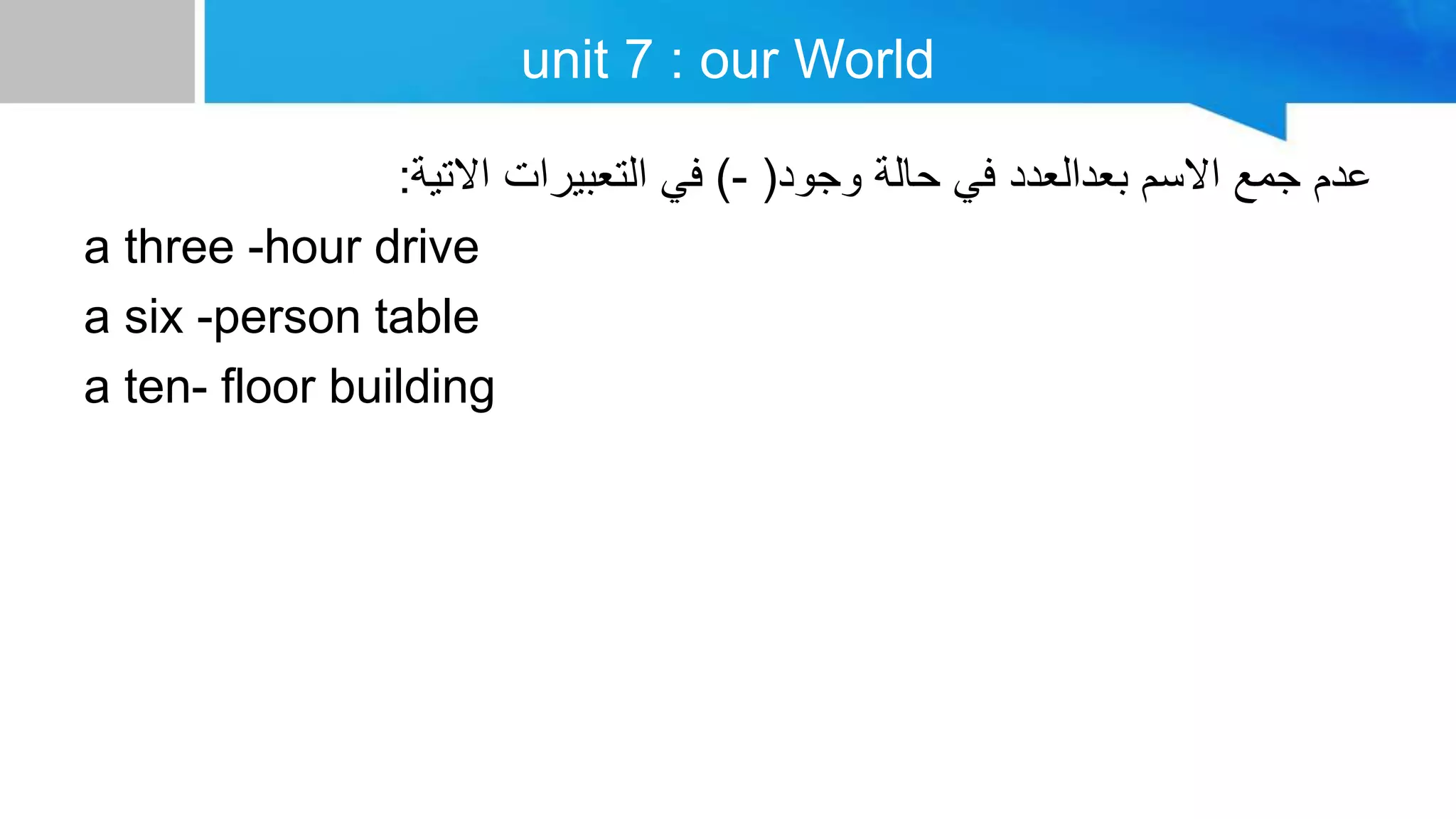
unit 7 : our World
‫وجود‬ ‫حالة‬ ‫في‬ ‫بعدالعدد‬ ‫االسم‬ ‫جمع‬ ‫عدم‬
(
-
)
‫االتية‬ ‫التعبيرات‬ ‫في‬
:
a three -hour drive
a six -person table
a ten- floor building
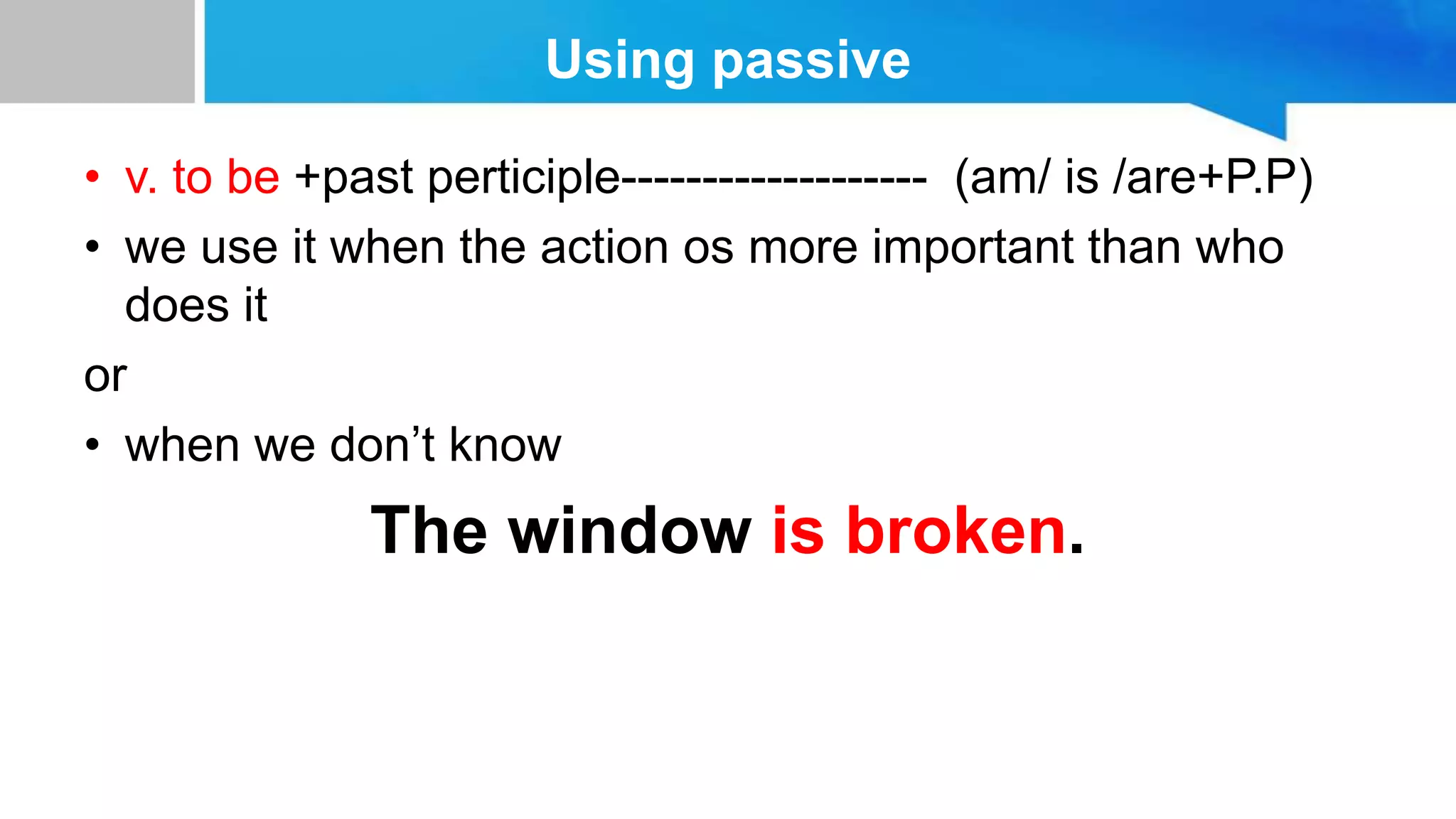
Using passive
• v. to be +past perticiple------------------- (am/ is /are+P.P)
• we use it when the action os more important than who
does it
or
• when we don’t know
The window is broken.
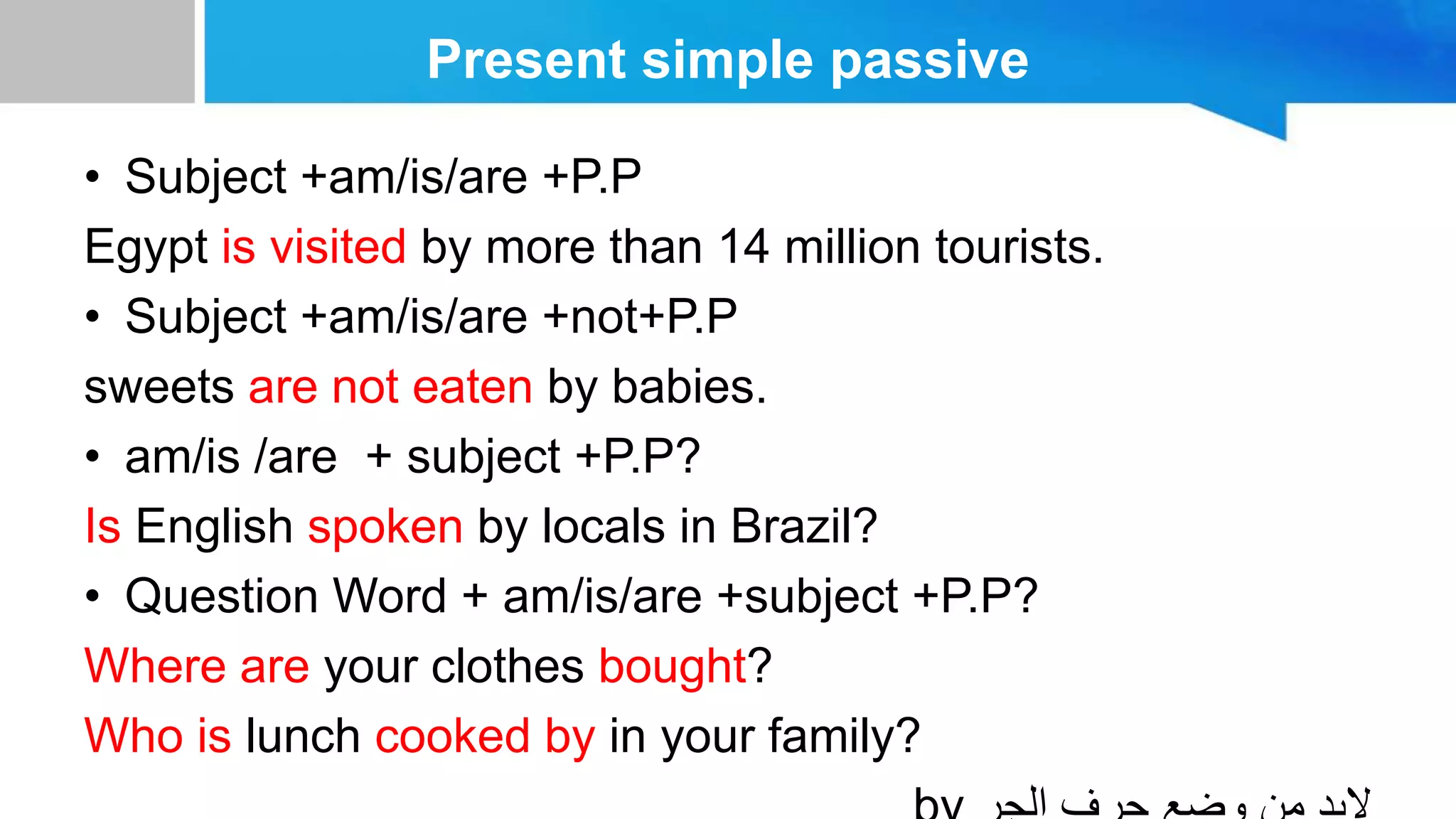
Present simple passive
• Subject +am/is/are +P.P
Egypt is visited by more than 14 million tourists.
• Subject +am/is/are +not+P.P
sweets are not eaten by babies.
• am/is /are + subject +P.P?
Is English spoken by locals in Brazil?
• Question Word + am/is/are +subject +P.P?
Where are your clothes bought?
Who is lunch cooked by in your family?
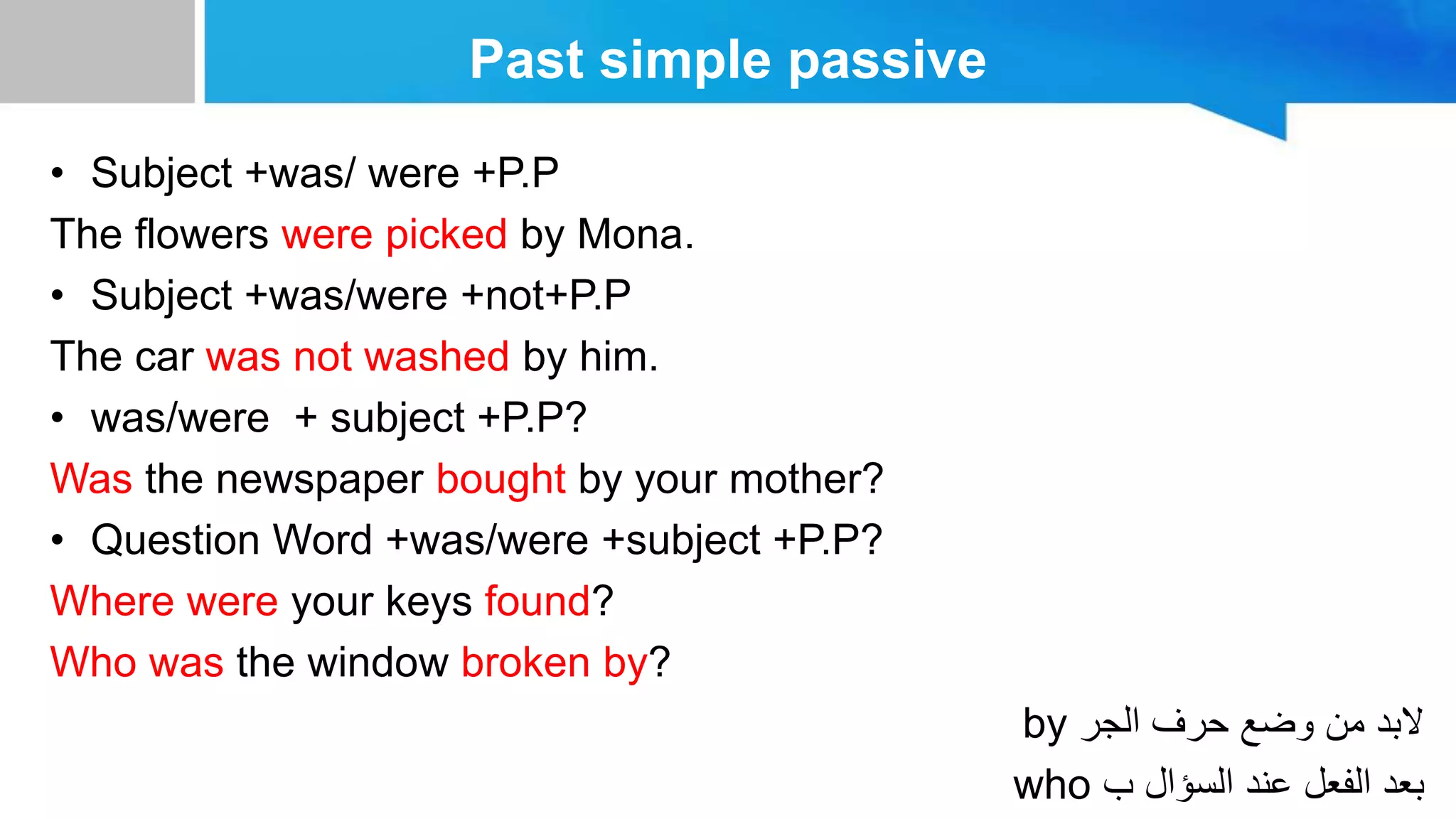
Past simple passive
• Subject +was/ were +P.P
The flowers were picked by Mona.
• Subject +was/were +not+P.P
The car was not washed by him.
• was/were + subject +P.P?
Was the newspaper bought by your mother?
• Question Word +was/were +subject +P.P?
Where were your keys found?
Who was the window broken by?
by ‫الجر‬ ‫حرف‬ ‫وضع‬ ‫من‬ ‫البد‬
who ‫ب‬ ‫السؤال‬ ‫عند‬ ‫الفعل‬ ‫بعد‬
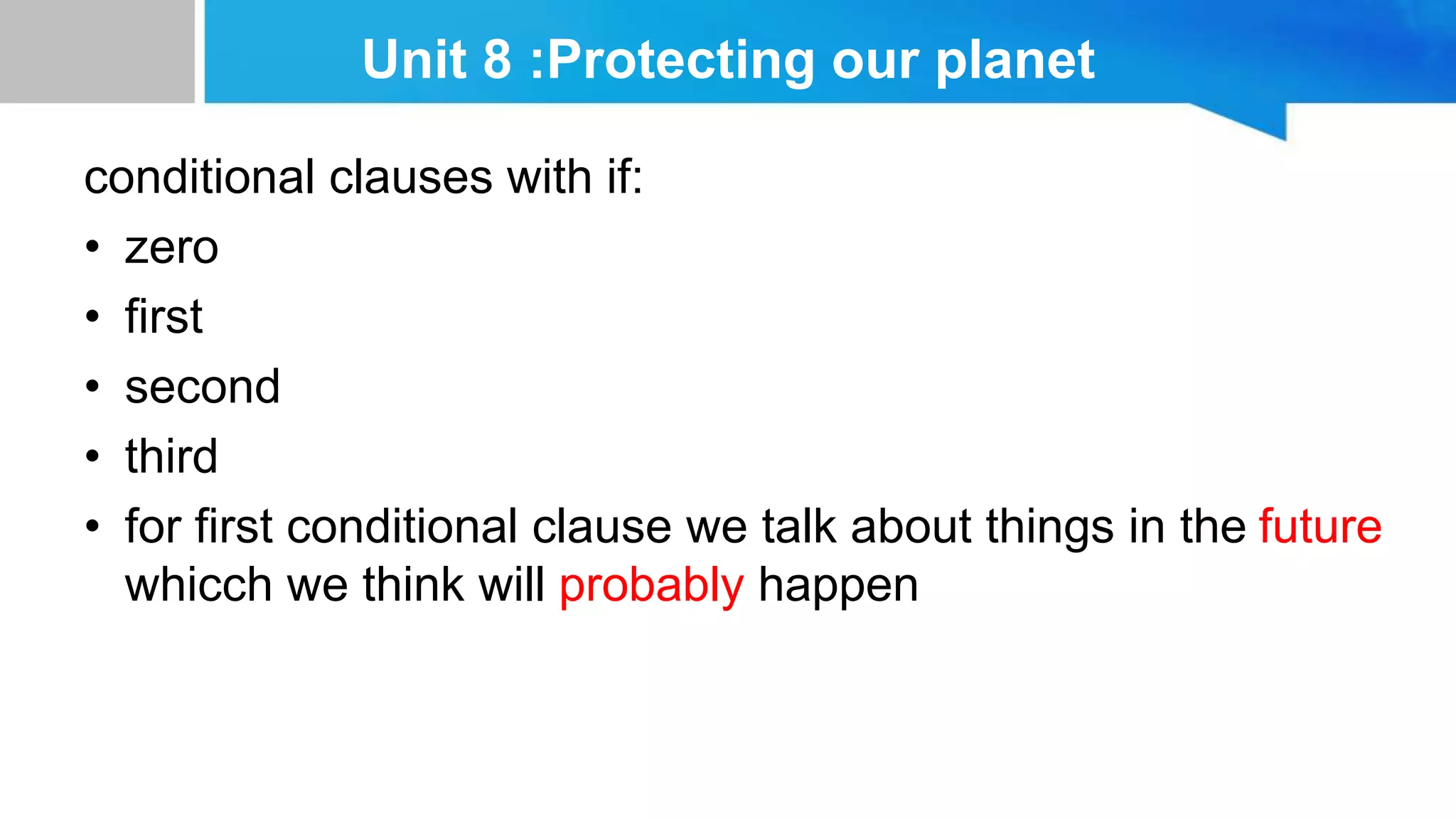
Unit 8 :Protecting our planet
conditional clauses with if:
• zero
• first
• second
• third
• for first conditional clause we talk about things in the future
whicch we think will probably happen
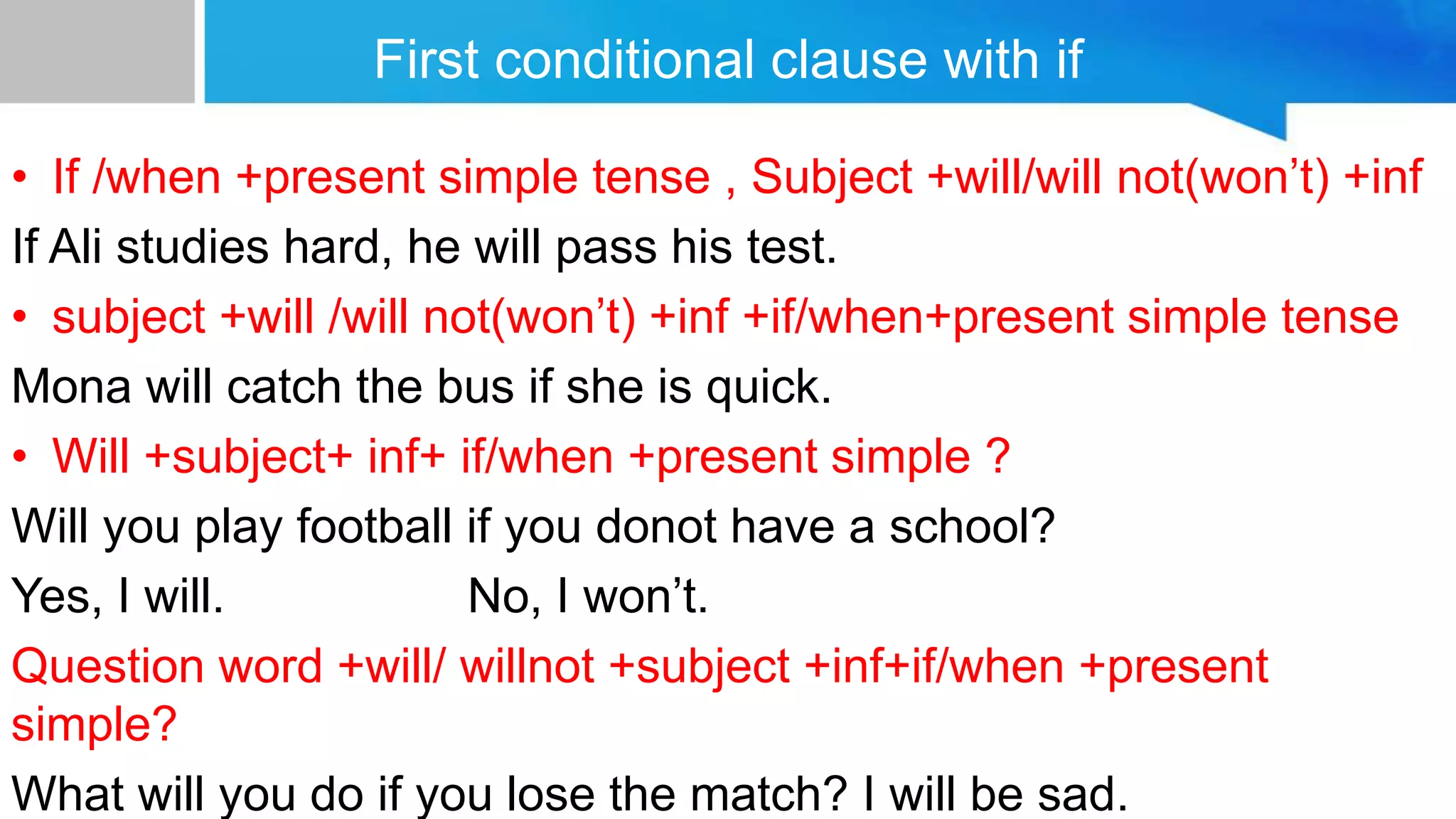
First conditional clause with if
• If /when +present simple tense , Subject +will/will not)won’t( +inf
If Ali studies hard, he will pass his test.
• subject +will /will not)won’t( +inf +if/when+present simple tense
Mona will catch the bus if she is quick.
• Will +subject+ inf+ if/when +present simple ?
Will you play football if you donot have a school?
Yes, I will. No, I won’t.
Question word +will/ willnot +subject +inf+if/when +present
simple?
What will you do if you lose the match? I will be sad.
Verbs +inf or -ing form
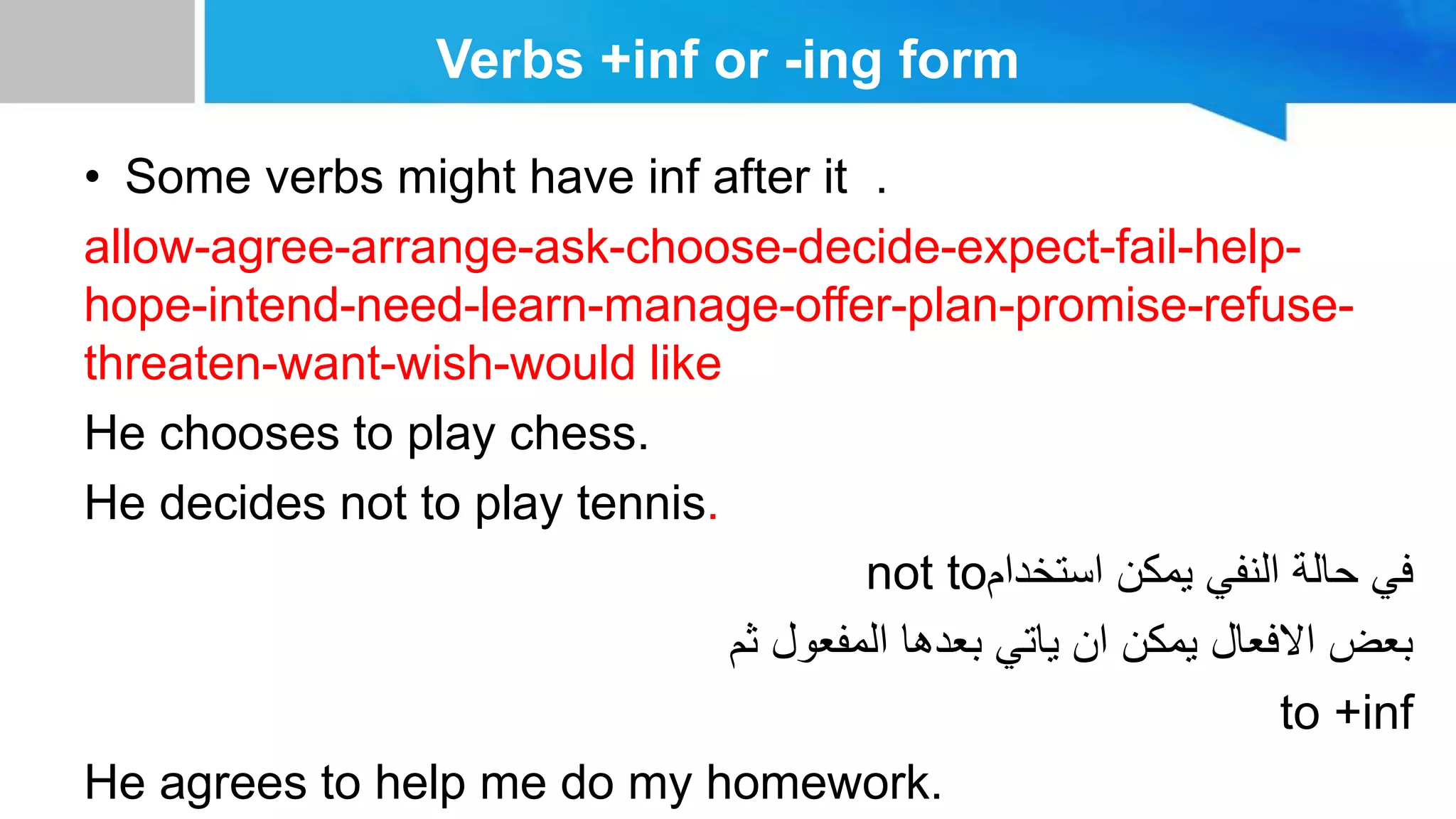
• Some verbs might have inf after it .
allow-agree-arrange-ask-choose-decide-expect-fail-help-
hope-intend-need-learn-manage-offer-plan-promise-refuse-
threaten-want-wish-would like
He chooses to play chess.
He decides not to play tennis.
not to‫استخدام‬ ‫يمكن‬ ‫النفي‬ ‫حالة‬ ‫في‬
‫ثم‬ ‫المفعول‬ ‫بعدها‬ ‫ياتي‬ ‫ان‬ ‫يمكن‬ ‫االفعال‬ ‫بعض‬
to +inf
He agrees to help me do my homework.
Verbs +inf or -ing form
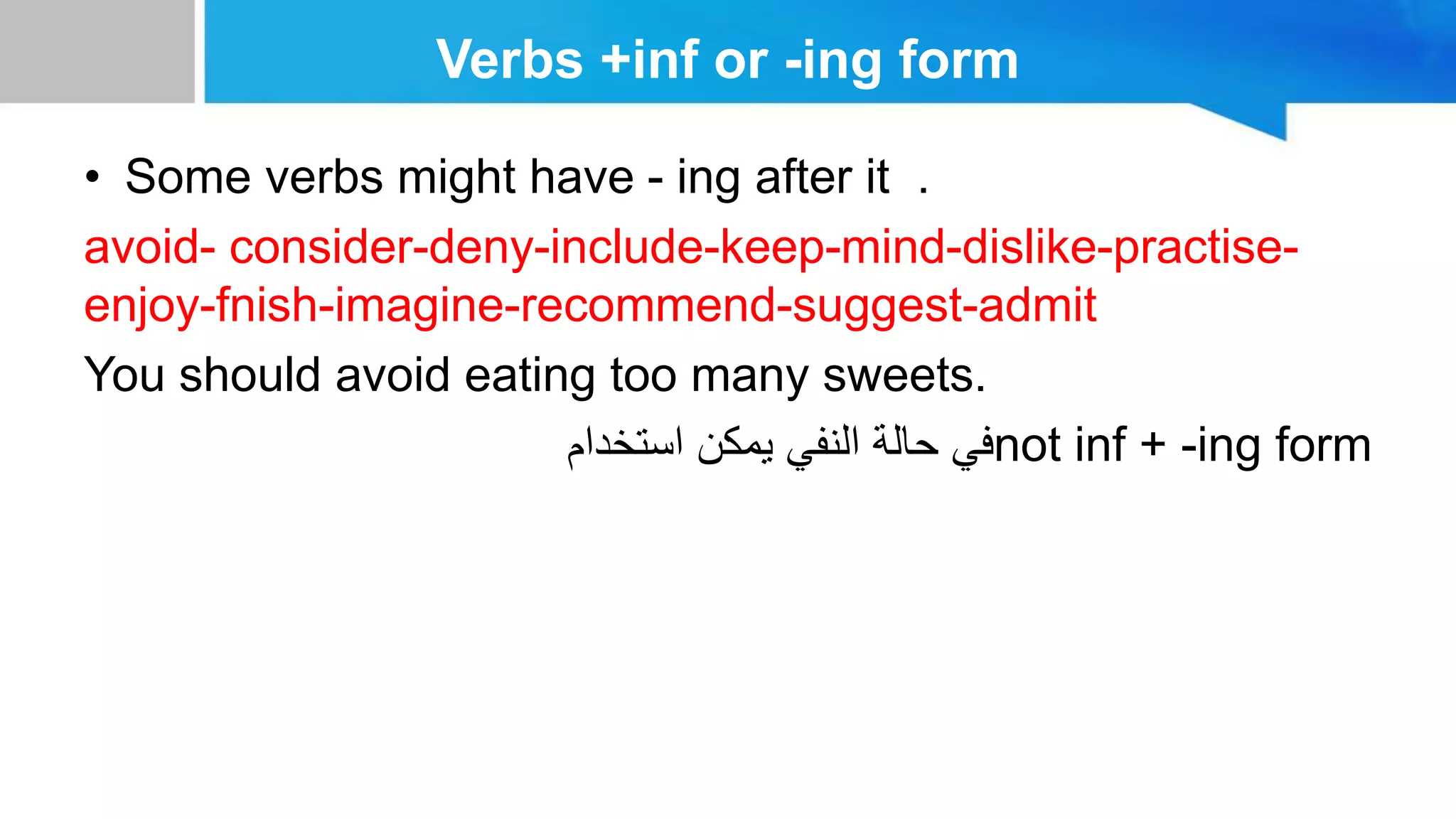
• Some verbs might have - ing after it .
avoid- consider-deny-include-keep-mind-dislike-practise-
enjoy-fnish-imagine-recommend-suggest-admit
You should avoid eating too many sweets.
‫استخدام‬ ‫يمكن‬ ‫النفي‬ ‫حالة‬ ‫في‬not inf + -ing form
verbs +inf or -ing form
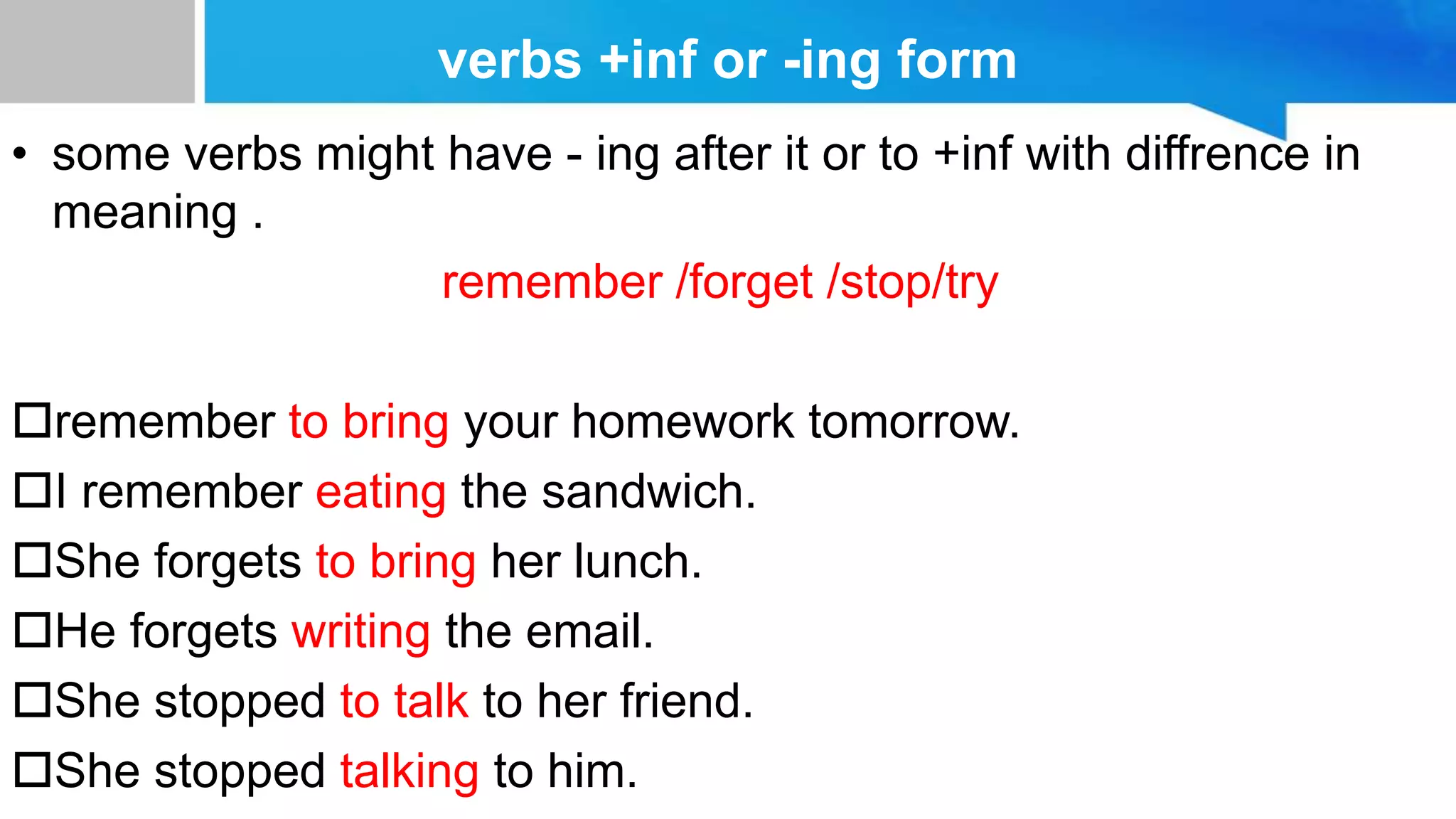
• some verbs might have - ing after it or to +inf with diffrence in
meaning .
remember /forget /stop/try
remember to bring your homework tomorrow.
I remember eating the sandwich.
She forgets to bring her lunch.
He forgets writing the email.
She stopped to talk to her friend.
She stopped talking to him.
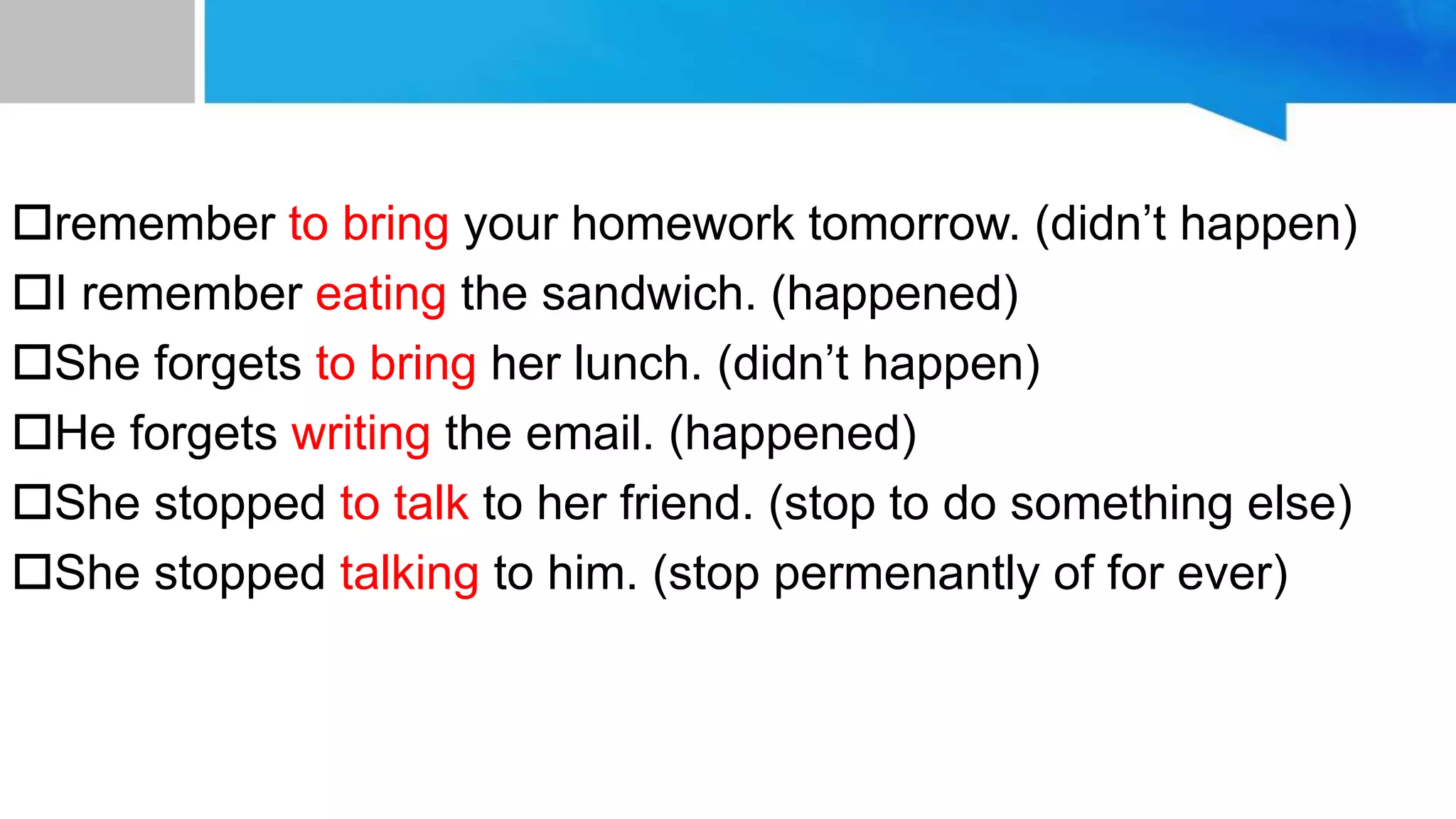
remember to bring your homework tomorrow. (didn’t happen)
I remember eating the sandwich. (happened)
She forgets to bring her lunch. (didn’t happen)
He forgets writing the email. (happened)
She stopped to talk to her friend. (stop to do something else)
She stopped talking to him. (stop permenantly of for ever)
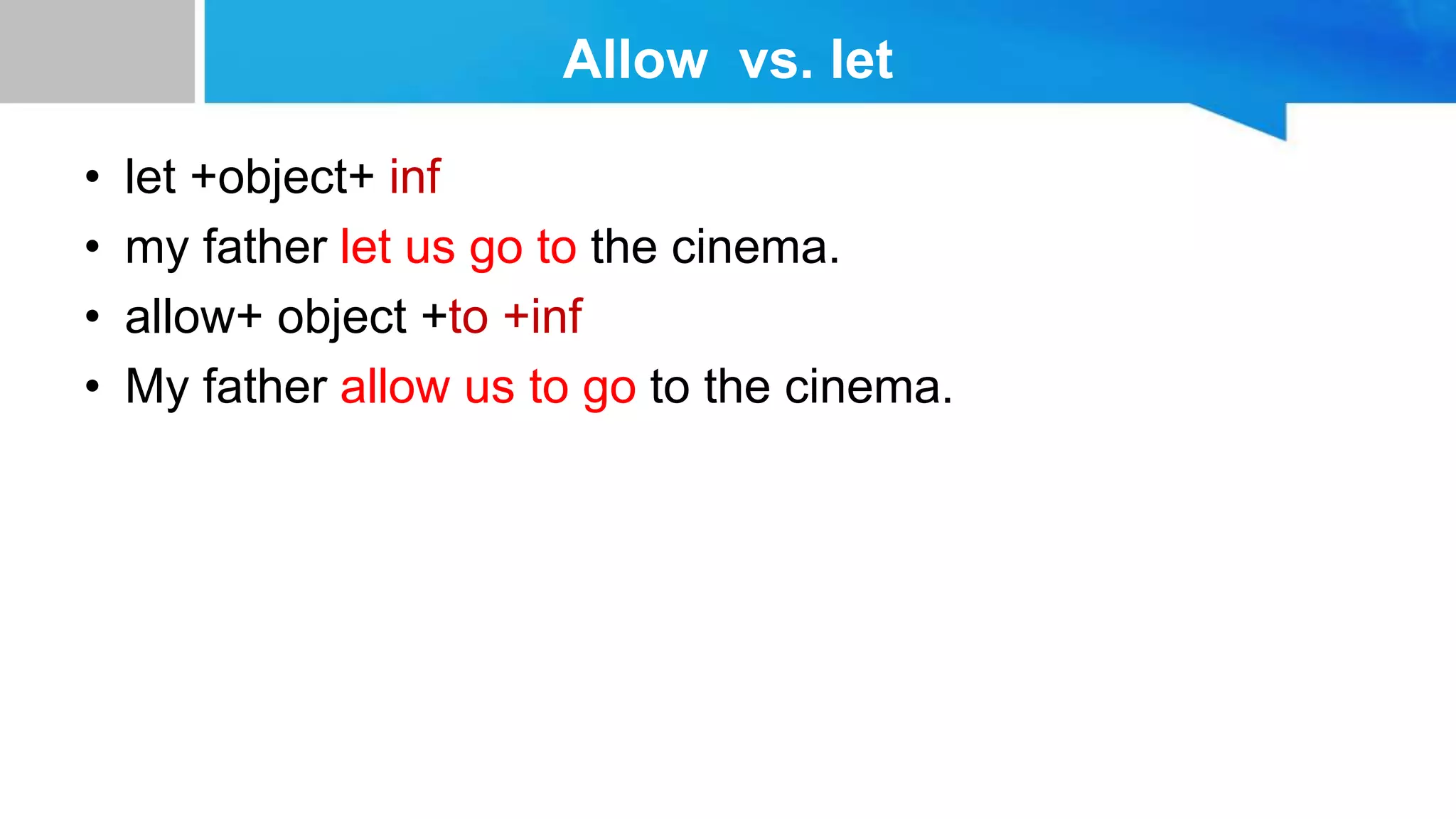
Allow vs. let
• let +object+ inf
• my father let us go to the cinema.
• allow+ object +to +inf
• My father allow us to go to the cinema.
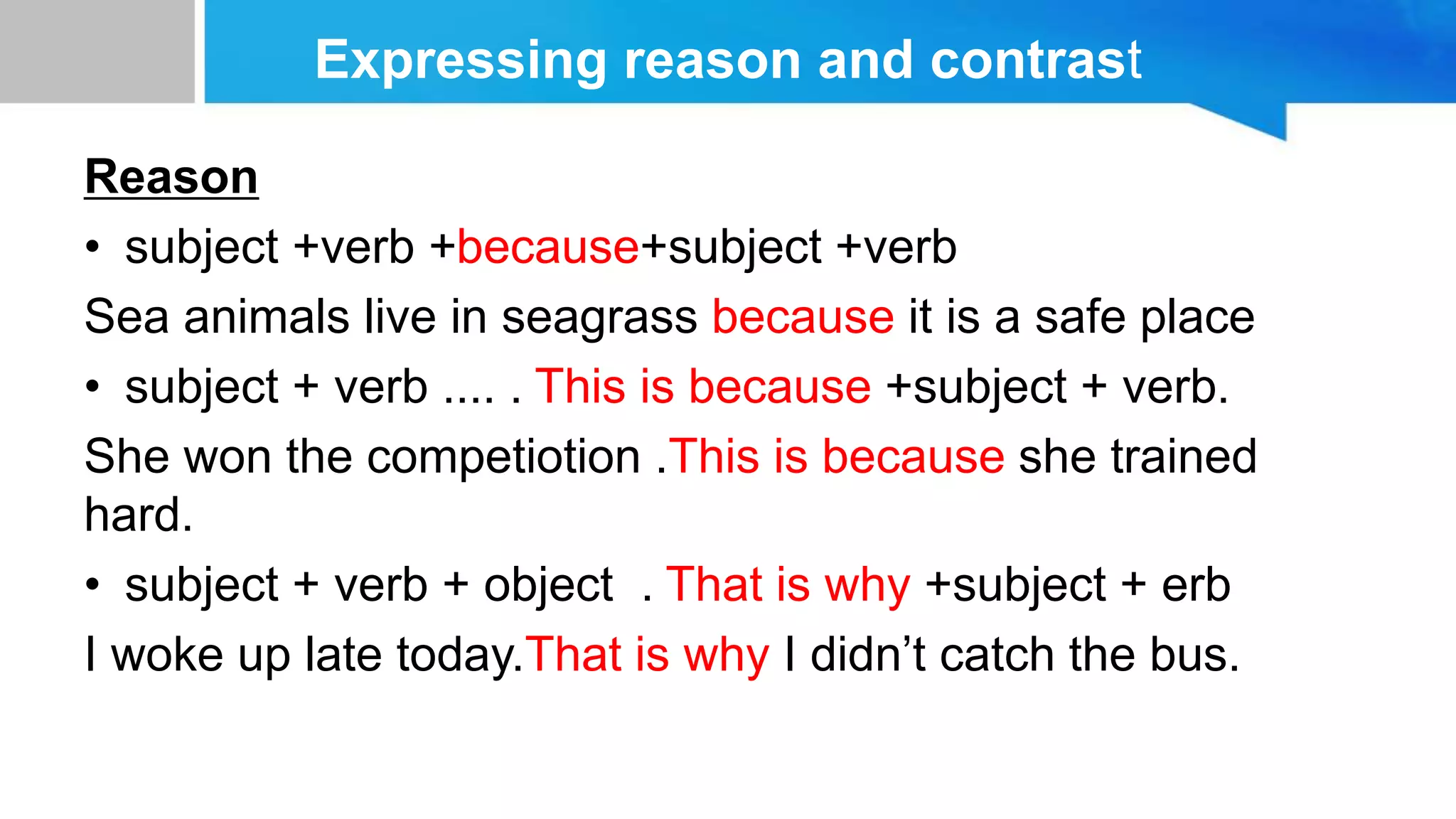
Expressing reason and contrast
Reason
• subject +verb +because+subject +verb
Sea animals live in seagrass because it is a safe place
• subject + verb .... . This is because +subject + verb.
She won the competiotion .This is because she trained
hard.
• subject + verb + object . That is why +subject + erb
I woke up late today.That is why I didn’t catch the bus.
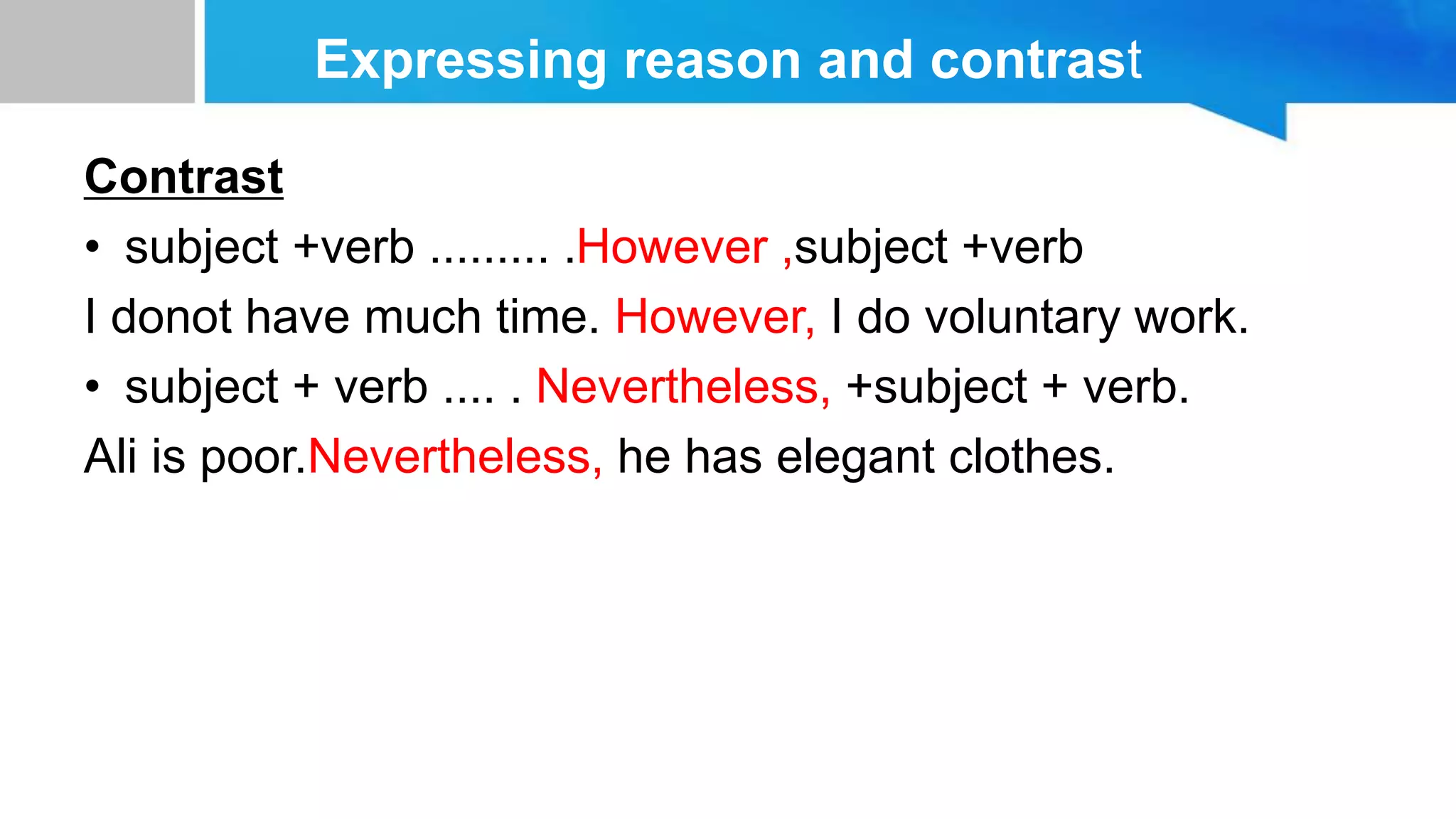
Expressing reason and contrast
Contrast
• subject +verb ......... .However ,subject +verb
I donot have much time. However, I do voluntary work.
• subject + verb .... . Nevertheless, +subject + verb.
Ali is poor.Nevertheless, he has elegant clothes.
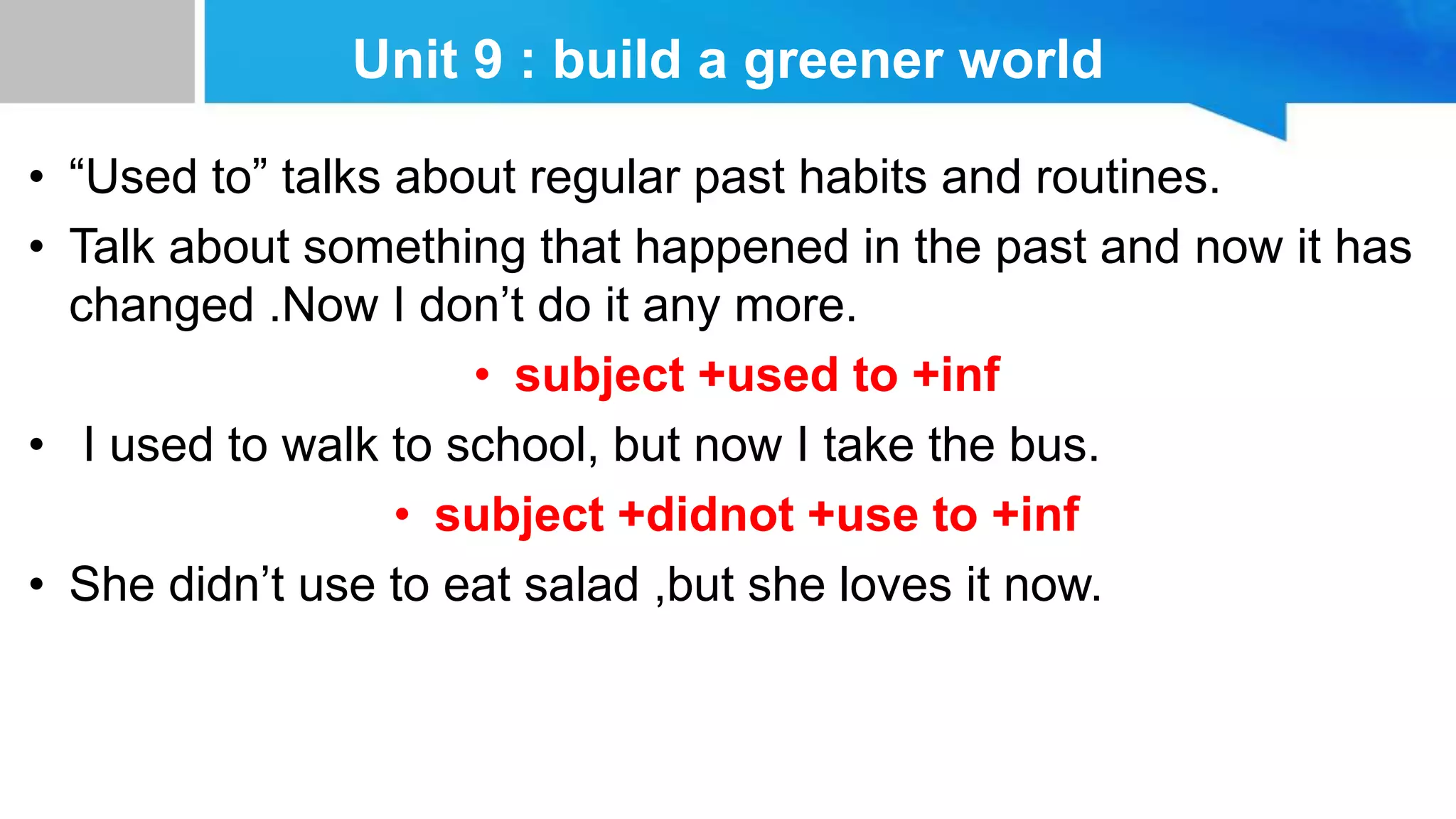
Unit 9 : build a greener world
• “Used to” talks about regular past habits and routines.
• Talk about something that happened in the past and now it has
changed .Now I don’t do it any more.
• subject +used to +inf
• I used to walk to school, but now I take the bus.
• subject +didnot +use to +inf
• She didn’t use to eat salad ,but she loves it now.
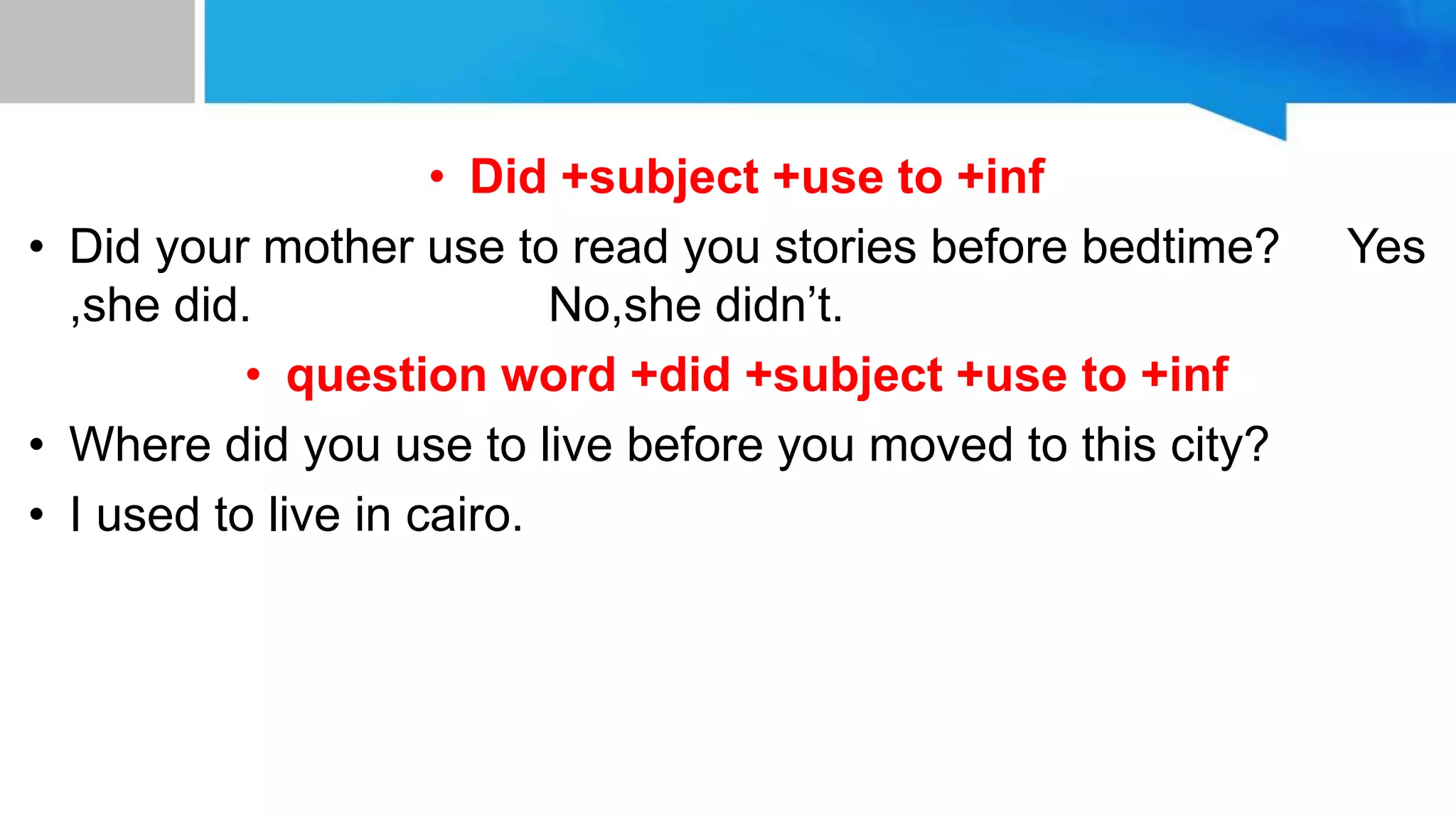
• Did +subject +use to +inf
• Did your mother use to read you stories before bedtime? Yes
,she did. No,she didn’t.
• question word +did +subject +use to +inf
• Where did you use to live before you moved to this city?
• I used to live in cairo.
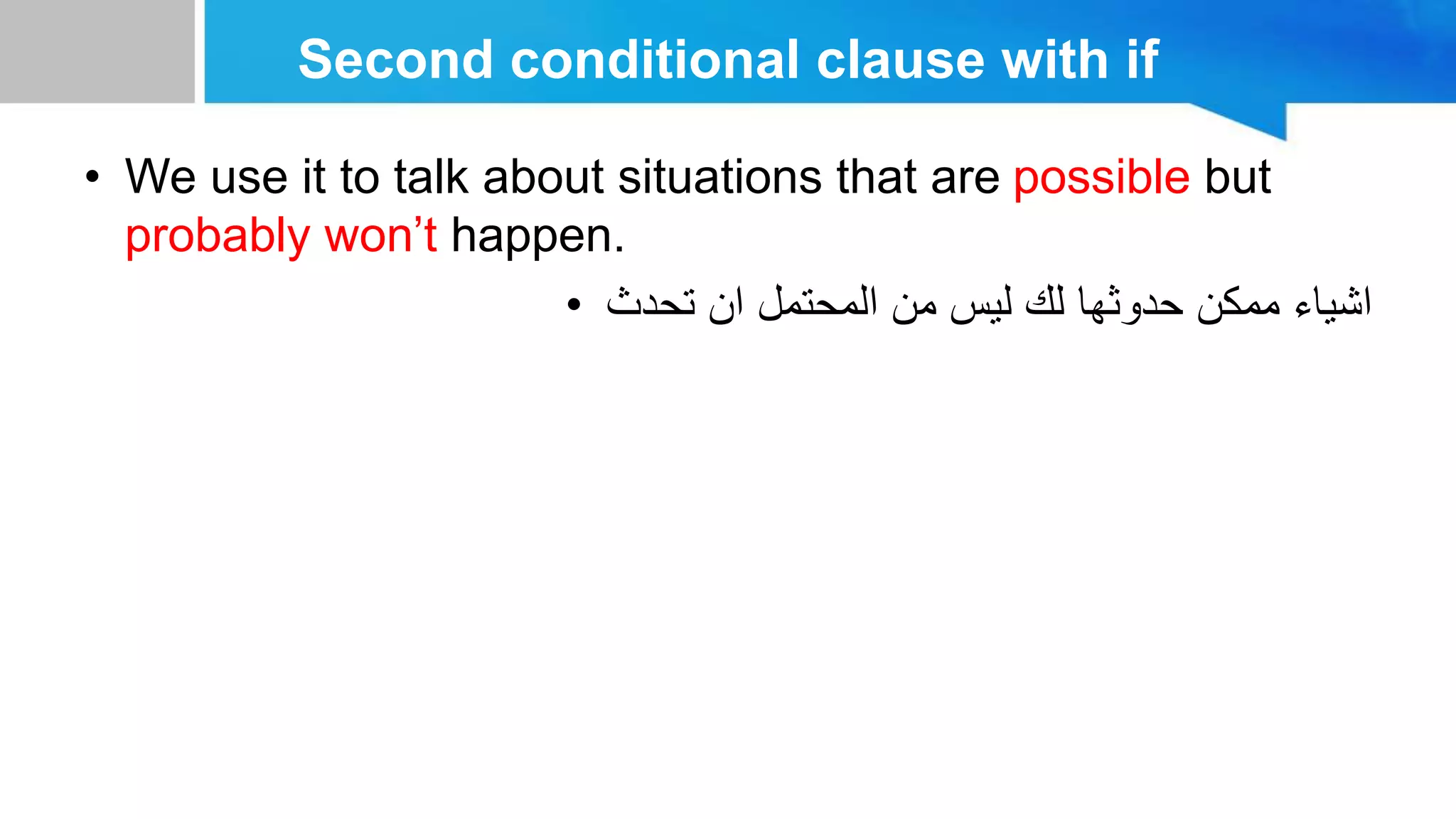
Second conditional clause with if
• We use it to talk about situations that are possible but
probably won’t happen.
• ‫تحدث‬ ‫ان‬ ‫المحتمل‬ ‫من‬ ‫ليس‬ ‫لك‬ ‫حدوثها‬ ‫ممكن‬ ‫اشياء‬
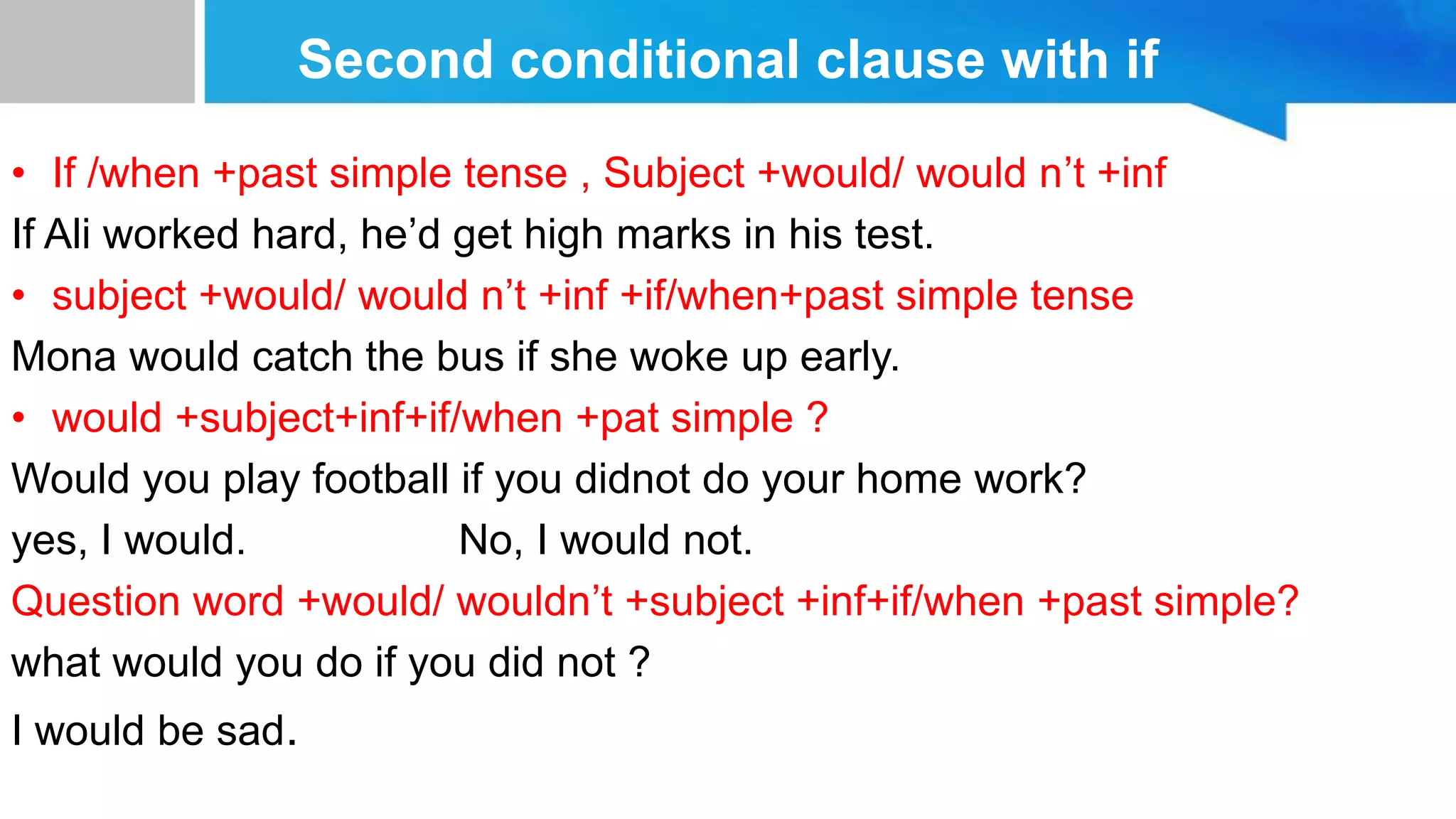
Second conditional clause with if
• If /when +past simple tense , Subject +would/ would n’t +inf
If Ali worked hard, he’d get high marks in his test.
• subject +would/ would n’t +inf +if/when+past simple tense
Mona would catch the bus if she woke up early.
• would +subject+inf+if/when +pat simple ?
Would you play football if you didnot do your home work?
yes, I would. No, I would not.
Question word +would/ wouldn’t +subject +inf+if/when +past simple?
what would you do if you did not ?
I would be sad.
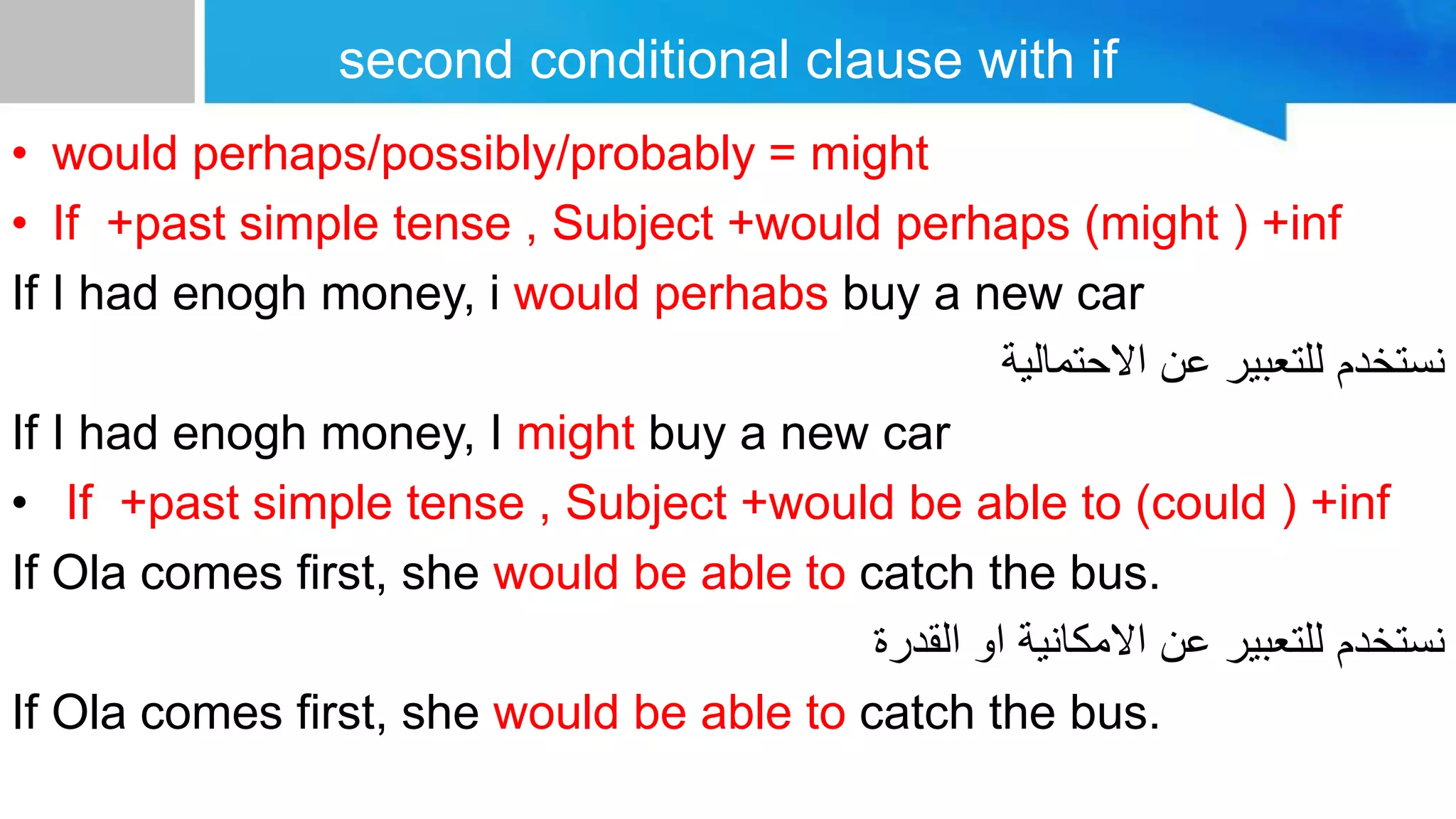
second conditional clause with if
• would perhaps/possibly/probably = might
• If +past simple tense , Subject +would perhaps (might ) +inf
If I had enogh money, i would perhabs buy a new car
‫االحتمالية‬ ‫عن‬ ‫للتعبير‬ ‫نستخدم‬
If I had enogh money, I might buy a new car
• If +past simple tense , Subject +would be able to (could ) +inf
If Ola comes first, she would be able to catch the bus.
‫القدرة‬ ‫او‬ ‫االمكانية‬ ‫عن‬ ‫للتعبير‬ ‫نستخدم‬
If Ola comes first, she would be able to catch the bus.
second conditional clause with if
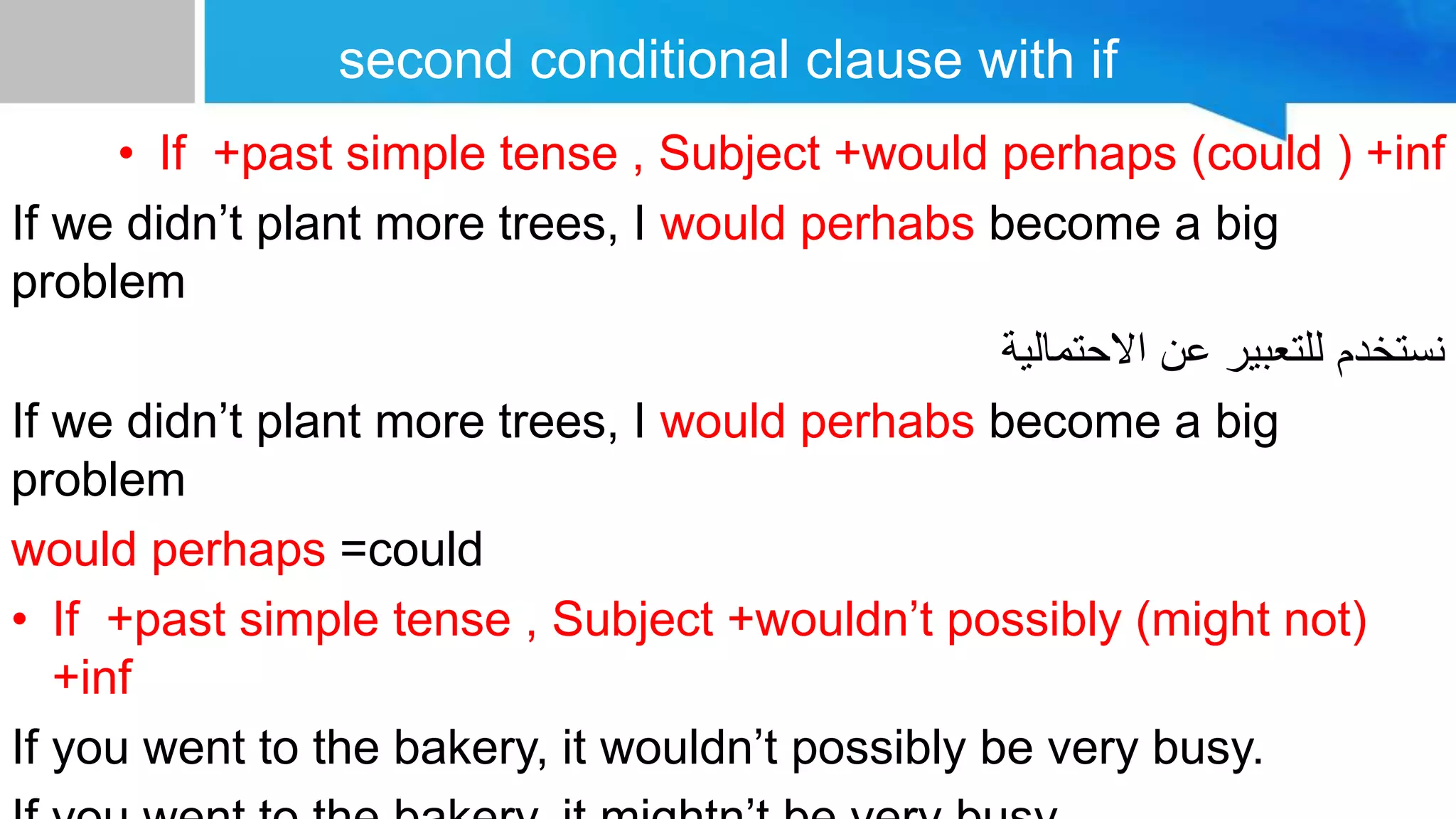
• If +past simple tense , Subject +would perhaps (could ) +inf
If we didn’t plant more trees, I would perhabs become a big
problem
‫االحتمالية‬ ‫عن‬ ‫للتعبير‬ ‫نستخدم‬
If we didn’t plant more trees, I would perhabs become a big
problem
would perhaps =could
• If +past simple tense , Subject +wouldn’t possibly (might not)
+inf
If you went to the bakery, it wouldn’t possibly be very busy.
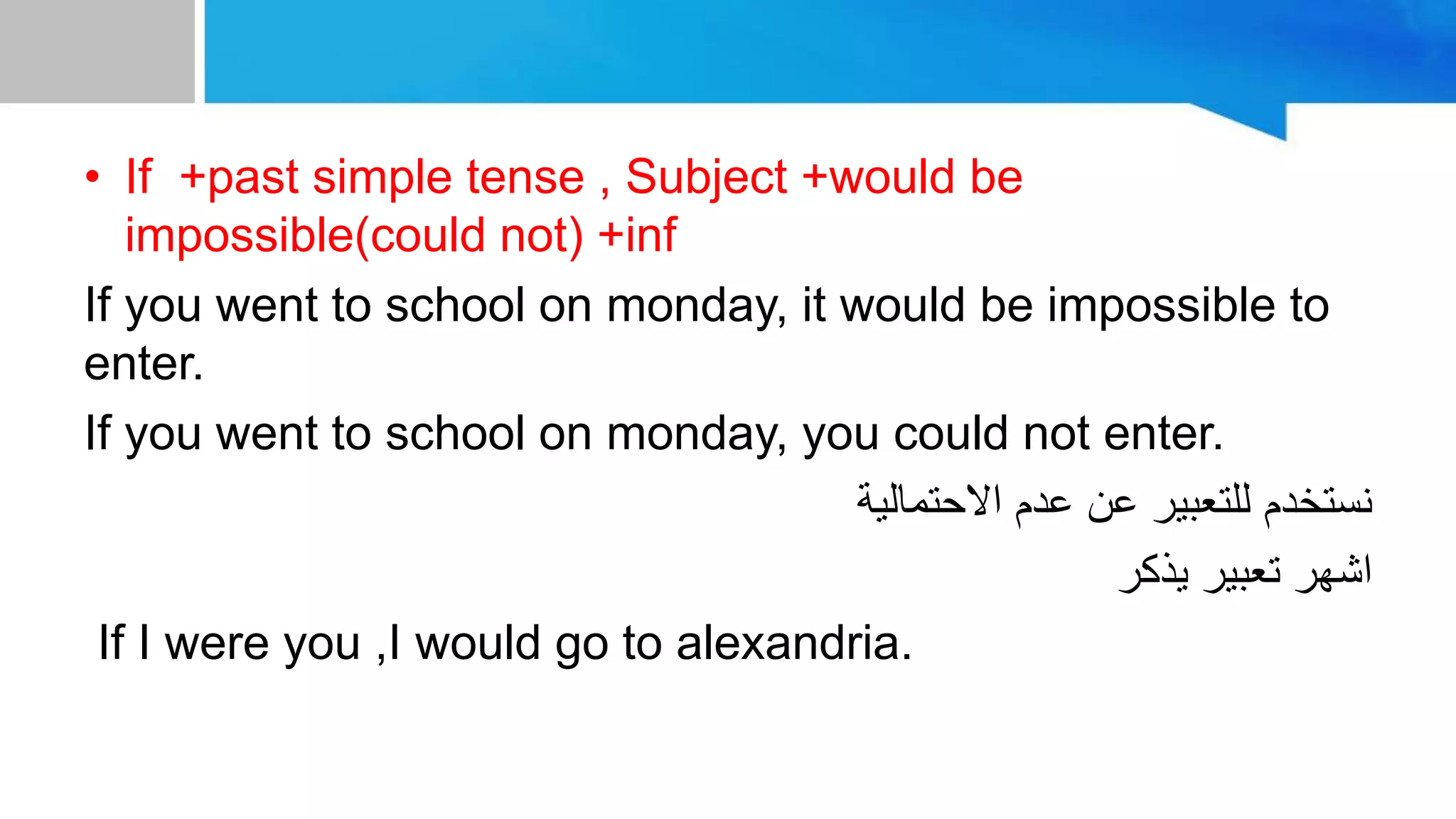
• If +past simple tense , Subject +would be
impossible(could not) +inf
If you went to school on monday, it would be impossible to
enter.
If you went to school on monday, you could not enter.
‫االحتمالية‬ ‫عدم‬ ‫عن‬ ‫للتعبير‬ ‫نستخدم‬
‫يذكر‬ ‫تعبير‬ ‫اشهر‬
If I were you ,I would go to alexandria.
unit 10:to space and back
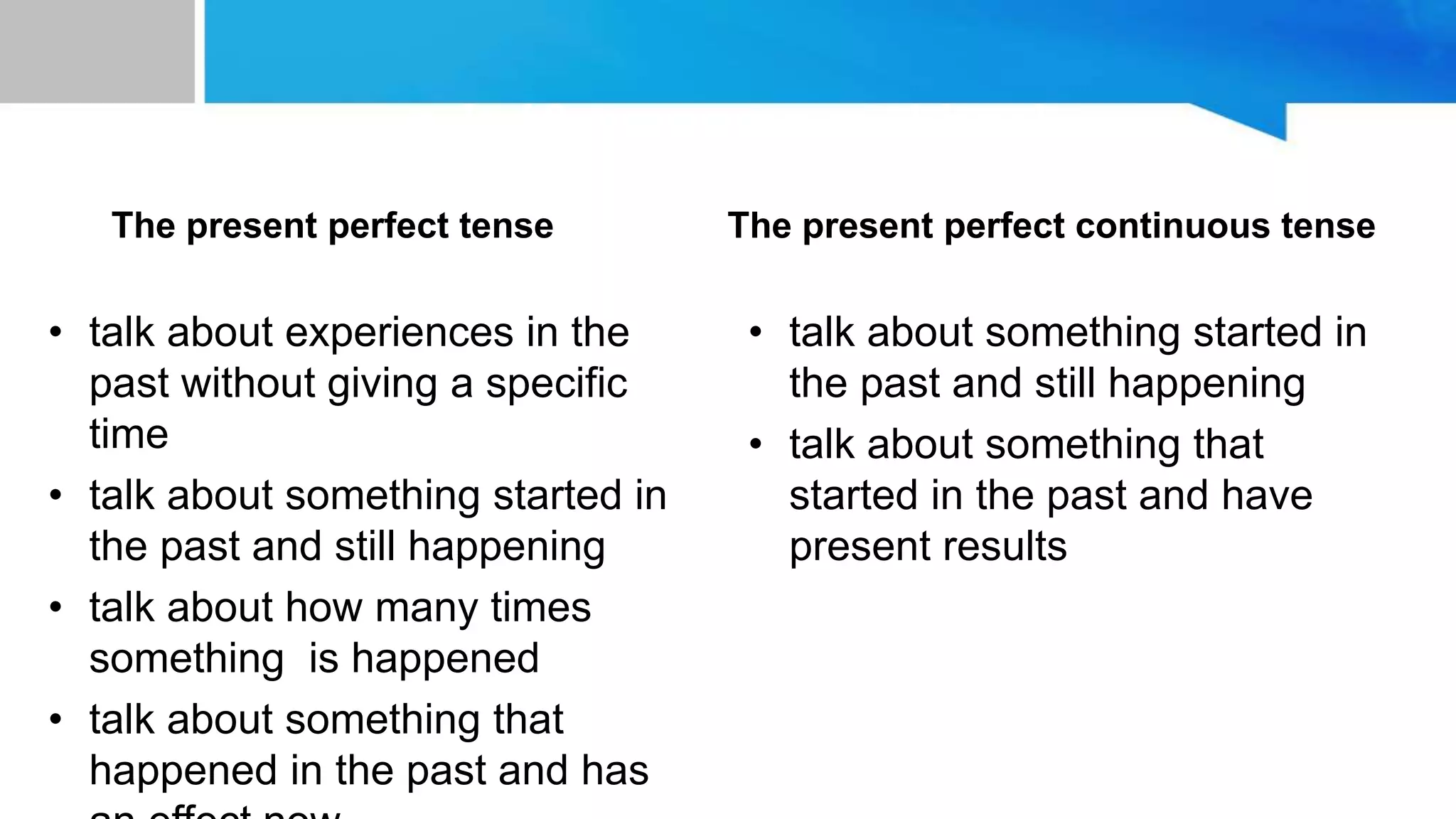
The present perfect tense
• talk about experiences in the
past without giving a specific
time
• talk about something started in
the past and still happening
• talk about how many times
something is happened
• talk about something that
happened in the past and has
The present perfect continuous tense
• talk about something started in
the past and still happening
• talk about something that
started in the past and have
present results
unit 10:to space and back
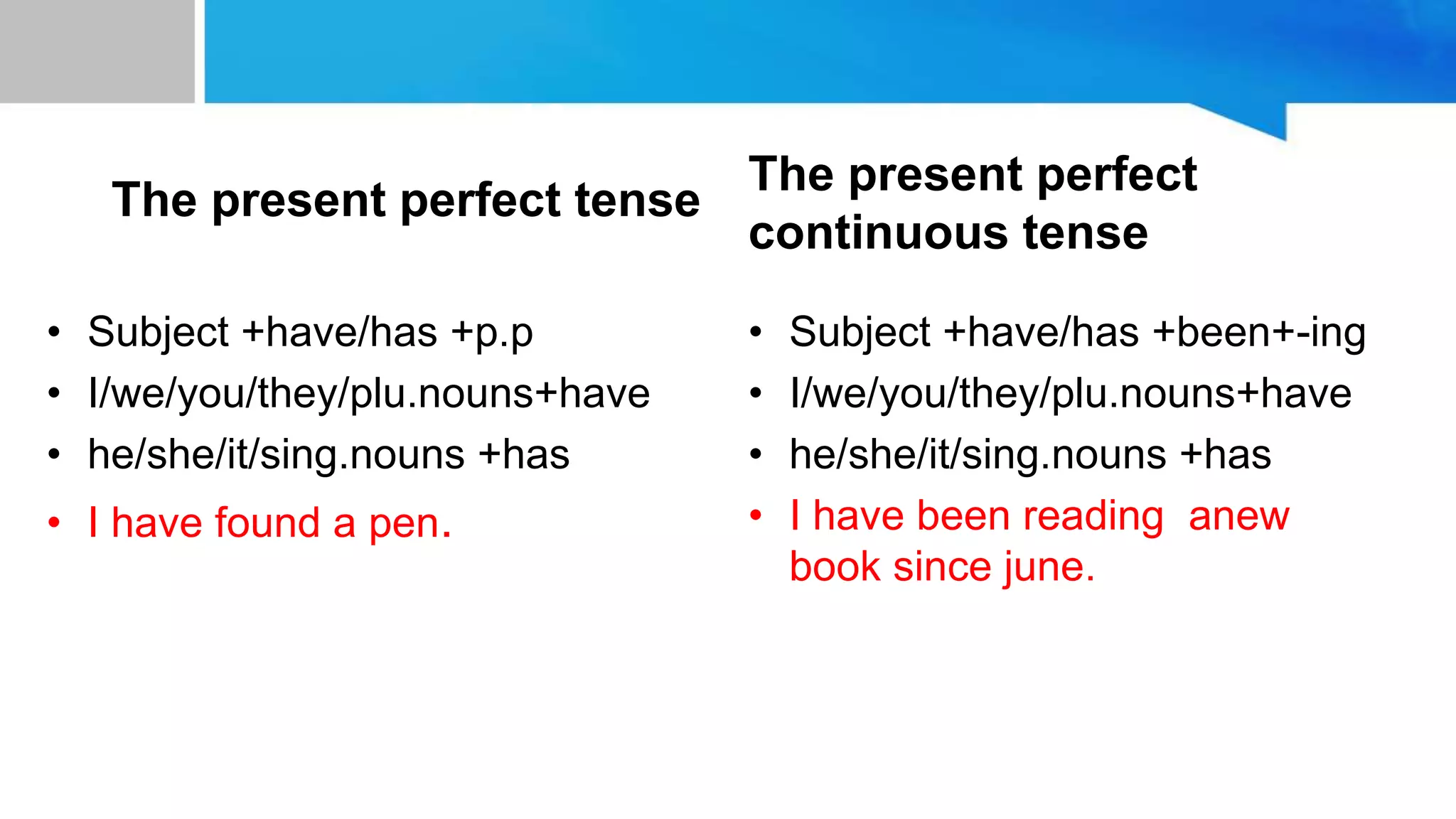
The present perfect tense
• Subject +have/has +p.p
• I/we/you/they/plu.nouns+have
• he/she/it/sing.nouns +has
• I have found a pen.
The present perfect
continuous tense
• Subject +have/has +been+-ing
• I/we/you/they/plu.nouns+have
• he/she/it/sing.nouns +has
• I have been reading anew
book since june.
unit 10:to space and back
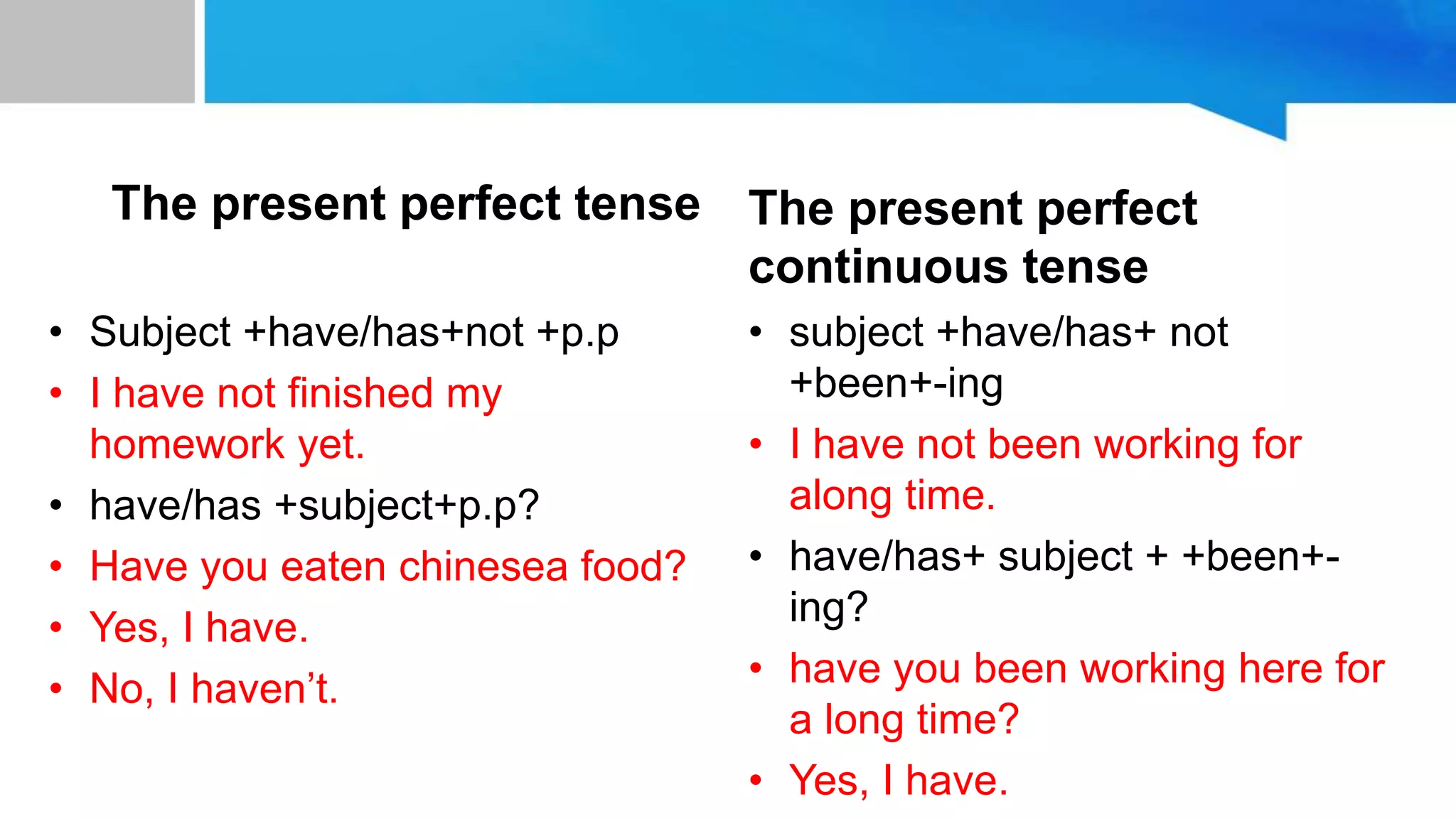
The present perfect tense
• Subject +have/has+not +p.p
• I have not finished my
homework yet.
• have/has +subject+p.p?
• Have you eaten chinesea food?
• Yes, I have.
• No, I haven’t.
The present perfect
continuous tense
• subject +have/has+ not
+been+-ing
• I have not been working for
along time.
• have/has+ subject + +been+-
ing?
• have you been working here for
a long time?
• Yes, I have.
unit 10:to space and back
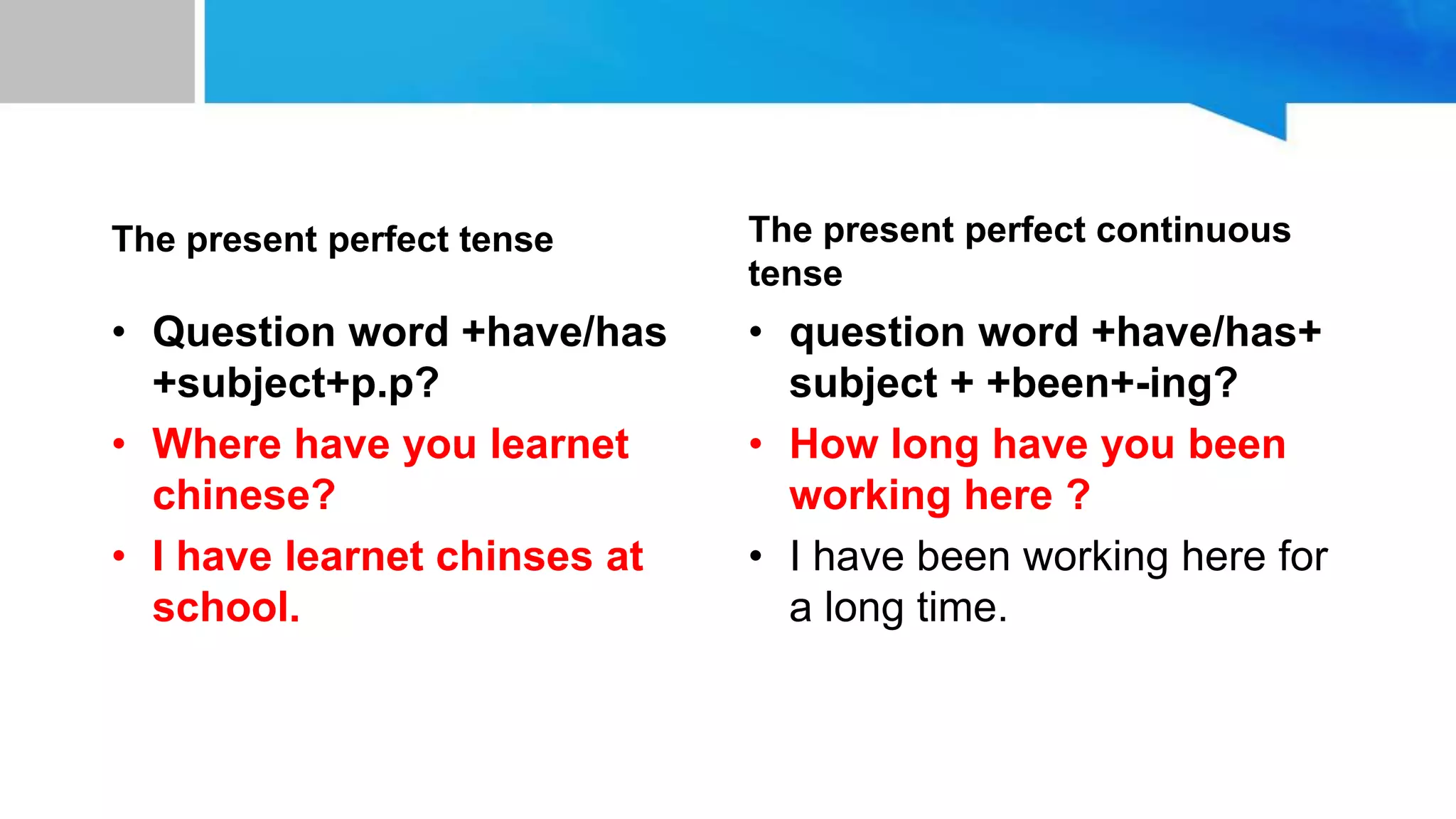
The present perfect tense
• Question word +have/has
+subject+p.p?
• Where have you learnet
chinese?
• I have learnet chinses at
school.
The present perfect continuous
tense
• question word +have/has+
subject + +been+-ing?
• How long have you been
working here ?
• I have been working here for
a long time.
unit 10:to space and back
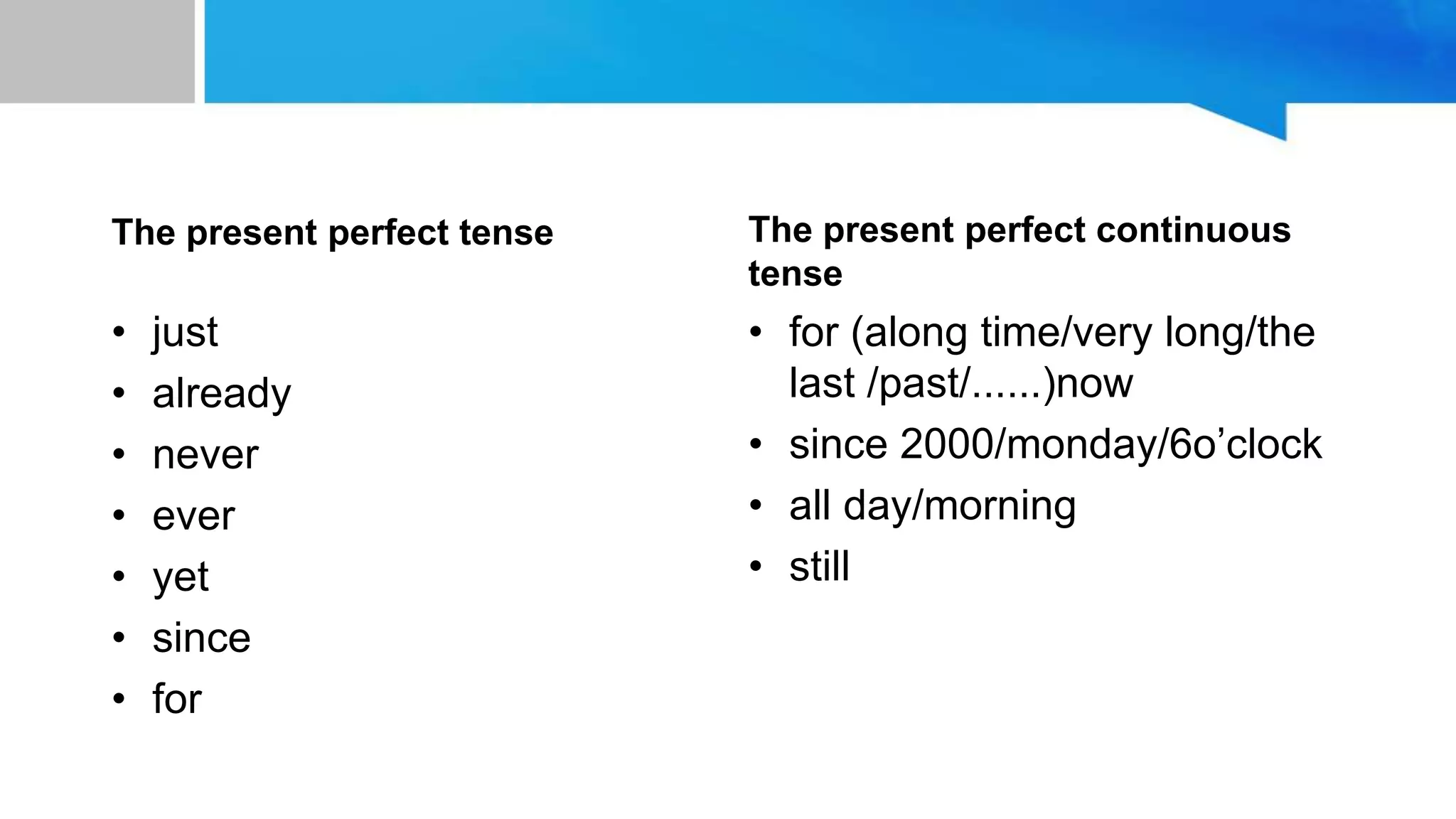
The present perfect tense
• just
• already
• never
• ever
• yet
• since
• for
The present perfect continuous
tense
• for (along time/very long/the
last /past/......)now
• since 2000/monday/6o’clock
• all day/morning
• still
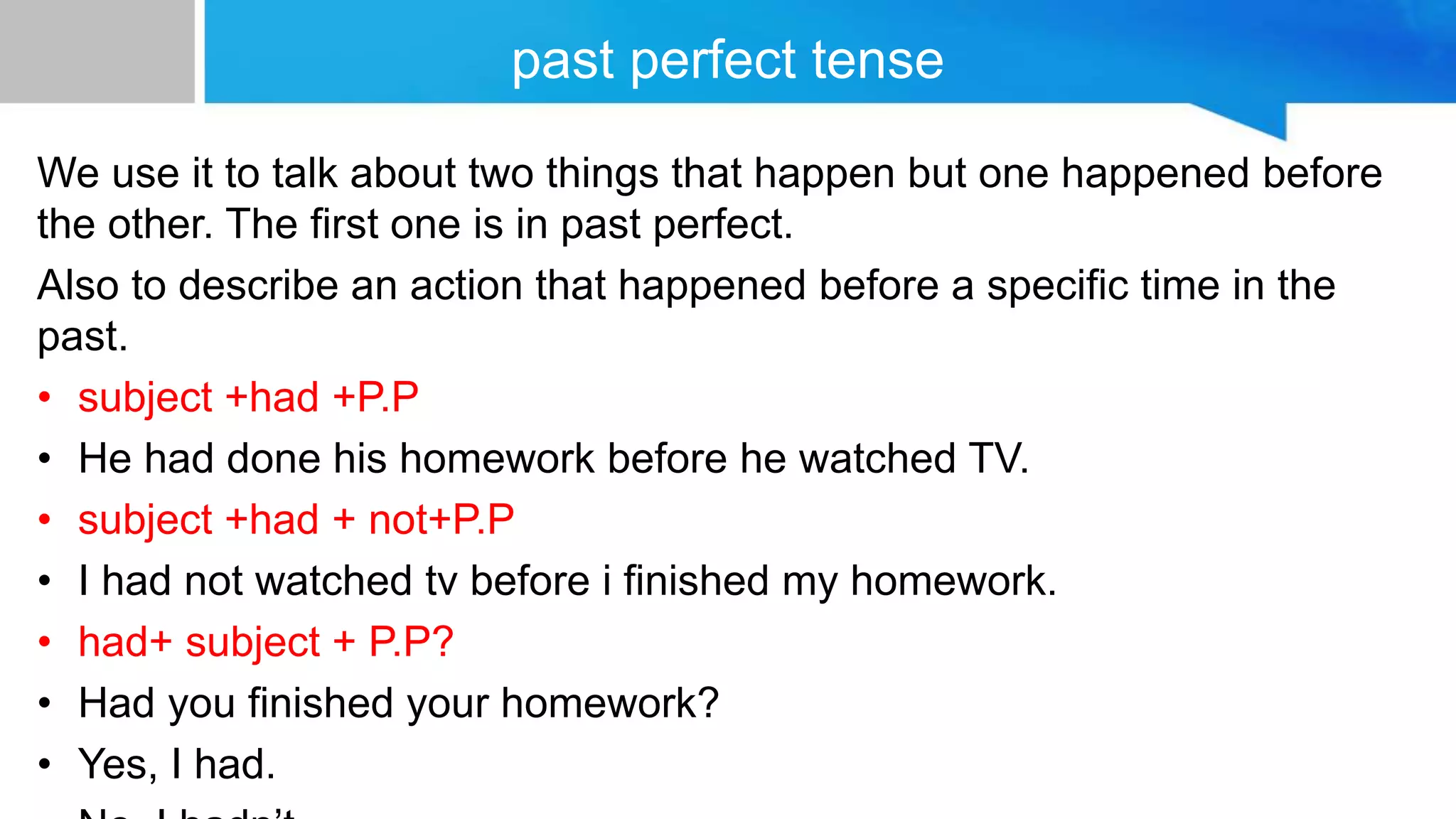
past perfect tense
We use it to talk about two things that happen but one happened before
the other. The first one is in past perfect.
Also to describe an action that happened before a specific time in the
past.
• subject +had +P.P
• He had done his homework before he watched TV.
• subject +had + not+P.P
• I had not watched tv before i finished my homework.
• had+ subject + P.P?
• Had you finished your homework?
• Yes, I had.
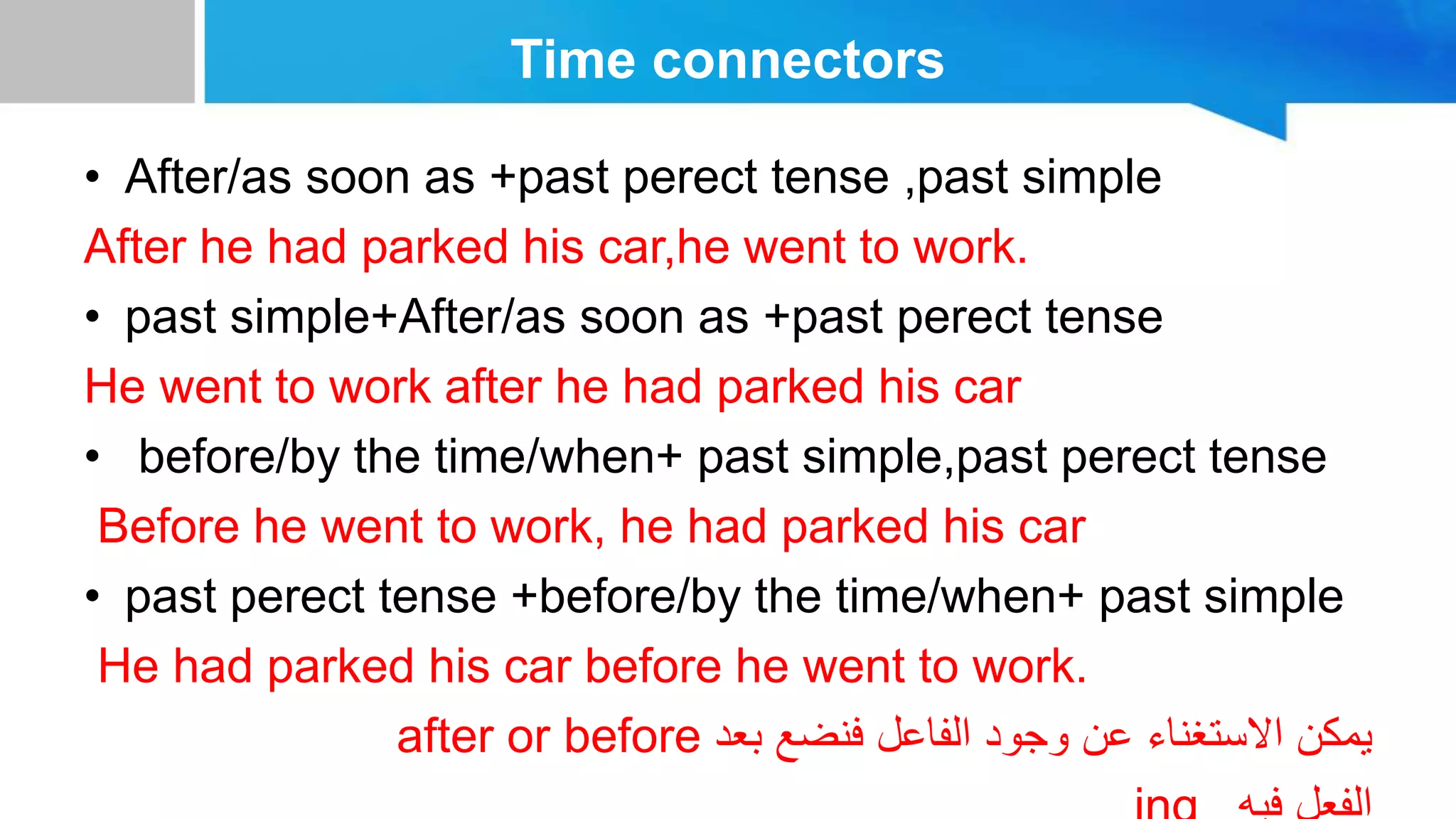
Time connectors
• After/as soon as +past perect tense ,past simple
After he had parked his car,he went to work.
• past simple+After/as soon as +past perect tense
He went to work after he had parked his car
• before/by the time/when+ past simple,past perect tense
Before he went to work, he had parked his car
• past perect tense +before/by the time/when+ past simple
He had parked his car before he went to work.
after or before ‫بعد‬ ‫فنضع‬ ‫الفاعل‬ ‫وجود‬ ‫عن‬ ‫االستغناء‬ ‫يمكن‬
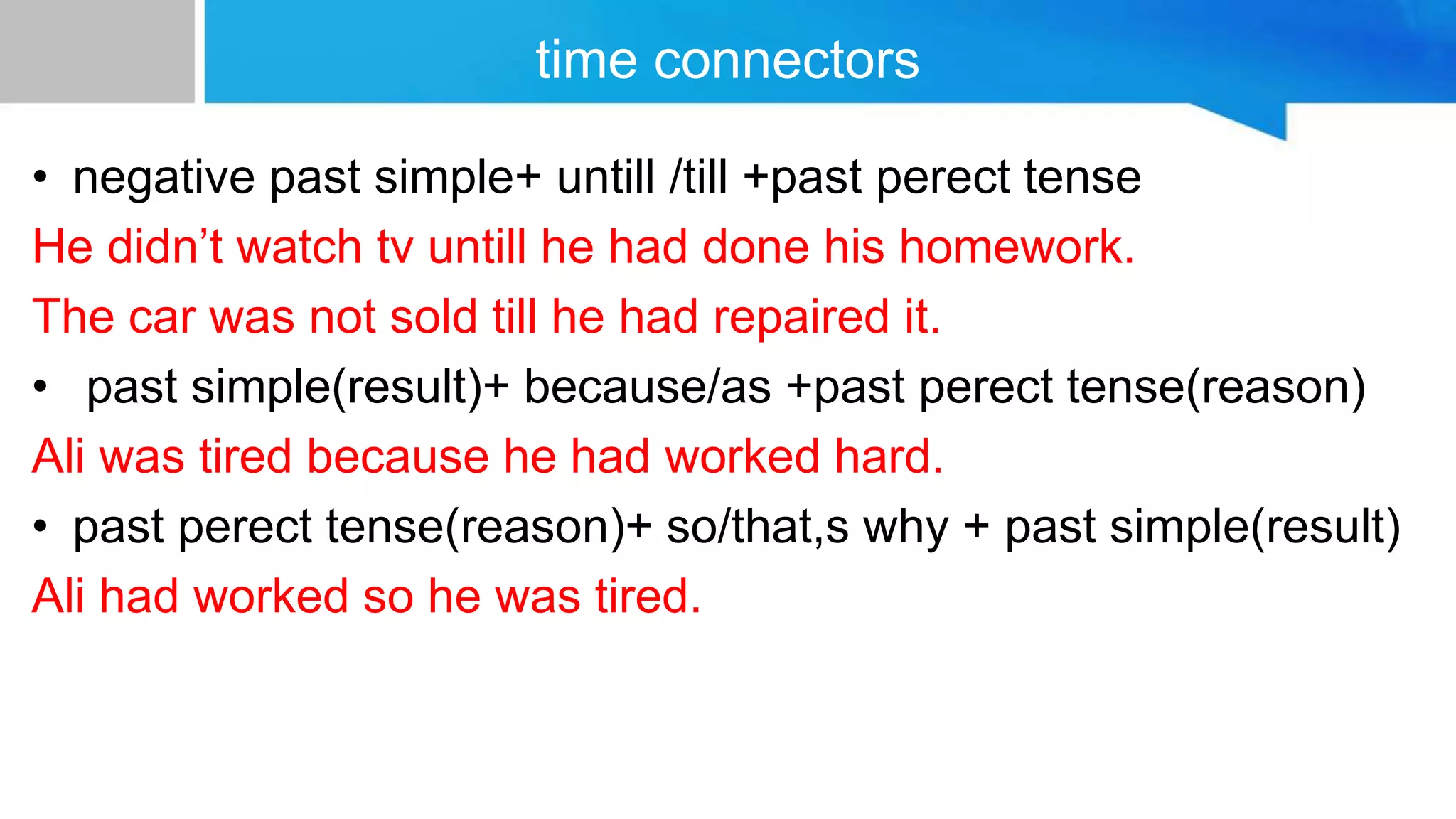
time connectors
• negative past simple+ untill /till +past perect tense
He didn’t watch tv untill he had done his homework.
The car was not sold till he had repaired it.
• past simple(result)+ because/as +past perect tense(reason)
Ali was tired because he had worked hard.
• past perect tense(reason)+ so/that,s why + past simple(result)
Ali had worked so he was tired.
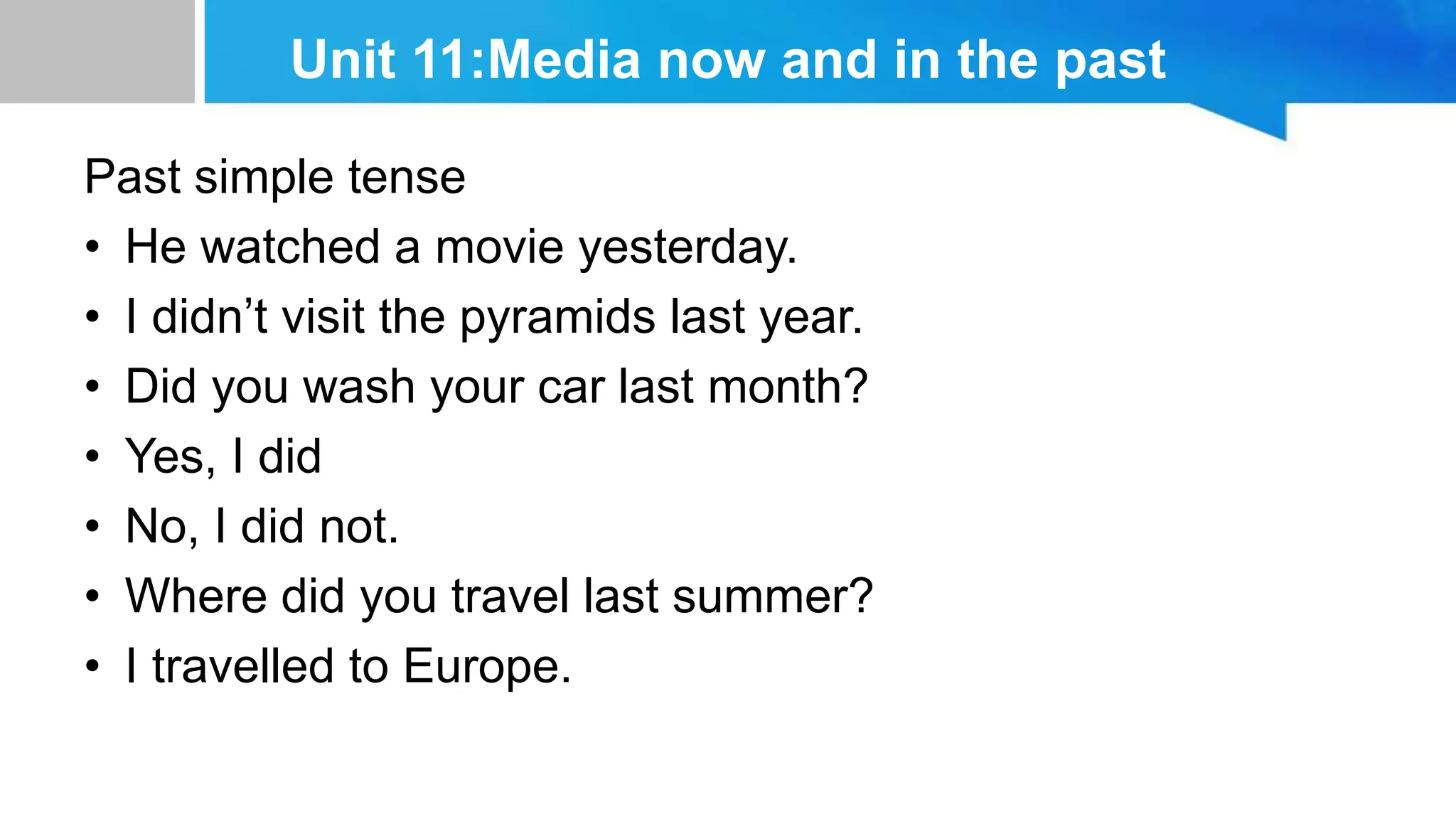
Unit 11:Media now and in the past
Past simple tense
• He watched a movie yesterday.
• I didn’t visit the pyramids last year.
• Did you wash your car last month?
• Yes, I did
• No, I did not.
• Where did you travel last summer?
• I travelled to Europe.
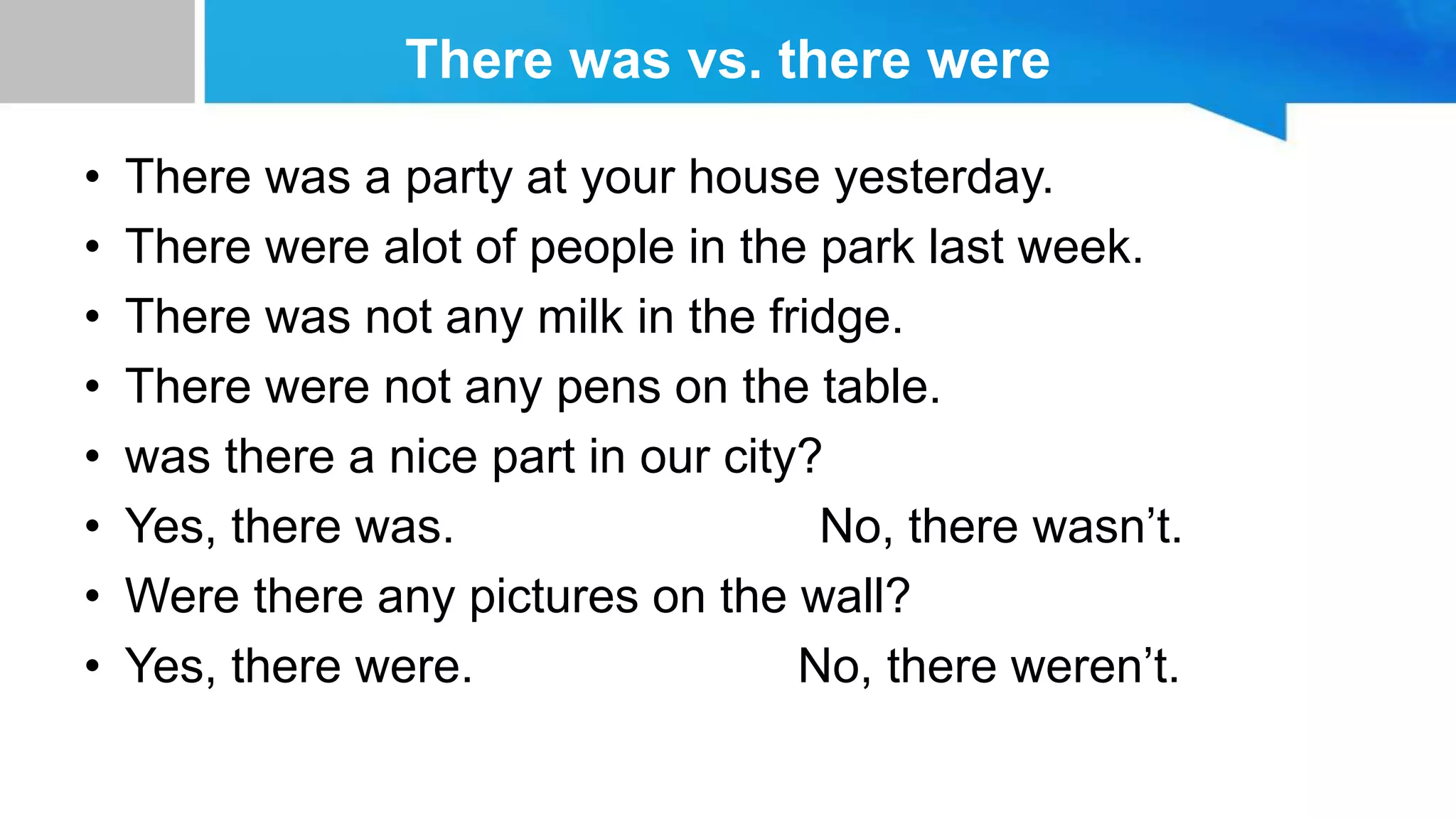
There was vs. there were
• There was a party at your house yesterday.
• There were alot of people in the park last week.
• There was not any milk in the fridge.
• There were not any pens on the table.
• was there a nice part in our city?
• Yes, there was. No, there wasn’t.
• Were there any pictures on the wall?
• Yes, there were. No, there weren’t.
Reported speech
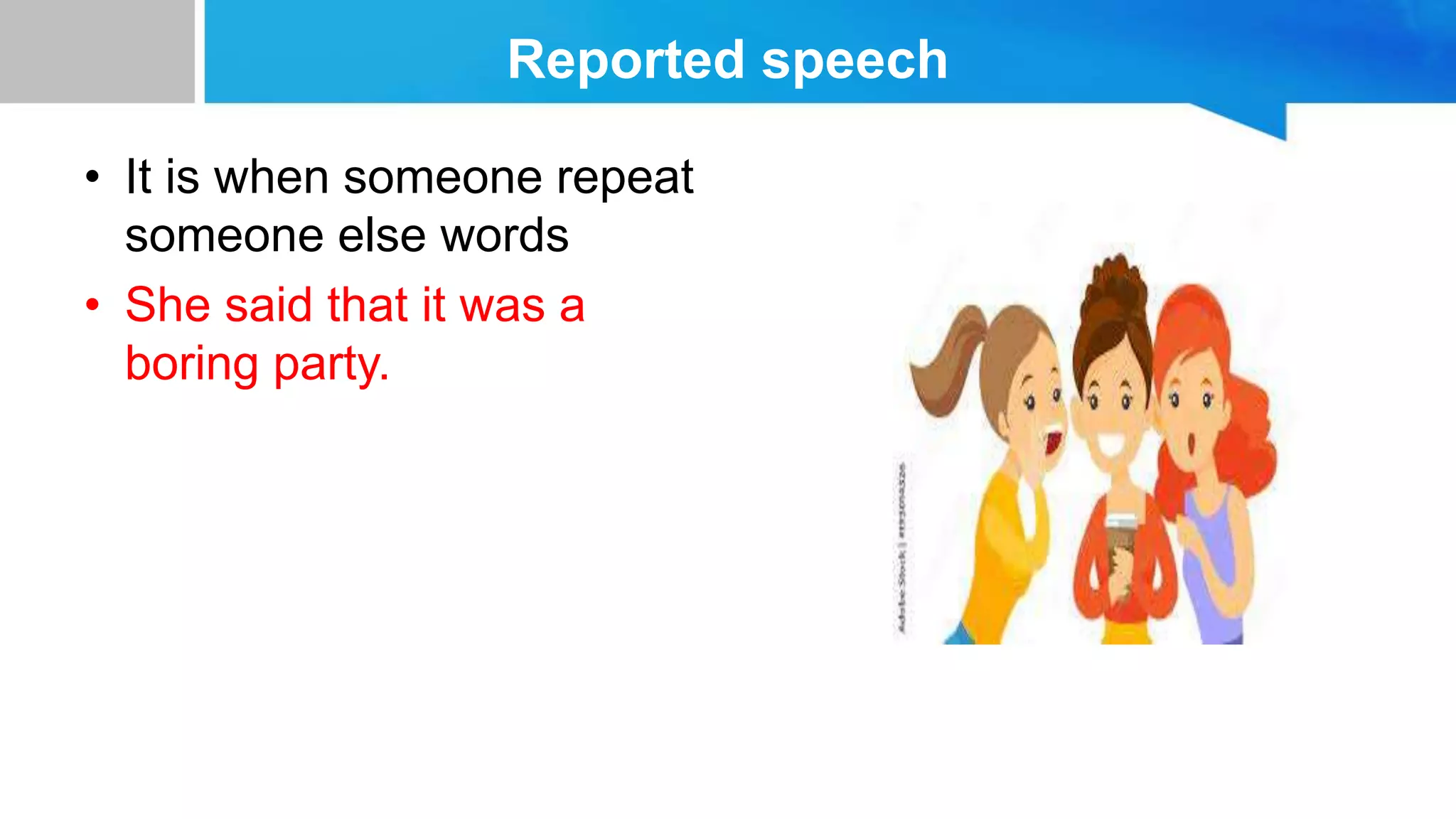
• It is when someone repeat
someone else words
• She said that it was a
boring party.
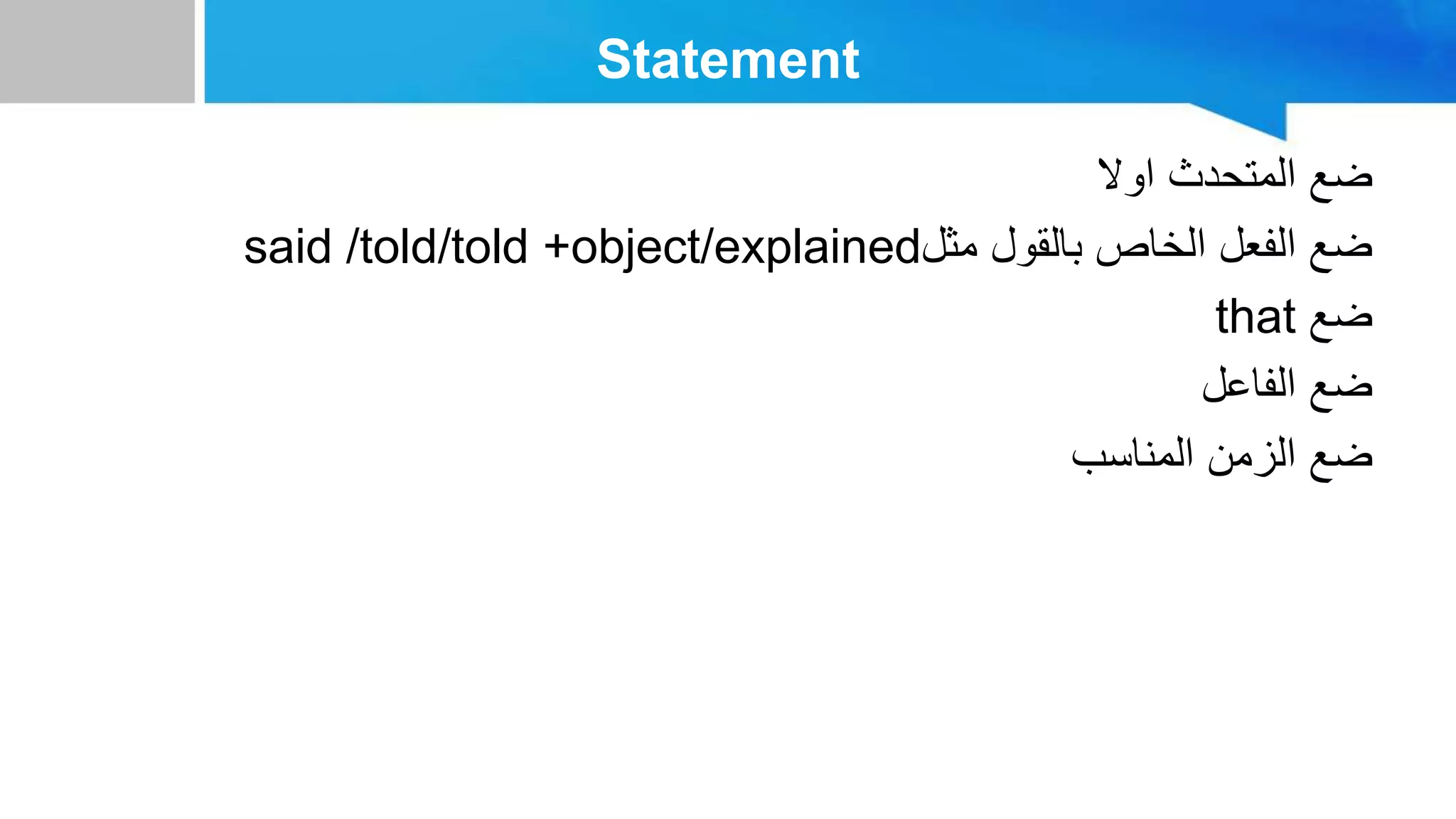
Statement
‫اوال‬ ‫المتحدث‬ ‫ضع‬
said /told/told +object/explained‫مثل‬ ‫بالقول‬ ‫الخاص‬ ‫الفعل‬ ‫ضع‬
that ‫ضع‬
‫الفاعل‬ ‫ضع‬
‫المناسب‬ ‫الزمن‬ ‫ضع‬
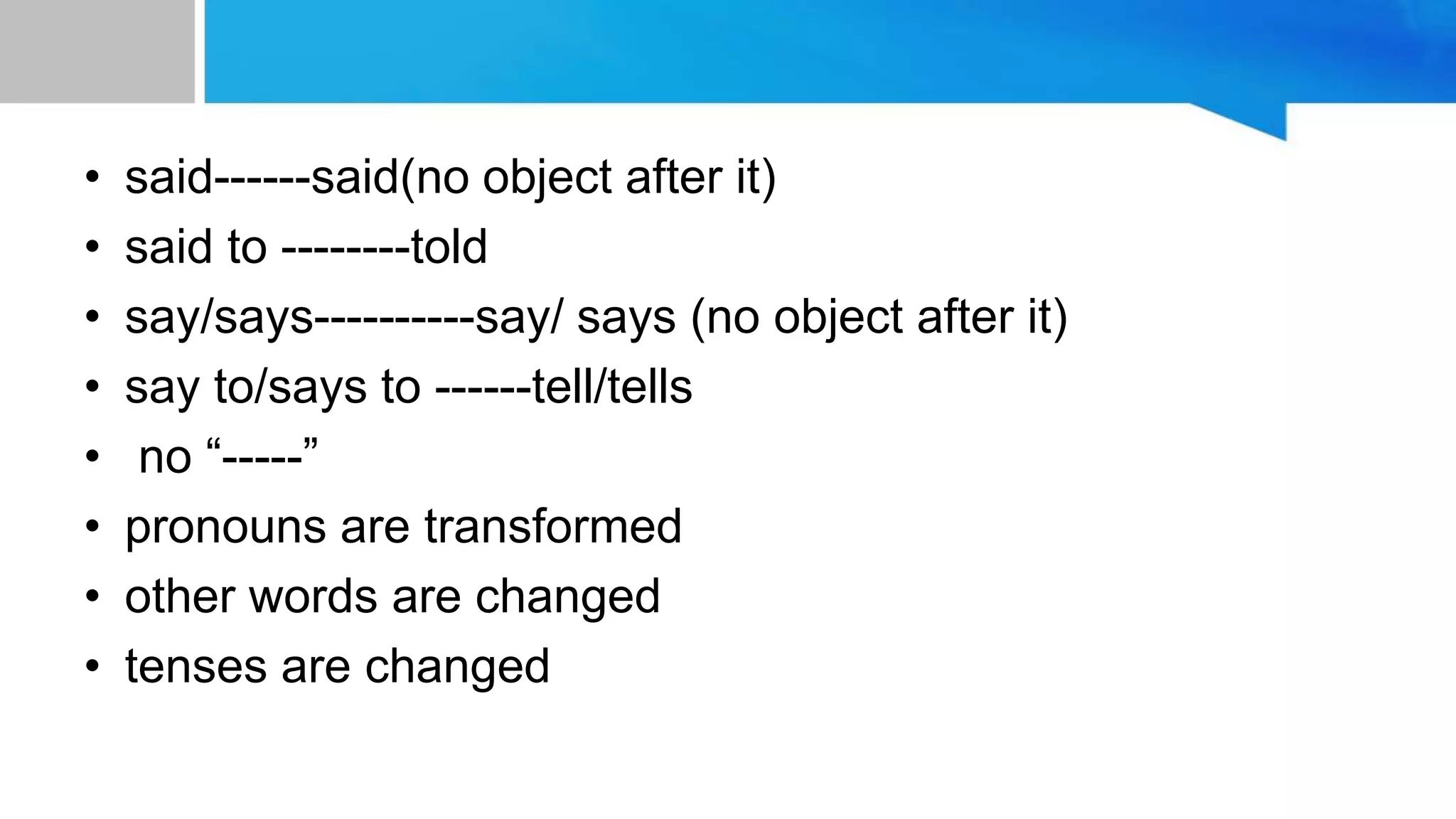
• said------said(no object after it)
• said to --------told
• say/says----------say/ says (no object after it)
• say to/says to ------tell/tells
• no “-----”
• pronouns are transformed
• other words are changed
• tenses are changed
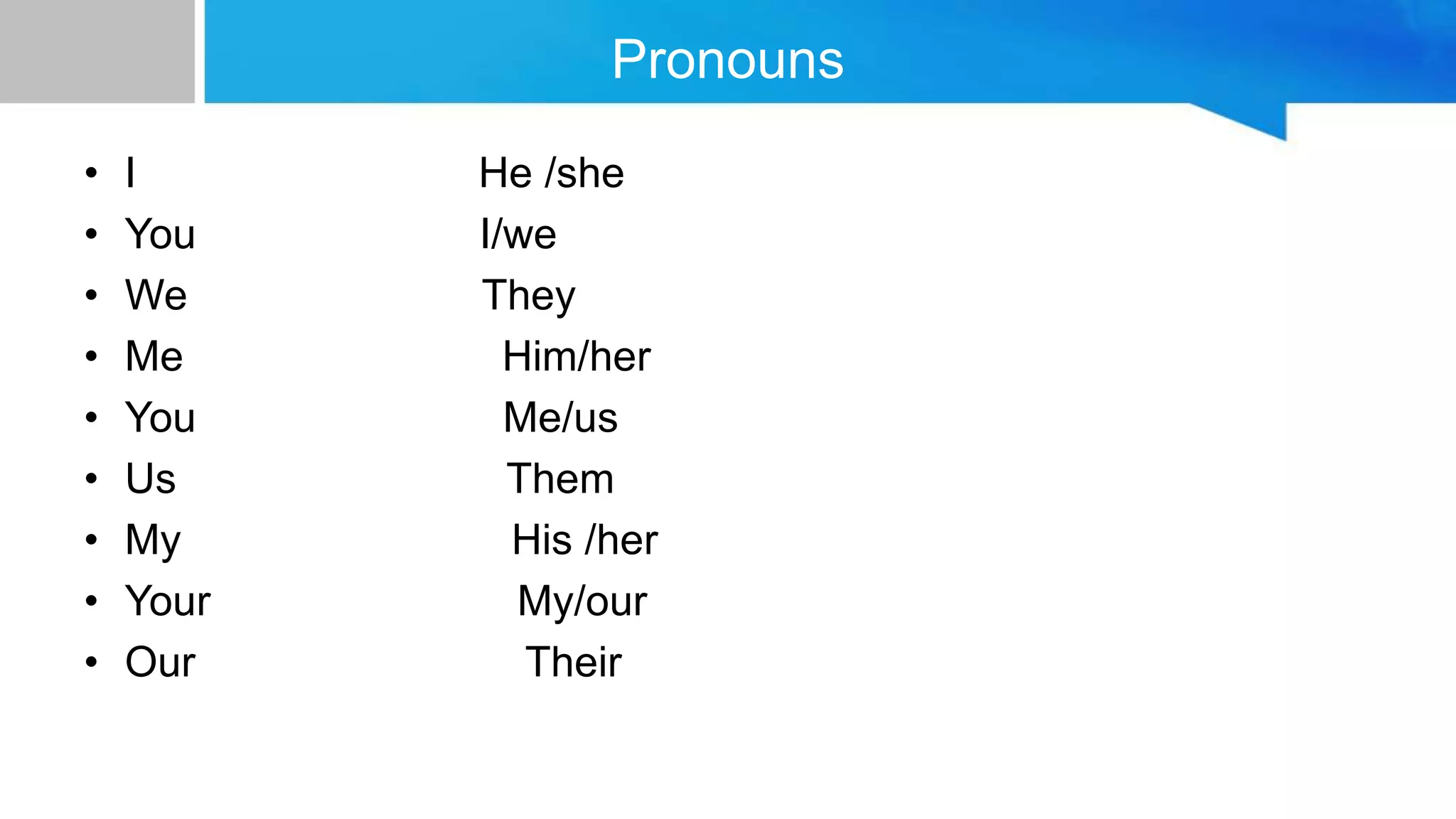
Pronouns
• I He /she
• You I/we
• We They
• Me Him/her
• You Me/us
• Us Them
• My His /her
• Your My/our
• Our Their
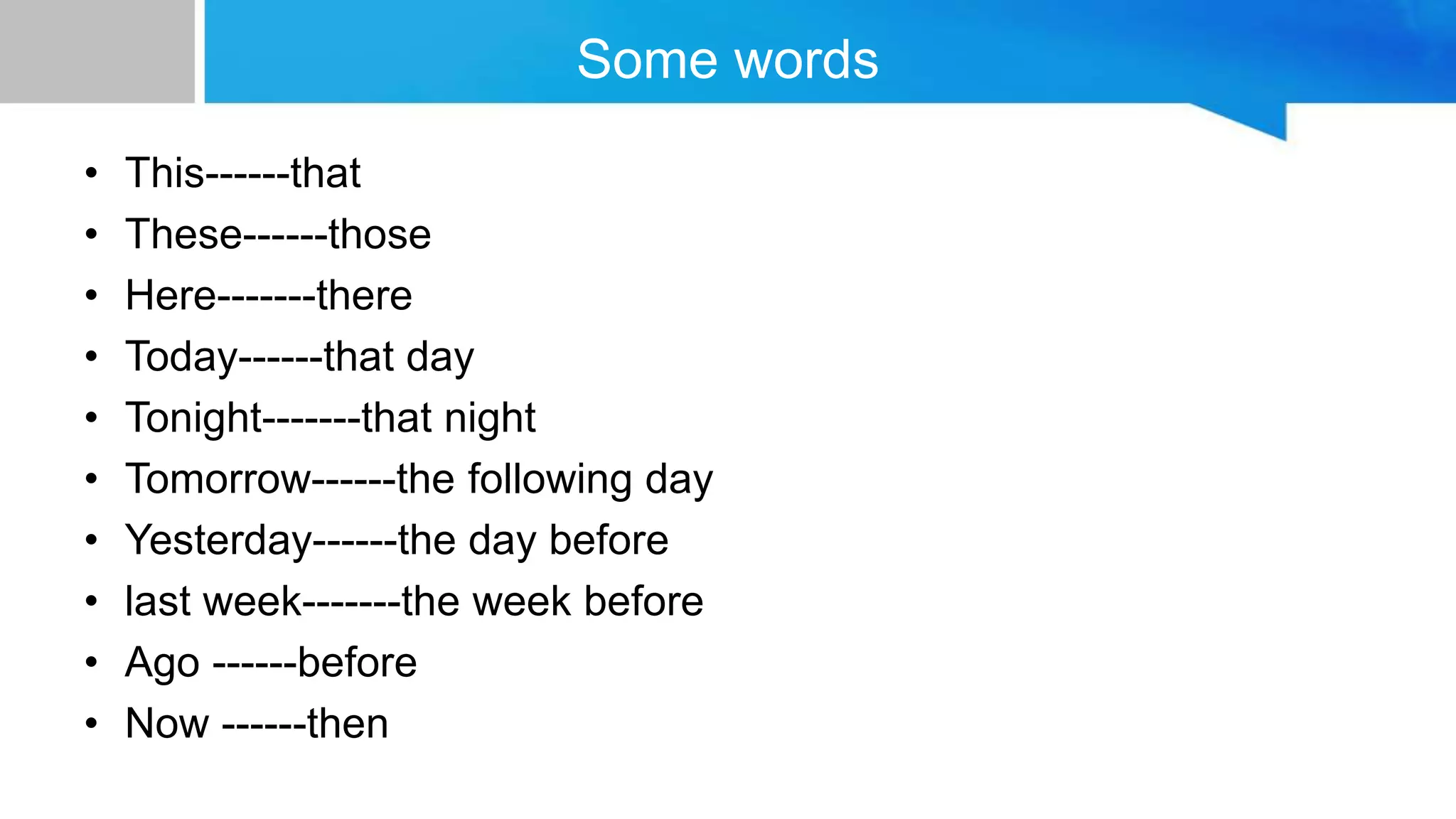
Some words
• This------that
• These------those
• Here-------there
• Today------that day
• Tonight-------that night
• Tomorrow------the following day
• Yesterday------the day before
• last week-------the week before
• Ago ------before
• Now ------then
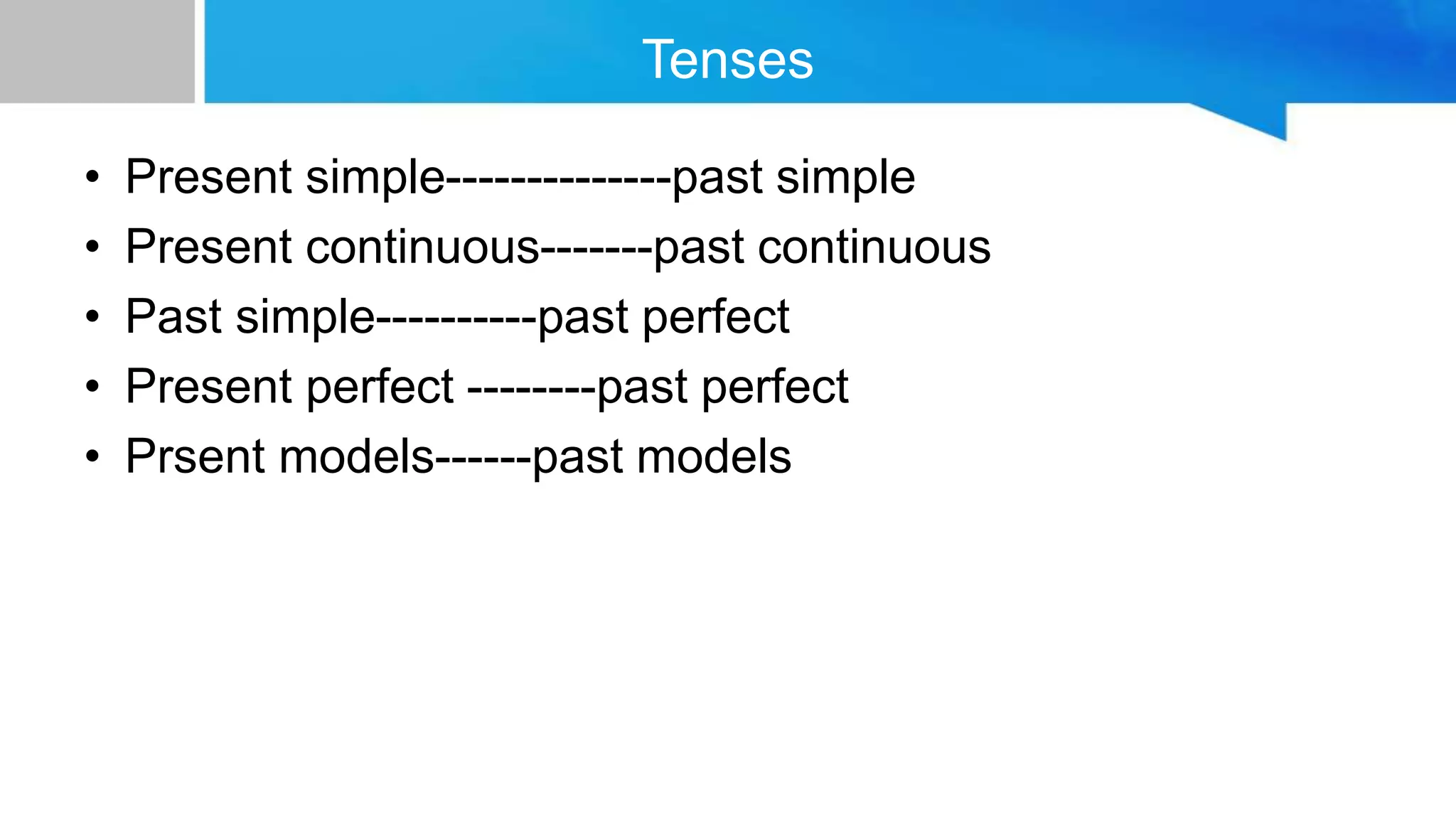
Tenses
• Present simple--------------past simple
• Present continuous-------past continuous
• Past simple----------past perfect
• Present perfect --------past perfect
• Prsent models------past models
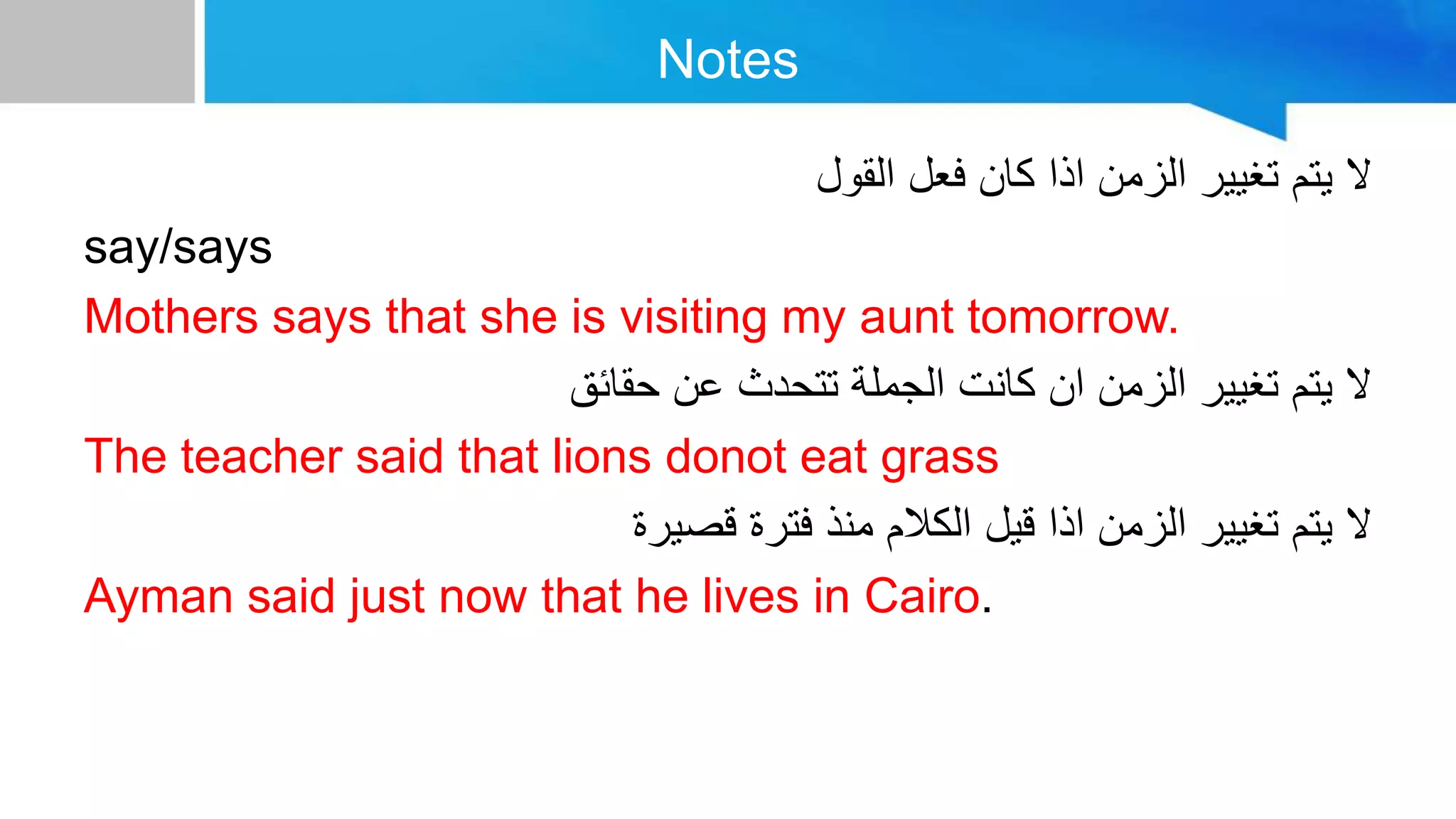
Notes
‫القول‬ ‫فعل‬ ‫كان‬ ‫اذا‬ ‫الزمن‬ ‫تغيير‬ ‫يتم‬ ‫ال‬
say/says
Mothers says that she is visiting my aunt tomorrow.
‫حقائق‬ ‫عن‬ ‫تتحدث‬ ‫الجملة‬ ‫كانت‬ ‫ان‬ ‫الزمن‬ ‫تغيير‬ ‫يتم‬ ‫ال‬
The teacher said that lions donot eat grass
‫قصيرة‬ ‫فترة‬ ‫منذ‬ ‫الكالم‬ ‫قيل‬ ‫اذا‬ ‫الزمن‬ ‫تغيير‬ ‫يتم‬ ‫ال‬
Ayman said just now that he lives in Cairo.
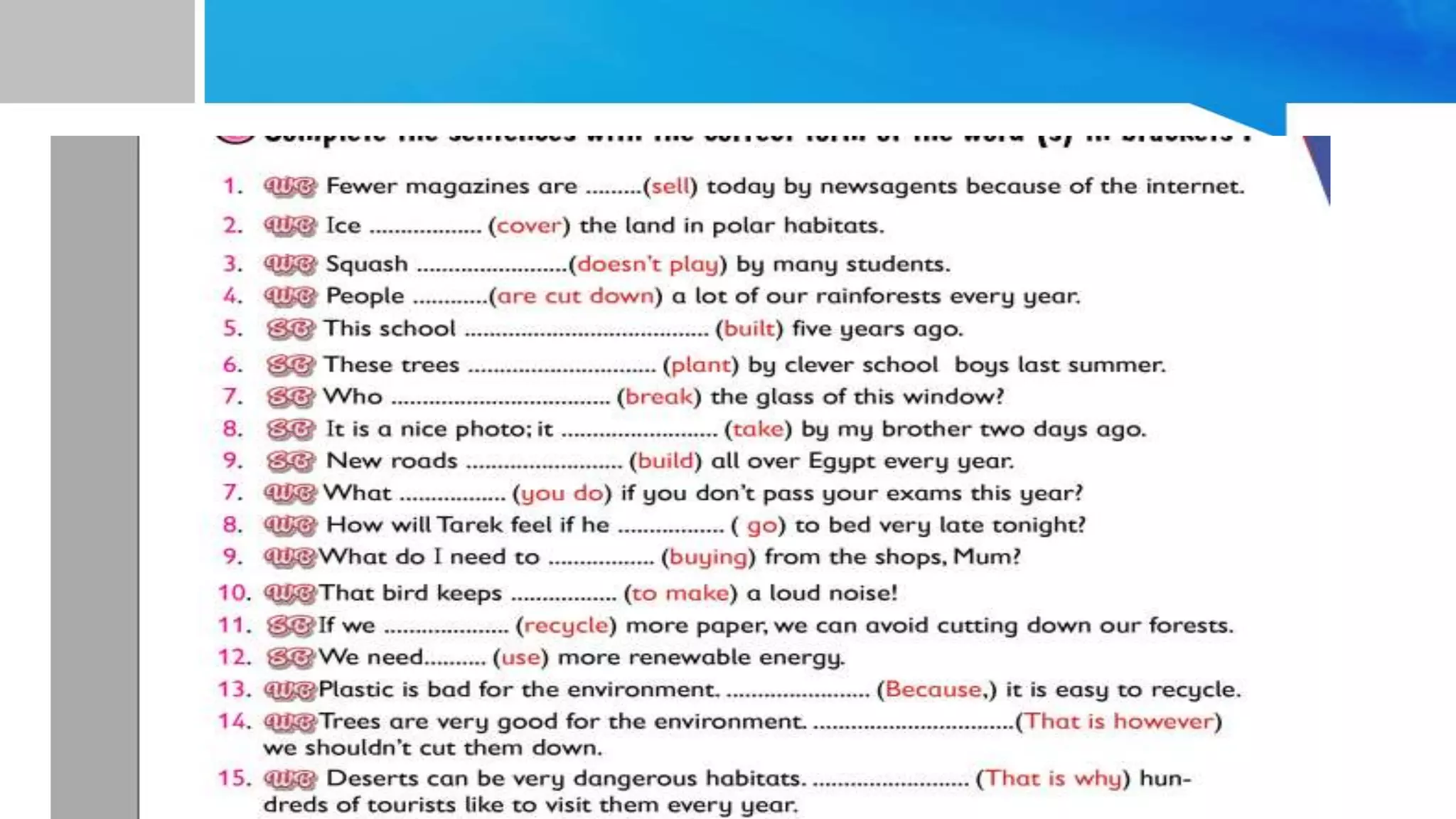
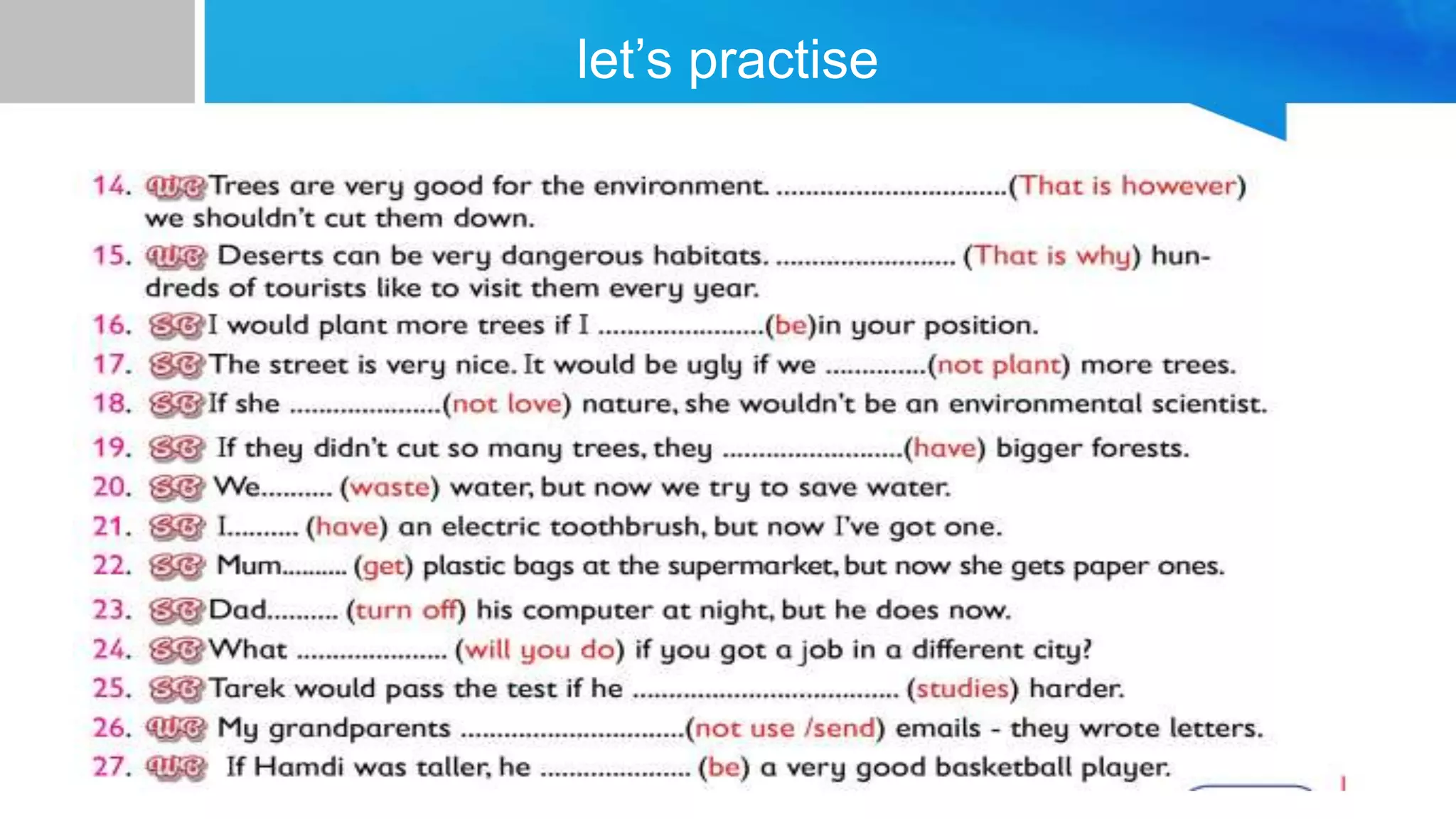
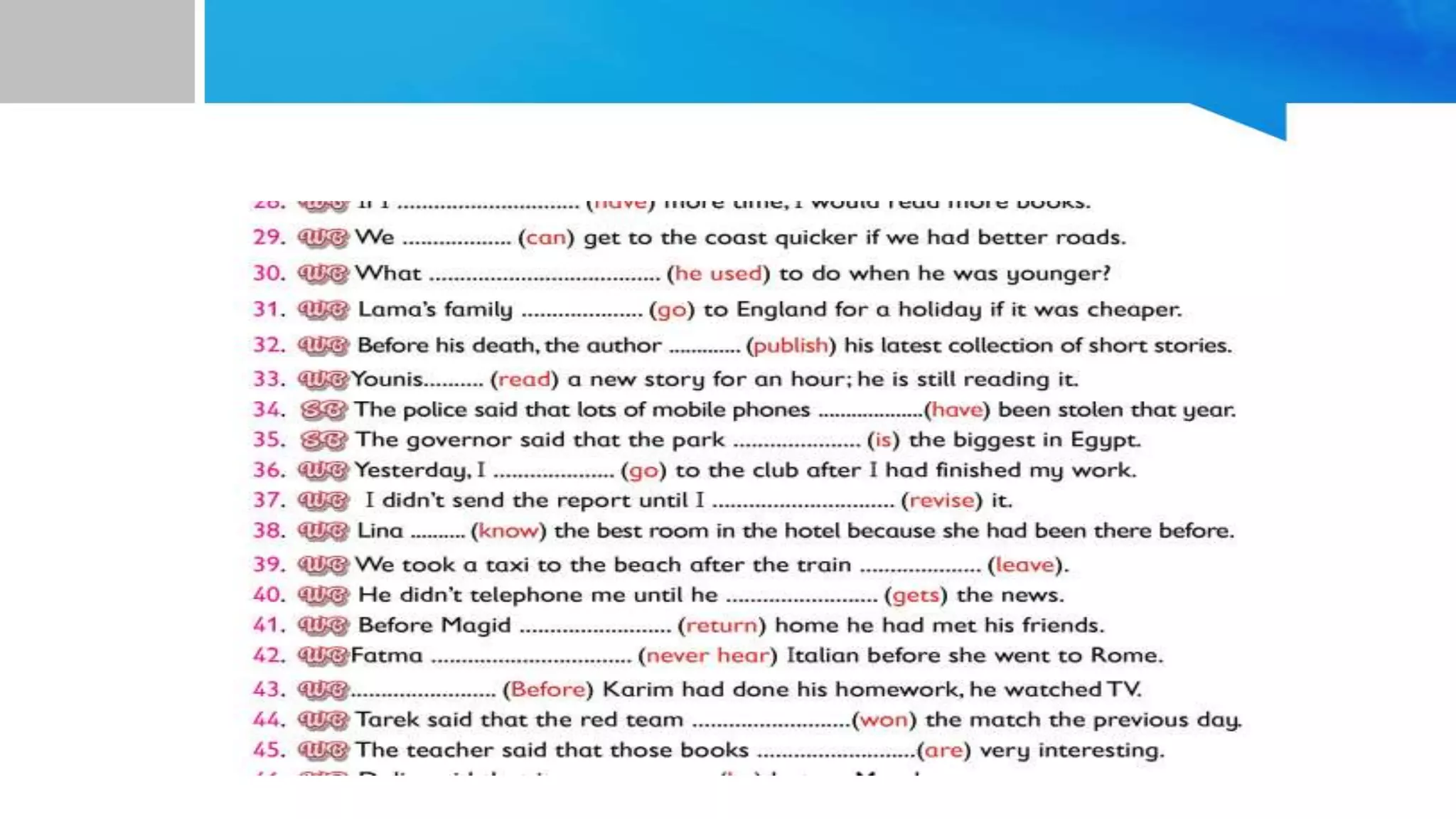
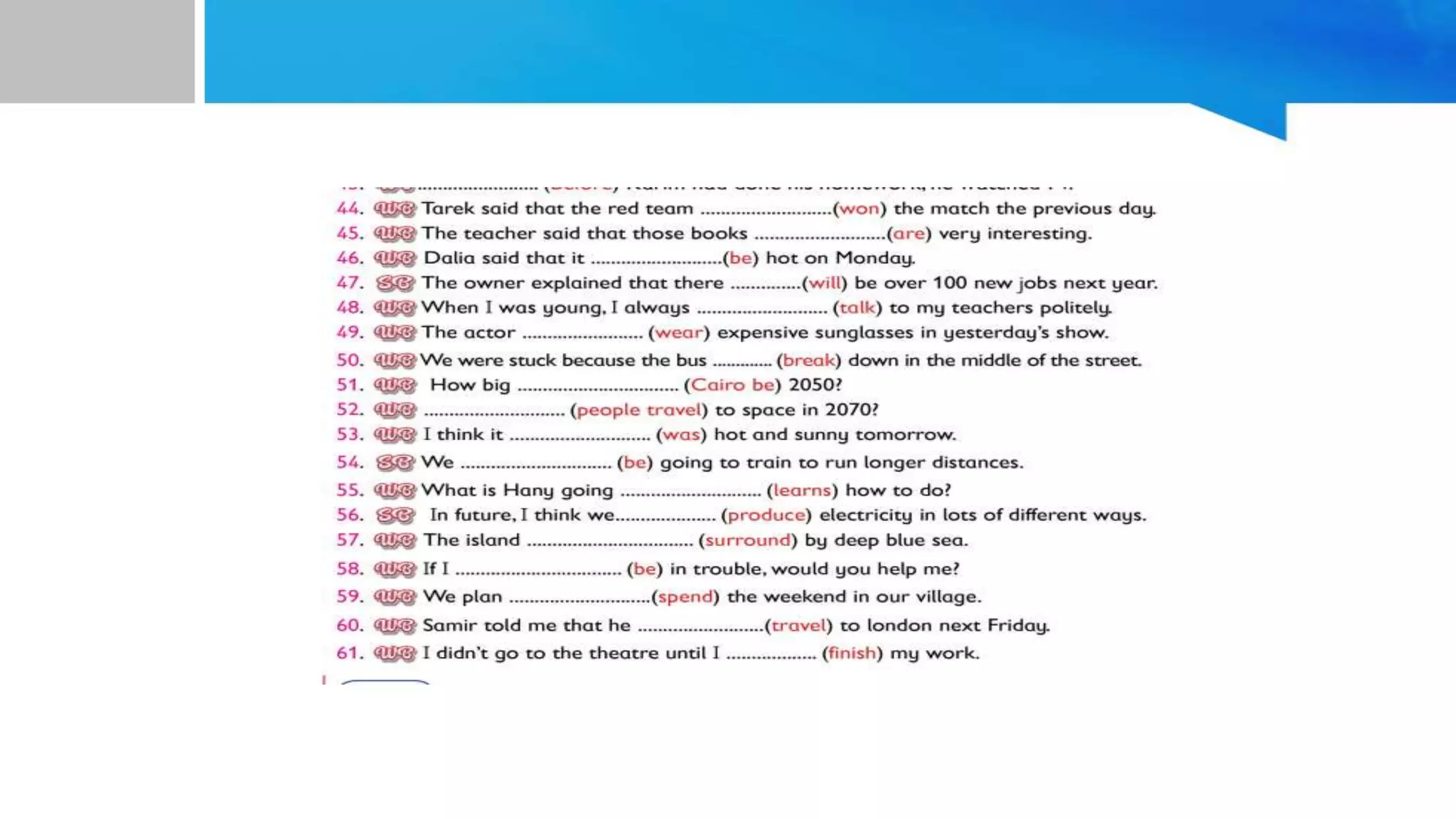
let’s practise
revision for prep 3.pptx

revision for prep 3.pptx

  • 1.
  • 2.
    let’s remember ourbook • Unit 7 : our world • unit 8: protecting our planet • unit 9: Build a greener world • unit 10:to space and back • unit 11: Media now and in the past
  • 3.
    unit 7 :our World ‫وجود‬ ‫حالة‬ ‫في‬ ‫بعدالعدد‬ ‫االسم‬ ‫جمع‬ ‫عدم‬ ( - ) ‫االتية‬ ‫التعبيرات‬ ‫في‬ : a three -hour drive a six -person table a ten- floor building
  • 4.
    Using passive • v.to be +past perticiple------------------- (am/ is /are+P.P) • we use it when the action os more important than who does it or • when we don’t know The window is broken.
  • 5.
    Present simple passive •Subject +am/is/are +P.P Egypt is visited by more than 14 million tourists. • Subject +am/is/are +not+P.P sweets are not eaten by babies. • am/is /are + subject +P.P? Is English spoken by locals in Brazil? • Question Word + am/is/are +subject +P.P? Where are your clothes bought? Who is lunch cooked by in your family?
  • 6.
    Past simple passive •Subject +was/ were +P.P The flowers were picked by Mona. • Subject +was/were +not+P.P The car was not washed by him. • was/were + subject +P.P? Was the newspaper bought by your mother? • Question Word +was/were +subject +P.P? Where were your keys found? Who was the window broken by? by ‫الجر‬ ‫حرف‬ ‫وضع‬ ‫من‬ ‫البد‬ who ‫ب‬ ‫السؤال‬ ‫عند‬ ‫الفعل‬ ‫بعد‬
  • 7.
    Unit 8 :Protectingour planet conditional clauses with if: • zero • first • second • third • for first conditional clause we talk about things in the future whicch we think will probably happen
  • 8.
    First conditional clausewith if • If /when +present simple tense , Subject +will/will not)won’t( +inf If Ali studies hard, he will pass his test. • subject +will /will not)won’t( +inf +if/when+present simple tense Mona will catch the bus if she is quick. • Will +subject+ inf+ if/when +present simple ? Will you play football if you donot have a school? Yes, I will. No, I won’t. Question word +will/ willnot +subject +inf+if/when +present simple? What will you do if you lose the match? I will be sad.
  • 9.
    Verbs +inf or-ing form • Some verbs might have inf after it . allow-agree-arrange-ask-choose-decide-expect-fail-help- hope-intend-need-learn-manage-offer-plan-promise-refuse- threaten-want-wish-would like He chooses to play chess. He decides not to play tennis. not to‫استخدام‬ ‫يمكن‬ ‫النفي‬ ‫حالة‬ ‫في‬ ‫ثم‬ ‫المفعول‬ ‫بعدها‬ ‫ياتي‬ ‫ان‬ ‫يمكن‬ ‫االفعال‬ ‫بعض‬ to +inf He agrees to help me do my homework.
  • 10.
    Verbs +inf or-ing form • Some verbs might have - ing after it . avoid- consider-deny-include-keep-mind-dislike-practise- enjoy-fnish-imagine-recommend-suggest-admit You should avoid eating too many sweets. ‫استخدام‬ ‫يمكن‬ ‫النفي‬ ‫حالة‬ ‫في‬not inf + -ing form
  • 11.
    verbs +inf or-ing form • some verbs might have - ing after it or to +inf with diffrence in meaning . remember /forget /stop/try remember to bring your homework tomorrow. I remember eating the sandwich. She forgets to bring her lunch. He forgets writing the email. She stopped to talk to her friend. She stopped talking to him.
  • 12.
    remember to bringyour homework tomorrow. (didn’t happen) I remember eating the sandwich. (happened) She forgets to bring her lunch. (didn’t happen) He forgets writing the email. (happened) She stopped to talk to her friend. (stop to do something else) She stopped talking to him. (stop permenantly of for ever)
  • 13.
    Allow vs. let •let +object+ inf • my father let us go to the cinema. • allow+ object +to +inf • My father allow us to go to the cinema.
  • 14.
    Expressing reason andcontrast Reason • subject +verb +because+subject +verb Sea animals live in seagrass because it is a safe place • subject + verb .... . This is because +subject + verb. She won the competiotion .This is because she trained hard. • subject + verb + object . That is why +subject + erb I woke up late today.That is why I didn’t catch the bus.
  • 15.
    Expressing reason andcontrast Contrast • subject +verb ......... .However ,subject +verb I donot have much time. However, I do voluntary work. • subject + verb .... . Nevertheless, +subject + verb. Ali is poor.Nevertheless, he has elegant clothes.
  • 16.
    Unit 9 :build a greener world • “Used to” talks about regular past habits and routines. • Talk about something that happened in the past and now it has changed .Now I don’t do it any more. • subject +used to +inf • I used to walk to school, but now I take the bus. • subject +didnot +use to +inf • She didn’t use to eat salad ,but she loves it now.
  • 17.
    • Did +subject+use to +inf • Did your mother use to read you stories before bedtime? Yes ,she did. No,she didn’t. • question word +did +subject +use to +inf • Where did you use to live before you moved to this city? • I used to live in cairo.
  • 18.
    Second conditional clausewith if • We use it to talk about situations that are possible but probably won’t happen. • ‫تحدث‬ ‫ان‬ ‫المحتمل‬ ‫من‬ ‫ليس‬ ‫لك‬ ‫حدوثها‬ ‫ممكن‬ ‫اشياء‬
  • 19.
    Second conditional clausewith if • If /when +past simple tense , Subject +would/ would n’t +inf If Ali worked hard, he’d get high marks in his test. • subject +would/ would n’t +inf +if/when+past simple tense Mona would catch the bus if she woke up early. • would +subject+inf+if/when +pat simple ? Would you play football if you didnot do your home work? yes, I would. No, I would not. Question word +would/ wouldn’t +subject +inf+if/when +past simple? what would you do if you did not ? I would be sad.
  • 20.
    second conditional clausewith if • would perhaps/possibly/probably = might • If +past simple tense , Subject +would perhaps (might ) +inf If I had enogh money, i would perhabs buy a new car ‫االحتمالية‬ ‫عن‬ ‫للتعبير‬ ‫نستخدم‬ If I had enogh money, I might buy a new car • If +past simple tense , Subject +would be able to (could ) +inf If Ola comes first, she would be able to catch the bus. ‫القدرة‬ ‫او‬ ‫االمكانية‬ ‫عن‬ ‫للتعبير‬ ‫نستخدم‬ If Ola comes first, she would be able to catch the bus.
  • 21.
    second conditional clausewith if • If +past simple tense , Subject +would perhaps (could ) +inf If we didn’t plant more trees, I would perhabs become a big problem ‫االحتمالية‬ ‫عن‬ ‫للتعبير‬ ‫نستخدم‬ If we didn’t plant more trees, I would perhabs become a big problem would perhaps =could • If +past simple tense , Subject +wouldn’t possibly (might not) +inf If you went to the bakery, it wouldn’t possibly be very busy.
  • 22.
    • If +pastsimple tense , Subject +would be impossible(could not) +inf If you went to school on monday, it would be impossible to enter. If you went to school on monday, you could not enter. ‫االحتمالية‬ ‫عدم‬ ‫عن‬ ‫للتعبير‬ ‫نستخدم‬ ‫يذكر‬ ‫تعبير‬ ‫اشهر‬ If I were you ,I would go to alexandria.
  • 23.
    unit 10:to spaceand back The present perfect tense • talk about experiences in the past without giving a specific time • talk about something started in the past and still happening • talk about how many times something is happened • talk about something that happened in the past and has The present perfect continuous tense • talk about something started in the past and still happening • talk about something that started in the past and have present results
  • 24.
    unit 10:to spaceand back The present perfect tense • Subject +have/has +p.p • I/we/you/they/plu.nouns+have • he/she/it/sing.nouns +has • I have found a pen. The present perfect continuous tense • Subject +have/has +been+-ing • I/we/you/they/plu.nouns+have • he/she/it/sing.nouns +has • I have been reading anew book since june.
  • 25.
    unit 10:to spaceand back The present perfect tense • Subject +have/has+not +p.p • I have not finished my homework yet. • have/has +subject+p.p? • Have you eaten chinesea food? • Yes, I have. • No, I haven’t. The present perfect continuous tense • subject +have/has+ not +been+-ing • I have not been working for along time. • have/has+ subject + +been+- ing? • have you been working here for a long time? • Yes, I have.
  • 26.
    unit 10:to spaceand back The present perfect tense • Question word +have/has +subject+p.p? • Where have you learnet chinese? • I have learnet chinses at school. The present perfect continuous tense • question word +have/has+ subject + +been+-ing? • How long have you been working here ? • I have been working here for a long time.
  • 27.
    unit 10:to spaceand back The present perfect tense • just • already • never • ever • yet • since • for The present perfect continuous tense • for (along time/very long/the last /past/......)now • since 2000/monday/6o’clock • all day/morning • still
  • 28.
    past perfect tense Weuse it to talk about two things that happen but one happened before the other. The first one is in past perfect. Also to describe an action that happened before a specific time in the past. • subject +had +P.P • He had done his homework before he watched TV. • subject +had + not+P.P • I had not watched tv before i finished my homework. • had+ subject + P.P? • Had you finished your homework? • Yes, I had.
  • 29.
    Time connectors • After/assoon as +past perect tense ,past simple After he had parked his car,he went to work. • past simple+After/as soon as +past perect tense He went to work after he had parked his car • before/by the time/when+ past simple,past perect tense Before he went to work, he had parked his car • past perect tense +before/by the time/when+ past simple He had parked his car before he went to work. after or before ‫بعد‬ ‫فنضع‬ ‫الفاعل‬ ‫وجود‬ ‫عن‬ ‫االستغناء‬ ‫يمكن‬
  • 30.
    time connectors • negativepast simple+ untill /till +past perect tense He didn’t watch tv untill he had done his homework. The car was not sold till he had repaired it. • past simple(result)+ because/as +past perect tense(reason) Ali was tired because he had worked hard. • past perect tense(reason)+ so/that,s why + past simple(result) Ali had worked so he was tired.
  • 31.
    Unit 11:Media nowand in the past Past simple tense • He watched a movie yesterday. • I didn’t visit the pyramids last year. • Did you wash your car last month? • Yes, I did • No, I did not. • Where did you travel last summer? • I travelled to Europe.
  • 32.
    There was vs.there were • There was a party at your house yesterday. • There were alot of people in the park last week. • There was not any milk in the fridge. • There were not any pens on the table. • was there a nice part in our city? • Yes, there was. No, there wasn’t. • Were there any pictures on the wall? • Yes, there were. No, there weren’t.
  • 33.
    Reported speech • Itis when someone repeat someone else words • She said that it was a boring party.
  • 34.
    Statement ‫اوال‬ ‫المتحدث‬ ‫ضع‬ said/told/told +object/explained‫مثل‬ ‫بالقول‬ ‫الخاص‬ ‫الفعل‬ ‫ضع‬ that ‫ضع‬ ‫الفاعل‬ ‫ضع‬ ‫المناسب‬ ‫الزمن‬ ‫ضع‬
  • 35.
    • said------said(no objectafter it) • said to --------told • say/says----------say/ says (no object after it) • say to/says to ------tell/tells • no “-----” • pronouns are transformed • other words are changed • tenses are changed
  • 36.
    Pronouns • I He/she • You I/we • We They • Me Him/her • You Me/us • Us Them • My His /her • Your My/our • Our Their
  • 37.
    Some words • This------that •These------those • Here-------there • Today------that day • Tonight-------that night • Tomorrow------the following day • Yesterday------the day before • last week-------the week before • Ago ------before • Now ------then
  • 38.
    Tenses • Present simple--------------pastsimple • Present continuous-------past continuous • Past simple----------past perfect • Present perfect --------past perfect • Prsent models------past models
  • 39.
    Notes ‫القول‬ ‫فعل‬ ‫كان‬‫اذا‬ ‫الزمن‬ ‫تغيير‬ ‫يتم‬ ‫ال‬ say/says Mothers says that she is visiting my aunt tomorrow. ‫حقائق‬ ‫عن‬ ‫تتحدث‬ ‫الجملة‬ ‫كانت‬ ‫ان‬ ‫الزمن‬ ‫تغيير‬ ‫يتم‬ ‫ال‬ The teacher said that lions donot eat grass ‫قصيرة‬ ‫فترة‬ ‫منذ‬ ‫الكالم‬ ‫قيل‬ ‫اذا‬ ‫الزمن‬ ‫تغيير‬ ‫يتم‬ ‫ال‬ Ayman said just now that he lives in Cairo.
  • 41.