Resumos Inglês

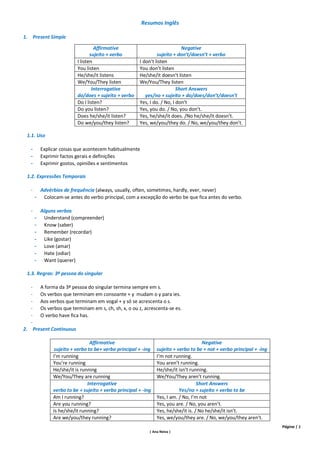
1. Present Simple

                                     Affirmative                             Negative
                                   sujeito + verbo               sujeito + don’t/doesn’t + verbo
                            I listen                    I don’t listen
                            You listen                  You don’t listen
                            He/she/it listens           He/she/it doesn’t listen
                            We/You/They listen          We/You/They listen
                                    Interrogative                          Short Answers
                            do/does + sujeito + verbo      yes/no + sujeito + do/does/don’t/doesn’t
                            Do I listen?                Yes, I do. / No, I don’t
                            Do you listen?              Yes, you do. / No, you don’t.
                            Does he/she/it listen?      Yes, he/she/it does. /No he/she/it doesn’t.
                            Do we/you/they listen?      Yes, we/you/they do. / No, we/you/they don’t.

 1.1. Uso

   -       Explicar coisas que acontecem habitualmente
   -       Exprimir factos gerais e definições
   -       Exprimir gostos, opiniões e sentimentos

 1.2. Expressões Temporais

   -       Advérbios de frequência (always, usually, often, sometimes, hardly, ever, never)
       -    Colocam-se antes do verbo principal, com a excepção do verbo be que fica antes do verbo.

   -       Alguns verbos
       -    Understand (compreender)
       -    Know (saber)
       -    Remember (recordar)
       -    Like (gostar)
       -    Love (amar)
       -    Hate (odiar)
       -    Want (querer)

 1.3. Regras: 3ª pessoa do singular

   -       A forma da 3ª pessoa do singular termina sempre em s.
   -       Os verbos que terminam em consoante + y mudam o y para ies.
   -       Aos verbos que terminam em vogal + y só se acrescenta o s.
   -       Os verbos que terminam em s, ch, sh, x, o ou z, acrescenta-se es.
   -       O verbo have fica has.
   -
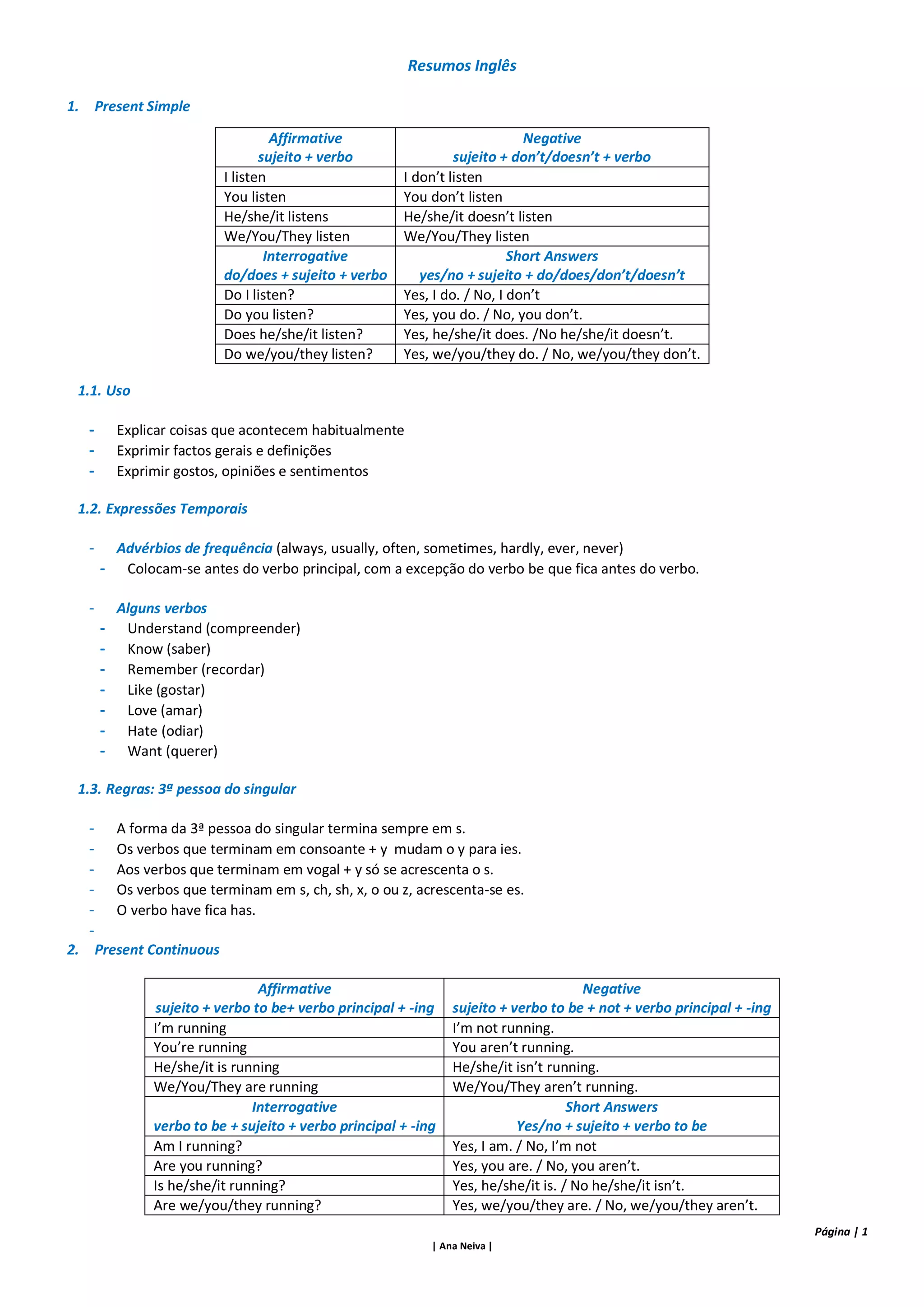
2. Present Continuous

                                 Affirmative                                           Negative
                sujeito + verbo to be+ verbo principal + -ing    sujeito + verbo to be + not + verbo principal + -ing
                I’m running                                      I’m not running.
                You’re running                                   You aren’t running.
                He/she/it is running                             He/she/it isn’t running.
                We/You/They are running                          We/You/They aren’t running.
                                Interrogative                                        Short Answers
                verbo to be + sujeito + verbo principal + -ing              Yes/no + sujeito + verbo to be
                Am I running?                                    Yes, I am. / No, I’m not
                Are you running?                                 Yes, you are. / No, you aren’t.
                Is he/she/it running?                            Yes, he/she/it is. / No he/she/it isn’t.
                Are we/you/they running?                         Yes, we/you/they are. / No, we/you/they aren’t.
                                                                                                                        Página | 1
                                                             | Ana Neiva |
Resumos Inglês

 2.1. Uso
   - Exprimir acções decorridas no momento

 2.2. Expressões temporais
   - Now (agora)
   - At the moment (neste momento)

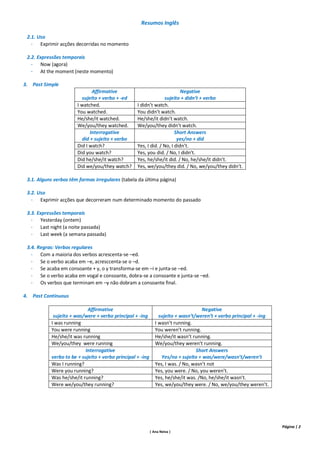
3. Past Simple
                               Affirmative                                 Negative
                          sujeito + verbo + -ed                   sujeito + didn’t + verbo
                        I watched.                  I didn’t watch.
                        You watched.                You didn’t watch.
                        He/she/it watched.          He/she/it didn’t watch.
                        We/you/they watched.        We/you/they didn’t watch.
                              Interrogative                             Short Answers
                          did + sujeito + verbo                          yes/no + did
                        Did I watch?                Yes, I did. / No, I didn’t.
                        Did you watch?              Yes, you did. / No, I didn’t.
                        Did he/she/it watch?        Yes, he/she/it did. / No, he/she/it didn’t.
                        Did we/you/they watch?      Yes, we/you/they did. / No, we/you/they didn’t.

 3.1. Alguns verbos têm formas irregulares (tabela da última página)

 3.2. Uso
   - Exprimir acções que decorreram num determinado momento do passado

 3.3. Expressões temporais
   - Yesterday (ontem)
   - Last night (a noite passada)
   - Last week (a semana passada)

 3.4. Regras: Verbos regulares
   - Com a maioria dos verbos acrescenta-se –ed.
   - Se o verbo acaba em –e, acresccenta-se o –d.
   - Se acaba em consoante + y, o y transforma-se em –i e junta-se –ed.
   - Se o verbo acaba em vogal e consoante, dobra-se a consoante e junta-se –ed.
   - Os verbos que terminam em –y não dobram a consoante final.

4. Past Continuous

                             Affirmative                                              Negative
             sujeito + was/were + verbo principal + -ing          sujeito + wasn’t/weren’t + verbo principal + -ing
            I was running                                       I wasn’t running.
            You were running                                    You weren’t running.
            He/she/it was running                               He/she/it wasn’t running.
            We/you/they were running                            We/you/they weren’t running.
                            Interrogative                                          Short Answers
            verbo to be + sujeito + verbo principal + -ing         Yes/no + sujeito + was/were/wasn’t/weren’t
            Was I running?                                      Yes, I was. / No, wasn’t not
            Were you running?                                   Yes, you were. / No, you weren’t.
            Was he/she/it running?                              Yes, he/she/it was. /No, he/she/it wasn’t.
            Were we/you/they running?                           Yes, we/you/they were. / No, we/you/they weren’t.


                                                                                                                      Página | 2
                                                             | Ana Neiva |
Resumos Inglês

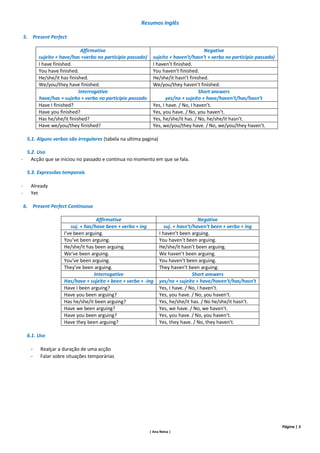
    5. Present Perfect

                               Affirmative                                               Negative
           sujeito + have/has +verbo no particípio passado)     sujeito + haven’t/hasn’t + verbo no particípio passado)
           I have finished.                                     I haven’t finished.
           You have finished.                                   You haven’t finished.
           He/she/it has finished.                              He/she/it hasn’t finished.
           We/you/they have finished.                           We/you/they haven’t finished.
                              Interrogative                                            Short answers
           have/has + sujeito + verbo no particípio passado            yes/no + sujeito + have/haven’t/has/hasn’t
           Have I finished?                                     Yes, I have. / No, I haven’t.
           Have you finished?                                   Yes, you have. / No, you haven’t.
           Has he/she/it finished?                              Yes, he/she/it has. / No, he/she/it hasn’t.
           Have we/you/they finished?                           Yes, we/you/they have. / No, we/you/they haven’t.

     5.1. Alguns verbos são irregulares (tabela na ultima pagina)

     5.2. Uso
-      Acção que se iniciou no passado e continua no momento em que se fala.

     5.3. Expressões temporais

-      Already
-      Yet

    6. Present Perfect Continuous

                                      Affirmative                                      Negative
                          suj. + has/have been + verbo + ing           suj. + hasn’t/haven’t been + verbo + ing
                      I’ve been arguing.                            I haven’t been arguing.
                      You’ve been arguing.                          You haven’t been arguing.
                      He/she/it has been arguing.                   He/she/it hasn’t been arguing.
                      We’ve been arguing.                           We haven’t been arguing.
                      You’ve been arguing.                          You haven’t been arguing.
                      They’ve been arguing.                         They haven’t been arguing.
                                     Interrogative                                   Short answers
                      Has/have + sujeito + been + verbo + -ing      yes/no + sujeito + have/haven’t/has/hasn’t
                      Have I been arguing?                          Yes, I have. / No, I haven’t.
                      Have you been arguing?                        Yes, you have. / No, you haven’t.
                      Has he/she/it been arguing?                   Yes, he/she/it has. / No he/she/it hasn’t.
                      Have we been arguing?                         Yes, we have. / No, we haven’t.
                      Have you been arguing?                        Yes, you have. / No, you haven’t.
                      Have they been arguing?                       Yes, they have. / No, they haven’t.

     6.1. Uso

       -   Realçar a duração de uma acção
       -   Falar sobre situações temporárias


                                                                                                                          Página | 3
                                                              | Ana Neiva |
Resumos Inglês

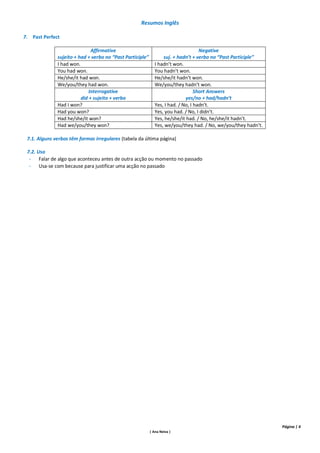
7. Past Perfect

                              Affirmative                                           Negative
              sujeito + had + verbo no “Past Participle”          suj. + hadn’t + verbo no “Past Participle”
              I had won.                                      I hadn’t won.
              You had won.                                    You hadn’t won.
              He/she/it had won.                              He/she/it hadn’t won.
              We/you/they had won.                            We/you/they hadn’t won.
                             Interrogative                                        Short Answers
                         did + sujeito + verbo                               yes/no + had/hadn’t
              Had I won?                                      Yes, I had. / No, I hadn’t.
              Had you won?                                    Yes, you had. / No, I didn’t.
              Had he/she/it won?                              Yes, he/she/it had. / No, he/she/it hadn’t.
              Had we/you/they won?                            Yes, we/you/they had. / No, we/you/they hadn’t.

 7.1. Alguns verbos têm formas irregulares (tabela da última página)

 7.2. Uso
  - Falar de algo que aconteceu antes de outra acção ou momento no passado
  - Usa-se com because para justificar uma acção no passado


                                                                                                                Página | 4
                                                           | Ana Neiva |
Resumos Inglês


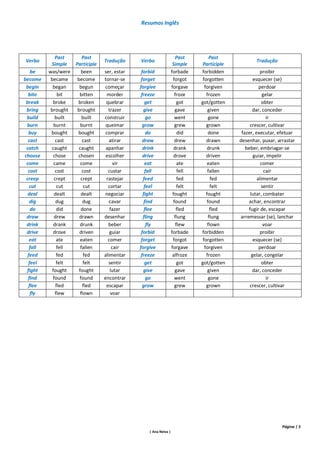
              Past      Past                                         Past         Past
Verbo                            Tradução     Verbo                                               Tradução
           Simple   Participle                                     Simple     Participle
    be    was/were     been      ser, estar    forbid             forbade    forbidden               proibir
become     became    become      tornar-se     forget              forgot     forgotten           esquecer (se)
 begin      began     begun      começar      forgive             forgave      forgiven              perdoar
  bite         bit    bitten       morder      freeze               froze       frozen                 gelar
 break       broke   broken       quebrar        get                  got    got/gotten                obter
 bring     brought   brought       trazer       give                gave         given           dar, conceder
 build        built     built    construir        go                went         gone                    ir
 burn        burnt     burnt      queimar       grow                grew        grown           crescer, cultivar
  buy      bought    bought       comprar         do                  did        done       fazer, executar, efetuar
  cast        cast      cast        atirar      draw                drew        drawn      desenhar, puxar, arrastar
 catch     caught     caught      apanhar       drink               drank       drunk         beber, embriagar-se
choose       chose   chosen       escolher      drive               drove       driven            guiar, impelir
 come        came      come           vir        eat                  ate        eaten                comer
  cost        cost      cost       custar        fall                 fell       fallen                 cair
 creep       crept     crept      rastejar      feed                  fed          fed              alimentar
   cut         cut       cut       cortar        feel                 felt         felt               sentir
  deal       dealt     dealt     negociar       fight              fought       fought          lutar, combater
   dig        dug       dug         cavar        find              found        found          achar, encontrar
   do          did     done         fazer        flee                fled         fled         fugir de, escapar
 draw        drew     drawn      desenhar       fling               flung        flung     arremessar (se), lanchar
 drink       drank     drunk       beber          fly                flew        flown                 voar
 drive       drove    driven        guiar      forbid             forbade    forbidden               proibir
   eat         ate     eaten       comer       forget              forgot     forgotten           esquecer (se)
   fall        fell    fallen        cair     forgive             forgave      forgiven              perdoar
  feed         fed       fed     alimentar     freeze              alfroze      frozen           gelar, congelar
  feel         felt      felt      sentir        get                  got    got/gotten                obter
 fight      fought    fought        lutar       give                gave         given           dar, conceder
  find      found     found      encontrar        go                went         gone                    ir
  flee        fled      fled      escapar       grow                grew        grown           crescer, cultivar
   fly        flew     flown        voar


                                                                                                              Página | 5
                                                  | Ana Neiva |

Resumos inglês (4º teste)

  • 1.
    Resumos Inglês 1. PresentSimple Affirmative Negative sujeito + verbo sujeito + don’t/doesn’t + verbo I listen I don’t listen You listen You don’t listen He/she/it listens He/she/it doesn’t listen We/You/They listen We/You/They listen Interrogative Short Answers do/does + sujeito + verbo yes/no + sujeito + do/does/don’t/doesn’t Do I listen? Yes, I do. / No, I don’t Do you listen? Yes, you do. / No, you don’t. Does he/she/it listen? Yes, he/she/it does. /No he/she/it doesn’t. Do we/you/they listen? Yes, we/you/they do. / No, we/you/they don’t. 1.1. Uso - Explicar coisas que acontecem habitualmente - Exprimir factos gerais e definições - Exprimir gostos, opiniões e sentimentos 1.2. Expressões Temporais - Advérbios de frequência (always, usually, often, sometimes, hardly, ever, never) - Colocam-se antes do verbo principal, com a excepção do verbo be que fica antes do verbo. - Alguns verbos - Understand (compreender) - Know (saber) - Remember (recordar) - Like (gostar) - Love (amar) - Hate (odiar) - Want (querer) 1.3. Regras: 3ª pessoa do singular - A forma da 3ª pessoa do singular termina sempre em s. - Os verbos que terminam em consoante + y mudam o y para ies. - Aos verbos que terminam em vogal + y só se acrescenta o s. - Os verbos que terminam em s, ch, sh, x, o ou z, acrescenta-se es. - O verbo have fica has. - 2. Present Continuous Affirmative Negative sujeito + verbo to be+ verbo principal + -ing sujeito + verbo to be + not + verbo principal + -ing I’m running I’m not running. You’re running You aren’t running. He/she/it is running He/she/it isn’t running. We/You/They are running We/You/They aren’t running. Interrogative Short Answers verbo to be + sujeito + verbo principal + -ing Yes/no + sujeito + verbo to be Am I running? Yes, I am. / No, I’m not Are you running? Yes, you are. / No, you aren’t. Is he/she/it running? Yes, he/she/it is. / No he/she/it isn’t. Are we/you/they running? Yes, we/you/they are. / No, we/you/they aren’t. Página | 1 | Ana Neiva |
  • 2.
    Resumos Inglês 2.1.Uso - Exprimir acções decorridas no momento 2.2. Expressões temporais - Now (agora) - At the moment (neste momento) 3. Past Simple Affirmative Negative sujeito + verbo + -ed sujeito + didn’t + verbo I watched. I didn’t watch. You watched. You didn’t watch. He/she/it watched. He/she/it didn’t watch. We/you/they watched. We/you/they didn’t watch. Interrogative Short Answers did + sujeito + verbo yes/no + did Did I watch? Yes, I did. / No, I didn’t. Did you watch? Yes, you did. / No, I didn’t. Did he/she/it watch? Yes, he/she/it did. / No, he/she/it didn’t. Did we/you/they watch? Yes, we/you/they did. / No, we/you/they didn’t. 3.1. Alguns verbos têm formas irregulares (tabela da última página) 3.2. Uso - Exprimir acções que decorreram num determinado momento do passado 3.3. Expressões temporais - Yesterday (ontem) - Last night (a noite passada) - Last week (a semana passada) 3.4. Regras: Verbos regulares - Com a maioria dos verbos acrescenta-se –ed. - Se o verbo acaba em –e, acresccenta-se o –d. - Se acaba em consoante + y, o y transforma-se em –i e junta-se –ed. - Se o verbo acaba em vogal e consoante, dobra-se a consoante e junta-se –ed. - Os verbos que terminam em –y não dobram a consoante final. 4. Past Continuous Affirmative Negative sujeito + was/were + verbo principal + -ing sujeito + wasn’t/weren’t + verbo principal + -ing I was running I wasn’t running. You were running You weren’t running. He/she/it was running He/she/it wasn’t running. We/you/they were running We/you/they weren’t running. Interrogative Short Answers verbo to be + sujeito + verbo principal + -ing Yes/no + sujeito + was/were/wasn’t/weren’t Was I running? Yes, I was. / No, wasn’t not Were you running? Yes, you were. / No, you weren’t. Was he/she/it running? Yes, he/she/it was. /No, he/she/it wasn’t. Were we/you/they running? Yes, we/you/they were. / No, we/you/they weren’t. Página | 2 | Ana Neiva |
  • 3.
    Resumos Inglês 5. Present Perfect Affirmative Negative sujeito + have/has +verbo no particípio passado) sujeito + haven’t/hasn’t + verbo no particípio passado) I have finished. I haven’t finished. You have finished. You haven’t finished. He/she/it has finished. He/she/it hasn’t finished. We/you/they have finished. We/you/they haven’t finished. Interrogative Short answers have/has + sujeito + verbo no particípio passado yes/no + sujeito + have/haven’t/has/hasn’t Have I finished? Yes, I have. / No, I haven’t. Have you finished? Yes, you have. / No, you haven’t. Has he/she/it finished? Yes, he/she/it has. / No, he/she/it hasn’t. Have we/you/they finished? Yes, we/you/they have. / No, we/you/they haven’t. 5.1. Alguns verbos são irregulares (tabela na ultima pagina) 5.2. Uso - Acção que se iniciou no passado e continua no momento em que se fala. 5.3. Expressões temporais - Already - Yet 6. Present Perfect Continuous Affirmative Negative suj. + has/have been + verbo + ing suj. + hasn’t/haven’t been + verbo + ing I’ve been arguing. I haven’t been arguing. You’ve been arguing. You haven’t been arguing. He/she/it has been arguing. He/she/it hasn’t been arguing. We’ve been arguing. We haven’t been arguing. You’ve been arguing. You haven’t been arguing. They’ve been arguing. They haven’t been arguing. Interrogative Short answers Has/have + sujeito + been + verbo + -ing yes/no + sujeito + have/haven’t/has/hasn’t Have I been arguing? Yes, I have. / No, I haven’t. Have you been arguing? Yes, you have. / No, you haven’t. Has he/she/it been arguing? Yes, he/she/it has. / No he/she/it hasn’t. Have we been arguing? Yes, we have. / No, we haven’t. Have you been arguing? Yes, you have. / No, you haven’t. Have they been arguing? Yes, they have. / No, they haven’t. 6.1. Uso - Realçar a duração de uma acção - Falar sobre situações temporárias Página | 3 | Ana Neiva |
  • 4.
    Resumos Inglês 7. PastPerfect Affirmative Negative sujeito + had + verbo no “Past Participle” suj. + hadn’t + verbo no “Past Participle” I had won. I hadn’t won. You had won. You hadn’t won. He/she/it had won. He/she/it hadn’t won. We/you/they had won. We/you/they hadn’t won. Interrogative Short Answers did + sujeito + verbo yes/no + had/hadn’t Had I won? Yes, I had. / No, I hadn’t. Had you won? Yes, you had. / No, I didn’t. Had he/she/it won? Yes, he/she/it had. / No, he/she/it hadn’t. Had we/you/they won? Yes, we/you/they had. / No, we/you/they hadn’t. 7.1. Alguns verbos têm formas irregulares (tabela da última página) 7.2. Uso - Falar de algo que aconteceu antes de outra acção ou momento no passado - Usa-se com because para justificar uma acção no passado Página | 4 | Ana Neiva |
  • 5.
    Resumos Inglês Past Past Past Past Verbo Tradução Verbo Tradução Simple Participle Simple Participle be was/were been ser, estar forbid forbade forbidden proibir become became become tornar-se forget forgot forgotten esquecer (se) begin began begun começar forgive forgave forgiven perdoar bite bit bitten morder freeze froze frozen gelar break broke broken quebrar get got got/gotten obter bring brought brought trazer give gave given dar, conceder build built built construir go went gone ir burn burnt burnt queimar grow grew grown crescer, cultivar buy bought bought comprar do did done fazer, executar, efetuar cast cast cast atirar draw drew drawn desenhar, puxar, arrastar catch caught caught apanhar drink drank drunk beber, embriagar-se choose chose chosen escolher drive drove driven guiar, impelir come came come vir eat ate eaten comer cost cost cost custar fall fell fallen cair creep crept crept rastejar feed fed fed alimentar cut cut cut cortar feel felt felt sentir deal dealt dealt negociar fight fought fought lutar, combater dig dug dug cavar find found found achar, encontrar do did done fazer flee fled fled fugir de, escapar draw drew drawn desenhar fling flung flung arremessar (se), lanchar drink drank drunk beber fly flew flown voar drive drove driven guiar forbid forbade forbidden proibir eat ate eaten comer forget forgot forgotten esquecer (se) fall fell fallen cair forgive forgave forgiven perdoar feed fed fed alimentar freeze alfroze frozen gelar, congelar feel felt felt sentir get got got/gotten obter fight fought fought lutar give gave given dar, conceder find found found encontrar go went gone ir flee fled fled escapar grow grew grown crescer, cultivar fly flew flown voar Página | 5 | Ana Neiva |