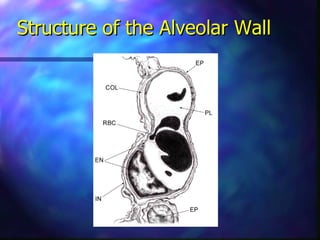
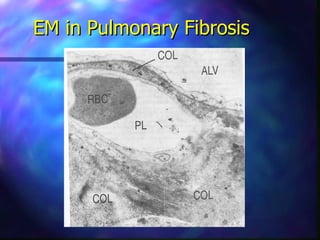
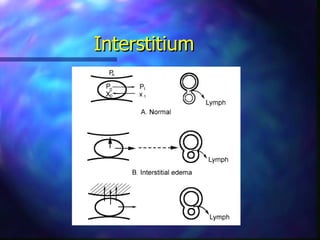
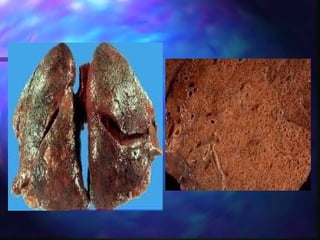
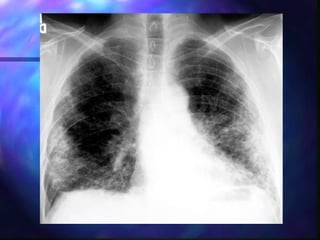
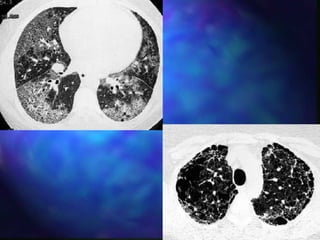
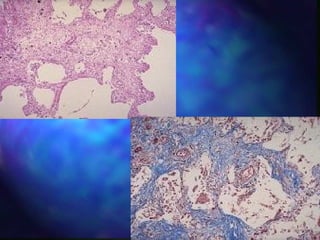
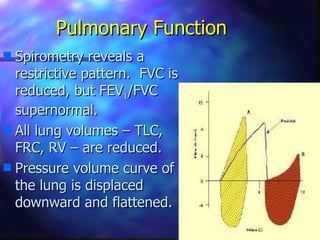
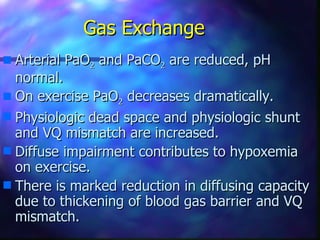
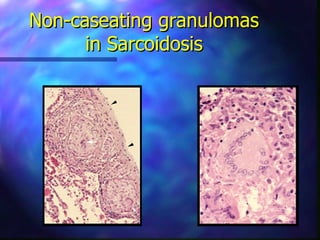
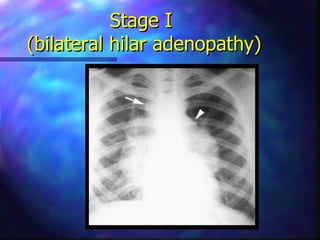
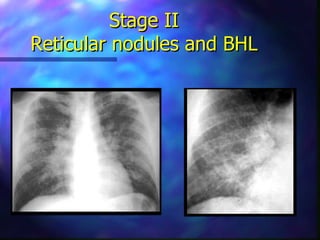
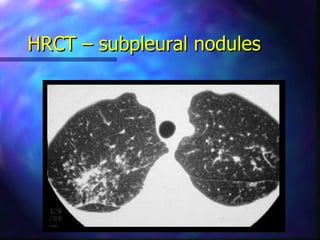
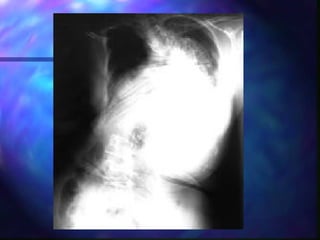
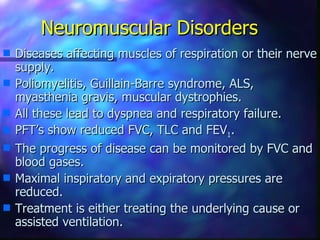
This document discusses restrictive lung disease, which is defined by reduced lung volumes. It can be caused by intrinsic lung diseases that affect the lung parenchyma through inflammation or scarring, or extrinsic disorders of the chest wall, pleura, or respiratory muscles. Common intrinsic lung diseases include idiopathic pulmonary fibrosis (IPF), sarcoidosis, hypersensitivity pneumonitis, and interstitial lung disease caused by drugs. Extrinsic disorders involve diseases of the pleura, chest wall, or neuromuscular system. Restrictive lung disease results in hypoxemia, reduced diffusion capacity, and impaired gas exchange. Evaluation involves pulmonary function tests and imaging, and treatment depends on the underlying cause.